



Abstract
This article investigates the development of squatting and house occupations in the Dutch city of Leiden during the 1970s to challenge stereotypical images of squatting and squatter protest in the Netherlands and beyond. Based on a historical analysis of 344 newspaper articles on squatting in the middle-sized city of Leiden from 1970 to 1980, this research not only shows the diversity of the squatter population and the ways in which the authorities responded to their actions—thus challenging the radical, confrontational, and metropolitan nature of squatting—but also analyzes how squatters were portrayed and how and why their image changed over time.
Introduction
Although the practice of squatting is currently near extinct in the Netherlands, the term continues to evoke lively images of punk youths who confront (riot) police in spectacular conflicts over occupied houses and buildings. In fact, this image has become a trope in Dutch popular culture and even European cultural memory.
The image of the militant squatter emerged in the 1980s, in the midst of a wave of intense confrontations between squatters and the authorities in various Western European cities, most notably Amsterdam, West Berlin, and Copenhagen. 1 The spectacular nature of these conflicts soon came to dominate the image of the squatters’ movement. Media reports spoke of civil war–like situations, causing journalists, politicians, and researchers to question whether the riots were indicative of a more fundamental societal crisis. 2
While the media were fascinated by the underground nature of the squatter subculture and the spectacular pictures that confrontations with the police produced, they were themselves an important factor in the making of the image of the militant squatter. The authorities responded to that image, mainly by asking questions that presupposed specific answers. For example, the West-German parliament initiated an investigation on the squatter riots, asking if West-German youths had given up on the principles of democracy and the rule of law.
3
The Dutch government initiated a similar research.
4
The squatters themselves were quick to pick up on the provisional explanations of journalists, politicians, and researchers, profiling themselves as outcasts, whose voices went unheard and who had to resort to violence as a last means to claim their rightful place in society. Thus, an Amsterdam squatter graffiti stated, They tell us / throwing stones does not make for a good argument / And hit us with clubs / bombard us with wrecking balls / poison us with chemicals / plague us with atoms / murder us with prison cells. They are right / stones are no arguments / stones are merely / hesitant attempts / to speak / in the only language / they understand. We have much more to say!
5
In fact, all actors had an interest in the image of the militant squatter: it offered the media opportunities to publish spectacular stories and images, it provided both liberal and conservative politicians with a means to criticize the government for being either too acquiescent or too repressive, and finally it offered radical squatters legitimacy and leverage, since they could both explain their actions and demand concessions.
Already in the early 1980s, claims that the squatter riots were indicative of a more general societal crisis were rebuffed by empirical studies, such as the Shell-survey on the views and sentiments of West-German youths.
6
In the Netherlands, it was criminologist Frank Bovenkerk who claimed that empirical proof was generally lacking in the claims made by Dutch journalists, politicians, and researchers. He and others criticized the supposed callousness with which researchers interpreted the squatter riots of the 1980s. Commenting on the Coronation Riots (April 30, 1980) that had spurred a governmental investigation, he claimed as follows: Experts interpret the events with a surprising boldness. . . . [They] continuously see them as proof of their own frustrations, world view, political claims or beloved theory, so that their studies teach us more about their views than about the riots of April 30.
7
Despite these criticisms, the narrative of a deep societal crisis remained very powerful and caused researchers to focus on the militant side of squatting.
Although the squatter riots were very real indeed, and often involved hundreds or even thousands of people, they still only mobilized a small minority of the squatters. A report on squatting in Amsterdam in 1981, for example, estimated that there were nine thousand squatters living in that city, 8 while its radical squatters’ movement mobilized “only” hundreds of people. Although most squatting resulted in compromises of “domesticity, lease, [or a] residence permit,” these cases have received relatively little attention from either media or researchers. 9
The sociologist Nazima Kadir has recently criticized the exclusionary nature of the stereotype of the anarchist squatter—“usually represented as a thin, white man in his late teens or early twenties”—noting that this image has not only informed media reports, but also the focus of many researchers and even the agendas of many activists themselves: “Thus, images from the 1980s—themselves made questionable by the focus on the actions of a tiny minority—swirl out of control, creating a funhouse mirror of ideologies, styles, and practices for activists nearly forty years later.” Kadir speaks of a myth of the militant squatter, which excludes the actions of “apolitical” squatters, migrant squatters, and women. According to her, “[t]he myth is dogmatic, exclusive, and so powerful that movement activists are regularly unable to go beyond the image and its limits.” 10
Kadir articulated her criticism of the stereotype—and the movement’s own relationship toward it—at a time when it had started to turn against the movement. In fact, the squatter ban in the Netherlands was passed in 2010 among stories of a “remilitarization” of the Amsterdam squatters’ movement. The supposed violent nature of the squatters’ movement thus became a central argument in favor of the ban. 11
Researching the phenomenon of squatting in Leiden creates possibilities to both question and move beyond this image. Our research does not focus on radical squatting, but instead maps the highly diverse nature of the multitude of people who took recourse to the act of squatting, thus challenging and broadening the definition of squatting. Furthermore, our research shows that authorities responded differently to the squatter actions of various groups, either supporting or repressing their efforts. Finally, we analyze how squatters were represented in local newspapers.
We have gathered our material by searching the Leidsch Dagblad for the period 1970 to 1980 for the keywords “kraken,” “krakers,” “gekraakt” (i.e., squatting, squatters, squatted). Of the three Leiden newspapers of the era, the secular and politically centrist Leidsch Dagblad had the highest print run and the largest local reporting staff. 12 Through keyword searches, we have compiled a database of 344 newspaper reports, referring to 87 squatter events in Leiden. 13 In specific cases, we have compared reporting by Leidsch Dagblad to reporting by one of the other two local newspapers. Our analysis of the newspaper reports focuses both on events and their framing, that is, their role in creating, reifying, and changing the image of squatters. Although we acknowledge that newspapers may offer biased and incomplete information, 14 we hold that they can still provide valuable information when used critically. 15 On the basis of newspaper reports, we have constructed a quantitative and spatial overview of Leiden squatting through an interactive map. 16
Using keyword searches in newspapers helps us avoid an anachronistic approach that focuses on radical squatting. Leidsch Dagblad reported on all squatter actions that it considered newsworthy. Our method has as an additional benefit that it allows us to reconstruct how the meaning of the word “squatting” changed over time. Although there were isolated instances of squatting in Leiden in the 1960s, the term only came into use in local newspapers from 1970 onward. Before 1970, the term “kraken”/“kraker” could (among other) refer to break-ins, country hit singles, ingenious chess moves, or harsh criticisms of theater plays. Squatters, however, adopted the term because it (also) referred to militant actions of resistance fighters during the occupation of the Netherlands by Nazi-Germany. Even after the term was introduced, its meaning remained fluid and did not only refer to the occupation of houses. Throughout the 1970s, the term squatting was appropriated by activists, but also used by newspapers to describe atypical acts such as occupying a square, mooring a boat without permission of the municipality, or putting alternative locations on a signpost. By including these atypical acts, we historicize and broaden our understanding of (what was seen as) squatting in the 1970s (Figure 1).
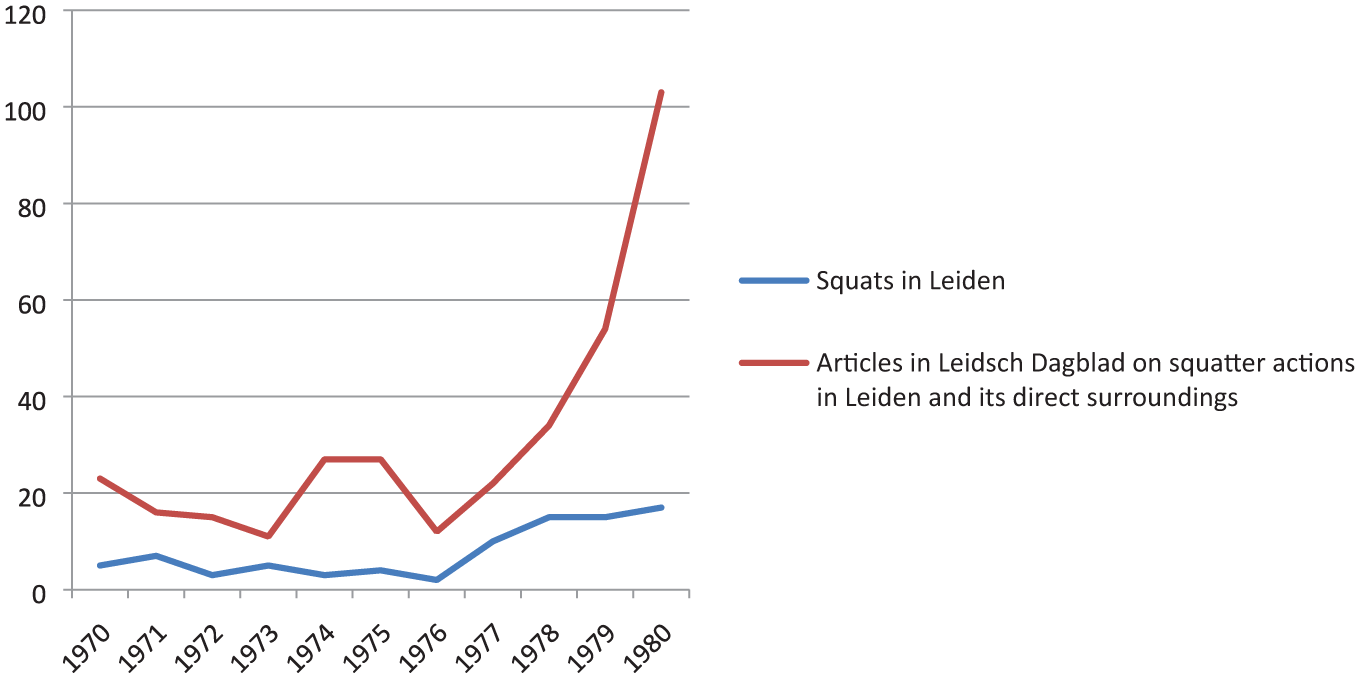
The number of squatter events in Leiden and the number of newspaper articles related to squatting in Leiden and its direct surroundings in Leidsch Dagblad, 1970-1980.
The main alternatives to newspaper sources would be municipal archives, interviews with (former) squatters, and movement publications. While not excluding these sources from the research altogether, the limits of these sources for our purposes seem obvious. The municipality only holds records of squatters that got into conflict with the authorities, thus providing information only on a specific part of the squatter population. An Oral History approach provides access to only those who self-identified (or still self-identify) as squatters and can thus be contacted or approached. As valuable as movement publications are, they again offer insight only into the world of those who actively participated in a self-proclaimed squatters’ movement. 17 The three aforementioned sources thus lead to preselection of actors, and do not offer a serial and broad overview that can be analyzed in a systematic way.
This contribution focuses on squatters in Leiden during the 1970s. During that decade, Leiden was an impoverished city of somewhat less than a hundred thousand inhabitants, about an hour away from Amsterdam. It had a severely run-down housing stock. In 1968, the municipality stated that a quarter of the twenty-nine thousand houses in Leiden were of inferior quality. The problems were worsened by deindustrialization, which set in during the early 1970s. A significant part of the Leiden population had previously worked as manual laborers in textile, steel, and canned food industry. Throughout the decade, unemployment rose, to a height of 15 percent in 1987. In 1970, 13.6 percent of the Leiden population was registered as in need of housing. In 1977, the waiting time for a rental house could run up to 4 years. 18
Squatting in small towns and middle-sized cities has up to recently received only little attention from researchers. Traditionally, (militant) squatting has been approached as a metropolitan phenomenon and has been researched as such. However, we have counted eighty-seven acts of squatting in Leiden between 1970 and 1980, and even more if we count squatter events just outside the city borders, so squatting was in no way a marginal phenomenon outside of major cities. Researching squatting in middle-sized cities and smaller towns thus helps to challenge and broaden our conception of squatting.
Our contribution is part of the currently growing interest for social movements in middle-sized cities and smaller towns. 19 It builds on the work of Haumann and Templin, who have researched various cases of squatting in West-German middle-sized cities and towns. Haumann, who researched squatting in Hilden (fifty-five thousand inhabitants), claims that—proportionally—squatting in West-Germany happened more frequently in smaller towns than in large cities. 20 Templin embedded his research in a larger debate on the resonance of 1960s protest movements beyond the metropolis, claiming that their larger context and effects are easily overlooked when these protests are only researched on a metropolitan level. 21 Research on squatting beyond the metropolis thus has the potential to significantly alter our perspective on the history of social movements.
Leiden newspapers offer a rich source of information on the diversity of the squatter population and the response of the authorities, as well as on their framing and the changing image of the squatters. In this contribution, we discuss two groups of squatters that were active in Leiden in the 1970s: working-class families and alternative youths. We have abstracted these two groups from historical cases, thus explicitly renouncing an anachronistic approach in which preexisting definitions of groups inform a search for their activities in historical reality. Our two groups seem to resemble the classic binary between the political and apolitical squatters, which was criticized by Rowan Milligan. 22 She argues that in fact all squatters are political agents, even if they do not self-define as such, because they challenge ownership rights and because their actions force confrontations with the state. However, we argue that it is relevant how squatters defined themselves, if one wishes to take them seriously as (political and/or) historical agents. Furthermore, our research has shown that historically, the binary has been highly influential in both the lives of squatters and the state’s responses to their actions.
Next to reconstructing the actions of (and the authorities’ responses to) the two aforementioned groups, we analyze how Leidsch Dagblad and the other two local newspapers reported on them. Finally, we analyze how the image of the Leiden squatters changed at the end of the 1970s, following intense squatter conflicts in Amsterdam. In this section, we also nuance the binary by bringing to the fore some atypical cases of squatting in relation to the responses to them by the local press.
Young Working-Class Families
In the early 1970s, a large part of the squatter population of Leiden consisted of young working-class families, often with small children. They squatted houses because they felt they had no other option, usually after having lived with parents or in-laws, and subsequently came in contact and/or conflict with the authorities. Often they described their own actions as “apolitical,” stating that they “just wanted a house.” 23 They did not self-identify as squatters and often distanced themselves from other groups of squatters, specifically students or working youths. 24 Perhaps because of this, young working-class families have barely been included in studies on squatting, even though they were the first and most successful squatters. 25
From various cases, we can abstract a model of how these squatting events tended to unfold. After occupying a house, the squatting families were mentioned or even interviewed in the local newspapers as people who were desperate for living space and did not see any other option than squatting. People also wrote letters to the newspapers, calling for help or attention. In about half of the cases, political activists offered support and know-how, thus increasing the chances of success. After positive local press coverage, the municipality in general decided to help the young families get a housing permit or an alternative address, even though official policy dictated that everyone had to respect the formal waiting list. 26 Even so, for squatting families to be successful, they needed to be stubborn, unrelenting, and in continuous contact with the press.
One example of a successful independent squatter action by a young family took place in 1970. A young working-class family squatted a house in 1970, after which the police soon arrived to evict them. When the father told the police that the family had nowhere to go, the latter offered them a police cell to spend the night (they were explicitly not arrested). In the following days, the father deliberately used the local media to pressure local institutions to provide him with a home, which eventually worked. Praising the local police, he stated as follows: “The police feel for us, every now and then they come by and chat with us—they even brought me a bottle of cider. I can stay up late and read.” 27
At other times, political activists supported or initiated squatter actions. In May 1970, the Comité Woningnood (Housing Crisis Committee, an activist group grown out of the Leiden student movement) squatted two houses on the Lange Mare street for two families. The committee members explicitly stated that their action was not only meant to acquire housing, but also formed a “political stunt” to address the “ridiculous housing situation” in Leiden. The two families themselves told the Leidsch Dagblad reporter that the squatter action was primarily aimed at “getting a house” for themselves and their young children. Both the police and the owner of the two houses refrained from undertaking action against the squatting families. They could both stay, at least temporarily. The action also led to a discussion in the city council about the housing situation in Leiden. 28
In another case, a similar committee was granted an important role. In March 1973, two families “occupied” the offices of the Bureau Huisvesting (Municipal Housing Agency, BHV) and stated that they would not leave before they had been granted larger living spaces. 29 Meanwhile, the children and representatives of the Bond van Huurders en Woningzoekenden (League of Tenants and Home Seekers, BHW) took to the street to hand out flyers stating they were fighting for a just cause: the families, consisting of seven and ten people respectively, lived in two- and three-room apartments. 30 Although public officials first stated that there were no available houses, they quickly found something when the families started to bring in stretchers and blankets, thus preparing to spend the night. Both families were offered alternative residences before the day was over. 31 However, when the family of ten came to the promised residence, it turned out to be just as small as their earlier apartment. The mother exclaimed as follows: “I will not move from a chicken run to a pigsty!” 32 The family then squatted a house with the help of the BHW, which distributed a pamphlet in the neighborhood stating that in principle they were against squatting, but in this case they saw no other option. 33 The press followed the actions of the family closely and eventually the municipality offered another residence, this time big enough, in the Agaatlaan.
This model—according to which squatting was followed by positive media attention and subsequent municipal sympathy and help—was not followed in every case. If media attention was less positive, squatters lost leverage. This happened, for example, to a young man who squatted a house for himself and his pregnant wife in the Joubertstraat in 1971. He was first mentioned in Leidsch Dagblad when he was evicted. Not being present on the scene, the journalist only spoke to the house owner, who stated that the squatter had never really lived there, but kept a table, a bed, and a chair in the house so that he could only be evicted after a court hearing, resulting in high costs for the owner. 34 The second time that the squatter was mentioned in the newspaper, it was in a court case report. It stated that the young man was sentenced to a fine and two weeks probation, because he had squatted five houses, next to driving a dangerously decrepit car without a drivers’ license or insurance. The squatter replied that he could not pay the fines and that eviction and imprisonment would mean that he had to leave his family living on the street. 35 Leidsch Dagblad depicted the man not so much as an individual worthy of sympathy, but rather as a petty criminal. Consequently, he did not receive much goodwill from the municipality. After being sentenced in court, the squatter disappeared from the newspapers, because he did not pursue his case any further.
In other cases, the model did not apply because the family did not undertake enough action. In March 1974, a family with young children was evicted from a squatted residence because the house had been assigned to another family. The squatters were depicted as sympathetic and their sad circumstances received much attention. The municipality offered them an alternative, but according to an acquaintance, who sent in a reader’s letter to the Leidsch Dagblad, this offer was worthless because the mother was handicapped and the residence was not situated on the ground floor. 36 The family decided to stay with their extended family instead and did not undertake any further action.
Families that stubbornly continued public action could achieve more. For example, an occupation of the town square with tents by the BHW in support of three squatter families faced with evictions was more successful: the municipality granted that they would review their cases one more time. 37 In 1981, a husband and wife chained themselves to the interior of the municipal construction agency, demanding their eviction be canceled. The municipality promised to offer them a house within three weeks. 38
In general, young working-class families could count on sympathy and even help from both local newspapers and the municipality when they actively fought for it. Even in cases where it was hard to feel sympathy for squatting families, the municipality often decided in their favor. In April 1974, an unemployed young florist squatted the house of a 79-year-old woman who had just passed away—in fact, the funeral had not even taken place. The florist received a great deal of attention from all three local newspapers. Especially the catholic and conservative Leidse Courant judged the events critically. The florist justified his action by stating that this was the only way to save his marriage: he could not cope with living in a three-room flat with his wife. The man further bluntly stated: “The passing away of one individual offers the other a way out of homelessness,” which in the original Dutch parodies a well-known, cynical rhyme. 39 The case got attention from readers, who called the young man a vulture and a liar. 40 An angry relative of the deceased woman wrote in a letter to the Leidse Courant that the squatter had provided false information to the newspaper. 41 As a result of the readers’ letters, another story about the squatter surfaced. Earlier, he had threatened and forcibly removed squatters from a residence that he had wanted to occupy himself. “He was able to scare off four, the resisting fifth was thrown into the canal,” a journalist of the Nieuwe Leidsche Courant reported. Even so, the director of the BHV took the florist’s side, even excusing his actions: “Living space is so important for people, that they take extreme measures.” 42 The municipality subsequently granted the florist and his family the right to stay in the residence because of their circumstances.
In the course of the 1970s, alternative youths started to squat as well. Even so, in 1980, a significant part of the squatter population still consisted of young working-class families. One success story is especially striking, because in this case, a young couple (21 and 18 years old) named Keyzer was granted the mayor’s former residence, after they had squatted at least three other houses. As in earlier cases, the young couple received a lot of attention in the newspapers and was given the opportunity to tell their story in great detail. They had tried to live with family, but lack of space had made their situation unbearable. In March 1980, the police had forcibly evicted the couple and the man’s brother from another house, which had resulted in a brawl. Asked by the press what he could do for the couple, the director of the BHV initially stated that they had to apply for a house like everybody else. Considering the waiting list, this meant that the couple would have had to wait at least three more years before they could acquire a rental house. But the couple persevered and in an ironic turn of events, the same police officers that they had initially fought with now offered them a sleeping place at the police station. Soon after, the housing agency offered them the former mayor’s residence as a house, probably through the help of a police officer. The Keyzers subsequently made the headlines: “The Keyzers [emperors] in the mayor’s residence!” 43
In cases of squatting involving young working-class families, the squatters could almost always count on the sympathy from Leiden’s main newspaper and a benevolent attitude from the authorities. The latter’s attitude was not fundamentally influenced by the composition of the city government. Before the elections of 1974, Leiden was governed by a conservative coalition, after which a social democrat–led coalition took over. The new coalition, with support from the central government, started to invest heavily in renovations and new constructions, 44 but their dealings with family squatters did not change significantly. They continued to find ad-hoc solutions for squatter families.
Despite favorable attitudes of local newspapers and authorities, it was imperative that squatting families undertook action, not only by squatting but also by stubbornly staying and actively seeking media attention. If they did not do so, they often ended up where they started. Other squatters often criticized the benevolent attitude of the authorities toward young families that squatted, stating that the authorities helped the “traditional families” while refraining from supporting single or communal squatters.
Alternative Youths, Local Entrepreneurs, and Political Activists
In the course of the 1970s, a new group of squatters emerged next to the working-class families. Students, working youths, and political activists joined the squatter population. They squatted for explicitly political reasons: they were not “merely” looking for a roof over their heads, but also made claims toward the municipality. They not only derided that Leiden lacked affordable housing, but also demanded spaces for living communally, for combining living and work and for art studios.
These young squatters generally did not receive much sympathy from the municipality, despite generally favorable reporting from Leidsch Dagblad. While the municipality was inclined to help working-class families, they generally thwarted the actions of young, unmarried squatters because they considered them troublemakers. Furthermore, they did not regard their housing problems urgent enough to elicit government action, since they believed that these youths could very well live with their parents or in normal single-family dwellings.
An analysis of all the squatter actions by the aforementioned groups in the 1970s shows that there were three different types of alternative youth squatters. There were youths who claimed spaces for communal living; others who set out to fight the soaring youth unemployment by establishing collective workspaces in squatted houses; and finally political activists who resorted to theatrical short-lived squatting actions to draw attention to the housing problems in Leiden and pressure the municipality to take action.
Students and working youths who wanted to live communally were the most common of the three groups. They were full of ideals and often not only wanted to live together, but also wanted to set up social and cultural initiatives for themselves and the neighborhood. The squatters of the monastery “De Goede Herder” in Zoeterwoude, a small town near Leiden, are a good example of this. They squatted the building in May 1974 with about fifteen people. Their plans were to ultimately provide housing for two hundred people and furthermore create room for artists, workspaces, conference rooms, and socializing. 45
As soon as the squatters were settled, they launched a charm offensive to win support for their cause, explicitly utilizing the media. First of all, they publicly offered to pay rent to the owner, showing their willingness to cooperate with the involved parties. 46 Furthermore, they organized an open house for locals, offering a tour through the premises, activities for children, a theater play, and even performances by multiple pop artists. Leidsch Dagblad contributed to this charm offensive by generating publicity for their cause. They published several feature articles and followed the squatters’ actions closely. 47
The municipality of Zoeterwoude did not take concrete steps against the squatters, but also did not facilitate them explicitly. Although the authorities did not approve of the squatters’ actions, they did not own the premise and the squatters enjoyed local support. Ultimately, the lack of government support nevertheless undermined the squat’s chances of success, because in the winter the building could not be heated, thus making the place uninhabitable. According to Leidsch Dagblad, the squatters’ ideals were thus literally “frozen.” 48 As a result, conflicts arose among the squatters as the core group lost its grip on the situation and could not prevent a rise of drug use, violence, and theft. By next spring, the core group had left and the place became a site for drug addicts and criminals until it burned down in October 1977. 49
Almost simultaneously with the squatting of the monastery, a farm was squatted in another nearby village. In contrast to the case concerning the monastery, the municipality did interfere in this situation: civil servants summoned the five student squatters to leave the building. There were, however, no judicial grounds upon which the squatters could be evicted, so they decided to stay. 50 The municipality was not pleased with the squatters’ stubbornness, but decided to reconnect the gas, light, and water out of “humanitarian considerations” a couple of days later. 51
Just like the monastery squatters, the farm squatters presented themselves as respectable, benevolent residents. They made provisional repairs to the obsolete building and offered to pay rent to the municipality. Again, Leidsch Dagblad contributed to their positive image by publishing extensive reports and by giving a voice to the squatters. For example, the newspaper reported that the local residents were happy with the arrival of the squatters, since they guarded the house against unwanted visitors and “furthermore they discovered that the squatters are simply nice, friendly and pleasant neighbors.” 52
The squatters were left in peace with the necessary commodities for more than half a year, after which the municipality summoned them to leave the building again. This time, however, the municipality had more leverage: they had assigned the farm to a homeless family. 53 The family was known as “Kattemie,” because they had taken in dozens of stray cats and dogs. The Leidsch Dagblad reported on the response of locals, emphasizing that the latter had been sympathetic toward the squatters, while being “fearful of getting a cats and dogs storehouse next door.” 54
The municipality thus played one group off against the other. Ironically, the farm had played no role in local politics before the squatters had taken refuge there. Only thereafter did the municipality start to see it as a location which they could use for the (re)location of outsider groups. The same thing happened in Leiden, when eight youths squatted a large complex on the Hooigracht street in September 1974.
At first, the municipality seemed sympathetic toward the squatters. 55 However, in the course of one week, the municipality declared that the building would be used to house thirty-five immigrant workers. 56 They subsequently offered the squatters alternative housing in the form of four flats just outside the city center. The squatters, however, declined, stating that these flats were not suited for their lifestyle: their aim was to form a living community and set up social and cultural activities in the city. 57 Alderman Verboom felt insulted by the squatters’ rejection of his proposal. He linked their attitude to their lifestyle: “I encountered a huge mess there. . . . I told the squatters: ‘You live in your own filth.’” 58 Leidsch Dagblad gave voice to the squatters’ point of view and even placed an advertisement for a house for the squatters next to the article, thus showing their sympathy. 59 The squatters were nevertheless evicted in July 1975. 60 Not even their sleep-in protest in front of the mayor’s house could change the city government’s opinion.
Seven years after the Hooigracht squat, an abandoned factory building was squatted by unemployed youths. Described as the largest squat in Leiden, its squatters claimed that they wanted to establish multiple small businesses in the building, such as an art studio, a handicraft center, a photo studio, and a music studio—as well as a shop where these manufactured products would be sold. 61 The municipality, however, had already made plans for the building prior to the squatters’ arrival. Ironically, they wanted to tear down the building to make room for a regional employment office. 62
After lengthy negotiations, the municipality offered the squatters the abandoned Harteveld complex, a former Jenever distillery that was subsequently renovated to accommodate small studios. In contrast to the Hooigracht case, this was a suitable alternative for the squatters, who gladly accepted the proposal. This is exemplary for the general attitude of the municipality toward squatting. Overall, they acted more sympathetic toward squatters who strove to establish workspaces, than to those who demanded spaces for communal living.
Finally, there was a group of squatters that used squatting exclusively to draw attention to housing problems in Leiden. Through short-lived theatrical actions, they tried to exert pressure on the municipality. A good example of this is the squatting of Breestraat 24, a monumental building located on the main street of Leiden. In December 1979, approximately fifty youths temporarily squatted the building, decorating the façade with banners stating as follows: “Youths want to live somewhere too” and “No postponement of building plans.” They even hung a doll from the building’s flagpole depicting one of the aldermen. The youths informed the police about the intention of the action, after which the latter decided not to intervene. After less than an hour, the youths left the building. Leidsch Dagblad reported extensively on the squatters’ action, and did so mainly from their perspective. The journalist precisely reproduced their demands, which focused on affordable houses for working youths and the extension of assisted-living projects. 63 Around this time, the Breestraat was a popular setting for squatters who wished to make a statement. In March 1979, women had occupied Breestraat 125 demanding a women’s social center. The municipality granted their demands. 64 But also on other locations, these kinds of actions took place. In 1973, working youths occupied the recently finished student flat Pelikaanhof in the city center, demanding more affordable housing for single working-class youths. 65
Contested Media Frames
Newspapers did not only report on working-class families and alternative youths who squatted but they also covered highly atypical squatters or atypical acts of squatting. In some of these cases, squatters purposefully sought media attention to further their goals. In other cases, however, the media took the initiative, thus framing squatter actions according to their own views. Throughout the 1970s, the media was fascinated by squatting, reporting extensively on it. Attention grew at the end of the decade, when squatter conflicts in Amsterdam escalated into large-scale riots. Even though escalation was avoided in Leiden, the image of the militant squatter became prominent. As it emerged, various actors started to “play” with it, adapting and appropriating it to their own needs. In this way, the image gained local characteristics.
An example of an “atypical” squatter who skillfully handled the media in her favor was a cat lady: an elderly woman who moved from place to place in search for space for herself and dozens of stray cats and dogs. She continuously used journalists to get attention for her improvised “animal shelter.” As a partly invalid woman, living off benefits and caring for up to sixty animals, she needed help in various forms. Throughout the 1960s and 1970s, she was able to call for financial, material, and even political help by telling her story to journalists of various newspapers and even convincing them to print her bank account number, so that sympathizers could donate money. After having moved from squat to squat, she finally managed to acquire a permanent residence in Leiden in 1981 through the help of local squatters. 66
In other cases, locals used the media to further their cause by calling their actions “squatter actions” to lend more urgency to their cause. For example, in 1972, children and their parents marched through the city, demanding a playground in their borough. At the end of the march, the group spontaneously “squatted” a plot of land, where the kids spent the day playing. 67 In the subsequent years, various neighborhood groups squatted plots of land in this way. In at least two cases, the city government gave in to the demands of the parents. 68 Other examples in which locals framed their actions as squatter actions to build up leverage include a car runner in the nearby village of Wassenaar, who squatted a plot of land in 1977. It was a way to pressure the local authorities after he had been unable to reach an agreement with them on the expansion of his business. 69 Again in 1983 a local businessman—who was disgruntled over the fact that new traffic rules led to increasing car traffic in front of his store—took to the act of squatting to push for local policy change. He “squatted” a traffic sign and added alternative locations to it, thus protesting the traffic policy and announcing “even firmer action” if his demands were not met. 70
It could, however, also work the other way. If squatters were not willing or able to set up an effective media strategy, the owners or journalists themselves would find a way to frame the squatters’ actions. Thus, when the house of an Indian-born worker was squatted in 1977, the Leidse Courant responded with a true media offensive, playing off the supposedly anti-immigrant squatters against a hard-working migrant house owner. The newspaper continuously depicted the house owner as “helpless” and “desperate,” emphasizing his immigration status and his sympathetic character. This narrative was beneficial to the house owner while undermining the squatters’ cause, who after some debate left the house. In the end, the Leidse Courant dedicated more than seventeen newspaper articles to the case and even supported a fund-raising action, which collected 3,760 guilders for the house owner. Their last article depicted the home owner with a fan of money bills, exclaiming in a text balloon: “Thank you, kind people!” 71
Newspapers thus played an active role in the formation of the squatter image. From the beginning, squatting proved to be a popular topic in the local press. Throughout the 1970s, journalists highlighted the spectacular nature of squatting. One Leidsch Dagblad journalist, who participated in a squatter action in 1977, described his experience as “similar to a thrilling adventure novel”: In no time, all their things were in the car and they were off. As quick as lightning they entered the house and remained there. The door was closed, as were the curtains, the lights were dimmed and they were done.
after, when the police arrived at the scene: “Panic! All doors are barricaded with desks. Will they come back or not? . . . ‘Squatters,’ the police call from the street. ‘We want a house!,’ they shout back. The police replies: ‘Your time will come,’ and then disappears.” 72
Another Leidsch Dagblad journalist described the experience of walking through the squatted Zoeterwoude monastery as almost mystical. He walked past “the memorial chapel—now a living room,” and then depicted “the way back to the door, that looks a lot friendlier from the inside. The muddy path, now completely shrouded in darkness. The fence. The lane. The Hoge Rijndijk street. The real world.” 73 Next to the mystifying frame, there was another frame that focused on the derelict state of squatted places. In this narrative, the building’s fallow state almost “spilled over” onto the “shabby” appearance of the squatters. Thus, a journalist described a squatted house in the Franchimontlaan as a place that was “bereft of any furniture” so that the squatters had to do with an “empty, bleached and corroded floor”: “Across the walls, there were some mattresses and airbeds, some books and squatter boys and girls who were passing the time.” 74
Around 1980, the image of the squatter changed dramatically. As the Amsterdam squatter conflict escalated in an unprecedented way, 75 fascination, excitement, and mysticism gave way to a fear for confrontation and violence. Amsterdam squatters confronted the police in extensive street fights in the first half of the 1980s. The riots during the coronation of Princess Beatrix (April 30, 1980) count among the heaviest riots of the postwar era. In Leiden, too, there was a surge of squatting activity, while confrontations between squatters and authorities increased. Especially on April 30, 1980, when Leiden squatters attempted to squat three different houses, they faced resistance from both police and hired thugs. 76 Even so, the situation in Leiden never escalated as much as in Amsterdam: the riot police was called in only one time in 1980, and even then did not have to undertake action.
In Leiden, both squatters and the authorities purposefully sought to avoid escalation. When Leiden squatters occupied the city council to protest upcoming evictions, for example, they came with a marching band rather than with smoke bombs, as squatters later did in Amsterdam. The city council, in turn, refrained from evicting the council hall by force, instead choosing to leave the room through an open window, while smiling at the newspaper camera. 77 When the city government debated new local police guidelines, squatters again protested by attending the meeting, intervening in the formal debate and circulating flyers. The authorities responded by making small alterations in the guidelines. 78 Furthermore, the police made a public statement that their policy was to protect squatters from hired thugs. 79
Despite these mutual efforts to avoid escalation, the images of the Amsterdam scenes highly affected the image of the Leiden squatters. Although squatting in Leiden only increased a little around 1980, news reports on squatting in Leiden and its surroundings increased exponentially. The media coverage, however, was not the only factor influencing the image of the squatters in Leiden. Politicians, high school students, musicians, and even businessmen played a role in mediating and moderating the image, often via newspapers.
In response to the increase of violent threats against Leiden squatters, the socialist council member Hilda Passchier used a one-time column in Leidsch Dagblad to call on the city government to guarantee the safety of squatters, so as to avoid “Amsterdam scenes.” 80 In doing so, she used the image of Amsterdam squatter riots as a way to invoke sympathy for the Leiden squatters, who according to her were not nearly as radical or militant. At the same time, she called on the Amsterdam image as a threat to the Leiden government: if they would not change their ways, the situation could still escalate.
A prominent means of adaption and appropriation of the squatter image in Leiden was parody and humor. The image of the Amsterdam squatter was used in a way that acknowledged that the Leiden situation was very different. Thus, in 1980, graduates “squatted” their high school as part of a traditional end of the year stunt. They decorated the school building with banners, stating among other: “We are squatting without violence or police interventions.” Despite the humorous intent, the stunt was not a success. According to Leidsch Dagblad, locals were not informed and “terrified after they read words such as ‘riot police,’ ‘violence’ and ‘squatting.’” Leidsch Dagblad reported that locals had feared for ‘Amsterdam-like scenes’ and complained to the school board.” 81
Artists, too, influenced the image of the Leiden squatter. In 1980, the Leiden folk band Rubberen Robbie composed the song “the riot policeman’s eyes looked at the squatter.” It was clearly sympathetic to the squatters’ cause, zooming in on a barricaded squat that was besieged by riot police. When the riot police stormed the building, “a magic fairy arrived at the scene. She magically made beautiful houses for everyone and solved the housing crisis. There was a big party that night and everybody lived happily ever after.” The song ended with the singer shouting: “Who would believe something like that!” 82 Interestingly, the song became a hit because it was broadcast on a local pirate TV-station. 83
Even local businessmen used the image of the militant squatter in a humorous way to stimulate business. Among them was carpet salesman Fer van Duuren, who advertised his goods and services in a full-page advertisement in Leidsch Dagblad. The advertisement’s background featured a picture collage of Amsterdam squatters and armored vehicles, taken from an Amsterdam squatter conflict of early 1980. 84 In front of the collage stood Fer van Duuren, with a rolled up carpet, stating as follows: “Well, these squatters have truly earned their carpet!” In an explanatory note, Fer praised his services, stating that he always took ample time to make sure the carpets were placed just right, “even in a squat that cracks under the blows of the riot police.” Van Duuren’s advertisement was part of a series of humorous full-page advertisements which featured among other queen Beatrix and Ronald Reagan. A background article in Leidsch Dagblad analyzed the strategy: “The philosophy behind the advertisements is simple. Everyone, from queen to squatter . . . can get a good carpet at Fer van Duuren.” The journalist quoted Van Duuren’s publicity agency, who stated: “Van Duuren is doing well, and so are we.” 85 The image of the militant squatter was thus adapted in Leiden into a more elusive one that could be used to further various causes, be they political, cultural, or even commercial. In this process of appropriation, local newspapers played a central role.
Conclusion
This article set out to show the diversity of the squatter population and the ways in which the authorities responded to their actions—thus challenging the radical, confrontational, and metropolitan nature of squatting. Two main groups of squatters were active in Leiden in the 1970s: working-class families and a broader group of alternative youths, who claimed spaces for communal living, political protest, and alternative work spaces. Next to these two main groups, a multitude of “atypical” squatter events further illustrate the diversity of the squatting population and the fluid nature of the term. By giving voice to either squatters or house owners, local newspapers played an important role in the outcome of the conflict. But newspapers did not only reproduce the views of others, they also commented on squatter actions themselves. In doing so, they often followed tropes, thus creating or reifying stereotypes.
This case study raises a number of questions for further research, the first of which is to what extent the presented findings were typical for Leiden in particular or middle-sized cities in general. Can a similar diversity among the squatter population be witnessed in smaller or larger cities? And how does the size of a locality affect the interaction between squatters and the media, and between squatters and the authorities? To answer these questions, a similar methodology as used for this article can be followed in other towns and cities.
A second question relates to squatting and (the potential for) violent escalation. In Leiden, both squatters and authorities attempted to avoid violent escalation, naming “Amsterdam” as an example that should not be followed. One could even speak of a case of “inverse transfer.” 86 But how did squatters and authorities in Amsterdam relate to violence and deal with violent escalation? And what did they consider “typically” for Amsterdam in this respect; escalation or negotiation? An empirical study may find very differentiated views toward squatting and violence among both metropolitan squatters and authorities.
Finally, mirroring information from newspaper reports to municipal and police archives—or interviews with journalists, authorities, and squatters—may deepen our understanding of the relationship between squatters, authorities, and the media. In a certain way, newspaper reports are mute sources; they only contain the information that the reporter typed up, but offer no transparency into how the report came to be, how it was read, or what effect it brought about. To assess these issues, it would be interesting to study newspaper reports in connection to other sources.
If either of these challenges is to be taken up, however, it is imperative to move beyond the image of the militant squatter and see the squatters for what they empirically were: a highly diverse population of actors with divergent social, political, and cultural identities.
Footnotes
Authors’ Note
All authors contributed equally to the work and are mentioned in alphabetical order.
Declaration of Conflicting Interests
The author(s) declared no potential conflicts of interest with respect to the research, authorship, and/or publication of this article.
Funding
The author(s) disclosed receipt of the following financial support for the research, authorship, and/or publication of this article: The research for this article was in part funded by Leiden University’s Faculty of Humanities Research Trainee Program.