



Abstract
Government labor unions frequently secure wage premiums for their members, leading many to assume that higher unionization increases aggregate payroll spending and, by extension, the overall cost of government. Because wages make up a large share of state expenditures, and accurate forecasting of these costs is essential, it is important to periodically reassess whether this assumption still holds. Using 5-year moving average estimates of state government employee unionization rates derived from the Merged Outgoing Rotation Group files in the Current Population Survey, this article re-examines the relationship between state government employee unionization and aggregate state wage spending among the 49 states with partisan legislatures from 1992 to 2018. Across all specifications, including models using cost-of-living–adjusted payroll spending, unionization rates are not significantly associated with higher state payroll expenditures or with changes in full-time or part-time staffing. The findings suggest that although unions continue to secure wage premiums for members at the bargaining unit-level, these gains do not translate into higher aggregate payroll spending. Tests of potential offsetting mechanisms, including inflation and wage–staffing substitution, produce null results, indicating that these channels do not explain the aggregate patterns observed. Instead, the findings point toward broader compensatory dynamics, such as sectoral dilution or shifts toward contracted service delivery, that allow states to absorb union wage gains without increasing total payroll costs.
Introduction
In recent years, organized labor in the public sector has achieved a number of significant policy goals and electoral victories. In 2020, under unified Democratic control of state government, the State of Virginia, which has long been noted for its explicit ban of governmental collective bargaining at the state and local levels, changed course and passed a law that allowed local governments the option to recognize and bargain with their unionized employees. During that same year, the United States elected President Joe Biden, who stated, “I intend to be the most pro-union President leading the most pro-union administration in American history.” (Biden, 2021). A year later, Gallup registered the highest approval rating of labor unions since 1965 (McCarthy, 2022). During the 2022 elections, voters in the State of Illinois enshrined a right to collectively bargain for all employees, public and private, in the state’s constitution. After Democrats took control of the state legislature and the governorship in Michigan in 2022, party leaders overturned the state’s 2013 right-to-work law (Whitmer, 2022). In 2023, President Biden became the first president in American history to visit striking workers on a picket line. Labor politics in the 2024 election cycle underscored growing heterogeneity within organized labor: rank-and-file Teamsters members favored Donald Trump by a nearly two-to-one margin, prompting the union to withhold a presidential endorsement for the first time since 1996 (Axelrod et al., 2024). Taken together, these high-visibility developments suggest a resurgence of labor’s political salience, a sharp contrast to the relative stagnation and retrenchment that characterized the prior three decades.
Public sector unions’ recent rise in public opinion and policy victories at state, local, and federal levels of government follows decades of “ossification” of American labor law (Estlund, 2002), leading Anzia and Moe (2015, p. 121) to conclude that “very few governments adopted collective bargaining for the first time after the 1980s.” Kearney (2010) reports that government unionization rates in government leveled off and then slightly declined post-1980. This was at least in part due to policies that curtailed the ability of government employees to bargain collectively. For example, in 2005, Indiana Governor Mitch Daniels issued an executive order that ended collective bargaining with public employees, and in 2011, Wisconsin Governor Scott Walker signed Wisconsin Act 10 that limited the scope and substance of collective bargaining for most state employees. Other states, such as West Virginia, enacted right-to-work laws in 2015 despite strong opposition from both public- and private-sector labor unions. These rollbacks of government employees’ collective bargaining rights also coincided with the lowest levels of union approval among the American public according to Gallup polling.
As public opinion, public sector labor policies, and union membership levels continue to shift, it is important to periodically revisit core assumptions about government labor unions and their implications for government and public personnel outcomes. To this end, this article is centered around two questions. First, does the unionization rate of state government employees increase the cost of government through higher aggregate payroll spending? Labor unions are dedicated to advancing the labor-related interests of their membership, and wages are a central component of these interests. As personnel costs consume a large portion of government expenditures, increased wage spending forces trade-offs with other policy priorities, especially at the state level, where balanced budget rules are nearly universal. Prior research suggests that unions are clearly successful in achieving wage premiums (e.g., Anzia & Moe, 2015) and that even non-union workers can benefit from the positive spillover effects of unionization (Rosenfeld & Denice, 2019). What remains unclear is whether these positive spillovers and wage premiums for unionized workers increase the cost of government or if these increased union wages are offset by policymakers who may lower personnel costs in other areas. For example, do unionized wage gains lead to alterations in the composition of a state’s labor force? This logic forms the basis for the second research question. Is the rate of state government employee labor union membership correlated with changes in the size or composition of state government workforces? These questions have direct relevance to discussions within public administration focused on the cost of government, government wage spending, and our understanding of government labor unions.
To examine these questions empirically, I use state government employee unionization data from 1992 to 2018 from the 49 states with partisan legislatures to estimate the association between changes in union membership and aggregate state wage spending. Second, the same estimates of union density are used to explore whether unionization is associated with changes in the size or composition of state government labor forces. Contrary to prior findings from the 1980s to 1990s (Chandler & Gely, 1995; R. Kearney & Morgan, 1980; Trejo, 1991), but consistent with more recent work on state education spending (Lovenheim & Willén, 2019; Paglayan, 2019), the analysis presented here suggests that state government unions do not increase state-level total wage spending or alter the composition of the state’s directly employed labor force. These findings do not mean that public sector unions are not able to achieve wage premiums. Indeed, considerable evidence sugsts that unionized government employees are paid more (Bahrami et al., 2009), and that unionized firefighters, teachers, and police make more than their non-union counterparts (Anzia & Moe, 2015; Crowley & Beaulier, 2018). The findings of the analysis here imply that such wage gains are absorbed or offset through compensatory dynamics. The most plausible, but untested, offsetting mechanisms are sectoral dilution and/or increased reliance on contracted service delivery.
A key difference between this study and earlier work from the 1980s to 1990s is the institutional and economic context in which public sector unions operate. Much of the prior research examined a period when public-sector union density was high, collective bargaining rights were expanding, and inflation was both higher and more volatile. Under those conditions, unions appear to have had greater ability to secure wage gains that translated into increases in aggregate payroll spending. In contrast, the period I analyzed (1992-2018) reflects a substantially more constrained environment for public unions. Union density steadily declined, state revenues grew unevenly, and several states enacted new limits on collective bargaining. In addition, Hirsch and Macpherson (2003) document a marked narrowing of the union–nonunion wage gap over this period, which diminished the potential for union wage premiums to increase aggregate payroll spending. Taken together, these changes help clarify why prior research found sizeable effects of state employee unionization on aggregate payroll spending, while the current analysis, situated in a markedly different political–economic period, finds none. Importantly, this study complements rather than contradicts previous agency-level findings: unions still secure wage premiums for members, but in the contemporary period those gains appear to be offset elsewhere in government, resulting in no detectable effect on aggregate payroll spending or state workforce composition.
This research makes two primary contributions to the public administration literature. First, it reviews and updates the literature on government labor unions. This research program has a rich history within public administration (e.g., R. C. Kearney, 2010, 2014; Mosher, 1968), but in the past decade, research on unions in the public sector, especially in the United States, has slowed considerably. This study examines wage spending at the aggregate rather than the agency level, enabling an assessment of unions’ fiscal effects across an entire state workforce. This perspective is important because localized wage gains may be offset elsewhere, a possibility that prior agency-specific research cannot capture. Second, longstanding public sector recruiting difficulties have been exacerbated by demographic changes, particularly the shrinking size of younger cohorts entering the workforce relative to the large number of retirements from the baby-boomer generation. In this context, understanding the factors that drive government wage spending is increasingly important for workforce planning and fiscal management.
The next section reviews both the foundational literature on public sector unions and more recent research on the changing union environment from the late 20th century through the first decades of the 21st century. This review is followed by a discussion of the relevant aspects of state government budgetary processes, the role of partisan politics in budgetary size and allocation, the prominence of personnel costs for state governments, and the role economic fluctuations play in budgetary allocations. Finally, I present the data, methodology, and findings on how state employee unionization rates relate to state spending on employee wages and the composition of the state workforce.
Modern Government Labor Unions
Because this study seeks to reassess how labor unions may influence the cost of government, it is important to first establish why a reassessment is needed. This section, reviews the origins of modern American public-sector unionism, the potential tensions between democratic governance and a unionized workforce, and the major studies linking unions to government personnel costs. The next section then describes the substantial erosion of public-sector bargaining rights and union membership since the turn of the century and explains how these institutional and demographic changes motivate a renewed examination of unions’ fiscal effects.
Mosher (1968) marks 1959 when Wisconsin granted local government employees the right to collectively bargain and 1962 when President Kennedy issued Executive Order 10,988 which guaranteed rights to union organizing, union recognition, and collective bargaining for some federal employees, as the starting points of the modern organized labor movement in the United States (see also R. C. Kearney, 2010, 2014). These policy changes ushered in a period of labor union membership growth in the public sector and the rapid adoption of policies that provided collective bargaining rights for various subsets of state government employees. This period of labor rights expansion in the public sector lasted through 1980. During this time of rapid labor policy diffusion, the size of some government labor unions, such as the American Federation of State, County, and Municipal Employees (AFSCME), more than tripled (Mosher, 1968). By 1980, 42 states had adopted collective bargaining coverage for at least one category of employee, and dozens of states adopted comprehensive bargaining rights for all employees (R. C. Kearney, 2010). During the 1970s and 1980s, research on government unions also was “in vogue” before it began to trail off in the 1990s (Anzia & Moe, 2015). This period of initial growth among state government labor unions produced a large number of studies examining the empirical impact of unions on the cost of government (i.e., their influence on average wages, benefit spending, employment levels, and other expenses; e.g., Ashenfelter, 1971; Chandler & Gely, 1995; Ichniowski, 1980; R. Kearney & Morgan, 1980; Trejo, 1991). Although these studies were methodologically limited compared to more recent examinations of government labor unions (see Anzia & Moe, 2015), cumulatively, they did show an increased cost of government due to increasing unionism.
The labor policy environment shifted in the 1980s. During the 1980s and 1990s, there was little change to state government labor union personnel policies. Following the beginning of the new millenium, however, organized public sector labor unions faced unprecedented challenges (R. C. Kearney, 2014). In Missouri, Kentucky, Ohio, and Wisconsin, executive or legislative actions at least temporarily reduced the bargaining powers of state employees significantly. Policymakers in Idaho, Michigan, and Tennessee also weakened the bargaining rights of public education employees. At the federal level, R. C. Kearney (2010) describes the George W. Bush administration as the most anti-union of all time: the President issued a number of executive orders that reversed the labor-friendly policies of the Clinton era and privatized or contracted out some previously unionized federal jobs. In addition to a decline in policies protecting government unions, public support of labor unions dropped to an all-time low. In 2009, Gallup reported that only 48% of Americans approved of labor unions, the lowest level recorded since the survey began in 1940. During this time, research on the influence of government unions also slowed. Figure 1, as well as the figure and table series in the Appendix (Supplemental Figures A–E and Supplemental Tables A–E), display state employee unionization trends from 1987 to 2018 and provide a visual summary of the unionization rates and cross-state heterogeneity this section discusses. Figure 1 and Appendices A to E show relatively stable state employee union membership rates until 2008 to 2012, when sharp declines took place in several states, including Wisconsin (see Supplemental Table E and Supplemental Figure E), with a slight rebound in unionization rates from 2016 to 2018 in most states.
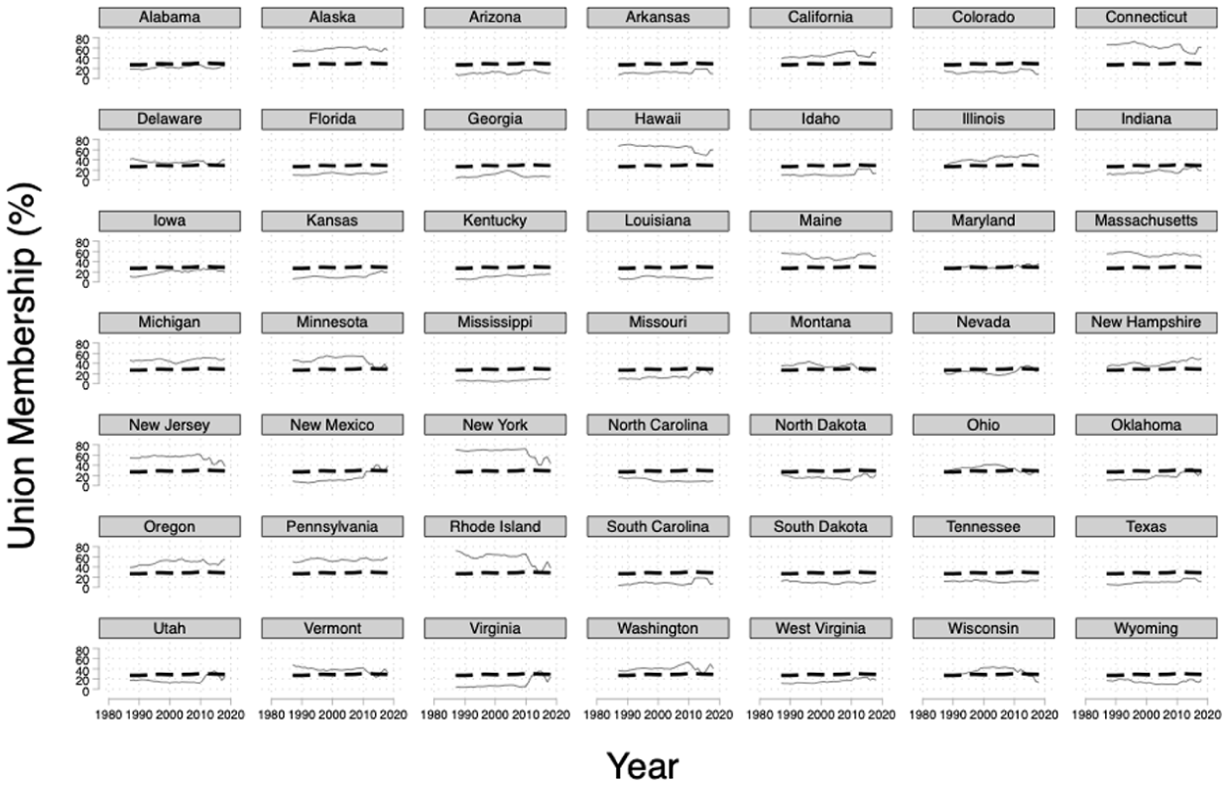
State government employee union membership rates, 1987 to 2018.
Although research on unions was limited during this period, advancements in statistical methodology enabled scholars to more effectively address potential endogeneity issues in organized labor studies (Anzia & Moe, 2015). Contemporary research maintains some focus on the relationship between government labor unions and wages (e.g., Anzia & Moe, 2015; Bahrami et al., 2009; Blanchflower & Bryson, 2004), employment levels (Crowley & Beaulier, 2018), benefit spending (Knepper, 2020), cost of government (e.g., DiSalvo & Kucik, 2018), and the determinants of union density (Fowles & Cowen, 2015; Rosenfeld & Denice, 2019). The study of government labor unions has broadened considerably, however, moving beyond questions of wages and employment to include unions’ effects on public service motivation (Davis, 2011), emotional labor (Davis et al., 2023), their role in non-bargaining states (Hodges & Warwick, 2011), privatization and outsourcing (Warner et al., 2021), and the behavior of government unions in international contexts (Madimutsa & Pretorius, 2017). A particularly important strand of recent scholarship examines the effects of public-sector collective bargaining rights using quasi-experimental methods.
Paglayan (2019) analyzes the introduction of collective bargaining and strike rights for teachers and finds little evidence that these policies increased teacher salaries, benefits, or reduced the student-teacher ratio. Paglayan attributes the null findings in part to the limited credibility of strike provisions in many states, an important reminder that legal authorization for bargaining does not always translate into bargaining power. Relatedly, Lovenheim and Willén (2019) use ACS microdata to estimate the impacts of public-sector bargaining laws on wages and employment across multiple occupations. They also find modest negative or null effects depending on the institutional and occupational context. Together, these studies suggest that legal bargaining rights alone may not generate large cost increases and that the wage effects of unions are highly dependent on institutional design, occupation, and political environment. These findings underscore the need for research, such as the present study, that evaluates the realized extent of unionization across the entire state workforce rather than focusing exclusively on discrete occupational groups or statutory rights to bargain.
More recent research on wages shows that public sector unions are able to achieve wage premiums (Bahrami et al., 2009), and that unionized firefighters and police make more than their non-union counterparts (Anzia & Moe, 2015). Yet, findings related to teachers’ unions suggest that wage growth is contingent on a friendly political administration; under these favorable circumstances, unionization also is associated with increases in the number of teachers employed (Crowley & Beaulier, 2018). These findings suggest that strong unions can increase wage spending and also may expand employment levels. Even so, they highlight the difficulty of drawing conclusions about unions’ effects on the overall cost of government, as most studies focus on one or two agencies rather than the entire state workforce. For this reason, the study here focuses on aggregate state-level wage spending rather than on unionized wage gains within a department or agency. Showing that unions increase wages for the state police or grow school staffing levels is important and can increase the personnel costs of that agency, but state governments are comprised of a number of agencies. Accordingly, I examine aggregate state-level wage spending rather than agency-specific wage gains. Although unions may raise wages for groups such as state police or teachers, and thereby increase costs within those agencies, state governments encompass many distinct units. Gains in one sector do not automatically produce increases in total state payroll spending or statewide staffing levels. Economic theory suggests that as payroll costs go up less labor will be purchased. Yet since public organizations are not inherently market-based structures, it is unclear whether governments will actually seek to control costs in this manner (Anzia & Moe, 2015).
Unions and State Government Spending on Employee Compensation
What mechanisms are available for unions to exert upward pressure on wages and increase hiring? Where collective bargaining is legally allowed, it is the most commonly cited tool labor unions use to put upward pressure on state employee wages and salaries (e.g., Galvin, 2016; R. Kearney & Morgan, 1980; Rosenfeld & Denice, 2019). This bargaining power allows union members to create a venue for negotiating wages, salaries, working conditions, and benefits with public sector executive managers or elected officials. If a labor union and public sector management cannot negotiate an agreement, then in some cases the union can take collective action designed to bring attention to the ongoing negotiations and put pressure on management to resolve the negotiations quickly to reduce political pressure. In other cases, state laws require employers and workers to submit to mandatory mediation and binding arbitration if negotiations run past a fixed period of time. In most states, state laws do not allow some or all state employees to strike; this is especially true for public safety employees and workers deemed essential (Fowles & Cowen, 2015). Where strikes are allowed, however, they may be more disruptive due to the essential nature of many public services (Bahrami et al., 2009).
State governments also confront other distinctive bargaining challenges (see, e.g., Bahrami et al., (2009) that private-sector employers do not face. First, a state government cannot quickly relocate or shift production in the event of a labor dispute (Lewin, 1987). Second, there is no profit motive for public sector employers, which some have theorized may make them less resistant to union demands (Kaufman & Hotchkiss, 2003). Third, the demand for government employees is relatively inelastic (Trejo, 1991). Fourth, political influence is the key mechanism that unions have to advance their interests. In states where union membership makes up a significant portion of the electorate, political parties, typically the Democratic Party, align themselves with the interests of the unions to secure union endorsements. Union members generally support union-endorsed candidates, which makes union voters an important voting bloc (Delaney et al., 1990). Unions can not only help supply voters, but they can also engage in political spending to support candidates of their choosing. Such characteristics of state government, along with the influence of labor union interest group activities and collective bargaining mechanisms, can create upward pressure on state spending for employee compensation.
Even in states without collective bargaining, unions still can influence wage-setting through political engagement and legal advocacy. State employees retain the constitutional right to associate, meaning they can join unions that lobby for higher compensation, improved protections, and stricter enforcement of employment laws. These unions also provide legal support in cases involving termination, discrimination, or wage theft (e.g., unpaid overtime), creating potential financial and political costs for states that fail to comply. As a result, higher unionization may lead governments to budget more for wages to minimize litigation risk and respond to organized political pressure. Taken together, such tools–lobbying, political mobilization, legal advocacy, and, where permitted, collective bargaining–give unions multiple avenues to exert upward pressure on wages, yielding the following testable prediction:
Unions, Partisan Control, and State Spending
Although unions may have the right to collective bargaining or engage in political action, they do not have unilateral control over working conditions, compensation, or labor laws. A union must work with negotiating partners or elected officials to achieve its policy goals or bargaining objectives. In collective bargaining, the union members are represented by a union agent, and the state is also represented by an authorized agent. These two agents then engage in discussions until an agreement that is acceptable to both sides is reached. In a bargaining scenario, having more state resources available to allocate to address union demands or concerns and a receptive bargaining partner has the potential to aid union bargaining efforts. Democratic control of government may provide both a more receptive bargaining partner and greater resource availability.
Partisan Control of Government and Public Expenditures
Democratic control of state government is generally associated with higher levels of public spending because Democrats tend to favor government action rather than viewing government as the problem (Alt & Lowry, 2000). When Democrats hold unified control, they are more likely to expand both total expenditures and shift the allocation of funds to public services compared to periods of unified Republican control or divided government (Beland & Oloomi, 2017; Hankins, 2015). These spending priorities also align with the political incentives of Democratic leaders, who benefit from the electoral support and campaign contributions of public sector unions. Greater fiscal capacity combined with a more union-friendly political environment may strengthen unions’ bargaining positions.
Unified Democratic control is relatively uncommon, however: rarely more than one-third of states in any given year are under unified Democratic control. Moreover, partisanship operates through both the executive and legislative branches. While Leigh (2008) finds that Democratic governors alone do not necessarily increase public employment or state employee salaries; governors cannot unilaterally shape fiscal policy. State legislatures play a central role, and prior research shows consistent partisan differences: Republican-controlled legislatures tend to spend less than divided governments, which in turn spend less than Democratic legislatures (Hankins, 2015). As Faricy (2011) notes, “the Democratic and Republican parties emphasize different core values, which in turn results in divergent partisan preferences for allocating economic resources to the public versus the private sector” (p. 76). Republicans are more likely to prioritize private-sector–oriented spending, whereas Democrats are more likely to invest in the public sector, including the state workforce. It is important to note that state-level unionization aggregates across diverse public sector occupations. Prior research indicates that political alignments among public sector unions vary markedly by occupation. Law enforcement unions, in the aggregate, split campaign contributions relatively evenly between Republican and Democratic candidates, while teachers’ unions are overwhelmingly aligned with Democrats, with approximately 90% of their state-level donations directed to Democratic candidates (DiSalvo, 2022; DiSalvo & Kucik, 2018). Because the present study relies on statewide union density rather than occupation-specific measures, the partisan interactions estimated here should be interpreted as capturing broad statewide political receptiveness to organized labor rather than the political behavior of particular unions. This occupational heterogeneity may also attenuate partisan effects in the models, which likely helps explain why the analysis finds little evidence that partisan control moderates the relationship between unionization and wage spending.
Democratic control of state government is also associated with support for legislation that protects and expands the rights of organized labor (Galvin, 2017; Nack et al., 2020). This occurs for three primary reasons. First, unions tend to make up an important part of the Democratic voting base and political apparatus in many states (Moe, 2011). Second, a majority of the political funds spent on campaigns and of the candidates endorsed by labor unions are in the Democratic Party, and unions serve as an important voting bloc, fundraiser, and mobilizer for the Party (Jansa & Hoyman, 2018). Third, Democrats generally support a more expansive role for government, which often translates into increased spending, either to bolster existing programs and personnel or to create new ones. This combination of political orientation, partisan alignment, and greater willingness to expand public spending suggests that unified Democratic control generally creates the most favorable bargaining environment for government unions. Yet, Democratic control of a single branch of state government is not enough to achieve these outcomes. Given the existing literature that suggests that Democratic governments tend to spend more on the public sector and allocate funds differently than divided governments or Republican governments, I propose the following hypothesis:
Non-Democratic partisan control of state government generally provides a more difficult bargaining and lobbying environment for unions. Under divided party control, bargaining laws are unlikely to change, at least in the near term, but divided governments tend to spend less than those under unified Democratic control, which leaves fewer available dollars for which to bargain (Hankins, 2015). Even so, this scenario is generally more preferable for labor unions than unified Republican control, as the Republican Party has long pursued an anti-union agenda (Cantin, 2012; Vachon & Wallace, 2018). Although state employee unions in some Republican states may still have the ability to collectively bargain, that right to bargain is most likely to be eliminated or reduced by a unified Republican state government. This was the case in Wisconsin, which had been a strong public-sector union state. After coming under unified Republican control, however, the state enacted right-to-work laws and policies that have reduced public sector bargaining power, which has decreased union membership (Crowley & Beaulier, 2018). Despite the obstacles public sector unions face in conservative states without collective bargaining rights, some scholars have suggested that public sector unions can still be effective worker advocates (Warwick & Hodges, 2012). When Democrats do not have control of government, unions may also choose to support existing street-level protests, movements, or advocacy coalitions as an alternative means of drawing attention to and ultimately achieving policy goals that advance the interests of their members (Galvin, 2016). Yet, these mechanisms of applying upward pressure to wages and growing government employment are not as strong as the prospects of bargaining and lobbying under unified Democratic control. It should also be noted that not all Republican states are anti-union. For example, Alaska and Missouri both allow for “comprehensive” collective bargaining with public sector employees and have higher union density than a state that frequently has been operated under unified Democratic control, like Virginia (R. C. Kearney, 2010). On the whole, strong evidence suggests that public-sector labor unions generally fare best under unified Democratic control (see Galvin, 2017).
Unions and Employment
If union wage premiums increase the cost-of-service provision and ultimately the cost of government through increased aggregate wage spending, then do policymakers seek to offset these additional personnel costs by reducing employment levels? While research on unionized government employees and wages mostly finds a positive relationship, empirical research on the relationship between unions and employment levels is less conclusive. Early work on unionization and government employment levels led to mixed findings, with research signaling either a positive relationship or no relationship (e.g., Chandler & Gely, 1995; Trejo, 1991). Later research suggests that under a union-friendly political administration, unionization can also increase the number of teachers employed (Crowley & Beaulier, 2018). Most recently, Warner et al. (2021) find that unions were not a barrier to the privatization of local government services. In fact, the findings by Warner et al. (2021) indicate that unionization was associated with more privatization. This suggests that when unions influence the composition of the government workforce, the effect may appear not in reduced public employment but in a shift toward greater reliance on contract workers. In other words, when payroll costs rise due to union wage premiums, governments may respond by outsourcing positions rather than reducing direct employment.
This pattern is consistent with Trejo’s (1991) argument that demand for government employees is relatively inelastic: governments cannot easily cut staff, even when labor costs increase. Taken together, these findings imply no strong overall relationship between unionization and public employment levels. They also suggest, however, that any positive association between unionization and staffing is most likely to emerge under unified Democratic control, when governments are more inclined to expand public services. Accordingly, I propose the following hypothesis:
Data and Statistical Methods
The data for this study come primarily from the Current Population Survey Merged Outgoing Rotation Group (CPS-ORG), the U.S. Census Bureau’s Annual Survey of Public Employment and Payroll (ASPEP), and Klarner’s (2013) dataset on state partisan control. The CPS-ORG provides between 7,903 and 9,719 annual observations of state government employees from 1992 to 2018, including union membership indicators. This source is widely used to estimate unionization rates (e.g., Bahrami et al., 2009; Hirsch & Macpherson, 2003; Rosenfeld & Denice, 2019). Aggregate state spending on employee compensation and the total number of state government employees come from ASPEP, which compiles information from state financial records and agency surveys. Klarner’s (2013) coding of unified Democratic control, unified Republican control, and divided government provides a standardized measure of partisan control through 2011. Klarner’s (2013) measures were extended through 2018 and cross-validated using data from the State Partisan Composition database from the National Conference of State Legislatures (NCSL).
Additional control covariates include state GDP per capita, population, median household income, poverty rates, rainy-day fund balances, and right-to-work laws. State GDP and population capture economic capacity and the scale of service demand, reflecting states’ ability to fund personnel costs (Kwak, 2013). Median income and poverty rates proxy labor-market conditions that influence governments’ competitiveness in hiring. Rainy-day fund balances indicate states’ fiscal stability and flexibility, key determinants of whether they expand or constrain payroll spending during economic fluctuations (Rubin & Willoughby, 2021; Wei & Denison, 2019). Including these variables helps ensure that estimated associations between unionization and payroll spending are not confounded by broader economic or institutional environments.
Wages
Although an established branch of scholarship explores the association between labor unions and employee benefits in the public sector (see Knepper, 2020), this study focuses only on state spending on salaries and wages. Why focus on wages? At the most fundamental level, pay is an important motivator for many public sector employees that helps satisfy higher and lower-order needs (Lawler, 1981). In addition, Kellough and Lu (1993) note that pay “provides the means to meet physiological, safety, and security requirements, and it may also serve as an indication of achievement and recognition in an organization” (p. 47). Lee and Whitford (2007, p. 647) also find that pay dissatisfaction is “a substantial cause of intention to leave” among government employees. Cumulatively, this literature demonstrates the fundamental importance of wages for public-sector employees.
Within the context of this study, government employee pay is also a highly visible and salient policy choice. In the public sector, public employee pay is often a matter of public record and has salience, whereas spending on pensions and benefits represents a potential “electoral blind spot” (DiSalvo & Kucik, 2018). As a result, marginal adjustments to state employee pensions or benefits are less likely to generate electoral pushback, but changes to aggregate payroll spending may not only affect the satisfaction of administrators but may also have electoral implications. As a result, wages represent a salient policy decision that deserves continued attention.
The primary dependent variable in this analysis is total monthly state wage spending per employee, supplemented by a log-transformed measure of total state payroll spending. Both measures are derived from the U.S. Census Bureau’s ASPEP and are expressed in real inflation-adjusted dollars. Per-employee spending standardizes payroll expenditures across states with different workforce sizes, ensuring that observed changes reflect wage dynamics rather than the scale of government employment. To verify that the results are not an artifact of this operationalization, a second dependent variable, the natural log of total state payroll spending, is used in Models 3 and 4 of Table 2 to address the right-skewed distribution of aggregate payroll data. For analyses in Table 3, the dependent variables are the total numbers of full-time equivalent (FTE) and part-time state employees, also sourced from the ASPEP and measured as integer counts. Descriptive statistics for all variables in the models are presented in Table 1.
Descriptive Statistics.
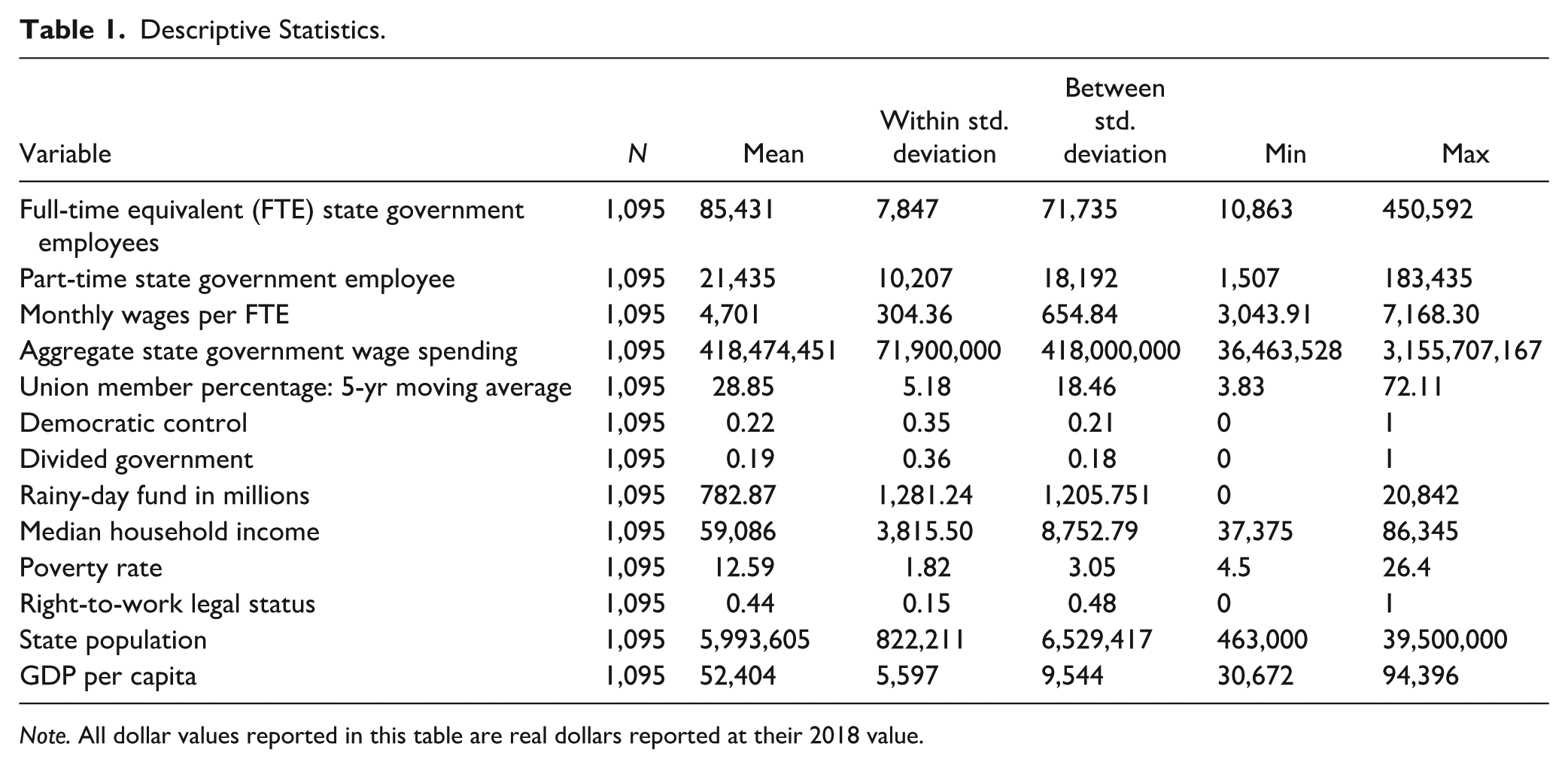
Note. All dollar values reported in this table are real dollars reported at their 2018 value.
Measuring Unionization
One reason state government employee unionization has been examined less frequently than agency-specific unionization is the difficulty of producing reliable, statewide unionization estimates. Most research focuses on a single bargaining unit, such as teachers, police, or firefighters, because membership data for individual unions are easier to obtain. In contrast, state governments employ workers across many occupational groups represented by multiple unions, and unions rarely publish comprehensive membership statistics. Surveying the entire state workforce is also prohibitively costly.
To address these limitations, this study relies on 5-year moving average unionization estimates constructed from the CPS Merged Outgoing Rotation Group files, following the approach Hirsch and Macpherson (2003) developed. The CPS identifies whether each respondent is a union member, covered by a union contract, or nonunion. For this analysis, unionization is operationalized as the share of state government employees who are union members (rather than union-covered), as membership more closely reflects the resources available for bargaining and lobbying.
Union membership is lagged 5 years to reflect the fact that collective bargaining agreements and related wage changes unfold gradually. Evidence from the Organization for Economic Cooperation and Development (OECD, 2017) and Jalette et al. (2020) indicates that most public-sector agreements last between 1 and 4 years; a 5-year lag allows time for both negotiation and initial implementation of wage adjustments. All other covariates are lagged 1 year to reflect their influence on the prior year’s budget deliberations. Alternative lags and moving-average windows were tested, and the results remain substantively unchanged. Models with alternative specifications appear in the appendix.
Partisan control is measured using a three-category dummy structure distinguishing unified Democratic control, divided government, and unified Republican control (the reference category). A state is coded as divided if control of the governorship and legislature is split, unless the legislature holds a veto-proof majority, in which case unified control is coded. Nebraska is excluded due to its formally nonpartisan legislature.
Statistical Methods
The effects of state government employee unionization on state spending on employee compensation are tapped using a two-way fixed effects regression model with robust standard errors that are cluster-adjusted by state. The panel dataset this study uses has 49 cross-sectional units, states, and 25 time periods from 1992 to 2018. Data for some key variables, including state government employment, were not available for 1996, so there are 25 instead of 26 years in the analytic sample. The average VIF for right-hand side variables was 2.34. Given the continuous nature of the dependent variable, the need to control for time-invariant factors, and the need to capture variation within the cross-sectional unit, U.S. states, a fixed effects model is used. A two-way, rather than a one-way, fixed effects model controls for serial correlation detected by a LaGrange Multiplier Serial Correlation Test. A modified Wald Test indicated the presence of groupwise heteroskedasticity, which led to the inclusion of robust standard errors clustered by state.
Although fluctuations in union density may reflect broader economic conditions that also influence wages and employment, several design features mitigate this endogeneity concern. State and year fixed effects absorb stable political–institutional characteristics and economic shocks, while controls for GDP per capita, poverty, population, and right-to-work laws account for observable economic and labor policy conditions. Union membership is also lagged 5 years to reduce contemporaneous reverse causality. These steps do not yield a causal estimate but provide a credible framework for assessing how changes in unionization are associated with aggregate payroll dynamics.
Findings
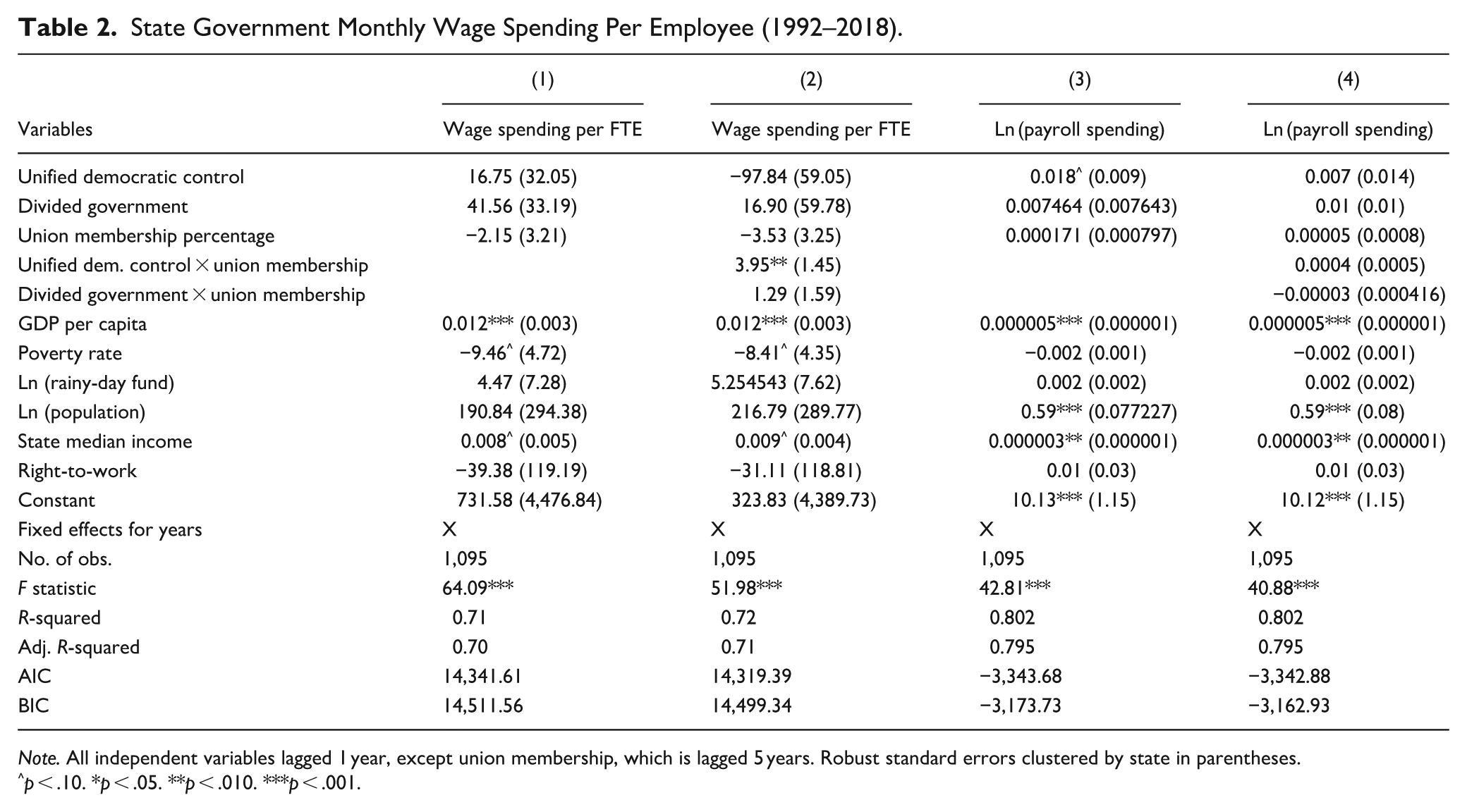
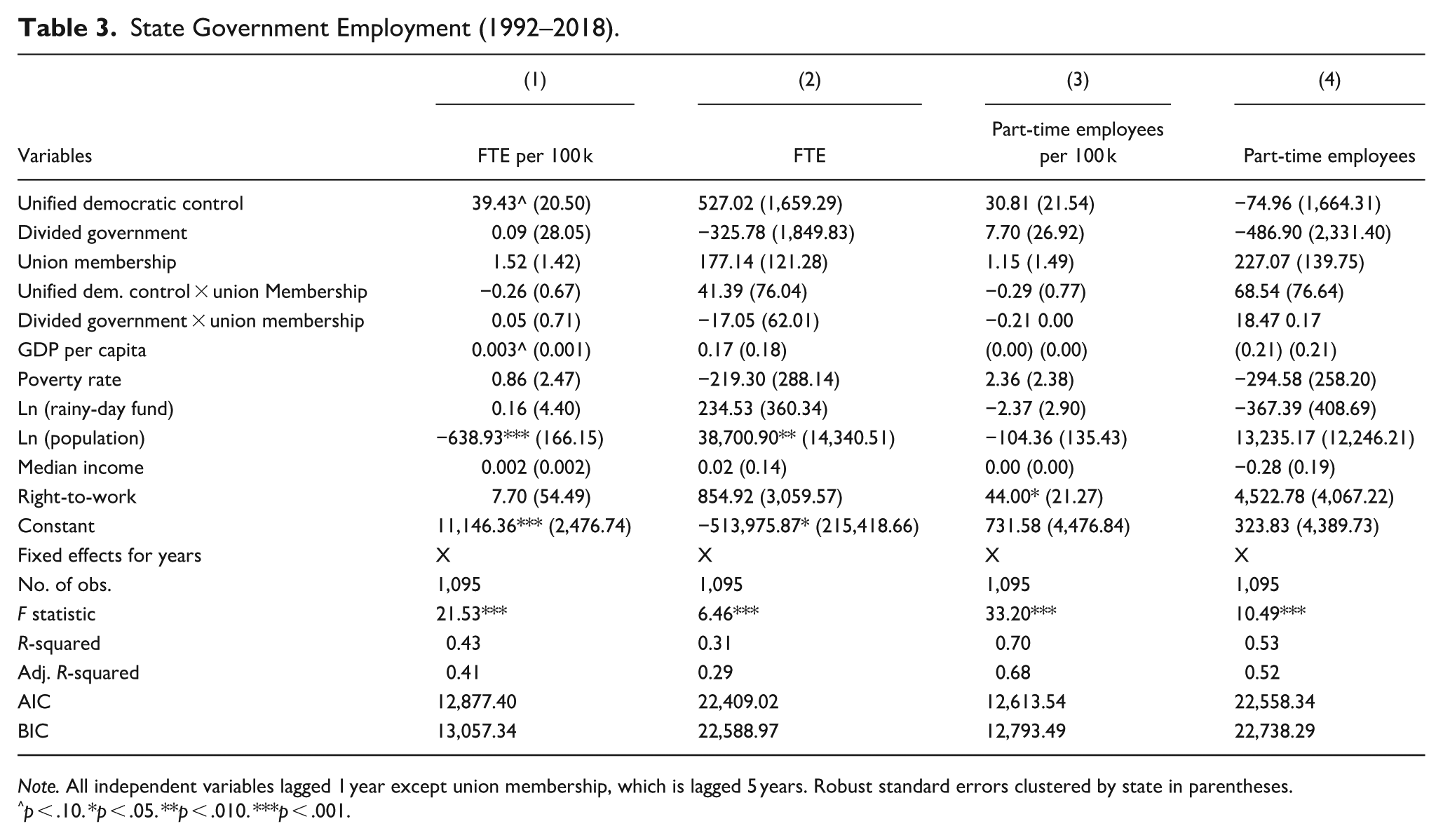
Does state government employee unionization affect total state spending on state government employee compensation? Tables 2 and 3 display the primary findings of the empirical analysis. Figure 2 illustrates how the relationship between state employee unionization rates and payroll spending varies under unified Democratic control compared to unified Republican control.
State Government Monthly Wage Spending Per Employee (1992–2018).
Note. All independent variables lagged 1 year, except union membership, which is lagged 5 years. Robust standard errors clustered by state in parentheses.
p < .10. *p < .05. **p < .010. ***p < .001.
State Government Employment (1992–2018).
Note. All independent variables lagged 1 year except union membership, which is lagged 5 years. Robust standard errors clustered by state in parentheses.
p < .10. *p < .05. **p < .010. ***p < .001.
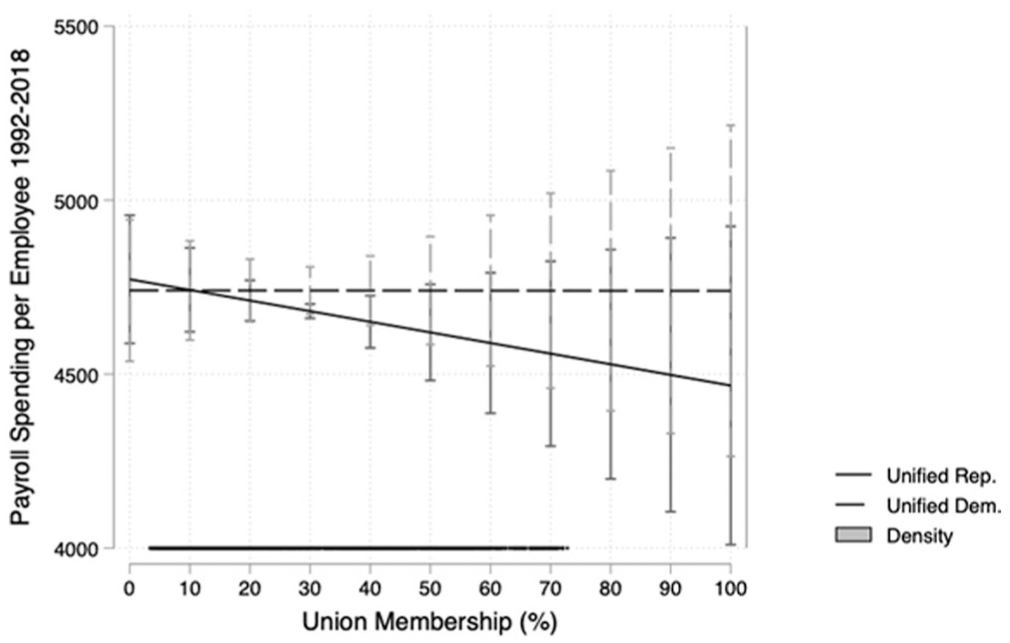
Margins plot of the effect of union membership contingent on partisan control.
The first hypothesis posited a positive association between state spending on employee wages and union membership. Yet, Models 1 and 3 in Table 2, which exclude partisan interaction terms, show no statistically significant relationship between unionization rates and aggregate wage spending. The second hypothesis anticipated that this relationship would be strongest under unified Democratic control. Models 2 and 4 test this conditional hypothesis. Although Model 2 produces a positive coefficient on the interaction between union membership and unified Democratic control, Model 4 again shows no significant association. Moreover, as Figure 2 illustrates, the confidence intervals for predicted payroll spending under unified Democratic and Republican control overlap across the full range of unionization rates. Consistent with this visual evidence, formal post-estimation tests using marginal effects indicate that the differences in predicted payroll spending across partisan regimes are not statistically significant at any level of union membership. Taken together, this means that for both
Although the main models report relatively wide confidence intervals around the union membership coefficient, this reflects substantive features of the data rather than instability in the estimation. Union density exhibits only gradual within-state movement over time, and the fixed-effects specification relies entirely on these modest year-to-year changes rather than on larger cross-state differences. In addition, aggregate payroll spending incorporates personnel costs across many state agencies, each of which follows distinct wage-setting and hiring patterns; this heterogeneity introduces noise that dilutes the precision of union-specific effects. To evaluate whether measurement choices contributed to this imprecision, I re-estimated all models using a cost-of-living–adjusted measure of payroll spending based on the U.S. Bureau of Economic Analysis (BEA) Regional Price Parities (RPP). These results, presented in Appendix Supplemental Table H, closely mirror those in the main models: union membership remains statistically unrelated to adjusted payroll levels, and the pattern of null findings is unchanged. Taken together, these results suggest that the wide intervals reflect the limited within-state variation available for identification, while the consistent null findings across both nominal and RPP-adjusted measures strengthen the conclusion that increases in unionization are not asssociated with higher aggregate state payroll spending during this period.
Among the control variables, state GDP per capita and median household income are statistically significant across all four models. Population is also significant in Models 3 and 4. As governments must compete for labor with the private sector, median household income is positively associated with state government wage spending. Population very likely creates more demand for service delivery, which increases the need for more government employees, which increases total payroll, but not per-employee wage spending. Finally, as economic activity (operationalized as GDP per capita) grows, there is more taxable income or property, which enables more government spending on employee wages.
Using per-employee wage spending assumes that state workforce size is not systematically shaped by the interaction between unionization and unified Democratic control. To assess whether unionization is correlated with state workforce composition, Models 1 and 3 in Table 3 use full-time equivalent (FTE) and part-time employees per 100,000 residents as dependent variables to adjust for scale. Models 2 and 4 instead use total employment counts. Across all specifications, there is no significant relationship between union membership and state employment levels. These findings align with Paglayan (2019), who likewise found no association between collective bargaining legalization and educational staffing. In Model 2, the positive coefficient on logged population appears large, but substantively it implies that a 1% population increase is associated with approximately 385 additional FTE employees. When expressed in terms of population, a decline of 100,000 residents would translate into a decrease of about 6.35 FTE employees per 100,000 people. The only other significant control is the indicator for right-to-work laws, which is associated with slightly higher part-time employment per 100,000 residents, though this relationship does not hold when examining total part-time employment.
Among the control variables, state GDP per capita and median household income are significant across all four models, and population is significant in Models 3 and 4. Median household income is positively associated with wage spending because state governments must compete with private-sector employers for labor, and higher private-sector wages place upward pressure on public-sector pay. Population likely increases the demand for public services, which in turn expands the number of government employees needed. This employment level growth raises total payroll spending but does not necessarily increase per-employee wages. Finally, higher GDP per capita indicates greater underlying economic activity and tax capacity, enabling states to devote more resources to employee compensation.
Discussion
Previous empirical research on unions and wages has consistently demonstrated the ability of government unions to secure higher wages for their members (Anzia & Moe, 2015; Bahrami et al., 2009; Blanchflower & Bryson, 2004). These localized wage gains and the positive spillover effects were thought to increase the cost of government as they pushed aggregate employee pay spending higher (Anzia & Moe, 2015). However, the findings presented here suggest that state payroll spending on wages is not significantly associated with state employee unionization rates. These findings are not without precedent. Lovenheim and Willén (2019) similarly report modest negative effects of public-sector bargaining laws on both wages and employment across multiple occupations. These findings suggest that although wages for firefighters, police, and teachers may be higher in heavily unionized settings, as documented in prior research, those elevated costs are offset elsewhere in ways that prevent increases in aggregate state payroll spending. At the same time, unions do not appear to meaningfully alter the composition of the formally employed state workforce.
A central puzzle raised by these findings is how unions can secure wage premiums for their members while aggregate state payroll spending remains unchanged. Prior research demonstrates clear wage gains at the agency level, yet the statewide models detect no increase in total wage expenditures. One potential explanation is inflation: if union wages rise faster than inflation while nonunion wages do not, then aggregate real payroll could remain flat even as union members experience wage growth. To evaluate this possibility, Appendix Supplemental Table F tests whether states with higher unionization exhibit larger gaps between nominal and real payroll spending, the pattern we would expect if inflation were eroding the real wages of nonunion employees. The results show no systematic association between unionization and the nominal–real payroll gap, indicating that inflation is unlikely to be the primary offsetting mechanism.
One possibility is wage–staffing substitution, in which states absorb higher wages by reducing hiring or leaving vacancies unfilled. Table 3 and Supplemental Table G test this mechanism directly by estimating whether unionization predicts changes in full-time equivalent (FTE) employment or part-time staffing. Across all model specifications, neither unionization alone nor interacted with partisan control is associated with increases or decreases in staffing levels. These results indicate that states are not offsetting union wage gains by shrinking or expanding their directly employed workforces.
Another, untested, possibility is sectoral dilution. Union membership in state government is not evenly distributed: it is disproportionately concentrated in a handful of agencies, most commonly education, corrections, law enforcement, and transportation. Wage gains achieved within these union-dense sectors can therefore be meaningful yet still exert limited influence on total payroll because these sectors constitute a relatively small fraction of the overall state workforce. When expenditures are aggregated across all agencies, the impact of union-driven wage increases may be diluted, producing the null effects observed in the statewide models.
Although the structure of the CPS-based unionization data limits the ability to estimate occupation- or agency-level unionization and wage effects with adequate statistical power, particularly at the state–year level, sectoral dilution remains a plausible offsetting mechanism. According to the Bureau of Labor Statistics (2025; U.S. Bureau of Labor Statistics, 2025), the two most union-dense occupational groups in the United States, and the only categories in which more than 30% of workers nationwide are union members, are protective services and education, training, and library services. The next most unionized occupational group, utilities workers, has a substantially lower unionization rate of just under 19%. These occupational clusters include police officers, correctional officers, and firefighters, as well as teachers, education administrators, and library staff. Despite their high union density, however, these occupations account for a limited share of total state government employment. Data from the U.S. Census Bureau’s 2024 Annual Survey of Public Employment and Payroll indicate that education and protective services together comprise only 41.87% of the state government workforce; including utilities raises this share only marginally, to 42.06%. Consequently, even sizeable wage gains within these union-dense sectors may be diluted when payroll spending is aggregated across all state government agencies.
Finally, contracted employment could be a potential offsetting mechanism. Prior research shows that when public-sector wages rise due to union bargaining or become politically difficult to reduce, governments often shift service delivery to privatization, outsourcing, or third-party providers to contain personnel costs (Warner et al., 2021). Contract workers do not appear in state payroll or employment statistics, so increased reliance on external labor markets would allow states to maintain higher wages for unionized employees without raising their own aggregate payroll or expanding their directly employed workforce. This dynamic is consistent with the pattern identified in this study: union members appear to receive wage premiums, yet total state payroll spending does not increase. This points to an important limitation of the analysis. Wage spending is measured only for directly employed state workers, excluding contracted or other nontraditional labor arrangements. Prior research suggests this omission may matter. Warner et al. (2021) find that higher unionization is not a barrier to privatization in local governments and is, in fact, associated with more contracting. Similarly, Dilger et al. (1997) show that cost savings are a primary motivator for shifting services to private providers. If state governments respond to rising wage pressures by expanding contracting rather than adjusting their formal workforce, those dynamics would fall outside the scope of the examined payroll measures. Future research should extend Warner et al.’s (2021) insights to state governments by incorporating measures of contracted service provision, contract worker wages, and non-wage compensation and benefits.
Although unionization dynamics clearly vary across public sector occupations, the CPS-based measures used in this study do not support reliable estimation of occupation-specific unionization rates. In many states, yearly CPS samples include only around 100 state-government workers distributed across dozens of agencies, which results in extremely small cell sizes when disaggregated by occupation. These data limitations substantially reduce statistical power and increase measurement error, preventing meaningful analysis of agency-level variation. For this reason, the models rely on statewide union density as the only consistently estimable indicator across states and years. Future research using administrative personnel data could more directly assess how occupational composition conditions the aggregate effects of unionization on wage spending.
Conclusion
Drawing on evidence that unionized employees earn higher wages than their nonunion counterparts (Bahrami et al., 2009), especially in traditionally union-dense occupations such as firefighting and policing, scholars have repeatedly argued that unions increase the cost of government (Anzia & Moe, 2015; DiSalvo & Kucik, 2018). While unionization may raise the cost of providing specific services, it is less clear whether these occupational wage premiums translate into higher aggregate government payroll spending. The findings in this manuscript suggest they do not: state employee unionization rates are not significantly associated with total state-level wage expenditures.
These findings carry important implications for public administration research and practice. First, they offer new evidence about the broader fiscal impact of government employee unionization, evidence that departs from early work during the expansionary era of public-sector unions, when scholars found sizeable increases in aggregate payroll spending due to increasing unionization (e.g., R. Kearney & Morgan, 1980). The results here suggest that contemporary unions may no longer exert the same systemwide fiscal influence, likely due to weakened legal authority, declining membership, and a changing political environment. These aggregate government-wide results align with agency-level studies that also find no relationship, and in some cases negative relationships, between public-sector unionization and resource allocation (Lovenheim & Willén, 2019; Paglayan, 2019). At the same time, as recent events signal a potential resurgence of public-sector labor activity, unions may reemerge as consequential actors in public personnel management. Continued shifts in state law, federal policy, and judicial decisions warrant ongoing reassessment of unions’ influence on government labor costs and administrative outcomes.
Second, the findings reflect a rarely examined unit of analysis, aggregate state-level payroll spending, and therefore require careful interpretation to avoid ecological fallacies. Although the results show no significant association between unionization and total wage spending per employee, this does not imply that unionization fails to raise individual workers’ wages. Rather, it indicates that during 1992 to 2018, higher union membership rates were not associated with higher aggregate payroll spending at the state level. This pattern is consistent with research showing wage premiums for union members but suggests that these additional labor costs may be offset elsewhere in state government, such as through increasing contract employment. It also does not rule out other forms of compensation, including benefits, as potential cost drivers that merit continued investigation (DiSalvo & Kucik, 2018).
Finally, as debates about public employee pay intensify, this study identifies several correlates of state wage spending beyond unionization. Right-to-work laws are associated with lower per-employee spending, while states with greater countercyclical fiscal capacity (rainy-day funds) and higher median household income tend to spend more. Taken together, these findings advance our understanding of how government labor unions relate to statewide personnel costs and highlight key economic and institutional factors shaping public-sector wage spending.
Supplemental Material
sj-docx-1-aas-10.1177_00953997251415556 – Supplemental material for The Unionization of State Government Employees and the Cost of State Government: Re-Evaluating an Evolving Relationship
Supplemental material, sj-docx-1-aas-10.1177_00953997251415556 for The Unionization of State Government Employees and the Cost of State Government: Re-Evaluating an Evolving Relationship by Colt Jensen in Administration & Society
Footnotes
Data Availability Statement
All data used in this study are publicly available from the U.S. Census Bureau’s Current Population Survey (CPS), the U.S. Bureau of Economic Analysis (BEA), and state-level administrative sources cited in the manuscript. Replication files and code are available from the author upon reasonable request.
Declaration of Conflicting Interests
The author declared no potential conflicts of interest with respect to the research, authorship, and/or publication of this article.
Funding
The author received no financial support for the research, authorship, and/or publication of this article.

Supplemental Material
Supplemental material for this article is available online.