



Abstract
This article examines the concept of epistemic governance during crises, a situation that presents simultaneous challenges of information scarcity and overload. Epistemic governance refers to the processes shaping collective perceptions and influencing the understanding of a situation. The research employs a complexity thinking approach, focusing on the interdependency of phenomena, actors, and events, which resists reductionism and linear thinking. It illustrates how epistemic governance—comprising self-organization, diversity, trust, feedback loops, attractor, and agency—operates in crises. The study advances a novel approach to epistemic governance in crises, promoting effective decision-making and embracing complexity-informed research.
Introduction
The concept of governance, in its inherent generality and neutrality, necessitates the inclusion of descriptive adjectives to effectively enhance its applicability for analytical scrutiny (Peters et al., 2022; see also Ansell & Torfing, 2022; Frederickson, 2007 for a critique of the overly vague use of the concept of governance). In recent decades, governance has attracted significant attention across various disciplines, with a growing body of literature examining its multiple dimensions and implications. Despite extensive research activity in the field, there remains no consensus on what governance actually entails. The lack of a comprehensive, all-encompassing theory of governance reflects the complexity and diversity of governance practices across different contexts (Ansell & Torfing, 2022). The research identifies, among other forms, network governance (e.g., Pierre & Peters, 2000) that emphasizes the interconnected nature of stakeholders; participatory governance (e.g., Grote & Gbikpi, 2002) that underscores the value of engaging citizens; experimentalist governance (e.g., Sabel & Zeitlin, 2012) that values trial and learning; collaborative governance (e.g., Emerson & Nabatchi, 2015) that celebrates collective endeavors and partnerships; anticipatory governance (e.g., Quay, 2010) that seeks foresight in its operations; and adaptive governance (e.g., Folke et al., 2005) that concerns flexibility and resilience in the face of change. A common feature of all the approaches is that they argue that effective governance requires coordination among local, regional, and national levels of government and across the public, private and non-profit sectors. Yet, although each aspect has solid theoretical foundations, none provides the comprehensive understanding necessary to drive effective governance during crises, especially in terms of how governance actors perceive unfolding events, the reasons behind them, and their potential consequences.
Each of these governance models has specific limitations, particularly regarding the production, dissemination, and utilization of information. First, network governance in crisis response shapes its functioning by creating coordination challenges for the actors involved, affecting how authority is distributed and negotiated (e.g., Moynihan, 2009). Its decentralized structure can create fragmented information streams and prompt a lack of agency. Different rhythms at various levels of governance (Janssen & van der Voort, 2016) make it difficult to acquire and synthesize information to enable rapid decision-making during a crisis. Second, the participatory governance approach has been applied in the fight against the climate crisis, emphasizing the inclusion of diverse voices in decision-making (e.g., Goell, 2018). However, the model’s underlying assumption of broad participation can be problematic in crises that demand the rapid formation of situational awareness and swift decision-making. The time required to gather and integrate a wide range of perspectives may delay critical action and undermine the effectiveness of crisis response. Third, experimentalist governance has been regarded as a valuable approach to address complex problems due to its iterative nature and emphasis on learning through experimentation (e.g., Zeitlin, 2016). This iterative foundation can become a limitation in rapidly unfolding crisis situations. The time required for trial-and-error processes may impede the ability to respond swiftly, delaying the implementation of immediate and decisive action when most needed. Fourth, while collaborative governance promotes collective decision-making, its tendency to favor consensus-based processes (Ansell & Gash, 2008) can slow information sharing and utilization, risking delayed responses. Fifth, anticipatory governance emphasizes preparedness for crises by proactively shaping legal frameworks to enhance governance actors’ capacity to act in exceptional situations (Koskimaa & Raunio, 2024). Its reliance on foresight can cause problems in the face of unforeseen events, making it difficult to produce and adapt new information, and potentially hindering responsiveness. Finally, adaptive governance aligns well with the dynamics of crises, as it emphasizes flexibility, learning, and the ability to adjust to changing circumstances (Janssen & van der Voort, 2020). Yet, its focus on learning and adaptation makes it better suited for understanding and developing governance after a crisis rather than during one.
This article assumes that the inherent uncertainty and complexity of crises can open the door for shaping narratives, selectively presenting information, or obscuring certain facts, all of which can distort the shared understanding of the crisis. I argue that tumultuous times require a more nuanced approach to governance, one that focuses on the epistemic challenges posed by a multitude of complex, interconnected, and persistent crises.
The article is founded on two premises. First, previous modes of governance fall short when addressing crises that reset requirements for how information is produced, interpreted, and utilized in decision-making processes. Although there is abundant research on the benefits and challenges of using knowledge and evidence in policy processes (e.g., Cairney, 2016; Head, 2016; Parkhurst, 2017), it does not adequately address the uncertainty arising during crises. That necessitates a specific approach to governance, that is, epistemic governance. The analysis here considers epistemic governance as more than simply governing based on established knowledge or existing paradigms but as an approach recognizing the limits of current understanding, continuously seeking new insights, and adjusting governance structures and processes accordingly. In so doing, the article draws on Ansell and Torfing (2022, p. 10), who suggest that “a problem-driven study of contemporary forms of governance is better off choosing between a large array of sharp and distinctive special-purpose theories than relying on a blunt, unified all-purpose theory.” In a world marked by uncertainty and ambiguity, a governance approach that acknowledges, interrogates, and integrates diverse forms of knowledge becomes indispensable. This reasoning aligns with the assumption that crises can spur transformative changes in governance structures (Torfing, 2023). Such crises can prompt a re-evaluation and restructuring of how systems function.
Second, previous studies define epistemic governance as a bundle of efforts to shape commonly shared or believed perceptions within a specific social context (Alasuutari & Qadir, 2014) and as practices through which the creation and dissemination of knowledge influence the comprehension of policy issues and the determination of priorities (Jacob & Hellström, 2018). While recognizing the validity of these approaches, this article suggests that the interactions between actors and events within the context of a crisis inherently contribute to increased complexity. Consequently, epistemic governance should not be approached from a reductionist perspective that seeks to simplify or isolate those interactions. For example, during the COVID-19 pandemic, the failure to adequately integrate horizontal and vertical coordination among different sectors, levels of government, and stakeholder groups increased the complexity of the crisis response (e.g., Kuhlmann & Franzke, 2021). For this reason, the article approaches epistemic governance from the perspective of complexity thinking, understood as a multidisciplinary and holistic approach that opposes simplifying causal relationships, reductionism, linear thinking, control of issues, and predictability (Cilliers, 1998; Eppel & Rhodes, 2018; Marks & Gerrits, 2013).
The study addresses the following research questions: Which key elements influence the dynamic interactions between actors and events in crisis situations, and how can complexity-informed epistemic governance unveil those elements? This article advocates an epistemic governance approach but does not seek to provide a rival theoretical construct. Instead, it suggests that epistemic governance could efficiently capture what is happening. A complexity-informed interpretation of epistemic governance enables governance systems to become more responsive and adaptive. Such an approach recognizes the inherent uncertainty and dynamic nature of governance environments during crises. I provide a thick description (Geertz, 1973) of the manner in which epistemic governance emerges during crises using qualitative data from three research projects. Epistemic governance centers on questions around what the crisis is about, who has the agency, and what constitutes a good response. Without minimizing the importance of institutional aspects or democratic level of governance, this article zooms in on the epistemic work, that is, the effort actors must invest in obtaining, verifying, applying, or changing the knowledge enabling them to carry out their activities (Alasuutari & Qadir, 2014; Cook & Brown, 1999).
The article’s contribution is twofold. Firstly, it introduces a novel approach to epistemic governance in the context of crises. This approach seeks to enhance the management of epistemic challenges during times of turmoil and uncertainty, thereby refining the application of evidence-based decision-making (e.g., French, 2019; Head, 2016; MacKillop & Downe, 2023; Parkhurst, 2017) and providing insight into the challenge of transforming cognition into action (e.g., Comfort et al., 2020; Comfort & Rhodes, 2022; Hutchins, 2000). The new perspective is intended to facilitate discussion around effective decision-making in crises. The second major contribution is promotion of complexity-informed research on governance. This approach emphasizes the importance of considering the intricate, interconnected nature of the systemic whole, recognizing that it cannot be easily dissected into individual components, as highlighted by Cilliers (1998), Byrne (1998), Mitleton-Kelly (2003), Teisman et al. (2009), Geyer and Rihani (2010), Rhodes et al. (2011), Morçöl (2012), Castellani and Gerrits (2024) and Jalonen (2024) and many others. The study demonstrates that epistemic governance is an inherently emergent phenomenon. Owing to its emergent and interactive nature, responsibility for epistemic governance cannot be assigned to any single actor. However, understanding the concept and its dynamic can be strengthened by analyzing its building blocks and their interactions. This article moves beyond merely working on complexity to working with complexity (see Byrne, 2001). The approach does not limit study to analyzing the intricate components, relationships, and dynamics of complexity; instead, I use a complexity lens to pursue interventions that acknowledge and engage with the dynamic nature of epistemic governance.
The managerial value of the article lies in its recognition that epistemic governance, which emerges through epistemic work, enhances managers’ capacity to influence perspectives and shape collective understanding of the prevailing reality during a crisis. A deconstruction of epistemic governance into its constituent components facilitates the development of effective strategies in response to crises.
This article offers a theoretical enhancement based on Vaughan (1992) to further our conceptual and empirical grasp of epistemic governance. Instead of focusing on a more “positivistic” approach to theory testing, this methodology emphasizes the exploration of a central subject (in this case, epistemic governance) within specific situations (like crises). Here, theory is understood as a mid-tier theoretical instrument rather than a connected set of propositions that can be tested to clarify a certain phenomenon. Elaboration pertains to the method of fine-tuning and updating both theoretical and empirical insights via qualitative data examination.
Theoretical Framework
Crisis as an Epistemic Challenge
It has been suggested that crises have increasingly assumed a transboundary character, challenging conventional crisis management and administrative processes (Ansell et al., 2010). The transboundary aspects of crises amplify the difficulties public authorities face when dealing with pressing threats. In such situations, the future becomes highly unpredictable, making it challenging for actors to gather the necessary information to make well-informed choices. I contend that actors face numerous epistemic challenges during a crisis, which can take various forms. First is a lack of relevant information. Access to accurate and timely information is limited in crises (Garnett & Kouzmin, 2007). Obtaining relevant data can be difficult, as many sources may be unavailable or unreliable. This information scarcity can hamper understanding the situation, leading to suboptimal decisions and exacerbating the crisis (Boin et al., 2017). Comfort (2022) writes of the gap between cognition and action and asserts that handling emergencies in real-time is a challenge for public-sector managers owing to a disconnect between recognizing potential risks and mitigating them. The inherent uncertainty of risks yet to arise makes it difficult to take proactive measures to mitigate their impact when they do eventually emerge. For example, Curnin and Owen (2014) address that challenge by emphasizing the pivotal role of boundary spanners, members of organizations dedicated to bridging inter-organizational divides. Second, crises also may lead to an abundance of information, making it difficult for actors to process and evaluate all available data. For example, Bawden and Robinson (2009) suggest that the volume of information available in a crisis exceeds the actors’ capacity to process it. The situation hinders focusing on key issues and leads to decision paralysis. Third, coordination between parties is essential during crises. Comfort (2007) defines coordination as the extent to which entities synchronize their resources, duties, and temporal commitments to attain a collective objective. Successful coordination largely depends on sharing information, such as situational awareness (Van de Walle et al., 2016). However, research indicates that doing so is challenging due to challenges of leadership, trust, and accountability (Ward & Wamsley, 2007). Fourth, crises often trigger the dissemination of false or misleading information (Hannah et al., 2023). Misinformation encompasses inaccuracies possibly spread unintentionally (Kuklinski et al., 2000), while disinformation involves deliberately spreading false information to deceive the public (Freelon & Wells, 2020). The rapid dissemination of such falsehoods can exacerbate confusion and impede effective responses (Vosoughi et al., 2018). Fifth, actors often draw on emotions, gut feelings, deeply held beliefs, habits, and what is familiar to them to make decisions quickly (Cairney, 2016). Research indicates that empathy, when serving as a foundation of cognitive processes, can foster a profound human connection with those who face similar risks, thereby spurring collaborative endeavors for the good of the entire community (Comfort et al., 2020). Nevertheless, although studies demonstrate that emotions serve as the foundation for cognition and that sound judgment and logical reasoning are notably reliant on emotional signals and intuition (Lerner et al., 2015; Sayegh et al.,2004), scholars generally agree emotions can introduce bias into decision-making processes. For instance, individuals in positive moods are more inclined to make optimistic assessments, while those in more negative moods tend toward pessimistic evaluations (e.g., Keltner & Lerner, 2010). Finally, crises can breed mistrust and distrust among actors. Mistrust manifests as “a cautious attitude towards others,” whereas distrust denotes “a suspicious or cynical attitude towards others” (Lenard, 2008, p. 313). During a crisis, an erosion of trust can hinder cooperation, fuel polarization, and undermine the credibility of accurate information (Jennings et al., 2021). The complexity, urgency, and lack of reliable information present challenges that necessitate a specific governance approach.
Epistemic Governance as a Concept
Epistemic governance refers to the management and regulation of a system or organization through understanding and addressing its underlying cognitive structures, epistemic bases, and knowledge paradigms. The approach emphasizes aligning governance practices with the foundational epistemic frameworks that shape and sustain the system. It has been used to ensure the effectiveness, sustainability, and quality of governance across various sectors (e.g., Campbell & Carayannis, 2013; Jacob & Hellström, 2018; Lund et al., 2022; Pearce & Raman, 2014; Vadrot, 2011). Epistemic governance has been deployed, for example, in the context of higher education. Campbell and Carayannis (2013) apply the concept to higher education and argue that this form of governance occurs when the governing process considers the foundational paradigmatic structures within the system being governed, such as those related to knowledge production. Kauppi (2018) illustrates the self-imposed nature of epistemic governance by showing that, even with limited evidence of mobility in ranking systems, higher education institution leaders continue to employ them as performance indicators. Pearce and Raman (2014) use the concept to propose that the processes involved in generating and selecting knowledge to develop policy require an additional layer of oversight—specifically, a form of governance dedicated to managing knowledge production for governance purposes.
This article draws on Alasuutari and Qadir’s (2014, 2019) perspective on epistemic governance, which is particularly applicable in crisis contexts because it emphasizes the recognised reality of the situation. Recognized reality describes the perspectives through which the definition of and influence on how a shared understanding of the prevailing reality is formed. Reality does not mean an accurate and real representation of the situation, but each actor’s perception of the situation and/or how conveyance of a reality image in the network of actors helps to promote the success of their perspective in decision-making (Alasuutari & Qadir, 2019, pp. 24–26). Norms and ideals are part of epistemic governance in which actors seek to convince others of the correctness of their viewpoint by appealing to widely accepted values, principles, and practices. In addition to universal principles, epistemic work utilizes legitimate needs and ideals. Yet, norms and ideals do not emerge and operate separately from the requirements of rationality and scientific knowledge. Rather, they spread very effectively when the value base can be justified by facts based on scientific knowledge (Alasuutari & Qadir, 2019, p. 27). Actors and identification encompass the actors’ understanding of themselves and the perception of their own and others’ roles in the issue. The process also involves identifying different groups as belonging to one’s own or another group. Stigmatizing groups as “other” in public discourse compared to one’s own group are typical examples of identification. At the same time, the definition of common agency and the group may be widely used in a positive way, promoting identification with goals generally considered worthy (Alasuutari & Qadir, 2019, p. 27).
The three aspects of epistemic governance are enacted through epistemic work (Alasuutari & Qadir, 2014). Alasuutari and Qadir (2014, p. 72) define epistemic work as “particular techniques used by actors engaged in affecting views and hegemonic definitions of the situation at hand.” Cook and Brown (1999, pp. 382–383) highlight two kinds of epistemic work: the epistemology of possession and that of practice. The epistemology of possession relates to with the idea of a static system, where knowledge is treated as a property that one can acquire and possess, implying a linear, deterministic understanding. In contrast, the epistemology of practice aligns more closely with complexity thinking. That perspective posits that human action does epistemic work, which suggests understanding knowledge as an emergent property of human activities within a system.
The Alasuutari and Qadir approach to epistemic governance is particularly relevant when viewed through a complexity thinking lens because it acknowledges the emergent and dynamic nature of knowledge in governance systems. Complexity thinking highlights the interconnectedness, nonlinearity, and unpredictability of systems (Jalonen, 2024). The process of epistemic work, where actors influence how a situation is understood, resonates with the complexity thinking view that knowledge is not simply possessed but enacted through practice and interaction. This article illustrates that examining epistemic governance from this perspective reveals how knowledge evolves in response to changing conditions, making it a robust framework for managing crises.
The Complexity Lens Approach to Crises
Complexity thinking has been described as a collection of concepts and heuristics focused on the interdependence of phenomena, actors, and events and the resulting emergent development (Geyer, 2012). Boulton et al. (2015, p. 29) situate complexity thinking between two contrasting views, one that treats the world as a mechanical system and the other that perceives it as chaotic, unpredictable, and lacking structure. Accordingly, external events or internal processes can interrupt an initial organized pattern, making our social world a product shaped by unforeseen circumstances, emergent trends, and possible path dependencies. The situation arises due to the reflexive nonlinear interactions between existing structures and occurrences, which contribute to both the system’s resilience and adaptability.
Governance systems can be perceived as complex for five distinct reasons. First, their functioning stems from interactions between parts that generate emergent developments, leading to unexpected solutions (Cairney, 2020; Marks & Gerrits, 2013). Second, these systems combine path dependency with unpredictability, as seen in punctuated equilibrium theory, which underscores institutional stability and sudden changes (Baumgartner et al., 2018; Bovaird, 2008; Geyer & Rihani, 2010). Third, actors within these systems co-evolve with their environments to shape them, but their influence remains limited (Bovaird, 2008; Teisman & Klijn, 2008). Fourth, such systems have fluid boundaries defined socially, where roles and inclusions in networks are negotiated (Eppel, 2017; Morçöl & Wachhaus, 2009). Lastly, systems exist in wicked environments among evolving phenomena that often challenge and contradict existing knowledge (Paananen et al., 2022; Sanderson, 2009).
The promise related to complexity thinking is that recognizing the interconnectedness of various components within a system unveils the multifaceted nature of crises, making it possible to develop more holistic solutions and better anticipate potential consequences. It enables us to examine these emergent properties and understand the mechanisms that drive them. The process can help reveal the underlying dynamics of crises and guide the design of effective policies. The operation of complex systems cannot be elucidated by breaking them down into individual components, as the interactions among those components give rise to developments that encompass elements absent from the individual parts. Owing to actors’ self-organization, the solutions achieved in practice often deviate to a greater or lesser extent from those anticipated (Marks & Gerrits, 2013). In crisis situations, conditions may change rapidly and unpredictably. Centralized guidance may not be able to respond as swiftly, whereas self-organized communities can adapt to their specific needs and challenges. For example, local communities possess unique knowledge of their context, including the resources, capacities, and risks involved (e.g., Gaillard et al., 2019). Crises encompass complex challenges across various sectors, highlighting the dynamic nature of systems and the fluidity of crises. By examining this dynamic, it is possible to develop a complexity-informed approach to epistemic governance.
Research Context and Methods
Finland consistently ranks highly in global evaluations of public governance (Pekkola et al., 2023; Pollitt & Bouckaert, 2017); however, challenges such as the intensifying climate crisis, an aging population, digital transformation, and global interconnectedness underscore the urgency of robust and lasting reforms. To navigate a volatile, uncertain, complex, and ambiguous environment, Finland’s executive emphasizes a holistic approach to crisis management, enhancing its effectiveness through improved coordination of military and civilian efforts. The country’s comprehensive security model involves collaboration among authorities (at national, regional, and local levels), businesses, NGOs, and the general public. Vital societal functions are leadership, international activities, defence capability, internal security, economy, infrastructure and security of supply, functional capacity of the population and services, and psychological resilience. The guiding document for the comprehensive Security Strategy for Society was last updated in 2017. This strategy, along with the Government Resolution on Comprehensive Security and other policy documents, directs the Security Committee’s efforts. Legal frameworks define responsibilities and tasks underpinning societal preparedness. The Committee monitors the Strategy’s relevance and updates it as needed to ensure consistency across different government departments. The general strategy is implemented through specific strategies and programmes, such as the Internal Security Strategy and the Finnish Cyber Security Strategy. Achieving the government’s security objectives enhances Finland’s security and welfare, especially given unpredictable international challenges. Analyzing the environment is crucial for allocating resources for preparedness and security (The Security Committee, 2023).
This study employs a combination of interviews, workshop discussions and a Delphi expert panel as its primary data collection methods. The data were gathered from February 2022 to February 2023 as part of three ongoing research projects conducted in Finland. The research projects address the challenges of governance in times of crisis. Project A focuses on the systems of governance and regulation, citizens’ participation, and the protection of the knowledge society by understanding information resilience as a critical element of national preparedness in a complex environment. Project B develops sustainable solutions to safeguard welfare in potential health crises based on lessons from the management of COVID-19. Project C analyses official communications in the context of emergencies and disasters. In these three projects, some of the crises addressed were national, such as COVID-19, while others were regional, like forest fires. Additionally, there were distinctly local crises, manifesting as acts of violence that shook local communities deeply.
A total of 171 informants from various fields were involved in the research projects. The data collection process involved interviewing 39 experts at various levels of governance, including 16 from the national government, 11 from regional government, and eight from local government. Furthermore, four informants representing the private sector were interviewed. The thematic interviews were organized via video calls. They lasted from 45 to 80 minutes and were audiotaped. The Delphi expert panel process comprised two rounds. A total of 64 experts participated, with diverse representation from different sectors. Twenty-nine came from public-sector agencies and represented various levels; 15 were from the science community, 11 were from the private sector, and 9 were from third-sector organizations. The panel element used the digital eDelphi platform specifically designed for the qualitative use of the Delphi method. It emphasizes the personal engagement and discussion of experts so that the Delphi process not only collects existing information but also generates new information. Moreover, a total of 49 experts took part in the three half-day workshops. The participants included people from various levels of public-sector agencies, 21 from third-sector organizations, 10 from the private sector, and 10 from the science community. The workshops encouraged detailed discussions and collaborative analysis of the research data.
In this study, informants were approached in the manner suggested by Holmes and Marcus (2005, p. 1104). They were characterized as experts to be treated “not as collateral colleagues helping to inform fieldwork to occur elsewhere but instead as subjects fully within their own analytical ambit whose cognitive purview and social action range potentially over multiple, if not countless, sites and locales.” In other words, they collaborated in the research (Alvesson & Sandberg, 2021).
Both interviews and workshop discussions were transcribed to ensure the accuracy and completeness of the data. The transcribed text amounted to approximately 560 pages. The data were subjected to theory-guided content analysis, a method used in qualitative research involving systematically examining written, spoken, or visual data to identify patterns and themes relevant to a particular theory or research question (Krippendorff, 2004). The method provided a systematic examination of texts by applying a complexity lens framework to identify, interpret, and evaluate patterns and themes within the text. The analysis was conducted in six phases (Figure 1).
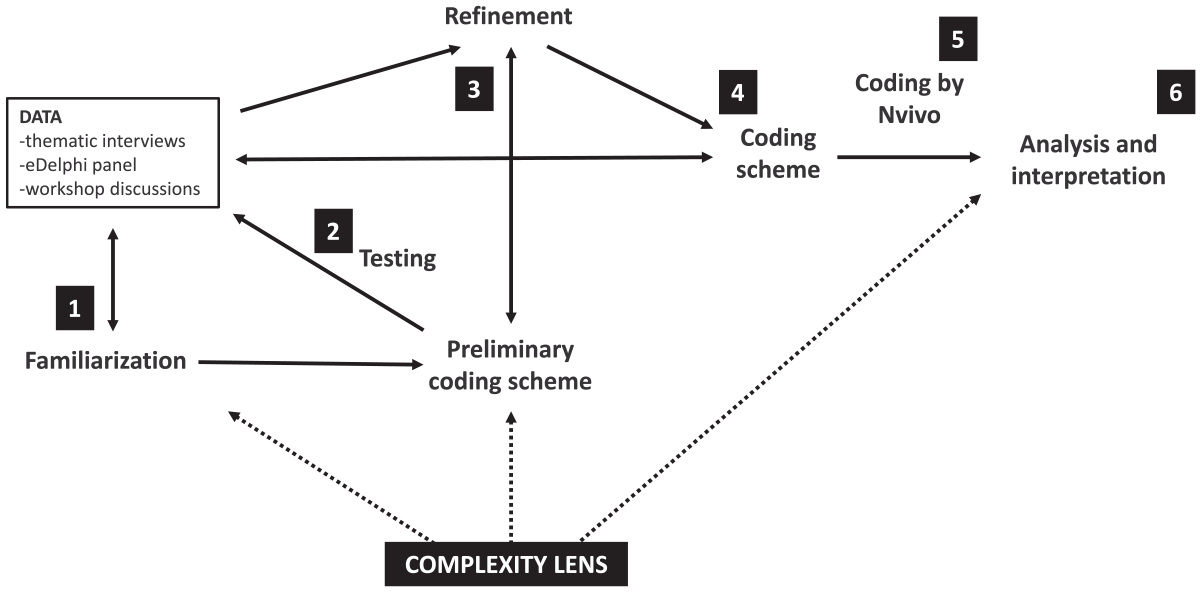
Overview of the data analysis.
The initial step was to ensure familiarization with the data. The author noted preliminary issues emerging from the data on complexity thinking. That identification utilized the complexity theme issue of Public Management Review (2008), alongside seminal works on complexity thinking by Cilliers (1998), Byrne (1998), Mitleton-Kelly (2003), Teisman et al. (2009), Geyer and Rihani (2010), Rhodes et al. (2011) and Morçöl (2012). The data revealed six primary dimensions of complexity: self-organization, diversity, trust, feedback loops, agency, and an attractor dimension. Next, the author developed a preliminary coding scheme comprising key complexity concepts that helped analyze the text systematically. Third, a sample of the data (two transcriptions of interviews and two transcriptions of workshops) was chosen. The author and a research assistant independently applied the coding scheme to the text, systematically identifying and labeling text portions corresponding to each code. The next step was to conduct an inter-rated reliability assessment. The percentage of agreement between the author and the research assistant on the application of codes was calculated to enhance the credibility and rigor of the analysis. Discrepancies were resolved through discussion, and the coding scheme was refined accordingly. In addition to concepts widely used in complexity thinking (such as self-organization, diversity, feedback loops, nonlinearity, and attractor), this phase identified the importance of trust and agency. Fifth, the data was coded using the scheme and NVivo software. The coding produced 1321 excerpts that embody the complexity of epistemic control. The units of analysis in the coding process were combinations of a few words or sentences. Finally, patterns, relationships, and discrepancies between the data and the theory (epistemic governance and complexity thinking) were identified. The research approach can be characterized as abductive reasoning (Sætre & Van de Ven, 2021), as the starting point was the idea that complexity thinking assists in comprehending the epistemic governance of decision-making during times of crisis in a novel manner. Van Hulst and Visser (2024) report that abductive analysis is well-suited to public administration research because it enables scholars to develop theories with practical relevance that are attuned to the complexities and uncertainties of real-world governance. This multifaceted approach to data collection provided a comprehensive and diverse set of perspectives, ensuring the findings were well-informed and robust. It also made it possible to connect the data to concepts used in complexity thinking, contributing to the development of epistemic governance.
A Complexity-informed Interpretation of Epistemic Governance
This section introduces a complexity-informed view of epistemic governance and traces its emergence through the concepts of self-organization, diversity, trust, feedback loops, attractors, and agency. The term actor refers to entities such as individuals, groups, and organizations with the means to deliberate and make choices. In contrast, a system represents an entity emerging from the components and their interactions (see also the Finnish comprehensive security model).
The analysis follows Vaughan’s (1992, p. 177) guidance on theoretical elaboration. Complexity thinking offers a means to analyze data. Data should be used to “contradict or reveal previously unseen inadequacies in the theoretical notions guiding the research, providing a basis or reassessment or rejection; the data can confirm the theory; the data also can force us to create new hypotheses, adding detail to the theory, model, or concept, more fully specifying it.” The subsequent analysis includes excerpts from interviews conducted in three research projects to enhance theoretical elaboration.
Self-organization Enables Adaptation
Self-organization happens when social systems exchange information, undertake actions, and continuously adapt to others’ actions; self-organization can be contrasted to a situation where a plan is imposed by a central authority (Cilliers, 1998, p. 90). In the subsequent interview excerpt, the respondent elucidates the complexity and unpredictability inherent in the planning process: “. . .we do have these plans in place, but it’s not like things would happen exactly as the plan says. Each situation is different . . . and it also depends on an individual level. I mean, I must realise that something is happening, which is potentially something for which the current plans don’t work” (Director, third-sector organization, Project A).
The self-organization form of epistemic work often takes place in groups known as epistemic communities (Haas, 1992). These communities self-organize around shared interests, challenges, or tasks, and the collective epistemic work leads to new insights, solutions, or understandings. While this is a spontaneous process, it is influenced by factors such as the initial conditions and external influences. Among these factors, trigger and boundary-spanning activities play crucial roles in self-organization (Nederhand et al., 2016). Trigger activities are the initiators of change within the system. A trigger is an external or internal event, stimulus, or condition that initiates creativity and innovation processes (Houtgraaf, 2022). Triggers can be understood as both objective facts and socially constructed phenomena. The term trigger in this context refers to an event or circumstance that causes a crisis. Triggers are objective in that they are observable and measurable, such as natural disasters, financial crises, or political upheavals. However, they also can be socially constructed, as their cultural, social, and psychological backgrounds influence people’s perceptions, interpretations, and reactions to such events (Pearson & Clair, 1998).
Observing and interpreting triggers requires key actors to undertake boundary-spanning activities that connect the internal realm of a system with its external environment. Boundary-spanning activities manifest as actions that help individuals and systems connect and interact with others beyond their immediate environment, fostering collaboration and the exchange of knowledge and ideas (Tushman & Scanlan, 1981). The process is important in the context of self-organization, as it enables the flow of information and resources to support the emergence of new structures and patterns. Both trigger and boundary-spanning activities are essential for self-organization as they drive the system’s capacity to evolve and adapt. Trigger activities initiate a transformation, while boundary-spanning activities ensure the system can adapt to its environment. Together, they contribute to the dynamic and emergent properties of self-organizing systems. The following excerpt illustrates the necessity for bridging during crises: “. . .in crises, there is nothing else but local action. Information may not necessarily flow from the site to the management, and messages from the management may not reach the site. . .This disconnect underscores the need for building stronger bridges of communication . . . it also requires the local actors to be capable of acting independently (Civil servant, state regional administration, Project A).
However, not all systems can make use of triggers. Self-organization is hampered when the system struggles to identify or respond to triggers, which might be due to various factors, such as rigid hierarchies, lack of communication, or resistance to change. A rspondent refers to such challenges: “. . .this is indeed its own challenge, that preparedness . . . when we are living through situations where we should adapt to a new position, should react quickly, I’m not at all sure how the administration can manage this . . . I doubt the agility of the administration” (Manager, third-sector organization, Project A).
Scholars have suggested that rather than provoking change, actors may perceive the triggers as reinforcing and confirming that their existing internal models are the appropriate responses to address the issues at hand (van Buuren & Gerrits, 2008, p. 369). A system may also suffer from the absence of boundary-spanning activities, which can hamper self-organization by limiting the flow of information and resources between different parts of a system, thus impeding the system’s ability to adapt and evolve. In that case, epistemic work reinforces information silos instead of prompting spontaneous renewal. This challenge can be mitigated through diversity.
Diversity Produces Multiple Perspectives
Diversity fosters self-organization and enhances epistemic work by broadening the range of ideas and considerations brought to the table, enabling more comprehensive exploration and understanding of issues. Diversity is not just about identity or representation but also cognitive and epistemic differences—diverse ways of thinking, experiences, and knowledge bases. One interviewee pondered how “the same piece of information appears different when viewed through different lenses” (Expert, regional government organization, Project C). The greater the diversity, the more opportunities there are for self-organization. Diversity contributes to the process of self-organization in several ways. A diverse entity, in terms of individual characteristics, perspectives, and experiences, can produce a wider range of ideas, spawning innovative solutions and approaches that would be less likely in a more homogeneous group. In doing so, diversity helps to mitigate various cognitive biases such as groupthink, the tendency of individuals to agree with each other and conform to a single viewpoint rather than challenging each other’s ideas (Janis, 1972).
Diverse groups are better suited to tackling complex problems. When applied to the concept of diversity, the idea that “we may not know the solutions to specific problems until they appear within the specific context of the problem” suggests that diverse perspectives are critical for problem-solving (Dennard, 2008, p. 652; originally Douglas & Wildasvky, 1982). Research indicates that heterogeneous groups tend to outperform homogeneous groups when dealing with complex tasks because different people see distinct aspects of a problem or understand it differently, which can enhance problem-solving (Woolley et al., 2010). One expert noted the importance of incorporating diverse perspectives in decision-making, particularly during the COVID-19 crisis: “I had also been considering evidence-based decision-making when the COVID-19 crisis touched the entire society. It’s naive to think that decisions rely solely on medically based matters. Of course, this should be the case in treatment. When actions begin to affect people in other ways, other perspectives must be considered. I think it was good that politicians were involved right from the start” (Director, Research Institute, Project B).
It is crucial to bring together actors with diverse backgrounds, expertise, and perspectives in times of crisis to foster collaboration. This diversity not only refers to the differences in the actors’ backgrounds but also emphasizes the importance of relational diversity—the diversity that emerges in their relationships. This approach can help break down silos, overcome cognitive biases, and enhance the collective intelligence needed to tackle complex crises effectively. It is also essential to accept that the same event can be interpreted differently and from different starting points (Grint, 2005). Ultimately, the issue revolves around the polyphony within the system. Hazen (1993) stresses that systems contain a multiplicity of perspectives. Embracing polyphony allows the system to explore a wider range of potential solutions to its challenges, including wicked problems (e.g., Head, 2022) that defy straightforward solutions. It encourages dialogue and interaction among various parts of the organization, fostering learning and adaptation. The quote from the interview highlights the importance of learning new things: “. . .when preparing for and during crises, we need to learn new things, so we are not like generals fighting old wars” (Manager, regional government organization, Project C). Moreover, by recognizing and valuing multiple perspectives, a system can increase its members’ sense of engagement and commitment, thus improving its overall effectiveness and resilience.
Diversity can bring challenges: Actors from diverse backgrounds may have different norms, values, and communication styles, which can increase the complexity of social interactions and even lead to conflicts (Jehn et al., 1999). Power dynamics often emerge that can lead to inequity and social stratification. For instance, some groups may have more access to resources or influence than others, which can create social divisions and limit interactions among actors (Sidanius & Pratto, 2001). It typically is more comfortable to trust, work with, and co-create bold ideas with those whose attributes largely mirror our own, but that might not contribute many fresh ideas and may only reinforce our existing thoughts on issues and potential solutions (Peters et al., 2022). Conversely, assembling a highly diverse group with little in common and different value systems and knowledge can foster new knowledge but might also jeopardize creating mutual trust.
Trust Connects and Facilitates
Trust can be dichotomized based on its target or object into two broad categories: systemic trust and individual-based trust (Luhmann, 1979). Systemic trust refers to a form of rational confidence in the smooth and reliable operations of institutions. This type of trust is based on a belief that institutions will function appropriately and fulfill their responsibilities. It is premised on the understanding that these institutions have established systems, regulations, and procedures that ensure their operations align with the expectations and needs of their stakeholders (Sztompka, 2000). Reflecting on the importance of systemic trust, a mayor observed that “citizens’ trust in authorities is the foundation . . . A trustworthy reputation helps in crisis situations . . . But yes, trust is incredibly important in this whole picture, so you can trust that if you can’t cope, then the authorities have always handled this matter well before, so, trust is absolutely essential” (City mayor, local government, Project B).
In contrast, individual-based trust is a personal and more intimate type of trust constructed and manifesting in interpersonal interactions and relationships (Kugler et al., 2007). It is built on personal experiences, integrity, reliability, and mutual respect and is often nurtured over time through consistent behavior and shared experiences. The following observation clarifies that point: “I have experienced that myself in a crisis situation; it’s the fact that you’ve established a certain kind of trust relationship with those people beforehand. And then, when you arrive at some command centre, and these people are there, you’re like, oh right, hello, we’ve actually been there before. And then it starts from there. It kind of lowers the threshold, not just a little, like, all right, let’s start doing this task” (Expert, central government organization, Project A). From an epistemological perspective, trust can be seen as a basis for accepting the validity of information or knowledge acquired from others. It is an essential element in social relationships and collaborations, significantly affecting knowledge-sharing and group decision-making processes.
Systemic and individual-based trust are key facilitators of predictability and cooperation during crises. One interviewee testified that “it makes sense to talk about trust when there is some underlying uncertainty or risk . . . trust is the result of long-term development, and that’s why it is so essential and important, not just trust between people but trust between people and institutions . . . and its maintenance” (Manager, regional government organization, Project A). By fostering a sense of reliability and safety, trust enables actors to anticipate others’ decisions, reducing uncertainty and promoting cooperative behavior. As Luhmann (1995) suggests, every system initially examines trust before it begins to process information and generate meanings. In essence, trust serves as a prerequisite or foundation for the effective processing and interpretation of information. Trust is therefore a reflection of the dependability of the object or person being trusted, and this assessment is primarily founded on previous experience in a given context (Hardin, 2006).
The significance of trust is further amplified because it minimizes the risk associated with information sharing, particularly the risk that the parties involved will misuse information to harm one another. When trust is established, the parties sharing and receiving information share common expectations concerning the principles of using the information. Trust in interpersonal communications can lubricate processes (Lane, 1998). Trust becomes particularly critical in crises where there are conflicting interpretations of opportunities and threats in the operating environment among the actors. In such instances, a trusting atmosphere can facilitate open discussions, allowing for effective problem-solving and decision-making.
A foundation of trust in a relationship encourages open and effective communication. When people trust each other, they are more likely to be honest and transparent. Meanwhile, individuals interacting openly demonstrate their reliability and predictability, which are key ingredients of trust. Sharing information, expressing thoughts, and listening attentively are all aspects of interaction that can gradually establish trust in a relationship. Trust and interaction essentially feed into and reinforce each other in a cyclical relationship. In the language of complexity, interaction can be approached through feedback loops.
Feedback Loops Balance and Stimulate
Feedback facilitates the transmission of information within the system and guides its activities. Negative feedback undoes changes elsewhere, resulting in the stability of the system. Internal features of systems—such as structures, hierarchies, rules, controls, cultures, defensive routines, and power relations—are held in place by feedback loops locking the system into a particular stable pattern (Eppel, 2012, p. 888). Negative feedback loops are thus associated with organizational stability, ensuring that the system does not deviate too much from its set goals or standards. The following observation clarifies how “. . .the tighter the situation is, the simpler the messages must be because it takes time for people to comprehend. So, one must be able to . . . move from instructions to prompts, from prompts to commands, and from commands to very simple commands” (Manager, central government organization, Project A). Conversely, positive feedback is stimulating and reinforcing. It primarily initiates and sustains proactive action. It is thus associated with change as it encourages new ideas and fosters novel approaches. Positive feedback cycles intensify change by endorsing the course of change, and can trigger abrupt, unpredictable, and destabilizing impacts (Eppel, 2012, p. 888).
Nevertheless, an imbalance between positive and negative feedback can lead to excessive or insufficient sensitivity to a crisis. Negative feedback can dampen responses and limit adaptability, hindering actors’ ability to address the crisis effectively. The result can be a downward spiral, making it difficult to break free from negative patterns and find innovative solutions. Conversely, an overabundance of positive feedback loops can exacerbate a crisis. Positive feedback amplifies small initial changes, leading to nonlinear behavior. Nonlinearity signifies that the relationship between an input (the situation or action) and the output (the resulting situation or action) is not always directly proportional or predictable (Kiel, 1993). Consequently, a minor change in one area might lead to disproportionately large impacts in another. One expert noted the profound shift in how incidents are reported and perceived: “ . . .the world of communication is so fast that even if an accident happens, there are already pictures of it online before the fire department arrives; it posed a challenge in the sense that in the old days, if there was a mining accident, for example, when the Ministry of Trade and Industry received the information, the first thought was probably whether to inform anyone, or simply acknowledge that it happened and leave it at that. Nowadays, it explodes on everyone’s phones, first the pictures from the explosion, and then it’s just a matter of when we will receive some information about it” (Expert, central government organization, Project C).
A crucial component of epistemic work is influencing the collective perception of what constitutes a credible and precise representation of the prevailing circumstance (Alasuutari & Qadir, 2014, p. 73). In times of crisis, those in charge are overwhelmed with a plethora of information or clues, which could potentially affect their decision-making. However, actors are limited by their cognitive abilities and resources and cannot process all the information available to them (Cairney, 2020). To overcome this limitation, actors must optimize their decision-making process; to do so, they ignore most of the information (negative feedback) and focus only on a few select pieces (positive feedback). They prioritize those pieces based on their relevance and importance to their current concerns (Cairney, 2012).
Occasionally, nonlinearity dominates, and then the system becomes unstable. When this happens, the system is repeatedly driven to the verge of chaos (Kauffman, 1993). While failure in balancing positive and negative feedback can lead to a rich variety of development paths, the rules governing the function of the system can be quite simple. Nonlinear behavior is not indefinite but bounded. Although a system develops through a series of separate phases, its behavior is constrained by its attractor(s).
Attractors Set the Limits
An attractor is an organizing principle that limits a system to a pattern of behavior (Geyer & Rihani, 2010). It can be defined as a collection of values or principles that offer the system the characteristic of relative stability in a given period (Haynes, 2008). Each system has its own attractors, that is, a typical set of norms and values that enable and constrain its actions. Reflecting on the gravity of administrative responsibilities amid pressing health challenges, the director of a research institute recounted the words of the Chancellor of Justice and their implications: “The Chancellor of Justice stated that the constitutional obligation for the administration to protect people’s health, and life is the top priority. This was taken quite literally. In fact, it was crucial” (Director, research institute, Project B). Alasuutari and Qadir (2014) suggest that these attractors are produced through epistemic work. While each organization has its unique attractors, they are not detached from the environment. For example, legal systems embody important societal values such as separation of state powers, human rights, and protection of past investments (Waldron, 2010), influencing what is and is not possible.
The system’s dependence on its environment and numerous feedback processes lead to a situation where the development of any system is not solely dependent on itself. An attractor in a system ensures that the choices made within the system are synchronous with the demands of the environment. That is illustrated in the following interview excerpt: “. . .we live in such a rapidly changing environment, and things become obsolete quickly. Especially now, with our security environment undergoing such rapid change, it certainly challenges our actions to ensure we neither overreact nor underreact” (Manager, third-sector organization, Project A). As a result of co-evolution, the development of every system is an emergent combination of conscious endeavors and randomness independent of the actors’ intentions (Sotarauta & Srinivas, 2006). The notion of agency underscores actors’ role in shaping development and highlights the dynamic, reciprocal relationship between structures and actors.
Agency Manifests as Accountability
When describing the processes of epistemic governance, it is necessary to acknowledge construction of interpersonal meaning and actors’ agency (Alasuutari & Qadir, 2014). Agency connotes the capacity of an entity to think, decide, and take action to achieve its objectives. The implication is that the actions are purposeful, emanating from the entity’s cognitive process and freedom to make choices rather than being dictated by external environmental factors (Cairney, 2020, p. 10). Agency is not solely confined to sovereign authorities; nor does it strictly correspond to limited logical thinking or completely independent actions and behaviors. Discussing the unpredictable nature of crises and the emergence of responsive mechanisms, one interviewee observed: “. . .agency can also be taken, so that is what is ‘great’ about these crises, that . . . if we think about things like the regional coronavirus groups, coordination groups, and all that, they are all very emergent, so these kinds of things arise because you can’t prepare in advance for any crisis, because it wouldn’t be a crisis if you could” (Expert, third-sector organization, Project A).
From the perspective of epistemic work, agency is understood as a recursive cycle of adaptive behavior, where actors respond to both internal and external triggers, including their interactions with each other and the broader system. Adaptive agency is not limited to intended actions attempting to alter the system or challenge the current state of affairs; nor is it merely an independent reaction to an external disruption or crisis (Bristow & Healy, 2015, p. 245). Rather, it fundamentally represents the dynamic ability of actors to adjust to others’ actions and changes in their surroundings. Of course, they also have the option to remain unaltered and resist change.
Accountability is the acknowledgment and assumption of responsibility for actions within the scope of the actors’ roles and encompassing the obligation to explain and be answerable for the consequences (Bovens, 2007). Accountability is not restricted to legislatures and administrative courts but also involves “agency as much as it does the activities of formal institutions of governing” (Peters et al., 2022, p. 223). Accountability is inherently linked to agency. When actors are held accountable for their actions, it is assumed that they have the agency (i.e., the capacity) to have acted differently. Conversely, the existence of agency implies the potential for accountability. If actors can make independent decisions and control their actions, it seems reasonable to hold them accountable for those actions. However, the level of accountability can vary depending on the actor’s level of agency. For example, an actor with an elevated level of agency may be held more accountable for their actions than someone with limited agency. The following interview excerpt illustrates agency-related challenges: “. . .from a national preparedness perspective, we have mechanisms in place to collect national data and construct an overall situational picture. However, what we lacked, and what we’ve currently established around COVID-19, is the regional perspective – let’s say, a situational picture by region and then further down by municipality or healthcare district, considering them as local entities. The municipality being the closest in terms of local scope. We had to create a model where we formed these municipal groups. Then, for the first six months, there was debate about whether one could request data from there and whether it could be transferred to the national situational picture . . . to the national situational image group or regional group” (Director, central government organization, Project A).
The connection between agency and accountability is particularly evident in the context of crises. Crises often heighten demands for accountability. The public wants to know why the crisis happened, who is responsible, and how it can be prevented in the future. In other words, there is a demand for those with agency to be held accountable for their decisions and actions (Boin et al., 2005). Crisis situations require both the ability to act and the willingness to accept responsibility for those actions (Ansell et al., 2010). A government may have the agency to implement policies aimed at mitigating crises, but it also needs to be accountable for the outcomes of those policies.
Discussion
Epistemic governance plays a significant role in shaping the perspectives and shared understanding of the prevailing reality during a crisis. Navigating the various dimensions of epistemic governance is a complex endeavor, as it requires a deep understanding of the interconnectedness of knowledge production, dissemination, and validation. The value of complexity thinking for epistemic governance is that it directs attention to its emergent nature. The argument that epistemic governance is an emergent pattern (Figure 2) suggests that the way knowledge is produced, validated, and governed within a society is not predetermined or centrally controlled but emerges through complex interactions and processes. A complexity-theoretical interpretation of epistemic governance aligns with Ansell and Torfing’s (2020) argument that approaches tailored to specific purposes are more effective than striving to formulate a universal theory of governance. It also resonates with Ansell and Geyer’s (2017) concept of pragmatic complexity. When applied to crisis contexts, that notion suggests that while it may be impossible to know an unfolding situation, ensuring effective interaction within government systems remains crucial
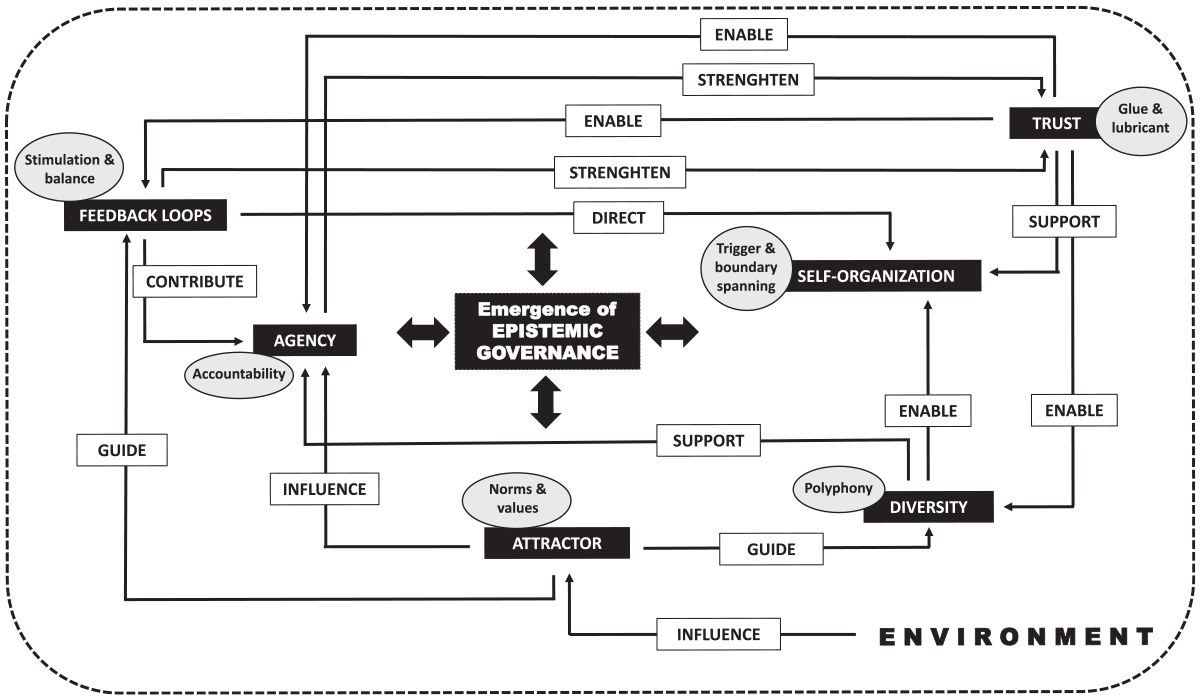
The emergence of epistemic governance through a complexity lens.
First, the dynamic of self-organization of epistemic governance manifests when there is a constant exchange of information, initiation of actions, and continuous adaptation. Actors’ behaviors are directed as triggers and boundary-spanning activities. Triggers are essentially catalysts for change while boundary-spanning activities serve as the conduits, interconnecting internal and external environments. A flaw in the recognition or response to these triggers, or a deficiency in boundary-spanning activities, can potentially disrupt the self-organization process. Second, diversity’s intrinsic and instrumental values are embodied in the equal treatment of diverse actors and enhancing the system’s overall performance. Diversity, through cognitive and epistemic variations, enriches the range of ideas, counteracts cognitive biases, and bolsters self-organization. While a diverse group of actors is often useful when complex problems must be addressed competently, diversity can also complicate social interactions and create conflicts due to the presence of contrasting norms, values, and communication styles. Third, trust, bifurcated into systemic and individual-based, is vital. Systemic trust entails faith in institutional mechanisms, while individual-based trust is established on personal experiences and interpersonal relationships. Both types significantly dictate the level of predictability, cooperation, and information sharing, especially during crises. Fourth, the evaluation of trust relies heavily on past experiences and lays the foundation for effective communication. Trust and interaction are intertwined in a symbiotic relationship, promoting honesty, reliability, and open discussions. Feedback mechanisms hold an imperative role in guiding actors’ activities. Negative feedback counters change, ensuring stability, whereas positive feedback bolsters novelty by reinforcing change. Fifth, an imbalance can trigger excessive sensitivity or stagnation during crises. The resulting instability is actually a fine balance between order and chaos dictated by the attractors, that is, norms, values, and principles. Systems are not isolated entities; they co-exist and co-evolve with their environment, thus generating a dynamic interplay between structures and actors. Accordingly, system development is a blend of intentional actions and elements of randomness. Sixth, agency, defined as the ability to act deliberately, is not confined to sovereign authorities but involves complex adaptive behaviors in response to internal and external triggers. Accountability, inherently linked to agency, entails responsibility for actions and the potential consequences. During crises, the increased demand for accountability necessitates that actors with agency behave responsibly and bear the repercussions of their decisions.
It is important, however, not to overinterpret these relationships. For instance, using arrows to indicate relationships between elements in a model does not denote a strict causal connection but signals an interplay or a mutual influence, the nature of which may be multifaceted, indirect, and nonlinear. The mechanisms of emergence in social systems often elude clear causal explanation, resulting from an intricate confluence of many factors and processes.
A core principle in the realm of complexity thinking highlights the notion that the emergent entity, arising from various interactions, simultaneously serves as the structure that influences the system’s behavior in two main ways: enabling certain behaviors and restricting others. The emergent entity enables certain behaviors by providing a framework or structure within which the system operates. This structure may define the boundaries, rules, or patterns of interactions that guide the behavior of the system’s components. It sets the stage for specific patterns or phenomena and legitimizes certain behaviors. In a crisis, the role of actors and identification becomes critical as different stakeholders try to assert their influence and authority. This process can involve stigmatizing or positively defining groups, which influences public opinion and support for certain actions or policies. For instance, the COVID-19-19 pandemic has led to a broadening of consensus, where confidence in political organizations and figures has seen various levels of growth across numerous national settings (Devine et al., 2021, p. 277).
Nevertheless, the emergent entity also constrains the system’s behavior. The structure that emerges from interactions can limit the occurrence of certain behaviors in the system. Those constraints might be rules, dependencies, or inherent properties of the emergent entity. They define what is feasible or possible within the system, thereby constraining behaviors that do not align with the emergent structure. The situation can lead to a widening gap between cognition and action (Comfort, 2022). Misalignment may also arise when actors manipulate information or selectively present aspects of reality to benefit their own cause or to disadvantage their opponents. Such recognized realities can shape perceptions of the problem’s severity, urgency, and potential solutions.
Theoretical and empirical inquiry prompts the question of whether epistemic governance is a “magic concept” that drives change in public governance, as Pollitt and Hupe (2011) suggest, or if it is merely a case of succumbing to the “trap of impressionistic descriptivism and premature diffusion of new fads and fashions” in the words of Torfing (2023, p. 4).
This article argues that the complexity-informed approach to epistemic governance aligns with the ideas of Sartori (1970), who advocated for the need to add intention to the concept of governance. While this may reduce the concept’s applicability, it simultaneously extends analytic capability (see also Peters et al., 2022.). This article views epistemic governance not as an activity performed by specific actors but rather as something that emerges through epistemic work. Epistemic governance appears to offer a heuristic value (Pollitt & Bouckaert, 2017) as it reflects the underlying assumptions often held by those responsible for managing crises. This perspective aligns with the tenets of complexity thinking. Specifically, while simplifying societal issues to render them controllable and solvable has an immediate appeal for public management, it may prove ineffective in the long run.
It is worth noting that while deconstructing epistemic governance into its constituent components can facilitate developing effective crisis response strategies, it can also be criticized on at least two grounds. First, it can be argued that the concept of governance has become too broad to be a useful analytical tool. For example, Frederickson (2007) questioned what happens to public administration in a world where governance is predominant. He contends that excessive use of governance blurs the distinction between politics and administration and undermines traditional roles and responsibilities in public administration. It then becomes difficult to discern where politics ends and administration begins. Frederickson (2007) suggests that mixing governance with broader political processes can complicate executing specific, accountable administrative actions. The current research addresses that criticism by emphasizing the importance of the epistemic dimension of governance. The ability of public officials or politicians to inspire trust and respect through their charisma, scientific knowledge, or moral authority can significantly influence the overall response and outcome, particularly in times of crisis (Alasuutari, 2018). This article asserts that the perceived vagueness of the governance concept can be addressed by focusing on the epistemic dimension, which offers a more precise analytical lens on how knowledge and authority shape decision-making and public trust during crises.
The second criticism centers on the novelty of a complexity-informed interpretation of epistemic governance. It has been argued that concepts like emergence and self-organization were not originally introduced by complexity scholars interested in public administration and governance (Castellani & Gerrits, 2024; McGee & Jones, 2019). Those concepts can be traced back to George Lewes’s (1874–1879) work Problems of Life and Mind, in which he argued that “the emergent is unlike its components in so far as these are incommensurable, and it cannot be reduced to their sum. . .” (p. 413). Self-organization–evident when a system spontaneously forms patterns or structures without external direction—was discovered in cybernetics by Ashby (1947) and later utilized, for example, by Jessop (1998) without reference to complexity theory. Moreover, similar observations can be made with other complexity concepts. Nevertheless, many theoretical frameworks and concepts developed before or beyond the scope of complexity thinking have established their explanatory credentials in the analysis of public administration and governance. In this context, Castellani and Gerrits (2024, pp. 39–44), for example, criticized complexity scholars for failing to engage with social sciences more broadly, effectively reinventing the wheel, and indulging in obscurantism and mystification. Indeed, many of the phenomena discussed in this article, such as inter- and intra-system interactions, have already been explored in political research through concepts like subsystems (Griffith, 1939) and issue networks (Heclo, 1978). Similarly, Wildavsky (1988) emphasized that understanding policy processes requires more than just focusing on individual actors and their goals; the key lies in recognizing the self-organization within these processes. There is ample public administration literature attesting that simplifying policy to individual actions and separating ideas from their implementation leads to an overly simplistic interpretation of complex governance dynamics (e.g., Hill & Hupe, 2022). The article addresses this criticism by advocating a management style that acknowledges the complexity of both the issue at hand and the strategies devised to address it, an approach Joosse and Teisman (2021) label “complexification.” The heuristic value of using a complexity-informed approach for epistemic governance becomes evident when understood in the context of how collective cognition emerges during crises. This perspective aligns with the insights garnered from Comfort and Rhodes (2022, p. 16), who define collective cognition as a “process of solving complex problems by structuring information to shape action and leads to a shared recognition of risk within a community or society.” An understanding informed by complexity thinking provides a solid framework for navigating and shaping these emergent processes productively.
Conclusion
Does complexity-informed research on epistemic governance during a crisis have practical significance? Based on its findings, the analysis here suggests four practical implications. First, it is essential to grasp the relationship between the emergent entity and the system’s intrinsic behavior to understand the complex dynamics and outcomes that arise in systems influenced by complexity thinking. Yet, epistemic governance is emergent and does not necessarily appear when it is needed. Instead, it demands proactive steps to gather, inspire, and synchronize the actors involved. Second, understanding the emergent structure can help managers foresee and prepare for possible behaviors or events within the system. This understanding could be particularly important during crisis situations, where the structure and actors’ roles become more critical. During crises, actors’ ability to inspire trust can significantly influence the overall response and outcome. Therefore, managers should work to enhance their charisma, expertise, or moral authority, as these traits can influence stakeholders’ perceptions and actions. Third, managers need to be aware of the constraints in and limitations of the system. One of these could be how information is manipulated or selectively presented, which could influence the perceived reality of a situation. Finally, managers should ensure a balanced and transparent flow of information to prevent any single actor from defining the problem or solution to their own benefit or the expense of others. In essence, managing perception becomes as important as managing the actual problem, especially in times of crisis. This ability to manage perception could affect the perceived severity, urgency, and possible solutions to the problem, thereby influencing the overall response and behavior within the system.
Every study has its limitations. All models of social systems, including those underpinning epistemic governance, are subject to an inevitable process of simplification. That process is both a necessary condition for creating manageable models and a potential source of misrepresentation. A model that entirely replicated the intricacies of reality would, paradoxically, be as unwieldy and unenlightening as reality itself. A complexity-informed approach attempts to strike a balance between oversimplification and unmanageable complexity. It acknowledges that epistemic governance exhibits emergent properties in the form of higher-level system characteristics that are not predictable by scrutinizing the properties of individual elements.
It should be noted as well that crises can take numerous forms. This article has not distinguished crises based on their nature. However, it is entirely possible that different crises would require the different forms of epistemic governance. Building on the notion that there are many shades of crisis, potential future research topics might include comparing and contrasting the strategies of epistemic governance employed in various crises such as economic recessions, environmental disasters, or pandemics or exploring how socio-political and cultural contexts influence the application of epistemic governance during crises.
Footnotes
Data Availability Statement
Data sharing not applicable to this article as no datasets were generated or analyzed during the current study.
Declaration of Conflicting Interests
The author(s) declared no potential conflicts of interest with respect to the research, authorship, and/or publication of this article.
Funding
The author(s) disclosed receipt of the following financial support for the research, authorship, and/or publication of this article: This article was developed in collaboration with the Information Resilience in a Wicked Environment (IRWIN) and Safeguarding Welfare in Times of Pandemics: Towards Collaborative Governance of Syndemics (WELGO) projects, both funded by the Strategic Research Council of Finland.
