




Abstract
Bureaucratic neutrality norms render emotions problematic in the workplace largely due to presumptions that emotions cloud reasoning. This article traces the origins of bureaucratic neutrality to 17th-century Cartesian mind/body dualism. However, in Descartes’s correspondence with contemporary philosopher Elisabeth of Bohemia, he retreats from strict dualism in reaction to her argument that emotions may actually inform decision making. Elisabeth’s critique stays lost to history due in part to the epistemological sexism underpinning bureaucratic neutrality and public administration. Structural Topic Modeling reveals embodied reasoning and interpersonal interdependence in Elisabeth’s critique, undermining the strict mind/body dualism that lurks in both bureaucratic neutrality and public administration.
Keywords
In public sector worklaces norms surrounding bureaucratic neutrality render emotions problematic largely due to the presumption that emotions cloud reasoning. This article traces the origin of bureaucratic neutrality norms to 17th-century Cartesian mind/body dualism. Bureaucratic neutrality is upheld as a “sacred cow” in public administration even today (Sweeting & Haupt, 2023, p. 1; also see Mayer, 1909/1944; A. Roberts, 1996; Weber, 1921/1968) due in part to beliefs that reason is superior to emotion and that emotions cloud reasoning. Far from being a blank slate, however, bureaucratic neutrality is justly criticized for its own biases including privileging Whiteness (Alexander & Stivers, 2020; Portillo et al., 2022a, 2022b) and maleness (Stivers, 1995, 2000, 2002). Bureaucratic neutrality rejects emotions as disruptions to professionalism and hindrances to public service. From this perspective, emotions impede professionalism; they do not foster it. And yet, emotions and emotional labor are foundational to work in public organizations and fundamental to presenting oneself professionally (Guy & Mastracci, 2018; Guy & Newman, 2004; Guy et al., 2008; Humphrey, 2023). Emotions are fundamental to professional practice.
One view of emotions in the workplace is found in Max Weber’s ideal bureaucracy sine ira et studio—without anger and passion. Weber’s ideal type shaped the development of bureaucratic organizations and particularly those in the public sector, due in part to the formative years of the academic field of public administration coinciding with the translation of Weber’s work into English. However, Kramer (2002) places Weber in context when he observes: “At the time impersonal public administration was proposed, it was a necessary and essential corrective for nepotism. Standardized rules and procedures were revolutionary breakthroughs in administrative thinking and retain value as a safeguard against corruption even today” (p. 14). Furthermore, Weber lamented on more than one occasion that the human need for order that bureaucracy satisfies could drive people to despair (Mayer, 1909/1944; Weber, 1921/1968). In this way, even Weber understood the value of emotions; or at least he recognized the long-term danger of suppressing them. Emotions in the public-sector workplace should not seem so out of place; yet according to norms of bureaucratic neutrality, they are.
In this article, I argue that the bias against emotions in the public administration workplace can be traced to the genderedness of Cartesian mind/body dualism, which situated emotions in the body and therefore inferior to mind and reason. The genderedness of mind/body dualism, with reasoning being male and positive and emotions being female and negative, arises in public administration’s origins, as revealed by Stivers’s (1995, 2000) bureau men and settlement women. Bureau men pursued “information that could be defended as ‘scientific’” (Stivers, 2000, p. 79), while settlement women engaged what would be considered today as ethnographic fieldwork. “Positivist” norms in public administration still favor traditionally-scientific quantitative data gathering methods, even if the genderedness is not overt. It is revealed by the discussion of qualitative research methods as aberrations from an unspoken quantitative norm (Riccucci, 2010). The same sexism that animates the gendered interpretation of mind/body dualism also obscures the counterargument to Descartes posed by Elisabeth of Bohemia four centuries ago. Descartes was among the most enduring voices of the Early Modern era—particularly 1600s Europe—which not only rendered emotion subordinate to reason, but also reified the White, male, Christian thinker as the norm against which all “others” are contrasted (Candler et al., 2010; Grosfoguel, 2013, 2015; Nisar, 2017; Nisar & Masood, 2023; Santos, 2018). Alexander and Stivers (2020) further observe that biases about who is and is not capable of reasoning established the basis for citizenship in societies borne of the Enlightenment such as the United States. In turn, concepts and definitions of citizenship underpin the development of the administrative state. In this way, beliefs about who is capable of reasoning in Early Modern Europe from Descartes as well as John Locke and Thomas Hobbes shaped definitions of the polity in societies situating the people as sovereign, such as the United States.
Descartes himself backed away from a strict reading of Cartesian mind/body dualism. In correspondence with Elisabeth of Bohemia, he retreated from his strict dualism in reaction to her argument that emotions might aid decision making rather than impede it. However, Elisabeth’s critique stays lost to history due in part to the epistemological sexism underpinning both bureaucratic neutrality and public administration. Epistemological sexism is rooted in the same global dynamics that animate modern thought in the Western world; dynamics that privilege the perspectives of White, Christian men. The Early Modern period in which Descartes and Elisabeth corresponded played host to four “epistemicides” that decimated all but the thought and views—and indeed the official personhood—of everyone else but White, Christian men in the Global North. It is these forces that continue to shape current views of bureaucratic neutrality and professionalism in public administration. The study of emotions in our field is one attempt to subvert these forces.
In this article, I employ Structural Topic Modeling (STM) to conduct content analysis of correspondence between Descartes and Elisabeth of Bohemia to reveal their contrasting approaches to reasoning. In spite of Elisabeth’s evident success in moving Descartes away from his strict dualism, a mind/body split remains influential centuries later, even in public administration. Why? For this answer, I turn to Grosfoguel (2013) who traces existing systems of oppression to four epistemicides of Descartes’s and Elisabeth’s era. In the next section, I discuss mind/body dualism, Descartes’s theory, and Elisabeth’s skepticism about his assertions about emotions. In the third section, I cover Elisabeth’s background and how that informed her critique of Descartes. Her experience of her own emotions informing her reasoning as they relate to her interdependence with members of her family shaped her critique of Descartes’s dualism. Her lived experience showed her that a strict mind/body dualism was inaccurate, and interestingly 20th-century neuroscience research supports her view (Damasio, 1994). In the fourth section, I discuss the STM process and results from the analysis. In the fifth section, I argue that mind/body dualism has survived over centuries due in part to four global phenomena that also animate sex and race hierarchies in the Global North. The final section discusses how these results can inform public administration practice by, for example, embracing the role of emotions in public service delivery rather than sanitizing them as mere coping. This paper’s critique of bureaucratic neutrality joins Portillo et al.’s (2022b) examination of the race bias inherent in norms of bureaucratic neutrality. Alexander and Stivers (2020) cover similar ground with respect to race in the development of public administration as a field, and the present article complements these authors’ examinations of race in the evolution of public administration.
Mind Over Matter: Cartesian Dualism
Descartes situated knowledge creation in the mind of man rather than delivered from God, and this shift in perspective is hailed as crucial to the birth of modern philosophy in the Western world (Grosfoguel, 2013). With Descartes’s shift in perspective, truth can arise in the mind of man and need not be divinely revealed. This is possible, according to Descartes, because the mind can conceive of truth. The mind is made of a different substance than the body, the ills and pains of which the mind can transcend. Truths arising from the mind of man are not therefore conditioned by context, but rather, surpass the physical body and place and time. This is Cartesian mind/body dualism: Mind can generate truth because mind is not subject to the deleterious influence of the body, of sensations and conditions experienced by the body. Mind transcends time and place, while physical sensations are grounded in time and place. Descartes’s assertion of an autonomous “I” brought him to the attention of the Catholic Church for its implications about the presence of God. Indeed, Descartes was careful to live and write in the Netherlands rather than in his native France due in part to the implications of his arguments for church teachings. Galileo’s trial and subsequent church sanction would have been fresh in Descartes’s mind, having occurred a decade prior to his first correspondence with Elisabeth. Descartes was a devout Roman Catholic, and perhaps for this reason his mind/body dualism leaves room for God: Body is situated to be inferior to mind. Indeed, the mind must be free of the body’s influences in order to engage in reasoning and the contemplation of truth.
Descartes’s mind/body dichotomy has proven remarkably durable: “Descartes’ philosophy inaugurated the ego-politics of knowledge: an ‘I’ that assumes itself to be producing a knowledge from nowhere” (Grosfoguel, 2013, p. 76, emphasis supplied). According to this perspective, valid reasoning and knowledge production are purely cognitive processes free from bodily states and emotion. Interestingly, despite the long shadow that Descartes still casts on positivist social science, he did not argue unequivocally in favor of reason over emotion at the time. This is evidenced by his correspondence with Elisabeth of Bohemia (Jeffrey, 2018, p. 113): Although Descartes conceived reason and the passions in opposition to one another, and maintained that reason should dominate the passions, he did not go so far as to suggest that we should overcome or eradicate our emotions, as the Stoics and neo-Stoics did . . . although they may distort our judgments, the passions remain of use to us in experiencing and understanding the world around us.
Descartes actually reserved a role for emotions to contextualize reasoning. The absolutism that bureaucratic neutrality implies with respect to emotions and reasoning—arguably a reductionist understanding of Descartes—is more Stoic than Cartesian (Johncock, 2020). In her first letter, Elisabeth cast doubt upon Descartes’s mind/body dualism, and in subsequent letters she developed and articulated her own concept of embodied knowledge (Jeffrey, 2018). Elisabeth’s theory of moral reasoning is informed by emotions, is interdependent with other people, and is inextricably being-in-the-world, not detached from it (Jeffrey, 2011, 2018; Nye, 1996; Shapiro, 1999). Elisabeth’s own lived experience convinced her that her bodily states affected her thinking, and that her thoughts affected her body: “It was his peculiarly mechanical explanation of how the mind and the body interact that Elisabeth challenged when she asked Descartes in her first letter how material and immaterial substances—such as the body and the mind—can ‘push’ each other” (Jeffrey, 2018, p. 72). Initially, Descartes equivocated (Garber, 2000). But Elisabeth persisted and not only developed a more nuanced, hybrid theory of reasoning informed by emotions—mind and body, or embodied reasoning—she actually persuaded Descartes away from his initial position (Johnstone, 1992; Tollefsen, 1999; Yandell, 1999). However, her argument is mostly lost to history, while a reductionist version of Descartes’ mind/body dualism remains influential today (Astrom et al., 2022). That Elisabeth’s critique is largely lost is due, following Grosfoguel (2015), to global forces in the Early Modern period that set in motion the sexism and racism that Stivers (1995, 2000) and Alexander and Stivers (2020) also reveal in their examination of the origins of public administration and gender, and public administration and race, respectively.
Despite her nuanced theory of embodied reasoning, Elisabeth of Bohemia is largely unknown to contemporary philosophy. In relation to Descartes, Elisabeth has been variously situated by historians of philosophy as his favorite disciple (Johnstone, 1992), his protégé (Atherton, 1993; Nye, 1996), or even an unrequited lover (Godfrey, 1909) but rarely a philosopher in her own right (Broad, 2002; Garber, 2000). Gendered conceptions of emotion and reason, where femaleness is linked to emotion and bodily processes and maleness is associated with mind and reason, perpetuate the reductionist understanding of Descartes’ mind/body dualism. The next section explains the source of Elisabeth’s theory as the interdependence of her lived experience.
Who Was Elisabeth of Bohemia?
Elisabeth of Bohemia was the third of thirteen children and the oldest daughter born to Frederick V and Elizabeth Stuart. On her mother’s side, she descended from King James VI and I, Mary Queen of Scots, and Henry VIII. Elisabeth was 24 years old when her correspondence with Descartes began in 1643, and he was twice her age. With respect to his dualist metaphysics, “Elisabeth presses Descartes more pointedly than anyone else on this matter. In this way, she can be viewed as the first person to pose the mind-body problem” (Shapiro, 2007, p. 23). Elisabeth’s skepticism appears in her first letter to Descartes. The importance of her initial argument warrants quoting her first letter at length (Shapiro, 2007, p. 62): So I ask you please to tell me how the soul of a human being (it being only a thinking substance) can determine the bodily spirits, in order to bring about voluntary actions. For it seems that all determination of movement happens through the impulsion of the thing moved, by the manner in which it is pushed by that which moves it, or else by the particular qualities and shape of the surface of the latter. . . . This is why I ask you for a more precise definition of the soul than the one you gave in your Metaphysics, that is to say, of its substance separate from its action, that is, from thought.
Their correspondence was prompted by her having read Descartes’s Metaphysics (1641) and then reaching out through a mutual friend in hopes of meeting him. In this first letter, Elisabeth questions how something immaterial—the mind—can move or affect the body or produce physical reactions. They discussed mind/body dualism on and off, but mostly in two series of letters, in 1643 and 1645. It is in the latter period that Elisabeth situates her moral philosophy within her lived experiences—specifically, her episodes of physical illness and the numerous scandals of her large, financially-strapped family—and this is when she develops her hybrid account of reasoning with emotion (Nye, 1996): embodied reasoning. Elisabeth observed in herself that the mind can move the body, suggesting the presence of as-yet-unknown substances: “There are properties of the soul that were not yet understood, and more significantly for Descartes, that these properties may even ‘overturn’ his dualist doctrine” (Jeffrey, 2018, p. 75). Feelings inspiring her reasoning constituted the “matter of a different sort” that her lived experience produced and demonstrated as crucial to reasoning, not problematic.
The stresses of her family dramas began early. She was 13 when her father died, and as the oldest daughter and the most pragmatic of her dozen siblings, Elisabeth quickly grew into the role of family custodian. She negotiated one brother’s release from prison based on an incident in the English Civil War, in which two of her brothers fought on the losing side with their uncle, King Charles I. Other scandals involving other family members followed. Elisabeth’s interest in political philosophy “is driven by the real pragmatic considerations of her own family’s position” (Shapiro, 2007, p. 36). While Descartes reasons abstractly, Elisabeth seeks actionable advice for her very real concerns. To help her manage her family’s political and financial problems, “Descartes advocated a sort of ‘mind-over-matter’ approach” (Jeffrey, 2017, p. 554) for he had no such problems. A contemplative existence detached from active living may have been possible for Descartes, but Elisabeth was responsible for the wellbeing of her mother and siblings (Nye, 1996, p. 79): Descartes’ financial stability and lack of emotional involvement with others, whether by choice or by temperament, was a deficit. Elisabeth, alive to the social world around her, must constantly deal with reactions to actual changing events and adjust herself to new circumstances.
Perhaps being “alive to the social world around her” inspired Elisabeth to perceive people as deeply interdependent with one another and their environment (Schneck, 2019, p. 756). She personally experiences not only that her thoughts can shape how she feels, but also that feelings can shape thoughts, both positively and negatively. Introspection allows her to propose that “mind, or the capacity for thought, might well be best understood as the motion of matter of a particular sort” (Shapiro, 2007, p. 29). Emotions, to Elisabeth, actually foster sound reasoning and inspire the individual to think and act virtuously. Rather than impede, emotions promote sound reasoning. Indeed, a person’s connections and interdependence with others give rise to the emotions that motivate corrective action: “Being emotionally affected by the outcome of one’s actions leads to greater care in planning and pursuing those actions” (Schneck, 2019, p. 760, emphasis supplied). Emotional involvement leads to better decisions, in Elisabeth’s view, because without experiencing the consequences of one’s actions, one would not sense a need for corrective action and social cues are not perceived. In this way, Elisabeth anticipates findings from 20th-century neuroscience research by 350 years.
Elisabeth’s Hybrid View of Emotions
Norms underpinning bureaucratic neutrality reflect Descartes’s view of emotional expression. However, Elisabeth rejects Descartes’s advice that she rest, and “do nothing but smell the flowers, forget painful events, and live for simple pleasure” (Nye, 1996, p. 86). Her rejection of his mind-over-matter approach is a rejection of both his view of emotions and his implication that a person’s ideal state is one devoid of emotion (Schneck, 2019, p. 766). According to his advice, the mind can move the body, but not the other way around, as she proposes. Elisabeth seizes upon this inconsistency: “If Descartes had indeed paid greater heed to Princess Elisabeth’s objections to his account of the self, he would have been led through the application of his own principles to a more coherent and experientially faithful view of the corporeal nature of the thinking self” (Johnstone, 1992, p. 17, emphasis supplied). In this way, Elisabeth was a more faithful Cartesian scholar than Descartes himself. As this relates to public administration, Elisabeth’s embodied reasoning is akin to Stivers’s (2000) “great grimed question marks” (p. 79) pursued by settlement women who lived within the societies they sought to understand. “It is significant that pioneers of the [survey] method saw themselves as scientific but not as objective, in the sense of separating themselves from the field of study. On the contrary, they immersed themselves in it” (Stivers, 2000, p. 78). Like Elisabeth, Stivers’s settlement women rejected the bureaucratic neutrality norms that shaped the very founding of the field of public administration.
Elisabeth further maintains that complete emotional detachment is neither possible nor desirable because emotions are useful and necessary for interpersonal relations: “Elisabeth conceived of emotions in hybrid terms, as being both cognitive and bodily, and saw a positive role for them in motivating good, virtuous actions” (Jeffrey, 2018, p. 9). Her hybrid theory of emotions with reasoning “highlights the importance of emotional involvement for motivating and improving moral action. Being emotionally invested makes our actions better in various regards: It causes them to be better planned, more forceful, and even more virtuous because we avoid repeating mistakes we have made in the past” (Schneck, 2019, p. 768, emphases supplied). This nuanced and holistic conception of the role of emotions is more complex than Descartes’ and also more accurate, as 20th-century laboratory research demonstrates (Damasio, 1994). In public administration, an example of emotions-as-information is found among first responders and law enforcement officers who describe the importance of their “spider sense” in the field (Guy et al., 2008, p. 172). Elisabeth’s hybrid view of emotions represents a nuanced adaptation of Cartesian mind/body dualism (Jeffrey, 2018, p. 4). In public administration praxis and in lived experience, Elisabeth’s embodied reasoning more accurately depicts human decision making. In the next section, I analyze the correspondence between Elisabeth of Bohemia and Rene Descartes to reveal whether or not STM confirms these conclusions about Elisabeth’s hybrid point of view.
STM Analysis of the Correspondence between Elisabeth of Bohemia and Rene Descartes
Structural Topic Modeling is an innovative tool for analyzing text, which allows greater volumes of text to be examined while researcher oversight guides the process (M. E. Roberts et al., 2019). STM holds great promise for the analysis of texts in public administration and in the social sciences generally (Mourtgos, 2024). In this section, I describe STM and examine the letters between Descartes and Elisabeth of Bohemia. This analysis complements Broad’s (2002) examination of women’s moral reasoning. Following Gilligan (1982), Broad (2002) argues that Elisabeth’s moral reasoning reveals her interdependence with others while Descartes’s is situated in an individualist ethos. The following empirical analysis employs STM to detect the presence of that ethos.
The letters between Elisabeth of Bohemia and Rene Descartes disappeared after her death in 1680, only to be discovered in a castle in the Netherlands 200 years later. In 1999, Shapiro translated the letters from French into English. In 2017, Bennett transcribed the English translations and published them electronically. Using the digitized letters, I employ machine learning via STM in order to examine their correspondence, both to complement earlier analyses of the corpus (Broad, 2002; Shapiro, 2007) and to reveal potential themes that earlier analyses have not. The former process is referred to as a supervised process, while the discovery of new topics via STM is an unsupervised process (M. E. Roberts et al., 2019). Here, I employ both. Furthermore, I am situating this analysis in the literature on public administration theory, because in the field there already exist important scholarhip on bureaucratic neutrality, the role of emotions, gendered knowledge creation, and epistemic silencing. Stivers’s (1995, 2000, 2002) seminal research into the gendered origins of the field opens the door to further analysis of the role of gender in knowledge creation; in this case, the possibility of epistemological sexism silencing voices in public administration. Indeed, Stivers’s examination of the origins of the field is the original work revealing epistemic sexism in public administration: Settlement women’s contributions were silenced and ignored in favor of the work of the Bureau Men. Further scholarship in public administration acknowledges the epistemological silencing that is lurking in its theory (Candler et al., 2010; Nisar & Masood, 2023; A. Roberts, 2020; Starke & Mastracci, 2023).
Conducting Analysis using STM
Pre-processing to prepare the text for content analysis using STM includes three steps: Removing stop words (a, an, the, I, you, me, mine), dropping punctuation, and stemming words; that is, reducing words to their root form (e.g., philosoph* captures philosopher, philosophy, or philosophical). In total, Descartes wrote 34 letters and Elisabeth 26 letters. The English translations of her letters average about 500 words in length, while his letters are about twice as long. The English translation of the total corpus of correspondence is roughly 45,000 words, which is a small corpus of text to analyze with STM (Ignatow & Mihalcea, 2018, p. 192). Output from analysis includes unigrams and bi-grams as well as word network maps. Unigrams plot the most frequent individual words in a set of documents and can display these frequencies by document author. Word clouds are a type of unigram. Bi-grams do the same with pairs of words. Word networks map chains of words, commonly two- and three-word strings. The unigrams in Figure 1 show each author’s most frequently used individual words.
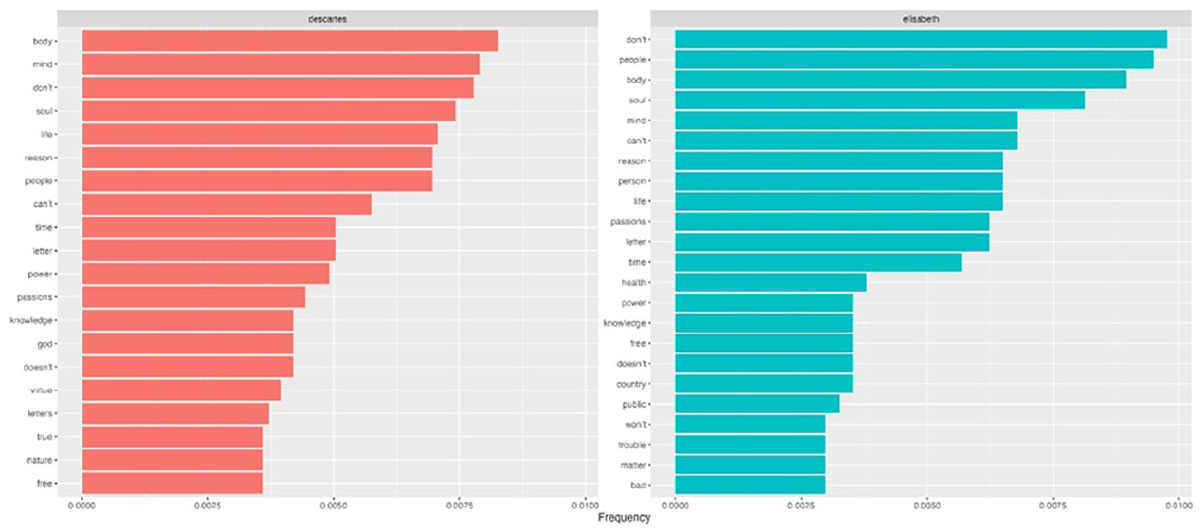
Most frequently used words by Descartes and by Elisabeth.
Figure 1 shows each author’s 20 most frequently used words. The words most frequently used from Descartes’ letters are shown in the left panel and Elisabeth’s are on the right. The figure shows a great deal of overlap between the two authors’ letters. Nearly all words are shared between the two letter writers with a handful of exceptions: Descartes mentions God, virtue, true, and nature, while Elisabeth does not. She mentions health, country, public, trouble, matter, and bad, and he does not. Figure 1 fails to reveal much about the content of their letters, particularly since the corpus under examination is comprised of letters of two people in dialog with one another. That is, it stands to reason that two individuals corresponding with one another would address many of the same topics. Turning to bi-grams may provide more insight.
The bi-gram plots in Figure 2 reveal Elisabeth’s mention of people by name as well as the more frequent negative constructions in her letters (several word pairs with “don’t” and “can’t” as well as “I’m forced” and “I’m afraid”), while Descartes’s letters tend not to use such language. Elisabeth writes of “public life,” “God’s existence,” and “moral failure,” while Descartes mentions “true reason,” “human mind,” and “human nature.” Although Figure 1 reveals similarities across the two authors’ letters, Figure 2 reveals some differences. So far, though, Figures 1 and 2 reveal few promising avenues for deeper analysis of the correspondence.
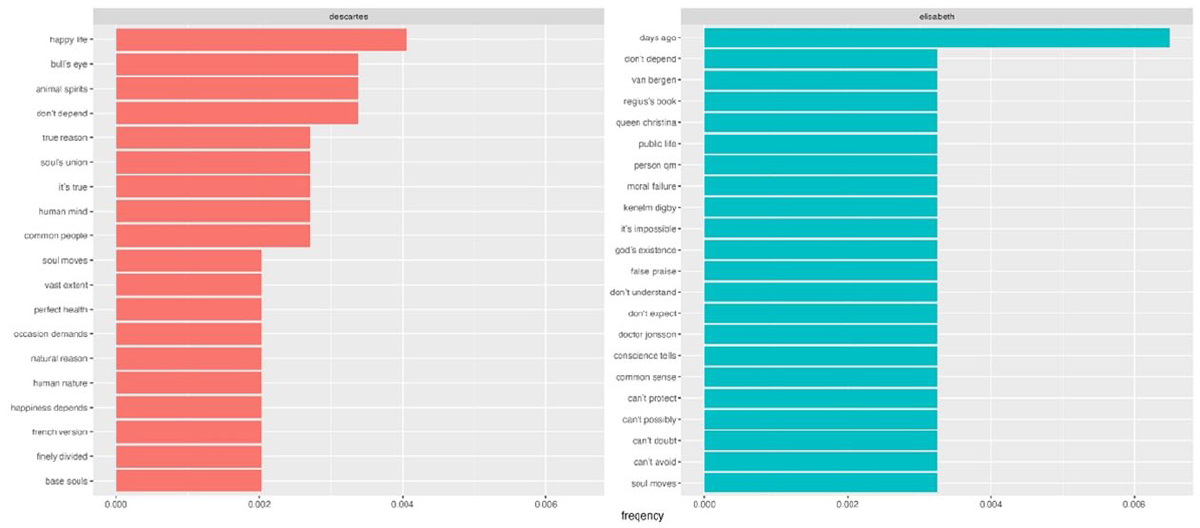
Most frequently used word pairs by author.
Feminist Moral Reasoning and Rethinking Stop Words
At this point, the evidence arising from these letters prompts one to reconsider further analysis to reveal their distinctive properties. Theory on feminist moral reasoning as well as previous research on the correspondence between Descartes and Elisabeth suggest a different approach. Broad (2002) concluded that Elisabeth’s philosophy is grounded in an interdependent and embodied moral reasoning, akin to Gilligan’s (1982) feminist moral reasoning. How could this affect arise in the correspondence and be detected by STM? Normally in STM, words like “my” and “your,” and pronouns like “I” and “me” are deleted as stop words in document preparation. These stop words as well as articles like “the” and “an” are deleted because, although they appear often in many bodies of text, their very frequency correlates with their absence of meaning (Mourtgos, 2024). To understand the correspondence between Elisabeth and Descartes, however, deleting possessive pronouns could miss important information. If Broad (2002) is correct and Elisabeth’s side of the correspondence betrays a communal ethos that Descartes’s does not, then deleting “my” and “your” as meaningless stop words might miss crucial clues to understanding her perspective on his mind/body dualism. For that reason, I analyze the correspondence with pronouns and possessive pronouns included. Although the unigrams look much the same as before (not shown) with possessives and pronouns dominating the top five words used (I, you, me, my, and your), the bi-grams provide a bit more interesting insight. With pronouns included, the bi-grams in Figure 3 reveal more about each author’s perspective.
Figure 3 shows that, when Elisabeth speaks about herself, she betrays some of the embodied reasoning described earlier: “My mind,” “my life,” “my health,” “my body”; in contrast Descartes focuses on himself as a subject in relationship to objects: “My letters,” “my opinion,” “my principles,” and “my views.” Reflecting this, Elisabeth’s top word pairs include “your letters,” “your principles,” and “your meditations”—all referring to Descartes. Figure 3 also reveals Elisabeth’s focus on “my life,” “my health,” and “my faults.” Further analysis allows for a deeper dive into word pairs using word networks.
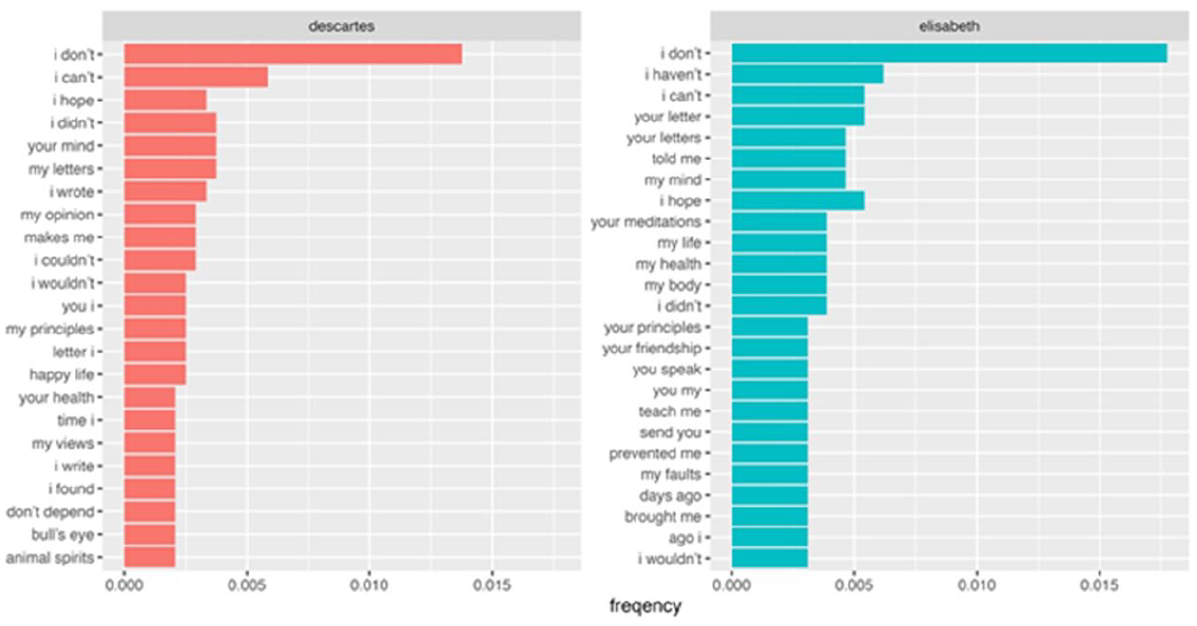
Most frequently used word pairs including possessive pronouns.
Bi-gram networks plot word pairs occurring more than twice. Thresholds can be set at any number, but with a small corpus of letters between two people such as in the present analysis, plots of word pairs that occur more than three times are very sparse, while plots of word pairs occurring once or twice are dense and messy. With the corpus of correspondence here, a network map of word pairs occurring more than twice allows for some analysis without an overwhelming amount of detail. Figures 4 and 5 plot word networks of pairs occurring more than twice for Descartes and Elisabeth, respectively. They reveal interesting patterns.
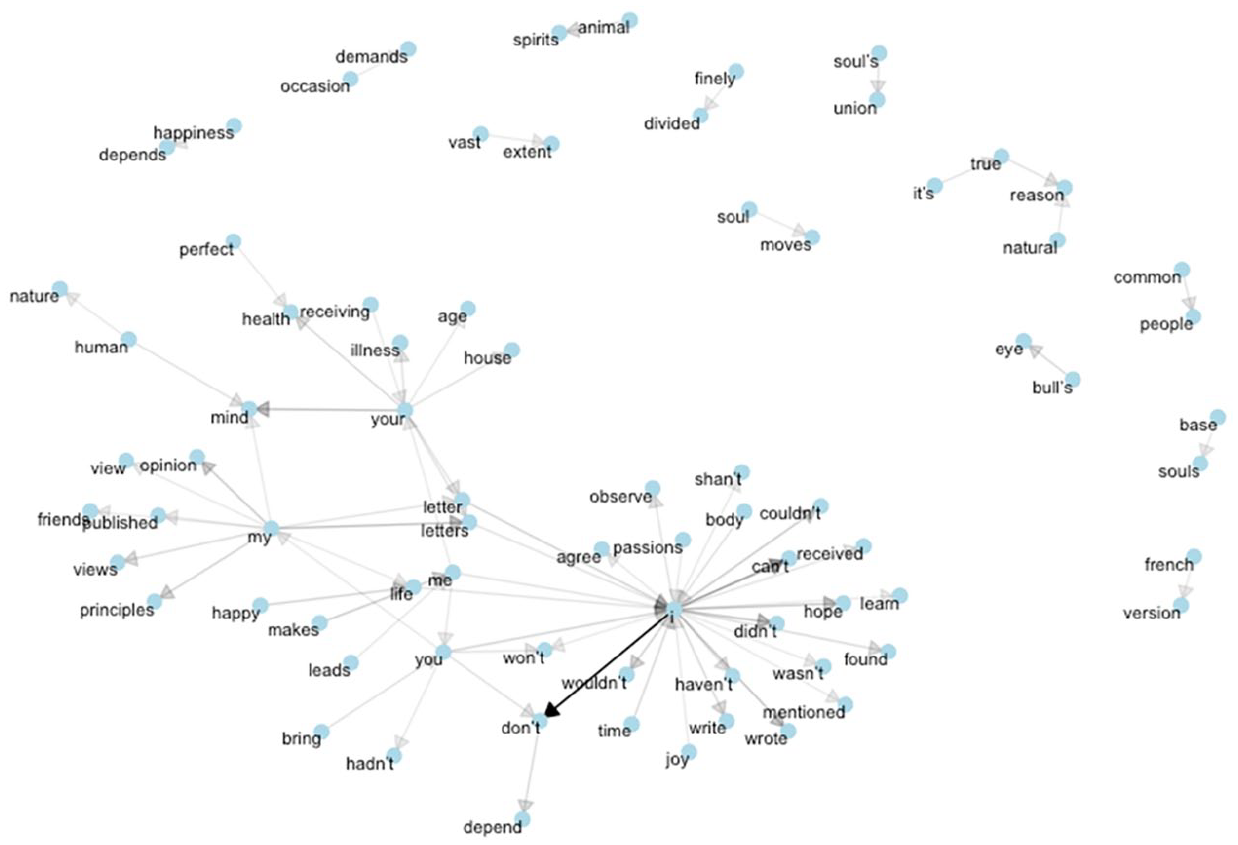
Descartes’s word networks for word pairs occurring more than twice.
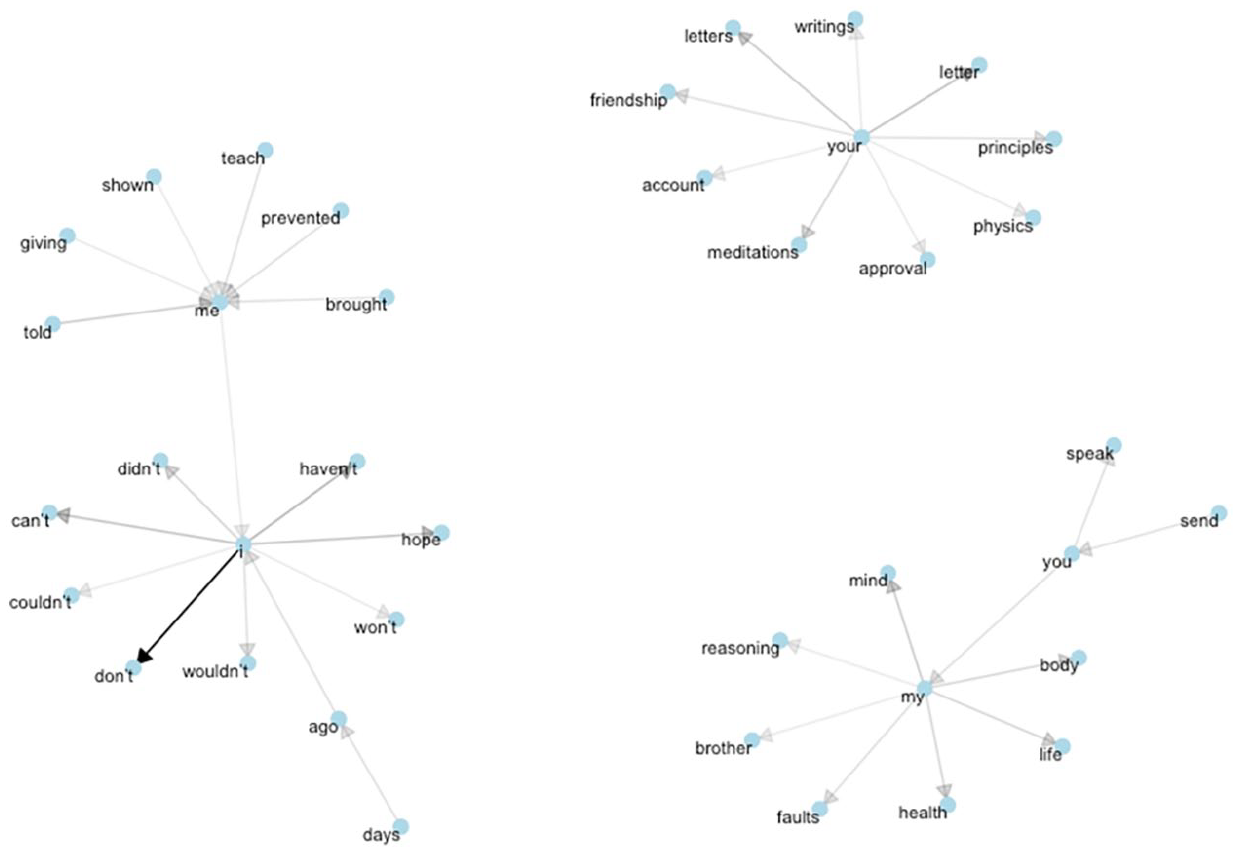
Elisabeth’s word networks for word pairs occurring more than twice.
Word networks in Figure 4 display the word pairs that arose in Descartes’ bi-gram in Figure 3: “My views,” “my principles,” “my opinion,” “my mind,” and “my principles.” Figure 4 also depicts the use of negative or passive language shown in Figure 3: “I can’t,” “I didn’t,” etc. Furthermore, when Descartes addresses Elisabeth, he reflects the topics she discusses: “Your illness,” “your health,” “your age,” “your house,” and “your mind.” Plotting Elisabeth’s word network for pairs occurring more than twice shows this in Figure 5.
Figures 4 and 5 suggest that, while Descartes writes about his views and principles and opinions, Elisabeth discusses her reasoning but also her life, her health, her body, her faults, and her family. Together, the word networks in Figures 4 and 5 support Broad’s (2002) conclusion that Elisabeth’s letters express a communal framework for her decision making such that her moral reasoning is embodied and interdependent and includes the people in her life in a way that Descartes’s does not. It is fair to acknowledge, however, that STM produces results that are interpreted according to a subjective process, akin to content analysis in general. In other words, like content analysis, word networks do not speak for themselves and still demand researcher intervention, which is subjective. Another researcher might draw different conclusions from Figures 4 and 5, but the foreground established by Broad 2002 provides an evidence base upon which this study builds.
As a set of letters between two people, the present corpus of correspondence differs from the types of documents that have been examined using STM in public administration and political science, such as politicians’ press releases (Grimmer & Stewart, 2013; M. E. Roberts et al., 2014, 2019), political speeches (Casiraghi & Curini, 2022), administrative agency documents (Hollibaugh, 2019), and newspaper headlines (Mourtgos, 2024). The word networks here reinforce Broad’s (2002) conclusion that Elisabeth’s letters betray a communal framework for her decision making, highlighting her moral reasoning includes the people in her life in a way that differs from Descartes. If Elisabeth’s argument about embodied reasoning was enough to sway Descartes from his strict mind/body dualism, as several scholars have argued (Broad, 2002; Garber, 2000; Jeffrey, 2018; Johnstone, 1992; Nye, 1996; O’Neill, 1998; Shapiro, 1999; Tollefsen, 1999; Yandell, 1999), why does a reductionist version of the mind/body dualism survive centuries of deliberations on emotions and reasoning? One answer following Grosfoguel (2015) points to the centrality and hegemony of White male norms, which also animate bureaucratic neutrality (Portillo et al., 2022b). I turn to that discussion now.
Epistemological Sexism: Defining and then Silencing the “Other”
Elisabeth’s hybrid concept of emotional reasoning stays lost to history for a range of reasons emanating from the broader power dynamics dictating who can create new knowledge and who cannot. Few women were published during Elisabeth’s time. Elisabeth communicated with several philosophers and thinkers during her lifetime in addition to Descartes. In spite of these frequent communications, however, Elisabeth was never a salonniere—she did not host writers and philosophers for the purpose of generating and disseminating knowledge. During her lifetime, Elisabeth might have been an appropriate midwife to new knowledge, but she was not considered a creator of new knowledge herself. This was due to events that began during the Early Modern period, when only certain individuals could credibly advance their views. Elisabeth’s knowledge creation was caught up in broader, global phenomena that privileged some views at the expense of others, dynamics that endure today as systemic oppression. The Early Modern era is the period of the “four epistemicides” that created and then silenced the “other” and help explain the race and sex hierarchies that endure to this day (Grosfoguel, 2015, p. 39): When Descartes wrote “I think therefore I am” in Amsterdam, in the “common sense” of the times, this “I” could neither be African, nor an Indigenous person, nor a Muslim, nor a Jew, nor a woman (Western or non-Western). All of these subjects were already considered “inferior” along the global racial/patriarchal power structure and their knowledge was considered inferior as a result of the four genocides/epistemicides of the sixteenth century.
The four epistemicides, described further below, disappeared all knowledge except that of White, European, Christian men. This period is recognized as the modernization of the Global North. Modernization simultaneously silenced and disappeared the Global South as well as women, non-Christians, and persons of color throughout the world. Alexander and Stivers (2020, p. 1477) also observe the defining and disappearing process in the eventual formation of the administrative state: “Citizenship is . . . a means of distinguishing and defending a defined community against chaos from without (foreigners) or from within (women, slaves, visitors): that is, those who lack the capacity to reason or do not share approved values.” What is more, Alexander and Stivers place the dawn of American public administration not with the Interstate Commerce Act of 1887 or with Woodrow Wilson’s article of that same year, but with acts of defining and disappearing: “The first administrative acts of the new government enforced racial categories as they pertained to citizenship. The federal Nationalization Acts of 1790, 1795, 1798, and 1802 consistently defined citizens as free White persons and excluded slaves, free Blacks, Muslims, and American Indians” (p. 1477). Defining citizenship in Alexander’s and Stivers’s (2020) observations about official personhood parallels the four epistemicides, establishes who counts, and determines who may rule.
Four global events set in motion a definition of “the people” (Catlaw, 2007)—who’s in and who’s out—that established the bases on which later Enlightenment philosophers developed a theory of popular sovereignty and citizenship (Alexander & Stivers, 2020)—who rules. Grosfoguel (2015) refers to these genocides as “epistemicides” because they gutted the capacity for all populations except White, male, Christians to create knowledge for centuries in the Global North:
Reconquista and the unification of Western Europe under Christianity (1492)
Trans-Atlantic slave trade (plundering Africa and its capacity, 1550–1800)
Colonizing the New World (plundering the Americas and their capacity, 1500–1950)
Witch hunts and witch burnings (silencing women’s knowledge, 1500–1750)
These global events rendered illegitimate all knowledge except that of White, European, Christian men. Descartes’s mind/body dualism is part of the broader disappearing of other knowledges that began during the Early Modern period.
These four genocides disappeared knowledge production by women, non-Christians, Africans, and indigenous people of the New World and solidified White, European, Christian men as the sole source of knowledge and official being. Such epistemic hegemony endures today. What remains is the powerful residue of centuries of domination that renders the thoughts of some thinkers more credible and legitimate than others: “White Euro-American values, beliefs, and worldviews, including individualism, meritocracy, progress, and so on, have dominated the rest of the world through colonialism, slavery, capitalism, and neocolonialism” (Kubota, 2020, p. 722). The capacity for knowledge creation by others was destroyed in these epistemicides, and this destruction hindered progress for centuries. Inequities of today were set in motion centuries ago.
Why is mind/body dualism so believable and so durable after so many years? Early on, the strength of this point of view came at the end of the sword (Grosfoguel, 2015; Kubota, 2020, Santos, 2014). It endured because the conquerors could depict their victory and enforce their view in terms of natural law, as if the adjudication of what is and what ought to be arose from a fundamental truth (Grosfoguel, 2015). If race and gender hierarchies can be depicted as naturally right and good, then such hierarchies become more than just the way things are; they become the way things ought to be. Candler et al. (2010, p. 844) draw a straight line from these epistemicides to current-day public administration theory and conclude: “A global public administration epistemic community does not exist in the sense of a homogeneous group of scholars who consistently draw on the work of others, and who therefore share consistent values, perspectives, and approaches.” North American scholarship is at once “woefully insular” (Candler et al., 2010, p. 844), yet also upheld as universal, as knowledge from nowhere, or “common sense” (Grosfoguel, 2015, p. 39) and the way society ought to be. Even research methods are characterized as American and White (Moloney et al., 2022). The research method used here is intended to be a departure from lingering positivist norms in public administration. Elisabeth’s moral outlook, like the settlement women living in the field, is based on her being in relationship with others. Public administration’s bureau men adopted an impartial and detached viewpoint akin to that in Descartes’s letters to Elisabeth. She adopts a contextualist approach that recognizes the needs of others; her focus is on relations between individuals, governed by care and concern (Broad, 2002, p. 15). At its origins, the field of public administration doubled down on technical rationality to explain administrative behavior (Stivers, 2000), but that explanation was always incomplete.
Twentieth century neuroscience research (Damasio, 1994) has illustrated Elisabeth’s hybrid theory of embodied reasoning. Emotions help to narrow the range of options in decision making by “upvoting” certain alternatives and ruling out others. Damasio’s somatic markers attach positive (or negative) valence to choices—the “upvotes” (or downvotes) that are both conscious and unconscious—to facilitate decision making. Damasio (1994) reveals that emotions give humans the capacity to assign social value to alternatives and prevents paralysis-by-analysis. Emotions assign value to some options over others. Feelings are motivators and drivers of behavior—matter of a different sort—because they provide meaning. Descartes’s notion of mind/body dualism has driven Western scholarly thought and embedded itself into administrative theory, even though it is not accurate and ultimately would not have been defended by Descartes himself.
Conclusion
In this analysis, STM demonstrates the presence of Elisabeth’s being in-the-world in her critique of Descartes’s mind/body dualism; a critique he evidently accepted. Results from STM confirm Broad’s (2002) conclusion that Elisabeth’s moral reasoning is consistent with what Gilligan (1982) asserted about women’s decision making: Elisabeth’s moral reasoning was other-inspired and founded in her interdependence with others. But her critique of Descartes’s mind/body dualism is largely lost to history due to global forces that elevated some perspectives at the expense of others. The durability of Descartes’s mind/body dualism is explained by Grosfoguel (2015) who traces how the four epistemicides in the Early Modern period that rendered knowledge in the Global North as the products of White, male, Christian elites that created the landscape in which Enlightenment thinking arose. Thought and reasoning from anyone other than White, male, Christian elites were obscured and silenced, and we live with the consequences of that silencing even today, as scholars criticize bureaucratic neutrality in public service (Portillo et al., 2022a, 2022b) and the origins of public administration (Alexander & Stivers, 2020). Even as laboratory research on the role of emotions in decision making supports Elisabeth’s insight (Damasio, 1994), the enduring impact of Descartes’s mind/body dualism leaves critics of bureaucratic neutrality and researchers of emotion pushing boulders up hills well into the 21st century.
The epistemic sexism that silences women’s voices in theory building (Stivers, 1995, 2000) also buries the role of emotions in the workplace. One way forward toward a more equitable epistemological landscape in public administration would be to create space for different forms of knowledge. This creates space for Santos’s (2014) Epistemologies of the South and the “critical engagement” prescribed by Candler et al. (2010, p. 847). Real change would arise from dismantling the knowledge structures around which public administration has developed as a field (Alexander & Stivers, 2020; Nisar, 2017, 2023). Emotional reasoning akin to Elisabeth’s hybrid account could play a role in public administration theorizing going forward. Narrowly defining emotions in decision making as simply coping (Tummers et al., 2015) reframes emotion as just another cognitive activity and is consistent with Descartes’s mind-over-matter prescription that Elisabeth resisted. Reasserting the important role of emotions in the workplace and the deleterious results of strict bureaucratic neutrality would be small steps toward undoing this instance of epistemic silencing in public administration theory and praxis. Doing so also would align public administration research with what has been known for decades from laboratory experiments about the important role of emotions in decision making. Reasoning and decision making are not diminished and distracted by emotions, but rather are facilitated and fostered. Emotions have an important function in the public administration workplace, and this role deserves a full appreciation and understanding.
Footnotes
Acknowledgements
The author thanks Dr. Scott Mourtgos and Dr. Ian Adams for assistance with analysis of evidence.
Data Availability Statement
The data that support the findings of this study are available from the corresponding author upon reasonable request.
Declaration of Conflicting Interests
The author declared no potential conflicts of interest with respect to the research, authorship, and/or publication of this article.
Funding
The author received no financial support for the research, authorship, and/or publication of this article.
Ethics Approval
N/A
Patient Consent
N/A
Permission to Reproduce Material from Other Sources
N/A
