




Abstract
To tackle persistent boundary-spanning problems with limited resources, some cities engage in collaborative innovation, combining expertise, effort, and creativity within and outside city hall to overcome limitations of conventional practices and siloed work. This article illustrates how collaborative innovation works in practice by examining specifics of how the Buffalo Clean Sweep Initiative, unique in longevity, scope, and scale, overcame common challenges and managed typical trade-offs. We describe, based on analyses of interviews and focus groups with city staff, community partners, and residents, how problem-solving, making an impact, and learning together helped Buffalo, New York, improve quality-of-life in its poorest neighborhoods.
Introduction
Cities facing major social, economic, and environmental issues—including crime, poverty, and climate change—are often not adequately funded, equipped, or empowered to respond effectively (Schragger, 2016). Moreover, the organizational fragmentation of city halls resulting from the division of labor into departmental silos inhibits creation of the type of boundary-spanning solutions these multifaceted issues demand. Performance pressure generated by fiscal constraints and residents’ need for results has led to local governments investing in innovations aimed at making themselves more effective, efficient, and equitable (Behn, 2003; de Jong & Rizvi, 2008; Katz & Bradley, 2014). Despite innovation in local government having become more mainstream—exemplary city governments sometimes being referred to as “hotbeds of innovation” and many U.S. cities, including the 10 largest, having installed chief innovation officers—changing the way government works remains a challenging enterprise, particularly when multiple departments are involved (Goldsmith & Crawford, 2014). Cities attempting to tackle complex social issues thus face the dual challenge of getting silos and sectors to work together as well as reinventing policy solutions. We refer to this important but difficult work as “collaborative innovation.”
More specifically, we define collaborative innovation as the process of combining organizational expertise, efforts, assets, and creativity within and outside city hall to enhance the efficiency, effectiveness, and equity of local government (Bommert, 2010; Sørensen & Torfing, 2018). The result is a discontinuity with established practices and the start of a new approach (Osborne & Brown, 2005). Collaborative innovation involves city staff, outside agencies, and residents working together to define problems and develop solutions (Roberts, 2004). Collaborative innovation can take the form of tweaking practices and promoting synergy to improve existing approaches or of generating entirely new approaches to complex problems. In the process, collaborative innovation can improve working relationships between governmental silos, between government and organizations in other sectors, and with residents (Alford, 2009; Page et al., 2015; Torfing et al., 2019).
There are significant barriers as well as benefits to collaborating across silos to solve problems. These challenges include aligning on a problem definition, managing competing commitments, building trust among collaborators, and measuring and managing collective performance (Douglas & Ansell, 2021; Waardenburg et al., 2020). Collaborative innovation involves changes not only in the way organizations work, but also in the mindsets of the individuals who populate the organizations (Bardach, 1998). Structures are sometimes easier to change than the entrenched roles and identities of city employees asked to work under different, more collaborative paradigms (Torfing et al., 2019; Waardenburg et al., 2020). Cross-boundary teams often get stuck in early stages of collaboration because they cannot agree on a shared vision sufficiently compelling to overcome the inherent obstacles to innovation (Martínez Orbegozo et al., 2022). Further, bringing relevant actors together in collaborative activities does not guarantee better outcomes, and can be detrimental in terms of lost money, time, and effort (Sørensen & Torfing, 2018; Vivona et al., 2023). Collaborative innovation also can be obstructed by legal, technological, performance, and operational barriers (Vivona et al., 2023).
Despite growing interest in collaborative innovation among practitioners and scholars, few empirical studies have examined how collaborative innovation works in practice at the operational level. How, exactly, do organizations reimagine individual professional practices, working processes, and organizational routines in service of joint problem-solving efforts? How do they address the inevitable challenges associated with aligning different organizational perspectives and interests to effect changes in existing practices?
This study seeks to answer the question of how collaborative innovation works in practice, at the street level and on the frontline of public service. To that end we closely examine a city-led collaborative innovation, Buffalo, New York’s Clean Sweep Initiative, remarkable for its longevity, scope, scale, and impact. The goal of the Clean Sweep Initiative is to improve quality of life in Buffalo’s poorest neighborhoods. Improving quality of life encompasses a wide range of interconnected solutions around safe housing, social and health services, public works, public safety, and more. Results of siloed approaches to multi-sector problems tend to be fragmented and exert insufficient impact. The Clean Sweep Initiative spans silos to improve quality of life and resident engagement in distressed neighborhoods by bringing together city staff from more than 10 departments and community partners from tens of organizations to pursue rapid, intensive blight remediation, community outreach and education, and code and law enforcement.
Substantial anecdotal evidence of the program’s impact has led to its replication in U.S. cities and internationally (Meyer, 2002; Weaver & Knight, 2018). An empirical study demonstrates its impact on residents’ reports of drug crime and blight (Dickens et al., 2023). In this study, drawing on data from interviews and focus groups across a wide range of stakeholders, we show how the city of Buffalo, through its Clean Sweep Initiative, has employed collaborative innovation to improve city government functions and devise novel approaches to solving complex neighborhood problems.
Context and Case
Buffalo, the second largest city in New York state, is one of the quintessential “Rust Belt” cities, former manufacturing epicenters confronting the socioeconomic fallout of deindustrialization, population loss, and shrinking municipal budgets (Goldman, 1983). Buffalo shares its social and economic challenges with other U.S. and international cities in which population loss, economic downturn, employment decline, and social problems have resulted in neighborhood neglect and abandonment (Martinez-Fernandez et al., 2012).
The first half of the 20th century saw Buffalo’s population and economic growth soar owing to its position as a principal rail and canal transshipment point (Goldman, 1983). Then, in the 1950s, highway construction siphoned off rail and canal shipping and federal housing subsidies prompted white and middle-class flight to Buffalo’s suburbs (Goldman, 1983). The city’s population declined by 61% between 1950 and 1980 (US Census Bureau, 2022), during which time federal housing programs wrote racial prejudices into public policy and produced enduring neighborhood inequities. Termed “redlining,” these policies denied Black residents access to federally backed loans and mortgages (Sugrue, 2008). Further blows dealt to the fabric of the Black community included the construction of a highway through Buffalo’s sole middle-class Black neighborhood in 1967 (Goldman, 1983).
Isolation from opportunity took a toll on quality of life in the neighborhoods of Buffalo, today home to 287,807 residents (US Census Bureau, 2022). Twenty-eight percent of the city’s families live at or below the poverty line, and racial disparities are staggering. Nearly 70% of Black, compared to 20% of White, residents live in poverty (US Census Bureau, 2022). That the majority of Buffalonians are renters (60%; US Census Bureau, 2022) reflects systemic barriers to wealth accumulation. Physical signs of vacant and abandoned properties abound. Seventeen percent of properties in the city are vacant, and the vacancy rate on Buffalo’s East side is 27% (US Census Bureau, 2022). Vacancy and abandonment have detrimental physical, mental, and social health outcomes for individuals and communities, increasing the risk of criminalized activity, poor mental health, reduced physical activity, and withdrawal from neighborhood social and civic life (Dahlberg & Mercy, 2009; de Leon & Schilling, 2017; Harrison & Immergluck, 2023; Lorenc et al., 2012; Stafford et al., 2007).
The Clean Sweep Initiative
The goal of the Clean Sweep Initiative is to improve quality of life in Buffalo’s poorest neighborhoods by increasing residents’ civic engagement and reducing blight and crime. Every Wednesday morning from May through October Clean Sweep participants (city staff and community partners) go to work in clusters of approximately 200 properties, encompassing an area of two to three blocks, selected across nine council districts on the basis of highest need, using data on crime, poverty, vacancy, and other indicators.
During a Clean Sweep, blocks are closed to traffic, and teams of city staff and community organization representatives go door-to-door greeting residents and distributing printed information related to city and community services including healthcare, employment, home improvement, the city’s non-emergency help line (311), and more. If no one is home, the information is left on the porch. Residents who answer the door are engaged in conversation about their needs and their concerns heard. Meanwhile, public works and forestry teams trim trees, grass, and bushes; remove graffiti and trash; repair signs and sewer grates; and board up vacant properties. Housing inspectors examine exteriors of homes and community police officers introduce themselves, listen to residents’ concerns, solicit reports about local criminal activity, and make residents aware of public safety programs. Also present to answer residents’ questions and learn about the neighborhood context are other city staff and the city council members who represent the neighborhood. Participants gather with neighborhood block clubs and community leaders to prepare and debrief before and after each Clean Sweep.
The Clean Sweep Initiative has run since the late 1990s and began in response to intransigently high rates of crime and blight that were not responsive to siloed efforts. The Clean Sweep built on existing community organizing work to improve neighborhood conditions. The early years of the Initiative were characterized by rooting out criminal activity, enforcement, and penalization, alongside community outreach. In 2006, with the election of a new mayor and the appointment of a new Director of Citizen Services, the Initiative changed to focus on compliance assistance, provision of support services, and community engagement. The Clean Sweep Initiative continues to evolve each year, adapting to feedback from partners and residents and to changing neighborhood needs. New city departments and community organizations are added or dropped, and new approaches are tried. The Clean Sweep Initiative is an example of collaborative innovation in practice. It brings together expertise, resources, and creativity from multiple departments in city hall and many organizations outside city hall. Through working together on shared problems, the Clean Sweep has been able to both improve existing practices and develop entirely new approaches, as will be described in the results section. Reasons for selecting the Initiative as the focus of this study include its longevity, number of sectors working together, frequency of collaboration, and scale. It was not selected as necessarily a best practice or “recipe for success.” In this study, we examine how the Clean Sweep’s collaborative innovation processes overcome common challenges in city government, and we explore the types of tradeoffs that are involved.
Methods
Data Collection: In October 2021, we conducted 25 semi-structured key informant interviews (KII) and five focus group discussions (FGD) around three themes: (a) if and how the Initiative’s goals are achieved, (b) the impact of and tradeoffs involved in working together (cross-silo collaboration) versus working alone (siloed work), and (c) perception of the Initiative’s impact across the range of Clean Sweep participants and community members. KIIs were conducted by the first, second, and third authors. FGDs were facilitated by trained Buffalo community leaders.
We conducted thirteen 60- to 90-min KIIs with city staff. Participants were recruited through purposive and snowball sampling; the interviews were held at City Hall (n = 7) or via video conferencing (n = 6). Eight 5- to 15-min KIIs were conducted during a Clean Sweep, with participants recruited through purposive and convenience sampling. Four 60- to 90-min KIIs were conducted with community leaders recruited via contacts at City Hall. Four FGDs were held with residents (average n = 4 participants) whose blocks had received a Clean Sweep with recruitment via flyers placed in neighborhoods and emails to lists maintained by block clubs and the Department of Citizen Services. The 90-min FGDs with residents were held in the evening at community centers. One 90-min FGD was conducted with Clean Sweep community partners (n = 11 participants) the morning before a Clean Sweep.
Data Analysis: All KIIs and FGDs were recorded and transcribed. Thematic analysis (Taylor et al., 2018) was used to code transcripts in Dedoose (version 8.0.35). Each transcript was coded independently by two researchers and discrepancies subsequently discussed and resolved. Sub-themes were identified after initial coding and a codebook was developed (13 parent codes, 17 child codes). The codes included deductive codes from the interview guides and inductive codes from the data. Analysis of the KII and FGD data revealed three processes by which collaborative innovation overcomes common challenges of siloed work: Problem Solving Together, Making Impact Together, and Learning Together. We situated our study within a framework that links multi-sector collaboration activities to socially desired outcomes (Figure 1).
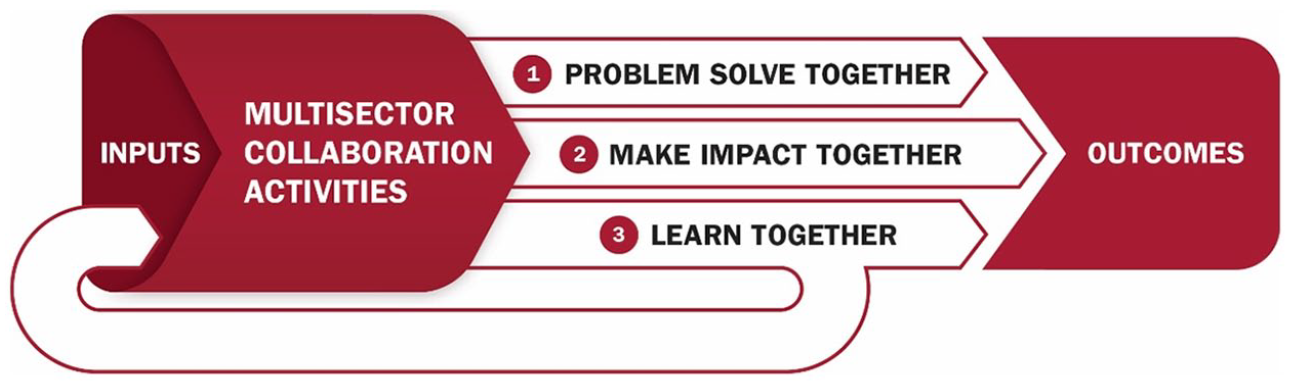
Social outcome generation through collaborative innovation.
Limitations: This study has several limitations. First, the data collected through the KIIs and FGDs are subject to common biases including social desirability and recall bias. Although KIIs with city staff and community leaders achieved saturation (Low, 2019), time and resource constraints limited resident FGDs to four. Selection bias is a further limitation of the data from resident FGDs. As the number of residents at each FGD was small despite broad outreach, it is likely those with strong opinions about the Clean Sweep Initiative were more likely to participate. Given that outreach was conducted in part through neighborhood block clubs and the Department of Citizen Services, it is also likely that residents who participated in the FGD were more engaged, or interested in becoming engaged in their community compared to residents who did not participate. To mitigate these biases, respondents were asked to share viewpoints of which they were aware but did not hear reflected in the discussion, and encouraged to think about how other members of the neighborhood might respond to the discussion questions. Respondents also were reminded that there were no correct answers and that researchers were interested in hearing both contrasting and affirming viewpoints. Recognizing that the results might be influenced as well by confirmation bias, wherein researchers interpret data to support their own hypotheses, we inductively and iteratively identified the mechanisms of collaborative innovation utilized by the Clean Sweep Initiative through rigorous coding and synthesis of the data and connected the findings to existing literature.
Results
Problem Solving Together
One way multi-sector collaboration affects basic city functions and complex boundary-spanning problems is through the co-creation of solutions. City employees, community organizations, and residents work together to define problems and generate aligned solutions. For example, housing inspectors, whose job is compliance-oriented, work alongside service-oriented city departments and organizations to provide information about fair housing, loans for home repair, and more. Inspectors can easily connect residents with services because the providers are on site. In interviews, frontline staff like housing inspectors described how the Clean Sweep afforded them time to learn from residents about the context of problems, a dynamic one housing inspector characterized in this way.
You get an opportunity to see the bigger picture. Whereas during daily duties, when you see a violation you might give a ticket and you’re on to the next call. But with a Clean Sweep, you talk to the person and find out this person’s elderly, they don’t have many funds, they’ve been on the waiting list a long time, and they need help. . .That’s going to change the nature of the interaction [. . .] We all work together and try to find the more appropriate service for a person.
Many residents who at first reported being skeptical of interactions with city staff during Clean Sweeps subsequently expressed surprise and satisfaction at the level of individualized problem solving. City staff shared how time spent talking with residents led to improved compliance with codes or more impactful delivery of services. “I did have some complaints [from residents] about the inspections,” observed one community leader, “but then they were really impressed because they found out that the city’s willing to help them.”
Creating space for police to work alongside service providers yielded a similar benefit. Recurrently, city employees, community leaders, and residents described how observing police officers working with representatives of community organizations and other city departments reduced barriers to communication and built trust. Police officers reported tangible benefits of impromptu conversations with residents, summarized by one officer: Police officers’ duties are so broad—it doesn’t lend a lot of time to give one-on-one attention to a specific area or specific people unless it’s attached to a 911 call. So, [the Clean Sweeps] are very, very important to us because we get to have that face time with citizens, we get to hear their complaints and you’ll be amazed at the amount of information they’re willing to give one-on-one [. . .] Some of that information hasn’t been available to us in other forums. These are things we learn firsthand talking to people because they feel comfortable in that environment.
Other city employees corroborated this sentiment. One recounted a specific interaction with a resident during a Clean Sweep.
When I was talking to [a resident], I found out the first thing she saw [during the Clean Sweep] was the police, and there’s already a negative connotation for a lot of people in the communities we serve. She was hesitant to open the door, but when she saw other people, she was like “Oh, there’s a team of people out here and they’re just cleaning and doing stuff.” So she opened the door like, “Oh, you guys are finally trimming that tree. Thank you.” Once the door is open [conversations happen].
This is not to suggest that solving problems together is easy. Interviewees described how the process of cross-team deliberation did not always lead to immediate consensus, but did provide space to iterate potential solutions that eventually led to a resolution. For example, several city employees recalled conversations about how best to induce landlords to make repairs when the lack of upkeep stemmed from diverse root causes (e.g., predatory, absentee, elderly, or low-income landlords). Through deliberation and experimentation, they tried several approaches in partnership with the courts, community organizations, and block clubs and adopted the strategies that worked.
Most city staff and community partners, although they endorsed the value of multiple sectors working together, also acknowledged difficulties. Observed a housing inspector: Even though they kick us in the shins you still have to work with [community organizations]. You’re not going to agree on everything, but there are large areas that we do agree with. And that’s important. Whether it’s zombie houses or tenant rights [. . .] You realize that we’re doing the best we can, but to be more effective we need to make some changes.
Of the challenges involved in collaborative innovation, loss of efficiency was cited most frequently. A community partner characterized the tradeoff: If you do it right, it’s slower because you’re engaging with the community. You’re finding out what they need. You’re trying to craft an appropriate response. But it’s much more effective. Whenever you have a group of people meeting, it can be sloppy, occasionally a little unruly, but the product is so much better.
Including multiple sectors and professional orientations in problem solving was perceived by a number of interviewees to introduce a degree of disorder and time inefficiencies. But while some city employees expressed frustration with sacrificing the regularity and order of siloed solutions, recognition of increased effectiveness and equity during Clean Sweeps was widespread.
Making Impact Together
A second way collaborative innovation during the Clean Sweep works is by shaping the physical and social environment in a highly visible way. Most of the city employees and community organization representatives interviewed maintained that working together generated greater impact than working alone. This was accomplished through mutually reinforcing activities and by generating a focused impact on a targeted area rather than dispersing the impact throughout the city. The trimming of a single tree on a street per a work order on a non-Clean Sweep day, for example, might be noticed only by the residents whose dwellings face it. Residents may not be aware that tree trimming is a government service because it is often performed by contractors. Untrimmed trees may damage street signs or cause other problems that cannot be resolved by forestry alone. During a Clean Sweep, every tree on a street is trimmed and grass cut, trash removed, and issues like damaged signage fixed on the spot by people wearing city uniforms. The impact is highly visible, as is the role of city government in generating the impact.
This impact of collaborative innovation extends to complex challenges as well. Residents and city staff repeatedly reported that observing change in the physical environment influenced social norms with respect to maintaining a cleaner environment. Some characterized this as providing a behavioral nudge that signals to residents that the city cares. One resident attested to this as follows: You know what the change was [after the Clean Sweep]? The neighbors felt as though they were going to maintain it [the cleaner environment] . . . Pride was developed because of the Clean Sweep. People took pride in the way the street was maintained. And now they know that’s what they’re expected to do.
This sentiment was echoed by another resident, who remarked, “I think the impact was that [residents] see that people are getting involved, because if no one ever gets involved no one’s ever going to pick up the litter. Someone has to start it.”
Making impact together inspired feelings of collectivism in city employees and residents alike. City staff frequently described the sense of community among Clean Sweep participants as motivating their involvement. They also cited examples of a Clean Sweep fostering a stronger sense of community among residents. For example, city staff reported that residents joined or started neighborhood block clubs as a result of a Clean Sweep, or participated in cleanup efforts, both of which increased the impact of the city’s work. Reflected one city employee: People talk about crime and problems in every city. Everyone looks for this newfangled solution, but the solution is always going to go back to community and collectivism. It’s in partnership [. . .] Because as a collective we say we’ll fight against it together as opposed to letting it pick us apart one by one. [. . .] [Residents] see [the collective approach] and it’s precedent setting. It sets the bar for what we’re trying to establish in each neighborhood—a collective community environment that works together and is cohesive.
Working together, however, although it may lead to greater change than working alone, can still be insufficient to meet residents’ needs or be sustainable. Some city employees suspected that the impression some residents took from the Clean Sweep was that the city will do the work for them, resulting in less accountability on the part of residents. For example, one city employee observed that, “In some places [residents] think that ‘Oh, the city does all of this work on trees, I don’t need to take care of the trees in my yard.’” Among residents, especially in areas with a low proportion of homeowners, the sustainability of blight remediation was perceived to be limited. One resident remarked: [The Clean Sweep] made us smile for a minute, but as far as impact is concerned, it’s us [. . .] After next weekend it was back to normal. It was back to just us. So, we appreciate it, but it was just a good gesture. That’s about it [. . .] It has to be long enough that the community takes over from there.
There was also a perception of diminishing returns from collaborative innovation. A number of city staff were quick to point out that although they achieved an impact not possible outside of Clean Sweeps, they were glad not all work involved extensive cross-sector collaboration and new approaches. Much of their core work, they explained, benefits from a siloed and predictable approach. “If we only did Clean Sweeps 5 days a week,” observed a public works employee,
I don’t think we’d get as much done or have it as organized as we do now . . . There’s a limit to it, there’s a role and a purpose for it, but I don’t think it’s the way to bring services to the city everywhere, every day. We wouldn’t be able to address all the city’s needs that way.
Collaborative innovation can help cities deliver basic city functions and devise innovative solutions, but bureaucratic division of labor was still viewed as the preferred mode for performing many standardized, routine, and high-volume activities.
Learning Together
A third way collaborative innovation during Clean Sweeps works is by initiating a self-reinforcing feedback loop of capacity building and learning. Interviewees described how what they learned during Clean Sweeps not only contributed to improved outcomes for residents, but also expanded the skill and knowledge they could bring to future Clean Sweeps, as well as utilize in their roles outside of Clean Sweeps. The structure of participation contributes to this feedback loop; staff participants in Clean Sweeps spend a morning a week for 6 months working alongside each other. Meetings before and after each Clean Sweep provide opportunities not just for action, but also for cycles of planning, shared decision-making, and reflection. The majority of city employees interviewed maintained that learning and working together on a recurring basis and the opportunity to expand their capacity though information exchange with residents yielded impacts that would not have been possible within single departments or static structures. “There are additional synergies when you have everybody together,” observed one city employee,
. . . because oftentimes it’s those side conversations. It is the networking. It is the “Hey wait, you got a problem with that house? I got a problem with that house also.” But your problem may be from a water or sewer line. And his is from a police issue. And his is from a building inspector. And his is from a neighbor. All these people together oftentimes have different perspectives, a how do you see the elephant type thing.
Added another city employee: [Clean Sweeps] allow different departments to build relationships so that going forward if they are talking to a resident who has a housing issue, they know that [Fair Housing] will be the guy to talk to about it. I think that through the Clean Sweep process we’re improving municipal government as a whole. We’re all here for the people. Working together creates that team energy and team culture.
A number of city employees observed that the expansion of knowledge and capacity during Clean Sweeps extended beyond the Clean Sweep activities, changing practices of individual departments and staff outside the Initiative. For example, in response to feedback from residents and community organizations that lack of cross-cultural understanding was a barrier to resolving code violations, the code enforcement department increased the diversity of its workforce. The new officers were from immigrant communities in which they were well known and respected. City staff and community partners reported that the new inspectors were better able to work with residents in culturally appropriate ways to ensure that their homes met safety and health standards. The officers were also able, through ties to community organizations, to provide support to residents when needed.
Connections formed during Clean Sweeps led a number of community organizations and community police officers to begin to collaborate on events outside of Clean Sweeps. They found they were better able, by working together, to reach their target populations and work toward a shared goal of safer communities, especially in predominately Black neighborhoods in which residents had had negative experiences with, and hence had negative perceptions of, the police. When city staff heard from residents about mental health problems and encountered increasing numbers of residents in mental health crisis, they invited the city’s behavioral health team to join Clean Sweeps and added an enhanced mental health component to their winter season program to reduce social isolation.
Many non-frontline staff reported that seeing problems they work on close-up during a Clean Sweep improved the way they do their jobs when in the office. Explained one city staff member, “The Clean Sweeps change perceptions of neighborhoods and priorities. . . and have an indirect impact on other decisions made at City Hall.” A city planner elaborated: So now I know as a planner “Okay I’m going out to this census tract in Black Rock. I know from my visit to this neighborhood from Clean Sweep last year that they really need X, Y, Z. So, my planning project is less on their priority list [. . .] They want their street fixed and their landlord to be better and things like that.” It gives me more context to the neighborhoods I work in.
Frontline staff also credited the results of their work to closer connections with residents. Explained one city staff person: When you’re out there on the Clean Sweeps you’re not just solving the problem because the request came across your boss’s desk, so they’re like, “Oh, fill the pothole.” You have a resident coming up to you saying, “Hey, can you please fill that pothole?” It makes it realer; it makes it that person-to-person connection.
“That’s why I love the Clean Sweeps,” remarked a community organization representative who shared this sentiment, “it gets us into the community door by door, bush by bush, house by house. We’re seeing the issues in the city versus from 30,000 feet up.” When asked what contributed to a culture of continuous learning and teamwork, most interviewees described the shared goal of improving quality of life for residents and a feeling of mutual support in trying out new efforts.
The process of learning and innovation is nevertheless messy. A number of interviewees stated that although collaborative innovation during Clean Sweeps is part of standard operating procedure for many departments, the process of getting there had not always been smooth. It had taken time and iteration. Reflected one city employee, “It’s hard to feel you have the [professional] latitude when you’re the only one [doing something new or different] [. . .] it’s a balancing act of expectations within city departments.” Some interviewees alluded to difficulties of unclear ownership and insufficient accountability structures when working on a new problem together or with new partners, but many found that a shared mission mitigated some of the messiness and uncertainty associated with change.
Discussion
In this article, we identify and describe three separate but interlinked types of work that enable collaborative innovation: problem solving together, making impact together, and learning together. These processes can help organizations overcome the limitations of siloed work and reimagine existing practices in order to achieve more effective, efficient, and equitable outcomes. Our analysis of the Clean Sweep Initiative demonstrates that collaborative innovation can surmount traditional boundaries and resource constraints through creative problem solving, collective impact, and engagement in continuous learning. Our analysis also, however, acknowledges tradeoffs with respect to efficiency and certainty. We elaborate below how these findings connect with and contribute to existing scholarship.
Problem Solving Together: Getting Closer to the Problem and Co-creating Solutions
The bureaucratic form of organization involves specialization and division of labor, which is associated with not only greater efficiency but also increased fragmentation (de Jong, 2016). Solving complex neighborhood problems typically requires the knowledge and efforts of a variety of disciplines and organizations. When frontline staff who work in close proximity to neighborhoods have few opportunities to share information or feedback with managers and other stakeholders, fragmentation can lead to inefficiency and ineffectiveness (Head & Alford, 2015).
In contrast to the conventional siloed approach to service delivery and law enforcement, collaborative innovation is problem-oriented. Problem-orientation in city government takes the problem at hand—rather than departments or institutions—as the starting point (Mayne et al., 2020). The Clean Sweep Initiative brings city staff and community partners nearer to the problems they are working to resolve (e.g., community and police relations, blight, lack of connection to support services), and in most cases involves them in conversation with the people experiencing the problems. As the findings exemplify, when actors with different resources, skills, and perspectives problem-solve together, they are likely to engage in mutual learning about a problem, and arrive at a better understanding and sense of collective ownership of the problem (Sørensen & Torfing, 2018). A systematic review of barriers to public sector innovation found that most common barrier related to the interaction of multiple parties was lack of shared understanding (Cinar et al., 2019). Interviewees in our study did not cite lack of a shared understanding as a barrier; rather they described how problem solving together helped them to build a shared vision even if they were “not going to agree on everything.” Problem solving together, especially alongside residents, afforded city staff the “opportunity to see the bigger picture” and access “information [that] hasn’t been available to [them] in other forums.”
Co-creation of solutions in the public sector is a process of addressing societal needs through open participation, exchange, and collaboration with relevant stakeholders, which may involve public, private, and civil society (Voorberg et al., 2015). As reported by interviewees in our study and borne out in previous studies, co-created solutions, especially when they involve residents, improve compliance with regulations and uptake of services and may also lead to increases in legitimacy and trust in government (Bekkers & Tummers, 2018; Voorberg et al., 2015).
Making Impact Together: Increasing the Efficacy of City Government and Residents
Interviews with residents and city staff revealed that engaging residents in problem solving during Clean Sweeps affects how they view their own efficacy as well as that of government. This finding has been described by others (Zacka, 2017) and explained as eliciting reciprocity through teamwork (Bardach, 1998). Dialog and tangible impact generated through interactions between government staffers and residents increases trust and influences residents’ attitudes and behavior regarding doing work themselves (Buell et al., 2021). For example, when an entire street is full of trash it is hard for an individual to feel their efforts could make a difference. When all the trash is removed during a Clean Sweep, however, residents feel empowered to maintain the physical environment. Improving the physical environment during Clean Sweeps demonstrates a government’s responsiveness, not just to fix problems once they’re known, but to proactively bring resources to neighborhoods neglected or intentionally harmed by past (federal, state, and city) government actions. The perception of government as responsive and effective is associated with an elevated individual and collective will to sustain improvements (Buell et al., 2021; Jennings & Stoker, 2004). This is evidenced during Clean Sweeps by residents engaging with government to report service needs or sign up for needed services—as well as by residents leading their own efforts by starting block clubs or participating in clean-ups. Collaborative innovation can strengthen communities by developing mutual trust between residents and city staff that can spur individual and collective efforts to accomplish new things (Torfing et al., 2019).
The shift that interviewees described in the attitude and behavior of residents represents what De Vries et al. refer to as “conceptual innovation,” or an innovation that reframes the nature of problems and their solutions. It also represents an “administrative process innovation” in which new working methods within local government (e.g., making impact together at the same time and in the same location) improves the quality and effectiveness of services (De Vries et al., 2016). In their systematic review of innovation in the public sector, De Vries et al. (2016) find that administrative process innovations are the most common and well-studied of innovation types, while conceptual innovation is the least common and the most scarcely researched.
Learning Together: Tapping into Resources, Authority, and Expertise Across Silos
The Clean Sweep Initiative opens the innovation cycle to a variety of actors, supplementing traditional government functions while transforming others by combining expertise, assets, and ideas across silos and sectors and reconfiguring activities and interventions. The Initiative transcends professional norms and generates broader sociopolitical support for new ways of problem-solving and learning. Horizontal learning between departments yields new resources and authority to tackle complex social problems (de Jong et al., 2021). This is especially important in contexts in which silos operating alone lack sufficient resources or community trust. Identifying points of interdependence across silos enables city staff and civil society to find and exploit synergies and leverage the knowledge gained to improve the delivery of basic services (e.g., street cleaning) and enforce regulations (e.g., up-to-code rental housing) as well as tackle complex social problems (e.g., crime; Touati et al., 2019).
For example, conversation between community police officers and residents is a core component of each Clean Sweep. When there is trust between police and community, not only can criminalized activity be more equitably and effectively identified and penalized, but the city, community organizations, and residents can work together to reduce conditions that foster crime (Jennings & Stoker, 2004; Lanfear et al., 2020). Resident input solicited during Clean Sweep activities is key to both solving and preventing crime. Tapping into this information and investing in community connections constitute a shift in professional norms and problem-orientation for police officers. This plays out in listening to residents and responding to their concerns and engaging in partnerships with community organizations that are trusted by residents.
Learning through collaborative innovation requires that participants not only be able to acquire knowledge from external partners and residents but also to absorb and apply it (Vivona et al., 2023). The weekly frequency of the Clean Sweep from May through October of each year offers many opportunities to acquire knowledge from diverse stakeholders, as well as opportunities to apply knowledge in iterative learning-by-doing cycles. Interviewees described the “additional synergies when you have everybody together” and the changed “perceptions of neighborhoods and priorities” that come from learning together—and these factors benefited the participants’ own work as well as the Clean Sweep Initiative’s work toward broader goals.
A study by Hammarfjord and Roxenhall (2017) found that organizations were more innovative when commitment among collaborators was high, as measured by indicators such as positive feelings toward the network, a desire to continue to be part of the network, and feeling that the network problems felt like their own problems. These sentiments were echoed by Clean Sweep participants and demonstrated through commitments of staff, resources, and energy. Learning together helped participants recognize the complexity of municipal problems and become more innovative in bringing about solutions.
Tradeoffs and Challenges
Its merits notwithstanding, collaborative innovation does not always work; nor is it always the best cse of action (Gray, 1989; Hartley, 2005; Vivona et al., 2023). Collaboration can be costly in terms of time and resources (Huxham & Vangen, 2005), disorienting and intimidating (Waardenburg et al., 2020), and cumbersome and frustrating with respect to achieving alignment on everything from problem definition to action planning to measuring success (Martínez Orbegozo et al., 2022). Loss of efficiency was the tradeoff associated with collaborative innovation interviewees most often cited in our study. Efficiency tradeoffs may be short-term and part of a longer-term shift toward more effective problem-solving (Eggers & Macmillan, 2013). Still, reduced efficiency is a well-documented cost of collaborative innovation (Vivona et al., 2023). Vivona et al. (2023) describe this as a “coordination cost” related to task interdependence, for example, when one employee must wait for others to finish their activities before he or she can begin.
Learning to problem solve together is iterative and takes time. It differs from bureaucratic norms in which processes and activities are highly structured and dictated top down. Collaborative innovation often requires changing existing beliefs and practices (Sørensen & Torfing, 2016), and initiating new processes and activities can be risky and uncertain (Bardach, 1998). City employees described how participating in Clean Sweeps changed their perspective on their work, but applying that changed perspective to work outside the Clean Sweep was not easy. It required building support to facilitate further innovation, test and integrate new ideas, and diffuse innovative solutions within departments and networks (Torfing & Sørensen, 2011). The challenges to collaborative innovation are many, but the challenges facing city governments are greater. Collaborative innovation is not a panacea, but it can help cities meet common challenges to achieving greater social impact.
Directions for Future Research
In this study, we closely examine the Clean Sweep Initiative in Buffalo, New York—a long-standing, city-led collaborative innovation that takes place in the context of high poverty and deficits in government legitimacy and resources. Through collaborative innovation, the city works to overcome these limitations and improve the wellbeing of its citizens. Future research should examine how collaborative innovation works in practice across other institutional, economic, and social contexts. For example, in higher-resource contexts there may be less to gain from harnessing resources across departments and from outside of city hall. Alternatively, in higher-resource contexts there may be more forums where diverse stakeholders can meet to discover, design, and implement innovation around shared problems. Further, the mechanisms of how collaborative innovation works within longstanding collaborations—like the Clean Sweep—may be different than within nascent collaborative initiatives. Future studies should also examine the distinctive leadership capabilities that are required for collaborative innovation across different contexts. For example, Cinar et al. (2019) found that a top-down (hands on) approach was the most common governance structure for collaborative innovation initiatives across several country contexts; however, Sørensen and Torfing (2016) underscore the importance of bottom-up (hands off) approaches to collaborative innovation. Finally, unlike most collaborative innovation work, the Clean Sweep engages in conceptual innovation—innovation that results in paradigm shifts in how residents, community partners, and local government view problems and solutions (De Vries et al., 2016). More research into the facilitators and barriers to conceptual innovation in particular is needed to advance solutions to many of cities’ most intractable problems.
Conclusion
Because no single silo or sector is adequately positioned, equipped, and resourced to address the persistent, boundary-spanning problems facing cities, new collaborative approaches are essential. The lessons drawn from how collaborative innovation in the context of the Clean Sweep Initiative expands the capacity and resources city governments bring to problems both simple and complex. The findings have broad applicability to how we understand and intentionally design collaborative innovation initiatives. Foremost among these lessons are: (a) Problem-Solve Together by making the real time definition and solution of concrete, practical problems a project of focused staff from relevant departments; (b) Make Impact Together by finding situations in which work by one actor visibly and tangibly enhances the work of another; (c) Learn Together by cultivating a culture in which learning occurs not just within but across departments. To realize the value of collaborative innovation requires not just breaking down silos, but actively engaging staff in transforming professional norms and practices. This transformation opens the innovation cycle to a diversity of resources and skills and broadens the support and resolve to confront cities’ most pressing social problems.
Footnotes
Acknowledgements
We extend sincere appreciation to Oswaldo Mestre Jr., director of the Division of Citizen Services in Buffalo, NY. We are also grateful to Juweria Dahir, Michael Smith, and Ellen Harris Harvey of Buffalo City Hall for their support.
Declaration of Conflicting Interests
The author(s) declared no potential conflicts of interest with respect to the research, authorship, and/or publication of this article.
Funding
The author(s) disclosed receipt of the following financial support for the research, authorship, and/or publication of this article: This work was supported by Bloomberg Philanthropies.
Ethics Statement
This study was approved by the Harvard Institutional Review Board, protocol number IRB19-1820.

Data Availability Statement
The data are not publicaly available because they contain information that could compromise the anonymity of reserach particiapnts.