



Abstract
This study investigates the intricate interplay between citizens’ trust in government institutions and their perceptions of institutional effectiveness. The two may have an endogenous relationship as they influence each other. Yet, since they stem from different sources and have distinct dynamics, their relationship may exhibit a directional bias in terms of causality: citizens’ trust may impact the perception of institutional effectiveness more than vice versa. As the survey results from Hong Kong suggest here, this may indicate that trust is not only performance-based but also character-based, with the latter lasting longer and exerting a greater impact on perceptions of institutional performance.
Introduction
Public trust in government institutions embodies dynamic interactions between the citizenry and the government. Trust may be understood as a declaration by citizens that government institutions are dependable and trustworthy (Brown, 2020; Mishler & Rose, 2001). It also may be regarded as the expectation that government institutions will fulfill their roles satisfactorily and will not cause harm to citizens (Hardin, 2000; Levi & Stoker, 2000). While institutional performance when deemed positive, helps to generate or sustain citizens’ trust, government institutions depend on citizens’ trust to underpin their legitimacy and to maintain effective functioning (Dong & Kübler, 2021; Van de Walle & Bouckaert, 2003; Zhang et al., 2022).
Scholarly works have focused on the relationship between institutional performance and trust at least since the 1970s, but the strength of their association and direction of causation remain controversial (Van der Meer, 2018; Van Ryzin, 2007). Some scholars treat public trust as a consequence of institutional performance. For example, rational choice institutionalists believe that institutional trust is rationally based (Hudson, 2006; Kim, 2005; Lühiste, 2006): the extent to which citizens are willing to place trust in a government institution is determined by its effective performance, whether perceived or actual. Trust is thus “earned” by institutions that can enable positive policy outcomes for citizens (Christensen & Lægreid, 2005; Grimmelikhuijsen et al., 2013).
A burgeoning strand of literature nevertheless has suggested the contrary, maintaining that public trust is an important determinant of institutional performance. Some scholars argue, for example, that citizens’ trust in a government institution induces their cooperation and compliance with the institution’s policies and regulations (Ball et al., 2019); trust can provide government institutions with a favorable environment that encourages them to work more diligently and deliver their services smoothly; as such, public trust increases institutional effectiveness (Rudolph & Evans, 2005; Van Ryzin, 2011). The importance of public trust in government has been clearly demonstrated by management of the global COVID-19 pandemic, where citizens are more willing to cooperate with the government to observe anti-coronavirus measures if they have a higher level of trust in government (Bargain & Aminjonov, 2020; Fukuyama, 2020; Han et al., 2023; Wu et al., 2022).
The controversy over the relationship between institutional performance and public trust brings several important questions to the fore: How are the two variables associated with and influence each other? How can we explain the seemingly endogenous relationship between perceived institutional effectiveness and public trust if we assume a causal relationship between them? In the literature that deals with the relationship between institutional performance and public trust, scholars tend to view this relationship as a one-way street and fail to carefully consider their mutual impact. Our study fills this research gap by examining how institutional performance and public trust are associated, whether one carries more weight in influencing the other, and the institutional logic underlying the relationship between the two.
We see a closely related yet nuanced and dynamic relationship between institutional effectiveness and public trust. Citizens’ positive perception of a government institution’s performance contributes to their trust in that institution, while public trust helps to enhance its institutional effectiveness. However, the two variables may carry different weights in their endogenous relationship because of their differing sources and dynamics. Trust can be either performance-based or character-based. Character-based trust highlights the impact of an institution’s structure and setting on citizens’ trust in the institution, whereas performance-based trust emphasizes the linkage between an institution’s performance and people’s trust in it (Hakhverdian & Mayne, 2012; Q. Yang & Tang, 2010). Our findings suggest that the impact of citizens’ trust on boosting perceptions of institutional effectiveness is stronger than the impact of institutional effectiveness on trust.
This study uses the Independent Commission Against Corruption (ICAC) in Hong Kong as a representative case to provide a refined understanding of the causal relationship between trust and institutional effectiveness. The ICAC has been widely regarded as a successful model for anti-corruption agencies (ACAs). Established in 1974, it has played a major role in turning a once notoriously corrupt society into one that has zero tolerance for corruption (Gong & Xiao, 2017). The ICAC has earned a high level of public trust and is widely regarded as an effective agency. The trust that people place in the ICAC is derived from a complex combination of factors, including ICAC’s long-standing effectiveness in combating corruption and its own institutional characteristics, such as independence and extensive investigative powers. Therefore, the case of the ICAC can be a typical example to exemplify the nuanced relationship between institutional effectiveness and public trust. Focusing on one single public institution may be methodologically preferable to studying the entire political system, as the latter consists of many different agencies and can be influenced by various factors (Robinson et al., 2013). Empirically, the study draws on a large-scale original survey that was conducted in Hong Kong in 2020 using a randomly selected sample of 2,009 participants. Methodologically, we employ 3SLS analysis to test the hypotheses, which is appropriate for addressing endogenous relationships (Chang & Chu, 2006; Morris & Klesner, 2010).
This study makes several contributions. Theoretically, it speaks to a rich volume of literature that investigates the relationship between institutional performance and public trust (Marien & Hooghe, 2011; K. Yang & Holzer, 2006; Zhang et al., 2022) but departs by focusing more on the impact that the two exert on each other; how they are associated. It argues that the interaction between the two is not like a one-way street but rather a virtuous circle, thus contributing to the theoretical debate about the direction of the causal relationship between institutional effectiveness and public trust. This study also contributes to a more nuanced understanding of the performance-trust relationship by measuring the different weights of the two factors in their association. The impact of public trust on institutional performance seems stronger than that of institutional performance on public trust, because trust can be not only performance-based but also character-based, which tends to last longer and exert a greater impact on institutions. This finding has practical as well as theoretical implications for government institutions’ endeavors to obtain and sustain public trust.
Theory and Hypotheses
Trust is a contested concept. This study follows the definition of the Organization for Economic Cooperation and Development (OECD) that deems trust as measurable by the share of people who report having confidence in government, which is crucial for the legitimacy of public institutions and for the maintenance of political participation and social cohesion (Morrone et al., 2009). Despite the importance of institutional trust, scholars nevertheless have different views regarding its sources. In contrast to the culturalist understanding of institutional trust that regards it as deeply embedded in a society’s cultural context, rationalist analysis contends that trust in public institutions is influenced by citizens’ evaluations of the economic and political performance of institutional actors (Christensen & Lægreid, 2005; Godefroidt et al., 2017; Norris, 1999). While good performance generates trust, poor performance breeds skepticism and distrust (Mishler & Rose, 2001; Zhang et al., 2022). Citizens tend to trust or distrust an institution on the basis of their perception of the quality of its policy outcomes (Kestilä-Kekkonen & Söderlund, 2016; Lühiste, 2006; Rohrschneider & Schmitt-Beck, 2002). Institutional trust, therefore, represents citizens’ affirmation of an institution’s ability to accomplish its goals and act consistently.
As a significant indicator of organizational performance, institutional effectiveness is defined as success in achieving “the formal objectives of services” of an institution (Boyne, 2002, p. 18). Perceptions of effectiveness then are intricately linked with public assessments of an institution’s capacity to provide desired goods and services (Hakhverdian & Mayne, 2012; Morris & Klesner, 2010). Perceived effectiveness is subjective, but it cannot be sustained unless there is actual evidence of satisfactory performance; in other words, a public organization must convey to citizens its effectiveness in order to earn their trust while improving its actual performance (K. Yang & Holzer, 2006). That positive perceptions of institutional effectiveness help raise levels of institutional trust has been confirmed by many empirical studies that have been conducted in both advanced democracies and in post-communist countries (Barbabela et al., 2022; Johnson, 2005; Lühiste, 2006; Newton, 2001; Van de Walle et al., 2008).
When we look at corruption prevention as a specific area of policy, we can see that citizens’ evaluations of institutional effectiveness logically hinge on the government’s capacity to reduce corruption. This capacity is demonstrated, on one hand, by how governments, and ACAs in particular, deal with corruption and, on the other hand, through citizens’ direct feelings about the amelioration of government integrity in their daily interactions with public officials. If citizens consider an ACA to be effective in curbing corruption, then that ACA has utility for them. Conversely, if an ACA is ineffective or is perceived to be so by citizens, it will eventually become redundant.
In Hong Kong, before the advent of the ICAC, corruption had penetrated almost every single segment of society. The ICAC overcame various challenges to build its strong organizational integrity and capacity and has acted effectively against corruption. Its achievements in controlling corruption have contributed to the creation of a favorable environment for good governance and rapid economic growth in Hong Kong (Dzhumashev, 2014; Scott & Gong, 2018). The public sector in Hong Kong has established as organizational values respect for the rule of law, freedom, dignity, and privacy (Brewer et al., 2014). The ICAC’s long and continued success in preventing corruption makes Hong Kong internationally well-known as one of the least corrupt societies in the world. In the meantime, the ICAC has earned favorable public perceptions of its work, which in turn have significantly increased citizens’ trust in the Commission. Based on relevant scholarship and the Hong Kong experience, we suggest our first hypothesis:
H1: A higher level of perceived institutional effectiveness of a public institution contributes to stronger public trust in that institution.
Whereas many scholars consider trust to be a result of institutional effectiveness, trust also influences institutional effectiveness. Trust is believed to exert positive effects both on the survival of an institution and on its effective functioning (Citrin & Luks, 2001; Mishler & Rose, 2001). Trust represents the citizenry’s endorsement, from which public institutions derive social support (Braithwaite & Levi, 1998; Easton, 1965). The public’s endorsement not only encourages institutional actors to work more diligently to live up to the expectations of that trust but also provides them with the courage to make policies that may be unpopular in the short term but generate long-term benefits (Hetherington, 2005). Furthermore, just as trust contributes to effective performance, trusting citizens also perceive the institution to have greater effectiveness, not only because of its good performance but also because they believe that it is trustworthy and dependable (Rudolph & Evans, 2005).
Low institutional trust, conversely, has detrimental effects on an institution. It may lead to noncompliance with policies that are promulgated or enforced by unpopular institutions or produce opposition to government programs, which, in turn, hinders effective institutional performance (Devine et al., 2021; Hamm et al., 2019). Citizens with lower levels of political trust are less likely to obey governmental regulations, which might undermine the effectiveness and legitimacy of a government’s action and its ability to implement legislation (Marien & Hooghe, 2011; Tu, 2023; Wu et al., 2022). This poor performance will then further reinforce dissatisfaction with and distrust in the government, thereby generating a vicious circle (Mishler & Rose, 2005).
The same logic underlies the performance of ACAs. Citizens’ trust is vital for an ACA to act effectively against corruption because citizens are more likely to lend their support to an ACA that they consider to be trustworthy. For example, if they trust the ACA, then they will be more willing to report suspected corruption cases to it, assist in its investigations, and back it up when it faces challenges (Gong & Wang, 2013). In Hong Kong, the ICAC has earned citizens’ trust not only because of its strong performance but also due to its independence, impartiality, and institutionalized policy process; in response, trust from citizens further strengthens its capacity and effectiveness (Scott & Gong, 2018). This logic prompts the inverse hypothesis of H1:
H2: Stronger trust in a public institution contributes to a higher level of perceived effectiveness of that institution.
Hypotheses 1 and 2 posit that citizens’ trust in government and their perceived effectiveness of government institutions are closely associated and potentially mutually reinforcing. Nevertheless, in reality, their relationship may prove to be more intricate than conventionally assumed. Although they influence each other, the two do not necessarily go hand in hand with each other. Research on institutional trust has drawn from Easton’s (1965, p. 273) concept of “diffuse” bases of support, which considers institutional trust to be a “reservoir of favorable attitudes or goodwill that helps members to accept or tolerate outputs to which they are opposed or the effects of which they see as damaging to their wants.” Diffuse trust includes a commitment to an institution, which is defined as a willingness to support and defend the rules, procedures, norms, and structures that guide and constrain the functioning of the institution even if doing so produces unfavorable consequences (Easton, 1975). Thus, institutional trust generally is built upon an institution’s demonstrated effectiveness; yet it is not always so, as it also may be character-based (Keele, 2007; Mishler & Rose, 2005; Price & Romantan, 2004).
According to Gabarro (1987), trust can be derived either from the character or from the competence of individuals and organizations. Character-based trust pertains to the qualitative attributes of conduct inherent in the strategic philosophies and cultures of individuals or organizations, such as integrity, true motives, consistency and predictability of behavior, openness, and discreteness, while competence-based trust regards operating behavior and day-to-day performance (Whipple et al., 2013; Whipple & Frankel 2000). In this way, diffuse support for an institution is partly derived from the character-based trust of the institution that features integrity, consistency, common values, transparency (Dirks & Skarlicki, 2004; Seijts et al., 2015), adequate accountability systems, and trustworthy procedures, which help prevent misbehavior (Laurian, 2009).
Moreover, institutional trust is considered to be “a more deeply entrenched psychological phenomenon that requires more time and extraordinary political events to change significantly” (Lühiste, 2006, p. 477). Scholars believe that institutional trust is path-dependent, meaning that once a level of trust is established, it may persist and ensure that the institution retains a certain leeway in times of insufficient short-term performance (Caldeira & Gibson, 1992; Price & Romantan, 2004). The deeper, more fundamental attitude toward the institution would be “more or less detached from its immediate performance and forms a ‘reservoir of goodwill’” (Thomassen et al., 2017, p. 512). Thus, trust in an institution may help it survive difficult situations and crises. Even when citizens do not have adequate information about the intentions and outcomes of the institution, they may still retain confidence that the institution will not willfully harm them and will perform well (Secor & O’Loughlin, 2005, p. 68). In other words, although institutional performance and effectiveness may be short-lived, public trust in a government institution tends to be stable and may last longer.
In Hong Kong, citizens’ trust in the ICAC rests on its institutional characteristics as well as on its performance. Public trust has enabled the ICAC to overcome various challenges and to enjoy a continuously high level of social support, even if it is not considered very effective in dealing with certain special situations (Scott & Gong, 2018). Thus, this study argues that although perceived institutional effectiveness and trust mutually influence each other, the impact of trust on perceived effectiveness may be stronger than that of perceived effectiveness on institutional trust. This leads to our third hypothesis about the interaction between the two variables:
H3: The impact of institutional trust on perceived effectiveness is stronger than that of perceived effectiveness on institutional trust.
Data, Measurements, and Empirical Strategies
Data Collection
Data for this research were collected through a survey that was administered with the help of the Social Sciences Research Centre at The University of Hong Kong in May and June 2020. Due to the COVID-19 pandemic, a telephone survey was more practical than face-to-face interviews. To obtain a representative sample, the telephone survey was conducted via both domestic fixed and mobile lines. For fixed lines, seed numbers were obtained from the online White Pages residential directory by dropping the last digital number. Then, all ten possible numbers (0 through 9) were added to the seed numbers, yielding the sampling frame for the fixed-line respondents. Within each household, the survey candidate was selected using the “Modified Next Birthday” rule. The sampling frame for the cellphone survey was obtained from blocks allocated by the Office of the Communications Authority (OFCA) for mobile use, and telephone numbers were randomly selected and used for contacting respondents. Eligible candidates were individuals aged 18 or above who spoke Cantonese, Putonghua, or English. Cantonese is the major language in Hong Kong, but the research team prepared the questionnaire in various languages. In total, 2,009 questionnaires were completed, with about half obtained through residential fixed lines and the other half through mobile phones. Specifically, interviewers made 22,184 fixed-line calls, using the sampling frame, identified 1,193 eligible respondents, and completed 1,005 interviews, with a response rate of 84%. For the cell phone survey, interviewers made 31,398 calls using the sampling frame and completed 1,004 interviews among the 1,157 eligible respondents, with a response rate of 87%. We used the pooled sample of 2,009 respondents in the empirical analysis. 1
Key Measurements: Perceived Effectiveness and Trust
The public perception of the effectiveness of the ICAC’s anti-corruption work is a major research variable in the study. Because performance is multidimensional and cannot be tapped by a general question, this study identified six specific aspects of the ICAC’s anti-corruption efforts that could be evaluated as being effective or ineffective: controlling illegal business transactions, cross-border collusion, government-business collusion, bribery, nepotism, and abuse of public power. These areas highlight the most challenging tasks of the ICAC. For example, in recent years the ICAC has received more corruption complaints from the private sector (about, e.g., illegal business transactions and government-business collusion) than it has from the public sector. In addition, the increased integration of Hong Kong into the Guangdong-Hong Kong-Macao Greater Bay Area has made tackling cross-border collusion more challenging.
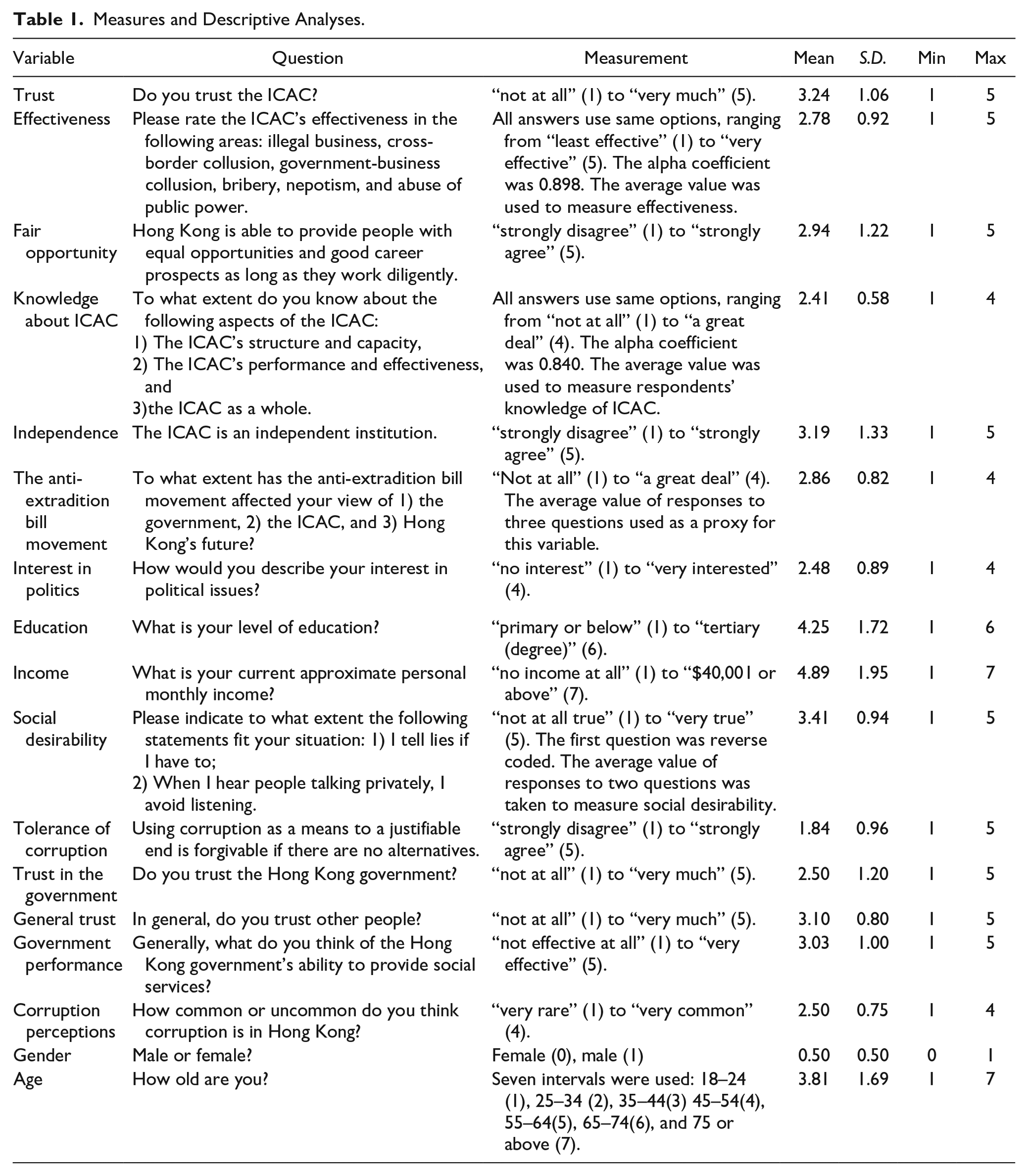
Respondents were invited to evaluate the effectiveness of the ICAC’s anti-corruption work in the six selected areas, with answers ranging from “least effective” (1) to “very effective” (5). Because interviewees might not fully understand the meaning of these items, a brief example was provided for each item in the survey. Interviewers would introduce the example to the respondent to help them understand the specific question if needed. The scores for the six specific scenarios demonstrated meaningful variations. Factor analysis showed that the six questions could be aggregated into only one factor with an eigenvalue of 3.99, which is larger than the threshold of 1. In addition, a reliability test of the 6-item scale had a Cronbach’s alpha of 0.898, demonstrating strong reliability. Thus, the average value of the six questions was taken as the measure of a respondent’s perception of the effectiveness of the ICAC. However, the mean value of the six effectiveness items was 2.78, which is relatively low. The average value may reflect a tendency for people to be more critical of the ICAC’s effectiveness when the contexts are more specific.
Following the literature on measuring institutional trust (Chen, 2017; Kang & Zhu, 2021; Morris & Klesner, 2010), this study measures trust by asking the respondents about the extent to which they trust the ICAC. Again, a 5-point Likert-type scale was used, with options ranging from “not at all” (1) to “very much” (5). The mean value of trust was 3.24, with a standard deviation of 1.06.
The survey process included a step to check the extent to which respondents were able to differentiate between institutional trust and perceived effectiveness. It asked respondents to choose one of following four statements that best described their opinion: the ICAC is effective, the ICAC is trustworthy, the ICAC is both effective and trustworthy, and the ICAC is neither effective nor trustworthy. As Figure 1 depicts, a considerable number of respondents choseeach item, suggesting that effectiveness and trustworthiness were distinguishable to them, although this preliminary finding may require further exploration and explanation.
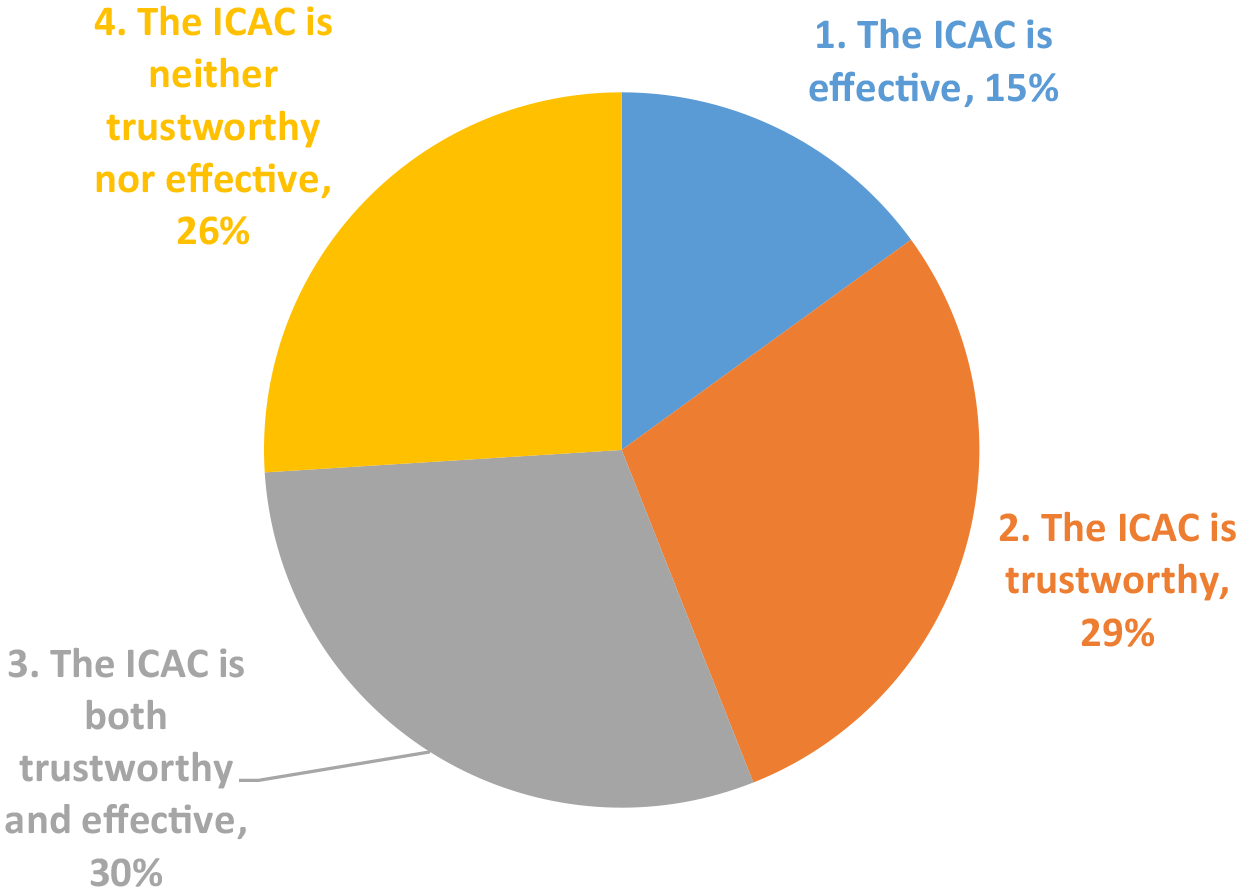
Trustworthiness and effectiveness.
Empirical Strategies: Modeling the Relationship
This study proposes a mutually reinforcing relationship between citizens’ perception of an institution’s effectiveness and their trust in that institution. An ordinary least squares estimation is not able to provide unbiased estimates because it produces residuals correlated with the endogenous variables, thus violating the assumptions of the OLS. To address this technical challenge, analysts typically adopt simultaneous equation modeling (SEM) to estimate the relationship between endogenous variables. Scholars often use two modeling techniques: two-stage least squares (2SLS) regression and three-stage least squares (3SLS) regression. Although these two methods are similar, 3SLS estimation further considers the correlation of disturbances in the final step, which is more suitable for this research because it enables us to analyze the empirical relationship between institutional trust and perceived effectiveness.
Recent studies from various disciplines that focus on endogenous relationships have adopted 3SLS regression (Jung & Lim, 2020; Kaidi et al., 2019; Kapri & Jha, 2020). This estimation method has also been employed in corruption studies that have encountered endogeneity issues. For example, Chang and Chu (2006) employ 3SLS to examine the mutual relationship between institutional trust and perceived levels of corruption. Morris and Klesner (2010) adopt the same method to support the mutual relationship between trust (both interpersonal and political) and perceived corruption using survey data from Mexico. Another recent study also adopts 3SLS to control for the reverse effect between corruption and income levels (Jetter et al., 2015). Thus, the 3SLS model is more suitable than OLS model for this study. 2
Some control variables are included in 3SLS models. People’s institutional trust and their perceptions of institutional effectiveness can be affected by various social, institutional, and individual factors. Our survey was conducted during the Anti-Extradition Bill Movement in Hong Kong, and public trust and the perception of institutional effectiveness may have been affected by the unusual political environment at the time. To control for the impact of the political situation, we asked survey respondents about the extent to which the Anti-Extradition Bill Movement affected their views of 1) the Hong Kong government, 2) the ICAC, and 3) Hong Kong’s future. The 3 items have a Cronbach’s alpha of 0.717; we used their average value to measure respondents’ attitudes toward the movement. In addition, respondents were asked about their political interests in general using a slightly modified version of question from the World Values Survey. Respondents were asked to answer the question “How would you describe your interest in political issues,” with four options ranging from “very interested” to “no interest at all.” Although 44.9% of the respondents providednegatively, 45.5% said that they were “somewhat interested,” and 9.7% reported being “very interested” in politics.
At the societal level, respondents were asked about their perceptions of the availability of fair career opportunities, because social inequality in Hong Kong is among the highest of cities across the world. Some critics have even argued that high social inequality was the main factor driving political protests in Hong Kong. 3 Thus, people’s view of career opportunities in Hong Kong could have an impact on their perceptions of the ICAC, which is an indispensable part of the government.
The survey also included two control variables about ICAC. People’s perceptions of an ACA can be affected by their knowledge of the institution, so respondents were asked to report the extent to which they understood ICAC’s structure and capacity, its performance and effectiveness, and ICAC as a whole. The average value of these three questions was taken as a proxy of a respondent’s knowledge about ICAC. 4 In addition, the survey included a question about the ICAC’s independence. The independence of ACAs is widely believed to be a pillar of anti-corruption governance, since independence not only strengthens an agency’s performance but also fosters citizens’ confidence in the fight against corruption. The independence of the ICAC, therefore, could exert important impact on respondents’ trust and their evaluation of its effectiveness and should be controlled for. Respondents were asked to what extent they agree with the statement that “ICAC is an independent institution,” with possible answers ranging from “strongly disagree” (1) to “strongly agree” (5).
Corruption is a sensitive topic and may influence respondents to give socially desirable answers. Following the literature (Collins et al., 2009; Paulhus, 1986), our survey included two questions as proxies to measure the respondents’ level of social desirability. 5 The two questions were “I tell lies if I have to” and “When I hear people talking privately, I avoid listening,” with answers ranging from 1 (least true) to 5 (very true). We also included two corruption-related variables. One was respondents’ tolerance of corruption, tapped by a single question in the form of a hypothetical statement. The other was respondents’ perception of corruption in Hong Kong. Citizens’ educational and income levels also were controlled for.
The 3SLS estimation requires unique variables in each equation. When analyzing respondents’ perceptions of the ICAC’s effectiveness, we accounted for their views about the overall performance of the Hong Kong government, because their perceived performance of the government as a whole might influence how they assessed the effectiveness of the ICAC as a government institution. Similarly, trust in the government and interpersonal trust are included as additional explanatory variables in the trust equation. Furthermore, 3SLS estimation requires that the number of additional exogenous variables be equal to or greater than the number of endogenous variables in the models, thus indicating that at least two additional exogenous variables are needed in the first-stage regression. Following the literature (Morris & Klesner, 2010), we added two exogenous variables:gender and age, as additional instrumental variables.
Table 1 provides detailed information on the measurements of all variables and descriptive analysis. On average, respondents relatively relatively higher trust in the ICAC (3.24 out of 5) compared with their perception of ICAC’s effectiveness (2.78 out of 5) and their overall trust in the government as a whole (2.50 out of 5). Respondents also reportpositive assessments of ICAC’s independence (3.15 out of 5) and low tolerance of corruption (1.84 out of 5). The average education level and income level of respondents are relatively high, which likely reflects the actual situation in Hong Kong. Respondents’ ages are equally distributed among the intervals, and males and females account for 50% each.
Measures and Descriptive Analyses.
Regression Findings and Discussion
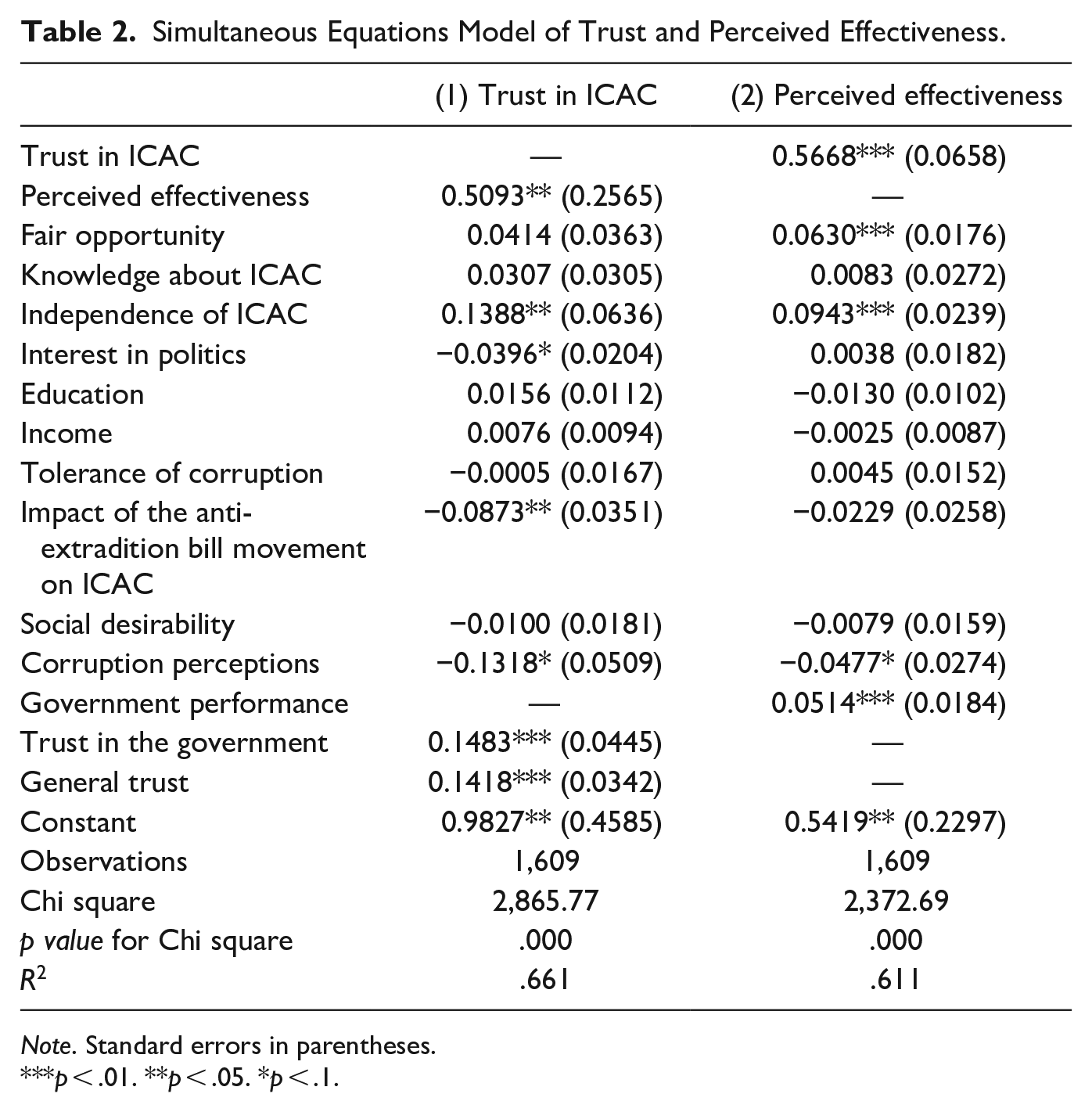
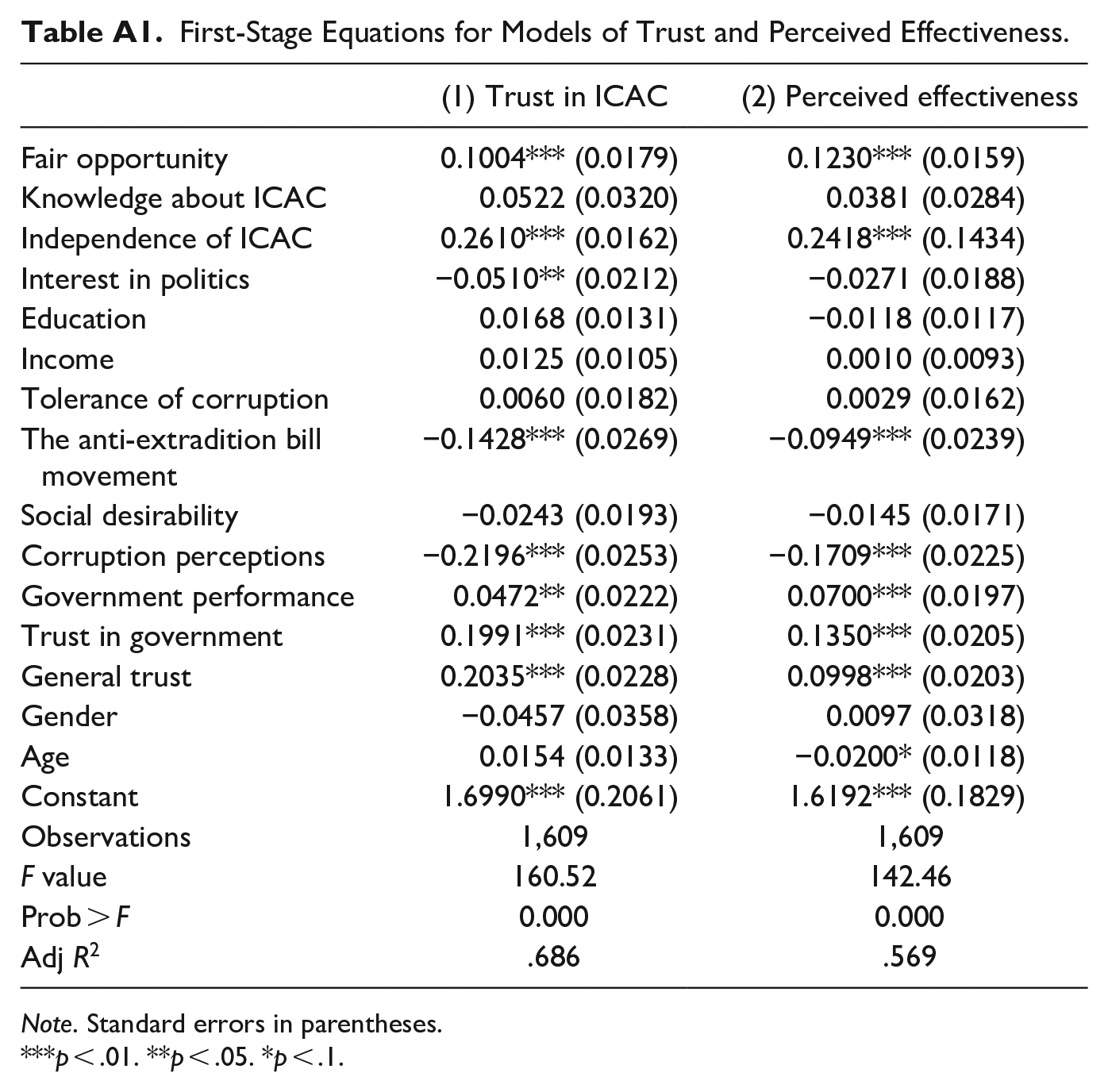
The first stage of the 3SLS estimation employed all of the exogenous variables to predict values for the endogenous variables, institutional trust and perceived effectiveness. The Appendix reports the results of the first-stage estimation. Both equations contain 15 exogenous variables and have high adjusted R2 values, indicating that the first-stage regression can generate accurate predicted values that then are used as instrumented values in the third stage. Table 2 reports the results of the 3SLS estimation of the SEM. In the trust equation of Model 1, effectiveness coefficient is 0.509 (p < .05), suggesting that perceived ICAC effectiveness has a statistically positive and significant association with trust in the ICAC. Thus, Hypothesis 1 is supported. In the effectiveness equation of Model 2, citizens’ trust in the ICAC has a significant and positive impact on perceived institutional effectiveness, with a coefficient of 0.567 (p < .01), supporting Hypothesis 2.
Simultaneous Equations Model of Trust and Perceived Effectiveness.
Note. Standard errors in parentheses.
p < .01. **p < .05. *p < .1.
Although the impact of respondents’ perceived effectiveness on their trust in ICAC passes the statistical significance test in the trust equation (Model 1), its magnitude is somewhat smaller than the coefficient of the impact of trust on perceived effectiveness and is statistically significant at the 5% level (compared to the 1% level for the coefficient of the impact of trust on effectivesness). This provides some evidence supporting Hypothesis 3; the impact of people’s trust on their perception of an institution’s effectiveness is stronger and more robust than their perception of the institution’s effectiveness on their level of institutional trust. In doing the statistical analysis, we also examined sub-sample regression analyses for those responding on fixed-lined and cell phones, respectively. Although these additional results provide only partial support for Hypothesis 1, the key findings for Hypotheses 2 and 3 remain the same.
A possible explanation is that institutional trust can be either character-based or performance-based, as several scholars suggest (Hakhverdian & Mayne, 2012; Van Ryzin, 2007; Q. Yang & Tang, 2010). As we discussed previously, character-based trust highlights the importance of an institution’s structure and characteristics in affecting citizens’ trust, whereas performance-based trust emphasizes the linkage between an institution’s performance and people’s trust in that institution. In Hong Kong, there is little doubt that the effectiveness of the ICAC contributes to public trust in the agency. Yet a substantial proportion of the population considers the ICAC trustworthy because they see themselves as sharing its moral values with it, and they regard it as a moral arbiter, a defender of impartiality, and a guarantor of fairness, as manifested in its independence, transparency, and institutionalized processes and procedures (Scott & Gong, 2018). Their trust in the agency may be maintained even if its performance is perceived as not being effective under some circumstances. This may be either because they consider it capable of self-redress or because they believe that factors other than the agency affect its diminished effectiveness (Xiao et al., 2022). Our survey results confirm the difference between character-based and performance-based trust, indicating that the impact of trust on the perception of ICAC’s institutional effectiveness of the ICAC is stronger than that of perceived institutional effectiveness on trust.
To distinguish the impact on trust of performance from that of institutional characteristics, we asked survey respondents to select two important reasons why they trusted or distrusted the ICAC. As Figure 2 shows,when explaining their trust respondents assigned higher weighting to the ICAC’s institutional character than to its performance. Whereas more than 60% of the respondents mentioned the power and independence of the ICAC as reasons for their trust or distrust, 27% noted the agency’s effectiveness, and others mentioned its efforts. This further indicates that trust is generated from different sources.
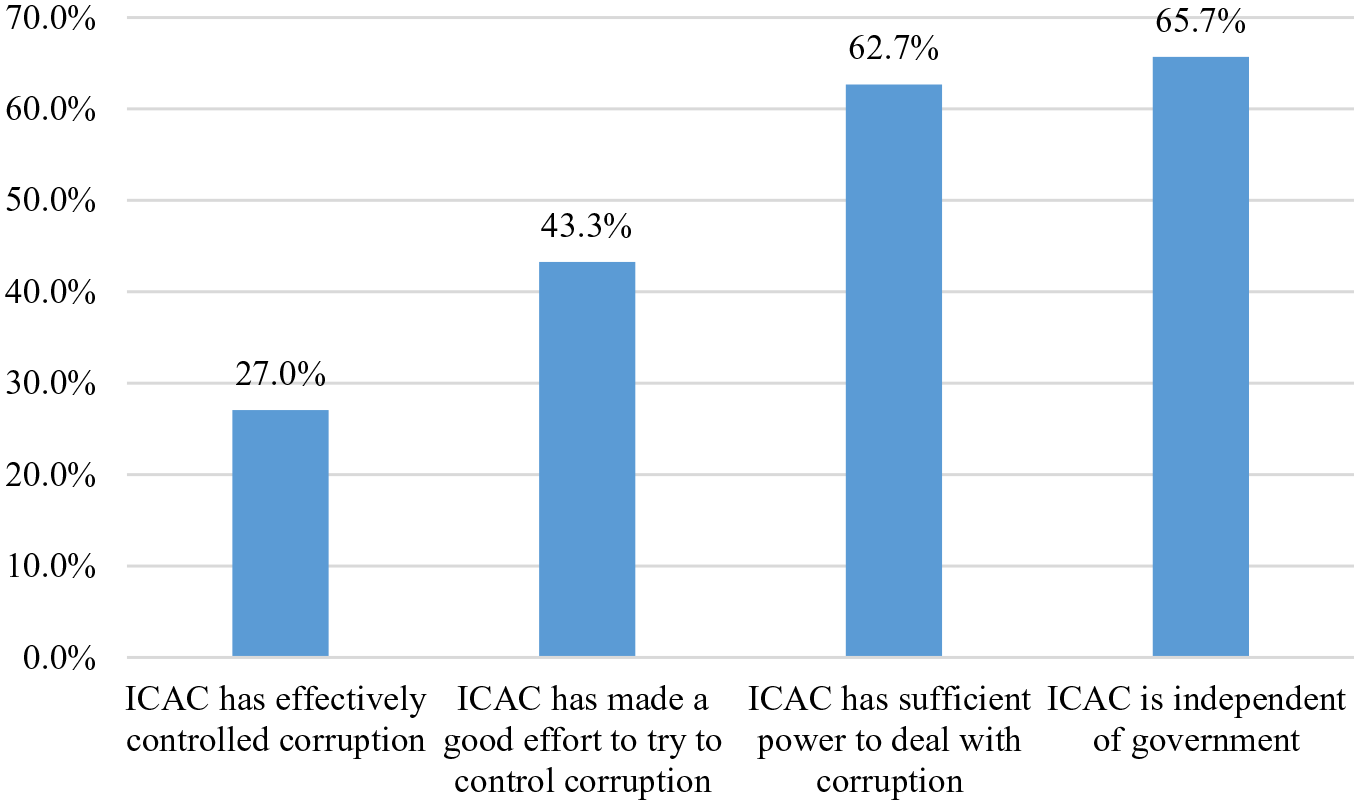
Reasons for respondents’ trust/distrust of the ICAC.
Finally, as the statistical results show, several control variables are statistically significant. In the trust equation of Model 1, trust in the ICAC is closely related to social and governmental factors, including public trust in the Hong Kong government, interpersonal trust in society, and respondents’ views of the Anti-extradition Bill Movement. At the institutional (ICAC) level, ICAC’s independence has a significant positive impact both on people’s trust in the agency and on their perception of its effectiveness, indicating that maintaining the institutional independence of ACAs is critical for public support. At the individual level, most variables have no impact on the level of trust in the ICAC.
In the perceived effectiveness equation of Model 2, other variables at the societal and governmental levels are associated with respondents’ perceived effectiveness of the ICAC. The perception of fair career opportunities in Hong Kong is positively related to the perception of the ICAC’s effectiveness. Similarly, respondents who appreciate the government’s performance in providing social services tend to have a positive perception of the ICAC’s effectiveness. Overall, the evidence suggests that citizens’ perceived effectiveness of the ICAC hinges upon their perceptions of the government as a whole and their perceptions of fair social opportunities, all of which are consistent with existing findings (Robinson et al., 2013). It is not surprising that at the institutional level, respondents’ view of whether the ICAC is independent has a statistically significant positive impact on its perceived effectiveness. This finding supports our argument about the importance of character-based trust.
In sum, the results suggest that the sources of citizens’ trust may differ somewhat from the sources of perceived effectiveness, and not all of the individual variables identified in this study evidently are related to either the perceived effectiveness or trust in the ICAC.
Conclusion
No government can govern successfully without sustaining public trust and functioning effectively. The relationship between these two particularly important pillars of good governance, especially how and to what extent they are associated, have been subject to some debate. Our study argues that they influence each other and are mutually reinforcing. We have used survey evidence to support the existence of their relationship. We also have shown that when the two variables interact, the impact of institutional trust on citizens’ perception of institutional effectiveness is more salient than the impact of perceived institutional effectiveness on public trust. As the case of the ICAC in Hong Kong highlights, the institutional characteristics of a government institution, such as its impartiality and integrity, contribute more to public trust than the institution’s performance.
In a lawful society such as Hong Kong, it is likely that the ACA has both performance-based and character-based public trust, although they may exist to different degrees. The public trusts the ACA because they believe that adequate institutional power and the commitment to act against corruption are embedded in its structure and principles; at the same time they appreciate the agency’s efforts and effectiveness. However, it is also true that in a society that has remained lawful for decades, people may develop extraordinarily high expectations about and stringent standards for preventing corruption. The public cannot be easily satisfied with, or may become more critical of, the ACA’s performance if they believe that in the longer run, organizational characteristics are the most important criteria for determining organizational performance. This nevertheless is not a problem for lawful societies: once a virtuous circle between public trust and institutional effectiveness has been established, the two factors can work together and reinforce each other. Yet, the situation in societies with rampant corruption may be quite different: there, an ACA must perform effectively in dealing with widespread corruption to earn public trust. Wielding organizational independence and adequate power, although important, cannot automatically earn public trust without demonstrated effective performance.
The study’s findings, based on the ICAC in Hong Kong, contribute to the academic literature and to a better understanding of the success or failure of public institutions. First, the analysis uses quantitative data and statistical analysis to delineate that it is important for government institutions to obtain public trust and to demonstrate institutional effectiveness and that these two factors, once obtained, can reinforce each other. Even so, the relationship between them is subtle because public trust also may come from other sources. This leads to the study’s second contribution: it demonstrates that institutional trust can be built either upon an agency’s performance or upon its organizational characteristics. Because institutional performance may fluctuate and is more subject to influences from the external environment, it is important for an agency to build strong organizational characteristics that show its impartiality, integrity, and trustworthiness. As our findings suggest, the organizational autonomy of a public institution such as the ICAC can help it obtain considerable trust from the public.
This study focuses on Hong Kong. Therefore, one should exercise caution when applying the findings and conclusions to other institutions or jurisdictions, especially where institutional and social settings differ. Additionally, although we employ the 3SLS approach to empirically test the relationship between trust and effectiveness, the data are from a cross-sectional survey, which cannot fully meet requirements for causal inference. Further research might well examine the causal relationships between effectiveness and trust when longitudinal data for more countries or regions are available.
Footnotes
Appendix
First-Stage Equations for Models of Trust and Perceived Effectiveness.
| (1) Trust in ICAC | (2) Perceived effectiveness | |
|---|---|---|
| Fair opportunity | 0.1004*** (0.0179) | 0.1230*** (0.0159) |
| Knowledge about ICAC | 0.0522 (0.0320) | 0.0381 (0.0284) |
| Independence of ICAC | 0.2610*** (0.0162) | 0.2418*** (0.1434) |
| Interest in politics | −0.0510** (0.0212) | −0.0271 (0.0188) |
| Education | 0.0168 (0.0131) | −0.0118 (0.0117) |
| Income | 0.0125 (0.0105) | 0.0010 (0.0093) |
| Tolerance of corruption | 0.0060 (0.0182) | 0.0029 (0.0162) |
| The anti-extradition bill movement | −0.1428*** (0.0269) | −0.0949*** (0.0239) |
| Social desirability | −0.0243 (0.0193) | −0.0145 (0.0171) |
| Corruption perceptions | −0.2196*** (0.0253) | −0.1709*** (0.0225) |
| Government performance | 0.0472** (0.0222) | 0.0700*** (0.0197) |
| Trust in government | 0.1991*** (0.0231) | 0.1350*** (0.0205) |
| General trust | 0.2035*** (0.0228) | 0.0998*** (0.0203) |
| Gender | −0.0457 (0.0358) | 0.0097 (0.0318) |
| Age | 0.0154 (0.0133) | −0.0200* (0.0118) |
| Constant | 1.6990*** (0.2061) | 1.6192*** (0.1829) |
| Observations | 1,609 | 1,609 |
| F value | 160.52 | 142.46 |
| Prob > F | 0.000 | 0.000 |
| Adj R2 | .686 | .569 |
Note. Standard errors in parentheses.
p < .01. **p < .05. *p < .1.
Author’s Note
Ting Gong is also affiliated to Southern University of Science and Technology.
Declaration of Conflicting Interests
The author(s) declared no potential conflicts of interest with respect to the research, authorship, and/or publication of this article.
Funding
The author(s) disclosed receipt of the following financial support for the research, authorship, and/or publication of this article: This work was supported by the Research Grants Council of Hong Kong under Grant HKIED11603219; the National Natural Science Foundation of China under Grant 72304069.

Data Availability Statement
Data sharing not applicable to this article as no datasets were generated or analyzed during the current study.