



Abstract
This paper explores the implementation of the Indian Government’s Smart Cities Mission in four cities. The Mission was to be delivered through a tightly specified governance form, known as a Special Purpose Vehicle (SPV), although its function (smart urban renewal) was left more open. The national reform was, however, silent on how the SPV would work within the pre-existing network of actors. Using interviews and documentary analysis, the paper shows how the embedding of SPVs within pre-existing governance networks was strongly shaped by state-level decisions and local institutional dynamics. These insights open up new avenues for research into multi-level meta-governance.
Introduction
India faces a major challenge of urbanization. In 1960, 80 million people lived in India’s urban areas, comprising 17% of the population. By 2019 this grew to 34% of the population (471 million) and is forecast to grow to more than 800 million by 2050 (World Bank, 2021). The World Health Organization identifies India as having 10 of the world’s 20 most polluted cities (NITI Aayog, 2017). In this context, redesigning local urban governance has been identified as a critical element of progress in delivering more inclusive and sustainable cities in India (Ministry of Urban Development [MoUD], 2006, 2015; NITI Aayog, 2017).
This article presents empirical research on the latest major urban reform initiative in India, the Smart Cities Mission. In 2015 the Indian Government launched the Smart Cities Mission as a new form of competition for funding for 100 cities in the country. Each successful city was tasked with implementing a mix of basic and innovative technological solutions to advance sustainability across the transport, housing, water, and waste sectors. Responsibility for implementation was assigned to a Special Purpose Vehicle (SPV) operating as a company in each city, which Skelcher (2006) describes as a type of Special Purpose Government.
The Government’s case for a new approach to urban governance was based on arguments that previous reform initiatives had fallen short on a number of fronts. These included an inability to meet deadlines, weak accountability for spending (Hoelscher, 2016), limited success in engaging citizens (Nandi & Gamkhar, 2013), and ineffectual delivery of promised urban governance institutional reform (Gijre & Gupta, 2020). The Government and others pointed to a lack of skills and entrepreneurial expertise in the civil service bureaucracy as well as corruption to argue for SPVs as a new form of delivery (Basu, 2019; Reardon et al., 2022). The model of delivering urban reforms through SPVs evidently draws on the perceived successes of metro-rail projects that have enabled states to access “supranational circuits of capital” (Sinha, 2021, p. 2).
The Smart Cities Mission, however, has been controversial in several ways. First, the language of “smart cities” and the presumption of homogeneous technology-led solutions ignore the reality of inequity and poor access to basic services on the ground, creating a normative disconnect (Singh & Upadhyay, 2022). Second, the changes can be argued to represent the latest manifestation of a neo-liberal shift in Indian politics and society that sees the creation of elite spaces with bespoke governance arrangements (Basu, 2019). Das (2020, p. 55) suggests that this “weakens the democratically elected governance process, leading to splintered infrastructure development that benefits the wealthy, further marginalizing the poor.” Thus some see a development such as the Mission as a direct dilution of the goals of the 74th constitutional amendment that sought to strengthen local government (Chakrabarty 2018; Datta, 2015). Indeed, strategies such as those embedded within the Mission are viewed as deliberate acts of state-rescaling of power away from municipal governments (Jain & Korzhenevych, 2022), continuing previous trends (Ahluwalla, 2019; Kennedy & Sood, 2019). We acknowledge the very substantial and contentious debates about the motivations and implications of the “Smart City” Mission for India’s governance writ large (Chakrabarty, 2018; Chakravarty et al., 2023; Datta, 2015; Praharaj et al., 2018; Prasad et al., 2022). Nevertheless, our focus here is on an aspect of the Mission that has received significantly less attention: how this reform was interpreted and delivered on the ground and the associated reasons.
Our principal theoretical lens for understanding these issues is meta-governance, which we take to mean “the involvement of the state [meaning government as a whole, not a specific level] in strategically organizing the context and ground rules for governance” (Gjaltema et al., 2020, p. 1761). The Smart Cities Mission is an example of a key meta-governance strategy of “network design” (Hooghe et al., 2022, p. 1594). Such a strategy “deliberately attempts to shape and structure networks, such as the in- and exclusion of actors, or facilitating actors to engage in a network” (Hooghe et al., 2022, p. 1594). The notion of network design as a meta-governance strategy invites exploration of the interplay between more hands-on, hierarchical strategies and more hands-off, facilitative strategies in the different delivery environments in which the “form and functioning” of the Mission (Sørensen & Torfing, 2009, p. 235) are embedded. To understand the impacts of the reforms we comparatively trace the changes in two aspects of the Smart Cities Mission that scholarship highlights as important:
Form—the design of the institutional arrangements through which the Smart Cities Mission would be delivered, including the establishment of the SPV and the rules through which funding would be approved and progress assessed.
Function—the programmatic goals which would include the policy areas, projects, and outcomes to be achieved.
As a result, the paper addresses two key research gaps. First, whilst the Mission has been led by the Government of India, its functioning depends on the participation and adaptation of the Mission by States and local bodies. We therefore anticipate “an important element of struggle, negotiation and contingency about how such arrangements operate” across scales (Gjaltema et al., 2020, p. 1766). Analysis of multi-level meta-governance in practice has received little attention in the literature to date (Gjaltema et al., 2020) and is the first gap we address.
The second gap recognizes that insufficient attention has been paid to the existing institutional landscape into which governance reforms are inserted and meta-governance exercised (Holman, 2013; Hooghe et al., 2022; Mukhtar-Landgren, 2021). This is particularly true for studies of meta-governance outside of a sub-set of Western countries (Gjaltema et al., 2020, p. 1765). We therefore aim to address this analytical gap, whilst also meeting calls for applied governance research in India, including Sinha’s (2021, p. 14) demand for future research on “how best to integrate SPVs within local urban planning structures” and Chakrabarti and Sanyal’s (2016, p. 4) call for more attention to be paid to the political shaping of policies “on the ground” in India.
The paper therefore takes a cross-comparative case study approach in four cities selected by the Mission (Jaipur, Indore, Kochi, and Bangalore) using in-depth interviews and documentary review. Through selecting sites with different local contextual environments we are able to explore the interplay of different institutional arrangements (Holman, 2013) and their impact on form and function as the national Mission program is rolled out.
The paper answers the following key questions:
How have form and function interacted as the Smart City Mission is enacted on the ground?
To what extent did national goals and processes for the Smart City Mission dominate more networked governance issues in delivery?
What are the implications of using SPVs for urban governance in India and for the wider literature on meta-governance and institutional change?
The paper is structured as follows. In the next section we introduce the Smart Cities Mission as the continuation of a set of evolving urban reform programs within India. This section describes the most relevant goals of the Mission and the nature of the SPVs. “Multi-level meta-governance of the Smart Cities Mission” briefly describes and maps the key elements of the reform process to critical concepts and questions in the governance literature, focusing on the interplay between state metagovernance and networks through which the analysis is structured. “Case studies and methods” section introduces the case studies, the interview based methodology and approach to analysis. This is followed by “Findings”, organized by case study area. The paper turns next to a cross-comparative “Discussion” section before the “Conclusion” section considers the significance of the findings for urban governance in India and for the wider literature.
India’s Urban Governance Reforms and the Smart City Mission: Outlining Form and Function
India has a hierarchical federalized governance structure. The key actors are the national government and the 29 states. As noted earlier, rapid ongoing urbanization in India has led to successive efforts to devolve powers and delivery to local level. Yet, the 74th amendment was the most important effort to transfer powers from the State to the local level; although promising, it largely failed to do so in practice. This has resulted in states retaining “considerable authority over functions now notionally in the urban local government sphere” (Rao & Singh, 2006, p. 305).
The challenge of delivering urban reform with substantial influence from the State level has undermined previous flagship government programs. The Mega City Scheme (1993–2003) focused on infrastructure delivery in five of the country’s largest cities, excluding Delhi. The initiative was considered unsuccessful due to financial shortcomings (Hoelscher, 2016) but helped set the stage for Jawaharlal Nehru National Urban Renewal Mission (JNNURM), the then Congress-led national government’s urban “flagship” program. It focused on improved quality of life through better infrastructure with an emphasis on basic services to the urban poor. A total of 23 reforms were to be enacted and the “urban renewal” component of the Mission was to stress urban services (Kundu, 2014).
Although originally launched as a 7-year scheme (Kundu, 2014), JNNURM came to an end with Narendra Modi’s election as Prime Minister in 2014, leaving more than 693 projects incomplete (Sharma, 2015). JNNURM was been criticized for its inability to acquire urban land and for funding delays (Hoelscher, 2016). Criticism also pointed to the continued influence of the States on and the interference of pre-existing strong local bureaucracies with program delivery; these coupled with continuing reliance on patronage and corruption in slowing slow progress (Birkinshaw, 2013). Williams et al. (2019) identified “contradictions between empowering cities and retaining centralised control” in JNNURM (Williams et al., 2019, p. 256). Prior to the Smart Cities Mission, then, urban governance reforms had not delivered notably on promises to increase community participation or transfer legislative powers in ways that empowered cities or enhanced their capacity for self-governance (Kennedy & Sood, 2019; Nandi & Gamkhar, 2013).
It was against this backdrop that the Indian national government in 2015 launched the Smart Cities Mission, a competition for funding for 100 cities in India through 2019/2020, although the period has been extended (Aijaz, 2021). The Mission is influenced by a range of global logics circulating around the notion of smart cities, including the need for technological innovation to drive social reform (Nesti, 2020). In the government’s own words, the initiative is “bold,” aiming to go beyond what had been achieved before at the local level. The initiative focuses on promoting “cities that provide core infrastructure and give a decent quality of life to [their] citizens” and provide “a clean and sustainable environment” through the application of “Smart” Solutions (MoUD, 2015, p. 5). The Smart Cities Mission covered topics including urban mobility, water supply, electricity supply, sanitation, affordable housing, safety and security, and health and education. Its remit ranged from core provision in areas such as “creating walkable localities” and “assur[ing] electricity supply” to innovative technological interventions such as smart meters and “intelligent traffic management” solutions (MoUD, 2015, pp. 6–7).
“Smart Cities” were to focus more intensive developments on geographically bounded areas within a city (referred to as Area Based Development), either as newly built or retrofitted; included as well were some pan-city initiatives (e.g., smart card payment, city wide traffic management systems). The guidance states that “The [national] Government is not prescribing any particular model to be adopted by the Smart Cities” (MoUD, 2015, p. 9). Each city’s submission would be assessed based on the distinctive challenges confronting the city and key system outcomes (e.g., improved air quality, better sanitation) it planned to achieve. This approach reveals a function—the policy aims and scope of the Smart Cities Mission—that was largely determined locally, although clearly within the context of the national adoption of the international framing of “Smart Cities.” Funding was provided for consultants to help develop the bids, and one of the key criteria for selection was evidence of citizen engagement in plan development.
Although interpretation of what the cities would aim to achieve was left open, city-level implementation of the Smart Cities Mission would be through a new organizational arrangement, an SPV. This new agency would work with the discipline and efficiency of the private sector (Reardon et al., 2022). The form of delivery of the Mission was fixed. According to the Mission: The implementation of the Smart Cities Mission at the City level will be done by a Special Purpose Vehicle (SPV) set up for that purpose. The SPV will plan, appraise, approve, release funds, implement, manage, operate, monitor and evaluate the Smart City development projects (MoUD, 2015, p. 12).
SPVs were to be set up under the 2013 Companies Act. Each SPV would receive money from the State and Urban Local Body 1 as well as from the national government. An explicit provision was inserted for private sector interests to become equity-based shareholders in the SPV. The State and Urban Local Bodies, however, both must retain equal shares and have combined majority shareholding. It was also possible for the SPV to establish projects with a revenue stream with which it can demonstrate creditworthiness to borrow in the market.
SPVs are governed by a Board of Directors. The Board of Directors is comprised of representatives of the National Government, State Government, Urban Local Bodies, Independent Directors, CEO of the SPV, and any functional directors. The CEO was to be appointed for a fixed term of three years with approval by the national Ministry of Housing and Urban Development. Since SPVs are created under the Companies Act, the appointed CEO can be from the private sector. According to the guidance, “one of the primary reasons for the creation of the SPV for the Smart Cities Mission is to ensure operational independence and autonomy in decision-making and implementation” (MoUD, 2015, p. 39). To this end, Urban Local Bodies were instructed to delegate their rights and responsibilities to the SPV for Smart City Mission projects. SPVs are required to report monthly to a Steering Committee comprised of National- and State-level actors. This monthly requirement to report spending reflects an on-going hierarchical preferences for accountability. On-going citizen engagement was to be assured through a Smart City Advisory Forum that would have input into the direction of the SPV as plans developed.
The design choices of how to steer the Smart City Mission are a deliberate expression of how the Modi government believed it should move beyond the shortcomings of JNNURM. Whilst loosening up program content (function), it tightened how programs would be delivered (form). We see significant attention given to the design of the SPV and its accountability to the state and national levels, but there is almost no detail of how the SPV will relate to existing institutions, even though the implication is that all necessary powers will be delegated up. In the next section we reflect on the design choices in the Smart Cities Mission through the lens of meta-governance.
Multi-Level Meta-Governance of the Smart Cities Mission
A recent comprehensive literature review by Gjaltema et al. (2020) has sought to provide some structure to the rather disparate body of research on meta-governance. From this, we understand meta-governance to mean “the involvement of the state in strategically organizing the contest and ground rules for governance” (Gjaltema et al., 2020, p. 1761). Meta-governance acknowledges the presence of networks of actors and their self-organizing properties in governing, but directs attention back to the potential ability to exercise control over these networks, and in essence is defined as the study of the “governance of governance.”
There are two main approaches to the study of metagovernance: society-centric (Klijn & Koppenjan, 2004; Kooiman & Jentoft, 2009; Sørensen, 2006) and state-centric (Bell & Hindmoor, 2009; Peters, 2007; Whitehead, 2003). The society-based perspective argues that government has become constrained by networks, and in turn networks must learn new techniques in order to advance their policy goals. The state-centric perspective, however, argues that government is able to cast a “shadow of hierarchy” (Scharpf, 1994) over networks through its distinctive resources, and in turn the focus of this literature is inclined toward how the institutions and structure of government give it the ability to manage and steer networks (Baker & Stoker, 2012, pp. 1027–1029). Both approaches provide useful insights for our purposes, with a useful distinction between first, “hands-on” steering, exercised through the shaping of political, financial, and organizational context in which networked self-governance takes place (for example through the provision of incentives or through the strategic construction of institutional design) and second, “hands-off,” which focuses on the shaping of interests through formation of the meanings and identities that constitute the self-governing actors (Sørensen, 2006). The extent to which multi-level meta-governance might apply in India remains under-researched. In the Indian context it has been suggested that the national government remains the dominant actor; although the plethora of network actors is quite apparent (Datta, 1994; Williams et al., 2019), the influence of non-state networks is overstated (Mathur, 2019). Sinha (2021, p. 2), however, suggests that the shift to SPVs as delivery mechanisms demonstrates “a scaling up of the municipality to a metropolitan region by transferring the power of rural and urban local bodies to state government-level specialized governance instruments…,” which points toward the importance of considering the indirect governance dynamics that shape networks at state and local levels in India.
This is also an analytical opportunity for us. Gjaltema et al. (2020, p. 1766) suggest the need to look beyond the direct actions of national actors in studying meta-governance to also consider the actions of actors at multiple levels in practice, which they refer to as multi-level meta-governance (see also Jessop, 2004). This is particularly important for the Smart Cities Mission, where it was to be applied in 100 cities across 29 states. Although there is an overarching system design architecture, divergence in implementation seems the most likely outcome (see Prasad et al., 2021).
In trace the effectiveness of national government-led reforms, meta-governance offersa way of assessing the seemingly contradictory influences of both top-down and bottom-up variables in a process layered with networks. Here, we consider the Smart Cities Mission to be a national governmental meta-governance strategy of deliberate network design, in which the government sought to shape and re-structure the urban governance network for the purposes of urban renewal. Such a network design strategy is akin to what Gjaltema et al. (2020, p. 1770) refer to as an element of “process strategies,” which “. . .bring together actors and institutionalize cooperation between them.” It is our contention here that strategies encompass both “hand-on” and “hands-off” forms of meta-governance in practice.
Hands-off approaches were used in setting the scope of the Mission but with local opportunities to shape the flavor of the bids and implementation (function). The SPV form of delivery is a very “hands-on” form of intervention with clear instruction that there would be local delegation of powers to the SPV for implementation. Looking further at the Mission guidance, this mode of delivery appears to be a deliberate attempt to insulate the Mission from the realities of day to day urban governance in an effort to accelerate delivery, mirroring other urban reform initiatives (Kennedy & Sood, 2019). The emphasis on a small, area-based approach, within which most of the SPV activities would take place, could potentially hive off the delivery of projects from wider power struggles. It has strong resonance with notions of the “projectification” of the state (Fred, 2020) and the creation of “organizations outside organizations” (Ahrne & Brunsson, 2011, p. 85). Existing institutions, however, continue to have responsibility for the same functions as the Mission outside of the SPV area. There are also likely to be practical limitations, since the urban institutional segregation of areas involves those typically dependent on infrastructures and services that cut across much wider geographical areas.
This new institution clearly will disturb and perhaps destroy existing institutional relationships within urban local bodies and among these bodies, the state, local politicians, and other delivery bodies (like parastatals and agencies) (Jain & Korzhenevych, 2022). Yet, despite the clear importance of networks to the embedding of the SPV, the Mission document paid little attention to such effects. This is not surprising: Holman (2013, p. 82) reports, for example, that whilst a lot of attention is paid to the purpose of new institutions during reforms, “rather less is paid to the structural elements involved in how these partnerships are mapped onto existing governance structures.”
It is at the nexus where the SPV meets the existing institutional landscape that this paper focusses. Through an exploration of how the aims of the mission are delivered in practice, we seek to understand the inter-relationship between form and function and how this changes over time as the SPVs negotiate their position in the institutional landscape. This in turn will reveal insights as to how the network design problem was perceived, appropriated and implemented in different local settings, answering the call for richer and contextualized insights into “the necessary and sufficient conditions under which meta-governance works” (Gjaltema et al., 2020, p. 1774).
Case Studies and Methods
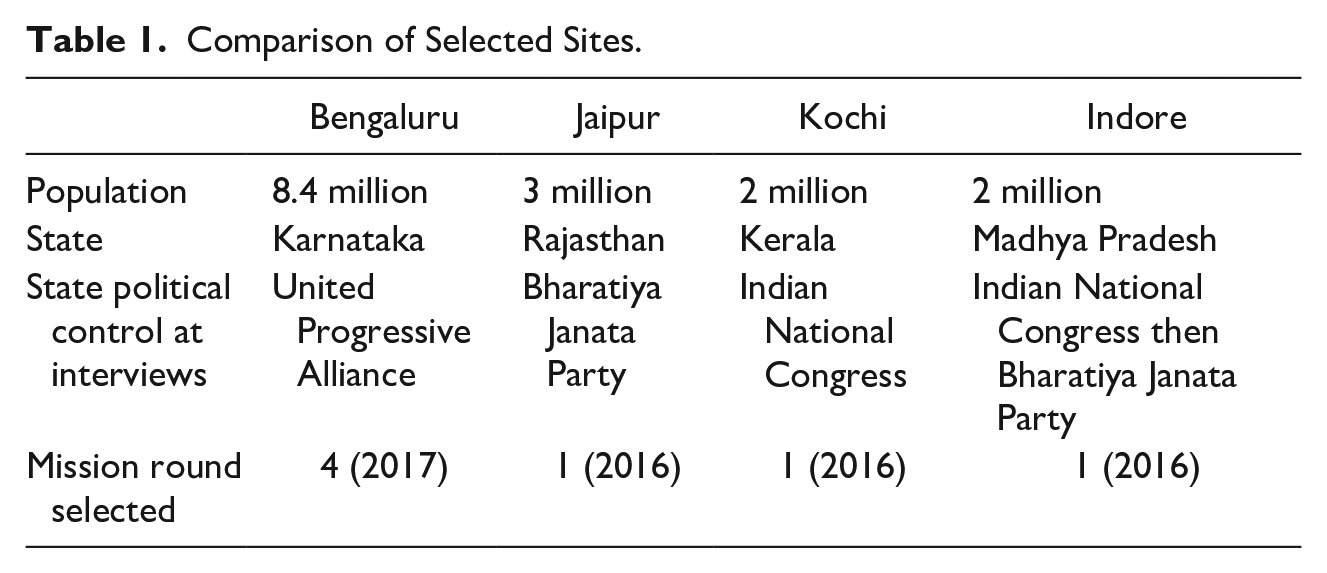
In order to understand the workings of SPVs we adopted a cross-site comparative approach across four designated Smart Cities (Mahoney, 2007). Bengaluru, Jaipur, Kochi, and Indore were selected as the case sites. These four sites were selected on the basis that they provided some diversity of location, scale, and state and local political alignments. All four cities participated in JNNURM.
Some key comparative data are shown in Table 1. Bengaluru and Jaipur are capital cities with distinct cultural identities. Bengaluru is well known for its technology sector and large number of civil society groups focused on good governance, sustainability, and technology. Jaipur is known for its rich history of craftsmanship and built heritage around the old walled city, the geographic focus for its Smart City Mission. Kochi and Indore are the commercial hubs of their respective states. Both have similar population sizes, but very different political alignments. At the state and local levels, Indore aligns with the national BJP government at state and local levels, whileKochi has a tradition of more decentralized governance. All four cities have similar agencies at the state and local levels, with the Municipal Corporation as the predominant local body. However, the composition and functioning of the Municipal Corporation varied significantly across the sites. Whilst most Indian cities have a directly elected Mayor, in Kochi the Mayor is also the head of the Municipal Corporation. (Full details of each site can be found at https://underreform.org/.)
Comparison of Selected Sites.
Our entry point for the interviews was to focus on aspects of the Mission that related to the transport sector. There were several reasons for this choice. First, some other aspects of the Smart Cities Mission such as sanitation were much more heavily funded through other governmental programs operating in parallel to the Mission, such as Swachh Bharat (Clean India), which complicates the influence of the Mission. Second, attempts to establish better cross-institutional coordination in transport reforms had proven difficult in the previous urban transformation program (Gijre and Gupta, 2020). Third, all four cities are identified as “metro cities,” meaning they are in some stage of having a metro transport system built within the city. All metro infrastructure projects in India are also executed through the creation of an SPV, modeled after the Delhi Metro structure (Bon, 2015). One aspect of research interest was to see if this had any influence on how the new institution developed and was shaped. Our interview schedule (see supplemental materials for the generic template), however, was sufficiently open for actors to discuss non-transport examples and links to wider plans, and we were guided in general by discussions about what had been done or was being done at the time of the interviews. Our focus, as suggested by Williams et al. (2019), was to emphasize process over outcomes. This approach became a practical necessity because of an apparent lack of attention to outcome monitoring in all four cities.
A semi-structured interview approach was chosen as the appropriate method for arriving at understanding. The interview questions were situated under several themes. The first was agency organization and the second the Smart Cities competition and the interviewee’s familiarity with the process. The next theme explored the relationship between stakeholders as a way of understanding vertical and horizontal relationships that were developed through the SPV. The final theme focused on the SPV itself and how it functioned in practice. In each site, an initial mapping of stakeholders was undertaken across the research teams and external research partners. This was used with local partners to ensure that full coverage of relevant local actors connected to the Mission had been established. Between 15 and 20 in-depth, individual interviews were completed in each city. Interviewees were selected on the basis of having direct involvement with the delivery of the Smart City Mission. A purposeful sample was designed to ensure representation across different agencies, different scales (e.g., state and local), and sectors (e.g., private sector consultants and public). Because of the risk of identification of respondents, we summarize the overall sample here rather than listing affiliations and organizations. Just over a half of interviewees were from the public sector, with almost two-thirds at the State level, a quarter at the municipal level, and the remainder at the national leve. Of our non-governmental stakeholders one-half were consultants, just over a quarter were university academics or representatives of professional bodies, with the balance being NGO officials. Each site had a blend of each category.
An additional round of interviews wasconducted in Delhi, with national actors (reported on with analysis of the multi-scalar nature of the reform in Reardon et al., 2022). Interviews lasted from 30 to 60 minutes, structured around the thematic issues. Two interviewers were present throughout the process with one being fluent in the local language. Participants were given consent forms and had the option of opting out of being audio recorded. The transcripts are available on the UK data service archive for download (https://reshare.ukdataservice.ac.uk/854476/).
Codes were primarily determined based on our initial interests in the SPV, institutions, accountability, and national-state-local dynamics. However, we adopted an iterative approach, reflecting on the data as they wereanalyzed. Independent coding was conducted by the three members of the UK team, with discussion on a monthly basis and two two-day coding discussions held jointly with the full Indo-UK research team. This enabled us to iteratively adapt the coding framework as new and important lines of enquiry emerged and to check the reliability of the application of the coding framework across the team. Figure 1 reports the outcome of the project team’s iterative coding process. Bolded words represent the parent nodes from which we started, while other words indicate the codes applied to specific passages in the transcribed interviews. Dotted lines show relationships and intersections across parent nodes and codes more generally.
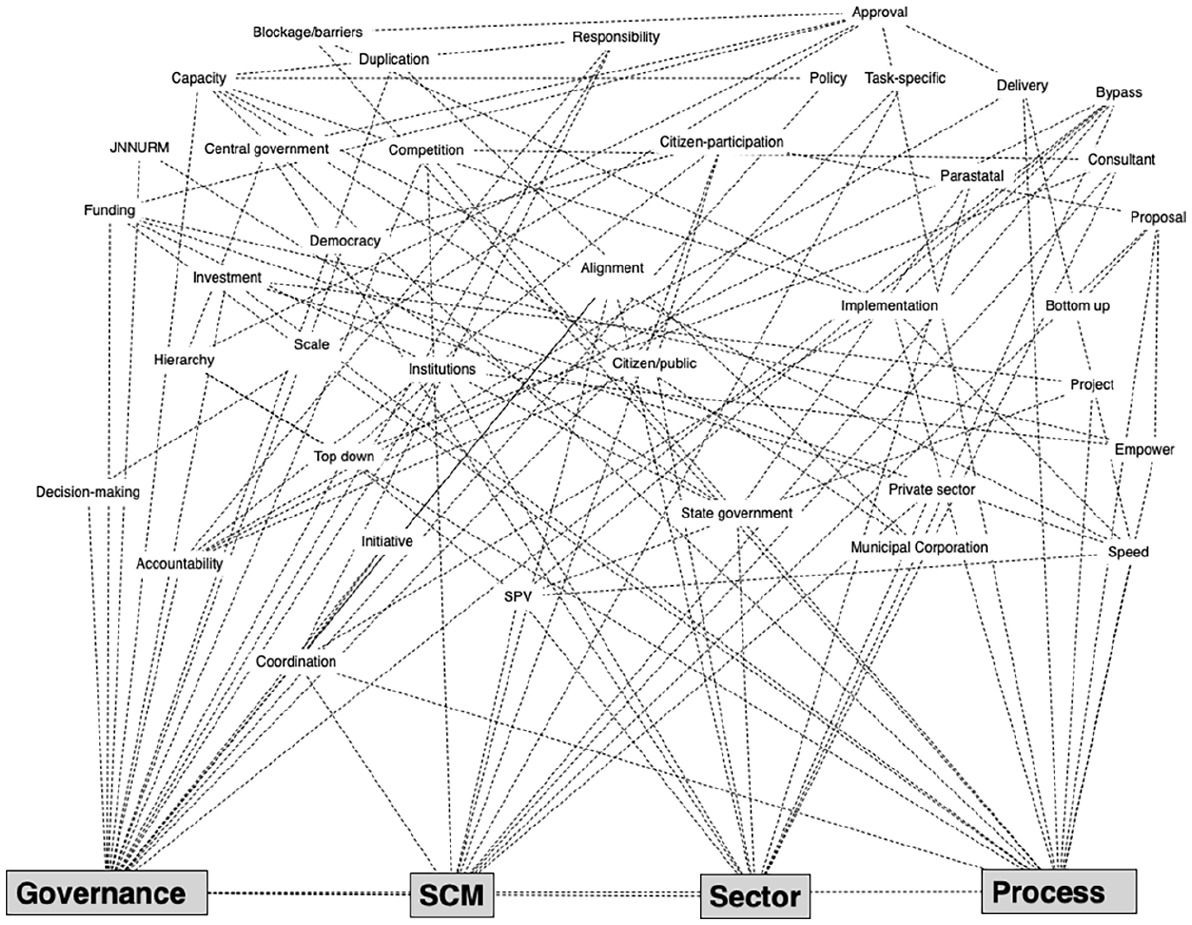
Project coding framework diagram.
Findings
In this section, we set out the key findings from each of the sites, exploring how form and function were adapted on the ground, with the following section providing the comparative analysis.
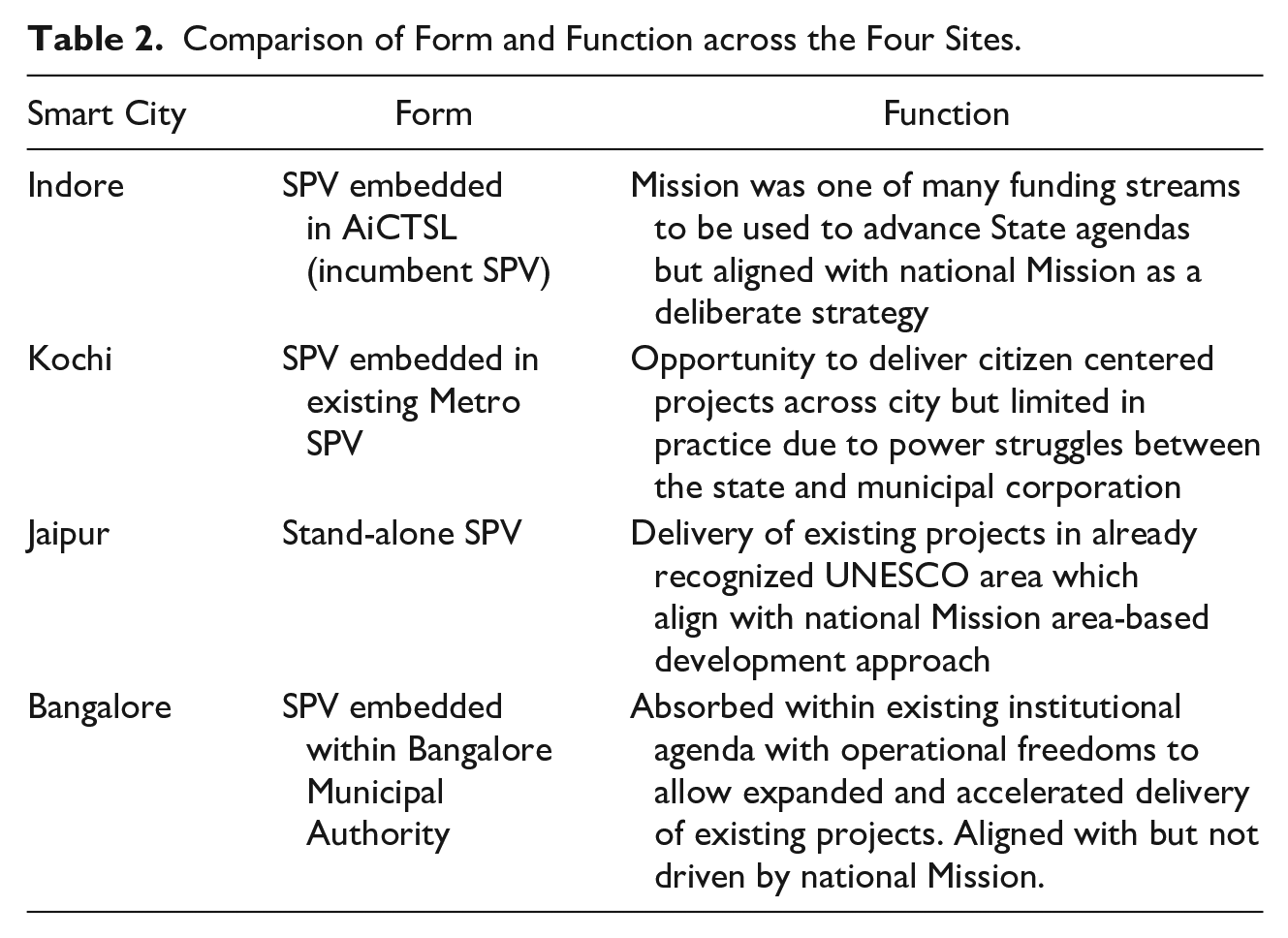
In Indore, the SPV was established by association and co-location with Atal Indore City Transport Services Ltd. (AiCTSL), the pre-existing municipal bus company SPV. Our interviews found comparatively few institutional actors (IN1 “We have a very small [existing] structure… and move the things very fast”) and a clear political alignment from a national to state and then local levels with the party in power. The SPV was described to us as a delivery agency for the (state appointed) Municipal Commissioner. As one interviewee neatly summarized; “Smart city is basically a helping hand to the commissioner… It is not like smart city is going to bring up altogether a new thing; it is just only helping the thoughts what you were earlier having or rather the requirements you were having earlier but not able to realise them” (IN6). The Smart Cities Mission was, to the civil servants (IAS officers), just one of several significant funding streams to harness and their job was to access those funds effectively and put them to use. This was further put into context as many development projects were being established through other parallel (and larger) funding streams such as AMRUT 2 and the approach was described as mapping different funding streams to a set of goals.
The SPV CEO position was held by IAS Civil Servants and not by private sector officials (as had been the aim in the national Smart Cities Mission guidelines). It was difficult to separate the roles of the different local actors, and this seemed to be a deliberate strategy. The CEO of smart city was the additional commissioner of the Indore Municipal Corporation, and the executive director of the smart city was the Municipal Commissioner. The bleeding across of roles of the Municipal Corporation and the SPV was described as advantageous for dealing with other government departments and for coordinating projects across multiple funding streams: “Mybeing from the IAS and from the government, it helps me do that. Which perhaps …would not be that easy for somebody coming directly from the private sector” (IN12).
Kochi had a very different experience, despite also embedding its SPV within an existing SPV for the Metro Rail system with a shared Managing Director. The Metro SPV is a state level company, and throughout our interviews in Kochi the lack of alignment between state actors and the municipality came to the fore. Kochi’s elected mayor acts as Municipal Commissioner, which is unique in this case. Here, the SPV was seen to be encroaching on the responsibilities of local actors and in turn in breach of the 74th constitutional amendment (which may have been a response derived from Kerela’s more historically progressive attempts and relative success in decentralization). The tensions were exhibited by a failure to provide adequate municipal level representation on the Board, so that State actors were able to push their preferences and “the [municipal] council’s sentiments [were] never reflect[ed] in the smart city work” (K1). The ways of working included not tabling papers in advance to facilitate local consultation and not reporting on disputes, leading a participant to conclude “it’s almost being taken over by the state as opposed to the local level” (K2). So, whilst the same vision expressed in Indore of the SPV acting as an advanced delivery agency for the municipality, was recognized by the actors in Kochi, the lack of alignment on the function of the SPV and the very different State-Local relations meant that, in reality, delivery was divorced from planning. The tensions manifested between the urban and State level actors were clearly not new.
Overall, our Kochi interviewees believed that the SPV was neither delivering the improvements identified in the proposal process nor accelerating delivery as imagined. The importance of land acquisition to a range of projects, over which local actors had a veto, also was seen as closing off a number of the initially proposed ideas (K7). The SPV ended up focusing more on the delivery of projects (such as WiFi masts) that were easier to deliver but not core to the promises in the proposal. This was in part a result of local frictions, but also influenced by the strong national and state accountability requirements that focused on spending the budget. Other tasks being done were ones that the municipal corporation had already done elsewhere or was planning anyway (K2). Despite its strong alliance with state level actors, the SPV came across as isolated from the many bodies it might have enlisted to help refocus its delivery. It did not include independent local citizen directors on its Board as the national guidance expected. The national guidance also recommended the establishment of a Smart City Advisory Forum comprising bodies such local youth groups, resident associations, technical experts, slum federations, and chambers of commerce. As in all of our sites, no interview respondent referred to the existence of such a forum. There was, therefore, no concrete mechanism to re-engage local expectations, and the SPV appeared as a temporary delivery shell.
The focus of the SPV in Jaipur was on innovations around the historic walled city area, for which a company was established. The relatively contained nature of the proposed developments meant the SPV had arguably little motivation, or need, to engage with other institutions in Jaipur. The pre-existing recognition of the walled city as a special area with UNESCO status suggested that an “area-based” approach could be easily achieved. Over time, however, the SPV was viewed as becoming an “isolated kind of organization” (JP15) that was not well integrated with the Municipal Corporation. Even comparatively simple projects around the edges but outside of the walled city, such as car parking, were difficult to implement. Stakeholder interviews were consistent in the lack of knowledge of what role the SPV had in the delivery of better outcomes in the wider city and how the interface with city institutions could work. Criticisms also emerged that the SPV was not doing anything new. The projects being undertaken had previously been planned and delivered by other agencies. According to local actors, one of the main benefits of the SPV structure was that funds for specific projects could not be interfered with by other agencies in any decision-making process, which largely kept projects from getting stuck on “four or five tables” (JP1). Interviewees could therefore identify the potential for the SPV structure to accelerate delivery because “so far as local bodies are concerned, they are overburdened with so many local functions” (JP9). Yet many of the same staff who were in the overburdened local bodies had simply been moved to the SPV or asked to double up. “Only bureaucrats are running it” (JP6), some saw as “fundamentally wrong” (JP9). High levels of political interference could also be inferred in Jaipur as the Chief Executive of the SPV was replaced three times in two years.
In Bangalore, relative to the total scale of investment going in to the city, the funds from the Mission were less significant than in the other three cities. There was little institutional buy in to the need for an SPV, since the city did not sponsor a bid in the first two rounds of Mission funding; on winning funding, it took over 12 months to decide how the SPV should be established. In Bangalore, the Municipal Commissioner was appointed Chief Executive of the SPV, which was lodged in the Bangalore Municipal Authority (BBMP). This arrangement marks a very distinct approach compared to the other sites. It was argued that a dual post would avoid misalignment between the goals of the Municipal Authority and the SPV. The convening power of the Commissioner (a state appointee) was also seen to be important to institutional co-ordination in a similar way to Indore.
The continued theme of tasking the SPV (in part) with supervision of previously successfully implemented urban renewal projects was clear in Bangalore as in Jaipur. The additional funding and the ability to procure the projects in a more efficient manner was seen to be beneficial for doubling the scope of what could be achieved (BLR5). It was suggested that there was too much power in the several parastatals in the transport sector for the SPV to tackle issues requiring institutional co-ordination. Projects bound tightly to a specific place and space were preferred for SPV delivery (BLR7). One of our interviewees concluded that the SPV is “just a project execution entity for certain projects, [a] one time city project” (BLR8). There seemed little appetite for the initiative and it appears to have been largely absorbed within the existing state apparatus, working somewhat against the wider transformative national goals of the program.
Table 2 summarizes the differences in Form and Function the interviews and institutional mapping identified.
Comparison of Form and Function across the Four Sites.
Discussion
In light of the findings, in this section we answer our three research questions, using the lens of multilevel meta-governance to explore the reasons for the differential outcomes of the national Mission program. The first research question focused on interaction of form and function on the ground. One of the key features of the Smart Cities Mission was the shift to programmatic delivery through a new form of governance in the SPVs. This was in large part to overcome the complex institutional environments and lack of skills suggested to be at fault for the failings of JNNURM. SPVs were viewed as successful in delivering large infrastructure projects such as Metro schemes, leading to the adoption of this form. As the four cases show, however, the SPV had to be established by State and Municipal actors, and herethe State level had primacy. The SPV had to be established within existing institutions and ways of working (Carstensen, 2015). Choices of how to do this highlighted thedivergent influences sof the states in their role as meta-governors as well as inconsistencies with the aims of the national meta-governor.
In relation to the second research question, the mechanics of implementation on the ground showed a level of nuance that national level design was never likely to anticipate given the range of environments in which the Mission would be implemented. In Indore and, to some degree Bangalore, the state actors appropriated the SPV as another delivery arm of the existing agenda (see also Sinha, 2021). Their logic was underpinned by creating overlapping membership between initiatives (Holman, 2013) and institutional sharing (Lowndes & McCaughie, 2013). Far from seeing the actors who were part of the “problem” in JNNURM as being a blockage, the civil servants saw knowledge of the system as part of the solution. This ability to more rapidly connect the SPV to the extant governance network then enabled it to take advantage of a few new decision-making freedoms on spending and this, we were told, speeded up delivery of projects and/or reduced costs. It was not, however, transformative to the agendas that were delivered in each city. Nor did it represent the shift to local capacity building and private sector expertise that were key parts of the national imagery for the Mission (see Kumar, 2021 for a critique).
The contrast between Indore and Bangalore and the approaches taken in Kochi and Jaipur are also important but for different reasons. Jaipur was an example where there was no real attempt to embed the SPV into the wider city but where there was a certain logic to area-based development for a one-off set of projects. It is clear from the interference in the management of the SPV that the SPV was still, though, very much embedded in state-level political processes. Kochi had perhaps the most inclusive vision at the initial bid stage but the implementation was a continuation of tensions between the state and the elected mayor of the Municipal Corporation. The SPV was located within an existing SPV as was the case in Indore but there was no way in which the institutional alignment evident in Indore could be achieved given the pre-existing State-Municipal tensions. Rather than appointing a skilled and experienced public officer to navigate these tensions the state appointed a private sector CEO aligned with its interests.
The contrast between Indore and Kochi shows the importance of national-state-local alignment to the ways in which the reform is interpreted on the ground as well as to the importance of the interpretations of the extent to which the State actors more directly appropriate the SPV as a deliberate design strategy choice. It seems clear that more than network structure matters; other factors such as political alignment, trust, and power contributed to the Mission playing out differently. This mirrors findings with other reform processes in India, such as those relating to special industrial areas (Kennedy & Sood, 2019). In Indore, for example, it was difficult to see any veto points to the State agenda, which in turn was very deliberately aligned to the national Mission.
Reflecting, then, on the relationship between form and function and the implementation of the Mission as a meta-governance network design strategy, we can see that the national form was interpreted according to state level institutional views of the legitimate function of the SPV in Indore, Bangalore and Jaipur. In the first two this was to continue, but accelerate, business as usual, whilst in the latter it was for a time limited improvement plan for an area that in Jaipur was already recognized as “special.” In Kochi, less thought had been given to how form and function would align. Once it became clear that the SPV was not aligned with the plans set out in the bid and that the SPV was behaving as the senior partner and marginalizing the Mayor in defining program changes, then this significantly impacted function.
How the SPV impacted function also was influenced by the national framework conditions and the accountability processes in place. Across all sites, it was very clear that the SPVs were accountable for spending their planned budgets on time. There was no mention of accountability for outcomes (which was part of the initial Mission), or of explaining changes to citizen groups, evidenced by the absence of Smart City Advisory Forums for public engagement. Function, over time, drifted from delivering on the plans submitted under the SCM competition, to spending money from the allocated budget. This was true to some degree in all sites but more so in Kochi where the institutional alignment was weakest. The attention paid to fulfilling the aims of the reform “from above” was reported as driving some of the outcomes across all of the sites, a strong echo of the experience in JNNURM (Williams et al., 2019, p. 256).
Some aspects of the national design strategy of form therefore remained important despite other elements being more subject to reinterpretation. Yet in response to our second research question, we see a very mixed picture with the national level being more effective at meta-governing form and less so at steering function. Yet our analysis strongly demonstrates the need to avoid the national-subnational dichotomy and instead take a broader more nuanced reading of the actions, interactions and power of actors and networks at all scales in shaping governance practices, tracing multi-level meta-governance in practice (Gjaltema et al., 2020).
Turning to the third and final research question about the implications of using SPVs for urban governance in India and for the wider literature on meta-governance and institutional change, one sees that when the Mission guidance is pulled back, the SPV was a deliberate corporatization (see Joss et al., 2019) of existing urban governance functions to bypass a failing or limited public sector (see also Reardon et al., 2022). Implementation of the SPV is a clear intervention that undermined local institutional power and further weakened Urban Local Bodies in practice. Our evidence points to policy environments where fairly small elites of influential bureaucrats are able to bend the form of the national mission to meet State goals to a large degree, aligning with other work that suggests that elites capture these privileged spaces of governance at the expense of institutions underpinned by democratic voice such as Urban Local Bodies (Basu, 2019; Carstensen, 2015). There is then a paradox between the wider national goal to sweep clean the institutional landscape and the response of actors at lower tiers to appropriate the “opportunity” for their own ends.
Ultimately, the same people and institutions that were “at fault” for the poor delivery of the previous urban reform program had to decide how to establish this new network actor, an SPV. The rescaling of what appears to be a city focused reform to a heavily State-led intervention is characteristic of other state rescaling processes in India (Kennedy & Sood, 2019). We cannot say, however, whether such conditions would be replicated in other countries with different network configurations (although see Rasheed, 2020 for a discussion of meta-governance in developing economies).
Reflecting on the case in relation to multilevel meta-governance theorizing, our analysis has demonstrated how the boundaries between neat conceptualizations of “hands-on” and “hands-off” modes of meta-governance are blurred in practice as both forms of steering exist in parallel at different scales, and both were embedded in the network design strategy of the Mission. We also conclude from the diversity of outcomes in the four cities that calls for greater attention to multi-level dynamics in meta-governance and to investigating these dynamics in practice are crucial for a holistic understanding the role of local institutional settings and context. A big national program such as the Smart Cities Mission, perhaps inevitably, is interpreted differently across and within scales.. However, through applying multilevel meta-governance in practice, this article goes some way to identifying the conditions for effective meta-governance across scales, relating, for example, to political alignment, trust, and the power of potential meta-governors.
Conclusion
The divergence between national initiative ambition and local delivery realities is a topic of continued global relevance. The case of the Smart Cities Mission in India is of particular interest because of the rapid scale of urbanization, the challenges to delivery of urban renewal evident in past decades and the continuing question of whether cities will really become an important independent governance tier. The Mission quite deliberately bypassed the last of these questions by proposing a new form of governance which essentially corporatized aspects of the local governance task. We caution against a strong read across between the findings in India and the extant literature on governance and smart cities in the global north, particularly given the ongoing weak institutional role of city level governance in India. However, the importance of the purposeful design of the intervention (Ahrne & Brunsson, 2011), the role of accountability regimes (Caprotti & Cowley, 2017), and the limits to institutional integration (Mukhtar-Landgren, 2021) appear to be common features. As the globalization of notions and applications of Smart Cities continue, such comparative perspectives become of increasing importance (see Joss et al., 2019), particularly as many of the logics derive from applications in the Global North This study was challenging enough,comparing four cities in a country that already has 48 cities with populations of over one million. We focus our conclusions on this context.
In answering our first research question, we showed the necessity of tracing the interaction between functional aspects of the Mission and the form through which it is delivered to understand what is (or is not) changing on the ground. Our findings strongly reinforce Holman’s call to pay attention to the local institutional environment (Holman, 2013) given the divergence among our four cities, which in turn represent just four of the one hundred “Smart Cities” that were part of the Mission. Whilst it was clear that, for the most part, local or municipal scale actors remain the weak players in the network, State level organizations exhibited substantial influence in appropriating the form of the SPV to advance their interpretation of the function of the Mission. Both the national and state levels clearly deployed meta-governance in their approach to the system design for the Mission.
The findings of our second research question to some degree challenge scholarship that suggests that network governance is more important rhetorically than in practice in India (Mathur, 2019). Whilst we do not trace a story of the influence of a wider network of non-governmental actors, we see divergence of implementation and outcomes which is a direct result of the political, resource, and institutional struggles in each of the cities. Although hierarchy, expressed through the application of hands-on steering strategies such as the SPV model and the strong national accounting protocols, influenced the approach to project selection and delivery, the shadow of hierarchy was not as strong as is perhaps expected in the Indian context.
Taken together, these insights inform the response to our third research question, where we conclude that strong evidence supports the concept of multi-level meta-governance. With that comes the requirement to explore the dynamics of policy reform across multiple scales and multiple sites if the importance of inherited as well as temergent forms of governance are to be understood. There is a lack of empirical work, in particular in non-Western contexts, to enable a more grounded interpretation of the findings which may either develop or challenge the utility of meta-governance as a lens. For example, in this case, it would be interesting to explore the extent to which the territorial hierarchies in the Indian Administrative Service affect the approach to policy design and the role of elite bureaucrats.
Reflecting then on the broader implications of the Smart Cities Mission initiative for urban governance in India, much emphasis was placed on the ability of the Mission to spend its funds as a measure of success, particularly in comparison to JNNURM. A national stock taking casts doubt on such success, with just under one-third of tendered projects completed (by value) by July 2021 (Aijaz, 2021). We would also caution against only counting what has been done through the Mission. The state and municipal civil services both were described as understaffed and lacking capacity. As such, the reshuffling of competent staff from within these organizations to lead the Smart Cities Mission SPV will clearly detract from their capacity elsewhere, but none of those wider losses has beentraced. In reality it will, be impossible to conclude with assurance much about t the impacts of the Mission on the relative pace of delivery.
In tracing the form and function of the Smart City Mission, the limitations of the SPV model for implementing complex multi-functional urban policies have also been exposed. SPVs were not designed to take on or resolve complex cross institutional issues which often sit at the heart of urban governance challenges. Nor did they have the legitimacy to act derived from the state institutions which established them. There seem to be real limits then to the kinds of projects that can be delivered through area-based SPV arrangements. Nationally, the Smart Cities Mission paid so much attention to what was new, it omitted to attention to what already existed. The same problems that beset previous reforms such as limited institutional capacity and complex, slow and contested institutional environments remain unresolved. Tackling institutional reform sounds altogether less transformative than turning cities smart. Yet not tackling institutional flaws is not, it seems, so smart at all.
Supplemental Material
sj-docx-1-aas-10.1177_00953997241237531 – Supplemental material for Tightly Bound, Loosely Interpreted: Meta-Governance and Local Institutional Adaptation in the Implementation of the Smart Cities Mission India
Supplemental material, sj-docx-1-aas-10.1177_00953997241237531 for Tightly Bound, Loosely Interpreted: Meta-Governance and Local Institutional Adaptation in the Implementation of the Smart Cities Mission India by Greg Marsden, Louise Reardon, Morgan Campbell, Sanjay Gupta and Ashish Verma in Administration & Society
Footnotes
Declaration of Conflicting Interests
The author(s) declared no potential conflicts of interest with respect to the research, authorship, and/or publication of this article.
Funding
The author(s) disclosed receipt of the following financial support for the research, authorship, and/or publication of this article: This work was supported by the Newton Fund, administered by the Economic and Social Research Council (ESRC) [grant number ES/R006741/1]; and the Indian Council of Social Science Research [grant number ICSR0002].

Data Availability Statement
Supplemental Material
Supplemental material for this article is available online.
Notes
Author Biographies
References
Supplementary Material
Please find the following supplemental material available below.
For Open Access articles published under a Creative Commons License, all supplemental material carries the same license as the article it is associated with.
For non-Open Access articles published, all supplemental material carries a non-exclusive license, and permission requests for re-use of supplemental material or any part of supplemental material shall be sent directly to the copyright owner as specified in the copyright notice associated with the article.
