




Abstract
Complex societal challenges require collaboration between organizations, often with conflicting priorities and ways of working. Connecting organizations has come to be referred to as boundary-spanning. There is a need to understand the features of boundary-spanning at the local level, since policy-makers and practitioners from different sectors need not only to work together but also to relate to the recipients of their interventions. Addressing this gap, a scoping review was conducted. The review highlights the need to carve out a contextualized conceptualization of boundary-spanning that accounts for the distinctive features of this work when embedded in local community context.
Background
While societal challenges are often rooted in complex, global, and interacting factors, many of these challenges find expression in and require a response at the local level. To consider just a few: poverty, (juvenile) offending, public health crises, and terrorism all can trace causes back to complex global and systemic issues; yet, a significant feature of responding involves practitioners and policy-makers tackling these issues in villages, neighborhoods and cities. Given the mismatch between the complex and convoluted nature of these challenges and the fragmentation and specialization in policy and practice, most professionals tasked with addressing such challenges find themselves called upon to collaborate, often through “whole-of-government” and “whole-of-society” approaches (Christensen & Laegreid, 2007; Papademetriou & Benton, 2016). Although the need for holistic and complex responses to complex challenges can seem self-evident, it is widely acknowledged that the reality of collaborative governance is problematic.
For example, a significant proportion of offenders suffer from mental health problems; thus prevention and rehabilitation require, at the very least, collaboration between the justice and health sectors (van Dijk et al., 2021).Similarly, preventing radicalization to extremism calls for collaboration among youth workers, police, social care, and schools—actors operating within different institutional systems and with different responsibilities, for whom the prevention of radicalization typically is not their primary objective (Stephens & Sieckelinck, 2019). The different internal logics and telos of these sectors means that collaboration has to overcome differences in goals, practices, priorities, and language. For those operating at the frontline, such as youth workers, district nurses and community police officers, the challenge extends not only to ensuring a smooth collaboration but also to ensuring that the fruits of that collaboration benefit the recipients of their interventions. That is to say, success cannot be viewed only from the vantage point of how well information and experience flow across sectoral boundaries, but also by the extent to which the exchanges actually connect with and respond to the challenges faced in a local community (Turrini et al., 2009).
This scoping review complements scholarship employing concepts like “intergovernmental relations,” “cross-sector collaborations,” and “governance networks” (e.g., Bryson et al., 2006; Klijn & Koppenjan, 2016; Stoker, 1995). Although significant thought and attention have focused appropriately on the models, systems and structures that can facilitate such collaboration, there is a need to take seriously that in the end it is people who are doing the work of crossing sectoral and disciplinary boundaries (van Meerkerk & Edelenbos, 2018; Williams, 2002). This focus on the individual is useful to accentuate several dimensions of local governance, specifically boundary-spanning between and beyond formal organizations. Policy-makers and practitioners from different sectors (e.g., justice, health, education) need not only to work together but also to relate to people and families that are the recipients of their interventions.
Boundary-Spanners as Local “Fixers”
The concept of boundary-spanning has its roots in organizational studies and business management, addressing the spanning of boundaries within and between companies (e.g., Marrone, 2010; Schotter et al., 2017). A rich and extensive literature has developed examining the characteristics of successful boundary-spanners, the challenges of boundary-spanning and the type of institutional context and leadership that enable boundary-spanning. More recent work has developed the concept outside of business settings, including examining its application in governance and public management (e.g., van Meerkerk & Edelenbos, 2018; Williams, 2012).
While much can be drawn from the business and organizational literature on boundary-spanning, it is clear from this more recent work that there are distinct features of boundary-spanning in the public context. For example, van Meerkerk and Edelenbos (2018) point to the likelihood of public boundary spanners having less autonomy than in the private sector, embedded in hierarchical and political environments, and needing to deal with a variety of constituencies, often with conflicting demands.
In their work, van Meerkerk and Edelenbos (2018) suggest that the various contexts give rise to a need for different profiles of boundary-spanners: no single form meets the varying needs and social realities of differing contexts. Of particular relevance to the work in bounded geographic settings such as neighborhoods is the notion of “Boundary Spanners as Fixers.” They describe the characteristics of these boundary spanners as being rooted in formal institutional organizations while aiming to fit with local communities and neighborhoods; viewing their role as more than just a job; and having strong personal relationships.
Such professionals present an interesting and important category. Not only are they embedded in hierarchical and political work contexts, but they also are embedded deeply in a local context and connected to local communities. Given the central role of this category of boundary spanners in the day-to-day work of local governance and the extent to which current challenges require “joined-up” responses at the grassroots, it is imperative to understand this role in more depth. That is to say, it is timely to develop a more comprehensive conceptualization of the particularities of boundary-spanning in local contexts. To this end, we aim to build on the work of van Meerkerk and Edelenbos (2018) by mapping the existing knowledge on what may be a nuanced set of elements to consider for boundary-spanning in local contexts. In order to do so, this scoping review addresses two questions: (a) How is boundary spanning conceptualized in relation to local governance? (b) What are the particular characteristics of boundary spanning in local governance arrangements?
First, we outline the method we adopted for this scoping review and set out the process of study selection. The results of the review are then presented, organized around the two research questions. A discussion of the results is followed by a look at the implications for future research.
Method
A scoping review is ideally suited to mapping and identifying gaps within an expansive body of literature. Scoping-reviews are marked by their systematic and transparent approach, with each stage clearly documented, aiming for a replicable review process (Arksey & O’Malley, 2005). They differ from systematic reviews in that they do not distinguish studies by their quality and as such cannot assess the strength of evidence on a given topic. This allows, however, for including a broader range of literature, the mapping its conceptual as well as empirical contours, and identifying gaps. The term scoping review has been used rather loosely, in order to promote greater consistency in approach. Colquhoun et al. (2014) propose a common definition for such reviews: “a form of knowledge synthesis that addresses an exploratory research question aimed at mapping key concepts, types of evidence, and gaps in research related to a defined area or field by systematically searching, selecting, and synthesizing existing knowledge.” In line with this aim for a consistent approach, our scoping review adopted the process outlined by Arksey and O’Malley (2005) and further developed by Colquhoun et al. (2014). This involves (a) identifying the research question, (b) using this as a guide for identifying relevant literature, (c) following an iterative process of study selection, (d) extracting relevant variables from the papers (data charting), and (e) analyzing and reporting the results. Our scoping review was reported in accordance with the Preferred Reporting Items for Systematic Reviews and Meta-Analysis extension for Scoping Reviews (PRISMA-ScR) statement (Tricco et al., 2018; prisma-statement.org). In this section we outline the search strategy and the approach to study selection and data charting.
Protocol and Registration
Our protocol was drafted in March 2022, reporting the rationale, research question, search strategy, and eligibility criteria. It was retrospectively registered on the open science framework and can be accessed at: https://osf.io/rkqam/?view_only=bc4b218d1b7b44d4aa43f296abbacc4d.
Eligibility Criteria
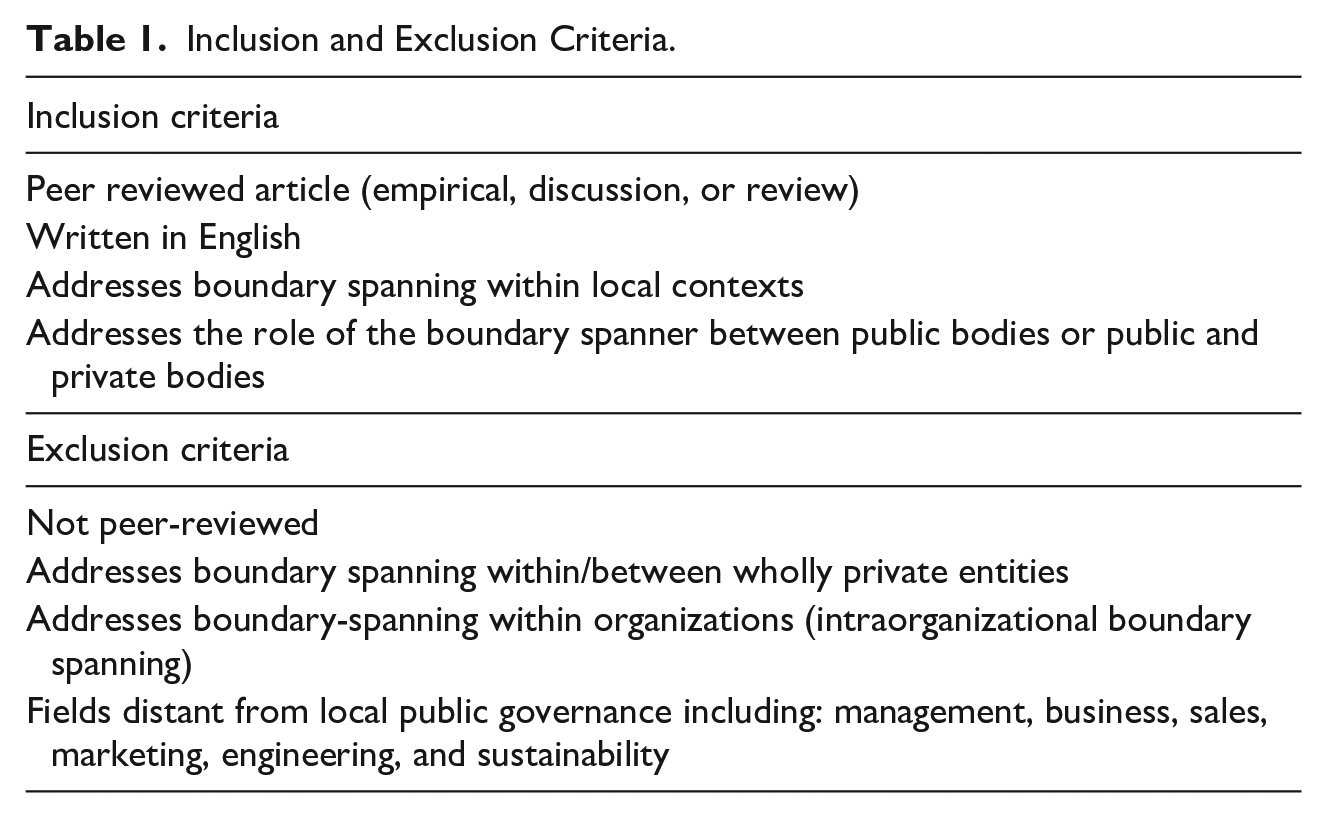
A set of eligibility criteria were established in the protocol (Table 1). To be eligible for inclusion articles had to be peer-reviewed journal articles written in English; the peer-review criterion aimed to ensure a base-line quality for the papers while the English criterion reflected the capacity of the reviewers. No date limits were set on the eligibility as we were interested in all papers written on boundary spanning in local contexts. Further, to be eligible articles had to address boundary-spanning in a local context, between public bodies or between public and private bodies. Articles on boundary spanning within organizations or wholly between private bodies were excluded. This was a reflection of our aim to address boundary spanning in the context of public governance, meaning spanning within organizations and between private organizations did not have a direct bearing on crossing organizational boundaries in the context of local public governance. In line with this reasoning, articles were excluded when they were in fields far from public governance, including business, sales, marketing, engineering, and sustainability.
Inclusion and Exclusion Criteria.
Search Strategy
A comprehensive search was performed in the bibliographic databases Scopus/Elsevier (coverage: 1823—14 March 2022), APA PsycInfo/Ebsco (coverage: 1800—present), the Web of Science Core Collection/Claritvate (coverage: 1900—present) and the International Bibliography of the Social Sciences (IBSS)/ProQuest (coverage: 1951—present) in collaboration with a literature researcher (LS). Search terms included controlled terms as well as free text terms. Synonyms for “local governance” were combined with variants for “boundary spanning.” The search was performed without date or language restrictions. Duplicate articles were excluded by a medical information specialist (LS) using Endnote X20.0.1 (Clarivate™), following the Bramer-method (Bramer et al., 2016). The full search strategies for all databases can be found in the Supplementary Information. Synonyms for “boundary spanning” were not included in the search string. Our decision not to include synonyms for boundary-spanning had two main-drivers. First, we were interested in how the boundary-spanning concept itself was being utilized in this context; although there are close synonyms for boundary-spanning such as “knowledge broker” and “connector,” boundary-spanning as a concept has a rather clear and distinct set of features that have emerged through an extensive literature dating back to the 1970s. Second, the inclusion of “boundary-spanning” alone yielded a significant number of hits for an extensive review.
Study Selection
Consistent with the methodology of a scoping review, study selection was an iterative process. One reviewer (WS) screened all potentially relevant titles and abstracts for eligibility using Rayyan (Ouzzani et al., 2016). Studies were excluded if they clearly were not relevant due to: (i) referring to boundaries in the contexts of physics or other hard science fields (ii) referring to boundary spanning within a single organization or (iii) referring to boundary spanning only within the context of private companies. Two reviewers (WS & RS) then independently screened the remaining 243 studies. Studies were included if they met the eligibility criteria in Table 1.
After both reviewers had blindly reviewed one hundred articles, a mid-review calibration was conducted using the comparison feature offered by Rayyan. During this calibration moment 16 papers were identified as differently categorized. The two reviewers discussed these differences in judgment and identified two ambiguities in the eligibility criteria: the definition of local context and the question of boundary spanning within the context of health organizations. Regarding the first, we developed a shared definition of local context as being within the limits of a city or municipality. The defining feature was that they fell within a layer of local governance rather than spanning cities or municipal areas. Regarding the second, we noted that a number of boundary-spanning articles addressed boundaries between different layers of the healthcare system at a local level. As we discussed these examples, however, it was clear that many were examples of intra- rather than inter-organizational boundary spanning since the entities were lodged within an overarching body.
These discussions led to clarification of the definitions of the eligibility criteria. Thus, the criterion “local context” was expanded to include neighborhood, municipality, or city. The initial 100 articles were re-reviewed along with the remaining articles to ensure this more encompassing criterion was applied. After all articles had been through a round of exclusion/inclusion by both reviewers, discrepancies in judgment were resolved through a consensus procedure, discussing the differences until consensus was reached on all articles. Where it was ambiguous from the title and abstract as to whether the article met the eligibility criteria, the full text of the articles was reviewed.
Data Charting
The data from the 38 eligible studies were charted using an extraction grid created with Microsoft Excel. The grid (Table 2) consisted of 15 columns, which can be divided between general data on the study (e.g., title, year, sample size) and data on findings relevant to the research questions. For general features of the study, we collected data on the authors, year of publication, title, journal, methodology, sample size and country of origin. For findings relevant to the research question, we abstracted (i) the definition of boundary spanning presented in the paper, (ii) the description of the actors whose boundaries were being spanned (for example, a health organization and a provider of social welfare services, a school and a local community), (iii) the individuals with the role of boundary spanner; these were the people the article identified as carrying out the work of boundary spanning.
Review Charting Grid.

We also abstracted data on specific local issues. This variable involved a level of interpretation by the reviewers given that the local context generally was not an explicit focus of the articles. In order to provide standards for this, we charted all references to locally specific issues as defined by (a) references to working in close physical proximity, (b) references to working within a bounded context (e.g., references to the influence of working within one municipality, one city, or one neighborhood), and (c) references to any relationship to a community or a neighborhood. The first author charted the data from the eligible studies, and the second author reviewed the data.
Synthesis and Reporting of Results
First, we summarized the general characteristics of articles, providing a descriptive account of the research methodologies, sample size and country of origin of the studies. In order to understand how the concept of boundary spanning is currently being drawn upon in relation to collaboration in local contexts we examined a number of features of the papers: (1) how boundary-spanning was defined, (2) what kinds of boundaries were identified as being spanned, (3) the features of the boundary-spanning role, and (4) issues specific to boundary-spanning in a local context. In practice this involved reading through each item in the data charting table and grouping those with the same or conceptually similar content. A descriptive account then was then written of common elements that emerged in multiple studies, with additional notes of outliers from these common descriptions. The process could be likened to a thematic content analysis. The results are presented as a narrative account in the following section.
Results
Source Selection
The literature search generated a total of 2,607 references: 1,131 in Scopus, 905 in Web of Science, 277 in PsycInfo and 294 in IBSS. After removing duplicates of references that were selected from more than one database, 1,439 references remained. The initial review of the titles and abstracts led to the removal of 1184 articles that clearly were not relevant, leaving 255 for retrieval. After searching the resources available to the reviewers, including emailing authors of papers, 12 articles could not be retrieved and thus had to be excluded from the review. This left 243 articles to be assessed for eligibility. After resolving all differences in judgment between the reviewers, 48 articles were included. During the course of data charting, all the articles were fully read. During the reading of full texts it became clear that an additional 10 articles only referred to boundary spanning in a tangential manner and did not address the role of a boundary spanner, leaving 38 papers to include in the final review. The flow chart of the search and selection process is presented in Figure 1. (Page et al., 2021; prisma-statement.org)
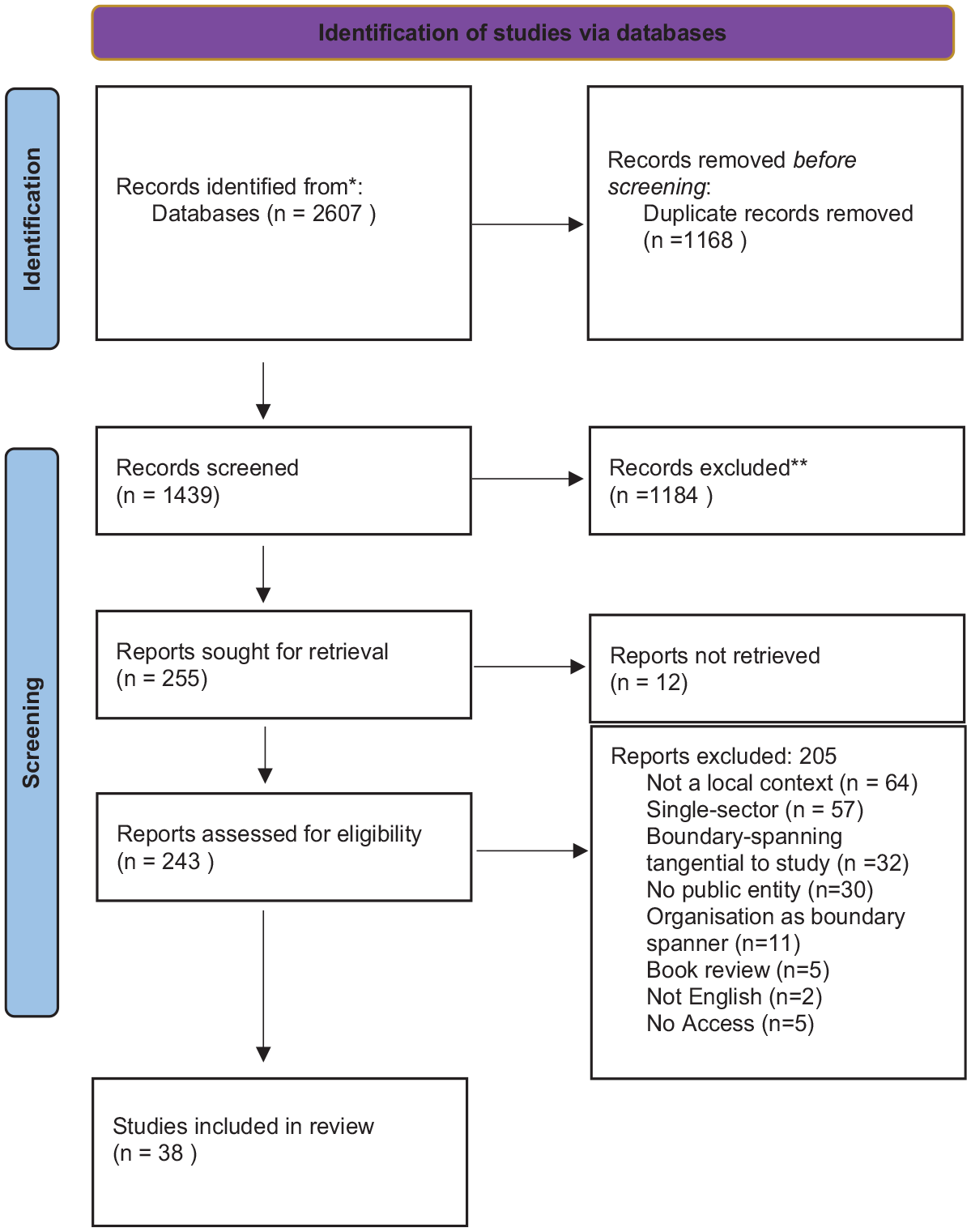
PRISMA Flowchart: Identification and Screening Process.
Study Characteristics
The majority of the studies are case studies of boundary-spanning in a specific context. In addition, there also were a literature review, a survey, and three conceptual and commentary papers. Twenty-eight of the studies used interviews, often in combination with document analysis (13) and observation (12). Seven studies drew on surveys and two on focus groups. The studies included a wide range in sample size, from an in-depth ethnographic study of one practitioner (Kovács, 2020), to interviews of over 200 participants (Lindsay et al., 2021), to a survey with 385 participants (McCuaig et al., 2019). The median sample size across the studies is 37.5 (excluding non-empirical papers). By virtue of the selection criteria, a defining feature of all the papers is that they deal with boundary spanning within a locally-bounded geographic context—a city, neighborhood, municipality, village or town. The majority of the studies were based in three countries: the USA (13), the Netherlands (13) and the UK (9).
Conceptualization of Boundary Spanning in Local Contexts
In this section we present the synthesis of the data abstracted from the articles on the definition of boundary spanning, the boundaries identified as being spanned, and the features of the boundary-spanning role.
Defining Boundary-Spanning
The studies varied greatly in the extent to which they paid attention to defining boundary spanning, ranging from no explicit definition to extensive discussions of definitions. Across the definitions, however, a clear core notion of boundary spanning emerged that involved bridging the gap between two or more organizations; most definitions pointed to a key role in translating between the different priorities, logics or languages of the different organizations. This core definition is encapsulated in Miles’s (1980, p. 62) widely cited definition that boundary-spanning refers to “positions that link two or more systems whose goals and expectations are at least partially conflicting.” Around this common core, though, are differences over the scope and position of the role.
At one end of the spectrum, the scope of the role is primarily one of facilitating the flow of information between organizations: “[they] facilitate information sharing back and forth across the organizational boundaries, and help match needs and resources” (L. K. Bradshaw, 1999, p. 39). Most go somewhat further and emphasize the role of translating between cultures; for example: “Boundary spanners (or collaborative managers) can be defined as individuals who work across different organizational cultures and exercise influence through formal and informal channels in order to strengthen the connections between actors” (Guarneros-Meza & Martin, 2016, p. 240), and “They deal with people on both sides of the boundary and specialize in negotiating the interactions between systems” (Van Hulst et al., 2012, p. 438). Some, however, highlight a more extensive and complex scope of work: “The boundary spanner has been defined as delivering a range of functions, including: providing local coordination as an ‘anchor point’ between collaborating agencies; linking stakeholder groups within and beyond the boundary spanner’s own organization; managing tensions and conflicts between partners; building trust and shared values; demonstrating leadership in pursuing the partnership’s goals; promoting innovation in policy solutions that reflect inter-disciplinary approaches; and (crucially) networking to share information and practice” (Lindsay & Dutton, 2012, p. 514).
Another key divergence between definitions concerns the positioning of boundary spanners. In some definitions, the role is clearly defined as one who is embedded within one organization and reaches out to others: for example: “Boundary spanners are individuals who act on behalf of their organization in an interorganizational interaction, by linking their unit to external areas” (Callens & Bouckaert, 2019, p. 1113). In other definitions, however, the rootedness in one organization is less apparent: “people with a foot in both worlds” (Etz et al., 2008, p. 396) and “Boundary spanners work in positions between two or more systems (e.g., the juridical system and the health system, different organizations). They deal with people on both sides of the boundary and specialize in negotiating the interactions between systems” (Van Hulst et al., 2012, p. 438).
The Boundaries Being Spanned
Across the studies, a plethora of organizations and sectors are identified as entities involved in some configuration of boundary-spanning. Here, we use the term entity to capture the range of actors involved in boundary-spanning relationships in these studies, including organizations, communities, and local governmental bodies.
These can be categorized broadly in the fields of health (11), social care/welfare (8), education (7), judicial (4), and local government (4). Other entities include emergency services (1), farming (1), and the private sector (1). In most studies, the boundaries being spanned are between two entities: however, 11 studies involved spanning boundaries among three or more entities.
Outside more clearly defined organizations, 11 studies identified “community” as an entity into which or from which boundaries were spanned.. “Community” often seemed to refer to a local population; for example, “boundary spanners who broker connections between the school district and the community” (Brown, 2017, p. 369) or “reaching beyond clinic walls to create community linkages” (Etz et al., 2008, p. 391). At other times, studies more explicitly referred to communities defined by ethnic or cultural connections (Carlsson & Pijpers, 2020).
Boundary Spanning Role Holder
We also examined the nature and positioning of the boundary spanning role, looking at two dimensions (Table 3). The first relates to how the role came to be defined as “boundary-spanning.” Three categories were identified: (1) individuals who are boundary-spanners because working across boundaries is inherent to the role, while not necessarily serving as the defining feature of their work (e.g., school principals), (2) roles that were specifically created to bridge between organizations, and (3) individuals who were identified during the course of the research as carrying out boundary-spanning work. Examples of the first category include school principals (L. K. Bradshaw, 1999), central office administrators (Honig, 2006), and frontline workers (Lindsay et al., 2021). The second category –created roles – includes positions such as “health brokers” (Harting et al., 2011), “care sport connectors” (Hermens et al., 2017), and “refugee-student family mentors” (Koyama & Kasper, 2021). The final category contained leaders who demonstrated specific boundary-spanning qualities in carrying out their work (Dudau et al., 2018), and emergency service personnel or managers who demonstrated boundary spanning capabilities during the course of a crisis (Gil-Garcia et al., 2016).
Conceptualisation of Boundary Spanning Role.
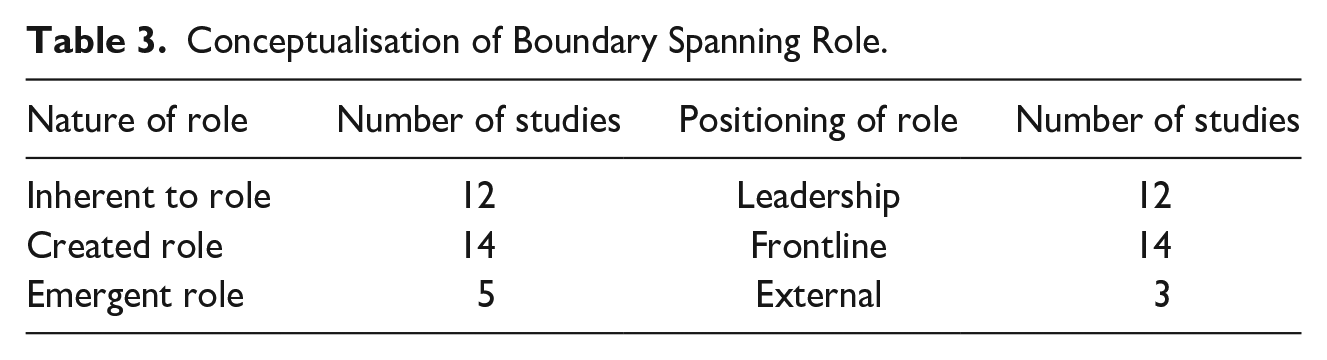
The second perspective from which the boundary spanning role was considered was the positioning of the role within an organizational hierarchy. Again, three categories were identified: (1) boundary-spanners holding a leadership or management position, (2) boundary spanners working in a frontline role, and (3) boundary spanners positioned externally to the organizations.
In summary, in studies examining boundary-spanning within a local context, a clear core definition of the boundary-spanning role emerged, with a wide spectrum of what the scope of that work looks like. The entities involved in boundary-spanning cluster in the fields of health, social care/welfare, education, and, significantly, the “community.” Those holding these roles are in some cases called upon to span boundaries as a result of the nature of their work more generally, while in other cases the central mandate of their role is to span boundaries.
Characteristics of Boundary Spanning in Local Settings
This section presents evidence about specific features of boundary-spanning in local contexts. Five key themes were identified in the articles: (1) the role of physical proximity, (2) the complexity of local conditions, (3) power imbalance, (4) frontline activities, and (5) the nature of relationships.
Physical Proximity
Across the papers, several key issues related to close physical proximity. First, some studies focus on individuals, due to their living in close proximity, interacting outside of formal settings, which can shape boundary-spanning possibilities. Alvinius et al. (2016) point to the spontaneous links created by family members or off-duty professionals embedded within the local context who end up taking on boundary spanning roles between health care and the community: “The municipality nurses running to the hospital to fetch medicines or going to the pharmacy to pick up patients’ prescriptions, which they do in their free time because they’re ‘nice’…” (p. 157). Embeddedness in a local context shaping the nature of boundary-spanning efforts is also identified by Koyama and Kasper (2021) who describe the importance of the informal interactions of the boundary spanner in community settings. In a somewhat similar vein, Miller (2008) and Van Hulst et al. (2012) refer to the deep relationships boundary spanners develop as a result of being embedded within their communities.
In some articles, however, physical proximity was not equated with greater ease of boundary crossing. Being physically proximate does not necessarily provide a clear picture of or relationships with other organizations (Etz et al., 2008; Harting et al., 2011). Further, Carlsson and Pijpers (2020) point out that when thinking about spanning into a community, thinking in terms of physical proximity can be a barrier. They note that while a boundary spanner’s role may be to connect to the local community of a neighborhood, the reality may be that the communities in which people interact are not geographically bounded, but rather span a wide area bringing together those with shared culture or interests.
Complex Local Contexts
Among the challenges authors identified that boundary spanners faced in local settings were the complexity and uniqueness of such contexts. One expression of this complexity was identifying appropriate partners given the plethora of organizations working within a neighborhood, for example, to address overlapping issues. For example, Harting et al. (2011, p. 66) describe the challenges for local health brokers faced by myriad fragmented projects operating in one setting: “Developing the content of the role was difficult and hampered by the complexity of health issues and the local situation.” In the context of education, successful boundary spanning required working with a whole neighborhood and not just specific organizations (Honig, 2006).
A number of studies identified individuals who were able to successfully cross boundaries in local contexts and pointed to their understanding of the local conditions. Nissen (2010, p. 379), examining successful youth work professionals, reported that: “Their ability to adapt to local circumstances allowed them to gain power and access across diverse groups. Failure to do this risked alienating one of these groups, impeding progress toward the vision.” Similarly, Kovács (2020, p. 140) pointed to effective boundary spanners’ “extensive knowledge of local conditions and ‘holistic problem orientation’, which allows them to prioritize the complex and interrelated neighbourhood problems.” Further, in a boundary-spanning role aimed at addressing labor market inclusion, Lindsay et al. (2021, p. 932) emphasize the importance of “deep community knowledge.” This seems to refer to an in-depth understanding of the various issues and concerns at play in a community as well as to its sources of strength.
This centrality of deep understanding of local conditions also evidently extends to the articulation of a rather different kind of relationship and orientation on the part of the boundary-spanner. Honig (2006) describes the effective boundary spanner as one who works with the whole neighborhood in a “servant or service capacity” (p. 365). Miller (2008) emphasizes the role of trusting and loving relationships in successful boundary-spanning leaders: “. . . not only do they know, respect and believe in their neighbours, their neighbours know, respect and believe in them” (p. 370). Van Hulst et al. (2012) highlight the value of “speaking the local language” and an “intense way of relating” (p. 442). In these particular studies, the role of boundary spanner comes across as a vocation rather than a job, with deep sincerity about and commitment to the local area, requiring the ability to develop respect from a wide range of constituencies. It is perhaps in light of this embedded role that a number of studies report on the emotional labor involved in such roles (McCuaig et al., 2019; Needham et al., 2017; Rugkåsa et al., 2007). Boundary spanning roles can require significant emotional labor in building and sustaining trusting relationships; in those settings dealing with challenging personal situations the emotional labor is likely to be higher (Needham et al., 2017).
The Question of Power
Where “the community” is identified of as one of the entities in a boundary spanning effort, a number of studies point to the power imbalance that exists, with formal institutions having sway over financial resources and access to information (Nederhand et al., 2016, 2019). Two studies explicitly refer to the notion of “spanning downwards”; a conceptualization of boundary spanning that includes this hierarchical relationship cannot be treated as the same as boundary spanning relationships between two organizations in which the imbalance of power is less central (Roussy et al., 2020; Rugkåsa et al., 2007).
This imbalance of power is addressed in two different ways. In some studies, the role of the boundary-spanner takes on that of an advocate, championing the voice of the less powerful entity. For example, “their primary loyalties were to their community-based constituents, and they both possessed inherent desires to learn from and advocate for those who have traditionally been oppressed” (Miller, 2008, p. 362). Guarneros-Meza and Martin (2016) also explicitly frame the boundary-spanning role in terms of advocacy. Other studies, however, reported that this power imbalance was handled by having an external boundary spanner who sits outside of the power imbalance and can play a role in negotiating the boundaries and issues at play. For example, Miller (2009) describes the creation of the role of “systems advocate” who stood outside of school and homeless shelter institutions, but had enough understanding of both contexts to bridge the gap between them.
Discussion: Theorizing Boundary-Spanning beyond Formal Organizations
The local context is distinguished by the fact that the spanning of boundaries does not happen between organizations alone, but often involves spanning the boundary from organizations into communities and neighborhoods. This is rather a different prospect than can be found in the roots of boundary-spanning scholarship based on examinations of spanning boundaries within or between businesses or other formal organizations. It also occurs in a context in which there is an expectation of inter-sectoral collaborative functioning at the “frontline” in the face of “wicked” problems, such as preventing radicalization, addressing poverty, and dealing with the intersection of crime and mental health. These are challenges that not only require multi-sectoral responses, but also typically are not amenable to simple solutions. Given such circumstances, this scoping review aimed to map how boundary spanning is currently conceptualized and the evident gaps in the current literature.
It is apparent from the number of studies identified both that boundary-spanning is drawn upon as a concept to understand and frame what is happening in local settings and that it is applied to collaborations involving a host of different organizations and sectors. Notably, despite one paper’s reference to the “lack of definitional clarity” around boundary spanning (Brown, 2017), a relatively solid core definition surfaced in the research examined, centered on boundary spanning as facilitating some collaboration between systems that often have different languages and priorities. The divergences center mostly on the scope of what this involves. This is not trivial, given the challenging journey other concepts have faced in moving across fields. Indeed, many social scientific concepts by their very nature are contested and the subject of ongoing definitional discussion; one needs only think of the debates surrounding key concepts such as democracy. Given this, boundary-spanning seems rather stable.
This relative stability of the boundary spanning concept enables much of the research to focus on application. It is in its broad and varied application that the divergences in the concept emerge. This suggests that perhaps more nuanced and contextualized understandings of boundary spanning are required. Indeed, this is demonstrated in van Meerkerk and Edelenbos’s (2018) profiles of different kinds of boundary-spanners: the fixer, the bridger, the broker, and the innovative entrepreneur. It is notable, however, that within the literature reviewed, a generalized notion and definition of boundary-spanning is called upon, and there is not yet an evident body of scholarship is grounded and developing contextualized notions of boundary spanning that addresses the distinctive features of the work in local and community contexts. That is to say, there seems to be a space for developing a more refined conceptualization of boundary-spanning in the context of its being embedded in local community settings.
Such embeddedness, not just in organizational and political contexts but also in local and community contexts, evidently suggests a more laden role than that of spanning the boundary between a business and government or between two departments in local government. Echoing van Meerkerk and Edelenbos (2018), this review highlighted the significance of the relationships built by those working in particular local contexts. These relationships can be marked by a deep commitment to the local setting, which at least in some cases highlights the role of boundary spanner as being more than doing a job, with deeper motivational roots. Although all forms of boundary-spanning require understanding the different cultures, languages and priorities of the systems involved, a local community seems to stand rather apart from organizations. Although organizations often are heterogeneous and complex, they usually are bound together by overarching organizational priorities and purposes. There are formal statements of organizational aims and missions, and individual participants become acculturated to the language and norms of the system: indeed major streams of human resource work are aimed at helping employees understand and take on the organizational culture (Bellot, 2011).
This rarely is the case with community, and particularly communities of place. Communities of shared interest or shared interaction may be more cohesive (T. K. Bradshaw, 2008); however, much of the frontline work takes place within communities of place, connected by virtue of geographic proximity, and not necessarily much more. A community of place is likely to be quite diverse in composition, priorities, language, and expectations. It is hard to view this through the same lens as an organization. A similar distinction emerges when we consider communities and local contexts as places where everyday living is taking place. The impact of boundary spanning is directly on the lived experience of individuals, rather than on the functioning of an organization. Further, and as highlighted in the studies reviewed, the question of power comes to the fore, with rather intractable imbalances in power between organizations, particularly governmental bodies and the communities with which they are seeking to span boundaries
If we consider again the cases of the teachers, police officers, and youth workers required to collaborate in the prevention of extremism in an urban neighborhood, the challenge before them is not only to align their own sometimes conflicting roles, responsibilities and priorities (Stephens & Sieckelinck, 2019), but also to build and maintain strong relationships with young people and families living within the neighborhood. The challenges are not insignificant: the very act of spanning the boundary between youth workers and police may work against efforts to span the boundary between youth workers and communities, if community members perceive the relations of youth workers with police as undermining trust in the confidentiality of the youth worker. The priorities of the police to ensure public safety do not necessarily easily cohere with the priority of the pedagogical perspective of the youth worker. The concerns and priorities of the local community include both the fears of some elderly residents and the discontent of some youth, the resolution of which do not necessarily seem immediately compatible.
Taken as a whole, these features highlight a distinctive and complex context in which boundary-spanning local governance is occurring. Indeed, the core definition of boundary-spanning appears to be critical, with individuals required to translate between systems with conflicting priorities and differing languages and cultures. As such, fuller understanding of what can be learned about those individuals charged with crossing numerous and varied boundaries in myriad contexts is likely to be of value. Yet, given the existing expansive base of research on boundary-spanning generally, carving out a clearer conceptualization and literature on boundary-spanning efforts embedded in local community contexts may provide a valuable basis for those policy-makers and practitioners faced with the day-to-day demanding task of collaborating amongst themselves and spanning into local communities around pressing challenges. The foundations of such a conceptualization already exist, for example, with the distinction drawn between vertical and horizontal spanning and the recognition that boundary spanners often have to cross boundaries into other organizations (horizontal) and into systems with a different power status (vertical) (Guarneros-Meza & Martin, 2016). Further developing contextualized conceptualizations of boundary-spanning, while keeping them embedded in the broader literature on boundary-spanning as whole, offer a promising avenue for assisting those charged with navigating this complex yet essential work.
Limitations
There are a number of limitations to this study. First, only English-language studies were included, meaning that it is conceivable that important scholarship on this topic in other languages has been missed. Going further into the question of boundary-spanning in local communities would benefit from a scan of the non-English literature. Second, our literature search did not include synonyms for boundary-spanning. A number of terms such as “broker” and “connector” have connotations similar to boundary spanning. However, for the purpose of this study, we were specifically interested to uncover how the specific term boundary-spanning is being conceptualized in relation to collaborations based in local contexts. Third, by selecting a scoping review rather than a systematic review we explicitly do not assess the quality of the evidence. This, however, allowed for the inclusion of a wider range of studies and is more suitable for mapping the conceptualization of boundary-spanning. Finally, only one reviewer (WS) screened titles and abstracts, while the standard is for two reviewers at each level of the scoping review process. Although two reviewers would have been preferable, it is worth noting that at this stage of the review, articles were excluded only when they were unambiguously not relevant because they dealt with very different concepts of boundary spanning such as those found in the natural sciences.
Supplemental Material
sj-docx-1-aas-10.1177_00953997231219262 – Supplemental material for Boundary Spanning in Local Governance: A Scoping Review
Supplemental material, sj-docx-1-aas-10.1177_00953997231219262 for Boundary Spanning in Local Governance: A Scoping Review by William Stephens, Ronald van Steden and Linda Schoonmade in Administration & Society
Footnotes
Declaration of Conflicting Interests
The author(s) declared no potential conflicts of interest with respect to the research, authorship, and/or publication of this article.
Funding
The author(s) received no financial support for the research, authorship, and/or publication of this article.

Data Availability Statement
Data sharing not applicable to this article as no datasets were generated or analyzed during the current study.
Supplemental Material
Supplemental material for this article is available online.
Author Biographies
References
Supplementary Material
Please find the following supplemental material available below.
For Open Access articles published under a Creative Commons License, all supplemental material carries the same license as the article it is associated with.
For non-Open Access articles published, all supplemental material carries a non-exclusive license, and permission requests for re-use of supplemental material or any part of supplemental material shall be sent directly to the copyright owner as specified in the copyright notice associated with the article.
