



Abstract
Studies of institutional change have focused on several themes. Yet, examinations of small innovations still require attention. This question is important because a new logic is usually only recognized after several modifications have taken place; thus, noticing it early becomes relevant. The emergence of a new logic presupposes new prescriptions about what is appropriate for both businesses and society. This article examines Brazilian health regulations that have undergone several alterations and suggests that this occurrence can be identified only when actors begin to react to the impact of such an event by changing their daily practices.
Introduction
In institutional studies, acknowledgment of change has mainly been examined as a finished process, suggesting that change events are sporadic. Over the past 20 years, researchers in sociology, political science, and other fields have studied how changes occur using different epistemologies and approaches (Haveman & Gualtieri, 2017; Mahoney & Thelen, 2010; Mutch, 2018; Thornton et al., 2012) and have discussed different drivers, mechanisms, and objects. In relation to the temporality of change, different issues have been analyzed, such as pace and phases. However, whether a new logic can only be perceived as a finished process or whether its construction can be anticipated remains to be examined.
Friedland and Alford (1991) conceive of “institutions as patterns of activity” (p. 232) that provide a repertoire of possibilities by which organizations and individuals behave. They also recognize the contradictory character of relations between central institutions, with multiple logics available to various actors. They consider that institutional transformations result from actors taking advantage of the contradictions between these multiple logics to create new social relationships and symbolic orders.
The institutional logics approach helps to explain institutional change better than prior studies of organizational institutionalism (Greenwood et al., 2011; Micelotta et al., 2017; Waldorff et al., 2013). Yet, the understanding of this approach is that first-order institutions remain practically unchanged for long periods, while other elements such as identities, roles, practices, resources, and rules can change; alternatively, according to Thornton et al. (2012), change occurs at the meso or micro level. For example, religion is a first-order logic in Western society, and regardless of what denomination is analyzed, religious practices and values have changed over the years and throughout the centuries. More recently, the modified practices of various Christian churches are still recognized as prior Catholic practices. Mutch (2018) uses examples of Lutheranism, Calvinism, and Episcopalianism as modifications to previous Christian practices and values.
Previous studies have tended to consider institutional change a transformational occurrence (Faik et al., 2020; Frenken et al., 2020; Greenwood et al., 2011). This study’s focus is related to the frequency of innovations introduced into a given context and how they constitute signs of future change in prevailing institutional logic. To examine this issue, we use the case of a regulatory change in the private health system in Brazil. We review the literature on change, and the case we explore enhances understanding of how incremental changes contribute to a larger picture.
Because it is a complex system full of uncertainties and public interest, the National Supplementary Health Agency (ANS) in Brazil was created to regulate the field of supplementary health. Currently, this regulation is done through so-called normative resolutions (RN), which are federative regulations and are the main means by which rules with the force of law are established in the Brazilian supplementary health market. These regulations are like the “Regulations” issued by the US Food & Drug Administration (FDA). Similar to the FDA, ANS regulations undergo a formal drafting and adoption process, including public comment periods and agency reviews, prior to publication.
Literature Review
Studies of institutional change have produced various approaches, including the practice (Lawrence et al., 2011; Smets et al., 2012), exogenous shocks (Barley, 1986), institutional entrepreneurship (Battilana & Dorado, 2010; Maguire et al., 2004), institutional work (Lawrence et al., 2011), and multiple institutional logics (Dunn & Jones, 2010; Greenwood et al., 2011; Micelotta et al., 2017; Waldorff et al., 2013) perspectives. Studies have focused on the pace of change (Dacin et al., 2002; Lawrence et al., 2001; Micelotta et al., 2017), the phases that the changing events undergo before they become settled (Maguire et al., 2004; Micelotta et al., 2017; Smets et al., 2012), and the different drivers, mechanisms, and objects of institutional change (Frenken et al., 2020; Lawrence et al., 2011; Maguire et al., 2004; Smets et al., 2012). Not yet considered, however, is the possibility that change events may occur frequently.
Most previous studies have adopted a transformational notion of change, whereby conditions are altered after a series of momentarous events (Faik et al., 2020). Any other alteration affects acquired stability. Barley’s (1986) study of the introduction of a new technology that changed the daily practices of two hospitals, which viewed change as the result of exogenous shocks, is an example of such a source of change. This suggests that new roles and interaction patterns are the result of an instant occurrence. The introduction of business planning and performance measures by the Cultural Facilities and Historical Resources division of the Government of Alberta (Townley, 2002) also embodied the idea of exogenous shocks. These studies point to the influence of the macro level on the meso and micro levels of analysis (Pollitt & Bouckaert, 2017; Roberts, 2020). However, the reference is, again, the episodic character of this phenomenon.
Various studies have explored the idea that change occurs when one logic becomes dominant in a context, while other logics either remain subsidiary or disappear (Haveman & Gualtieri, 2017; Thornton et al., 2012). Such analysis suggests that the domains in question had a previous dominant logic over a considerable period that was replaced by a new logic, which again manifests the episodic character of change. Tolbert and Zucker’s (1996) institutionalization process, which includes the stages of habitualization, objectification, and sedimentation, defines change as the perception of an event that takes time to diffuse in a context. Lawrence et al. (2001) define the pace of change as the time it takes for an innovation to diffuse.
Scott et al. (2000) examined the changes experienced by five populations of interrelated organizations in the San Francisco Bay area to show the successive dominance of different logics in this domain. Reay and Hinings (2009) note that although conflicting logics co-exist during times of transition, at some point, a specific logic dominates. Thornton and Ocasio (1999) studied the publishing business and concluded that editorial logic has been replaced by market logic. In the culinary field, haute cuisine has been replaced by nouvelle cuisine (Rao et al., 2003). The hybridization of logics, another approach in the literature, follows the same direction. Tracey et al. (2011) described an organization that combined the logics of charity and commercial retail to address the issue of homelessness. Battilana and Dorado (2010) studied how microfinance organizations combined development and banking logics to fight poverty in Bolivia.
Other studies differentiate between transformational and step-by-step modifications, thus providing the first indication that the initial events may lead to a logic change. Micelotta et al. (2017) found that the pace of change may be “revolutionary” or “evolutionary”: the former implies a disruptive and forceful conflict between players with asymmetrical power, while the latter occurs more slowly through modest innovations. The authors explain that local improvisations in practices (Jarzabkowski, 2005; Lounsbury & Crumley, 2007) combine to result in institutionalized changes. Dacin et al. (2002) contrast changes during brief periods and over time and state that they “can take place incrementally . . . or abruptly” (p. 48). Smets et al. (2012) note that most previous studies have emphasized field-level processes, neglecting micro-level and day-to-day actions; thus, they propose that institutional change involves various phases, from its beginning to its absorption by the organization.
Hoffman (1999) analyzes the emergence of environmentalist logic in the U.S. chemical industry as if it were made up of a sequence of events, including the formation of the Environmental Protection Agency (Mutch, 2018). Maguire et al. (2004), in their study of the HIV/AIDS epidemic, describe the successive phases of the treatment approach, starting with improvised interactions between pharmaceutical companies and HIV/AIDS community organizations and later gaining an institutionalized character. Leblebici et al. (1991) examine changes in the radio broadcasting industry, showing how new technologies and practices originated from the field’s periphery and were replaced in several stages because of the way in which the industry operated. Although these studies consider the different phases experienced a change process, they point to the continual occurrence of events that constitute change.
The small alterations along the way implied by these previous studies indicate that actors in each context dispute the prevailing logic’s configuration, trying to modify it in their favor because, according to Dacin et al. (2002), “institutions change over time, are not uniformly taken-for-granted, have effects that are particularistic, and are challenged as well as hotly contested” (p. 45). The notion that changes may occur frequently is apparent in concepts of modest innovation (Micelotta et al., 2017), incremental change (Dacin et al., 2002), and change phases (Hoffman, 1999; Leblebici et al., 1991; Maguire et al., 2004; Smets et al., 2012). Scott (2001) suggests observing the number and types of actors participating in each context, underlining that these should be examined over time together with logics and governance systems and affirming that a change in any of these factors indicates institutional change.
Another set of studies has determined that, among the different logics present in a specific context, one might prevail or combine with elements of other logics at different events, meaning that the innovations brought to the context are the product of constant action by various actors. Borum and Westenholz (1995) consider it possible to continuously integrate aspects of a new institutional logic into an organization’s practice while retaining previous ones. Waldorff et al. (2013) summarize their findings into two categories: a context characterized by the presence of an influential logic that brings in some elements of other logics and a context in which an alternative logic adopts complementary features.
Similarly, Raynard (2016) argues that logics might converge depending on features such as compatibility, field prioritization, and jurisdictional overlap. Dunn and Jones (2010) analyze the plural logics of care and science in medical education, noting that they “fluctuate” over time. Medical schools privilege and emphasize these two logics differently in their programs. Meyer and Höllerer (2010) admit the possibility that logics can peacefully coexist, compete, and supersede each other or reach a temporary truce. Heimer (1999) explains how legal, medical, and family logics interact or overlap to configure activities in medical care organizations. Goodrick and Reay (2011) understood coexisting logics as alternatives to field actors whose practices, structures, and understandings remain available to them to engage in without distinction to achieve their objectives. Lounsbury and Crumley (2007) warn about the possibility of perceiving new practices that emerge at the earliest moments of change.
Based on these studies, it can be assumed that frequent alterations take place given the possibility of continuous integration of logics, bringing in elements from other logics, and so on. Mahoney and Thelen (2010) observe that, in relation to the pace of change, actors in the same organization are constantly renegotiating the interpretation and application of certain rules. The possibility that actors have the power to propose alternatives leads to frequent changes; once created, institutions change in subtle ways over time.
These interpretations suggest that change events occur continually, albeit on an almost imperceptible scale. For example, when we talk about market logic, we can use instruments that did not exist a few years ago, such as virtual coins, price comparison websites, and bank cards. Although these new practices, structures, and rules have been introduced in several steps, they are recognizable as practices and guidelines used to buy and sell products and services (and consequently, as elements of market logic). The same applies to families that can exhibit different configurations (typical, single, same gender, three participants, other) and still consist of individuals who understand that they have a close intimate relationship. The difference is that the market logic or family logic under examination differs from the previous configurations.
This may suggest that change happens at the micro level of practices, structures, values, and rules, which acknowledge the first signs that, at a certain point, constitute a recognizable change in institutional logic (e.g., nouvelle cuisine); this modifies the character of the central logic (market, professional) while maintaining its proposition. Lounsbury et al. (2021) mention the concern of distinguishing between a change that is absorbed into an existing configuration of logic, “institutional accommodation,” and a change that can transform a field, or “institutional accretion.” However, not every introduced or modified activity leads to logical changes of either type. Thus, confirmatory actions, misinterpretations, and resistance can be considered activities that do not necessarily produce change (Greenwood et al., 2011; Lounsbury & Crumley, 2007; Micelotta et al., 2017).
Methodology
This study examines the regulations that determine how complaints about the private health system should examined to understand whether the incremental modifications brought to a context individually indicate a sign of future change in institutional logic and the frequency with which they occur.
In Brazil, the private health system comprises organizations meant to complement the National Health System (SUS). The private system is discretionary. People opt for this service because the SUS is associated with several problems, such as poor service and delays (Bahia, 2001), because they want to have a privileged or differentiated service, or because companies offer it as an employee benefit.
This sector is regulated by the National Supplementary Health Agency (ANS). Among other functions, the ANS checks for unfair price increases, denial of coverage of diseases, treatments listed by the ANS as mandatory, grace periods, time limits for the use of intensive care units, low quality of care, and the proliferation of fraud. Individuals who have complaints related to these or other issues can address them to the ANS, although other channels are also available, such as the consumer protection system and courts.
Health plan companies (HPs) charge individual beneficiaries (IBs) a monthly sum and pay health providers, such as physicians, hospitals, and laboratories, for the services required by IBs. Notwithstanding, these HPs can assess specific demands made by IBs as not complying with the conditions established in the contract or regulated by the ANS and thus reject the requests.
Since 2000, the first year of operation, the ANS has issued various guidelines called Supplementary Health Council Resolutions (CONSU), Collegiate Board Resolutions (RDCs), and Normative Resolutions (RNs), each of which seeks to enable more effective monitoring of how companies deal with IBs. The agency has since moved from paperwork intermediation to the electronic exchange of messages (Notification of Preliminary Investigation [NIP]) and introduced the concept of collective intermediation, called conduct adjustment (Agência Nacional de Saúde Suplementar, 2001). Sanctions against health insurance companies have also improved since penalties were imposed for lack of brief answers, which encouraged the resolution of problems without imposing monetary fines, if operators ensured “immediate and spontaneous repair of all damages or losses caused” (Agência Nacional de Saúde Suplementar, 2003). Finally, penalties were discounted on the condition that HP companies relinquished any allegations in relation to demands, encouraging inspection processes to conclude more rapidly. Table 1 summarizes the changes in regulations through 2020.
Summary of Regulation Changes.
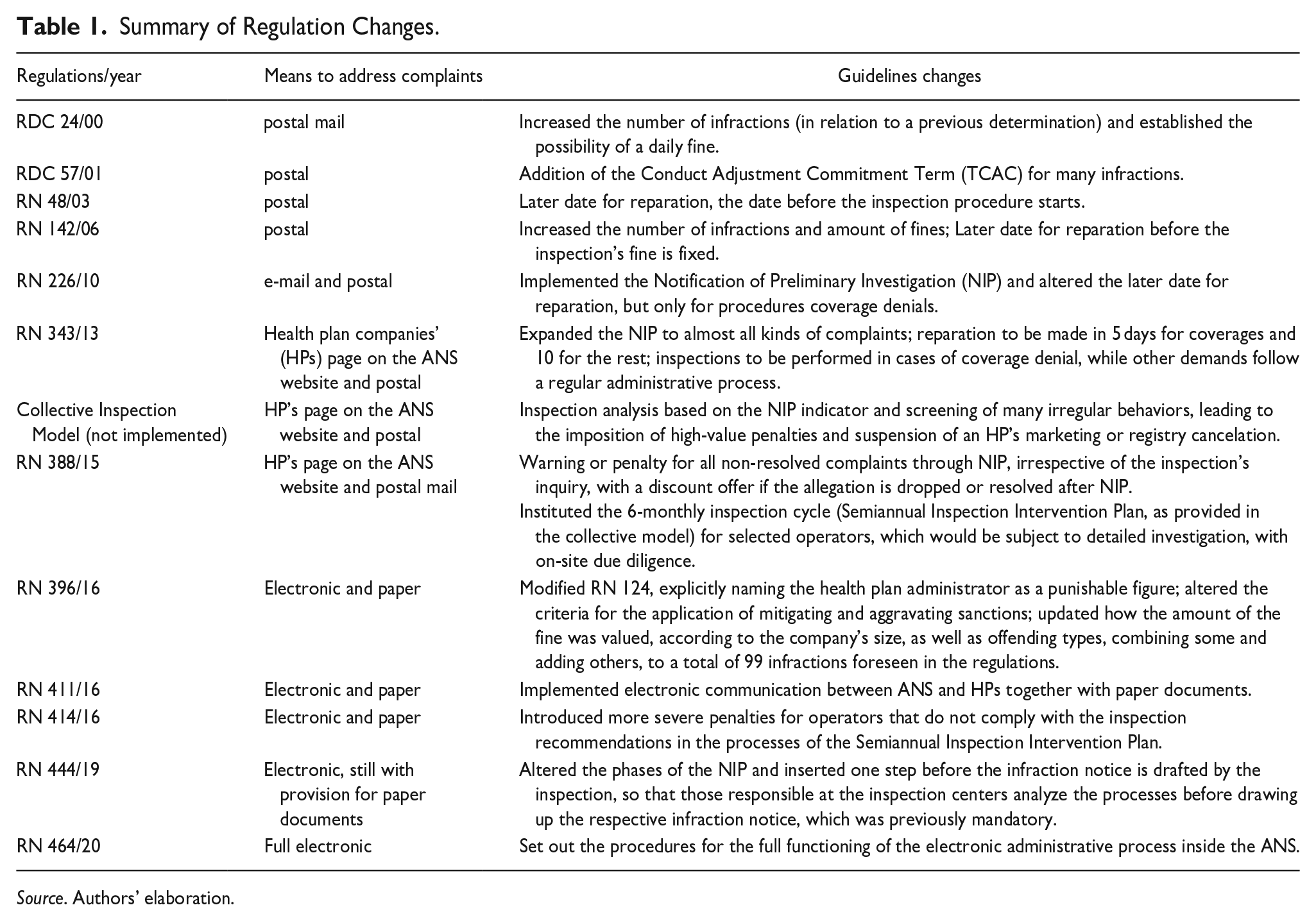
Source. Authors’ elaboration.
Method and Data Sources
A qualitative explanatory research was conducted to examine the health field change events in the health field that take place in ‘an integrated system’ (Stake, 1995, p. 2) comprising different actors active in the Brazilian private health field: a regulatory agency, the ANS; the HPs; IBs, represented by consumer protection organizations (CPOs), such as the Brazilian Institute for Consumer Defense (IDEC) and the PROCON Foundation; medical providers, and the media. In addition, other actors from the macro environment directly affect events in the field, such as the WHO, the Health Ministry, and the pharmaceutical industry.
This study concentrated on grievances guideline changes, which presented successive alterations every few years since the establishment of the regulatory agency, lending themselves to the examination of the contribution of incremental modifications to logic change. To draw this picture, we examined actors’ participation in each of the ANS guideline changes, their descriptions of the events involved, and the meanings presented. Qualitative research is appropriate for studying the context under study from the perspective of actors’ participation (Denzin & Lincoln, 2008; Stake, 2005), and as it is suited to explore their understanding of and agreement with the guidelines issued by the regulatory agency (Dacin et al., 2002; Thornton & Ocasio, 2008).
Data collection was conducted through (1) direct consultation with the ANS through the Citizen Information Service Electronic System (e-SIC) about the main motivations for drawing up regulations to monitor consumer complaints; (2) interviews with executives from several of the main organizations in the field, such as a previous ANS director, five inspection managers, and two inspectors at ANS; six HPs’ executives and ABRAMGE, the HPs’ association; PROCON-SP and the PROCON-ES Foundation, governmental consumer defense agencies; and IDEC, which is a civil society defense organization; and (3) reports and statements in newspapers, magazines, and the publications and websites of field organizations and the ANS.
Data Coding and Analysis
This study used thematic analysis (Guest et al., 2012; Terry et al., 2017) to identify the different elements of the logics competing in the field. Terry et al. (2017) explain that in a deductive approach, the analytic starting point is more “top down”—the researcher brings in existing theoretical concepts or theories that provide a foundation for “seeing” the data, for what “meanings” are coded, and for how codes are clustered to develop themes; it also provides the basis for interpretation of the data. (p. 22)
Thus, the research began by coding the elements that constitute a logic, such as values, practices, and structures, which, according to their characteristics, determine the kind of logic. Table 2 details society’s central logics and their elements.
Thematic Analysis.
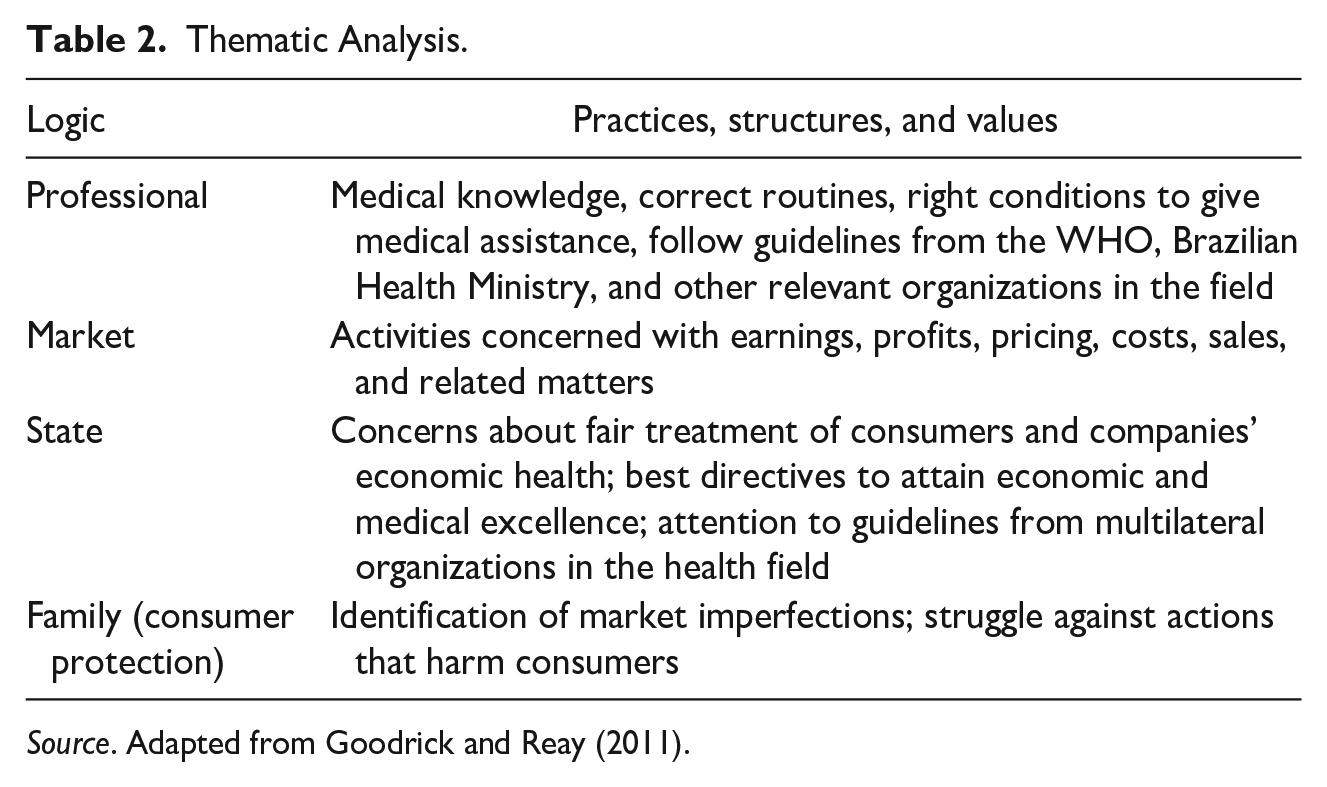
Source. Adapted from Goodrick and Reay (2011).
Data analysis indicated that the occurrence of a logic change could be identified when a new guideline informed the participation in discussions or dealings of actors in the field, which confirmed the modification and rationale for its introduction. Any alteration of a logic element (practices, structure, and rules) introduced due to the actors’ maneuvering can be called “change” because it does not confirm prevailing practices and structures. Although the alteration may not last, its new configuration can be considered an initial step for future changes. This is consistent with the idea that actors keep negotiating the interpretation and application of rules (Mahoney & Thelen, 2010). Changes that occurred after criticisms of and suggestions about a previous version of guidelines that were taken into account also were considered.
Sixteen interviews were recorded, totaling 684 minutes of audio recordings (with an average duration of 43 minutes per interview). These were conducted by two researchers to reconcile understanding of the reports; they resulted in 33 pages of transcripts that the researchers analyzed separately.
Those interviewed represented the main constituencies, including HPs, regulatory agencies, and CPOs. Thus, their responses could be compared, giving greater credibility to the study (Guba, 1990; Yin, 2001). The triangulation of multiple sources of evidence and the use of thematic analytical technique bolster research validity (Yin, 2001).
Findings
Regulations/Years 2000 to 2006
The accounts of the earliest years of the program suggest that the guidelines were enforced according to a state logic ANS developed and other actors did not question, even though the agency introduced successive changes to what could be considered infractions by the HPs with corresponding fines and a conduct adjustment term to engage HPs in operating commitments (Table 1).
The publication of the first set of guidelines saw almost no reaction from other relevant actors in the field. Reports on media and documentary research are scant. These first guidelines suggest that the participants either had no objections or did not vocalize them openly at the time. During those years, the grievance procedure may have favored state logic as the ANS seemed to set the conditions to define the guidelines and establish sanctions, while providing flexible conditions for reparation.
An interviewee [2I, ANS] remembered that the complaint process was very slow at the beginning, being recorded on paper, going through a few screening steps to determine whether the demand was relevant, and then finally being forwarded to HPs by mail. The interviews confirmed that HPs did not pay much attention to the sanctions received, probably because of the slow process; this may have discouraged IBs from reporting when HPs denied their demands after long waiting periods. To remedy this situation, one interviewee noted, “. . . (about) the reversal of the proof burden . . . previously, the (ANS) inspection had to obtain the proof of the infraction, (but) not today, (when) the health plan company has to prove (itself) right; if it doesn’t, it’ll be wrong” [2I, ANS].
When guideline RN 142/2006 was released, a comment by the Biomedical Regional Board magazine indicated that all actors were satisfied with the modifications. The lack of known reactions again suggests that the actors did not have or could not express concerns.
This resolution creates mechanisms that allow processes to be reviewed in less time and infringements by health operators to be repaired more quickly. A reduction in bureaucracy serves the interests of consumers, service providers, operators, and ANS. (Revista do Biomédico, 2007)
The picture of these first years of regulation shows that an actor—the regulatory agency—introduced successive guideline changes in the field following a state logic. These changes did not seem to involve other actors, who likely did not feel affected.
Regulation/2010
The introduction of the Notification of Preliminary Investigation (NIP) was a substantial change resulting from the 2010 guideline. This was recognized by consumer protection organizations and one local magazine as a more effective instrument because it brought agility to the process. Administrative procedures against health companies became effective only after electronic intermediation. As one interviewee noted, “We believed we had to provide a more agile treatment for these demands, although our focus is not consumer defense” [2I, ANS].
The NIP was based on what the PROCONs did at that time. The Citizen Partnership Program had a strong dialogue with the PROCONs, and then the notification of preliminary investigation changed—very similar to a PROCON initiative in Minas Gerais, which had a conflict mediation program like it. [2I]
This statement indicates the influence of the consumer protection logic on the alteration of the guideline, which was absorbed by the regulatory agency, which privileges a state and family logic. This modification was accompanied by the decentralization of decisions about these processes. Nonetheless, after an outcry from the HPs, attribution returned to the Inspection Director. The state and consumer protection logics seem to have coincided in their intentions to bring more agility to the process. However, the HPs’ market logic managed to avert the decentralization of the final step, which prevented better results.
This important modification was implemented gradually from 2008 with a pilot project, during which “there was a great deal of negotiation. It (was) started, (then) experimented with the operators (HPs); (they) criticized it, and there was a discussion through negotiation, conciliation, and shaping the system” [2I, ANS]. This statement shows that although a state logic was used to orient the new instrument, it was subjected to restrictions brought by HPs’ actions that expressed a market logic.
Despite the guideline’s more favorable inclination toward consumers, the following comment suggests that, although actors followed the accepted logic’s prescriptions, they may not have been completely satisfied: “The other side (of the problem) is that some beneficiaries do not have much of a reference, they make complaints that are not pertinent in this channel, they could have (their problem) resolved with a call to the company” [2II, health plans].
Introduction of the electronic process, which constituted an important additional change in expectations for mediating the claims, plus the alteration of the reparation date included important contributions from a state and family logic. However, the outcry against decentralization introduced yet another characteristic to the procedure from a market logic because it sought to discourage the processes from moving faster, which would otherwise imply higher expenses for HPs.
Regulation/2013
The publication of the 2013 guideline once again promoted operational improvements in the inspection process, and it seems that the agency imposed state logic on the field due to an increase in consumer demands. However, the clarifications obtained in the interviews showed that administrative processes could still be long (lasting a year or more on several occasions) mainly because no standards existed to classify different grievances. This situation gave HPs the necessary time to discourage beneficiaries’ demands, signaling the operation of a market logic in their favor.
Sanctions were applied only to complaints that the NIP did not resolve, making the process more agile. As one interviewee noted, “HPs had to restructure how they related with the ANS; until then, they had kept a relatively small judicial mediation (team) and were forced to increase this frontline . . . (they) started to participate in all the regulatory process and demanded more time” [2I, ANS]. This is because the use of NIPs stimulated an increase in complaints.
A previous director of the agency declared that “(before the improvements) it was basically a reactive inspection, you could not see an effective result for the citizens. To perfect market practices, the agency’s police power was swallowed up by a bureaucracy that we knew would get nowhere” [2I, ANS].
RN 343/13 brought another alteration to the guidelines regulating grievance processing based on a combination of propositions from a state logic yielding to a consumer protection logic. Consumers, though, still faced sometimes long processing times. The fact that HPs have had to build structures to deal with complaints indicates that the greater agility of the administrative processes began to show a new logic prevailing in the field.
Regulation/2015
Most of what was published about the previous guidelines tended to merely reproduce or describe the texts. However, when guideline RN 388/2015 was released, these four contrasting statements appeared: ANS: The guideline was meant to rationalize the procedures adopted to structure and perform ANS’ inspections, to be able to grant greater speed and efficiency . . . Carta Capital magazine: Such a resolution has brought a number of benefits to delinquent operators, for example, the 80% discount on the fine for those who do not meet the service deadlines . . . In practice, it may be more profitable for the company to pay the fine for the offense committed. (Revista Carta Capital, 2016) PROTESTE consumer defense organization: The consumer will be discouraged from filing a complaint with ANS against health plans because the punishment based on Resolution 388 will be innocuous . . . (It) gives incremental discounts according to the attention paid to a consumer’s complaints. (Proteste, 2016) O Globo newspaper: Resolution 388 showed significant positive results . . . The regulation, in force since February 2016, has created a system that induces health plan companies to resolve individual beneficiaries’ demands more quickly, and it stipulates that health plan operators who fail to comply with the legislation and regulations related to these guidelines will be penalized automatically. (O Globo, 2016)
These statements indicate that the 2015 guidelines were acknowledged but produced dissatisfaction among some actors, which may lead to a desire to change them in the future. Meanwhile, they suggest that the modification harmed consumers but favored HPs, indicating that a market logic prevailed over a consumer protection logic.
The announcement of the 2015 guideline underlined the conflicts between the participants and the logics privileged by each. The documentary material surveyed shows that the ANS introduced a mechanism aiming to encourage faster solutions by HPs, trying to encourage and expedite compliance with the sanctioning procedures and offering discounts on fines whenever a health plan operator withdrew its allegations related to a claim filed by a beneficiary. However, CPOs and the media commented that this measure would discourage complaints to the ANS. According to an interview participant, HPs sought discounts only when they were sure they could not escape the fines: “The discount was meant for cases where we could not redress the infraction” [2II, health plans], and “later, the (HP’s) president adhered to the 40% discount; he understood that the fine would be incurred and it was better to pay with a discount. There are cases in which it is of no use, and the inspection is right” [2II]. Issues were raised as well inside ANS: There was conflict among the inspectors. Some pointed out problems with the guidelines, while others suggested a more avant-garde inspection. However, with the passing of time, they assimilated the RN388 well; after all, the collection of fines improved . . . before it was very low, around 5%, and it was a time-consuming and inefficient process. [2I]
CPOs also voiced their disagreement: We oppose the discounting of the fine; it is a means to make the operators comply with the rules, but we do not see this happening. The discount does not stimulate compliance. The risk is that the penalty will become so cheap that it becomes a fraction of their business working capital. [2III, consumer protection]
This state logic, which aimed at balancing the interests in the field, seems to have been aligned more with the HPs’ logic. This guideline shows conflicting points of view arising in the field, where one group agreed with the CPOs and another did not, with the logic of the HPs prevailing.
Regulation Proposal
A Collective Inspection Model that ANS developed but did not implement sought to respond to the recurrence of improper behavior by HPs associated with specific problems that led to high complaint figures. The idea was to sanction these events more severely. All the interviews with ANS members reaffirmed the advantages of this model. One interviewee noted: “We knew that for every incoming demand, many other problems were not reported. The collectivization objective was to inhibit the behavior of operators in general . . .” [2I]. Another stated: “Anatel’s (the communications industry’s regulatory agency) idea not to handle individual demands—some thought that was a great idea” [2I]; and “the working group was assembled to achieve a more efficient and intelligent inspection, move from an individual focus . . . we only sanctioned case by case, and there was no incentive for health plan companies to change their behavior” [2I]. The experiment encountered resistance from CPOs, a PROCON interviewee explained: “When one is talking about coverage denial, the individual case must be evaluated; putting together a block of complaints tends to diminish the importance of the (individual) complaint. This is important for the regulator but bad for the consumer” [2III]. Another interviewee observed that the opposition came from the companies [2I]. In this instance, the consumer protection logic appears to have obstructed the proposed change but with the support of a market logic.
Between 2016 and 2020, the Regulatory Agency issued five regulations that changed inspection procedures, aiming to ensure stricter sanctioning of HPs. 1 It also added a step to the inspection flow, enabling inspections to review the process before imposing a possible penalty to encourage case-by-case analysis.
Discussion
Various studies have considered institutional change as an episodic event that ushers a different logic into a context at a precise moment (Barley, 1986; Tolbert & Zucker, 1996; Townley, 2002), while others have distinguished between episodic events and incremental innovations, suggesting frequent changes (Dacin et al., 2002; Hoffman, 1999; Micelotta et al., 2017; Smets et al., 2012). In this study, we question when changes can be considered part of a new logic.
Institutional change has been viewed as the transformation of the central institutions of society (Friedland & Alford, 1991) as well as the transformation of field-level and organizational institutions at the meso and micro levels (Thornton et al., 2012), understood as instantiations of the central institutions. First-order institutions remain the central features of society, while the constitutive elements of meso- and micro-level logics change.
The previous section discussed the various changes that have affected guidelines regulating inspections in the Brazilian private health field. Despite successive alterations, actors in the field confirmed every new guideline by either putting what was specified in place or refusing to apply it. Every new guideline sought not only to improve the inspection process of the HPs’ performance in addressing individual benefiaries’ complaints but also to bring changes to practices in the field. Although inspection practices and structures did not remain the same throughout the period, inspection since 2000 has been concerned with examining the reliability of demands, HPs’ compliance with guidelines, and grievance intermediation, that is, with the program’s original mandate. However, the practices and structures supporting responses to inspections have been modified (Goodrick & Reay, 2011; Heimer, 1999).
The picture painted by the research findings shows a highly competitive field that has experienced successive changes in its regulatory guidelines, which have introduced important new practices. In the early days, the practice of handling complaints was informed by a state logic without much debate because the administrative process took too long, which was satisfactory for HPs, while consumers expected little. Subsequent changes showed greater involvement by these participants when the complaint process became faster, and it started to make sense for IBs to complain and for HPs to be concerned. This indicates that, during the first period, the logic that prevailed in the field differed from that that has taken over more recently. During the first period, most actors—except for the regulatory agency—simply were not involved. More recently, actors persist in bringing new proposals to alter the process grievance process and its objects, in renegotiating interpretations, and in implementing practices and rules, as can be seen in the successive guideline alterations (Mahoney & Thelen, 2010).
After the introduction of the electronic grievance procedure, different logics emerged to dispute the next guideline definition, signaling a coming logic change. The electronic innovation brought to the field points to an environmental influence from another field that helps in shaping a new logic, where all the main field actors have constituted specialized teams to handle grievances and guideline discussions (Pollitt & Bouckaert, 2017; Roberts, 2020).
This study uses acknowledgement of the first signs of change in practices, adopted structures, and values guiding actors in the field as indicators of a logic change in each context. In the ANS case, actors were not involved when the first guidelines were issued because such guidelines had minimal practical consequences for them. Yet, introduction of the electronic grievance process urged them to press their demands about the grievance process and its objects and to obtain the best possible configuration. CPO staff assigned to deal with healthcare issues began to participate in negotiations with other actors in the field, while health plan operators also set up departments focused on dealing with claims. HPs have established specific structures for handling complaints. The ANS, a regulatory agency, has established periodic meetings and public consultations to discuss the issue of guidelines (Dacin et al., 2002; Hoffman, 1999; Leblebici et al., 1991; Micelotta et al., 2017).
Conclusion
This study addressed the question of whether institutional change might be thought of as constituted by frequent changes instead of as an episodic event that changes the logic prevalent in a specific context. The occurrence of continual changes raises the question of when a new logic begins to define contextual parameters.
Although they do not explicitly mention the frequent modifications of practices, values, rules, and other aspects of reality, some studies indicate that logic change comprises these everyday alterations, which after some time may constitute the new logic (Dacin et al., 2002; Hoffman, 1999; Leblebici et al., 1991; Micelotta et al., 2017).
This study investigated successive changes in the guidelines that regulate the monitoring of complaints about HPs’ performance and consumer care in Brazil. Since the creation of a regulatory agency to deal with how this sector should behave, successive guideline modifications have addressed the process of handling consumers’ complaints and how companies should respond.
The field is portrayed as highly competitive with different actors disputing the definition of the guidelines. During the first few years after the creation of the regulatory agency, however, actors were not involved because of the residual practical consequences for the participants. With the introduction of electronic grievance technology, parties have become more involved, causing changes to the strategy and structure to handle the increased number of complaints.
Thus, based on this research, the question of which changes indicate a possible future logic change is related to when actors begin altering their daily practices and the understanding that gives them meaning. In the health field, when IBs and CPOs saw their demands draw attention, they adopted a new emphasis on influencing the regulatory process. Similarly, companies set up specific structures to respond to claims and influence regulatory processes. This study suggests that a small change can be an indication of the emergence of a new institutional logic when other actors in the field show considerable reaction to its impact.
The current study was restricted to examining the changes in the guidelines of the Brazilian private health system. Hence, other studies in different contexts might seek to confirm the proposition about the acknowledgement of logic change in a field.
Footnotes
Declaration of Conflicting Interests
The author(s) declared no potential conflicts of interest with respect to the research, authorship, and/or publication of this article.
Funding
The author(s) received no financial support for the research, authorship, and/or publication of this article.
