



Abstract
Does a public administrator’s political orientation color how they perceive the actions and activities of the federal government? Using a long-running national survey, I measure the impact of state administrators’ party identification and ideology on several measures of federal encroachment. I find that self-identified Democratic and liberal administrators are less likely to believe that the federal government is encroaching on state actions and hold more positive evaluations of encroachment when it occurs. Additionally, I find that these beliefs are conditioned on the composition of the federal government, with the largest differences occurring under a Democratic-controlled White House and Congress.
The role and meaning of federalism represent a long and important debate within the American administrative and political system (Derthick, 2001; Lynn, 2013). The strength of federalism relies, in part, on the opinions of mass publics and elites on issues such as decentralization and the encroachment of the federal government. 1 While politicians and the public often assume that administrators are politically neutral, this belies the fact that administrators increasingly play a critical role in implementing and administering programs and policies (Merriman & Pacewicz, 2022). This article looks at how an administrator’s political orientations relate to one important aspect of their jobs—federalism.
Prior studies find that politicians’ and citizens’ opinions on decentralization are conditioned by ideology and political party. Politicians are opportunistic in their support of decentralization—with federal government control strategically linked to decentralizing appeals of governmental actions (Bulman-Pozen, 2014; Kincaid, 2004). Republicans espouse decentralization but will centralize national policy when they control the presidency—this trend is evident in evaluations of the Reagan (Conlan, 1986), George W. Bush (Conlan, 2006; Conlan & Dinan, 2007), and Trump (Rose & Goelzhauser, 2018) administrations. Conversely, Democratic elected officials are generally supportive of centralization, but will support decentralizing various policies and procedures when Republicans control the White House (Nathan, 2006).
Citizens’ support for decentralization also depends on their ideology and partisan affiliation (Dinan & Heckelman, 2020; Wolak 2016). Using survey data collected by Pew Research Center, studies have found that citizens mirror the opportunistic centralization preferences of politicians. Democratic and liberal citizens tend to support centralization. Meanwhile Republican and conservative citizens tend to support decentralization. This support is nonetheless based, in part, on control of federal government with Democrats and liberals being more supportive of decentralization and conservatives less supportive when Republicans control Congress and the White House (Dinan & Heckelman, 2020, p. 241).
These studies have helped administrators better understand when citizens will support decentralization-based appeals—and in turn pressure elected officials to support these proposals (Erikson et al., 1993). While these studies are valuable, scholars have yet to investigate if administrators behave in a similar way—even as prior research finds that administrators have partisan and ideological identities (for example, Maranto & Hult, 2004), which are correlated with policy preferences (Bell et al., 2021) and behavior (Palus & Yackee, 2016).
I contribute to this research area by analyzing how public administrators’ political beliefs and party control of the federal government impact their views of federal actions using several waves of the American State Administrators Project (ASAP) survey (Yackee & Yackee, 2021). The ASAP survey is valuable as it provides a measure of administrative actions from the agents’ viewpoint. I leverage the survey questions that inquire about: (1) perceptions of federal encroachment on state activities, and (2) whether that encroachment is viewed positively or negatively by administrators. These are ideal questions to evaluate state administrators’ federal perceptions as the survey questions have been asked across all arrangements of the federal government (Republican, Divided, and Democratic federal control) while simultaneously being fielded during a period when rates of decentralization by federal officials remained generally constant, 1994 to 2008 (Cole et al., 1999; Kincaid, 1998).
I find that a state administrator’s perception of federalism is similar to that of a typical citizen. Democratic and increasingly liberal public administrators are less likely to perceive recent federal actions as encroaching on state agencies. Furthermore, Democratic and liberal administrators hold more positive views of federal actions compared to other types of administrators. Finally, administrators’ views of encroachment are colored in familiar, but not identical, ways. Republican, Democratic, and conservative administrators are likely to shift preferences on decentralization depending on which party controls the federal government.
These findings have important implications. Like citizens, state administrators’ views of federal activities are affected by their political values as well as who occupies federal office. This is particularly concerning as these administrators are increasingly the lynchpin of policymaking and implementation in the United States (Grumbach, 2018). Administrators should be aware of how their personal orientations may influence their views of national government. This awareness can equip administrators to better understand how the political environment influences their own preferences in their decision-making tasks. This analysis underscores that administrators’ own views play a role in bureaucratic structures. Additionally, this article raises several questions about the scope and role of intergovernmental relations in the administrative state and advances a series of arguments for researchers to take into consideration.
Public Administrators and Federalism
I review several strands of research in public administration and political science to guide theoretical expectations of the article. First, I illustrate that public administrators have increasing discretion in federal-state programs and that their political orientations could possibly lead them to evaluate decisions in meaningful ways. I then review recent findings within federalism research that connect citizens’ partisan and ideological beliefs with their opinions of the federal government. Finally, I explore the existing literature on how public administrators navigate a federal system illustrating that scholars have yet to consider how the core beliefs of administrators may influence their views on federal actions.
The Importance of Administrator Orientations
Administrators increasingly operate in a world in which the executive branch has major discretion in bureaucracy (Moynihan et al., 2016; Thompson, 2013). Similarly, state agency heads frequently have broad discretion in administering federal policies and programs.
There are several reasons why state agency heads have significant discretion over federal-state programs. First, lawmaking at the national level is currently defined by historic levels of inaction and gridlock (Konisky & Nolette, 2021). This inaction has led Congress to frequently bypass the federal executive branch and delegate policymaking and implementation tasks to the states (Barron & Rakoff, 2013). Second, states have increasingly become the level of government at which new public policies are made (Grumbach, 2018). States have also become better at securing greater policy discretion, through litigation (Nolette, 2015) and successful lobbying for fewer restrictions on federal funding (Nicholson-Crotty, 2015). Third, while states initiate more policy today than in the past, state governments—particularly state legislatures—have failed to professionalize with these new tasks, limiting the ability of legislators to oversee the actions of state administrators (Boushey & McGrath, 2017). Merriman and Pacewicz (2022) summarize the effect of such changes, stating that they have generated “broad scope for state executive branch actors, elected or unelected, to bend federal policy towards their own political ends, with few strong checks from either the federal government or state legislatures” (pp. 1227–1228).
Merriman and Pacewicz (2022) illustrate the consequences of state administrative discretion. Examining the implementation of both the Help American Vote Act and the Affordable Care Act in Kansas and Rhode Island, the authors trace how administrators work with co-partisan third-party actors while implementing new programs. Through a combination of agency advocacy, inertia, and technical lock-in, Kansas was able to implement conservative programs and Rhode Island liberal programs from the same federal legislation (p. 1256). Furthermore, by engaging in “partisanship by administrative means” (p. 1258), administrators were able to implement programs free from national government interference. Put differently, a state administrator’s political orientation can be an important determinant in how federal policy is implemented within the states, and as a result, how state administrators evaluate the federal government is an important relationship to understand.
Beyond program implementation, several prior studies have found that an administrator’s partisanship is an important variable in how administrators navigate their jobs. For example, using ASAP survey data, Palus and Yackee (2016) show that when state administrators have the same partisan orientation as the governor and state legislative majority, these administrators believe that they have less policy discretion compared to working with political officials of the opposite party. The authors assert this takes place because co-partisan elected officials are more likely to tighten control over administrators while crafting various policies.
The influence of administrator orientations can also be observed at the local-level. Kropf et al. (2013) found that Democratic election administrators’ support of provisional voting was tied to the level of Democratic support in local constituencies, while support from Republican election officials was not conditioned on partisanship. Beyond election administration, Bell et al. (2021) found that conservative bureaucrats favored more burdensome administrative policies compared to their liberal counterparts for a means-tested college access program in Oklahoma. These studies highlight how access to critical services for citizens—such as voting and education—can be influenced by the partisanship of the administrator.
Turning to review recent literature on federalism, while scholars have evaluated how administrators perceive the amount of decentralization occurring generally at a given time (Bowling & Wright, 1998), they have yet to evaluate whether and how the political values of administrators influence their perceptions on federal-state relations. This is surprising as prior research reported that the orientations of administrators can influence their views of the administrative structure and various actions.
Citizens’ Views on Federalism
Prior research has often leveraged survey data to understand how individuals evaluate the role of federalism in their political and policy preferences. In one such example, Schneider and Jacoby (2013) find that Democratic and Republican citizens have distinct preferences on which level of government should be responsible for executing policies.
Previous conclusions have found that support for decentralization is highly correlated with partisan and ideological identifications. Citizens who identify as Republicans are more supportive of decentralization compared to individuals who identify as Democrats. Likewise, conservatives are more supportive of decentralization than liberals (Dinan & Heckelman, 2020; Schneider & Jacoby, 2003). Moreover, Republican and conservative citizens tend to hold more consistent beliefs on centralization than their Democratic and liberal counterparts. Glaser et al. (2023) in evaluating citizens’ intergovernmental policy preferences found that a conservative’s consistency in support for federalism was driven by their core values—namely predilections for small government and states’ rights (p. 4).
A more recent vein of this research has focused on exploring if citizens’ preferences for government change depend on the political composition of government. Essentially, does the political party occupying various government offices influence preferences on federalism? Konisky (2011) and Wolak (2016) both found that control of state offices—the state legislature and governor—is not associated with a change in federalism preferences. However, changes in who occupies national office does impact preferences. Wolak (2016) finds that citizens are more supportive of decentralization when their preferred political party does not control the presidency. Dinan and Heckleman (2020) provide further insight. Estimating a logistic regression that accounted for the effects of partisan and ideological identifications as well as partisan control of Congress and the presidency, the authors found that “Democrats and liberals become more supportive [of decentralization], and conservatives less supportive, when Republicans control the Presidency and Congress” (Dinan & Heckleman, 2020, p. 241).
In the next section I tie these two strands of literature together to investigate the intersection of administrator beliefs and views on federal actions.
How Public Administrators Engage With Federalism
The intersection of an administrator’s beliefs with the outcomes of recent devolution efforts has been explored to some extent. Previous scholarship has worked to identify how administrators view federal actions. Several of these pieces were authored in response to the devolution revolution and found that administrators thought that the interest in devolution during the 1990s was insincere and did not deeply impact administrative actions (Cole et al., 1999). 2
Cho and Wright (2004) provide the most detailed examination of this question to date. Using ASAP survey data and confirmatory factor analysis, the authors find that state public administrators perceived that fiscal and regulatory decisions devolved from the national to state level between 1994 and 1998 (pp. 464–465). The devolution was modest, and the authors concluded that the results suggested a “devolution evolution.” This push “made state administration more responsive, more representative, more competent, more significant, more organized, more controlled, and broader in scope and size.” (Bowling & Wright, 1998, p. 61). Although these findings are important, the studies do not address how the personal orientations of state administrators influenced their perceptions of federal government.
Why would the orientations of state administrators influence their attitudes toward the federal government? Public administration scholars have long known that the orientations of administrators are influenced in part by their personal beliefs. Kaufman (1960) noted in his study of the U.S. Forest Service that administrators brought “opinions, values, preferences and their own interpretation of the world” (pp. 80–81) with them into their careers, and that considering these attitudes is foundational in understanding their behavior. Several subsequent analyses of street-level bureaucrats have consistently identified partisanship and ideology as significant determinants of how administrators make decisions and judgments (Bell et al., 2021; Riccucci, 2005; Stensöta, 2012; Stone, 1984; Whitford, 2002).
Keiser (2010) provides a theoretical mechanism through which a bureaucrat’s personal political orientation can influence their decision-making. Using a framework of bounded rationality, Keiser articulates that a street-level bureaucrat’s political ideology can affect how these individuals interpret information, particularly in agencies with multiple or vague missions. In other words, administrators use their personal belief systems to process the cacophony of information they receive on the job. Filtering this information through their belief system guides how they interpret this information and can lead to the same information provoking varied responses based in part on the administrator’s personal values.
In the context of state administrative agency heads, I anticipate these individuals to filter federalism preferences through their partisan and ideological core values (Glaser et al., 2023). Republican and conservative administrators rely on their predilection for small government and would be warier of increased federal authority than more Democratic and liberal officials. Although state administrators’ intergovernmental preferences have not previously been assessed, public budgeting scholars have found that Republican state administrators are on average less likely to support budget increases for their agency relative to other administrators (Arapis & Bowling, 2020; Ryu et al., 2007). These findings are related to the framework outlined by Keiser (2010).
Expectations
Public administrators in the United States must make decisions in a federated system of government (Bowling & Wright, 1998). They also are, like other citizens, partisan and ideological (Arapis & Bowling, 2020; Bell et al., 2021; Merriman & Pacewicz, 2022) and leverage their personal belief systems when making decisions (Kaufman, 1960; Keiser, 2010). I expect that individual-level partisanship, ideology, and the partisan makeup of the federal government will be important determinants of administrators’ perceptions and support of federal encroachment.
Based on question wording in the ASAP survey, I structure the hypotheses around federal encroachment. Following the centralization literature, I expect federal encroachment and decentralization to elicit similar reactions from administrators (e.g., support for decentralization would be positively related with increasing federal encroachment). As Walker (2000) notes, American federalism has been marked since the 1950s by a centralization bias where the national government takes on greater responsibilities while simultaneously relying on states for implementation. This leads to frequent negotiations between federal and state actors to implement laws and policies. Several studies have found that decentralization and encroachment engender similar responses (Kincaid, 1998; Krause & Bowman, 2005). When the federal government attempts to increase it control of various public policies, state actors push back through negotiation or failure to implement to maintain control over the policy area.
I build on the recent finding that Democratic and liberal citizens tend to be less supportive of decentralization than Republicans and conservatives (Dinan & Heckelman, 2020; Schneider & Jacoby, 2003). On the one hand, I predict that both Democratic and liberal public administrators will have more favorable views of national actions compared to those with less Democratic or liberal political orientations. I can tap these beliefs in two ways: perceptions of whether federal encroachment is occurring, and support for or against observed federal encroachment.
Hypothesis 1: Democratic (liberal) administrators are less likely to perceive that federal encroachment is occurring and Republican (conservative) administrators will be more likely to perceive encroachment as occurring.
Hypothesis 2: Democratic (liberal) administrators will have more favorable views of federal encroachment and Republican (conservative) administrators will hold less favorable views of encroachment.
On the other hand, public administrators, like citizens, may condition their beliefs about encroachment on which party controls the federal government (Dinan & Heckelman, 2020; Wolak, 2016). In other words, are administrators more supportive of federal actions when their preferred political party is in control? If so, I expect administrators to condition their support for encroachment in the following ways:
Hypothesis 3a: Democratic (Republican) administrators will be less (more) likely to perceive encroachment and be more (less) supportive of encroachment when Democrats control the federal government; the opposite will occur when Republicans control the federal government.
Hypothesis 3b: Liberal (conservative) administrators will be less (more) likely to perceive encroachment and will be more (less) supportive of encroachment when Democrats control the federal government; the opposite will occur when Republicans control the federal government.
Federalism and the ASAP Survey
I examine the federalism preferences of administrators by leveraging four waves of the ASAP survey. Originating in the 1960s, the survey was sent to state administrative agency heads and asked about their characteristics, responsibilities, and attitudes toward government. The survey includes administrators in over 110 different agencies in all 50 states. Beginning in 1994, telephone surveys with a random sample of non-respondents have been conducted. These follow-up surveys find nonsystematic differences between respondents and non-respondents, suggesting that the ASAP data are representative, “covering the full range of administrative agencies across the 50 states” (Palus & Yackee, 2016, p. 699).
The 1994, 1998, 2004, and 2008 survey waves of ASAP provide the necessary information to explore the association between political orientation and federalism preferences. Beginning with the 1994 wave, ASAP added a series of questions that measured administrators’ views of federal encroachment over previous years. The 1994 wave was also the first to ask administrators report their ideology in the survey.
Additionally, the four waves of the survey cover all three possibilities of federal party government. Throughout each wave, federal-state relations saw the established pattern of negotiation (Derthick, 1987), with the federal government attempting to expand its control across policies and states pushing back by seeking to control the implementation process.
In 1994, Democrats controlled the presidency as well as Congress. This period was marked by the early policy successes and failures of the Clinton administration in healthcare reform, crime, and gun control (Bowman & Pangano, 1994). The administration expanded federal government powers through various public safety bills. Two examples are the Brady Act, which expanded federal regulations on firearms, and the Violent Crime Control and Violent Enforcement Act, which increased federal oversight of drug, criminal justice, and law enforcement policymaking in the states. The period also saw attempts to increase federal regulation fail—most notably through Clinton’s attempt to reform healthcare policy. Many of these federal policies were put in place via federal mandates, and states responded by requesting waivers for additional flexibility and control over policy.
In 2004, Republicans controlled both the White House and Congress where intergovernmental feuds remained common (Krane & Koenig, 2005). The federal government expanded policy negotiations in domestic areas traditionally reserved to the states. Election administration became more centralized with the passage of the Help America Vote Act. Standardized testing in schools was established under No Child Left Behind. The Medicaid Modernization Act affected health policy. In the shadow of 9/11, Congress drastically increased federal control through the PATRIOT Act and the Homeland Security Act; new federal agencies, such as the Transportation Security Administration, were established.
Party control of the federal government was divided in the 1998 and 2008 waves of the survey. Although less legislation passes under periods of divided government (Binder, 1999), the familiar push-and-pull of federal-state negotiation remains. The 1998 wave occurred in the wake of the devolutionary push by Republicans, with the main intergovernmental issue focusing on the budget surplus and federal spending (Weissert & Schram, 1998). This period marks the most explicitly devolutionary policy change during the study period, with the passage of welfare reform that provided states with substantial discretionary authority in defining and implementing welfare policy. However, the federal government also attempted to expand control in public policy: for example, health policy expanded with the establishment of the State Children’s Health Insurance Program (SCHIP). Federalism in 2008 revolved around topics of states securing relief from federal directives, while simultaneously having to adapt to new federal mandates (Dinan, 2008). States began implementation of the REAL ID Act in this period; simultaneously the federal government reauthorized and expanded the PATRIOT Act. The federal government also started new policy negotiations in energy with the passage of the Energy Policy Act of 2005.
Thus, across four waves of the ASAP survey, I have the three necessary variations of federal control needed to evaluate hypotheses:—one wave of Democratic, one of Republican, and two of divided national government.
Dependent Variables
I use six dependent variables to measure administrators’ perceptions of the federal government. To test Hypothesis 1, I rely on the following survey question that asks administrators’ opinions on federal encroachment in the states. 3
“In the past four years have National actions – court decisions, statutes, or regulations – infringed on the reserved powers of the States?”
For this question, respondents’ answers could vary from no federal encroachment (0) to high federal encroachment (5).
For Hypothesis 2, I use a series of four questions and a scale, to tap whether administrators viewed federal encroachment more negatively or more positively.
“In your opinion, how would you rate, negatively or positively, the impact of the following types of national actions on your agency?”
Administrators could rate the impact of administrative regulations, mandates, statutory preemptions, and federal court decisions. 4 Each of the four questions was tapped using a five-point scale ranging from negative two (having a very negative view of national actions), to positive two (having a very positive view national actions). A score of zero indicates neutral or no impact of national actions.
Finally, I create an additive scale of all national actions. The scale ranges from negative eight (having a very negative view across all four national actions) to positive eight (having a very positive view across all four national actions). 5
Independent Variables
I leverage two independent variables of interest. The first variable is a measure of party identification. Respondents can identify as Democratic, Republican, or Independent. Independents are used as the reference category.
The second independent variable is a continuous measure of ideology. Respondents were asked to place themselves on a 7-point scale for both social issues and fiscal issues. 6 I take the arithmetic mean of a respondent’s response to these two questions to produce a single measure of ideology. A score of one indicates a very conservative respondent, while a score of seven indicates a very liberal respondent.
Control Variables
I include several control variables in the models to account for potential spuriousness. These measure characteristics of the administrator, the agency, and state political context. Table 1 reports summary statistics for all variables.
Summary Statistics.
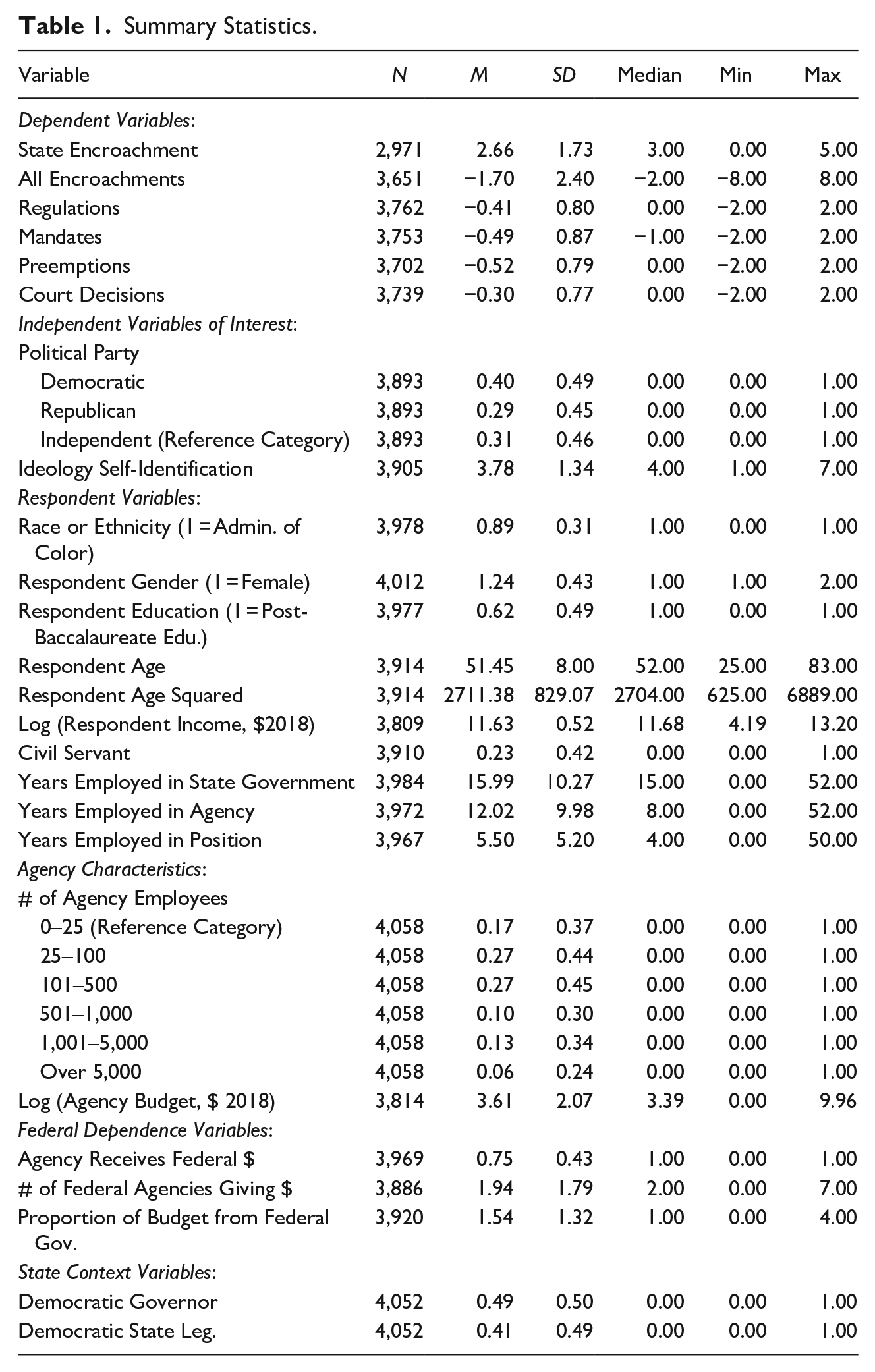
I include a binary measure of administrator race (coded one if the respondent is an administrator of color). I also control for administrator gender (coded one if the respondent identifies as female) and education (coded one if the respondent has received a post-baccalaureate education). I include a continuous measure for administrator age and a measure of administrator age-squared, to account for the potential non-linear effects of age. 7 I also control for salary, measured as the log of respondent income normalized in 2018 dollars. 8 I include a binary measure to account for administrators who are merit-based appointees (coded one if the respondent is a civil servant). Finally, I include a trio of continuous variables to account for administrator experience: the number of years the administrator has been employed in state government, the agency, and their current position.
Additionally, I account for agency characteristics by including an ordinal measure of agency size and the agency budget, measured as the log of the agency budget normalized in 2018 dollars. I also account for an agency’s dependency on federal funding using three variables: whether the agency receives any funding from a federal entity, the number of federal entities that the state agency receives funding from, and the proportion of the state agency’s budget that is derived from federal funding.
I account for state political context with two binary variables. The first measure is coded one if the state’s governor is Democratic and the second variable is coded one if the state’s legislature is controlled by Democrats.
Finally, across models I include a series of fixed effects to account for: (1) agency function, (2) state, and (3) survey-year. I do not report these coefficients in the results tables.
Results
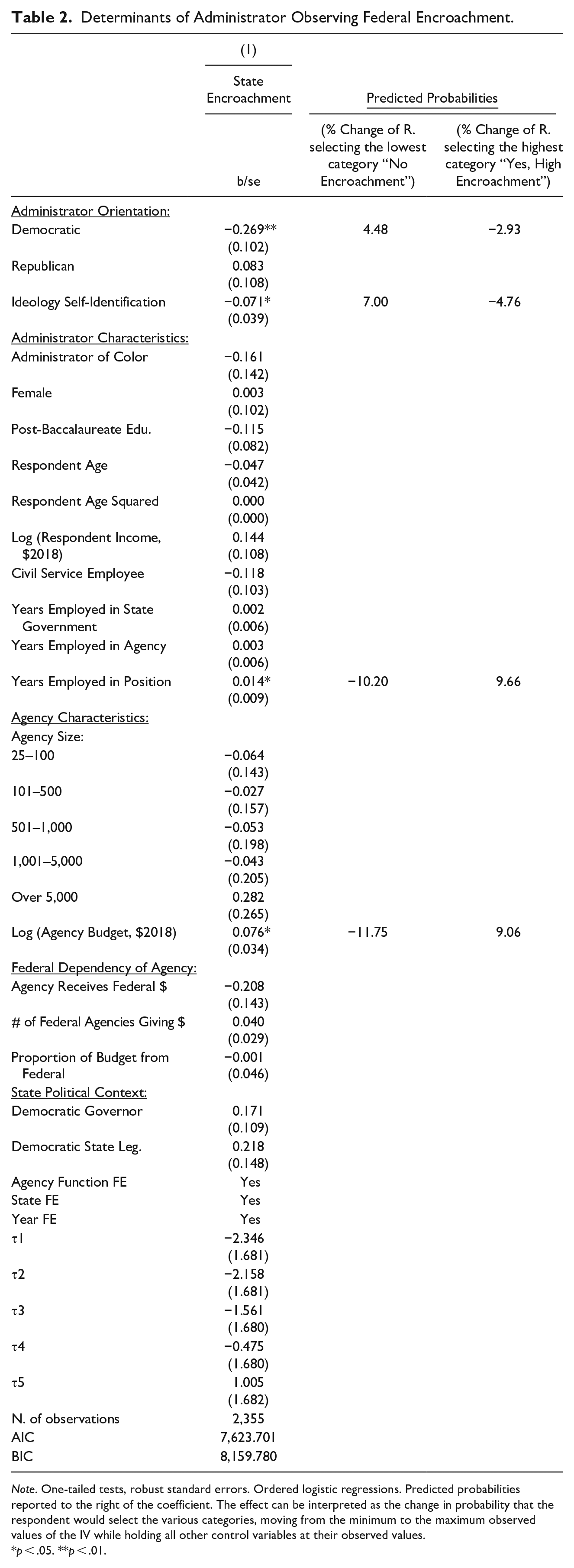
Table 2 reports the results for testing hypothesis 1, for which I find support. The dependent variable is the measure of amount of perceived federal encroachment on state activities. A positive coefficient indicates that the administrator believes that there are higher levels of federal encroachment on state actions. Conversely, a negative coefficient indicates that the administrator believes that there are lower levels of federal encroachment. As ordered logistic regressions are not directly interpretable, I include two predicted probabilities to the right of statistically significant coefficients. The values can be interpreted as the change in the probability that an administrator believes there is no federal encroachment (the lowest outcome category) and that there is high encroachment (the highest outcome category).
Determinants of Administrator Observing Federal Encroachment.
Note. One-tailed tests, robust standard errors. Ordered logistic regressions. Predicted probabilities reported to the right of the coefficient. The effect can be interpreted as the change in probability that the respondent would select the various categories, moving from the minimum to the maximum observed values of the IV while holding all other control variables at their observed values.
p < .05. **p < .01.
Examining Model 1, I find that both measures of political orientation are related to perceptions of encroachment. Democratic and liberal administrators are less likely to think that the federal government is encroaching on states activities. Compared to an Independent administrator, the reference category, a Democratic administrator is 4.5% more likely to state the federal government is not encroaching on state activities, and 2.9% less likely to state that there is a high level of encroachment. Republican administrators do not vary significantly compared to Independent administrators. Looking at ideology, the average very liberal administrator compared to the average very conservative administrator is 7% more likely to state that there is no federal encroachment in state activities and 4.8% less likely to state that there is a high level of federal encroachment.
I also find that administrators who have held their positions for longer periods of time and those who operate agencies with larger budgets are more likely to indicate that the federal government is encroaching on state activities, on average.
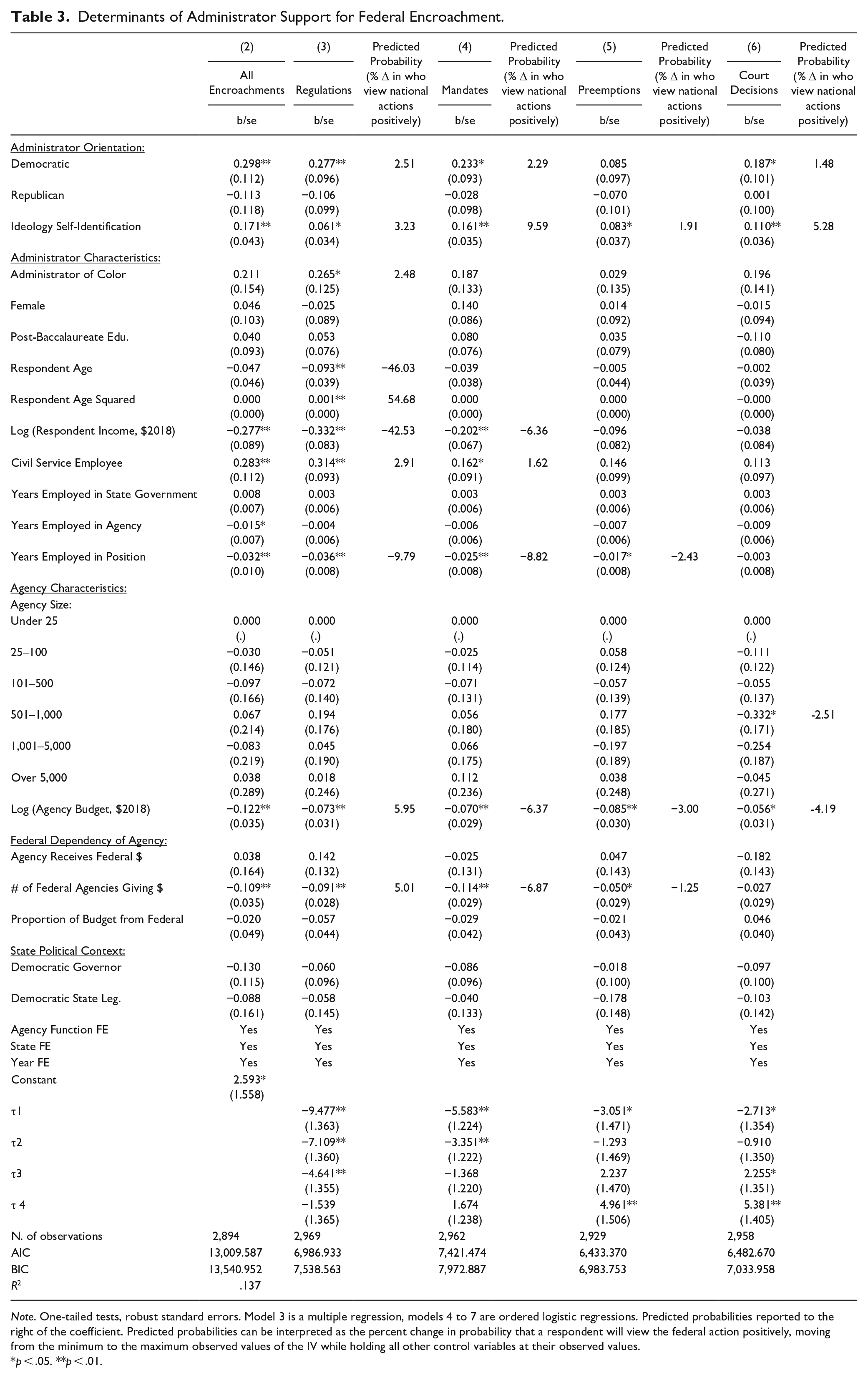
I now examine hypothesis 2, assessing support for federal encroachment (see Table 3). In all models, positive coefficients indicate greater support for federal encroachment. Model 2 estimates a multiple regression of support for encroachment across all national activities. The dependent variable is a 16-point index—with higher values indicating greater support for federal activities. The coefficients in this model are directly interpretable. Models 3 to 6 are ordered logistic regressions for each national action individually—national regulations, mandates, preemptions, and federal court decisions, respectively. Predicted probabilities are reported to the right of statistically significant coefficients in these models and can be interpreted as the percent change in the probability that the administrator views the national action positively. 9
Determinants of Administrator Support for Federal Encroachment.
Note. One-tailed tests, robust standard errors. Model 3 is a multiple regression, models 4 to 7 are ordered logistic regressions. Predicted probabilities reported to the right of the coefficient. Predicted probabilities can be interpreted as the percent change in probability that a respondent will view the federal action positively, moving from the minimum to the maximum observed values of the IV while holding all other control variables at their observed values.
p < .05. **p < .01.
I find that Democratic administrators view national actions more positively than Independents—the reference category. A Democratic administrator ranks national actions 0.30 points higher on average. Across action types, Democratic administrators are 2.5% more likely to view national regulations positively, 2.3% more likely to view national mandates positively, and 1.5% more likely to view federal court decisions positively. Party affiliation is not associated with opinions on national preemptions.
Across all five models in Table 3, increasingly liberal ideology is also associated with higher favorability regarding national actions. Compared to a very conservative administrator, a very liberal administrator scores 1.12-points higher on the administrative actions scale. Likewise, the average very liberal administrator, compared to the very conservative administrator, is associated with a 3.2% increase in the likelihood of favorably viewing national regulations, a 9.6% increase in favorably viewing national mandates, a 2.0% increase in favorably viewing national preemptions, and a 5.3% increase in favorably viewing federal court actions.
Administrator characteristics are the only variables that are consistently related to increases in support for national actions. Administrators of color report greater support for federal regulations, and civil service employees show greater support in the additive model for federal actions, federal regulations, and federal mandates. Conversely, administrator age, income, years employed in the current position, the log of the agency budget, and the number of federal agencies funding the state agency are related to lower support for federal encroachments.
Having found evidence of administrator orientations being linked to perceptions of federalism, I now explore whether and how such evaluations are conditioned on party control of the federal government. Taking the dependent variables from Models 1 and 2, I estimate four additional models that interact administrator partisanship and ideology across the three types of federal government party control—unified Democratic, divided, and unified Republican. I include the same set of control variables in the new models. To save space and focus discussion on hypothesis 3, I only report predicted probability figures in the main text. Tabular results, as well as marginal effects plots and appropriate hypotheses (Brambor et al., 2006), are included in the Supplemental Appendix. 10
The analysis finds partial support for the hypothesis that party control of Washington is associated with administrators’ views of federal encroachment. Yet how administrators’ political values are related to federal party control are distinct from findings in previous studies.
Figure 1 reports the predicted probabilities across perceptions of federal encroachment on state activities. The y-axis is the probability that the administrator believes that there is no federal government encroachment into state affairs. Higher values along the axis suggest that the respondent sees greater separation between federal and state affairs. Looking at differences across arrangements of federal government control, I observe that when Democrats control the federal government, all administrators are more likely to state that there is greater federal encroachment. Compared to divided government, Democratic administrators are about 12% less likely, Republican administrators are 11% less likely, and Independent administrators are 10% less likely to report that no encroachment is occurring, respectively. Under Republican federal government, administrators’ party identifications are not associated with significantly different beliefs in federal encroachment compared to divided government. Looking at differences among state administrators of different parties, I find that Democratic public administrators are less likely to state there is federal encroachment compared to Republican administrator when the federal government is under divided party control or controlled by Democrats. Democratic administrators are about 5% and 8% more likely to report that there is no federal encroachment, respectively. When there is unified Republican control of government, Republican administrators are the most likely to believe is no federal encroachment, —although the differences with administrators who Independent or Democrats are not statistically significant difference.
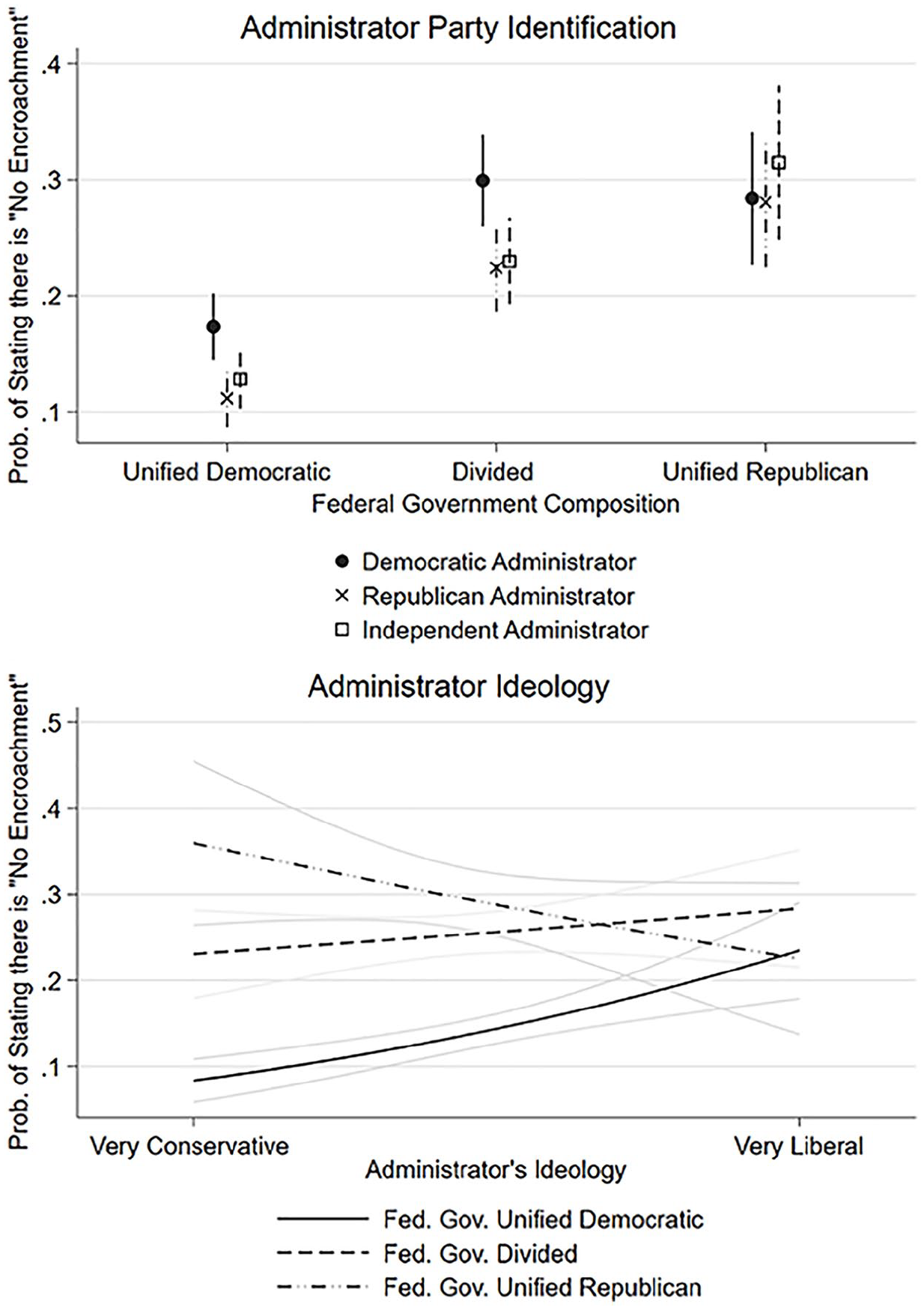
Predicted Probability of Administrator Observing Encroachment by Party c Control of Federal Government.
Turning to administrator ideology, I again find perceptions of encroachment vary with party control of the federal government. Under a Democratic government, the average very conservative administrator has a 9% probability of stating there is no federal encroachment while the average very liberal administrator has a 23% chance of reporting no federal encroachment. Conversely, under Republican federal control, a very conservative administrator has a 36% probability of stating there is no federal encroachment, while a very liberal administrator has a 23% chance of believing there is no federal encroachment. Under divided government, beliefs that encroachment is occurring do not vary significantly with administrator ideology.
Additionally, unlike previous research, I find that liberal administrators hold more consistent feelings on federal encroachment (Dinan & Heckelman, 2020). Across all configurations of partisan control, liberal administrators have a 7% range in their observations of federal encroachment, compared to a 27% range among conservative administrators.
Figure 2 reports the multiple regression results examining administrators’ support for federal encroachment across varying types of party control of the federal government. The values of the dependent variables range from negative eight to positive eight.
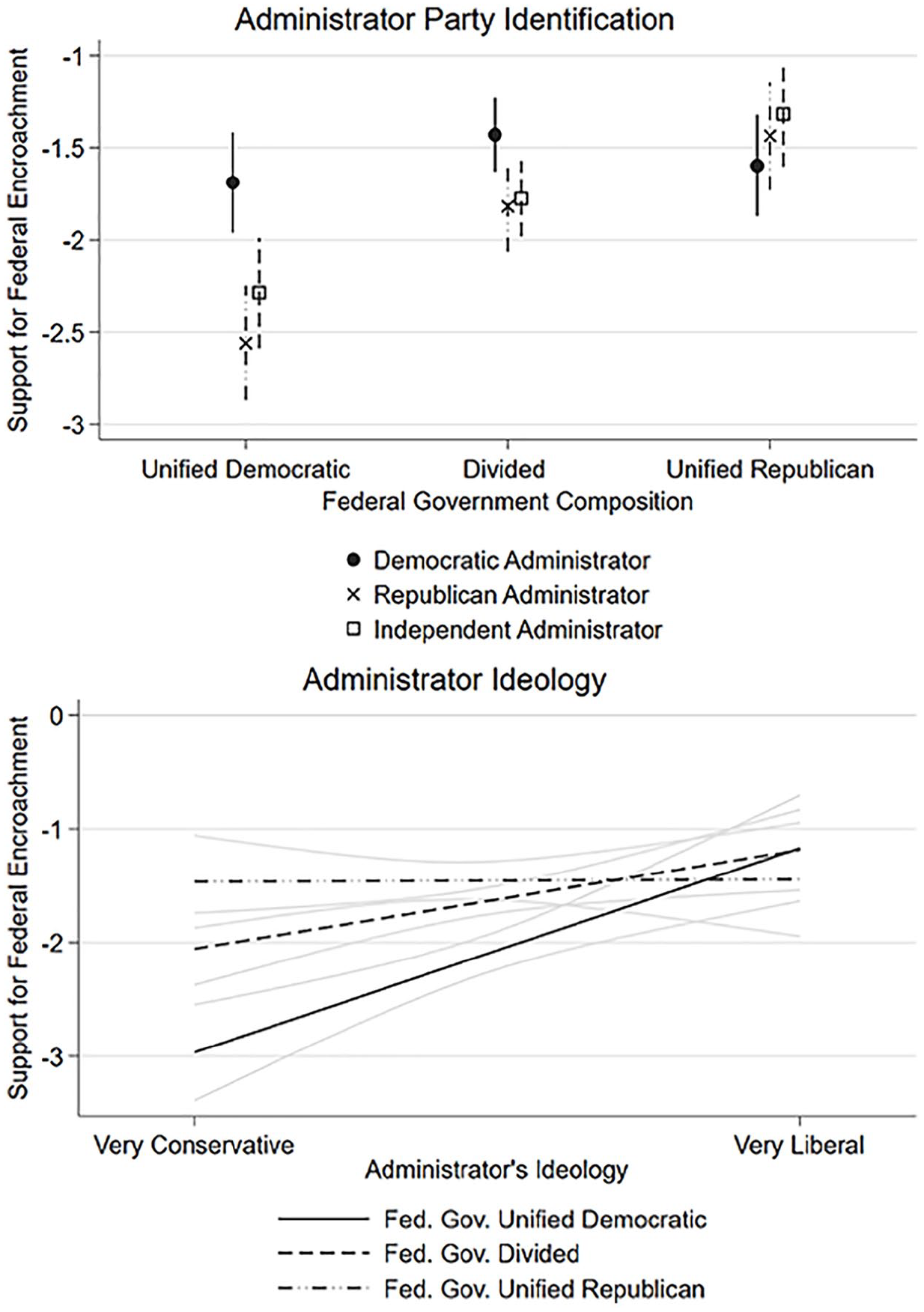
Predicted Administrator Support of Federal Encroachment by Party Control of Federal Government.
Examining administrator party identification, I find that administrators who identify as Republicans or Independents shift beliefs on federal encroachment depending on which party controls the federal government, while Democratic administrators maintain more consistent views. Republican administrators shift from a low of −2.6 on the federal actions index under unified Democratic government to a high of −1.4 under unified Republican government. Likewise, Independent administrators shift from a low on the federal action index of −2.3 under Democratic-controlled federal government to a high of −1.3 under unified Republican government. Looking between identifications, Democratic administrators score 0.9 and 0.4 points higher on the federal actions index compared to Republican administrators under unified Democratic and divided government, respectively. Again, Republican administrators show the greatest support for federal action of all groups when Republicans have unified control of the national government.
Shifting to administrator ideology, I find that a very conservative administrator scores −3 on the federal actions index under unified Democratic government, while the average very liberal administrator scores −0.2 on the index. Similarly, a very conservative administrator scores about −2 on the federal actions index under divided government, while a very liberal administrator scores −0.2. The relationship between administrator ideology and support for federal action is not statistically significant under unified Republican control of government. I also find that compared to very conservative administrators very liberal administrators have more consistent views of federal actions regardless of party control of the federal government. Across all partisan configurations, liberal public administrators’ support for federal activities shifts 0.3 points, while conservative public administrators shift a statistically significant 1.5 points.
Overall, I find partial support for hypothesis 3. State administrators’ views of the federal government depend on which party has control. However, I find that liberal administrators hold consistent views on federal encroachment, while Democratic, Republican, and conservative administrators’ views on federal encroachment shift across federal control. These differences appear to be the most pronounced under unified Democratic government.
Discussion and Conclusion
Using ASAP survey data, I find evidence in support of the proposed hypotheses. State administrators’ perceptions of the federal government are associated in similar ways to those of mass publics. Democratic and liberal administrators are less likely to view the activities of the federal government as encroaching and more likely to have positive evaluations of federal actions compared to more Republican and conservative administrators. Additionally, in line with previous research, I find that these perceptions of federal encroachment are driven by the composition and partisan orientation of the federal government.
The finding that liberal administrators hold more consistent views than Democratic, Republican, and conservative administrators contrasts with recent studies (Dinan & Heckelman, 2020; Glaser et al., 2023), which report that conservative citizens held the most consistent beliefs on federalism. Theory is unclear as to why who holds consistent views on federalism changes. It may be that individuals who choose careers in public service vary systematically in some way from the public. It could also be that the shift reflects the differences between a survey question focusing on “federal encroachment” and one asking about “decentralization.” Future research will need to disentangle whether and why the stability of these preferences shifted.
Additionally, scholars of public administration need to further investigate how political orientations shape the views and values of administrators. While scholarship continues to evaluate the role that political core values play in bureaucracy (Bell et al., 2021; Keiser, 2010), this analysis further suggests that these orientations play a significant role in how administrators view government actions. More research might be dedicated to exploring: (1) where such views exist, (2) their strength, and (3) whether the views should be mitigated..
Of note to scholars of federalism, this research raises several important questions that might be investigated. For 25 years, federalism scholars have debated the devolution revolution in American politics (Nathan, 1996). Most of the research has failed to find evidence of American politics and policy decentralizing over this period (Krause & Bowman, 2005; Cole et al., 1999), with Cho and Wright (2004) arguing that what was occurring was a devolution evolution.
This article adds important context to this debate. 1995 marked the first time in a generation that the Republican Party controlled the U.S. House and later gained control of the Senate and the presidency. My research finds that this transfer of power likely changed many administrators’ perceptions of national-state relations. It could be that individuals’ (particularly administrators’) discernment of devolution was muddled by these partisan shifts. In this case, Republican and conservative administrators likely viewed national government as less onerous as Republicans gained more control over national institutions. Future scholarship should more closely evaluate the link between administrators’ ideology and their perceptions of devolution.
Above all, this article has important implications for practitioners. As states continue to play a key role in shaping the outputs of federal legislation (Konisky & Nolette, 2021), a state administrator’s political orientation will be critical in affecting how they engage in intergovernmental tasks. How much these orientations are cause for concern will need to be evaluated in future research.
On the one hand, it may be that administrators’ orientations reflect the values of the community that they serve, or those of under-represented groups in the community. Prior research has identified the importance of community preferences in studies of welfare (Weissert, 1994) and education (Berkman & Plutzer, 2010) policy. Put differently, an administrator may have a legitimate reason for promoting a particular course of intergovernmental action. In this case, the political orientation of administrators provides an opportunity for constituencies’ preferences to be better expressed within the implementation process (Miller, 2013).
Conversely, if these orientations reflect only those of the administrator, the findings are concerning, since many potential solutions require institutional changes in the state or federal governments. One way to reduce the significance of an administrator’s political orientation is to reverse the factors that led state administrators to have meaningful influence in federal-state tasks. Reducing gridlock in national government, increasing the primacy of the national government in budgeting processes, and increasing the professionalism—and thus oversight capacity—of state legislatures would decrease the relative influence of state administrators’ partisanship (Grumbach, 2018; Merriman & Pacewicz, 2022). Another solution would be for the United States to return to a layer-cake system of federalism, where national and state governments each have separate political, policy, and administrative tasks, with limited joint decision-making between levels of government. Unfortunately, few—if any—of these changes are likely to occur within states in the near future.
Until we can better understand whether and how representative administrators’ preferences reflect those of the constituents they serve, administrators must carefully consider the role that their personal political orientation may play in their perceptions of government. Failing to do so could lead to administrators providing sub-optimal recommendations to elected officials and the public. Federalism will continue to be part of the administrative structure in the United States. Practitioners and scholars must continue to increase our understanding of federalism’s effects to better navigate the administrative system.
Supplemental Material
sj-docx-1-aas-10.1177_00953997231199230 – Supplemental material for Administrator Political Orientations and Views on Federal Encroachment
Supplemental material, sj-docx-1-aas-10.1177_00953997231199230 for Administrator Political Orientations and Views on Federal Encroachment by Matthew J. Uttermark in Administration & Society
Footnotes
Acknowledgements
I wish to thank Carol Weissert, Lauren Dula, Kristina Marty, Frances Berry, and two anonymous reviewers for their helpful feedback on prior drafts of this paper. I also gratefully acknowledge the contributions of Professor Deil Wright, the Earhart Foundation of Ann Arbor Michigan, and the University of North Carolina, Chapel Hill; Professor Cynthia Bowling, Professor Theodore Arapis, and Auburn University; Professor Susan Webb Yackee and the University of Wisconsin-Madison; and the dozens of students and colleagues who drafted questions and collected data across the years. A previous draft of this paper was presented at the 2022 State Politics and Policy Conference in Tallahassee, Florida.
Declaration of Conflicting Interests
The author declared no potential conflicts of interest with respect to the research, authorship, and/or publication of this article.
Funding
The author received no financial support for the research, authorship, and/or publication of this article.

Supplemental Material
Supplemental material for this article is available online.
Notes
Author Biography
References
Supplementary Material
Please find the following supplemental material available below.
For Open Access articles published under a Creative Commons License, all supplemental material carries the same license as the article it is associated with.
For non-Open Access articles published, all supplemental material carries a non-exclusive license, and permission requests for re-use of supplemental material or any part of supplemental material shall be sent directly to the copyright owner as specified in the copyright notice associated with the article.
