




Abstract
Public accountability may involve dysfunction. However, few empirical studies explain when and how external accountability pressure and subsequent intraorganizational dynamics cause dysfunctions. To bridge this gap, using a case study method, we examined Japan’s public procurement after a series of scandals, focusing on the procurers’ cognition and behavior. First, we found that an administrative unit in a ministry leverages external pressure to enhance its power within the organization. Second, we identified bias toward procedural accountability rather than product accountability. Third, we noted the paradox that the excessive pursuit of procedural accountability undermines not only product accountability, but also procedural accountability.
Keywords
Accountability plays a crucial role in modern public administration (Willems & Van Dooren, 2011), ensuring that public authorities comply with rules and procedures to prevent fraud and abuse of power. It also provides citizens with opportunities to control public authorities, thus, improving public authorities’ performance.
Besides such roles, accountability also involves dysfunction. However, while such dysfunctions are unanticipated consequences of inter- and intra-organizational dynamics, they have been insufficiently examined. In particular, the influence of external accountability pressure on intraorganizational dynamics requires further examination. To bridge these gaps, this study analyzes the accountability pressure imposed on Japan’s public procurement after a series of scandals such as bid-rigging events and related intraorganizational dynamics that led to other problems. That is, we investigated the relationship between external and internal accountability pressure, which Romzek and Dubnick (1987) differentiated.
The remainder of this paper is organized as follows. First, we review the literature to clarify research gaps in the existing theory. Next, we explain the research design, setting, data, and method. We then describe the case of Japan’s public procurement, which we explain from the accountability perspective in the subsequent section. In the discussion section, we interpret and compare the results with assertions in the literature, based on which we develop propositions. Finally, we present the theoretical and practical implications as well as the study’s limitations.
Theoretical Background
Accountability
Accountability has been examined in various domains, such as political science, public administration, social psychology, law, and business administration (Bovens et al., 2014). As a result, its definition is contested (Dubnick, 2014). This article refers to Bovens’ (2007, p. 450) definition: accountability is “a relationship between an actor and a forum, in which the actor has an obligation to explain and to justify his or her conduct, the forum can pose questions and pass judgment, and the actor may face consequences.” This definition fits this study’s objectives because, first, it focuses on the relationship between actors (accountability holdees) and forums (the locus where accountability holders hold holdees accountable). This is consistent with this study’s scope, which focuses on the cognition and behavior of accountability holders and holdees. Second, it emphasizes consequence, which includes not only favorable evaluations and rewards, but also formal and informal sanctions (Bovens, 2007). Expectations and fears of consequences are important factors for the current analysis, as they form the behavior of accountability holdees. Third, this definition considers accountability holdees’ obligation to justify their activities. The difficulty in justification leads to the problem of bias toward “measures that are convenient for accountability” (measures for which public officials can easily render account), which is discussed later.
In public administration, accountability plays various roles (Willems & Van Dooren, 2011). It ensures that public authorities comply with rules and procedures to prevent fraud and abuse of power, provides opportunities for the public to control public authorities, and contributes to improving the performance of public administration (Willems & Van Dooren, 2011).
Bovens (2007) identifies three types of accountability from the perspective of what public administration is accountable for: financial accountability for the financial status of the government, procedural accountability for the appropriateness of administration procedures, and product accountability for the achievement of outputs and outcomes of government activities. 1 We referred to this classification when discussing the target of accountability pressure. For example, in public procurement, financial accountability is achieved through the correctness of transaction records and other financial information. Procedural accountability is ensured through fairness in procurement procedures, such as in contractor selection. Product accountability refers to the value and quality of deliverables (output) and their social impact (outcome). Additionally, procuring a service or good at a lower cost contributes to product accountability, as it improves efficiency in achieving a certain output.
Scholars differ in their assertions regarding which of these type of accountability holders emphasize. On one hand, Bovens (2007) and Jos and Tompkins (2004) argue that accountability holders emphasize product accountability as a natural consequence of new public management (NPM) since NPM aims to control government through outcome evaluation (Norman & Gregory, 2003). On the other hand, Behn (2001) argues that financial accountability and procedural accountability (accountability for fairness), which are easier to evaluate and pursue, are
The application of accountability has shifted. First, requirements were added, and the scope of the application was expanded. While accountability was invented as an accounting concept (Bovens, 2007), it was intended to prevent governments’ and public officials’ scandals (Romzek, 1998). For this purpose, new rules have historically been added after scandals (Jos & Tompkins, 2004). Second, in addition to the expansion, the existing mechanisms have been strengthened (Bovens et al., 2008). Third, besides these formal expansions and strengthening, accountability came to be used in many contexts (Mulgan, 2000) as a “cultural phenomenon” (Dubnick, 2014, p. 25). Finally, accountability became a “golden concept” (Bovens et al., 2008, p. 225) that nobody can oppose (Pollitt & Hupe, 2011). Particularly in Japan, accountability is not an explicit legal obligation (Yamamoto, 2013) but rather a cultural phenomenon.
Accountability and Organizational Dynamics
As Bovens’ (2007) definition indicates, accountability applies in relationships between various actors, such as between a focal organization and its external actors, and between actors within the focal organization. Romzek and Dubnick (1987) classified accountability in terms of the source (internal or external to an organization) and degree of control. As for accountability under external control, they identified legal accountability (a high degree of control) and political accountability (a low degree of control). For those under internal control, they identified bureaucratic accountability (high) and professional accountability (low). As the starting point of our discussion on accountability pressure, this study referred to Romzek and Dubnick’s (1987) distinction between internal and external sources of control.
As seen in legal accountability and political accountability, organization’s attempts to ensure accountability are often a response to external pressures. Pressure from constituents encourages the introduction of transparent accounting systems and information disclosure of public service (Haraldsson, 2016). A UK ministry introduced a risk management system (RMS) in response to pressure from top government (Huber & Rothstein, 2013). Similarly, in response to pressure from external committees, universities in New Zealand introduced performance-reporting systems (Rana et al., 2022). In public corporations, when incidents (e.g., scandals) occur, subsequent media attention prompts reforms of accountability systems. In other words, it is not the incident itself but the media attention that triggers reform (Krause, 2015).
Dysfunctions of Accountability
Besides its functions (Willems & Van Dooren, 2011), accountability also has dysfunctions. Excessive pressure for accountability degrades the efficiency of public administration. That is, government bodies become hypersensitive to the public’s voices, which reduces the speed of policy implementation (Chan & Karim, 2012) and produces overload in officers’ work (Bovens et al., 2008; Radin, 2011).
Furthermore, it causes a paradox wherein the pursuit of accountability leads to degradation of accountability. Securing procedural accountability through compliance with various procedures and audit systems negatively affects operational efficiency, at least in the short term, and may negatively influence product accountability (Behn, 2001). Furthermore, pursuing product accountability may lead to a paradoxical decline in outputs and outcomes (Dubnick, 2005), undermining product accountability itself, as resources are devoted to rendering account on the achievement, rather than improving achievement itself.
Lastly, the excessive pressure for product accountability leads the public administration to adopt measures that are convenient for achieving product accountability. That is, they set goals that are easy to achieve (Jos & Tompkins, 2004), and emphasize outcome indicators that are easy to measure (Romzek, 2000).
Thus, prior studies have discussed the dysfunction of accountability in detail. However, the majority of assertions on inefficiency (Bovens et al., 2008), paradox (Behn, 2001; Dubnick, 2005), and “easy-to-achieve” goals (Jos & Tompkins, 2004; Romzek, 2000) are based on theoretical arguments that lack empirical evidence. Among few exceptions, Chan and Karim (2012) found that external pressure for accountability negatively affects public spending efficiency using a quantitative approach. However, the underlying mechanism remains unclear. While Radin (2011) analyzed formal institutions that may lead to inefficiency, organizational dynamics through which the institution causes such inefficiency need to be explored further.
Research Gap
As discussed above, previous studies have examined the functions and dysfunctions of accountability. Such dysfunctions are not intentional, but are rather unanticipated consequences of interactive dynamics among parties. To understand such a process, it is essential to understand organizational dynamics, such as power politics between units. Romzek and Dubnick (1987) examined the process through which the pursuit of accountability led to the NASA space shuttle Challenger accident. They found that the emphasis on external rather than internal accountability led to the accident. Thus, external accountability pressure is a double-edged sword; while it contributes to ensuring accountability, it may also cause dysfunction.
However, previous researchers derived their assertions concerning the dysfunction from theoretical discussions (e.g., Behn, 2001; Bovens et al., 2008; Dubnick, 2005; Jos & Tompkins, 2004; Romzek, 2000), which should be empirically verified. Of note is that organizations have multilayered pluralistic structures. However, in analyzing the impact and consequences of accountability pressure, past studies often regarded an organization as a monistic entity, and overlooked its heterogenous and multi-layered nature. For example, Haraldsson (2016) and Krause (2015) observed consequences of external pressure, but they did not explore the intraorganizational mechanisms that led to those consequences. In the analysis of the government’s RMS implementation (Huber & Rothstein, 2013), other than describing the general staff’s dissatisfaction with RMS enforcement officers, the researchers did not explain the intraorganizational dynamics. In their analysis of a university performance reporting system, Rana et al. (2022) do not address the squabbles between proponents and opponents or the resistance that the proponents might have faced.
Furthermore, each unit in an organization is a multifaceted entity. For example, an organization’s administrative unit not only has to render account to external accountability holders, but also has to hold front-line technical units accountable. Here, the administrative unit transmits accountability pressure from outside the organization to the organization. Regarding the transmission of accountability, R. Mulgan (1997) analyzed the accountability relations between the general public and public servants as being mediated by the judiciary, minister, parliament, and ombudsman. However, these relations have different mechanisms from intraorganizational transmission between units within government bodies.
Thus, the relationships between external accountability holders, administrative units, and technical units as well as related intraorganizational power dynamics require further study. Examining these dynamics will improve our understanding of the condition and manner through which accountability dysfunctions occur and provide useful practical implications. Hence, the research question examined here are Research Question: How does external accountability pressure influence intraorganizational dynamics? Under which condition does the pressure cause dysfunctions in accountability and what are the consequences?
Method
Research Design
As the first step in exploring the effect of accountability pressure on intraorganizational dynamics, this study employed a single-case study method (Yin, 2018). Although a single case is less generalizable than multiple cases, “[it] can richly describe the existence of a phenomenon” (Eisenhardt & Graebner, 2007, p. 27). Thus, through this study, we seek to “offer a convincing example that can both connect to and promote further inquiry” (Vince & Saleem, 2004, p. 139).
Research Setting
To examine the intraorganizational mechanism of a government body, focusing on external pressure for accountability, public procurement in Japan was selected as the research setting. Public procurement is a suitable site for observing accountability relations as the parties involved are always held accountable. In public procurement, the principle of competition is applied to the selection of the best and most economical contractor. Simultaneously, fairness—equality and transparency—must be ensured (Sorte Junior, 2016). These requirements are related to Bovens’ (2007) accountability types, as follows. Fairness in procurement procedures contributes to procedural accountability. The value and quality of deliverables, as well as their social impact, lead to product accountability. Appropriate accounting treatment leads to financial accountability. However, financial accountability was outside the scope of this study, as accounting procedures were not observed.
Japan’s public procurement process was chosen because it lends itself to observing external pressures and the reactions of government bodies. While bureaucracy is an open system and is affected by the environment (Welch & Wong, 2001), Japanese government agencies are known to be particularly sensitive to external pressure (A. Mulgan, 1997). Moreover, Japan’s public procurement has been subject to strict external scrutiny due to its history of bid rigging (Black, 2004). Hence, rich secondary data, such as newspaper articles, are available.
For the analysis, Ministry Y (pseudonym) was selected and its response to accountability pressure related to public procurement, as well as its consequences, were observed. Figure 1 summarizes the relationships among the parties involved. Technical units are responsible for all technical matters. To achieve their goals, they procure goods and services from contractors when necessary. An administrative unit, which is in charge of accounting, external relations, and other general affairs, controls procurement processes. The formal role of the Bidding Monitoring Committee (BMC) is to monitor the effectiveness and fairness of Ministry Y’s procurement process. Its members are external experts such as professors and lawyers. As shown in Figure 1, the administrative unit and technical units are not in a vertical relationship. However, any procurement contract requires the administrative unit’s consent. The main deliverables that Ministry Y procures are research and information systems.
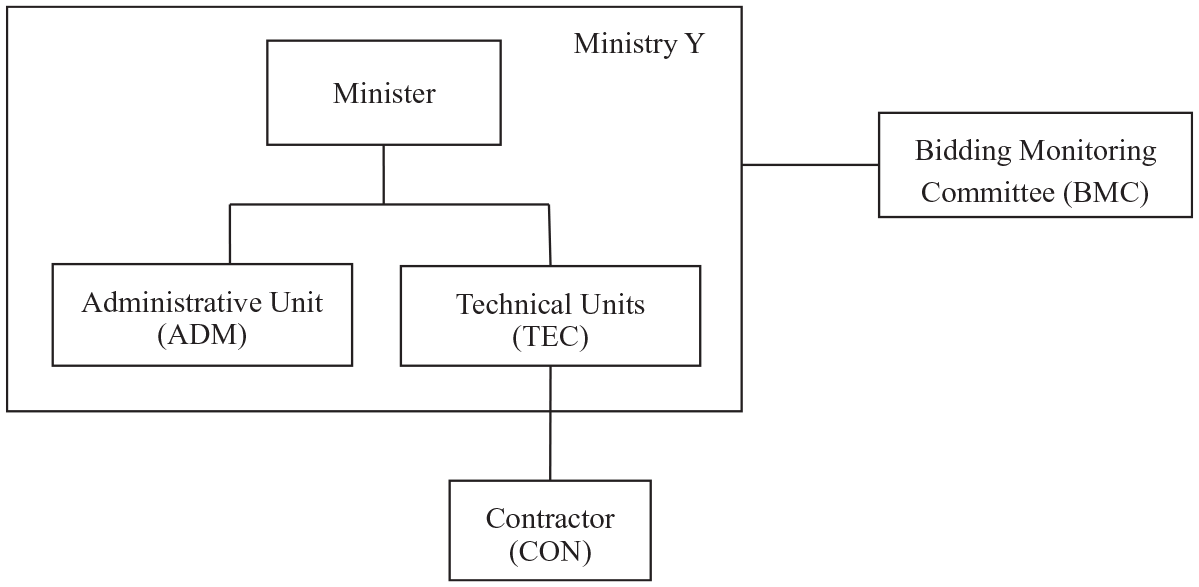
Parties involved in Ministry Y’s procurement process.
Ministry Y was chosen as a critical case (Flyvbjerg, 2006; Yin, 2018) because it is one of the ministries with the largest volume of procurement among the central government ministries in Japan and is therefore exposed to much criticism. Hence, a wealth of secondary data is available. The case discussed here is not unique to Ministry Y. It depicts paradoxical accountability pressures that can be observed in other cases. However, its intended purpose was not to provide a basis for direct inferences concerning the phenomenon in other cases. Instead, it attempted to spur future research and comparisons, not to claim generalizable patterns.
Data Collection
The main data sources included various secondary and interview data. For secondary data, official documents such as ordinances and directives, government press releases, documents of various committees and councils, and other information available on ministry websites as well as newspaper articles were used. Semi-structured interviews were conducted with relevant persons. These interviews were essential to collect information on the reality of procurement practices that cannot be obtained from secondary data.
The interviewees were selected following the method of theoretical sampling (Glaser & Strauss, 1967). To avoid bias, interviewees with diverse backgrounds, such as bidders (contractors), procurers (orderers) of Ministry Y (both technical and administrative units), and BMC, were selected. The number of interviewees was 31. Among them, 14 (TEC01 to TEC14) belonged to front-line technical units that require deliverables and were directly in charge of procurement processes; six (ADM01 to ADM06) belonged to the administrative unit; five (BMC01 to BMC05) were BMC members; and six (CON01 to CON06) were contractors. To collect unbiased comments, the interviewees also included those with experience in multiple roles. For instance, ADM06 was originally a technical officer; CON04, CON05, and CON06 previously worked as technical unit officers for Ministry Y and had experience as accountability holdees rendering account to the administrative unit; BMC05 was previously a member of another government committee that provided recommendations for public procurement policies. Some interviews were conducted with counterparts of other interviewees (e.g., an accountability holder of a specific interviewed holdee).
Prior to the interview, interviewees’ rights were explained in writing according to the guidelines of the author’s institute, and their informed consent was obtained. Additionally, supplemental responses were obtained in writing.
Analytical Method
Our analysis consisted of descriptive and explanatory parts (Yin, 2018). For the descriptive part, we describe the series of events and relationships between those events. To this end, we created a chronology depicting the flow of facts, which was linked to evidential secondary data. Based on the chronology, supplemented by interview data, we analyzed the causality between the events. The results are summarized in the “Facts” section.
For the explanatory part, we analyzed the facts from the viewpoint of accountability pressure and subsequent organizational dynamics. We referred to the process of a grounded theory approach (Strauss & Corbin, 1998) to ensure credibility and reliability. First, from the interview transcripts, segments related to the purpose of this study were extracted and coded. Second, related codes were grouped into categories that constitute the organizational dynamics. Each category corresponds with each “proposition” in the “Findings” section, where the results of this part of the analysis are summarized. During this step, output was continuously compared with data so that the results remained grounded on data while mitigating possible bias. The results are summarized in the “Findings” section below. We used the MAXQDA software to support this process.
Facts: Japan’s Public Procurement and Chain of Problems
This section first describes the brief history of public procurement in Japan, focusing on measures implemented after a series of scandals. Next, it illustrates the problems that arose in Ministry Y as a result of these measures. These are analyzed from the perspective of accountability in the next section.
The technical terms related to public procurement are as follows. There are two types of contractor determination methods in public procurement: discretionary contracts (non-competitive contracts) and competitive bidding. Discretionary contracts are methods in which a procurer chooses the contractor discretionally without bidding. For competitive bidding, there are two types of methods: open bidding and selective bidding (invitation-only bidding). In open bidding, any registered entity that satisfies the prequalification criteria specified for each project can participate. In selective bidding, only entities designated by the procurer can participate. The term bid rigging refers to a conspiracy of multiple contractors prior to a bidding to determine the bid price, successful bidder, and so on. Government-facilitated bid rigging refers to bid rigging in which bid prices and successful bidders are decided unfairly at the procurers’ initiative.
The process we observed is summarized in Figure 2. In Japan, until the 1990s, scandals such as bid rigging arose, and pressure to solve these problems intensified. Responding to such a situation, open bidding, which is considered fairer, has been widely applied to replace selective bidding and discretionary contracts, which were suspected of lacking fairness. In particular, it was pointed out that selective bidding is a breeding ground for collusion among contractors and governmental officials, as they can identify each other. However, expectations, the number of one-party bid cases, where only one party submits a bid, increased. For one-party bids, outsiders questioned fairness and competitiveness. In response to this, the prequalification criteria for screening bidders were relaxed to increase the number of bidders, which led to a new chain of problems: the entry of incompetent contractors with substandard deliverables and the withdrawal of competent contractors. The following subsections elaborate on the details of this process.
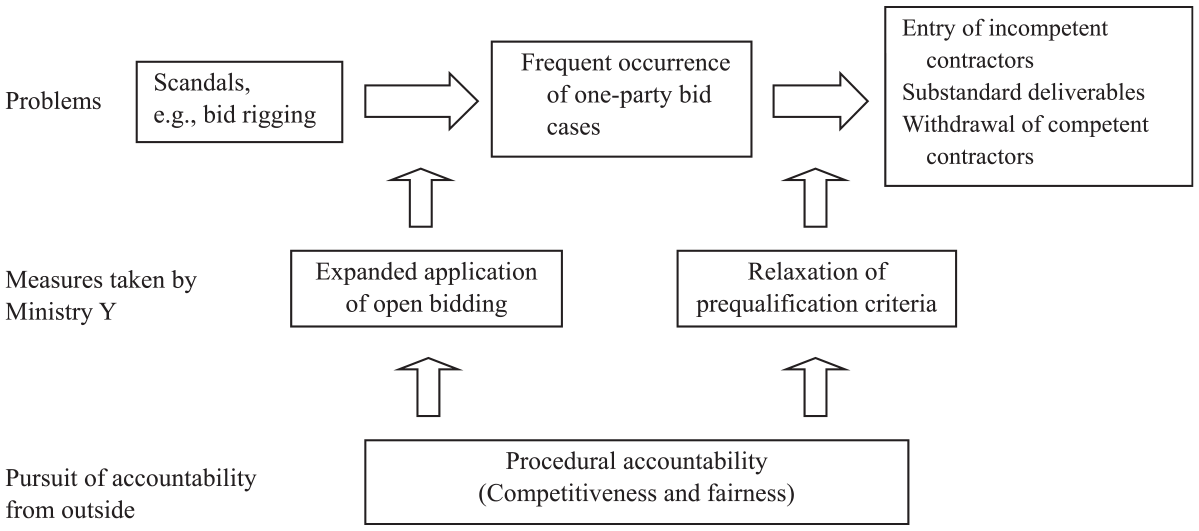
Chain of problems at ministry Y.
A Series of Scandals in Japan’s Public Procurement and Measures
Within Japan’s public procurement space, various issues such as bid rigging have come to the surface since the 1990s (Kusunoki, 2007). It was pointed out that the context of selective bidding, which had been a normal procedure until then (Sorte Junior, 2016), encouraged bid rigging (Ohashi, 2009). As a preventive measure, in 1994, open bidding was applied to large-scale construction projects. In the 2000s, government-facilitated bid-rigging cases were uncovered (Tanaka & Hayashi, 2016). Additionally, it was pointed out that discretionary contracts tended to create an opaque relationship between a procurer and a contractor and became a hotbed of collusion. There was also a critique that companies that employed retired ex-government officers were given preferential treatment (Asai et al., 2021).
In February 2006, Japan’s government announced a policy to expand the application of open bidding further. The Prime Minister Jun-ichiro Koizumi commented in the Diet, “From now on, discretionary contracts will be restricted to those for which there is no other way” (April 19, 2006). In August 2006, the Ministry of Finance ordered other ministries to restrict the application of discretionary contracts. Thus, since the 1990s, all procurement events have been switched to open bidding in principle.
Responding to external accountability pressure such as
One-Party Bid Cases Resulting From the Expanded Application of Open Bidding
Open bidding was expected to increase the number of bidders and thus improve competitiveness and fairness. However, expansion of the application of open bidding did not lead to the entry of as many bidders as expected. Instead, the number of one-party bid cases increased and became a problem. One-party bids were first discussed in public at the third session of the Study Group on the Reform and Promotion of Public Procurement (January 30, 2008) hosted by the Fair Trade Commission. The Group’s report outlined four reasons for one-party bids: release from the sense of obligation to bid in the era of selective bidding, contractors’ careful selection of procurement events, too-low prices set by procurers, and the cost of preparing a bid.
Outsiders criticized one-party bid as lacking competitiveness and fairness. The Board of Audit pointed out in its audit report for the fiscal year 2008 that one-party bids led to high costs. In December 2008, the Ministry of Internal Affairs and Communications recommended that ministries and agencies take measures to eliminate the one-party bid situation. On May 22, 2009, at the 171st ordinary session of the Diet, a member of the Democratic Party of Japan asked about the government’s recognition of the one-party bid status. One-party bid cases are frequently discussed in the bidding monitoring committees (BMCs) of various government ministries and agencies.
Meanwhile, practitioners involved in public procurement practices confirmed one-party bids. First, they argue that the number of bidders is naturally limited because of (1) the small size of the market as a result of the specificity and specialty of the work, (2) the need for investment to enter new business fields (particularly relationship-specific investment), and (3) associated business risks. Second, they argue that the procurement procedure itself is still appropriate, even if it results in a one-party bid. They stress that fairness is maintained as long as bids are publicly announced, and that, even in one-party bid cases, potential competition exists prior to bidding. Some BMC members (e.g., BMC04) also make such arguments. However, the government continued to regard one-party bids as a problem.
Relaxation of Prequalification Criteria and Entry of Incompetent Contractors
Ministries and agencies continued their efforts to increase the number of bidders with the aim of eliminating one-party bids. For example, in March 2009, the Ministry of Land, Infrastructure, Transport, and Tourism announced its policy to increase the number of bidders, which included relaxing prequalification criteria, securing periods for preparing bids, and expanding public announcements for bidding.
Among these measures, excessive relaxation of the prequalification criteria, which includes the requirements for engineers and the experience of companies, was regarded as a service quality problem by the technical units procuring services and goods in government bodies and contractors. However, technical units in Ministry Y, under the pressure of the administrative unit, relaxed prequalification criteria to such an extent that CON02, a contractor, expressed that there was no room to relax them any further. Finally, it caused the entry of incompetent contractors who did not have the necessary experience or skills.
[ADM01] Generally, we apply open bidding to all works. However, some contractors do not have appropriate competency, and their products do not meet our expectations. “Oh! Only this quality?”
The procurers cannot punish incompetent contractors and bar them from the next bidding even if they default on the contract. This is because, in such cases the officer in charge is required to account for having worked with such an incompetent contractor.
[TEC10] It is very difficult [to punish a contractor for substandard deliverables as a breach of contract]. . . . If the procurer punishes, it will be accused of contracting with such a contractor. So, it is difficult.
Officers conceal such a situation by shouldering the contractor’s task, particularly for research projects (TEC01, TEC02, TEC11, ADM05, CON01, CON02).
[TEC01] Punishing an incompetent contractor will cause us significant trouble. No one will benefit from it while causing huge additional work. Hence, we do such contractors’ work for them.
[CON01] Finally, projects are ostensibly completed with technical units’ support. Then, such incompetent contractors mistakenly feel as if they could have completed the task.
Thus, in Ministry Y, while both technical units and the administrative unit were aware of the existence of this problem, they were hesitant to make it public. Furthermore, in the case of research projects, it was difficult for external accountability holders such as BMC to observe delays in work completion or quality problems. Hence, external accountability holders continued to blame the one-party bid situation without realizing that their pressure had caused the problems of incompetent contractors.
The entry of incompetent contractors caused further problems by discouraging competent contractors to invest (TEC01, TEC10, BMC03, CON01). Competent contractors who had made necessary relation-specific investments perceived that the excessive relaxation of the prequalification criteria was unfair.
[CON04] The best incentive for a company is becoming the top runner and stronger than others. There is no way, if it is not permitted.
Finally, some competent contractors withdrew from the market. As Yao and Tanaka (2020) claim, low quality standards increase the total number of bidders but discourage competent contractors.
Findings: Ministry Y’s Public Procurement Seen From the Perspective of Accountability
The evolution of Japan’s public procurement process can be attributed to the governments’ responses to external accountability pressure. That is, in this case, external pressure contributed to improving accountability in public procurement (Grossi & Pianezzi, 2018; Mabillard & Zumofen, 2021) and preventing fraud and abuse of power (Willems & Van Dooren, 2011). However, it also caused unintended side effects.
Ministry Y expanded the application of open bidding, which unintentionally increased the number of one-party bid cases, and the subsequent excessive relaxation of the prequalification criteria caused the entry of incompetent contractors and the withdrawal of competent contractors. This process is summarized in terms of accountability (Figure 3). Within Ministry Y, the administrative unit, which emphasized the obligation to render account to external accountability holders, obtained a power advantage over the technical units that emphasized outcomes. The technical units had doubts about relaxing the prequalification criteria from the viewpoint of quality. However, it was difficult for them to render persuasive accounts to defend one-party bid status and maintain the required prequalification criteria to the administrative unit, which emphasized accountability pressure from outside. Thus, the technical units stopped trying to persuade the administrative unit. The following subsections elaborate on the behaviors and intentions of each actor from the viewpoint of accountability (Table 1).
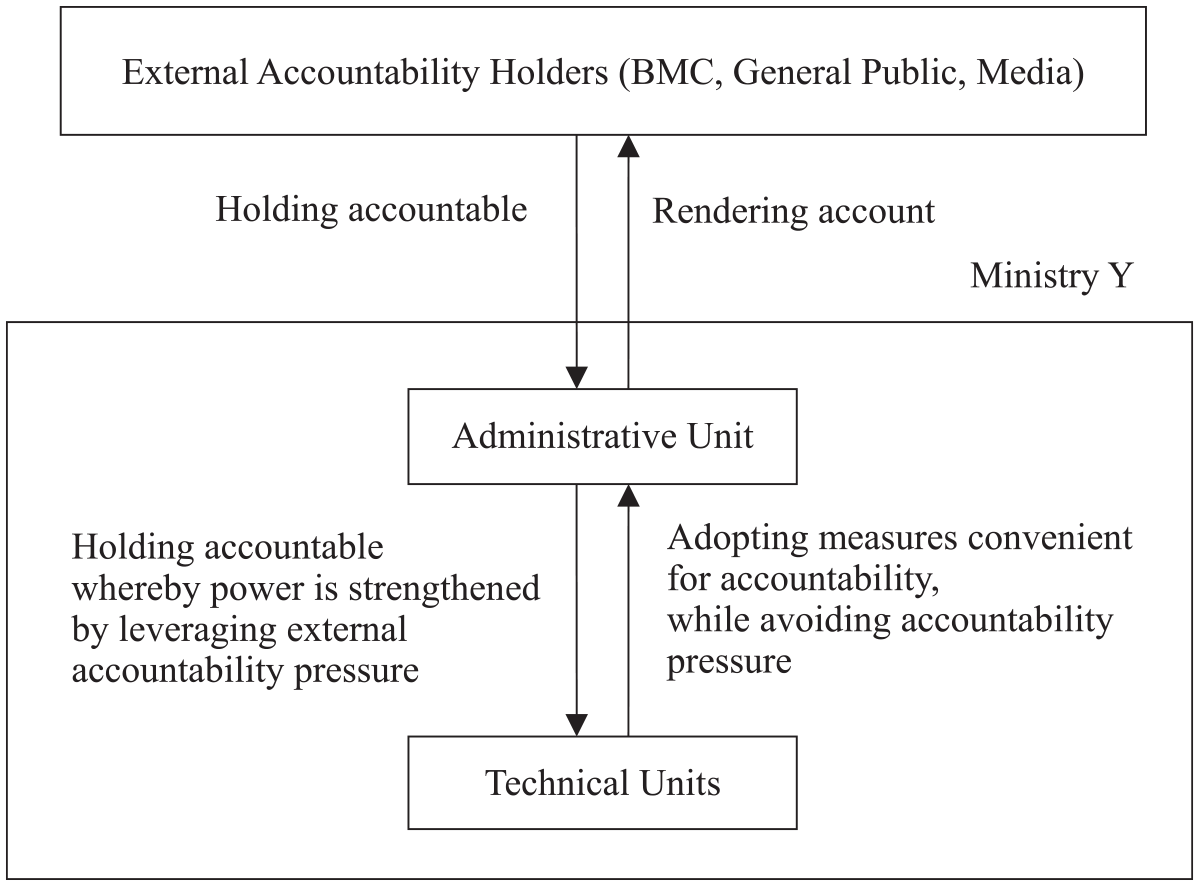
Accountability pressure and intraorganizational dynamics.
Behavior and Intention of Actors.
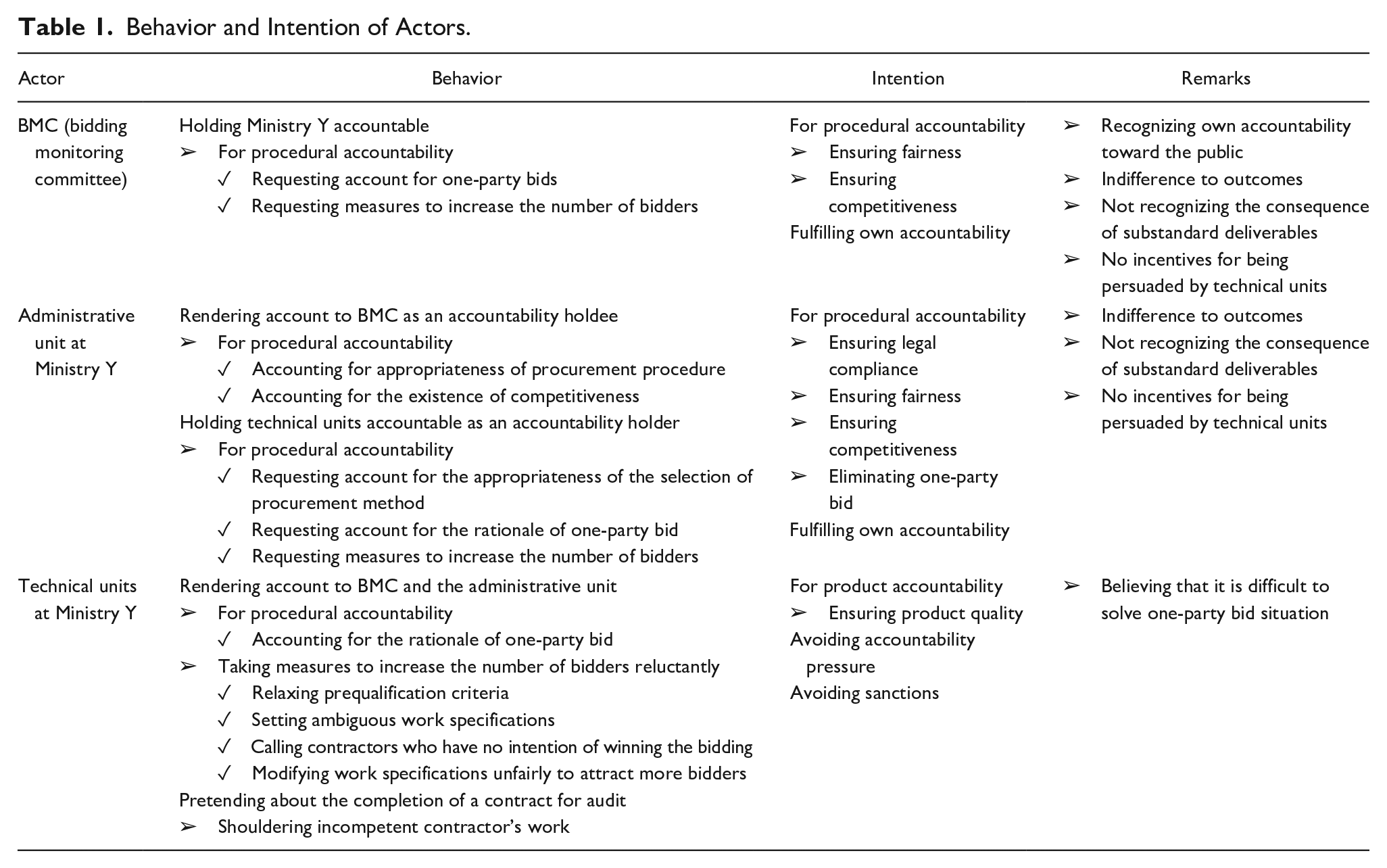
Accountability Pressure of BMC as an Accountability Holder
The most significant external accountability holder for Ministry Y is its BMC. It held Ministry Y’s officials accountable for one-party bids to ensure the fairness and competitiveness of the procurement process (procedural accountability). It also requested measures to increase the number of bidders (procedural accountability). Notably, its interest in competitiveness was procedural appropriateness, where bidding ensures fairness, rather than efficiency achieved through competition. The BMC seldom cared for the outcome of the procured works.
[TEC01] Eliminating one-party bids was set as our goal. It is our executives’ intention. They [executives] emphasize the audiences’ concern about transparency. Audiences including BMC value only procedural fairness.
At the same time, BMC members also recognized that, as accountability holdees, they must be ready to render account to their own accountability holders, such as the general public. That is, BMC transmits accountability pressure from the general public to Ministry Y, as in R. Mulgan’s (1997) model of accountability channels.
[BMC04] We always say, “It’s OK if we can render our account.” It is OK if the public or experts in the field, not we, are satisfied [with the account rendered by the Ministry officers].
Additionally, behind the pressure from the general public, there is distrust of the government. It is prominent in Japan’s public procurement, where bid-rigging scandals have continued (Black, 2004). Thus, to fulfill its own accountability, the BMC had to hold Ministry Y officers accountable even though members knew that no effective measure was available in some cases (CON05).
Two Facets of Administrative Unit: As an Accountability Holdee and Accountability Holder
The administrative unit has two faces: an accountability holdee rendering account to external accountability holders such as BMC and an accountability holder to the technical units of the ministry. As an accountability holdee representing Ministry Y, the administrative unit tried to render account to the BMC for the appropriateness of procurement procedures (procedural accountability), and the existence of competitiveness in biddings (procedural accountability). In addition to their fundamental attitude to ensure legal compliance (procedural accountability), the pursuits of fairness (procedural accountability) and competitiveness (procedural accountability) are behind these efforts.
The position of the administrative unit as an accountability holdee to external accountability holders forms behavior as an accountability holder facing the technical units.
[ADM01] Now, when a third party asks, “Why is there only one bidder? Is it an adequate situation?” we must render an account [based on the account rendered by technical units].
In other words, the administrative unit transmits accountability pressure from outside into Ministry Y, as in the accountability channel model proposed by R. Mulgan (1997). Thus, as an accountability holder, the administrative unit held the technical units accountable for the selection of the procurement method and the rationale for one-party bids (procedural accountability). If it was not satisfied with the account, it requested that the technical units take measures to increase the number of bidders. The administrative unit sought to eliminate one-party bids (procedural accountability) and ensure competitiveness (procedural accountability).
However, the administrative unit showed indifference to the outcomes of the procured deliverables. Similar to the BMG the administrative unit’s pursuit of competitiveness was mainly for apparent procedural appropriateness, not for cost efficiency. Such an attitude strengthened the pursuit of procedural appropriateness, lacking a sufficient notion of outcome quality.
[Interviewer] Does it not matter for the administrative unit whether the procured work is properly completed?
[TEC01] This does not seem to matter much to them. They simply assume that contractors will properly complete the terms in the specifications. If the contractor does not meet expectations, they may say that the specifications are not sufficient [and blame the technical unit who sets the specification]. Outsiders cannot recognize reality.
Accountability of Technical Units as Accountability Holdees
Above all, the technical units wished to ensure the quality of deliverables (product accountability) as they directly influence their services. While the one-party bid has been criticized, technical units sincerely believed it was inevitable. The units tried to account for the rationale of one-party bid cases (procedural accountability) while being held accountable by the BMC and the administrative unit.
If they had persuaded the accountability holders, they could have achieved procedural accountability. However, such persuasion is difficult, as discussed next. Thus, the technical unit reluctantly took measures to increase the number of bidders (e.g., relaxing prequalification criteria and setting ambiguous work specifications that more contractors could fulfill). These measures were intended to avoid accountability pressure; however, they made it difficult to check quality upon completion and to punish substandard results.
Difficulty in Persuading Accountability Holders
Giving up persuading the administrative unit about the inevitability of one-party bids and the necessity of a certain level of prequalification criteria, the technical unit relaxed prequalification criteria even excessively. This is due to the difficulty of persuasion.
[TEC10] There are certain types of work that only specific companies can do. . . . However, no matter how much I explain, people say, “That’s just what only the person in charge thinks, is not it?” It is difficult to objectively explain reality.
The reasons for this difficulty are as follows. First, there was information asymmetry; Second, a noted earlier, the accountability holders had little information about the importance of deliverable quality; they could not fully understand the problems resulting from substandard deliverables. Second, as in TEC01’s discourse in the previous subsection, the accountability holders had no incentive to be persuaded. Even if the project does not proceed with a contract as a result of disapproval by the administrative unit, or even if the deliverable does not meet the expectation, the administrative unit has no direct negative impact. A similar lack of incentives was observed in some BMC members.
[TEC11] [Regarding the problem of incompetent contractors,] BMC members did not have the slightest issue. I felt, they assumed that we [technical units] would be able to cope with it [no matter whether substandard deliverables were delivered].
Thus, technical unit officers thought that it would be difficult to render persuasive accounts for the acceptance of one-party bids while maintaining the necessary prequalification criteria. Finally, they were inclined to relax the prequalification criteria, for which they did need to account.
Dysfunctions of Accountability
This case showed dysfunctions of accountability. First, the pursuit of accountability caused overload (Bovens et al., 2008; Radin, 2011); officers in technical units devoted many of their resources to rendering account for one-party bid status. Additionally, to avoid overload, they tended to choose measures that they could easily account for (measures that are convenient for accountability). The technical units of Ministry Y, under accountability pressure, were inclined to accept the application of open bidding and the relaxation of prequalification criteria, which required no account.
[Interviewer] In principle, a discretionary contract is also possible, but it needs a special account. Did you apply open bidding to avoid this obligation?
[CON04] Yes, that’s right. Procuring officers [of technical units] must make significant efforts to render persuasive accounts for applying discretionary contracts. So, I guess they would rather choose open bidding [to avoid the obligation to render an account].
These factors are related to procedural accountability. Jos and Tompkins (2004) and Romzek (2000) claim that public administrators is inclined to adopt measures for which officers can easily render account concerning product accountability (“measures that are convenient for product accountability”). Additionally, this case indicates that such a tendency occurs also for procedural accountability; officers prefer “measures that are convenient for procedural accountability” to avoid strict accountability pressure.
Second, the pursuit of procedural accountability, such as the expanded application of open bidding and the elimination of one-party bids, undermined product accountability. In this case, incompetent contractors entered the market, and substandard deliverables were produced. This phenomenon is in line with Behn’s (2001) assertion on the paradox of accountability.
[ADM03] Some contractors do not complete their work on time or do not fulfil work specifications. Such cases are not so frequent but occur a couple of times every year, I think.
[CON02] Such cases [where incompetent contractors are awarded the contract] exist. In such cases, their outputs are not satisfactory. So, officers [of technical units] must shoulder the contractors’ work.
Third, we observed that the pursuit of procedural accountability to ensure fairness (equality and transparency) degraded procedural appropriateness. To increase the apparent number of bidders, technical unit officers informally called contractors who had no intention of winning the contract.
[CON05] We [ordering officers] were told to have multiple bidders, but this was difficult. They [contractors who were not interested] did not show up. Therefore, we had to make many phone calls and beg them to come.
In another case, competition was distorted by an unfair modification of the contract statement. In a procurement for design service, a clause was added to the work specification that allowed for the free lending of special computer software necessary for the work to contractors who did not have them. It aimed to increase the number of bidders by lowering entry barriers. However, it eliminated the first-mover advantage and denied any efforts of potential contractors to win the contract and to succeed in their business. CON01, a contractor who had acquired the software before the modification of the contract, commented that it was unfair as his company had to compete over price with other companies that could use the software for free.
[CON01] The work specification states that a specific software tool must be used. Now, as the contract framework was modified, the specification states that the procurer will lend the software to contractors. It’s unfair! We have invested in the software. It is not fair if we must compete for prices with those who did not invest.
In the long run, this measure reduces the willingness of competent contractors to invest and encourages them to withdraw from the market, which will have a long-term negative impact on Ministry Y.
Procedural appropriateness was also spoiled by technical officers’ inadequate support for the contractors’ work. When an incompetent contractor could not complete its research project by the deadline, the procurers helped them, or even shouldered a part of the contracted work to maintain the appearance of completed projects for audits by the Board of Audit, as described previously. Moreover, to avoid being sanctioned, procurers cannot punish such contractors (Bovens, 2007).
Discussion
By responding to external pressure—such as that from the media, Japan’s public procurement has improved in terms of transparency and accountability. Nevertheless, we observed a series of problems that occurred in Ministry Y and interpreted them from an accountability perspective. In this section, we present our observations as theoretical propositions.
Impact of External Accountability Pressure on Intraorganizational Dynamics
External accountability pressure came into Ministry Y via the administrative unit. When exposed to pressure from external accountability holders, the administrative unit transmits pressure to technical units, as witnessed by the previously quoted comments by ADM01 and TEC10. BMC also transmits the pressure from general public to Ministry Y, according to BMC04. This process is similar to R. Mulgan’s (1997) model of the accountability channel. Furthermore, the administrative unit leveraged pressure in its relationship with the technical units. Although technical units did not wish to relax the prequalification criteria, they could not render persuasive accounts to the administrative unit, who enhanced their power by justifying itself and leveraging external accountability pressure. This is because the administrative unit emphasized the accountability imposed on Ministry Y as a golden concept (Bovens et al., 2008) which technical units cannot be against (Pollitt & Hupe, 2011). If we take this argument as a proposition, it is as follows:
[Proposition 1] An administrative unit that represents an entire organization, leveraging accountability pressure from external accountability holders, strengthens their power within the entire organization.
This proposition indicates that, while Romzek and Dubnick (1987) differentiated accountability types based on whether the source of control is external or internal, internal accountability is influenced by external accountability. That is, we found that internal and external accountability relationships are interrelated. This result expands our knowledge about intraorganizational dynamics as a response to external accountability pressure and enriches the observations of previous studies (e g., Huber & Rothstein, 2013; Rana et al., 2022), whose analyses of such dynamics are limited.
Bias Toward Procedural Accountability
The BMC and administrative unit emphasized procedural accountability, insisting on eliminating one-party bids. They hardly pursued product accountability, disregarding the quality of deliverables.
Prior studies are inconsistent in their assertions about priority among accountability types (financial, procedural, or product). While Bovens (2007) and Jos and Tompkins (2004) argue that product accountability is emphasized, Behn (2001) asserts that procedural accountability is prioritized. Meanwhile, Romzek (2000) claims that accountability holders shift their priorities. If so, there must be contingencies that determine priority.
Concerning such contingencies, procedural accountability was prioritized in this case for the following reasons. First, in public procurement, it is difficult to set and measure outcome indicators (Behn, 2001; Romzek, 1998; Van Thiel & Leeuw, 2002). In this case, research and information systems are the main work that Ministry Y procures; its outcomes―social impact―are difficult to measure. Second, information asymmetry existed between the inside and outside of Ministry Y and between the administrative unit and technical units. While the technical units could check the quality of the deliverables after the projects, the administrative units or BMC did not have sufficient information (TEC11 and BMC01). Without sufficient knowledge, they could not pursue product accountability. Third, in some cases, accountability holders were not interested in outcomes, as can be seen from TEC01 and TEC11’s comment quoted previously. They had no incentive to care for the result of deliverables, as there were no consequences for them even if the results were substandard. They did not fear sanctions either (Bovens, 2007). From the discussion above, the following proposition is proposed.
[Proposition 2] The pursuit by accountability holders is biased toward procedural accountability if it is difficult to set and measure outcome indicators, if accountability holders do not have sufficient information about the outcomes, or if they are not interested in the outcomes.
Extant literature is divided on the direction of accountability bias; Bovens (2007) and Jos and Tompkins (2004) assert that the bias is toward product accountability, while Behn (2001) asserts that it is toward procedural accountability. Proposition 2 provides new insight into this debate by showing the contingencies that influence the direction of the bias.
Degradation of Procedural Appropriateness Due to Pursuit of Procedural Accountability
What are the consequences of overemphasizing procedural accountability? In Japan’s public procurement, the call for improving fairness by expanding the application of open bidding (pursuit of procedural accountability) unintentionally created a one-party bid situation. Next, as a result of efforts to increase the number of bidders, the excessive relaxation of prequalification criteria led to the entry of incompetent contractors, substandard deliverables, and the withdrawal of competent contractors from the market. This reality was recognized not only by the technical units, but also by the administrative unit, as ADM01 and ADM03 noted. Thus, the pursuit of procedural accountability led to the degradation of product accountability, as (Behn, 2001) asserts.
Moreover, this study observed that pursuing procedural accountability degraded procedural appropriateness as well; the effort to eliminate one-party bids led to inappropriate calls to contractors (CON05), the distortion of fair competition by the arbitrary modification of work specifications that allows free lending of software (CON01), and the shouldering of incompetent contractors’ tasks (TEC01, CON01, CON02). While an overemphasis on procedural accountability undermines product accountability (Behn, 2001), and the pursuit of product accountability paradoxically degrades outcome (Dubnick, 2005), this study found a similar but distinctive paradox concerning procedural accountability.
[Proposition 3] The excessive pursuit of procedural accountability degrades not only product accountability but also procedural accountability.
Adoption of Measures Convenient for Procedural Accountability
As a result of the strict pursuit of procedural accountability, procurers took measures that were convenient for procedural accountability. This includes the expanded application of open bidding and the relaxation of prequalification criteria, which unintentionally led to other problems. As CON04 confessed, technical unit officers gave up their effort to render account for applying a discretionary contract despite recognizing the problems that might arise. By shouldering incompetent contractors’ work, technical unit officers also avoided the possibility of being blamed for having selected such incompetent contractors in the first place (TEC01, CON01).
Previous studies have shown that the pursuit of product accountability leads to the selection of easy-to-achieve goals (Jos & Tompkins, 2004) and easy-to-measure outcome indicators (Romzek, 2000; i.e., the selection of measures that are convenient for product accountability). This study identified a similar tendency for procedural accountability, as in the following proposition.
[Proposition 4] The excessive pursuit of procedural accountability leads public administrators to adopt measures that are convenient for procedural accountability.
In summary, external accountability pressure influences intraorganizational dynamics. External accountability pressure is transmitted to organizations (R. Mulgan, 1997), enhancing the power of the administrative unit. Consequently, the administrative unit that typically emphasizes procedural accountability in the procurement process prevails, while technical units, which tend to emphasize effectiveness, are silenced. Such altered power relations cause bias toward procedural accountability, potentially depressing product accountability and paradoxically degrading procedural fairness. Thus, our observations contribute to understanding the organizational dynamics that may cause dysfunctions, which literature (e.g., Behn, 2001; Bovens et al., 2008; Dubnick, 2005; Jos & Tompkins, 2004; Romzek, 2000) has not examined sufficiently in empirical settings.
Conclusion
This study examined pressure from external accountability holders, accountability holdees’ responses, and the subsequent organizational dynamics in public procurement in Japan. This study’s originality and novelty lie in its empirical analysis of the intraorganizational mechanism responding to accountability pressure. We elaborated on previous studies’ assertions regarding the inefficiency caused by accountability pressure by illustrating the underlying organizational dynamics. Our findings suggest a possible explanation for the assertion of past quantitative studies (e.g., Chan & Karim, 2012) about the negative impact of external accountability pressure on public service efficiency.
This study’s theoretical contributions are as follows. First, as presented in Proposition 1, we found that external accountability pressure influences intraorganizational dynamics; the administrative unit not only transmits pressure but also leverages it to enhance its power within the organization. Thus, internal and external accountability are mutually related, though Romzek and Dubnick (1987) separated them. This study shed light on the organizational dynamics that result from external accountability pressure, supplementing the assertions of previous studies (e.g., Huber & Rothstein, 2013; Rana et al., 2022). Additionally, this study empirically elaborated on the theoretical discussion regarding dysfunction of accountability (e.g., Behn, 2001; Bovens et al., 2008; Dubnick, 2005; Jos & Tompkins, 2004; Romzek, 2000).
Second, we identified the contingencies that determine the direction of accountability bias. As presented in Proposition 2, accountability holders’ biased focus on procedural accountability rather than product accountability results from their insufficient information and their indifference to outcomes, as well as the difficulty in outcome measurement. This adds to previous discussions on conflicts between accountability types (Behn, 2001; Bovens, 2007; Jos & Tompkins, 2004).
Third, as presented in Proposition 3, we found that the excessive pursuit of procedural accountability paradoxically leads to degradation of procedural appropriateness. Prior studies have pointed out that overemphasis on procedural accountability undermines product accountability (Behn, 2001) and that overemphasis on product accountability degrades outcomes (Dubnick, 2005). Our finding that the degradation of procedural accountability is caused by the excessive pursuit of procedural accountability complements the discussion of the accountability paradox.
Fourth, as Proposition 4 suggests, we found that the excessive pursuit of procedural accountability encourages the adoption of measures that are convenient for procedural accountability and unveiled its underling mechanism. This extends the argument of Jos and Tompkins (2004) and Romzek (2000) on the adoption of measures that are convenient for product accountability; a similar problem occurs for procedural accountability.
Emerging from this analysis are several practical implications. As in previous studies (Bovens et al., 2008; Radin, 2011), this study confirmed that excessive accountability pressure imposes overload on administrative staff. Additionally, it was found that the excessive pursuit of procedural accountability may undermine not only product accountability but also procedural accountability. This situation is undesirable; accountability holders should recognize what is happening as a result of accountability pressure. People should consider developing a mechanism to protect government officials from unreasonable accountability pressures.
Moreover, procedural and product accountability should be balanced. While procedural appropriateness is important, the output or outcome of government activities must not be neglected. Although such balancing is not easy, we suggest the following. As presented in Proposition 1, information asymmetry contributes to the occurrence of bias. Therefore, providing detailed information on the consequence of overemphasizing procedural accountability will mitigate information asymmetry and excessive bias toward procedural accountability. In Switzerland, for example, discretionary contracts are applied to some extent to maintain efficiency in public procurement, while fairness is adequately achieved (Mabillard & Zumofen, 2021). Such balance seems to be maintained through sound information dissemination using a centralized web platform.
Furthermore, dialog between accountability holders and accountability holdees is encouraged (Roberts, 2002; Whitaker et al., 2004). As suggested in the “mutual accountability” discussion, in case of Ministry Y, a collaborative relationship (Whitaker et al., 2004) should be established between the administrative unit and technical units. In addition, setting clear performance objectives will strengthen the focus on product accountability (Jantz & Jann, 2013).
For those facing fierce pressure for procedural accountability (technical units, in our case), we suggest placing external pressure for product accountability on them. In Japanese government, parties that recognize the persuasiveness of external pressure have intentionally used it (A. Mulgan, 1997) to further their agendas. Counterparts will not neglect such pressure for product accountability.
The limitations of this study and its associated future directions are as follows. First, as a single case study, the generalizability of the findings is limited. Nevertheless, this study provides a reference point for future research. This is because the phenomena we observed are not unique to Ministry Y. Similar dynamics related to accountability pressure have occurred in other countries. For example, U.S. contractors experience a dilemma between accountability and flexible operations, and between reducing procedural complexity and preventing fraud (McCue et al., 2015). Sorte Junior (2016), based on a comparison of Brazil’s and Japan’s public procurement processes, argues that public officers become risk averse and overly fixated on rules due to the need to attain accountability, and that procedures become less likely to emphasize outcome quality. Further studies are needed in such settings, and findings should be compared. Second, as a future direction, scholars should investigate conditions under which the excessive pursuit of procedural accountability undermines procedural adequacy. In our case, the situation in which officers had no alternatives led to the selection of ineffective measures, such as excessive relaxation of prequalification criteria. However, other factors may cause similar problems. Further studies are needed to confirm this hypothesis. Third, while we observed the bias toward procedural accountability and subsequent problems, we did not sufficiently examine the necessary mitigations. Further studies should explore such measures.
Footnotes
Acknowledgements
The author is grateful to the interviewees for providing valuable information on the topic of study.
Declaration of Conflicting Interests
The author declared no potential conflicts of interest with respect to the research, authorship, and/or publication of this article.
Funding
The author disclosed receipt of the following financial support for the research, authorship, and/or publication of this article: This work was supported by JSPS KAKENHI Grant Number JP19K01916.
