




Abstract
Amid crises of trust in government, the legitimacy of public organizations has never been more important. In this context, access to performance information ensures democratic control and thus legitimacy. However, performance evaluation is hindered by transaction costs in accessing and cognitive biases in interpreting performance. We examine two antecedents of citizen evaluations of performance: sector and bureaucratic reputation. Utilizing two experiments on a representative sample of Indian citizens, we situate our paper amid the increasing privatization of public services, and reputation management strategies used to influence performance evaluations. We discuss our findings and their implications for public management theory and practice.
Government performance is a bedrock concern for public management scholars and policymakers alike, and is the driving motivation behind public management reforms aimed at improving public services. A longstanding research tradition within public administration has demonstrated the multidimensional and contested nature of performance (L. B. Andersen et al., 2016; Andrews et al. 2010), as well as the role individual judgments play in performance assessments (James, 2011). This is important inasmuch as access to performance information ensures democratic control of government, and informs political knowledge and subsequent (political) behavior, such as voting and tax compliance. However, performance information is fraught with challenges, including the large transaction costs involved in obtaining and understanding large “rivers of data” (Moynihan & Pandey, 2010), the use of heuristics to judge performance (Hvidman & Andersen, 2016), as well as reliance on other sources of reliable information in the absence of clear performance data.
Perceptions of governmental performance are important since they shed light on larger issues of institutional trust and legitimacy of government. This is especially the case when public organizations are exposed to hostile and negative external environments (Garrett et al., 2006; Goodsell, 2003), which in turn can affect public employee behavior and attitudes (Hameduddin, 2021; Hameduddin & Lee, 2021; Lee et al., 2023). In the context of declines in trust in government across time (Van de Walle et al., 2008), perceptions of weak performance (compared to organizational peers in the private sector) may fuel demands for increased accountability for perceived public service failures (Sievert et al., 2020). These perceptions may then weaken the ability of governments to recruit and retain talented employees, further hurting the performance and reputation of agencies (Marvel, 2016).
In this paper, we address two specific antecedents of citizen evaluations of performance: sector and bureaucratic reputation. Although past work has demonstrated how individuals may have unconscious and implicit cognitive biases toward public sector organizational performance (Hvidman & Andersen, 2016), we broaden this by examining how sector switching by public entities may influence citizen evaluations of performance. Secondly, we devote attention to how the performance and moral reputations of government organizations may affect citizen evaluations of performance. This is important inasmuch as bureaucratic reputation is linked to organizational power and performance (Carpenter & Krause, 2012) and can be managed and influenced using different reputation management strategies (Maor et al., 2012).
To address our research questions, we utilize two large-scale survey experiments in India, and embed them in the distinct policy context of two public sector roles, that is, industrial development, and public health. We focus on these state functions since they have been central to the performance management reforms of the Indian Central Government, with limited degrees of success (Bali & Ramesh, 2015; Hammer et al., 2007).
We contribute to the public management literature in a few ways. Firstly, among the antecedents of citizen evaluation of performance we consider not simply sector, but also sector switching, that is, public sector divestment. As discussed in the context section, this is an important policy issue in developing country contexts, where states have been under increasing donor pressure to privatize state functions. Secondly, we focus on the role of bureaucratic reputation in influencing citizen evaluations of performance, which holds practical implications for public managers as they seek to manage organizational reputations. In addition, given the multidimensional nature of the performance construct, we evaluate a number of different process and outcome dimensions of performance, such as goal achievement, equity, accountability, and transparency (L. B. Andersen et al., 2016).
Lastly, since scholarly understanding of performance evaluation is limited by its geographic focus on the Global North, this study contributes to broadening this understanding to lower- and middle-income countries, where government performance of basic service delivery and employment provision takes on heightened salience. In this context, it behooves public administration scholars to bring forth research to bear on governmental performance in lesser studied contexts, especially as it relates to good governance (ADB, 1999) and achieving the Sustainable Development Goals (Trivedi, 2016).
The following section briefly develops a theoretical model based on the literature on citizen evaluation of performance, and the roles of sector and reputation. It then describes the policy context and methodology. We then discuss the findings, and conclude with implications and directions for future research.
Theory
Organizational Performance
Organizational performance has been at the heart of management studies, with a long tradition that seeks to understand, explain, and predict why and how organizations perform (Rainey, 2014; Scott & Davis, 2007). This is not surprising given the profit-seeking role of most organizations, and the need for survivability. Unlike private sector organizations, however, public organizations cannot rely on market-based measures of performance such as profit, revenues, and market share (Rainey, 2014). Instead, they have to construct other means of determining performance, which tends to be a mix of process-, outcome-, our output-measures, including, goal achievement, efficiency, and effectiveness (Andrews et al., 2010).
The complexity of performance and its multidimensional nature can further hamper the ability of public organizations to determine their performance and communicate it accordingly. This is especially so in democratic societies where public organizations also have to devote attention to other criteria such as due process, accountability, equity, transparency, and responsiveness, among others.
Further public organizations are continually subject to administrative reforms that tend to emphasize some values over others (Hameduddin & Fernandez, 2019; Kettl, 2005). For instance, New Public Management reforms tended to emphasize managerial control, managing for results, and in some cases privatization of public services (Moynihan, 2006), while other sets of reforms highlight the use of digital technologies to reintegrate public services and enhance public service delivery, that is, Digital Era Governance (Dunleavy et al., 2006). Irrespective of the evolution of public management reforms, the larger point is that public organizations are continually asked to focus on different and sometimes conflicting sets of performance criteria.
Scholars have acknowledged the difficulty of determining performance (L. B. Andersen et al., 2016; Andrews et al., 2010), but have emphasized that performance and its evaluation depends on the stakeholders of public organizations. The public, as a key stakeholder in determining performance, thus plays a crucial role in such an evaluation (Marvel, 2016; Olsen, 2015).
Citizen Evaluation of Performance
Although scholars have devoted significant attention toward understanding performance, it is only recently that attention has been paid to citizen evaluation of performance. Most acknowledge that performance is important since public organizations provide essential services and—in a democracy—represent the will of citizens translated into public policy action. However, citizen evaluation of performance holds far greater implications.
For instance, it can represent the trust and legitimacy of the state and predict compliance with the law and other requirements of civic life, for example, paying taxes and voting (James, 2011). On a more managerial level, citizen perceptions of performance may influence the extent to which public organizations are able to recruit and retain high-performing public employees (Marvel, 2016).
However, like public sector performance, citizen evaluation of performance is fraught with challenges. Drawing insights from psychology and behavioral economics, as well as Simon’s (1955) contributions, public management scholars have begun to understand the kinds of cognitive biases that affect how citizens evaluate performance, and how managers use and interpret performance information (S. C. Andersen & Hjortskov, 2016; James, 2011; Olsen, 2018). For instance, under conditions of bounded rationality (Simon, 1955), individuals rely on heuristics or cues to make decisions (Taversky & Kahneman, 1974).
Public Sector Performance Bias
In addition to the heuristics noted above, individual decisions may reflect deep-seated, or implicit attitudes, as well as cognitive biases. As an example of the latter, Porumbescu et al. (2021) find that negative performance information interacted with racial bias to predict performance evaluations, suggesting an activation of racial bias in the presence of different types of performance information.
Among deep-seated attitudes, scholars have also sought to understand anti-public sector bias, which permeates the social fabric of different societies. For example, evidence shows that when compared to private sector entities, public organizations are assumed to be more inefficient, corrupt, and unresponsive to the needs of clients, creating negative images of public sector workers and their performance, and leading to bureau-bashing (Garrett et al., 2006; Goodsell, 2003; Hameduddin & Lee, 2021).
In light of this bias, it is not surprising to find that public sector organizations are rated more poorly on performance dimensions compared to private entities, regardless of actual performance. For example, Hvidman and Andersen (2016) use a student sample to experimentally manipulate sector in a survey experiment, finding statistically significant evidence that public sector organizations were seen as having lower efficiency and higher levels of red tape. Further, Marvel (2016) used an Implicit Association Test to examine whether implicit attitudes about the United States Postal Service (USPS) affects how performance information is interpreted and subsequently influences performance evaluation. He finds evidence to suggest that implicit negative attitudes attenuate the presumed effects of favorable performance information on performance evaluation.
Given the preponderance of evidence on simple sector differences influencing evaluations of performance, we would similarly expect that regardless of actual performance, public organizations would be evaluated poorly compared to private sector organizations. This leads to the following hypothesis:
H1: Public sector organizations will be associated with less favorable citizen evaluation of performance
Privatization of Public Services
Although past research has demonstrated the effect of sector and implicit anti-public sector attitudes on performance evaluation, it has to date not examined the role of divestment or sector switching on evaluations of performance. In other words, while we know that an anti-public sector bias permeates performance evaluations, how does such a bias influence evaluation when public organizations undergo privatization efforts?
This is an important oversight since influential public sector reforms (such as NPM) have generally argued for opening state functions to market competition, that is, privatizing state functions, with varying levels of success or failure (Dunleavy et al., 2006). This is especially the case with low and middle-income countries that have been subject to reform requirements from lending agencies such as the IMF and World Bank (Rodrik, 2006).
When considering privatization from the lens of citizen evaluation, previous evidence does not provide an unambiguous answer. For instance, Battaglio and Legge (2009) compare support for privatizing state functions (electricity distribution) among individuals in transition and developed market economies, finding much higher support in the latter, as well as among those with a preference for right-wing parties. However, other characteristics seem to have mixed effects. For instance, Ramirez and Lewis (2018) found that in the U.S. women are more likely to support privatization, while Durant and Legge (2001) found the opposite in the UK.
Regardless of the level of support for privatization, it is unclear to what extent this may predict evaluations of performance. On the one hand, support for privatization may be predicated on the belief that public organizations are inefficient, that is, have lower performance. On the other hand, it is possible that support for privatization may emerge from a political ideology that has a limited view of state functions, regardless of their performance. Indeed, Battaglio and Legge (2009) do find statistically significant evidence for ideological variables predicting support for privatization. Given these competing directions, we propose the following competing hypotheses:
H2A: Privatization will lead to less favorable citizen evaluations of performance
H2B: Privatization will lead to more favorable citizen evaluations of performance
Managing Bureaucratic Reputations
The first two hypotheses deal with the core issue of sector and publicness (Bozeman & Bretschneider, 1994) impacting performance evaluations, but they do not reflect how organizations themselves can enact their environments and enhance how they are perceived in the external environment, thereby affecting citizen evaluation of performance. For instance, Marvel (2016) utilizes advertising as a method to enhance evaluation, finding that it had a statistically significant and positive effect on performance evaluation, a finding which only held in the short-term. However, this study did not formally consider the role of reputation and reputation management as a core organizational strategy used to enhance performance evaluations.
This is an unfortunate oversight since bureaucratic reputation—defined as perceptions of an organization’s mission, capacity, and intentions embedded in distinct audiences—has been associated with organizational power, discretion, and autonomy (Bustos, 2021; Carpenter, 2010; Carpenter & Krause, 2012). Further, scholars have noted that firms can use reputation as a strategic asset to influence performance (Christensen & Gornitzka, 2019), gain competitive advantage (Bergh et al., 2010; Roberts & Dowling, 2002; Sabate & Puente, 2003), and evidence shows that it affects managerial behavior (Gilad et al., 2018).
Given the contested nature of public sector performance (as discussed earlier), and since citizens do not actually see the functioning of an organization and its reality, they instead rely on “an uncertain image of the organization’s performance, technical skills, morality, and/or procedural rightness” (Boon & Salomonsen, 2020, p. 219). It is precisely through these dimensions that reputations can be cultivated and managed (Wæraas & Byrkjeflot, 2012), and subsequently influence citizen evaluation of performance.
In particular, scholars have identified four distinct dimensions of reputation: performance reputation, moral reputation, technical reputation, and procedural reputation (Carpenter, 2010; Lee & Van Ryzin, 2020). Among these, we devote attention to performance reputation and moral reputation. The former taps whether an organization can effectively carry out its tasks, constituting the general conceptual domain of organizational performance, while the latter refers to whether the organization behaves ethically and morally in society and how it treats its employees and clients (Carpenter, 2010).
Despite the importance of these reputations, public organizations have to actively enact reputations by communicating with their stakeholders (Davies & Miles, 1998). However, given the difficulty of accessing performance information and the information asymmetry between organizations and their stakeholders (Baumgartner et al., 2022), public organizations rely on signals, which are “informational cues sent out by one party to another in order to influence desired outcomes” (Taj, 2016, p. 339). Indeed, according to signaling theory, signals are particularly important in the presence of information asymmetry, which “arise between those who hold [an] information and those who could potentially make better decisions if they had it” (Connelly et al., 2011, p. 42).
Thus, we may expect that the communication and promotion of reputational signals (both performance and moral) may reduce informational asymmetries, thereby allowing unbiased judgment of performance from citizens to. Based on these rationales, we hypothesize the following:
H3: Performance reputation will lead to more favorable citizen evaluations of performance
H4: Moral reputation will lead to more favorable citizen evaluations of performance
Figure 1 summarizes the theoretical model.
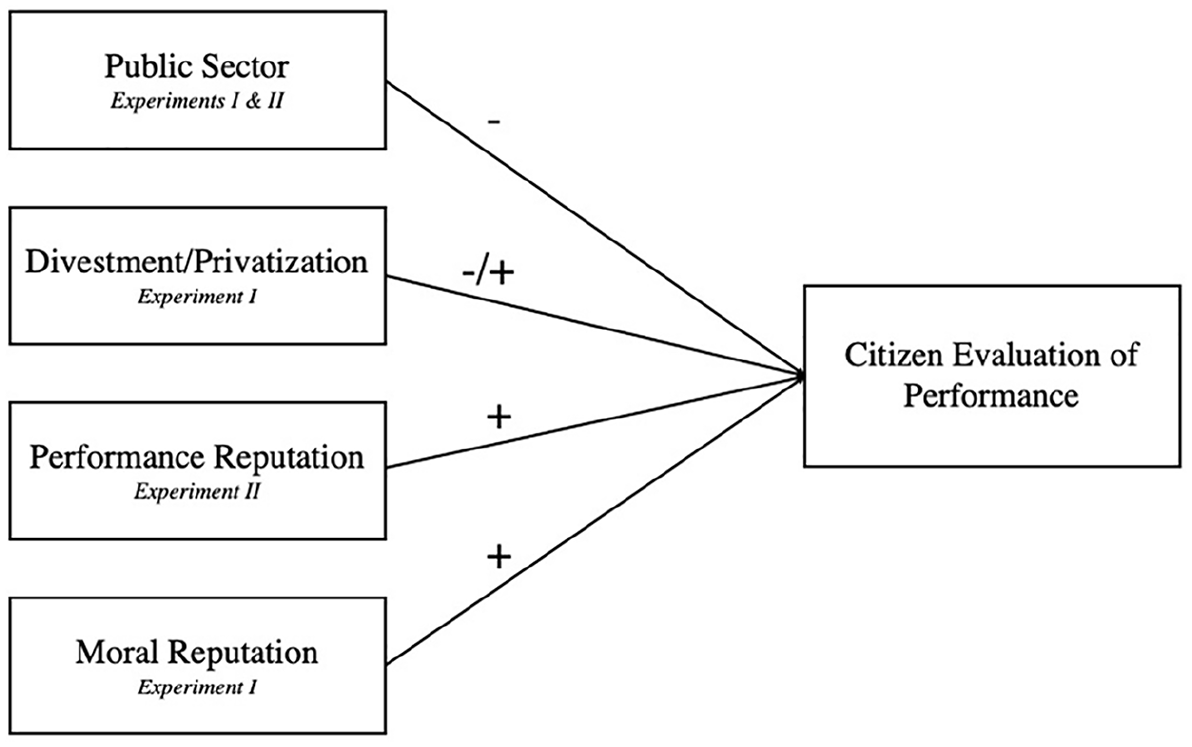
Theoretical model.
Context
The context of our study is in India, and specifically with two sectors where the public sector has seen a waning role: heavy industries and healthcare. We describe each below.
Self-reliance and industrialization have been key themes in post-Independence India (Khanna, 2015). Initially, this entailed exerting a high degree of control on the economy through a pervasive public sector (Bhagwati, 1993), state-led programming, and a complex web of regulations and licenses—also known as the License Raj—designed to control and contain the creation and expansion of private enterprises (Aghion et al., 2008). However, this industrial strategy proved unsuccessful, and by the mid-1970s, it was clear that public sector industries were inefficient and stagnating (Bhattacharyya, 2013; Khanna, 2015).
Ensuing trade imbalances caused a severe economic crisis in 1991, which ultimately led to economic liberalization reforms, ending convoluted licensing arrangements and opening many sectors of the economy to the private market and foreign investment (Bhattacharyya, 2013). Over the years, however, a number of ill-performing PSEs were subject to restructuring, closure, or privatization (Khanna, 2015), the latter of which had little impact in terms of performance or reducing deficit (Gouri, 1997; Khanna, 2015). More recently, the ruling National Democratic Alliance (NDA) government announced a strategic divestment of PSE’s (Government of India, 2021). Importantly, such a divestment is to occur regardless of financial performance (Ranganathan & Shenoy, 2020).
A similar transformation occurred in health care, as the share of public hospitals declined from 92% in the 1960s to 10% more recently (Bajpai, 2014; Bali & Ramesh, 2015), with private players supporting upwards of 80% of healthcare service delivery (UNDP, 2020). In both cases, then, the market power of private corporations may hinder inclusive development (Kanitkar, 2020).
Although most agree that the performance of these institutions do matter for the legitimacy of the state, debates over performance management reform persist (Trivedi, 2017). Among these includes the reservation scheme, which represents a constitutionally guaranteed system of affirmative action aimed at achieving representation through reserved positions for out-groups (i.e., scheduled castes, scheduled tribes, and other backward classes) (Haynes & Alagaraja, 2016). Criticisms arise as this system is perceived to hinder meritocracy, a change not empirically demonstrated; moreover, the strategic selection of human resources is considered one major leverage the public sector can use to improve its performance (Guest, 1997), and the reservation system thus may require public institutions to balance between representation and performance.
Further, scholars have argued that Indian public institutions are ill-equipped for the challenge of governing (Das, 2012; Kapur & Mehta, 2005) and that improving the capacity of these institutions represents the “single biggest challenge” (Kapur et al., 2017, p. 3) facing the country and the realization of its development goals. Attempts at instituting performance agreements at the organizational level have had mixed rates of adoption and success, particularly when civil servants face too much performance monitoring from a diverse group of actors, without actually having control over performance goals (Trivedi, 2017). Further, institutions of accountability, such as the Central Vigilance Commission (which have weakened over time), publish reports with a time lag and are generally inaccessible to the public, making the use of this type of performance information rare (Kapur & Mehta, 2005): in other words, there is an important issue of information asymmetry, a key encumbrance reputational signals can help ameliorate.
In this context, it is important to understand citizen evaluations of public sector performance and to what extent sector, divestment, and reputational signals are associated with it. This has implications for legitimacy of government, compliance with the law and public policy objectives, especially when citizens co-produce policy outcomes, as well as managerial issues such as public employee recruitment and retention.
Methodology
Study Design
This study utilizes two survey experiments conducted in India. Institutional review board approval for the study was granted on 5 October 2020. Participants were recruited in partnership with the survey agency YouGov, from its proprietary panel of respondents. Recruitment took place between 1 and 10 December 2020, and 2020 from an urban-representative sample 1 of Indian citizens aged 21 to 85. Participants were first introduced to the study and its aims, they were assured of their anonymity, that their participation was voluntary, and that they were free to decline their participation at any time. After completing each survey, participants were offered points which could be converted into cash or other rewards.
Both experiments followed a between-subjects design, wherein participants are randomly allocated to a set number of groups and presented with a vignette, followed by a small survey (see Supplemental Appendix). For both studies, the dependent variable was citizen evaluation of performance, which consisted of five distinct aspects of performance representing both organizational outcomes that are most associated with public organizations: numerical performance, goal achievement, and red tape (see Table 1). These measures have been used in past research, and represent the general conceptual space of organizational performance (L. B. Andersen et al., 2016; Hvidman & Andersen 2016; Olsen, 2015). In particular, the psychology of numbers has shown that numbers have a large effect on how information is processed, inform subsequent behavior, and are associated with specific biases (Olsen, 2015).
Performance Dimensions.
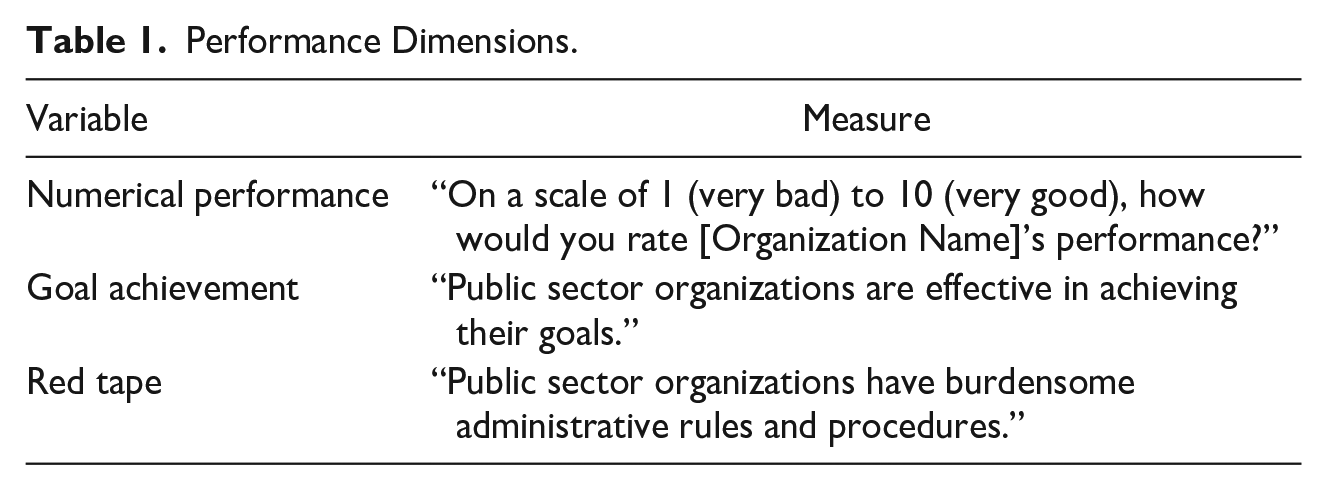
To determine numerical performance, respondents were asked to rate the performance the organization on a scale of 1 to 10, with 1 representing “very bad” and 10 representing “very good” performance. Each of the other dimensions were measured using a standard Likert scale ranging from 1 to 5, with 1 representing strongly disagree, and 5 representing strongly agree.
For both experiments, Ordinary Least Squares (OLS) regression was used to predict the influence of being in a given experimental group (where the control group was public sector) on the performance dimensions. The model included controls for gender, age, region, full-time status, and college education (these results are not shown for the sake of brevity, but are included in the Supplemental Appendix).
Experiment I
The purpose of the first study is to evaluate how citizens evaluate performance of a public sector enterprise that may have little contact with citizens. It explores whether sector, privatization, and moral reputational signals affect citizen evaluation of performance. Each group was presented with information about the same organization (1,107 valid responses), but were presented with slightly different information about its sector, whether it was being privatized, and whether it was fulfilling the Indian Central Government’s quota for minority representation.
Importantly, the organization represents a private sector enterprise that resembles others that have been privatized in recent years. In addition, the information was based on an actual public sector enterprise of the Indian Central Government, thereby ensuring realism in the survey experiment.
Demographic representation is a contested topic in many polities (Peters et al., 2015), where affirmative action policies may be seen by overrepresented groups as a form of reverse legal discrimination (Mor Barak, 2017). In the Indian context, in addition to constitutionally mandated reservations (for Scheduled Castes and Scheduled Tribes), designating beneficiaries of other Backward Castes is frequently prone to political patronage and ever-expanding lists of beneficiaries (van Gool & de Zwart, 2013).
In addition, reservations are prone to so-called creamy layer politics, wherein highly organized and educated sub-groups within beneficiary groups are the most likely to take advantage of and benefit from reservations (Chaudhury, 2004; van Gool & de Zwart, 2013). Despite all of this, however, representation of minorities and other “backward” classes represents an important social equity goal that is enshrined in the Indian constitution. Thus, fulfilling a mandated quota for minority representation constitutes a moral reputational signal, that is, that the organization is dedicated to morally fitting behavior in society, as well as how it treats its employees and clients (Carpenter, 2010).
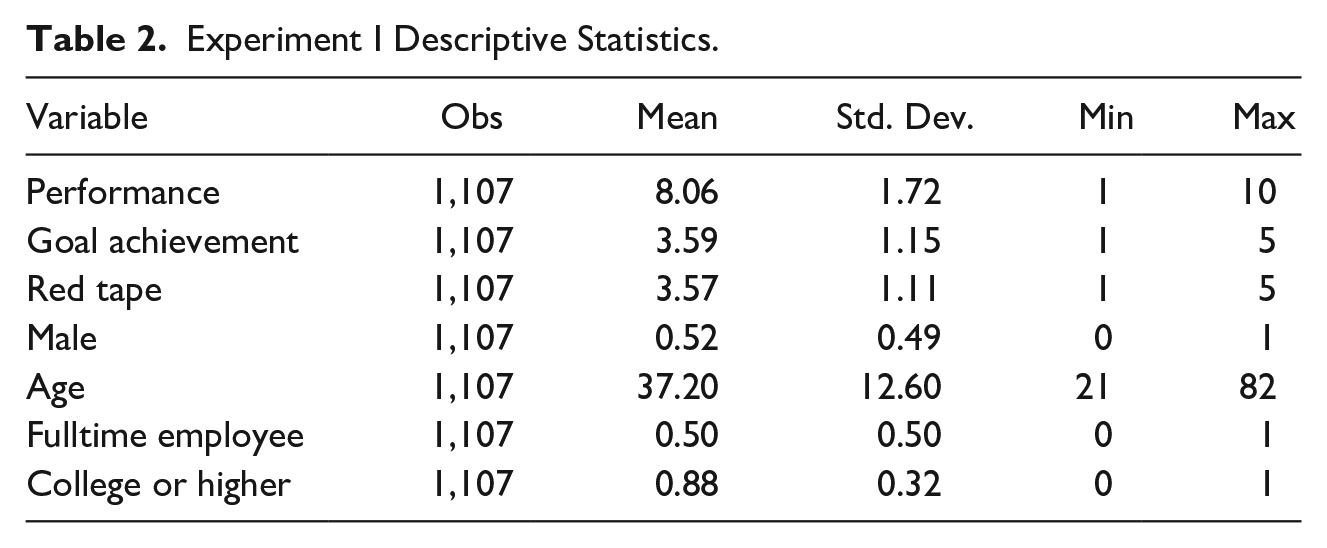
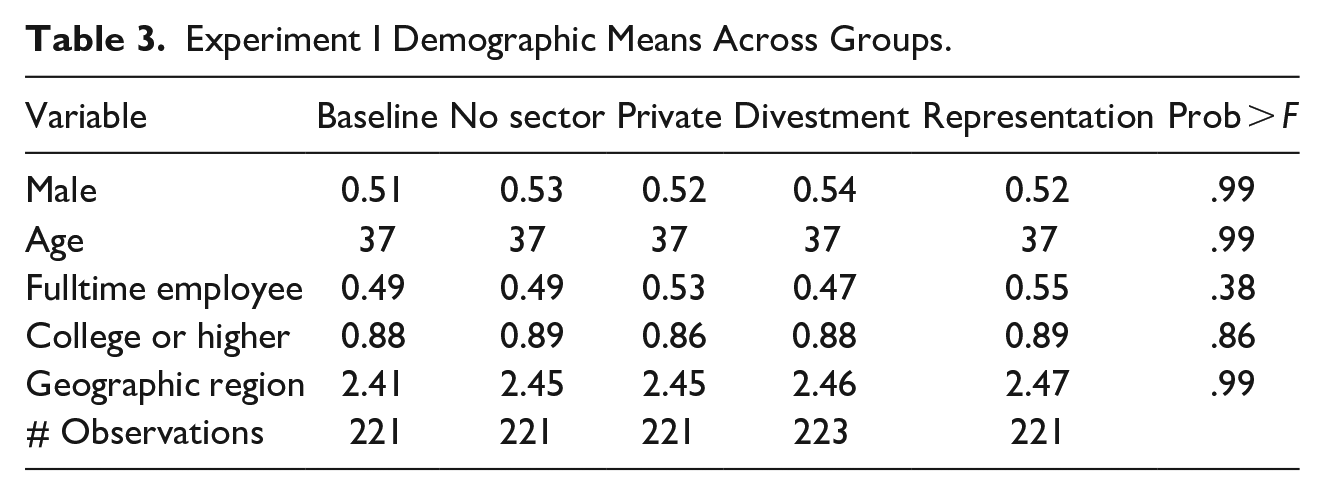
Table 2 shows the descriptive statistics of the entire sample as well as average responses to the survey items. Further, a comparison of demographic means across the different groups shows little variation, and these differences were not found to be statistically significant using analysis of variance (see Table 3).
Experiment I Descriptive Statistics.
Experiment I Demographic Means Across Groups.
Experiment II
The second survey experiment uses the specific case of a hospital, which citizens may have much more familiarity and frontline contact with, and is thus less abstract compared to a large public sector enterprise. Its purpose is to explore whether sector and performance reputation influences citizen evaluation of performance. Similar to the first experiment, participants were recruited using the same strategy (with 1,105 valid responses), and randomly allocated to different experimental groups.
Each group was then presented with information about the same organization, but with slightly different information about its sector, and well as its performance reputation. We consider three main signals public organizations can use to influence performance reputation assessments:
Reports on customer satisfaction, as they serve as an indicator of whether an organization is effective in providing quality service, and relates to both performance and trust in government (S. C. Andersen & Hjortskov, 2016; Van Ryzin, 2007).
Awards, which are directly linked to reputation as they allow the signaler to derive “significant social capital in the form of social status or reputation” (Frey & Gallus, 2014, p. 14).
Use of performance management systems: organizations with well-developed systems to measure and manage their performance can be more perceived as more transparent and trustworthy, which consequently influence perceived performance (Van Thiel & Leeuw, 2002).
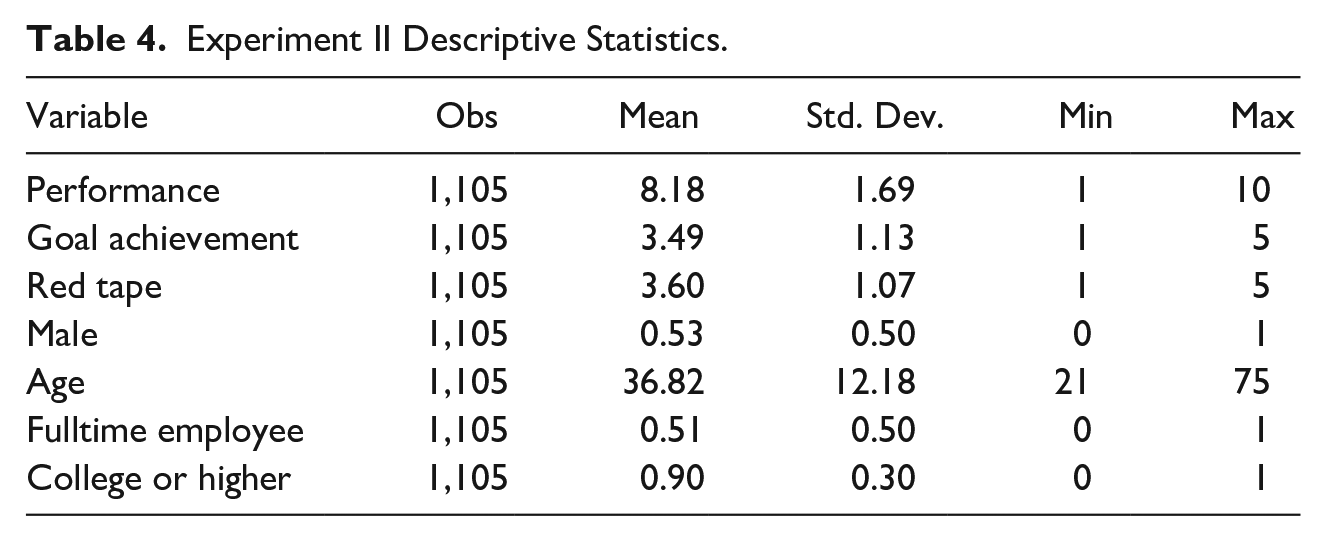
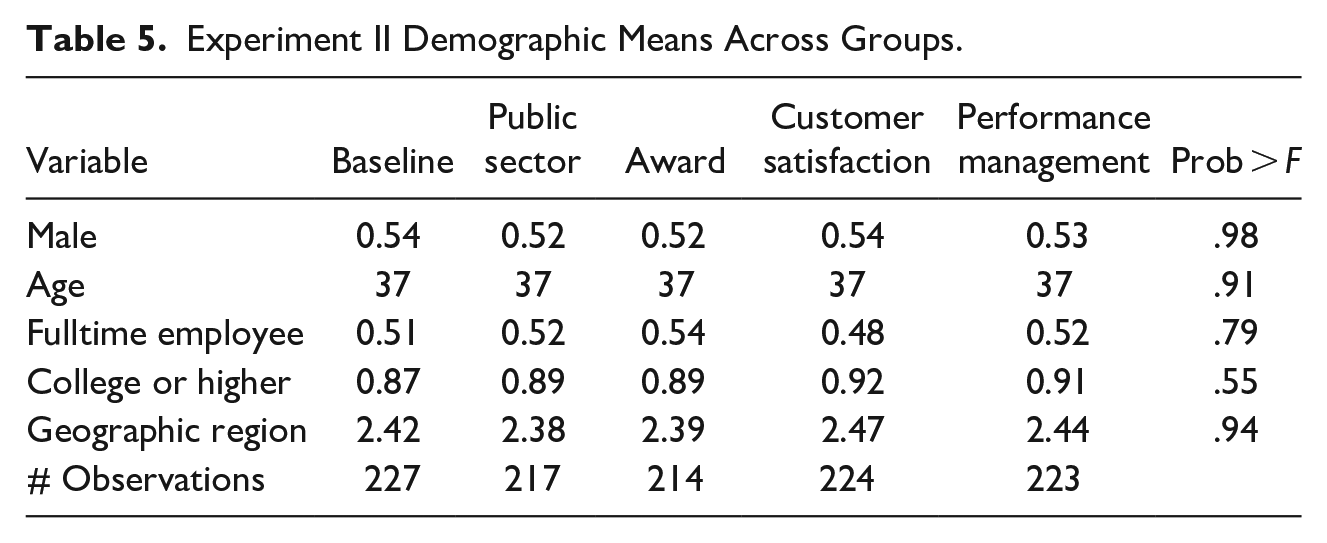
Table 4 shows the descriptive statistics for the sample. As with experiment 1, differences in demographic means across the control and experimental groups were not statistically significant (see Table 5). The following section presents the results of the analyses, arranged by hypotheses.
Experiment II Descriptive Statistics.
Experiment II Demographic Means Across Groups.
Results
H1: Public sector organizations will be associated with less favorable citizen evaluation of performance
To evaluate this hypothesis, we examined whether sector had any statistically significant impact on how individuals evaluated public sector performance. The base condition includes information indicating that the enterprise is a public sector organization. Figure 2 graphically illustrates these results of the analyses, with 95% confidence intervals. Thus, overlap of the confidence intervals with zero suggests lack of statistical significance at the α = .05 level.
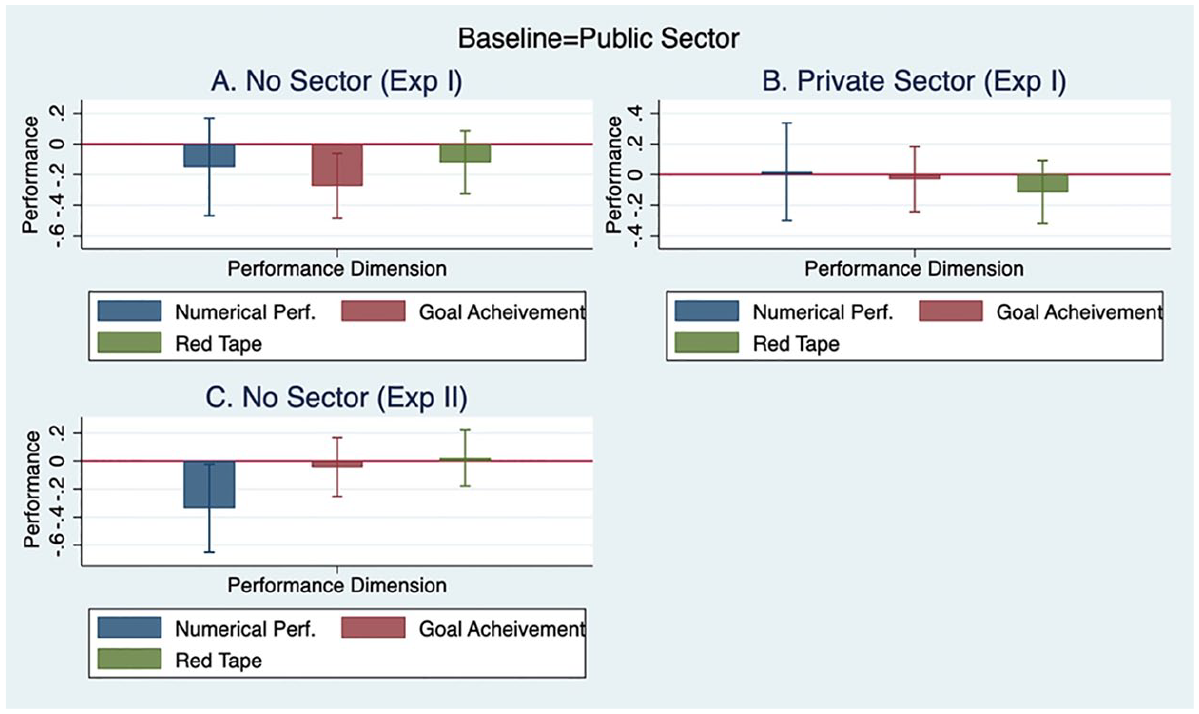
Effects of sector performance evaluation.
When comparing the no sector condition to the public sector reference group in experiment I (Panel A), the only statistically significant effect was for goal achievement, with lower levels of goal achievement for the no sector condition. This suggests that public sector organizations would be associated with higher levels of performance.
Examining Panel B shows that there was no statistically significant difference between the public sector reference group and the private sector condition, across all three performance dimensions. Lastly, Panel C mirrors Panel A, but uses experiment II, and shows that numerical performance in the no sector condition was statistically significant and lower compared to the public sector condition. However, relationships between sector and both goal achievement and rec tape were not statistically significant.
Together with the Panel A and C, the results show that the public sector is associated with higher levels of performance evaluation, although in different dimensions of performance, leading to a rejection of hypothesis 1. Differences across dimensions of performance are not surprising, given that experiment I (manufacturing firm) and II (hospital) used different organizations in the survey experiment.
H2A: Privatization will lead to less favorable citizen evaluations of performance
H2B: Privatization will lead to more favorable citizen evaluations of performance
Figure 3 shows the effects of divestment on citizen evaluation of performance. The results show that divestment was associated with lower levels of numerical performance. However, relationships with red tape and goal achievement were not statistically significant, although their direction was consistent with that of numerical performance. This leads to a rejection of hypothesis 2B, and the conclusion that privatization leads to less favorable citizen evaluations of performance.
H3: Performance reputation will lead to more favorable citizen evaluations of performance
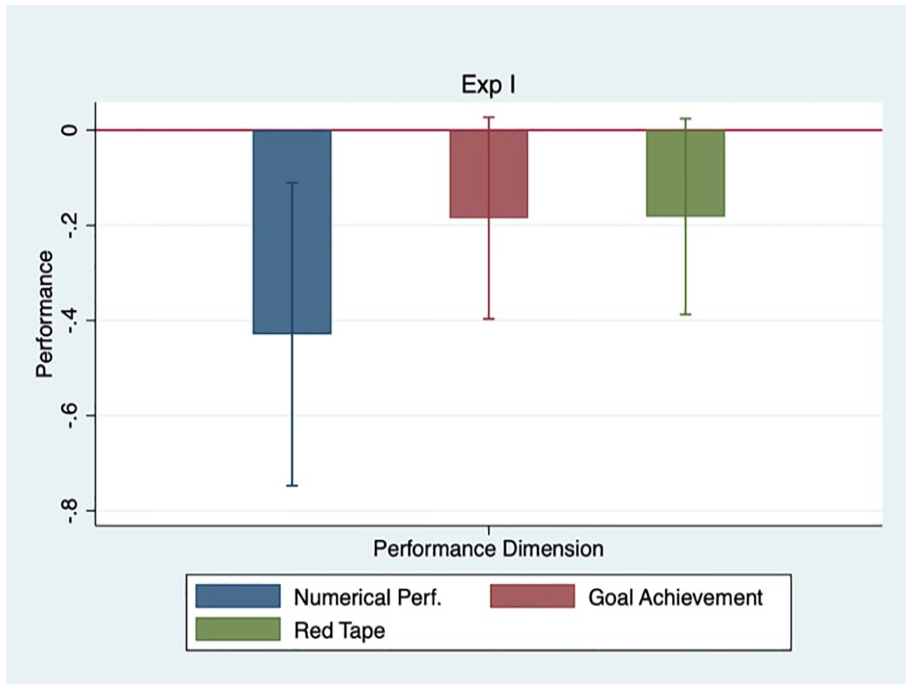
Effects of divestment on performance evaluation.
As discussed in the methods section, in constructing performance reputation, we relied on a number of activities that can signal the performance of organizations, and eventually inform the types of enduring images citizens have of organizations. These included awards recognizing performance, customer satisfaction, as well as evidence of improvements due to performance management. Figure 4 shows the effects of each of these performance reputation signals on performance evaluation. As the confidence intervals of each performance dimension overlaps with zero, we do not find any statistically significant evidence, leading to a rejection of hypothesis 3.
H4: Moral reputation will lead to more favorable citizen evaluations of performance
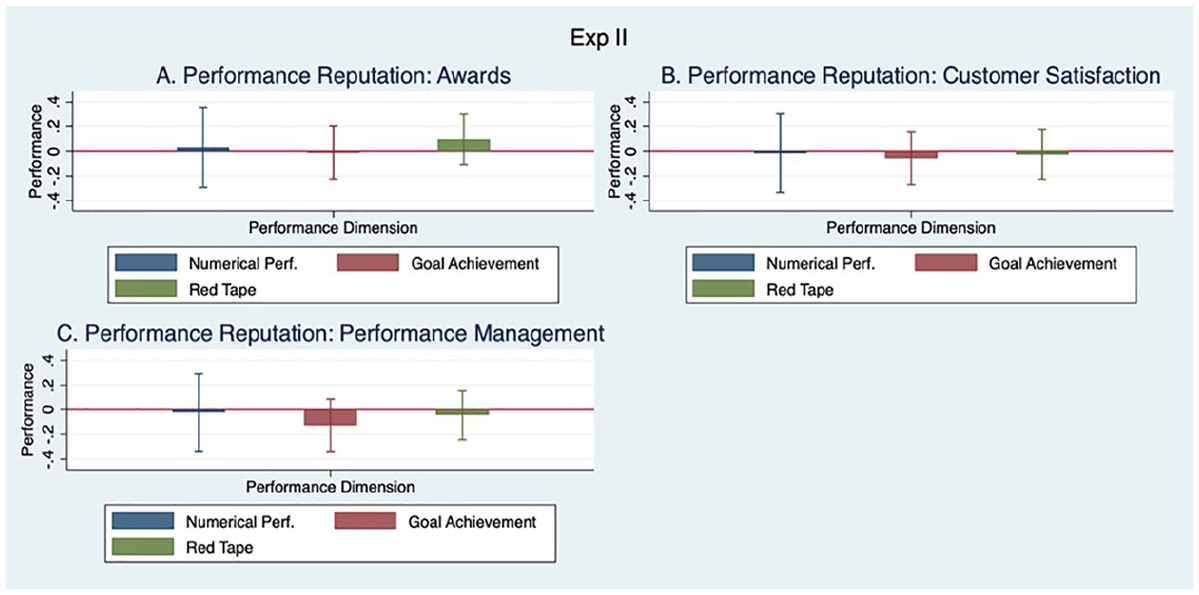
Effects of performance reputation on performance evaluation.
Lastly, hypothesis 4 concerned the positive effect of moral reputations on citizen evaluations of performance. Moral reputation was constructed by signaling the organization’s commitment toward social equity goals such as achieving of minority representation quotas. Figure 5 graphs the effects of these signals on performance evaluations, showing that moral reputation signals led to statistically significant reductions in levels of goal achievement and red tape, but no effect on numerical performance. Since the existence of red tape is pejorative, lower levels of red tape would be understood as more favorable evaluations.
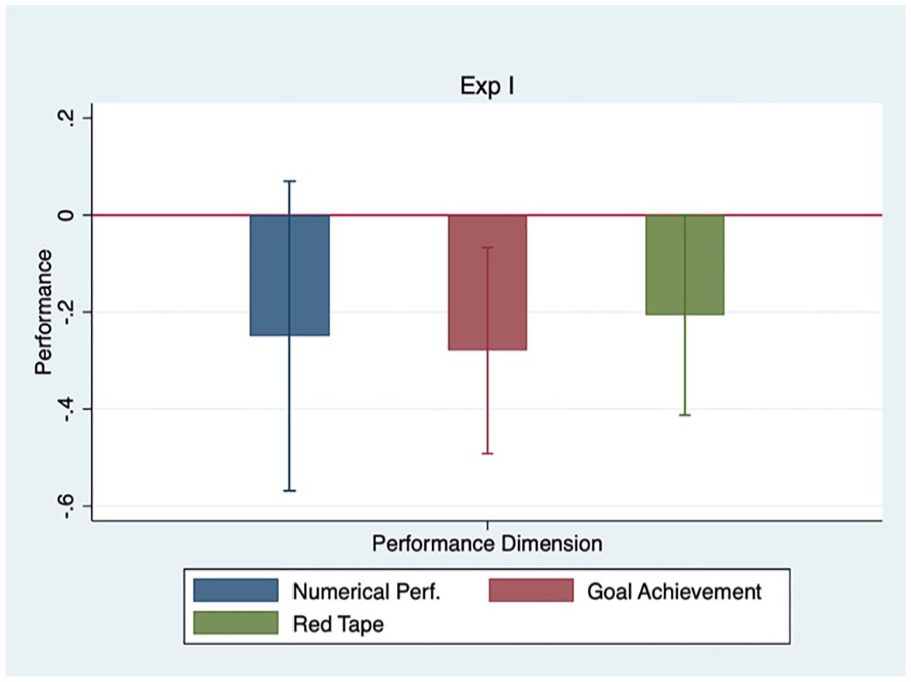
Effects of moral reputation on performance evaluation.
Although these results would imply mixed results, we find more convincing evidence for goal achievement, since its 95% confidence intervals do not overlap with zero. Indeed, upon examining the regression coefficients (see Supplemental Appendix Table A1), red tape was weakly statistically significant (α = .10). Thus, we reject hypothesis 4.
Discussion and Conclusion
Performance is a bedrock concern for organizations, public and private. Its pursuit, however, is a fraught affair, with debates on what counts as performance, as well as the multiplicity of administrative reforms targeted at increasing performance. While these are general concerns, performance in a democratic polity is especially important since it gives citizens the ability to exercise control over government and informs political knowledge and subsequent behavior (James, 2011). However, as scholars have demonstrated, interpreting and evaluating performance are subject to a number of cognitive biases (Hvidman & Andersen, 2016; Olsen, 2015), not to mention the significant transaction costs involved in obtaining and understanding large “rivers of [performance] data” (Moynihan & Pandey, 2010).
While previous research has examined a number of these biases, including an anti-public sector performance bias (Hvidman, 2018; Marvel, 2016), gaps in our understanding remain. Firstly, we don’t know to what extent sector bias also extends to instances where public service delivery is divested, that is, privatization. This is a significant question to overlook, since privatization and market reforms are frequent contingencies associated with development assistance to developing countries (Khanna, 2015; Ramesh et al., 2010). The lack of attention to this is not surprising, however, given the overrepresentation of the Global North in such studies, although they too experienced pressures to hollow out the capacity and reduce the role of government (Hood & Peters, 2004; Rhodes, 1994).
Secondly, despite research on biases in performance evaluation, the scholarly literature has to date paid scant attention to how public organizations and managers can use reputational signals to overcome information asymmetries, and thus allow better citizen evaluation of performance (for exceptions see Gilad et al., 2018; Marvel, 2016 study III).
In light of these gaps, we sought to examine two specific antecedents of citizen evaluations of performance: sector and bureaucratic reputation signals. Given the contested nature of performance (L. B. Andersen et al., 2016; Andrews et al., 2010), we took a wide view of performance and how it is constructed in different forms and policy arenas. We did so by including three dimensions of performance, and also examining how performance reputations can be constructed across different types of activities.
We find that public sector organizations are subject to more favorable citizen evaluations of performance, rebutting some of the existing evidence (Hvidman, 2018; Hvidman & Andersen, 2016; Marvel, 2016). Further we find that privatization is associated with lower levels of performance. Lastly, we fail to find any significant effects of reputational signals on citizen evaluations of performance.
Together, these results sow doubt about the universality of the public-performance-bias found in other studies. In addition, they shed light on the assumption underpinning the push for privatization, that is, public organizations do not perform well, even if such assumptions may be at least partially warranted.
However, despite the lack of performance bias in our findings, public organizations may be limited in their ability to enact their environments and influence performance evaluation through reputational signals. In the context of healthcare in India, this holds implications for what mechanisms and policy tools (Bali & Ramesh, 2015) the state uses in achieving universal healthcare coverage and the Sustainable Development Goals (Bhaduri, 2020).
For public managers, it affects to what extent they can resist pressures for increased monitoring, accountability (due to performance biases), and performance regimes, as well as recruitment and retention of talented public employees. For instance, research on organizational images and perceived environmental support shows that public employees are aware of how their organizations are perceived in the external environment and that this has an an effect on their performance (Hameduddin, 2021; Hameduddin & Lee, 2021; Rho et al., 2015).
Although this was one study to examine performance assessments in India, we encourage future research to more fully examine how performance information is used across different contexts. Further development of signaling theory in public administration research (see Abolafia & Hatmaker, 2013) may shed light on issues as diverse as performance assessments, public expenditure, as well as recruitment and selection of motivated individuals into public service roles.
Despite our findings, our study is not without limitations. Since we relied on a survey experiment, we can derive plausibly causal estimates of effects but at the cost of external validity (James et al., 2017). It may then be difficult to generalize these results beyond the case of India, or other so-called middle-income countries such as Brazil, China, Russia, and South Africa. However, there are a few contextual features that relate to the form of the public sector that may help understand to what extent these results may hold in other countries. Firstly, public sector employment in India has been historically characterized by both job security and prestige, elements which appear in other country contexts, such as China (Miao et al., 2014).
Another element of the Indian public sector is a preference for minority representation or direct quotas, which have appeared in ethnically diverse countries including South Africa, Pakistan, and Malaysia, among others (Fernandez, 2020; Lim, 2007; Tan & Preece, 2021), and to varying degrees of success and/or contention. For example, Fernandez (2020) finds evidence that representation of Blacks in the South African bureaucracy led to marked gains in public sector performance, while Lim (2007) argues that a preference for ethnic Malays has subdued the responsiveness and legitimacy of the bureaucracy altogether. Thus, along with the outsize role government employment plays in society, this may imply that the current results may hold in countries with similar values on this contextual feature.
However, these similarities may be moderated on the type of government regime, and by extension, the role of government in economic affairs. In particular, as the context section noted, India moved from a centrally planned economy envisioned on Soviet-style 5-year plans to a liberalized economy in 1991. This shift removed convoluted business licensing regulations and greatly expanded private enterprise, and periods in the past few decades have seen large increases in GDP growth. Although not entirely analogous given their varying starting points, such a shift can be compared to China’s transformation from a largely agrarian economy to one characterized by an open market economy during the Deng Xiaoping era (Vogel, 2013) and the lifting of millions out of poverty (Ang, 2016). However, the extent of these similarities may end with the contrast between China’s authoritarian regime and India’s increasingly illiberal but nevertheless open democracy (Economist Intelligence Unit, 2020; Tan & Preece, 2021).
A third contextual feature relates to the prevalence of corruption, a problem plaguing public service delivery across a number of developing countries (Davis, 2004). In this context, evidence suggests that dishonest individuals may self-select into professions where there are more opportunities for rent seeking, such as public sector employment (Barfort et al., 2015; Hanna & Wang, 2017). This in turn affects how citizens come to evaluate public sector performance, as well as the motives and behaviors of public servants. Thus, we may generalize the findings to countries with similar values on the prevalence of corruption, such as Brazil, South Africa, and China (Transparency International, 2021).
Lastly, the two experimental cases represent distinct public sector entities, that is, public sector enterprises and public hospitals, and we may expect differing results from other types of public organizations; especially those that have much more direct contact with citizens, such as welfare and social service organizations. Given the survey experimental design, it is possible that placing respondents in a natural setting may change the results of the study. In addition, since we did not conduct a manipulation check prior to placing the experiment in the field, the null results we find either may be a true null, or could be because the experimental manipulation failed to produce the kind of psychological response it was intended to elicit. However, since we modeled our experiment based on other studies within the field that produced effects, we are more confident that our results are not a function of a failed manipulation (Hvidman & Andersen, 2016).
Further, we did not pre-register our study, an increasingly common practice that is designed to separate postdiction (or posthoc theorizing) from prediction (Nosek et al., 2018). However, for a number of reasons, we do not feel that our study would be prone to such issues. Firstly, since we found evidence for only a few of our hypotheses, this provides some credibility to the fact that we did not engage in post-hoc theorizing and didn’t seek out and report only statistically significant results (p-hacking). Secondly, given the strongly deterministic nature of the study, that is, setting up the experimental design, carrying out and obtaining institutional review, as well as working with a survey agency, we had in fact working hypotheses and theories to test (which informed the design of the study), making it unlikely that we engaged in post-hoc theorizing or postdiction.
Ultimately, our findings are one attempt to disentangle how citizens assess performance. We thus encourage future research to examine these issues using other methodologies that may provide both internal and external validity, such as field experiments and longitudinal research designs, in addition to research conducted in other middle- and lower-income countries.
Supplemental Material
sj-docx-1-aas-10.1177_00953997221147231 – Supplemental material for Sector-Switching, Bureaucratic Reputation, and Citizen Evaluation of Performance: Evidence From a Large-Scale Experiment in India
Supplemental material, sj-docx-1-aas-10.1177_00953997221147231 for Sector-Switching, Bureaucratic Reputation, and Citizen Evaluation of Performance: Evidence From a Large-Scale Experiment in India by Taha Hameduddin and Roberto Vivona in Administration & Society
Footnotes
Declaration of Conflicting Interests
The author(s) declared no potential conflicts of interest with respect to the research, authorship, and/or publication of this article.
Funding
The author(s) disclosed receipt of the following financial support for the research, authorship, and/or publication of this article: This research was generously supported by the National University of Singapore (Tier 1 Ministry of Education Grant).

Supplemental Material
Supplemental material for this article is available online.
Notes
Author Biographies
References
Supplementary Material
Please find the following supplemental material available below.
For Open Access articles published under a Creative Commons License, all supplemental material carries the same license as the article it is associated with.
For non-Open Access articles published, all supplemental material carries a non-exclusive license, and permission requests for re-use of supplemental material or any part of supplemental material shall be sent directly to the copyright owner as specified in the copyright notice associated with the article.
