




Abstract
Allowing private companies to de facto exercise legal authority is becoming increasingly common in several countries. Externalizing legal authority is sustained by a discourse replacing a conventional institutional approach to law enforcement with a functional approach where the agent is less important than efficiency and expected outcomes. Drawing on two brief case studies in Sweden—automobile inspections and reviews of international financial transactions—we argue that legal authority is transferred to for-profit actors with only a minimum of safeguards and accountability. For-profit actors are legal authority insiders but outsiders in the democratic chain of accountability.
Introduction
The basic research questions addressed in this article are focused on administrative reform externalizing public authority to for-private organizations. We argue that unlike contracting out public service delivery, externalizing public authority has more profound ramifications as it compromises the state’s monopoly of coercive power. Against that backdrop, what have been the drivers of this reform and what have been the political and discursive justifications for externalizing public authority?
Even a casual observer of public administration and law enforcement would probably agree that exercising legal authority is the undisputed purview of government. Yet, when airline staff ask to see our travel documents, it is not simply to confirm our identity but also to make sure that we will be allowed into the country we are heading to; or when we make a cash deposit in a bank and the clerk makes discrete enquiries to ascertain that this is not a case of money laundering; or, when we take our car to a private shop for the annual automobile inspection, we are, in fact, subject to legal authority exercised by a private, for-profit organization.
These are examples of externalized legal authority. Does this matter? Why is this something we should take note of? We associate the use of coercive power with the state as these powers must be exercised under strict responsibility and accountability (Bovens, 2007). As Max Weber (1946) put it, “a state is a human community that (successfully) claims the monopoly of the legitimate use of physical force within a given territory” (p. 78, italics in original). Although automobile inspections rarely result in an exercise of physical force, they invariably include the exercise of legal authority. Such authority, as Weber (1946, p. 79) points out, is exercised “by virtue of the belief in the validity of legal statute and functional ‘competence’ based on rationally created rules” . . . “This is domination as exercised by the modern ‘servant of the state’ and by all those bearers of power who in this respect resemble him.” Given the powerful argument why legal, coercive authority should be the monopoly of the state, the justification for any delegation of that authority to private actors becomes a matter of critical concern. If the legitimacy of legal authority stems from the circumstance that it is derived from the authority of the state, how can a delegation of that authority to societal actors be legitimized and justified?
In this article, we elaborate and address precisely that question. We study the justifications and legitimations of the marketization of legal authority and the accountability issues associated with such reform. We argue that the conventional institutional approach to exercising public authority, where such authority is embedded in and derived from public, accountable institutions, is increasingly supplemented or even replaced by a functional approach where institutional ownership is seen as secondary to functional efficiency. Private actors have for decades delivered public services across a wide range of policy areas. Extending such delegation to also include legal authority-making was apparently not very controversial (Pierre, 2011; Pollitt & Bouckaert, 2017). Indeed, we can think of this pattern as a normalization of marketization of the public sector, where after decades of marketization reform, introducing such reform also in the context of law enforcement did not raise any significant opposition.
From a service production perspective, allowing private businesses to exercise some degree of legal authority could be considered a means to increase the availability of public services and to cuts costs for the public sector. Delegation of legal authority to private actors can also assist public authorities with problem-solving and decision-making in transnational policy areas where the state has limited operational capacity. We have already mentioned international travels and financial transactions as examples of such international matters that require legal authority. The common denominator between these cases is a huge case load with tasks requiring only limited specialization or expertise in public law.
For private-sector organizations, the practice of legal authority offers potential profit and business expansion into new areas. Decades of public management reform of the state and a growing publicization of the private sector (Scherer & Palazzo, 2011; Sellers, 2003) have helped create a hybrid space of public authority-making that defines the exercise of public authority as a generic function rather than a task invariably assigned to public agents (Terzi & Tonnelat, 2017).
Reform which externalizes legal authority implies that that essentially anyone with a minimum of credentials can be entrusted to implement the law. Is that really the case, or are important democratic values and public interests lost in translation from the institutional to the functional perspective on legal authority? In the present analysis, perhaps the most intriguing question in this “second wave” context of marketization of the state is the degree to which potential efficiency gains are believed to justify and legitimize the externalization of legal authority and law enforcement in the first place (see Bozeman, 2007). Although there may be a functional justification for the argument that externalizing legal authority increases efficiency and client satisfaction, it may at the same time be detrimental to the quality of law enforcement, to compliance, to the legitimacy of legislative and regulatory institutions, and ultimately to the capacity of lawmakers and regulators to actually use legislation and regulation to shape social and economic behavior.
In cases of externalized legal authority, such authority is decoupled from the democratic chain of command and control. This separation could jeopardize the traditional order in liberal democracies where exercising legal authority is the purview of public institutions. Indeed, in welfare bureaucracies, the functional approach could open for new “logics of competition” (Miller & Rose, 2008, p. 15), redefining to whom, and for what, the functional agent is accountable.
This article seeks to deepen the conceptual and normative analysis on externalizing legal authority by developing an analytical framework for further empirical research that incorporates the functional public discourse—the legitimation process by the state—as well as the performance and implementation by the private agent of legal authority, and the democratic implications of separating legal authority from accountability.
The article is divided into four sections. First, we review previous research on the political, legal, and administrative context where exercising legal authority—that is, authority on behalf of the state—is delegated to market actors. Second, we outline a conceptual framework on externalized legal authority. Third, we apply the framework in an empirical analysis of two Swedish cases of externalized legal authority. These cases capture, first, the marketization of a previous state prerogative—the annual automobile inspections—and, second, how private actors are authorized in an area where the state has limited operational capacity—the policing of detecting and preventing financial crimes. In the closing section, we present our conclusions and discuss how the analytical framework on externalized legal authority can be used in future empirical studies.
Previous Research
The demarcation between the public and private spheres of society is fundamental to liberal democratic theory (see, for instance, Weintraub, 1997) and is one of the major dichotomies in the social sciences (Arendt, 1958; Elshtain, 1997). This research tradition studies how the two spheres of social organization—markets and hierarchies—engender different expectations and roles (Gilpin, 1987; Lindblom, 1980; Pierre, 1999; Polanyi, 1944; Strange, 1988, 1996). The state pursues universalistic and collective objectives and interests, whereas the market is mainly concerned with particularistic private objectives and interests (Weintraub, 1997).
Over the years, the significance of this dichotomy has become increasingly questioned. Rather, there is recognition of the interdependences between the political and economic systems in society (Lindblom, 1980) and the potential for synergies between public and private action (Madrick, 2010). In the public sector, extensive public management reform in the Organisation for Economic Co-operation and Development (OECD) countries has brought the market into the public sphere to address problems of organizational rigidity and low efficiency in public organizations (Pollitt & Bouckaert, 2017). Meanwhile, the private sector has undergone a process of publicization, emphasizing corporate citizenship (Crane et al., 2008; Helgesson & Mörth, 2013; Néron, 2010; Scherer & Palazzo, 2011; Sellers, 2003) and “moral actorhood” (Holzer, 2013). The combined outcome of these developments has been a further permeation of the public–private distinction into a new public domain (Drache, 2001; Ruggie, 2004; for example, Bull & MacNeill, 2007) and a lower degree of publicness of public administration (e.g., Pesch, 2008).
Toward Hybridization
The decreasing significance of the public–private distinction has propelled the emergence of a hybrid space where organizations incorporate multiple institutional logics or embedded agencies (Thornton & Ocasio, 2013) prescribing what constitutes legitimate behavior (Pache & Santos, 2013) and are confronted with multiple demands (Skelcher & Rathgeb Smith, 2015). The empirical cases studied in this article exemplify hybridization where private-sector organizations perform roles defined by public-sector norms.
How does hybridization impact organizations traversing the public–private border? These organizations have been found to use different coping strategies to address multiple demands (de Graaf et al., 2016; Pache & Santos, 2013; see also Meyer & Rowman, 1977). These different “institutional orders” (2012, p. 54) 1 feature different sources of legitimacy, authority, and identity that shape “the basis of strategy” (Thornton et al., 2012, p. 54) of the organization.
Empirical studies on what these multiple orders or logics mean to frontline workers with multiple interests and loyalties in veterinary services, migration, and law enforcement (Dörrenbächer, 2017; Steden, 2007; Thomann et al., 2017) show that agents tend to adapt to policies creatively if those logics contradict the dominant institutional practices of their respective parent organizations (de Graaf et al., 2016; Mastenbroek, 2017). When facing conflicting demands, frontline workers tend to follow the dominant loyalty, be it to the company or a professional norm (Thomann & Sager, 2017). Hybrid organizations may even engage in what Pache and Santos (2013) describe as a hybridization pattern of the Trojan horse “whereby organizations that entered the work integration field with low legitimacy because of their embeddedness in the commercial logic strategically incorporated elements from the social welfare logic” (p. 972).
This is not to suggest that the public–private dichotomy has lost all meaning; only that those boundaries are redefined and renegotiated in the practice of externalizing legal authority. Market actors relinquish some degree of agency and autonomy in externalized authority-making and find ways to construct boundaries to protect their autonomy and achieve “defendable compliance” (Ericson, 2006). Corporations are “neoliberal subjects living with risk” (Grove, 2014, p. 250), and if they are to benefit from engaging in legal authority-making, they need to devise a strategy that allows them to pursue corporate objectives alongside conducting legal authority.
While market-related objectives like efficiency and customer satisfaction are also present in public-sector management and administration, they are there embedded in regulatory frameworks and professional norms that differ from those of the private sector. This framework relates to the democratic polity’s need for accountability, impartiality, and transparency (Bovens, 2007). Public institutions harbor the expertise and professionalism required to enforce authority and due process, whereas airline staff, automobile inspectors, and financial managers do not. Therefore, most, if not all, legal and constitutional experts in liberal democracies would probably agree that the exercise of legal authority is, and normatively speaking should be, a function of governing that is reserved for public institutions and actors. As exercising legal authority may potentially include enforcing sanctions on citizens and businesses, it must be conducted under strict accountability and transparency which only public institutions can offer (Pierre & Painter, 2010). What is ultimately at stake here is the fundamental normative framework, according to which citizens and businesses are expected to follow the law: that breaking the law may lead to sanctions; that those institutions and officials who pass judgments and sentences are held to formal-legal account; and that the law serves to protect the public interest as well as the right of the individual to have his or her case tried in a legal process (Bovens, 2007).
Hybridization highlights the tensions between democratic and managerial objectives and values in the public sphere. While much of public management reform and certainly the marketization of legal authority is sustained by a discourse downplaying the differences between the public and private sector (Peters, 2001), the public–private dichotomy remains fundamental for organizing democracy (Dahl, 1989; Guess, 2003; Mörth, 2009). This model of the sources and conduct of legal authority is predicated on the state as the sole agent exercising such authority, but can this postulate be sustained by public institutions if important legal authority-making is externalized to actors with competing or even conflicting institutional values? Indeed, legal authority may be exercised by “major insider participants in the policy-making process” (Crouch, 2013, p. 219; see also Dahl, 1972; Vogel, 1975, 2008) outside the democratic chain of accountability (e.g., Habermas, 1996).
In sum, important but frequently overlooked elements of public management reform are predicated on a discourse denying the importance of the border between the public and private spheres of society. This discourse emphasizes that it is the function of legal authority, not the agent executing that authority, that matters. Further along this argument, this functional approach to legal authority will improve the efficiency and accessibility of public services that require some degree of legal authority.
A key aspect of marketization of legal authority is the justification and legitimation of such reform. Here, we need to make a distinction between how externalized public authority-making is legitimized on the one hand and the implementation of legal authority-making on the other hand. The first aspect refers to the function of public authority-making while the second issue is related to the agent performing the authority-making.
These aspects of externalized legal authority are developed in the Figure 1.
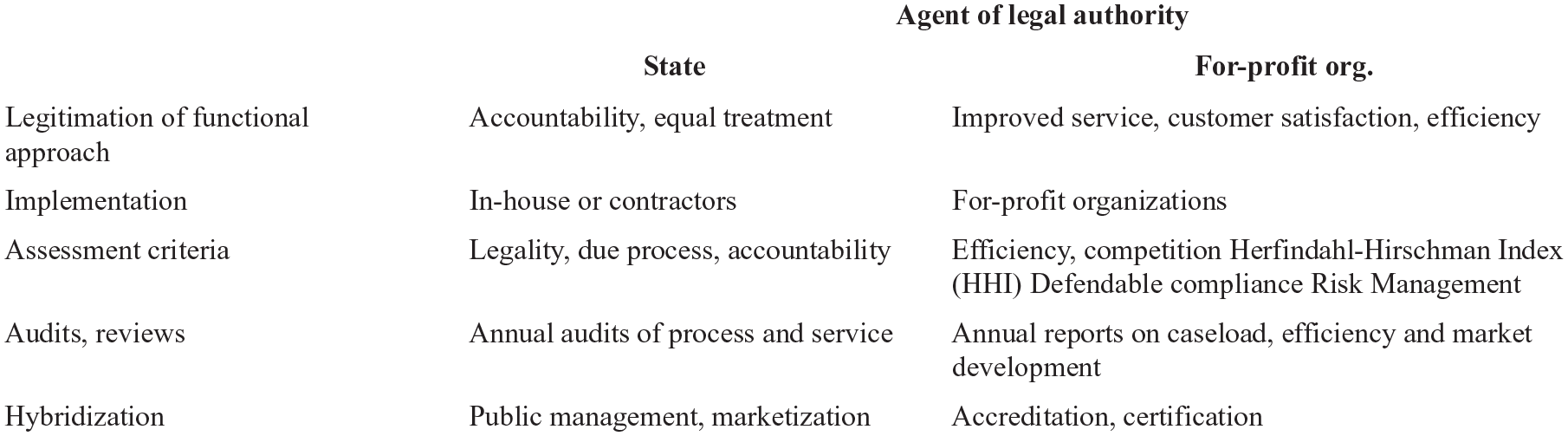
Public and private agents of local authority.
Research Design
Sweden, with its long Rechtsstaat tradition emphasizing the legality, transparency, and accountability of public administration on the one hand and extensive New Public Management reform on the other hand, is a well-chosen case for an analysis of the externalization of legal authority (Hall, 2013, 2015; Sundström, 2015).
Our two empirical cases are situated at the border between the state and the market. Thus, first, automobile inspections, for a long time provided by a state monopoly, were opened up for market competition by a center-right government in 2009. The second case concerns the prevention of money laundering and terrorism financing (henceforth AML/CTF)—a case of a de facto externalized legal authority to private actors, which has opened up for a marketization on policing in an area where the state has limited operational capacity.
The analysis draws on official documents and informant interviews with key public officials. Public documents are essential to an understanding of how the government seeks to legitimize the externalization of legal authority. While interviews with senior public servants may be of some assistance in that analysis, too, their main role has been to help clarify how key actors perceive the tradeoffs between marketization and law enforcement strictly by state institutions.
The Cases
The Swedish public service is one of the most marketized public sectors among the OECD countries (Hall, 2013; Pollitt & Bouckaert, 2017). We therefore expect to find discursive legitimation on externalized legal authority by the state and coping strategies by the performing for-profit agents. The first case on legal authority-making on automobile inspections concerns the marketization of the public-sector services. Automobile inspections used to be the prerogative of the state. Over the past few decades, however, many OECD countries have opened up a competitive market for inspections, thereby commercializing the exercise of legal authority.
The second case is related to the government’s concern with financial transactions that serve to launder money or fund terrorist activities (AML/CTF). Faced with a huge caseload combined with very limited access to data and operational capacity, the government opted to request that banks and other financial institutions review all transaction with regard to their legality. Thus, the government externalized the exercise of legal authorities to financial institutions, requesting them to report any suspicious transaction to the police.
A detailed, thematic analysis of the cases is presented in the next section.
Empirical Analysis
Our empirical analysis is structured in accordance with the themes outlined in Figure 1. Our main focus is on the legitimation of the functional approach and the implementation by the for-profit organizations. The first aspect is analyzed as the public discourse on the functional approach, based on legislation and other official documents and interviews with public officials. The second aspect on the implementation—assessment and auditing criteria—is focused on the overall conditions for legal authority-making and the performance by the for-profit organizations. This part of the analysis is based on legislative documents, interviews, and previous empirical research on how for-profit organizations handle externalized legal authority-making.
The purpose of the case studies is primarily to illustrate the complexities associated with externalizing legal authority and how our analytical framework disentangles this complexity with a focus on the legitimation and implementation of externalized legal authority-making.
Annual inspections of motor vehicles are common across the world. The purpose of the inspection is not just to ensure the safety of the vehicle. Motor vehicle inspections also include checking the level of CO2 exhaust emissions of the vehicle and thus cater to a public interest of environmental protection. In Sweden, comprehensive annual inspections of all motor vehicles were introduced by legislation in 1965. The government created a state-owned company, AB Svensk Bilprovning, to conduct the inspections. This model was integral to subsequent reform and the externalization of public authority as it brought hybridization into the inspections service sector before marketization and other public management reform strategies had emerged on the agenda.
The empirical background to externalizing legal authority to for-profit organizations in preventing AML/CTF dates to the second EU (European Union) Directive from 2001 (2001/97) and the third directive from 2005 (2005/60; see also EU Directive, 2015/845). 2 These directives obligate European banks, lawyers, accountants and a wide range of other credit financial institutions to make risk-based decisions in their interaction with clients. The political background to the directives is the EU’s rapidly increasing attention to combating terrorism in the aftermath of 9/11 (Seyad, 2012). The Swedish government, particularly the finance police, created special units to control that financial institutions conducted due diligence of their clients, including registering individuals and other policing tasks (Swedish Government Regulation 2009:92).
Legitimation—The Functional Public Discourse
In both cases, the externalization of legal authority to for-profit organizations is motivated by market efficiency, either to create a market for a public service to boost cost-efficiency and to offer “customers” a choice (automobile inspections) or to sustain a sound financial market (AML/CTF). Informally, or at least less articulated, there were also political and ideological reasons for opening up a new market within a sector that used to be a prerogative of public authorities.
The Swedish Parliament (Riksdag) ruled in 1994 that not just the Svensk Bilprovning but also private companies should be allowed to conduct automobile inspections. In 2009, the center-right “Alliance” government introduced a Bill (Swedish Government Bill, 2009/10:32) to the Riksdag, proposing that there should be a market for automobile inspections and that private inspectors should henceforth be allowed to deliver service. Framed not as a privatization or a contracting out reform but rather as one of “re-regulation,” the objective of the reform was to increase the number of inspection facilities, thus making it easier for car owners to have their cars inspected.
Reflecting on the reform, a senior official at the Transport Agency argues that the basic logic of the reform in 2010 to open up automobile inspections to private actors and market competition was not economic but political. It was part and parcel of the center-right government’s overall philosophy to open up public monopolies to the market. (Interview, Senior Official, Swedish Transport Agency, September 5, 2018)
In the case of AML/CTF, the main argument brought forward in the directives and legislation for obligating private financial institutions to exercise legal authority-making was that preventing serious crimes and terrorist attacks is crucial for the functioning of the European financial market (EU Directive, 2005/60; Swedish Government Bill, 2008/09:70). Here, market actors are assumed to have the knowledge and resources that is required by the authorities to combat criminal financial transactions. Thus, Swedish legislation specifies a comprehensive list of policing tasks, including conducting investigations of the identity of clients and the beneficial owner of a company; keeping records on clients and transactions; establishing internal procedures; training staff; and reporting any indications of money laundering to the national financial police without informing the client about the suspicion of illicit money transfer (Swedish Government Bill, 2008/09:70).
Internally, the authorities did not consider any alternative strategies than granting for-profit organizations de facto legal authority to investigate and register people, up to and including breaching client confidentiality, to implement the EU Directives. As one senior official put it, “any actor who can open the door to the financial system should take part in efficient crime prevention” (Interview, Senior Official, Swedish Ministry of Finance, September 14, 2018). The alternative is for the state to control every bank account, which would be “unthinkable”; hence, the state needs to “trust” the market actors to do the job (Interview, Senior Official, Swedish Ministry of Finance, September 14, 2018).
Furthermore, in both cases, externalization of legal authority was both explicitly articulated and at the same time downplayed. In the case of automobile inspections, the discourse portrayed the reform as a re-regulation, whereas in the case of AML/CTF, the discourse was more ambiguous. In the AML/CTF case, banks and lawyers were legally obliged to investigate and keep a register on clients and decide whether cases were sufficiently suspicious to warrant a report to the police although these policing tasks were often framed as administrative tasks. The reform is described as risk management, a discourse borrowed from the private sector that portrays banks and other for-profit organizations as “reporting units” (Unger et al., 2014) and “active participants in the sector” (Interview, Senior Official, Swedish Ministry of Finance, September 14, 2018).
In the automobile inspections case, a market is de facto created, whereas in the AML/CTF case, government requires market actors to quietly monitor their clients’ financial behavior. In the first case, the sensitivity is toward legislation (domestic and EU), regulation, and public authority, whereas in the second case, there is sensitivity toward clients. Again, in both cases, there is a strong belief in market efficiency, and EU directives were brought in to sustain the market efficiency objective.
In the case of the automobile inspections, the Government Bill acknowledged that there were a couple of complex issues that the reform would have to consider. One issue was to what extent the proposed reform was compatible with the EU rules about competition within its member states; should the reform allow foreign companies to inspect vehicles in Sweden? The other issue was related to the fact that automobile inspections essentially were instances where Swedish law was exercised. Could private, for-profit organizations implement the law? The government arrived at essentially the same solution to both problems. In the 2009 Bill to the Riksdag, the government points out that “according to Article 45, the EG Treaty’s rules concerning free mobility for services do not apply to services which in the member state, even if only temporarily, involves the exercise of public authority” (Swedish Government Bill, 2009/10:32, p. 53). The government also argues that it would be “far-fetched” (Swedish Government Bill, 2009/10:32, p. 54) to think that overseas private companies would seek accreditation to inspect motor vehicles in Sweden.
Turning to the matter of whether private organizations could exercise such authority, the government states bluntly that “an automobile inspection is an exercise of public authority” (Swedish Government Bill, 2009/10:32, p. 36) and therefore must be “monitored” (p. 37) by the state. However, the emerging market for inspections will have both big and small actors, it is said, and “in order not to obstruct smaller actors it is important that obstacles to market access such as administrative burdens and costs associated with starting an inspection business are not too extensive” (p. 37). Regulations should furthermore be easy for the authorities to implement and neutral from a competition perspective.
Thus, in essentially the same paragraph, the government’s view on the externalization of public authority changes from emphasizing the public interest that inspections do entail the exercise of public authority and therefore require a strong presence of public institutions, to articulating a special interest that exercising public authority must not discriminate against smaller businesses, and that market access must not be impaired by costs or red tape. We underscore the changing discourse because we believe that discourse signals the fundamental values sustaining the reform and identifies which social constituencies that government caters to.
The case of AML/CTF offers a broad range of questions related to the rule of law and democracy but these questions were rarely addressed by the Swedish government. In the background review section of the Swedish Government Bill (2008/09:70), it was explicitly argued that lawyers, with their strong professional ethics and competencies, should use professional judgment rather than ticking boxes in their decisions on whether to report a client (Swedish Government Bill, 2008/09:70, p. 197). Questions related to due process and legality were essentially left to the lawyers.
Politically, the potential tension between efficiency and the rule of law such as personal integrity was discussed in connection the United Nations’ (UN) competence to enforce sanctions and to freeze individual or corporate bank accounts to combat AML/CTF (Interview, Senior Official, Swedish Ministry of Finance, September 14, 2018). From a legal perspective, the issue of whether the UN’s decision to sanction individuals or organizations could be viewed as an administrative, technocratic decision-making procedure, whereas in practice, it could be interpreted as a punishment lacking fundamental components in rule of law (Interview, Senior Official, Swedish Finance Ministry, September 14, 2018).
Implementation—Key Assessment Criterion
In both our cases, we can clearly see how the institutional origins matter in the implementation. When there were conflicting values and interests, lawyers and financial institutions constructed boundaries to protect their autonomy as businesses. In the case of the automobile inspections, the externalized legal authority was watered down and questions on legality and due process had difficulties to even arise in the daily work.
In the AML/CTF case, the assessment from the public institutions was to report the number of reports on suspicious clients and financial transactions, a typical assessment criterion for the marketization of the state. Banks and lawyers created policing units or compliance units consisting of compliance officers to secure that policing tasks had been conducted properly (Council of Bars and Law Societies of Europe, 2011, 2017; Favarel-Garrigues et al., 2011; Unger et al., 2014). The Swedish police are not at liberty to share information on suspicions of crime or whether the reports they have submitted will lead to prosecution with private actors. The incentives for a dialogue between the authorities and the private actors will therefore differ. Public authorities require extensive information on crime prevention and investigation, whereas the main objective for the private actors, given the unclear legal authority placed upon them, is to develop knowledge on compliance matters, for instance, how to achieve defendable compliance with the regulatory framework.
To manage this uncertainty and achieve defendable compliance private actors, particularly lawyers, had to make decisions on potentially conflicting legislation. For example, a Swedish law firm placed the servers of these systems outside Sweden as they assumed that keeping a register over clients might be a violation of privacy legislation (Helgesson & Mörth, 2016, 2018). Thus, lawyers were on their own when balancing conflicting values and commercial interests (e.g., on how French banks use prejudices regarding clients in setting up alarm systems to achieve defendable compliance, Favarel-Garrigues et al., 2011).
Swedish lawyers avoided accusations of noncompliance with the law by being extremely strict with taking on new clients and even avoiding clients from “strange” countries (Helgesson & Mörth, 2018). Another strategy was to acquire expertise from private companies specializing in how to be compliant and handle risk management in AML/CTF or on how Swedish banks recruited compliance officers from the Financial Supervisory Authority (Interview, Senior Official, Ministry of Finance, September 14, 2018).
The key data used by the Swedish unit within the financial police to demonstrate the efficiency of the externalized legal authority-making are the number of reports: “As long as there are incoming reports from the banking sector and other financial institutions, the system works” (Interview, Senior Official, Swedish Finance Police, October 25, 2018). Swedish authorities sometimes conduct campaigns to “test if the systems work” (Interview, Senior Official, Swedish Finance Ministry, September 14, 2018). If the campaigns result in only a few reports from a special group of market actors, “that could be a cause for concern for the government and the authorities” (Interview, Senior Official, Swedish Finance Ministry, September 14, 2018).
In the case of automobile inspections, an important component of the reform was that private businesses seeking to enter the inspection market would have to apply for accreditation with Swedac, the Swedish agency for accreditation and technical control. Accreditation should be conducted at the level of ISO 17020 to ensure that inspections of high quality were conducted by properly trained and skilled staff “with a degree” (Swedish Government Bill, 2009/10:32, p. 19).
More importantly, accreditation is integral to the legitimation of the externalization of public authority to private entities. In its 2009 Bill (2009/10:32, p. 19), the government suggested that the state-owned company, Svensk Bilprovning, was living proof of the hybridization of automobile tests. A senior official at the Swedish Transport Agency points out in an interview that “since the government used a state-owned company for automobile inspection, that authority was already externalized” (Interview, Senior Official, Swedish Transport Agency, September 5, 2018).
This official also emphasized the significance of Swedac’s accreditation of new companies entering the inspection market. This argument echoes the government’s analysis of the legality of externalizing public authority where, as the government concludes, “it is with Swedac’s [accreditation] decision that the administrative assignment (förvaltningsuppgiften) can be said to have been delegated” (Swedish Government Bill, 2009/10:32, p. 39)—a procedure which the government notes is consistent with the constitution. Indeed, in the government’s view, the only significant change brought about by the reform is that the legislation will no longer list the name(s) of companies or public entities that are accredited to conduct inspections as the number of accredited companies could increase rapidly.
The decision to externalize legal authority to private companies is thus de facto delegated to the accrediting agency Swedac. This raises the question of what requirements private businesses must fulfill to be certified inspectors. These requirements are presented in a legal document issued by the Swedish Transport Agency (Transportstyrelsen). Not surprisingly, the list of required skills features a long list of technical skills (TSFS, 2017:53, Appendix, p. 11). There are 10 competence areas where tests will be conducted, only one of which is called “legal knowledge.” This area includes knowledge about national regulatory frameworks, EU and FN/ECE (the UN Economic Commission for Europe) regulations, and domestic agencies relevant to inspections (e.g., the police; TSFS, 2017:53, Appendix, p. 42).
Thus, there are only extremely basic accreditation and certification requirements for private companies and their staff seeking entrance to the automobile inspection market in Sweden. The Transport Agency’s 2018 report lists the Swedac’s unspecified criteria for accreditation of new companies; that their staff is “competent”; that the company is “independent” and has a “good reputation”; and that their technicians are certified (Transport Agency, 2018, p. 9). Reflecting on this omission, an interviewee at Swedac states, No, there are no explicit, clear rules in that area. . . This was put on our lap by the politicians. We are not really having a discussion about these matters. It would be good with a certification framework which took these issues into consideration. (Interview, Assessment Manager, Swedac, June 19, 2019)
The Transport Agency has monitored the development and performance of the inspections market as a market, focusing on its concentration, that is, the number of companies that have entered the market and their market shares. The agency uses the Herfindahl–Hirschman Index (HHI), a measurement developed in economics, to measure the level of concentration in the market. In 2018, the agency was happy to report that the index had decreased somewhat (Transport Agency, 2018, p. 13). The Transport Agency also monitors changes in the number of inspection stations and their localization to make sure that inspection services are available across the nation’s territory.
Overall, the efficiency of the new market for automobile inspections and the compatibility of the reform with EU regulatory frameworks appear to have been far greater concerns for the government than the fact that legal authority was now externalized to market-based actors. For instance, the 2018 annual report is silent on issues related to hybridization or any problems associated with delegating public authority to for-profit organizations.
Discussion
The two cases of externalized legal authority differ in some aspects but also share many key features. The framework (see Figure 1) outlined earlier, focusing on the key aspects of the transfer of legal authority and the justification, legitimation, and implementation of externalized legal authority, highlights these similarities and differences. Perhaps the main difference is that in one case (automobile testing), government creates a market and opens for a service that includes the exercise of legal authority and invites private businesses to enter that market. In the other case (financial management), government requires market actors to assume a law-enforcing role and surveil financial transactions.
The outcome is however quite similar. In both cases, market-based actors perform tasks and roles closely associated with the rule of law on massive caseloads of reviews. Also, in both cases, clients and private law enforces share the same incentives to produce a favorable outcome, with very limited accountability or process surveillance. And, in both cases, reform is legitimized and justified, not with reference to the requirement for private actors to assume a law-enforcing role, but rather with reference to efficiency gains and customer service quality. While reform documents acknowledge that legal authority is indeed being externalized, the efficiency of the market and its agency coupled with the largely symbolic requirements for accreditation and certification is brought forward as justification.
This means that while the implementation of externalization of legal authority differs between the two cases, the strategies to legitimize and justify reform are very similar. Differences in implementation strategies can largely be attributed to the preexistence of a market in the financial management case and the creation of a market in the automobile testing case. Hybridization occurs in both cases although interestingly the reform advocates in the automobile cautions that private organizations must be expected to adapt significantly to the new role as law enforcers, whereas in the financial management case, such adaptation was not seen as very problematic.
Conclusions and Further Research
The reforms analyzed in this article were predicated on a reconceptualization of legal authority from an institutional to a functional perspective where the function of exercising legal authority is divorced from its institutional context. In this new hybrid space, any market actor that processes information not easily available to public authorities or passes a very modest feasibility test can deliver legal authority, While the reform objectives are to enhance efficiency and, essentially, relieve the public sector from a massive case load of routinized administrative or technical tasks, they raise a host of questions about the rule of law, accountability, and due process. The quality assurance mechanisms put in place—accreditation, certification—are technical to a much higher extent than formal and legal. The implementation process substantiates how private actors as agents of law enforcement devised coping strategies to achieve defendable compliance that were at best loosely coupled to due process.
Throughout this article, we have emphasized the critical role of public discourse in reform that externalizes legal authority. Discourse precedes framing, which in turn shapes how reform is presented and designed. In neither of the cases we have studied is the potential, or real, danger of reform compromising the quality of law enforcement seriously addressed. Architects of administrative reform as well as scholars need to reflect on the extent to which efficiency is a legitimate cause for surrendering legal authority to market-based actors with only scant attention to the values we tend to associate with the exercise of legal authority.
Alternatively, we could think of this type of reform as a risk management strategy where regulators acknowledge that the quality of private law enforcement will be inferior to that which is executed by public institutions, but where efficiency gains are substantial enough to justify the reform regardless. Either way, the discourse sustaining this reform carefully avoids addressing the core issues that public, legal authority is transferred to for-profit actors.
Moreover, we need to ask to what extent the complexity of the technologies of governing and public administration not only have override the traditional political dichotomy between public and private but also what this change entail in terms of democratic accountability. The democratic implications of separating legal authority with accountability needs to be further addressed in empirical studies on hybridization between states and markets.
Interviews
Senior official, Director Anti-Money Laundering Division, The Swedish Financial Supervisory Authority, telephone interview, July 9, 2018
Senior official, Swedish Transport Agency, September 5, 2018.
Senior official, The Swedish Ministry of Finance and the Swedish representative of FATF, September 14, 2018.
Senior official, Head of Coordinating Unit of AML/CTF, The Swedish Finance Police, October 25, 2018.
Assessment manager, Swedac, June 19, 2019.
Footnotes
Declaration of Conflicting Interests
The author(s) declared no potential conflicts of interest with respect to the research, authorship, and/or publication of this article.
Funding
The author(s) received no financial support for the research, authorship, and/or publication of this article.
