



Abstract
This paper qualitatively examines “privation of inclusion” at work in the lived experiences of racialized participants hired in publicly funded places of employment. Taking the position that the dualistic inclusion-exclusion paradigm fails to capture their lived realities with inclusive exclusions and exclusive inclusions, it presents privative inclusion as a third space, between inclusion and exclusion, for a more robust framework in understanding how racialized bodies were marked and targeted for differential treatment. The paper then outlines and discusses findings as key indicators of privative mechanisms that had undermined life chances by limiting career mobility of racialized participants of this study. It concludes by emphasizing the need for additional research in this area given the salience of racism at work as well as the demographic changes that Canada is currently experiencing.
Keywords
Introduction
The murder of George Floyd, an unarmed Black man, by a White police officer in Minneapolis has galvanized a series of racial solidarity events that have put on display the full range of anguish that Black, Indigenous, and other racialized communities have been feeling about longstanding racial justice issues in Canada, in the United States and around the globe (Deliso, 2020; Tasker, 2020; Xi, 2020). However, the tragedy has also, and ironically so, ignited another debate north of the border, that of Canadian exceptionalism, mobilizing defensive postures from influential White Canadians. On June 2nd, 2020, Mr. Doug Ford, the Premier of Ontario, Canada’s most populous province, would go on record to say that racism in Canada is not systemic and does not have deep roots here (Xi, 2020). At about the same time, yet another powerful White man, Mr. François Legault, the Premier of Québec, Canada’s second most populous province, would also assert that “. . . there’s no systemic discrimination. There’s no system in Québec of discrimination” (Lapierre, 2020). While Mr. Legault still maintains the view that there is no systematic racism in his beloved Québec, Mr. Ford would retreat from his initial position in the face of public backlash. Other examples of such denials include assertions by the Commissioner of Royal Canadian Mounted Police (RCMP), Canada’s federal national police service, and other senior officials (Morin, 2020; Wakefield & Junker, 2020). Ultimately, the language of denial and deflection combined with fossilized Canadian exceptionalism, ensconced in colonial overtones, create an illusion that there is no racism in Canada, thereby ensuring that systemic discrimination is swept under, and thriving beneath, the proverbial carpet in the country.
Although overt acts of bigotry are no longer acceptable, research evidence suggests that the privileging of White domination, in subtle and insidious ways, continues to cement colonial White supremacy in Canada (Banting & Thompson, 2021; Henry, 2017; Mensah & Williams, 2017; Patterson & Veenstra, 2016; Ramraj et al., 2016; Thobani, 2007). In fact, colonial whiteness reverberates in the day-to-day social life of Canadians, particularly those living in BC (Hiebert, 2017; Massarutto, 2004; Mawani, 2009; Ward, 2002). Moreover, whiteness’s powerful structural tentacles are institutionalized and deeply embedded in daily practices in ways that create an illusion of inclusion, a façade that makes it harder to identify sources and operations of power (Das Gupta, 2008; Henry & Tator, 2010; Razack, 2010). These forces are also behind the conflation of giving entry to the racialized with their inclusion in certain institutional environments-and the confusion of their presence with their acceptance and tolerance in these contexts.
Objectives and Outline
This study offers an examination of highly sophisticated, subtle and insidious mechanisms through which workplace racial discrimination in form of privation of inclusion persisted in hiring and promotional decision making. The site for the study was publicly funded places of employment in British Columba (BC), Canada, an institutional context that is significant considering the fact that workers for these employers offered services directly to the general public. More importantly, these institutions were mostly led by elected officials who, under Canada’s parliamentary democracy and the Westminster model of representative government, were Members of the BC Legislative Assembly and appointed as ministers of the government (Brooks, 2015). As such, the privation of inclusion that is outlined in this paper occurred under the watchful eyes of the executive branch of the government, the body that derives its legitimacy from the electoral process by virtue of symbolizing not only the will of British Columbians but also the confidence of the legislative body that they represented (Brooks, 2015).
Against this backdrop, the present article examines privation of inclusion as an apparatus of racial discrimination that signifies the absence of meaningful inclusion rather than an outright and blunt denial of it. As part of this endeavour, it investigates the lived experiences of non-White participants to understand how they were marked and targeted for differential treatment at work. To this end, taking the position that everyday racism is not the inevitable outcome of human difference but of deliberate processes (Essed, 1991, 2007), the paper will then outline and discuss the study’s findings in form of job description manipulation, benevolent preclusion, filtering out, cultural deficit fallacy, and temporary assignment backchannel as key indicators of how these mechanisms had undermined the life chances of participants by limiting their career mobility and denying them access to workplace advancement opportunities.
Privation of Inclusion: Utility of the Framework and the Nexus With Other Theories
Privation of inclusion offers a conceptual framework to explain how racialized employment discriminations occur in public institutional spheres. The framework identifies specific mechanisms used to deny racialized workers unfettered access to workplace mobility, inclusion, and enjoyment. It also underscores mundane bureaucratic maneuverings, tactical shifts and procedural techniques that allow subtle and sophisticated exclusionary practices to prevail in public employment contexts despite the rhetoric of institutional equity and inclusion (see BC Government, 2021). In doing so, the framework troubles the official proclamations of inclusiveness by stressing the disconnect between what an employer says and what it does with regards to workplace inclusion, acceptance and tolerance for those who are racially marginalized.
Privation of inclusion is particularly salient in institutional environments where it is incumbent upon the administrators and other key actors representing the employer to vehemently deny and condemn racism. This denial or condemnation is, however, nothing more than a performance act or a performative (see Ahmed, 2012), that offers official cover and protection to White workers and managers to practice discrimination against the racially marginalized under the cloak of inclusion. As such, the privation of inclusion framework goes beyond the exclusion-inclusion binary by highlighting the absence of meaningful inclusion rather than focusing on categorical exclusion.
Crucial to this formulation is the caveat that privation of inclusion does not simply and directly equate to exclusion. Specifically, privation of inclusion represents not an undisguised denial of inclusion but a defective form of inclusion in terms of impeded participation in workplace opportunities. Additionally, whereas the inclusion-exclusion dualistic view would (trans)fix these two concepts in immovable, mutually irreducible positions where the total absence of one would constitute presence of the other, privation of inclusion allows for the possibility of inclusive exclusions or, conversely, exclusive inclusions. Despite the seeming paradox, rather than operating in fixed states of competition, under a privative framework, inclusion and exclusion would work in a space of transition, fluidity, and hybridity. It, thus, becomes the third space between the two ostensibly mutually exclusive opposites: of inclusion and exclusion. As such, exclusion in the context of this framework is not a lack or total absence of inclusion but rather a form of deficient, defective, and corrupt(ed) inclusion.
Nevertheless, privation of inclusion must not be simply equated to and/or interchangeably used with deficient, defective, or corrupt inclusion. The nuance here is that these qualifiers could signal that the deficiency, defectiveness, or corruption largely as a function of (the lack of) racism awareness and racial sensitivity training. Since privation denotes the deliberate denial of inclusion and is imbued with intentionality on the part of those utilizing this form of racial discrimination at work, deficient, defective, or corrupt inclusion will not adequately capture this intentionality. In the context of Canada, this point bears particular emphasis since racial discrimination is often attributed to a lack of adequate training on racial sensitivity and the resulting notions of implicit or unconscious bias (Maclean’s, 2020; Turnbull, 2020).
Moreover, it is worth noting that while exclusion absolutely extinguishes inclusion and is linear and symmetric with absolute and identifiable qualities and states of presence, privation of inclusion is the mushy, non-linear and occasionally incoherent middle. This is conceptually helpful as it allows a privative encounter to engage with inclusion, to varying degrees, while also perpetuating exclusion. The adoption of privative framework as an apparatus of racism is, therefore, appropriate for this study as participants came from within the publicly funded places of employment, a presumed space of (pseudo-)inclusion, by virtue of having been previously let in or employed in these organizations.
In this regard, what makes privation of inclusion particularly insidious is that it is largely paperless and traceless but experienced (and felt) every bit as real and painful as the more overt and explicit forms of employment racial discrimination. Additionally, the insidiousness of privation of inclusion comes not from a patent denial of participation in workplace opportunities but from a corrupted notion of inclusion which is distinguished from a mere lack of the positive state of inclusion. Otherwise stated, inclusion is not completely absent but present in a diseased form. The targets cannot reasonably claim that they are on the outside given that they are technically on the inside of these White institutions. However, they are inside as outsiders or “outsiders within” (see Collins, 1986)—a conceptualization of exclusion that stresses the presence of deficient, defective, and corrupted inclusion by analyzing how a racialized employee could be on the inside but kept out of, let in but not allowed inside the circles that grant access to employment mobility and enjoyment opportunities.
By the same token, and to expound the linkage of privation of inclusion with other relevant frameworks, the theory of everyday racism (Essed, 1991, 2007) lends a strong inspiration to the privation framework. Everyday racism represents the subtle, evasive and widespread contemporary constellations of formerly explicit, blatant, and vocal forms of racial violence (Essed, 1991, 2007). Through reminding the racialized of their non-belongingness in Western societies, everyday racism is also concerned with providing a structural account of how racial conflict, as a recurrent and familiar lived reality, is experienced and recognized in quotidian details of socialized behaviors (Essed, 1991, 2007; Hoving & Essed, 2014). Stated differently, everyday racism is a particular form of systemic discrimination that is less concerned with the discourse of individuals’ psyche and culpability in racial violence and more attentive to the practicalities of (re)producing racist practices that prevail over certain everyday contexts—along with the impact and the implication of those practices on the lives of racialized individuals (Essed, 1991, 2007). As such, the everyday racism theory is aligned with the privation of inclusion framework insofar as the latter serves as a mechanism that highlights the ways in which everyday racism is not only naturalized in workplace practices but is also stealthily deployed to shape and taint the lived experiences of racialized workers in these employment contexts.
For another comparative framework, racial gatekeeping, the process signifies the control of access to critical resources such as employment, housing, education, investment markets, and so on (Corra, 2014, 2020). Here, a gatekeeper is “an actor - or network position - that controls access to ‘benefits’ [that they do not own] valued by another actor called the ‘client’” (Corra, 2020, p. 296; Corra & Willer, 2002, p. 180). Although a fee is often exchanged in gatekeeping, to the benefit of the gatekeeper, this is not necessarily the case when bureaucratic gatekeeping is under consideration (Corra, 2020). In these administrative settings, a racial gatekeeper has the power, as well as the institutional leverage, to control access to opportunities by engaging in homophily, or loving and choosing “people just like themselves” (Cassuto, 2016). The implication is that gatekeeping affords White bureaucrats the mechanism to engage in race-concordant/same-race gatekeeping (see Corra, 2020) by steering undesirable racialized applicants away from career opportunities using expedient manipulatable rules that are embedded in organizational structures and hiring practices.
Although there are technical and tactical parallels between racial gatekeeping and the privation of inclusion framework, the main difference between the two concepts is that the former primarily takes place pre-admission while the latter is conducted in an environment of post-admission in workplaces. In other words, gatekeeping could be seen as concerned with excluding the racialized from entering into employment relations with a particular employer whereas privation of inclusion is more committed to uncovering what could be viewed as deficient, defective, or corrupted forms of inclusion, post-entry. Thus, the gatekeeping framework falls short of providing an all-encompassing explanation of nefarious contemporary mechanisms that are used to deny racialized employees access to post-employment career mobility and enjoyment resources at work. In this connection, and to reiterate the point, while the effects of racial gatekeeping in amplifying workplace inequalities could not be understated, it is important to bear in mind that whereas racial gatekeeping denies racialized applicants access to advancement opportunities, privation of inclusion is deployed as a mechanism to stymie racialized employees’ mobility and enjoyment of work, at work.
Furthermore, the linkage with meta-theories such as Critical Race Theory (CRT) could also propound my conceptualization of privation of inclusion theory. CRT is primarily concerned with emphasizing the enduring salience of racist laws, policies, and other instruments in perpetuating societal racisms (Delgado & Stefancic, 2017; Matsuda, 1993; Yosso, 2005). While CRT focuses on legal structures and institutional macro-processes that are wholly implicated in producing societal inequalities, this macro focus fails to provide a granular and textured account for the specifics of how unjust and discriminatory organizational processes “interpenetrate one another to create and sustain patterns of resource inequality” (Ridgeway, 2014, p. 2). Additionally, as Ridgeway (2014) adds, the analytical focus in studies of inequalities should be on interrogating the micro-level processes that entrench lasting resource distribution and power access disparities. In fact, analyses that fall short of this maxim would run the risk of committing a “major misjudgment that greatly limits our ability to understand how stratification actually works [at the granular level] in an advanced industrial society like our own” (Ridgeway, 2014, p. 1).
Subsequently, since the privation of inclusion framework brings to bear an exploration of the day-to-day operations of micro- and meso-level mechanisms that engender systemic inequities and inequalities in racialized employment contexts, it provides a more helpful analysis of workplace experiences of racialized participants, as outlined later in this paper. Specifically, the privation framework brings to the analytical limelight bureaucratic processes and administrative procedural techniques that perpetuated inequality, at the practice level, by allowing White managers and executives to exercise their discretion in tailoring opportunities to the disadvantage of racialized minorities in ways that undermine their life chances. Stated differently, while CRT and everyday racisms provide a potent explanation for the overall patterns and motivations of racist encounters in society, privation of inclusion endeavors to explicate the particular mechanisms, maneuvers, tactics, techniques and technologies of deficient, defective, and corrupted forms of inclusion.
It also bears emphasizing that workplace racism is deeply embedded in structures and systems of institutions such that it becomes part of White employers’ “normative culture” (p. 32). In this respect, as Nelson and Nelson (2004) elaborate, “[t]he systemic and structural racism prevalent in institutions such as government departments, educational institutions, corporate boardrooms, hospital wings, religious organizations, media outlets and family networks is often so entrenched that it becomes part of the normative culture of an organization” (p. 32). This normative culture systematically devalues racialized embodiments, achievements, accomplishments, and perspectives—ever so subtly and insidiously—in ways that profoundly transcend the meaning and scope of terms such as “prejudice” and “racism” (Stewart, 2004). In effect, its stealth evades most established theoretical understandings of racial hostility, with its force coming from not only operating to exclude non-Whites in institutional settings but also “force[ing] conformity . . . [and] enforce[ing] silence” among those who are targeted (Nelson & Nelson, 2004, p. 32).
Accordingly, one utility of the privation of inclusion framework comes from exploring and exposing the deeply entrenched systemic and institutional operations of this normative culture in predominantly White organizations such as the ones studied for this paper. To that end, the privation framework demystifies the legacy of this culture by describing how it continues to function in organizations to monopolize “the maintenance of exclusivity” by exposing strategies with which this culture maneuvers to devalue the involvement of racialized minorities in workplace activities (Stewart, 2004, p. 34). Moreover, the privative framework ruptures classic understandings of racial discrimination in the inner sanctum of publicly funded bureaucratic spaces by revealing some of its contemporary mechanisms and giving these mechanisms the granular texture that could render them more perceptible, visible, and discernible. Lastly, the privation of inclusion framework transforms the meaning of this culture by transporting it from the realm of the abstract to the sphere of experiential illustration of everyday conditions and manifestations of this vile phenomenon in employment domains.
Ultimately, privation of inclusion is a concept that is distinct from racial gatekeeping, organizational normative culture, everyday racism, and CRT. The use of this concept as an analytical tool is justified in examinations of workplace racisms insofar as nuancing the post-entry (lack of) inclusion at work is concerned. Since it goes beyond the inclusion-exclusion binary, in presenting the privation of inclusion framework, my argument is effectively that this framework represents racism in structurally embedded everyday rhythms, gatekeeping patterns, and other exchanges of life to deny racialized workers access to critical opportunities for career advancement and workplace enjoyment.
Lastly, in acting as a significant access barrier to equal workplace participation for non-White workers, the privative apparatus remains in place partly due to historic White supremacist laws and belief systems that remain sedimented in organizational policies and practices. The privative apparatus is also in operation as a function of contemporary discriminatory practices that are carefully crafted to mask their racial intent (see Lopes & Thomas, 2006)—as embedded in organizational mechanisms, techniques, and tactical maneuverings that actively perpetuate Whites’ monopoly over institutional resources and powers (see Das Gupta, 2008; Henry & Tator, 2010; Kang et al., 2016; Lopes & Thomas, 2006; Mensah & Williams, 2017; Ramjattan, 2015, 2019; Thobani, 2007). Consequently, as an instrument of racist violence, the privation of inclusion conceptual framework advances our thinking on racism, racialization, and other systems of oppression that serve to reinforce White supremacy, hegemony, and domination in the workplace.
Participants, Recruitment, and Hermeneutic Phenomenology
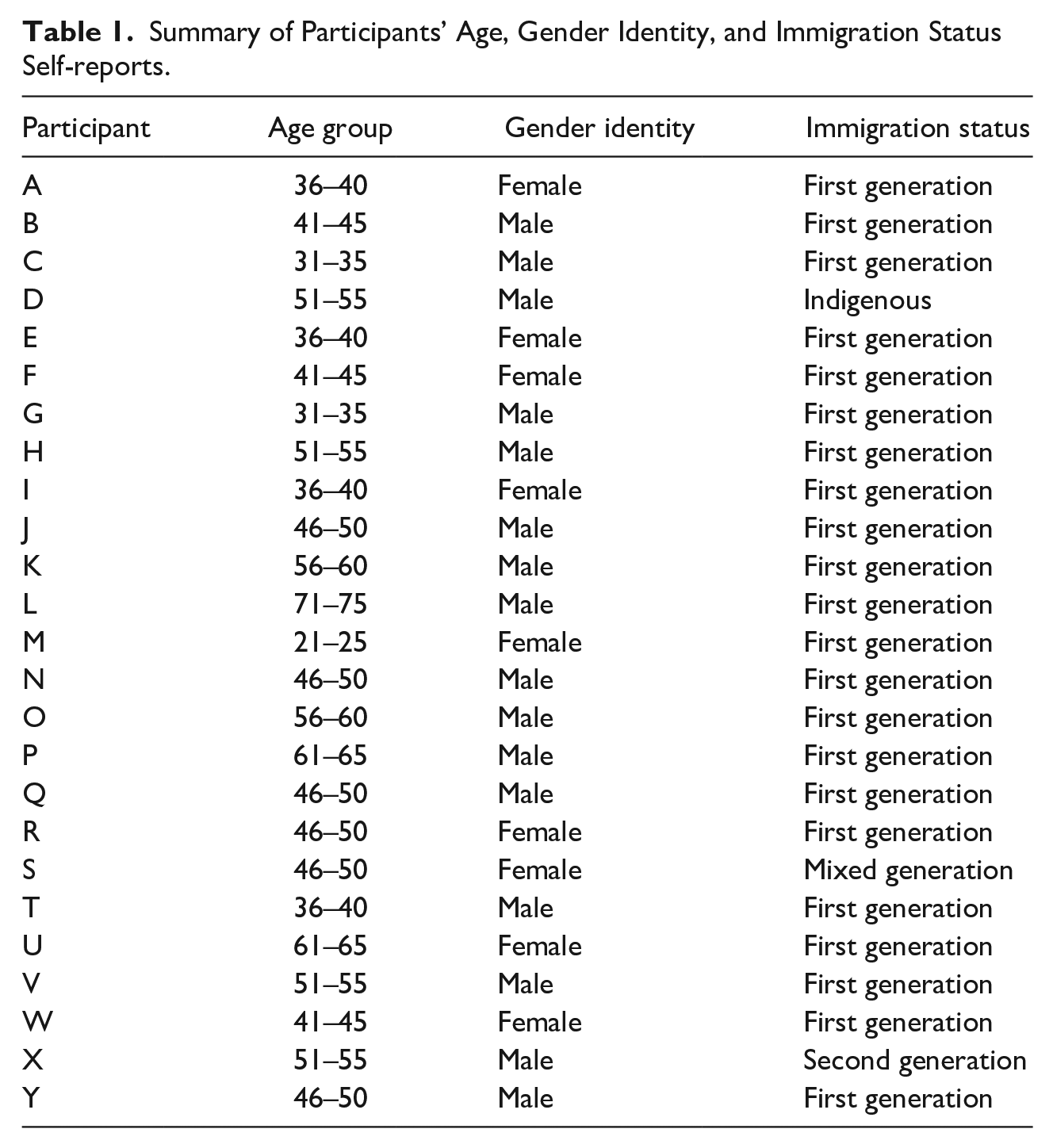
This research examined the lived experiences of racialized workers in publicly funded places of employment in BC. It received ethics approval from the University of Toronto’s Research Ethics Committee responsible for overseeing social work research. Twenty-five racialized public servants were recruited, from a plurality of backgrounds, from across BC, on the basis of self-identification as a racialized individual, working or having worked in a provincially funded place of work in BC in the past year, and having had lived experiences with race-based discrimination at work. The demographic profile of these participants is presented in Table 1 above.
Summary of Participants’ Age, Gender Identity, and Immigration Status Self-reports.
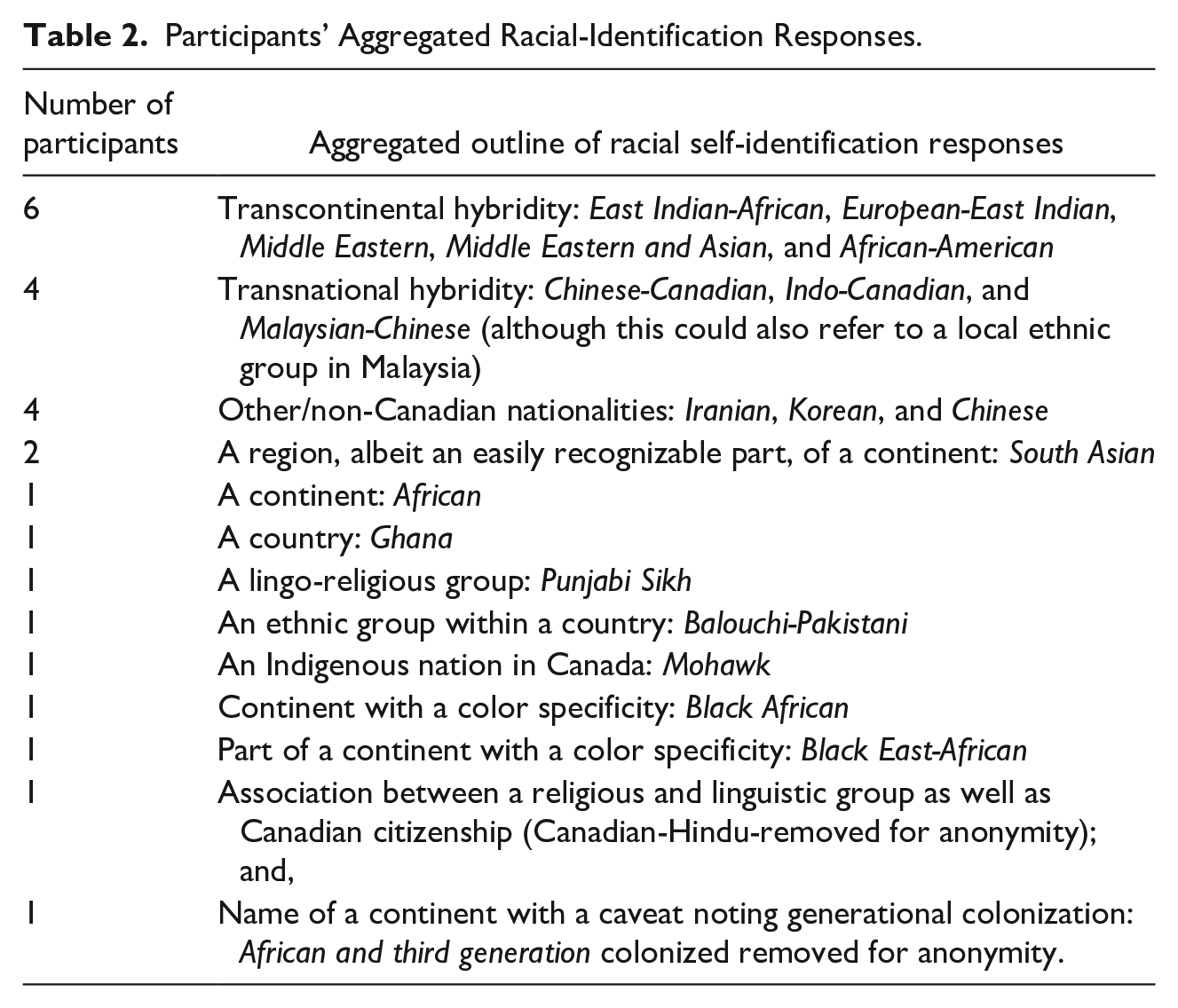
To protect the identities of participants, self-reported racial self-identification responses were segregated from gender and age information. The data were further aggregated as illustrated in Table 2, above. As an aside, the grouping of these racial categories exposes the heterogeneity of references to race, pointing to the absence of concordance on what race meant to participants and the categories into which they considered themselves racially belonging.
Participants’ Aggregated Racial-Identification Responses.
Recruitment commenced in February and ended in August 2017. Participants were interviewed primarily in public and university library environments across BC and received a $20 gift card to a coffee shop of their choice as a token of my appreciation for their time and efforts. To adhere to principles of ethically conducting this research, an informed consent was administered before interviews commenced and participants were informed that they could end their interviews at any point or withdraw from the study, for any reason, for a period of up to a week after the interviews had been completed. Interviews lasted between 1 and 3.5 hours and a semi-structured interview guide was used to ensure conversations stayed on topic. Interviews were recorded, transcribed verbatim, and anonymized. In some cases, the transcripts of interviews were also reviewed and revised by participants. Final versions of transcripts were analyzed using NVivo 12. Data analysis involved using hermeneutic phenomenological approach, including the hermeneutic meaning-making circle, to inductively and intersubjectively unveil multiple meanings that emanated from not only the different horizons of participants but also those of myself (Finlay, 2014; Newberry, 2012; Sembera, 2007). Specifically, it involved multiple reading, coding of transcripts, and structural analyses that identified meaning units, condensed those meaning units, and determined analytical subthemes and themes (Lindseth & Norberg, 2004; McAuley, 2004; Wiklund et al., 2002).
Hermeneutic phenomenology’s interpretivist tools allow participants to be placed in their worlds using a relativistic ontological perspective which acknowledges the possibility of multiple realities and truths (Creswell, 2009; de Sales, 2003; Finlay, 2014). In this regard, data analysis, or meaning-making as a process, was self-reflective involving examining intersubjectivities in a “hermeneutic dialogue” (Gagnon, 2019)—with the data and with myself. As part of this process, I reviewed notes that I had taken in form of memos during interviews, as outlined in Anastas (2004) and Kanuha (2000), as well as journals that I had kept documenting “personal, affective, and cognitive reactions to the day’s research activities” (Anastas, 2004, p. 57). In reviewing notes, journals and memos along with interview transcripts, I also examined my own embodied and internalized subjectivities as a racialized researcher studying privation of inclusion—a phenomenon that I had personally experienced outside the context of this research. Lastly, these reflective processes were uneasy at times particularly when it came to understandings of the transcripts that deviated from my own preconceptions and prejudgments about the essence or “is-ness” of the observed phenomenon (Finlay, 2014). However, I was able to reconcile these discomforting reflections through speaking with another qualitative researcher and benefiting from her perspectives on the interpretation of data.
Findings
Analyses presented in this article are informed by the privation of inclusion conceptual framework which enabled an investigation of the embeddedness of “race thinking” (Arendt, 1944) in the context of sabotaging interventions that guided access to workplace opportunities for the racialized participants of this study. Additionally, I found everyday racism (Essed, 1991, 2007), Critical Race Theory (Chan et al., 2014; Delgado & Stefancic, 2017; Essed, 1991, 2007; Yosso, 2005), and racial gatekeeping (Corra, 2014, 2020) particularly useful in in making sense of the data with respect to how racism is entrenched in dominant assumptions that maintain White supremacy and the ways in which it operates in workplace bureaucratic structures in the public sector.
The five analytical subthemes that emerged from my data analysis underscore the prevalence of racial domination in form of privation of inclusion in workplaces represented by participants of this study. As mentioned before, these privative processes functioned in a concerted manner to mask their racial intent for targeting racialized individuals through exuding an air of formality, in following formalized and informal procedures. Collectively, these subthemes highlight not only how meaningful participation and inclusion were stymied but also the ways in which participants were all but effectively shut out of career advancement and workplace enjoyment opportunities at work.
Subtheme 1: Job Description Manipulation
Participants’ narratives described the practice of job description manipulation as the act of revising job advertisement contents in ways that closely fitted the profile of preferred White candidates before the postings went up. Participants noted that vacancy announcements were “reverse-engineered” to serve the hiring manager’s preferences for a White candidate, in advance of the hiring process commencing. Interestingly enough, those job announcements would then be retrofitted with symbolic statements such as “preference may be given to a visible minority applicant.” For example, when Participant V applied to a position that was similar to his, for a lateral move, he noticed extensive changes in an otherwise standard job advertisement that he felt were made to put a specific White candidate in a better stead in the competition. “I couldn’t believe it [long pause] but I knew exactly why they were doing it” (Participant V).
“It happens all the time,” declared Participant N, in reference to “job description customization” in recruitment processes. “This whole thing [job description manipulation] is [done] so they could bring in the person they want” (Participant N). Subsequently, the feelings were that longlisting, shortlisting, interviews, and testing would only be done “as a show” (Participant W) to validate and legitimize a recruitment fait accompli, long before the hiring panel had even been convened. She then proceeded to provide specific details as following: In that ad, it was mentioned that you should have a minimum of five years of senior management experience. . . visible minority public servants who have expertise in [her field of work] and who will be applying for this kind of a job. . . you don’t need five years of five years of senior management experience. When your expectation is minimum five years of senior management experience [a long pause] . . . so tell me, how many visible minorities are in there in the BC public service? And how many of them are in senior positions? So basically they are eliminating most of the people who have the expertise but do not have the senior management titles but they’re doing it [the job]. . . it’s on purpose so that this other White person who’s their favourite could end up getting the job even though they have no experience doing [her field of work] type of work. (Participant W)
Corroborating the above, Participant H detailed recently witnessing a hiring event where job description was “reverse-engineered” so that the hiring manager could get “her way.” Describing the hiring process as a “sham,” Participant H referred to the human resources team as a “mafia” that works behind the scenes to satisfy hiring managers’ needs and wants. “Just this last month, I witnessed the hiring of a young White girl whose mother was friends with the hiring manager. They did some wordsmithing [in the job description] and before you know it, the job was custom-made for her [the successful White candidate]” (Participant H).
Participant U, who had a long career with the BC public sector, described how job description manipulation has evolved over the years that she has been with the BC government. She noted that whereas in the past this practice was overt in that a recruitment process would be openly tilted toward a desired outcome, it had evolved over time such that it was now more subtle and exuded an air of formality and competitive fairness. She then described how job description manipulation was baked into formal hiring processes.
Before [in the past] they would do whatever they liked and nobody could say or do anything about it. Now, if you notice something, you could really make a fuss about it [a recruitment outcome]. You could complain here and there and they’re afraid. So they have become smart. Very smart. What they do now is to make things appear formal and as though they are doing something legal. They make it seem like they have followed due process when they have not. On paper, everything looks great but behind the scenes, that is where the design and engineering [have] happened. (Participant U)
Job description manipulation, as a mechanism for privation of inclusion, served a proactively exclusionary function in dissuading racialized applicants from submitting their applications in the first place. This not only lends specificity and thickness to the existing body of literature but also extends it to the public sector in a Canadian context. Specifically, for over 50 years, controlled experiments involving “situation-tests” and “audit tests” have measured White employers’ discriminatory acts and attitudes toward non-White applicants—consistently confirming the racial bias in hiring practices (Daniel, 1968; Kang et al., 2016; Pager et al., 2009; Riach & Rich, 2002; Rivera, 2012). However, what this subtheme highlights is a very particular micro-level process, a distinct bureaucratic mechanism, for how racialized employees are deprived of meaningful participation in workplace career advancement opportunities.
Subtheme 2: Benevolent Preclusion
Judging from their facial expressions, among the privative practices that racialized public servants had experienced, benevolent preclusion, or the notion of presumably well-meaning and purportedly kind-hearted privation of exclusion, was the most painful to recount for the participants. Participants N, M, R, and P who work for a major employer in the BC public sector detailed practices that required them to first consult with their immediate supervisors before applying to vacant positions. It was in the course of those consultations that their supervisors appeared to “do them a favour” (Participant N) by “looking into things” (Participant R)—a process that often involved consulting with the hiring managers for the vacant positions under participants’ considerations. These supervisors would then come back to effectively discourage participants from engaging in competitive hiring processes using a variety of pretexts, including arguments that someone else was already under serious consideration and that there were unmeetable requirements for the position (Participant N).
In this regard, Participant V noted having become “sick and tired of” hearing rejections. “They say no as though there is something wrong about me. But I feel no, there is something wrong in the system” (Participant V). Another example, where a White hiring panel member did not hide his racial bigotry, was provided by Participant D. In this instance, when Participant D made his intentions of applying for a senior position known to someone at the hiring committee, he was unofficially informed not to bother with the application process.
Just like don’t waste your time because you will never . . . they will never accept you as a [title of the position] because you are too radical. You’re too Indigenous basically [chuckles]. . . I didn’t even apply because they said no, don’t even think about it. . . you are too Mohawk, you are too . . . they will never accept you in that position. You are too much trouble. (Participant D)
It is noteworthy that when participants were discouraged from applying to positions on the basis of their managers’ unofficial feedback, this feedback always carried an air of officiality. Afterall, it came from a member of the management team. However, it was never written anywhere and was brought up in the context of a friendly conversation where the managers purportedly showed that they cared for participants’ chances of professional success at work. In other words, the maliciously racist intent was always disguised under the cloak of a caring bureaucratic, albeit informal and unwritten, advice that reportedly came from a good place. “Just don’t waste your time” was conveyed to Participant D who was kindly reminded of his radical existence as an Indigenous man in Canada. “You’re too much trouble,” he was told for being an Indigenous worker in a pathologically White institution. “They will never accept you,” he heard, because of his Indigenous identity. Participant D was smiling when he recounted these experiences; however, it would be hard to argue that receiving such comments from someone who was in position of authority over him did not burn into his memory, leaving a profound mark on his soul, mind, spirit, and psyche.
In addition to recounting experiences that had impacted them personally, participants also reported witnessing scenarios where pre-emptive preclusion was applied to other racialized candidates. Respondent J detailed witnessing the “screening out” of candidates based on their racial identities. Having sat in hiring committees, he noted: “I have seen candidates excluded from further consideration in job competitions because of their name and ethnic background” (Participant J). He then gave specific examples of qualified candidates who were eliminated from various stages of hiring considerations because, for example, the Chair of the hiring panel had stated: “we already have someone from the Middle East. No. We already have an Arab, so no [with a look of disgust on his face].” When I probed into why the Chair of the hiring committee seemed to think that it would be a good idea to exclude Arabs and Middle-Easterns, Participant J’s response was “because they think all Muslims are terrorists” but then clarified that those were not the Chair’s words and that the official response from the Chair was that he did not want any conflicts between Arabs in the office. In other words, he was doing Arabs a favor by not putting them under the same roof. The Chair was being benevolent, and it was out of caring and kindness that he wished to avoid an office conflict between Arabs—or so he wanted Participant J to believe.
Participant M also recounted an experience sitting on a hiring panel. So being on this panel, one of the individuals on this panel, thought it was ok to make fun of names of the applicants we read. I’m glad I said what I did. One was . . . it was a Punjabi name and Punjabi culture is that if you have a longer name, you shorten into similar. Yeah. So [candidate’s real name] to [anglicized name] . . . And this person on our panel decided to make fun of that. . . Oh, who names himself [candidate’s real name]? And that I listened, listened and listened and said. . . I think that is actually their culture. This is what it is, because of his culture. . . I don’t know she thought that was appropriate. But looking at her conduct, throughout the years, I see that she is a very unprofessional person but unfortunately she is put in a position of authority. (Participant M)
Unfortunately for the above-referenced candidate, he would be excluded from the longlist because the hiring manager was concerned that his future colleagues would make fun of his name thereby impacting his productivity at work as well as the staff morale. Alternatively stated, rather than addressing racial discrimination at work, the manager would rather block the entry of a racialized worker into the publicly funded workforce in order to avoid future race-based workplace conflict on account of the anticipated derision of non-White names by her White subordinates.
Benevolent privation of inclusion is conceptually linked to a form of benevolent racism (Esposito & Romano, 2016). It is tied to the notion of doing applicants a favor by blocking their access to competitive opportunities because they would have the idiomatic no snowball’s chance in hell of getting the position. In this connection and as mentioned earlier, privative tactical maneuvers were deployed in form of friendly and smiling verbal reminders that left no audit or paper trails of the deed to discourage racialized applicants from following formal procedure with respect to applying to positions. However, while the prejudice was conveyed in a friendly manner, it was clearly strategic in that it likely cleared the way for White candidates to succeed more easily in securing those vacant positions.
Subtheme 3: Filtering Out
Oxford Learner’s Dictionaries define filtering out as the act of removing “somebody/something that you do not want from a large number of people or things using a special system, device, etc.” (Oxford Learner’s Dictionaries, 2020). In the context of this study, filtering out constituted technocratic practices that, on the surface, appeared to be neutral, de-racialized, and defensibly non-racist administrative HR mechanisms. However, a closer inspection reveals that the discretion exercised in the interpretation of regulations and the application of administrative rules disproportionately impacted racialized individuals. Specifically, participants reported “finding out the hard way” (Participant N) that their applications had been scrutinized with a “fine tooth comb” (Participant P) for anything that could serve as a justification to block their further consideration in the hiring process. They also reported “getting excessively grilled” (Participant Q) about irrelevant topics in phone interviews. For example, a participant was questioned about a peripheral matter: the ability to use a specific government database with restricted access, the training for which would only be provided to a select group of employees, on an as-needed basis. “They are biased, and you can feel their bias when you go up there to answer their questions,” (Participant W) she continued. Another participant mentioned that her “leadership skills” (Participant R) was questioned and used as the pretext to restrict her access to career advancement opportunities. Thus, White hiring managers looked for any justification that they could to keep racialized employees from progressing through the ranks in public bureaucracies.
In a similar vein, Participant V, who described himself as an “executive of color,” noted that when he competed for an internal position, he considered getting the job a “slam-dunk,” considering the alignment with his professional experiences and expertise—as well as the fact that it was at the same classification level as his current position and at the same Ministry. He said: “I was practically doing the job so getting it was just a thing of formality” (Participant V). However, after applying, he realized that he would not even be invited for an interview. When asked for a debrief, he found out what was happening. The Chair of the hiring committee’s feedback was that “one of the requirements of this position is to be able to present to Senior Executives but you had not mentioned this in your application” (Participant V). When Participant V directed the Chair’s attention to the exact location for that statement in his application package, as well as two recommendation letters that had specifically praised Participant V’s ability to present sophisticated material, the Chair had responded: “Yes, but the recommendations did not say ‘Executive presentations’ specifically.”
Participant V said he was “flabbergasted” because one of the recommendations praising his communication and presentation skills had come from an Assistant Deputy Minister. In addition, Participant V was already serving in a senior executive position; therefore, making regular executive presentations to the leadership at his ministry was part and parcel of his day-to-day deliverables. “And there is a very big recommendation from an ADM talking about how I. . . [long pause and seems visibly irritated] so there is one paragraph talking about how my presentations were powerful” (Participant V). However, because the ADM had not specifically stated “Executive presentations,” his application had been excluded and he would not be reconsidered by the Chair of the hiring committee.
Would you give this benefit of the doubt to a White person? Because my name is [the participant’s name], an obviously non-Caucasian name, I feel that people are not giving me that. . . Do you give the same screening to all the candidates, and like this, based on the exact words used?. . . So, Farid, I can easily submit, because there is something called the fair hiring process. . . I can easily submit a complaint. . . but when you start submitting complaints what happens? Then, this is called a distraction and people say “oh this guy”. . . and even if I get the position, they talk to each other and then I have you a black dot [pointing to his forehead]. . . they know what we’re up against and they take advantage of it (Participant V).
The negative impact of racial cues on White evaluators “deselecting” and “screening out” résumés is well-documented. Kang et al. (2016) have demonstrated that racialized applicants were aware of the risk of getting filtered out and up to 40% of them had resorted to “résumé whitening” in order to conceal racial cues in their applications. Other studies have also demonstrated that racialized applicants get filtered out because of their name (Watson et al., 2011), names and address (Davis & Muir, 2003), skin tone (Derous et al., 2017), and skin color, class, and gender (Dias, 2020).
While the jury is still out on whether racial animus specifically triggers negative responses to racial cues in résumés, research continues to demonstrate that White hiring managers regularly filter racialized applicants out of competitive hiring processes (Fernandez & Greenberg, 2013). Moreover, whereas job description manipulation and benevolent preclusion discouraged racialized applicants from participating in competitions, the filtering out process was mainly used to obstruct the advancement of racialized applicants through the hiring stages, after they had submitted a formal application to join the competition.
Subtheme 4: The Cultural Deficit Fallacy
Presumed deficits and incompatibilities associated with the nebulous term “culture” appear to have also been used as yet another justification for privation of meaningful inclusion in workplace opportunities. For example, after Respondent E applied for an internal position, she was informed that she wouldn’t get the job because of her Chinese “cultural background.” I was told that you are shy, maybe because of your cultural background, but this position requires a lot of communication with external stakeholders [laughing]. . . I never had any issues communicating with stakeholders [laughing continues]. Just like I’m talking to you, I talk to the stakeholders. . . [pause and shaking her head in disbelief] So with ethnic background being a factor in consideration of promotion. . . I see a negative view of my culture a factor with my current employer. . . I think culture would be a consideration factor but they would never say that . . . that your ethnic culture was a consideration but they would never say that in writing that because of your race, or background, we think your communication won’t be good. (Participant E)
It is worth pointing out that Respondent E had by that point been working with the BC government for over 13 years and was already holding a management position that required a high degree of communication and stakeholder engagement. Therefore, I asked if she pushed back against the suggestion that she was not getting the job because of her “shyness-inculcating cultural background.” Her response was as following: . . . it was in the context of a follow-up, not even a debrief, that the boss told me that . . . like with other Executives in the same room, he told me that yeah, the position requires engagement with external parties and you are a little shy maybe because of your cultural background [laughing]. So, I told them, yeah, I believe this is a misunderstanding. We. . . our culture. . . I don’t think the Asian culture teaches people to be shy. Also, I came to Canada while I was still a teenager. That was 20 years ago. I now recognize myself as Canadian, you know. And it could be a cultural misunderstanding and in Asia people are taught to be humble and polite, respectful, but there is never anything that says you should not say things publicly. There is nothing on this anywhere. . . But at least he said it out loud. And other people sitting in the room, they are part of the recruitment panel, but they remained silent. That means they agreed to it. The other executives agreed with what was being said about my culture. (Participant E)
On the other end of the hiring table, that is as a hiring manager, Participant V noted that when he was tasked with hiring a person who would directly report to him, he assembled a hiring panel and went through the regular process. These culminated in identifying a top-scoring candidate, a Middle Eastern man from Vancouver, who was tested, interviewed, and reference-checked accordingly. As part of finalizing the process, Participant V brought the case of the top-scoring candidate to the attention of the Chief Information Officer (CIO) in his organization for a final approval. The CIO, however, requested to have an in-person meeting with the top-scoring candidate. Participant V noted that it was highly unusual for the CIO to get involved in the hiring of a manager, a responsibility that was ordinarily delegated to lower ranking executives. Participant V obliged and managed to convince the top-scoring Middle Eastern candidate to make another trip from Vancouver to Victoria under the pretext of a second interview. However, the top-scoring candidate was met by a less-than-friendly CIO who had asked him unusual questions.
. . . the CIO and he asked him three or four questions. In one of the questions, the CIO asked the candidate about this very specific type of testing and the candidate said I don’t have it. And after the . . . I think you know where this is going. . . and after the interview, the CIO told me that this is not our candidate. Although he was the top candidate and it was a very specific question that we don’t expect anyone to know the answer. But the CIO said [the participant’s name], advertise the position again. (Participant V)
Participant V attempted, to no avail, to make the point that the test was something that only internal employees would have familiarity with, because of its proprietary nature, but that did not make a difference. Subsequently, Participant V would be forced to proceed with re-advertising the position.
So, I went and advertised again and this time the top candidate was a Chinese lady from Telus. Young Chinese lady from Telus [he repeated]. This time no interview. He said [using the participant’s name] my ideal candidate is a White person with White hair on his head. Ok [laughing]! (Participant V)
Participant V agreed that this was a glaring case of racism; however, he also pointed out: But you see the trick is that he never wrote it down in an email or shared with others. It was just verbal. I kept asking what is your criteria so that based on your criteria I can select the right candidate for the job and every time he would give me the official criteria: five years doing this, and so on. I checked the boxes for all those people, the Middle Eastern and the Chinese candidates. And then we did not hire a Middle Eastern. We did not hire the Chinese. We ended up hiring a White person with White hair on their head [laughing]! (Participant V)
As yet another mechanism for privation of inclusion, culture deficit fallacy was found to be linked to the idea that there existed a cultural mismatch (Rivera, 2012) between racialized and White work environments. This cultural mismatch, in turn, is linked to Bourdieu’s (1985) cultural capital theory and the closely associated notion of “social and cultural exclusion” (Lareau & Weininger, 2003, p. 587) which, in the context of this study, postulates that one’s fit within a place of employment would be contingent on “culturally specific symbols, norms, and disposition plays [that enable] a person to gain (or not) prestige, power, and position” (Hora, 2020, p. 310).
The fallacy here presumes that despite near identical skills, knowledge, and qualifications, a mismatch exists between dispositions and cultural habits of racialized candidates and their “knowledge of a single cultural group or organizational unit” (Hora, 2020, p. 311) which could render them unfit to do the job conceived in the minds of White managers. Thus, it is better to leave the racialized workers out of these merit-based competitive opportunities. Ultimately, the cultural deficit fallacious beliefs were found to have fundamentally and painfully hindered the inclusion of participants in workplace opportunities.
Subtheme 5: TAs as the Backchannel
From what I understood, Temporary Assignments, or TAs, provided public sector employers with a tactical backdoor to expeditiously respond to unexpected HR needs within their organizations. In this vein, TAs also offered development opportunities to employees who could take on stretch roles and expand on their repertoire of knowledge and skills by spending a short time at a new position while also holding on to their old jobs. Moreover, although originally intended as a temporary/limited-term employment, TAs often transformed into full-time permanent positions. TAs, therefore, provided not only the employers with a quick fix to unexpected staffing challenges but also a pathway to upward mobility for employees.
However, stories that participants detailed suggested that White candidates enjoyed preferential treatment in the TA selection process. Respondent M, for instance, noted that when a position opened up in her Ministry, the notice for internal advertisement was not properly disseminated to everyone, racialized employees in particular. As a result, most were unaware of the temporary opening and would find out when a new TA employee was brought onboard.
. . . the person who got the job is a White external [has not worked in the public sector before] and . . . the reason an external got the position is because the manager can do whatever they want. She got the job because she was someone’s friend and she was White. That just blows my mind. . . It just amazes me how somebody can be just White and do not have any experiences at all, no experiences and don’t know any of the tools, and depended on all these PSA [Public Service Agency] courses and assert her dominance that way and become hired as a manager. It was amazing [shaking her head in disbelief]. (Participant M)
Respondent C also noted that while he had to apply to more than 200 positions and go through numerous interviews and other recruitment processes to get his current job, he had noticed that White individuals would be brought in as TAs without due process, often exclusive of even a basic job interview, in clear violation of the extensive and time-consuming public sector recruitment rules and procedures. He also noted that of all the TA positions he had applied to, all had gone to a White person from outside the government—someone who had no prior professional work experience but was White and knew a Manager or a Director at his work. Perplexed and with a pensive look on his face, he asked me the following rhetorical questions: Is it because they know the system? Is it because the system is for them? For example, if that system is somehow disadvantaging certain people and advantaging others. . . I don’t know how it is but it kinda needs to be looked at. (Participant C)
Similarly, Participant V described that despite their best attempts, qualified racialized public servants are systematically kept away from TA positions. He noted that such positions appeared to be exclusively reserved for White applicants. He then described an instance where he had applied to a TA opportunity but was unsuccessful.
So, I applied to a Temporary Assignment. The Director was extremely happy with me, the ED [Executive Director] was also happy and then they went to the ADM and the ADM said: “Is [using the participant’s name] the only one available? Why don’t guys extend the deadline for the TA ad, giving more time for others to apply? Or re-advertise the position.” (Participant V)
He then remarked that while the back-and-forth with his ADM was going on, another TA position at the same level as the position he had applied to was not even advertised and filled by a colleague with significantly less professional experience and technical expertise.
I’m not going to connect the dots for you but that other person is a White person. And I discovered it when I ran into him. I said “Oh hey, what are you doing here?” And said, “Oh, it is a Temporary Assignment.” And guess what? That temporary assignment became a fully permanent job without ever being advertised! (Participant V)
Temporary Assignments as the backchannel offering an entry pathway to careers in the civil service is unique to the public sector. For this reason, empirical research or theoretical literature on this practice could not be located. However, in light of participants’ accounts and since TAs can bypass the notoriously time-consuming and complex job competition formalities, the closest comparative practice in the wider job market would likely be network hiring, or recruiting from the hidden job market (Asher, 2011; Fernandez & Greenberg, 2013; Hamaker, 2013; Hansen, 2008). What is remarkable about the TAs backchannel is that it allowed White candidates to bank on their social capital (Bourdieu, 1985), availing themselves of an expedited pathway to entering the public sector. For these reasons, participants perceived limited access to these TA opportunities as yet another potent mechanism for privation of inclusion.
Discussion
Data presented and analyzed in this study principally differ from what have been used in other studies of racism in Canada in three ways. Firstly, this is the only study that I am aware of (and could locate, despite extensive search) that has exclusively focused on the workplace experiences of racialized public servants in British Columbia, Canada. Secondly, the majority of studies on racial inequalities in Canada relies on the positivist/quantitative paradigm to provide a valuable breadth for the problem of employment racism and the resulting income disparities. Thirdly, they use data points originating in sources other than those who are directly targeted and impacted as a result of racial discrimination at work. Thus, with a view to providing an in-depth analysis of workplace racism, the present study has offered a thick qualitative description of this phenomenon.
One of the reasons that a depth-focused qualitative exploration is a useful addition to the existing body of literature on workplace racism is that racial violence has become part and parcel of the quotidian social order in the West (Essed, 1991, 2007; Henry, 2017; Henry & Tator, 2010; Lopes & Thomas, 2006; Stewart, 2004). However, in most cases it is difficult to detect or even acknowledge the contemporary iterations of workplace racism owing to the fact that most mundane racist processes and routine discriminatory practices seem innocuous and abstract at a first glance. For example, racism could be embedded in sanctified bureaucratic procedures that are delivered via seemingly innocuous organizational decisions, with remarkable stealth and surreptitious silence.
Another reason that providing a depth-focused picture of workplace racism is significant is that major institutions such as government ministries and other publicly funded employers are influential with respect to modeling equity hiring (Anand & Sossin, 2018; Cooper, 2018). In fact, these institutions are not only places of employment but they also function and serve as powerful examples of social infra(structures) that “by their nature operate to support the functioning of the society as a whole” (Better, 2008, p. 113). Against this background, as Better (2008) notes, these social institutions have an important function in directly perpetuating racist exclusion, or at the very least, they are complicit in promoting privation of inclusion through their non-action in addressing workplace racism.
Picture social institutions as the spine of the society. The myriad social institutions function in a holistic way; they operate as a complete system. Thus, social institutions have an interlocking character and in this theoretical framework operate as a single unit. One could say that racist policies of one institution are supported and reinforced in the other closely related social institutions. (Better, 2008, p. 113)
An additional point that bears noting is although it was clear to participants that the objective of this study was to qualitatively explore racism, some found it difficult to explicitly and unequivocally name their experiences as racially discriminatory. In this respect, workplace racism thrives in an environment where systems of oppression manage to individualize and atomize racialized individuals’ lived experiences. Furthermore, I believe the difficulty (and/or reluctance) to name racism also emanated from an internalized, gaslit ambivalence—created, cultivated, and bred by the rhetoric of non-racism in a presumably post-racial Canada where, at least on paper, policies of multiculturalism, diversity and workplace inclusion abound.
“It is not as bad as in the US,” I heard on more than one occasion from participants. A number of respondents also prefaced their comments with caveats such as “it is really not as bad,” “I am not sure if this would be exclusion but. . .,” and “they are actually really nice people.” This ambivalence was further compounded by participants’ work in spatially isolated environments where they were not often in contact with other suffering racialized civil servants, physically or virtually, to effectively put two and two together and call a spade a spade. That is, clearly and directly attribute their lived experiences to racial discrimination at work. Having said that, and to further nuance this, I present this analysis with the benefit of having put together the collective perspectives of all study participants. Stated differently, it took a lot of effort on my part to consolidate the different elements of privation of inclusion in order to present the bigger picture—the overall patterns of inclusive exclusion and exclusive inclusion, as discussed earlier in this paper. This, as Essed (1991, 2007) also notes, is a function of the invisibility and imperceptibility of oppressive practices that are central in bureaucratic, human resources, and administrative processes that repress and reduce chances of workplace success for the racialized.
At this point, and for a slight shift in our discussion, it would be helpful to also problematize the inclusion-exclusion binary concept. Firstly, inclusion is not coplanar with acceptance. The inclusion of one in a collective does not automatically confer upon that person their acceptance and tolerance by the collective. One could simultaneously be included and not accepted and/or not tolerated at the same time. Secondly, there exists a spectrum of inclusion(s) and exclusion(s). In this regard, the conceptualization of privation of inclusion, presented earlier in this article, offers a nuanced account of inclusive exclusions and exclusive inclusions, a third space between the two.
Ultimately and as outlined above, participants had previously enjoyed “inclusion” by way of getting admitted into the public service sector. However, some or most opportunities for mobility and advancement were restricted to them post-admission. To call this either exclusion or inclusion would gloss over the crucial nuances involved and grossly simplify and distort participants’ complex lived experiences with racism at work. While the complexity of their experiences was demonstrated the previous section, the sophisticated maneuvers that underlie, sustain, and maintain privation of inclusion, operating in interconnected and reinforcing ways such that one mechanism feed into the other in a multi-directional fashion, is graphically illustrated in Figure 1, above. The illustration underscores how privation mechanisms operated in a concerted manner to keep the racialized from meaningfully engaging with, and advancing in, the public sector workforce.
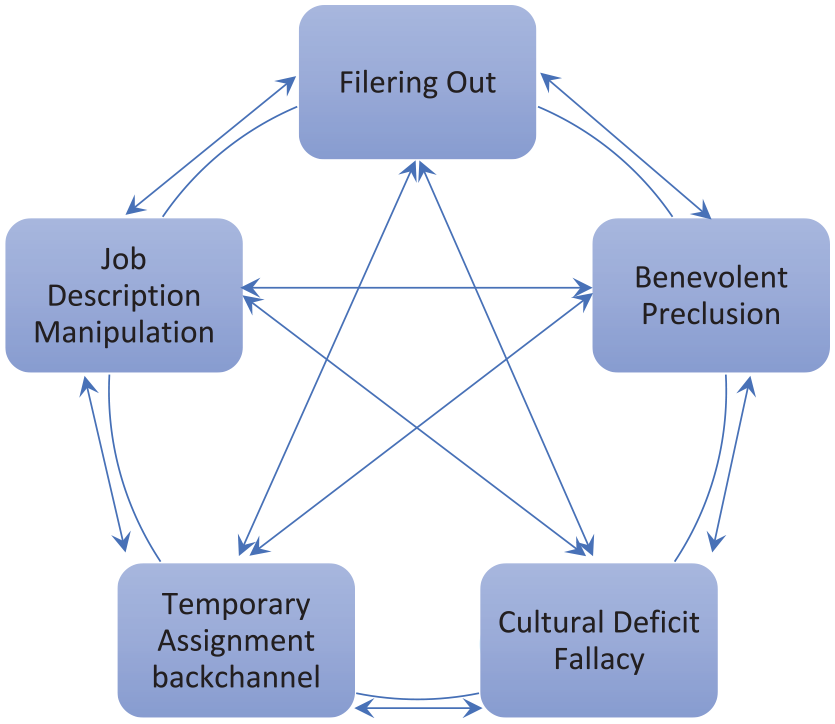
Sub-processes of privation mechanisms used to sabotage the inclusion of racialized in promotional and career advancement opportunities.
Implications for Research and Practice
Building upon previous scholarship on employment discrimination in Canada (Al-Waqfi & Jain, 2008; Bernhardt, 2015; Block et al., 2019; Cheung, 2008; Das Gupta, 2008; Galabuzi, 2008; Ku et al., 2019; Li, 2012; Muñoz, 2016; Teelucksingh & Galabuzi, 2007), this study contributes to the expansion of existing literature on workplace discrimination. It by illustrates the ways in which privation of inclusion operated to oppress racialized bodies in White bureaucratic spaces within the government circle and others closely associated with it. In this context and as far as I am aware, it is the only research that provides an in-depth picture of workplace privation of inclusion, as an apparatus of racial discrimination, in the BC public sector.
It is equally important to bear in mind that major institutions such as government ministries and other publicly funded employers are influential with respect to their impact on society (Anand & Sossin, 2018; Cooper, 2018). This is because they are not only places of employment but are also examples and exemplars of social institutions that “by their [very] nature operate to support the functioning of the society as a whole” (Better, 2008, p. 113). Nevertheless, some of the racist encounters that participants recounted as having experienced in government ministries and publicly funded spheres of employment in BC resembled nothing of the blatant and bigoted forms of historic racisms – e.g., derogatory comments about Chinese-Canadians and disparaging remarks about Arab-Muslims. This was a perplexing finding as it is no longer socially, culturally, politically, and even morally permissible to openly and unequivocally denigrate non-Whites, particularly in professional work environments in these ways (Ku et al., 2019). This is also particularly noteworthy since the majority of Whites have developed the ability to exercise restraint in not making less-than-respectful comments about racialized minorities (Barker, 1981).
This begs the question of how could this prevail in the context of the public sector where, as Anand and Sossin (2018) note, taxpayers’ trust in government largely hinges on the ethical conduct and accountable behavior of the public servants? The answer could lie in the fact that reporting unethical behavior in the public sector is not an easy task (Cooper, 2018). Moreover, biased, denigrating and demeaning perceptions of racialized workers are not always officially acknowledged, particularly when it comes to bureaucratic decisions, as “[c]ulpability and plausible deniability, associated with these mechanisms, have the added benefit of providing a veneer of racial respectability and neutrality” (Coates, 2011c, p. 10). Considering the above, and in the face of near universal rejection of racism as a moral wrong in contemporary times, it is imperative that additional research is conducted to carefully analyze the subtle, complex and implicit patterns and streams that transmit racist outcomes to racialized workers. Additionally, it is hoped that publicly funded employers in BC, and beyond, would use the findings of this research to start a conversation about debilitating challenges that their racialized workers may face in terms of barriers to engaging with career mobility and workplace enjoyments as detailed in this article.
Conclusion
Employment racial discrimination manifested through differential access to work and workplace opportunities is well documented (Block et al., 2019; Das Gupta, 2008; Lopes & Thomas, 2006; Teelucksingh & Galabuzi, 2007). Meanwhile, according to the 2016 census, Canada’s rapidly growing population of racialized minorities continue to face economic inequalities on account of labor market discrimination (Block et al., 2019). However, despite a more active engagement with the workforce, racialized Canadians had an unemployment rate of 9.6% compared to White Canadians who were unemployed at a rate that hovered at around 7.3% (Block et al., 2019). Moreover, racialized women earned 59 cents for every dollar that White men earned, pointing to not only the racialization of employment discrimination but also its gendered basis (Block et al., 2019). The outlook is equally bleak with respect to patterns of wealth gap in areas such as capital gains and investment income (Block et al., 2019).
In discussing the larger implications of workplace racial discrimination on life chances of racialized minorities, Teelucksingh and Galabuzi (2007) argue that the unequal labor market access resulting from the exclusion of racialized Canadians is not only an affront to the liberal democratic principle of equality but also costs the Canadian economy quite significantly in terms of diminished competitiveness and increased poverty levels. These authors also note the dilemma in Canadian public policy spheres that emphasize a more educated and skilled workforce while leaving “historical structures of discrimination in employment” intact such that they continue to impede “the labor market success of the better educated and expanding proportion of the Canadian population that is racialized” (Teelucksingh & Galabuzi, 2007, p. 202). Employment discrimination, therefore, is a dynamic and multidimensional process that is embedded and multiply layered in various societal structures that prevent racialized individuals from full membership in society (Coates, 2011a). It remains “submerged, entangled in the centuries-old tentacles borne of exploitation, extortion, and hyper-oppression” of racialized people (Coates, 2011a, p. 242). Thus, privation of inclusion appears to be the new “racially structured social reality” (Back & Solomos, 1996, p. 6) of work for racialized workers in ways that are actively mediating access to resources and opportunities, including hiring and career advancement prospects.
Findings of this study highlight stealthy mechanisms and surreptitious strategies through which participants were pushed out, thwarted from meaningful and equitable workplace engagement and career advancement. The tactical maneuvers were built into routine discriminatory encounters that were diffused through, and infused in, institutional practices. I have theorized this as the privation of inclusion, encapsulating salient, and intricate mechanisms for stifling the progress of racialized workers in the BC public sector. Effectively, and supporting Essed’s (2007) theory of “racism as a process” (p. 209), privation of inclusion is grounded in processes that undergird lack of meaningful inclusion at work. It unmasks structural apparatuses that “serves to restrict, deny, or otherwise distort the opportunities available” (Coates, 2011b, p. 244) to racialized workers through racist exclusionary practices are embedded in quotidian practices that reinforce the dominance of mainstream Whites.
While days of overt discriminatory practices are over, we now have a situation where occupational hierarchies still remain in place under sanctified and seemingly neutral bureaucratic tactical maneuverings that have no explicit racist intent (Lopes & Thomas, 2006). However, highlighting the continued persistence and proliferation of privation of inclusion of racialized workers ruptures this fallacious notion—the myth that is part and parcel of producing exalted subjects in Canada (Thobani, 2007). Considering the above, and to the extent that privation of inclusion remains a pernicious form of workplace discrimination in other contexts, more attention and research would be needed to expand on the privative practices that are glaringly disparaging in some cases, but are covertly excluding in all cases, racialized individuals from fully participating in workplace opportunities. This attention is particularly warranted in public sector contexts where expectations for modeling equity and just behavior are higher.
Footnotes
Declaration of Conflicting Interests
The author declared no potential conflicts of interest with respect to the research, authorship, and/or publication of this article.
Funding
The author received no financial support for the research, authorship, and/or publication of this article.
