




Abstract
This paper describes indications of goal displacement in regulatory enforcement agencies as reported by enforcement professionals from a range of regulatory domains. The findings suggest that the occurrence of this phenomenon in these agencies may be more prevalent and multifaceted than expected. Among the goal-displacement types reported as most impactful were goal narrowing, induced by calamities, goal diversion through ongoing organizational reform, and goal diversion brought upon by strict regimes of output management. A systematic exploration of these various goal-displacement types as conducted here sheds light onto the intricate nature of goal alignment of these agencies.
Introduction
Goal displacement, which was originally defined by Michels (1911/1949), refers to a broad spectrum of changes of goals in organizations, such as general shifts in goals, and shifts in the relative importance of different goals within an organization are included (Abramson, 2009; Bohte & Meier, 2000). A common characteristic is that the original goals are formally preserved, but the actual goals pursued differ from these original goals. Goal displacement has been demonstrated in widely varying organizational settings, especially in government and semi-government agencies and services (e.g., Abramson, 2009; Bohte & Meier, 2000; Lipset, 1950; Lu et al., 2021; Resh & Marvel, 2012; Selznick, 1949; Uitermark & Loopmans, 2013). 1 Most of these studies highlight the negative impacts of goal displacement on the effectiveness of the organizations concerned. Only a limited number of these studies encompass quantitative analyses of the phenomenon (e.g., Bohte & Meier, 2000; Resh & Marvel, 2012).
In general, organizations with specific, tangible, and focused goals tend to have a limited vulnerability to goal displacement. In contrast, organizations with vague, intangible and abstract goals have been shown vulnerable to this phenomenon (Abramson, 2010; Bohte & Meier, 2000; Warner & Havens, 1968). The goals of many public organizations exhibit these latter characteristics as these organizations are often charged with complex social problems. Consequently, performance in relation to solving or mitigating these problems may prove difficult to evaluate, thereby increasing the risk of goal displacement.
Despite the elevated risk of goal displacement in public agencies, research into this phenomenon has remained very limited as noted by Bohte and Meier (2000, p. 174). Their observation still seems to hold. While a full-text search for “goal displacement” in the period 2001 to 2020 yields over 5,400 hits on Google Scholar, few dedicated studies in public agencies have been conducted (e.g., Resh & Marvel, 2012). Apparently, goal displacement has become something of a general covering term for any movement away from an articulated goal under any circumstances, a “catch-all term.” Moreover, theory building has received relatively little attention and has remained fragmented. These observations may to some extent be explained by the development of a rich literature on specific issues related to ineffectiveness and even counter-productivity of government agencies. For example, the unintended and constitutive effects of performance indicators as used by government agencies have been studied extensively (Dahler-Larsen, 2014; Smith, 1995; Terpstra & Trommel, 2004; Van Thiel & Leeuw, 2003). Another example is provided by the phenomenon of decoupling, specifically, means-end decoupling as described in general terms by Bromley and Powell (2012) and in the case of regulation by De Bree and Stoopendaal (2018).
Considering these and other lines of research describing phenomena negatively influencing effectiveness of public agencies, one might be tempted to ask for the reason to use the concept of goal displacement in the first place. At least two reasons can be given in support of it. Firstly, it could function as an umbrella concept for a variety of phenomena leading to disappointing effectiveness and even counter productiveness, thus allowing for a more systematic approach to analyze such phenomena. More specifically, by taking an integrated view at these various phenomena impeding effectiveness, insights into common underlying causes might be gained, which may also prove helpful in efforts to increase effectiveness. An illustration of this umbrella-function is provided by both lines of research mentioned in the previous paragraph which point out risks of decreased effectiveness that, at a closer look, can also be considered as goal displacement. 2
A second reason pleading for the use of the concept of goal displacement is that it directly relates to the very reason of being of organizations, which is to achieve specified goals. Displacements from these goals will generally seriously impair effectiveness and as such may have grave consequences. For example, Blewett and O’Keeffe (2011) describe how goal displacement lead to an explosion at a large gas plant in Victoria, Australia taking the lives of two workers. A subsequent investigation concluded that the development and maintenance of the occupational health and safety management system had to a large extent diverted attention from what was actually happening in the practical functioning of the plant.
Elsewhere, a basic framework of goal displacement in regulatory enforcement agencies has been proposed encompassing multiple goal-displacement types. Using this framework, a variety of indications of goal displacement were extracted from the regulatory literature (Huizinga & De Bree, 2017). In addition, the vulnerability to goal displacement of these agencies was related to multiple goal ambiguities that characterize regulatory enforcement goals (Huizinga & De Bree, 2021). This relation suggests that the risk of goal displacement is deeply ingrained in these agencies. As such it may be more prevalent than expected since regulatory enforcement goals are generally considered as relatively robust and straightforward and therefore not prone to displacements of any sorts.
In this research, an exploratory approach was taken, probing into widely varying regulatory domains, focusing on agencies exclusively entrusted with enforcement and on the enforcement activities of agencies entrusted with several phases of the regulatory process, such as rule-making, enforcement, and evaluation. The intention was not to obtain a detailed, exhaustive profile of goal-displacement types influencing each of the agencies included. Rather, it was strived to draw a first, sketchy picture of potential goal-displacement vulnerabilities of regulatory enforcement agencies as perceived by enforcement professionals themselves. The underlying research questions are as follows. First, do regulatory enforcement professionals observe phenomena within their agencies that could be characterized as goal displacement? Second, if so, what sort of displacements do they observe and what major determinants of these displacements do they identify?
Conceptual Framework
The conceptual framework guiding this research consists of a number of distinct types of goal displacement that are characterized by two components, specifically the modality and the form of goal displacement. The first component specifies what constituent or aspect of the goal is actually being displaced. Three modalities of goal displacement are distinguished, corresponding to three processes underlying enforcement processes. The first modality relates to the process of scope selection. It refers to situations in which the scope of enforcement activities actually conducted by the agency deviates significantly from a scope selection based on an adequate risk analysis. The second modality relates to the process of compliance perception. It refers to situations in which compliance perceptions held by the enforcers regarding regulatory requirements deviate significantly from the intentions of the regulator that drafted those requirements. The third modality relates to the process of means determination. It refers to displacements of goals by means, where means can be decomposed into input (personnel, resources, strategies), throughput (enforcement processes and procedures) and output (the direct results of enforcement activities) (Huizinga & De Bree, 2017, 2021).
The second component characterizing goal displacement specifies how the goals are being displaced, that is, what form of displacement takes place outwardly. Three base types of how goals can be displaced are distinguished. These are goal narrowing, goal widening and goal diversion (Huizinga & De Bree, 2017). Goal narrowing refers to a situation in which the original goal is no longer completely comprised, that is, the goal has shrunk to a part of the original goal. In the case of goal widening, new goal elements are added, while the original goal remains completely comprised. It also includes situations where parts of the original goal that have already been attained, continue to be addressed by the agency. Finally, goal diversion refers to a situation in which the original goal is partly or even fully abandoned in favor of new goal elements. It is important to stress that official modifications of organizational goals, such as new regulations to be covered, are not considered goal displacement.
Combining both components of goal displacement as just described, seven types of goal displacement have been identified as potentially the most relevant. 3 These will be introduced in the Section 3, which describes the indications of the occurrence of each of these types and their main determinants. Although this framework may give the impression of a series of clear-cut goal-displacement types, caution must be exercised because of a paradox inherent to goal-displacement research. As noted in the introduction, organizations charged with intangible, abstract goals may be especially vulnerable to goal displacement. In terms of goal ambiguity, these are goals that are characterized by a considerable degree of evaluative goal ambiguity (Chun & Rainey, 2005; Huizinga & De Bree, 2021). However, that very same ambiguity also blurs the notion of goal displacement since in order to be able to recognize the latter, the original goals as well as the displaced goals must somehow be distinguishable and definable. Obviously, this paradox complicates any elaboration, conceptual or empirical, of goal displacement. 4 A major way to deal with this paradox, in the author’s view, is to identify situations that unequivocally reflect displaced goals, that is, situations in which the goals actually strived for clearly transgress the leeway inherent to ambiguous goals. This notion has guided the empirical investigations described below. This issue will be revisited in the discussion section.
Methodology
Regulatory Enforcement Domains Considered
In order to cover all major regulatory domains, a rough classification of regulatory domains was first devised. This classification encompasses the following 10 domains: Physical Environment and Major Hazards 5 ; Food and Consumer Products; Occupational Health and Safety; Transport and (Digital) Infrastructure; Building and Built Environment; Education; Health and Youth Care; Justice and Security; Finance; and Mining. While it is clear that other classifications are possible, this classification is deemed useful for the exploratory aims of this investigation. First, these domains cover a considerable array of public interests and therefore represent a large share of total enforcement capacity available. For the Netherlands, it is estimated that, together, these domains cover more than 90% of total enforcement capacity. Second, the classification reflects, although in a coarse way, the degree of variation of regulatory enforcement goals, which may be an important determinant in terms of goal-displacement vulnerability.
Interview Sample and Procedure
A series of face-to face interviews was conducted with enforcement professionals covering the 10 regulatory domains mentioned above. Interviewing was deemed the most appropriate qualitative research method. Of specific importance is the potential richness of information uncovered by interviews as compared to questionnaires or observation. Additional benefits are the opportunity to ensure, during interviews, mutual understanding by rephrasing and simplifying by the interviewer, and its flexibility to elaborate issues of specific interest in more detail (Alshenqeeti, 2014).
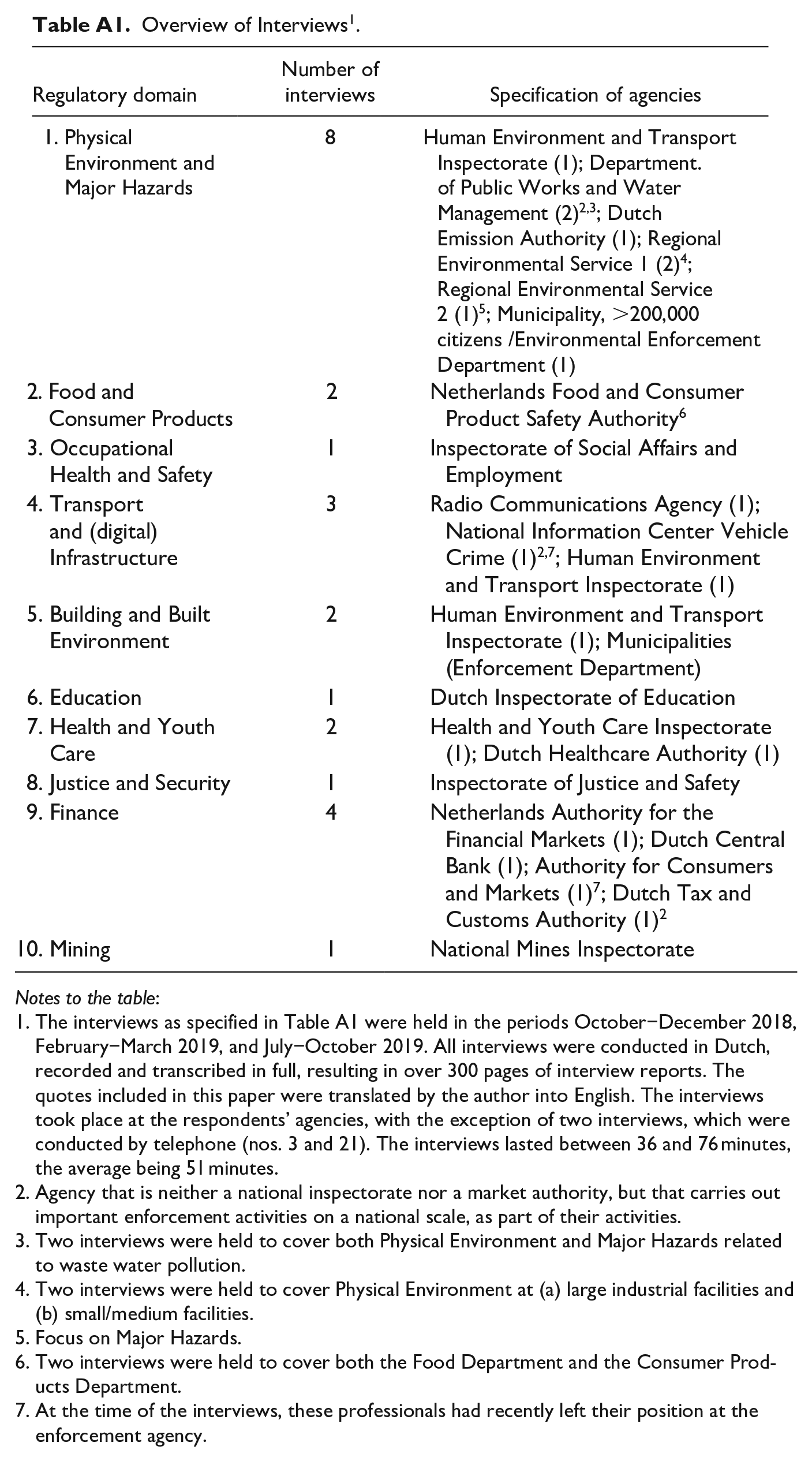
A total number of 25 interviews were held at 20 national, regional and local enforcement agencies. An overview of the agencies selected is provided in the Appendix. Four regulatory domains, specifically Physical Environment and Major Hazards, Transports and (Digital) Infrastructure, Building and Built Environment, and Finance cover about two thirds of the interviews, reflecting the number of agencies in these domains and the density of regulations. On a national level, 20 interviews were held at 16 agencies. These include the eight national inspectorates and five market authorities deemed most important by Mertens et al. (2015) in their overview of enforcement agencies in the Netherlands.6,7 On a regional and local level, five interviews were held at four agencies. The reason for this limited number is that regional and local enforcement agencies predominantly cover two regulatory domains, specifically Physical Environment and Major Hazards and Building and Built Environment.
The selection of individual participants within each agency conformed to a pattern of convenience and snowball sampling. While a certain bias cannot be ruled out, this risk has been limited by the following measures. First, participants were selected from three main categories of employers, field enforcers, middle managers and internal advisors such as legal advisors, strategic advisors and planning officers. These three categories are approximately equally represented in the sample. Second, as described above, respondents were selected from 25 unique agency/regulatory (sub)domain combinations reflecting 25 different enforcement contexts.
All interviews were semi-structured in character, consisting of four main topics. Firstly, the respondents were asked to shortly describe their professional careers in enforcement, including the agencies they had been employed at, the positions held, including the current one, and their professional specializations. This served to make the respondents comfortable and open-minded for the rest of the interview and provided information that could be referred to later in the interview to specify and concretize questions. Secondly, respondents were asked to describe the goal of their agency or, in the case where enforcement activities constituted only a part of the agency’s activities, the goal of its enforcement activities. This topic served to facilitate the transition to goal displacement and to provide useful information to ask specific questions concerning goal displacement. Thirdly, respondents were asked about goal displacement within their agencies. The backbone of these questions was the conceptual framework, as elaborated in Section 2, but in a prudent, inexplicit way (see next subsection). Finally, respondents were asked to identify, if any, organizational developments not discussed up to that point in the interview, which were considered worrisome in terms of the agency’s functioning, its effectiveness or specifically as another form of goal displacement.
Validity of the Data on Goal Displacement
Important questions referring to the validity of the data as collected in this study refer to whether the goal displacement reported here actually happened, whether accounts of goal displacement were accurate and whether all goal-displacement types that were actually present were observed. These questions relate to descriptive validity, which refers to the factual accuracy of the account as reported by the researchers (Johnson, 1997, p. 286). Of particular importance in this study is the potential sensitivity of the subject. More specifically, a general willingness of enforcement professionals to freely discuss the topic of goal displacement at an organizational level, as expressed in contacts prior to the interviews, did not guarantee that they would actually freely discuss the potentially sensitive issues as raised during the interview. Therefore, precautions were taken prior to and during the interviews. Prior to the interviews, following the first contact with the candidates, written information explaining the research goal, including general information on the subject of goal displacement, and the guarantee of anonymous handling of the findings, was sent to these potential respondents. In addition, before actually starting the interviews, both previous points were again emphasized.
During the interviews, the interviewer did not explicitly “process” through the typology of goal displacement guiding this research, as it was deemed desirable to prevent any impression of an interrogation intended to identify organizational shortcomings or even stymy these agencies. Instead, the interviewer only sparsely mentioned the word goal displacement or the specific types such as goal narrowing. By stimulating the interviewees to elaborate on examples considered by the interviewer as specific and concrete cases of goal displacement, it was intended to tap into their professional commitment to high-quality enforcement and the specific barriers as perceived by the respondents to realize that goal. Interestingly, quite a few respondents used the researcher to unsolicitedly raise concerns of organizational goal displacement, which suggests that they did not conceal perceived goal-displacement types from the researcher. Thus, these measures contributed to make respondents comfortable to freely reflect on the issues raised by the interviewer.
In addition to descriptive validity, it was important to ensure that participants interpret phenomena in their agencies as goal displacement and that it is not a researcher-imposed label. This issue relates to interpretative validity which refers to the degree to which the research participants’ viewpoints, thoughts, feelings, intentions, and interpretations are accurately understood by the researcher and portrayed in the research report (Johnson, 1997). In order to increase interpretative validity, the use of low inference descriptors was applied as the exact words of participants are provided in many, direct quotations. Moreover, versions of the draft report were reviewed by a panel of enforcement experts. The connection between quotes and goal-displacement types was a focal point of the review-panel.
Data Analysis
Based on a preparatory reading of the interview transcripts, a basic coding set was developed, based on the goal displacement types described by Huizinga and De Bree (2017). In the second step of the analysis, codes were assigned throughout the transcripts. 8 In the third step, additional codes were assigned, specifically codes assigning goal-displacement types and contributing factors not contained in the framework. Finally, all transcripts were re-analyzed to collect all other information deemed relevant to the research questions. This information included specific enforcement challenges and dilemmas, such as optimum strategies to mitigate goal displacement, specifically the task to stay on course despite intense stakeholder pressures, and optimum strategies to adapt the course in response to rapid changes within regulatory enforcement domains without neglecting successful traditional approaches.
Findings
Overview
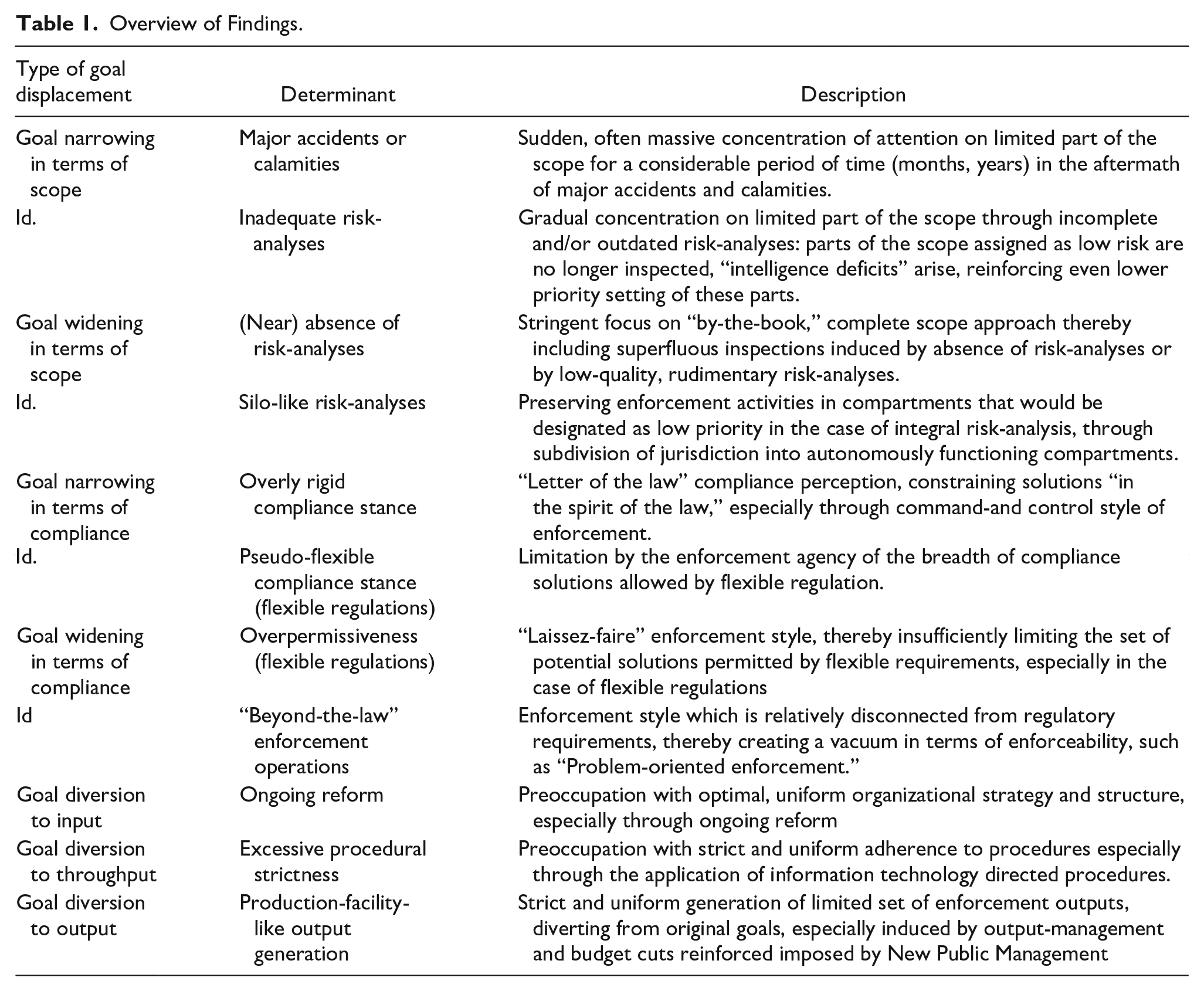
An overview of the findings is provided in Table 1. For each of the goal-displacement types observed (first column), one or more determinants were identified (second column). In the following subsections, the indications for the occurrence of these types and their determinants are discussed in detail.
Overview of Findings.
Goal Narrowing and Widening in Terms of Scope
Goal narrowing in terms of scope
Goal narrowing in terms of scope refers to an underinclusive coverage of tasks within the jurisdiction of the agency, that is, a neglect of tasks deemed significant in terms of risks. The interview data provided strong indications for the occurrence of this goal-displacement type originating from two distinct determinants. The first is the occurrence of major accidents and calamities related to the jurisdiction of the agency. These events may lead to a sudden, often massive concentration of attention on a limited part of the scope for a considerable period of time, that is, many months or even years. Their relevance in generating a narrowing in the scope was reported by practically all respondents. These negative events, in their view, almost inevitably lead to a sudden contraction of capacity toward enforcement activities related to that specific event and the task to prevent comparable events, a phenomenon described in the literature (Carrigan & Coglianese, 2012). This contraction leads to a risk of the neglect of other relevant parts of the regulatory domain and therefore goal narrowing in terms of scope. In the majority of the interviews, covering all regulatory domains, this risk was recognized as being very relevant. However, the degree of accident sensitivity of agencies appears to be higher for regulatory domains that cover highly salient risks such as food safety, health and youth care, major hazards, and building.
Especially impactful consequences were reported for two major agencies, reflecting two distinct patterns, specifically consecutive contractions and single, long-lasting contractions. First, the Dutch Food and Consumer Products Authority has dealt with various calamities with nationwide repercussions in the past decade, such as a horse-meat scandal and an eggs-contamination calamity. Reflecting on the impact of the latter, a senior enforcer states: “[I]f you then reconsider what we had planned to do this year, well, with this type of big crisis that impacts on all fronts, not much could withstand it.” This quote illustrates that the annual program was largely abandoned in favor of enforcement activities related to the calamity. As this agency was plagued by impactful calamities during a considerable number of consecutive years, the scope of activities appear to have been significantly narrowed each year.
Second, the Health and Youth Care Inspectorate specifically illustrates how one grave accident may narrow the scope of activities for many years. The accident concerned a fatal mistreatment of a young infant by its parents in the year 2004, leading to a nationwide outpouring. This lead to an incisive change of the course of the agency as a senior advisor explains: A part of what you expected to do, you have to put that aside for a while. That’s the short-term effect, but in the long run you see another effect . . . . That issue of safety in such situations has deeply influenced the way we think, the way we program, you name it . . . . So we could change things there. But ever since that time, we almost exclusively focused on that issue. . . . You start wondering, what’s the situation in terms of the quality of care?
According to this respondent, the issue of safety structurally displaced broader issues of quality. The narrowing effect induced by this accident still endured 15 years after the accident.
Obviously, major accidents and calamities may point at “blind spots” in goal perception, enabling the agency to perform enforcement activities filling in those spots and consequently become better aligned with the organizational goals. However, in these examples this re-alignment was completely overshadowed by an enduring, structural narrowing of the scope.
The second determinant of goal narrowing in terms of scope emerging from the interviews was the use of inadequate risk-analyses. In contrast to the examples just provided reflecting a very sudden narrowing of the scope, inadequate risk-analyses may lead to a gradual shift toward a part of the scope, leading to the neglect of other parts of the regulatory domain. Obviously risk-analysis based enforcement may have the advantage of focusing attention on the potentially most harmful topics. However, when not properly updated and covering the complete mandate, risk-analysis based enforcement may lead to byopia. More specifically, an unjustifiable neglect of other parts of the regulatory domain and therefore goal narrowing in terms of scope may be introduced. This narrowing mechanism was described in general terms by a senior advisor of the Food and Consumer Products Authority as follows: [S]omething that bothers me, which may be related to [goal] narrowing . . . is that you intentionally allocate your capacity where you expect the biggest problems, it’s where the benefits in terms of risk reduction are maximal. A consequence may also be that you definitely no longer have a realistic picture of how things really are in terms of overall compliance, because you have ended all random monitoring.
This respondent describes the danger that by a risk analysis based focus on the “biggest problems,” other areas within the jurisdiction may become underexposed. As parts of the scope assigned as low risk are no longer inspected or with a much lower frequency, the agency may gradually lose sight of these parts. This effect was termed “intelligence deficit” by Tombs and Whyte (2013). Because of these “intelligence deficits” significant changes in risk in these areas may be completely missed. More specifically, the input of refreshed risk analyses tend to become dominated by the activities related to the high-risk areas. In contrast, no or few input is available concerning the low-risk areas, reinforcing even lower priority setting of these parts. Thus, risk analyses may lead enforcement agencies to gradually become, in a self-strengthening way, locked-in into a limited part of the jurisdiction, unless, as the enforcer above points out, some “random monitoring” of these low-risk areas is put in place.
Especially likely may be a “locking-in” on short-term risks at the expense of long-term risks. The former are usually more salient, often coinciding with those included in the risk analyses of regulated organizations as these are of vital importance to the continuity of their operations and to their profitability prospects, such as safety issues. In contrast, long-term risks may be largely invisible over many years. However, they may reflect important public risks, such as long-term health effects or earthquakes after many years of mining activities. A senior advisor acknowledged the relevance of this phenomenon, although as something of the past: What I see is that the way the companies think, that way of thinking was present within [name of the agency]. It’s not that you were captured, but the company perspective was really internalized in [name of the agency]. And therefore, the inspectors don’t see these [long term] risks, don’t see their role therein, don’t see what position they should take to change things.
In this example, the inspectors tended to focus on short-term operational risks of activities and neglect the long-term, public risks. They were locked-in into a specific set of risks as they were focused on short-term risks. The inspections focusing on these risks provided input for future risk-analyses, guaranteeing a dominant position in new annual programs, whereas the absence of long-term issues in inspections only reinforced their absence in future inspections. It should be noted that this example can also be considered an example of regulatory “capture” (Gunningham, 2011; Oded, 2013).
Goal widening in terms of scope
Goal widening in terms of scope refers to an overinclusive coverage of tasks within jurisdiction, that is, carrying out inspections that, from a perspective of risks, are superfluous.
Although indications pointing at two distinct determinants emerged from the interviews, these were provided only by a limited number of respondents. Moreover, these indications only indirectly related to goal widening. The first determinant, the (near) absence of risk-analyses, leads enforcement agencies to cover, more or less systematically, the whole mandate inspecting all regulated organizations and including all regulations within the mandate. In such an undifferentiated approach, the possibility of over inclusiveness in terms of scope may be considerable, as for example, pointed out by Bardach and Kagan (1982/2010). The danger of superfluous inspections was raised, although only indirectly, by respondents from regional agencies lacking a risk-based approach.
The second determinant, the presence of silo-like risk-analyses, refers to a non-integrated approach to risk analysis. More specifically, priority setting is based on separate risk analyses within limits of specific programs, subdivisions or other types of silos within the agency, but these are not subjected to an overall prioritization of risks. This may lead to goal widening as low-risk areas may be “shielded,” that is continue to be allocated capacity for the very reason that they are covered by separate entities within the agency. This silo-like approach to risk-analyses was mainly reported by respondents from large national agencies usually covering multiple regulatory (sub)domains or “mini-inspectorates.” They indicate that the lacking integral perspective may have the result of overexposure of some of the public interests covered.
Goal Narrowing and Widening in Terms of Compliance
Goal narrowing in terms of compliance
Goal narrowing in terms of compliance refers to an underinclusive interpretation of compliance with regulatory requirements, that is, a highly inflexible interpretational stance severely limiting optimal compliance solutions. The interview data provided indications for two determinants of goal narrowing in terms of scope. The first determinant, an overly rigid compliance stance, is characterized by a “letter of the law” approach of regulatory requirements, also called a “by-the-book” approach. When such a compliance stance dominates the agency, as may be the case when a command-and-control style of enforcement is exerted, solutions “in the spirit of the law” are constrained. Although in the Netherlands, flexible regulation is gradually becoming more important, especially on a national scale (see also 3.3.2), this does not mean that a classical, “by-the-book” interpretation of regulatory requirements is something of the past.
9
The interviews provided clear indications countering this latter assumption. For example, the respondents working at the Human Environment and Transports Inspectorate clearly pointed out that this phenomenon had been dominating the agency for a number of years. Within a short period of time, a top manager, who was a clear supporter of this enforcement stance, succeeded in adopting this compliance perception throughout the agency. As one former middle manager at this agency reported: During the time [name of the top manager] was in charge, things were completely reduced to [by-the-book] compliance . . . . and you were not allowed to think further than compliance. So, during that time the credo really was: those laws are someone else’s responsibility, you must take for granted they are good and that the goal is achieved when they are complied with. Well, that’s a complete reduction.
This quote reflects the respondent’s conviction that a strict, “by-the-book” approach to compliance implies a reduced, narrowed view of the ultimate goals as aimed for by the regulators, as described in the literature (Bardach & Kagan, 1982/2010; Gunningham, 2011; Oded, 2013; Tyler, 2011).
More structural trends toward a classical “by-the-book” compliance perception were reported by respondents of regional and local enforcement agencies. Interestingly, these are reinforced by the increased use of modern techniques, specifically the use of digital checklists during inspections. As one senior enforcer from a Regional Environmental Service puts it: It’s much easier with a checklist (pause) and this is it, this is our enforcement strategy. From a perspective of enforcement, it is a more comfortable position, it’s just black and white. But what do you achieve with it? The underlying goal? I really doubt it.
This respondent explains how these digital checklists on the one hand facilitate enforcement professionals, but on the other hand force them to a strict adherence to the actions and interpretations prescribed by those checklists, inevitably bringing about a rigidity in terms of compliance perception ultimately leading to goal narrowing. Another risk associated with the trend of using checklists, which will be discussed below in more detail, is that the procedures become goals in themselves (see 4.4.2).
A second determinant potentially inducing goal narrowing in terms of compliance as forwarded by several respondents is a pseudo-flexible compliance stance in the case of flexible regulations. It refers to a situation in which the enforcement agency limits the breadth of compliance solutions allowed by flexible regulations. The general mechanism that can be observed in these cases is that the leeway for the regulated organizations to find optimum solutions for compliance, as provided by these regulations, is severely reduced in the enforcement practice, potentially resulting in goal narrowing in terms of compliance. A first example was reported by a senior advisor of municipalities in relation to housing and facility building regulations, a regulatory subdomain characterized by a relatively flexible framework of regulations: It’s just striking how it is almost an institutionalized form of goal displacement how these building regulations function . . . . So the regulator states, the Building Decree states, we have a functional requirement that expresses a goal and we give one example of a solution that is indisputable. That’s the intention but the focus is laid on that specific example.
This quote points out the pervasiveness, as perceived by this respondent, of the phenomenon that specific examples as included in these regulations tend to displace the flexible requirements themselves. It is interesting to note that this tendency, according to this respondent, is embraced by both enforcers and regulated organizations in order to save time and costs. As such, it reflects a risk-evasive attitude on both sides.
A second example of goal narrowing in enforcing flexible regulations was provided by a respondent from the Health Care Authority. The Health Care Authority was asked by the Minister of Health Care to develop a more horizontal, collaborative way of supervision as a part of a larger strategy to supervise good governance of health-care providers. This transition appeared to be difficult to realize, as described ironically by the respondent of this agency: So, if we start a conversation, we don’t start that conversation to hear what someone else thinks about the matter, but instead we start the conversation to hear that the other thinks about it just the way we think about it. And of course they do not. But that’s no reason for us to reconsider the situation from another perspective. It is a reason for us to say they don’t understand.
This quote clearly illustrates that, according to this respondent, the intended horizontal, collaborative supervision approach failed. Instead, a traditional vertical, prescriptive stance, which clearly prevents any open exchange of views as originally intended by the assignment, is taken. Obviously, this may severely limit the set of potential measures and actions to tackle the problems discussed. In a real collaborative approach, a wider set of options will generally be negotiated.
Goal widening in terms of compliance
Goal widening in terms of compliance refers to an overinclusive interpretation of compliance with regulatory requirements, that is, a highly flexible interpretational stance insufficiently limiting optimal compliance solutions. The interview data provided indications for two determinants of goal widening in terms of compliance. The first, over permissiveness in the case of flexible regulations, refers to a “laissez-faire” enforcement style, thereby insufficiently limiting the set of potential solutions permitted by flexible requirements. This enforcement style therefore leads to a risk of goal widening in terms of compliance. From the interviews it became apparent that in practically all regulatory domains developments of flexible regulation and/or flexible enforcement had been developed or were being developed. Although many respondents recognized the risk of goal widening associated to flexible regulations, they were confident that specific measures would successfully prevent this goal-displacement type from occurring. Such measures include training, inspecting in teams, discussing findings and proposed enforcement procedures within the team and colleagues outside the team, submitting enforcement cases to the (top) management, and separating inspections from enforcement procedures in terms of personnel involved.
However, despite this general confidence to successfully limit this risk associated with flexible regulations, examples of failure were reported, sometimes within other contexts, during the interviews. For example, at the Inspectorate of Human Environment and Transport, flexibility associated with a system of private oversight failed spectacularly and publicly in the case of the admission of a new series of trains. As these trains were plagued by incessant malfunctioning, the admission was retrieved. In the public hearings following this deception, it became clear that the inspectorate had given free rein to private oversight in this case and had neglected the oversight of certification bodies. Consequently, corrective measures had to be taken, as described by a senior advisor: When you consider what the consequence has been, it is that an enormous pressure was built up concerning the way we deal with certification bodies . . . . It led us to invest very much energy, including actual oversight of those certification bodies, all of them (emphasis added).
This quote shows that the agency had to recalibrate its goals related to railroad traffic, specifically guaranteeing the admission of safe and well-functioning trains to the railroads in the Netherlands. Due to the near-absence of oversight by the inspectorate of the private oversight system, these goals had gradually been widened as a clear dividing line between compliance and noncompliance had disappeared. Comparable risks associated with private oversight have been described in the literature (Bennear & Coglianese, 2012; May, 2003; Short & Toffel, 2010).
The second determinant of goal widening in terms of compliance emerging from the interviews is the occurrence of “beyond-the-law” enforcement operations. It refers to an enforcement style which is relatively disconnected from regulatory requirements, thereby creating a vacuum in terms of enforceability, such as “problem-oriented enforcement” (Sparrow, 2000). As the latter term suggests, agencies working alongside this policy claim to be primarily focused on problems, that is, to solve problems in their domains, whether backed up by relevant regulations or in the absence of such regulations. An illustration of the risk associated with the latter provides the problem-oriented approach adopted by the Authority of Financial Markets (AFM) to the so-called “Woekerpolis affair,” concerning the sale of insurance policies with excessive charges, affecting about 50,000 consumers in the Netherlands. A problem-solving strategy was agreed on, termed “activating the customer,” that is, by encouraging financial companies and affected consumers to settle their disputes. The shortcomings of this activation approach were described by a former middle manager as follows: But we lacked the jurisdiction to do that. Yes, we couldn’t force the suppliers to approach the people, couldn’t force the people to do that. Then you can only use soft powers and customer interest, public pressure, and let’s say the whole informal enforcement apparatus of AFM. But that meant things changed only very slowly and very gradually.
What this quote demonstrates is that if no regulatory requirements can be applied to the problems, answering the question of what full compliant behavior looks like tends to become fuzzy. In the absence of enforceable regulations, regulated organizations may embrace the goal as set by the agency, but they may also set their own goals, which may fall short in the eyes of the agency. In this way a variety of goals may be observed among regulated organizations, that is, the goal has widened.
A second example was provided by an enforcement professional from the Authority of Consumers and Markets, relating to a period in which the agency followed a clear problem-oriented approach focusing on “chances and choices for consumers and markets.” This approach was heavily criticized in a newspaper article in the year 2015 entitled: “Fines? We prefer to have a face-to-face conversation first,” which may have contributed to its demise. A downward trend in terms of the rating in global competitiveness of regions was seen in this period as a junior enforcer from this authority remembers: I think that in those years, as we were having that mission . . . our score went down in comparison to other countries . . . . Thus, in that period we went from a five-star authority to four, three and a half and three or something like that.
This quote illustrates how the agency, through adapting this problem-oriented approach, gradually became less effective. Its efforts to solve problems without the use of regulatory requirements, but by means of dialog, widened the goals in terms of compliance, as, similarly to the previous example, regulated organizations may stick to their specific goal perception without risking an impactful enforcement procedure by the agency.
Goal Diversion to Means
Goal diversion to input
Goal diversion to input, refers to the phenomenon whereby basic aspects of enforcement activities, such as general strategies and techniques applied by the agency, lose their goal-subordinate position by becoming goals in themselves. Strong indications of this goal-displacement type were observed in relation to ongoing organizational reform within the agencies that was consistently linked to a preoccupation of top management with optimal, uniform organizational strategy and structure. The issue of organizational reform was raised by respondents in almost all interviews, and related to both mergers of enforcement agencies and internal reforms. Both types of reform could be very consequential in terms of working methods, enforcement style, work culture, repositioning all employers and many other aspects, that is, involving complete organizational overhauls.
Although the official motive behind both types of reforms is to optimize the enforcement strategies to create more efficient and effective enforcement agencies, some respondents were highly critical of these reforms. As one senior enforcer from the Food and Consumer Products Authority describes it: I have worked quite a long time here, I had 5 reforms . . . and every 5 years I have one, and by the time you approach that fifth year, in the fourth or fifth year—that is, by the time that the reform really starts to bear fruit and you are really reconnected to each other and you really get going, then, once more—we had it just the other day—and yes, things change rigorously and yes, another search starts.
A senior enforcer from the Human Environment and Transports Inspectorate concisely puts it as follows: “We never achieve a situation of equilibrium anymore. The dust never settles.”
Both quotes illustrate the high frequency of reforms, their duration and especially the extent to which they structurally divert from the original goals of the agency. The phenomenon of ongoing reform has been described in the literature in relation to the decoupling of means and goals (Bromley & Powell, 2012; De Bree & Stoopendaal, 2018). Additional factors diverting attention away from the restructuring activities themselves, are, as reported by these respondents, feelings of anxiety among personnel and even apathy.
The real reason behind these reforms as perceived by the enforcer just quoted is as follows: [E]very three years there’s a new goal and we have to. . . . But actually there is not a new goal or so. You know, our reason for being is still the same, to put it that way . . . . We’re in the midst of a reform now; our general manager is 62 years old, well, he will very probably leave within two years. A new general manager comes, a new reform will start. And if not, we’ll get a new administration and we’ll have a reform anyway.
According to this respondent, reforms as such primarily seem to function as actions initiated by managers and politicians to show strength and leadership. This indicates that strategy development and the accompanying organizational reforms have to a significant extent become autonomous, a goal in itself.
Goal diversion to throughput
Goal diversion to throughput refers to the phenomenon that guidelines for enforcement operations and practices, such as enforcement procedures and processes, become goals themselves. Emerging from several interviews were indications of the dominance within the agency of a strict and uniform adherence to procedures. Interestingly, the examples provided do not confirm the picture of classical bureaucracies demanding employers to strictly follow procedures (Wilson, 1989), also referred to as over-formalization (Van der Walle, 2014). Instead, the examples provided relate to modernizing tendencies of enforcement agencies, specifically information technology systems. Central to these tendencies are techniques and tools that are supposed to increase the efficiency and effectiveness of enforcement agencies but to become autonomous (Perez, 2014). The trend of using digital checklists to prepare, execute, and process the results of inspections was predominantly reported by respondents working at regional or local agencies in the domain of Physical Environment. The major benefits mentioned were an increased transparency and equity of inspections, a better accountability and increased precision and completeness of inspection. The respondents showed considerable differences in terms of perceived risks of using these checklists. Whereas two respondents were convinced this was a true improvement, another respondent was critical: And I think checklists are very useful tools, but you must not visit a general site manager of [name of multinational company], take your iPad and fill out a checklist. That’s a bit missing the point, I guess. It’s fine to have it at your disposal (pause) and there’s where you see a very big displacement. Now it’s just, you’re on your way, fill out that checklist and you have finished another inspection.
What this quote illustrates is that whereas checklists might be helpful in the case of small, homogeneous sectors of regulated organizations and relatively straightforward regulatory requirements according to this respondents, enforcers should be very reluctant to use them in the case of complex regulated organizations that have to comply with complex regulations. In the eyes of this respondent, the tool has become a goal in itself.
Goal diversion to output
Goal diversion to output refers to the phenomenon of products of enforcement, such as the number of inspections or violations detected becoming goals in themselves. The indications collected pointing at this goal-displacement type all relate to a strict and uniform generation of a limited set of enforcement outputs. Strong indications of this phenomenon were reported by enforcement professionals from the subdomain of Physical Environment, among others the Department of Public Works and Water Management and Regional Environmental Services. The main output used in these agencies is the number of inspections, usually specified in advance in annual programs. The resulting goal diversion is described as follows by one respondent: It becomes very instrumental . . . . They play tricks to comply with the performance indicators as set. And nobody cares about the quality of the inspections. And all creativity of enforcement professionals is pushed out—you make a machine of them.
A senior enforcer from an Regional Environmental Service describes this phenomenon this way: I for myself think that the numbers are becoming the main drivers. And not what actually lies behind these numbers, the ultimate goal you mentioned, I don’t know if that’s any longer an issue in inspection conversations, no.
Comparable autonomizing tendencies generated by a strong focus on quantitative indicators in organizations have been described in the literature (Dahler-Larsen, 2014; Perrin, 1998; Smith, 1995; Terpstra & Trommel, 2004; Van Thiel & Leeuw, 2003).
On a more fundamental level, most respondents recognized the complex relationship between outputs and outcomes in the case of regulatory enforcement. As a senior advisor from the domain of Education points out in relation to the outcomes the inspectorate focuses on: Therefore, the moment you can easily calculate it, or something is easily calculable or SMART, well you might say SMART is already a form of goal displacement . . . . [T]he less testable in quantitative terms, the greater the risk of displacement.
This quote shows the respondent’s perception of the general risk of goal diversion associated with the use of—and especially the overreliance on—simple outputs, detaching outputs from outcomes resulting from a production-like, strict output management approach.
Discussion
This research has generated indications for the actual occurrence of an array of goal-displacement types within Dutch regulatory enforcement agencies. Moreover, for each of these goal-displacement types one or more determinants have been identified. Among these determinants, a few stand out from the others as they may infer exceptionally high degrees of goal displacement. For example, large accidents and calamities in the regulatory domain of the agency appear to be powerful generators of enduring goal narrowing in terms of scope in a number of domains. Another example is the widespread phenomenon of ongoing reform at enforcement agencies leading to goal diversion to input. Finally, strict regimes of output management appear to infer high degrees of goal diversion to output. A visual overview of the various types of goal displacement emerging from this study are shown in Figure 1.
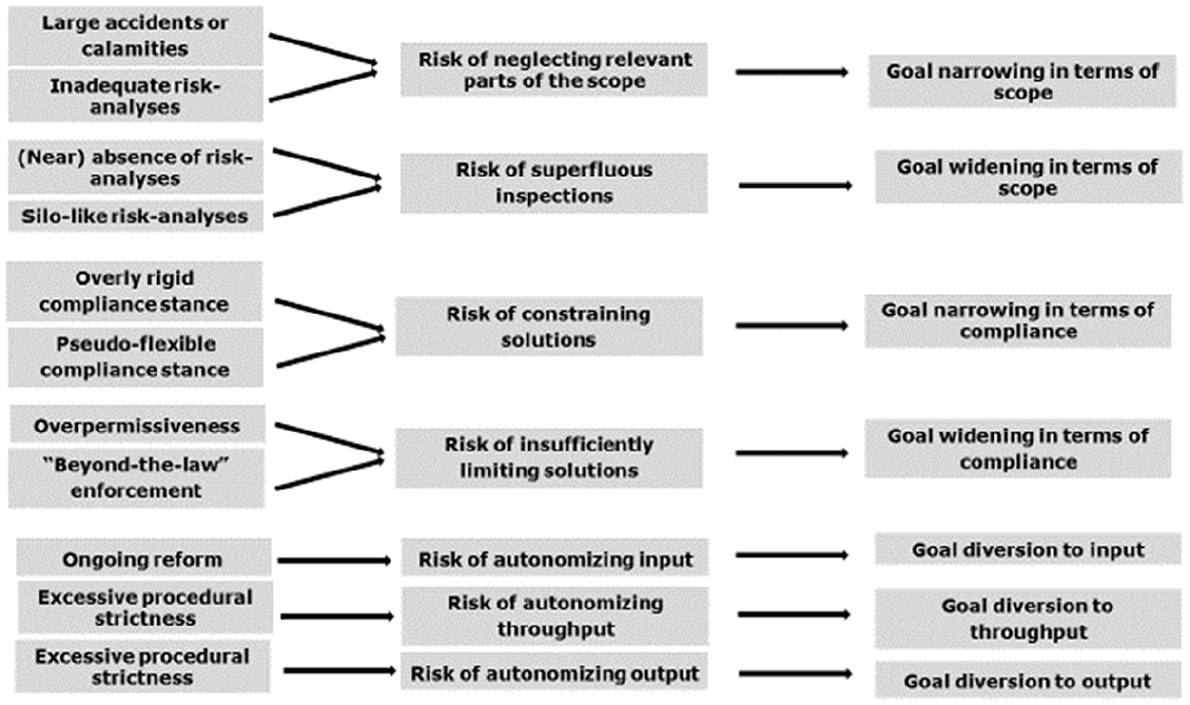
Schematic overview of goal-displacement types and their main determinants emerging from this research.
It is important to note that the dividing lines between situations of goal displacement and goal alignment may not be as clear cut as depicted in Table 1 and Figure 1. Context matters a lot. For example, in the case of a specific group of regulated organizations persistently resisting compliance, an optimum goal alignment may be a “by-the-book,” command and control approach as the latter may be the only effective option left for the agency to move these resistant organizations toward compliance. Moreover, contexts may significantly change over time, requiring adjustments in terms of optimal goal alignment. For example, if the resistant regulated organizations just mentioned decide to give up their course of resistance and achieve significantly higher levels of compliance, a “by-the-book,” command and control approach will no longer represent an optimal goal alignment. Instead, an approach allowing site-specific options reflecting the spirit of the law will then be more appropriate. Thus, the balancing act to divert from goal displacement is not a uniform, one-off adjustment, but a case-by-case dynamic process. It reflects the ambiguity inherent to regulatory enforcement goals.
Recently, an explanatory framework for goal displacement in regulatory enforcement agencies based on an analysis of their characteristic ambiguity profile was proposed by Huizinga and De Bree (2021). Taking account of a rich literature on goal ambiguity (e.g., Carrigan, 2012; Chun & Rainey, 2005; Lee et al., 2010; Rainey & Jung, 2015), these scholars point out that these agencies’ goals are characterized by multiple dimensions of goal ambiguity. The authors assert that in particular evaluative goal ambiguity makes the agencies vulnerable to rely on simple indicators and proxies of goal realization, referred to as grip factors (Goal realization Indicators and Proxies). These include major accidents and calamities, the internal organization of agencies and the generation of simple output. However, they may also have the unwanted and often overlooked effect of simplifying the original goals to such extent that the latter can be said to be displaced. The findings of the current research appear to support this explanatory framework. More specifically, the determinants of goal displacement as identified in this research coincide with or can be easily related to the grip factors listed by Huizinga and De Bree (2021). The results indicate that external events, such as calamities or election cycles or internal events such as executive turnover may lead to far-reaching changes in the scope of activities, the internal organization, or both. Such changes may induce substantial goal displacement, as this research indicates. Apparently, goal alignment in regulatory enforcement agencies is less robust than often assumed. The results confirm that goal displacement and goal ambiguity may be valuable concepts to advance the understanding of regulatory enforcement effectiveness.
Conclusions and Implications
The main conclusion of this research is that goal displacement in regulatory enforcement appears to be a real risk. Its multifaceted forms of expression may substantially and enduringly affect these agencies and thereby impair effectiveness of these agencies. Of special importance is that multiple goal displacement types may simultaneously befall an agency.
The main implication of this research is that a goal displacement perspective may help to explain the intricate nature of effective regulatory enforcement by shedding light onto the multiple pitfalls that must be taken into account in designing and performing enforcement activities that can be said to be goal aligned. Although finding such a balanced approach may not be easy, avoiding situations of pursuing distorted goals, that is, reducing ineffectiveness, may well be a promising avenue to increase effectiveness of regulatory enforcement.
Obviously, as this is one of the first studies to empirically explore goal displacement in regulatory enforcement agencies, a still very incomplete picture of the relevance of this phenomenon in these agencies remains. Important questions pertain to the relevance of the various goal displacement types within widely varying regulatory domains, the actual degrees and endurance of goal displacement, and the possibility of sorts of displacement not yet included. Moreover, specific characteristics of regulatory enforcement agencies, such as the number of enforcement professionals employed, the background and experience of these professionals, specific organizational characteristics or geographic boundaries, were not taken into account. These factors should be considered in future research in order to obtain a more comprehensive view of goal displacement in these agencies.
Footnotes
Appendix
Overview of Interviews 1 .
| Regulatory domain | Number of interviews | Specification of agencies |
|---|---|---|
| 1. Physical Environment and Major Hazards | 8 | Human Environment and Transport Inspectorate (1); Department. of Public Works and Water Management (2)2,3; Dutch Emission Authority (1); Regional Environmental Service 1 (2) 4 ; Regional Environmental Service 2 (1) 5 ; Municipality, >200,000 citizens /Environmental Enforcement Department (1) |
| 2. Food and Consumer Products | 2 | Netherlands Food and Consumer Product Safety Authority 6 |
| 3. Occupational Health and Safety | 1 | Inspectorate of Social Affairs and Employment |
| 4. Transport and (digital) Infrastructure | 3 | Radio Communications Agency (1); National Information Center Vehicle Crime (1)2,7; Human Environment and Transport Inspectorate (1) |
| 5. Building and Built Environment | 2 | Human Environment and Transport Inspectorate (1); Municipalities (Enforcement Department) |
| 6. Education | 1 | Dutch Inspectorate of Education |
| 7. Health and Youth Care | 2 | Health and Youth Care Inspectorate (1); Dutch Healthcare Authority (1) |
| 8. Justice and Security | 1 | Inspectorate of Justice and Safety |
| 9. Finance | 4 | Netherlands Authority for the Financial Markets (1); Dutch Central Bank (1); Authority for Consumers and Markets (1) 7 ; Dutch Tax and Customs Authority (1) 2 |
| 10. Mining | 1 | National Mines Inspectorate |
Notes to the table:
The interviews as specified in Table A1 were held in the periods October−December 2018, February−March 2019, and July−October 2019. All interviews were conducted in Dutch, recorded and transcribed in full, resulting in over 300 pages of interview reports. The quotes included in this paper were translated by the author into English. The interviews took place at the respondents’ agencies, with the exception of two interviews, which were conducted by telephone (nos. 3 and 21). The interviews lasted between 36 and 76 minutes, the average being 51 minutes.
Agency that is neither a national inspectorate nor a market authority, but that carries out important enforcement activities on a national scale, as part of their activities.
Two interviews were held to cover both Physical Environment and Major Hazards related to waste water pollution.
Two interviews were held to cover Physical Environment at (a) large industrial facilities and (b) small/medium facilities.
Focus on Major Hazards.
Two interviews were held to cover both the Food Department and the Consumer Products Department.
At the time of the interviews, these professionals had recently left their position at the enforcement agency.
Acknowledgements
The author would like to thank Martin de Bree, Muel Kaptein, Leonie Schakel, Aute Kasdorp and two anonymous reviewers for their valuable comments on earlier versions of the manuscript.
Declaration of Conflicting Interests
The author declared no potential conflicts of interest with respect to the research, authorship, and/or publication of this article.
Funding
The author received no financial support for the research, authorship, and/or publication of this article.
