



Abstract
This case study investigates interactions between inspectors and regulatee representatives during regulatory conversations. We study how health care inspectors pursue voluntary cooperation from internal supervisors of health care providers to alter organizational management practices. We identify ambiguity as a central characteristic of the regulatory conversations. We observe several discrepancies as inspectors display hierarchical behavior incongruent with the horizontal relationship they aim for—and incongruent with the relationship style that internal supervisors expect. Analyzing these discrepancies in terms of relationship types and associated relational signals helps explain and prevent suboptimal communication and reduced acceptance of regulators’ demands by regulatees.
Keywords
Introduction
Studies aiming to understand interactions between representatives of public regulators (inspectors) and regulatee representatives are often limited to exploring the perspective of the regulator and their inspectors’ regulatory enforcement style, separately from regulatees’ compliance motivations and perceptions of these interactions (Li & Van Rooij, 2021; Pautz et al., 2017). Such regulatory interactions nevertheless appear to be important sites of conflicts and disputes due to misunderstandings and discrepancies between mutual perceptions that take place in this hierarchical setting (Black, 2002; V. Braithwaite et al., 1994; Etienne, 2012; Gilad, 2014; Mascini & Wijk, 2009). Studies that do take into account both perspectives showed how inspectors were unable to accurately communicate their intentions, while regulatee representatives were unable to recognize cooperative intentions and perceived regulators as punitive and/or inconsistent (Mascini & Wijk, 2009; May & Wood, 2003; Winter & May, 2001). They also show how regulatory interactions are perceived differs depending on the regulatee representative (Li & Van Rooij, 2021) and context (Carter & Siddiki, 2021). These studies imply a need to better understand regulatory interactions in a way that incorporates regulatees’ perceptions of these interactions and the implications for compliance (Pautz et al., 2017, p. 103). This need is especially salient in the absence of readily enforceable norms because in such a context inspectors need to persuade rather than force regulatees to comply with the norms that they advance (Black, 2009).
We apply Etienne’s (2012) relational signaling framework to study regulatory interactions from the perspective of both inspectors and regulatee representatives. More particularly, this article examines interactions of inspectors with members of internal supervisory boards of regulated organizations—a group that has not been a focal point for such empirical research before. In the three case studies we present, Dutch health care regulators—the Dutch Health and Youth Care Inspectorate (Inspectorate) and the Dutch Healthcare Authority (NZa)—were concerned that poor executive management of the regulated organization would adversely affect the public interest, and they perceived the executives of the health care providers to be ineffective or unwilling to improve the quality of management of their organizations. 1 But what constitutes good or poor organizational management may be subjective and may not be articulated in detail by (enforceable) law. So, obtaining voluntary regulatee cooperation is essential. In response, the regulators searched for new approaches and collaborated with members of the internal supervisory board of the regulated organizations (a discursive form of “meta-regulation,” see Black, 2002, p. 172 and Ottow, 2015) to nevertheless address the problem. But if there is no readily enforceable norm underlying such attempts, how do inspectors pursue voluntary cooperation from regulatees in those regulatory conversations? And, specifically, what role does hierarchy play in such attempts? That is the focus of the research reported here.
We study the regulatory interactions between inspectors and regulatee representatives by identifying and analyzing the displayed behavior and the subjective relationship styles (Freeman, 1985; Huitema & Van Snellenberg, 1999; May & Wood, 2003). We derive the displayed behavior by identifying the behavior both parties observed during their interaction, making use of the relational signaling theory as elaborated by Etienne (2012). We derive the subjective relationship style by asking both parties about their intentions and perceptions of the relationship (Huitema & Van Snellenberg, 1999; May & Wood, 2003). Comparing the displayed behavior and the subjective relationship styles brought several discrepancies to the fore that help us understand regulatory interaction outcomes. A better understanding of this dynamic may help to more fully illuminate how voluntary cooperation might be obtained, what role hierarchy plays in this process, and how in such a context regulatory relationships evolve and regulatory objectives can be achieved (comp. Pautz & Wamsley, 2012).
Next, we first provide an overview of relevant regulatory relationship theory and the methods we have used. We then present our findings and conclude with a discussion addressing our research question:
Theoretical Framework
Relevant Extant Theory
Whether a regulator primarily aims to elicit voluntary regulatee cooperation or to establish deterrence is a matter of supervisory strategy, or more particularly agency enforcement philosophy (May & Burby, 1998). To what extent this voluntary cooperation is sought also where there is no readily enforceable norm underlying such attempts, as in our case studies, may depend not only on the regulator’s discretionary attitude toward its supervisory mandate (Kasdorp, 2016) but also on individual inspectors’ preferences and enforcement style (Kasdorp & Zijlstra 2020). Our case studies focus on the ensuing interaction via face-to-face regulatory conversations (Black, 2002) between inspectors and regulatee representatives and the individual cognition and decision-making in the context of those conversations. Our theoretical framework is thus positioned at the individual rather than the institutional level. We refer to regulators and regulatees (as organizations) for instance where the institutional level is relevant to understand inspectors’ and regulatee representatives’ viewpoint, for example, to interpret the institutional context in which the individual actors operate.
Regulatory inspectors are a particular type of “street-level bureaucrat” (De Boer, 2018; May & Wood, 2003) who interact directly with citizens with substantial discretion. Inspectors use this discretion to choose their enforcement styles and cope with the uncertainties of their work (Klenk, 2020). Those enforcement styles are relevant here as they affect regulatees’ motivations and conduct, and thereby the efficacy of supervisory interventions (May & Winter, 1999; Van Parys & Struyven, 2018), particularly when pursuing voluntary cooperation.
Enforcement styles can be defined as the character of the day-to-day interactions of inspectors when dealing with representatives of regulated entities (May & Wood, 2003). They can be conceptualized on a continuum of two dimensions: formalism, the degree of rigidity in interactions that varies from informal to rule-bound conversations (May & Winter, 1999, 2000; May & Wood, 2003), and facilitation, “the willingness of [street-level bureaucrats] to help regulatees and be forgiving” (May & Wood, 2003, p. 1999; for example, De Boer, 2018; Mascini & Wijk, 2009; Nielsen, 2015). 2 Inspectors frequently employ a combination of regulatory styles, depending on the situation and the regulated firm (De Boer, 2018; Mascini, 2013; Pautz, 2010; Pautz et al., 2017). They may even display different styles during the same inspectee-encounter (De Boer, 2018; Mascini & Wijk, 2009; May & Winter, 2000; Nielsen, 2015). Although there might be more dimensions, this two-dimensional understanding remains the main conceptualization (De Boer, 2018; May & Winter, 2011; Van Parys & Struyven, 2018).
Insights into how these enforcement styles affect regulatees’ motivations to comply with regulations and their subsequent conduct are arguably less established (Van Parys & Struyven, 2018; Pautz et al., 2017). Such motives likely play a fundamental role in explaining regulatees’ compliance (Nielsen & Parker, 2012), in particular when obtaining voluntary cooperation (Borck & Coglianese, 2011). It seems that three types of interest or commitment motivate compliance (May, 2005; Nielsen & Parker, 2012; Winter & May, 2001). Compliance motives subsequently tend to be categorized as economic, social (commitment to earning the approval and respect of others), or normative (commitment to obeying the law because doing so makes the firm realize its normative understanding of what is it to “do the right thing”). However, data indicate that obeying the law and doing the right thing constitute separate motives (Nielsen & Parker, 2012).
All firms, through their representatives, hold a mix of such compliance motives. Regulators are advised to deploy plural regulatory strategies “responsively” to activate these plural motives, that is, in ways that are sensitive to the conditions in which regulation occurs and the capacity of the regulated for self-regulation (Ayres & Braithwaite, 1992; J. Braithwaite, 2011; Nielsen & Parker, 2012). Extensive empirical research into regulator–regulatee relationships (Ayres & Braithwaite, 1992; Black, 2002; J. Braithwaite, 2011; Etienne, 2012; Mascini & Wijk, 2009; Nielsen & Parker, 2008; Pautz et al., 2017) indeed shows that regulation is considered to be more legitimate and effective when becoming more “responsive” (Ayres & Braithwaite, 1992; Black, 2001; Crawford, 2006). It also demonstrates how compliance is negotiated in repeated interactions between regulator and regulatee representatives (Black, 2002; Lewin, 2016). It is through such communicative interactions that issues are defined and redefined, identities constructed, and interdependencies and interlinkages recognized and formed (Black, 2002, see also Black, 1997; Fineman, 1998; Hedge et al., 1988; Hutter, 1997; Pautz, 2009; Pautz et al., 2017). The regulatory interactions between inspector and regulatee representatives thus determine the outcome that a regulator obtains (Pautz et al., 2017, p. 101; see also Black, 1997; Fineman, 1998; Hedge et al., 1988; Hutter, 1997; Pautz, 2009).
Extant research on regulatory interactions shows that inspectors indeed often employ combinations of regulatory styles, depending on the situation and the regulated firm (Pautz et al., 2017). But although theory suggests to choose an approach in light of the specific regulatory context, in practice inspectors do not always agree on what is the best approach and their intentions are regularly perceived differently by regulatee representatives, evidently affecting the results of the interaction (Mascini & Wijk, 2008, 2009). Empirical studies suggest that it is difficult for inspectors to accurately communicate their intentions or for regulatee representatives to recognize them, even if these intentions are cooperative (Mascini & Wijk, 2009; May & Wood, 2003; Pautz et al., 2017; Winter & May, 2001). This communicative challenge is exacerbated as regulatee representatives may typically not want or choose the interaction (Nielsen, 2015; Winter & May, 2015) but feel obliged to enter into it in light of inspectors’ perceived power (De Boer, 2018; Raaphorst, 2018). The “shadow of hierarchy” (Rhodes, 2007) inherent to regulatory conversations may thus further hamper effective communication.
In the particular context of obtaining voluntary compliance, inspectors may be especially dependent on creating a shared understanding of the situation. A key insight, derived in particular from discourse analysis of regulatory conversations, is however that parties to a regulatory conversation may fail to reach such a shared understanding because each interprets what is said according to his or her own position and purposes (Black, 2002). Black (2002) highlights the need to research this further: Co-ordinated action may depend on the conversational development of shared meanings, but these of course may not arise . . . More generally, the task for further research into regulatory conversations is to ask which conversations “work” to produce coordinated action, which do not, and why. (p. 182)
Empirical research into how inspectors and regulatee representatives perceive their interactions is thus needed to enrich our understanding of voluntary compliance more broadly. We conduct such research by applying Etienne’s (2012) relational signaling framework for regulatory relationships to identify what behavior participants realize during regulatory interaction. Etienne’s theoretical work, grounded in empirical scholarship as referred to above may help explain which conversations “work” and which do not, especially in light of the ambivalence and discrepancies that tend to occur in the context of regulatory practice. Etienne (2011, 2012) proposes a detailed, five-fold typology of relationships between inspectors and regulatee representatives (see also Table 1). One type of relationship, whereby considerations of gain and cost dominate, can be defined as self-interest. Etienne also discerns two types of relationship that presuppose a vertical or hierarchical relation between inspector and regulatee representative: Authority (in which the inspectors’ orders are expected to be given and obeyed without question) and Legality (revolving around rules and obligations). In addition, he discerns two regulatory relationship types that have a more horizontal character: Judgment (in which considerations of truth or right dominate) and Solidarity (in which expectations of solidarity are pivotal).
Signals in Regulatory Interactions Congruent/Incongruent With Relationship Types, Modified After Etienne (2012).
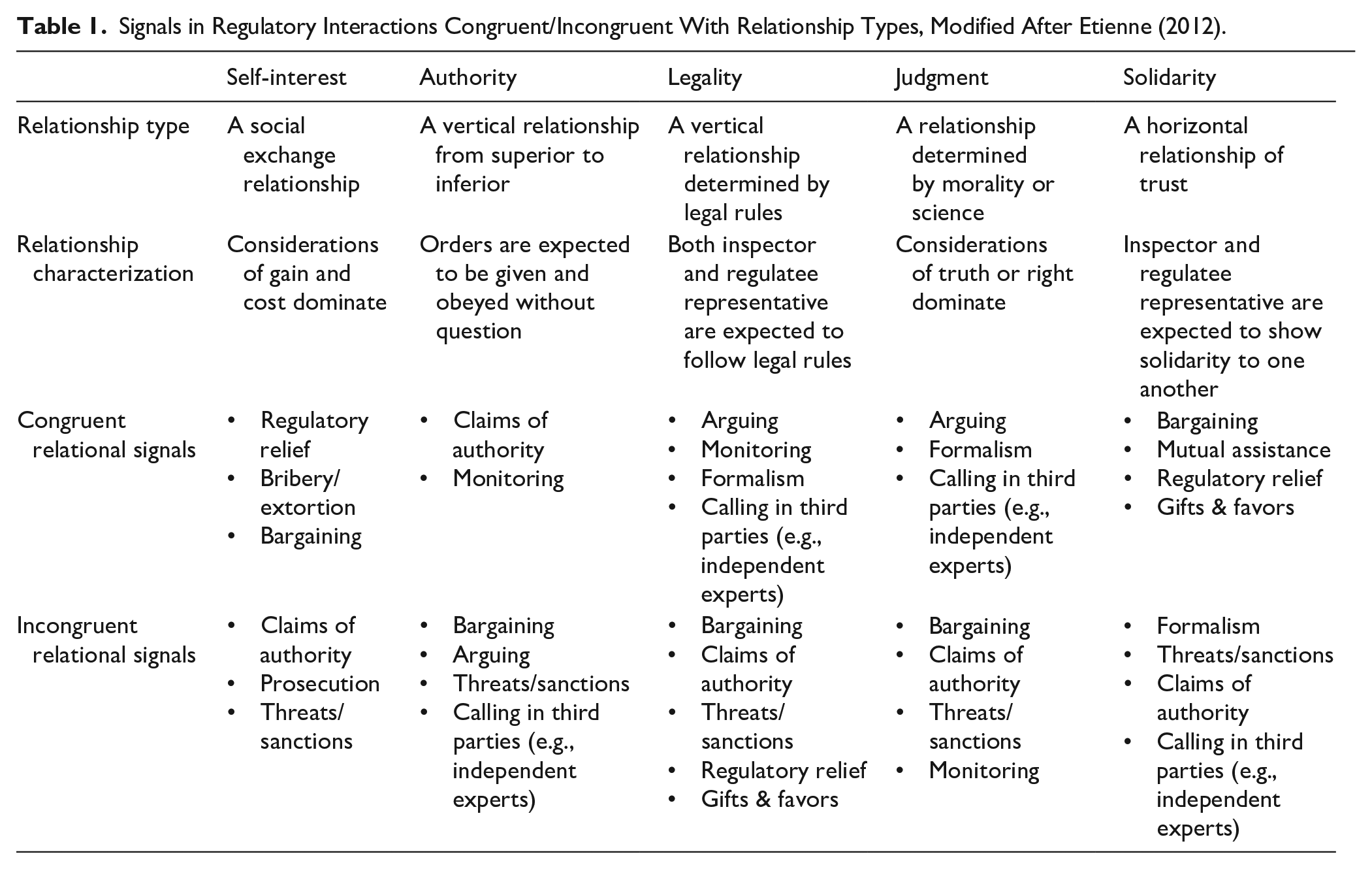
This typology is meant to account for the ambiguity inherent to regulatory encounters (Etienne, 2012, p. 1; see also Mascini & Wijk, 2009). Such ambiguity may be caused by discrepancies between participants’ intentions on such an encounter (e.g., their goals and expectations) and the signals they give off during that encounter, and the difference between participants’ intentions and their intentions as perceived by the other participant (V. Braithwaite et al., 1994; Etienne, 2012; Jung, 2012; Mascini & Wijk, 2009).
Etienne identifies “relational signals”—types of conduct of either party in a regulatory relationship—that support cooperation in such a relationship, and relational signals that are counterproductive. He outlines which relational signals would in theory qualify as either “positive” (hereinafter: congruent) or “negative” (incongruent) within five ideal types of relationships, as summarized in Table 1 (modified after Etienne, 2012, p. 39). In this context, a congruent relational signal supports and contributes to the establishment and maintenance of a certain relationship type, whereas an incongruent relational signal undermines it. Certain behaviors may qualify as congruent relational signals in one type of relationship, but incongruent in another (Etienne, 2012). For instance, arguing may be a congruent relational signal in a relationship typified by Judgment (focused on determining what is appropriate or accurate). But arguing may be an incongruent relational signal in an Authority relationship, as from this perspective arguing by the regulatee representative may be seen as challenging or disrespecting authority. Thus, if an inspector and a regulatee representative typify their relationship differently, they may hold conflicting interpretations of their mutual relational signals. Such discrepancies can negatively affect the regulatee’s acceptance of the regulator’s efforts and thereby the regulator’s efficacy (Mascini & Wijk, 2009). 3
Applying Relational Signaling Theory to Our Case Studies
To our knowledge, our study is the first empirical application of Etienne’s relational signaling framework. Our study addresses situations in which inspectors consider regulatee conduct to be problematic as it assumedly constitutes poor organizational management, yet this conduct is legal or legally ambiguous. Inspectors thus cannot readily impose the management practices that they aim to achieve.
To enable analysis of selected face-to-face regulatory conversations—whereby inspectors intended to discuss and alter the conduct of regulatees (hereafter: the focal meetings)—in light of Etienne’s (2012) relational signaling framework, we undertook research steps that imply several choices. First, we make a distinction between displayed behavior and subjective relationship styles (Freeman, 1985; Huitema & Van Snellenberg, 1999; May & Wood, 2003). To analyze the displayed behavior, we analyzed what behavior participants realized as indicated by their recollection during our case study interviews, by asking interviewees (a) which relational signals, as mentioned in Etienne’s framework, they have sent themselves, and (b) which they have observed that the other party sent (Etienne, 2012; also May & Wood, 2003). As we did not participate in the focal meetings, these actions were not observed directly but triangulated from after the event accounts.
A subjective relationship style is the style that is preferred and pursued—also referred to as “intended behavior” (Freeman, 1985; Huitema & Van Snellenberg, 1999; May & Wood, 2003). To analyze the subjective relationship style, we identify (a) what behavior each party intended by identifying their oral statements during the interviews about their goals and expectations for the examined meeting, and (b) their perception of the behavior of the other party (Huitema & Van Snellenberg, 1999; Mascini & Wijk, 2009).
Second, we used statements of interviewees on their intended behavior during focal meetings to help us interpret the relational signals. For instance, if one was bargaining, was it out of self-interest or out of solidarity? Statements of interviewees on their perception help us reveal any gap between intentions of one party and perception by the other. Although it is likely that inspectors’ and regulatee representatives’ behavior signals to the other party which particular relationship style is assumed (Lindenberg, 2000), such relationships are full of ambiguity (Etienne, 2012; Lindenberg, 2003). Perverse effects of inspector behavior are relatively common because regulatee representatives’ perceptions and inspectors’ intentions often do not match (Mascini & Wijk, 2009, p. 48; also V. Braithwaite et al., 2007; Six et al., 2010). Therefore, we analyzed the focal meetings with specific attention to any apparent discrepancies between the displayed behavior of inspectors and regulatee representatives in conjunction with the intended and perceived relationship.
Third, we explore how those discrepancies, if any, might be analyzed in terms of relationship types, and how this may help explain suboptimal communication and reduced acceptance of the inspectors’ wishes by internal supervisors. We also examine whether, vice versa, convergence between the parties’ professed intensions and actions seems to contribute to quality of communication, acceptance, and voluntary cooperation.
To provide additional structure to our analysis and to do justice to the perspective of both the inspector and the regulatee representative, we rearranged Etienne’s framework into a figure (Figure 1) that plots relationship types into quadrants and adds motivations to comply. This figure visualizes, for example, the hierarchical orientation of relationship types, which is helpful given our particular research interest in the role hierarchy plays in obtaining cooperation. Figure 1 is thus a two-axial elaboration of the first row of Table 1, typifying the regulatee motivation to comply in each type of relationship. On the x-axis, we thus distinguish the predominant orientation of the relationship as being vertical (hierarchical) or horizontal (heterarchical; Black, 2002; Etienne, 2012). Although in compliance motivation theory a motivation to comply out of respect (or fear) for authority is not commonly distinguished separately, Etienne (2012) argues that authority is to be distinguished as typifying a separate relationship type where “As a motivation, authority requires one to conform to the requests of someone whose status enables him or her to legitimately claim unquestioned obedience, irrespective of the content of the request” (p. 8). As such, we have plotted “authority” in Quadrant III as it constitutes a relationship type—and an associated motivation to comply—characterized by a vertical, hierarchical relationship between inspector and regulatee representative, with a social focus where a regulatee representative aims to earn the approval of the authoritarian inspector. Along the y-axis, we distinguish the focus of relationships as being normative or social (Nielsen & Parker, 2012).
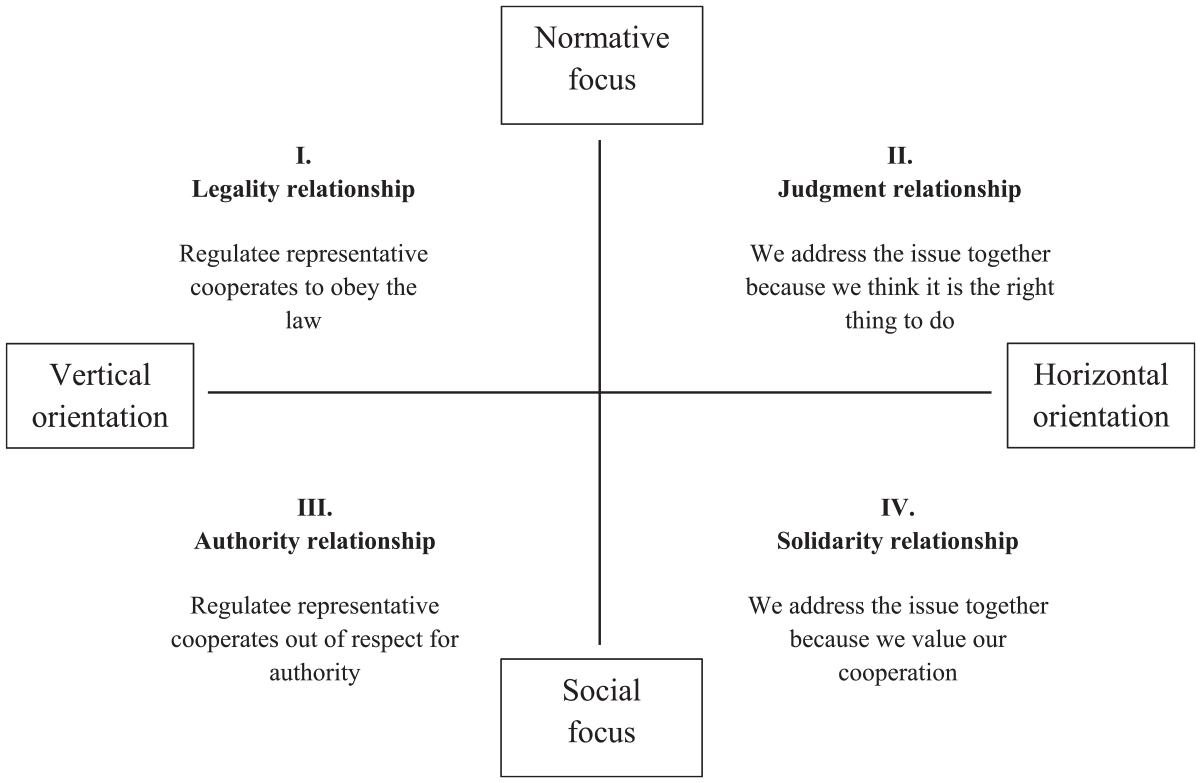
Regulatory relationship types and compliance motivations.
Method
In our case studies, we use relational signaling theory to analyze how inspectors manage voluntary cooperation in their regulatory relationship with regulatees through interactions with board members. We thereby take inspiration from Black’s (2002) viewpoint which “. . . contends that social action can be comprehended only by comprehending discourse” (p. 164). The focus of our analysis is on regulatory conversations, more specifically (a) the displayed behavior as observed by the participants of the conversation and (b) the subjective relationship type(s) as intended and perceived in these conversations. We reconstruct these relationship styles through interviews. To this end, we adopted a data management protocol, interview protocol, and code list. 4
We focused on cases in the context of the NZa and Inspectorate’s joint “Good governance” program (see “Supervisory Context” section). We made a selection from all nine cases available in this program in 2017. We initially selected all four cases in which inspectors conducted regulatory conversations with internal supervisors of the care provider to address problematic conduct by the executives (see also “Regulatory Context” section). We excluded one of these four cases because the two internal supervisors of the relevant care provider that we approached did not respond to our requests for an interview and their participation was deemed essential. For each of the three remaining cases, we obtained cooperation from both inspectors and internal supervisors, although for two of these cases, one of the two regulators’ inspectors did not grant an interview. We thus obtained an initial response rate of 75% at the case level and 83% at the interview level for the three cases ultimately selected.
Studying three cases in the same broader context (the same supervisory program) enabled rich empirical descriptions (Eisenhardt & Graebner, 2007) and provided us with a stronger base than a single case (Eisenhardt & Graebner, 2007; Swanborn, 2010). Studying data from multiple cases and sources (interviews and document research) enabled us to triangulate our research and increase the internal validity of our findings (Mortelmans, 2013). We conducted 10 interviews (see next) that generated our primary source of data. To help us understand the particular regulatory setting, we supplemented the interview data with publicly available documentation (e.g., reports and news items).
We selected a focal meeting for each of the three selected cases. We first conducted four semi-structured preliminary interviews with NZa inspectors to better understand the broader regulatory context and the specific cases’ context and to identify a suitable focal meeting. We then conducted six semi-structured case-specific interviews with representatives from NZa or Inspectorate, and with internal supervisory board members that were present at those three focal meetings (thus six case-specific interviews in total).
During the case-specific interviews, we explored, inter alia, interviewees’ intentions in terms of goals and strategy, as well as their perceptions of the other party with regard to the focal meeting. We also provided interviewees with sets of cue cards, each representing a type of relational signal (e.g., “arguing,” “issuing threats”) plus an “Other, namely” cue card in case interviewees’ observations did not match any of the predetermined options. We clarified these in nontechnical terms. We invited interviewees to identify, using the cue cards, which relational signals played a role in the focal meeting (consecutively focusing on relational signals from their conversational counterparts and from themselves). We then systematically explored via follow-up questions how this was the case.
The interviews were recorded and transcribed in full. We made use of standard qualitative analysis software to analyze these transcripts. To enable us to categorize our findings, we developed themes and codes deductively, based on available theory, but we supplemented these in an iterative abductive process (Dubois & Gadde, 2002) going back and forth among the relevant literature, interview data, and other documentation (Klenk, 2020; Tummers & Karsten, 2012). During the research process, we inductively refined our framework where needed in light of the preliminary findings (Decorte & Zaitch, 2009; Klenk, 2020). We elaborate this in the remainder of this section.
Our coding system was geared toward identifying and analyzing the displayed behavior and subjective relationship styles (Freeman, 1985; Huitema & Van Snellenberg, 1999; May & Wood, 2003). To account for indicators of the displayed behavior, each relational signal that Etienne (2012) distinguished and described theoretically was assigned a code to categorize interviewees’ realized behavior during the focal meeting. We applied these relational signal codes (e.g., “arguing”) to the transcripts not based on formal definitions of these codes, but rather on interviewees’ accounts of the focal meetings as triggered by the cue cards (each cue card reflecting one type of relational signal). To account for indicators of subjective relationship styles, we categorized interviewees’ intended behavior and perceptions of the relationship (Freeman, 1985; Huitema & Van Snellenberg, 1999; May & Wood, 2003) by applying respective codes to interviewees’ oral statements regarding their goals, strategy, and meeting expectations.
In light of the exploratory nature of this research, the application of these codes to segments of interview transcripts and documentation was governed primarily by the authors’ conjunct judgment, rather than a fixed set of indicators for each code. That operationalization was objectified by having standard interview questions, as featured in the interview protocol, correspond with specific codes (for instance, all interviewees were asked what their prior goals for the focal meeting were, and responses were coded as “meeting goals”). The sets of cue cards, which we used to systematically inquire after interviewees’ displayed relational signals, provided additional structure to the operationalization as these cue cards equally corresponded with codes. The interview protocol and coding scheme were also reviewed by six regulatory scholars.
As an example of framework refinement during the research execution (Decorte & Zaitch, 2009; Klenk, 2020), we adjusted our coding and subsequent analyses to reflect the preliminary finding emerging from our analysis (Saldaña, 2021) that the hierarchy that interviewees perceived during the focal meeting and the way they characterized the other meeting participants seemed pivotal in how they experienced the regulatory relationship. That preliminary finding generated “hierarchy” and “characterization of meeting participant” as additional codes, which enabled systematic analysis of those themes across the three cases.
Results
Regulatory Context
In the Netherlands, two separate public regulators oversee the health care system. The Inspectorate regulates health care quality, and the NZa regulates the accessibility, affordability, and transparency of quality of health care.
Dutch regulators possess only limited independent regulatory powers. Typically, although the regulator may prompt this process, adopting new substantive regulations is the prerogative of the central legislature (which may mandate regulators to “fill in the details”). Thus, when a regulator is faced with a regulatory gap in its supervisory practice, adjusting regulations is not a “quick fix” option. This can make Dutch regulators more prone to seek alternative ways to address harmful but unregulated conduct in their supervisory practice, such as prompting regulatees to cooperate on a voluntary basis.
In addition, Dutch regulatory culture “. . . is based on the corporatist philosophy, which emphasizes the principles of consensus building and the use of expert advice to improve regulatory quality, with a view to promoting the legitimacy of regulation and trust in government” (Organisation for Economic Co-operation and Development [OECD], 2010, p. 13). This predilection for consensus building can generate a deliberative supervisory style that, rather than resorting merely to formal supervisory measures and associated hierarchical communication, may feature substantial regulator–regulatee discussions.
Supervisory Context
In our cases, the Inspectorate and the NZa join forces to address management deficiencies at health care providers. However, their regimes are focused primarily on the objectives that health care providers as organizations are expected to achieve, not on their executives or internal supervisors. The Inspectorate and the NZa have no legal basis to supervise or enforce how management mitigates the risks that its organizations’ operations pose to those regulatory objectives. Thus, in a context of organizational management issues, they cannot directly coerce appropriate conduct from executives themselves (see Figure 2). The inspectors in our cases therefore engage with the organizations’ supervisory boards informally—although they lack formal regulatory powers over them—to obtain their voluntary cooperation in improving organizational management.
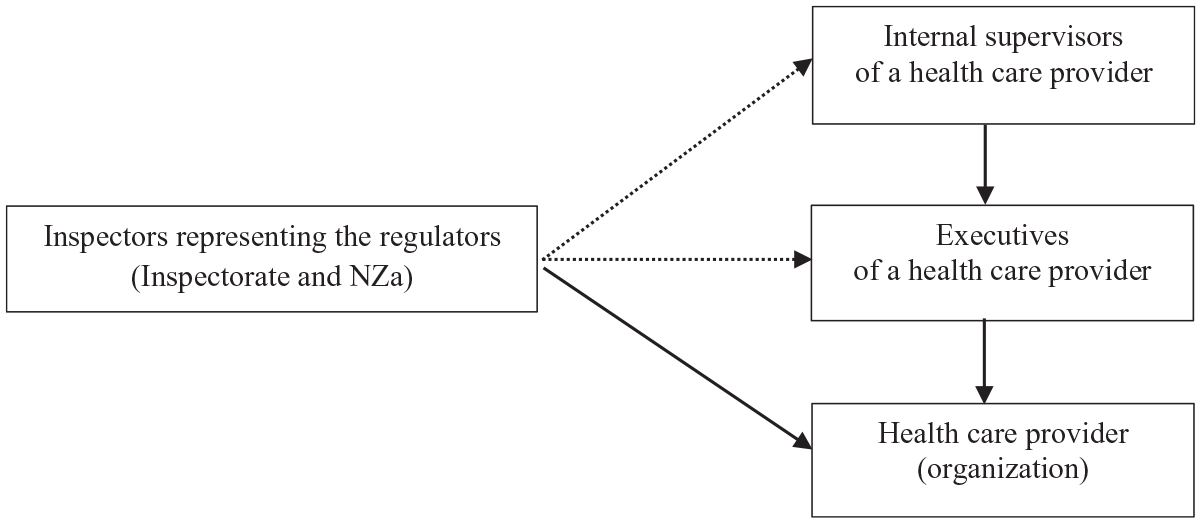
Simplified illustration of formal and informal powers in the presented case studies (formal powers indicated by solid arrows).
Our cases take place in the context of the NZa and the Inspectorate’s joint “Good governance” supervisory program. In this context, the concept of “governance” is used to denote the way boards of directors and supervisory boards ensure proper management of a health care provider to safeguard quality of care and of compliance with regulation (in other words, the internal governance of the organization, see Van de Bovenkamp et al., 2017). In July 2016, the NZa and the Inspectorate jointly published a regulatory framework on “Good Governance” (the Framework). In this Framework, the regulators describe what conduct they expect from board members—executives and internal supervisors—of health care providers and how they intend to oversee this conduct. The Framework has no formal regulatory status and is not enforceable through legal coercion by the regulators. The health care sector has also adopted a “governance code.” 5 This is a self-regulatory code that also does not provide the regulators with formal leverage to compel a change of conduct.
Internal supervisors of Dutch health care providers are by civil law obliged to pursue sound organizational governance and provide for well-functioning executives. And, in contrast with inspectors, they do possess formal means of leverage toward the executives: As the executives’ superiors, internal supervisors can discharge executives as an ultimum remedium. The governance code also asserts that internal supervisors need to take the public interest served by a health care provider into account in their actions, which provides some common ground for inspectors and internal supervisors as they share this public interest focus. Therefore, the inspectors in our cases engage with internal supervisors informally—although they lack regulatory powers over supervisory boards themselves—to obtain their voluntary cooperation in preventing or mitigating the perceived harm to the public interest. The primary objects of our case studies are thus the regulatory interactions between inspectors and internal supervisors of Dutch health care providers (see also Figure 2).
A final supervisory context element is the possibility of initiating an “intensified supervision regime.” If a care provider breaches regulations, the Inspectorate or the NZa might impose a fine or institute disciplinary proceedings. A milder, yet still impactful measure of the Inspectorate is the temporary intensified supervision regime, which it can impose in light of quality of health care concerns even if no breach of regulations has been established. An intensified supervision trajectory is “an undefined period wherein the [Inspectorate] intensifies its supervision activities within the health care facility, in the attempt to force its leadership and management to ‘sort out’ serious issues that have been identified” (Kok et al., 2020). During this regime, the Inspectorate monitors a care provider constantly until it has achieved the desired results (Schakel, 2017). The Inspectorate publicizes names of providers subject to an intensified supervision regime. This tends to generate negative media attention (Van Erp et al., 2020). In our cases, the inspectors’ threat of imposing an intensified supervision regime and internal supervisors’ wish to prevent such a regime (Bokhorst & van Erp, 2018) evidently affected the tone and content of the focal meetings in the selected case studies (see “Discussion” section).
Summary of Case-Specific Findings
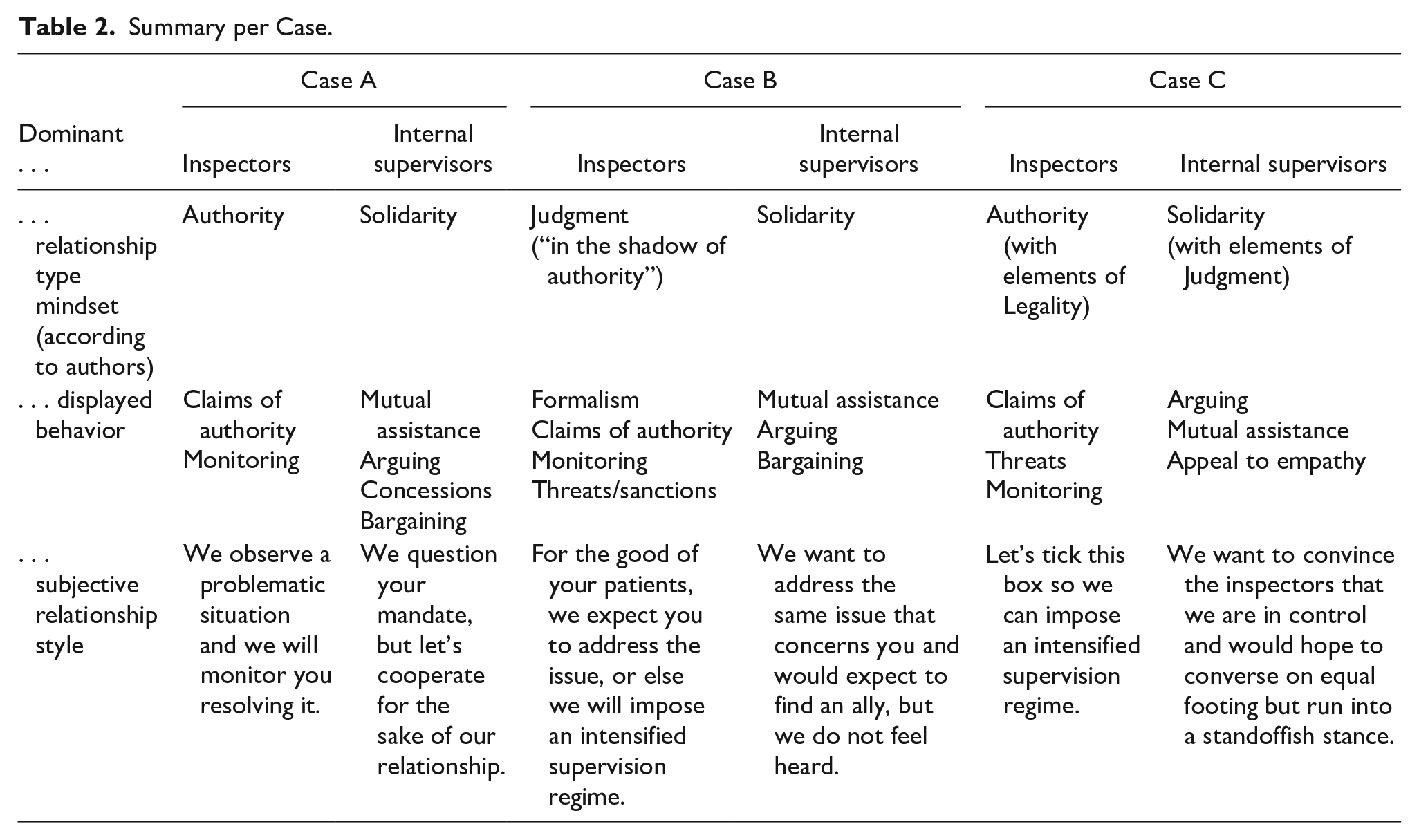
Table 2 provides a summary of our findings per case. It lists our conclusions on the relationship type that was dominant from the perspective of the inspectors and internal supervisors in the focal meeting (first row). The dominant relational signals they reportedly gave off during that meeting are listed in the second row; the third row features our characterization of inspectors’ and internal supervisors’ intentions and perceptions regarding the focal meeting as expressed during their interview with us (bottom row). The subjective relationship type (third row) enables interpretation of the displayed behavior (second row), as discussed further below.
Summary per Case.
Case A
In Case A, the Inspectorate and NZa were concerned that the administrative and financial preconditions for the provision of good health care were not sufficiently met due to a lack of transparency and accountability in the governance structures. The health care provider first became aware that the regulators had these concerns from media reports rather than from the regulators themselves. Inspectors and internal supervisors agreed that this was not appropriate, and both indicated in their interviews that the aim of the focal meeting highlighted in Case A was to address this.
For both, a second goal of the focal meeting was for the internal supervisors to provide the inspectors with more information about the governance situation at the care provider. The internal supervisors wanted to provide the inspectors with information by “explaining the correct facts,” hoping that this would avert an intensified supervision regime. Accordingly, the internal supervisors’ relational signals were mutual assistance—volunteering information (about their governance structure, procedures, and decision-making process), arguing, concessions, and bargaining: . . . they [were] willing to be completely transparent, we were given access to every employee in the organization [and all] documents . . . I clearly sensed their interest in this: if we provide you with the documents than you will be able to see very quickly that there is no issue here . . . (Inspector)
The inspectors requested information to better understand the situation and also to convey a monitoring signal: “there is more going on and we are on to you, and this will have consequences, we are all over this.” The interviewed inspectors and internal supervisor concurred that the most dominant relational signal sent by inspectors was claims of authority—sometimes underscored by the implicit threat of sanctions or negative publicity: Above all, we had to rely on our authority. So foremost we had to say: listen, it does not matter at all which rule you violate here, we see a situation here that is undesirable, which may have consequences for: affordability, accessibility and transparency . . . we worry about that and you should too.
In the inspectors’ perception, they based this appeal to authority on their mission, rather than on formal rules or powers: You use your authority from [an implicit appeal to] your mission and vision . . ., not [from] an appeal to the law. (Inspector)
Although the inspectors assumed an authoritarian position—by appealing to their authority and monitoring the regulatee—they were also seeking for Solidarity, a partner to solve the problem: “In this way, I think we [inspectors] shared our concerns with them.” Inspectors tried to convince the internal supervisors to accept their intervention and to cooperate with them, using public-interest arguments and transparency about the limits of their formal mandate.
The internal supervisors likewise found it legitimate for the Inspectorate to investigate indications about the quality and safety of health care provided by their health care organization. They did however comment on how far this mandate extends: What I observed was . . . a need for a wider supervisory framework to be able to get more within scope than usual . . . That may be hidden in those moral arguments . . . As if saying: there is also sort of a national political sentiment, which further supports a mistrustful view of organizations such as [ours]. (Internal supervisor)
The interviewed internal supervisor doubted whether the inspectors were capable of fulfilling this expanded role: We felt there was a . . . narrowed understanding of the daily [governance] . . . So, we felt that we were not talking to fellow experts in this field. (Internal supervisor)
The internal supervisor considered hierarchy inherent to the regulatory relationship and therefore as such unproblematic. However, in his experience, this hierarchical relationship was tainted by personal preferences from an inspector: In any case, the personal opinion of the official did play a role . . . I think: that should not play a role in this context. You should supervise objectively, within the framework of standards that applies. (Internal supervisor)
Notwithstanding the internal supervisor’s occasional “push back,” he demonstrated an interest to maintain cooperative relationships given the inspector’s position: You are . . . entrusted to the supervision of the external supervisor, so we also have an interest in keeping the relationship normalized if possible . . . a bit calculative, perhaps.
In summary, in this Case A, we observe a discrepancy in “chosen” relationship types. In light of their claims of authority and their monitoring signals throughout the focal meeting, the inspectors primarily assumed an Authoritarian relationship type, although at some point they sought cooperation using public-interest arguments and transparency about the limits of their formal mandate. The internal supervisors, on the contrary, were not convinced that the inspectors were entitled—or had the capability—to act as they did, but did cooperate to maintain a good relationship (aiming to prevent an intensified supervision regime), hence opting for a Solidarity relationship type.
Case B
The focal meeting in Case Study B took place shortly before the Inspectorate established an intensified supervision regime in light of the disturbed working relationships between executives and internal supervisors. Another cause for concern was the executives’ apparent intention to transfer a substantive amount of money from the organization’s funds to personal accounts, although in the inspectors’ view the organization needed the money to invest in the quality of its health care. Although the inspectors could not identify any illegal intended transaction, they invited both the executives and the internal supervisors to a meeting at the inspectors’ office.
The interviewed inspectors and internal supervisor concurred that the regulatory relationship during this meeting was of a vertical nature (from superior to inferior): There was hierarchy, unmistakably. [This was evident from] the fact that we clearly had the chairmanship, but also because we cut off [discussions] where needed and started looking, very purposefully, whether there was any remaining reason to adjust [our course]. (Inspector) Hierarchical. Like: “You have been naughty. All of you.” (Internal supervisor)
As for the regulatee, the purpose of the internal supervisors was to receive support from the inspectors, enabling them to supervise the executives more thoroughly: Well, we expected to get more support from the Inspectorate to be able to supervise a little more in-depth, to find support . . . we expected an ally. And that was not experienced at all [by us]. (Internal supervisor)
With regard to the relational signals sent, both parties’ interview accounts indicate that the internal supervisors wanted to discuss the case and offered to keep the Inspectorate informed or quickly deliver actions that would provide the Inspectorate with insight into the intended improvements, which suggests that the internal supervisors assumed a Solidarity relationship type.
Considering the inspectors’ stance, we find indicators of several relationship types, but not Solidarity. The inspectors’ primary goals were to formally determine whether they had correctly summarized the facts, substantiate whether they should impose an intensified supervision regime, and give the internal supervisors the opportunity to respond to the intended duration of that regime. In terms of relational signals, both inspector and internal supervisor indicated that the inspectors mainly invoked rules and procedures, appealed to authority, and threatened to impose sanctions, leaving little room for discussion. In the perception of the inspectors, they mainly appealed to public-interest-based arguments to justify their intervention: We said, you just have to fix it, because those clients are going to be affected somehow. And we stand for good care for the clients . . . We did use our authority, of course. Had we not been from the Inspectorate and NZa, we would not have been able to do this. So that was a legitimation that enabled us to do it. That is explicitly part of our role, of course. (Inspector)
The interviewed internal supervisor confirms that the inspectors mainly appealed to public-interest-based and authoritarian arguments to justify their intervention: I also think it is moral because it is about public resources. “And that concerns us as supervisors,” they did say. But we also said that it was our concern as well . . . Yes, and authority . . . As they invoked their authority, we did not feel taken seriously. (Internal supervisor)
According to the interviewed inspectors, the internal supervisors cooperated well, all relevant information was shared, and the relationship was sound. However, the internal supervisors had a different recollection of the focal meeting. The interviewed internal supervisor did not feel heard: We were all there with spirit and passion for the social side of the company and we were not seen as such by the Inspectorate, I felt . . . the Inspectorate has continuously called us to account.
The internal supervisor also doubted whether the inspectors were capable to fully comprehend and assess the situation: I also found the background of some inspectors to be very “blue” . . . If you need to assess whether the relationships and the genes of the organization and the management are trustworthy, such that you can be confident of good management, that is impossible to tick off. You need to sense that. You don’t need paper for that. And if you are blue, you cannot sense that. (Internal supervisor)
Given these findings, we observe a discrepancy between the inspectors’ and internal supervisors’ pursued relationship type—and corresponding expectations—during the meeting. The inspectors appeal to public-interest-based arguments with their call to address the issue because it is the right thing to do, apparently aiming for a Judgment type of relationship. Interestingly, the inspectors do so “in the shadow of hierarchy” (Rhodes, 2007)—indicative of an authoritarian relationship type—by referring to their authority and by threatening with an intensified supervision regime if the issue is not addressed soon. The internal supervisors, on the contrary, were in search for a partner who would help them to “put their house in order,” apparently pursuing a Solidarity relationship type.
Case C
The focal meeting in Case Study C took place shortly before the Inspectorate established an intensified supervision regime in light of disturbed working relationships between executives and medical staff. By withholding information, the medical staff did not sufficiently enable executives to fulfill their coordinating and controlling obligations toward the quality and safety of the health care provided. Neither executives nor internal supervisors were able to reestablish functional working relationships. As no regulation was infringed, the inspectors lacked regulatory instruments to intervene.
The inspectors’ formal goal for the focal meeting was to meet the administrative requirement (“tick-the-box”) of discussing the Inspectorate’s intention to establish an intensified supervision regime with representatives of the organization. The inspectors also had an “informal” goal: . . . the informal goal [was] that the Inspectorate wanted to give the hospital one more opportunity to reflect on that intention. The arguments they would put forward would then be taken into account in the final judgment of the Inspectorate to impose . . . intensified supervision. Actually . . . that judgment had already more or less been established. So, it was sort of a mere formality. (Inspector)
The internal supervisors’ goal was to prevent the intensified supervision regime. They intended to convey that a lot had been done already to deal with the issues, thus no need to establish the regime: Our goal was also to take the Inspectorate along with how we had acted, . . . towards the entire organization, as we were taking steps . . . Perhaps still to prevent an intensified supervision regime. (Internal supervisor)
They expected the inspectors to use the meeting to gain a better understanding of the situation: What you expect is that they question us, but also question the executive and the medical staff what role each person has taken. And that they get an impression of whether that constitutes good governance as expressed in the governance code. (Internal supervisor)
The NZa inspector observed a discrepancy between the inspectors’ and internal supervisors’ expectations during the focal meeting: They still wanted to engage us in a conversation and jointly reflect . . . Our approach was precisely not to do that . . . This was also a difficult element of the meeting, because we noticed that the care organization really wanted to hear from [us]: “what exactly should we do or what exactly are we doing wrong that makes you want to impose an intensified supervision regime?” [We] had a very different view: “. . . this is your chance to convince us that intensified supervision is not necessary. So, bring it on.” So, both parties . . . expected different things from each other.
As indicated above, the inspectors’ relational signals included enquiries. Both parties attest to that. However, the apparent intent behind these enquiries diverged. The inspectors’ intent was to meet an administrative requirement to impose an intensified supervision regime and invite the internal supervisors to reflect on the case. The inspectors did not want to enter into substantive discussions. In contrast, internal supervisors did repeatedly signal that they wanted to conduct substantive discussions (arguing) and they expected inspectors’ enquiries to be aimed at understanding the case better (which might avert the inspector’s apparent need to establish an intensified supervision regime).
The inspectors and internal supervisor agree that the inspectors’ relational signals during the focal meeting included frequent threats—specifically the threat of imposing an intensified supervision regime—and appeal to authority.
The internal supervisors occasionally appealed to empathy, according to an inspector (who noted that this was not included in the relational signal options provided for the interview). Apparently, this appeal to empathy was not reciprocated: Perhaps that is an [aspect of the meeting to be caught by the relational signal cue card] “Other, namely.” [That is] that the care organization tried to create a lot of understanding for their situation . . . Like: “Pity us, because this has turned our entire organization upside down . . . Because intensified supervision . . . what if the hospital goes belly up. So please quit this intensified supervision thing” . . . Not specifically focused on content, but rather on empathy: “Please understand our situation.” (Inspector)
Both parties reported that their mutual relationship during the focal meeting was problematic. The internal supervisor thereby repeatedly emphasized the interpersonal (noninstitutional) aspect of this, stressing a perceived lack of empathy from an inspector: That [relationship] was, I think, already poor. (Inspector) I had the impression . . . that it was hard to get through [to one of the Inspectors] . . . One [was] very open and . . . listened [well] . . . While, [with] the other person you just noticed the appearance, . . . the atmosphere, the setting, the facial expressions, almost through his non-verbal behavior I noticed that what was being said, may not have been [properly] heard. (Internal supervisor)
More broadly, the internal supervisors felt that the relationship between inspectors and themselves arguably should be on equal footing, given their complementary roles in pursuing the same objective: The objective of both parties is the same. You want to guarantee quality of care. You respect everyone’s role and the [mutual] relationships. (Internal supervisor)
However, they perceived that the relationship was actually hierarchical: It [was] not an equal relationship. You are summoned . . . So, that already says something . . . And I don’t know if it’s wrong, perhaps this is how it should be in such a situation . . . (Internal supervisor)
In sum, various relational signals and associated relationship types were apparent during the focal meeting. The inspectors’ frequent threats and appeals to authority mostly reflect an Authority relationship preference. In addition, the “tick-the-box” meeting goal that motivated much of the inspectors’ enquiries (consistent with monitoring and formalism) indicates elements of a Legality relationship. In contrast, the internal supervisors were inclined toward a horizontal relationship type. They had hoped to argue the facts on equal footing (indicative of a Judgment relationship) and appealed to empathy to stave off an intensified supervision regime (indicative of a Solidarity relationship). However, it seems that, in light of the inspectors’ strictly vertical stance in practice, internal supervisors reluctantly acquiesced in a (vertical) Legality relationship.
In all three cases overall, we observe a range of discrepancies, as inspectors send relational signals incongruent with their intentions and between the relationship types as pursued by the inspectors on one hand and internal supervisors on the other. In the next section, we analyze these discrepancies in terms of relationship types and associated relational signals to explain suboptimal communication and reduced acceptance of the regulators’ demands by regulatee representatives.
Analysis
Below, we first analyze the discrepancies that we observed. We then discuss how such discrepancies shape regulatory relationships, both in these three cases and more generally. We conclude this section with broader observations on the consequences of these relational dynamics for managing regulators’ legitimacy and voluntary regulatee cooperation.
Two Kinds of Discrepancies
We observe discrepancies predominantly of two kinds. First, discrepancies between the inspectors’ displayed behavior and subjective relationship style. Their displayed behavior expressed by the relational signals as observed by the participants predominantly tended toward Authority, whereas their subjective relationship style—the intentions—had characteristics of Authority, Judgment, and Solidarity relationship types. Second, discrepancies between these inspectors’ displayed behavior—their authoritarian relational signals—and the displayed behavior of internal supervisors, featuring relational signals congruent with Solidarity. Hence, where earlier research surfaced a gap between the relationship style as intended and the relationship style as perceived (Mascini & Van Wijk, 2009), we can also pinpoint a gap between the subjective relationship style as intended and the behavior as displayed (by the relational signals used) by the inspectors, and a gap between the displayed behavior of the inspector and the displayed behavior of the regulatee representative. Meanwhile, the displayed behavior and the subjective relationship style of the representatives of the regulatee were mostly congruent; their behavior as identified by the relational signals matched their intentions.
Clearly, we must exercise caution in those interpretations, especially given that we did not observe the focal meetings themselves but rather depend on participants’ recollection and interpretation thereof. Still, several analytical contentions seem warranted, as discussed below.
The three cases are fairly comparable in terms of their broader context and they arguably show the same general pattern in the regulatory relationship analyzed. In each case, a key part of the inspectors’ approach is to seek an alliance with the internal supervisors based on common ground. To that end, they appeal to the public interest goals—quality and affordability of care—that they have in common with these internal supervisors, if only as a starting point to engage them in a regulatory conversation, pursuing a horizontal relationship type—either a Judgment relationship with a substantive focus or a Solidarity relationship with a relational focus (Figure 1, Quadrants II and IV respectively).
In all three cases, the inspectors ostensibly had the opportunity to find such an ally in the internal supervisor. In each case, the internal supervisors send “mutual assistance” and “arguing” signals. These are signals that are especially congruent with a horizontal relationship. In Cases B and C, the internal supervisors explicitly state that they hoped to find an ally in the inspectors and they interpret their interactions in terms of solidarity and nonsolidarity.
Despite their prior intentions, the actual approach of the inspectors during the focal meetings is ambivalent. On one hand, they stress the public interest issue, hoping that internal supervisors will share their concerns and help address it (which may suggest a horizontal orientation). On the other hand, in the focal meetings, the inspectors specifically tend toward an Authority relationship as they send hierarchical relational signals that are congruent with that relationship type (and incongruent with a horizontal relationship). For example, they send “claims of authority” and “monitoring” signals in every focal meeting. This suggests that the inspectors consciously or unconsciously tend toward a vertical relationship in practice. In addition, in every case, inspectors threaten, and ultimately impose, a measure feared by the regulatee: a publicly announced intensified supervision regime. They avoid relational signals that can stimulate an alliance and affirm a Solidarity relationship, although internal supervisors repeatedly invite such an alliance by means of their “mutual assistance” and “arguing” signals.
These discrepancies in relational focus—the vertical Authority relationship type of the inspectors and the horizontal Solidarity relationship type of the internal supervisors (see the lower side of Figure 1)—thus hamper the interaction between the parties. This frustrates any prior intention from inspectors to arrive at a joint substantive focus with internal supervisors revolving around the public health interest at stake. These findings are in line with Etienne’s theoretical expectation that the signaling ambiguities already inherent in regulatory relationships may turn out to be especially troublesome in cases where the regulatory requirements are ambiguous and that an appeal to authority may nevertheless be a key source that inspectors turn to alter behavior.
The Effects of Discrepancies on Regulatory Relationships
Inspectors and internal supervisors failed to settle on a shared relationship type in each of the focal meetings (despite the partial joint interests). The inspectors interpret the regulatory conversations primarily in terms of obedience or nonobedience, whereas the internal supervisors interpret them in terms of solidarity and nonsolidarity. Hence, they do not make sense of these conversations in mutually consistent ways, making cooperation difficult to achieve (cf. Etienne, 2012, p. 4). Inspectors and internal supervisors are both looking for an ally to steer the executives’ problematic conduct and safeguard public interests. But in practice, due to the authoritarian relational signals send by the inspectors, the inspectors provoke a defensive response and the internal supervisors feel unjustly treated as “offenders” who are being held accountable (as if they were the executives), rather than as an ally. They experience insufficient space to express their own concerns regarding the issues under discussion as professional supervisors. And the discrepancy between the inspectors’ intentions and the signals they give off not only confounds the internal supervisors (cf. May & Wood, 2003); it also triggers confusion for the inspectors themselves. Whereas internal supervisors adopt a wait-and-see attitude in response to inspectors’ authoritarian relational signals, inspectors do not understand this attitude, seemingly not recognizing the effect of their own authoritarian signals.
Our case studies also suggest that whether a shared relationship understanding is established might depend more on what relational signals participants actually sent than on their intended relationship type. The authoritarian relational signals sent by inspectors proved decisive for the dynamics of the focal meetings, regardless of what prior thoughts (in terms of goals and strategy) inspectors had and regardless of what arguments they used to convince internal supervisors to address the issue. Case B clearly exemplifies this. In this case, inspectors mix public interest arguments with authoritarian relational signals, which subverts the solidarity relationship sought by the internal supervisors.
Our research further illustrates how participants’ relationship type preference in a regulatory conversation impacts their interpretation of signals send by the other party. Consider for example Case C, in which both parties send “discussion” signals but ostensibly with a different relationship type in mind. Internal supervisors assume a Solidarity or Judgment relationship. They sent “discussion” signals to exchange information to address the issue together. Meanwhile, inspectors sent “discussion” signals to meet an administrative requirement before imposing an intensified supervision regime, congruent with a vertical Authority or Legality relationship type. Hence, both parties send “discussion” signals with an underlying intention quite different from how the other party interprets them. This discrepancy ostensibly generated an emotional distancing that undercut a potential cooperation pursued by both parties: The internal supervisors were frustrated that discussion did not lead to a Solidary-type dialogue about jointly safeguarding public interests, whereas inspectors in turn were annoyed that internal supervisors kept debating instead of accepting the situation. This example also underscores the value of studying discrepancies between displayed behavior and subjective relationship style—what is intended by the sender of the signals and what is perceived by the receiver—as studying signals alone may be insufficient to understand what is going on.
Consequences for Managing Regulators’ Legitimacy and Voluntary Regulatee Cooperation
In all three cases, a prominent “shadow of hierarchy” (Rhodes, 2007) affects the focal meeting as the inherently hierarchical structure of the relation between regulator and regulatee as organizations ostensibly defines the context within which the focal meetings between their representatives take place, and steers how signals are interpreted. The hierarchical manner in which the inspectors interact with the internal supervisors seems to detract from any voluntary acceptance of their position, which may negatively affect the regulators’ authority and regulatees’ inclination to cooperate voluntarily in future instances. The problematic management conduct is ultimately addressed via pressure applied through an intensified supervision regime.
The ongoing threat of an intensified supervision regime can hamper “voluntary” compliance (Baldwin & Black, 2008) and decrease cooperation early in the interaction (Tenbrunsel & Messick, 1999). That presence makes agents such as internal supervisors more calculative and less aware of public interests. Inspectors may control such perverse effects only when they successfully communicate their intentions (Mascini & Wijk, 2009). In our cases, the focal meetings suggest that the available fallback option of intensified supervision might contribute to the inspectors’ vertical (hierarchical) orientation, their ambiguous signaling, and their disconnected communication with internal supervisors.
In a case where obtaining voluntary cooperation is crucial, regulators might therefore consider removing the threat of such a fallback option, for example, by renouncing that option explicitly. This might prompt their inspectors out of their hierarchical “comfort zone” to actually engage in a horizontal relationship with regulatee representatives, focused on the content and public interests at stake (Judgment) and/or seeking real rapprochement (Solidarity). However, even without such a threat at their disposal, regulators cannot realistically erase their hierarchical position (Black, 2002). It is therefore uncertain if such an approach would indeed enable inspectors to adopt a horizontal orientation in regulatory conversations.
Our analysis also reveals broader consequences for inspectors who intend to secure cooperation from regulatees by persuasion rather than force. Specifically, while addressing poor management practices or other problematic conduct that is not clearly illegal, managing legitimacy may require inspectors to acknowledge that they do not get to decide what is “right” (De Graaf et al., 2016) and to reconsider how they wield the power they possess through the aforementioned “shadow of hierarchy.” Research suggests that the quality of inspectors’ coping strategies may depend on their attitude toward the hybridity of the context and the reflexively of their response to it (Klenk, 2020). Managing legitimacy in this context may require them to adopt a more “decentered” (Black, 2002, p. 192) understanding of their role in that context and to engage representatives of regulatees in reflective dialogues on each other’s position in their regulatory relationship. In cases such as discussed here, executives and internal supervisors of the same care provider may have diverging goals. Given that goal clarity empowers such representatives to conduct a more effective dialogue (Song et al., 2020), this may thus warrant separate engagements. Such reflective dialogues can take place at the outset of a regulatory conversation to lay a foundation for mutual understanding, during such a conversation if and when discrepancies in signals and mutual relational perceptions emerge, or as a separate effort. It should arguably address the different types of regulatory relationships and the institutional and personal factors that determine whether the parties to a regulatory conversation are able to develop a stable common conception of their relationship (cf. De Boer, 2018; Mascini & Wijk, 2009).
More generally, our analysis suggests that inspectors who intend to secure voluntary cooperation need to reflect critically on their role; on the nature of their relationship with regulatees (and with particular representatives such as internal supervisors); on who gets to assert or contest what counts as, for example, a regulatory issue and an acceptable solution thereof (and on what grounds); and on what these reflections imply about the power distribution and impact of hierarchy in that context (cf. Black, 2002). During interviews, we noticed that Etienne’s relational signaling theory helped to raise inspectors’ and internal supervisors’ awareness of regulatory relationship types and the relational signals they send, and inspectors were enthusiastic about the resulting insight into their own performance during the focal meetings. If inspectors are thereby able to recognize a mismatch of mutual perceptions regarding roles, relationships, and assertive powers, they can choose to reframe their messages (Gilad, 2014) and accordingly adjust their relational signals to attain effective and legitimate regulatory conversations.
Conclusion
This article shows how inspectors may struggle to obtain voluntary cooperation from regulatees if there is no readily enforceable norm underlying such attempts. It features the first case study application of Etienne’s (2012) relational signaling framework for regulatory conversations, grounded in literature strands on enforcement styles and compliance motivations. We show how this framework helps to understand the ambiguities inherent to such regulatory conversations. We analyze how the “shadow of hierarchy” (Rhodes, 2007) implicit in regulatory conversations may thwart efforts to establish a cooperative affiliation. We also show how incongruencies between inspectors’ and regulatee representatives’ displayed behavior and subjective relationship styles may generate an emotional distancing, which undercuts attempts to achieve the common ground conducive to voluntary cooperation. Our findings further suggest how converging on this common ground in a regulatory conversation may be more dependent on the relational signals that participants express and observe than on their subjective intentions, and how a participant’s relationship type preference may impact his interpretation of the relational signals he observes. Increased scholarly insight into this dynamic will help to more fully understand how voluntary regulatee cooperation might be obtained.
Besides scholarly contributions, our findings also generate actionable insights conducive to effective and legitimate regulatory practice. Awareness of the relational signals that inspectors send during regulatory conversations—and of the resulting incongruencies they may come with—can help these inspectors to proactively manage regulatee representatives’ perceptions and obtain voluntary cooperation. More specifically, awareness of how persistent the regulatory “shadow of hierarchy” (Rhodes, 2007) impacts both their relational signals and how regulatee representatives perceive those signals can lead inspectors to consider communicative measures that counteract this effect (e.g., discarding the threat of enforcement; acknowledging that regulations fail to capture a regulatee’s potentially harmful conduct; denouncing any claim to unilaterally “judge” such harmful but legal conduct).
Future research may posit relational signals not included in Etienne’s (2012) framework. For instance, the crucial role that information requests play in regulatory conversations might lead to considering a dedicated “inquiry” relational signal category separate from “discussion.” 6 It will also add value to apply Etienne’s framework in other settings. For instance, regulatory settings that feature a different power balance and degree of hierarchy between inspectors and regulatee representatives, or a different degree of overlap between their interests at stake in a regulatory conversation, may generate additional insights. Other methods to apply this framework (e.g., discourse analysis, vignette study) might also prove fruitful.
While interpreting our findings and discussions, the inherent generalizability limitations of in-depth qualitative case study research should be taken into account (Swanborn, 2010; Yin, 2009) as well as its potential to capture the subtleties inherent to regulatory conversations. Specifically, our findings seem most likely to be relevant in regulatory contexts where averting regulatee conduct through regulatory conversations and pursuing voluntary regulatee cooperation are among the accepted regulatory practices. In addition, our case studies’ Dutch regulatory context—highlighted at the outset of the “Results” section—should be taken into account. This context can make inspectors more inclined to seek voluntary cooperation through regulatory conversations in case the regulatory framework precludes coercion. The cultural context might also make regulatee representatives less inclined to accept a hierarchical relationship toward inspectors, especially if coercive powers are lacking. However, regardless of such context specifics, the fundamental dynamics inherent to a regulatory conversation and the role of relational signals therein—as illustrated by our case studies—should be considered, especially if the parties to such a conversation pursue a voluntary resolution of the issues at hand.
Footnotes
Acknowledgements
The authors wish to thank the respondents for their willingness to participate in our study. They are grateful to Prof. Dr. R. A. Bal, Prof. Dr. J. G. van Erp, Prof. Dr. S. P. Kaptein, Dr. A. M. V. Stoopendaal, and the members of the Modern Regulation Group of the Rotterdam School of Management, Erasmus University Rotterdam, for their critical comments and valuable recommendations to earlier drafts of this paper.
Authors’ Note
Both authors contributed equally to this paper and the underlying research.
Declaration of Conflicting Interests
The author(s) declared no potential conflicts of interest with respect to the research, authorship, and/or publication of this article.
Funding
The author(s) received no financial support for the research, authorship, and/or publication of this article.
