



Abstract
Democracies are under pressure and public administrations must evolve to accommodate new forms of public participation. Participation processes may reproduce or disrupt existing power inequalities. Through a multi-method empirical study of “Participation Requests,” a new legislative policy tool to open up public services in Scotland, this article addresses an empirical gap on governance-driven democratic innovations (DIs). We use Young’s distinction of external and internal inclusion and find Participation Requests replicate the pitfalls of traditional forms of associative democracy. We contend that DIs should be co-produced between institutions and communities to bring a participatory and deliberative corrective to temper bureaucratic logics.
Keywords
Introduction
Democratic innovations (DIs) are processes or institutions “developed to reimagine and deepen the role of citizens in governance processes by increasing opportunities for participation, deliberation and influence” (Elstub & Escobar, 2019b, p. 28). They are emerging across the world as a way of countering democratic deficits, in part because the normative legitimacy of democratic decision-making depends on the extent to which “those affected by it have been included in the decision-making processes and have had the opportunity to influence the outcomes” (Young, 2000, pp. 5–6). Governments, civil society, democratic reformers, and scholars are increasingly collaborating to develop various forms of DIs. Although much attention focuses on traditional politically driven initiatives, it is functional needs in policymaking and governance that tends to drive such reforms. Warren (2009, p. 3) calls this phenomenon “governance-driven democratization” and comments, Who would have thought that policy and policy-making—the domain of technocrats and administrators would move into the vanguard of democratization? And yet it is in this domain—not in electoral democracy—that we are seeing a rebirth of strongly democratic ideals, including empowered participation, focused deliberation, and attentiveness to those affected by decisions.
This article addresses the need for empirical research into DIs that emerge from, and operate within, these policy contexts.
In the United Kingdom, as in many other countries, the nature of democratic decision-making and the working of public institutions are currently the focus of major political debates. Such arguments featured heavily in the referendum from 2016 and subsequent legal and political processes for the United Kingdom to leave the European Union (Hobolt, 2016). Furthermore, the multilevel governance arrangement of the United Kingdom, where Scotland, Northern Ireland, and Wales have their own tiers of government with particular policy making functions, has created the space for tense debates about democratic engagement and subnational relations for over a decade. The Scottish Government and Parliament (led by the Scottish National Party) has not only held an independence referendum (in 2014) but also engaged in large-scale public service reform emphasizing democratic renewal and community empowerment (What Works Scotland, 2019). In 2017, the Scottish Government introduced a DI called “Participation Requests” as part of a wider “Community Empowerment” legislative agenda in an effort to change state–citizen relations. Participation Requests, the focus of this article, are a legal tool allowing certain organizations and groups the right to request to participate in decision-making processes in Public Service Authorities (PSAs), such as local government, police and fire authorities, health boards, and other national agencies. The Scottish Government has designed a prescriptive process to submit, evaluate, respond to, and report on these requests. As such, examining the creation and introduction of a DI in this context can offer valuable insights into governance-driven DIs in practice.
This article is structured as follows. First, we discuss the existing literature on governance-driven DIs and approaches to increase participation in public services. Following this, we provide details of the specific policy context, describing the Scottish Government’s introduction of Participation Requests via the Community Empowerment (Scotland) Act (Scottish Government, 2015) to explore how policymakers construct and institutionalize governance-driven DIs in their policy systems and institutional contexts. We ask how this tool opens the door to decision-making in public services and to what extent it enables public deliberation and power-sharing in public governance? We then outline our methodological approach to answer these questions, providing details on extensive multi-method empirical data involving interviews with central government practitioners and local officers, community group members and leaders, survey data with key officials, and analysis of public consultation and reporting documents.
We analyze and code the data using Young’s (2000) framework of external and internal inclusion to identify the “forms of exclusions that sometimes occur even when individuals and groups are nominally included in the discussion and decision-making process” (p. 52). Instead of power-sharing and dialogue to shape policy making, our empirical research demonstrates how an intended “door” for dialogue and influence on public service decision-making can become a “small window,” primarily for some established organizations to view the backstage bureaucratic processes that shape decision-making. In the “Findings” and “Discussion” sections, we consider how this process occurs, drawing attention to two paradoxes. First, how the bureaucratic design and discourse of the participatory tool excludes and discourages community participation for most groups. Second, how the overly centralized design of Participation Requests increases the discretionary behavior of influential local officers who seek to reconstruct participation and, in doing so, circumvent the new legislative tool. In the discussion, we reflect on the effectiveness of Participation Requests in relation to democratic reform, and in doing so we conclude that DIs should be co-produced between (various) institutions and communities to bring a participatory and deliberative corrective to temper dominant bureaucratic logics (Bua & Bussu, 2020; Warren, 2009).
Democratic Innovation to Counter the Democratic Recession
Democratic systems around the world face capacity and legitimacy challenges. On the one hand, there are doubts about the capacity of current institutions to provide effective governance in the face of challenges such as the transformation of welfare states and labor markets, the sustained displacement of populations, or the climate crisis (Fischer, 2017; Trebeck & Williams, 2019). On the other hand, the legitimacy of public institutions is under question due to deficits in inclusion, trust, accountability, and efficacy (Dalton, 2017; Della Porta, 2013). These twin tracks form a vicious circle: It is difficult to develop capacity for collective action without strong legitimacy, and it is difficult to build legitimacy without the capacity to act effectively on public issues. A driving force of this institutional malaise is the gap between the “politically rich” and the “politically poor,” which is growing across the world (Dalton, 2017). Scholars argue that political inequalities (power/influence) provide a foundation for the reproduction and expansion of inequalities in wealth, health, education, and income (Dorling, 2015; Wilkinson & Pickett, 2018). This has fuelled current debates about how various democratic deficits and crises are galvanizing into a period of global “democratic recession” (Diamond, 2015; Foa et al., 2020).
This context is challenging the foundations of traditional models of representative democracy and public administration, but it is also providing fertile ground for experimentation and reform (Fung, 2015). DIs are proliferating across the world across a range of policy areas with the aim of countering democratic deficits by increasing the legitimacy and capacity of public institutions (Elstub & Escobar, 2019a; Michels, 2012). DIs seek to expand citizens’ roles in political life, creating opportunities for them to become co-producers and problem-solvers with a more substantial contribution to public governance. Therefore, DIs seek to directly involve citizens rather than only individuals representing organized groups (Smith, 2009, p. 2) and, by doing so, “change the political subject and widen the political boundaries to include lay citizens” (Baiocchi & Ganuza, 2017, p. 45). Many DIs have been trialed in governance contexts (e.g., executive branches, processes of policymaking, and public service design), rather than in the more traditional arenas of politics (e.g., legislative branches, parliamentary processes). This development is what Warren (2009) terms “governance-driven democratisation” and draws our attention to policy design alongside the culture and practices of bureaucrats within institutional systems. Furthermore, Elstub and Escobar (2019b) identify an international trend of the incorporation and development of DIs as permanent features of a governance system. How do governance-driven DIs emerge? What form do they take in governance systems?
An examination of Participation Requests can help address these questions, as the legislative underpinning situates this DI as a permanent feature of the Scottish governance system. This stands in contrast to much existing research by scholars of democracy that has tended to focus on DIs as ad hoc initiatives, prone to the problem of “cherry-picking” by decision makers, and lacking formal institutionalization as part of a coherent system of governance (Font et al., 2018; Michels & Binnema, 2019). Participation Requests also belong to the underexplored DI family of collaborative governance arrangements (Bussu, 2019) that seek to “enable cooperation and coproduction between citizens, public authorities and stakeholders” (Elstub & Escobar, 2019a, p. 27). Thus, our research contributes to a fruitful development of empirical research to test or reshape overarching normative theories of the value of democratic innovations.
Relatively little DI research into public service reforms examines collaborative governance and governance-driven DIs and arguably scholars of democracy “neglect the politics of administration and implementation” and pay “scant attention . . . to the exacerbation of [power] biases ‘downstream’” in the policy process (Boswell, 2016, p. 725). Public administration scholars have focused their attention on increasing public involvement in decision-making and service provision, leading to the development of debates and concepts around notions of co-creation and co-production (Ansell & Torfing, 2021). In contrast to DI scholars’ interest in dialogue, power-sharing, and democratic engagement, much public administration research is shaped by a rational, functional, or goal-oriented approach that frames citizens as “stakeholders” and “end-users” for service design and management (Osborne et al., 2016; Torfing et al., 2019). Furthermore, according to Voorberg et al. (2015), public administration research has empirical and conceptual gaps. First, there is a need for greater understanding of the varied roles of citizens in public services process, rather than primarily focusing on citizens as co-implementers. Second, most empirical data are derived from individual case studies in the education and health care sector, and research into cross-cutting policy tools for citizen involvement is limited. Finally, they argue that “future research must conclude to what extent co-creation/co-production contributes to bridge the perceived democratic or performance gap, thereby also acknowledging its symbolic function” (Voorberg et al., 2015, p. 1349). Scotland, where our study takes place, offers an excellent site to investigate this, with the Participation Request mechanism addressing these identified knowledge gaps.
We situate our research within the DI literature to demonstrate the value of an analytical approach grounded on democratic principles and practices (Fischer, 2009). By doing so, we seek to counter public administration’s technocratic analysis of participatory policy developments or co-production initiatives. Our approach addresses some of the identified weaknesses and knowledge gaps outlined previously by Voorberg et al. (2015) while also enabling an empirical contribution to the existing (thin) literature on collaborative governance DIs and governance-driven DIs.
Participation Requests: A Governance-Driven Response
Before explaining the details of the Participation Request tool, it is necessary to briefly outline the democratic and governance context in which it is situated. A detailed discussion of complex national and subnational governance arrangements is beyond our remit, but there are key features of public service reform in Scotland (see the appendix) that are important to discuss if we are to understand the nature of governance-driven DIs. Existing structures for local governance in Scotland struggle to connect local participation to official decision-making and lack meaningful devolution of power from local authorities to local forums (Weakley & Escobar, 2018). Some institutions of local democracy, such as Community Councils, lack legitimacy and diversity and fall short of enabling community participation (Paterson et al., 2019). Other forms of civic participation are, however, proliferating in the form of development trusts, social enterprises, housing associations, and a wide range of community groups and initiatives. The Scottish Social Attitudes Survey suggests that civic participation is increasing, from 55% in 2009 to 69% in 2015, with 96% of respondents agreeing that “people should be involved in making decisions about how local services are planned and run” (Marcinkiewicz et al., 2016; Reid et al., 2013). The Scottish Government’s influential “Commission on the Future Delivery of Public Services” endorsed greater provisions to “embed community participation in the design and delivery of services” (Scottish Government, 2011, p. ix) and has supported the proliferation of DIs such as mini-publics and participatory budgeting (Escobar et al., 2018; O’Hagan et al., 2019). There is therefore both political and public appetite for greater democratic engagement and increasing public service capacity for DIs.
Participation Requests are part of the Scottish Government’s “Community Empowerment (Scotland) Act (Scottish Government, 2015)” that came into force on April 1, 2017. The Act comprises 12 parts that seek to expand community involvement in local decisions and community ownership of land and buildings. Echoing a communitarian approach to citizenship, policymakers construct and organize participation through the creation of new terms and prescribed processes, such as so-called “Community Participation Bodies” (CPBs) who can now request participation in decision-making in numerous organizations described as “Public Service Authorities” (PSAs), such as Local Authorities, Police Scotland, the Health Board, and the Scottish Fire & Rescue Service. The Act uses the CPB term to encompass most charitable and interest groups, as well as informal groups with the stated aim of increasing the direct participation of underrepresented groups or citizens. For example, the guidance explicitly states that CPB’s “knowledge, expertise and experience” can relate to lived experience and “how they can use their own know-how and awareness of the improvements that can be made” (Scottish Government, 2017, p. 32). With the government adopting the role of facilitator and enabler rather than traditional provider (Markantoni et al., 2019), the increasing role for local communities arguably “responsibilises” communities for their localities (Zebrowski & Sage, 2017).
Policymakers can construct participation in many ways (Dean, 2017), which draws our attention to various models of participatory democracy: associative democracy, where those invited to participate are community representatives or intermediaries from established community groups and associations; direct democracy, where those invited to participate are citizens/residents who do not need to be part of existing community groups or associations; and hybrid democracy, where those invited to participate are a mix of community representatives/intermediaries and citizens/residents. Participation in the Community Empowerment (Scotland) Act is constructed through the lens of associative democracy, with clear emphasis on community organizations and associational forms of participation. For example, the creation of new terms and inclusion of citizens through various organizing means illustrates an attempt to open up the process beyond individuals who represent organized groups. This approach also shows a desire to address some of the concerns that have hampered previous approaches to collaborative governance (Escobar et al., 2018).
In practice, the Scottish Government dictates the participation process through prescriptive guidance and a predetermined application procedure and timelines (Scottish Government, 2017). In doing so, they institutionalize participation, thus creating an insightful case to examine from the perspective of governance-driven DI. To illustrate, the application process requires CPBs to demonstrate an understanding of the outcome they want to improve, the reasons why they should participate, and their relevant knowledge and experience. The guidance document provides only a broad definition of outcomes as “the changes, benefits, learning or other effect that result from what the public services authority makes, offers or provides” (Scottish Government, 2017, p. 30) and requires PSAs to respond to requests by proposing an “Outcome Improvement Process” or signposting the applicant to an alternative participatory space. At the end of the process, the PSA must publish a progress report to include the extent to which the outcome has improved (Scottish Government, 2017, p. 46). The process is highly prescriptive; to participate, both applicants and respondents must engage in specific, predetermined application and reporting processes using government language and frames. The process constructs a particular mode of participation and citizenship that subsequently plays out in diverse organizational and community settings. We ask, “How does this tool open the door to decision-making in public services?” and “To what extent does it enable public deliberation and power-sharing in public governance?”
Method
This article draws on extensive primary and secondary qualitative data and survey material from two research projects conducted between April 2017 and June 2019 by research teams at the School of Social and Political Science at the University of Edinburgh and the Yunus Centre at Glasgow Caledonian University. 1 First, an initial round of data collection started in April 2017 as part of the “What Works Scotland” research programme, 2 which examined public service reform in Scotland. Primary data included an open-ended question on Participation Requests (gaining 74 responses) in the second wave of What Works Scotland’s “Community Planning Officials’ survey” in 2018. The survey captured the views of community planning officials on issues around community engagement and community planning, including their perceptions of and involvement in participatory processes. The researchers also conducted eight semi-structured qualitative interviews with key officers from the Scottish Government, local authorities, third sector, and community organizations. Topics covered in these interviews included expectations, initial experiences, and emerging implementation practice. Secondary data included analyzing 102 responses to the Scottish Government’s consultation on participation requests (Scottish Government, 2016) and analyzing the What Works Scotland field notes from a Community Planning Network meeting with 61 community planning managers (April 2017). The team collated these data within the first six months after Participation Requests came into force. This first project focussed on the perceptions of the design and function of Participation Requests (as a statutory tool) at the point of inception and early implementation.
Second, in 2018, the Scottish Government commissioned the Yunus Centre at Glasgow Caledonian to conduct an evaluation of Participation Requests activities across Scotland using data from three sources, including 67 annual reports of PSAs, 3 in-depth interviews with 12 stakeholders from 10 organizations named in the Act, and in-depth interviews with 12 members from five CPBs that had submitted Participation Requests. The interview guides covered three key areas: internal policies and processes, examples of submissions, and actual and potential outcomes. In addition, the researchers identified publicly available reports on Outcome Improvement Processes that follow successful submissions. This second project provides information on how Participation Requests function in practice, the experiences of CPBs, and the nature of their participation throughout the process.
Combining the two research projects and multiple data sources creates a strong evidence base to assess the implementation of a new governance-driven DI aimed at increasing participation in public services. To ensure analytical integration and coherence across the projects, we collaboratively reanalyzed and coded our data using Young’s (2000) framework of external and internal inclusion, which is central to the study of participatory processes. By using the concept of “external inclusion,” we interrogated the extent to which a diverse range of participants can access the Participation Request process. “Internal inclusion” refers to whether those participants have a meaningful opportunity to contribute and exercise influence once they are inside the process. In other words, external inclusion is about getting a place “at the table,” whereas internal inclusion is about the capacity to shape deliberations and decisions once there. In the context of Participation Requests, external inclusion thus refers to the phase leading up to submission (whether it makes it into the formal process or rerouted in some alternative way), whereas internal inclusion refers to the phase that begins once the Participation Request officially enters the system.
Findings
Use of Participation Requests
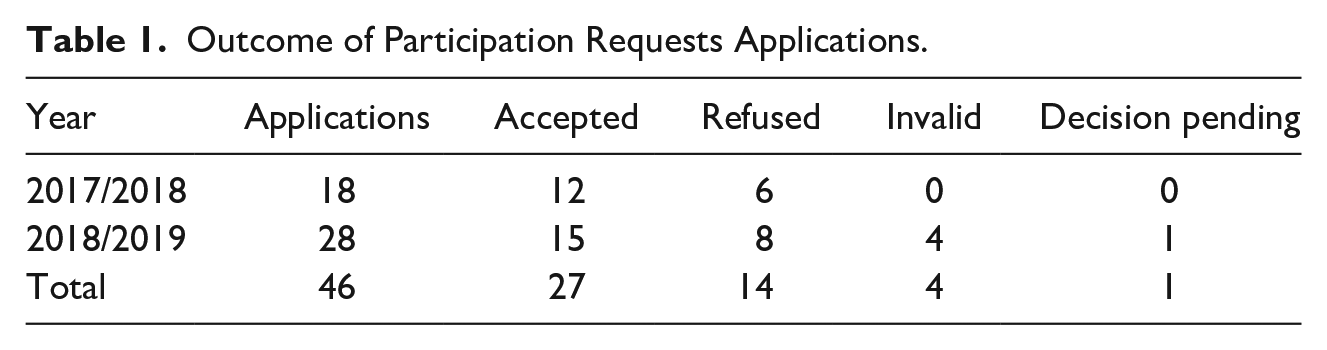
Young (2000) discusses external exclusion and states “citizens with formally equal rights to participate nevertheless have little or no real access to the fora and procedures through which they might influence decisions” (p. 52). According to the Scottish Government, Participation Requests are intentionally designed to address access issues through the direct participation of underrepresented groups or citizens; however, an examination of the data suggests otherwise. PSAs received 46 applications between April 1, 2017 (date of introduction) and March 31, 2019 (last reporting date). Of these 46 applications, they accepted 27, refused 14, deemed four invalid, and one was under review at the time of the latest reporting period. Local Authorities received most of these applications. Requests related to participation in decisions about how money is spent, land use, traffic management, road and pavement infrastructure, and representation on public body committees.
Table 1 suggests that the introduction of the Participation Request mechanism generated limited interest from community groups or citizens. The relatively low numbers (considering that it is an open process) alongside the fact that PSAs refused 30% of requests, raises questions regarding the political and organizational context. Participation Requests are available to a wide variety of informal groups, including those without a written constitution (Scottish Government, 2017, p. 8). Indeed, the term Community Participation Body seeks to ensure that organizations and groups with less resources than, for example, established voluntary sector organizations can use this participatory tool to access decision-making spaces. In this way, Participation Requests reflect the idea that DIs expand citizens’ roles through direct access to decision-making (Smith, 2009), albeit via a mechanism that also supports representation by organized groups. So, why are community organizations and citizens not using this legal tool to request a seat at the table? As discussed in detail below and summarized in Figure 1, there are multiple ways in which external and internal inclusion affects who and how applicants access the Participation Request process.
Outcome of Participation Requests Applications.
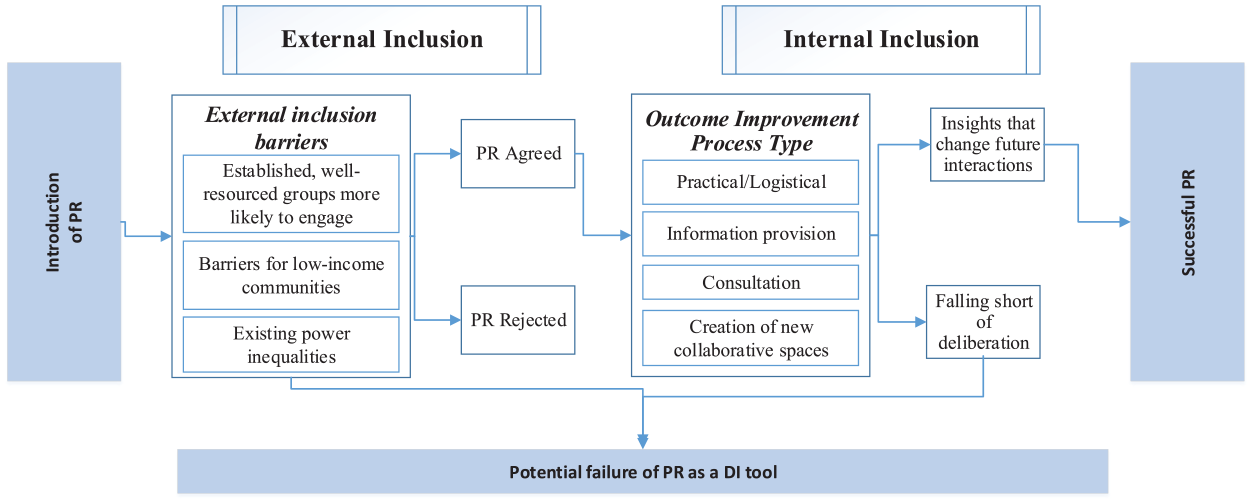
External and Internal Inclusion of Participation Requests.
Three inequality issues are visible in the Participation Request process: inequalities between professionalized community groups (or third-sector organizations) and informal community groups; variations in the capacity of community groups across neighborhoods and locations; and power inequities between state and nonstate actors in collaborative governance arrangements. First, and considering aspects of external inclusion, both community organizations and public authorities raised concerns prior to full implementation that well-resourced and established organizations would be more able to engage with the Participation Request apparatus than less formalized groups. This proved to be the case; Community Councils, established bodies experienced in aspects of policymaking and public service delivery, submitted 12 of 27 requests in 2018/2019 (with the rest submitted by a combination of local charities, development trusts, and a sports club) 4 and Community Councils were the most common form of CPB to submit Participation Requests across both years. Their use of the tool is unsurprising as there is a long history of complex relations between Community Councils and local government, Community Planning Partnerships, and the Scottish Government (see the appendix). Criticisms include their lack of democratic legitimacy and diversity in community representation, their absence or limited influence in many deprived areas, and that marginalized groups are unlikely to participate (Paterson et al., 2019; Raco & Flint, 2001). Despite these concerns, and the policy rhetoric encouraging access for all types of community groups, our analysis echoes existing research that identifies self-selection bias and participation of the most vocal, motivated, resourced, and well-organized (Dalton et al., 2003; Lightbody, 2017).
The second problem relates to the barriers for community groups in low-income communities. Respondents identified participatory inequalities as some communities did not have well-resourced groups experienced in engaging in public service decision-making (see also Lightbody, 2017; Skerratt & Steiner, 2013). As one respondent reflected, It’ll end up being twin-track in terms of the communities that are already mobilised and capable being more likely to use them, for example [name of wealthy neighbourhood], as opposed to communities that maybe aren’t quite so mobilised and capable are less likely to use them unless there’s some support. (PSA, 33)
As another respondent stated, We have some communities that are very forceful and very good at . . . or have traditionally been very good at getting their needs met and very insistent on their share of the budget as they see it . . . We also have communities that have struggled to get a voice . . . We felt that any community could actually have a conversation with us whereas only some communities have got the skills to go down a more formal route. (PSA, 28)
As such, the prescriptive and formalized design of Participation Requests may reduce participation for some communities or groups rather than increase it as policymakers hoped.
Finally, respondents raised concerns that the “requester versus approver” distinction strengthens the existing power inequalities between public authorities and the community sector. That is, powerful (state) partners remain responsible for creating, allowing, and implementing power-sharing processes. As one respondent stated, The public sector agencies are happy to have these conversations as long as these conversations are about things that they don’t mind handing over. When they [communities] start to want to shift this conversation to something more complex, there is a resistance . . . and then you start to find that their [PSAs] interpretation around certain things can vary a little bit. (CPB 7)
Our analysis of the application process found that Participation Requests empower PSAs to retain an authoritative control over participation in decision-making demonstrating how elites can determine the scope and conditions of participatory spaces (Dean, 2017). As one respondent explains, “Communities neither know of, nor understand, Participation Requests with the majority of the information coming through those organisations already sitting in a position of power” (Community Planning Officials’ survey response, 2018).
Internal Inclusion
Young (2000) conceptualizes internal exclusion as the “ways that people lack effective opportunity to influence the thinking of others even when they have access to fora and procedures of decision-making” (p. 56). As such, we ask, “Once a PSA approves a Participation Request, do groups gain an influential seat at the metaphorical table?” Following an agreed request, the PSA decides on an appropriate type of engagement through the design of an “Outcome Improvement Process.” We analyzed the 27 Participation Requests that PSAs accepted between 2017 and 2019 and identified four types of engagement (shown in Figure 1): (a) practical/logistical, (b) information provision, (c) consultation, and (d) creation of new collaborative spaces. First, practical/logistical responses refer to specific, often material, propositions. In these cases, the request and outcome followed a traditional demand–response relationship between citizens/communities and PSAs. For example, a PSA accepted a request to repair damage to a local park, agreed to undertake the works, and put in place an agreement to confirm ongoing maintenance. Second, information provision was often a PSA response to direct requests for information, but available data do not reveal whether providing information was a satisfactory response to community groups. Third, PSAs often responded with consultation processes in connection with existing processes such as the development of neighborhood plans or formal planning processes, for example: “It was agreed that the Outcome Improvement Process will operate by organizing consultation events at locations around [name of town] to engage with the local community. A maximum of five questions will be asked to gauge views and opinions” (PSA 10, Outcome Improvement Process Report, 2019). Finally, some responses referred to the creation of new collaborative spaces, including a PSA “collectively and collaboratively” designing the Outcome Improvement Process with the CPB, and a PSA and CPB co-producing a new application and scrutiny processes to increase community involvement in funding decisions.
The experiences and expectations of participation varied, specifically around the nature of relationships and communication. These are characterized in Figure 1 as (a) creating insights that may change future interactions between citizens and governing bodies, and (b) falling short of deliberation. The former is evident in respondents who felt that having a seat at the table was enough (even if it was not a deliberative or power-sharing experience) as the process enabled more insight into decision-making or greater information sharing: We now have access to the people who advise the councillors and what we’re now getting is direct decisions, why decisions are getting made. We’re now getting the opportunity to put in other concerns and raise questions and get answers. (CPB 4, submitted Participation Request)
The process created space for some PSAs to better understand communities, as well as vice versa: It has developed into communication and it’s being able to see somebody else’s point of view and it works both ways. He sees our point of view and we can see his point of view, so there’s a mutual understanding developed. (CPB 2, submitted Participation Request)
One could argue, therefore, that Participation Requests retain a key feature of a DI in that they create insights and experiences that may change citizens and governing bodies’ future interactions. However, PSAs operate in environments where politics and policy change rapidly (Meier et al., 2019). There is a risk that the tool falls short of meaningful deliberation as PSAs can complete the necessary bureaucratic tasks without substantively changing the way in which communities and administrative systems engage in reciprocal deliberation: I also suspect that even before the participation request was granted that [PSA] had made its mind up on what it was wanting to do, and the terms in which the participation request was granted . . . you felt they were trying to shove us sideways. They were adhering to the letter of the legislation rather than the spirit of it. (CPB 1, submitted Participation Request)
Organizational Cultures and Practices
Organizational cultures and practices heavily influence all aspects of external and internal inclusion. Existing bureaucratic practices reshape Participation Requests, notably through public service norms, language, and processes that require professional knowledge. To successfully submit a request and gain access to decision-making spaces, community groups and citizens require knowledge of the public service reform discourse (such as an “Outcome Improvement Process”) in addition to familiarity with local policy making processes and organizational practices. Instead of reimagining and remaking participation, bureaucratic language dissuades community groups from using Participation Requests and can create new (or reproduce existing) inequalities, with respondents describing the process and terms as “not community friendly.” Our research supports a view that the rise of governance-driven democratization carries the risk of reinforcing existing inequalities, in part because “the more points of access there are to government, the more advantaged are those with organization and resources” (Warren, 2009, p. 10).
Exploring inequalities in power, resources, and knowledge illustrates how different settings and actors rework participation and power in practice. Despite the Act and associated guidance outlining formal, legal, and prescriptive processes, local flexibility in usage remains. Some PSAs provide their own information on the desired outcome and participation options or employ local discretion when supporting community-led applications. As such, if the PSA, department, or local officer is willing to help community bodies understand the participatory context, they can transform exclusionary processes into inclusive ones. To illustrate this, a public sector officer thought it acceptable for applications to be very general and to create a more collaborative application process appropriate for the local context: It is very much engaging with them . . . there always has to be that initial meeting and discussion . . . because generally they come in general terms . . . there was an initial discussion about what would be the best way forward . . . and from that they worked out a plan that both parties were happy with to progress. (PSA 22)
However, some public sector officers and organizations adopt an alternative approach and simply refuse “incorrect” requests. For example, a PSA considered two applications invalid, stating, “No clear outcome indicated. Focus broadly on community planning” (PSA 20, Annual Report, 2019). Although the same annual report states that “dialogue took place,” this action does not have the same legal status as a Participation Request. Similarly, officers in a different PSA deemed two Participation Requests invalid: one because the request related to access to information rather than “improving an outcome,” and the other because there was “no outcome” included in the request. Community groups must therefore navigate the public service language and bureaucratic process as well as understand the local context, officer preferences, and “moral dispositions” that shape how such officers perceive and prioritize the work they encounter (Zacka, 2017, p. 66). In effect, the mode of participation is reconstructed in each PSA, with some employing a view that “participation is to improve outcomes, not necessarily because of a right to participate” (Dean, 2017, p. 6) while others adopting a collaborative, inclusive approach to decision-making spaces. Such actions echo assessments that bureaucrats hold and exercise a wide range of values and different perspectives on how to address policy issues (see Meier et al., 2019; Zacka, 2017).
PSAs exert control over all aspects of the Participation Request process, meaning localized variations in participation also reflect overarching organizational practices. PSA officers are often the first point of contact for those considering submitting a Participation Request, and they are also responsible for managing the Outcome Improvement Processes. For example, a Local Authority officer situated Participation Requests within council policies that encourage an informal approach prior to the submission of a formal application: Quite often if we hear that a group’s thinking about submitting a Participation Request, we’ll speak to them about what dialogue they’ve had with the council in the first place, because one of the things is that groups can sometimes find the actual timescales quite frustrating because we’ve a formal process to go through. So, actually if we can fast track that by linking . . . [to a] department and moving things forward, because people are happy to move things forward, then we’re keen to do that as well. (PSA, 22)
The Participation Request guidance (Scottish Government, 2017) states that PSAs can direct applicants to other engagement routes and many PSAs have alternative approaches such as employing community development specialists or operate other participatory processes. It is unsurprising therefore that some officers actively redirect potential Participation Requests toward other engagement spaces that they determine more suited to the applicant or to their own ways of working.
What is more striking, however, is how many organizations reframe Participation Requests as a tool of last resort rather than a new and additional participation mechanism to increase deliberative processes and decision-making. In effect, they use established practices to avoid political attention and scrutiny (Meier, 2019) associated with the Participation Request’s required reporting process. One PSA declares that “our aim is to minimize rather than maximize the number of formal Participation Requests received” through the use of existing engagement processes (PSA 25, Annual Report, 2018). Another states that the need to establish an Outcome Improvement Process would demonstrate a “failure of our support to communities and our Local Community Planning structures” (PSA 15, Annual Report, 2019), with a different authority stating that there have been no Participation Requests due to the success of other participatory mechanisms. Similarly, a further PSA believes that a formal approach should be the “exception rather than the rule” (PSA 28, Annual Report, 2018). Within all these organizations, there have been no recorded Participation Requests.
Discussion
This article examines the introduction of Participation Requests in Scotland as a form of democratic innovation (DI). Participation Requests illustrate Warren’s (2009) observation that DIs often emerge top-down, as a response to the functional needs of public administrations and policy processes. The Scottish Government introduced Participation Requests within the Community Empowerment (Scotland) Act, as a new system through which citizens could pry open the black boxes of public services to engage in deliberative decision-making. DIs, as defined by Elstub and Escobar (2019b), seek to reimagine the role of citizens by increasing opportunities for (a) participation, not just via intermediaries and established organizations but directly as residents, service users, and citizens; (b) deliberation, not just through conventional ways of eliciting public opinion but new ways of enabling public reasoning oriented to the common good; and (c) influence, that is, clear and coherent connection and impact on decision-making. The internal and external aspects of inclusion/exclusion (Young, 2000) explored in our findings illustrate how Participation Requests fare variably on these three dimensions.
In terms of participation (i.e., external inclusion, lowering barriers to participation) and influence, Participation Requests face several issues. The language and processes limit those who can engage, gatekeeping practices alter the ways that Participation Requests function at the local level, and even “successful” requests lead to interactions of variable quality between state and nonstate actors. The legal format and prescriptive design do little to disrupt existing power relations and instead mimic established bureaucratic power, and professionalized public service knowledge leads the (unequal) participation process. The focus on “outcomes” and evaluation processes reflects managerial trends to monitor measurable activities.
Participation Requests function as a prime example of a technocratic rather than participatory approach oriented to improving government performance. As such, they stand in great contrast to Bang’s (2005) research on “everyday makers,” which argues that citizens are more interested in direct action than in formal procedures. As Bang and Sorensen (1999) put it, everyday makers are “people whose political engagement is directed towards concrete problem solving in everyday life more than it is related to the performance of government” (p. 326). Although Participation Requests do offer a new opportunity and potential space for (some) community groups to challenge and engage with public services, the procedural, formal, bureaucratic process and language prevents meaningful inclusion in public service processes. Instead of a door into public service decision-making, our research found that Participation Requests are a small window, primarily for some established organizations to gain a better view of the backstage bureaucratic processes that shape decision-making.
Importantly, despite policy rhetoric to the contrary, we found that applicants are not necessarily entering a deliberative space where they can reason their way into, and then within, decision-making processes. Instead, often they are entering an “alternative resolution” route that has emerged tacitly from practitioners at the frontline—where they decide not to make progress through the formal (legal and reported) route but informally through other processes already in place. Hence, despite the overly prescriptive guidance created by national policymakers, Participation Requests are “alive” on the ground, shaped by PSA officers circumventing the overly prescriptive nature of the mechanism. This “alternative resolution” means that “refusal” of a Participation Request is not necessarily a bad result for the applicants. In this sense, on the ground, Participation Requests reflect practices of street-level bureaucracy where officers with variable dispositions and room for manoeuvre and discretion operate in ways contrary to the overriding policy diktat (see Lipsky, 2010; Zacka, 2017).
All in all, Participation Requests have the potential to be both a co-option mechanism for the placation of organized local interests and an emancipatory mechanism that allows new voices to shape policy agendas to enable co-production in public services. However, realizing that potential depends on the ecology of affordances and constraints of local administrative and political cultures. To date, with their preference for established community groups, they resemble an associative model that (problematically) assumes that existing groups and organizations can represent the diverse views of citizens and communities. Yet, nothing in the mechanism makes it inherently manipulative or emancipatory; it is context, culture, and agency that shape the meanings and practices that result. The learning from the early stages of this DI, as it finds its way into local governance in Scotland, emphasizes that governance scholars, democratic innovators, and system designers must pay careful attention to prescriptive top-down design processes as well as local and administrative cultures, resources, and existing dynamics. Participation Requests illustrate that, ideally, DIs should be designed through co-production between (various) institutions and communities, which could provide a participatory corrective to temper the technocratic logics that prevailed in the inception and design of Participation Requests in Scotland.
Conclusion
Through our extensive empirical research into the introduction and implementation of a governance-driven DI, we asked whether the introduction of Participation Requests in Scotland opens the door to decision-making in public services. Specifically, does the design and practice associated with such tools enable deliberation and power-sharing? Our study offers three key insights into governance-driven DIs. First, external inclusion and “getting a seat at the table” might be limited to those capable, with skills and know-how to take advantage of what is frequently perceived as complex legislation. Indeed, those who are “positioned” to take part in enacting Participation Requests evidenced a positive impact of the legislation on influencing local decisions, accessing information, and developing positive relationships with public governing bodies. What we observe is that while the introduction and rhetoric of Participation Requests suggest they are a democratic innovation, in practice they reinforce traditional forms of associative democracy. This is an important lesson for democratic innovation scholars and system designers.
Second, although the guidance acknowledges the importance of local knowledge and the potential of CPBs in improving outcomes, the prescribed process gives, probably unintentionally, those already with power (including some community groups and public authorities) the primary voice to determine the scope and conditions of participation. In short, local officers rework and reframe the offer of “participation” into their existing organizational systems, understandings, and preferences for working with communities, and often seek to circumvent the prescribed reporting processes.
Finally, some organizations interpret Participation Request submissions as representative of systems failure, which has the potential to create environments where applications are more likely to be refused, or not submitted. This is contrary to the intention of the Act, and of DIs more broadly, but indicates the way in which local context and perceptions of assessment processes can shape how DIs work in practice. Given that, unavoidably, there is space for street-level actors to subvert and adapt the policy, policymakers and public authorities may need to reconsider their approaches to opening up decision-making processes.
Our assessment must be tempered by the recognition that we have analyzed the early stages of implementation and reflect the issues that become apparent as legislation turns to implementation. At inception, all systems, but especially DIs, throw into relief the frictions and unanticipated consequences; practice shows “what works and what does not.” DIs require multiple cycles of learning and adaptation to bed in, negotiate their place in a given system, and navigate the disruption of, or co-option by, local administrative and political cultures (see Meier et al., 2019). It is likely that, in time, when Participation Requests are better recognized as a public participation process, other community groups and citizens—beyond those formally constituted or associated—may use this opportunity to participate in local decision-making.
Footnotes
Appendix
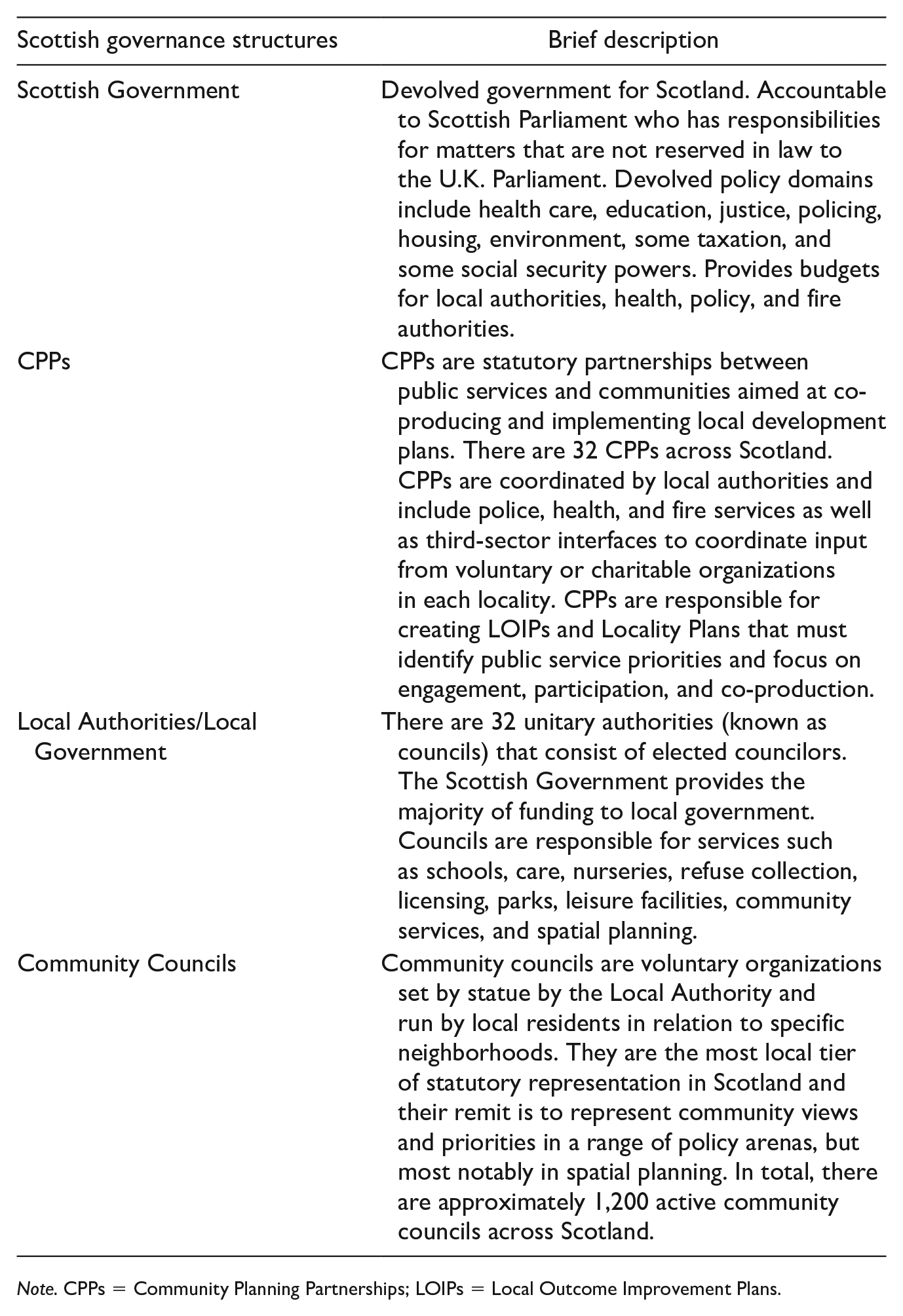
| Scottish governance structures | Brief description |
|---|---|
| Scottish Government | Devolved government for Scotland. Accountable to Scottish Parliament who has responsibilities for matters that are not reserved in law to the U.K. Parliament. Devolved policy domains include health care, education, justice, policing, housing, environment, some taxation, and some social security powers. Provides budgets for local authorities, health, policy, and fire authorities. |
| CPPs | CPPs are statutory partnerships between public services and communities aimed at co-producing and implementing local development plans. There are 32 CPPs across Scotland. CPPs are coordinated by local authorities and include police, health, and fire services as well as third-sector interfaces to coordinate input from voluntary or charitable organizations in each locality. CPPs are responsible for creating LOIPs and Locality Plans that must identify public service priorities and focus on engagement, participation, and co-production. |
| Local Authorities/Local Government | There are 32 unitary authorities (known as councils) that consist of elected councilors. The Scottish Government provides the majority of funding to local government. Councils are responsible for services such as schools, care, nurseries, refuse collection, licensing, parks, leisure facilities, community services, and spatial planning. |
| Community Councils | Community councils are voluntary organizations set by statue by the Local Authority and run by local residents in relation to specific neighborhoods. They are the most local tier of statutory representation in Scotland and their remit is to represent community views and priorities in a range of policy arenas, but most notably in spatial planning. In total, there are approximately 1,200 active community councils across Scotland. |
Note. CPPs = Community Planning Partnerships; LOIPs = Local Outcome Improvement Plans.
Declaration of Conflicting Interests
The author(s) declared no potential conflicts of interest with respect to the research, authorship, and/or publication of this article.
Funding
The author(s) disclosed receipt of the following financial support for the research, authorship, and/or publication of this article: This work was supported by: 1) What Works Scotland was funded by The Economic and Social Research Council and Scottish Government, grant number ES/Moo3922/1 , 2) Yunus Centre evaluation was funded by the Scottish Government funding reference: MAR312731.
