




Abstract
In research on policy learning, target groups’ responses have been insufficiently investigated. This article aims to expand the theory of policy learning by focusing on the effect of policy layering on disparity in learning among target groups, and its social consequences. Using the case of South Korea’s education policy, we show that policy layering to pursue multiple goals over 25 years has resulted in a complexly layered policy structure that has generated a discriminatory effect among different target groups and policy instability. We conclude that research on target groups renders implications for effective and ethical policy learning.
Currently, education policy has frequently been linked to social inequality and class mobility around the world (Bailey & Dynarski, 2011; Hoxby & Avery, 2012; Hyman, 2017; Reeves, 2017). Particularly in South Korea, a country where its “education fever” (Seth, 2002) is well known, a weird political landscape has unfolded around policy layering in college entrance examination policy since 1994. On one hand, one sees the policymakers having been exerting efforts to sophisticate policy layers to pursue academic excellence, social equity, and college autonomy simultaneously; on the other hand, there are the target groups who are the students and parents wrestling with preparing the national standard exam and application packets, with their complaints resonant over the burden to keep abreast of the complicated and frequently changing policy. In a survey performed by the Korea Education Development Institute (2018), simplification of the policy was selected as the second most important after the college tuition policy. A challenging reality is apparent in this contrast, as policy layering put forward to lead to sophistication of the system and aptly regarded as policy learning by policymakers is not always appreciated by target groups. If target groups find difficulty in understanding and complying with policy changes, can we even call them policy learning, only from the policymakers’ viewpoint?
The concept of policy layering has provided a concrete theoretical construct capable of reflecting the process and results of policy learning by policymakers and administrators, in response to political pressure to uphold the policy’s core goals (Bick, 2016; Daugbjerg & Swinbank, 2016; Mahoney & Thelen, 2010; Rudoler et al., 2019). This perspective assumes that policy layers become more sophisticated in response to the evolution of policy problems, political resistance, or simply single-loop learning from policy implementation (Bick, 2016; Daugbjerg & Swinbank, 2016; Wellstead et al., 2016). As the concept of layering has great potential to enrich policy learning research by acknowledging nonstate actors’ influence on policy layers, nonstate actors’ roles and responses need to be considered more seriously. In addition, the theoretical literature has traditionally focused on stakeholders who are visible and actively involved in the policy process, while attention has sparingly been given to the target groups who are relatively dissipated, invisible, and passive in the policy process. Although target groups may not be actively involved in policy learning process, their responses to policy layering can influence a political mechanism susceptible to policy instability.
The purpose of this study is to expand the theory of policy learning, by exploring the effect of policy layering on target groups when they are differentiated by their learning capacity. Specifically, we ask how policy layering aiming to improve outcomes of a policy by sophisticating its structure is perceived by target groups and consequently has a negative effect on social equity and policy stability. We focus on the historical unfolding of policy layering, disparities in learning among policymakers and different target groups, and their perceived distributional effects, particularly when target groups must actively spend great learning costs to get the most benefit from complying with the policy. By presenting a model of policy layering that affects policy outcomes through learning disparity among target groups, we aim to contribute toward a more comprehensive understanding of the theory of policy learning and feedback, as well as the theoretical tie between policy studies and public administration studies in the era of participatory governance. We adopt the South Korea’s National College Entrance Examination policy as a test case. Education policy is unique in terms of characteristics germane to its target groups. The target groups are fragmented rather than organized into strong advocacy groups, and not simply dependent on the policy benefits but must actively make commitments to the policy. The case may substantiate the theoretical model proposed in this article, by providing empirical evidence of policy layering and its consequences.
Theoretical Background
Target Groups as Part of Policy Learning
Historical institutionalism has understood policy learning mainly from the perspective of the state’s ability to adapt to changing policy environments (cf. Béland, 2010; Bennett & Howlett, 1992; P. A. Hall, 1993; Moynihan & Soss, 2014). Regarding the question of “who learns?” (Bennett & Howlett, 1992; Moyson et al., 2017), theorists have focused primarily on policymakers who possess official decision-making authority (P. A. Hall, 1993; May, 1992; Moyson et al., 2017; Rudoler et al., 2019). The concept of social learning, defined by P. A. Hall (1993, p. 278) as “deliberate attempts to adjust the goals or techniques of policy in response to past experience and new information,” and refined by recent studies (e.g., Berman, 2013; Grin & Loeber, 2006; C. M. Hall, 2011; Moyson et al., 2017; Pemberton, 2000; Suškevičs et al., 2018), has specifically highlighted policy learning as being stimulated by societal inputs of ideas and values. Although the concept of social learning implies the potential of mutual learning between the state and society, social learning has been understood from the standpoint of the state, focusing on policymakers’ “deep” learning from social inputs (Bennett & Howlett, 1992; Bomberg, 2007; Nykvist, 2014, p. 281) explicitly pointed out that the subject of social learning for P. A. Hall (1988) is “the officially-sanctioned expert operating in a given field of policy” (p. 5). Similarly, May (1992) saw social learning as entailing lessons about the social construction of policy problems, the scope of policy, or policy goals . . . by the policy elites of a given policy domain. . . . It involves a rethinking among the policy elites that comprise a policy domain of the dominant view about fundamental aspects of a policy. (p. 331, emphasis added)
When nonstate actors, who happen to be stakeholders, target groups, or the general public, are considered as another subject of learning, the central issue has been their role as allies to policymakers (Sabatier, 1987) or as service recipients who form their own social image in welfare policy (Schneider & Ingram, 1993; Skocpol, 1992).
In accordance with the increasing interest in participatory and deliberative governance (Dryzek, 2000), recent scholars have taken greater interest in the mutuality of policy learning. For example, Moyson et al. (2017, p. 162) defined “policy learning” as “adjusting understandings and beliefs related to public policy” (Dunlop & Radaelli, 2013), emphasizing the political over the technical aspects of policy learning. Newig et al. (2016), by using the term “governance learning,” emphasized how stakeholder involvement can contribute to the rise of new governance in a certain policy area. Recognition of citizens’ role in governance and policy decisions and implementation has also increased as deliberative governance has attracted increasing attention from scholars and practitioners (Brody, 2003; Dryzek, 2000; Freeman, 2006; C. M. Hall, 2011; Heikkila & Gerlak, 2013; Jacobs & Weaver, 2015; Klein, 1997). Accordingly, in the literature on policy learning and change, the role of nonstate actors has gradually shifted toward the center, but relevant theories have not yet developed fully.
Focusing on the role of target groups in policy learning merits unique theoretical attention. Because target groups are relatively dissipated and passive, they may not directly interact with policymakers to share the sorts of information and knowledge that lead to “mutual learning and better solutions” (Heikkila & Gerlak, 2013; Weber & Khademian, 2008). Instead, theoretical emphasis with regard to the target groups’ policy learning focuses less on policy solutions than on the way the policy actually communicates with and works for “targets,” so that the policy achieves its goals. In addition, theoretical emphasis can be on how target groups’ voices be heard for a better understanding of the constructivistic aspect of policy. That is, the issue of target groups in policy learning includes how policy is understood by them, how they respond, and how their responses affect the policy process and outcome. Eventually, as a better outcome signifies learning (Argote, 2013), target groups constitute part of policy learning even when not actively involved in knowledge sharing in the traditional sense.
Policy Layering
The concept of policy layering has been used to explain how a policy keeps its core purpose by adding new layers in response to political pressure for more substantial changes (Bick, 2016; Daugbjerg & Swinbank, 2016; Mahoney & Thelen, 2010; Rudoler et al., 2019). The resilience of a policy depends on “the availability of incremental reform options that can be used to patch the status quo” (Weaver, 2010, p. 137). Daugbjerg and Swinbank (2016) argued that policy layering “adds new policy instruments, or redesigns existing ones, to address new concerns while pursuing the original objectives” (p. 269). Some scholars also considered the revision of policy goals as a form of policy layering (Rayner et al., 2017; Vij et al., 2018). In comparison with concepts like policy conversion and drift, the conceptual core of policy layering has been political feasibility and the incremental nature of change (Bick, 2016).
Interestingly, not all scholars agree regarding the effect of policy layering on increased policy stability; policy layering is expected by some to contribute to policy stability when successful (Daugbjerg & Swinbank, 2016), but others suspect that it can cause policy instability (Vij et al., 2018; Wellstead et al., 2016). Some have emphasized the advantage of policy layering as the only feasible mode of policy change in the face of strong political opposition (Bick, 2016). They have suggested smart layering (Rudoler et al., 2019), which highlights public managers’ ability to maximize the benefits of policy layering. Other scholars have proposed the concept of tense layering, which refers to the increasing tension between layers as a result of adding layers that are not mutually coherent and supportive (Kay, 2007; Rudoler et al., 2019; Wellstead et al., 2016).
A Theoretical Model of Policy Layering
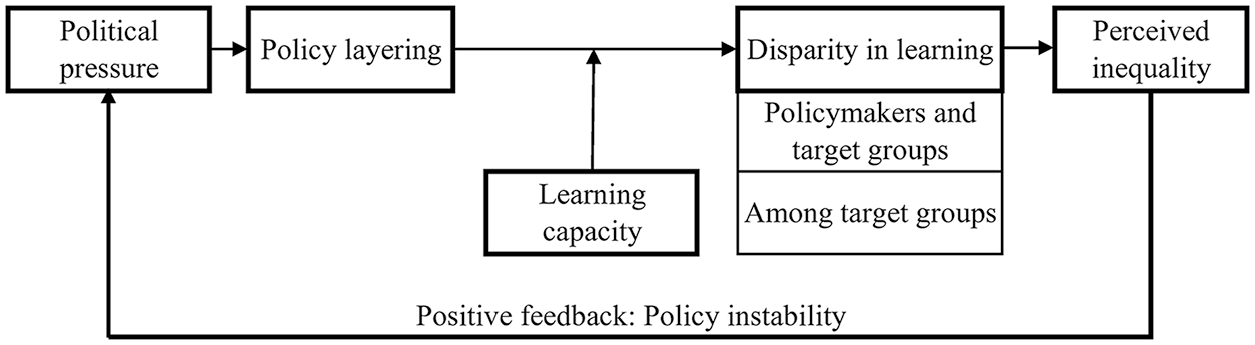
Given the debate on the effect of policy layering, here we explore a theoretical model of policy layering. Particularly, by highlighting the role of target groups, we hypothesize a relationship among policy layering, learning capacity of and disparity in learning among target groups, social inequality, and positive feedback. Figure 1 illustrates the hypothetical causal model of policy layering that summarizes the following discussion.
Theoretical framework.
First, as the concept of tense layering implies, policy layering driven by political pressure from different groups and ideas can incur self-undermining effects by gradually making the overall structure of the policy goals and instruments overly complex and inconsistent (Kay, 2007; Rudoler et al., 2019; Wellstead et al., 2016). Policymakers sometimes drive the addition of layers not to rationally improve the effectiveness of policy instruments but to defend themselves against political opposition. Political dissention between different ideological coalitions—where one side cannot overwhelm the opposing party—results in policy changes characterized by the addition of inconsistent layers to avoid severe social conflict (Moe, 1989; Vij et al., 2018). Although policy mixes may initially seem responsive (Kern & Howlett, 2009), pertinent actors may become confused by inconsistent policy goals and instruments that have become interwoven over time.
Given the gradual and cumulative nature of policy layers that incorporate heterogeneous goals and tools, it is likely that the complexity of policy layer structure prevents target groups from effective learning. That is, a complex multilayer system of policy would make it difficult for target groups to grasp the full picture of a given policy and judge how to respond to new layers (Pierson, 1993). Seen from this view, even smart policy layering from the policymakers’ viewpoint can be confusing to target groups who lack sufficient resources to decipher the overall policy. Whereas both “tense layering” and “smart layering” highlight the policymakers’ side, the heterogeneity and complexity of policy layering opens a way to reflect a shift in theoretical concern from the layering itself to pertinent actors’ interpretation thereof.
Policy layering then may cause disparities in learning: first between policymakers and target groups, and second among the latter. As the structure of a policy becomes more complex, not all citizens or pertinent target groups can grasp the whole picture of the policy as policymakers intend, which is the first-order disparity. Next, as not all target groups possess the same level of cognitive and material resources to understand the overall policy (Bianco, 2001; Milner, 2002), variance among people then constitutes the second-order disparity in learning.
The discriminatory effect of policy layering on learning can be exacerbated by the varied learning capacity of different target groups, which refers to the ability to follow-up policy changes by spending time and financial resources to collect relevant information. A policy learning process, from the target groups’ perspective, calls for their investment of resources in government policy with the expectation that the policy outcome will be beneficial to them (Pierson, 1993). Even when the benefits from learning exceed the costs, some can afford to spend learning costs while others cannot. As learning and commitment do not occur without costs, and not all actors can bear such costs to the same degree, the effect of policy layering on the learning disparity may be exacerbated by the level of learning capacity.
Finally, when knowledge of policy details is critical for target groups to maximize their benefits, the aforementioned disparity in learning may lead to negative consequences such as social inequality and policy instability. Those who can afford the learning cost will take the more advantageous position than those who cannot, under the information asymmetry. This distributional effect resulting from learning disparities among policymakers and different target groups raises the legitimacy issue of policy change; whatever universal goals it aims to achieve, policy layering will not be perceived as egalitarian if it divides people into groups. This equity issue usually invokes significant political pressure and ignites a positive policy feedback loop (Pierson, 1993). This loop would call for another layering to assuage the situation, which in turn would exacerbate the learning disparity and social inequality, again generating political pressure for another layering, and so on.
To explore the theoretical inference and enrich it through empirical evidence, we employed the case of education policy, specifically college entrance examination policy in South Korea. We focused on what happened in policy layering and how it became complicated over time as a result of pursuing different policy goals and adopting heterogeneous policy instruments; how policy layering interacted with different actors’ learning capacity to exacerbate the disparity in learning among policymakers and different target groups; and what consequences of the process can be observed.
College Entrance Examination Policy in South Korea
Method and Data
There has been a methodological call for historical analysis of issues such as policy learning and feedback, including policy layering (Bick, 2016; Wellstead et al., 2016), spanning more than a decade (Busenberg, 2001; Howlett & Cashore, 2009; May, 1992; Pierson, 1993; Sabatier & Jenkins-Smith, 1999). The case of South Korea’s College Entrance Examination policy offers an opportunity to analyze the long-term history of policy layering in detail, not only in abstract policy goals but very specific changes, because the government has comprehensively documented the specific elements of this policy in detail. We set the scope of analysis to cover about 25 years, from 1994 to 2018. This case represents a situation in which policy layers have gathered for years, so they have reached a level at which different actors are discriminated by the degree to which they can understand the policy’s structure. Annual adjustments of layers rendered the dynamic of policy layering, disparity in learning, and their social consequences markedly visible.
We collected information from government documents, previous research, and media archives since 1994 to trace all historical policy changes at both the instrument and goal levels, statistics, and relevant actors’ viewpoints. We first mapped every change that had been made with regard to the College Entrance Examination System (CEES). We then organized these changes according to three major layers: College Scholastic Ability Test (CSAT), high school transcripts, and application reviews managed by each college. Within each layer, we summarized details of the changes, including the adoption, revision, and abolition of sublayers. Second, the voices of target groups, including applicants, teachers, and colleges, in response to those changes were also collected. The report of the National Deliberative Polling Committee on the CEES (NDPCC) held in 2018 provides an especially reliable source of nonstate actors’ perspectives, as various representatives were given official opportunities to make their voices heard on the CEES, issue by issue. Finally, to analyze the social consequences and positive feedback of policy layering, we collected data from governmental and scholarly sources, governmental research institutes, and civic organizations. 1
Overview of the CEES and Its Contexts
Education in South Korea has always been linked to the issue of social equity because education factors significantly in one’s ability to achieve higher social status. The introduction of a new policy in 1994 was a path-breaking change in the history of education policy in three areas. First, a new national standard test called the CSAT was adopted and has remained as the primary criterion for use for student evaluation ever since. Along with this referential test, a high school transcript and college-specific tests were also instituted as parts of the policy. Although the details of these three areas have frequently changed, the layers have formed the backbone of the policy since 1994.
Some of the contexts around the CEES are especially illustrative of its goals and changes. First, the middle and higher education system has been stratified. Colleges have been strictly stratified from the top to the bottom by social reputations. Even private universities, which comprise 82% of higher educational institutes in South Korea, are so tightly controlled by the government through regulations and financial supports that there is no critical difference between private and public universities regarding admission policy (Weidman & Park, 2000). In addition, just like some prestigious private schools in the United States, prestigious special-purpose high schools specializing in foreign language, natural science, art, and international affairs have been considered as a stepping stone to lead to top universities. Although by no means being official, a perceived high school classification has been reproduced by these high schools and other competitive local schools.
Second, to gain admission to a better college (or special-purpose high school), most students (about 72.8% of elementary, middle, and high school students in 2018) spend money on private lessons and extracurricular activities, including for-profit private education institutes, personal tutoring, and government-managed internet lecture programs (Baker et al., 2001). The financial burden of private lessons has illuminated social inequalities as well as the ineffectiveness of the public education system, placing great political pressure on the government.
Finally, some policy advocacy organizations in the field claim different educational values and policies, but not directly supporting specific target groups. Parents and teachers have formed policy advocacy groups ranging from conservative to radical, and from pro-government to anti-government. Universities, some small nonprofit organizations (NPOs), and private lesson providers have also been active from civil society.
Policy Layering in the CEES
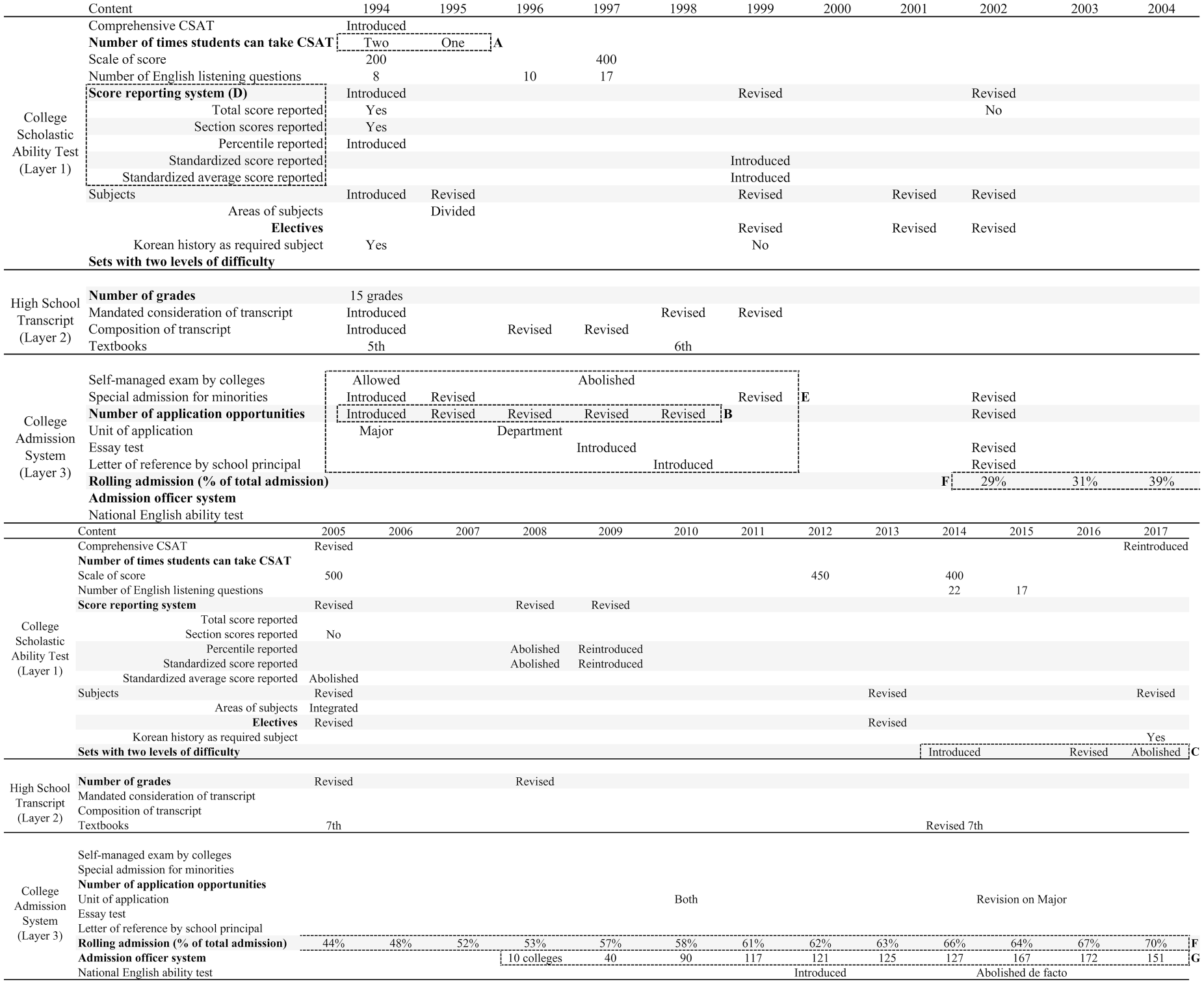
Figure 2 summarizes the changes of the CEES since its inception in 1994. As Figure 2 shows, the CEES has a multilayer structure (Rayner et al., 2017), consisting of three consistent major layers and numerous sublayers in each major layer. The layering cases discussed in this section will highlight the contrasting attitudes toward policy layering: For policymakers, they are rational responses to political inputs; for target groups, they are confusing and hurting equity. Below, we analyze the case according to three distinct aspects of layering: heterogeneous goals, experimental layering, and technical fine-tuning.
Changes of the college entrance examination policy in South Korea: 1994–2017.
Heterogeneous goals
The first characteristic of policy layering in the CEES is the influx of heterogeneous goals over time. The launch of the CEES in 1994 originally aimed at the overarching goals of enhancing academic excellence (Goal 1 hereafter), relieving target groups’ burden (including personal expenditure for private lessons; Goal 2), and improving college autonomy (Goal 3; Han, 1998). In the 2000s, enhancement of diversity in education (Goal 4) and equity in education quality and opportunity across social classes and regions (Goal 5) were added simultaneously.
The addition of the goals was intertwined with changes of layers. Box E in Figure 2 shows that for the first 6 years after 1994, numerous new introductions, revisions, and abolitions of sublayers came out to balance college autonomy (Goal 3) with burden relief (Goal 2). Those changes were related mainly to allowing each college to manage their own evaluation policy, such as a writing or oral examination in addition to the standard CSAT. At the same time, Box B in Figure 2 shows that the government revised the number of opportunities to submit applications to colleges each year between 1994 and 1998 to reconcile between burden relief (Goal 2) and college autonomy (Goal 3).
The year 2002 was another milestone, particularly with the introduction of rolling (early) admission to enhance diversity (Goal 4) and creativity (Goal 1) in high school education as well as equity (Goal 5) in college admission, which subsequently became a key element. As Figure 2 (Box F) shows, this key layer was revised each year until recently. A similar change was made in 2007, when the admission officer system was introduced to pursue both diversity (Goal 4) and autonomy (Goal 3). Over the next 4 years, the system expanded gradually (Figure 2, Box G) with regard to the number of colleges that adopted the admission officer system.
Overall, the case shows the lack of a direct correspondence between goals and layers over time; new layers were adopted to pursue multiple goals and revised to serve new goals accordingly. The pursuit of heterogeneous goals turned out to be the foundation of the complicated layer structure in the CEES.
Experimental layering
The second characteristic of policy layering in the CEES is that some layering was done in an experimental manner. As shown in Figure 2, many layers were added, revised, and abolished during the first few years. For example, with the adoption of the new system in 1994, two radical experiments were attempted: integration of the natural and social sciences which ignored the current high school curricula system, and holding of the CSAT twice a year that ignited an issue of consistency between the two exams (see Box A in Figure 2). Facing criticisms that these reforms only increased uncertainty, left applicants unprepared, and hurt the reliability of the nationwide test, both policies were abolished the very next year.
The most recent instance of experimental layering was the CSAT sets of two difficulty levels in 2014 (see Box C in Figure 2), designed to let students choose between difficult and easy sets according to academic ability and preference (Ministry of Education, 2011). Although the Ministry of Education (2011) announced that these changes aimed to relieve students of the burden of preparing for the CSAT (Goal 2), applicants preferred a simpler option to avoid uncertainty (Kyunghyang, 2013). Eventually, the system was abolished in two steps in 2016 and 2017, leaving social costs, confusion, and general distrust in its wake.
This kind of introduction and abolition of layers reveals the contrasting perception of policy layering. On one hand, the cases can be seen as the result of responsive and effective learning from policy feedback, which is the state-oriented perspective; on the other hand, they can be seen as relentless trial and error ignoring the target groups’ burden and preference. The overall history of the CEES tells that it corresponds more to the latter than to the former in that similar trial and error has repeated for the last 25 years.
Technical fine-tuning
Learning as fine-tuning is theoretically expected to cure potential inconsistencies among old and new policy instruments and enhance performance (P. A. Hall, 1993). However, the CEES case, as its last characteristic, shows that even the fine-tuning of the existing layers is perceived differently between policymakers and target groups, rendering itself not as purely technical as political, consequently leaving the layer structure unstable.
A noteworthy example is to set up the standard scale of the CSAT scoring system (see Box D in Figure 2). One issue was to set the criterion for transforming continuous raw scores into discrete intervals. This technical task turned out challenging, because a greater number of intervals would fuel student competition by more finely differentiating students (against Goal 2), while fewer intervals would reduce the discriminating power of the measure (against Goal 1). The frequent changes in this layer reflect the political struggle to arrive at a socially acceptable number of intervals.
Another heated issue was whether to use the raw or standardized score. As for the CSAT, the government has been increasing the number of electives to endow students with more options (Goal 4). The key to the success of this reform was to balance the difficulty level across electives and years so that students were not disadvantaged by what they chose (Goal 5). Technically, there is nothing wrong with those who took a more difficult elective receiving a higher standardized score. Politically, this was unacceptable because, as a high school teacher’s claim signified, “students have no control on the difficulty level, so it’s not their fault” (Ministry of Education, 2018, p. 220). This debate has not been resolved since the standardized score system was first adopted in 1999.
Learning Disparity Demonstrated
Increasing voices
Not surprisingly, while policymakers attempted to make the CEES more sophisticated, applicants frequently expressed preference for a simpler system. For example, one large survey of high school students, parents, and teachers conducted by a legislator and an nongovernmental organization (NGO) together (Noworry, 2017) revealed that 51.1% of parents thought the current CEES was “too complex,” and 45.5% “complex.” The problem is that, although applicants invest additional resources in their education to sail through the complex system, they suffer from the “Red Queen effect,” whereby additional effort to make oneself more competitive is immediately negated by similar efforts by others, so no one in the game gains an advantage (Derfus et al., 2008). Then, there is no point in enduring the complex system, so respondents’ prior concern was to simplify the CEES by removing redundant and confusing elements and putting the CSAT back at the system’s center (Ministry of Education, 2018).
Interestingly, after the introduction, revision, and abolition of layers at different levels from 1994 to 2013, the government had acknowledged the complexity issue and announced a plan to simplify the CEES, providing a roadmap for improvements (Ministry of Education, 2013). In this roadmap, the government admitted that the CEES was too complex and changed too frequently, resulting in an educational divide and harsh competition among middle- and high-school students (Ministry of Education, 2013, p. 1). Accordingly, the government emphasized the CEES’s simplicity and predictability to reduce the burden of parents and students (Goal 2), while retaining college autonomy (Goal 3), excellence (Goal 1), and equity (Goal 5; Ministry of Education, 2013, p. 2). Unfortunately, the aforementioned 2017 survey shows that this plan in 2013 failed to realize its goal of decreasing the perceived complexity of the system, and in a milestone deliberative poll on the CEES in 2018, many participants still criticized the system’s complexity (NDPCC, 2018). As a result, in early 2019, in response to this deliberative poll, another announcement was made regarding plans for simplification. In late 2019 again, the president made clear that the CSAT should be the backbone of the CEES, which was against the Ministry of Education’s stance at the time (Do, 2019). The Ministry of Education then announced that those colleges that increase the weight of the CSAT score in their evaluation criteria would receive government financial support (Korea Joongang Daily, 2019).
Deepened spending gap
The case shows that the complexity of a policy is not simply a matter of the amount of layers or information the government released but also a matter of the variance among people in the degree of learning in designing successful application strategies under severely competitive conditions. Under competition, what matters most is not how much one knows but how much more one knows than others, and how to maintain that advantage (Derfus et al., 2008). Even a small change of one element can be exploited to increase potential options (Daugbjerg & Swinbank, 2016; Pierson, 1993), adding perceived complexity to the policy layer structure.
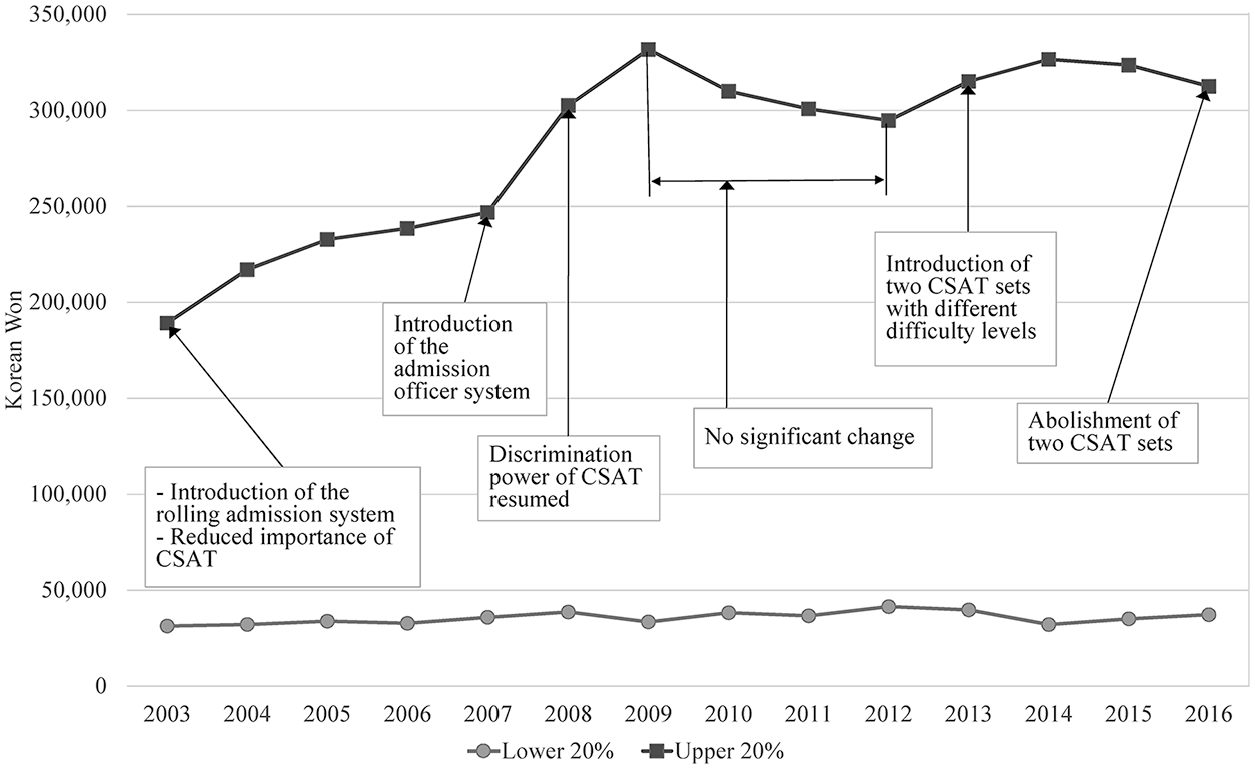
Statistics have shown that learning capacity in terms of educational spending differs quite dramatically across social classes. For example, Figure 3 illustrates that the educational spending gap in private lessons between the upper 20% and lower 20% increased steadily between 2003 and 2016. The lower 20% consistently spent less than Korean Won 50,000 (about US$40) per month every year, whereas the spending of the upper 20% increased by 150% to more than Korean Won 300,000 (about US$250) between 2003 and 2016. Second, spending has fluctuated for the upper 20% much more sensitively than for the lower 20%. Although no robust causality can be claimed between policy changes and educational spending, the fact that the expenditure of the upper 20% has been more elastic than that of the lower 20% reflects potential disparity in learning among target groups as the CEES has changed continuously.
Private lesson costs per student.
Perceived Social Inequality
As for the results of disparity in learning, political discourse has been dominated by the social perception of inequality regarding admissions results. Because there has been no comprehensive governmental survey on the admission results of colleges, anecdotal statistics of a few top universities have been used as a proxy of social inequality by the society. For example, the media has frequently reported that the socioeconomic status of students at top universities is much higher than that of average students. 2 Song (2018) found that the entrance rate to Seoul National University (SNU) explains 29.40% of the real estate value gap between “Gangnam districts,” a well-to-do district in Seoul, where parents lead the Korean education fever (Seth, 2002; Yang, 2011), and the rest of the city.
This issue has often been cited by the legislature. According to the 2015 annual legislative inspection, the ratio of students in SNU who graduated from privileged “special-purpose” high schools was 9 times higher than those in the other national universities (National Assembly, 2016, p. 178). Representative Yoo (2018) reported that the ratio of national scholarship recipients in SNU with household income within the top 20% was 41.3%, the highest among even major universities.
Anecdotal cases have also influenced the social construction of inequality. Some applicants co-authored academic articles with college professors who happened to be applicants’ parents or colleagues (Korea Herald, 2018). Concerns about nepotism and corruption were ignited, and, after a few reversals, most recently, the reporting of publications has been prohibited (Ministry of Education, 2019). Analyses of the student body at one of the top universities in the country have shown that an average of 48 awards and four-and-a-half extracurricular experiences were credited with the students who ranked the highest on school records (Jeong & Jeon, 2016), which was interpreted as a lack of fairness in student care. Accordingly, many participants in the NDPCC (2018) have pointed out that the system is “unfair, unreliable, and burdensome” (pp. 11, 19, 22).
Although these statistics and anecdotal issues with its focus on top universities do not tell us about overall social inequality in admission, they keep on inducing people to construct an image that the CEES is exacerbating social inequality and eradicating class mobility. This phenomenon illustrates how policy feedback would work when there is no objective measure to gauge a policy’s success or failure (Jeon, 2017; May & Jochim, 2013). The NDPCC’s ambitious attempt to solve this issue through participatory and deliberative governance, although having come short of reaching specific consensus on the way to revise the system, demonstrated the difference of perspectives between policymakers and target groups that fuels policy instability when the difference is ignored.
Discussion
Theoretical Implications
The case analysis emphasizes the two faces of policy layering when it imposes significant cognitive burden and learning costs on target groups. It may be sufficiently legitimate for policymakers to add layers in response to political pressure or learning from doing as the concept of policy learning implies; however, the case shows that policymakers’ learning is one thing, and the target groups’ follow-up and actual benefit is another. For target groups who lack sufficient resources, any policy and administrative changes or reforms may incur significant cognitive burden at the individual level, increase disparity in learning among different actors at the societal level, and lead to actual or perceived social inequality, which in turn leads to other unexpected consequences, such as policy instability and additional self-undermining layering. So this study suggests the need to investigate the potential effect of disparity in learning among policy actors that mediates between policy layering and its expected positive effects.
This study also suggests the need to develop contextual knowledge of policy learning that may vary dramatically depending on pertinent policy areas in which the characteristics of target groups differ. First, unlike the “distributive” social policy area in which target groups remain passive due to the negative social image as political dependents (Schneider & Ingram, 1993; Skocpol, 1992), advocacy groups and policy entrepreneurs exist who act on their behalf (Schneider & Ingram, 1993). The CEES case depicts a policy area in which government sets the institutional rules that target groups should know and follow, and those who know the rules better get more benefits. Second, changes in the CEES were not like adjustments of tax rates, pensions, or eligibility criteria that universally affect eligible people’s status and thereby invoke their collective political action; under the strictly hierarchical college ranking system, which is related to the attainment of higher socioeconomic status, applicants remain fragmented, and collective action and learning is not likely to be normal. The CEES case implies that in such a policy area, policy changes are likely to be ineffective, not necessarily because of poor policy design (Skocpol, 1992), but of the ignorance of the responding target groups.
Practical Implications
The analysis of the case raises an intriguing issue regarding the legitimacy of policy layering. The general view on policy learning assumes that policymakers are proactive. Experimenting with policy changes in response to feedback from pertinent actors and revising political goals have been considered as state capability and signs of adaptation (Brody, 2003; C. M. Hall, 2011; May, 1992). By contrast, the CEES case implies that policymakers’ layering has an ethical implication; that is, policymakers need to make a meta decision on “whether to change” beyond “what and how to change”; in fact, refraining from layering by considering the capacity and pace of learning by target groups could be as effective, socially equitable, and ethically desirable as proactive layering. In such a case, intentional simplification of the policy layer structure could be as important as sophisticated policy layering.
The case also proposes the potentially positive role of participation in the process of policy learning. Denhardt and Denhardt (2015) pointed out that performance measurement tools have neglected the role of citizens in developing measures, and that policy changes may gain legitimacy by incorporating citizens into the policy evaluation and decision-making processes. Analysis of policy needs from policymakers’ viewpoint may not be as accurate as that developed through deliberate inclusion of diverse target groups in a participatory process, as attempted in the case of the CEES through the NDPCC in 2018. It is not surprising that the most recent studies on policy learning pay increasing attention to participation (Heikkila & Gerlak, 2013; Newig et al., 2016). A broader institutional practice is warranted thereby to come closer to the theoretical understanding of policy learning as a process of mutual learning between the state and the society.
Conclusion
In this article, we explored the effect of policy layering in education policy and proposed a theoretical framework that highlights disparity in learning caused by policy layering among policymakers and different target groups. Based on the framework and the case analysis, we have suggested that more theoretical attention needs to be given to disparity in learning among different policy actors with focusing on target groups’ learning capacity, and that policymakers need to make a meta decision on policy changes for those changes to be effective and ethical. Although policymakers add and revise layers to realize policy goals, those additions and revisions can increase policy complexity and inconsistency to the point that some target groups may not be able to comply with, resulting in perceived social inequality and policy instability. Policy learning, therefore, needs to be understood in a broad sense to explicitly consider target groups’ point of view. In the era of participatory and deliberative governance, the theoretical exploration of this article dedicated to the target groups’ side in policy learning could expand the study of policy change and administrative reform.
Although the case analysis aimed to serve as a substantiation of the proposed theoretical framework, it should be noted that the analysis based on secondary data sources has a limitation in inferring a rigorous causality among policy layering, educational spending, and social consequences. Future research may benefit from collecting data at the individual level via survey by asking the target groups’ perception of the degree of policy layering, perceived level of policy knowledge, and actual response behaviors such as educational spending along with their socioeconomic status. As for a comparative design, the degree of policy layering may be measured objectively and be related to policy outcomes across different policy areas of different target group characteristics. As for further theory development, future research is warranted to investigate the general conditions under which policy layering and administrative reforms inhibit nonstate actors’ learning. Finally, studies on the psychology of policymakers and nonstate actors, as attempted by recent research on administrative burden (Barnes & Henly, 2018), could enrich our understanding of policy learning by providing a theoretical ground at the cognitive level.
Footnotes
Acknowledgements
The authors thank the anonymous reviewers and the editor for their constructive and helpful comments.
Declaration of Conflicting Interests
The author(s) declared no potential conflicts of interest with respect to the research, authorship, and/or publication of this article.
Funding
The author(s) received no financial support for the research, authorship, and/or publication of this article.
