




Abstract
A key theme in the research on bureaucratic encounters pertains to street-level bureaucrats’ opportunities for responsiveness when discretion is constrained by the introduction of standardized service delivery regulations, such as information communication technology (ICT). This article contributes to existing scholarship by exploring how low-discretion officials at the Swedish Social Insurance Agency Customer Center manage competing demands of making decisions that are built on regulations and simultaneously responding to the situation at hand and individuals’ needs. Analyzing real-time interactions using the conversation analytical concept of “offers of assistance” enables us to discover new aspects of interactional practices of responsiveness in standardized service encounters.
Introduction
Lipsky (2010) initiated a major research field when claiming that street-level bureaucrats often work in situations that are too complicated to reduce to programmatic formats and that regularly require responses to situations’ human dimensions. Therefore, discretion in citizen interactions is widely deemed essential for street-level bureaucrats to ensure the effective functioning of service delivery, combining rule compliance (compassion or consistency) with consideration of specific circumstances and individuals’ needs (flexibility or responsiveness; Hupe & Buffat, 2014; Lipsky, 2010). Demonstrating responsiveness to individuals’ needs and providing a personalized and flexible service to citizens are regarded as key aspects of the state government’s trust and legitimacy (Lipsky, 2010). Accordingly, researchers today debate the consequences for street-level bureaucrats’ discretion in the form of responsiveness to the situation at hand when a range of measures to standardize practices such as information communication technology (ICT) and other service delivery regulations are introduced within the public sector. In a research overview, Buffat (2015) has called for more empirical research regarding ICT’s impacts on frontline discretion to provide a deeper understanding of this complex phenomenon, specifically through examining how contextual factors other than technical solutions affect responsive decision making. In particular, it considered as essential that more studies are developed that account for contextual factors and complexity by observing actual interactions between officials and citizens to capture how the impacts of constraints due to developments within ICT and management are negotiated (Buffat, 2015). In addition, researchers put forth the necessity of gaining more insights into the experiences and practices of lower discretion officials of responsiveness in regulated encounters (Raaphorst, 2017).
This article heeds these calls by examining low-discretion officials’ phone conversation with citizens at the Swedish Social Insurance Agency’s (SSIA) national call center. With the help of recorded telephone calls, we study actual service encounters, not their outcome, but how service and responsiveness in the form of interactional practices are performed in strictly standardized contexts. With the help of recent developments in ICT, the SSIA “Customer Center” has, akin to many of its counterparts, been established as part of New Public Management–influenced reforms that seek to improve service by placing greater emphasis on efficiency, consistency, and responsiveness toward citizens’ or “customers’” needs (e.g., Bartels, 2013; Coleman & Harris, 2008). Such customer-oriented restructurings have helped to render frontline service delivery more prevalent in public organizations. In a comparative report based on public call center case studies, Dunkel and Schönauer (2008) have concluded that this frontline service workforce is an occupational group of increasing importance in the execution of the welfare state.
The SSIA Customer Center is a typical public call center in that it is characterized by high-volume, highly standardized procedures. At the same time, an important guiding principle is service delivery tailored to the situation and the circumstances of each individual. This aim places call-takers in a situation where they are expected to provide quality service at the same time as they, due to strict regulations, have limited mandate to deliver these services. The dilemma is not unique for the SSIA call center workers but applies to many other frontline service officials. As described by Lloyd and Payne (2009, p. 628), call center frontline work seeks “to deliver a very restricted service with anything outside of the job boundary being passed on elsewhere,” with “imposed strict limits on what workers could actually do when interacting with customers.” Hence, the job design reduces discretion and gives rise to difficulties associated with providing situation-oriented services, involving responsiveness to individual circumstances (Bélanger & Edwards, 2013). In Korczynski’s (2002) well-known conceptualization of this call center dilemma, an inherent conflict exists in “customer-oriented bureaucracy” between endeavors to combine the two conflicting principles of rationalization and standardization, and delivering a personalized service. In fact, the contradictory logics of standardization and customization constrain the call-taker’s core task to provide service by assisting callers (Korczynski, 2002, pp. 81–84). This conflict of interest “is a lived reality for participants within these service encounter contexts” (Kevoe-Feldman, 2015, p. 512).
At call centers, this lived reality of conflicting interests takes place in numerous daily conversations with citizens, characterized by the unpredictability that always accompanies human interactions (Schuppan, 2015). Conversations at a call center like the Customer Center appear to provide fruitful departure points for a deeper examination of street-level bureaucrats’ work when their resources for situation-orientedness and flexible responses are limited. With the aim of contributing to the scholarship on how constrained discretion due to standardizing service delivery regulations is managed, we are particularly interested in how these low-discretion officials perceive and deal with questions of responsiveness to citizens’ requests and the situation at hand in a highly standardized service encounter context. To this end, we conducted a systematic analysis of recorded call center conversations and interviews with this group of officials. The recordings of actual conversations enable us to study how the immediate social context affects responsive decision making. Inspired by conversation analysis (CA), we analyzed the call center conversations at a micro level using the concept of “offer of assistance.” By acts of responsiveness in citizen encounters, we mean acts that not only apply the authority’s regulations, but also consider the individual’s need for help in a particular situation. Offers of assistance are central interactional practices of this responsiveness (Hofstetter & Stokoe, 2015). Not the least, this centrality is evident from the fact that, in accordance with the authority’s routines, the Customer Center official always answer the calls by asking how (s)he can help the caller. Of course, there are other forms of responsive practices in service calls, but offering help is a vital part. The article examines (a) how the officials experience their opportunities to be responsive to callers’ requests or needs when service delivery is strictly regulated; (b) what the officials offer to do as a response to a request or need; and (c) how these offers are made and formulated, as well as in what situations and how they are answered.
With empirical attention to what happens “in-between” officials and citizens (Bartels, 2013, p. 475), the study also addresses calls for research on the role of the immediate social context and situational dynamics in frontline decision making (Bruhn & Ekström, 2017; Bartels, 2013; Nielsen, 2007). Despite the emphasis on interaction processes between street-level bureaucrats and citizens within this field, little research has systematically examined how the actual enactment of service delivery is made and how social interaction might affect decision making (Bruhn & Ekström, 2017; Bartels, 2013; Hand & Catlaw, 2019; Monteiro, 2016).
Previous Studies: The Impact of Standardized Developments for Frontline Discretion
The question of how standardized developments such as ICT and managerial reforms affect frontline discretion is contested. Researchers disagree about whether officials still have room to make responsive, personalized decisions. Such debate has been conceptualized through distinguishing between “curtailment” and “enablement” (Buffat, 2015, p. 151) or “continuation” (Evans & Harris, 2004, p. 874).
The curtailment thesis suggests that ICT and other standardizing regulations have negative and constraining effects on frontline discretion. According to authors like Bovens and Zouridis (2002) and Snellen (1998), in computerized public service delivery, street-level bureaucrats’ flexibility is significantly reduced. Due to ICT applications, street-level bureaucrats lose their intermediary or central position between the organization and the citizens. When their decision making is replaced by automatized assessments of cases, human “interference” in cases is eliminated (Snellen, 1998). According to Bovens and Zouridis (2002, p. 175), organizations transform into “screen-level” or “system-level” bureaucracies where the street-level dimension vanishes with ICT because contact with citizens no longer takes place in face-to-face encounters, and instead occurs behind screens.
Advocates of the enablement thesis object to the univocally negative image of how such new technologies affect frontline discretion (Buffat, 2015; Evans & Harris, 2004). Empirical studies strive to provide nuance by claiming that the mere adoption and use of ICT tools does not curtail discretion. For instance, in a comparative study of decision-making tools, Høybye-Mortensen (2015) has accentuated the importance of the technical solutions’ character, showing how a varying degree of standardization—and thus also of transparency and management control—is related to officials’ experiences of the tools as being intrusive or not. Moreover, in a case study of public agencies, Jorna and Wagenaar (2007) have demonstrated that ICT provides increased managerial control over formal aspects of organizational life, but that such supervision is unable to capture the informal dimensions of the decisions made by officials.
Another branch of bureaucratic encounter research highlights the inherent unpredictability of social interaction, which affects officers’ leeway for discretion. This factor is associated with the assertion that ICT tools can never be comprehensive in the sense of covering the diversity of what might occur in interpersonal encounters. In an interview study of one-stop government, where citizens receive access to several public services from a central call center, Schuppan (2015) argues that these highly regulated call center officials exercise discretion to successfully perform interactive work: Even if the use of ICT, as well as the controlling systems, restrict the day-today work of public servants in one-stop government call centers to some extent, the work itself is so diverse and uncertain, and the interaction with citizens is so situation-dependent, that the public servants are continuously required to improvise in the decisions about the adequacy of the information they deliver. They act as policy co-makers at the level of interaction between citizens and public administrations. (p. 258)
In criticizing Bovens and Zouridis’s thesis, Schuppan (2015, p. 259) concludes that although call center workers may be regarded as screen- or system-level bureaucrats, such a perspective is too mechanical to fully account for officials’ experiences of these non-face-to-face encounters. Schuppan’s conclusion has been supported by studies of tele-nurses based on systematic conversation analyses of recorded calls by Goode and Greatbatch (2005) and Greatbatch et al. (2005). These researchers have shown that despite the presence of an integrated telephony and computerized assessment system, which provides the basis for uniformity and standardized service delivery, tele-nurses use it in ways that enable them to deliver individualized service, adapted to the circumstances and needs of individual callers. For example, they depart from the routines prescribed by the system by reframing scripted questions and modifying the recommended advice. Greatbatch et al. (2005) conclude that tele-nurses’ discretion should be related to a situation-dependency that the system is unable to completely control, as it “will never cover the vast range of contingencies that confront nurses as they deal with particular cases” (p. 827). Similarly, studies of recorded encounters about applications demonstrate how social dynamics between public officials and citizens affect decision making (Bruhn & Ekström, 2017; Cedersund & Olaison, 2010). These authors show that although such encounters follow standardized procedures, they comprise a negotiated order that does not exist on its own, but is achieved in the ongoing interaction.
Yet, another branch of research has sought to add nuance to the curtailing effects of ICT and managerial regulations by arguing that officials do not always perceive constraints as obstacles to responsiveness. One example is a hospital case study by Checkland et al. (2007), which found that the implementation of a standardized system for electronic medical records had generated pressure to move away from a traditional model of personalized, flexible practice, yet the doctors did not experience any tensions. Instead, the respondents were able to uncritically adopt significant changes in their working practices while maintaining a rhetorical commitment to holistic and personalized care.
Other researchers have claimed that street-level bureaucrats do perceive such constraints as obstacles to responsiveness. For instance, Ellis (2011) and Thomas and Davies (2005) argue that these experiences of tensions engender critical manifestations of subversion when frontline officials critically reflect upon and resist undesired policies in their everyday practices. The empirical research on street-level bureaucrats’ strategies to find leeway for discretion to continue making personalized decisions is extensive (examples are Coleman & Harris, 2008; Collin-Jacques & Smith, 2005; De Witte et al., 2016). For instance, case studies of call center nurses (Goode & Greatbatch, 2005; Hanlon et al., 2005; Mueller et al., 2008) and social workers (van den Broek, 2003, 2008) illustrate how a traditional professional identity and knowledge are used to consider the situation at hand and meet callers’ needs. Identified expressions of resistance are to deviate from algorithms or prescribed questions, and instead rely on one’s own tacit knowledge and judgments, or letting the call take more than the prescribed time (Mueller et al., 2008; van den Broek, 2003, 2008).
However, research on street-level bureaucrats’ tendency to act on experiences of tensions due to constrained discretion is not unanimous. Indeed, some researchers have objected to the notion of critical reflections upon undesired regulations necessarily giving rise to active resistance. In a study of standardized formats for client interactions and documentation in social work, Matarese and Caswell (2018, p. 729) consider “restricted talk” as a consequence of the implementation of new standardized technology where both social workers and clients were conversationally constrained by the paperwork practices. The authors found that interaction was organized by documentation, characterized by routinization and effectivization rather than personalization. In an ethnographic study regarding the introduction of practice-regulating measures in child welfare, Wastell et al. (2010) have come to similar conclusions, identifying signs of reduced discretion that reflect how work has increasingly become structured into formal processes embedded in ICT, a shift that has given rise to workers’ critical reflections. Instead of active resistance aimed at maintaining a responsive approach, the authors detected the emergence of passive resistance (“Švejkism”), a pattern of formally conformant behavior in which ICT-regulated processes are obeyed, but without genuine commitment.
In sum, previous research indicates that the relationship between standardization, discretion, and responsiveness is complex. How standardization with the help of ICT is experienced and managed by public officials varies greatly. Thus, there is a need to continue the examination of other contextual factors than the technical solutions (Buffat, 2015; Schuppan, 2015), not least through considering the situation-dependent interaction between street-level bureaucrats and citizen (Raaphorst & Loyens, 2018; Schuppan, 2015). This study aims to fill that gap by further exploring the importance of the immediate social context for how questions of responsiveness are practically managed in the rule-saturated context of SSIA Customer Center service encounters. As told above, we do this by studying real-time interactions in the form of recorded phone calls. In addition, our study aims to supplement existing studies of real-time interactions by examining interactions of a less uniform occupational group with fewer common values and traditions than, for example, studied groups as nurses and social workers. The studied officials work in a context where, in one sense, low discretion is desirable to provide uniform, efficient service. Their work assignment, to deliver a highly restricted service, formally has a low level of “prescriptively granted” discretion (Hupe, 2013, p. 434). However, low discretion is not always desirable because the service assignment includes responsive citizen interactions; hence, occupational practice implicitly presupposes the use of discretion (Hupe, 2013). This study therefore follows previous street-level bureaucracy research by focusing on the latter, that is, “discretion-as-used” (Hupe, 2013, p. 435).
The Occupational Role of Customer Service Officials at the Swedish Social Insurance Authority
SSIA is a fundamental feature of the Swedish welfare system, transferring large sums of money into various benefit systems. Phone conversations are central to SSIA because they are a large part of the service the authority provides. One indication of the centrality of these conversations is the establishment of a special call center which citizens can call for getting personalized service. The Customer Center is the authority’s first point of entry for the public. Although SSIA, like many public institutions, is working on transferring services to digital channels to streamline citizen contacts, phone conversations still play a central role in the authority’s service performance. A lot of calls cannot be reduced. As much as almost 1,000 call-takers respond to a total of 4 to 6 million calls per year. Furthermore, physical meetings with citizens have been transferred to phone contacts, which has made the authority place even more emphasis on phone contacts. Today, it is mainly through phone citizens have personal contact with SSIA, a development reflected in many other public authorities.
The Customer Center was established 2007 in connection with the centralization of a locally governed social insurance system aimed at increasing efficiency and providing better service. The SSIA’s restructuring involved an internal reorganization of work, resulting in a clear differentiation between front and back office. The differentiation has—akin to that in many other reformed public organizations—been enabled by a standardization of procedures and workflows with the help of ICT. SSIA reflects a general trend toward standardizing reorganizations within public services through the modularization of services and the codification of knowledge (cp. Dunkel & Schönauer, 2008). As a consequence, the occupational roles of front and back office officials are practiced within the framework of their particular modules’ limitations and appropriate knowledge. Customer Center officials are specialized in providing services such as general information and answering simple questions about SSIA’s many compensations. The knowledge required regarding compensation is merely on a general level. Investigations and decisions on one’s right to compensation are the main tasks of the case managing back officials. The division is based on the authority’s centrally determined process descriptions, introduced as a means of creating increased uniformity. These processes provide strict regulations as to the “interface” between front and back office involvement.
The requirements for formal education are relatively low, especially when compared with the case managing back officials. No more than final grades from high school and a year of college studies or equivalent are necessary. The officials exhibit a diverse employment background: former salesmen in commercial call centers, and new graduates and experienced customer service workers within the SSIA’s various compensations. They have undergone internal training, which, in addition to basic knowledge about the regulations for compensation, concerns knowledge of internal ICT tools, computer systems, the organization of the authority, the website and self-services, and customer treatment.
Together with the centrally controlled telephone system, process standardization renders each working day at the Customer Center strictly regulated. There are regulations for what and how things should be done in a call. During a call, the official looks at the case on the screen via the SSIA’s case management system (ÄHS). With the help of ÄHS, the official can then provide information about ongoing, back office–handled matters to the caller. Officials are unable to directly connect the caller to the responsible back office official. In this way, they play the role of service providers as well as gatekeepers. The job design is typical for call centers in that service providers are interchangeable, with only single interactions between call-takers and callers, and all work being undertaken within the framework of the call (cp. Dunkel & Schönauer, 2008; Kevoe-Feldman, 2015).
In addition to demands to follow standardized regulations to provide an efficient and uniform service, officials are expected to be responsive to individuals’ requests or needs. SSIA’s recruitment criteria state that “[t]he customer service official is the customer’s first personal contact with the Swedish Social Insurance Agency and has a decisive role in exceeding the customer’s expectations of treatment, quality service and accessibility.” The formulation about “exceeding customer expectations” forms part of the authority’s general vision as well. The idea about providing service that goes beyond what is normally included in the authority’s assignment is a result of SSIA’s increased customer orientation in recent years. According to the recruitment criteria, “service orientation” is “a very important characteristic” that, among other things, pertains to the call center employee being “flexible concerning the wishes and need of others.” The Customer center contacts are central to the agency showing responsiveness to citizens. However, these calls are the most strictly regulated by the authority. Deviations from standardized routines that may be required to exceed expectations or being flexible are prevented by the system together with an organizational culture at the Customer Center that dictates a strict rule adherence and the officials’ low mandate and often limited knowledge and work experience.
Analytical Approach: “Offers of Assistance”
As indicated above, at the Customer Center, the core task is to provide service by helping callers. As indicated above, in this study, we focus on “offers of assistance” to systematically analyze interactive service work in the corpus of the recorded conversations. Offers of assistance are regarded as interactional practices of responsiveness. Hofstetter and Stokoe (2015, p. 727) regard offers as “the bedrock activity of service provision and other institutional settings, such as call centers or doctors’ offices, as well as a regular activity in everyday social life.” In line with Curl (2006, p. 1258), the present article investigates situations where “one speaker (the offerer) proposes to satisfy some want or need of the recipient’s, or proposes to assist in the resolution of a difficulty or misfortune experienced by the recipient.” Offers may be formulated in many different ways, such as in the form of a question like “Do you want any pots for coffee?” or as a proposition like “I’ll bring you a peony when they flower” (Curl, 2006, pp. 1257–1258). In this article, “offer” is defined with the help of Couper-Kuhlen (2014), the “self” being an agent (i.e., the offerer undertakes the action required to bring about the future state), and the “other” being a beneficiary (i.e., the recipient attains the object or assistance of the offerer).
In our analysis, we use Hofstetter and Stokoe’s (2015) three-part typology within an “offering” sequence in institutional settings. These authors’ conclusions were based on CA of interactions between British constituents and politicians, focusing on offers of assistance. In “proposal offers,” which usually appear first in an offering sequence, a suggestion to help and a request of approval to act are made (e.g., “Do you want be to . . .” or “We could . . .”). “Announcement offers,” which appear second, indicate that something has been decided, and confirm the intended action (e.g., “I will do this . . .”). “Request offers” appear third and refer to the offer being available but unable to be finalized until the present conversation has ended (e.g., “Let me do this . . .”; Hofstetter & Stokoe, 2015, p. 730).
Data and the Analysis Process
When calling the Customer Center, the caller is initially required to choose between different compensation entries. This study is based on calls in the two case streams where the selected compensations (sickness compensation [SC] and child care allowance) are included. SC is a form of compensation for adults who will probably never be able to work full-time due to disability or illness. Child care allowance is support for parents caring for a child with a disability or long-term illness.
The total number of recorded calls to the Customer Center was approximately 1,400. The duration of the calls varied between 0.20 s and 23.52 min. The recordings were made in fall 2017. The study was undertaken with informed consent received from all participants, and was approved by the Swedish Ethics Review Board. The theme identification of offers of assistance was partly made by listening and partly based on a selection of rough transcriptions of recordings. Based on this initial analysis, 43 conversations were selected for detailed transcription and further analysis. These 43 calls contained offers that were in line with Couper-Kuhlen’s (2014) definition. The call duration for our sample was between 1.46 and 16.06 min, with an average call of 6.03 min. The sample was based on “theoretical saturation” (Glaser & Strauss, 1967, pp. 61–62), that is, we recognized that the possible variations of offers and their associated problems had been exhausted. This meant that the new recordings no longer contributed to the analysis because the same types of offers and situations reappeared, merely confirming already detected aspects. Our saturation point determined the sample size, as it indicated that an adequate number of recordings had been collected for detailed analysis. Hofstetter and Stokoe’s (2015) distinctions were utilized to answer the second and third research questions regarding what call center officials offer to do in response to a request or need, as well as how these offers are made, formulated and in what situations and how they are treated. For this article, a few anonymized conversations were selected with the purpose of exemplifying the results of the analysis.
Interview data were utilized to answer the first research question concerning public call center officials’ experiences of their opportunities to fulfill callers’ needs when the forms for service delivery are strictly regulated. Interviews, lasting between 1 and 1½ hr, were conducted with eight call center officials and their local manager. Officials from the two case streams were evenly distributed. The selection of respondents consisted of officials who had consented to recordings. This enabled us to relate the call-takers’ conversations to their understandings of the calls. Central interview themes comprised the respondents’ comprehension of their occupational role and role expectations, their approach to the standardized framework, and possibilities to provide the requested service. Interviews were recorded, transcribed, and analyzed. In this article, some citations are used as illustrations.
Results
Challenges in Creating Meaningful Encounters
The interviewed officials described how front and back office modularization generates limited opportunities to provide callers with adequate help. In accordance with their specific module, only general knowledge is required and they lack the authority to make decisions in individual cases. One interviewee highlighted how these conditions would give rise to a sense of being superfluous: Sometimes I think it’s almost unnecessary for the customers that they have queued for so long, and then they come through to me, and then I cannot help them. It’s still a case manager who has to call them up. (Childcare Allowance [CA] Official 2)
One’s limited mandate and expertise can create feelings of dissatisfaction about being unable to fulfill the service assignment as desired: Sometimes you can almost feel a bit insufficient, because you really want to help the customer. . . . There are a lot of things you think you should know, but at the same time, it’s not part of my interface . . . I am not supposed to know this. . . . Often, you end up writing a message to the case manager so that somebody can call them [the customers] back. (CA Official 2)
These experiences reflect the tensions (as also described in previous research) that can arise when ICT and other standardized regulations obstruct consideration of the situation at hand. It was stated above that Customer Center officials are expected to make decisions based on regulations. At the same time, they are required to be flexible regarding individuals’ needs, and must exceed customers’ expectations of treatment, service, and accessibility. The respondents’ understanding of the latter being part of their responsibility is evident in the following quotation: “We are in fact supposed to be a service unit, and be humane, and what this whole vision says . . . is that we should be close to the citizen. So that’s an important part” (SC Official 2)
Accordingly, the interviewees talked about their endeavors to give the calling citizens as personalized and flexible help as possible also in situations where they were unable to give solutions to requests owing to the regulations. Such commitment to responsiveness is explicitly stated in the following: But you still have to do everything for the caller to be . . . that’s what I’m striving for when I go home at least, that no one I have talked to should be able to say that I have not tried to help. Even if I haven’t been able to, they should always feel I have tried and that I have done everything to make it good. (SC Official 1)
Officials’ efforts to display their eagerness and ability to help despite the restricted mandate can be seen as expressions of “sense-making” in their work, creating a meaningful understanding of their occupational self (Arevshatian & William, 2015). As a consequence, a recurring theme in the interviews comprised revelations of a strategy to accentuate the help that can be offered within a call: You need to try to see it as something positive, that “I help you with this,” to regard it as something positive rather than trying to explain what you cannot help them with. You still try to find some kind of solution. (CA Official 3)
Such demonstrations of a willingness to help in problematic situations where the assistance requested cannot be given due to the regulations may be interpreted as a means of giving meaning to the call and hence oneself as a call-taker. In the following four sections, how these efforts can be expressed in concrete interactions with citizens is examined.
Offers of Intermediary Services as Solutions to Problematic Encounters
In the corpus, a distinct pattern was detected between the kind of service requested and the call center official’s reply. A distinction can be made between “unproblematic situations” in which the official, within the scope of her or his competencies or mandate, is able to provide assistance that corresponds to the request, and “problematic situations,” where limitations in the occupational role instead generate an offer of a different form of assistance from that initially requested (Table 1). When simpler services are required, such as sending an application form or providing general information, the request is usually followed by the assistance that the official can provide within the context of the call. If more complex services are required, for instance, comprehensively answering questions about the status of a submitted application, the request or need cannot be properly met during the call. The analysis here shows that Customer Center officials’ limited opportunities to help callers inhibited their contact. In the corpus, an official frankly declaring an inability to fulfill a request never occurred. Instead, offers of alternative assistance were given as solutions to the problems encountered. In the corpus, the suggested solution, which did not necessarily correspond directly with the caller’s request, consistently contained an offer of back office contact. Hence, the offers could be regarded as a personalized form of help in the sense of considering the individual’s needs by providing a back office entrance.
Caller’s Service Request or Need and the Official’s Ability to Help.
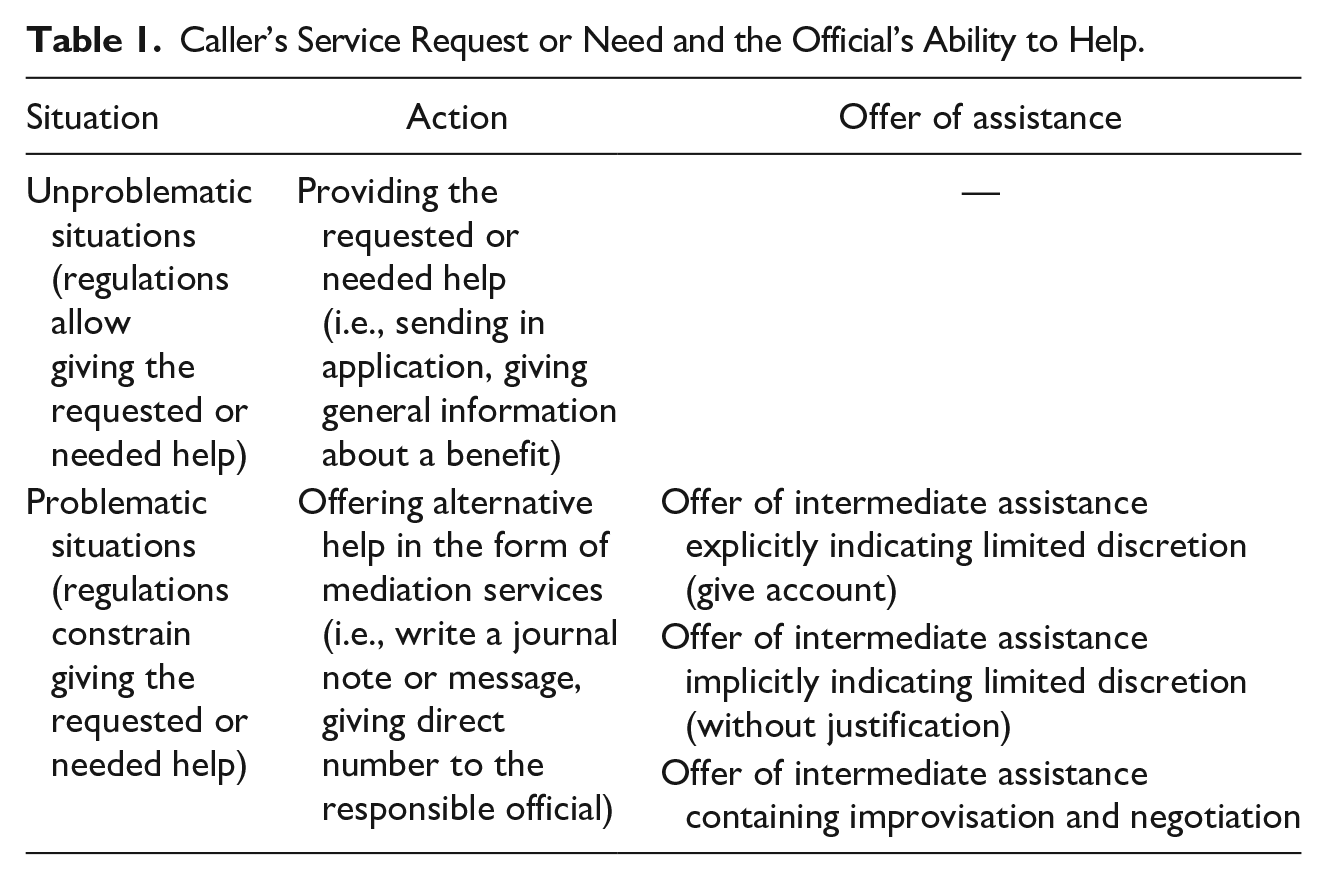
In these “problematic situations,” the issue of responsiveness reaches its focal point, necessitating more careful study. Therefore, in the following analysis, we will focus on encounters where rule-saturated context complicate service delivery performance. In the calls, the mediation service is offered in two main ways: an offer to write a journal note or message (“conversation”) in the ÄHS or, if the caller’s case is currently processed by the back office, an offer of the responsible manager’s direct number. According to the regulations, when receiving a journal note or message, the back office should contact the caller within 48 hr (Table 1). Offering back office contact is not prohibited, but SSIA considers these “handovers” undesirable because they counteract the Customer Center’s purpose to achieve greater efficiency by relieving back officials.
These alternative offers can in themselves be regarded as interactional strategies as a way to deal with questions of responsiveness in situations where discretion is constrained, thereby fulfilling the occupational role’s expectations of flexibility regarding the situation at hand and individuals’ needs within the strictly regulated service encounter context. In the following, more precise attention is paid to how offers of intermediary assistance are given as solutions to the contact problems encountered, as well as how these are formulated and addressed. Through applying the offer of assistance concept, we explore in detail how this mediation service is constructed in conversations. Our analysis demonstrates that variations exist with regard to how frontline officials offer to transfer cases to the back office in problematic situations. Furthermore, the interactional practices identified reflect different ways of balancing competing demands of rule conformity and citizen responsiveness. On one hand, we identify offers that explicitly or implicitly indicate the problematic nature of the situation. The call-taker demonstrates that due to a lack of mandate or knowledge, (s)he has limited opportunities to provide the help requested, the solution that can be offered within the call instead constituting mediation service. Such offers indicate that the officials’ restricted discretion and hence ability to solve the problem is related to not being able to give solutions to requests during the conversation. Explicit ways of indicating limited discretion give account for not being able to help. In these situations, a justification is given for the lack of opportunity to help by invoking their limited discretion. When implicit ways are used, no such justification is made. Offers of alternative help are given without explaining why the requested help cannot be provided. On the other hand, we note that problematic situations might also contain improvisation regarding the kind of mediating services offered. Such improvisation indicates the use of discretion (within the restricted mediating role) that is negotiated in the interaction (Table 1). In the following three sections, examples of these different offers of intermediating services are presented.
Offers of Intermediate Assistance Explicitly Indicating Limited Discretion
First, offers of intermediate service that demonstrate responsiveness as well as a limited ability to help are presented. Example 1 illustrates an offer of mediating assistance that explicitly indicates the problematic nature of the situation due to a limited mandate. The caller requests a decision about his SC application. According to the SSIA regulations, a submitted application is entirely handled by the back office and the only available knowledge is given through these officials’ registrations of their actions in ÄHS. After declaring that he will read the caller’s journal on the screen, the official informs the caller that he can see signs of the responsible official working on the case: Example 1 SC13 00.49-01.02 29 CT: exactly and I see that she has (0.5) registered here then that (.) they will 30 look through your case here during the day 31 h so it looks like she’s looking at it so do you 32 C: direct number? 33 CT: direct (.) have you got Monica’s direct number? 34 I know she had sent a letter to you before with that 35 C: she has sent a letter 36 CT: yes with a phone number to her (.) you haven’t still got it? 37 C: Yes (.) I just didn’t ask about the telephone number I asked if she has made a decision
The answer can be interpreted as the front official providing the restricted solution he is able to deliver due to the work regulations, although it does not provide a complete answer to the caller’s question. The fact that the call-taker immediately asks about the direct number to the responsible administrator (line 33) can be understood as an attempt to solve the contact problem while still exhibiting responsiveness to the caller’s request. However, the subsequent section shows that the caller (in accordance with the SSIA’s regulations) already has the direct number. The caller does not accept the proposed solution, rejecting the phone number and repeating his initial request (line 37). When returning a bit later in the conversation, the caller once again repeats his question about a decision. The official replies: Example 1 SC13 01.34-01.50 55 CT: no (.) she has looked at the case during the day today but there is no decision (.) so I 56 cannot see what she has done but I can see that she has been looking into the case today 57 C: mhm 58 CT: if you want to (.) you can get her direct number if you haven’t got it 59 then you have the opportunity to contact her at once 60 C: no I wait till tomorrow and call you again
By using the negative formulation “there is no decision (.) so I cannot see what she has done” (lines 55–56), the official now more openly articulates his limited opportunities to fulfill the caller’s request. However, accentuating the help he is able to deliver immediately follows the rejection: “but I can see that she has been looking into the case today” (line 56). This addition is congruent with the responsive strategy revealed in the interview analysis, handling the restricted mandate by emphasizing the service that one may provide. Nonetheless, the suggested solution to the contact problem is the same: the caller contacting the responsible official. This time, the phone number issue is formulated as an explicit proposal offer: “If you want to (.) you can get her direct number” (line 58), in which the benefit of the offer (Clayman & Heritage, 2014) is also emphasized: “then you have the opportunity to contact her at once” (line 59). At the same time, with the formulation “if you haven’t got it” (line 58), the official states the possibility that the caller already has the phone number. This offer is actually given, and its benefits are even emphasized, despite the fact that previously in the call it was evident that the caller already has the number (lines 33–37). Together with the caller earlier in the call (line 37) not treating the direct number as a benefit (cp. Clayman & Heritage, 2014) by refusing it, this example indicates the restrictiveness of the solution offered. The caller clearly rejects the proposed solution by saying “No” (line 60). Instead, he announces his intention to solve the contact problem by himself (calling the Customer Center another day; line 60).
Restricted discretion might be more directly addressed, even if such formulations appeared less frequently in the recordings. Example 2, as one of the exceptions, shows how offers of intermediary services can be made in connection to an even more explicitly formulated limited mandate. In the example above, the detailed rules regarding the application of SC are actualized. Previously in the call, the call-taker explained how, based on her knowledge of the general compensation rules, the caller is not entitled to compensation. However, the caller insists that she should be allowed, referring to previously accepted applications. The call-taker replies: Example 2 SC6 04.58-05.14 180 CT: . . . and it is up to the case manager to approve that .h and have you received 181 an approval then it’s totally 182 C: [yes 183 CT: I can say here then .h at customer center then or- eh these are the rules 184 I can only tell about (.) the gen[eral rules then 185 C: [right 186 CT: so I send this to a case manager then she will contact you 187 C: [yes
In the same way as in Example 1, the official, “forced” by the caller’s persistence, finally talks in negative terms about her opportunities to help. However, there is a crucial difference. The official in Example 1 emphasizes the preferred actions by saying, “I can’t see what she has done but I can see . . .” (line 56), thereby referring to what he can do in the conversation without explaining his limited discretion. The official in Example 2 instead firmly declares, “I can say nothing” (lines 181–183) and “I can only tell . . .” (line 184). The subsequent offer of a less preferable action (intermediary services, line 186) is accounted for by referring to her limited discretion (lines 181–184). Unlike in Example 1, where the offer is formulated as a proposal, this offer is presented here as an announcement: The official declares her intention to transmit the request to a back official (line 186). The use of an announcement offer can be interpreted as a form of compensation for having considered the less preferable action (referring to limited discretion) by nevertheless showing determination to help. Unlike the offer in Example 1, this offer is accepted (line 187). We will return to the use of announcement offers.
Offers of Intermediate Assistance Implicitly Indicating Limited Discretion
The previous section examined officials’ handling of contact problems that implied making one’s constrained discretion explicit. This section further explores how questions of responsiveness can be managed in a way that more implicitly invokes one’s limited ability to help. Example 3 illustrates how restricted discretion might be implicitly suggested alongside a demonstration of responsiveness to individuals’ needs through offering alternative personalized help. After providing a detailed account of her poor health and economically vulnerable situation, the caller requests the status of her recently submitted SC application (line 73): Example 3 SC52 01.54-02.04 73 C: . . . and then I wonder (0.5) how far you have come with that 74 CT: yea it’s actually just arrived but what we can do like 75 you will get the number to your case manager 77 C: well (0.5) then I’ll just get a pen
The official’s declaration that the application has “actually just arrived” (line 74) is probably based on reading back office information on the screen. Consequently, the answer she can provide concerning the status of the case is limited, but this is not explicitly declared. Without ascertaining whether this answer is satisfactory to the caller, the statement is directly followed by an offer of assistance: “but what we can do like
Example 4 provides a further illustration of an offer that simultaneously indicates limited discretion and an inclination to help. In the conversation, a parent starts to thoroughly describe her child’s increased need for care. According to the SSIA regulations, an altered need may entitle an individual to increased child care allowance. It is evident that the caller regards a detailed description during the call as relevant. However, according to the regulations, the front officer does not have the mandate to proceed with the case. In other words, the caller has an alternative understanding of the call-taker’s discretion, akin to Examples 1 and 2. Finally, the official interrupts the parent’s statement through an offer: Example 4 CA35 02:20-02.29 33 CT: because what- what I could do then that is that I e:h I write down a bit of what you tell 34 me and then I 35 C: yes because this is very difficult
In this example, the call-taker does not explicitly declare her inability to provide the help requested. Instead, just like in Example 3, she responds by making an offer of intermediary services. As in Examples 2 and 3, the caller is not expected to answer “yes” or “no” to the offer (lines 33–34). According to Hofstetter and Stokoe (2015), announcement offers enable politicians to appear proactive and helpful in their interactions with constituents. In being announced rather than proposed, the offer thus “shows that [the] office is determined to help; in the face of failure to assist adequately so far, the office may appear weak, inept or not trying hard enough to be of assistance to the constituent” (Hofstetter & Stokoe, 2015, p. 74). In accordance with Hofstetter and Stokoe’s argument, offers that are made as announcements can be interpreted as the SSIA officials demonstrating a willingness and ability to help in problematic situations. In none of the three examples above (2, 3, and 4) was the announcement offer preceded by a proposal offer, as Hofstetter and Stokoe assume. Rather, the offers were simply announced, directly followed by the proclaimed action. To make an announcement offer without an earlier proposal offer can be interpreted as a reinforcing strategy to manage this failure by demonstrating proactivity and an inclination to help. Consequently, the use of announcement offers together with a lack of sequentiality (no preceding proposal offers) can be regarded as an approach to handle contact problems due to restricted discretion in a way that still demonstrates responsiveness to an individual’s requests. In this way, this article supplements Hofstetter and Stokoe’s analysis of announcement offers. Compared with the proposal offer in Example 1, which did not receive a positive response, these announcement offers were accepted by the callers in all three examples. Announcement offers more often being positively responded to is a recurring pattern in our corpus of recordings. Hence, approval of announcement offers can be interpreted as an interactionally successful practice of responsiveness, as callers were satisfied even though they did not receive the initially requested help.
Offers of Intermediate Assistance Containing Improvisation
Finally, problematic situations containing improvisation regarding the intermediary services offered are presented here. This far, the analysis has shown that explicit or implicit invocations of ICT and other constraining regulations can be accompanied by manifestations of willingness to help by making an alternative offer. Demonstrations of an inclination to find a solution to a problem can take a step further by the official exhibiting greater openness to what is happening in the interaction through treating their offer as negotiable. In the following, the ways in which offers of intermediary services might indicate the use of discretion are considered.
Example 5 illustrates improvisation regarding the character of the transfer offer. In the example, the caller has asked for an application decision about child care allowance. The official, who is reading about the case on the computer screen, is unable to give an answer: She informs the caller that no back official has started to work on their application yet. The caller then complains that she has been waiting for a long time. The official responds as follows: Example 5 CA39 01.55-02.40 25 CT: e:h how should we do- would you like to talk with a case manager regarding your case 26 C: Yes I want a case manager to pick up my case (The caller complains about her delicate financial situation) 27 CT: I understand 28 C: (sighs) 29 CT: I understand you but- (1.0) 30 C: and I know it’s not you but- 31 CT: I know- I know 32 C: (sighs) (1.0) 33 CT: I know you do not mean me but .h one must try to think of a way in order to help you 34 C: (sighs) yes I thought if I just call and ask so maybe there will be a note that hello (giggling)
The official’s question of whether the caller would like to get in touch with “a case manager” can be interpreted as a proposal offer (line 25) of a back office transfer to solve the contact problem. The caller indirectly refuses the intermediary service offer by requesting that a manager handle her case (line 26). The official’s response might be interpreted as further demonstrating her responsiveness to the caller’s situation (“I understand you”) while at the same time indicating her limited discretion to help (“but”) (line 29). In emphasizing, “I know it’s not you” (line 30), the caller manages the delicacy of complaining, avoiding the risk of presenting oneself as complaining excessively and of making accusations against another person (Edwards, 2005). The official confirms the caller’s balancing attempts when answering that she does not feel accused (lines 31 and 33). At the same time, she indicates the legitimacy of the complaint by announcing her inclination to find a solution (“one must try to think of a way in order to help you”) (line 33). Again, the official displays responsiveness to the caller’s needs and the situation at hand. By making a new service delivery suggestion, the caller reinforces this flexibility: the official reminding the back office about the application (line 34). The official responds by altering her offer of intermediary assistance: Example 5 CA39 02.41-02.56 38 CT: yes or- or we leave a conversation right now to speed up the case management 39 C: yes that would be good since as I said 40 CT: absolutely (start typing) 41 C: my children had needed me to stay home a bit more 42 CT: of course
In the formulation “or we leave a conversation right now” (line 38), a suggestion to help and a request of approval to act are made. Thus, the call-taker makes a proposal, in which the benefit of the offer is additionally emphasized (“to speed up the case management,” line 38). The official’s use of the words “absolutely” (line 40) and “of course” (line 42) reinforces the demonstration of determination to help. Moreover, the fact that the service offers changes during the conversation implies the official’s flexible adaption to what is happening in the interaction and the individual case. Such improvisation indicates the use of discretion (within the restricted mediating role) that is negotiated in the interaction. Example 5 can be regarded as an example of the negotiations described by Bruhn and Ekström (2017) and Cedersund and Olaison (2010) in encounters following standardized procedures while still containing a negotiated order achieved in the ongoing interaction. Furthermore, the outcome of this interaction can be compared with the results of the conversation in Example 1. Although the caller demonstrates dissatisfaction with the phone number offer, the official does not display a willingness to negotiate, for instance, by altering the solution offered.
Example 6 provides another illustration of an improvisational offer of transfer service. A parent calls, upset about a negative decision regarding her child care allowance application. The call-taker indicates her limited discretion by suggesting a contact with the back official who made the decision. The parent, who does not respond to the proposal, continues to complain about the decision and starts crying.
Example 6 CA15 01.59-02.28 56 C: (crying) 57 CT: yes- yes I hear what you say and eh (4.0) I sit and think a little if you hold on a while then I’ll see 58 C: yes thanks (The call is paused) 59 CT: yeah you I’m thinking about would you like to be contacted by a case manager eh I thought 60 maybe not the same officer who handled the case but a completely different case manager 61 C: yes that would be nice if someone could explain to me
In the conversation above, the official handles the problematic situation by declaring that she is considering the caller’s response (line 57). Her pausing of the call can be understood as a demonstration of responsiveness to the caller’s case, displaying that she is taking the time to find an individually adapted solution. When returning, the official suggests a different intermediary service from that originally recommended (contacting the responsible official), in the form of a proposal offer, that is, an explicit question regarding whether the caller would like to be contacted by a another (back) official (lines 59–60). The front official hereby departs from the usual routine to transfer the caller to the responsible back officer (albeit still in accordance with the regulations), which can be interpreted as an indication of the use of discretion to offer personalized help, just like in Example 5. The caller accepts the offer (line 61). However, this action represents discretion in a very limited sense, within a role that in other ways remains highly restricted. In particular, the limited nature of discretion is evident in the offered service still not directly addressing the caller’s articulated request and, at the end of the call, neither caller nor call-taker knowing whether the need actually will be addressed by the back office.
Examples 5 and 6 can be interpreted with the aid of Schuppan’s (2015) conclusion that even if call center work is restricted by ICT and other controlling systems, interaction with citizens is so situation-dependent that public officials are continuously required to improvise in their decisions, in this case regarding the character of the offered intermediary service. Moreover, the negotiation and improvisation concerning the offer identified here might be understood as approaches to particularly difficult situations (for instance, callers complaining and crying). Officials making use of their available repertoire of offers to handle callers’ negative emotions can be related to the interview statements above about the aim of providing a responsive service, regardless of one’s limited mandate.
Conclusion
The call center organization studied here can, alongside Bovens and Zouridis (2002), be understood as a screen-level or system-level bureaucracy. Nevertheless, the strict regulation of non-face-to-face encounters does not completely eliminate the street-level dimension as the curtailment thesis research authors assume. Instead, our results confirm the inherent unpredictability that exists even in highly regulated citizen interactions, which require a certain amount of improvisation and use of discretion (Schuppan, 2015). In our analysis, we used “problematic situations,” evolving when officials are prohibited from providing requested or needed help, as departure points because they bring the need for responsive practices to the fore. We have displayed that offers of assistance are central interactional practices of responsiveness in these situations. The centrality of offers is made evident in the differences between how they are made and formulated, identified by applying Hofstetter and Stokoe’s offering formats (proposal, announcement, and request offers). By analyzing the use of different conversational forms to make offers of alternative help, we have explored variations in the ways in which officials creatively use their restricted repertoire to deal with the dynamics of their calls. For instance, we have shown that announcement offers not being preceded by a proposal offer (without asking if the help is wanted) are used to demonstrate proactivity and willingness to provide a service even though the requested or needed help cannot be provided. We have also been able to reveal variations in how explicitly the official declares the inability to help. Direct announcement offers usually more implicitly indicate that the help the official is able to provide is understood as insufficient. Yet, other offers of alternative assistance include more explicit clarifications of this inability. A detected interactional strategy for dealing with this failure is the offer being accompanied by giving an account (by referring to regulations) for why the requested or needed help cannot be properly responded to. Furthermore, by analyzing how offers are answered to by callers, we have displayed how the situational dynamics might give rise to negotiations about the character of the offer (cp. Bruhn & Ekström, 2017; Cedersund & Olaison, 2010). By identifying officials’ repertoire of ways to be responsive to the situation at hand, we can thus conclude that even in these strictly regulated interactions, the importance of the immediate social context and the inherent unpredictability of social dynamics cannot be ignored. The complexity of frontline service work does not vanish when citizen contacts become more regulated. On the contrary, we have shown that standardization partly create even more complicated encounters to handle. As a result, our detailed microanalysis of phone calls makes an important contribution to continuation thesis research by providing a deeper understanding of how responsiveness is actually performed when practices are strictly regulated by ICT and other standardizing processes.
Moreover, we have revealed that the regulations expose officials to engaging in problematic encounters with citizens and experiencing difficulties in making sense of themselves in their occupational role. In this way, our results support previous studies that demonstrate how ICT and other regulations are perceived as constraining. However, unlike these studies, we have not found that the tensions engender the use of discretion through rule bending or other subversive actions to make responsive decisions. Neither have we discovered that interactions are solely characterized by routinization and effectivization rather than personalization, as argued by Matarese and Caswell (2018). Instead, we can conclude that the call-takers’ work combines rule compliance with responsiveness to the situation at hand by using the limited resources available, that is, using a variety of conversational forms when offering intermediary assistance. In recent years, studies have demonstrated that street-level bureaucrats are being granted increased discretion to achieve citizen trust. Indeed, authors such as Raaphorst and Loyens (2018) and Rutz et al. (2017) have shown how these officials, who have substantial room to maneuver to make responsive decisions, instead are dealing with questions of consistency and equality in citizen encounters. Hence, our results add to the line of research on social dynamics affecting frontline decisions by assessing the mirror image of the question of consistency through showing how officials, with little room for situation-orientedness and flexibility, handle questions of responsiveness. The detected interactional practices to provide as responsive service as possible within the set of regulations may seem negligible. Still, we argue that identifying these acts is crucial for understanding the relation between public institutions and citizens. As mentioned above, for SSIA, a key authority in the Swedish welfare system, as for many public authorities, today, phone contacts are central in providing service. Therefore, the subtle interactive work of frontline officials to meet callers’ service expectations has an important function. Accordingly, we believe the mirroring dealings with combining rule compliance (consistency) with consideration of specific circumstances and individual’s need (responsiveness) in citizen interactions are equally important contributions to the legitimacy and trust of the welfare service state.
To ascertain whether our conclusion about this interactive combining work applies to similar strictly standardized service encounters, we request further studies on the growing frontline workforce within (for example) national public call centers and one-stop shops. Moreover, our study does not provide insights into whether call-takers succeed in transferring callers to the back office. An expanded case study would thus be valuable in examining the outcomes of offers. Not the least is attention to whether callers eventually receive the assistance they require crucial to fully evaluating the significance of these offers for legitimacy. Another limitation of this study is that we have investigated a single approach to dealing with questions of responsiveness. The recordings suggested that there are other ways to show responsiveness than merely offering and improvising upon the mediation services offered, such as showing empathy for the caller’s situation by taking the time to listen. Hence, there is a need for further explorations of low-discretion officials’ interactional practices of responsiveness. Finally, we have identified callers’ use of emotions to pursue personalization within the service encounter. We therefore suggest that our study could be extended by examining why negotiation and improvisation seem to occur in certain problematic situations, and how this course of action is related to callers’ strategies to individualize their problem by humanizing it (Kevoe-Feldman, 2015).
Footnotes
Declaration of Conflicting Interests
The author(s) declared no potential conflicts of interest with respect to the research, authorship, and/or publication of this article.
Funding
The author(s) disclosed receipt of the following financial support for the research, authorship, and/or publication of this article: The study was financed by the Swedish Research Council for Health, Working Life and Welfare (Grant No. 2015-00874).
