




Abstract
In the aftermath of a crisis situation, citizen volunteers play an important role by providing first aid and immediate relief. Little is known about how response organizations are successful in governing citizen volunteers. I propose that, due to the spontaneous and emergent nature of convergence by citizen volunteers on disaster sites, it matters how response organizations resolve governance dilemmas when engaging with citizen volunteers. I theorize that specific responses to governance dilemmas likely lead to successful governance outcomes. To illustrate the argument, I have conducted a multiple case study analysis of the Dutch response to the 2015-2016 refugee crisis.
Introduction
In the immediate aftermath of crisis and disaster situations, citizen volunteers play an important role by providing first aid and immediate relief to affected communities (Dynes & Quarantelli, 1968; Hermann, 1963; Majchrzak, Jarvenpaa, & Hollingshead, 2007). Crisis situations occur when there is “a threat to core values or life-sustaining systems which requires an urgent response under conditions of deep uncertainty” (Rosenthal, ‘t Hart, & Charles, 1989). The convergence of citizen volunteers at crisis and disaster sites is, according to many accounts, ubiquitous (Drabek & McEntire, 2003; Stallings & Quarantelli, 1985; Whittaker, McLennan, & Handmer, 2015). For example, in the aftermath of Hurricane Harvey, local citizen groups flocked to flooded areas in Texas to rescue people from drowning (Almklov, Antonsen, Størkersen, & Roe, 2018). In the wake of 9/11, local civilian boat operators rescued people from Manhattan (Kendra & Wachtendorf, 2016). And after the Haiti earthquake, citizen volunteers used online tools to identify missing people and provide initial damage assessments (Zook, Graham, Shelton, & Gorman, 2010).
The convergence of citizen volunteers at disaster sites presents many challenges and dilemmas for response organizations (Whittaker et al., 2015). Barsky, Trainor, Torres, and Aguirre (2007) documented how citizen volunteers can be useful because they perform important tasks, but at the same time, they can be perceived as a liability because they may put themselves and others in harm’s way. For example, citizen volunteers assisted first responders in the aftermath of 9/11 by providing food and logistics (Voorhees, 2008). However, in the aftermath of the 1999 Gölcük earthquake in Turkey, “emergency services’ attempts to access the disaster area were hindered by a 32 km traffic jam caused by spontaneous volunteers” (Whittaker et al., 2015, p. 363).
An unresolved issue is how citizen volunteers can be governed by response organizations at disaster sites (Kuipers & Welsh, 2017). Governance is defined as a process of “achieving direction, control, and coordination of individuals and organizations with varying degrees of autonomy to advance joint objectives” (Imperial, 2005, p. 282), Previous research has mostly focused on governance questions and issues involving formal response networks (Moynihan, 2009; Nohrstedt, Bynander, Parker, & ‘t Hart, 2018). We know little about how and why response organizations are successful in governing citizen volunteers. In this article, I propose that, due to the spontaneous, unpredictable, and emergent nature of convergence by citizen volunteers at disaster sites, how response organizations resolve governance dilemmas when engaging with citizen volunteers is important to the operation’s success (Carlson, Poole, Lambert, & Lammers, 2017; Poole & Van de Ven, 1989). The term “dilemma” refers to a “tension such as that each competing alternative [of the dilemma] poses clear advantages and disadvantages” (Smith & Lewis, 2011, p. 396). Governance dilemmas may, for example, focus on whether to include or exclude citizen volunteers in an ongoing response operation; in principle, choosing one pole of a dilemma necessarily comes at a cost of the other pole. I theorize that specific responses to governance dilemmas are more likely to lead to increased crisis governance performance, understood as the emergence of virtuous response cycles (Christensen, Lægreid, & Rykkja, 2016).
To provide a first empirical illustration of this argument, I conducted a multiple case study analysis of the Dutch response to the 2015-2016 refugee crisis, comparing how five Dutch Safety Regions responded to the arrival of refugees in their area. In the Netherlands, Safety Regions are often the primary responsible actors in crisis and disaster management. My results showed that four governance responses to dilemmas (overlooking, denial, cosmetic, and selection) produced vicious response cycles, while three governance responses (segmentation, alternation, and transcendence) produced virtuous response cycles. In cases where positive governance responses were enacted, collaborations between response organizations and citizen volunteers were successful. In documenting the occurrence of virtuous and vicious response cycles, I contribute to the literature by demonstrating how governance dilemmas can be resolved in chaotic and stressful situations and how better volunteer governance can be achieved.
In this article, I begin by describing the role of citizen volunteers in crisis and disaster management. Next, I examine how governance dilemmas emerge from governance tensions, how response organizations respond to governance dilemmas, and how governance responses influence the occurrence of vicious and virtuous response cycles, ultimately leading to better crisis governance performance. Based on this theoretical framework, I then analyze the Dutch response to the 2015-2016 refugee crisis. Finally, I discuss the research results and avenues for future research.
Theoretical Framework
Setting the Scene: Citizen Volunteers in Crisis and Disaster Management
Before moving to the theoretical framework, I will first describe the role of volunteers in crisis situations in more detail. The role of volunteers in crisis situations is often understood from the perspective of “convergence” (Dynes & Quarantelli, 1968; Fritz & Mathewson, 1957; Hughes & Palen, 2009): “the movement toward the disaster struck area from the outside (external convergence) and movement toward specific points within a given disaster (internal convergence)” (Fritz & Mathewson, 1957, p. 3). Convergence of citizen volunteers occurs in most crisis and disaster situations, often because citizens want to help affected communities or are searching for missing relatives (Kendra & Wachtendorf, 2003a).
The convergence of citizen volunteers takes place in two contexts: organized volunteer groups and emergent volunteer groups. Most volunteers are mobilized through established volunteer organizations such as the Red Cross and the Salvation Army. Similarly, in recent years, authorities have adopted programs to channel volunteer involvement in crisis and disaster management. For example, in the United States, Community Emergency Response Teams (CERTs) are a staple of many local emergency management agencies (Flint & Stevenson, 2009). CERTs provide citizen volunteers with opportunities to receive training about crisis and disaster management and to learn ways of assisting first responders during crisis and disaster situations. Besides organized volunteer groups, volunteerism also takes place in so-called emergent groups (Quarantelli, 1988). Emergent groups are spontaneous groups of citizen volunteers who self-organize to help in the aftermath of a crisis (Drabek & McEntire, 2003). Emergent groups may set up shelters, assist with the distribution of food and medicine, conduct search and rescue operations, and so on. In the aftermath of the 2015 Nepal earthquakes, emergent citizen groups rescued people from the rubble before emergency services arrived (Wolbers, Ferguson, Groenewegen, Mulder, & Boersma, 2016).
Research in the field of humanitarian logistics emphasizes that it can be complex for nonestablished and nontraditional volunteer groups and organizations to become part of crisis response processes (Holguín-Veras, Jaller, Van Wassenhove, Pérez, & Wachtendorf, 2012; Tatham & Kovács, 2010). In practice, response organizations confronted by such volunteers see them as a “mixed blessing” (Kvarnlöf, 2018) or a “help and a hindrance” (Barsky et al., 2007). Though response organizations recognize the benefits of extra help, local knowledge, and increased response performance from engaging with citizen volunteers (Simpson, 2001), they can find it hard to trust untrained volunteers, who may endanger themselves and others (Stallings & Quarantelli, 1985). Similarly, response organizations grapple with issues of liability and responsibility if citizen volunteers get hurt during their involvement in the response process (Twigg & Mosel, 2017).
Tensions and Dilemmas in Crisis Governance
The question is “How can response organizations best navigate these dilemmas and enact an appropriate governance response?” In this section, I build on the paradox literature to theorize which response strategies work best (Carlson et al., 2017; Putnam, Fairhurst, & Banghart, 2016; Schad, Lewis, Raisch, & Smith, 2016; Smith & Lewis, 2011). Figure 1 summarizes my theoretical argument, which I will further elaborate in the following sections. The figure captures the relationship between governance tensions, governance dilemmas that result from those tensions, organizational responses to governance dilemmas, and the occurrence of vicious and virtuous response cycles. The tensions and dilemmas occur between response organizations and citizen volunteers, while the response cycles function as feedback loops.
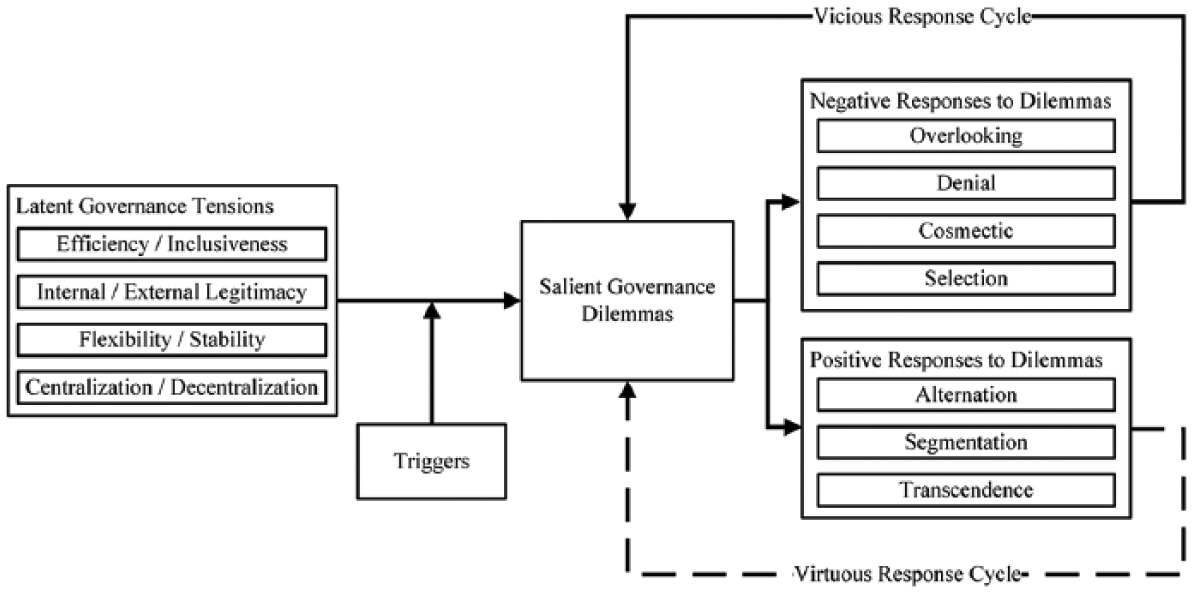
The relationship between governance tensions, dilemmas, and response cycles.
The theoretical model is based on the idea that there are many latent governance tensions that may potentially lead to issues and challenges during a crisis response process (Smith & Lewis, 2011). Crisis response processes take place in a network context, where tensions as a source of potential issues and challenges has been well established in the literature (Provan & Kenis, 2008; Saz-Carranza & Ospina, 2010). In crisis management, four overarching tensions have been identified: tension between centralization and decentralization (‘t Hart, Rosenthal, & Kouzmin, 1993), between efficiency and inclusiveness (Moynihan, 2009), between internal legitimacy and external legitimacy (Christensen et al., 2016), and between flexibility and stability (Webb & Chevreau, 2006). Table 1 describes these four governance tensions in relation to citizen volunteers.
Tensions in crisis governance: The role of citizen volunteers.
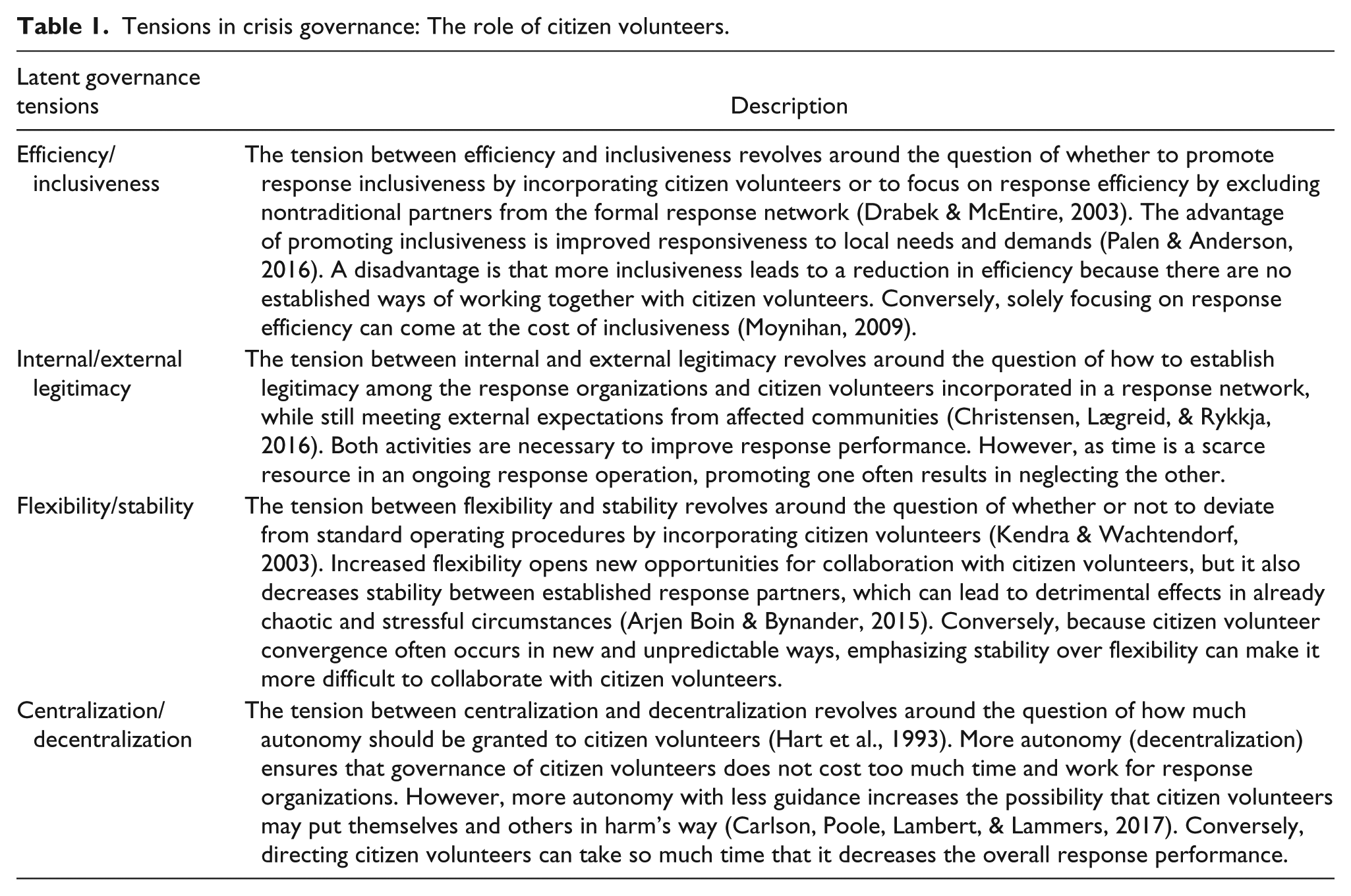
Following researchers in the paradox tradition, I argue that these tensions are “ubiquitous” and “persistent,” meaning that they cannot be eradicated by clever organizing (Lewis & Smith, 2014). Take, for example, the tension between centralization and decentralization (‘t Hart et al., 1993). At a disaster site, it is important that first responders have some flexibility and control over their actions (decentralization). However, as the response process progresses and new units arrive on scene, the need for coordination and collaboration grows (centralization). Solutions to the centralization/decentralization tension that focus on one demand, such as the need for coordination, necessarily come at the cost of the other demand, in this case, flexibility. This means that no solution will fundamentally eradicate a tension; instead, any response to a tension will likely produce different governance challenges down the line.
However, it is important to recognize that not all tensions lead to issues that require attention. In fact, it often happens that actors do not notice or respond to a particular tension (Lewis & Smith, 2014). This does not mean that the underlying governance issue disappears; instead, it means the issue has yet to produce any challenges. To account for this characteristic, Smith and Lewis (2011) introduced a distinction between “latent” and “salient” tensions. Tensions are latent when actors do not notice them or do not respond to them, and they are salient when actors perceive them as issues that require a response.
In this article, I refer to salient tensions as dilemmas. I use the concept of dilemmas because “it serves as a more widely applicable label for decisional situations—acknowledging possible variations in the degree to which demands conflict or compete” (Carlson et al., 2017, p. 288). Dilemmas occur when tensions have produced issues in the response process that need to be resolved. In practice, dilemmas can be experienced differently by different actors. Carlson et al. (2017) suggested that some dilemmas are perceived as difficult paradoxes, whereas others as perceived as “tolerable choices” or “resolvable contradictions.”
Two triggers lead to the salience of dilemmas. First, environmental factors such as the occurrence of a crisis situation, a scarcity in resources during a response process, or a plurality of viewpoints can encourage an emphasis on issues associated with underlying tensions (Cameron & Quinn, 1988; Smith & Lewis, 2011). For example, having too many actors involved in the decision-making procedures of an ongoing crisis response operation might force a decision on whether or not to “scale up” authority. Second, individual framing processes in which oppositional frames are emphasized (focusing on differences instead of commonalities) can also lead to the increased salience of tensions (Lüscher & Lewis, 2008). For example, the existence of limited trust between response organizations and citizen volunteers may lead to dilemmas involving inclusion or exclusion of new response actors.
Enacting Responses to Governance Dilemmas
Once governance dilemmas emerge, response organizations can enact multiple strategies to resolve them. Responses are enacted by crisis managers and strategic leaders in charge of the organizations (Ansell & Boin, 2017). Based on Carlson et al.’s (2017) work, I identified seven types of responses. I hypothesize that three of these responses have a positive effect on outcomes, leading to virtuous response cycles, while four have a negative effect that leads to vicious response cycles.
Vicious and Virtuous Response Cycles
The outcome of enacting particular response strategies is captured in the concept of response cycles, which are “iterative spirals or self-reinforcing sequences of events that grow out of the ways that actors process contradictions and develop into positive (virtuous) or negative (vicious) cycles” (Putnam et al., 2016, p. 81). The concept of cycles encapsulates the idea that underlying tensions cannot be fundamentally resolved but may always result in salient governance dilemmas. Smith and Lewis (2011) made a distinction between vicious or virtuous cycles. Enacting a specific response to a salient dilemma can inform the extent to which the tension emerges (or reemerges) as an issue to be dealt with later, where positive strategies lead to virtuous cycles and negative strategies lead to vicious cycles.
A vicious response cycle occurs when dilemmas are not recognized or are not addressed properly (Smith & Lewis, 2011). As a result, activities between response organizations and citizen volunteers either do not align (e.g., groups perform redundant tasks) or they conflict with one another (e.g., groups do not agree on a way forward). In worst-case scenarios, the response process is severely disrupted. With a vicious cycle, the underlying tension is more likely to reemerge as a new dilemma (Schad et al., 2016).
A virtuous cycle occurs when dilemmas are fully addressed, taking the different actors into account. A virtuous cycle means that crisis management activities occur in sync between response organizations and citizen volunteers and can therefore be sustained for a prolonged period of time (Smith & Lewis, 2011). In such a case, response organizations and citizen volunteers recognize mutual benefits in working together, address otherwise unmet needs in the response process, or support each other so each can focus on specific tasks. In a virtuous response cycle, response organizations are able to creatively and flexibly respond to any issues and problems that might arise in the governance process. It is therefore much less likely that underlying tensions will reemerge as salient dilemmas.
Ultimately, vicious or virtuous response cycles lead to negative or positive governance outcomes, respectively. As Christensen et al. (2016) argued, the performance of crisis management systems depends on two factors: governance capacity and governance legitimacy. Governance capacity is understood as a government’s ability to coordinate crisis management actors, deliver public services, regulate power and provide oversight, and analyze information about the unfolding crisis. Governance legitimacy concerns citizen’s perceptions of how a government performs during a crisis, and whether its actions are “desirable, proper, or appropriate” (Christensen et al., 2016, p. 889). To be effective, a response strategy should produce not only greater governance capacities in the response process but also maintain or increase legitimacy of response actors. Both factors are equally important in crisis volunteer governance. For example, if response organizations were to send citizen volunteers away from a disaster site because they were hindering operations, it could decrease their governance legitimacy—likely leading to an overall negative assessment of their response. In contrast, virtuous response cycles promote an increase in governance capacity because they lead to improvements in joint actions between response organizations and volunteers as well as increases in the number of tasks performed. They also promote governance legitimacy because citizen involvement in crisis response helps response processes become more responsive to citizen needs. And citizen involvement likely leads to increased transparency, thereby further strengthening governance legitimacy.
Responses That Lead to Vicious Governance Cycles
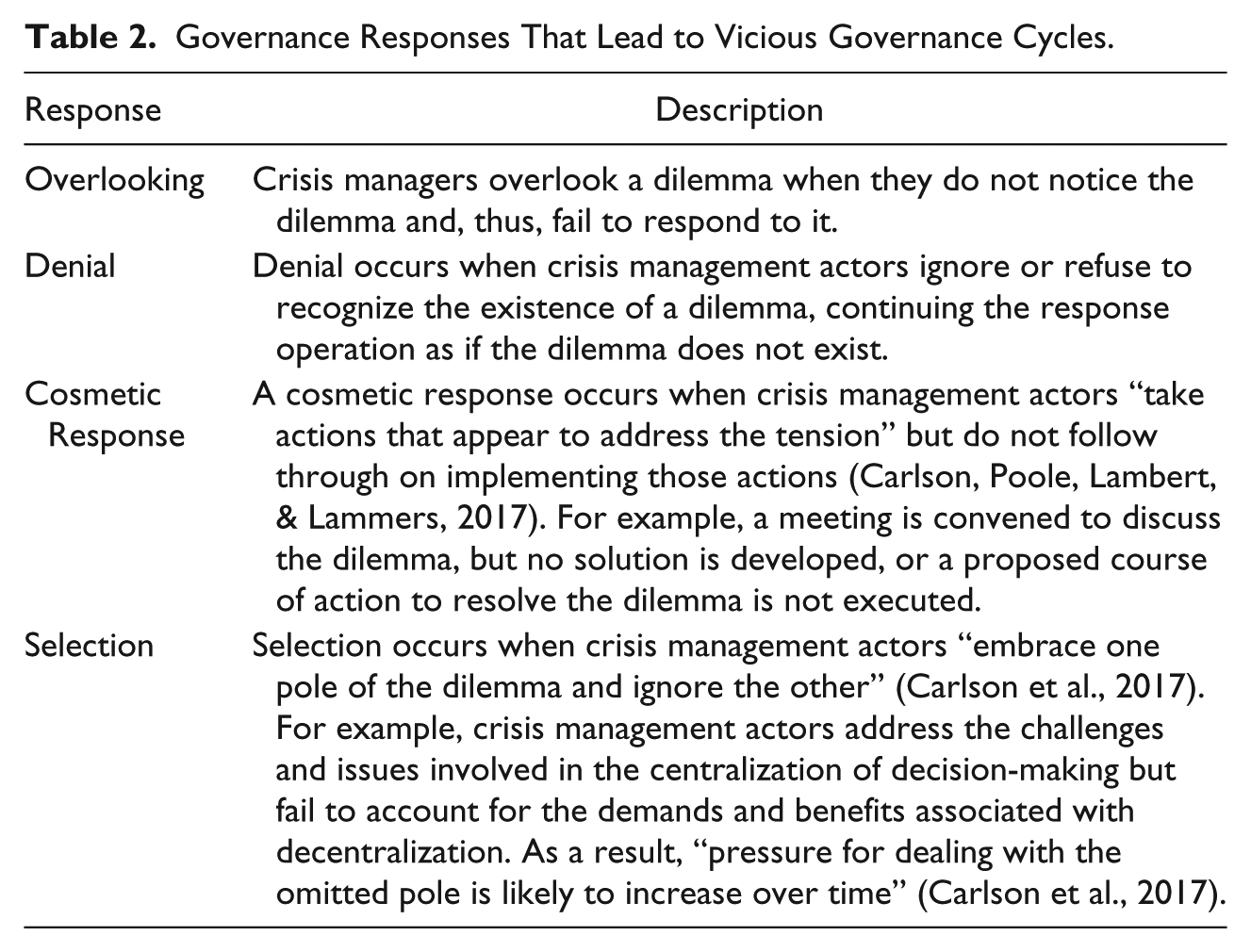
Based on the literature, I hypothesize that the four responses to governance dilemmas described in Table 2—overlooking, denial, cosmetic responses, and selection—negatively affect crisis management outcomes and lead to vicious governance cycles, because the underlying issue is either not addressed at all (overlooking, denial, cosmetic response) or it is addressed in an overly drastic manner (selection) (Schad et al., 2016). For example, when dilemmas involving centralization/decentralization are left unaddressed or are denied, coordination between response organizations and citizen volunteers will likely become more difficult (‘t Hart et al., 1993). Some citizen volunteer groups may wait for instructions that never arrive, while others may take initiative where inappropriate. Teets (2009), for example, described how, in the wake of the 2008 Wenchuan earthquake in China, authorities were initially so overwhelmed by citizen initiatives offering help that officials “who were supposed to be doing relief efforts ended up taking care of the unorganized volunteers.” Once they recognized the governance dilemma, authorities were able to delegate responsibilities to the Red Cross and other NGOs. Enacting a cosmetic response would not have produced better results in this situation, because citizen volunteers would have still been in the way. Similarly, enacting selection by embracing either extreme centralization or extreme formalization would have also negatively affected the response process. If the former were used, response organizations would not have had the capacity to govern citizen volunteers; conversely, if the latter were used, citizen volunteers would not have been able to adequately address dangerous situations by themselves (Barsky et al., 2007; Wolbers, Boersma, & Groenewegen, 2018).
Governance Responses That Lead to Vicious Governance Cycles.
Responses That Lead to Virtuous Governance Cycles
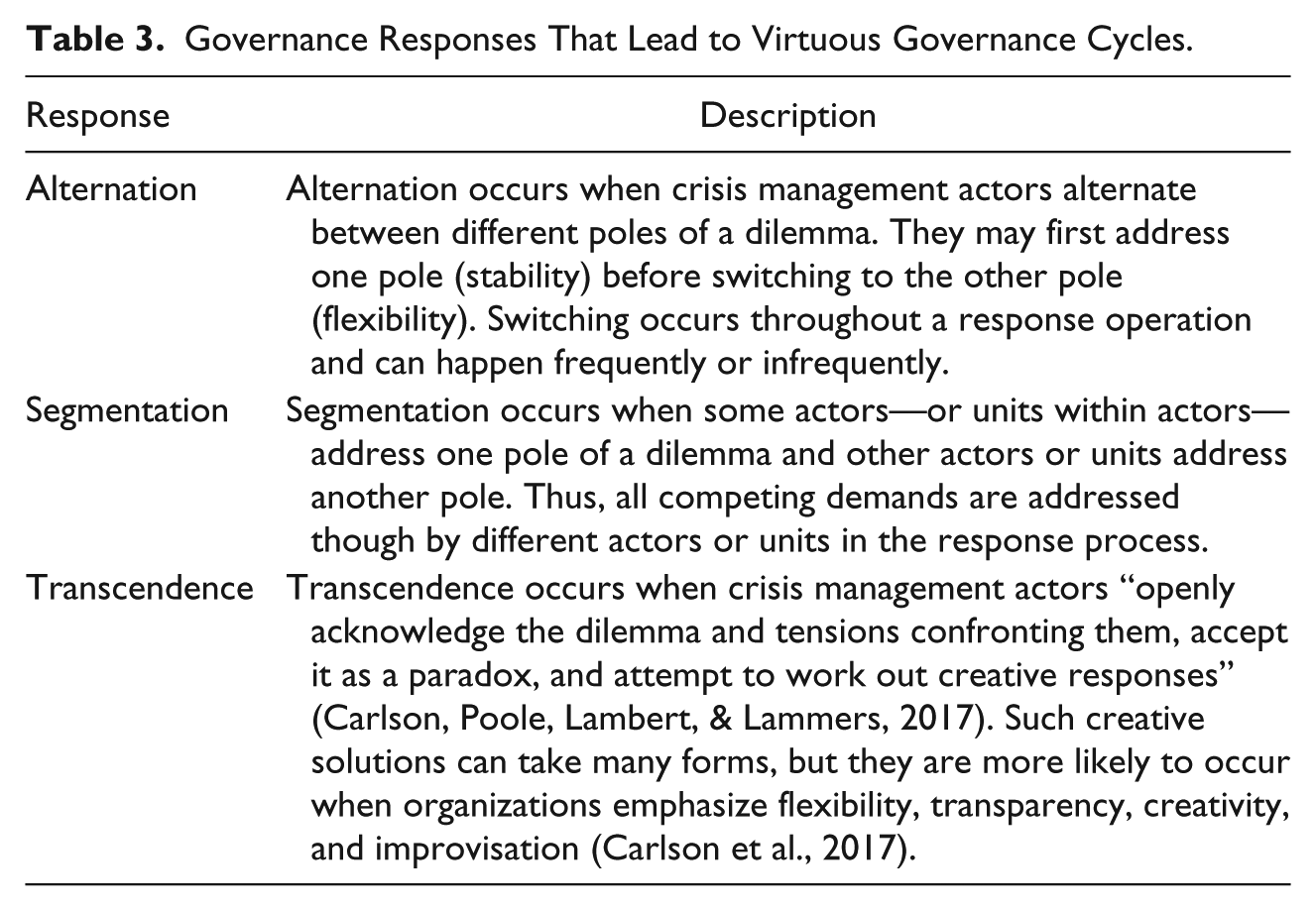
Based on the literature, I hypothesize that the three responses described in Table 3—alternation, segmentation, and transcendence—positively affect outcomes and lead to virtuous governance cycles: rather than ignoring, side-stepping, or failing to recognize a dilemma, these responses either address the governance dilemma in different organizations/units and at different times during the response process, or they mount creative solutions (Carlson et al., 2017). The literature on tensions has repeatedly identified that “working through” (Lüscher & Lewis, 2008) tensions or actively engaging with them is the most likely path to organizational success (Smith & Lewis, 2011). According to Lewis and Smith (2014), it is best to “co-exist” with tensions, which means that actors “accept and engage with them.” Examples in the crisis management literature support this line of thinking (Boin & Bynander, 2015). The waterborne evacuation of Manhattan during 9/11, for instance, was largely successful because of creative management by U.S. Coast Guard officials, who used a flexible, informal decision-making style coupled with formal decision-making when necessary (Kendra & Wachtendorf, 2016). Thus, with help from citizen volunteers, approximately 500,000 people were evacuated from Manhattan without prior contingency plans or established standard operating procedures.
Governance Responses That Lead to Virtuous Governance Cycles.
Method
To provide a first empirical illustration of the theoretical framework, I conducted a multiple case study analysis of the management of the 2015-2016 refugee crisis in the Netherlands (Yin, 2013). My goal was to examine the mechanisms presented in the theoretical framework, rather than to test the framework per se (George & Bennett, 2005). The multiple case study should therefore be seen as a first empirical illustration of the theoretical argument and not as representative.
During the refugee crisis, 50,000-60,000 refugees entered the Netherlands to escape violent conflicts in countries such as Syria and Eritrea (Central Bureau of Statistics, 2019). A key challenge for the Dutch government was to organize food, shelter, and medical care for refugees on short notice. At the same time, many citizen volunteers mobilized to help refugees and response agencies. For the Netherlands, the consequences of the refugee crisis were small in comparison to countries such as Germany, where many more refugees arrived. Nevertheless, because authorities were ill-prepared to handle the influx of refugees, in every important respect, a crisis did emerge. Similar to regular crisis situations, most authorities involved had limited advance warning and were suddenly confronted with crisis management tasks under conditions of stress and ambiguity. For example, it was not uncommon for first responders to be told that busses with refugees would be arriving in a matter of hours at their location, before any shelter locations had been identified and prepared.
I compared the ways in which five Safety Regions addressed the refugee crisis and engaged with citizen volunteers (see Table 4). The Safety Regions were selected so as to ensure variation in geographical location and size (number of citizens). In the Netherlands, a total of 25 Safety Regions are in charge of crisis management at the local and regional levels. They are network arrangements that cover multiple municipalities and maintain their own fire departments and medical services. When a crisis occurs, Safety Regions provide a standing organization that collaborates with the police to combat the adverse effects of the crisis. During the refugee crisis, Safety Regions were the authorities responsible for organizing and maintaining local emergency shelters for refugees. Thus, they were the main actors confronted with citizen volunteers. At the national level, many authorities were involved in the response to the refugee crisis, ranging from ministries to the National Crisis Center (a coordinating body). Their involvement was mainly geared toward distributing refugees across the Netherlands and the different Safety Regions, as well as monitoring local needs and capacities.
Description of Safety Regions.
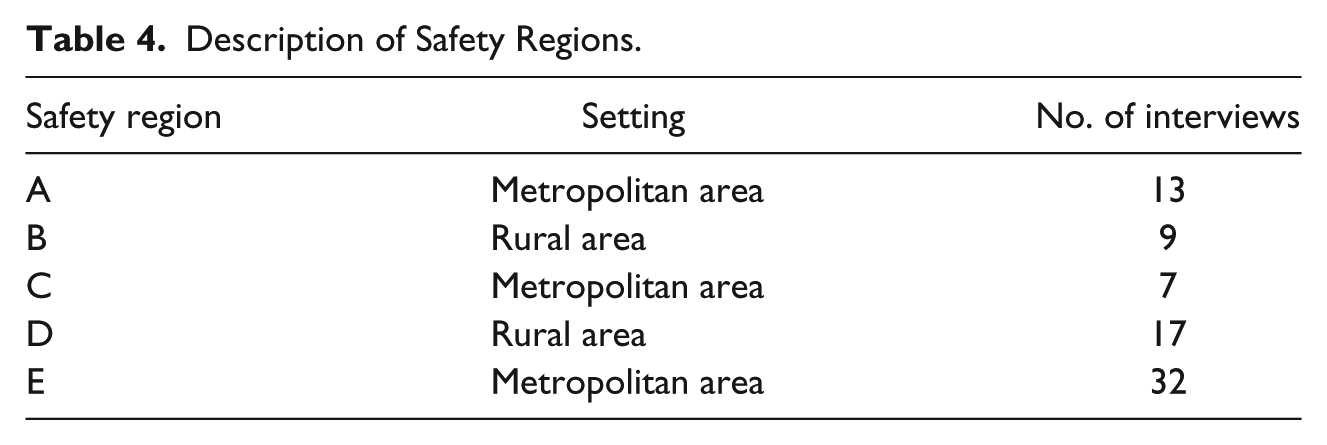
My analysis is based on data collection from 78 semistructured interviews (Eisenhardt, 1989). These interviews were conducted between December 2016 and May 2017. Respondents were identified by contacting Safety Regions directly and through snowball sampling. Differences in numbers of respondents between Safety Regions reflect the relative complexity of specific response operations, the number of organizations or (groups of) citizen volunteers involved in the response operation, and the various governance arrangements involved in the response process.
As I did not know what kind of governance dilemmas would emerge in each of the Safety Regions or what form those dilemmas would take, I asked respondents to describe how they engaged with citizen volunteers (if at all); how the governance process unfolded; whether issues, tensions, or dilemmas emerged during the governance process; and how their organization (or others) responded to dilemmas.
The coding of the independent variable was based on a coding scheme I developed from work by Carlson et al. (2016), who also conducted research in the Dutch crisis management context. Their operationalization of responses to emerging dilemmas in crisis management was easy to adopt in my own research context. Some modifications were made to focus on response organizations and citizen volunteers. The coding of the dependent variable was based on work by Putnam et al. (2016) and Smith and Lewis (2011), who have discussed the emergence of virtuous and vicious response cycles. The coding scheme for both variables is attached in the Online Appendix. To account for emerging themes in the interviews, I also used open coding to code surprising events, strategies, and actions.
Research Results
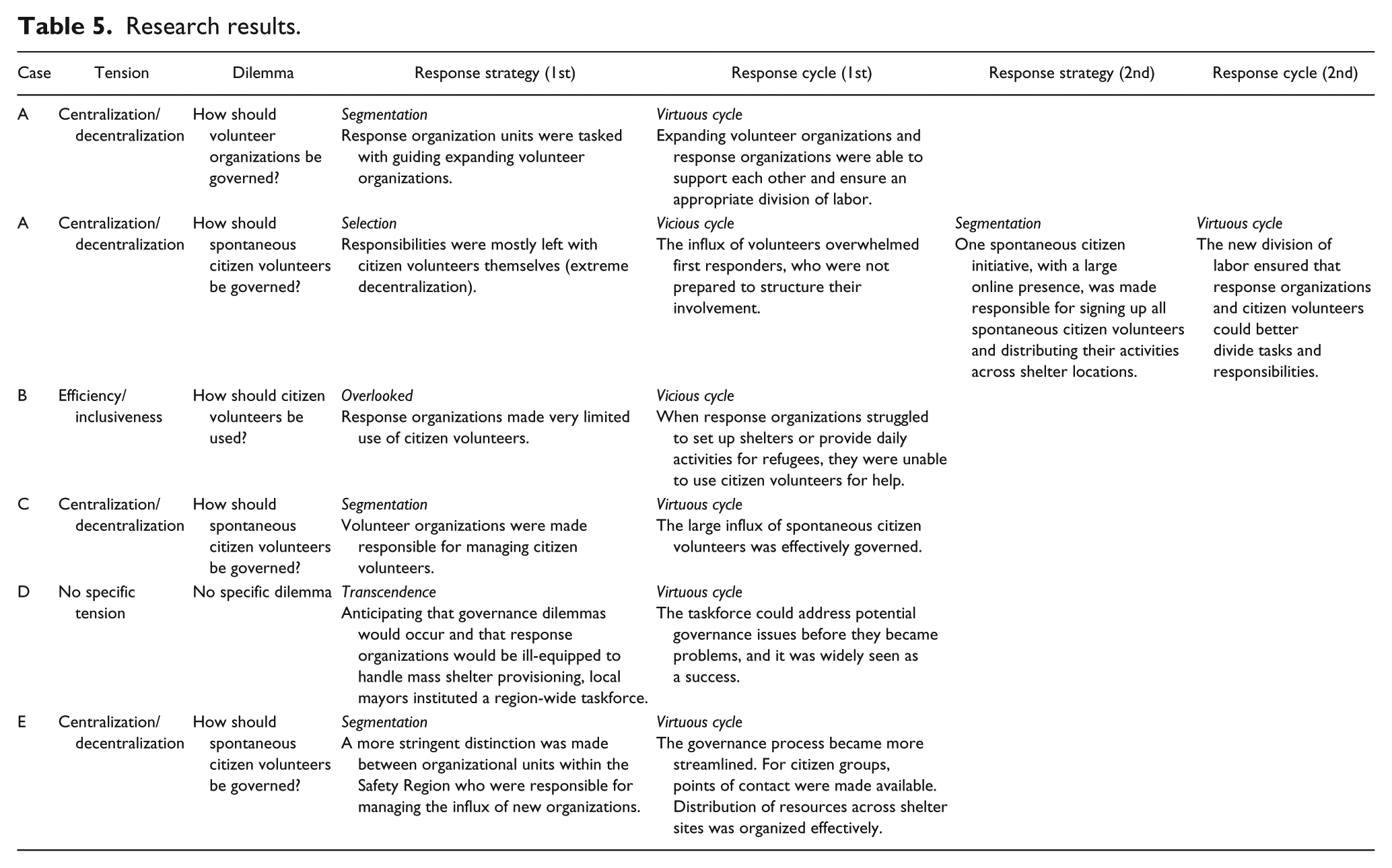
In all five cases (i.e., Safety Regions), governance tensions and dilemmas emerged, mostly focusing on tensions between centralization/decentralization or efficiency/inclusiveness (see Table 5 for a summary). In some cases, multiple dilemmas emerged at once. Positive governance strategies were immediately enacted in response to a dilemma in four cases (A, C, D, E), resulting in virtuous response cycles. In two cases (A, B), negative strategies were initially enacted, which led to vicious response cycles. But in one of those cases (A), the vicious cycle was ultimately turned into a virtuous cycle. Both hypotheses were therefore supported.
Research results.
Emergence of Tensions and Dilemmas
Most of the issues that caused tensions and dilemmas revolved around centralization/decentralization of decision-making (who is in control?) or inclusion/efficiency (who can be a part of the response process?). Governance tensions generally resulted in salient dilemmas early in the crisis response process. In each of the cases, numerous volunteer initiatives were present, ranging from efforts organized by the Red Cross or the Salvation Army to spontaneous volunteer initiatives that emerged within local communities. Spontaneous citizen volunteers, for example, wanted to organize daily activities for refugees, provide them with new clothing, or even help run the shelters. Oftentimes, as soon as response organizations started to plan shelter locations, offers of help came pouring in. As one respondent observed, A positive result was all the citizen volunteers. We were very happy with them. It was great to see so much commitment. (. . .) Everyone wanted to help. (Respondent 33)
In most of the cases, it took some time before response organizations recognized dilemmas as issues that needed to be resolved. For example, in Safety Region C, a metropolitan area with one major city and a number of smaller municipalities, a fairly large number of shelters were created. There were also many citizen initiatives offering assistance, especially in the city. At first, response organizations would only work with established volunteer organizations because they had previous working relations with those groups. Response organizations were more hesitant to acknowledge spontaneous citizen initiatives. One first responder observed: What were their intentions? Could we trust them? I didn’t know them, and had no experience with citizen volunteers, so no, we organized everything ourselves first. (Respondent 19)
However, when spontaneous citizen volunteers continued to show up at shelter locations or to contact response organizations with offers of help, response organizations recognized that the dilemma would not go away by itself. It had to be addressed.
In another instance, the Safety Region proactively anticipated potential governance dilemmas. At the start of the refugee crisis, local mayors in Safety Region D anticipated that governance dilemmas would occur and that response organizations would be ill-equipped to handle mass shelter provisioning. They therefore instituted a region-wide taskforce consisting of a small number of first responders who would be responsible for setting up all the shelters. The taskforce had fairly wide latitude and decision-making authority, so it could decide for itself how to govern citizen volunteers. At each shelter, the taskforce was supported by local municipal staff and first responders. Before establishing any new shelter, the taskforce identified how citizen volunteers might be able to help response organizations. A volunteer coordinator would then be assigned, ensuring that citizen volunteers always had one point of contact for discussing initiatives. The approach was widely seen as a success by both response organizations and citizen volunteers.
Positive and Negative Responses to Governance Dilemmas
Safety Regions responded to emerging dilemmas with both positive and negative strategies. A common positive response was segmentation, while a common negative response was selection. In one case, a dilemma was overlooked, and in another, a transcendent response was enacted.
For Safety Region A, the question was this: How should citizen volunteers be governed? Initially, a selection response was enacted in which responsibilities were mostly left with citizen volunteers. As a respondent observed, They left responsibilities mostly with citizens themselves. Thinking that it would be OK. (. . .) At a certain point there were too many citizen initiatives. We asked for structure. But it definitely took some time to organize. (Respondent 12)
The selection response led to a growing number of spontaneous citizen initiatives, with volunteers gathering at shelter locations to provide help. Some shelters had more volunteers than refugees. The influx of volunteers overwhelmed first responders, who were not prepared to structure volunteers’ involvement. When these issues became apparent, a new dilemma emerged.
Citizen initiatives presented themselves everywhere, but especially with us [a municipality]. We noticed some people posted information on Facebook, and there was a website as well. We thought, it is better to have one access point. It would be easiest to leave everything to society, but you should help people a little bit. We have resources to organize everything more easily than citizens. So we thought, what if we combine our activities? (. . .) So we talked to them and discussed how they could be the primary access point for citizen initiatives. Of course we supported them, but they did very important work. (Respondent 6)
When the municipality in this example realized the citizens would not be able to do everything themselves, it enacted a segmentation response. One spontaneous citizen initiative, with a large online presence, was made responsible for signing up all spontaneous citizen volunteers and distributing their activities across shelter locations. This also meant that they could turn potential volunteers away if there was no need for them. The new division of labor ensured that response organizations and citizen volunteers could better divide tasks and responsibilities. In the other cases where segmentation responses were enacted, formal volunteer organizations were usually made responsible for governing spontaneous citizen volunteers.
In Safety Region B, the prominent tension was between efficiency and inclusiveness. However, response organizations overlooked that the tension was there. In fact, they made very limited use of citizen volunteers (both extending and spontaneous) who were willing to help response organizations. Volunteers were therefore disillusioned. At one point in the response process, several expanding volunteer organizations were invited to support response organizations by mobilizing their citizen volunteers, but limited efforts were made to include them in decision-making. One volunteer organization representative who attended a meeting with response organizations said, I thought, What a drama! What a mess! Then I left. There was no one in charge, no one who said what we should do. (. . .) We were willing to help. But ultimately our resources weren’t used. It was such a shame. (Respondent 20)
Consequently, when response organizations struggled to set up shelters or to provide daily activities for refugees, they were unable to get help from citizen volunteers. In contrast to the other cases, this issue was not resolved during the refugee crisis.
Vicious and Virtuous Response Cycles
As theorized, the enactment of positive response strategies led to virtuous response cycles in which dilemmas did not reemerge, and the enactment of negative response strategies led to vicious cycles where dilemmas did reemerge.
Virtuous response cycles were characterized by relatively close cooperation between response organizations and citizen volunteers. Citizen volunteers were, for example, responsible for helping set up shelter sites, organizing day-to-day activities with refugees, and distributing goods such as clothing and other necessities. Only in very limited instances were specific volunteers responsible for more encompassing or substantive tasks. Interactions between citizen volunteers and response organizations were relatively smooth during virtuous response cycles, though it was sometimes difficult to manage the expectations of volunteers who would have liked to contribute more to the response process. For response organizations, citizen volunteers were a significant added benefit in the response to the refugee crisis. During the first hectic weeks of the crisis response, when logistical issues were the most pressing, citizen volunteers were perfectly situated to provide assistance. They could often rely on local social networks to quickly gain access to food or to organize daily activities for refugees.
In vicious response cycles, two main issues emerged. First, as was seen in Case B, the large potential for citizen involvement was not adequately used. This mostly resulted in a slower response process because response organizations had to do all necessary tasks by themselves. They quickly became overwhelmed and therefore limited themselves to organizing only the basic necessities at shelter sites and, for example, providing few daily activities for refugees. Second, as was seen in Case A, the convergence of citizen volunteers at the shelters ensured that first responders at those locations were unable to structure volunteers’ involvement sufficiently. There were quickly more citizen volunteers than first responders, which hindered the efficiency of the ongoing crisis response. However, the response of leaving citizen volunteer groups completely responsible for refugee care, without any form of governance, led to significant issues at the shelters. These issues did not go away until a segmentation response was enacted.
Dilemmas Across Response Levels
The case study results also show how issues between response levels can influence the response to governance dilemmas. Crisis response processes occur across three levels: strategic, tactical, and operational. Strategic crisis managers are concerned with the overall direction and long-term consequences of a response process, and they issue general guidance to affected citizens and first responders. At the operational and tactical levels, first responders are more immediately concerned with the short-term effects of a crisis situation.
Safety Region E presents a case in point. Here, strategic-level managers centralized much of the decision-making and neglected opportunities for decentralization early in the crisis response process (a selection strategy). Consequently, at the operational level, crisis managers were often busy answering questions, writing reports, or developing policies for strategic-level crisis managers rather than actually managing the crisis or engaging with citizen volunteers. The time-intensive nature of those activities caused dissatisfaction to grow. Weeks into the response process, a conflict between strategic and operational crisis managers erupted. One of our operational respondents explained this as follows: We had no time for writing reports. So it became a conflict. (. . .) At a certain point I thought I could no longer take responsibility for the [governance] process. Ultimately, we were able to wall off the operational process, the work itself [from the strategic-level crisis managers]. That made a huge difference. (Respondent 71)
After this conflict erupted, a segmentation response was enacted. The segmentation response ensured the “peace and quiet” that operational crisis managers needed to do their jobs and engage with citizen volunteers.
Conversely, in the other cases, governance dilemmas were present mostly at the tactical and operational levels, where first responders were immediately confronted with citizen volunteers. Although all five cases illustrate that dilemmas were (mostly) handled successfully at the tactical and operational levels, it should be noted that because the dilemmas were addressed only at those levels, strategic-level crisis managers were unable to issue overall policy guidance on what to do with citizen volunteers.
Discussion and Conclusion
In this article, I have investigated how response organizations are confronted by governance dilemmas involving citizen volunteers, and how response organizations can best navigate dilemmas and enact appropriate governance responses (Carlson et al., 2016; Poole & Van de Ven, 1989). Based on a multiple case study, I have identified that four governance responses to dilemmas (overlooking, denial, cosmetic, and selection) produce vicious response cycles and three governance responses (segmentation, alternation and transcendence) produce virtuous response cycles. In cases where positive governance responses were enacted, the collaboration between response organizations and citizen volunteers was successful. Thus, this article adds to our understanding of governance processes in times of crisis and provides new opportunities to study the relationship between citizen volunteers and response organizations (Boin & Lodge, 2016).
This multiple case study also reveals possible avenues for future research. Though this project did not focus on the governance context in which strategies were enacted, the literature suggests that context plays an important role (Christensen et al., 2016). In fact, there are three likely factors that influence why specific types of responses are more or less likely to be enacted. First, some administrative systems or organizations may be more used to encountering various governance issues and mounting new, creative solutions to intractable problems. For example, the U.S. Coast Guard is often lauded for its flexible performance and easy collaboration with multiple, diverging actors (Kendra & Wachtendorf, 2003b). FEMA (the Federal Emergency Management Agency), on the contrary, has been criticized for its inflexibility (Bowman, Kapp, & Belasco, 2005). Second, the level of politicization of a crisis situation can also influence the extent to which certain responses may be enacted. Crisis situations that are more politicized may allow for less flexibility because political risks are greater when organizations deviate from standard operating procedures (Boin, Sundelius, ‘t Hart, & Stern, 2005). And third, the selection of specific responses is also dependent on the capacity and legitimacy of response organizations (Christensen et al., 2016; Wang & Kuo, 2017). Greater precrisis response capacity and legitimacy can likely be associated with more success in enacting positive responses. Future research efforts may determine to what extent these factors influence the selection of particular response strategies.
Furthermore, researchers have recently focused on the relationship between sensemaking and dilemma salience. Some have suggested that governance tensions that have become salient “surface in the form of ambiguity that demands sensemaking” (Jay, 2013; Smith & Lewis, 2011; Weick, 1995). In the process of sensemaking, actors shape and influence the way in which crises are governed. Therefore, when actors work together to respond to a dilemma, they enact a dilemma in Weick’s (1995) sense of the term. For example, a study by Carlson et al. (2016) demonstrated that crisis managers can enact dilemmas as choices, contradictions, or paradoxes. Future research should explore the impact of sensemaking processes in responses to governance dilemmas. Specific attention could be given to the various forms of sensemaking present in crisis management, from collective sensemaking to sensegiving or distributed sensemaking (Maitlis & Christianson, 2014; Maitlis & Sonenshein, 2010).
Finally, this article illustrates that more attention needs to be given to governance processes in crisis and disaster management (Boin & Lodge, 2016). To date, the field lacks a “crisis governance” perspective from which the complex, stressful, and rapidly evolving crisis landscape can be understood (Nohrstedt et al., 2018). The increasing number of actors involved in crisis and disaster management necessitates new perspectives that help us understand and improve response processes. Research on network governance has already made a positive contribution, but it has a fairly narrow focus on formal response networks (Kapucu & Garayev, 2013). However, this study shows that actors outside of formal response processes also play an important role in crisis and disaster management and should be taken into account in new research efforts (Whittaker et al., 2015).
Supplemental Material
AandS836734_Online_Appendix_CLN – Supplemental material for Tensions and Dilemmas in Crisis Governance: Responding to Citizen Volunteers
Supplemental material, AandS836734_Online_Appendix_CLN for Tensions and Dilemmas in Crisis Governance: Responding to Citizen Volunteers by Arjen Schmidt in Administration & Society
Footnotes
Declaration of conflicting Interests
The author(s) declared no potential conflicts of interest with respect to the research, authorship, and/or publication of this article.
Funding
The author(s) disclosed receipt of the following financial support for the research, authorship, and/or publication of this article: This project is sponsored by the Netherlands Organization for Scientific Research (NWO), Division of Social Sciences, Smart Disaster Governance (Project 409-14-003), under the supervision of principal investigator dr. ir. Kees Boersma.

Supplemental Material
Supplemental material for this article is available online.
Author Biography
His recent publications include the following:
Schmidt, A., Boersma, K., & Groenewegen, P. (2018). Management strategies in response to an institutional crisis: The case of earthquakes in the Netherlands. Public Administration, 96, 513-527. Schmidt, A., Wolbers, J., Ferguson, J., & Boersma, K. (2018). Are you Ready2Help? Conceptualizing the management of online and onsite volunteer convergence. Journal of Contingencies and Crisis Management, 26, 338-349. Ferguson, J., Schmidt, A., & Boersma, K. (2018). Citizens in crisis and disaster management: Understanding barriers and opportunities for inclusion. Journal of Contingencies and Crisis Management, 26, 326-328.
References
Supplementary Material
Please find the following supplemental material available below.
For Open Access articles published under a Creative Commons License, all supplemental material carries the same license as the article it is associated with.
For non-Open Access articles published, all supplemental material carries a non-exclusive license, and permission requests for re-use of supplemental material or any part of supplemental material shall be sent directly to the copyright owner as specified in the copyright notice associated with the article.
