



Abstract
Profound shifts in media environments—marked by real-time broadcasting devices, ubiquitous smartphones, and networked social platforms—have intensified the mediatization of war. These dynamics were starkly evident during the Hamas attack on Israel on October 7, 2023, when, for example, militants recorded their assault with GoPros and drones; civilians under fire livestreamed their experiences; vehicle, roadside, and security cameras captured unfolding events; and graphic materials spread rapidly via WhatsApp, Telegram, Facebook, and other platforms. Using this case as an empirical anchor, the article proposes an updated analytical framework for studying the mediatization of war—integrating multiple interrelated dimensions: (a) enabling technologies, (b) information producers, (c) information consumers, (d) characteristics of content production, and (e) wartime outcomes and implications. This multidimensional roadmap offers conceptual and methodological tools for examining technologically advanced conflicts, where communication technologies shape not only how wars are reported but also how they are experienced and remembered.
Introduction
The surprise attack by Hamas on Israel’s “Gaza Envelope” (the area surrounding the Gaza Strip) on the morning of October 7, 2023, was a traumatic and unprecedented event. In a single day, approximately 800 Israeli civilians and 370 soldiers and security personnel were killed, around 1,500 people were injured (Yassur Beit-Or, 2024), and 250 individuals—including civilians, soldiers, and foreign nationals—were kidnapped. The destruction shocked Israeli society and much of the world, as images and videos documenting the atrocities spread rapidly and in vast quantities. Civilians were murdered on roads and at music festivals, homes were burned with residents inside, sexual assaults occurred, and numerous villages, kibbutzim, and military bases were severely damaged. Looting and destruction of property, infrastructure, and agricultural equipment added to the devastation. Graphic footage was disseminated almost instantly on social media, exposing audiences—including children and teenagers worldwide—to highly distressing content without preparation or supervision.
While the ensuing war brought further loss of life and displacement for many Israelis and Palestinians, this article focuses on the first 24 hr of October 7, a condensed and intense demonstration of the power of media in contemporary warfare. During this period, militants, soldiers, and civilians alike were equipped with media devices and online access. Militants documented their assault with GoPro cameras and drones; fleeing civilians shared real-time images and videos via WhatsApp groups; and additional footage from car, road, and security cameras circulated on Telegram, Facebook, and other platforms. Alongside professional coverage from mainstream and independent news outlets, these diverse sources created a dense, multiperspectival record of events.
The distinctive documentation patterns observed on October 7 cannot be fully understood without acknowledging the specific operational conditions that shaped them. The attack involved a profound strategic surprise, during which several communities were left without immediate military response for hours. Much of the violence unfolded in civilian spaces—homes, roads, shelters, and a music festival—resulting in a highly concentrated civilian presence in the documented events. These conditions created an environment in which civilian-generated recordings became the primary and earliest sources of information, both for the public and, at times, for emergency responders. While not unique in global contexts of asymmetric warfare, the convergence of these factors on October 7 heightened the visibility, intensity, and centrality of real-time civilian documentation.
This article applies the theoretical framework of mediatization (Couldry & Hepp, 2013) to examine how communication systems shaped the documentation, dissemination, and reception of this attack. Using the October 7 case as an empirical anchor, it synthesizes and extends strands of research on mediatization and war into a conceptual roadmap for future scholarship. The framework identifies five interrelated dimensions central to the mediatization of war: (a) technologies enabling mediation; (b) information producers and their roles; (c) information consumers and their mediated experience; (d) the characteristics of wartime content production and circulation; and (e) the outcomes and implications of mediatization. By mapping these dimensions, the article highlights the growing participation of individuals in documenting, sharing, and interpreting events—a development that blurs the boundaries between traditional journalism, propaganda, and personal testimony (see also Chermak & Gruenewald, 2006; Weimann, 2004).
In contemporary conflicts, such participation enables the near-instantaneous, global distribution of content, often bypassing traditional editorial and regulatory mechanisms. The proposed multidimensional framework aims to capture these transformations, providing conceptual and methodological tools for analyzing technologically advanced conflict arenas and guiding future research on the mediatization of war.
Mediatization: Theoretical Roots and Contemporary Relevance
Communication scholars use the term mediatization to describe a process in which communication systems do more than simply mediate reality—they actively influence, structure, and sometimes even dictate the relationships between actors. As an analytical framework, mediatization examines how communication systems shape and frame social, cultural, and political practices and institutions, altering the ways information is transmitted and impacting interactions, perceptions, and behaviors across contexts (Couldry & Hepp, 2013; Deacon & Stanyer, 2014; Hepp, 2017; Hjarvard, 2017; Jensen, 2013; Schulz, 2004; Strömbäck, 2008).
As communication technologies evolve, mediatization intensifies, moving from a background process to a dominant force that restructures social and political life. Digital platforms and social media have transformed information flows, diminishing the gatekeeping role of journalists, editors, and regulatory bodies. In their place, a decentralized, often unregulated ecosystem has emerged, in which content is produced, circulated, and consumed across multiple channels. This shift reflects not only technological change but also a reconfiguration of power: Institutions, political actors, and ordinary citizens now operate in a hypermediatized environment where visibility, narrative control, and real-time responsiveness are key resources for influence and legitimacy.
Mediatization does not unfold uniformly. Its manifestations depend on the affordances of specific technologies and the socio-political contexts in which they are embedded. In war and conflict, mediatization shapes how violence is perceived, legitimized, and contested. The ability to livestream battles, mobilize digital activism, or manipulate narratives through algorithmic amplification reveals how deeply communication technologies are woven into the conduct and interpretation of contemporary conflicts. Here, mediatization does not merely record events—it constructs them, blurring the lines between direct experience and mediated representation.
Building on this, Hepp’s (2017, 2019) concept of deep mediatization captures a stage in which mediated communication becomes inseparable from social practices and meaning-making. Deep mediatization is marked by three features: (a) cross-media integration; (b) a multifaceted rather than binary nature; and (c) reflexivity, or a practical awareness of the affordances and constraints of the media selected and used.
While this article focuses on mediatization in the context of war, the framework has been applied to diverse fields—politics (Landerer, 2013; Meyen et al., 2014), work (Örnebring et al., 2024), religion (Wei, 2024), sports (Kopecka-Piech, 2019), public relations (Strömbäck & Esser, 2017), and mourning (Giaxoglou & Döveling, 2018). In journalism, the rise of independent content producers, blogs, and alternative platforms has created a dynamic exchange between mainstream and nonmainstream media. Independent outlets often address issues overlooked by established news organizations, attracting loyal audiences and sometimes influencing professional journalists’ coverage (Dahlgren, 1996; Farrell & Drezner, 2008).
By synthesizing these strands of theory and research, this study positions mediatization as a lens for understanding the October 7 Hamas attack. It treats the case not only as an isolated incident but also as an empirical entry point for developing a roadmap—a multidimensional framework for analyzing the mediatization of war that can be applied across other technologically advanced conflict settings.
Mediatization and Wars
Research on communication and war consistently demonstrates the central role of media in disseminating information and shaping public opinion during major conflicts—from the Vietnam and Iraq wars (Horten, 2011) to repeated confrontations between Israel and Gaza or Lebanon (Peri, 2017; Siapera et al., 2015). Scholars have examined who produces content during war and why, how wartime communication reinforces or challenges official narratives (Weimann, 2006), and how audiences interpret, discuss, and act upon mediated messages (Lev-On, 2010; Lev-On & Uziel, 2018).
Yet, much of this work does not explicitly employ the analytical lens of mediatization. In this context, the mediatization of war refers to the embedding of media logic into the conduct, perception, and lived experience of armed conflict. Communication is no longer simply a channel for representing war—it has become a constitutive element of the battlefield itself (Hoskins & O’Loughlin, 2015). Despite the growing number of studies in this area, the field remains under-theorized, and scholars have called for a more systematic conceptual foundation tailored specifically to war and conflict (Kopecka-Piech et al., 2024).
Existing literature traces the mediatization of war across three historical phases. The broadcast war phase was dominated by centralized, linear media such as television, enabling governments and militaries to control wartime narratives. The diffused war phase emerged with digital and social media, characterized by decentralized information flows, diverse sources, and fragmented control over narratives. Most recently, Hoskins and O’Loughlin’s (2015) notion of arrested war describes how state and military actors have adapted to chaotic digital spaces, using hybrid tactics to regain narrative dominance. Here, official institutions exploit the participatory affordances of social media while simultaneously suppressing or marginalizing dissenting voices (Hoskins & O’Loughlin, 2015; Kopecka-Piech et al., 2024).
Recent work shows that digital platforms and social media have expanded the range of wartime actors to include individual users, algorithms, media organizations, and governments. Studies of conflicts such as the 2017 Sino-Indian border crisis reveal that social media platforms are not neutral carriers of information but active arenas where narratives are constructed, contested, and amplified (Giri & Bhandari, 2023). Four primary actors—users, platforms, mainstream media, and the content itself—interact in shaping meaning in real time. Algorithms and platform governance exert their own logic over visibility and credibility, positioning platforms as nonhuman agents of mediatization. The phenomenon of “sofa warriors” (Asmolov, 2021)—citizens engaging in digital activism or commentary from afar—illustrates the collapse of boundaries between the front line and the home front. The domestication of warfare through memes, short videos, and participatory culture deepens the integration of distant conflicts into everyday life, raising questions about whether such engagement empowers citizens or manipulates them.
Systematic reviews confirm that mediatization of war is a rapidly evolving field but remains geographically and methodologically uneven. A meta-analysis of nearly 90 studies from 2018 to 2022 found that most research stems from communication, political science, and sociology, relying heavily on qualitative approaches such as discourse analysis, narrative inquiry, and ethnography (Kopecka-Piech et al., 2024). While case studies—especially from Eastern Europe and the Middle East—dominate, recurring themes include narrative framing, audience participation, and real-time meaning-making. Across this literature, one insight stands out: In mediatized warfare, media are not peripheral observers but central structuring forces that influence how wars are fought, experienced, and remembered.
Toward a Multidimensional Framework for Analyzing the Mediatization of War
The Hamas attack on October 7, 2023, and the ensuing war offered an unprecedented demonstration of how deeply mediatization now shapes the conduct and perception of armed conflict. One of its most striking features was the sheer volume and accessibility of visual materials broadcast and shared in real time. In earlier wars, reporting and interpretation were largely mediated by traditional news outlets and institutional actors. Today, however, journalists and military forces are no longer the sole narrators of war. Private citizens—equipped with smartphones, body cameras, drones, and access to platforms such as WhatsApp, Telegram, Facebook, and X—operate as active documentarians. This proliferation of devices and platforms has created a multichanneled, unfiltered, and often uncontrolled flow of wartime content, where real-time documentation transforms individuals from passive witnesses into participants in shaping the war’s narrative. Similar uses of WhatsApp and community-based messaging during terror attacks and emergencies in Israel have been documented in earlier research as well (Lev-On, 2018; Simon et al., 2016).
While civilians were indeed the primary documentarians in many of the affected communities—due largely to the prolonged absence of Israeli forces from several areas in the early hours of the attack—it is important to note that they were not the sole source of visual materials. Military personnel were present in a number of locations, including bases and roadways that were attacked early in the assault, and some documentation originated from these positions as well. In addition, footage recorded by Hamas militants themselves, through body cameras and drones, formed a significant component of the emerging visual archive. The overall corpus of documentation from October 7, therefore, reflects contributions from multiple actors, even if civilian-generated materials were disproportionately prominent.
While these dynamics have drawn attention in both media commentary and academic research, this article moves beyond documenting them. It develops an updated analytical framework for studying the mediatization of war—one that moves from case-specific observations toward a systematic, multidimensional approach. Rather than isolating a single dimension, such as technology, audiences, or producers, the framework integrates these and other aspects to capture the complexity of mediatization in technologically advanced conflict arenas.
The October 7 attack provides an especially concentrated illustration of these dynamics. Within hours, militants’ GoPro and drone footage, civilians’ escape videos, and security camera recordings were circulating globally—often bypassing traditional verification and editorial processes. These flows of mediated content did not merely report events; they actively constructed competing narratives that shaped how the conflict was experienced, understood, and remembered.
Building on the preceding discussion of mediatization theory and its applications to war, this framework expands existing models by mapping the mediatization of war across multiple interlinked dimensions. It is designed as a conceptual tool for future research, offering categories and relationships that can be adapted to other conflict contexts. While no single study can exhaust all relevant aspects, we highlight the dimensions that emerged most prominently during the first 24 hr of the October 7 attack, offering them as starting points for further theoretical development:
Technologies enabling the mediatization of the surprise attack and subsequent war.
Information producers, consumers, and the characteristics of content production and dissemination.
Outcomes and implications of wartime mediatization.
Figure 1 visualizes the interrelations among the five analytical dimensions generated from the empirical corpus, demonstrating how mediatization structures the documentation and perception of wartime events.
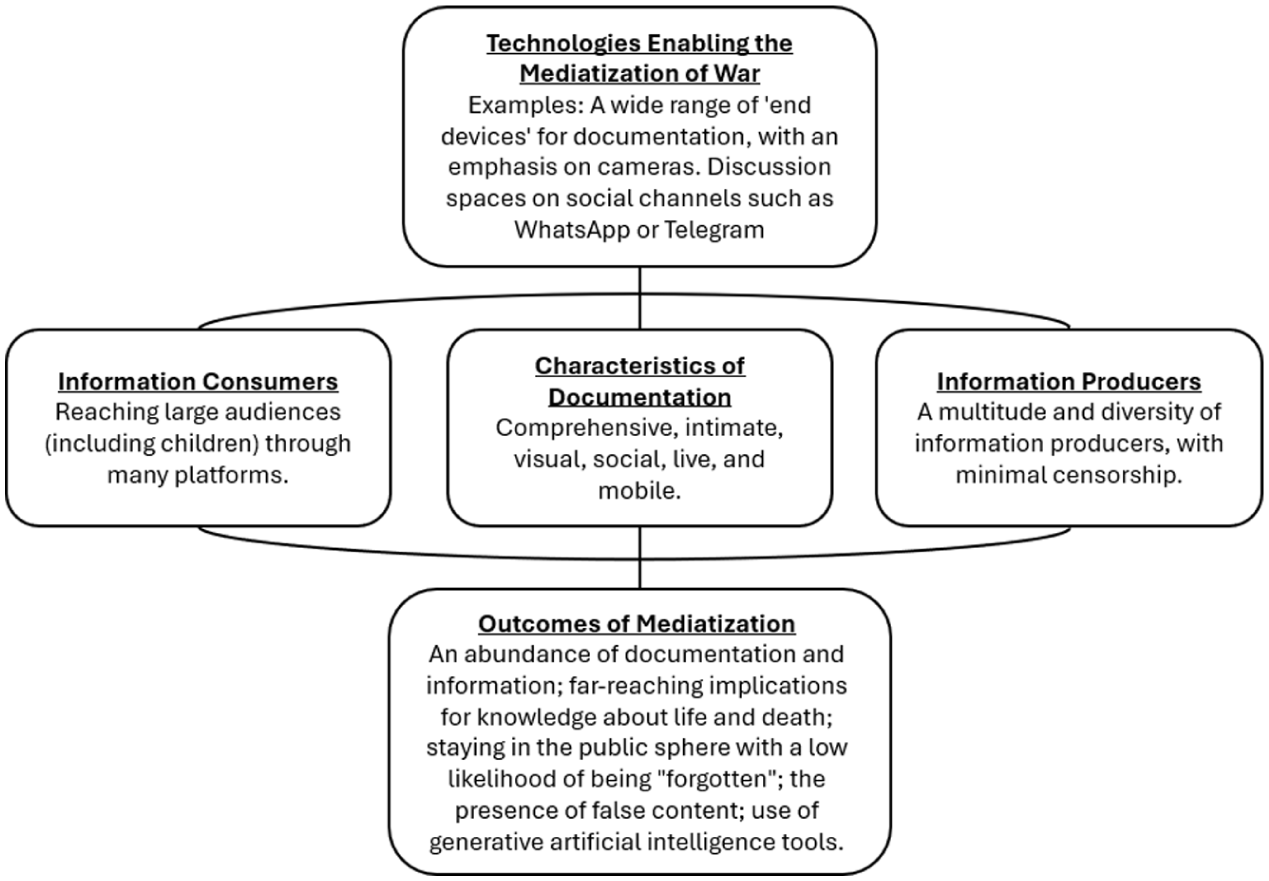
The Key Aspects of the Mediatization of War
Research Materials and Analytical Procedure
The analysis presented in this article is grounded in a systematic qualitative examination of documentation generated during the first 24 hr of the October 7, 2023, Hamas attack. The research materials include (a) real-time and near real-time visual recordings (such as security footage, dashcam videos, GoPro documentation, live broadcasts, and civilian smartphone recordings); (b) news reports and televised coverage from Israeli and international media; (c) posts, messages, and videos circulated on platforms such as Telegram, WhatsApp, Facebook, and X; and (d) official documents, public statements, and civil society reports that contextualized the unfolding events.
These materials were collected contemporaneously and cataloged into a structured corpus. The analysis proceeded through an iterative thematic process (Morgan & Nica, 2020), in which we identified recurring patterns across technological affordances, documentation practices, actor roles, and audience responses. The thematic patterns that emerged served as the empirical basis for the multidimensional framework proposed in this article. Rather than imposing a predefined model, the framework was inductively developed from the materials themselves, allowing the conceptual dimensions to reflect the lived and mediated realities of the attack as it unfolded in real time.
This methodological approach aligns with established qualitative media analysis and supports the article’s goal of integrating empirical evidence with theoretical reflection.
Technologies Enabling the Mediatization of War
The mediatization of war in the 21st century rests on a technological infrastructure that is both advanced and relatively recent. Over the past two decades, the proliferation of portable, high-quality recording devices—most notably smartphones—has expanded the capacity of individuals to document events, disseminate content instantaneously, engage in networked dialogue, and remain constantly connected. These affordances have redefined the role of individuals in wartime communication, transforming them from passive witnesses into active producers, curators, and interpreters of conflict narratives (Santos & Valenzuela, 2025).
Messaging platforms such as WhatsApp and Telegram, both barely over a decade old, exemplify how quickly new communication infrastructures become embedded in everyday life and, in wartime, in the circulation of urgent and often intimate information. Family and community WhatsApp groups, for example, became critical channels for sharing location updates, eyewitness accounts, and safety instructions during the October 7 Hamas attack (Yavetz, 2024). Telegram channels, widely used for real-time news, quickly filled with footage from multiple sources, bypassing conventional editorial filters.
Equally transformative has been the rapid evolution of camera technologies. The October 7 attack was documented through a dense network of recording devices: Dashcams, fixed security cameras, body cameras worn by police officers, helmet-mounted GoPros used by Hamas militants, and smartphones in the hands of both victims and bystanders. Militants employed cameras as deliberate tools of psychological warfare, producing graphic footage for propaganda and intimidation (see Katz & Liebes, 2007; Peri, 2017; Weimann & Weimann-Saks, in press). Civilians, in contrast, recorded from hiding places or while fleeing, sending urgent appeals for help or farewell messages to loved ones. This dual use—planned, strategic recording by perpetrators versus spontaneous self-documentation by victims—demonstrates the contradictory roles of visual technologies in the mediatization of war.
Many of these devices are recent innovations. GoPro cameras entered operational use roughly 15 years ago, while large-scale public surveillance systems have expanded mainly in the past two decades, often linked to “smart city” initiatives (Townsend, 2014). The widespread adoption of vehicle-mounted cameras—sometimes mandated by insurers—has further normalized constant visual monitoring of public spaces. The expectation that significant events will be captured from multiple angles has become so ingrained that the absence of footage can itself be striking, as in the cases of Nova festival attendees whose fate was unknown until eyewitness accounts emerged during the first hostage exchanges.
The abundance of visual material also enables postevent reconstructions that shape collective memory. One example is Be’eri’s Black Box, an episode of the investigative television program Uvda (September 2024) composed entirely from security, dashcam, and body-worn camera footage collected in Kibbutz Be’eri on October 7 (Shani, 2024).
This rapid shift stands in stark contrast to earlier cases. For instance, Lev-On’s (2023a, 2023b) study of the Roman Zadorov trial—centered on the 2006 murder of Tair Rada—notes that no security cameras were installed in the school or its surroundings at the time. Public discourse unfolded in online forums, but visual documentation was absent, and the case itself spurred later installation of cameras in schools across Israel. Today, however, nearly every major incident—criminal, accidental, or wartime—is documented from multiple perspectives, often within moments of occurrence. This capacity, developed in less than two decades, illustrates how swiftly technological infrastructures reshape public expectations, transform information flows, and redefine the evidentiary foundations of mediated events.
Characteristics of the Mediatization of War: Information Producers
Many have compared the events of October 7, 2023, and the subsequent war to the Yom Kippur War of 1973, which erupted almost exactly 50 years earlier. The parallels often cited include the prevailing “conception” that the enemy lacked both the capability and intent to launch a major attack (Egypt and Syria in 1973; Hamas in 2023) and the shock of an assault during the Jewish Tishrei holidays (Jewish new year month). Yet from a communication perspective, the differences are profound. In 1973, documentation of the surprise attack was gathered primarily by professional photographers and reporters on the ground. Images and testimonies reached the public only after significant delays, in fragmented form, and following censorship approval—creating an information vacuum in which unverified rumors flourished (Peled & Katz, 1974). By contrast, on October 7, 2023, technological developments enabled real-time, multisource documentation, allowing the public not only to access but also to experience the events almost as they unfolded—often without any censorship. Particularly notable were the live broadcasts on all major Israeli channels, where reporters in the south relayed the desperate cries of residents trapped in shelters, pleading for army assistance that never came. This shift illustrates how deep mediatization transforms wartime perception, collapsing temporal and spatial distances between the battlefield and the home front.
In the past, reaching large audiences required operating a newspaper, radio station, or television channel—endeavors that demanded substantial resources, infrastructure, and institutional backing. Today, by contrast, individuals and small, independent groups can serve as central information producers. Content now flows to the public not only from established political and economic gatekeepers but also from fringe actors, grassroots initiatives, and social media influencers who can disseminate messages to mass audiences with minimal cost or delay. In times of emergency, social media platforms enable the rapid, wide-scale circulation of information from this diverse array of producers, reshaping the dynamics of authority, credibility, and agenda-setting in wartime communication (Hoskins & O’Loughlin, 2015).
Platforms such as Telegram and Facebook—particularly groups focused on current events—along with WhatsApp distribution lists have become key channels for the rapid dissemination of information during crises. While some of these spaces circulate false or unverified claims, others are run by individuals with professional expertise or privileged access to information, producing content that is often more timely and targeted than that of mainstream outlets. In many cases, these channels bypass traditional gatekeeping altogether. The minimal or nonexistent censorship on such platforms creates an environment where accurate, reliable updates coexist with misinformation, privacy violations, and graphic or harmful content. This unfiltered information ecology illustrates a core feature of the mediatization of war: the simultaneous expansion of access to diverse sources and the erosion of editorial control, producing both unprecedented immediacy and heightened challenges for verification, ethical oversight, and audience protection.
Until recently, the number of information producers active during emergencies was relatively small, making it easier to enforce censorship. Journalists rarely required explicit instructions on what to broadcast or suppress, as professional norms and conventions guided their decisions (Cook & Heilmann, 2013). The result was an “engineered” public sphere in which content was edited to align with state or commercial interests. In today’s media environment, this gatekeeping power has eroded. Numerous actors now broadcast live without prior approval, enabling the circulation of material that would once have been withheld from public view. During the October 7 attack, for example, videos documenting kidnappings, shootings, murders, and even the mistreatment of corpses were widely shared on Facebook and Telegram. These unfiltered channels, which operate with minimal to no content moderation, reflect the increasingly decentralized and rapid circulation of wartime information, a pattern also observed in earlier terror incidents, including cases where attackers livestreamed their actions.
Characteristics of the Mediatization of War: Characteristics of Documentation
The contemporary mediatization of war can be defined by six interrelated characteristics—comprehensive, intimate, visual, social, live, and mobile—that together reshape how conflicts are documented, disseminated, and experienced (see Lev-On & Uziel, 2018). The following subsections examine each of these dimensions, highlighting how they manifested during the October 7 attack and how they contribute to a broader understanding of wartime mediatization.
Comprehensive Documentation
The October 7, 2023, Hamas attack produced an unprecedented volume and diversity of wartime documentation. Unlike earlier conflicts, where coverage depended largely on professional photographers or occasional eyewitnesses, this event generated material from a wide array of sources—militants, victims, car and security cameras, body-worn devices, and civilians’ self-documentation—a high-intensity configuration that illustrates, rather than defines, the broader mediatization processes that may appear in varying forms across different conflicts. Militants deliberately used body cameras and drones to record their actions in real time, intending to disseminate the footage as propaganda and psychological warfare (Channel 13 News, 2024)—a practice that aligns with broader contemporary trends in both military and paramilitary documentation, where operational activities are routinely recorded and circulated.
The resulting visual record—depicting severe violence, abductions, and murders—spread rapidly across social media and mainstream outlets, shocking Israeli and international audiences alike (Human Rights Watch, 2024). This breadth of sources exemplifies the “comprehensive” dimension of mediatization, in which multiple, overlapping channels produce a dense, multiperspective archive of events in near real time.
Victims and civilians caught in the events used mobile phones and personal cameras to capture the attack from their own perspective. Some livestreamed moments of terror; others sent recordings to authorities or shared them on social media (Human Rights Watch, 2024). These firsthand accounts offered a personal, unmediated window into the traumatic experiences endured, adding emotional depth and immediacy to the public’s understanding of events. The rapid circulation of such content intensified the international response and influenced political discourse worldwide. As noted in postattack reporting, video footage and personal testimonies became central to shaping both media narratives and public opinion (Eichner, 2023). This intimate dimension of mediatization transforms victims into active narrators of their own experiences, collapsing the distance between private suffering and global witnessing.
Evidence revealed after the attack showed that the militants’ documentation was premeditated and integral to a broader strategic plan. Recovered documents indicated that assailants received explicit instructions to record their actions and, where possible, to broadcast them live. The aim was to instill fear and panic among the Israeli public while leveraging the materials for international propaganda (Eichner, 2023). The public disclosure of the “Hostage Abduction Plan” by Israeli President Isaac Herzog in a CNN interview underscored the deliberate nature of this media strategy (The Times of Israel, 2023). Reports further indicated that Hamas operatives were equipped with advanced recording devices and trained in their use—demonstrating how digital media technologies have become embedded in the operational logic of contemporary terrorism (Channel 13 News, 2024; Schecter, 2023). This calculated use of documentation exemplifies the instrumentalization of mediatization, where the act of recording is not incidental but a core component of the conflict’s psychological and political objectives.
Intimate Documentation
The Hamas attack on October 7, 2023, produced intimate forms of documentation unprecedented in both scale and emotional immediacy. Many civilians in life-threatening situations used available technologies to share their experiences in real time—contacting others from shelters via video calls, sending urgent messages in neighborhood and family WhatsApp groups, and livestreaming their most harrowing moments on Facebook, including scenes of severe injury or death (Birnhack, 2024). These recordings provided an unfiltered window into the personal and painful experiences of victims, collapsing the boundary between private trauma and public witnessing—a dynamic documented in earlier crises such as 9/11 (see Allan, 2013).
In addition, Hamas at times seized control of hostages’ Facebook accounts, using them to broadcast content designed to instill fear and panic among the Israeli public (Frenkel & Minsberg, 2023). Such incidents underscore the dual nature of intimate documentation during the October 7 attack: It can serve as a powerful means of immediate communication and testimony, yet it also creates profound ethical, legal, and psychological challenges (Birnhack, 2024). The capacity to share deeply personal experiences in real time magnifies the reach and emotional force of wartime narratives, but it also exposes victims and their families to exploitation, retraumatization, and violations of privacy—illustrating how the intimate dimension of mediatization operates as both a tool for connection and an instrument of harm.
Visual Documentation
The Hamas attack on October 7, 2023, produced an exceptionally rich and varied visual record, consisting largely of high-quality photographs and videos, many accompanied by sound. This material came from a wide range of sources, including mobile phone cameras, GoPro devices carried by both attackers and victims, and security cameras positioned in public and private spaces. The portability, durability, and image quality of GoPro cameras enabled militants to record their actions in real time, while civilians used smartphones to livestream or capture unfolding events. This visual dimension of mediatization demonstrates how advanced recording technologies collapse temporal and spatial distance, allowing viewers to witness events almost as if present—thereby amplifying their emotional, political, and strategic impact.
The visual documentation also included footage from security cameras installed in various communities and facilities. These cameras offered another perspective on the events, often without sound but clearly showing movement and activity in the area. Security forces and media outlets used these recordings to reconstruct the sequence of events, identify those involved, and understand how the incident unfolded (Kan360, 2024). In addition, international media outlets, including Al Jazeera, aired special investigative reports featuring exclusive footage of the attack, including behind-the-scenes images of its planning and execution. These investigations revealed new details and added another visual layer to the documentation of the events (AlJazeera Arabic, 2025).
Social Documentation
In contemporary societies, documentation—including in times of war—can be understood as a relational practice of citizenship, in which the act of documenting becomes a civic gesture that shapes social ties, collective memory, and public ethics. As relational citizenship, documentation emerges from lived experience rather than institutional mandate, signaling civic agency in contexts often excluded from mainstream media representation. Unlike professional journalistic accounts, personal citizen documentation during wartime arises from embedded, subjective experience and serves as a form of civic expression that enacts presence, voice, and care within relational networks (Isin & Nielsen, 2008).
A defining feature of such documentation is its inherently social character. People do not document solely for themselves, but address others—known or unknown—who in turn can respond, comment, and share, often in the presence of still other viewers. In this sense, documentation is a social action performed by many, for many, in front of many others, creating layered audiences that can expand further as the content is reshared.
Mediated relational citizenship thus emphasizes everyday social interactions as sites of civic enactment, especially in moments of crisis. In these social and relational frames, documentation is not merely expressive—it is performative, transforming private moments into civic gestures that anchor individuals within broader publics.
Live Documentation
From the earliest moments of the Hamas attack on October 7, 2023, citizens began recording and sharing footage in real time. Videos and audio segments were uploaded to social media platforms, sent to loved ones via WhatsApp groups, and in some cases, streamed live from hiding places. These images spread rapidly, both locally and internationally, across multiple digital platforms. In the temporal dimension, this represents a shift from retrospective coverage to immediate, synchronous witnessing.
Hamas militants also exploited live-broadcasting platforms, using footage from their own cameras to spread messages and instill fear among the Israeli public (AlJazeera Arabic, 2025; Channel 13 News, 2024). This mirrors a broader pattern in which terrorist groups use social media to livestream attacks and acts of violence.
In mainstream media, live broadcasting—often under the familiar banner of “breaking news”—has long been a feature of event coverage, including wartime incidents and terrorist attacks. In today’s competitive digital environment, however, news outlets increasingly incorporate citizens’ live recordings directly into their own reporting. Invoking the doctrine of fair use, which allows limited use of copyrighted material without permission for purposes such as news reporting (Velázquez, 2025), they often embed or replay user-generated footage in their live broadcasts. While this practice accelerates reporting, it also heightens ethical and professional challenges, particularly when the material contains graphic imagery, originates from unverified sources, or requires balancing speed with accuracy. Nonetheless, live documentation has become inseparable from the very concept of “breaking news” in the mediatized war environment.
Mobile Documentation
The mobile phone has become a central tool for documenting and disseminating on-location information, particularly during life-threatening events. The constant availability of smartphones enables anyone to act as a field reporter, providing immediate, location-specific coverage of unfolding situations. During the Hamas attack on October 7, 2023, many people under fire used their devices to record their surroundings. Young people fleeing the Nova music festival, for example, hid in nearby fields while documenting themselves to inform loved ones of their safety and whereabouts. In another case, retired Israeli Major General Noam Tibon rescued his son and family from Kibbutz Nahal Oz by navigating to the location his son transmitted via smartphone (Hoffman, 2024).
Smartphone use for location sharing was common among both Israeli soldiers and Palestinian combatants, serving purposes of communication, navigation, documentation, and—in some cases—live broadcasting from the battlefield. GoPro and smartphone footage from Gaza, for instance, helped confirm to the families of five female soldiers taken hostage on October 7 that they were alive and had been taken into captivity (Siemaszko, 2024).
Characteristics of the Mediatization of War: Information Consumers
In recent years, patterns of information consumption have shifted significantly, particularly during times of war and crisis. Television remains a central source of information, yet social media platforms and online news websites have become integral components of the communication mix. A study conducted in Israel during the Israel–Hamas War found that while traditional outlets such as television and radio continue to hold a major role in crises, social media now occupies an increasingly important place alongside them (Yavetz, 2024). While this pattern is well-documented in the Israeli context (see Lev-On & Uziel, 2018), where television continues to serve as a primary and trusted source during crises, media consumption habits differ across countries and demographic groups, with many relying more heavily on digital platforms.
Today, vast volumes of war-related information reach broad audiences, including groups previously shielded from exposure—most notably children and teenagers, who spend extensive time online and actively engage with social media. Although Israeli children have long been exposed to news (Alon-Tirosh & Lemish, 2014), past exposure was lower in volume, different in content, and more easily filtered. In the current war, it has been far harder to prevent young people from encountering disturbing or graphic content. Indeed, a study by the National Bureau for the Protection of Children on the Internet found that a high percentage of Israeli teenagers were exposed to distressing and harmful material during the conflict (National Bureau for the Protection of Children on the Internet, 2024).
The heightened engagement with social media during crises—driven by consumers’ need for immediate updates—also brings challenges, including the rapid spread of rumors and misinformation. A report by the Israel Democracy Institute found that news websites are the leading source of updates for many citizens, with 70.5% of respondents stating they did not regret sharing information in groups or on social media, even when it was unverified (Shwartz Altshuler & Spuzhnikov, 2024). Emotional effects are also evident: A 2024 study found a correlation between levels of anxiety, perceived psychological proximity to events, and the tendency to spread rumors, with frequent news consumption on social media serving as a mediating factor (Weimann-Saks et al., 2024).
Another dimension of mediatization emerges from viewing social media as a central arena for political and social struggles, particularly in times of conflict. Users often adjust their behavior and posting patterns according to the political and social climate—even to the point of altering what content they consume or share. For example, a Bar-Ilan University study found that roughly 50% of Arab citizens of Israel reduced their content sharing on social media after the outbreak of the conflict, although they continued to regard these platforms as reliable sources of accurate information (Walla, 2023). Such shifts—whether silencing or amplifying voices—carry significant implications for freedom of expression and political discourse.
Outcomes of Mediatization of War
In light of the October seventh attack, several key possible outcomes of the mediatization of war can be identified.
First, these processes result in the accumulation of enormous amounts of documentation and information. This abundance provides media consumers with a more comprehensive basis for understanding events, enabling them to rely on multiple sources rather than on partial or fragmented accounts. However, the sheer volume and speed of dissemination demand complex cataloging and verification to ensure accuracy and relevance.
Second, documentation has profound implications for knowledge about life and death in mediatized contexts. Following October 7, the public often learned about individuals who had been kidnapped, with their fate unknown—only to later discover, through cross-referencing documentation with additional evidence, that they had been murdered and their bodies held by Hamas. In some cases, a person’s death was determined even without the recovery of their body.
Third, documentation may remain in the public sphere indefinitely, as users can store and preserve it. Even when materials appear forgotten, they can resurface unexpectedly. Historical comparisons are often made to the Nazis’ documentation of atrocities during World War II: When they realized they were losing, they attempted to erase evidence, including destroying archives and burning concentration camps. In contrast, today’s brutal acts are almost impossible to erase once recorded and shared online. This enduring presence raises significant ethical questions regarding how such materials should be displayed in public.
Fourth, despite the public’s ability to contribute to wartime documentation, the process has problematic dimensions. False and fabricated materials—such as videos claimed to depict the October 7 attack but actually filmed elsewhere, or testimonies later found inaccurate due to malice, memory errors, or trauma-related confusion—circulate widely. To present a complete and truthful picture, such content must be identified and filtered out (Spencer & Gore, 2024). While disinformation has been a long-standing feature of conflicts worldwide, the October 7 case illustrates how such materials circulate within a highly mediatized, real-time information ecosystem.
Finally, the growing prevalence of artificial intelligence complicates the distinction between authentic and fabricated content. As these tools become increasingly sophisticated, it becomes harder to discern genuine documentation from forgeries, threatening the ability to grasp the real and complete picture. At the same time, AI technologies can support evidence analysis and event verification. During the early days of the war, for example, volunteers operating a “civilian war room” used facial-recognition and AI-based detection tools—not generative AI—to sift through vast quantities of videos and images and identify hostages by cross-referencing visual clues (AFP & ToI Staff, 2023).
While generative AI did not play a documented role in producing false or manipulated content within the first 24 hr of the October 7 attacks (Scott, 2024), its rapid global diffusion underscores its relevance for future conflicts. The accelerating integration of generative AI into information warfare suggests that similar events in the coming years may involve real-time synthetic media, deepfakes, or AI-amplified misinformation. For this reason, the conceptual framework proposed in this article includes generative AI as an emerging factor likely to shape the mediatization of war in future scenarios.
Discussion and Conclusion
This article has examined the mediatization of war through the lens of the October 7, 2023, Hamas attack, using the case to outline a conceptual roadmap for future studies. Drawing on the dimensions presented in Figure 1 and the accompanying analysis, it has shown how deep mediatization (Hepp, 2019) manifests when diverse technologies, actors, and platforms converge to shape the production, circulation, and reception of wartime content.
The case demonstrates how the documentation of war today is characterized by a multiplicity of information producers, minimal censorship, and content that is comprehensive, intimate, visual, social, live, and mobile. These features—rarely all present in earlier conflicts—create a fundamentally different information environment from the one in which traditional media once served as the primary gatekeepers. In this new environment, private citizens, organized groups, and state actors all produce and disseminate material that can reach mass audiences in real time, shaping public perception before official narratives can take hold.
This transformation offers significant advantages for transparency, historical record-building, and civic participation. Documentation can help clarify events, uncover leads, and broaden the range of perspectives represented in the public sphere. Yet the same environment also produces unprecedented challenges: Fabricated or misleading content spreads rapidly; multiple and sometimes contradictory narratives target different audiences; and unfiltered exposure to graphic material risks long-term psychological harm, particularly for younger audiences.
The October 7 events also highlight the role of real-time documentation in amplifying the emotional immediacy of war. Similar dynamics were observed during earlier crises such as the 9/11 attacks, where real-time broadcasting contributed to strong emotional and even traumatic responses in distant viewers (Ahern et al., 2002; Silver et al., 2002).
Livestreams, instant video uploads, and unmediated visual updates collapse temporal and spatial distance, allowing distant viewers to witness atrocities as they occur. While this can enhance accountability, it also intensifies the affective impact of conflict and raises questions about the ethical and psychological boundaries of public exposure.
Another key finding concerns the strategic use of media as a tool of psychological warfare. Both Hamas and Israeli media actors used the same footage to serve opposing narrative goals—one to spread fear and propaganda and the other to reframe and counter those messages. This underscores the dual nature of mediatized war content: It is simultaneously a resource for documentation and an instrument of influence. Similar bidirectional uses of visual materials were documented in earlier conflicts as well, including during Operation Pillar of Defense in 2012 (Seo, 2014; Zeitzoff, 2018).
Furthermore, the speed of mediatized communication alters the relationship between the public and decision-makers. Viral content can create immediate political and social pressure, compelling leaders to act before thorough situational assessments are complete. In this sense, mediatization reshapes not only how wars are experienced but also how they are governed.
The conclusions drawn from this case reflect the full scope of the multidimensional framework outlined in the introduction. The technological infrastructures shaped the immediacy and granularity of available documentation; the expanded range of information producers—from militants to civilians—reshaped authority and narrative control; audience behaviors demonstrated how mediatized war collapses distances and amplifies emotional engagement; and the characteristics of wartime documentation (comprehensive, intimate, visual, social, live, and mobile) emerged as defining features of contemporary conflicts. Together, these dimensions illustrate how mediatization operates not only as a single process but also as an interrelated system that structures how wars are recorded, understood, contested, and remembered.
The roadmap proposed here—based on the identified dimensions of comprehensiveness, intimacy, visuality, sociality, liveness, and mobility—offers a structured way to study the mediatization of war across cases. It highlights both the opportunities and the risks of contemporary wartime media environments, as well as the tensions between freedom of documentation and the need for verification, ethical safeguards, and mental health protections.
A broader implication that emerges from this analysis is that real-time documentation may reshape the conduct of war itself. When actors—state and nonstate alike—operate with the awareness that their actions may be instantly recorded, circulated, and interpreted by multiple audiences, this creates new feedback loops that can influence decision-making, public pressure, operational behavior, and the symbolic dimensions of warfare. While these strategic implications lie beyond the scope of the present conceptual roadmap, they represent an important avenue for future research connecting mediatization processes to developments in contemporary conflict.
Future research should extend this framework by examining how emerging technologies—such as artificial intelligence, augmented reality, and decentralized networks—further transform the dynamics of documenting, disseminating, and interpreting war. In doing so, scholars can deepen our understanding of how mediatization shapes the realities of conflict, from the battlefield to the political arena, and from immediate public perception to long-term historical memory.
Footnotes
Acknowledgements
The author thanks Gabi Weimann for his helpful and insightful comments and Esther Mark, Shira Lev-On, and Raz Yehuda for their assistance with preparing the article for publication.
Declaration of Conflicting Interests
The authors declared no potential conflicts of interest with respect to the research, authorship, and/or publication of this article.
Funding
The authors received no financial support for the research, authorship, and/or publication of this article.
