



Abstract
This exploratory analysis advances the concept of “matrix control” in civil–military relations. While existing theories conceptualize military–civilian dynamics through centralized, hierarchical mechanisms of control, this study identifies an emerging pattern where control is exercised through decentralized networks of local actors, particularly in noncombat missions within civilian communities. Drawing on cases from established democracies, this study provides an initial theoretical understanding of how informal networks of influence modify military operations without formally undermining command structures. Matrix control emerges organically when military units deeply engage with civilian communities, leading to a transformation rather than an absence of control. This framework is especially relevant for understanding civil–military relations in peacekeeping, counterinsurgency, and humanitarian missions. It addresses a significant theoretical gap and presents working hypotheses for future research on how military conduct can diverge from official policy due to accumulated local influences, even in stable democracies.
Introduction
This article offers an exploratory analysis introducing the concept of “matrix control” in civil–military relations. It begins by presenting six cases that share a common feature: military operations embedded within civilian communities in specific geographic areas, conducting noncombat missions under democratic regimes (or under a UN mandate, which itself derives from the democratic character of the United Nations [UN]). In each case, military forces are influenced by informal, localized networks of power. After presenting these cases, I highlight the scholarly gap in addressing the form of civilian control that emerges in such contexts and then articulate the concept of matrix control and its broader implications. The six cases are as follows:
What is common to these cases is that while state institutions maintain oversight of the armed forces, they no longer do so exclusively. Local entities also exert control by influencing operational aspects. Moreover, the chain of command may be disrupted as local agencies operate in parallel to the supreme command. This may result in deviations from or compromises with formal policies.
To further validate this implication, this article treats the case of the Israeli policing army as its primary running example. This case is the most conceptually developed due to reliance on existing research (Levy, 2020, 2023) and therefore serves as the main reference point throughout the study.
In the West Bank, the cumulative result of the specific control pattern is the facilitation of settler violence. The mandate to protect both Jewish settlers and Palestinians evolved into biased enforcement favoring settlers. To use the original data presented by Levy, from 2005 to 2019, the Israel Police failed to investigate 82% of cases involving offenses by Israeli citizens and settlers against Palestinians. Similarly, between 2013 and 2018, only 4% of 785 investigations by the Military Police into soldiers’ offenses led to indictments, and of 106 investigations into Palestinian deaths by soldiers (2011–2015), only one resulted in a conviction (Levy, 2023, pp. 376–377). This pattern of violence deters Palestinians from entering areas targeted by settlers, expels Palestinian communities through violence, and allows the construction of illegal outposts and farms (Levy, 2023).
This failure of the policing army to uphold its duty to enforce the law among settlers and to protect Palestinians can be explained in two ways. First, weak civilian control may stem from conflicts between settlers and the Israel Defense Forces (IDF), which undermine the latter’s ability to implement government policies (Alimi & Demetriou, 2018; Mendelsohn, 2016). Alternatively, it could indicate that civilian control is an illusion, as the state does not fully intend for its policies to be implemented, especially insofar as settler violence covertly serves the informal annexation of parts of the West Bank by means that the formal Israeli state cannot openly pursue (Levy, 2023).
In either case, the key lies in the matrix type of control. If the first explanation holds, matrix control undermines civilian control by allowing extra-institutional agents to intervene. If the second explanation is more accurate, the legitimacy of the policing army’s unofficial annexation efforts rests on the claim that settler militias, which undermine the authority of the Israeli state, are driving actions that the state cannot openly pursue due to its commitment to international law.
This case cannot be adequately explained by traditional models of civilian control. By introducing matrix control, this article addresses this scholarly gap.
The Literature Gap
Democracies, more so than nondemocracies, embed the principle that a unified chain of command should govern the armed forces, ensuring full subordination to state agencies without interference from political or civilian institutions outside this chain. This principle aligns with Huntington’s (1967) concept of “objective control,” still the normative democratic model, by which military power is enhanced through the political neutrality of the armed forces. This hierarchical nature remains unified, even in the face of potential conflicts between the executive and parliament over the authority to monitor the military. As Richard Kohn (1997, p. 145) asserts, “If they [the militaries] are to function as an expression of the whole society’s will, their subordination must be to the entire governmental structure, not simply to the incumbent president or prime minister.” However, the unified chain of command remained intact, even when a divided control structure was established.
Similarly, Kuehn and Croissant (2023, p. 26) argue, “Full civilian control exists if civilians enjoy uncontested decision-making power in all five areas [of military performance], while soldiers rule over all five areas in the ideal-type military regime.” In autocracies or new democracies, power is often contested, but the cases above suggest that a similar form of contestation can also occur within democracies, specifically, between the formal authority of the state and the influence of local entities.
In sum, traditional literature on civil–military relations assumes hierarchical forms of governance between a single civilian agency and a single military one, while the cases suggest that authority and accountability may become diffused through multiple and overlapping channels of authority operated by extra-institutional agencies. Extra-institutional control refers to actions by nonbureaucratic actors, such as social movements and interest groups, which operate in the public sphere to negotiate with or restrain the military, either directly or through state institutions. These actors primarily function in the public and judicial arenas and may effectively limit the military’s professional autonomy (Levy & Michael, 2011). However, traditional theories often overlook the operation of such agencies. Here are a few examples.
In Feaver’s (2003) principal–agent theory, the public influences decision-making, for example, by increasing scrutiny of human resources policies (location 1174–1178), but public agents do not interfere with the chain of command. However, as shown in the concluding section, modification of this theory can bolster the conceptualization of matrix control. In Avant’s institutional theory, the public shapes military doctrine primarily through electoral incentives that constrain civilian leaders’ choices. As she argued, “civil-military relationship is a two-tiered relationship of delegation, where voters (sometimes organized in interest groups) delegate power to civilian leaders, who then delegate a portion of that power to military organizations” (Avant, 1994, p. 7). In other words, influence is exerted through elected institutions, not directly. Similarly, in Schiff’s (2009) concordance theory, the citizenry partners with the military and political elites to affect military policies in key aspects. The citizenry is comprised of voters and organized groups. Their impact results from dialogue with the military and politicians but, again, without interfering with the chain of command.
Even in Morris Janowitz’s (1960) sociological theory of civil–military relations, effective civilian control emerges through greater integration of military and civilian values, in a process by which the public influences military affairs through socialization processes and shared civic values. Internalization of democratic values by military personnel can occur through informal channels and social interaction, but social actors do not affect policies directly.
In sum, the cases exhibit situations that challenge the prevailing assumption about the unified chain of command—challenges that existing theories fail to capture. Given the increasing engagement of militaries in noncombat operations within civilian communities, these situations warrant scholarly attention.
The mode of civilian control observed in cases where military forces engage in policing, peacekeeping, or intervention operations is unique. The closest parallel is Huntington’s concept of subjective control, which arises when there is a maximization: of the power of some particular civilian group or groups . . . The general concept of civilian control is identified with the specific interests of one or more civilian groups. It is advanced by one civilian group as a means to enhance its power at the expense of other civilian groups. (Huntington, 1967, p. 80)
Boundaries between military and civilian institutions become permeable “to the point where the distinction between ‘civil’ and ‘military’ institutions tends to lose meaning” (Luckham, 1971, p. 25). This process politicizes the military.
This form of control arises when state institutions require the military to prepare for both internal and external missions. Internal missions, however, tend to draw the military into political affairs (Mares, 2001, p. 244; see the post-Apartheid South African case, Heinecken, 2021, pp. 189–194). This leads to permeable boundaries that weaken the distinction between civil and military institutions (Luckham, 1971, p. 25).
However, although the cases presented above reflect military forces drawn into noncombat internal missions (including peacekeeping forces involved in local domestic politics), the concept of subjective control does not provide the necessary analytical tools to examine them. This is mainly because subjective control is rooted in centralized power held by specific political groups, often at the expense of others (Huntington, 1956, p. 678). Under subjective control, ultimate governance over the military remains concentrated within specific political factions. However, the cases examined here depict control operating through a decentralized network of multiple independent actors.
Moreover, coup-proofing studies are also inadequate, as they apply almost exclusively to autocracies and new democracies (Pilster & Böhmelt, 2012). A relevant mechanism in this literature is counterbalancing, which aims to reduce the military’s capacity to stage a coup. To this end, autocratic or newly democratic regimes create additional paramilitary forces to encourage rivalries between military units, thereby fostering mutual checks and balances—particularly by counterweighting the regular military (Kim, 2024, p. 32). Counterbalancing is most effective when actively resisting plotters (De Bruin, 2018, p. 1450). However, counterbalancing is not a practice employed by democracies, as the literature cited above demonstrates. Furthermore, even if, as part of a counterbalancing strategy, political elites exercise control over loyal forces outside the regular army’s chain of command, this involves a distinct force rather than one operating, at least formally, within the formal chain of command, as seen in the cases presented above.
To highlight the scholarly gap from another angle, while counterbalancing can be implemented through the creation of paramilitary forces (Kim, 2024, p. 32), other motivations beyond counterbalancing may also play a role, such as a form of privatization. In Colombia, for example, paramilitarism emerged in the 1980s as the government authorized self-defense groups, effectively privatized local paramilitary forces, to counter guerrilla threats. Counterbalancing was not the primary motivation. While these groups cooperated with state military forces, they also maintained some distance and primarily formed alliances with local stakeholders (Sanín & Barón, 2005). This case is similar to others where militias have been created outside the state’s control to compensate for its weaknesses, often with limited state assistance or interference, such as in the case of Ukraine’s pro-government volunteer battalions (volontery) (Aliyev, 2016). Privatization may take the form of delegation, when the state delegates sovereign tasks to nonstate organizations, at the cost of reducing both the state’s direct control and accountability (Carey & Mitchell, 2017).
However, the paramilitary and delegation models are less applicable to the cases analyzed in this study, which examine state forces operating within established democracies rather than privatized or independent paramilitaries. Even in this context, existing literature lacks systematic analysis of how local actors influence their operations, particularly regarding forms of control relevant to these cases.
Another potential avenue of analysis is to assess whether these cases represent medium-level civilian control over internal security matters. This occurs when there is “subordination of police or other agencies in limited specified geographic areas or missions” (Kuehn & Croissant, 2023, p. 30). Although this framework was designed for new democracies, it could potentially be applied to established democracies as well. However, Kuehn and Croissant’s analysis primarily focuses on structural variables affecting control, rather than on the specific dynamics between local actors and the military, which is central to the cases examined here.
To summarize the existing literature, a significant gap remains in our theoretical understanding of how civilian control can be compromised within established democracies, particularly in noncombat missions conducted within civilian populations. Crucially, this is not due to the weakening of formal institutions, coup threats, or privatization and delegation, but rather through informal influences from local actors that affect military operations on the ground without formally fragmenting the military. This suggests the need for a new conceptual framework that can better account for such deployments within established democracies, where traditional concerns about coups and regime instability are less relevant. Given the growing engagement of militaries in such missions, this situation warrants scholarly attention. The cases analyzed here serve as an invitation to explore a new form of control.
While the Israeli force is formally subordinate to political authority, in practice, it is controlled through a matrix structure. This matrix is characterized by a network of mechanisms—primarily extra-military—such as Jewish settler communities and human rights organizations, rather than by a hierarchical command structure. Levy (2020, 2023) has termed this form of control “matrix control.” However, his work has not fully conceptualized this matrix, and this article adopts the concept and extends it by systematically exploring the mechanisms, implications, and broader theoretical significance of matrix control in civil–military relations.
The Concept of Matrix Control
Before drawing broader theoretical conclusions, it is important to clarify the methodological stance. The cases reveal a potential new phenomenon that deserves research, fitting within the framework of exploratory research. Drawing on Casula et al. (2021), exploratory research is a type of inquiry conducted in its preliminary or early stages, particularly when the subject of study is relatively new. This approach invites the “discovery of potential generalizations, which can become future hypotheses and eventually theories that emerge from the data” (Casula et al., 2021, p. 1707). This type of research aims for an initial understanding, not final conclusions. It represents only the first stage, which calls for further research. As this type of research seeks to generate new ideas, it is distinguished from confirmatory research, which aims to test hypotheses within existing theory (Stebbins, 2001, p. 9).
Matrix control can be characterized by the following features, each of which can serve as a working hypothesis for broader research:
These are the features outlining the framework of matrix control. It is worth emphasizing that not all features necessarily emerge at all times. The key aspect, the litmus test, is the creation of informal networks of influential extra-institutional controlling agents that affect military conduct. Only when decentralization reaches a substantial level does the system qualify as matrix control. Furthermore, not all forces in noncombat missions are inevitably subject to this form of control. Each case must be assessed to determine the extent of decentralization and local influence.
Different controlling agents simultaneously exert different forms of control, influencing various aspects of military conduct. Therefore, the matrix is organized as a set of values distributed across rows and columns. As can be drawn from the cases presented above, the row dimension comprises the agents involved in monitoring the military units, in addition to the formal military command, such as local civilian authorities (e.g., mayors), security intermediaries (e.g., police forces, security coordinators), civil society organizations (e.g., human rights groups and other nongovernmental organizations [NGOs]), community religious figures, local groups (e.g., settlers and ethnic communities), the troops themselves, and more. The column dimension comprises the modes of influence, such as daily tactical decisions, geographic access control, resource allocation, rules of engagement, mission prioritization, and more.
This framework reveals that matrix control is not just about multiple actors having influence but about how different types of actors exert different types of influence simultaneously, creating a complex web that fundamentally alters military behavior while maintaining the formal appearance of hierarchical command. This framework thus enables us to map influence patterns and compare them across different contexts. This can be illustrated by the case of the policing forces in the West Bank (Levy, 2020, 2023), as Figure 1 depicts.
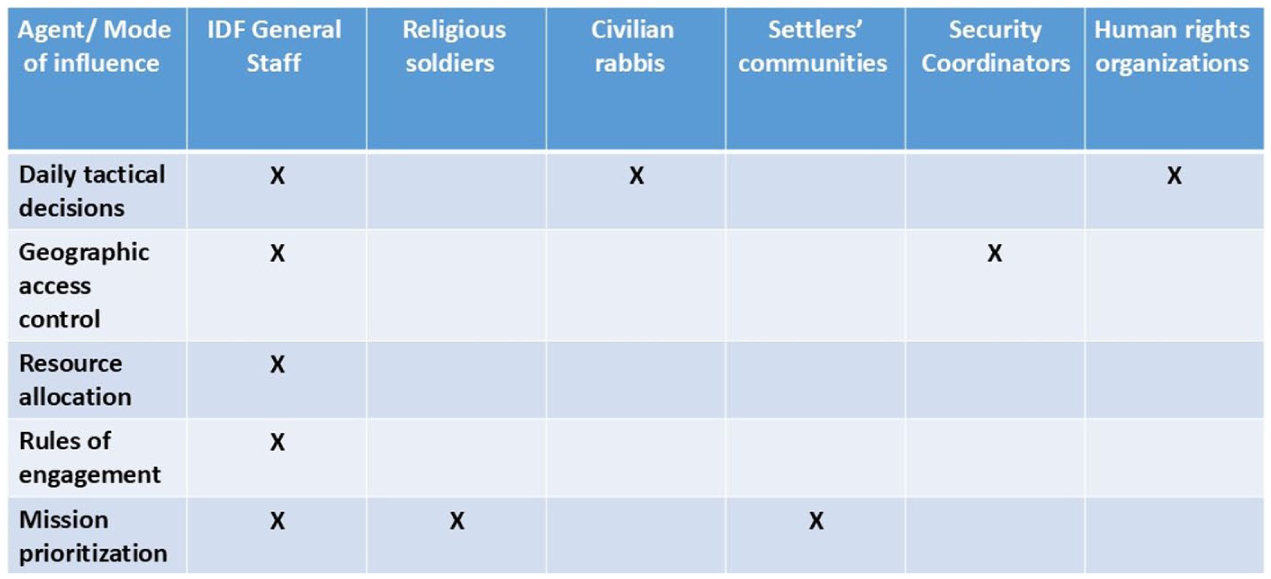
The Matrix of Control (West Bank).
As we can see, it matters who influences the military, as different actors exert different modes of influence. Different actors endeavor to shape military behavior in different ways according to their priorities and their relative advantages in power resources. Therefore, human rights organizations may bridge power gaps by petitioning the High Court of Justice in an attempt to reshape the troops’ conduct, while rabbis do not need to do so. They utilize their influence over graduates of religious pre-military frameworks who staff many of the policing missions to affect their conduct and use this power to influence their commanders.
Conclusions and Theoretical Implications
Civil–military relations traditionally focus on the triangular relationships between politicians, soldiers, and the public. However, much of the existing literature concentrates on the interaction between the military and political elites (Pion-Berlin et al., 2024, p. 2), particularly in the context of civilian control. This study, aimed at concept-building, contributes to the field by incorporating society into the analysis of civilian control, highlighting the impact of local civilian actors on military control dynamics.
The concept of matrix control addresses a theoretical gap in civil–military relations literature. Studies focused on subjective control, coup-proofing, privatization, and delegation fall short of capturing how military control can be modified in established democracies through informal local influences. This deficit also applies to established theories of civilian control in democracies. Matrix control fills this gap by demonstrating how military conduct in noncombat operations embedded within local populations can be shaped by multiple civilian actors outside the formal chain of command, without threatening the overall democratic structure. This decentralized approach creates a more complex and nuanced form of civilian influence than traditional theories anticipate. The matrix control framework helps explain how military conduct can diverge from official policy or contribute to its reshaping due to the accumulated influence of local actors, even in stable democracies.
Among these theories, principal–agent theory (Feaver, 2003) has been particularly influential in analyzing democratic civilian control. However, recent scholarship has identified systematic limitations in the application of principal–agent theory to civil–military relations. The concept of matrix control addresses some of these limitations while extending Feaver’s (2003) foundational framework. In Feaver’s model, civil–military relations constitute a strategic interaction between civilian principals and military agents: civilians monitor based on expectations of compliance or “shirking,” while military agents calculate the likelihood of detection and punishment. Matrix control suggests four extensions.
Moreover, jurisdictional ambiguities in the legal and institutional environment, such as the West Bank’s unclear status or divided military–police authority in conflict zones, as in the case of Northern Ireland, fragment authority relations. As a result, multiple principals claim legitimate authority simultaneously, unlike situations where the authority structure is clearer (Harnly, 2020). The more so when jurisdictional ambiguities extend to jurisdictional competition. When civilian authority is divided (e.g., the President versus Congress in the United States), military organizations may gain room for maneuver as a consequence of competition among civilian principals. From a principal–agent perspective, this dynamic creates space for discretion and agency slack, insofar as competition over control constrains key instruments of civilian oversight and inadvertently reinforces organizational bias and resistance to intervention (Avant, 1994, p. 35). Matrix control extends this logic by showing how such opportunities for maneuver expand further when competition over control involves not only state institutions but also decentralized, extra-institutional actors embedded in military operations or competition between local actors and the supreme command.
At the same time, local principals may provide more intrusive oversight than elected civilians owing to their intensive interactions with the troops, even bypassing the supreme command. Such local actors can act as a “fire alarm”—a decentralized mechanism in which citizens, the media, and interest groups “examine administrative decisions (sometimes in prospect), to charge executive agencies with violating congressional goals, and to seek remedies from agencies, courts, and Congress itself” (McCubbins & Schwartz, 1984, p. 166). This type of oversight contrasts with the centralized “police patrol” model, in which oversight is direct and continuous. The fire alarm metaphor applies to civilian control over the armed forces, where civilian agents alert elected officials or the supreme command when lower-ranking commanders deviate from policy (Feaver, 2003, pp. 80–81).
2.
3.
4.
These four extensions reveal that when matrix control emerges, state institutions have not lost control but rather have entered into informal compromises with local actors. This represents a transformation of control—from hierarchical and centralized to networked and decentralized—rather than an absence of control.
This transformation of control—from hierarchical to matrix—carries profound implications for both democratic governance and military effectiveness. Matrix control creates a fundamental democratic accountability paradox. While it can enhance local responsiveness and create multiple oversight channels by enabling communities to directly shape security provision, it simultaneously has negative implications. This form of control diffuses responsibility and enables buck-passing. More critically, local influence may thwart the will of elected civilians. The informal nature of matrix control, moreover, undermines transparency, while unequal access creates representation problems.
Matrix control also has implications for mission effectiveness. It can be positive by mobilizing local communities, by integrating local knowledge, by enabling adaptive flexibility, and by supplementing resources. However, it risks mission drift, operational incoherence, and the corruption of professionalization and ethics by blurring boundaries and enabling exploitation by local actors pursuing parochial agendas. The West Bank illustrates how original protection missions can transform into settlement expansion. Effectiveness depends on whether local principals’ goals align with legitimate mission objectives and on adaptable gaps between the local and supreme commands.
This study adopts an exploratory research approach, examining matrix control as a novel concept in civil–military relations that emerges from new, extended noncombat missions. While such network-based control patterns have not been previously theorized, this study provides an initial theoretical understanding of decentralized control mechanisms and identifies patterns that can be investigated in other contexts. To advance this research agenda, whenever militaries are deployed within civilian communities for noncombat missions, we should first map the potential agents engaged with the military activity (such as mayors, interest groups, sectoral leadership, and more) and then examine how informal interactions are divided into several modes of influence and thus create forms of control that challenge, balance, or modify formal oversight by the supreme military command. Figure 1 may assist in this mapping. These local interactions are key to drawing broader conclusions about whether matrix control is truly created.
As Casula et al. (2021) and Stebbins (2001) suggest, this study presents matrix control as a concept that is not a definitive development but remains in the exploratory phase. The theoretical features of matrix control should serve as working hypotheses in deductive exploratory research. The study’s emphasis on further investigation, its qualitative and flexible methodology, and its positioning as concept-building rather than theory-finalizing all confirm that matrix control still requires extensive study before it can become a fully developed and validated theory.
Matrix control offers a novel perspective on civil–military relations in complex, politically sensitive environments, particularly as militaries increasingly assume roles beyond traditional combat missions. This theory warrants further development, evolving from the exploratory conceptual framework presented in this study into a more detailed, comparative inquiry across different contexts.
Footnotes
Acknowledgements
Earlier versions of this article were presented at the IUS conference and at a meeting of the Research Committee on Armed Forces and Conflict Resolution of the International Sociological Association. The author thanks the participants for their valuable comments. The author is also grateful to the journal’s anonymous reviewers for their constructive feedback and especially for the guidance provided by the editors, Patricia Shields and Ori Swed. The author specially thanks David Kuehn for encouraging him to develop this conceptual paper.
Declaration of Conflicting Interests
The author declared no potential conflicts of interest with respect to the research, authorship, and/or publication of this article.
Funding
The author received no financial support for the research, authorship, and/or publication of this article.
