




Abstract
In this article, we examine the militarization of public administration in Mexico under President Andrés Manuel López Obrador (AMLO). Between 2018 and 2024, AMLO expanded the military’s role beyond traditional public security and disaster response to include civilian tasks, such as infrastructure construction, social program delivery, and the operation of public agencies. We argue that this shift is not solely the result of authoritarian impulses. Instead, it reflects a convergence of fiscal austerity, infrastructure as a political priority, and distrust of technocratic bureaucracies. Using a process-tracing methodology, we analyze public spending data, official speeches, and policy decisions to show how austerity weakened civilian capacity, positioning the military as a practical alternative. Militarization enabled the government to circumvent administrative constraints while pursuing flagship infrastructure projects. Our findings contribute to debates on civil-military relations, populism, and neo-developmentalism in contexts of middle-quality institutions, highlighting how militarization can emerge from developmental goals under fiscal and administrative constraints.
Mexican citizens have witnessed an increased military presence on the streets since the escalation of the War on Drugs in 2006. However, with the inauguration of Andrés Manuel López Obrador (AMLO) as President for the 2018–2024 term, this presence has diversified to include civilian tasks beyond public security or disaster relief. The Mexican military’s involvement in public administration responsibilities has expanded from distributing public school books to managing the publicly funded pharmaceutical company, reforestation efforts, and building airports, railways, and hotels. Even if academics have registered the involvement of the military in civilian duties in Latin America, Africa and Asia, the Mexican expansion is considerable. According to the 2024 “National Inventory of the Militarised” (hereafter referred to as the Inventory), compiled by academics and civil society, more than 258 budget or function transfers have occurred from civilian agencies to the military since 2018 (Velázquez et al., 2024, p. 6).
The militarization of Mexican public administration remains largely unexplored, particularly among academics. Although not central to their arguments, other authors have commented on this process. We concur with them in some respects, but their explanations fall short of fully accounting for this militarization process. Pansters and Serrano (2024) argued that this militarization process is due to the autocratic tendencies of AMLO, his disdain for bureaucratic opinions and legal procedures, the army’s popularity, and his intent to circumvent transparency laws and scrutiny. Alternatively, as Pardo López and Nieto Morales (2025) noted, AMLO sought unquestionable loyalty. Sánchez Talanquer (2020) argued that the shift to the military was indeed a surprise. However, it was in line with AMLO’s conservative tendencies. Centeno (2023) argues that militarization serves as a process of protecting private business ventures that AMLO has fostered. Moreover, Galego and Nieto-Morales (2024) rightly pointed out that AMLO used the military to reinforce the state due to the vacuum of civilian authority.
Although we share some views, we argue that these explanations are insufficient. Indeed, AMLO utilized the army’s national security laws to evade freedom of information requests. However, his popularity and the army shielded them from significant electoral backlash. AMLO enjoyed a congressional majority that allowed him to advance his agenda without resistance. In addition, he never considered strengthening the state through tax reform or borrowing from financial institutions, as he believed corruption and excessive spending had consumed the budget, which he deemed sufficient to his projects if properly managed. Furthermore, AMLO has conservative views, but he did not admire the military before assuming office.
Indeed, civil society has published robust reports on the militarization process (Moncada & Rojas, 2022; Onofre et al., 2024; Ravelo et al., 2024; Velázquez et al., 2021, 2024). However, most of their explanations rely on the idea of AMLO avoiding public scrutiny by assigning projects and functions to the military. However, this is a post-factum explanation.
We contend that scholars and commentators have overlooked two key factors. First, AMLO did not promise this militarization in his presidential campaigns. Moreover, he argued that he wanted the military to be held accountable for past human rights violations. Second, this shift toward the army occurred while he implemented cuts to the administrative budget of Mexican civilian agencies in favor of social and infrastructure spending. These events are not coincidental or merely contextual; they are part of a process that unfolded throughout AMLO’s administration.
As we will argue, AMLO’s austerity measures in the public sector, his ambitions for infrastructure projects, and his fiscal policies played a pivotal role in the militarization of several sectors of the Mexican public administration. To understand why militarization occurred, we must examine the events that led AMLO to rely on the armed forces. We demonstrate how and why this process happened by using both aggregated spending data and public statements made by AMLO during his campaign, administration, and by cabinet members. AMLO’s budgetary decisions highlight how austerity, ambitious infrastructure projects, and fiscal beliefs contributed to militarizing public administration functions. By adopting a process-tracing analytical narrative, we analyze how the militarization of the public administration developed in Mexico, why the military seemed positioned to be a solution to various problems AMLO faced, and why other explanations fall short of fully accounting for this change.
From this point, we clarify that this article does not evaluate the actual capacities of the Mexican Army or the civil bureaucracy. Nor are we endorsing or refuting AMLO’s points of view about bureaucracy or the military. Instead, we describe how his views and practical circumstances influenced the militarization process.
In the first section, we conduct a literature review to demonstrate how this case can expand our understanding of militarization under populist leadership, austerity measures, and infrastructure development in democracies and the Global South. This previously unexplored relation is worth the attention of political scientists. Next, we contextualize the reader with the history of the Mexican civil-military relations before the AMLO administration. In the second section, we outline our methods and data processing decisions. In the third section, we narrate the process of militarization during AMLO’s administration. In conclusion, we reflect on how this process impacts subsequent civil-military relations and development policy in Mexico, offering insights for comparison with other countries in the Global South experiencing a middle-quality institutions trap.
Literature Review
In this brief literature review, we will summarize relevant literature that helps solve the puzzle of Mexico’s public administration militarization, with a particular emphasis on literature from Latin America.
Before advancing, it is essential to have conceptual clarity about militarization and militarism. As Levy (2024, pp. 305–306) summarizes, militarization transforms non-military issues into security threats to defend their domestic use. Militarizing civil duties requires legitimisation and an explanation to elites and the public of why the military is performing non-traditional tasks. Levy (2024, pp. 306–308) argues that there are five ways in which civilians justify militarization: (a) to indulge military autonomy to keep their distance from politics; (b) argue they need them; (c) to face war; (d) argue that the military has adapted new civilian values; and (e) portray them as depoliticized. All these arguments amount to militarism, an ideology that justifies the use of the military. Levy (2024, pp. 298–304) summarized that this ideology normalizes the use of the military for any purpose, including the use of violence, because politicians portray the military to society as patriotic, professional, and technically superior.
There is a growing literature about the militarization of public security in Mexico and Latin America, and arguments from these scholars vary when explaining why there has been an expansion of military forces in counter-narcotic operations. In summary, the authors argue that it happens because police agencies are not capable of performing the tasks that politicians expect (Flores-Macías & Zarkin, 2021); the United States (US) has pressured governments in the region (Forner, 2024); the military is a popular agency that can enact hard on crime operations (Cutrona et al., 2025; Pion-Berlin & Carreras, 2017); and because Latin American military need to justify their existence due to the absence of external threats (Pion-Berlin, 2016).
Overall, scholars find something familiar: historically, governments in Latin America have not developed sufficient state capacity to provide public services (Centeno, 2002). Therefore, politicians must find ways to fill administrative ranks to deliver services or implement political initiatives (Geddes, 2023; Mazzuca & Munk, 2021; Soifer, 2015). This condition became acute in the 1990s, when governments faced debt crises and structural adjustment programs (SAPs) that imposed austerity measures on the administrative state (Kaplan, 2018). Reinsberg and colleagues (2019) found that most countries that faced SAP austerity programs experienced a decline in bureaucratic quality.
As Soifer (2015) summarizes, during the 20th century, Latin American governments’ attempts to build capacity have been hindered not only by a lack of resources but also by the creation of patrimonial networks within bureaucracies that, in some moments, turned into informal institutions that became complementary to the actual formal mechanisms (Levitsky, 2012). Prominently, O’Donnell (1979) argued that some military dictatorships suppressed popular dissent to allow new technocratic elites to reform the economy. In this regard, some areas of the states became dominated by technocrats, while in other cases, patrimonialism prevailed, depending on the circumstances.
Studies on the military’s involvement in other civil duties in Latin America are relatively new, primarily in the first decades of the 21st century. For example, scholars have documented the use of the military for environmental protection in the Amazon (Corredor García & López Vega, 2024; Rodrigues & Kalil, 2021) or their politicization by using them to distribute welfare programs in Venezuela (Penfold Becerra, 2007). During the COVID-19 pandemic, governments in the region deployed their military to distribute vaccines and other medical equipment as an emergency measure (Acacio & Passos, 2020; Acacio et al., 2023); however, research on Mexico has not been focused on this aspect. Jenne and Martínez (2022) documented several duties that military forces have undertaken in Latin America beyond public or national security activities, including literacy campaigns, infrastructure building, and the distribution of benefits or medicine.
As Stepan (2001), Hunter (1995), and de Carvalho and Lima (2023) argued, in the case of Brazil, governments have viewed the military forces as a developmental agency in alliance with the civilian sector. This view is also a trend in other parts of the Global South. For example, politicians in Kenya utilize the military to construct infrastructure (K’Akumu, 2025). Izadi (2022) documented that 47 countries have armies that engage in civilian economic activities, primarily in Africa, Asia, and Latin America. Brömmelhörster and Paes (2003) and Mani (2007, 2011) argue that the military often agrees to participate in economic policy to capture resources for their budget, thereby securing financial and institutional autonomy when civilian state capacity is weak.
In China, Cheung (2001) documented a similar trajectory. As the central government reduced defense budgets, the People’s Liberation Army developed one of the world’s largest military-run commercial empires, thereby compensating for formal resource constraints through market activity. Likewise, Grimes and Pion-Berlin (2019) show that even in democratic contexts, militaries may exploit off-budget revenue streams—such as levies on natural resource exports—to accumulate rents outside the reach of civilian oversight, making reform politically costly without strong cross-sector coalitions. In the case of post-war Sri Lanka, Kelegama (2024) demonstrates how the government reframed large-scale development and resettlement programs as national security priorities, granting the military broad authority over infrastructure, agriculture, and public service delivery, which in turn normalized its peacetime role in public administration.
Collectively, these studies illustrate a pattern of developmental militarism in the Global South, in which civilian governments, faced with fiscal constraints or weakened state institutions, enlist the military as a surrogate administrative apparatus. While not always explicitly driven by austerity, these cases underscore how institutional fragility and resource scarcity create structural incentives for expanding military influence into economic and public administration domains.
Therefore, it seems that in the Global South, and in particular, Latin America, some politicians (particularly presidents) have opted to use the military (Flores-Macías, 2018; Geddes, 2023, chap. 6) because it is a loyal institution, which also has allowed them to expand their executive power (Flores-Macías, 2023). In summary, some Latin American politicians have recently found that they can rely on the military to execute civilian functions, thereby covering low state capacity and justifying the military presence through discourses of emergency, military patriotism, or perceived incompetence among public servants.
It is not a coincidence that elites employ similar discourses about public servants’ alleged incompetence, once used to justify military involvement during times of austerity. Whiteside and colleagues (2021, chap. 4) documented how, after SAP, public administration scholars and intellectuals argued that spending cuts, privatization and centralization of functions would bring efficiency to the public sector. Elites transformed crafted new narratives to justify austerity to the public, employing a discourse of emergency following mismanagement. This transformation was achieved by comparing public finances to household finances, using metaphors such as “maxing out the national credit card” after debt increases (Hopkin & Rosamond, 2018; Stanley, 2014).
Then, austerity becomes an unavoidable political option when leaders believe it is the only solution to debt problems and economic crises or when external pressures amount (Doyle, 2010). Austerity policies are counterproductive when governments propose investing, as Whiteside and colleagues (2021, chap. 2) found that governments obtained new debt after assuring international financial organisations that they would not increase public sector bureaucratic spending. Therefore, paradoxically, austerity measures used to gain access to resources hinder further capacity building. Hence, executives find themselves forced to find new solutions.
In Latin America, the new wave of left-wing governments since the early 20th century has tried to spend more on social programs. Madrid et al. (2010) documented that left-wing governments adopted two approaches: hard-left governments defied austerity and international financial institutions, while moderate left-wing governments adopted a pragmatic position, maintaining some measures of fiscal orthodoxy.
As Schneider (2013, chap. 8) documented, left-wing and populist governments in the region have attempted to reassert their influence over developmental policy amid their economies’ geographical and trade restrictions. Bresser-Pereira (2011) argues that Latin American governments adopting these policies follow a neo-developmental agenda, emphasizing state investment to create opportunities and reduce inequality while maintaining fiscal balance. This approach prioritizes export-led industrialization over import substitution. However, as Holland and Ross Schneider (2017) argued, these changes need some budgetary redistribution. They found that governments either adopt “easy redistribution” by rearranging small-scale national budgets or “hard redistribution” by implementing significant fiscal changes.
Populists have led many of these left-wing governments in Latin America. For this article, we align with two conceptualizations of populism. First, Weyland (2001), inspired by the early cases of populist leaders in the late 20th century, says that populist leaders exercise government power to gather large numbers of followers. Initially, Wayland argued that populist governments use the military to coerce those who oppose the construction of the new clientelist relations with the leader. However, Taş (2024) has recently documented how populist leaders in office utilize the military for their personal goals following negotiations. In particular, Izadi (2022) argued that leaders involve the military in civilian duties as a survival strategy to gain the armed forces’ backing, and militaries, seeking more budget (Dunleavy, 1985), comply.
The leaders of the “pink tides” in Latin America have proven adept at employing populist rhetoric and techniques. In particular, arguing against the bureaucratic elites that supported neoliberal policies. Populist leaders have criticized the bureaucracy, particularly against technocrats, as counter-popular agents (Bickerton & Invernizzi Accetti, 2017). These tendencies shape how populist leaders govern: they adopt pragmatic policies to achieve their agenda, downplay the expertise of civil servants, and implement policy quickly (Bartha et al., 2020). As Bauer (2024) summarized, populist governments tend to cut administrative budgets to hinder independent parts of the civil service and replace bureaucrats with loyalists. In our study case, the new loyalists are the military.
The second approach to populism is ideational. As Mudde (2024, p. 543) argues, populism is “an ideology that considers society to be ultimately separated into two homogeneous and antagonistic groups, ‘the pure people’ versus ‘the corrupt elite,’ and which argues that politics should be an expression of the general will of the people.” This concept is essential for our case because AMLO has framed bureaucracies as enemies. However, as populism is thin in terms of policy solutions, it offers populist leaders broad flexibility to adapt their goals to broader objectives without programmatic constraints (Mudde, 2017, pp. 30, 40). When studying the AMLO administration, Dussauge-Laguna (2022) argued that the President designed the policy based on “hunches.” Nonetheless, we do not think these were hunches; instead, they were strategic decisions shaped by the populist logic of perceiving bureaucracies as enemies of the people, thus disregarding them and using the Army as an ally of the people.
After this review, we notice that state capacity mediates the relationship between militarization, austerity, and public administration, and these conditions entrenched populist leaders. Therefore, if populist leaders have enough political strength, they face a set of decisions: what kind of redistribution do they want to enact when in office? What to do about bureaucratic resistance? As evident in the literature reviewed here, some explanations are predominantly strategic (power accumulation), while others are ideational (militarism and fiscal orthodoxy). We argue that, at least in the Mexican case, AMLO assigned the military to several civilian duties for ideational and strategic reasons, combined in a particular sequence.
As the reader can notice, based on the literature reviewed, our case study offers a crucial theoretical contribution by integrating multiple strands of scholarship on militarization, austerity, state capacity, neo-developmentalism, and populism—that scholars have rarely analyzed together in a single framework. Most existing studies isolate either the ideological justifications of militarism, the strategic uses of the military for regime survival or executive expansion, or the effects of austerity on state capacity. However, no one has fully captured how these dynamics can converge in a single political project.
The Mexican case under AMLO is distinctive because it illustrates how fiscal orthodoxy, developmental ambitions, and populist ideology interact under conditions of administrative austerity and hybrid state capacity. This intersection produces a unique pathway to militarization that is neither reducible to authoritarian intent nor the collapse of civilian institutions alone. Our study expands current theories of state transformation in the Global South by showing how ideational commitments and strategic imperatives combine to shape bureaucratic restructuring through military substitution. It highlights the need for a more integrated conceptual framework to understand Latin America’s contemporary civil-military dynamics.
Mexican Civil-Military Relations
Before introducing the methods, we synthesize the state of Mexican civil-military relations. Mexico is a clear outlier in Latin America because the country did not face coups during the 20th century, and the army was isolated from politics. After the end of the Mexican Revolution in the 1946s, an implicit civil-military pact established a unique hierarchical obedience to the presidency in exchange for autonomy from the civilians to the point that today, there has not been a civilian leading the Secretariat of Defense (Sedena in Spanish) or the Secretariat of the Navy (Semar in Spanish) (Serrano, 1995). The post-revolutionary regime led by the hegemonic one-party state of the Revolutionary Institutional Party (PRI) and its direct predecessors from 1929 to 2000 kept the military out of civilian politics, with some arranged occasional interventions such as electing a retired general as a member of Congress to lead congressional committees on the army, leaving the army essentially unscrutinized (Díez, 2008). Scholars such as Roderic Ai Camp (1992) and Serrano (1995) have called the previous arrangement the post-revolutionary civil-military pact, what we could call a concordance pact (Schiff, 1995), yet one in which the only principal (Feaver, 2003) is the President, and civilians have no control over the military.
The President instructed the military to tackle Marxist guerrillas in the 1970s, as well as some operations related to environmental protection (protecting the monarch butterfly migration) and disaster rescue operations. However, military hesitation to other duties was noticeable, such as avoiding deployment in United Nations peacekeeping operations (Zepeda Gil, 2016). Since the late 1980s, the US government has urged Mexico to confront drug cartels, pushing for the militarization of public security (Enciso, 2010). As mentioned before, militarization escalated when President Felipe Calderón deployed the Mexican Army in 2006 to confront drug cartels directly, leading to a steep increase in violence in the country (Kenny & Serrano, 2011). The militarization of public security in Mexico advanced vastly before AMLO’s election in 2018. As Zarkin (2023) documented, several majors have appointed military officers to lead local police agencies, and Sedena or Semar conducted most anti-narcotic operations. Although the Mexican government occasionally downscaled military operations during the Peña Nieto and AMLO administrations (Lessing, 2017, pp. 202–238), the military’s dominance in public security remains.
Before the constitutional reform proposed by AMLO on September 30, 2024, the Mexican constitution mandated that public security should be a civilian duty (Article 21) and that the military had strictly military duties (Article 129). However, since the Calderón administration, the Mexican Military gained significant legal protections with a national security law that allowed them to perform public security duties if those were related to drug trafficking. Furthermore, this law protected them from civilian scrutiny if they declared they were performing national security acts, bypassing civilian and transparency laws (Barreto Rozo & Madrazo Lajous, 2015). AMLO inherited the military in these conditions when elected President in 2018.
Methods
To understand AMLO’s decision to militarize the Mexican public administration, we conducted a process-tracing narrative (Collier, 2011; Mahoney, 2010) of his views before and during his 6-year term, focusing on how his fiscal beliefs and infrastructure ambitions shaped this outcome. We hypothesize that AMLO’s budgetary austerity and developmental goals jointly led to the militarization of civilian functions by positioning the military as the most viable instrument to implement policy under bureaucratic constraints.
Due to the nature of the issue, process tracing was the most appropriate method because it allows for identifying the specific causal mechanism through which AMLO’s fiscal and developmental preferences translated into policy outcomes. This approach assumes that political outcomes emerge from a sequence of identifiable decisions and constraints, and that researchers can reconstruct these through detailed empirical evidence within a single case (Bennett & Checkel, 2014; Falleti, 2016).
As noted in the literature, most cases of militarization in Latin America begin with strategic authoritarian moves or institutional breakdown. Mexico diverges from this pattern. Rather than reacting to crisis or incapacity, militarization, in this case, reflects a deliberate reconfiguration of the state. We, therefore, treat Mexico as a theoretically generative outlier and apply process tracing as a divergent case study (Beach & Pedersen, 2018) to show how fiscal morality, populist anti-bureaucratic rhetoric, and neo-developmental goals converged under austerity to produce institutional change. This case adds a new dimension to existing explanations by showing how militarization can emerge from the intersection of ideas and constrained developmental ambitions.
As Crasnow (2022) explains, the narration in process tracing functions to understand the complete process, test the hypothesis, and organize evidence. To analyze AMLO’s decision-making process, we collected key statements from him and his functionaries, paying close attention to the events that motivated subsequent militarization decisions. The phases we narrate are not clear-cut, discrete moments, but instead continued processes that emerged after the key critical juncture (Mahoney, 2012; Mahoney & Thelen, 2009): the 2019 budget. Falleti (2016) refers to this as an extensive process—that is, a process that encompasses both the causes (in this case, austerity) and outcomes (militarization).
We selected speeches from his website https:// lopezobrador. org. mx/, which collects all his speeches, using keywords in Spanish related to the army, such as austerity, budget, and military forces. We conducted a word search around the days when AMLO made key announcements, specifically those involving AMLO events with the military. Finally, to have references before the presidential campaigns, we cited both AMLO campaign books (López Obrador, 2004, 2017).
In terms of process tracing, we apply a straw-in-the-wind test (Collier, 2011, pp. 826–827)—the form of process-tracing test used to assess whether the evidence is merely consistent with the hypothesis—to evaluate whether austerity plausibly contributed to militarization before any autocratic tendencies. We examine AMLO’s pre-presidency discourse to show that militarization was not an explicit part of his early political project. Instead, we demonstrate that the causal mechanism between AMLO’s arrival at the presidency and the militarization of the public administration is as follows: AMLO framed austerity as a moral and fiscal imperative, which, combined with his frustration with institutions and bureaucrats, led him to utilize the military in civilian duties. Furthermore, we argue that the alternative explanations (military popularity, authoritarian tendencies and alliances with the private sector) are mediating variables behind this causal mechanism.
We then periodize AMLO’s presidency into three phases of militarization: first, a workforce need after the creation of the National Guard; second, a logistical shift during the COVID-19 pandemic; and third, an efficiency push aimed at completing flagship infrastructure projects.
To test our hypothesis further, we also analyze budgetary data, following Bennett and Checkel’s (2014, p. 21) emphasis on going beyond discourse alone. The data confirm that militarization in public administration followed a gradual trend. Most budget changes were incremental, and austerity disproportionately affected the administrative branches of government, not social programs. Unlike most research focusing on the administration’s second half, we emphasize the period before and during AMLO’s first year in office. This moment is when most militarization efforts concentrated on infrastructure rather than welfare delivery. It was only after the onset of COVID-19 that social spending and service delivery intensified, as seen in other Latin American cases.
There, we revised the Mexican budget and public accounts (Peters, 2018) to explain how budgetary decisions unravelled during AMLO’s administration and checked how the government spent that budget by using the Inventory data (Velázquez et al., 2024), and with reports by civil society (Moncada & Rojas, 2022; Ravelo et al., 2024). It is important to emphasize that, according to the national spending law, the Secretariat of Finance (SHCP in Spanish) can amend the budget approved by the Mexican Congress (Nuñez, 2017). As Puente (2020) showed, AMLO’s party majority in Congress, the National Regeneration Movement Party (Morena), avoided scrutinizing the President’s budgetary modifications. The online Appendix enables readers to understand how we processed this data, specifically how we identified military spending using the budgetary classifications employed by the SHCP.
We identified these phases as a paradoxical aggregation of militarism (Levy, 2024), fiscal orthodoxy, and neo-developmental views of the government’s role (Bresser-Pereira, 2011; Whiteside et al., 2021), rather than arbitrary hunches, as Dussauge-Laguna (2022) claimed. These choices appear logical and pragmatic from AMLO’s perspective and his functionaries. Still, his previous beliefs were a precondition for making heuristic decisions. As Shah and Oppenheimer (2008) argued, individuals tend to reduce options by examining fewer alternatives or discarding some, in this case, the civilian bureaucracy. Kahneman and Tversky (1984), and Elster (2000, 2015) argue that individuals constrain their choices because they act on certain beliefs they justify as the most convenient at some point. These ideational beliefs reinforce the cognitive processes by which actors make decisions and establish normative principles around them (Schmidt, 2008). To be clear, we are not arguing that the militarization of the Mexican public administration is purely ideational. Instead, we claim that AMLO’s strategic goals converged with his views on the military, social spending, and development model.
AMLO and the Militarization Process
Neo-Developmentalism, Fiscal Conservatism, and Anti-Militarism
We used AMLO’s campaign books as the primary documents to examine AMLO’s views before his presidency. In the first of them, published before his 2006 presidential campaign, López Obrador (2004, pp. 119–120) wrote: “The Army, surged from the peoples’ struggles, must not assume civilian duties or replace political incapacities of the rulers.” Moreover, he later added, “Nevermore a massacre after demands of liberty and justice.” AMLO has a history of confrontation with the Army. On February 7, 1996, AMLO led a protest in Tabasco, blocking 18 oil wells to demand compensation for damages to the local population. That same day, a thousand army officers broke up the protest and hit AMLO on the head, leaving him with a minor bleed (Proceso, 1996).
However, his positions shifted slightly toward the use of the armed forces for public security after the escalation of the war on drugs in Mexico in 2006. In his book for his 2018 presidential campaign, López Obrador (2017, p. 124) stated that the armed forces would remain in charge of public security. However, AMLO mentioned that he would not use the military for political repression. At this point, AMLO did not contemplate the army on any other civilian duty. In addition, in his speech at Tlatelolco, where the Mexican Army repressed student protests in 1968, López Obrador (2018) referred to the army as “uniformed people.”
In his last campaign book, AMLO outlined his government project. First, AMLO outlined his fiscal conservatism and orientation to austerity in chapter VIII, entitled Republican austerity: The implementation of an austerity policy will allow us, alongside the fight against corruption, to have a sufficient budget to promote development and ensure the well-being of all. With this strategy, there will be no need to increase taxes in real terms or create new contributions, nor will it be necessary to resort to deficits or financing development through public debt (López Obrador, 2017, p. 60).
López Obrador (2022) directly attributed the spending of the Mexican Government to bureaucratic privileges: (. . .) All that got into (the budget), sometimes with tax rises and debt, was costly to keep the lifestyle of high functionaries, and they stole it, so all the money stayed in the government. The government was rapt in using the budget for high salaries for a golden bureaucracy.
As shown in Figure 1, the changes to the budget throughout the entire AMLO administration resulted in a decrease in the operating expenses of the Mexican federal government. AMLO ordered a freeze on the payroll increase, and the budget’s key priorities included paying off debt and increasing social spending. As we can see, in the first year, the government increased their payments toward the national debt and social spending. In the following years, operating expenses increased or remained the same each year. In other words, after two years of decline, government expenses remained unchanged. Conversely, the overall budget did not increase in proportion to the GDP.
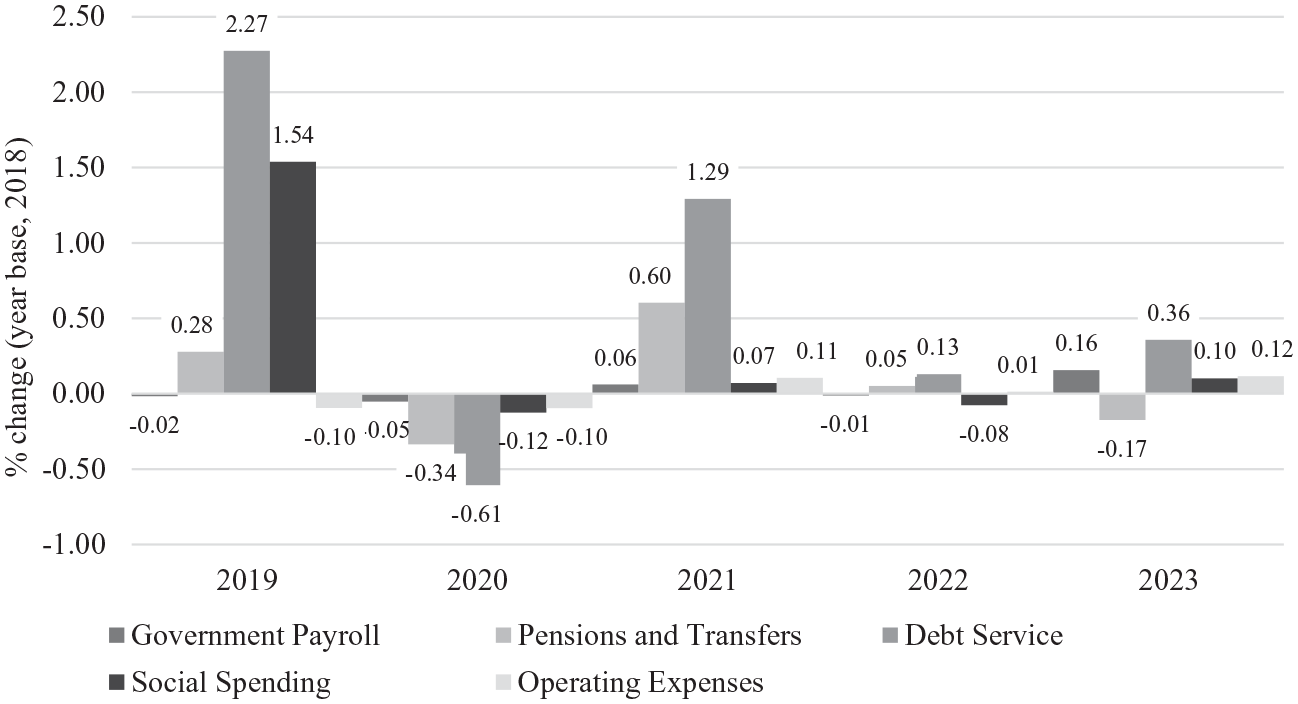
Percentage Change by Spending Category in the Mexican National Budget During the AMLO Administration (2019–2023).
AMLO later promised to direct more than $18.8 billion to development projects. Although this number was never archived, the government implemented a round of austerity cuts to the administrative budget to finance a diverse number of unconditional cash transfers, particularly a non-taxable pension for senior citizens, the construction of two train lines, a new airport, the Tehuantepec Interoceanic Corridor, the Mayan Train, a new refinery of the state-owned company Pemex named Dos Bocas, and to refinance the debt of Pemex. As shown in Figure 2, the energy sector experienced the highest increase due to the construction of the new refinery and Pemex’s debt payment. Tourism funded the budget for the Mayan Train, Welfare managed cash transfers for programs targeting vulnerable populations, and the military saw its largest increase in decades. Paradoxically, the infrastructure secretariat lost resources, as did the “other executive agencies” that comprise the rest of the Mexican Government, namely those affected by the austerity in the administrative budget.
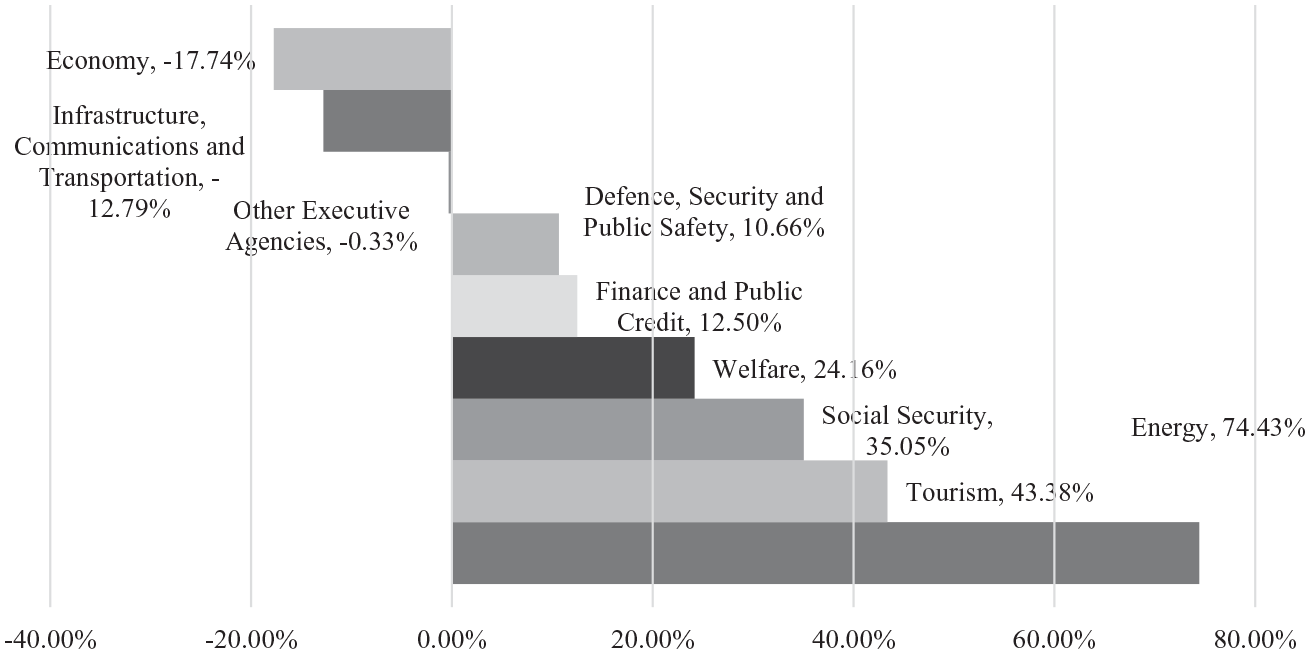
Average Percentage Change to the Federal Agencies Budget (2018–2023).
Indeed, AMLO’s view on macroeconomic policy is not only driven by his distrust of technocrats but also by his political strategy to appease the business sector. From the start of his administration, López Obrador announced to several business chambers that he would not raise taxes, but rather increase contributions by improving the operations of the revenue agency (Muñiz, 2018). By announcing this in parallel to respect the Mexican Central Bank’s independence, AMLO followed the steps of other left-wing presidents in the region who avoided confrontation with their business elites, fearing capital flight (Madrid et al., 2010). Yet, it is essential to recognize that austerity is an old ideological issue. Before his first presidential campaign, López Obrador (2004, pp. 145–156) argued that austerity was a moral value, that corruption was consuming public resources, and that the tax system needed adjustments without raising taxes.
Trump and the National Guard: The Workforce Needs
In his campaign book, López Obrador (2017, p. 224) rehashed a policy that failed to come to fruition during Enrique Peña Nieto’s presidency (2012–2018): the creation of a new militarized gendarmerie to tackle organized crime. The main idea behind the creation of this agency was to have sufficient armed agents to confront drug cartels, even in parts of the Mexican territory where these organizations dispute state presence. Peña Nieto’s administration failed to convince Sedena and Semar leadership to transfer part of their units to the new agency. Military leaders wanted reassurances that their ranks, social security system and salaries would remain intact (Carrasco Araizaga, 2014). AMLO’s solution was to transfer the military police units from Sedena and Semar to a new National Guard, which would also merge with the Federal Police that had existed since 1999.
The first constitutional reform AMLO negotiated with the opposition after assuming office was to create the National Guard. With an all-party consensus, in 2019, the Mexican Congress created the new agency and assigned it to the resurrected civilian Public Security Secretariat. Congress ordered the units to merge, while maintaining the previous contractual arrangements for military ranks and positions. AMLO appointed a General as the first commander. The logic was simple: more military officers doing police duties. López Obrador (2021) declared, during the opening of a new garrison of the National Guard, that: In its best time, the Federal Police had 40 thousand officers, but half were assigned to administrative duties, and really, the ones assigned to police operations were less than 10 thousand. Now, we have 100 thousand elements with the National Guard, well-trained with these installations.
However, this number is below the 250,000 agents he promised during his campaign. In Figure 3, we can see the steep increase in military spending on military personnel. AMLO’s administration increased spending beyond what President Calderón and Congress assigned to the Mexican Army during the early years of the Mexican Drug War from 2018 to 2014. Even without considering the National Guard, Sedena and Semar spend as much as they did in 2013. Nevertheless, as we will explain later, the increase in personnel spending had another driving force: using the military as a multipurpose agency.
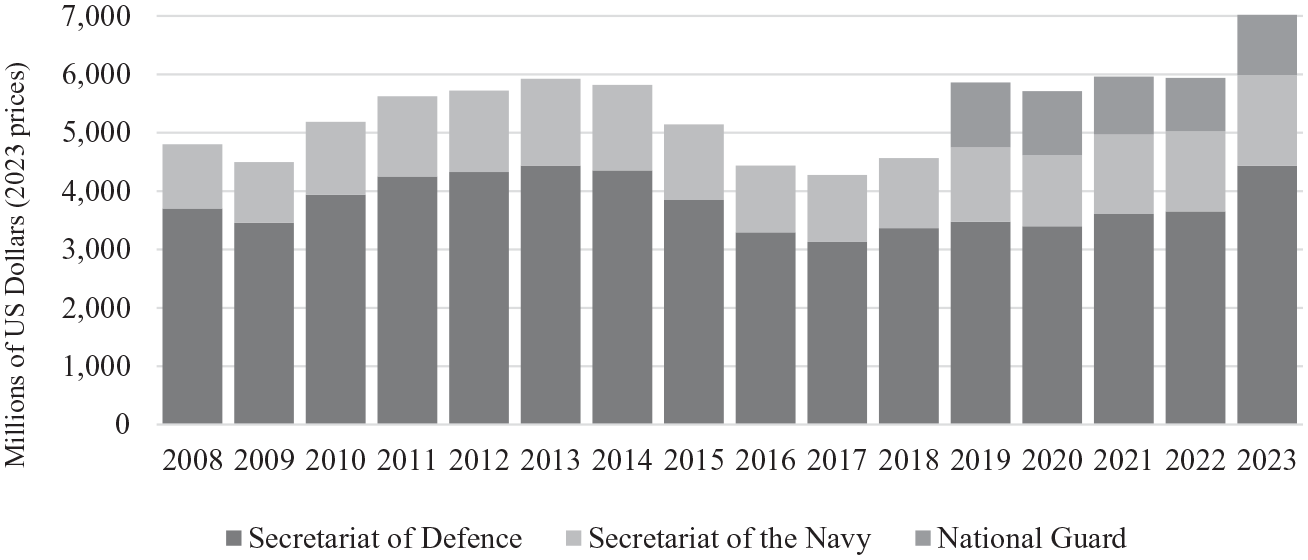
Increase of Spending in Military Personnel From 2008 to 2023.
In May 2019, Donald Trump threatened Mexico with imposing a 5% tariff on all goods if the Mexican Government did not comply with his demand to reduce migration from Central America to the US. After a hasty round of negotiations, AMLO’s administration agreed to deploy the National Guard to the border with Guatemala and across the country to stop migrant caravans trying to reach the US to get asylum (Graham, 2019). Furthermore, Mexico agreed to tackle illicit fentanyl smuggling coming from China through Mexican ports.
As a result, López Obrador de facto militarized the National Migration Institute by appointing retired military officers to more than half of its regional commands (Moncada & Rojas, 2022). Also, in 2020, the Mexican Congress approved AMLO’s proposal to transfer all civilian port authorities and personnel to Semar. Finally, AMLO also proposed creating a new customs agency within the SHCP. Still, he assigned customs control to Sedena at the borders and Semar at ports. The Secretary of the Navy, Admiral Ojeda Durán (2021), said in a speech about the transfer of the civilian ports: We are using the experience of the merchant navy because we are not militarizing the ports or displacing anybody, as it has been misinterpreted. In that logic, we are appointing graduate personnel from our nautical commands to organisational posts of the ports, merchant navy, and nautical education.
Consequently, in his administration, there was an increase in personnel under the control of the Mexican military. Figure 4 shows this transfer. It is essential to emphasize that we are counting all personnel from all agencies. We cannot infer which military officers are in the civilian agencies. Still, we know that military officers direct them. In the case of Sedena and Semar, most personnel are military. We have now counted civilian port personnel under Semar separately. We assigned them to the task of counting for the year that Congress approved personnel transfers. Alternatively, AMLO appointed military commanders. The increase from 2018 is notable.
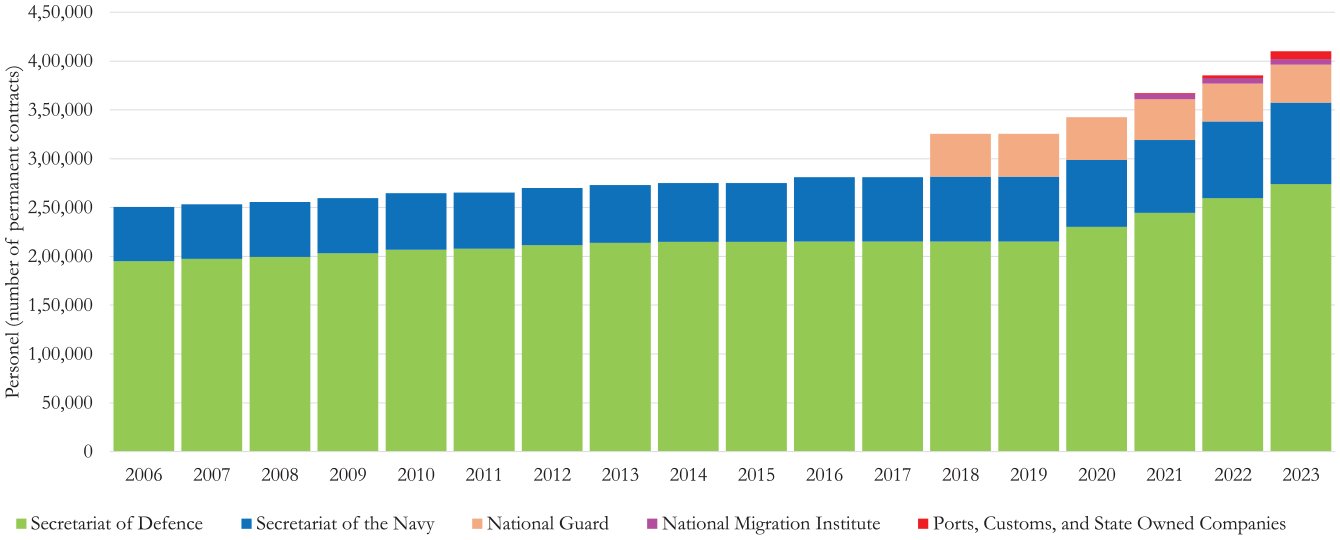
Personnel Under the Command of Sedena—Semar (2018–2023).
COVID and Government Malfunction: The Logistical Workforce
After his first year in government, civilian agencies subjected to his budget cuts began to fail, reinforcing AMLO’s belief that civil bureaucracies were ineffective—a self-fulfilling prophecy. In those moments of failure and the COVID-19 emergency, AMLO detected that he could utilize the military as a multipurpose agency.
During the summer of 2019, a series of fires destroyed part of the Sian Ka’an Biosphere Reserve. The head of Quintana Roo’s Civilian Protection Agency reported that his agency suffered a 50% budget cut from National Forestry Commission funds (Conafor in Spanish). Therefore, he could not pay the salaries of ten specialized forest guards, and Conafor fired their legal officer in the state before the fires started (Animal Político, 2019). AMLO ordered the Army to intervene to contain the fires. As seen in Figure 5, in 2019, Sedena had to spend several million pesos to compensate for the budget cut to Conafor. The budget cuts to Conafor continued because they did not spend the entire budget assigned by Congress. At the same time, Sedena began to spend more on foresting. As the Inventory shows, since 2016, Conafor has agreed to transfer the budget to Sedena for foresting activities. As the 2018 data show, this was not a substantial budget, but Sedena has increased spending on this since 2018 under AMLO.
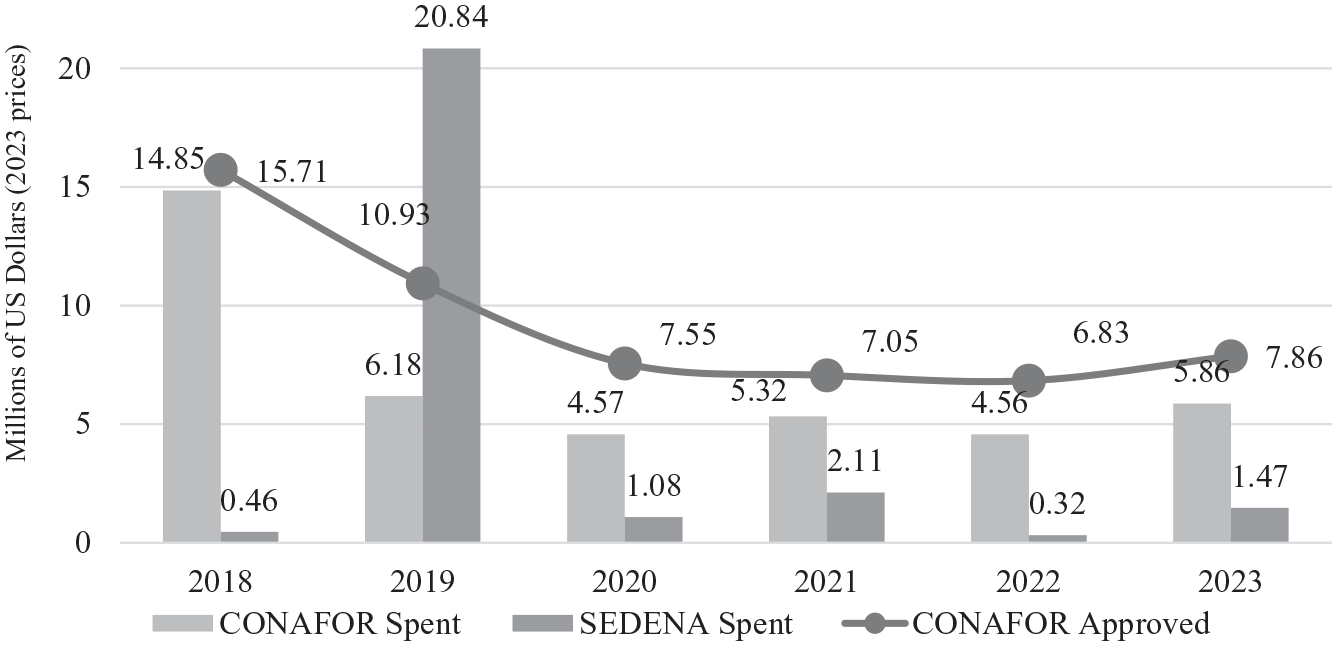
Logistical Tasks Budget Assigned to Foresting Programs in Sedena and Conafor (2018–2023).
To reduce costs in government procurement, in 2019, AMLO’s administration assigned the printing and distribution of government-provided textbooks to the SHCP administrative office, a task typically handled by the National Commission of Free Textbooks (Conaliteg in Spanish). Subsequently, the SHCP rejected the contracts negotiated yearly by Conaliget, delaying the printing and distribution for months, as reported in April. The government should have distributed the textbooks by August, before the start of the school year. Afterwards, Conaliteg (2019) signed an agreement with Sedena and Semar to distribute the books. According to the Inventory, this agreement renewed a previous one in which Sedena agreed to distribute textbooks only in cases of natural disasters or in very remote areas of the country. Figure 6 shows that Conaliteg began to spend less on logistics from 2019 to 2021, but then there was a spike in 2022. Essentially, the government had to compensate for the cuts from previous years by transferring a larger portion of the budget to Semar and Sedena.
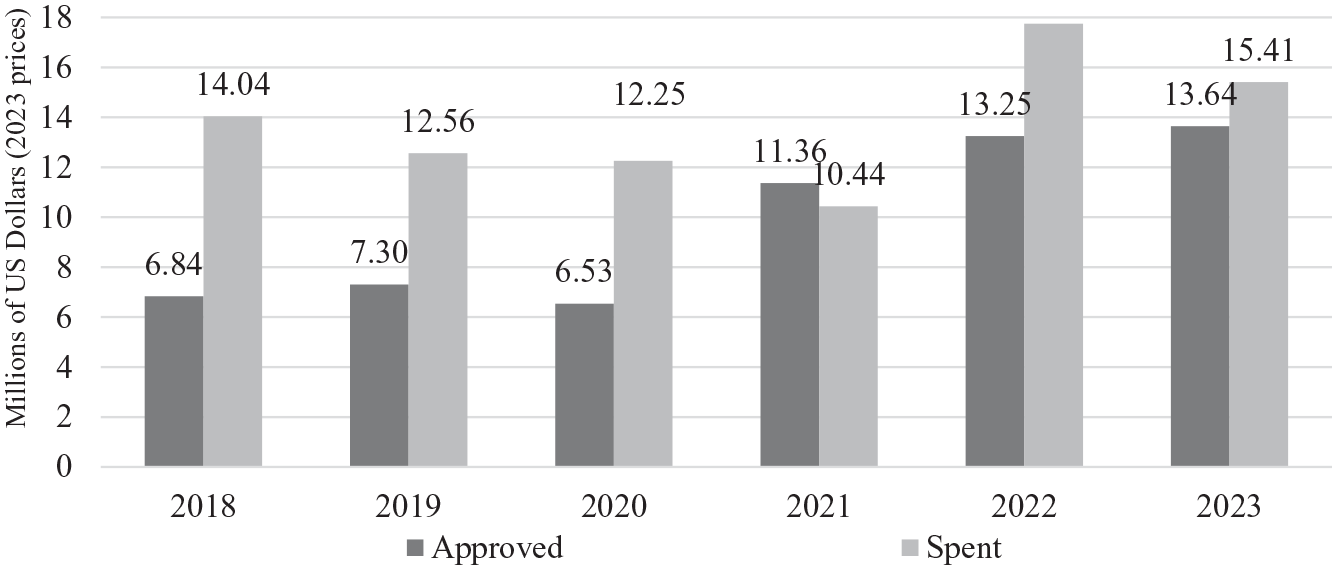
Logistical Tasks Budget of the National Commission of Free Textbooks (Conaliteg) (2018–2023).
Indeed, governments worldwide needed to deploy their armies to confront the overwhelming challenge of the COVID-19 pandemic. However, the intensity of the military involvement in public health differed. Acacio and Passos (2020) offered a helpful interpretation: the armed forces could be involved or take over logistical tasks.
The Mexican case was a takeover. The second annual report of the Secretariat of Public Security (SSPC, 2020) indicates that the National Guard coordinated the security of health facilities and transported medicines and medical equipment. In their second annual report, Sedena (2020b) stated they had hired civilian medical personnel and acquired medical equipment. AMLO also assigned the rollout of the COVID-19 vaccines to the army. The then COVID-19 Czar, Hugo López Gatell (2021), said: These institutions (The Army and the Navy) participated in various steps in safeguarding facilities, personnel, the vaccination product, and the people who came to vaccinate. The General Secretary will later comment on the important logistics task that was also essential to achieve something that seemed impossible, and that was accomplished in a very good time and with perfect operation.
However, participating is an understatement, as AMLO appointed a general head of the leading state-owned vaccine distribution and production enterprise, Birmex (Vega, 2021). In its third annual report, Sedena (2021) states that it paid the National Welfare Health Institute (Insabi in Spanish) to compensate civilian medical personnel it had hired. Moreover, Birmex coordinated the vaccination process.
These cases are just some highlights of when AMLO say the Army is a solution to increasing challenges to civil bureaucracy. Both secretariats have assumed several civilian duties not as supplementary help but as part of their primary goals. In Sedena’s (2013) sectoral program 2013–2018, they only contemplated protecting civilians in the event of natural disasters. Sedenas’s (2020a) 2019-2024 program includes a priority called “Support government actions in the areas of Public Security, Social Welfare, and Economic Development for the benefit of the country’s population,” which included AMLO’s cash transfer programs such as “Sembrando Vida” and “Youth Building Future,” even if those were activities assigned to the Secretariat of Environment and the Secretariat of Labor respectively.
Finishing Projects on Time: The Efficiency Push and the New Military Industry
At the end of Enrique Peña Nieto’s Government, the New International Airport of Mexico (NAIM in Spanish) was under construction. In his book, López Obrador (2017, p. 19) stated that this was a corrupt project and that he would cancel it after a public consultative vote. On the first day of his presidency, he cancelled the project. He ordered the building of a new airport on the “Santa Lucia” air military base. AMLO inaugurated the new airport on March 21, 2022, renaming it “Felipe Ángeles” International Airport (AIFA in Spanish) and placing it under the control of Sedena, including the collection of the Airport Use Fee Tax.
The President replicated the AIFA construction model to expedite government infrastructure projects. López Obrador (2019) laid out the logic of his future way to proceed when criticizing the Mexican bureaucracy: That is why I am talking about the rheumatic and tricky elephant, and I request you (the people) to help me push the elephant (. . .). Normativity must adjust to reality because that (normativity) obstructs (delivering social programs and infrastructure).
As civil society has shown (Ravelo et al., 2024), after 2020, the President began to utilize the armed forces, as laws and normativity do not constrain these agencies when they invoke national security law. This act accelerated their capacity to undertake new infrastructure projects.
Initially, AMLO assigned infrastructure projects to different civilian agencies: the Tehuantepec Interoceanic Corridor to the Secretariat of Communications and Infrastructure and the Mayan Train to the Secretariat of Tourism. However, Sedena and Semar began to participate in progressively constructing these two projects. Figure 7 shows how infrastructure budgets increased during AMLO’s administration, particularly in what they named “National Security Infrastructure,” which included railway, port and airport construction. The 2019 government expenditure was re-programmed throughout the year, while in subsequent years, Congress endorsed those amounts in the budgets AMLO presented. The decline from 2022 indicates that the government has finished most of the spending on those infrastructure projects. However, in 2023, the expenditures reflected Sedena and Semar’s investment in their newly acquired responsibilities. Railway and massive mobility projects are on the budget because AMLO decided to reorganize the AIFA and the Mayan Train as companies under the ownership of Sedena. At the same time, the Tehuantepec Interoceanic Corridor and the Mexico City Airport became companies under the ownership of Semar.
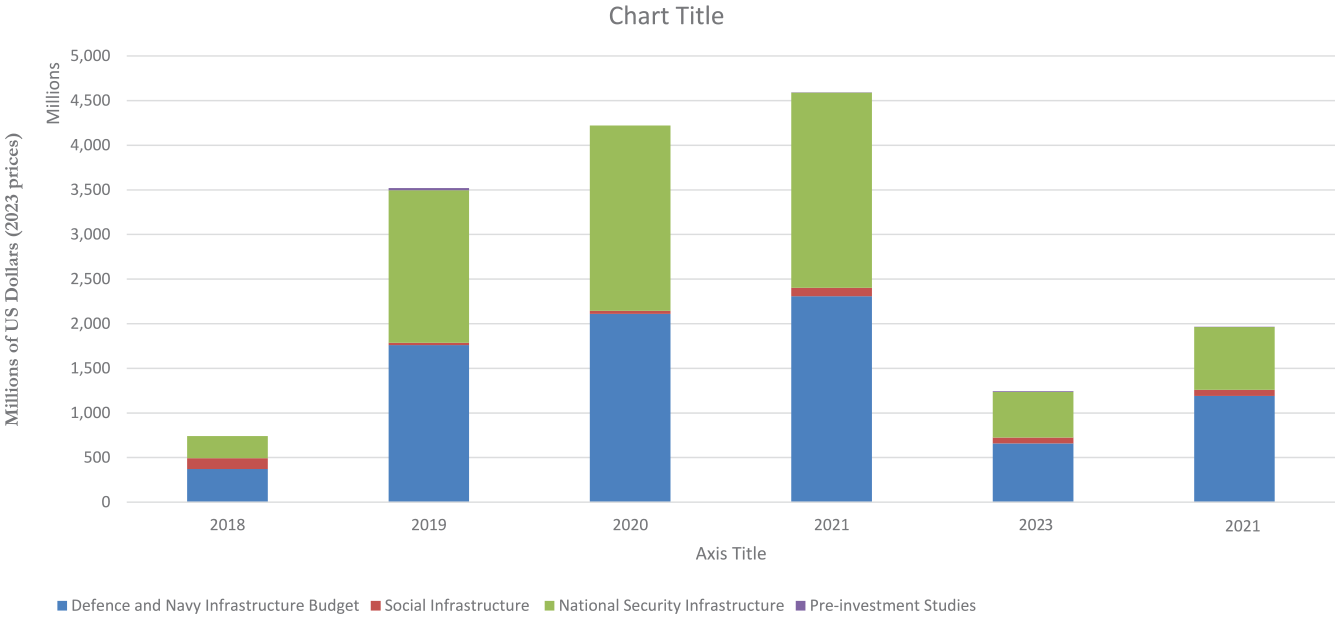
Budget Spent to Infrastructure Programs Under the Control of the Secretariat of Defense and the Secretariat of the Navy (2018–2023).
López Obrador (2022) said on Army Day: Without the Army (. . .) It would have been impossible to carry on the current public works with the building companies that were used to, or better said, badly used to, cronyism, irresponsibility, and corruption.
Hence, AMLO rewarded these Secretariats with budgetary increases. As Figure 8 shows, the military expenditure during AMLO’s administration surpassed even the increases Felipe Calderón gave the Army in the most violent year of the war on drugs, 2011. At the time of writing, we did not have access to 2024 data, and to conclude whether this process endures, we will need to analyze Claudia Sheinbaum’s first year as President. Yet, as of 2025, none of these companies has returned to the civilian agencies.
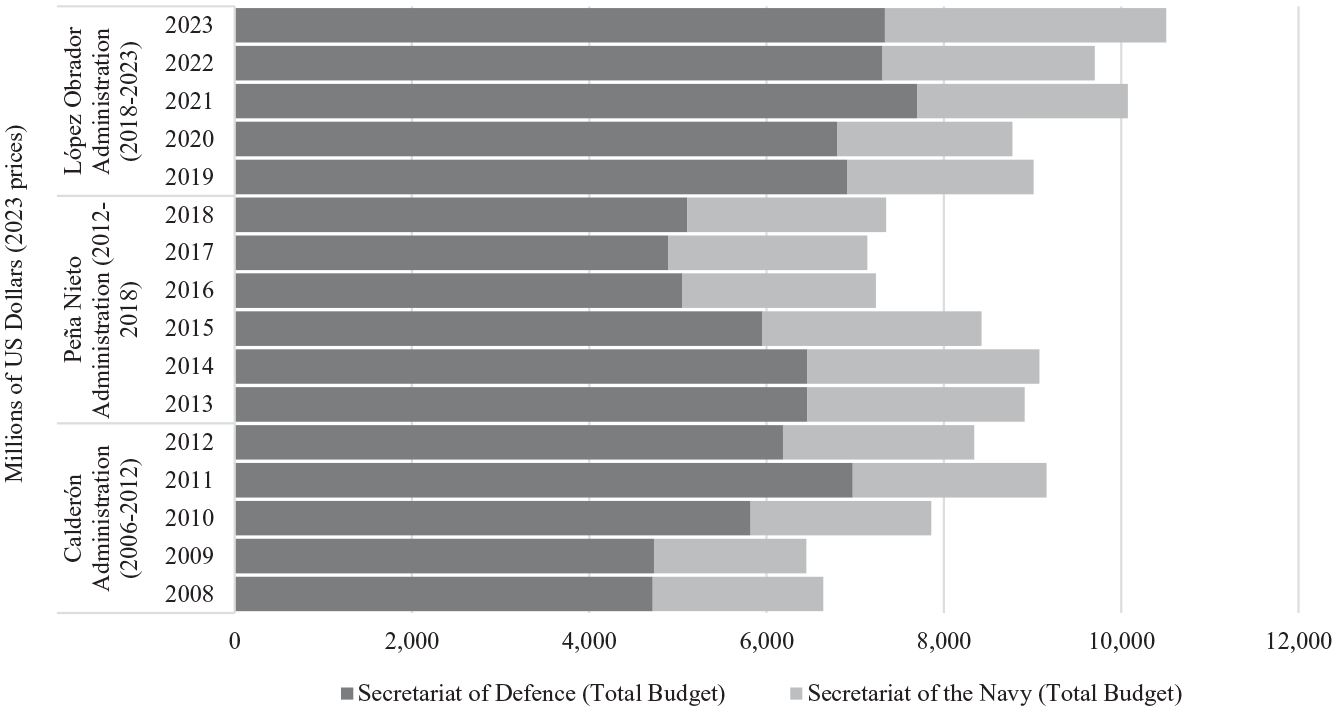
Budget Assigned to the Military (2008–2023).
Discussion: Alternative Explanations
The three alternative explanations for militarization during the AMLO administration are his autocratic tendencies and the military’s popularity (Pansters & Serrano, 2024), his authoritarian and conservative tendencies (Sánchez Talanquer, 2020), and his alliances with private businesses (Centeno, 2023). Although these claims have some truth, they are insufficient to explain military use. For us, these are preconditions or features that developed through his presidency that intersect with our explanation. Indeed, the Mexican military proved its unwavering loyalty to the President by executing these infrastructure projects, aligning with AMLO’s autocratic tendencies. AMLO’s first Secretary of Finance resigned after a few months, denouncing the President’s autocratic tendencies: There was not a profound analysis, and the president’s voluntarism makes him decide things he would not have done if he had thought them through a day later (Urzúa, 2022).
However, if these tendencies were evident, we would have documentation of his intentions before taking office. As Taş (2024) mentioned, populist leaders usually negotiate with the army rather than using it as a first option.
Indeed, the military is a very popular agency in Mexico. In Figure 9, we can notice the popularity of the Mexican Army. Nevertheless, curiously, the military was at its lowest point in popularity when AMLO took office, and it gained popularity after his presidency. Further to our point, as Solar (2022) showed for Brazil and Chile, the military in the region is popular because Congress and Police Agencies are very unpopular. The case of Mexico seems similar. According to Latinobarómetro data (Latinbarómetro, 2017), over 50% of the Mexican population lacked confidence in the government, and more than 67% distrusted the police. Indeed, the military has participated in civil activities before. Conversely, popularity cannot explain the steep increase in military presence in civilian activities.
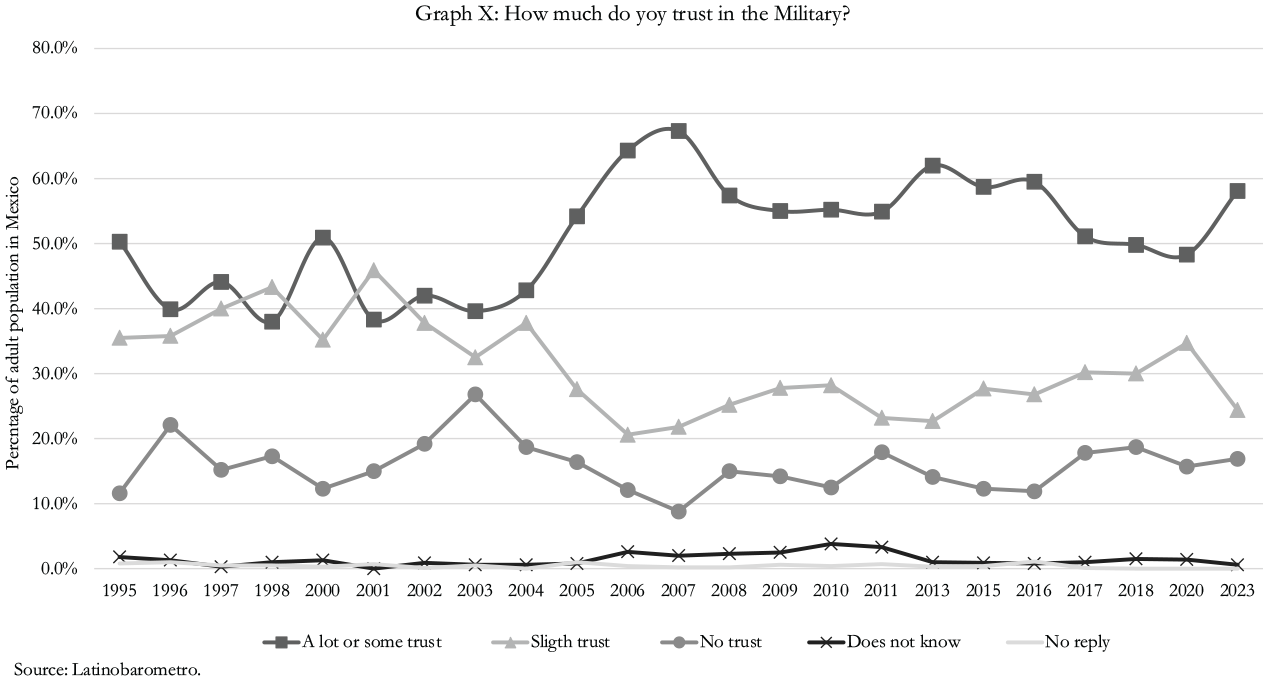
How Much Do You Trust in the Military? (Mexican Adult Population).
Rather than conservatism, AMLO adopted a militaristic tone in his speeches and portrayed the army as “uniformed people” pushed to repress citizens in the previous administrations. Yet, before taking office, in his book, AMLO never mentioned the military as a substitute for civilians. Instead, in his speech at Tlatelolco, López Obrador (2018) said: And now, sailors and soldiers have to help us, without using force, like a peacekeeping army; they have to help guarantee internal and public security.
Rather than justifying militarization as an extraordinary measure against threats. Following Levy’s (2024) definition, AMLO justified it with a militaristic tone, portraying them as a logistically superior, patriotic, and non-corrupt agency.
AMLO’s government had a close relationship with the private sector. Nevertheless, the use of the military on infrastructure projects does not seem entirely related to protecting them from the opposition of indigenous or environmental groups. Instead, it appears incidental and primarily related to AMLO’s impetus to complete the projects before the end of his administration. Greenpeace México (2022) and other organizations pursued an injunction to stop the construction of the Mayan Train. López Obrador (2024) reacted mainly against legal attempts to delay his project: And we have gone through communities, ejidos, small properties, towns, and the people have helped a lot even though pseudo-environmentalists, pseudo-lawyers, bureaucrats wanting to take advantage, and these organisations of Claudio and everything to promote injunctions, have gone.
Later, he focused on not using the military to repress organizations or communities, but rather on eliminating the judicial system’s capacity to impose injunctions on public works (Aguiar et al., 2025). In summary, AMLO promised large-scale infrastructure projects during his campaign, which he prioritized as visible deliverables that the government could complete within his tenure as part of a populist strategy. However, AMLO’s fiscal beliefs and distrust of technocrats, whom he views as corrupt, molded his preference for austerity within public administration. Furthermore, he expressed frustration with the perceived inefficiency of traditional bureaucracies. As a result, needing to deliver public works quickly, AMLO turned to the military to bypass administrative law without constraints.
The subsequent militarization of public administration extended to various sectors, reflecting AMLO’s heuristic biases about logistics, efficiency, and workforce management, rooted in his anti-technocratic views. In other words, AMLO imposed strict fiscal and anti-technocratic constraints on his administration from the outset. To pursue his ambitious infrastructure agenda, he found an obedient ally in the Mexican military. Under AMLO’s government, the military became a multipurpose agency that would not oppose his decisions.
In Figure 10, the reader can observe the process in a timeline. As the reader can note, instead of a conservative AMLO with authoritarian impulses from the beginning, there was a gradual transformation of his positions that later led to the militarization process. A key moment in his process was his 2017–2018 campaign, in which he began to embrace the military and outlined his political project in office. Indeed, the war on drugs had a role in his change of perceptions, but also his views on the role of the government and fiscal policy.
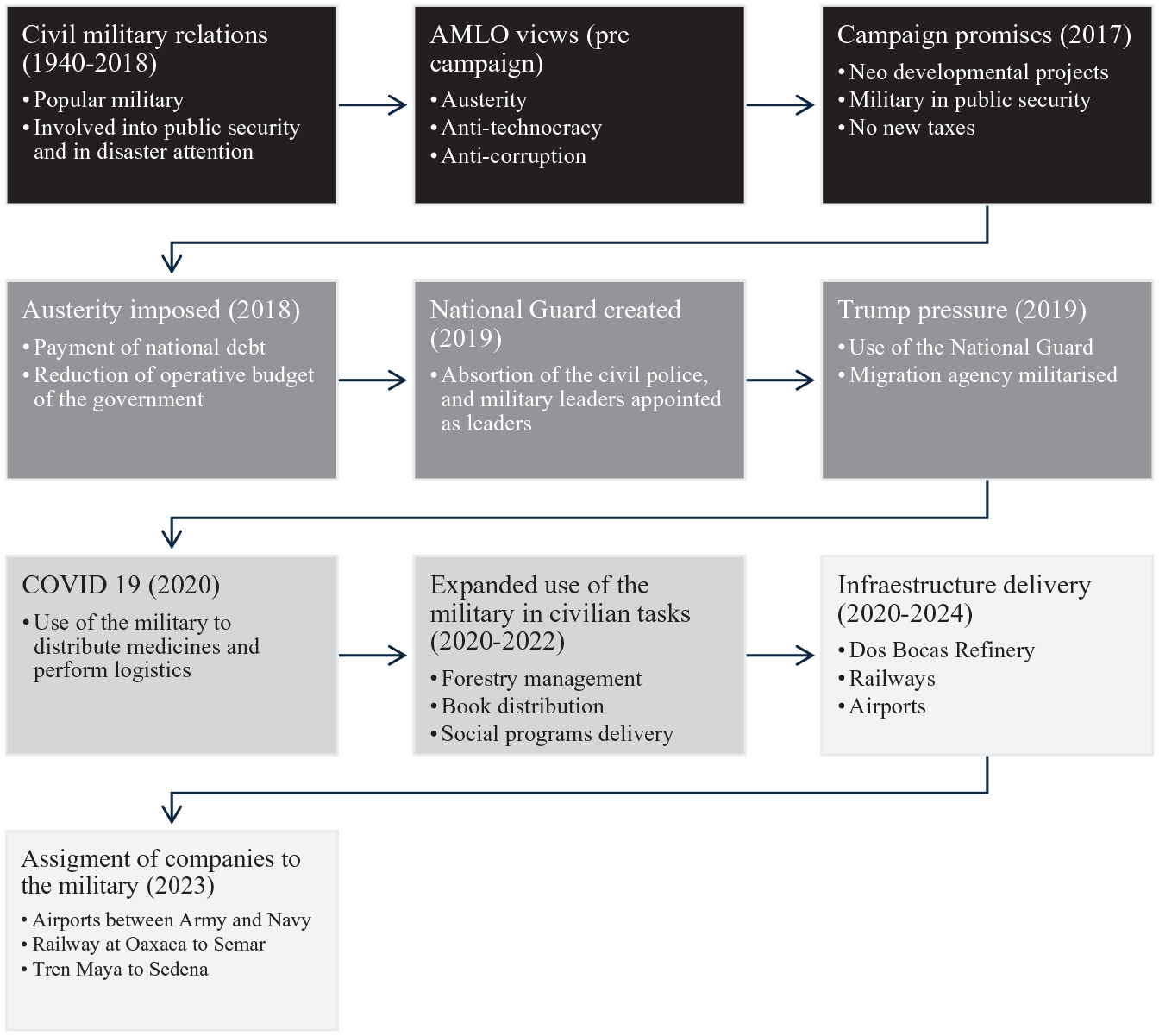
The Process of Militarization of the Mexican Public Administration Under AMLO.
It is essential to emphasize that AMLO’s neo-developmental approach was a response to the restrained state capacity. When his austerity measures themselves affected capacity, he had to resort to the Army. Yet, AMLO’s interpretation of the restrained capacity is that corruption by technocrats was to blame, rather than a lack of resources.
Conclusion
Derived from our study, we concluded that state capacity constraints (Geddes, 2023), a populist idea that austerity protects public finances (Hopkin & Rosamond, 2018), and his opposition to bureaucracy (Bickerton & Invernizzi Accetti, 2017) shaped AMLO’s strategic choices. Rather than seeing AMLO’s autocratic instincts as an explanation, they were just part of the beliefs (Elster, 2015) that shaped his choices. We concur with Mudde (2017, p. 40) that even if populist leaders have a strategic goal to expand their base, a distinctive part of their operating style is to assign enemies of the people, such as punishing technocrats through austerity cuts.
Using the military evolved into an “easy distribution” (Holland & Schneider, 2017) choice for AMLO because he could utilize another agency, impose austerity, and execute multiple tasks simultaneously, rather than seeking a “hard redistribution” that would have involved tax reform in the country. According to the Organisation for Economic Cooperation and Development (OECD, 2024), Mexico’s tax-to-GDP ratio in the Latin America and the Caribbean region is 16.9, which is below the region’s average of 21.5 and the OECD members’ average. Mexico’s tax morale (the willingness to pay taxes) is low. According to Latinbarómetro (2016) data, 79.9% of Mexicans would not favor a tax increase to build infrastructure. Researchers have found that Mexicans are unwilling to pay taxes because they perceive institutions cannot provide security and public health coverage (Castañeda et al., 2020; Flores-Macías & Sánchez-Talanquer, 2020).
AMLO’s preference for militarization provides lessons about the motivations of populist leaders to utilize the army for their purposes. Concurring with Schmidt (2023), populist leaders set their agenda by framing their policies as a way to resolve the “people” versus “enemies” dilemma. On one side, AMLO further normalized the military as patriotic and technically superior, fostering its character as “uniformed people” against technocratic enemies. On the other side, it highlights technocrats’ corruption and incompetence as enemies of the people. Similar to cases of defenders of privatizing the public sector, leaders emphasize public resentment against public services (Durant & Legge, 2001; Svallfors & Tyllström, 2019), transferring related functions to the military as a weapon against technocrats, in a similar way as they used to do when they proposed privatizations (Feigenbaum & Henig, 1994).
Geddes (2023, p. 132) argues that leaders in Latin America have to build the capacity to survive politically, in particular, by delivering an economic development legacy. However, as Soifer (2015, p. 86) argues, capacity building is constrained if governments are not independent enough from other actors. Izadi’s (2022) hypothesis seems true in the Mexican case. When leaders are constrained and need to survive, they use the military in economic policy.
Indeed, using the army was an effort to reinforce the Mexican middle-quality institutions (Mazzuca & Munk, 2021) that the neoliberal governments have severely impacted since 1982 (Galego & Nieto-Morales, 2024). Nevertheless, the cases of vaccination, textbooks, and forestry protection we mentioned are clear examples of areas where the Mexican bureaucracy had well-tested capacities. For this reason, we argue that AMLO’s ideas went beyond rational strategic choices.
Has austerity fostered militarization in other countries? So far, it is unclear whether this has occurred in Latin America. Since most governments in South America transitioned to democracy from military rule at the end of the 20th century, it is natural that civilian elites have essentially removed military leaders from other tasks. Also, judging by a case like Argentina, which has faced SAPs, it seems that acquiring debt is the primary solution for some of them. Yet, it appears that Africa and Asia are more likely to utilize the military for civilian duties (Izadi, 2022; K’Akumu, 2025; Kelegama, 2024), a region where debt restrictions are higher. Probably, new research needs to explore whether high debt interest payment rates also encourage military involvement in civilian duties.
There is a vast body of literature on the spillover effects of military expenditure on the defense industry and economic growth, particularly in the research and development of new technologies (Mazzucato, 2015). However, there is limited research on how the participation of the military in civil infrastructure can drive growth. Hypothetically, one would expect trains to create Keynesian spillover effects in Mexico. However, the authors who have addressed the military’s role in civilian economic duties are skeptical because they have documented the tendency of military forces to gain control of new entrepreneurship for their budgets (Brömmelhörster & Paes, 2003; Mani, 2011). However, the Mexican military gained budget increases after these transfers of civilian duties, proving that they acted as budget-capturing agencies (Dunleavy, 1985). Perhaps the military is gaining capabilities, but none of the ones we discussed here were capabilities that the Mexican civilian authorities did not already possess. A probable outcome is that the civilian sector will lose capacity as a result of this process.
This article makes three main theoretical contributions. First, it brings together separate strands of literature—on militarization, austerity, state capacity, populism, and neo-developmentalism—into a unified analytical framework that explains how these forces can interact within a single political project. Second, it introduces the Mexican case as a theoretically generative outlier that challenges dominant explanations of militarization in Latin America based on institutional collapse, security crises, or authoritarian drift. Instead, we show how militarization can emerge from the deliberate convergence of fiscal orthodoxy, populist distrust of bureaucracies, and the developmental ambitions of a left-wing government self-constrained by austerity. Third, by using process tracing to reconstruct the temporal and ideational sequence of decisions under AMLO, we highlight how leaders may rely on the military as a tool of coercion and as an alternative bureaucracy in pursuit of policy delivery. These findings open new avenues for comparative research on how political ideas, administrative limitations, and developmental goals shape state transformation in other countries of the Global South.
A final issue to address is the impact of this militarization on civil-military relations and democracy in Mexico. Following Levy’s (2016) premises about civilian control through incentive structures, AMLO delegated control of public enterprises to Sedena and Semar as a form of loyalty management, assigning each a distinct role. This allocation deepened the military’s economic autonomy and institutional reach, intensifying tensions between the branches. As a leak from the private emails of the heads of both secretariats shows (El Financiero, 2022), Admiral Ojeda cautioned General Sandoval that “coordination, not protagonism, is what matters”—a remark that highlights growing inter-service rivalry. Rather than reinforcing traditional forms of civilian supremacy, this arrangement resembles what Schiff (1995) calls concordance theory: a model of stability grounded in shared institutional roles between military and civilian elites.
Building on this pattern, Hunter (1995) observed in her analysis of post-authoritarian Latin America that such power-sharing tends to increase military leverage and blur lines of accountability when armed forces manage state resources. The new Mexican dynamic, viewed through Feaver’s (2003) principal-agent framework, reflects a deeper erosion of civilian control. Since the military has always reported directly to the President—its sole principal—the expansion of militarized civilian tasks has further reduced civilian oversight and political accountability across broader areas of public administration. This shift has expanded the scope of the post-revolutionary civil-military pact (Ai Camp, 1992; Serrano, 1995).
Beyond existing civil society reports, we call for further academic research on how militarization shapes key democratic dimensions, both in Mexico and in other countries facing similar trends. This research includes exploring the effects of militarization of the public administration on transparency, accountability, and civil-military norms. Citizens may find it difficult to hold anyone accountable for infrastructure projects when responsibilities are shared—or blurred—between civilian authorities and the military. In Mexico, the government has already restricted transparency by increasingly classifying information under national security provisions, limiting public oversight.
Through the process of militarization in Mexico, first in public security and later in other civil duties, military commanders and officers rarely offer their views on this process. As Roderic Ai Camp (1992, pp. 217–218) documented, even the Generals consider that the Mexican Army is hermetic and inwardly focused. Indeed, once General Secretary Félix Galván requested that President López Portillo provide “more tasks and new means” because he believed the armed forces could do more for the country. Yet, citing Ai Camp (1992, p. 277) again, the military’s withdrawal from participating in politics in Mexico also meant that they would, in exchange, increase their influence if permitted by the civilian elite and the President, as we have seen in security policy. As we reviewed before, the Mexican military adapted to AMLOs instructions and added in supporting national development initiatives in their sectorial program, aligning their agenda with the civilian one (Sedena, 2020a).
Indeed, as Aguiar et al. (2025) showed, it is worrying that Sedena and Semar’s leaders adopted the language of the “fourth transformation” used by AMLO and Morena. For us, indeed, the civilian-military pact in Mexico has evolved. However, it remains based on the fundamental principle of obedience to the President. If we read Geddes et al. (2014) closely, the AMLO presidency followed a personalist agenda that discovered the Army as part of their support coalition. The significant difference is that the military’s involvement beyond security (that they saw as internal threats) effectively challenges the depoliticization of the Mexican Army achieved after the creation of the one-party hegemonic regime that ruled Mexico for most of the 20th century. As Ai Camp (1992) states, Mexican civil-military relations were characterised by a pact in which the army would keep its issues to itself. This pact has evolved into an implicit agreement of cooperation and shared responsibility (Bland, 1999) between civilians and the military, extending beyond security. Whether that pact evolves into an unwavering support for Morena is yet to be seen.
Supplemental Material
sj-docx-1-afs-10.1177_0095327X251368871 – Supplemental material for Rushing Infrastructure Projects Under Austerity: The Militarization of the Mexican Public Administration During AMLO’s Government
Supplemental material, sj-docx-1-afs-10.1177_0095327X251368871 for Rushing Infrastructure Projects Under Austerity: The Militarization of the Mexican Public Administration During AMLO’s Government by Raúl Zepeda Gil and Luis Roberto Vargas Pineda in Armed Forces & Society
Footnotes
Acknowledgements
We are especially thankful to Raphael Lima for the insight he gave us for the writing of this research piece. We thank the attendees of the 2024 Latin American Studies Association Congress and the 2024 Workshop on Comparative Politics in Latin America at Nuffield College, Oxford, for their comments. In particular, the comments were made by Ezequiel Gonzalez Ocantos, Leigh Payne, Javier Pérez Sandoval, César B. Martínez Álvarez, and Sebastian Raphael. We also thank the anonymous reviewers for their thoughtful comments, which have improved this document.
Data Availability Statement
Data and Appendix will be included and available for replication.
Declaration of Conflicting Interests
The authors declared no potential conflicts of interest with respect to the research, authorship, and/or publication of this article.
Funding
The authors received no financial support for the research, authorship, and/or publication of this article.

Supplemental Material
Supplemental material for this article is available online.
Author Biographies
References
Supplementary Material
Please find the following supplemental material available below.
For Open Access articles published under a Creative Commons License, all supplemental material carries the same license as the article it is associated with.
For non-Open Access articles published, all supplemental material carries a non-exclusive license, and permission requests for re-use of supplemental material or any part of supplemental material shall be sent directly to the copyright owner as specified in the copyright notice associated with the article.
