



Abstract
Following the 2022 Russian invasion of Ukraine, the Visegrad Group (V4) began shifting defense policy toward the comprehensive approach involving the state and society alongside the military. Extensively analyzed in security studies, this shift is less discussed in military and society research. Interrogating mixed data through the exploratory concept of “societal relationship with defense,” the paper provides the first comparative analysis of how V4 societies engage with these new defense demands. It argues, first, that the whole-of-society approach is challenged by social trends of declining willingness to defend the state, low defense engagement, and shaky defense consensus. Second, that V4 exhibits significant variance in societal relationship with defense, represented by the “ideal types” of Polish citizen-soldiers, Czech civilian hawks, Slovak anomic pacifists, and Hungarian freedom fighters. Highlighting the importance of studying societal underpinnings of comprehensive defense, the paper also makes a case for a conceptual shift from society-military to society-defense relations.
Keywords
The 2022 Russian invasion of Ukraine, preceded by the 2014 annexation of Crimea, and accompanied by gray-zone aggressions toward NATO’s North-Eastern flank have recentered defense in the politics and society of the of the Visegrad Group (V4), reversing decades of its deprioritization under Pax Europaea. This resurgence has been characterized through military buildup and modernization (Mutschler & Bales, 2020), alongside early signs of a shift toward comprehensive defense integrating armed forces with a whole-of-government and whole-of-society involvement (NATO, 2020). All V4 nations introduced new concepts to their strategic documents that are broadly in line with comprehensive defense, from “whole-of-government and whole-of-society approach (NSSCR, 2023, p. 4)” to “social resilience (Law on Civil Protection and Civil Defense [LCPD], 2024, p. 2).” Consequently, they also begun fostering a whole-of-society culture of defense (Conway & Ulrich, 2023) through public events strengthening society-military ties, information resilience programs, defense trainings and crisis manuals for civilians, all the way to new reserve/national guard formations. While in their early stages, these reforms have nevertheless constituted a profound shift from the post-militarist societal trends that have shaped the region after the Cold War—the move away from territorial defense to out-of-area operations, from universal conscription to professional forces and civilian societies, as well as from military readiness toward a softer security agenda (Shaw, 1991; Sheehan, 2008).
How do V4 societies relate to this defense policy shift and its new demands toward citizens? Such critical inquiries have largely been overlooked in the academic field, despite their significant policy relevance. While comprehensive defense policy has been the object of much conventional security studies literature (Wither, 2020), these strands seldom focus on the social glue of policy reforms—the character and strength of society-defense relations underlying them. Interest in public attitudes toward defense surged regionally after 2022, resulting in numerous media articles and policy papers whose analysis often remains narrow and non-academic. Aiming to bridge these gaps, this paper explores V4 similarities and differences in public attitudes and participation in defense matters in the period of the shifting defense conceptions. It employs an inductive exploratory approach to interrogate mixed, cross-country data through the heuristic concept of societal relationship with defense originally developed for the study of the Finnish comprehensive security system (Kosonen et al., 2019a, 2019b). This exploration suggests, first, that V4 exhibits several common patterns hindering the whole-of-society approach: declined willingness to defend the state, low defense engagement, and shaky defense consensus. Second, that despite these homogenizing trends, V4 societies reveal varying, politico-culturally situated relationships to defense, represented by the ideal types of Polish citizen-soldiers, Czech civilian hawks, Slovak anomic pacifists, and Hungarian freedom fighters.
The paper is structured as follows. The first section situates the discussion on V4 societies’ defense relationships within the broader context of military and society studies (Shields, 2020). It contends that exploring V4 offers both analytical and theoretical advancements to the field, broadening its scope from the interactions between society and the military to ones between society and defense as a broader concept. The second section discusses the inductive exploratory methodological approach of the paper oriented toward generating hypotheses on an under researched phenomenon, as well as details the aggregated data sets underpinning the analysis. The third section analyzes defense-society relations across the four V4 nations, focusing on five key areas identified from the data: willingness to defend, culture and memory, geopolitical imagination, defense engagement, and attitudes toward armed forces. The conclusion summarizes key findings by positing four country-specific ideal types of societal relationship to defense.
Conceptualizing Society-Defense Relations in V4
This paper’s exploration of society-defense relations positions it within the military and society research field focused on “all aspects of relations between armed forces, as a political, social and economic institution, and the society, state, or political ethnic movement of which they are a part (Forster, 2005, p. 9).” With its foundations developed during the Cold War by military sociologists and political scientists, the field is methodologically diverse and revolving around the topics of civil-military relations, public opinion on the armed forces, personnel recruitment and retention, minority representation, and military family and veterans (Shields, 2020, p. 2). Simultaneously, the paper’s guiding concept of societal relationship with defense broadens the traditional scope of the field from a focus on the interface between the society and the military to exploring societal interactions with a broader sphere of defense institutions, ideas and practices. This conceptual shift is necessitated by evolving defense policies in V4 toward the comprehensive, whole-of-society approach where the military is just one pillar of defense.
Before and during the post-communist transition, military and society research on V4 was vibrant, albeit predominantly conducted in the framework of civil-military relations. Cold War scholarship analyzed the relations of Warsaw Pact armies to communist parties and societies (Herspring & Volgyes, 1977; Michta, 1990; Wiatr, 1988). After 1989, the region underwent a series of reforms aimed at denationalizing defense policy, instilling democratic control over the army, and increasing military interoperability with Western partners which eventually meant a shift from conscription to professionalization (Epstein, 2008). Despite these homogenizing trends, some differences in military strategies have persisted between V4 states due to their differing relative power and exposure to threats (Edström & Westberg, 2023). Nevertheless, international scholarship expected the rapidly Europeanizing V4 to gradually “come to resemble the ‘post-military societies’ of Western Europe and North America” where the military is democratically controlled, professionalized, and increasingly insulated from civil society (Forster et al., 2003, p. 255). Hence, society and military research explored the region’s transformation toward Western models of democratic civil-military relations, new social roles of the armed forces, and growing gaps between civilians and defense (Barany, 1993; Forster et al., 2003; Jones & Mychajlyszyn, 2002; Michta, 1997).
Despite research continuing in the 2000s, the topic has nevertheless lost much of the geopolitical steam that made it internationally relevant during the Cold War. Recently, the war in Ukraine reignited interest in NATO’s Eastern flank within security and defense scholarship and policy (Bērziņa, 2020; Chivvis et al., 2017). So far, much less scholarly attention has been paid to the way societies interact with these reforms, and despite calls for the centrality of sociological research for defense policy (Nowotny, 2017). However, with V4 policy beginning to reconceptualize defense as resting on the entire state and society and not only the military, there is a need for new conceptual frameworks able to capture the nature of this shift by broadening the focus from the military to defense as a wider concept.
One such concept is societal relationship with defense developed in Finnish military sociology to study how different groups of citizens interact with comprehensive defense (Hart, 2021; Kosonen et al., 2019a, 2019b). The concept was originally introduced as a qualitative corrective to a well-established tradition of researching citizens’ commitment to national defense through a single survey question on the will to defend the state (Andžāns & Sprūds, 2020; Harinen & Hannola, 2013). It proposed to look at society-defense relations through a more multi-dimensional framework including not just willingness to defend but also citizens’ attitudes toward defense, confidence and participation in defense, as well as skills, knowledge and agency related to it (Kosonen et al., 2019a, p. 311; National Defense University [NDF], 2018). As of now, the concept has only been used in qualitative studies and is best understood as a sensitizing, heuristic tool—one that “suggest[s] directions along which to look” rather than “provide[s] prescriptions of what to see (Blumer, 1954, p. 7).” Its sensitizing, exploratory character makes it more flexible and open to including those dimensions of the society-defense interface that make analytical sense in the light of available data or the nature of the socio-political context.
To add analytical depth to the otherwise heuristic concept, this paper bases it on five dimensions—willingness to defend, culture and memory, geopolitical imagination, defense engagement, and attitudes toward the military. The selection of these dimensions was guided by three principles. First, correspond with categories derived from existing literature on comprehensive defense and society-military relations. Second, they ensure topical breadth, capturing attitudinal, participatory, and memory-based facets of defense–society dynamics. Third, they reflect available data, covering aspects of society–defense relations measurable across V4 surveys. As such, these dimensions reflect not only what can be measured but also what must be understood to grasp the evolving society–defense relations in the region.
To provide a more structured comparative framework, this study conceptualizes each society’s relationship to defense by employing ideal types—a conceptual approach that abstracts dominant empirical patterns into heuristic models for comparison (Gerhardt, 1994; Weber, 1904/1949). The ideal-type approach is widely applied in comparative political science and military sociology to classify patterns of state behavior, civil-military relations, and security cultures (Adams & Sydie, 2001; Swedberg, 2017). Rather than claiming that any society fully embodies an ideal type, this approach highlights dominant trends across the five dimensions while identifying national deviations from the broader regional pattern. The ideal types used here were constructed inductively, based on consistent clustering of empirical patterns across several studied dimensions. This pattern-based approach deepens the analytical understanding of the societal relationship with defense by articulating empirically grounded typologies that highlight the region’s unique socio-historical complexities.
Methods and Data
Given the lack of systematic, comparative scholarship on citizen–defense relations in the V4, this study employs an inductive exploratory approach (Babbie, 2008, p. 98; Shields, 2020, p. 15). Rather than testing predefined hypotheses, it seeks to identify patterns and emerging trends “without explicit expectations” (Schutt, 2009, p. 14). Exploratory research is particularly useful in contexts where empirical data exists but remains under-theorized. Instead of focusing on why certain conditions exist (Adler & Clark, 2008, p. 14), this study primarily asks what (Schutt, 2009) is occurring in society–defense relations, mapping dominant themes in public engagement with national defense. This inductive approach is well suited to cases where multiple variables interact in complex, historically contingent ways. While common in qualitative research, exploratory methods also apply to fragmented quantitative datasets with comparability issues (Trochim, 2006).
The V4 is treated as a regional security subcomplex, shaped by shared communist and post-communist transformations, NATO integration, and EU security frameworks. Although national defense policies diverge, these states operate within a common security environment, making them ideal for studying how societies relate to defense under similar institutional and geopolitical conditions. Regional security complex theory (Buzan and Wæver, 2003) traditionally emphasizes state-level interactions, but recent scholarship (Amable, 2022) underscores the role of societal perceptions in shaping security policies. The V4 provides a compelling test case, where public attitudes toward defense are shaped by a shared historical trajectory yet diverge in national expression.
The study employs a mixed-methods strategy, integrating quantitative survey data with qualitative policy analysis. Given the scarcity of defense-related public opinion research in the V4, it synthesizes cross-national survey datasets with institutional and historical analysis to construct a comparative framework. Four major cross-national surveys—GLOBSEC Trends, Defence24 polling, the World Values Survey (WVS), and the European Values Study (EVS)—form the empirical core. These were selected not only for availability but because they adhere to standardized sampling protocols. The WVS and EVS ensure national representativeness through stratified probabilistic sampling, standardized questionnaires, and professional fieldwork. GLOBSEC and Defence24 likewise rely on transparent, professional methodologies. These baselines support both national representativeness and cross-country comparability. Their multi-year survey waves also provide insight into both contemporary and longitudinal trends in defense attitudes.
Nonetheless, several limitations must be acknowledged. While these surveys offer overlapping insights into public attitudes, discrepancies in question framing and timing complicate direct comparison. GLOBSEC focuses on geopolitical orientations, while Defence24 targets defense engagement. The WVS and EVS offer longitudinal value but emphasize broader social attitudes rather than military issues specifically. Consequently, certain aspects of comprehensive defense—such as civil defense organizations, practical skills, or emergency preparedness—are not directly measurable. The study therefore recognizes partial coverage of the societal–defense relationship and stresses the need for future research to address these gaps. To mitigate limitations, survey data is triangulated with qualitative sources including policy documents, strategy papers, and media discourse. In addition, core findings were cross-validated with national polls—such as those conducted by CBOS (Poland)—to identify anomalies or outlier effects. This triangulation enables the distinction between genuine public opinion trends and methodological artifacts.
How Do V4 Societies Relate to Defense?
In recent decades, V4 defense organization underwent three shifts: from the mass-mobilization, offensive defense Cold War model of the Warsaw Pact, to the professional-expeditionary NATO model focused on out-of-area crisis management, and the ongoing reorientation toward territorial, comprehensive defense stressing whole-of-government and whole-of-society approaches. Each era developed a different model of society-defense relations. During communism, close bonds between societal and military realms were ensured by mass male conscription, popular civil defense trainings, and existence of veteran’s associations promoting a form of military patriotism. At the same time, trust in the army were challenged by its internal role of defending the communist party from internal enemies (Barany, 1991) and its consequent involvement in pacification of protests. As a result, dissidents often defined themselves against Soviet-style militarism and conscription.
Together with the democratic reforms of 1989, V4 states focused on policy homogenization and military interoperability with NATO, leading to army reduction and suspension of conscription in the early 2000s (Cottey, 2008). This shift saw the emergence of post-military societies (Shaw, 1991) characterized by distant society-military relations and low engagement of citizens in defense. Due to the ambiguous legacy of communist society-defense relations, professionalization was largely seen as a positive development enhancing civic freedoms and rebuilding the prestige of the army (Červinková, 2009). Following Russia’s war in Ukraine, the region is beginning to shift the gear back to territorial defense and adopting elements of the whole-of-society approach, while encountering serious obstacles rooted in prior models of society-defense relations. These regional patterns notwithstanding, V4 societies also vary considerably in their relationship to defense, revealing divergent patterns and traditions.
Using a combination of survey data, literature review and policy analysis, the following section zooms in on V4 trends of convergence and divergence of society-defense relations through a twofold analysis. First, key region-wide patterns in V4 society-defense relations are identified which put the feasibility of building a whole-of-society approach into question. Second, the specificities of each society’s relationship with defense are discussed in more detail through the heuristic tool of ideal types.
Mapping Regional Trends—Obstacles to Whole-of-Society approach
In response to the worsening of regional security, V4 nations introduced new concepts to their strategic documents which are in line with the comprehensive, whole-of-society approach to defense: from “common civic defense making full use of the potential of the state . . . and citizens (National Security Bureau of Poland, 2020, p. 15),” through “comprehensive national defense capabilities encompassing the whole of society, the economy and governmental organizations” (Office of the Government of Hungary, 2021), all the way to “whole-of-government and whole-of-society approach (NSSCR, 2023, p. 4)” and the “readiness of the state and society to withstand crises (Ministry of Foreign and European Affairs of the Slovak Republic, 2021, p. 25).” These policy formulations notwithstanding, numerous structural obstacles to this approach exist in V4, among them the institutional myopia of V4 ministries (Kandrík, 2020a). This section looks at three constraints that have their roots in society-defense relations specifically: the decline in willingness to defend, low defense engagement, and polarization on defense and geopolitics.
Declining Willingness to Defend
The whole-of-society approach sees citizens as security actors and fundamentally relies on their willingness to engage in defense of their country if the need arises (NATO, 2020, p. 15). In the Nordic context, societal willingness to defend is routinely high, and functions as a marker of the feasibility of the comprehensive defense model (Häkkinen and Kaarkoski 2024). Across literature, society’s defense posture is also evoked as a deterrence instrument, raising the costs of possible attack (Braw and Roberts, 2019), as well as a factor behind the national government’s will to fight (Connable et al., 2019, p. 10).
Despite its importance for defense and deterrence, the willingness has been steadily declining across post-Cold War Europe (Inglehart et al., 2015). The V4 states are no exception to this broader trend, all ranking much lower than the Nordic states that follow a comprehensive defense model. However, after 1989, Czechia and Slovakia recorded a continued decline, and Poland and Hungary displayed some resurgence (Table 1).
Willingness to Fight for One’s Country (European Values Study [EVS], 2017; Haerpfer et al., 2022).
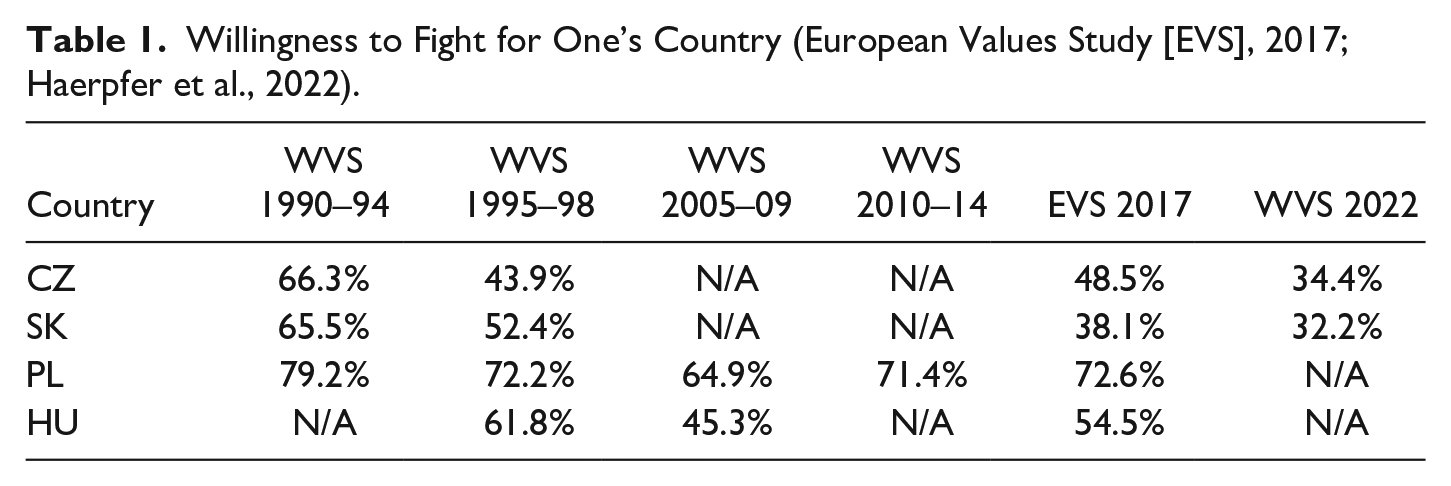
While defense willingness remains the main survey indicator of citizens’ commitment to national defense, results of any one survey should be interpreted cautiously. The wording of the question may evoke different meanings—from war of defense to war of aggression, and from more civilian forms of resistance to armed struggle—depending on cultural or subjective interpretation. National surveys that ask about willingness to engage in more civilian, non-violent forms defense tend to yield higher results than the WVS which asks about the more abstract willingness to fight for the state. However, such data is not available for all of V4. Moreover, declarations of willingness in peacetime do not directly translate into wartime decisions, with a modest defense willingness in Ukraine almost doubling after the 2022 invasion (Bukkvoll and Steder, 2023).
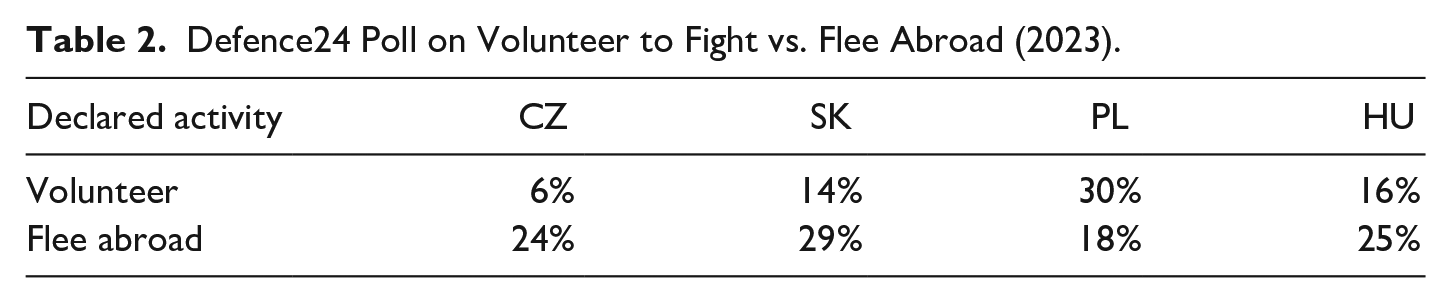
Bringing further nuance to WVS results, the 2023 Defence24 poll shows a larger percentage of citizens in V4 declaring they would flee abroad than volunteer for military, paramilitary, or medical roles. Table 2 elucidates these preferences, showing Poland as an outlier where a higher percentage of the population prefers to volunteer rather than flee. At the same time, the highest percentage of respondents declared the will to stay in the country, which may be interpreted as an inclination for at least passive resistance.
Defence24 Poll on Volunteer to Fight vs. Flee Abroad (2023).
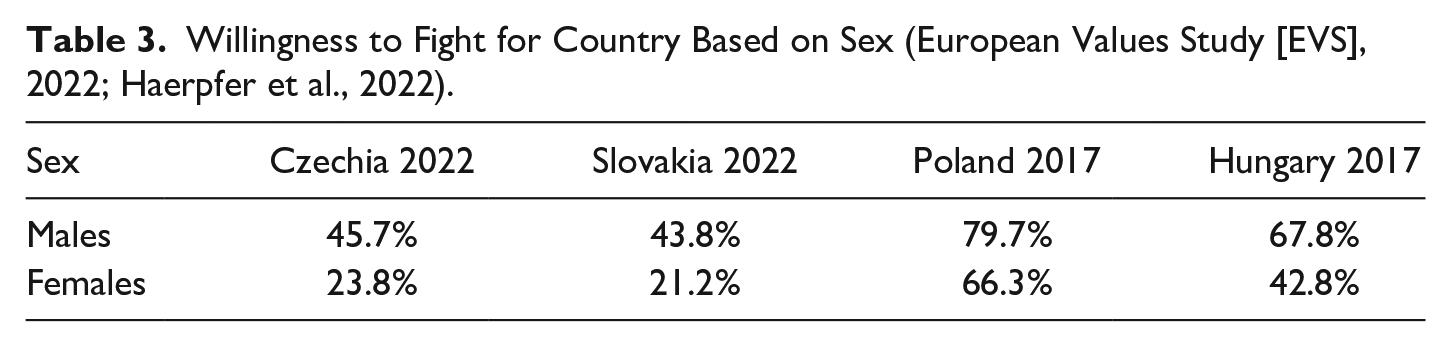
Finally, the gender dimension provides an additional insight into the feasibility of V4 adopting a whole-of-society doctrine. V4 data shows women as considerably less likely to declare defense willingness, with Poland recording the smallest gender gap in the studies period and Hungary—the largest. This tendency is observable globally due to the gendered division of security and reproductive labor in societies (Listhaug, 1986), yet the size of this gender gap varies between countries. How well societies integrate women in defense and resilience matters for the whole-of-society model, partially contributing to the general willingness metrics (Table 3).
Willingness to Fight for Country Based on Sex (European Values Study [EVS], 2022; Haerpfer et al., 2022).
With regards to the decline in willingness to defend, two popular hypotheses in particular are applicable to the V4. The first one, widely discussed in V4 national debates, centers on the role of conscription in increasing citizens’ defense willingness, as indicated by research from Nordic countries (Cronberg, 2006; Juurvee, 2021). Consequently, the turn to army professionalization in the V4 between 2004 and 2008 is likely to have played a significant role in the decline of defense willingness in the region.
The second hypothesis points to the change of social values toward secular, emancipative ones, as a major factor behind the decline of willingness to defend. Proposed by Inglehart et al. (2015) and empirically robust, the emancipative lifestyle hypothesis posits that the overall improvement of existential conditions in V4 as part of the developed world due to democratization and prosperity has led to a deep cultural shift whereby “readiness to sacrifice life gives way to an emphasis on living life as one chooses” (Inglehart et al., 2015, p. 419). As pro-choice, emancipative values became more widely spread than traditional and survivalist ones, willingness to defend the state has declined.
In line with this narrative, after 1989, the V4 states have undergone the transition toward democratic states and capitalist economies, and present comparable macroeconomic and Human Development Indices. Value wise, all V4 states fall close to one another as members of the Catholic Europe cultural cluster (Inglehart and Welzel, 2023). As recorded by WVS/EVS surveys, over time, the V4 saw the combined trend of increase in pro-choice values, and decline of willingness to defend (Inglehart et al., 2015, pp. 425, 430), with Poland scoring higher than the rest on traditional values related to family, religion, and nation (Inglehart and Welzel, 2023).
While both hypotheses provide a plausible explanation of the post-1989 decline in defense willingness in V4, they fall short of elucidating national variance. After all, despite the V4 sharing very similar—though not identical—structural conditions, willingness to defend is highest in Poland, and lowest in Slovakia and Czechia. Therefore, country-specific factors should be taken into consideration as drivers of these differences. So far, V4 comparisons have been missing from this growing body of research studying concrete factors behind willingness to defend. Empirical literature on different countries reveals that factors shaping defense willingness are not universal (Berzins, 2025), with different variables found to play a role in different contexts (e.g., Andžāns, 2021). The next section on ideal types provides more in-depth insights into regional differences.
Low Defense Engagement and Preparedness
Alongside the rather low and declining willingness to defend, another regional trend in society-defense relations affecting the feasibility of the whole-of-society approach is the low level of public involvement in defense affairs.
During the Cold War and during the regime transition, V4 states followed a universal male conscription model, where obligatory military service served as a primary channel for defense-minded socialization of male citizens in V4. While unpopular due to its ideological function in the communist context, conscription nevertheless translated into large reserves and high defense preparedness. Following NATO’s shift from territorial defense toward expeditionary forces in the early 2000s, the V4 moved toward army reduction and professionalization, shrinking the reserves, and leaving citizens outside of the defense system. While widely supported in V4, the suspension of conscription between 2004 and 2008 left an institutional vacuum that was not filled by other channels such as civil protection or defense-minded civil society organizations.
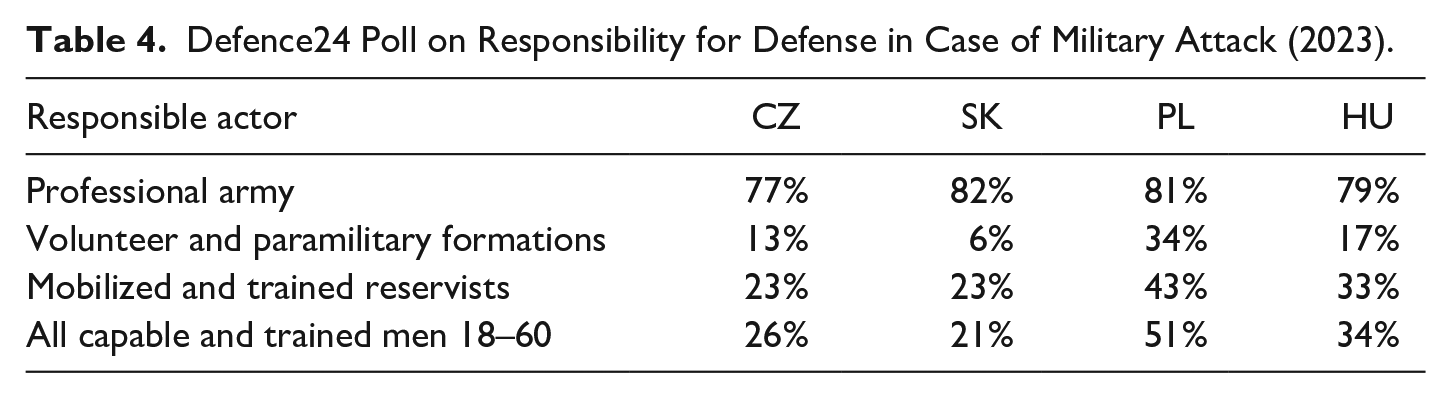
Over time, lack of such channels contributed to the erosion of basic security competencies among civilians. In Poland alone, the percentage of respondents with military training experience dropped from 39% in 1999 to 25% in 2014 (Centrum Badania Opinii Społecznej [CBOS], 2014). Despite V4 constitutions stipulating that defense is a civic duty, the professionalization of the army also led to the gradual detachment of citizenship from military service, with the majority of the society wishing to subcontract defense to the armed forces. A case in point is the Defence24 survey which examined whether respondents saw defense as the duty of the professional military, volunteer formations, mobilized reservists, or all trained men aged 18–60. As Table 4 illustrates, across the V4, the professional army is overwhelmingly seen as the primary defense provider, with only limited public support for broader civilian mobilization.
Defence24 Poll on Responsibility for Defense in Case of Military Attack (2023).
The war in Ukraine has prompted a partial reversal of this trajectory in V4, with early steps toward institutionalizing the whole-of-society approach. While in the Nordic and Baltic states, comprehensive defense is a national security doctrine, V4 states lack a similar concept in their strategic documents. Nevertheless, they have all introduced new formulations to their policy which align with the model: from “common civic defense making full use of the potential of the state . . . and citizens (National Security Bureau of Poland, 2020, p. 15),” through “comprehensive national defense capabilities encompassing the whole of society, the economy and governmental organizations” (Office of the Government of Hungary, 2021), all the way to “whole-of-government and whole-of-society approach (NSSCR, 2023, p. 4)” and “preparing the general public for defense” (Ministry of Defence of the Slovak Republic, 2021, p. 23).”
Consequently, V4 has also begun adopting solutions characteristic of the whole-of-society approach, centered on increasing citizens’ defense preparedness and engagement. Among these new innovations have been the issuing of crisis manuals for citizens, expansion of army reserves, defense education in schools and universities, rebuilding of civil protection, and the promotion of preparedness through trainings and civil society organizations. These innovations have been implemented at a markedly different scale and pace, with Poland closest to a comprehensive defense model (Szymański, 2025), and Slovakia not moving far beyond minor mentions in its strategic documents. Despite these reforms, the low level of defense engagement and preparedness remains a key challenge, with the percentage of V4 citizens who participated in emergency trainings lower than the EU average (Eurobarometer, 2024). The different ways V4 states adapt elements of the whole-of-society defense model will be discussed in the next section.
Shaky Consensus on Geopolitics and Defense
Another major V4 pattern in society-defense relations observed in survey data is political polarization on geopolitics and defense. The whole-of-society model fundamentally relies on a cohesive geopolitical and security imagination—a collective understanding of a nation’s place in the global security landscape (Güney & Gökcan, 2010). In other words, a society needs to share basic ideas about “who and what ‘we’ are, who and what ‘our enemies’ are, in what ways ‘we’ are threatened by ‘them,’ and how ‘we’ might best deal with those ‘threats’” (Weldes, 1999, p. 15).
After 1989, the V4’s state-level geopolitical orientation has been anchored in Euro-Atlantic integration, with major political actors agreeing on the direction of security policy set out by NATO and the EU. However, this consensus is eroding, challenged by contestations of the post-1989 “liberal script” both on both the national and international level (Börzel & Zürn, 2020). With more political actors challenging “political, economic, cultural, geopolitical, civilizational” aspects of the liberal democratic project (Laruelle, 2022), deepening fractures arise with regards to perception of security threats, geopolitical orientations, and trust in defense institutions. In the studied period, these fractures were very pronounced in Slovakia and almost negligeable in Poland, however, the shift in US NATO policy during Trump’s second presidency has ignited new polarizations whose effects are only being studied (Wike et al., 2025). While the remainder of this section looks at V4 patterns, security imagination of each society will be discussed in more detail in the next section.
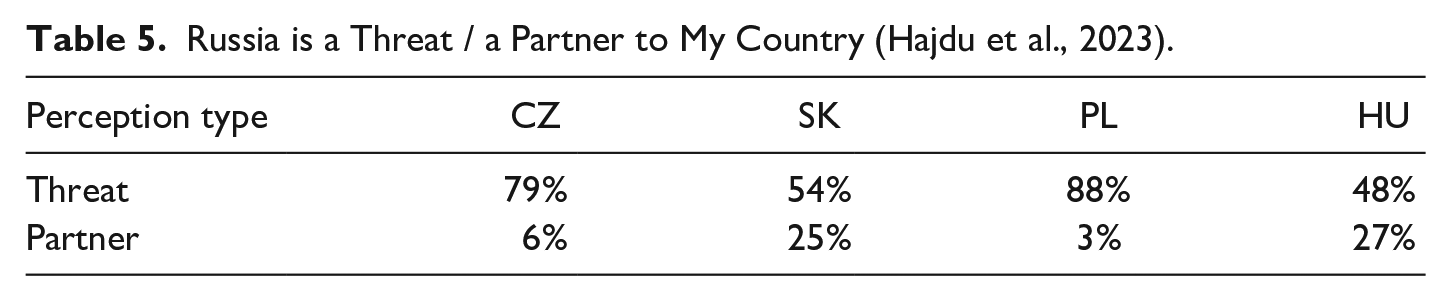
Unified perceptions of friends and foes aid collective mobilization. NATO’s position is clear, having designated Russia as a “direct threat” during the Madrid NATO Summit in June 2022 (Herszenhorn, 2022). In V4, fractured unity over national security is reflected in polarized trust in NATO, and divergent perceptions of Russia and the West. While NATO remains seen as a central pillar of regional security by V4 societies, public perceptions vary across the region, with a positive view of the alliance held by a large majority in Poland (77%), small majority in Hungary (58%) and Czechia (51%), and a minority (40%) of Slovaks (NATO, 2022, p. 14). At the same time, all societies demonstrate a strong desire to remain within NATO (Hajdu et al., 2022, p. 29). Public opinion on Russia in V4 does not always align with NATO’s official position. While some V4 countries overwhelmingly see Russia as a primary security threat, others remain divided, with significant segments of the population viewing Russia as a neutral or even cooperative partner (Table 5).
Russia is a Threat / a Partner to My Country (Hajdu et al., 2023).
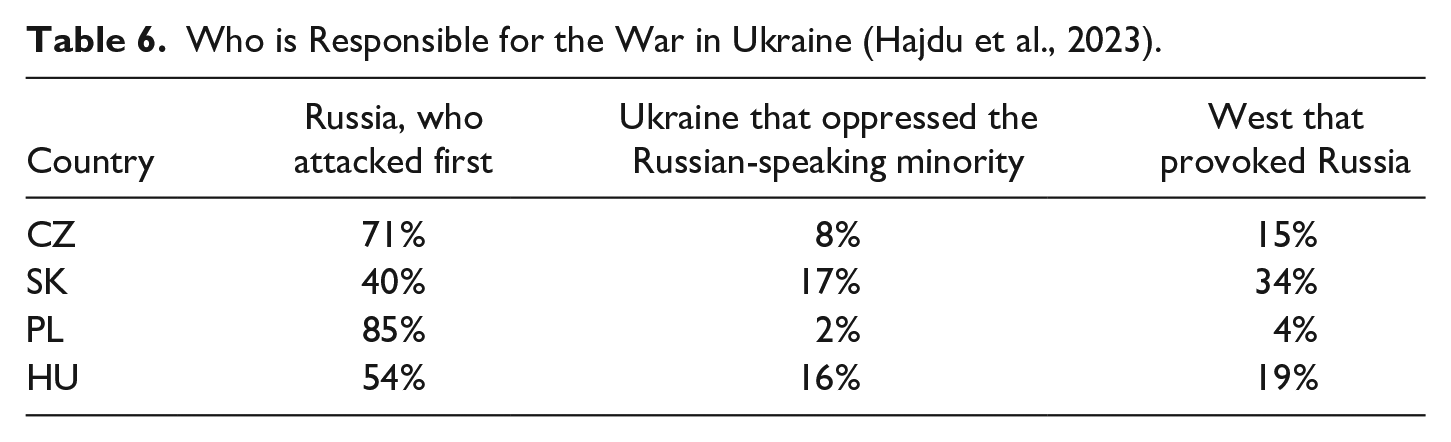
These divisions extend to narratives surrounding the war in Ukraine. While certain V4 states unequivocally assign responsibility to Russia, others display more fragmented views, with notable portions of the population attributing blame to Ukraine or the West (Table 6).
Who is Responsible for the War in Ukraine (Hajdu et al., 2023).
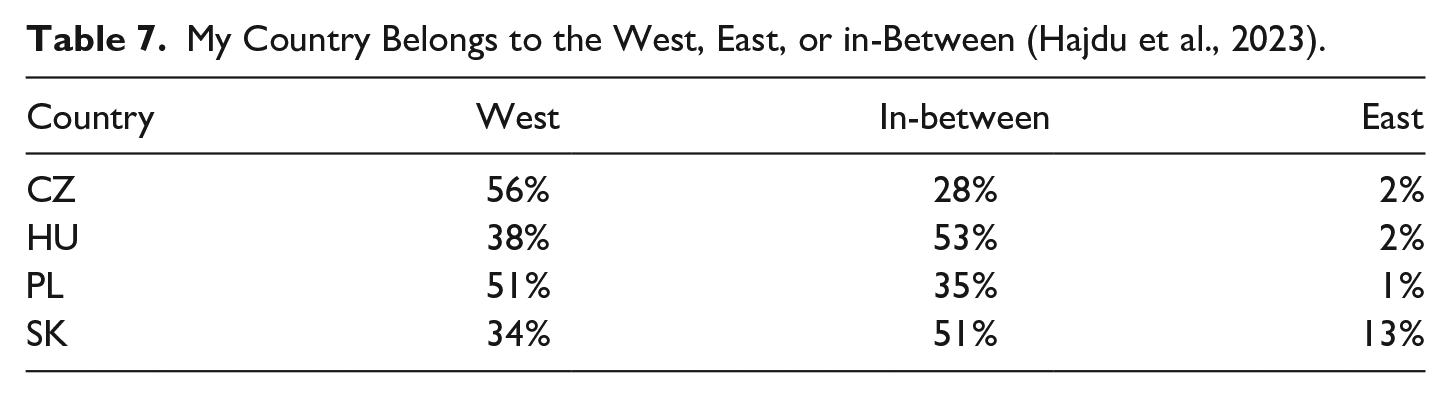
Despite the homogenizing nature of being part of NATO and EU, polling data reveals that V4 societies are divided on their geopolitical affiliation. Considerable minorities see Western way of life and liberal democracy as threatening their identity (Hajdu et al., 2022, p. 84). V4 societies also lack a strong consensus on whether they belong to the West or somewhere “in between” East and West (Table 7).
My Country Belongs to the West, East, or in-Between (Hajdu et al., 2023).
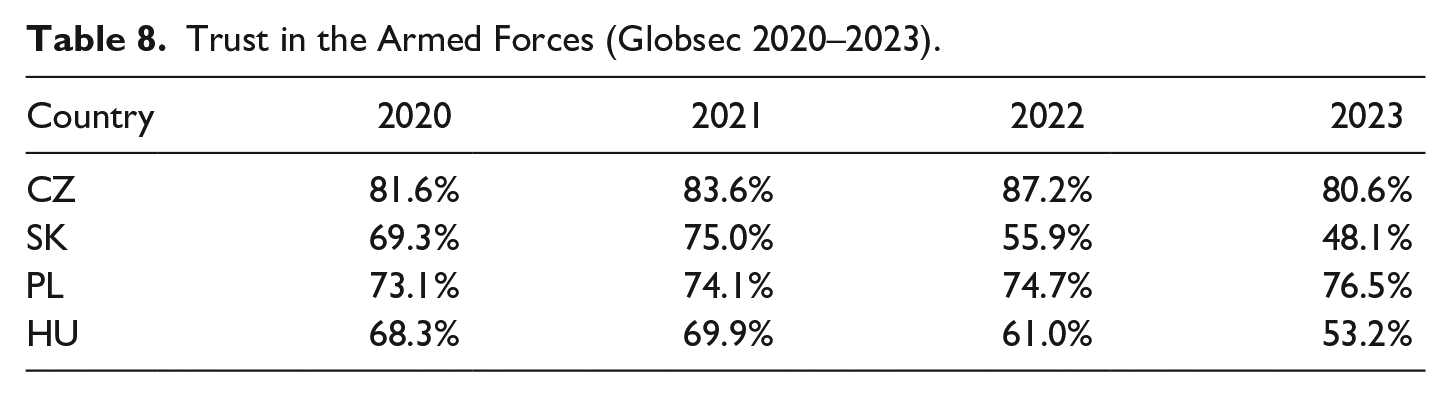
Establishing a robust comprehensive defense system also depends on stable public trust in, and continued support for, key institutions conductive to social protection (Joerin & Schubert, 2023). An institution lacking public trust faces significant challenges in mobilizing financial support and civil-military cooperation. Trust in the armed forces remains and other emergency services is relatively high across the V4, and higher than in media or political institutions (GfK Verein, 2018). However, it also shows signs of political polarization, fluctuating in response to political developments, and dispersing between opposing electorates depending on who is in power (STEM, 2024; Table 8).
Trust in the Armed Forces (Globsec 2020–2023).
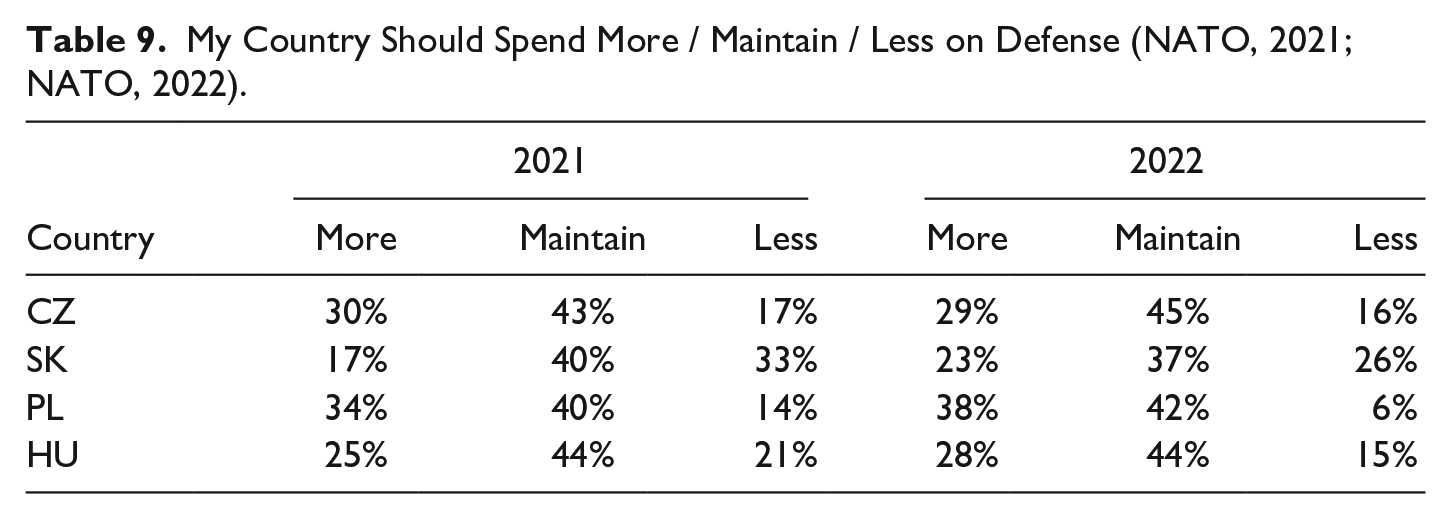
Beyond institutional trust, willingness to support defense efforts financially remains uneven across the V4, with Poles exhibiting a preference for increasing military spending or maintaining higher levels of spending, and Slovakia showing greater demand for lower levels of spending. Moreover, financing the armed forces is not an object of a strong societal consensus, with large portions of V4 populations having a different opinion (Table 9).
My Country Should Spend More / Maintain / Less on Defense (NATO, 2021; NATO, 2022).
While V4 societies exhibit high support for NATO and trust in their armed forces, these indices show signs of volatility, and important divisions exist on Russia and Western liberalism as a threat, as well as military spending. These incohesive security imaginaries create broader challenges for the whole-of-society model of defense, undermining the potential for a domestically and regionally unified response in times of crisis.
Mapping National Differences—Four Ideal Types
Despite regional trends, V4 societies exhibit distinct patterns in how they relate to defense. Based on differences exhibited in five areas—willingness to defend, culture and memory, security imagination, defense engagement, and attitudes toward the armed forces—this section presents four national ideal types that illustrate the dominant societal orientations toward defense across the region: Citizen-Soldiers (Poland), Civilian Hawks (Czechia), Freedom Fighters (Hungary), and Anomic Pacifists (Slovakia). While these ideal types are simplifications and do not account for variance between different societal segments, they offer a comparative lens to better understand the underlying logic of each society’s relationship with defense.
Poland: Citizen-Soldiers
Poland represents the most defense-oriented society in the V4. Its citizen-soldier ideal type is characterized by a strong position of defense traditions in national memory, high and stable trust in the army and high willingness to defend the state, relatively developed institutionalized channels for civic engagement in defense, and a strong consensus on geopolitics and security.
In security studies literature, Poland is often discussed as having a regionally unique societal relationship to defense that “differ[s] substantially from those of her . . . neighbors (Michta, 1990, p. 19).” It is because the era of European nation building met Poland in a 123-year long period of partitions, leading to resistance being naturalized as part of national identity itself. During the 19th and 20th century independence struggles, mainstream culture prioritized “all things ‘military,’ ‘heroic ‘agile’ over those ‘civilian,’ ‘ordinary’ and ‘mundane’” (Janion, 1998, p. 28), erecting a heroic-romantic military myth. These historical conditions translated into lasting prestige of the army as national defender and nation builder, creating close and lasting society-military bonds (Latawski, 2003, pp. 26–28). They also gave rise to the whole-of-society defense model relying on “military amateurs” (Wiatr, 1988, p. 2) and resilient citizenry rather than just the professional army. Today, this citizen-soldier ethos is evoked by the Territorial Defense Forces that draw heavily from the WW2 Home Army. The use of the communist army against the society in 1981, coupled with negative experiences of compulsory service have temporarily weakened the society-military bond in the regime transition period. Today, defense traditions remain influential, prompting Poles to value resistance over negative peace in the beginning of the Ukraine war (Krastev & Leonard, 2022).
Poland’s high willingness to defend (76.5% in 2017) stands out in the region, resembling levels found in the Nordic states rather than its V4 neighbors. Notably, Polish women exhibit higher willingness to fight than Czech or Slovak men, underlining how defense commitment transcends traditional demographic divides (see Table 3). While all V4 countries show a preference for professional armies over civilian mobilization, Poles are significantly more open to the idea that national defense should be a shared responsibility beyond just the armed forces (Defence24, 2023).
While Poland lacks a comprehensive defense concept in its strategic documents, it has de facto implemented numerous elements typical for this model (Szymański, 2025). In V4, Poland has the most developed institutional setup for engaging civilians in defense. Since 2015, many of such efforts have been managed by the newly-founded Pro-Defense Affairs Bureau of the MOD. In 2017, Poland established the Territorial Defense Forces (WOT), which had grown to over 40,000 members by 2023. As a volunteer, part-time force, WOT members receive 30 days of military training annually and are primarily recruited from local communities. In addition, Poland boasts a robust sector of pro-defense civil society organizations which in times of crisis would form the backbone of civil defense. Among them are 228,000 active-duty volunteer firefighters (out of 700,000 members of the organization), as well as predominantly youth-based paramilitary organizations, consisting of tens of thousands of members, and drawing from historical citizen-soldier formations such as the early 20th century Riflemen Association (Grzebalska, 2024). Aside from compulsory security education in schools, Polish pupils can also join volunteer programs called uniformed classes (klasy mundurowe) where they wear uniforms to school and undergo specialized police, border guard, firefighter, or military training outside of the regular curriculum. Attracting tens of thousands of students nation-wide, uniformed classes channel their members into the defense sector, while also enhancing societal security skills. Further specialized training is offered to students at universities as part of the Academic Legion program, ranging from light infantry to advanced tactical medicine training. Moreover, the MOD has offered a number of short defense trainings to civilians, e.g., Train with the Military, along with a program sponsoring local shooting ranges. Following a 2024 civil protection and defense law, Poland is also training representatives of local governments and NGOs in population protection.
Finally, in the studied period, Poles exhibited a strong consensus on geopolitics and defense. The majority agreed on the country’s Western orientation, NATO membership, as well as seeing Russia as a threat. Poles are also regional outliers in terms of stable high trust in, and support for, the armed forces. Even more interestingly, this trust remains high among voters of all major political parties (CBOS, 2024, p. 15). Relative to their V4 neighbors, Poles also show the strongest support for military spending and the least pressure for budget cuts (see Table 8). One marker of this consensus has been the overall defense policy continuity between the incumbent illiberal government of Law and Justice and its stark opponent—the Civic Coalition elected in 2023.
Czechia: Civilian Hawks
Czechia’s ambiguous society-defense relationship in the studied period is captured by the ideal type of civilian hawks. It is characterized by low societal willingness to defend the state and conflicted, pragmatic historical attitudes toward military resistance on the one hand, and a decisive, unified stance against the Russian threat coupled with a pro-Western orientation and high trust in the professional army on the other.
According to military sociologists, Czech defense legacies have a more conflicted and ambivalent status in collective consciousness than in Poland, oscillating “between two extreme positions” (Vlachová, 2003, p. 42). First and less dominant stance centers on positive traditions of the army as the defender of national sovereignty (Vlachová, 2003, p. 42), represented by the heroic-warrior legacy of the Sokol movement, WW1 Czechoslovak Legions, or popular resistance toward the Nazis (Wingfield, 2022). The second, more powerful position is the anti-militarist, pragmatic strand guided by the cultural idiom of the “good soldier Švejk” (Červinková, 2009). The comedic literary figure of Švejk—a WW1 soldier discharged from the Habsburg common army—came to embody Czech passive resistance against repeated foreign rule, military authority, and war itself. Two events in particular—surrendering to the Nazis in 1938 and to the Warsaw Pact in 1968—have shaped Czech ambiguity toward defense and the army itself (see e.g., Gabal et al., 2002). They have also bled into the somewhat fatalistic “national myth of impossibility of defense (Sarvaš, 1998, p. 11)” portraying military resistance as pointless in case of a small state whose fate is determined by great powers (Sarvaš, 1998). After 1989, Czech leaders sought to use NATO-led professionalization to strengthen the position of the army in the society against these pacifist trends (Červinková, 2009). Over time, the army became one of the most trusted institutions (see Table 7), yet new research suggests this formerly stable trust has recently become more polarized along political lines (STEM, 2024).
Survey data confirms this pragmatic approach to security. Czechia maintains one of the lowest levels of willingness to defend the state in the V4 (34.4% in 2022), with a strong preference for subcontracting defense responsibilities to the professional military. Like their neighbors, the majority of Czechs (77%) believe defense should be handled by professional armed forces, yet their support for civilian mobilization or paramilitary engagement is more minimal than in Poland or Hungary (Defence24, 2023).
Despite this low endorsement of the whole-of-society approach in war, Czechia has several institutional channels for citizens’ engagement in defense. Among them are predominantly the Active Reserves (AZ), a part-time voluntary reserve force established in 2004 to enhance local defense capabilities and provide support to the professional army. With 4,000 current members, it trains civilians in three different capacities—the territorial infantry companies built of local residents designed to bolster local defense, reserves attached to concrete units of the professional army that can bolster their numbers in times of need, and specialists that can be drawn on to assist the commanding officers or headquarters (Nováková, 2022). Czechia also created a system of voluntary predetermination which allows citizens who agree to be prioritized for mobilization to undergo medical checks and legal procedures. The mobilization time of such predetermined volunteers is much lower than in the case of regular civilians. Czechia also founded a POKOS program aiming to strengthen civil-military relationships and promote military service in the society, e.g., through meetings with school students. Since 2023, a new scheme at Prague’s Charles University offers students credits for training with the AZ, and since 2025, a pilot project at the same university trains teachers to better educate students on security. While these military initiatives educating citizens in defense remain limited and develop slowly to not draw negative attention, Czechia also boasts one of Europe’s most dense networks of volunteer firefighters (over 350 thousand members) planned to play a bigger role in national security. Moreover, the country has the highest level of gun ownership in V4 protected by the constitution, yet gun culture is not explicitly considered in the Security Strategy, arguably treated as a self-defense rather than a national defense issue (Niiler, 2023).
Finally, Czechs present a strong geopolitical consensus, unequivocally aligning themselves with the West, supporting NATO membership, and not perceiving Western liberal democracy as a threat. Unlike Poles, however, they locate their strategic partnership primarily in Germany rather than the United States (Hajdu et al., 2023, pp. 46–48). Most Czechs also perceive Russia as a threat to both security and values (Hajdu et al., 2023, p. 38), a view reflected in the new national security strategy, as well as the decisive stance of Czech leaders on Russia sanctions and aid for Ukraine. This paradoxical, civilian-hawkish stance was perhaps best symbolized by the otherwise militarism-critical Czechs choosing an ex-army chief Petr Pavol for President in 2023.
Hungary: Freedom Fighters
Hungary presents the most puzzling case in the V4, showcasing a considerable degree of societal militarization not accompanied by a high level of threat perception from Russia nor a strong trust in the army. The freedom fighter ideal type is centered on a relatively high societal willingness to defend the state and the existence of a network of new defense-minded institutions, coupled with a considerable geopolitical orientation toward national exceptionalism and a historical legacy of resistance against empires. However, in several dimensions, this ideal type is predominantly reflective of the supporters of the ruling illiberal party which got over 50% of the vote in 2022.
Similarly to Czechs, Hungarian society has a complicated relationship with military resistance, grounded in the negative legacy of repeated military defeat in “every war between 1487 and 1991,” along with the army’s “doubtful political reliability” due to its collaboration with the Nazis in WW2, and disbanding during the Soviet invasion of 1956 (Dunay, 2003, p. 76). In what became a legacy organizing national consciousness around victimhood and military-skepticism, Hungary lost two thirds of its territory in the 1920 Trianon treaty. These historical experiences led to considerable public disillusionment with both the army and war as a tool of politics in case of small states like Hungary (Epstein, 2008, p. 125). On the other end of collective memory, however, lies the myth of popular resistance of freedom fighters against empires, represented most notably by defense against the Ottomans, the 1848 revolution against the Habsburgs, and the 1956 uprising against Soviet rule. While embedded in national culture, this myth has also been central to Viktor Orbán’s illiberal identity politics which presents opposition to the EU and liberal democracy as a continuation of the freedom fighter tradition (Gyollai, 2024, p. 4).
Hungarians have the second highest willingness to defend the state (54,5% in 2017) in V4 after Poland, coupled with the second highest percentage of people who believe that defense is the responsibility of all trained citizens, not just the army (see Table 4). At the same time, trust in the armed forces is moderate and volatile, in part due to partisan polarization.
Since 2017, Hungary has built a considerable infrastructure educating and engaging citizens in defense, spanning from different types of reserves, through school programs, to defense-minded sports centers. These new channels and reforms have been implemented as part of the ambitious Zrínyi 2026 Defense and Force Development Program. Consequently, country now has five types of reserves: the Volunteer Territorial Reserves organized in every district of the country, Volunteer Defense Reserves comprised of civilians guarding military facilities, Volunteer Operational Reserves comprised of civilian specialists attached to regular units, the Special Territorial Volunteer Reserves offering a one year long paid training and Volunteer Military Service lasting 6 months (Balógh, 2019). Hungary also opened several new military high schools, as well as introduced the Honvéd Cadet Program in regular schools which adds volunteer homeland defense education to the general curriculum. Since 2017, the government has also founded the National Defense Sports Association (Honvédelmi Sportszövetség) focused on popularizing youth defense-mindedness through sports. The organization aims to build multiple centers and shooting ranges across the country. On the outskirts of government programs are associations offering popular military summer camps for teenagers, as well as military historical reenactment. Hungary also has a robust paramilitary sector, yet many organizations are openly affiliated with far-right politics (Kandrík, 2020b, p. 10), thus putting them in stark contrast to the pro-statist and non-political Polish organizations.
Despite these indicators of growing societal militarism, less than a half of Hungarians see Russia as a threat, a considerable minority (27%) view it as a partner, and only a slim majority assign exclusive responsibility for the war in Ukraine to Russia (see Table 6). Moreover, a large proportion of Hungarians view Western values and liberal democracy as threatening their way of life (25% and 40% respectively in Hajdu et al., 2022, p. 84). Hungary also differs from the Western-oriented Poland and Czechia in that most respondents position themselves in-between West and East, while dismissing the East (see Table 4). This distinctiveness, often referred to as “Hungarian exceptionalism,” captures the essence of Hungary’s desired place in Europe—a nation that aligns neither straightforwardly with the West nor with the East (Szabo, 1999). For many contemporary Hungarians, a desire for belonging remains unfulfilled within the conventional East-West dichotomy, emphasizing a path of independence and self-definition. This exceptionalism has been nurtured by post-2015 illiberal politics relying on the freedom fighter rhetoric, and accentuating Hungary’s sovereignty from external alliances and influences (Gyollai, 2024; Kazharski & Macalová, 2020).
Slovakia: Anomic Pacifists
Out of all V4 states, Slovakia presents a case of the weakest and most conflicted societal relationship with defense, reflective of the country’s deeper struggles with its own international fragility and social cohesion (Kosnáč & Gloss, 2023). The anomic pacifists ideal type is characterized by volatile and polarizing memory of war and resistance, strong divisions on geopolitical orientation, low and volatile trust in the army, relatively low willingness to defend, and virtually no infrastructure for engaging citizens in defense.
Like in Czechia and Hungary, armed resistance is believed to have a “mixed historical legacy” in Slovakia (Ulrich, 2003, p. 60). On the one hand, the army has a reputation of an unreliable actor due to its passivity during the 1938 Nazi occupation and the 1968 Soviet invasion. On the other hand, it is also remembered for its national defender role during the puppet regime of the First Slovak Republic (1939–1945), and its nation builder role during the early years of the Second Slovak Republic founded in 1993. More so than its neighbors, Slovakia also faces problems with building a consensus around national memory due to the lack of early modern traditions of independent statehood, as well as contested legacy of the Hungarian Kingdom and the Czechoslovak federations that Slovaks were part of (Cohen, 1999; Ukielski, 2020). As a result, military events and traditions shared with others have often been marginalized by national elites seeking to create a Slovak identity, while major autonomous national-military events remain few and far between and are the object of conflicted interpretations. One example is the contested legacy of the 1944 Slovak National Uprising, viewed by some as a military putsch and others—a major national insurgency (Pekník, 2009). These problems with social cohesion translate into pacifist and skeptical attitudes toward defense (Zmeko, 2023).
Slovaks exhibit the lowest willingness to defend the state in the V4, coupled with the highest willingness to flee the country in an event of war. The percentage of those who see defense as a responsibility of all trained citizens is also the lowest in V4 (21% in Defence24, 2023), and so is trust in the armed forces. Despite having the lowest defense spending in V4, most Slovaks prefer to maintain or lower the current rate (see Table 8).
Slovakia also lags behind its neighbors in terms of integrating civilians into defense. The country lacks a territorial defense system and since 2015 only offers passive voluntary military training (DVP) which has never gained more than several hundred trainees. As opposed to Poland or Czechia, the purpose of DVP was not to actively integrate civilians into the defense architecture, but to offer a 11-week-long one-off adjusted infantry training. A graduate of the DVP was subsequently assigned to the military reserves, which are activated in the event of mobilization. Defense education is virtually absent from schools, with no significant efforts undertaken since 2014. Compared to Czechia, Slovakia’s Voluntary Fire Protection counts only over 80 thousand members. Against this background of limited state activity, Slovakia has seen the rise of non-state, right-wing paramilitarism represented by the controversial paramilitary group Slovak Conscripts (Kandrík, 2020b, p. 11).
Slovaks are the most divided on geopolitical orientations, with considerable parts of the society torn between Westward and Eastward orientations. Like Hungarians, most see themselves as belonging somewhere in between, with a significant minority looking toward the East. Moreover, around half of Slovaks view the West as liberalism as a threat to their values (Hajdu et al., 2022, p. 84), and one-third blame the West for the war in Ukraine. These findings reflect the general scholarship on modern Slovakia as a country challenged by low social cohesion, polarization and high levels of mistrust (Kosnáč & Gloss, 2023).
Conclusions
In V4, Russia’s war in Ukraine triggered a slow and uneven policy shift from out-of-area operations to territorial defense, from army professionalization to the rebuilding of reserves, and from civilianized societies to ones increasingly expected to engage in their own resilience and defense in a whole-of-society manner. In this new era, European security rests not only on the interoperability of armed forces and strength of international alliances, but progressively on the depth and quality of society-defense relations. Interrogating survey data, academic literature, and policy developments, this paper explored region-wide trends and country-specific differences in societal relationship to defense.
It argued, first, that while the whole-of-society approach is increasingly finding its way into V4 policy, there are three region-wide societal constraints to its adoption: the declining willingness to defend the state, low defense engagement and preparedness due to underdeveloped institutions, and the increasingly polarized security imaginaries. The article thus lays bare the disconnect between the aspirational whole-of-society rhetoric and its low practical implementation which would require not only a policy shift but also a social transformation toward rebuilding close, stable, and trusting relations between society and defense as a sphere of practices, norms, and institutions.
Second, that despite cooperating closely within a regional security (sub)complex, V4 societies reveal pertinent differences in how they relate to defense, represented by the socially-dominant ideal types of Polish Citizen-Soldiers, Czech Civilian Hawks, Hungarian freedom fighters, and Slovak anomic pacifists. The reconstruction of these differences has profound implications for collective defense and deterrence in the face of external threats like Russa, with divergence and polarization undermining the robustness of regional defense posture. While in the studied period Poland was close to a de facto comprehensive defense model, lacking a comparable defense consensus Slovakia barely moved beyond rhetorical nods. These national differences also serve as a reminder that those implementing new defense doctrines need to be mindful of adjusting them to the specificity of on-the-ground societal conditions.
Alongside the aforementioned analytical findings, the paper also makes a conceptual-theoretical contribution to the military and society research field by broadening its scope from society-military interactions to a wider sphere of society-defense relations brought about by the ongoing shift toward comprehensive, whole-of-society approaches.
Footnotes
Acknowledgements
The authors would like to thank Mária Friedmannová, Hugo Gloss, Matej Kandrík, Justin Lane, and Tadeáš Pala for their valuable feedback and for sharing their country-specific expertise during the development of this article.
Declaration of Conflicting Interests
The author(s) declared no potential conflicts of interest with respect to the research, authorship, and/or publication of this article.
Funding
The author(s) disclosed receipt of the following financial support for the research, authorship, and/or publication of this article: The authors gratefully acknowledge funding from the Central European Digital Media Observatory (CEDMO) at Charles University in Prague, Czech Republic, which supported this research in 2023.
