



Abstract
Scholarship concurs that autocratic and military regimes are highly likely to initiate and escalate militarized interstate disputes. While combat experience can moderate the war-prone tendencies of some leaders, most agree that this does not occur in autocratic regimes. This article presents evidence that under at least some conditions, the experience of military combat can make leaders of autocratic and military regimes less likely to initiate militarized disputes. The empirical analysis supports these claims through examining three leaders of the same state—Iraq—who varied in their military and combat experience but faced the same two adversaries regarding the same territorial disputes.
Under what conditions, if any, are autocratic states’ and military regimes’ foreign policies less likely to provoke, initiate and escalate interstate crises and wars than other states? Can the experience of military combat moderate the higher conflict propensity of autocratic and especially military leader foreign policy? Recent research (i.e., Horowitz & Fuhrmann, 2018; Horowitz & Stam, 2014; Yarhi-Milo, 2013) on political leaders has revealed much about the effect of leaders’ personal experiences and beliefs on their foreign policy and interstate crisis decision-making making and assessment of other leaders and states. Most scholarship (i.e., Horowitz & Fuhrmann, 2015; Weeks, 2012) concurred, however, that autocratic and military regimes tend to be highly likely to authorize policies that increase the probability of interstate conflict and war. Institutional incentives within such states and the leaders that select into them, this scholarship argues, make for a dangerous cocktail that increases the probability of interstate conflict and war. The analysis here suggests, however, that combat experience can moderate the higher conflict propensity of autocratic and military leaders. Against a conventional wisdom that found that the institutional dynamics of autocratic regimes constrains individual leader agencies from authorizing more moderate and peaceful foreign and security policies, this analysis suggests that the psychological impact of combat experience on autocratic leaders beliefs and foreign policy preferences can, under some conditions, overcome such tight institutional pressures on their foreign policy-making.
The empirical analysis examines two different leaders from the same autocratic regime that faced the same two interstate adversaries over the same two territorial disputes. One of these leaders had combat experience, while the other had no military experience. It provides further analytical leverage by comparing these two leaders to another leader from the same autocratic regime that had military but not combat experience and started wars with these same two adversaries over the same two territorial disputes. Iraq faced territorial disputes with Kuwait and Iran long before Saddam Hussein invaded both countries. The combat hardened Iraqi leader Abd Al-Karim Qasim ultimately declined an opportunity to dash down and occupy Kuwait after Kuwaiti independence was established and before British forces arrived in July 1961. Ahmed Hassan Al-Bakr, however, did not experience military service or combat and authorized Iraqi troops to enter Kuwait during a crisis with Iran in 1969 and then, in 1973, attacked a Kuwaiti border post that led to between 15,000 and 20,000 Saudi troops entering Kuwait in anticipation of a fight with Iraqi military forces. Furthermore, while Qasim provoked a crisis with Iran over the Shatt Al-Arab river shortly after entering office but backed down when the Shah sent a ship through the disputed passage, Al-Bakr provoked a similar crisis in 1969 against the same Iranian leader but sent an Iraqi ship to challenge the Iranian vessel in a naval game of chicken. The analysis also uses available archival records documenting Saddam Hussein’s decision-making to document his approach to the use of military power to address the challenges from Iran and Kuwait.
Political Leaders and Interstate Conflict
Scholarship on the effects of political leaders on interstate military conflict and war has undergone a recent renaissance. Building on growing research into what Waltz (1959) called the “first image,” Horowitz and Fuhrmann (2018) differentiated between what they call an “institutional leadership” school and “leader attribute” school. The institutional leadership school assigns a greater role to leaders but an even greater role to international structural and domestic institutional variables that tend to pose significant constraints on leaders’ foreign policy preferences and policies (Chiozza & Goemans, 2011; Croco, 2011; Debs & Goemans, 2010; Goemans et al., 2009; Wolford, 2007). The leader attribute school tends to assign leaders greater power to buck the constraining effects of domestic and international constraints and exert an independent effect on foreign policy-making. Leader attributes, personal experiences, and beliefs—which are of course related—tend to exert a greater role here than most earlier International Relations scholarship demonstrated. Scholarship has now established a relationship between political leader beliefs (Kertzer, 2016; Saunders, 2011; Yarhi-Milo, 2013), age (Bak & Palmer, 2010; Horowitz et al., 2005; Potter, 2007), gender (Barnes & O’Brien, 2018; Koch & Fulton, 2011; Post & Sen, 2020; Schramm & Stark, 2020), military and rebel experience (Betts, 1991; Colgan, 2013; DiLorenzo & Rooney, 2023; Horowitz et al., 2018; Horowitz & Fuhrmann, 2015; Horowitz & Stam, 2014; Gelpi & Feaver, 2002; Petraeus, 1989; Sechser, 2004; White, 2021), business (Fuhrmann, 2020) and education (Barcelo, 2020) experiences, and foreign policy and interstate crisis and war behavior.
The leader attribute school has generally, as Lupton (2022) noted, said less about the causal mechanism whereby particular leader attributes cause specific beliefs and/or foreign policy preferences. Horowitz and Stam (2014, pp. 542–550), for example, in one of the most important contributions, found that combat experience tends to make leaders less likely to initiate disputes than leaders with military but not combat experience and leaders without military experience. Why combat experience drives leaders to be less likely to initiate disputes is less clear. Part of the answer could be that experiencing combat directly instills fear of the loss of life and destruction that military conflicts tend to involve and encourages subsequent risk aversion. Thus, a member of New Zealand’s military commitment to the Vietnam War recalled, 7 days after arriving in his first combat theater, “the terrific whoosh of the incoming shells,” “the crump of the detonations and the whine of shrapnel” that led him to feel “scared shitless” and like a “sitting duck (McGibbon, 2010, p. 128).” It is also likely that combat experience is a good teacher of how imprecise military operations can be and how easily inadvertent escalation can undermine previously well thought out military plans. Leaders here are more likely to learn from vivid and cognitively available personal experiences than the historical record (Yarhi-Milo, 2013). Such lessons should make leaders on average less likely to initiate and escalate military disputes. President John Kennedy—whose torpedo boat was unexpectedly cut in half by a Japanese destroyer in the Second World War, forcing the American to brave the Pacific Ocean and its uninhabited islands—thus explained his wariness regarding the role of military power in the deteriorating situation in Vietnam in October 1961 to the Thai Foreign Minister when he claimed that “military action at best would be uncertain in its result, and hazardous . . . should be thought of only as a last resort. 1 ” Research has also shown that we need to know more about the scope conditions when which types of combat experience moderate leaders conflict propensity toward which adversaries. Grossman et al. (2015) found that combat exposure hardened Israeli’s attitudes toward adversaries, reduced support for negotiation and compromise and increased support for more hawkish parties. It could be that combat experience has less of a pacifying effect on people against enduring rivals that their country has fought frequently in the past. Jost et al. (2022; see also Nteta & Tarsi, 2016) found that prior attitudes can influence the groups that elites select into as much as experiences can then influence attitudes. They found that future military elites are more hawkish than civilians and that this was evident when military officers arrived at a military academy and could not be explained by initial socializing experiences.
Greater scholarly consensus exists regarding the high crisis and war-prone status of autocratic, military and personalist regimes. As Jessica Weeks (2012) argued, military officers who tend to form the core constituency in military juntas tend to be more willing to use force abroad than civilian regimes whose core supporters tend to be more wary of such uses of military power. Colgan (2013; see also Timmerman, 2022) showed that revolutionary leaders with high risk tolerance and political ambition tend to both reach high office and authorize aggressive foreign policies. Colgan and Weeks (2015) showed that revolutions that result in personalist dictatorships are much more likely to cause interstate conflict than revolutions that end in other forms of government. Sophie Panel (2017) concurred that while the causal mechanisms remain imprecise, military dictatorships are more likely to initiate militarized interstate disputes. Horowitz and Stam (2014, pp. 545–549) found that while combat experience moderates the probability that democratically elected leaders will initiate disputes, this is not the case in autocratic and especially military regimes where institutional incentives to use force means that combat experience increases the probability of dispute initiation. Horowitz and Stam found that while the general effect on militarized interstate dispute initiation across all political regimes of leaders with combat experience and no combat experience is similar, combat experience tends to make leaders in highly autocratic and military regimes much more likely to initiate and escalate military conflicts. The analysis here suggests that this second finding requires further refinement. There is no doubt that the institutional mechanisms of autocratic regimes are highly constraining. The analysis here suggests that the psychological effects of combat experience or the lack of it can exert similarly profound effects on leaders subsequent foreign policy preferences that can overwhelm the also strong pressures inherent in autocratic and military regimes.
A key implication of the findings regarding the dispute and war-prone nature of autocratic and military regimes is that the leader attribute school and institutional leadership school have much to learn from each other (Horowitz & Fuhrmann, 2018, p. 2078). This also begs the question of what, if anything, can moderate the dangerous conflict propensity of autocratic and military regimes. Under what conditions, if any, can combat experience do to military juntas, strongmen and other autocrats what Horowitz and Stam showed it does for democratically elected leaders? That question requires further research and is beyond the scope of this paper. This analysis shows, however, that combat experience can moderate the high conflict propensity of military juntas and strongmen under some conditions. The empirical analysis selects cases of two leaders that varied in their combat experience but held high political office in the same state and faced two crises against the same adversaries over the same territorial disputes between 1959 and 1973. One of these adversaries also had the same leader during both crises (for a similar empirical strategy see Saunders, 2017). The analysis then selects a third leader from the former state who had military but not combat experience to further demonstrate how variation in leader background experiences can lead to variation in autocratic regime foreign policy.
One might counter that a quantitative analysis that shows which types of combat experiences moderate the conflict propensity of what types of autocratic leaders would more convincingly demonstrate the effect of military combat on autocratic leaders. I agree and submit that the analysis here is the first step in a larger research effort culminating in that enterprise. Given the scholarly consensus that autocratic military leaders are highly conflict prone and immune to any military combat inducing moderating effects, qualitative analysis that generates causal process observations that establish the effect of which type of combat on what leaders is warranted (Bennett & Checkel, 2014; Brady & Collier, 2004; George & Bennett, 2004; Gerring, 2007). Establishing the effect of which types of combat experience on what types of autocratic leaders requires moving beyond a binary variable measuring the presence or absence of combat experience and the creation of a new dataset; qualitative research can help quantitative efforts better specify this variable (Seawright, 2016). Such quantitative analysis might measure and estimate the effect on autocratic leader conflict initiation and escalation behavior on the number of fatalities of combatants and non-combatants in a military conflict, the period of time over which these losses of life occurred, the length of time that the autocratic leader experienced combat in this conflict and the number of fatalities that he or she personally observed (Cohen, 2017, 2019). The analysis below uses data available from archival sources and secondary studies to measure the combat experience and militarized dispute behavior variables of interest.
Autocratic Leader Combat Experience and Dispute Initiation Behavior: Iraq
A comparison of Iraqi leaders Abd-Al Karim Qasim (also often referred to as Kassem or Kassim), 1958–1963, and Ahmed Hassan Al-Bakr, 1968–1979, allows an assessment of the role of combat experience in autocratic leader military dispute initiation behavior. Horowitz and Stam (2014; see also Weeks, 2012, p. 337) coded Qasim and his successors Aref and Aref as having had military and combat experience and Al-Bakr as having had no military experience. Qasim’s role as the leader of the 1958 Revolution that overthrew the Iraqi monarchy makes him a hard case for a theory connecting combat experience with interstate conflict moderation as rebellion involvement further increases the probability of subsequent interstate dispute initiation (Colgan, 2013; Colgan & Weeks, 2015; Horowitz & Stam, 2014). Iraq from 1958 through 1979—before Saddam’s invasion of Iran in 1980 and Kuwait in 1990—was involved in multiple disputes with the former over the Shatt Al-Arab river and Kuwait over its sovereignty and access to offshore islands. Qasim’s combat experience and Al-Bakr’s lack of military experience when both ran highly autocratic regimes allows a test of the effect of combat experience on autocratic leader dispute initiation behavior. Against Horowitz and Stam’s findings that leader combat experience does not, on average, moderate high conflict propensity of autocratic regimes, these cases show that combat experience can moderate the war proneness of highly autocratic leaders.
Summary of Empirical Analysis.
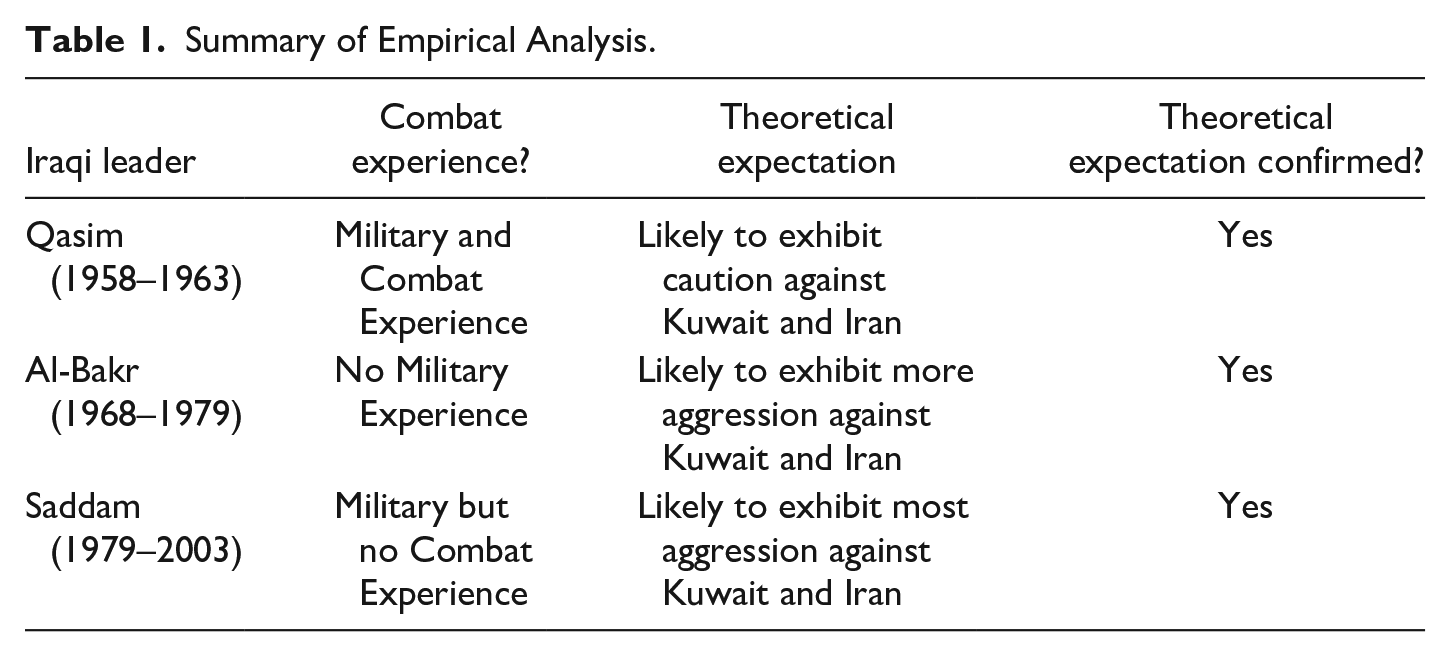
Qasim fought in the first 1948 Arab-Israeli War and became a battalion commander at the rank of Lieutenant Colonel (Al-Marashi & Salama, 2008, p. 71). Iraq’s contribution to the 1948 Arab-Israeli War was Iraq’s only deployment of troops abroad before the 1967 Six Day War. Qasim’s First Brigade battalion, located in the Kafr Qassem area south of Qilqilya, is highly likely to have been involved in the operation against Israeli forces at Jenin. The Iraqi operation in Jenin exhibited many of the unpredictable escalation dynamics typically associated with military operations. Malovany (2017, pp. 40–46; see also Morris, 2008, pp. 247–250) concluded that “Iraqi forces did not fulfil their assigned tasks and did not achieve their goal, having quickly been diverted to other tasks that were not commensurate with their operational capabilities.” Qasim is also likely to have been involved in combat operations in Palestine and against the Kurds. The Shatt Al-Arab and the Kuwait challenges—both central to Iraqi foreign policy and grand strategy (Malovany, 2017, p. 79)—were amenable to multiple policy options. The former was left unresolved in a 1937 treaty (Melamid, 1968; Schofield, 1986) that called for a joint commission to adjudicate the dispute that was still up in the air when Qasim came to power. Iraq had long held expansionist goals over Kuwait that an earlier Kuwaiti agreement with Britain challenged. The empirical analysis compares these leaders with another leader’s approach to the same challenges who had military but not combat experience — Saddam Hussein — to establish the effects of further variation in the independent variable.
Kuwait
Iraqi ambitions to annex Kuwait existed long before Saddam attained high office and invaded that country in 1990. Kuwait was “the proverbial jewel in the crown of British interests in the Persian Gulf” and formally achieved independence from Britain on June 19, 1961 (Ashton, 1998, p. 164; Fain, 2002, p. 102). The British had come to believe by the summer of 1961 that given “Kuwait’s vulnerability and Iraq’s ambitions, independence without British guarantees would simply be a formula for suicide (Alani, 1990, cited in Schofield, 1991, p. 105).” Clause D of the associated treaty between Britain and Kuwait noted that London would remain willing to defend Kuwait if the latter’s leader Sheikh al-Sabah requested such assistance. Qasim indeed announced on June 25 that the Sheikh was actually his subordinate and that Kuwait was an Iraqi province (Middle East Journal, 1961, p. 423; Smith, 1999, p. 117; Sluglett, 2002, p. 808). He continued that “we will liberate this section of Iraqi territory . . . but we always resort to peaceful means (Schofield, 1991, p. 107).” The Kuwaiti Sheikh reported Iraqi military movements near the Kuwaiti border on June 30 (Middle East Journal, 1961, p. 433). Despite the Shiekh invoking clause D a day before Qasim’s proclamation, 4,500 British troops, amid the desire for a formal request from Kuwait and consultations with the U.S. State Department, took 1 week to reach Kuwait, arriving on July 2 (Ashton, 1998, p. 168). A further 2,500 British troops as well as aerial and naval support and a small Saudi contingent had arrived by July 5 (Smith, 1999, p. 120). Although most of the Arab states rejected the Iraqi claim on Kuwait, the Soviets ensured that an appeal for Kuwaiti admission to the United Nations failed on the grounds that the Anglo-Kuwaiti treaty implied that Kuwait was not a sovereign state (Sluglett, 2002, p. 809). All of this left an approximately 1-week window where Qasim could have invaded and occupied Kuwait before British forces arrived.
Kuwait Militarized Interstate Dispute Behavior.
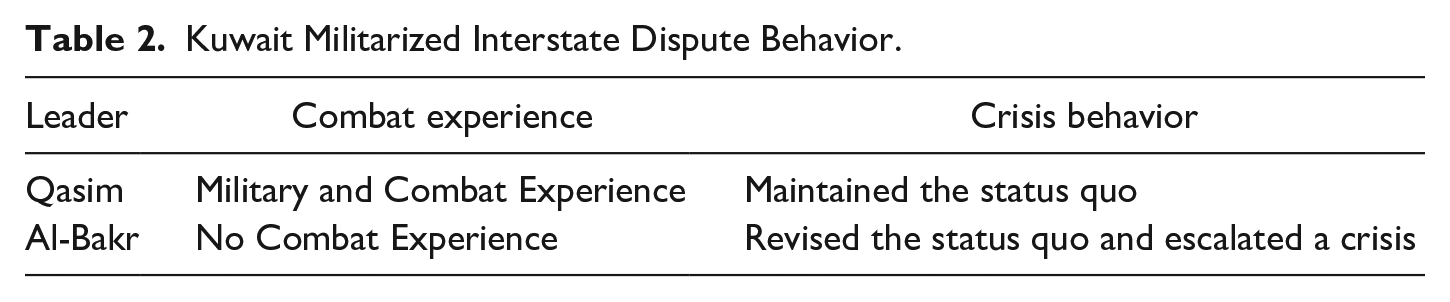
Schofield (1991, pp. 101–104) found that the British Foreign office believed that from the July 1958 Iraqi coup that brought Qasim to high office through December 1960, Qasim held annexing Kuwait as a core goal but that the prospect of British military intervention, as well as reactions from Turkey, Syria, and Iran on their shared borders, would deter him. The Foreign Office became more alarmed about the prospects of an Iraqi Kuwait-grab after the Anglo-Kuwaiti exchange of letters leading to Kuwaiti independence and provocative rhetoric from Baghdad that this caused and before British forces reached Kuwait. Qasim’s decision not to occupy Kuwait in the last days of June 1961 through “a quick dash from Basra” that “could occupy the territory in a few hours” before the British forces arrived, perhaps as a bargaining chip in future negotiations if not to permanently annex the country, is at least somewhat puzzling (Ashton, 1997, p. 1076). 2 The British Joint Intelligence Committee concluded that summer that “considering a bolt-from-the-blue scenario bereft of other indicators . . . the handful of (Iraqi) forces along the border could cross into Kuwait before detection (Mobley, 2001, p. 31).” The British held that only a British military intervention could save Kuwait. The U.K. Political Resident for the Persian Gulf reported on June 28 that the “threat to Kuwait’s independence is as grave and imminent as it could be (Mobley, 2001, p. 23).” Whitehall therefore “did not dare rule out the threat of Iraqi invasion (Mobley, 2001, p. 21).” London also feared that if Iraq annexed Kuwait before British forces arrived, such a territorial revision might be impossible to reverse (Ashton, 1997, p. 1073, 1998, p. 166). The British Ambassador to Iraq was well aware of “the difficulties which our forces would face if Qasim got there first (Joyce, 1998, p. 106).” The Foreign Office had informed U.S. Secretary of State Dean Rusk that “Kassem is so nearly mad that military action cannot be excluded but we have no evidence that preparations are taking place (Joyce, 1995, p. 286).” President Kennedy however admitted that the British ambassador’s fear of an Iraqi “quick military move . . . tallied with information he had received.” 3 Some in London worried that Qasim might attempt to take over Kuwait after British forces had arrived. The British Defence Committee maintained that in July 7,000 British troops might not have deterred Qasim because rash Iraqi action ultimately could not be discounted (Joyce, 1995, pp. 289–290; Rahman, 1997, pp. 258–260).”
Some scholars have maintained that Qasim never intended to invade Kuwait given the prospect of a fight with British forces (Alani, 1990; Bulloch, 1984 see also Joyce, 1995, p. 289; Rahman, 1997, pp. 242–250). By January 1962, U.S. National Intelligence Estimate 36.2-62 concluded that “the prospect of a fight with other Arab (and British) forces” would deter the Iraqi leader. 4 After the Arab league admitted Kuwait—to Iraqi disdain—on July 20, an Arab league force arrived in Kuwait in mid-September and British forces left weeks later. Qasim was left to ruminate that “it is a pledge and resolve that Kuwait will return to the homeland within not a long period (Middle East Journal, 1961, pp. 434–435; Joyce, 1998, pp. 108–109; Sluglett, 2002, p. 810).” The Soviets again blocked Kuwait from admission to the General Assembly that November, and Qasim continued to maintain his claim on Kuwait until his assassination in February 1963 (after which Kuwait was admitted to the U.N. General assembly; Schofield, 1991, pp. 110–111). An Iraqi leader with different beliefs about the utility of military power may well have occupied Kuwait before the British arrived and perhaps attempted to stave off a new era of Kuwaiti independence or at least attempted to leverage territorial concessions. Qasim’s earlier combat experience looms large as the source of Iraqi moderation in Kuwait in the summer of 1961.
A later Iraqi leader who lacked prior military combat experience did indeed authorize a fait accompli inside Kuwait territory 8 years later. By April 1969 Al-Bakr had been President of Iraq for 9 months but had already consolidated his hold on power by exiling potential challengers to his leadership (Coughlin, 2005). In the days after a crisis with Iran over a territorial dispute in the Shatt al-Arab river (see below), an Iraqi delegation advised the Kuwaiti government of an impending Iranian attack on Iraq and requested permission to station Iraqi forces on Kuwaiti territory to protect a recently constructed port. The Kuwaiti Sheikh and his colleagues claimed that Iraqi troops had already advanced a few miles into Kuwaiti territory when this request was made (Schofield, 1991, pp. 115–116; Rahman, 1997, pp. 280–281). The 1969 Shatt Al-Arab crisis had ended by that November, but Baghdad insisted that its forces had to remain in Kuwait (Litwak, 1981, p. 30). By May 1972, the Iraqi Foreign Minister tried to leverage the Iraqi presence in Kuwait by offering a willingness to accept an earlier boundary agreement if Iraq was allowed free access to the strategically located Warba and Bubiyan Islands and permitted to construct military bases there (Kelly, 1980; in Schofield, 1991, p. 116). The Kuwaiti rejection of this proposal and an Iraqi demand for a large financial loan did not stop Al-Bakr from increasing the Iraqi troop deployment in Kuwait. The Iraqi foreign minister dismissed the Kuwaiti Ambassador’s objection to the Iraqi construction of a road about 100 to 150 m inside Kuwait that he was not sure that it indeed was Kuwaiti territory (Rahman, 1997, p. 282). The Kuwaiti Ambassador concluded that this was part of an Iraqi gambit to gain access to a strategically located Kuwaiti border post.
The significance of the March 20, 1973, Iraqi attack on a Kuwaiti border post was not only Iraq’s territorial encroachment over 4 km into Kuwaiti territory but the deaths of Kuwaiti’s that it generated in what the Kuwaiti Minister of the Interior claimed were “heavily armed Iraqi troops carrying out a premediated plan of attack (Rahman, 1997, p. 283; Schofield, 1991, pp. 117–118; Tomasek, 1977, p. 216).” The Soviet call for a peaceful resolution to the dispute given concerns that Moscow harbored a desire for its own military base at the port and the Saudi and Iranian threat of their own military intervention if Iraq penetrated further into Kuwait were also signs that Al-Bakr had perhaps gone too far. One of the signs that Al-Bakr’s salami slicing into Kuwait was perceived as deeply threatening is the much greater 1973 Saudi military deployment into Kuwait. In the earlier 1961 Kuwaiti independence crisis, between 100 and 130 Saudi forces joined the 7000 British troops stationed in Kuwait to deter and defend against Iraqi revisionism. (President’s Intelligence Checklist, 3 July 1961). 5 By the end of March 1973, between 15,000 and 20,000 Saudi troops—between two to three times the number of British troops deployed to Kuwait twelve years earlier—were deployed to Kuwait in anticipation of further and greater Iraqi revisionism in that country (The Times, 1973). Iraq’s continued occupation of the territory it had occupied since 1969 but eventual withdrawal from the border post it had just annexed suggests that Al-Bakr was testing the regional waters to see how far into Kuwait he could get to secure Kuwaiti concessions on Warba and Bubiyan islands if not Kuwait itself before triggering Saudi and/or Iranian intervention. Iraqi forces would only further withdraw from their 1969 position to a point agreed upon by the Arab league in 1977 (Litwak, 1981).
One might argue that Iraq’s growing hostility toward Iran required greater access to the Gulf through the Warba and Bubiyan islands (Rahman, 1997, p. 275, see also 285–286). Rahman (1997, p. 281), for example, explained that: Iranian efforts to become predominant in the Gulf following the occupation of these (Persian Gulf Abu Musa and the Tunb Islands) induced Iraq to become more aggressive in its efforts to gain direct access to Gulf waters through the acquisition of Warba and Bubiyan.
But what explains the growing Iraqi hostility toward a more powerful Iran? For Ramazani (1975, p. 418), Iraqi hostility toward Iran under Al-Bakr’s leadership “was resumed with greater intensity than during the Qasim regime through propaganda, deportation of Iranian nationals in Iraq, expulsion of thousands of Iranian residents and pilgrims from Iraq, detention of diplomatic personnel by Iraq, and similar acts.” Britain’s exit from the region and Iran’s increasing power perhaps warranted bolder Iraqi moves. But the absence of more moderate and diplomatic Iraqi moves by Al-Bakr to deal with the threats from Iran is striking. Al-Bakr pursued his goals over Kuwait through the covert and overt use of military force. Diplomacy found little role in this Iraqi leader’s strategy, and his absence of military combat experience likely explains this policy preference.
The Shatt-Al Arab Dispute
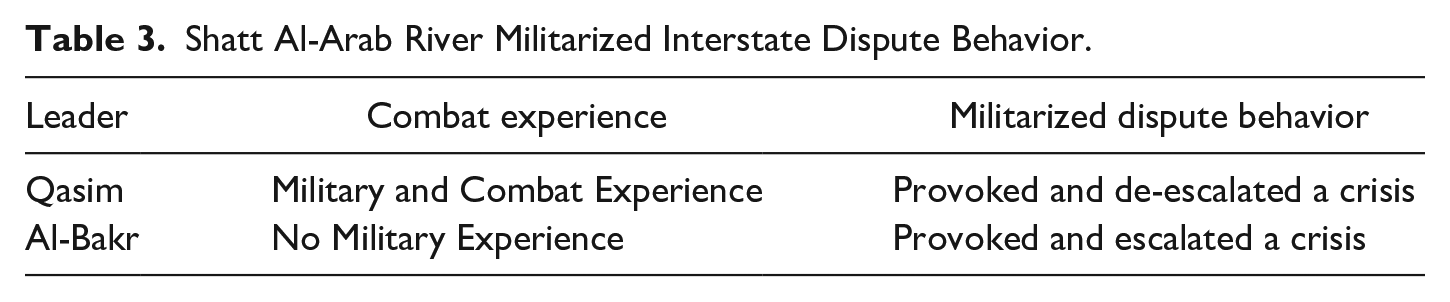
The same pattern observed in Kuwait between Qasim and Al-Bakr recurred elsewhere. As Schofield (1986, p. 58) noted, consistently with literature on revolutions and interstate conflict, “the Iraqi revolution of 1958 essentially signalled the dawn of a new era in Iran-Iraq relations in which there was to be a marked revival of conflict over sovereignty on both sides of the Shatt al-Arab.” Within a few months of the 1958 coup, new Iraqi leader Qasim advanced claims to twelve miles of territorial waters. This was soon followed by an equal Iranian claim (Chubin & Zabih, 1974, p. 171). Qasim withdrew Iraq from the Baghdad Pact (later CENTO) the following march; this may have been viewed as opening the door to greater Soviet influence in Baghdad. That year Iraq also interfered with Iranian Pan-American Oil Company ships (Chubin & Zabih, 1974, p. 173). After the Iranian Shah described the disputed waterway status quo as “intolerable” at a November 28, 1959, press conference, a few days later Qasim repeated, defended, and perhaps expanded the Iraqi territorial claim (Dann, 1969, p. 264). After Iraq expelled several Iranian nationals from Iraqi territory and placed employment restrictions on others, by December 10 and 15 border clashes had occurred. By December 16 Iranian border guards were sent to reinforce the Iranian position at the disputed border (Middle East Journal, 1960, p. 181). By December 21 Iranian artillery, armored cars, and tanks were deployed to the border (Middle East Journal, 1960, p. 181) and were matched by a similar Iraqi deployment. That day Qasim intimated, however, that he would “not resort to force to regain Iraq’s rights unless all peaceful methods for solving international issues failed (162).” The next day the Iraqi leader alleged that many Iranian border violations had occurred. By December 23, the Shah had placed Iranian military forces on full alert. On January 4, however, Qasim allowed an Iranian ship to pass through the disputed river without any Iraqi naval encroachments.
Shatt Al-Arab River Militarized Interstate Dispute Behavior.
According to Malovany (2017, pp. 30–33), Al-Bakr’s Ba-ath regime increased the army’s mandate from internal security to “achieving strategic goals outside Iraq’s borders, particularly against Iran, (which) made developing military might a top national priority.” Chubin and Zabih (1974, p. 184) argued that by the late 1960s when Al-Bakr had reached high office, the Iraq-Iran rivalry had changed: Iran was now a more powerful state militarily, with a stable government and on good relations with both superpowers as well as most of its neighbors. The (al-Bakr) Iraqi regime, on the other hand, had few regional friends and numerous regional rivals. (see also Swearingen, 1988, pp. 411–412)
The announcement of the impending British withdrawal from the region by 1971 added further uncertainty regarding the balance of power and resolve (Middle East Journal, 1970, p. 55). All of this left the Iraqi leadership with multiple options. Concessions to Iran on the Shatt Al-Arab may indeed have signaled weakness and encouraged further Iranian demands. But this might have bought time for Baghdad to increase its own naval and military power. A hard-line may have signaled that Iraq would not budge but risked conflict with an adversary that had become more powerful. Suggesting an even split of the disputed river might have signaled resolve while not risking conflict. But it was Iran that proposed a line that would divide the disputed river more or less through the middle. The Iraqi position maintained that the 1937 treaty demarcation—where the border was on the Iranian bank of the river—remained valid (Chubin & Zabih, 1974, p. 185).
It is perhaps not surprising then that a provocative Iraqi move sparked the 1969 crisis. The Iraqi deputy foreign minister informed the Iranian ambassador on April 15 that the Al-Bakr government considered the disputed Shatt-al-Arab river as Iraqi territory and that Iranian ships were to lower the Iranian flag when entering and not transport any Iranian nationals (Middle East Journal, 1969, p. 370; Rahman, 1997, p. 280). 6 The minister threatened that Iranian noncompliance with these very strict and unprecedented demands would lead to Iraq using force to prevent Iranian vessels from passing through (Tomasek, 1977, p. 208). Iran, in response, declared the 1937 treaty that covered the disputed territory invalid, called for its renegotiation, and warned that any violation of Iranian sovereign rights would warrant retaliation. The Shah placed Iranian naval and air forces on full alert, provided Iranian ships or ships bound for Iran with a military escort, and threatened Baghdad that interference with Iranian shipping might lead to war. Al-Bakr put Iraqi forces in the region on alert but reiterated the validity of the 1937 treaty. After the Shah sent an Iranian ship through assisted by naval and jet fighter escorts, an Iraqi naval vessel was launched to approach the Iranian vessels in what appeared to be a naval game of chicken. The Iraqi ship was ultimately ordered to steer away from the Iranian vessel and complied with the demand (Tomasek, 1977, pp. 208–209). Al-Bakr’s much more provocative demand about the disputed river and greater challenge to the Iranian naval deployment increased the probability of conflict with Iran more than Qasim’s moves in the crises over the same river ten years before.
The Iraqi challenge to Iranian passage through the straits in 1969 is striking, given the balance of power then between Tehran and Baghdad. According to the Military Balance (2009, p. 34), in 1969 Iran’s total number in the armed forces was almost three times that of Iraq, Iran’s “gross national product” more than three times that of Iraq, and Iran’s population three times that of Iraq. Iran’s army and navy were also quantitatively superior to Iraq’s; Iraq’s air force might have been more comparable to Iran’s. Al-Bakr’s challenge to the Iranian ship running through the Straits might have been motivated by a desire to signal resolve in the face of much greater Iranian military power. But the Iraqi leader’s decision to play a naval game of chicken that could have led to a crash in the Straits and many means of inadvertent escalation and war in the face of much weaker Iraqi military and economic power when Qasim had earlier declined to challenge the Iranian naval passage is striking. Al-Bakr’s insistence on the validity of a treaty that posited the border of the disputed river at the Iranian bank of the river and demands for Iran to recognize Iraqi sovereignty in the face of greater and growing Iranian military power is the sort of provocative behavior that extant literature on leaders with military but not combat experience expects.
Saddam, Iran, and Kuwait
The above analysis has compared two Iraqi leaders who had combat experience and no military experience and suggested that the battle-hardened Qasim authorized much less provocative and dangerous policies that reduced the prospects of war. This section analyses a leader of the same country who had military but not combat experience and who faced challenges involving the same two adversaries. Against findings that expect all highly autocratic regimes to be highly war-prone, and the above analysis that showed that combat experience can make autocratic leaders less war-prone than those without any military experience, this section shows that military but not combat experience can make autocratic leaders especially war-prone. While archival records of Qasim and Al-Bakr’s leadership and decision-making remain elusive, the analysis uses extensive archival records of Saddam Hussein’s approach to Iran and Kuwait before he invaded those countries in 1980 and 1990 to document his approach to these conflicts.
Saddam Hussein Militarized Dispute Behavior.
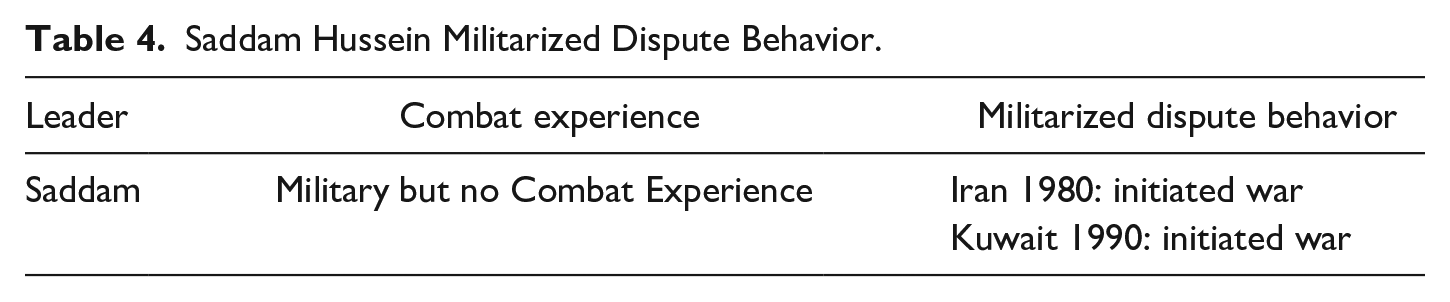
The Iranian revolution’s decimation of the Shah’s previously menacing military power surely made that longtime rival of Iraq an attractive target in Saddam’s eye, especially as most believed that restoring Iran’s military power would be high on Khomeini’s priority list (Brands, 2011, p. 875; Woods et al., 2011, p. 135; Nelson, 2018, pp. 248–250; see also Blainey, 1988). Evidence suggests, however, that more was required for the Iraqi attack than Iranian weakness. Nelson (2018, p. 265) argued that while Iran’s military weakness was a necessary condition for Saddam’s invasion, concern that Iran was attempting to undermine and ultimately overthrow his government was sufficient for him to authorize the Iraqi military invasion of that country. Most scholarship concurred that Saddam authorized the Iraqi military to start preparing for war in April 1980, shortly after Iranian calls for the overthrow of Saddam’s Ba’ath party and the assassination attempt on his Deputy Tariq Aziz but long after it was clear that the Iranian revolution had significantly weakened Tehran’s military power (Nelson, 2018, p. 255 fn 50). Brands (2011, p. 863) concluded that while the Iraqi invasion of Iran was partly “a defensive reaction to threatening Iranian policies, especially those that seemed to pose an ideological and internal security threat to the Iraqi regime . . . the attack can also persuasively be characterised as an opportunistic land-grab.”
According to Woods et al. (2011, p. 128; see also Brands & Palkki, 2011, p. 153), Iraqi records make it clear that “the Iran-Iraq War cannot be understood independent of Saddam Hussein.” Saddam claimed in February 1979 (Brands, 2011, p. 870 fn 28) that Iranian hostility left “no options except the military option.” However the Iraqi leader would not authorize his invasion for a further one and a half years. Six days before Iraqi forces did invade Iran, Saddam expressed a “repeated desire (Woods et al., 2011, p. 129, 134–135)” to limit the conflict but concluded that Tehran’s potential to escalate was too great to allow for a more limited Iraqi use of force. Saddam’s subsequent initial military successes encouraged him and led him to expect a quick victory. This is precisely the sort of belief that a leader who has military but not combat experience would be expected to have. Saddam subsequently concluded on September 16, 1980 (Woods et al., 2011, pp. 133–135) that regarding the disputed Shatt al-Arab and possibly elsewhere, “we have to gain it back with the blood of our soldiers and by force . . . when we have the ability to return what is our right, we will do it.” He continued that “if they do not give it (the land) to us, then we will grab it back.” Saddam was committed to this despite realizing that he could not guarantee the Soviet supply of weapons that were crucial to Iraqi military prospects. Another utterance suggests that Saddam believed that diplomatic and political options were no substitute for the use of military force. He informed the Revolutionary Command Council and National Command during that September 16, 1980, discussion that “we have to stick their noses in mud so we can impose our political will over them. This cannot take place except militarily (Woods et al., 2011, p. 137).” That same day he said that “a year and a half and they didn’t return the lands controlled and occupied by them according to the Agreement. This necessitates that we regain it with blood and weapons (Pollack, 2023, p. 517).” It is hard to imagine the combat-hardened Qasim making the same arguments regarding Tehran.
Iraq had orchestrated a substantial arms build-up throughout the 1970s, and in 1979 Saddam clarified that his country had “the resources and the ability to put our decisions and resolutions into action that can be effective and have great influence in the international political arena (Brands, 2011, p. 874 fn 50).” Brands (2011, p. 867) found that the Iraqi leader’s military plan was: ambitious in the extreme; . . . Iraqi advances, Saddam assumed, would spark an uprising among the Arab population in Khuzestan and force Khomeini to commit his best troops to meet the Baathist invasion . . . anti-Khomeini elements would exploit the vacuum of authority to overthrow the regime and conclude a compromise peace leaving Iraq in possession of the captured territory.
A former Iraqi general admitted that he and his colleagues—almost certainly including Saddam—believed that “this would not take any more than 4 to 6 weeks (Brands, 2011, pp. 868 fn15; 876 fn62).” Shortly after the start of the fighting Saddam exhibited great overconfidence and estimated that “we will completely destroy them in a way that they would not be able to fix for 20 years (Brands, 2011, p. 872 fn 40).” Saddam did not anticipate that, as Brands pointed out, although the revolution dented Iranian military power, the Iraqi invasion compensated for some of this by igniting nationalistic resistance. This caused “the military and much of the population to rally behind the regime rather than turning against it (Brands, 2011, p. 868).” Although Iran’s denial of a quick Iraqi victory must have at least dented Saddam’s overconfidence, as the war dragged on he continued to believe in the promise of Iraqi military power. He claimed between late 1983 and early 1984 that “war, in spite of its consequences . . . brings with it many scientific advances (Woods et al., 2011, p. 144).” In 1984, he informed senior army staff that “one of the most distinguished factors among military personnel is the ability to attack successfully and defeat the enemy instead of waiting for the enemy to wage his attack (Brands & Palkki, 2012, p. 655 fn125).” In 1985, he involved himself in a Republican Guard manual on preemptive attacks (Brands & Palkki, 2012, p. 655).”
Saddam’s invasion of Iran generated positive feedback insofar as it sufficiently bankrupted his country that he saw another invasion of Kuwait as a relatively attractive means to pay his debts. Ultimately, in the face of a crippling Iran-Iraq war 80 billion dollar debt and a fall in oil prices that impeded Iraqi efforts to repay this (Chardell, 2023, p. 54), Saddam concluded that invading Kuwait would allow Iraq’s, in the words of Woods et al. (2011, p. 167), “consolidating political and economic power in the Arab world.” Indeed, Saddam concluded that in light of his conviction that the Bush administration was conspiring with the Israelis and Kuwaitis to topple his regime, occupying Kuwait and seizing its oil “was not an end in itself but a means to break up the larger plot to which the royal family was party (Chardell, 2023, pp. 54, see also 63, 68, 71–72, 77; Brands & Palkki, 2012, pp. 651–654).” For Chardell (2023, p. 74 fn147; see also Brands & Palkki, 2012, p. 654), Saddam concluded that “taking all of Kuwait would give him greater leverage to deter the United States and Israel.” After the Kuwaitis backtracked on their earlier commitment regarding an oil quota, Saddam responded that “it seems (the Kuwaitis) do not understand words . . . we have to use another language with them (Chardell, 2023, p. 74).” The Iraqi leader seems to have concluded that Iraqi military power would be able to sustain any such radical change to the Kuwaiti status quo in the face of U.S. retaliation that he knew would come. After U.S. Ambassador to Iraq, April Glaspie informed Saddam on July 25 that her government would only accept peaceful means of Iraq-Kuwait dispute resolution, Saddam expected his invasion of Kuwait to be met with a U.S. “complete boycott” and military strikes from “air, land and sea—everywhere (Brands & Palkki, 2012, pp. 656–657).” Strikingly, this did not stop him from authorizing the invasion of Kuwait. Stein (1992) concurred that the Iraqi leader’s beliefs loomed large in the U.S. deterrence and compellence failures.
Saddam seems to have also tied his war with Iran as necessary and ultimately linked to a later military showdown with Israel (Brands, 2011, pp. 863, 878–880, 882). Indeed, Saddam seems to have also believed that he could eventually somehow defeat Israel (Brands & Palkki, 2011, p. 152 fn75). Ultimately for Saddam, “the ones who make history are those who carry their spears high and their swords sharp (Brands & Palkki, 2011, p. 142 fn30).” Brands and Palkki (2012, p. 658) ultimately concluded that asking whether Saddam was rational or irrational is less productive than addressing how “ideology, personality and concrete experience mixed to produce such an extreme and aggressive worldview.” That the Iraqi leader's experience involved a military but not combat background likely loomed large in creating his beliefs about the use of Iraqi military force in Iran and Kuwait.
Conclusion
The literature mostly concurs that the institutional logic of autocratic and military regimes constrains any pushback from individual political leaders that might influence foreign policy and the initiation and escalation of interstate disputes. The analysis here has however suggested otherwise, and shown that Qasim both experienced military combat and authorized more moderate policies regarding disputes with Iran and Kuwait than Al-Bakr who had no military experience. It has also shown that Saddam Hussein, who had military but not combat experience, authorized major military interventions in disputes with both countries. Most importantly, the case of Qasim suggests that combat experience can moderate the otherwise aggressive and dangerous foreign policies of leaders in autocratic and military regimes. While the military combat hardened Qasim provoked but held back from occupying Kuwait before British forces arrived, Al-Bakr authorized covert and overt military encroachments into Kuwaiti territory that caused a substantial Saudi military deployment into Kuwait to deter and/or defend against Iraqi forces. One might counter that the prospect of occupying Kuwait in 1961 and dealing with 7000 British troops was hardly risk-free for Qasim. But covertly and overtly penetrating Kuwait when the Iraqi regional position had worsened and risking a fight with two to three times as many Saudi forces was a greater gamble that Al-Bakr accepted. The military combat hardened Qasim also ultimately let an Iranian ship pass through the disputed Shatt Al-Arab straits while Al-Bakr sent out an Iraqi ship to meet the Iranian vessel (only to eventually call it off) in the face of much greater Iranian military power. Some scholars have argued that Iraqi foreign policy during this period was driven not only by the pursuit of interests regarding other actors but also by the need to signal Arab and related credentials and agendas to domestic, regional, or even international audiences (Khadduri, 1967, pp. 84–85; Tomasek, 1977). But leaders’ military experiences are endogenous to and strongly influence the foreign policies that particular ideological commitments give rise to. As Chubin and Zabih (1974, p. 170) noted, Iraq’s resulting foreign policies were nonetheless “divisively shaped by the ideological predisposition of the leadership that has happened to seize power.”
Most extant research has treated military combat experience in a binary manner. Further research should address the conditions when which combat experiences moderate the conflict propensity of what types of autocratic leaders against which adversaries. It could be the case that some combat experience moderates the conflict propensity of all leaders but that higher amounts of combat experience normalize violence and make people more likely to authorize more aggressive and crisis-inducing foreign policies. According to Odd Arne Westad (2019, p. 366), Leonid Brezhnev, for example, “rarely saw combat close up” but nonetheless “carried the images of devastation with him for the rest of his life, and they made him fear war.” The Soviet leader believed that in war “everyone loses” and told U.S. President Ford in 1974 that “I do not want to inflict that on my people again.” The Soviet leader refrained from picking a fight with the United States and its allies in high-stakes Western Europe as his predecessor had done to avoid another Berlin and/or nuclear crisis. He invaded lower-stakes Afghanistan where the probability of Soviet forces engaging with U.S. forces and the likelihood of nuclear escalation was lower. Brehznev also refrained from using military power in the 1973 Yom-Kippur war and seems to have mostly relied on threats to respond to a Chinese surprise attack near a disputed river that triggered the 1969 border crisis. Research could also address the role of combat experience in advisers and close associates to autocratic leaders (Saunders, 2024). Zhou Enlai, for example, was wary of war on the grounds that “war had its own law of development, usually in a way contrary to the wishes of people,” (cited in Carson, 2018, p. 215).” Better understanding the conditions when what type of exposure to military combat moderates the foreign policies of which types of autocratic leaders should be possible through quantitative and qualitative research. This would allow a richer understanding of conditions when autocratic leaders are more likely to provoke interstate crises and wars and how these can be better mitigated and managed.
Footnotes
Acknowledgements
The author is grateful to the editor and external reviewers for their helpful feedback and to Sally Davis for research assistance.
Declaration of Conflicting Interests
The author declared no potential conflicts of interest with respect to the research, authorship, and/or publication of this article.
Funding
The author received no financial support for the research, authorship, and/or publication of this article.
