



Abstract
Despite an increase in academic research over recent years into military veterans in the criminal justice system, little of this has focused on U.K. veterans’ views and attitudes toward authority in prison or how veterans respond to prison regime. This study used semistructured qualitative interviews with 35 ex-military prisoners to explore their views and attitudes toward the authority and legitimacy of the prison and to assess their behavior toward prison regime. It found that participants expressed positive attitudes toward authority and the legitimacy of the prison, reportedly influenced by previous military experiences. This was accompanied by an acceptance of one’s prison sentence and a generally high compliance with prison regime. Findings suggest that research participants’ previous military service may have lasting effects on how they engage with authority within the prison by providing resilience toward the effects of imprisonment. Possible areas of future research are also discussed.
An estimated 3000 former U.K. military service personnel are currently in prison in England and Wales, making up around 3.6% of the total prison population (DASA, 2010; Ministry of Justice, 2023). These ex-military personnel are in the somewhat unusual position when sent to prison of having already experienced life within a structured, disciplined, and regimented institution governed by a hierarchical body of staff who direct the closely regimented daily routines and activities. Such establishments have often been termed “total institutions” (Brown, 2015; Goffman, 1961; Scott, 2011).
Recent decades have seen a surge in public, political, and media interest in the welfare of military veterans following the wars in Afghanistan and Iraq. This has corresponded with an increase in academic research interest into veterans’ welfare and, for the small minority of those who subsequently fall foul of the law, their involvement with the criminal justice system and imprisonment. Despite this increase, qualitative research into how U.K. military veterans respond to and experience imprisonment has been somewhat lacking (Logan et al., 2023; Treadwell, 2016). This article explores the perceptions and attitudes of veteran prisoners toward the authority of the prison, its legitimacy, and compliance with prison regime. By presenting findings from 35 qualitative interviews conducted with U.K. military veterans serving prison sentences in England, it provides a hitherto absent, in-depth picture of the role that attitudes toward authority play in the experiences of veterans across two institutional settings, that of the military and of the prison. It explores how and why attitudes toward authority influenced by military service might influence veterans’ behavior and, ultimately, their compliance with prison regime.
This article begins with a review of the research literature to date, highlighting the importance of veteran prisoners’ attitudes toward authority in prison in determining their experience of imprisonment. It then describes the research methods used to obtain the voices of imprisoned veterans so as to fully understand their experiences of authority and compliance within the military and the prison. It will then move on to present the study’s findings, organized into the predominant themes which emerged from the research. It will first explore participants’ attitudes toward authority in the military and how these influenced later attitudes toward authority in prison. It will then explore the notion of personal responsibility which dominated many participant accounts and often led to an acceptance of one’s sentence, before finally reflecting on how this might influence prisoners’ compliance with regime. A discussion of the implications of these findings will then follow before the article concludes with proposals for further research in the field.
Identity, Authority, and Legitimacy
Military institutions have particular values, ethos, and cultures which they seek to inculcate into their charges, emphasizing discipline, respect, and obedience to authority. Military institutions strive to generate and maintain an uncompromising obedience to authority in their members. Failure or refusal to observe and conform to this obedience elicits sanction from the institution’s staff, thereby creating a culture of compliance driven by perpetual anxiety over threat of sanction (Hockey, 1986), with obedience to authority maintained due to a universal acknowledgment of authority in the system (King, 2006). Living and working within such institutions can have a profound and lasting effect on an individual’s values, beliefs, world-view, and ultimately their self-identity. Burdett et al. (2012) describe how dominant, embedded military identities can persist beyond the end of military service and are often carried forward into civilian life (see also: Brewster et al., 2020). Ashcroft (2014) further highlights the myriad ways in which this can impact upon an individual’s adjustment to mainstream civilian culture on release from service and on one’s subsequent life-course and experiences.
Morgan et al. (2021) reported that military service and the culture it instills can have a lasting influence on an individual’s behavior long after leaving the military, including their views of and attitudes toward authority (see also: Morgan et al., 2023). Having been conditioned over time to the obeisance of authority, military personnel can therefore develop and maintain a lasting attitude of acceptance toward authority and positive attitudes toward those in the institutions that govern society and protect its people (Ashcroft, 2014; Higate, 2001; Hopton, 2003).
Authority is essentially the legitimate use of power with, typically, an unequal relationship between the power-holder and the person over whom the power is being exercised (Liebling, 2011). Legitimacy, by a similar token, can be understood as the rightful use of that authority (Liebling, 2011) or the exercise of power within established rules which have a grounding in values and beliefs shared by both the dominant and the subordinate (Beetham, 1991; Bottoms & Tankebe, 2013; Sparks, 1994). Wooldredge (2020) therefore asserts that authorities are legitimate if they “(a) occupy a lawful position that influences others, (b) act fairly, and (c) behave in ways that are morally justifiable to those impacted by their behaviors.” Beetham (1991) argues that legitimacy requires evidence of consent by the subordinate to the power being exercised over them, but this might not always be present in total institutions such as the prison and the military which, as Sparks (1994) points out, “operate as an autocracy within a democratic polity” (p. 15). While consent can be present in the military, since those joining the institution typically place themselves voluntarily under the authority of military power-holders, Sparks (1994) points out that this is not always the case in prison. Crewe (2011a), however, asserts that power and authority in prison can be exercised to a greater degree of legitimacy through good staff-prisoner relations and treatment that is respectful and procedurally fair (see also: Crewe, 2011b; Liebling, 2011b). For veterans who had joined their chosen military institution voluntarily but were now held involuntarily within the prison, little is known of their perceptions of legitimacy (or illegitimacy) of these institutions.
Veterans in Prison
The first rigorous analysis of U.K. veterans in prison was conducted by Defence Analytical Services and Advice (DASA, 2010) which provided the first snapshot of how the veteran prisoner population was comprised in terms of age, gender, and offense type. It found that ex-military persons were less likely to be imprisoned than the general U.K. population and were on average substantially older than the general prison population. Veterans were overwhelmingly male and were proportionally over-represented in categories of violent and sexual offenses (DASA, 2010).
Following on from this, the Howard League (Howard League for Penal Reform, 2011) was one of the first to conduct qualitative research into U.K. veterans in prison with its independent review which interviewed 29 serving prisoners in England and Wales who had previously served in the U.K. military. It found that many had encountered problems after leaving military service which had contributed to their offending and eventual entry to prison. These included misuse of alcohol, family breakdown, and problems gaining and retaining civilian employment, thereby mirroring findings from other research which also identified issues such as financial difficulties (Ashcroft, 2014; Carpenter & Silberman, 2020; Treadwell, 2009), homelessness (Dandeker et al., 2005; Fleuty et al., 2021; Higate, 2000; Johnsen et al., 2008; Royal British Legion, 2014) and mental health conditions (Iversen et al., 2005; Iversen & Greenberg, 2009; Murphy & Busuttil, 2019; Murphy et al., 2008; Rhead et al., 2022) as prominent issues among ex-military personnel. Further research has since shown that these problems can be exacerbated by a lack of awareness of available support services or otherwise an unwillingness to seek help (Rafferty et al., 2017; Wainwright et al., 2017; Williamson et al., 2019), ultimately resulting in some cases in criminal offending (MacManus & Wessely, 2011; Short et al., 2018) and particularly violent offending (MacManus et al., 2013; Madoc-Jones et al., 2018).
In 2014, HM Inspectorate of Prisons (HMIP) published analysis of survey data which revealed initial insights into how ex-military personnel might experience their lives in prison. It found that veteran prisoners managed some aspects of imprisonment better than nonveteran prisoners, with analysis of survey findings suggesting that they had more positive views of the institution’s regime and systems of discipline, better relationships with staff and less incidence of being placed in segregation units (suggesting fewer or less severe disciplinary infringements) (HMIP, 2014b). The findings from this descriptive study suggest that veteran prisoners might manage some aspects of imprisonment better than nonveterans, with their behavior better reflecting that which was expected by the institution’s disciplinary regime. Further research has since supported these findings that veterans might experience imprisonment somewhat differently to nonveterans.
Focusing on reasons leading to imprisonment rather than the lived experience of imprisonment, the Howard League did nevertheless provide the first tentative insight into U.K. veterans’ attitudes toward their prison sentences and the institutional regime, with one interviewee remarking, “After the Army, jail doesn’t bother me, because I know how it is. I spent half my life living this way, following petty rules” (Howard League for Penal Reform, 2011, p. 58). The findings of this inquiry, while not focused on the experience of imprisonment, does provide a tentative insight which suggests the possibility that previous military service provides experience of where one might learn to, or become conditioned to, live within structured, disciplined and hierarchical institutional environments which might be transferable to one’s later life in prison. The Howard League (Howard League for Penal Reform, 2011) claimed that, as a result of its governing of individuals within a clearly structured and disciplined institution, the military can act as a protective factor for many of those at risk of otherwise coming into contact with the criminal justice system had they otherwise remained in civilian society. Following this same line of argument, Logan et al. (2023) contend that prison can similarly act as a protective factor influencing veterans’ behavior within the prison regime as it provides a similar disciplined and structured environment which veterans are accustomed to living within. From this perspective, rather than creating particular vulnerability in prison (Albertson et al., 2018), previous military service can give veterans both a level of familiarization with how to live an institutional life and a certain physical and mental resilience which can be an asset employed to assist with living within prison and coping with its hardships. As a result, veterans are thought to adjust to imprisonment in a manner which results in higher levels of coping, lower levels of disciplinary infractions and better relationships with prison staff, which Logan et al. (2023) term “the veteran effect.”
While the body of research testing this theory is limited (Logan et al., 2023), Logan and Pare (2016) found that military veterans in U.S. prisons were less likely to be given punishments for a variety of rule infractions including insubordination, abuse, and drugs. This led researchers to conclude that veterans’ previous military service assisted them in adjusting to institutional life within prison and reduced their likelihood of coming into conflict with authority figures. These findings are tentatively supported by a further study by Brooke (2018) who found that veterans who were older or had served in the military for longer were less likely to be punished for prison misconduct.
While this previous research indicates that veteran prisoner behavior could be more in line with the disciplinary regime of the prison (HMIP, 2014a) and that this could be due to learning or conditioning transferred over from previous military service (Howard League for Penal Reform, 2011; Logan et al., 2023), there remains a missing picture of how U.K. veterans actually experience imprisonment and, in particular, how they perceive, experience, and respond to authority in prison. This study takes steps toward filling this gap by building on this initial tentative body of evidence. It explores further whether veterans might, as a result of their previous military service, hold attitudes toward authority which might influence their views, and experiences of authority in prison and ultimately their behavior and their compliance with prison regime. It seeks to explore the connection between prior military service and how veterans view and experience authority in the prison by drawing directly on the voices of veteran prisoners and by presenting their accounts.
Research Design and Methodology
This study took the form of a qualitative-exploratory research study (Stebbins, 2001), an approach often adopted when little is known about the group under study and considered useful for developing an evidence base for further development of hypotheses and theories (Babbie, 2007; Stebbins, 2001). Aimed at gaining insight and understandings of a population, situation, or events under study, rather than generating definitively generalizable findings with high external validity, such qualitative research methods can provide valuable descriptions of specific populations’ interpretations of experiences within specific contexts and environments (Casula et al., 2021; Nowell & Albrecht, 2019), such as the under-studied population of U.K. veterans in prison.
The study involved conducting in-depth qualitative interviews with U.K. military veterans serving prison sentences in England. Six prisons were selected purposively as research sites to ensure inclusion of participants housed within establishments across a range of different security categorisations. These included a category D open prison, a category C and D closed prison, a category C training and resettlement prison, a category B training and resettlement prison and two category B local prisons. Selected research sites included both public and private run prisons, were located in different regions across the country and only housed men.
The Study Sample
Stebbins (2001) asserts that validity in qualitative-exploratory research is largely dependent on the representativeness of the study’s sample, with appropriate sampling methods such as purposive and snowball sampling necessary to achieve this. Participants were therefore selected using purposive sampling methods to ensure inclusion of a range of participants across length of military service, age, offense type, and sentence length. Some additional participants were further recruited in each location through snowball sampling which had the benefit of including some of those who had been reluctant to disclose their veteran status to the prison authorities and staff. Participants were recruited and included in the study until saturation point was reached (Casula et al., 2021; Morse, 1995), with the final sample totaling 35 participants. Those included had served in all branches of the U.K. military with 27 having served in the British Army, six in the Royal Navy (four of whom had been Royal Marines) and two in the Royal Air Force. Proportionally, this corresponds with the composition of ex-military prisoners found in U.K. prisons by The Howard League (Howard League for Penal Reform, 2011) and HMIP (2014b). Two participants had served in more than one military organization; one had moved from the Royal Marines to the British Army and one had served in the British Army before joining the French Foreign Legion. The majority of participants’ military service had been confirmed by prison staff working with veterans although this was not always possible, for example, with snowball-sampled participants who wished to remain unknown to prison staff.
The majority of participants had served in combat roles (n = 25) (e.g., infantry, armor or artillery), with most of these being former Army (n = 23). Most of these (n = 19) had been deployed on operations overseas, mostly in Northern Ireland during The Troubles but also in Bosnia, Kosovo, Serbia, Afghanistan, Kuwait, and Iraq. Of this number, 12 reported having experienced some form of hostile engagement or other potentially traumatic event (e.g., being shot, discovering a mass grave, witnessing death of a comrade etc.). Most (n = 33) participants in the sample had served as noncommissioned ranks, mostly as private (or equivalent) (n = 19) but with a number of junior and senior noncommissioned officers ranging from Lance Corporal to Staff Sergeant (or equivalents) (n = 14). Two former commissioned officers were also present in the sample. The overall length of previous military service ranged from 6 months to 21 years, and the majority of participants had left the military over 5 years prior to the time of interview.
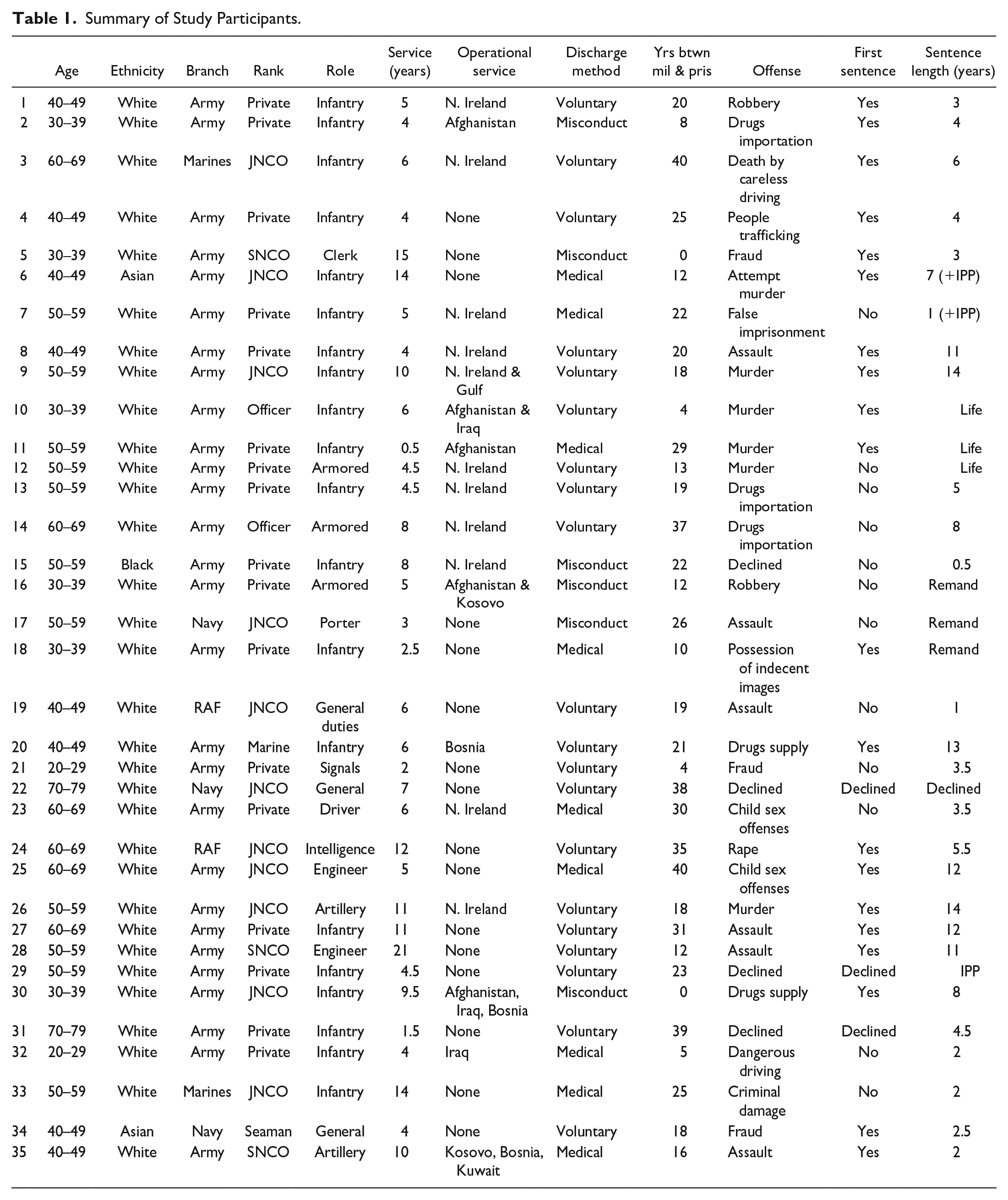
The study sample proved to be a somewhat diverse group demographically (see Table 1), with participants aged from 23 to 72 years and coming from England, Scotland, Wales, Northern Ireland, and The Republic of Ireland. The majority of participants were white (British, Irish or European) (n = 32) with one who was of Black Caribbean descent and two of south Asian heritage. While participants were not asked about their sexual preferences, at least two participants voluntarily reported being gay. Most interviewees reported little by way of formal education, with 10 reporting that they had achieved GCSEs and/or A-Levels (or equivalents) and a further four reporting that they completed an undergraduate degree or higher. Participants’ offenses ranged from relatively low-level crimes, such as shoplifting, to more serious offenses, such as large-scale drugs importation and murder. Of those willing to disclose their offense, 13 were in prison for violent offenses (including five for murder), five for drugs offenses (all of which were supply or importation), four for acquisitive offenses (two for preplanned robbery, two for fraud), four for sexual offenses, and two for driving offenses. This wide range of offenses was reflected in the varied sentence lengths which ranged from 8 months to life. Three participants were serving indeterminate sentences, and three were currently on remand pending trial or extradition. Twenty reported that they were serving their first prison sentence.
Summary of Study Participants.
The Interview Process
Interviews were conducted one-on-one in private and lasted approximately 50 minutes on average. These took the form of in-depth, semistructured interviews, using an interview schedule to guide the course of the interviews and ensure consistency but to still allow for other topics relevant to participants and unanticipated themes to emerge during discussions (Robson, 2002; Rubin & Rubin, 1995). Interviews were audio-recorded with the permission of participants, and the audio recordings were later transcribed verbatim. Data within each transcript were analyzed thematically using a flexible, inductive approach to data analysis which allowed data to be continually analyzed throughout the data collection process and thereby permit the identification of dominant, unanticipated, and recurring themes as they emerged (Corbin & Strauss, 1990; Noaks & Wincup, 2004). The dominant themes which came out during participant interviews form the outline of the following sections of this article which detail the project’s findings. Each of these themes are explored in turn and consist of authority in the military; authority in prison; personal responsibility and acceptance of sentence; and compliance with regime. These are then brought together in a following discussion of how previous military experience can influence attitudes toward authority, legitimacy, and compliance with prison regime.
Findings
Ex-military prisoners in this study often expressed a generally positive view of authority and a sentiment of acceptance of authority and legitimacy of power-holders throughout the life-course. The following section of findings presents the voices of military veterans to illustrate the views and attitudes toward authority that participants held through the different stages of the life-course; through childhood, military service, and into prison.
Authority in the Military
During their military service, participants had been generally accepting of military authority and compliant with military regime. However, participants had simultaneously ascribed to an informal code of conduct which permitted some behaviors which were culturally accepted within their military units while formally against the institutions’ rules. For example, those who had served in fighting units such as infantry regiments often recounted engaging in violence while in the military but considered these behaviors to be acceptable. That is, the majority of participants had typically contravened military rules without considering these acts to be out of line with institutional expectations according to their institution’s culture. Most of these breaches were considered by participants to be minor in nature and not necessarily acts that would be considered criminal in civilian society, such as being drunk on duty, going absent without leave (AWOL) or using disrespectful language toward a superior: I spent three weeks in a military prison in Londonderry for turning up drunk on duty. (Participant) I went AWOL for three weeks when I came back on leave from Northern Ireland but nothing more than that, really. (Participant)
However, other behaviors which some participants had engaged in during their service were more significant and would be considered illegal in civilian society, although to these participants, such activities were still considered to be trivial, or at least acceptable, within the informal, culturally accepted code of behavior within their institutions. Similar to other masculine cultures of violence (Ellis, 2017; Winlow & Hall, 2009), much of this related to alcohol consumption and violence:
When you were in the military did you ever get in trouble?
Yeah! [bursts into laughter].
Is that a silly question?
You’re not a good soldier till you go to jail!
So what sort of trouble were you getting into.
Oh, fighting, drinking, back late, just everything . . . then when I went to Belize it was fucking all the time. It was all the time. It was a six-month tour and it was constant.
I would always get in trouble for fighting when we was going out on the piss. All the time. But I never hit an NCO . . . just fighting. Just standard Army stuff. Fighting and getting pissed up and getting sick in the cab. . . everyone was always getting in trouble for the same sort of things. (Participant)
Despite such incidents typically being considered by participants to be somewhat normal and acceptable, often they did lead to formal disciplinary actions and court proceedings resulting in sentences being imposed and sometimes even discharge from service: I got in a fight with someone and then I went to Colchester [military prison] and got discharged . . . it was just a German. A civilian. (Participant) I just got drunk during a mess evening with a bunch of guys I was with [and attacked someone]. Got court martialled for it and taken to a military prison in Portsmouth. Did three months and then got discharged. (Participant)
While these kinds of incidents might have been considered culturally acceptable in some military institutions during the times that these participants served in the military, particularly in fighting units such as the infantry, these accounts demonstrate a somewhat unconventional attitude toward authority. While engaging in behavior that is technically prohibited by the institution, individuals remained within the unofficially accepted, informal institutional code of conduct. Furthermore, participants recognized that their culturally accepted behavior was still officially prohibited by the institution and could still elicit formal punishment.
Authority in Prison
Attitudes toward authority in the military were subsequently reflected in participants’ lives and experiences in prison. While often critical of the ways in which authority was organized and exercised in prison—which was not always seen to be exercised fairly and respectfully—participants purported to accept, or at least tolerate, the authority of the prison over them and their lives:
When it comes to authority, that matters a lot. These screws telling you what to do. Telling you you’ve got to go behind your door, telling you you’re not having any exercise. I’m used to it all aren’t I. . . .
So you don’t have any problem with prison authority?
Nah. Not one bit. I’m used to it. I just want to do my time and go home.
I’ve been taught that when there’s someone in authority, like a prison officer, you accept it. I’m not going to start complaining about it. (Participant)
For some participants, this orientation toward authority originated in early life and was carried forward from childhood into both the military and the prison. This was especially the case among those participants who had grown up in care homes: “I grew up in care. In a children’s home. So my life was always kind of regimented and in a set down way and then I joined the army at sixteen and, obviously it’s the same.”
Others recounted problematic behavior in school and home during their childhoods but framed these mostly as pranks and mischief, rather than direct challenges to authority figures such as teachers: “I wasn’t the best behaved. . . I got suspended once because we let off fireworks in the school. . . It was more like mischief really.” Participants often framed delinquent childhood behavior as trivial, although for some it had resulted in involvement with the criminal justice system: Yeah, we’d get in trouble with the police a few times but not a great deal. . . Fighting, smashing windows, fucking vandalism. Things like that. That was it. (Participant) Yeah, I had issues with the police from a young age. Nicking motorbikes. Just for boy things really. Nothing major. (Participant)
Despite narratives detailing disruptive behavior in childhood and early life, for most interviewees, this period in life was not characterized by opposition to established authority and disruptive behavior. Of those who had experienced such behavior, the dominant theme was one of breaking school rules and engaging in low-level criminal offending such as fighting, theft, and vandalism without necessarily directly challenging authority.
For some participants, disruptive behavior in early life had actually spurred their decision to join the military and direct their behavior away from petty criminality:
Were you ever in trouble as a kid?
Oh yeah. Just minor things. Well, I say minor things, assault, robbery. Stupid little things. Not going to school. Breaking into people’s shops. Things like that. It was a case of if I don’t join the Army, I’m going to end up in the prison system. And just thought, you know what, I’m tired of this. Join the army.
While early-life experiences of and attitudes toward authority undoubtedly had a bearing on later attitudes, for most participants the acceptance of authority was largely attributed to the enduring impact of military service which had conditioned participants to follow rules within institutional environments, including those in prison: I haven’t got a problem with national authority, see. . . Maybe I don’t agree with everything that goes on but it’s rules isn’t it. I’m used to rules. I’m used to being told what to do. That’s what the Army’s helped me a lot with. I’m used to being told what to do. Do this, do that. (Participant)
How do you feel about prison authority?
You’ve just got to accept it. In the Army they’ve got power over you. In the prison they’ve got power over you. I don’t see any difference. It’s just the same. You’ve got to respect that.
While authority in prison was accepted and considered legitimate by veterans, it was not generally welcomed, as one participant explained: “I’ve had it all my life . . . with staff and all that, if they’re telling me to do something. If I don’t like it, it’s the same as in the Army. Alright I don’t like it, but I’ll do it. That’s my attitude.”
Veteran prisoners’ begrudging acceptance of authority often manifested as resignation whereby participants felt that it was futile to resist prison authorities, a realization that they had come to during their military service and had carried with them into prison: A lot of the lads get angry and stuff like that, whereas I don’t. They all say to me, “I can’t understand how you’re so calm and quiet and nice.” I say, “well, you’re in prison. Is there anything you can do about it? There isn’t. So why worry about it? There’s nothing you can do about it. So just do your sentence and do what they want you to do.” (Participant)
There were some notable exceptions to this resigned submission to unwanted authority, however, with some participants indicating that having an authority overseeing them was not particularly troubling for them and was easy to operate under. A level of familiarity with authoritative environments was considered helpful in this regard:
So how do you feel about the prison having authority over you and having power over you?
Well in the forces you’ve got to do as you’re told otherwise it’s just not going to work [laughs]. So again, I fall back on the forces. They’re the ones in charge and I’m just the lower ranking one so you just go with the flow, do what you’re supposed to do.
Others went as far as to say that they believed they actively needed forms of authority in their lives to keep themselves on a stable footing. Being closely governed by an authority was seen to help in preventing one from losing control or to protect one from engaging in behaviors that could be detrimental to one’s own life:
How do you feel about the prison having power over you?
Well, you have to get used to it. . . I cannot choose which way I turn. Maybe that’s good for me. Maybe I needed a good slap. I don’t know.
As these participant accounts testify to, an acceptance of authority which had been established or entrenched in the military translated into an acceptance of authority in the prison for many participants. This was characterized by a comfort with, an acceptance of and in some cases a need for an authority governing participants’ lives.
Personal Responsibility and Acceptance of Sentence
The acceptance of authority expressed by many participants was linked to an acceptance of their present circumstances. Veteran prisoners placed a high emphasis on the need for individuals to take personal responsibility for their actions, in particular those actions which had led to imprisonment. As a result of this, veterans largely displayed an acceptance of their sentence as just punishment for the offenses they had committed:
I’ve done wrong. This is what they done to me so. . . I’m getting punished.
So you just accept it?
I just accept it. Do the time and then get out and carry on with my life again.
Do you think it’s fair that you’re here?
Yes. Yes, because I’ve done what I did. I regret what I did but I can’t turn back the clock. And I can’t take back the damage that’s been done. . if you do a crime then you’ve got to do the time. . . You’ve got to respect the law.
Indeed, this recurring belief that punishment was necessary to address wrong-doing manifested in an over-riding belief that those who contravene the law deserved to be punished, regardless of motive: I deserve to be here for what I’ve done. It’s as simple as that. I’m totally responsible for my actions and I deserve to be punished. It’s as simple as that. (Anthony)
Do you think you should be in prison?
I deserve every last day I get in here. I’ve done wrong, I’ve got to be in here.
Likewise, even where a participant felt that their particular offense should not be considered criminal, as in the case of violence they believed to be justified within their own moral and cultural framework, there was still an evident acceptance of the resulting sanction:
The drinking got worse and took hold of me. Then I got in trouble with it and ended up in prison with it. Fighting with other blokes again. I never gone down the road of being a criminal- I know I’m classed as a criminal but I don’t think of fighting as criminal. With an Irish upbringing, fights are just normal but in the eyes of the law it’s a big thing.
So what was your offence?
ABH. It involved drink. It was my fault.
The language used by veterans in such statements suggested a somewhat macho form of acceptance, implying that to accept one’s sentence and get on with it was a marker of masculinity. They evidently held a degree of respect for the law and for legal authorities, expressing a normative acceptance of authority (Bottoms & Tankebe, 2013).
Participants therefore held the unequivocal view that regardless of circumstances, if someone commits an offense, they are the sole person at fault for their actions and they must accept the consequences: “If anyone comes to prison, it’s their fault. . . It’s like- I fucked up.” As another participant also explained, “Prison’s not designed to be easy. If you don’t like it, don’t break the law. That’s the way I think of it.”
Such attitudes prevailed even among those serving long prison sentences: Obviously I don’t want to be here but I understand why I’m in here and I’m not denying the fact that what I did was wrong. . . It’s not going to change me from what I was before to what it is now but I understand that I’ve got to be punished.
Compliance With Regime
A familiarity with structured and ordered regimes from previous military service, along with an acceptance of authority and accompanying willingness to follow rules and regulations appeared to be the main bases of compliance with prison regime:
So you see similarities in how you cope with it and how you conduct yourself?
I’m on my 11th year now. I haven’t had one negative IEP against me. Never been in any trouble with any staff. They’re only doing their job. I just take it and get on with it. When you’re in the Army you’re always told what to do. You just flow with it. If someone tells you what to do, you just flow with it. You’re conditioned to it and it sticks with you. It’s something that never leaves.
In some cases, participants described their compliance with considerable pride: My prison record’s been excellent so I’ve had no issues. I’ve followed what they’ve told me to do. I’ve followed the regime which is how I got here [privileged wing of the prison], basically. (Participant) I’ve never been disciplined. If someone tells me to do something, I’ll do it. If I’m told to go behind my door, I’ll go behind my door. (Participant)
Interviewees invariably accounted for their willingness to comply by invoking their experience of military service, which had conditioned them to obeying authority: I think the military has helped. With discipline, and with taking orders. When they say, go back to your cell, you see people wandering around and that, whereas I’ll just go straight back. (Participant) An officer tells me to do something, I’ve had it all my life. Since I was 18. I don’t have to fight with staff and all that, if they’re telling me to do something. . . alright I don’t like it, but I’ll do it. [unintelligible] but I’m not going to get in trouble for it am I? That’s my attitude. (Participant)
Participants distinguished their attitude toward compliance with that of other prisoners, for example: I think they [staff] know that if they talk to you, they’re going to get respect back. I think there are so many little scrotes- when they talk to them it’s, ’oh, you’re always picking on me,’ but you don’t get that from an ex-squaddy. An ex-squaddy says, “oh right boss” and off he goes.
Some participants qualified their acceptance of authority with exceptions that were formally against the institutional rules but which they considered acceptable within the prisoner normative system. This behavior most frequently took the form of interpersonal violence among prisoners:
I like being beasted. That’s why I like fighting and stuff. . . and that’s why I joined the army. . .
Do you get in trouble for fighting in prisons?
Depends if you’re caught. You’d think with the cameras and how open it is that you couldn’t fight but there’s plenty of places. You can go in a cell on association when it’s really noisy.
Such approaches to compliance, which were in a small minority, demonstrated a juxtaposition of outward compliance with the majority of prison rules and regime while breaching selected rules seen to be acceptable within the prison’s informal culture, reflecting a similar culture to that reported in the military (Hockey, 1986).
Discussion
The findings presented above illustrate the views and attitudes of veterans in this study toward authority during their imprisonment, as well as their perceptions of the legitimacy of that authority and their reported compliance with prison regime. Overall, the findings illustrate a generally positive view of authority and a sentiment of acceptance of authority and legitimacy of power-holders throughout the life-course. This had carried forward into prison where ex-military prisoners typically recognized and accepted the institution’s authority over them and often attributed this acceptance to their previous military service.
Perhaps surprisingly, findings in this study were consistent across participants, regardless of offending background, military unit, military service record or method of discharge from the military. Many participants recounted that their orientation toward accepting authority had been held from early life and few had experienced difficulties in school, with only limited involvement with the criminal justice system for minor offending which typically ceased on entry to the military.
The childhoods that participants described, however, were often reported to be somewhat less than stable and conventional. A notable proportion of participants had grown up in children’s care homes and described their orientation toward acceptance of authority as deriving from their experiences in these institutional contexts. Farrington (2005) outlines the link between attitudes and behaviors toward authority in younger life and those in adult life, arguing that adult delinquency is heavily influenced by several childhood factors. Participants in this study described many of these childhood risk factors in their own life narratives, including poverty, low educational attainment, parental neglect and parental abuse and, while participants often framed delinquent childhood behavior as trivial, for some it had resulted in involvement with the criminal justice system.
For many participants, positive attitudes toward authority had become further embedded during their military service, during which they had become socialized into adhering to military authority and become oriented toward compliance with formal military regime (Hall, 2010; Matthews, 2009). Like Hockey (1986), however, this study found that during military service, while ostensibly accepting the rules, laws, and regulations of their institutions, participants had simultaneously adhered to a parallel, unofficial code of conduct which was both tacitly permitted by those in charge and sometimes contravened official stated rules. This is what Hockey (1986) describes as an informal system of discipline. Such behavior described by participants often revolved around excessive alcohol consumption and fighting which was often regarded as trivial, even though this sometimes resulted in disciplinary action. While admittedly engaging in such activities, participants often otherwise described their behavior as compliant with military regime and accepting of military authority.
For those few participants whose behavior had elicited serious disciplinary sanction during military service, none expressed feelings of injustice or unfair treatment at the punishments received for their behavior, even when this treatment involved a career-ending dismissal from service. The prevailing narrative among veterans in this study recognized that rules are laid down by the authorities and that while some are culturally acceptable to break, one could not complain about sanctions that resulted from being caught doing so, even when such sanctions were severe.
This reportedly derived from a prevailing culture in the military that demanded a high degree of personal responsibility, where failure to adhere to institutional rules invariably led to punishment which had to be borne, regardless of mitigation, or excuse. This applied even if this punishment was considered disproportionately harsh for the offense committed or the behavior had received tacit approval from those in authority. Participants recounted how formal military discipline allowed little room for wrong-doing, contravention of the rules or simply errors, and how proscribed behavior was typically punished without exception when formally brought to the attention of institutional authorities (Hockey, 1986; Siebold, 2007). This previous experience formed the basis for norms and values relating to the acceptance of punishment which translated into an acceptance of one’s sentence among participants. This, combined with interviewees’ established acceptance of authority, brought with it a belief that any acts against formal rules or laws necessitated a corresponding punishment from the authorities. Anything less than a strong punishment was considered to be weak, permissive, and irresponsible.
These views, beliefs and attitudes toward authority and personal responsibility had been imported into the prison where veteran prisoners placed a high emphasis on the need for individuals to take personal responsibility for their actions, in particular those actions which had led to imprisonment. Participants expressed an ardent belief that an offense deserved and indeed required punishment, even if the offense was considered nothing more than a momentary lapse in judgment, a mistake or was not considered to be morally wrong. They subscribed to a normative belief that criminal offending was unacceptable and deserved to be punished, with the state being the rightful and legitimate instrument of authority to administer such punishments (Beetham, 1991).
One typical exception to this was certain violent offending, typically unarmed male-on-male violence, which was deemed to be acceptable within broader masculine culture (Ellis, 2017) and which aligned with the unofficial code of conduct which had governed their previous military lives (Hockey, 1986). Nevertheless, with punishment considered a necessary response to a criminal offense to ensure deterrence, alternative responses were often dismissed out of hand or derided as weak and permissive. As a consequence of this emphasis on personal responsibility for one’s actions and perceived legitimacy of the state’s right to punish, participants largely accepted personal responsibility for their offenses and for their current predicaments in prison. Even when participants recognized that a sentence might have little purpose beyond punishment, they still regarded it as a just response to a legal breach. This view, which reflected the conservative attitudes toward authority held in military culture (Hockey, 1986; Kirche, 2009), prevailed even among those serving long prison sentences. This led to an acceptance of one’s sentence, even among those serving long prison terms, with a strong tendency for participants to discount connections between their military service and their subsequent criminal offending.
This may differ somewhat from findings among nonveteran prisoners. Previous research has found varying perceptions and acceptance of authority among prisoners in the United Kingdom (Crewe, 2011a; Sparks, 1994), with Sparks et al. (1996) proposing that prisoners are more likely to be accepting of prison authority where their treatment by the institution and its staff are perceived as fair and relational, rather than overly controlling and restrictive. Furthermore, McNeil and Robinson (2011) argue that orientations toward authority can be unstable, with those subject to it constantly evaluating the validity of the authority expressed over them. With participants in this study, however, this did not appear to be the case, supporting similar research findings with veteran prisoners (Logan et al., 2020, 2023; Murray, 2015). Instead, conditioning in the military had left a lasting attitude in which state authorities such as the prison were considered to be legitimate and whose directions were complied with, even when participants did not agree with them (Beetham, 1991; Crewe, 2011a; Sparks, 1994a). This was most pronounced among those who had served longer periods in the military and those who had held positions of authority in the military, for example as NCOs or officers. Participants did not openly question the legitimacy of the prison’s authority, and seemingly took it for granted, perhaps due to having previously been part of the state apparatus in the military.
It followed, then, that participants’ previous experiences of living within structured and disciplined military regimes and the beliefs, views, and values this had inculcated, typically resulted in broad compliance with the prison regime. Veterans were familiar with the workings of authority and how to operate under it, with some even recounting that they felt a desire or indeed a need for ever-present authority in their lives, particularly those who described themselves in terms of being institutionalized. This echoes previous research findings (see: Brooke, 2018; Logan & Pare, 2016; Wright et al., 2005) and supports the theory that military service can provide resilience which can help veterans to live within the structured and disciplined environment of the prison and mitigate some of its hardships (Logan et al., 2023). The main exceptions to this compliance centered around behaviors that, while technically in breach of prison rules, were believed to fall within the informally accepted code of conduct for prisoners, namely the resolution of interpersonal conflict through violence (Crewe, 2009; Hockey, 1986). Such adherence to an informal code of violence embedded within but in contravention of the prison’s established set of formal rules mirrors findings by Gooch and Treadwell (2023) in which outward adherence to prison rules and regime can sometimes conceal hidden noncompliance in the form of interpersonal violence and bullying.
Nevertheless, a familiarity with structured and ordered regimes from previous military service, along with an acceptance of authority and accompanying willingness to follow rules and regulations drawn from prior military service appeared to shape veterans’ experiences of imprisonment and form a base of compliance with prison regime.
Conclusions
This article has presented research findings on veteran prisoners’ attitudes toward the authority of the prison, their perceptions of its legitimacy and ultimately their compliance with prison regime. Through the presentation and analysis of data from interviews with U.K. military veterans serving prison sentences, it contributes to the limited knowledge and understanding of veterans in prison. It provides an in-depth analysis of the role that veterans’ attitudes toward authority, conceived during early life, are then shaped during military service and subsequently impact upon veterans’ later experiences of imprisonment. It demonstrates how these attitudes influence veterans’ perceptions of the legitimacy of institutional authority in the prison and ultimately, also, their compliance with prison regime. These findings add to the growing body of research evidence to suggest that prior military service influences U.K. veteran prisoners’ attitudes and behaviors in prison. It corroborates similar recent findings emerging from other jurisdictions, namely the United States (see: Logan et al., 2020; Morgan et al., 2023), which indicate a predisposition toward acceptance of authority and compliance with prison regime among prisoners who have served in the military. Such conclusions could have important implications for the understanding of this sub-group and thereby the management of veteran offenders within the U.K. criminal justice system.
This study, however, is not without its limitations. As a qualitative research study employing in-depth interviews with participants in prison, the sample size is limited to 35 participants across six different prisons. This prevents generalizability of the study’s findings across the prison population as a whole and so future research could use alternative methods to further explore some of these issues across the broader prison population. This study was also limited to men’s prisons meaning that women’s voices are absent. While locating and recruiting female veterans to a research study could be challenging, since DASA (2010) identified only 11 female veteran prisoners across all England and Wales, other studies could seek to complement the findings here with the voices of those women.
Two additional limitations of this study concern the positionality of the researcher and triangulation of data collected. While this researcher’s position as a male U.K. veteran undoubtedly assisted with site access, sample recruitment and data collection, there is potential for this to have influenced responses by participants during interview who might be concerned about presentation of their image to another veteran. It is possible that a researcher of a different position might elicit different data, as Higate and Cameron (2006) found in their qualitative research with veterans in which the male veteran researcher elicited more data on behavior and combat experience, while the female nonveteran researcher elicited more data on vulnerabilities and welfare issues. Finally, there is the issue of triangulation of data and confirmation of participant accounts. In seeking to capture the voices of veteran prisoners themselves, this study relies on the data gathered from participants without the ability to triangulate their accounts with other data sources to confirm their claims around their conduct in the military, their compliance with prison regime and their relationships with prison staff. Indeed, Gooch and Treadwell (2023) demonstrated the complexities of assessing prison conduct by illustrating the ways in which prisoners can at times overtly purport to behave in accordance with prison regime while simultaneously and surreptitiously subverting it covertly. Further research could therefore include the perspectives of prison staff and other, nonveteran prisoners to corroborate (or refute) veterans’ claims. Furthermore, analysis of prison disciplinary records, criminal records and military service records could provide even more comprehensive assessments of behavioral conduct, including the frequency and nature of infractions committed.
With these limitations in mind, a number of future research studies could complement and contextualize the findings presented here to help in advancing our knowledge and understanding of veteran prisoners. One obvious start point would be to assess how the prison conduct records of U.K. military veterans in prison compares to that of nonveterans to inquire into whether veterans really are more compliant with prison regime. Likewise, a study to investigate the perceptions and experiences of veteran prisoners among prison staff could also help to answer the question of whether veteran prisoners are compliant with regime and how their relationships with staff might impact veterans’ experience of imprisonment. Finally, with a growing female participation in military occupations, including their belated admission into front-line combat roles in 2018, research is needed to answer the question of how female military veterans experience imprisonment in the United Kingdom. Given the present sparcity of research literature currently available in this field of study, such further research could help to advance the limited understanding of this under-researched subgroup of prisoners, both in the United Kingdom and elsewhere.
Footnotes
Appendix: Main Questions Included in Interview Schedule
Acknowledgements
The author thanks Professor Ben Crewe for his supervision of the doctoral research study which gave rise to the findings presented here and for his reviews of the resulting thesis which formed the basis of this article. The author also thanks the Dawes Trust whose support funded the doctoral research study which resulted in the findings presented in this article.
Declaration of Conflicting Interests
The author declared no potential conflicts of interest with respect to the research, authorship, and/or publication of this article.
Funding
The author disclosed receipt of the following financial support for the research, authorship, and/or publication of this article: This research study was funded by the Dawes Trust.
