



Abstract
This article explores the lived experiences of Ukrainian soldiers in a romantic relationship with another soldier in the same unit in the Russo-Ukrainian War. Contributing to scholarship on military couples, embodied experiences of war, human dimensions of warfare, and soldierly love, the study aims to understand how these soldiers are affected emotionally and as soldiers by having a relationship on the frontline. Drawing upon the Grounded Theory method, based on eight semi-structured interviews with soldiers from four couples, the findings visualize these experiences through four theoretical constructs. Having a relationship while serving on the frontline endowed these soldiers in Ukraine with an existential purpose that was protective and motivating, making them cautious and feel less dehumanized but also stressed from fear of loss. The findings have implications for how armed forces understand soldiers’ emotional needs and relations at war.
Keywords
The Russo-Ukrainian War, which began with the Russian annexations of the Donbas and Crimea in 2014 and was considerably enlarged with the full-scale Russian invasion in 2022, has led to many Ukrainians becoming servicemembers and, as a result, many have met through the war and engaged in romantic relationships, often in the same units. During the full-scale invasion, pictures of these dual-military couples and invocations of love have circulated frequently in international media coverage (“Mariupol defender becomes a widow three days . . .,” 2022; O’Grady & Khudov, 2022; Petersson, 2023; Taylor, 2022; “Ukrainian military couple celebrates wedding with camo and cake,” 2022) and in Ukrainian media and on social media (Image 1, Euromaidan Press [Facebook] 2022) as symbols of Ukrainian resistance and unity. 1 The formation of these couples has, in part, been the outcome of the Armed Forces of Ukraine (AFU) being gradually more inclusive of women in recent years (Martsenyuk, 2023) and has been supported by legal facilitations for soldiers to marry on the frontline (Ministry of Justice Ukraine, 2022). 2
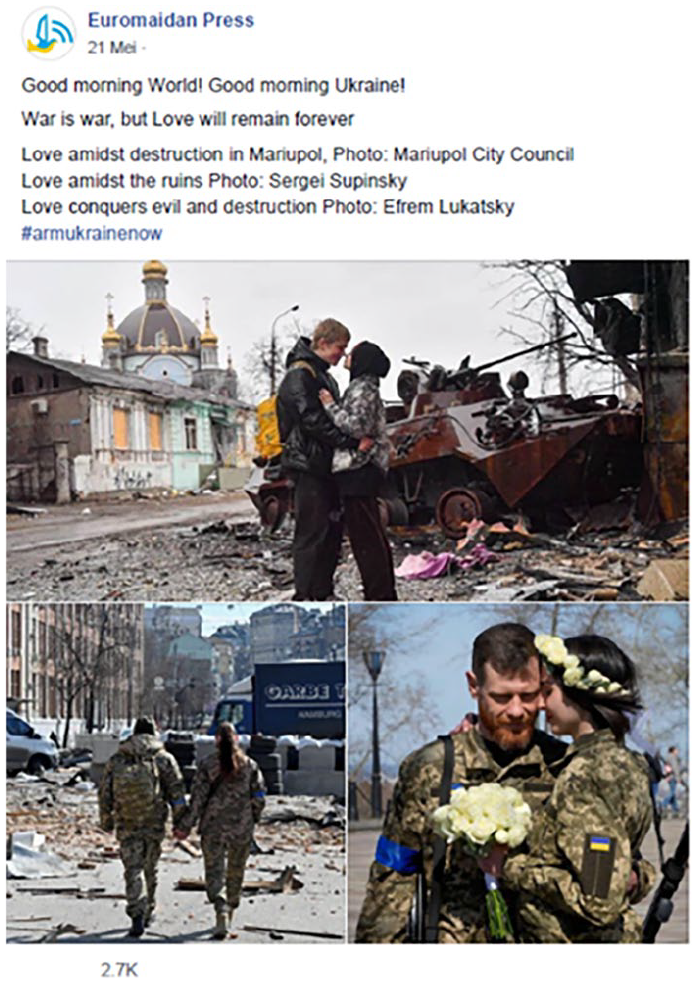
Screenshot From Euromaidan Press’ Facebook Page (2022).
Research on military couples has tended to focus on an American context, almost exclusively on non-dual military couples, and predominantly on heterosexual and non-minority White couples (Knobloch et al., 2023). It has foregrounded that mobilization, demobilization, trauma, stress, and other effects of duty affect the psychological well-being of the soldiers and their partners in challenging ways (Pflieger et al., 2018, 2021). Research on relationship maintenance has shown that partners in military couples who are separated physically for longer periods enhance understanding and strengthen intimacy and solidarity by sharing information about their thoughts, feelings, and experiences with their partner (Knobloch & Basinger, 2021; Knobloch et al., 2023). This research has also shown that military couples enact emotional, social, esteem, or informational support by developing coping strategies to manage stress and emotions together or on their own (Knobloch et al., 2023). The scarce and exclusively U.S.-centered research that exists on dual-military couples, in which both partners are servicemembers, focuses on how such couples sustain both work and family (Huffman et al., 2017), showing that double-military partners in the United States, who are rarely deployed together, face multiple stressors that create work–family conflicts, with females being hit the worst (Woodall et al., 2020). However, it has also revealed that “work-family boundaries are more flexible for dual-military couples than for dual-career couples, allowing for more work-family management” (Huffman, 2015, p. 14).
From this review of research on military couples, the experiences of dual-military couples forming and fighting the war together in Ukraine present an unresearched topic and an unusual sample from a different context with unique characteristics, such as being deployed in the same units and fighting a full-scale war together for months or years. Addressing this gap, this article explores the lived experiences of eight Ukrainian soldiers from four dual-military couples in the Russo-Ukrainian War. The article aims to understand how these soldiers were affected emotionally and as soldiers by having a relationship with another soldier on the frontline. This includes understanding how—out of which feelings and commitments—these relationships were formed in this context and how emotions and feelings of the relationship are interrelated with embodied experiences of the war and soldierly commitments, tasks, and social and organizational contexts.
Apart from contributing to research on military couples, by exploring the purposes and motives of being a soldier in a romantic relationship with another soldier in the same unit, the study adds knowledge to literature on human dimensions of warfare, “the cognitive, physical, social, and cultural components of combatants, leaders, and supporters” that explain why and how people fight and what motivates them to fight (Engen et al., 2020, p. 3). This research has shown that central features of combat performance, such as cohesion and morale, are shaped and affected in numerous ways by different “warrior cultures,” organizational features, and leadership styles, depending on cultural, historical, and social contexts (Engen et al., 2020). Dual-military couples in the same unit introduce a different element in the relational dynamics that shape and affect military morale, the knowledge of which is currently based on assumptions that no private relations or other entities—such as couples—are coexistent with the relations in the units, with morale mainly being a matter of the individual’s relation to the group, the leaders, and the organization (Kasemaa & Säälik, 2023; Kümmel, 2011; Reed et al., 2011). In addition, exploring how having a relationship at war affects Ukrainian soldiers, the study adds new knowledge to research in military psychology that foregrounds how having an existential purpose and feeling meaning and trust are protective factors against depression and loneliness, which has previously been researched from the viewpoint of unit cohesion and leadership (Trachik et al., 2021).
Moreover, while a growing scholarship in international relations and critical military studies argues that war increasingly needs to be researched from the “many ways in that people in different locations touch war and are touched by it in physical, emotional, and intellectual ways” (Sylvester, 2012, p. 3; Sylvester, 2013; see also Ahall & Gregory, 2015; Dyvik, 2016), including through experiences of love (Krystalli & Schulz, 2022; Pin-Fat, 2019) and joy (Pentinnen, 2013; Welland, 2018), contributions to this research agenda rarely includes empirical case studies. By researching the embodied and emotional experiences of soldiers in a dual-military couple in the war in Ukraine, the study adopts this agenda and adds new knowledge to this literature.
Furthermore, previous research that treats soldier love has mainly approached it as a notion or feeling that soldiers invoke to denote or explain cohesion and solidarity between soldiers (Baaz & Stern, 2013), to make sense of and motivate hardships in military contexts of constraints and private sacrifices (MacLeish, 2013), and as a notion that is invoked in ways that obscure inequalities and exploitation in the private security domain (Cisholm, 2023). Scarce research exists on embodied, soldierly experiences of love at war. However, John Glenn Gray’s (1998) autobiographical account of military–civilian relationships from his service in France with American troops during World War II conceptualizes wartime love as friendship, concern, and physical passion, with the latter being characterized by a “compulsiveness . . . that peacetime seldom knows” (Gray, 1998, p. 41). Through its empirical exploration, the study adds knowledge to this literature on embodied, soldierly experiences of love in relationships at war.
The study’s empirically grounded understanding of soldierly love and relationships as war experiences is also relevant for discussions in theoretical literature on love as an intense, transformative affect, relation, and act of will (Ahmed, 2014; Calcagno & Enns, 2015; hooks, 2001; May, 2015; Nancy, 2013). This literature has shown that love is not a passive condition but involves acts and does something to those affected by or enacting it, transforming the subjects in the relationship and constituting new entities and emotional places between those in love. This literature rarely defines love. However, bell hooks uses and develops the psychiatrist M. Scott Peck’s definition of love: the will to extend one’s self for the purpose of nurturing one’s own, or another’s spiritual growth . . . Love is an act of will—namely, both an intention and an action. Will also implies choice. We do not have to love. We choose to love. (hooks, 2001, p. 4)
3
She adds that when “we are loving, we openly and honestly express care, affection, responsibility, respect, commitment, and trust” (p. 14), allowing “us to confront . . . negative realities in a manner that is life-affirming and life-enhancing” (p. 139). Others have foregrounded how vulnerability, the prospect of death (May, 2015), and the attestation of the other’s uniqueness (Nancy, 2013) make love in a relationship intense. By providing an empirically grounded understanding of experiences of soldierly love and relationships at war, the article adds additional understanding to this literature of how acts, emotional places between partners, and intensity of love in a romantic relationship are shaped by war and soldierly tasks.
The article first develops the historical and political context of the war in Ukraine. Next, methodology and ethical considerations are presented and discussed. In the analysis, the article first explores the collective context in which the respondents enrolled in the armed forces and met. Thereafter, it explores how practices of affirming life and the relationship are intertwined with death, suffering, danger, fear, and increased caution, and thereafter, the shared everyday realities of the war and the relationship. Finally, it explores the experiences of having a relationship in the contexts of the army unit and the armed forces. The article ends by discussing the study’s findings and implications and by proposing avenues for additional research.
Historical and Political Context
To better understand the emotions and commitments that led civilians, in seven out of eight cases in this study, to join the AFU and meet and how Ukrainian history relates to the participants’ experiences in this study, this section briefly describes the historical and political developments in Ukraine from 2004 to 2014 and the war from 2014 to 2022.
Ukrainian history has, in many periods, been shaped by external powers, in the last three centuries mainly by Russia (Plokhy, 2021). In the 1930s, the Soviets attempted to erase Ukrainian-ness and undermine local resistance through both the man-made famine-genocide in 1930–1933, which according to historian Paul Magocsi killed 4.8 million Ukrainians (Magocsi, 2002, p. 563), and the ensuing purges of the Ukrainian intelligentsia (pp. 568–570). Since independence in 1991, Ukraine has formally declared European integration as its foreign policy priority while de facto balancing its interests between the EU/NATO and Russia (Hedenskog, 2016). However, through the Orange Revolution in 2004 and the Dignity Revolution in 2013–2014, the Ukrainian people demanded European integration, initiating a process of decolonization from the Soviet past and Russian influence (Horbyk, 2024; Riabchuk, 2016).
The Orange Revolution protested Russian influence over Ukraine, leading, despite weak democratization outcomes, to a more vibrant civil society and media climate and to a new constitution that balanced power distribution between the president and the parliament (Dutsyk & Dyczok, 2021; Hedenskog, 2016, pp. 6–7). Another outcome was Ukraine’s signing of the EU-Ukraine Eastern Partnership in 2009. However, after Moscow-supported candidate Yanukovych became president in 2010, Ukraine became more authoritarian. When Yanukovych put the foreseen agreement negotiations with the EU on hold on November 21, 2013, favoring closer ties with Russia, the Euromaidan protests, later called Dignity Revolution, formed on Maidan Square in Kyiv (Marples & Mills, 2015; Wilson, 2014). The Euromaidan has been described as a movement of ordinary people: students, pensioners, entrepreneurs, workers, and civil servants, who occupied and barricaded the Maidan Square and official buildings, protesting corruption, oligarch influence over politics, abuse of power, and violations of human rights (Onuch, 2015; Wilson, 2014). According to Jakob Hedenskog (2016, pp. 8–9), the Euromaidan was about dignity, people’s reluctance to let themselves be ruled by Yanukovych, the oligarchs, or Russia, and about taking control of their lives and the development of the country. Others have foregrounded the centrality of claims that Ukraine was part of Europe as a set of values and institutions (Horbyk, 2017). For weeks, between 400,000 and 800,000 people gathered during weekends, escalating into a contestation between the protesters and the police. When around 100 protesters were killed by snipers between February 18 and 20, 2014, protester pressured the special police Berkut to abandon the government quarters, forcing Yanukovych to make concessions to the protesters (Wilson, 2014), after which he fled to Russia (Oldberg, 2020, p. 6).
Seizing the opportunity in the wake of the protests, Russia annexed Crimea and administrative buildings in Luhansk and Donetsk in Eastern Ukraine. In the spring of 2014, Russia tried to spread destabilization attempts to Mariupol and Odesa and held “referendums” in the occupied areas of Luhansk and Donetsk (Oldberg, 2020). Soon, Ukrainian forces were involved in a war against Russian-led separatists and regular Russian forces. In 2014 and early 2015, Ukraine lost the battles of Ilovaisk, Donetsk Airport, and Debaltseve, leading to losses of several hundred Ukrainian soldiers as retreating Ukrainian soldiers were shelled by Russian armed forces and separatists despite agreed-upon ceasefires (Käihkö, 2021). Out of the public’s shock from these events, a strong volunteer engagement grew in Ukraine to support and join the AFU. The engagement was fueled by discontent with how the political elites treated lost battles and casualties (Oldberg, 2020). Until 2021, the war developed into a contact line in eastern Ukraine, mainly constituted by artillery duels, Special Forces operations, and trench warfare. In these years, through volunteer engagement and campaigns, Ukraine expanded its armed forces from approximately 121,500 in 2013 to 311,000 in 2019 (World Bank, 2024), with additional servicemembers after the full-scale invasion in February 2022. Since 2014, more women have joined the armed forces, with 22.8% of personnel in the armed forces being women in 2021, often in supporting roles, and 15.5% of all “service-personnel” (in combat roles) being women in 2021 (Rusnak, 2021; Women in the Ukrainian Military, 2024).
This contextualization of the study shows that the Ukrainian state and its population have faced many challenging events in the past two decades, but also historically, affecting people fundamentally, leading to hardships, solidarity, and commitments to defend the country. The historical overview serves as a contextualization for descriptions by the respondents that relate to this history.
Method
Addressing a topic that has not previously been addressed, for which there is a lack of pre-existing knowledge or paradigm to research it, the article is based on an exploratory research design (Stebbins, 2001). To collect data, I used an interview guide to conduct semi-structured interviews online with eight soldiers from, in total, four couples. The data exploration was guided by the historical and political contextualization of the study and the literature reviews that helped frame the topic (Stebbins, 2001, p. 19).
The interview guide consisted of open-ended questions and follow-up questions to expand the answers, providing a wide selection of soldiers’ experiences of having a romantic couple relationship on the frontline. The questions centered on how the respondents decided to become soldiers, how they met their partners, their feelings from being together on the frontline, and their experiences of having a relationship and fighting the war together. The data capture these experiences in the specific historical and political context of Ukraine, the soldiers’ feelings of affection for another soldier while at war, and the relations between these feelings and experiences and their soldierly tasks and social relations.
Due to the difficulty in finding respondents for this study, the sample is relatively low. Participation was voluntary, and the respondents were interviewed individually. Snowball sampling was used to find respondents through the networks of other respondents. The sample consists of Ukrainian soldiers who, since 2014, have had a contract with the AFU and have experienced being together on the frontline for at least 1 month with their partner. Five out of eight respondents were on the frontline when interviewed. The selected couples reflect a variety in sex and gender, military experience, unit type, time spent at war, age, sexual orientation, and how they met and joined the armed forces. The sample differs from average samples in existing research on military couples (Knobloch et al., 2023), with 37.5% of the interviewees being women, one respondent (12.5%) identifying as transgender, and one relationship of two individuals with non-binary gender identities. 4 Three couples met on the frontline, whereas one joined the armed forces and was deployed together. This couple, which met in the aftermath of activism during the Euromaidan, has been included to include the experience of joining the armed forces and the war together and to increase representativity in experience, unit type, and gender diversity.
Before the interviews, the project was subject to an ethical review at the Swedish Ethical Review Agency and accepted by it. In the analysis below, the respondents have obtained made-up names and details that could enable identification of one person, such as place or time, have been omitted or modified (Saunders et al., 2015). Information about consent was presented in writing when the potential interviewees were contacted and again orally at the start of the interviews. The participants were informed in writing beforehand about the purpose of the study, how the study was to be conducted, risks and benefits of participation, handling of data, how to find out results, and about me and the interpreter if the interviews were in Ukrainian. This information was repeated orally before the start of the interview. Consent was obtained from all participants orally at the beginning of each interview. Five interviews were conducted in Ukrainian and translated into English using an interpreter, and three were conducted in English by the author. The interviews were conducted online through considered safe applications and recorded between February and March 2023, after which the author transcribed them and printed them out in full.
The data were coded using the Grounded Theory method. The author coded the data twice, following a stepwise, iterative process from the raw data to a theoretical narrative in line with the Grounded Theory method (Auerbach & Silverstein, 2003; Glaser, 1998). The coding aimed to generate descriptions of patterns in the data based on which transferable theoretical constructs were created, which could be starting points for additional studies on similar experiences (Auerbach & Silverstein, 2003; Stebbins, 2001). First, relevant text was identified in the material, after which repeating patterns of thought, emotions, or behavior related to the research concerns were identified, from which themes were created to organize these patterns. Next, four theoretical constructs were created inductively based on the themes and patterns found in the material. In practice, however, I moved back and forth between these steps, revising my theoretical constructs and altering my initial understanding of how specific experiences related to one another and the research concerns. Finally, I wrote a theoretical narrative that wove patterns, themes, and theoretical constructs, highlighting implicit patterns with quotations from the respondents (Auerbach & Silverstein, 2003, pp. 35–40). The use of the Grounded Theory method allowed me to understand the contexts in which these respondents met and decided to defend Ukraine together, how these soldiers were affected emotionally as soldiers by having a relationship with another soldier on the frontline, and how the relationships were interrelated with embodied experiences of the war and soldierly tasks and relations.
Based on a small sample of interviews from a specific context and using an explorative approach, the study does not allow for any generalizations. However, despite this limitation, exploring this unaddressed topic is essential to generate a first phase of research on these specific experiences, which could serve as a starting point for future research. The study is essential to further our understanding of what it implies for these soldiers in Ukraine to form and have a relationship on the frontline, how these relationships emerged in this context, and how these experiences are affected by soldierly tasks and social relations.
Collective Commitments
Recurrently, the respondents described their experiences of having a relationship on the frontline as continuations of collective commitments before and during the war. One identified theme was that Ukrainian struggles for independence and survival have made people meet and commit to one another. Several respondents became soldiers as a prolongation of their activism during the Orange Revolution and the Revolution of Dignity. When the war broke out, they became volunteers who supported troops or families close to the front, later volunteering as soldiers, in one case despite having disliked weapons and the military and with no previous thought of becoming a soldier (Tetiana). Only one respondent had planned, since youth, to become a soldier. Echoing Gray’s notion of love during wartime as “concern,” the “impersonal passion for protecting and conserving life itself” (Gray, 1998, p. 49), but also the “special affection, feeling, or emotive response” (p. 52) of nationalist attachments, several respondents described their youths as devoted to Ukraine, with the logical consequence of becoming a soldier after Russia’s attack in 2014. Only Valerii and Yevhen were trained in 2014. Yevhen described how he, being trained, volunteered to spare the lives of volunteers with little training or experience and as a desire to contribute to Ukraine.
Another theme was that having committed as volunteers and been activists made these then-civilian respondents meet and be affected by people and families touched by the war, often amounting to difficult emotions, acts of solidarity, and a desire to extend their engagements for Ukraine. Yaroslava described her gradual engagement as born out of the frustrations with the war and the poor military preparations in 2014: I used to be a clothes designer, and I had a workshop. When things started happening in 2014, I couldn’t just stay aside and observe it, I wanted to intervene and do something about it. I wanted to contribute and started as a volunteer, eventually in the armed forces.
Other respondents described their decisions to become soldiers as born out of the shocks and traumas they experienced as volunteers. Alina became a servicemember in the aftermath of the death of her serving boyfriend. She was outraged at the political indifference to the deaths of young men on the front and the lax political attitude toward Russia despite several years of war. These descriptions illustrate the collective, emotional, and historical context for these respondents’ becoming soldiers, meeting, and forming relationships.
The respondents also emphasized the experience of meeting and being together on the front as an extension of solidaristic collective commitments among people at large in and for Ukraine. Several respondents described how, in contrast to 2014 and 2015, when people in the East were suspicious of or even hated Ukrainian soldiers, the full-scale invasion has improved the emotional ties between the population and the armed forces and increased solidarity considerably. Alina described how, after the invasion, there had been a decrease in the distance between civil Ukrainians and the armed forces and an intensification of commitments to one another. Echoing Gray’s (1998) notion of love as friendship between soldiers during wartime (see also Baaz & Stern, 2013), Myron emphasized that many civilians are now grateful and supporting the troops, describing how “friendship and solidarity have become stronger in our population,” pointing out that “civilians and soldiers are really like one team together . . . People . . . now . . . ask about how we are doing and if we need something and so on, and that really helps.”
Echoing May’s (2015) understanding that death makes love intense, Tetiana described how, with the intensification of commitments through the war and the prospect of death, one “wants to experience something authentic,” increasing a determination to either be together in a relationship or to break up. For others (Alina; Myron), the war has made them want a patriotic partner or made their relationship more patriotic, with the Ukrainian language being essential in the relationship, reflecting how the relationship, in this context, becomes intertwined with the “special affection, feeling, or emotive response” of a “love of a country” (Gray, 1998, p. 52).
Two respondents also described the experience of meeting or being together on the front and committing as an experience connected to an existential struggle that they shared with those killed in the war and those killed historically by Russians, a struggle that their children may have to take over. Alina described how knowledge of the destiny of those killed historically by Russian purges almost a hundred years apart empowered them to fight. Resonating with the Ukrainian determination to decolonize themselves (Horbyk, 2024), she explained how knowing about the historical Ukrainian sacrifices made them more aware of the longevity of this war and the need to fight it until they have won. Similarly, Daryna described the collective realization of the war’s longevity as “our new reality . . . our permanent reality that will not change anytime soon . . . [that] might continue indefinitely.”
In some accounts, these existential and historical understandings of the collective commitments of the war were related to the aspirations and hopes of the couple and its family, with several respondents describing how the fight for the country, family, and houses is related to emotions and acts of love. Desiring a shared future, both with the partner and families and often with a larger collective, was recurrently expressed as part of the experiences of having a relationship on the front, even if planning was complicated. Oleh and Valerii described how the affection for families and the home is connected to the war, making it necessary to defend the country. Oleh explained this relationship as: The fight for Ukraine is to live in my house safely and freely, to stay in my country in peace. Unless we fight, we will all lose our houses and homes. I would not have a place in this country if we were defeated. Love relates to our fight for Ukraine because it makes it possible for our families to live in their homes; in this way, it is connected.
Valerii expressed this connection with fury: Ukraine is my country, my native land where I was born, where I went to preschool and school, where my kids were born, and where I created my family. This is the country I love, and I deeply associate with it. It might perhaps be insignificant for some, but for me, it is the best country in the world: here, the grass is greener, the sun is brighter, the air is sweeter, and I will fight for it until my last breath, to defend it, to defend my family, to drive these bastards away from here. We didn’t invite them; they broke into our home; we will see to it that they leave, and if they don’t want to leave, we will force them out.
In these accounts, Gray’s (1998) notion of a “love of a country” dovetails with love for the family and the home, in Valerii’s quote, connected to hatred of the enemy. In the quote, the threat to the homes and families is also a threat to shared happiness, which, with Cisholm (2023), is a particularly future-oriented emotion, making defending the country even more committed.
The Affirmation of Life and Love at War
The respondents recurrently described the lived experiences of having a relationship on the frontline as embodied experiences of danger, fear of loss, and increased caution intertwined with moments for affirming life and love. As indicated above, several respondents became soldiers in reaction to a feeling of powerlessness of experiencing the death and suffering of Ukrainian citizens or loved ones in the war. The bodily experiences of loss and of frustration and becoming a servicemember to survive pain and injustice stood out in their stories. Alina described how the trauma when her servicemember boyfriend was killed in the war made her understand that “to survive,” she also had to become a servicemember and “take his way.” Tetiana described how she supported families as a volunteer in the search for the bodies of soldiers killed in action, which eventually became unbearable. After Ukraine’s defeat in Debaltseve, she felt it was not enough to be a volunteer: I realized that no matter how much stuff I brought to the front, I could not bring these guys back; it didn’t feel like enough, so I decided to do this. In a way, I ran away from those phone calls from relatives looking for their kids and dear ones . . . I could have chosen the military occupation of a nurse or a cook, but I chose to be a sniper because it did not feel enough to cook or take care of the wounded, I wanted to destroy the enemy actively . . . I wanted to be feared.
Apart from reactions to traumas, injustices, and frustrations of experiencing the death of loved ones and fellow citizens, the quote reflects how becoming a servicemember was also a commitment to fight the enemy. This reflects how death and danger to what one holds dear not only, as May (2015) points out, makes love intense but also, as an act of survival, spurs a decisiveness to defend what one holds dear and values.
However, while the respondents described these decisions and commitments, two respondents explained that they were hesitant to engage in a relationship on the front. For Oleh, this hesitance was born out of his experience of the death of a unit member who was in a relationship with another soldier: [He] got a bullet in his head from a sniper . . . I evacuated his body from the battlefield and witnessed how [his girlfriend] hugged him when he was dying. It was very hard; it was a hard feeling; it is a hard memory for me. Back then, when I was single, I thought having a relationship with a soldier was a bad idea.
In several accounts, experiences of other soldier relationships on the frontline and stories of them circulating, both sad and happy, appeared intriguing, emotionally, when the couple or one of the partners were killed, and inspiring when they are still alive (Oleh; Valerii; Yaroslava). Oleh’s reluctance to engage in a relationship after experiencing the death of unit members reflects Gray’s (1998) observation that love between soldier friends is “terribly hard” because both “have so much to lose” (p. 52). However, despite his reluctance, Oleh later engaged in his current relationship.
In contrast, Tetiana described her reluctance to engage in a relationship because she feared it would interfere with the soldierly tasks. However, when she, having already met her future partner in the same unit, experienced how a close soldier friend of hers was killed by artillery that hit a car in which she was also supposed to be on that day, she gave in: “Somehow all these mental blocks about relationships or love ruining discipline or making people do stupid things and so on . . . became very distant and irrelevant, and I only was in love, and I wanted to be in love.” In this case, once the harrowing experience broke the reluctance to engage in a relationship, there was a strong desire to engage in it. What hooks (2001) calls the “choice” or “action” of love in this extreme situation appears as an act of survival related to vulnerability and to the need for affection and care. Echoing Krystalli and Schulz (2022), love and care here shine forth as not only essential for “remaking worlds in the wake of conflicts” (p. 3) but also as ways of surviving and affirming life and shared affection at war.
This relation between vulnerability, love, and the decision to become a soldier is also reflected in Alina’s account of how she, having experienced how her boyfriend was killed on the frontline in the aftermath of the old boyfriend’s death, met and decided to be together with her current soldier husband, who had supported her in her grief. Apart from her personal decision to become a servicemember, this was also a decision to be able to join him on the frontline. For Alina, the initial separation from her husband was difficult due to fear of loss: I was afraid . . . for these two years when we were in different units, that he would be killed, I was afraid that his commander would call me one day and say, “I’m sorry, your husband just died,” and I was dreaming that we were serving together, that we were fighting together, that we were together in this war.
Like Tetiana’s harrowing experience, Alina’s traumatic loss of her former partner shines forth as creating an increased desire to be together with and not physically separated from the new partner.
Despite wanting to be together on the frontline, however, once they were together, based on experiencing a constant worry and fear of loss, most respondents described the experiences of being together on the front as “very hard,” “scary,” “terrifying,” or a “nightmare.” All respondents nevertheless agreed that they still preferred being together to being deployed and separated because they would otherwise not know what is happening to the other, worry and become demoralized. For Yaroslava, being apart from her partner was no option after all they had gone through together. Valerii pointed out that despite the stress from fear of loss, once one is back at the base, it is “really great and important to have someone you love by your side.” Tetiana, however, described how sometimes the worry for one’s partner is close to unbearable: once, we had to install a camera on a tree only 150 meters away from the enemy positions. The tree was entirely bare, without leaves, and he [her husband] had to climb that tree. And he did that while I, as a sniper, had to cover him. But when he was doing that, I realized that I couldn’t really look at him because it was too scary; I was stoned with fear that he would get killed—which was a very realistic prospect. So, I asked another guy from our unit to look at him while I was covering against the enemy positions. But I realized that it was too intense to do good work. But my husband did it—he pulled it off!—it was unbearable, I couldn’t watch him. The whole time, bullets were whistling around us, with the man looking at him and telling me repeatedly that the bullets were not directed at my husband but in other directions.
Reflecting May’s contention that mortality or the prospect of loss is a “gift” to love (May, 2015), several respondents described how such experiences, and when other unit members were killed, led to the realization that both can die at any moment, making them express affection for one another, catalyzing an affirmation of the relationship and their love choices.
Apart from worrying about their partner, two respondents described how, once in a relationship, they became more prudent and less risk-taking than when they were single (Oleh; Valerii). Valerii explained, “I used to be a dare-devil maverick. Now, I am more motivated to take good care of myself and see to it that I survive in this war, making me more cautious.” Oleh described, I would take stupid risks . . . I was indifferent as to whether I would live or not. With our relationship, I want to live and make plans. Before that, as a soldier, I didn’t have that, and I made no plans.
As much as sharing deep affection with someone in a relationship may create a dependence that can be frightening and ambiguous (Ahmed, 2014), as illustrated above, the shared vulnerability of being dependent here shines forth as also making one care more for oneself, endowing one with an existential purpose and a desire to survive.
A theme in accounts by Yehven, who had long been at war, and described by Tetiana on when she met her husband, was an intensity of affection for their future partners and desire to have a relationship. This intensity was reflected in their behavior the first time they met after having been in contact online. Tetiana described how her husband lifted her, exclaiming, “she will be mine!” with joy at their first encounter, and Yevhen described how he was euphoric the first time he met his future wife: “When I arrived, I was stunned, and I just kissed her immediately, thinking will she hit me or not. She did not hit me, so that’s how we met and stayed together.” He also described the intense desire to see his wife made him walk several kilometers in the mud under artillery fire to see her for 15 min, after which he needed to return the same way, and how he once dug out his car from mud for 2 days to be able to go see her despite being lightly wounded. These acts, which could be described as “follies” related to the intense desire to see or be with someone, were described by Tetiana and Yaroslava with fear. For Tetiana, the fear of such “stupid chivalry” was one reason she was initially reluctant to have a relationship on the frontline. Yaroslava also described an example of how she, as her husband returned to her from combat nearby when there was a pause in tank fire, immediately drove him to the nearest barber shop a hundred kilometers away to treat him, making him look good as he later returned to combat. These follies reflect Gray’s claim that during wartime love has a “compulsiveness about it that peacetime seldom knows” (Gray, 1998, p. 41), being affirmed in a present in which one does not know if one or one’s partner will live the next hours or days. They also reflect what Nancy (Nancy 2013) would term the folie of love: the attestation of the uniqueness of the other, which in this context shines forth as tied to an affirmation of life itself. 5
The intensity of these acts is also reflected in descriptions by Yevhen and Valerii of how they cared and sacrificed a lot on the frontline for the relationships and the female partner: “You care about her and want to keep her alive . . . it’s caring, caring all the time. You make sure that she has eaten, is not cold, and is out of harm’s way” (Valerii). Here, love and having a romantic couple relationship, appear, with hooks, as an “act of will . . . both an intention and an action” that, in the gendered Ukrainian context and on the dangerous frontline, is laborious for these men. The desire to please and keep the partner safe in a context of zero comfort and lethal risks illustrates the ambiguous feelings of wanting to be with the partner and enjoy the relationship while simultaneously being stressed by the challenges of having a relationship in such a context.
Finally, the respondents also described how having a romantic relationship on the frontline became a way of living or affirming life and meaning at war, giving one an existential purpose and a desire to live and survive. Alina described how “love is a way and experience in which you survive together” adding that being together has been the only thing that makes me happy because everything, the rest that we survived in this war, terrible things . . . our love may be the only thing that did not make us lose the desire to live and to survive.
In these accounts, echoing results from research in military psychology on the protectiveness of soldiers having a purpose and experiencing meaningfulness (Trachik et al., 2021), the existential purpose of being in a romantic relationship and sharing the challenging war experiences appears protective, creating a desire to live and survive. Reflecting how love, according to Calagno and Enns (2015, p. 1), can become a “motivator” that pushes those in love, Daryna described how she and her partner’s joint decision to become soldiers would have been less likely if they were single. Yevhen described how, in a very difficult combat situation, the desire to see his loved one made him promise to return alive and how such feelings “in critical moments . . . can give you will and strength to keep fighting,” adding that “love in war is meaningful.” Valerii also described how the relations to their families, “our wives, girlfriends and beloved—those we defend, those we are fighting for,” were vital sources of inspiration, making it imperative to take all occasions to meet and to maintain digital communication. The “act of will” of love (hooks, 2001) and the purpose for fighting here appear as acts that, with Yevhen, “give you will and strength to keep fighting.” Resonating with Kenneth MacLeish’s (2013) account of how soldiers’ invocations of love and sacrifices for loved ones constitute a “sovereignty” in a context of constraints and literature on morale (Reed et al., 2011), the relations with the loved ones here appear as crucial to inspire and support the soldiers to keep fighting, while making them feel human or having a purpose in their sacrifices.
The Soldiers’ Shared Everyday Realities of War and the Relationship
The respondents also described their embodied experiences as a coexistence of the everyday reality of war with the reality of the couple’s relationship in the shared place of the relationship. This emotional “dwelling place” (Ahmed, 2014) created conditions for the relationship to strengthen, for example, through everyday tasks and being there for one another. Oleh joked that the war had become “an opportunity to be together with my wife [laughter].” The couple that signed up together in the same unit described how the new routines of building trenches and fortifications made them closer in some ways, but also less romantic, “because at war you see things that you never see in normal, peaceful times” (Myron). The respondents described how sharing the everyday of war and its soldierly tasks became a shared place for couple experiences and something from which couples were formed. One couple was formed out of the experience of working together as a sniper pair, and another couple met when one of them was recruiting people for a new unit.
The soldiers’ relationships at war were also described as a place for feelings and desires where war became part of the relationship. Tetiana and Yevhen described how war attracts and pulls you back in, making it “a great temptation to go back to the frontline” (Tetiana). Yevhen, who was decommissioned for a period, explained: For a while, I wasn’t at war. I went back home and tried to live a civilian life for some time, but it wasn’t working. I was attracted to war like something was dragging me to war. I watched the news and saw how we were suffering heavy losses. I got news of comrades who had gotten killed and felt I was just wasting my time. So, I wanted to join the Army again, but I couldn’t because of my injury. (Yevhen)
However, Yaroslava emphasized this experience as less destructive for the relationship when you are in a dual-military relationship: Because civilians don’t understand us. I understand it, I can understand them. Being in a relationship with a soldier is extremely difficult; it’s not a fairy tale; they can be hysterical, they can be aggressive, there are all sorts of challenges, all sorts of things. You need to be extremely patient, forgiving, and loving.
Yevhen also described the shared reality of the war and the relationship as a shared household experience when returning home on leave after several days of intense combat: So, when I came, the first thing I did was kiss her. Then I started cleaning my gun, and she started cleaning the cartridges. Because I had been in the mud, the gun had gotten dirty, and the cartridges had gotten dirty, so she was helping me to clean it. So that’s the kind of ideal, the kind of romance we have.
In contrast, Valerii tried to separate the role of the partner and that of the soldier but conceded that “war is war, love is love, and feelings are feelings,” implying that these still coexist.
Moreover, reflecting research on dyadic coping in military couples (see Knobloch et al., 2023, for an overview), Alina explained how sharing war experiences and being in a relationship at war also made it easier to overcome trauma: [after difficult combat experiences] our relationship became even stronger . . . they let us rest for nine days in Kyiv . . . During that vacation, I understood that nothing had changed; we were together, we understood each other, and we could talk easily about hard experiences because we witnessed that; for me, it’s no different if we were in the café in Kyiv or on the battlefield. Of course, we had this traumatic experience, and sometimes it causes depression, but together, it is much easier to leave it behind.
One recurrent theme of the coexistence of the everyday realities of the war and the relationships as shared spaces was weddings or celebrations of the relationship, which both have legal implications and constitute practices of and for the couple while serving. These practices appeared as both helping frame the soldiers as married soldiers in a couple and constitute the everyday of war as a time and space for relationships and emotions. In one case, marrying was also a way to be allowed to serve in the same unit. In addition, marrying, celebrating the wedding or relationship, or wedding anniversaries appeared as ways for the respondents to shape the everyday of war and the reality of the front, with its unstructured, abstract time, through the couple’s temporality, structured both by small everyday acts of affection and care and by symbolic acts of marrying or anniversaries. In the respondents’ narratives, these acts introduce moments of joy, shaping this everyday and time to make it less despairing. For example, Yaroslava described her wedding on the front as “the best day in my life.” One couple had married several times, both confessional and civil.
Echoing hooks’ (2001) understanding of love as an act of will and a choice, these acts appeared to introduce spaces for celebration and to re-frame the everyday of war, enabling people around them to get together in a context where life could end anytime. Yaroslava explained that a church wedding was vital for her husband because it constituted a commitment to be together in the afterlife. Here, willing one another (hooks, 2001) becomes a bet or a faith extending beyond life itself, imposing the couple’s commitment, temporality, and shared space as an existential counterweight to ever-present risk and uncertainty. Yevhen, who first wedded civilly and later, when a chaplain came to the frontline, had a church wedding, described these ceremonies in a way that captures how they coexisted with and, to some extent, re-framed the reality of war: Our later weddings were beautiful, particularly the church wedding at the frontline—the most beautiful in the Army—and the locals greatly helped us. Our commanders helped us make this feast and even constructed an arch we could use as a decoration. And instead of . . . holding crowns over our heads, our commanders held military helmets above our heads, and there were flowers and balloons. I had just come from the barbershop, and she had nice makeup on, so we looked outstanding. We even got 36 hours of vacation after that . . . (Yevhen)
Valerii described marrying in his hometown when they got a small leave since their relatives would otherwise be unable to participate in the wedding. The non-binary couple, who is not allowed to marry yet, described how they celebrated the anniversary of their relationship by dancing in a bomb shelter.
Yevhen also described how sharing the everyday of war and the relationship also meant sharing romantic moments of attending to the beauty of moments and surroundings. Yevhen illustrated this by describing how he and his wife, on leave, found themselves in a particular atmosphere: “The scenery was extremely beautiful. It was breathtaking; something was burning, there was smoke, it was war, and there was this beautiful nature, and I was kneeling in front of her with flowers. It was beautiful.” He also described an episode of camping together briefly between deployments. Sharing the folie (Nancy, 2013) of love, of attesting to the uniqueness of each other in the everyday of war here shines forth as introducing romantic moments and atmospheres in which the couple attended to beauty and the surroundings together in small gaps of time when danger was not dominant.
Finally, illustrating the webs of affection and care that Gray (1998, p. 49) conceptualized as “love as a concern,” several respondents described experiences of having adopted or been adopted by abandoned pets who lived with them, creating a presence of multiple relations of care and affection in the everyday reality and spaces of war.
Handling Multiple Relationships, Roles, and Tasks
The respondents also described how having a relationship on the frontline implied handling multiple relationships, roles, and tasks. Worry about private relationships appeared to affect the respondents’ soldierly duties in complex ways. Routines and daily tasks on the frontline, knowing why one fights, and sharing this purpose in the relationship was something that several respondents brought up made them worry less for one another despite fear of loss: You are constantly in fear that you will be witnessing his death . . . But . . . we are soldiers; we should do our job; we should defend our country because we have no choice, and we do our best . . . we have done that, and we have never asked to be sent back to a safer place, all the time we have been with our company and platoon and done our job with them. (Alina)
Being in a relationship, Alina explained, makes you avoid taking unnecessary risks, however, without refraining from following orders: “We understand and perceive this moment that any one of us could be killed in any moment, but still, we do what we must.” Reflecting how discipline makes soldiers more resilient (Reed et al., 2021), Myron, who was less experienced, described how the new reality of being soldiers at war had turned him and his partner into a “function,” with routines and knowing the purpose for what one does, making them less worried or focused on emotions: “there is only drive, something is turned on and drives you further and further.” However, Tetiana and Valerii described how working became harder because worry for one’s partner was added to the stress of soldierly tasks.
Another theme related to handling multiple relationships, roles, and tasks that the respondents brought up was their social relationships with the unit, its commander, and the armed forces. Three out of four couples described their unit as characterized by positive attitudes toward the couple and with caring relations, a “family” (several respondents), or “a brotherhood tempered by fire and steel” (Valerii). For Teitana, this soldierly affection or love of soldierly friendship in wartime (Gray, 1998) extended to a vision of how her home after the war could become a place to “transmit some of that frontline family feeling and . . . brotherhood into civilian life and inspire others to set an example.” Many respondents described how the other unit members were mainly indifferent to the couples, caring more about themselves. However, Yaroslava described how unit members, after having initially been favorable to her and her husband’s relationship, envied and tried to separate them because her husband, the unit commander, having been injured, decided to resign and leave the unit: “[They were] really unhappy about it . . . they tried to separate us, to part us in all possible ways, I think something got broken . . . previously [they] were supporting us, but now they envy us.” Reflecting the ambiguity of affection and trust (Ahmed, 2014), in this case, the male soldiers in the unit, who probably felt affection and trust for their commander, appear to have felt betrayed.
The social relationships on the front and having a relationship in this context were also described by Oleh and Daryna as affected by the “big rotation” of soldiers, which makes soldiers into “a number” (Oleh) and “precludes deeper relations between soldiers” (Daryna). Yevhen and Oleh, who had been long in the war, described how relations of trust between soldiers had gradually deteriorated, compared with “the patriots who were in the Euromaidan [who] are not around any longer, sadly” (Yevhen). Oleh described the frontline as a place of low trust characterized by feeling reduced to “statistics” and “dehumanized,” in contrast to the couple’s relationship, with its trust, care, and emotional support. Echoing MacLeish’s (2013) notion of how soldiers experiencing constraints invoke love as a form of “sovereignty,” the couple’s shared, emotional “dwelling place” (Ahmed, 2014) here appears as a protective place against the dehumanizing aspects of the “big rotation.” Resonating with Gray’s observation that love as friendship at war makes dying “terribly hard” (Gray, 1998, p. 52), Oleh, however, also emphasized that another reason for a lack of close relationships is that people try not to have many good friends because it is too painful to lose them.
Finally, in two cases, the respondents described how individual decisions and exceptions by commanders because they perceived the full-scale invasion as a state of exception enabled the couples to serve in the same unit (if they did not meet in the unit).
Discussion and Conclusion
In this article, I have explored eight Ukrainian soldiers’ experiences of having a relationship with another soldier in the Russo-Ukrainian War, aiming to generate a deeper understanding of these soldiers’ lived experiences of having a romantic relationship with another soldier on the frontline. This included understanding how—out of which feelings and commitments—these relationships were formed in this context and how emotions and feelings of the relationship were interrelated with being soldiers at war. Adding to scholarship on embodied experiences of war, military couples, human dimensions of warfare, scholarship on soldierly love, and theoretical scholarship on love, the study provides important new data on the embodied experiences of being in a dual-military relationship and serving in the Ukrainian context.
The results were visualized through four theoretical constructs. First, these experiences were articulated as emerging from collective commitments, both before and during the war. Several respondents described their youths as devoted to Ukraine and becoming volunteers, often out of shocks and traumas of meeting families affected by the war or from killed loved ones. The findings revealed that these commitments were both immediate, as acts of solidarity in the context of increased shared commitments of fellow citizens and born out of nationalist feelings and an historical awareness of Ukrainian sacrifices and the need to decolonize themselves (Horbyk, 2024). The findings showed that through these collective commitments, affection for the nation, the family, the home, and the couple often became intertwined in ways that blurred the borders of Gray’s (1998) divisions of love in wartime as concern, friendship, passion, and of a country.
Second, the respondents’ lived experiences of having a romantic couple relationship on the frontline were also visualized as experiences of death, suffering, danger, fear, and increased caution intertwined with practices of affirming life, love, and the relationship. The findings revealed that several respondents volunteered as soldiers and wanted to fight, both to survive trauma and feelings of helplessness, but also from a decisiveness to defend what they held dear and to stop the enemy. At the same time, reflecting Gray’s (1998) observation that love in wartime makes dying “terribly hard” because one has “so much to lose” (p. 52), the findings showed that some were at first hesitant to engage in a relationship with another soldier due to fear of loss, but also because they feared it would affect soldierly tasks. Moreover, the findings showed that despite this reluctance, they formed couples, in some cases, after harrowing experiences and the emotional support of overcoming them with one’s future partner. Willing love (hooks, 2001) here shone forth as not only essential for “remaking worlds in the wake of conflict” (Krystalli & Schulz, 2022, p. 3) but also to survive and live by affirming life and affection at war. In addition, the findings showed that all respondents preferred being together from separated physically despite fears that they might witness their partner’s death because worry from separation and not knowing what is happening to the other was considered worse.
It was also revealed that experiences of death of other unit members increased the awareness that it might happen to them. In line with May’s (2015) observation that the prospect of death or finitude makes love intense, these experiences catalyzed affirmations of the relationship and the love choices. Also, the findings showed that once the respondents were in a relationship, they became more prudent, endowed with an existential purpose, and more caring for themselves. Illustrating Gray’s claim that love in wartime has a “compulsiveness that peacetime seldom knows” (Gray, 1998, p. 41), other findings displayed respondents’ intense desire to engage in a relationship illustrated by romantic follies. The intensity of these acts reflected how, in this war context, the folie of love (Nancy, 2013), of attesting to the uniqueness of the other, could be viewed as intertwined with an affirmation of life, of the here and now and the relationship. Adding to research in military psychology (Trachik et al., 2021), the findings from this section also revealed that this affirmation of life and the relationship endowed the respondents with an existential purpose that appeared protective, creating a desire not only to survive and keep fighting but also to live.
Third, the findings revealed that the respondents’ experiences of having a relationship with another soldier on the frontline were experiences of shared everyday realities of the war and the relationship. The relationship appeared as a shared place both of war, with its difficult and mundane experiences, and of the relationship with its everyday acts, temporalities, and spaces. Reflecting research on dyadic coping and disclosure in military couples (see Knobloch et al., 2023, for an overview), sharing war with someone with similar experiences and being able to talk and care for one another was described as making it easier to handle hard experiences and overcome trauma. Echoing hooks’ (2001) understanding of love as an act of will and a choice, in the respondents’ narratives, the shared everyday realities of the war and the relationship were also shaped by small everyday acts of care and celebrations of the relationship. These acts helped re-frame the everyday of war as a time and space of the relationship. This, the findings revealed, helped counter the war’s abstract time and despairing features, introducing anniversaries, weddings, and moments of joy through which people came together.
The findings also revealed that the respondents’ experiences of having a relationship with another soldier on the frontline were also experiences of handling multiple relationships, roles, and tasks. The findings showed that routines and daily tasks made the respondents worry less despite fear of loss and that following orders and being disciplined did not conflict with avoiding taking unnecessary risks. Rather, illustrating how discipline makes soldiers more resilient (Reed et al., 2011), it made some respondents focus less on emotions. Quotes, however, also described how the stress from soldierly tasks became harder for some due to the stress of fear of loss.
Finally, these experiences were also visualized as social relations within the unit, often characterized by positive attitudes toward the couple, but in one case, by negative feelings. Relations were moreover described as affected by the constant big rotation of troops and by feeling dehumanized from being reduced to “statistics,” feelings and relations that were contrasted to the couple with its relations of trust, care, and support. Reflecting MacLeish’s (2013) notion of how soldiers experiencing constraints invoke love as a form of sovereignty and findings in military psychology on the protectiveness of having an existential purpose and experiencing meaningfulness (Trachik et al., 2021), the couple’s shared dwelling place (Ahmed, 2014) appeared protective against the negative effects of the “big rotation.”
Being an exploratory study of an unaddressed topic and based on a small sample of interviews from a specific context, the study does not allow for any generalizations. Another limitation is that three of the interviews were in English and five in Ukrainian, and were conducted online, which could have influenced the material since ways of expressing oneself are different for a native speaker than in English and online rather than in person. However, with the interpreter being Ukrainian and experienced in interviewing and interpreting Ukrainian servicemen, the potential negative impact from interpretation and language was not considered affecting the quality of the data and the findings. Despite being online, the interviews were surprisingly natural and open. The participants’ narratives reflected a willingness to tell their stories and experiences, which could be viewed as meaningful performative acts. The study was essential to generate a primary understanding of these soldier experiences in the Russo-Ukrainian War, which could be transferred to other contexts.
Apart from the study’s mentioned implications for research, practically, the findings have implications for how armed forces understand and shape human dimensions of warfare. Insights from this study may help organize armed forces to better meet human needs, making soldiers feel less dehumanized and less that they are forsaking their lives while serving at war, but also, if possible, to avoid potential issues or stress for dual-military couples. Insights from the study could yield a greater understanding of the needs that are met by not being separated from one’s partner, which could challenge norms and rules in the armed forces that prohibit or pose challenges to private relationships.
Based on this study’s narrowing down of the topic to recurrent patterns and constructs, there are several avenues for future research. In the Ukrainian context, studies using a larger sample of interviews and other types of material could validate the theoretical constructs or add new ones. This could include an attempt to conceptualize how soldiers enact or will love in a dual-military relationship and how these choices affect them. It could also include researching the implications of disclosure and coping (Knobloch & Basinger, 2021; Knobloch et al., 2023) taking place between these couples directly without physical separation. Also, how having a relationship with another soldier in the same unit at war relates to military morale, which is usually conceptualized from the viewpoint of the individual’s relationship to the leadership (Kasemaa & Säälik, 2023; Kümmel, 2011; Reed et al., 2011), and how commanders perceive these couples in relation to human dimensions of warfare (Engen et al., 2020), could be further researched in the Ukraine context.
Adding knowledge to literature ranging from research on military couples, embodied experiences of war, soldierly love, and theoretical scholarship on love, the study, which is the first to explore the lived experiences of dual-military couples serving together in a full-scale war, has contributed with unique, in-depth insights on how these Ukrainian soldiers were affected by having a romantic couple relationship while serving together. It has furthered our understanding of soldierly love as a war experience, specifically in the Ukraine context, where these couples have been a recurrent topic in media and social media representations of Ukrainian resistance and unity.
Footnotes
Acknowledgements
I would like to express my profound gratitude to the participants, who generously shared their experiences, stories, and networks. I would also like to thank the reviewers and the editor for their helpful comments, Roman Horbyk for fruitful suggestions, and Peter Lidén for valuable discussions.
Declaration of Conflicting Interests
The author declared no potential conflicts of interest with respect to the research, authorship, and/or publication of this article.
Funding
The author received no financial support for the research, authorship, and/or publication of this article.

Interviews
Online interview with Alina, February 2023.
Online interview with Tetiana, February 2023.
Online interview with Oleh, February 2023.
Online interview with Daryna, March 2023.
Online interview with Myron, March 2023.
Online interview with Valerii, March 2023.
Online interview with Yaroslava, March 2023.
Online interview with Yevhen, March 2023.