



Abstract
Military statues are being attacked and removed in multiple countries, but there is little analytic work on the associated reasons. Therefore, this research aimed to conduct a nationwide survey of outdoor military statues in a case study country (New Zealand) and identify reasons for attacks. Of the 118 statues identified, 11 (9%) of these had been physically attacked. A key risk factor for statue attack was it being linked to the colonial-era New Zealand Wars versus any other specific war (75% vs 8%, p = .003). This finding fitted with other evidence from attacks on statues of named New Zealanders (e.g. politicians) and on attacks of other types of monuments to these particular wars. It is also consistent with past and persisting injustices experienced by the Indigenous Māori population. In conclusion, some of the attacks on the military statues in this country appear to reflect social injustices and harm from colonialism.
Military statues may be constructed for such reasons as to commemorate military victories, to honor the sacrifices of those involved in a conflict, to honor specific military leaders and heroes, or for political reasons such as for one social group to project power over others (Inglis & Phillips, 1991; Rausch, 2007). An example of the latter is the White supremacy component of the erection of statues of Confederate soldiers in the Jim Crow era of United States history (Mervosh, 2019). Another example of this type of power projection was the construction of more than 400 Red Army monuments in post-war Poland, with many of these being of giant Red Army soldiers on pedestals (Czarnecka, 2015). These statues were “supposed to provide a ‘tool’ with which to construct a new reality, to revise the pre-war order, to create new stereotypes; finally, to shape new categories and images of the familiar and the Other.”
Statues of specific military leaders can also be erected for such political purposes. For example, a giant statue of Alexander the Great was built by North Macedonia to claim a historical military hero and as part of a long-running dispute with neighboring Greece over the name “Macedonia” (Marusic, 2018).
These reasons for why statues are erected may also help explain why they are then attacked—particularly by those who have the symbolic power of the statue projected over them. Nevertheless, we could find no systematic classification that encompassed all the causes for statue attacks and so we devised, for the purposes of further investigation, the following three groups of possible reasons:
Political protest against a particular conflict or societal process. Political protest materializes in many different forms and can perhaps best be understood via the interweaving of democratic theory and social movement studies (Gobbi et al., 2022). When protest involves the destruction or defacement of objects such as monuments, it has been historically associated with “iconoclasm” (Dinkins, 2023). However, more contemporary perspectives view these protest actions as more than mere destruction in that they can also be seen as re-contextualizing or reclaiming space and collective memory (Dinkins, 2023). This seems to be the case with Confederate statues in the United States being toppled by protestors, doused in red paint/red ink/blood, and having graffiti messages such as “they were racists” painted on them (Epstein, 2019). In particular, these protests were stimulated by “George Floyd’s death at the hands of Minneapolis police officers in May 2020 and nationwide protests over systemic racism and police violence against Black people” (Hauser, 2022). Similarly, in post-apartheid South Africa, the defacement of statues (including a solider statue) arose from “debate about ‘white heritage’ and symbols of the colonial and apartheid era” (Marschall, 2017).
In another country with a colonial history, Australia, statues have also become “lightning rods for social conflict” (Gregory, 2021). Some of the statues attacked with paint, including military figures, have been involved in colonization, for example, Admiral Stirling (Gregory, 2021) and the military governor Lachlan Macquarie (Whittington, 2024). Finally, there has been vandalism of Red Army monuments (including soldier statues) in various Eastern European countries following Russia’s annexation of Crimea and attempts to secure the Donbas in Ukraine in 2014 (Dunkley, 2023). While there has also been official removal of such monuments by these Eastern European governments, the authorities have also ignored unofficial actions by citizens. For example, a group of masked men destroyed a series of Soviet statues in Kharkiv (Ukraine) in 2015, while the online video footage “shows police officers standing idly by as the attackers carry out the destruction” (Neuendorf, 2015).
Political protest against a specific military leader. An example of this more specific protest was that involving the statue of Air Chief Marshall Sir Arthur Harris (“Bomber Harris”), a British military leader in World War II. The unveiling of his statue in 1992 was disrupted by protests and then shortly afterwards had the word “shame” painted onto it (Geograph, 1992; Hughes, 2023). This protest likely reflected the controversy around his advocacy of area bombing of Germany in this war rather than attempts to bomb precise military targets (Hughes, 2023). But this specificity of concern may be complex given that more recently the Harris statue “was once again in the headlines, with campaigners from #BlackLivesMatter, #MustFall and the Peace Pledge Union calling for its removal—as much on the grounds of Harris’s role in interwar colonial policing as for area bombing during the war” (Hughes, 2023).
Non-political acts by individuals. These acts may relate to cases of vandalism by individuals, with this reflecting the general causes of vandalism. These include deviant behavior and societal factors such as “society’s ability to integrate all its members,” with the theory of vandalism detailed by Bhati and Pearce (2016). Possible examples are the repeated attacks on the “Bomber Command” statues in London, which in some cases might reflect the acting out of personal frustration toward the police and the official response to a high-profile murder (Sky News, 2019). Furthermore, bronze statues can have parts removed or be stolen as a result of the widespread problem of metal theft (Bennett, 2008).
In this article, we aimed to explore these various possible reasons for statue attacks using the case study country of New Zealand. This country provides a favorable setting to study this issue for two main reasons.
First, it is small enough to relatively easily survey all the military statues and potentially identify some reasons for the attacks. That is, all the war memorials with statues are well documented online and there is a single online repository for all historical newspaper articles: “Papers Past.”
Second, over the past two centuries, the country has been involved in a number of internal conflicts and external wars. The arrival of European settlers and traders in the early years of the 19th century was marked by a vigorous commerce with Māori (indigenous) in which muskets were exchanged for goods such as flax. This lead to an acceleration of tensions between iwi (Māori tribes), resulting in inter-tribal conflicts between 1818 and the 1830s, known as the Musket Wars (Ballara, 2003). This was followed by conflicts involving Māori, British and colonial troops, and settlers during the New Zealand Wars (1840s–1870s), together with seizures of Māori land (O’Malley, 2019). The land confiscations (raupatu), the social, cultural, and other impacts on Māori of the loss of authority, and other major effects of the wars continue to shape New Zealand society and politics (Crosby, 2015; O’Malley & Kidman, 2018; Thom & Grimes, 2022). New Zealand has also been a particularly active participant in international conflicts, including the South African War (1899–1902), World War I (WWI), World War II (WWII), and the Korean and Vietnam Wars.
There has been previous quantitative work in New Zealand on statues of named (typically famous) New Zealanders (Wilson et al., 2021), but 83% of these were non-military statues. Other work has involved general descriptive research on military statues as a component of research on New Zealand’s war memorials (Inglis & Phillips, 1991; Phillips, 2016). Work on the historical and colonization context around one controversial military statue has also been published (Aikman & Azarmandi, 2023).
Method
Statues Included in This Survey
For the purposes of this study, we included outdoor statues of military personnel in New Zealand that were specifically linked to any of the conflicts in New Zealand or involving New Zealand forces, from the Musket Wars (1818–1830s) onwards to the end of 2021. Statues of royalty as official military leaders were included if the statue involved military associations such as wearing a military uniform (e.g., statues of King George V). Also included were statues of any veterans, if the statue displayed any military associations, for example, wearing medals. However, if the predominant reason for the person represented by the statue’s fame was a non-military one, despite having some military associations during their careers, then these statues were excluded (e.g., statues of politicians such as Sir George Grey, Premier John Ballance, Premier Richard Seddon, Sir Joseph Ward, Prime Minister Peter Fraser, and Sir Keith Holyoake). Also excluded were statues of religious or mythical figures on war memorials.
We only included outdoor statues (of any size), busts, or bas reliefs while excluding small bas reliefs on panels that were under 0.5 m in height. If a statue involved multiple figures within the same structure or plinth, we only collected data on the predominant figure.
Statue Identification and Data Collection
The search strategy was as per one used previously for statues of named figures (which included some famous military personnel) as detailed elsewhere (Wilson et al., 2021). To identify the generic military statues, we examined all the war memorials in an online New Zealand Government-run database (Ministry for Culture and Heritage, 2022) to determine if they involved a statue. We also consulted published works on war memorials in New Zealand (Aberhart, 2014; Bargas & Shoebridge, 2015; Maclean & Phillips, 1990; Phillips, 2016; Taylor, 2021) and various websites detailing war memorials (Ministry for Culture and Heritage, 2014; Palmer, 2011; Phillips, 2018). Searches of Google Images specifically included the various search terms: “war memorial,” “Zealand,” “statue/sculptor,” “soldier,” “army,” “navy,” “air force,” and “veteran” (conducted during 2019 and with the last search conducted on December 24, 2021).
Identifying a statue using the above search strategies frequently revealed historical information about physical attacks on the statue. We performed additional searches in Google Images, Google Scholar, and Papers Past (a collection of New Zealand and Pacific text items), with attack-related search terms (e.g., statue and vandalism, statue decapitation). For all statues with any history of damage, we made further searches for information about the possible motives for such damage or if any criminal charges were made by authorities.
Site visits to the statues were conducted between December 2018 and January 2022. For each statue, a standardized data collection form was completed. Photographs were taken of the setting, all sides of the statue, and any associated plaques or information boards. In particular, the statues were closely examined for evidence of past and current damage (including attacks with paint). We compared our photographs with historical ones to assess changes over time (e.g., removal of weapons). For the statues without field visits (i.e., those five statues on private marae [Māori meeting grounds] settings and one on a secured military base), we examined online photographs of the statues, particularly at an official history website (Ministry for Culture and Heritage, 2022).
Data from internet searches and field visits were collated in an Excel file and then analyzed. The denominator used was for all outdoor statues of military personnel associated with wars (from the Musket Wars onward) and unveiled in New Zealand up to December 24, 2021. This denominator included all statues that were attacked/stolen and destroyed, unintentionally destroyed; decayed and never replaced, or were subsequently removed from outdoor display. If a statue was completely destroyed or stolen and then replaced (two instances), the replacement statue was counted as a new statue in the denominator. Each statue was coded for characteristics such as: time (e.g., unveiling year), setting (e.g., city), the statue figure’s demographic characteristics, the associated war/s, and key physical features of the statue (e.g., construction material). Within military rank or positions, we differentiated “strategic military leaders” from other officers. We used “strategic” as describing a person who directs or is the figure-head for military activity at a national or international level (for Māori leaders, at least at a regional level). Generally, this would be a General with overall military command of at least large parts of a war, or a monarch who was closely identified with the pursuit of a war.
As in a previous statue study in New Zealand (Wilson et al., 2021), we defined a physical attack on a statue as being where there was documentation of an attack or where our field observations indicated damage. Attack documentation included reports in Papers Past or in online media reports. We did not include as attacks the disappearance of rifles and swords from statues, given that these may have relatively trivial motives (e.g., they could be theft for souvenir/trophy collection or removal by the authorities after decay or damage). We also discounted graffiti that was of the “tagging” variety (e.g., typically some word-free squiggles).
Analysis
The analysis involved basic descriptive statistics and also comparison of the characteristics associated with the attacked versus non-attacked outdoor military statues. Statistical analysis was conducted with Epi Info (version 7.2.5.0) and used the Mid-p exact test (two-tailed) or analysis of variance (ANOVA). We considered the identified reasons for statue attacks under the three groups of potential reasons based on theory and available literature as outlined in the Introduction. That is: (1) political protest against a particular conflict or societal process; (2) political protest against a specific military leader; and (3) non-political acts by individuals. For all these classifications, we considered the uncertainties arising from incomplete and missing data and other limitations arising from the study methods.
Results
Statue Descriptions
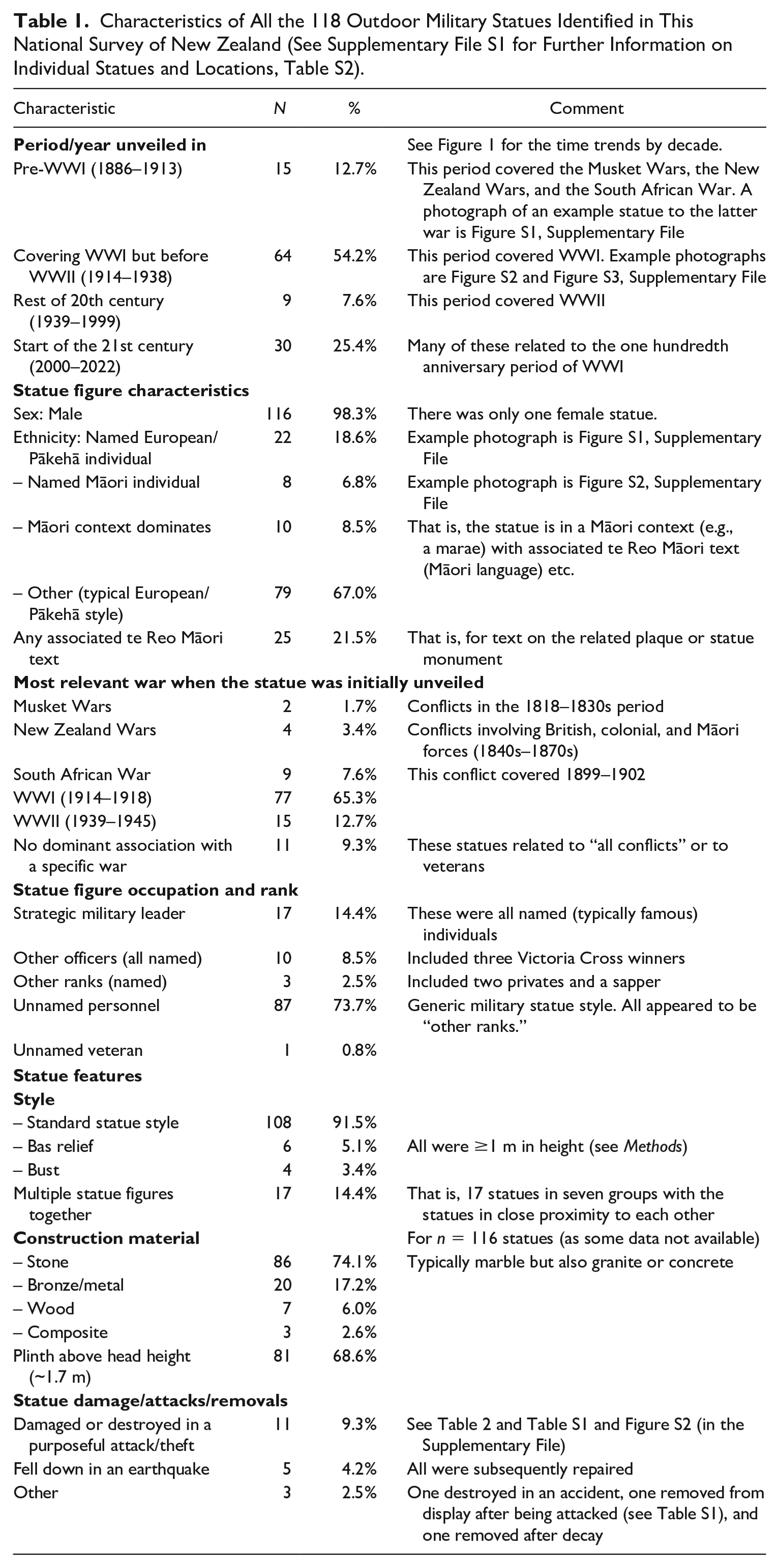
A total of 118 outdoor statues of military personnel were identified in this nationwide survey (Table 1). These spanned the time period from 1886 to 2020 (for unveiling dates) with the peak decade for unveiling being the 1920s (Figure 1). Indeed, 54% were unveiled in the period covering WWI up to just prior to WWII (i.e., 1914–1938). One-hundred-year commemorative events for WWI also contributed to the second highest decade for statue unveiling: the 2010s.
Characteristics of All the 118 Outdoor Military Statues Identified in This National Survey of New Zealand (See Supplementary File S1 for Further Information on Individual Statues and Locations, Table S2).
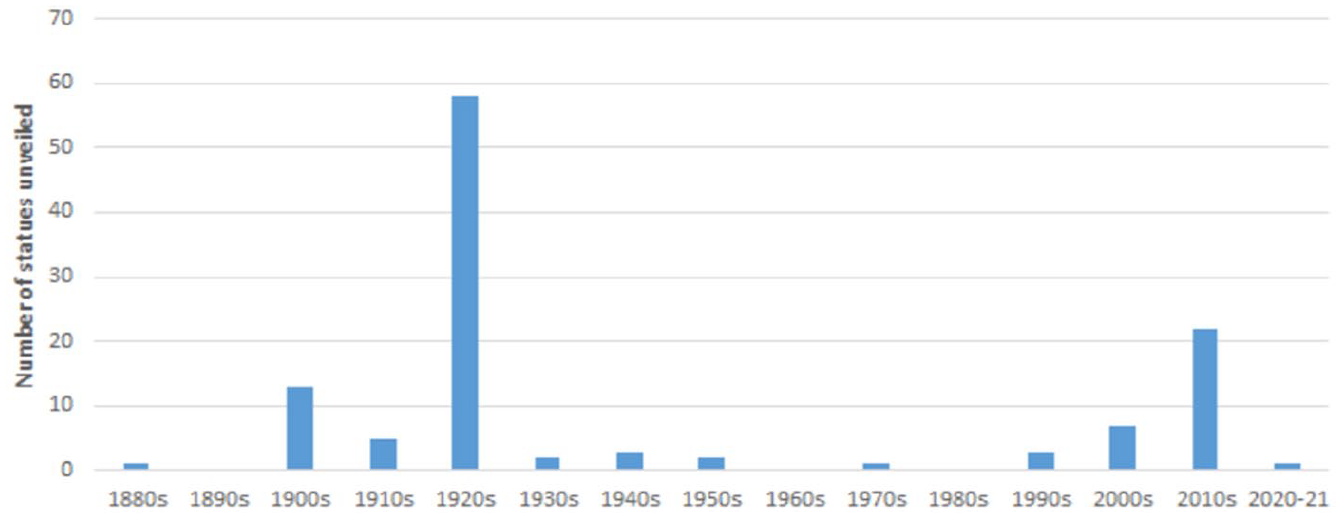
Decade of Unveiling for All the 118 Outdoor Military Statues Identified in This Nationwide Survey of New Zealand.
Statues were predominantly of male figures (98%) and of named or otherwise implied European/Pākehā figures (86%) (Table 1). Nevertheless, 7% of statues were of named Māori individuals and another 9% involved a dominant Māori context (e.g., the statue was on a marae). There were no statues and mentions of military personnel of Pasifika ethnicity. Statues were found to predominantly relate to WWI (65%), followed by WWII (13%), the South African War (8%), the New Zealand Wars (3%), and the Musket Wars (2%), with an additional number relating to a wide range of conflicts (9%).
Statue figures were mainly of generic unnamed military personnel (74%), but 25% were named individuals of various degrees of fame. The latter were mainly strategic military leaders (14% of the total of 118), followed by other officers (9%) and then the other ranks (3%). The generic statues all appeared to be of “other ranks.”
Stone (mainly marble) was the most common statue construction material, followed by bronze/metal (17%) and then wood (6%). Some statues (14%) were part of the same overall monument (but not the same carved or molded structure) or in close proximity to others.
Statue Attacks
A total of 11 statues (9%) were identified as having been attacked, with two being completely destroyed and with one of these being subsequently removed from public display (specific details of these in Table S1 in the Supplementary File). Out of the 11 statues attacked, the perpetrators were identified on four occasions (36%) and of these: one was never prosecuted, one was fined, and for the remaining two, internet searches could not identify any legal outcomes (Table S1, Supplementary File).
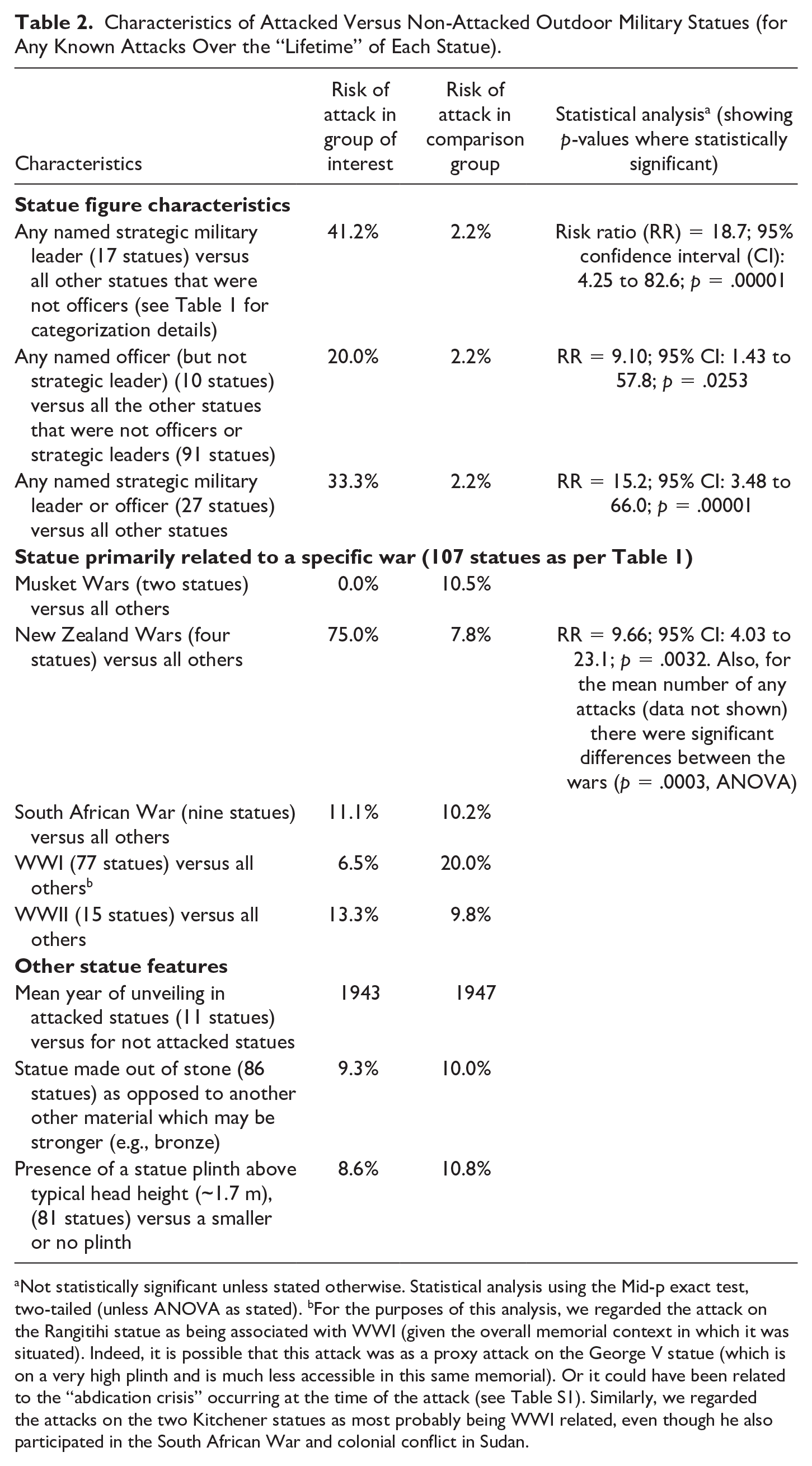
In terms of the three possible reasons for statue attack given in the Introduction, the first reason was: “political protest against a particular conflict or societal process.” We found that three statue attacks involved this reason with links to the New Zealand Wars (Captain Hamilton, Chief Te Peeti Te Awe Awe, and a generic soldier statue on Marsland Hill/Pūkākā, New Plymouth). This association was statistically significant with 75% of the statues associated with the New Zealand Wars being attacked compared with 8% of other statues. None of the three potential confounding factors for statue attacks (i.e., statue age, being made out of stone, and being on a high plinth or not) were significantly different by attack status (Table 2).
Characteristics of Attacked Versus Non-Attacked Outdoor Military Statues (for Any Known Attacks Over the “Lifetime” of Each Statue).
Not statistically significant unless stated otherwise. Statistical analysis using the Mid-p exact test, two-tailed (unless ANOVA as stated). bFor the purposes of this analysis, we regarded the attack on the Rangitihi statue as being associated with WWI (given the overall memorial context in which it was situated). Indeed, it is possible that this attack was as a proxy attack on the George V statue (which is on a very high plinth and is much less accessible in this same memorial). Or it could have been related to the “abdication crisis” occurring at the time of the attack (see Table S1). Similarly, we regarded the attacks on the two Kitchener statues as most probably being WWI related, even though he also participated in the South African War and colonial conflict in Sudan.
There were no other statues linked to specific wars with notably elevated attack rates, but for two statue attacks, there could plausibly have been a link to the 1936 “abdication crisis” of the British Monarchy (given that New Zealand shared the same monarch, Table S1 in the Supplementary File). There were also the actions of a sole individual who had a long history of anti-military protests in New Zealand (i.e., the Charles Upham statue attack). Another single political statue attack involved graffiti on a statue that appeared to oppose government Covid-19 pandemic control measures (Table S1).
In terms of the second possible reason for statue attack given in the Introduction, “political protest against a specific military leader,” the analysis did find a relevant result that was statistically significant. That is, statues of a named strategic military leader had a higher attack risk (41%) when compared with all non-officer statues (i.e., nearly all generic statues), at 2% risk (Table 2). This pattern was also seen for attacks on statues of officers versus non-officers/non-strategic leader statues (20% vs 2% risk of attack).
Statue attacks as part of “non-political acts by individuals” were inconclusive. That is, there were the repeat decapitations of the statue of King George V in Matakana and Earl Jellicoe’s nose removal (e.g., both possibly acts of non-political vandalism) and the theft of the bust of Admiral Tait (possibly for the bronze metal) (Table S1 in the Supplementary File).
Discussion
This survey of military statues in an entire country found evidence for statue attacks being part of a “political protest against a particular conflict or societal process.” More specifically, these particularly related to protest concerning the New Zealand Wars. This pattern was consistent with attacks on statues of named (typically famous) individuals associated with colonialism in previous work (Wilson et al., 2021). It is also apparent with attacks of other military monuments for the New Zealand Wars that were outside our survey (since they lacked statues of military personnel). These included documented attacks on four monuments, that is, in Symonds St/Wakefield St (Maclean & Phillips, 1990; Martin, 2018) and Ōtāhuhu (Neilson, 2020) in Auckland City; Ōmarunui (Ministry for Culture and Heritage, Undated-a); and Pētane in the Hawke’s Bay region (Ministry for Culture and Heritage, Undated-b). Another such monument is to be removed following an official decision concerning its offensiveness (Ellis, 2023). Similarly, there have been descriptions of attacks on statues of political leaders with links to the New Zealand Wars, for example, the former Premier Sir George Grey (Stocker, 2009) and the former Prime Minister John Ballance (Morris, 2012; Schrader, 2023). Collectively, these findings fit with the contested ways that the New Zealand Wars are remembered (O’Malley & Kidman, 2018), and the “stark inequalities and deeply-felt pain” arising from the “empire-building and colonialism” as “the central facts of New Zealand history” (Ballantyne, 2021). Some of the reminders of these injustices are relatively recent, as in the case of the statue of Captain Hamilton, which was erected in 2013 (he was a leading figure in the attack on Gate Pā [Pukehinahina] in 1864 during the New Zealand Wars; Aikman & Azarmandi, 2023). It took years of protest by local Māori before this statue was removed by the local government authority—possibly with some contribution from “Black Lives Matter” protests occurring in Hamilton City (Leaman, 2020) and other New Zealand settings at the time of the removal.
In terms of the second possible reason for statue attack given in the Introduction, “political protest against a specific military leader,” the interpretation is probably more complex. That is the higher attack rates against statues of “named strategic military leaders” might not necessarily reflect protest against their personal decisions, but rather they might just be seen as a more salient target for protest against a specific conflict (i.e., relative to an attack on a generic solider statue). While some of these leaders did generate controversies associated with their specific decisions, our impression is that these were not particularly major controversies within the New Zealand context. For example, Field Marshal Kitchener was associated with brutal colonial conflict in Sudan and establishing concentration camps during the South African War (Heathorn, 2016), but these were not major controversies in New Zealand at the time of the attacks on the two statues of Kitchener in 1931 and 1932 (Table S1 in the Supplementary File). Indeed, these unexplained attacks might conceivably be more likely to reflect a personal grievance relating to WW1, a war in which Kitchener also had a prominent role.
Such complexities are also apparent in statue attacks that were outside the scope of our military statue survey. That is the statue of former Prime Minister Keith Holyoake having its hands painted red on an anniversary of the Vietnam War (Wilson et al., 2021). This protest could reflect a response to this leader’s decision to authorize New Zealand troops going to this war, or it could have been a general protest against this war with this statue being the most visible Vietnam War era-associated monument available to the protestor/s.
Strengths and Limitations of This Study
This is the first nationwide systematic survey of outdoor military statues and associated attacks that we know of. It benefited from New Zealand being a small enough country for comprehensive field work to be performed, in what was an unfunded study. This country also has relatively good documentation of military memorials to multiple wars, and a detailed database of historic newspaper articles (Papers Past) which typically reported on statues being erected and damaged. Nevertheless, this study has a number of limitations as listed below:
It is possible some eligible military statues were missed. However, any such number is probably low, as subsequent research suggests that for the previous statue survey (of 123 statues of named figures in New Zealand; Wilson et al., 2021), only one eligible missed statue has subsequently been identified in the more than 3 years since data collection for that earlier study.
More likely is that some statue attacks were not identified, for example, where authorities removed paint or repaired a statue without reporting it publicly or it being disclosed by the media. We also discounted the disappearance of weapons from statues on the grounds that this could either be for the relatively trivial reasons of souvenir/trophy collection or purposeful removal by authorities on account of decay or other damage. Nevertheless, it is not implausible that some of these actions may reflect purposeful protests against what the statue represents.
There were some statues where there was missing data (e.g., some specific characteristics of a previously destroyed statue) and photographs had to be relied upon where field visits were not so feasible. These included statues on marae and a secured military base (see Methods).
Potential for Further Research
This type of study could also be repeated in other countries that have military monuments reflecting past internal and external conflicts (e.g., Australia, Canada, and the United States that have some similar historical and colonialism experiences to that of New Zealand). It could also be extended to consider attacks on additional types of military monuments including those with other types of statues (e.g., statues of mythical figures are quite common on such memorials, at least in New Zealand). However, this would be far more complex, as the number and heterogeneity of all military monuments is very much larger.
Conclusion
This nationwide survey of outdoor statues of military personnel identified 118 statues. Of these, 11 (9%) had been physically attacked at some point in time. A key risk factor for statue attack was it being linked to the colonial-era New Zealand Wars versus any other specific war (75% vs 8%, p = .003). This finding fitted with other evidence from attacks on statues of named New Zealanders (e.g. politicians) and on attacks of other types of monuments to these particular wars. It is also consistent with the contested nature of how the New Zealand Wars are remembered and the past and persisting injustices experienced by the Indigenous Māori population. In conclusion, some of the attacks on the military statues in this country appear to reflect social injustices and harm from colonialism.
Supplemental Material
sj-docx-1-afs-10.1177_0095327X241247811 – Supplemental material for Why Do People Attack Military Statues? A National Survey in New Zealand
Supplemental material, sj-docx-1-afs-10.1177_0095327X241247811 for Why Do People Attack Military Statues? A National Survey in New Zealand by Nick Wilson, John Horrocks and George Thomson in Armed Forces & Society
Footnotes
Acknowledgements
We wish to thank Dr. Amanda C. Jones for her very helpful assistance with data collection and photography, and Dr Doug Munro for assistance in identifying background literature.
Declaration of Conflicting Interests
The authors declared no potential conflicts of interest with respect to the research, authorship, and/or publication of this article.
Funding
The authors received no financial support for the research, authorship, and/or publication of this article.

Supplemental Material
Supplemental material for this article is available online.
Author Biographies
References
Supplementary Material
Please find the following supplemental material available below.
For Open Access articles published under a Creative Commons License, all supplemental material carries the same license as the article it is associated with.
For non-Open Access articles published, all supplemental material carries a non-exclusive license, and permission requests for re-use of supplemental material or any part of supplemental material shall be sent directly to the copyright owner as specified in the copyright notice associated with the article.
