



Abstract
In this article, we present the novel M3-dataset. This global dataset brings together 30 existing and newly developed indicators and a total of 140,000 observations on three dimensions of material, political, and societal militarization from 1990 to 2020. We introduce a novel, multidimensional concept of militarization, explain the construction of the dataset, data-collection process, and the measures taken to ensure the validity and reliability of the data. We illustrate the usefulness of the dataset for researchers by analyzing for the first time the impact of military policing as one aspect of societal militarization on violence and human rights violations at the global level. We conclude by discussing the significance of the M3 dataset and outlining how scholars in different fields and with various research interests, including (de-)democratization, armed conflict, and human development, can benefit from incorporating this dataset into their studies.
Introduction
Since the invention of modern armies in the 19th century, their organizational forms, political roles, economic influence, and societal functions have continuously evolved. Nevertheless, the military remains a core element of modern statehood in the 21st century. With its coercive capacity and vast resources of organized violence, the military remains an essential power factor in societies. As a result, militarization, that is, the extension of military influence into social, political, and economic life of societies—commonly referred to as the civilian sphere—has long been a subject of academic research (e.g., Bickford, 2015; Kuehn & Levy, 2020). The literature on peace and conflict studies, military sociology, comparative politics, and political economy provide ample evidence on how the military and dynamics of militarization can affect state and nation-building processes (Koonings & Kruijt, 2002; Tilly, 2017), [political] socialization (Jennings & Markus, 1977; Y. Levy, 1997), elite recruitment (Mills, 1956); international and domestic conflicts (Schofield, 2007; Weeks, 2012), regime formation and consolidation (Bowman, 2002; Geddes et al., 2014; Kuehn & Croissant, 2023), public policy, and socio-economic development of societies (Bowman, 2002; Cappelen et al., 1984; Cook, 2007).
With the third wave of democratization (Huntington, 1991) and the end of the Cold War, interest in militarization waned. However, triggered by the return of military coups in recent years (Kendall-Taylor et al., 2019) as well as interstate war in Europe, militarization seems to become the defining zeitgeist of a new “post-post-Cold War era.” Since 2022, not only Russia and Ukraine but also NATO member states have witnessed a significant increase in militarization, leading to changes in fiscal priorities and production capacities as well as public discourse and societal views (Kofroň & Stauber, 2023). In Asia, material, political, and social facets of militarization are also growing rapidly (Bayer & Rohleder, 2022), with the militarization of territorial disputes posing a significant risk of turning the region into a volatile powder keg.
Despite a rich research tradition and a recent resurgence of interest in militarization, new insights into this evolving topic are scarce, and empirical research utilizing cross-national time-series data on the topic remain small. Some conventional assumptions of traditional militarization literature, such as the idea that increase in the capabilities of the armed forces leads to aggressive foreign policies driven by military’s political influence, have been shown to be overly simplistic. These assumptions tend to overlook the intricate social dimensions of militarization (Acacio et al., 2022; Majeski, 1995; Pion-Berlin, 2016a; Schofield, 2007; Simckes et al., 2019). More recent contributions to militarization mainly originate from critical military and security studies that highlight the importance of doing justice to the multi-faceted nature of the phenomenon, and especially taking the societal aspects into account (cf. Bonacker, 2019; Enloe, 2007; Howell, 2018; Leander, 2022; Stavrianakis & Stern, 2017).
While there is a consensus that militarization is a multidimensional phenomenon, there is no consensus regarding its conceptual definition. Despite a boom in the development of social science indicators in the last three decades, we still lack a comprehensive dataset that provides scholars with various dimensions of militarization and their linkages. Hitherto, most existing data sources, like the Political Roles of the Military (PRM) dataset, the Military Involvement in the Economy (MIITE) Dataset, the Military Recruitment Data Set, the Military Schools Data Set, or the Global Militarisation Index (GMI), contain only very specific information that are either too narrow or not always openly accessible. Some existing data, such as the databases that attempt to capture societal aspects of militarization, are scarce and have limited temporal and geographical coverage. The M3-dataset compiles data from the existing datasets and complements it with new original data to offer a comprehensive global coverage of three dimensions of militarization: material, political, and societal militarization. It is an important step toward improving empirical research on militarization, allowing researchers to conduct more robust analyses of their topics of interests.
In the following section, we discuss our definition of militarization and the conceptualization of the M3-dataset for which we distinguish three dimensions of material, political, and social militarization, each operationalized by several indicators. We also describe the dataset’s management structure, data source and coding procedures, temporal and spatial coverage, and the collinearity of the different indicators. Finally, we use the dataset to test the impact of military policing on violence and human rights violations at the global level. We conclude with a discussion of avenues for future research using the data. 1
Conceptualization
We use the word military to refer to any state organization that is permanently established by constitutional law, has a monopoly on certain weapons of war, with its core function defined as the defense of the state, primarily against external threats (Edmonds, 1988) but not limited to it (see Brooks, 2019; Pion-Berlin, 2016a, 2016b). The conventional armed services include branches such as the Army, Navy, and Air Force but can incorporate other services such as a Marine Corps, Nuclear Deterrence, or Space Force. We also include uniformed armed organizations such as presidential and coast guards, police, border security forces, and government militias if they are official units that operate under the direct command of the ministry of defense. Excluded from this definition are nonstate armed groups such as pro-government militias that are [temporarily] aligned with the regime (Carey et al., 2022) as well as police forces and other paramilitary groups that do not operate under the control of the ministry of defense.
Although the explicit analytical distinction between civil (society) on the one hand and the military on the other is “the sine qua non of all civil-military theory” (Feaver, 2003, p. 12), a military can never be completely detached from either its society or the political regime in power. Consequently, we understand the military as an institution that interacts with politics, the economy, and society. This interaction shapes particular military–government and military–society relations (Rukavishnikov & Pugh, 2006, 2018), which provide the military with varying degrees of influence and resources.
Militarization as a Multidimensional Process
We view militarization as a process in which “a society’s institutions, policies, behaviors, thought, and values are devoted to military power and shaped by war” (Kohn Richard, 2009, p. 182). Militarization is a matter of degree. The degree of militarization of state–soldier–society relations in a nation is a function of the extent to which the military takes on different roles and missions, and the extent to which the various resources of a society are placed in the hands of the military. The more missions and resources are placed in the hands of the military, the greater the degree of militarization (see also Stearn, 2013, pp. 2–3). Following Bowman (2002), the M3-dataset conceptualizes militarization as a three-dimensional process:
Material militarization refers to the allocation of material, economic and social resources to the armed forces.
Political militarization refers to the degree to which the military holds prerogatives and decision-making power over policies and influences the inner workings of the ruling coalition.
Societal militarization takes the form of an expansion of the military’s role in societal institutions and the daily lives of ordinary citizens such as conscription, constabularization and policing, and entrepreneurial activities.
The different dimensions of militarization are interconnected. For example, increase in the size of the military (e.g., through the introduction of compulsory military service) is usually accompanied by changes in the military’s material resources. Changes in military spending and the associated shifts in government spending must be politically justified (Kuehn & Levy, 2020). Empirical research has hitherto primarily focused on examining these three dimensions independently, often displaying a notable inclination toward individual aspects like political control or the resource-related facets of militarization. The third dimension, concerning military-society relations, has received limited empirical attention. The M3-dataset seeks to rectify these limitations by offering a comprehensive database that encompasses all three dimensions.
Variables and Operationalization
As shown in Figure 1, we conceptualize three dimensions of militarization, each dimension comprising several indicators, resulting in a total of 30 expert-coded and statistical indicators.
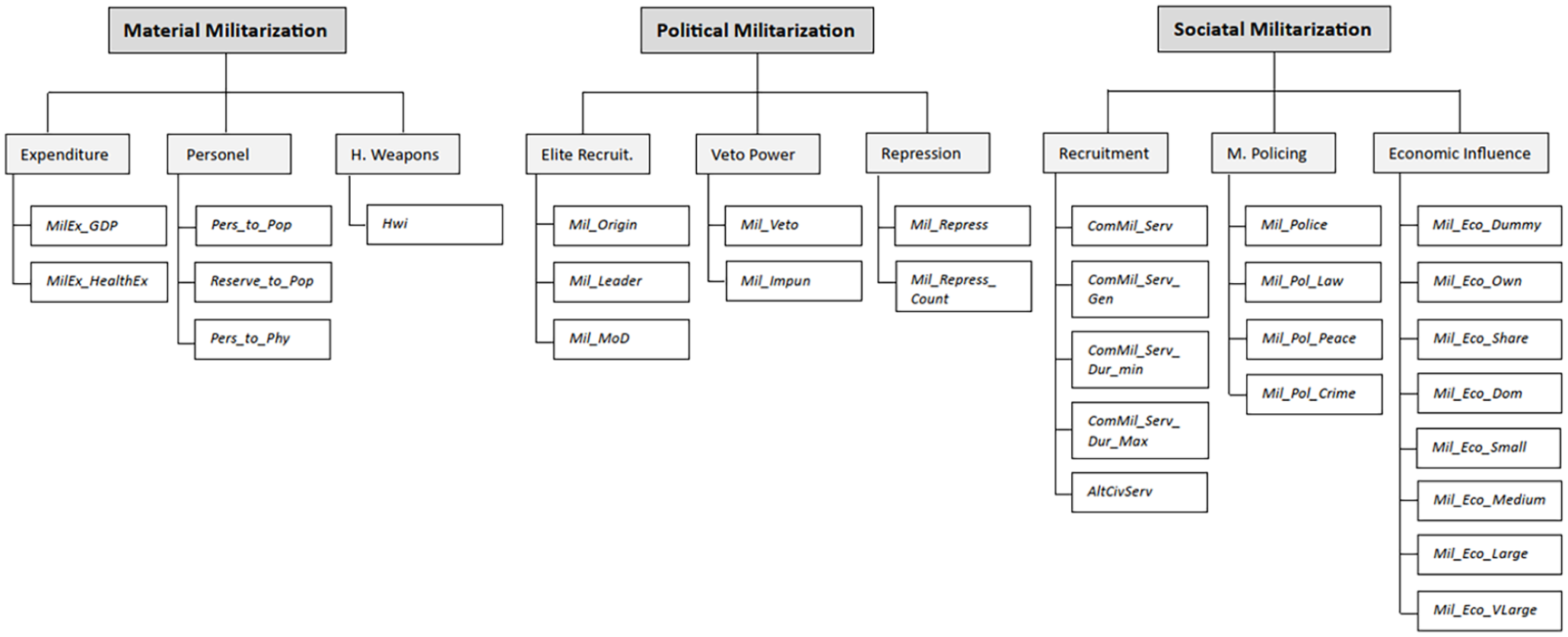
M3 Concept Tree.
Material Militarization
Militarization is often associated with an increase in military capacity (Lind, 2004). Historically, military spending has been considered the “standard measure” of militarization understood in this material reading (Gifford, 2006, p. 473). Some scholars have attempted to disentangle different aspects of material militarization by distinguishing between an “increase in armaments, advance in the destructive capacity of weapons, growing numbers of people under arms, and dramatic increases in military expenditure” (Eide & Thee 1980, p. 9). Our understanding of material militarization is a relational and resource-based one. Accordingly, the M3-dataset covers the material dimension through six indicators that capture the allocation of resources in terms of personnel, financial resources, and conventional heavy weapons. These resources are assigned to the military by political elites with the aim of enabling it to fulfill its mission.
Our data on material militarization is taken from the Global Militarisation Index (GMI) of Bonn International Center for Conflict Studies (von Boemcken et al., 2022). In comparison to other sources on the material dimension, like SIPRI or the World Military Expenditures and Arms Transfers, the GMI provides additional data on military personnel and heavy weapons which allows a more detailed and comprehensive assessment of the material dimension of militarization. Furthermore, the GMI offers variables that measure expenditure, personnel, and heavy weapons not in absolute but in relative terms, which makes the measure particularly suited for connecting the material militarization dimension to elite preferences and the broader population and consequently to the two dimensions of political and societal militarization.
The variables MilEx_GDP and MilEx_HealthEx measure a state’s military expenditure relative to its society’s economic wealth and relative to public health spending. The two indicators capture the policy priorities of political elites and give a reasonable estimate of military capacity. The variables Pers_to_Pop, Reserve_to_Pop, and Pers_to_Phy reflect a country’s military capacity with regard to personnel and in relation to other areas of society (such as health). The first indicator measures the extent to which active military and paramilitary personnel constitute a significant proportion of the national population. The Reserve_to_Pop indicator measures the ratio of military reserves to the national population. This indicator is particularly relevant for countries that rely heavily on militias and consequently have a comparatively small standing army but a larger number of reservists. The variable Pers_to_Phy captures the total number of active military to the total number of physicians in a country. Finally, militarization is often associated with an increase in armaments (Eide & Thee, 1980). The Heavy Weapons Index (HWI) measures the number of heavy weapons in the arsenals of the armed forces relative to the total population, thus capturing military capacity in terms of armament. This is an important addition to the other two aspects since military expenditure and troop number do not necessarily translate into firepower and military strength. Our definition of conventional heavy weapons largely follows the classification of the United Nations Register of Conventional Arms and thus does not include Weapons of Mass Destruction (WMD).
Political Militarization
The next dimension in the M3-dataset covers the political dimension of militarization. Following Eibl et al. (2021), we define political militarization as increases in key decision-making power over policies and influence in the inner workings of the ruling coalition. According to Finer (1988), one should distinguish between direct and indirect forms of political influence exercised by the military. While direct influence is given when the chief executive or cabinet positions are occupied by active-duty officers, indirect influence is exercised when the executive is formally occupied by civilians but the military exercises political power from behind the scenes. We distinguish between direct and indirect influence by drawing from conceptualizations offered by Political Roles of the Military (PRM) dataset, the Military Participation in Government Data (MPG), the Military Dimension Index of the Varieties of Democracy (V-Dem) project, and the Military Legal Subordination Dataset (Coppedge et al., 2023; Croissant et al., 2017; Kyle & Reiter, 2020; White, 2017). We include three components of political militarization: elite recruitment, veto power, and repression (cf. Croissant et al., 2017). Elite recruitment denotes the ability of the military to occupy core positions of political power in a state. Veto power encompasses the military’s capacity to exert influence on the policy-making process by either threatening to or actively preventing changes to the status quo. Finally, repression captures the role of the military in suppressing political dissent and acting as an agent of state repression. While these components do not directly measure the influence of the military over specific policy decisions, they are widely used as indicators of political militarization in civil-military relations research and comparative politics more broadly (Croissant et al., 2017; Eibl et al. 2021; Svolik, 2012). For example, it is reasonable to assume that the more political leaders depend on soldiers to suppress dissent, the more likely that they are compelled to grant the military greater influence and privileges within national politics. Furthermore, occupation of political offices usually comes along with some degree of political influence.
Accordingly, we capture political militarization by taking into account the three mentioned components. First is the direct influence of the military that includes whether the incumbent political regime originates from a military background (Mil_Origin), whether the incumbent regime leader is a member of the armed forces or is a rebel leader (Mil_Leader), and whether the defense minister is an active military officer (Mil_Mod). Second is military’s veto power that includes whether a country’s chief executive usually seeks the approval of the military before making relevant decisions (Mil_Veto) and whether members of the armed forces enjoy impunity when they engage in illegal activities such as violating human rights, engaging in corruption, and committing acts of insubordination (e.g., coups) (Mil_Impun).
Third is the military as an agent of repression that captures whether there was an internal military action against unarmed civilians that results in the death of at least one unarmed noncombatant (Mil_Repress), and a second indicator that counts the absolute number of events of military repression that occurred in a given country in a given year (Mil_Repress_Count). Our indicators of military repression build on Davenport’s (2007) definition of repression as the “use of physical sanctions against an individual [. . .], within the territorial jurisdiction of the state, for the purpose of imposing a cost on the target” (p. 2).
Societal Militarization
Finally, militarization is linked to broader societal contexts. Scholars of militarization, for example, emphasize that material and political militarization is often linked to a discursive process that shifts “societal beliefs and values in ways necessary to legitimate the use of force, the organization of large standing armies and their leaders, and the higher taxes or tribute used to pay for them (Lutz, 2002, p. 723).” We understand societal militarization as increases in the militaries social influence.
Societal militarization is arguably the most complex among the three dimensions of militarization as it encompasses a diverse range of factors, including forms of recruitment, entrepreneurial activities, and military’s influence on educational and value system, political culture, legal system, and so on. We capture the military’s social influence through three core components of soldier–society relations with each component capturing several indicators: recruitment practices, military policing, and its economic activities. These three components do not cover the concept of societal militarization in its full breadth but represent key aspects of the concept. As mentioned, a military’s social influence can grow if a larger share of the population is recruited by the military. Typically, the degree of recruitment, already reflected in our two indicators, Pers_to_Pop and Reserve_to_Pop, is highly correlates with the institutionalized practices of recruitment: all-volunteer service, some form of conscription or a mix of the two. The recruitment system has important implications for military–society relations, as all-volunteer armies tend to be smaller which means that fewer citizens are exposed to the institution of the military, its norms, values, and procedures (Asal et al., 2017; Navajas et al., 2022). Our indicators on recruitment practices not only measure how many people are recruited but they also offer information on “who” gets recruited, “how” and for “how long.”
One important and potentially momentous example of societal militarization by expanding the militaries mission is military policing, which refers to the assumption of (civilian) police functions by the military. The most important difference between military and police operations concerns the use of force: While the police forces are committed to the principle of the minimum necessary use of force, a military is characterized by its readiness to employ maximum coercive and violent power (Campbell & Campbell, 2010, p. 331). Traditionally, there exists a reasonably distinct division of labor between the armed forces and the police, with the former primarily tasked with safeguarding the state from external threats, while the police is responsible for internal security and maintaining public order (Easton, 2017, p. 1117). Military policing begins where the boundaries between the military and the police begin to blur as the military takes on police-related operational tasks. This is central to military–society relations because the presence and scope of military policing significantly determine the level of direct interaction between citizens and soldiers. Considering the military’s access to significant means of violence, these interactions can potentially manifest as violent repression. However, policing is “a single role comprised of numerous responsibilities” (Hess & Orthmann, 2009, p. 118) and would be oversimplified if we subsumed it into a single category.
Building on Hess and Orthmann (2009), we thus distinguish between three distinct tasks of military policing: law enforcement, peace preservation, and crime prevention. Four qualitative expert-coded variables capture whether the military regularly performs policing activities (Mil_Police); is engaged in ‘enforcing the law’– whether military personnel are involved in apprehending and assisting in the prosecution of individuals violating the law (Mil_Pol_Law); is engaged in “keeping the peace” by supervising and intervening in noncriminal behavior—through crowd control at public events and demonstrations, settling social disputes or regulating and controlling traffic (Mil_Pol_Peace); or is proactively involved in the prevention of crime—through the prevention of terrorism, physical visibility and patrols in crime-affected areas, or the promotion of preventive measures through public education (Mil_Pol_Crime). Although all three policing tasks are inherently related, they constitute three distinct tasks: law enforcement encompasses the intervention of policing institutions following an actual breach of the law; peace preservation addresses intervention in noncriminal behavior. Crime prevention differs from the other two policing tasks in its proactive nature, explicitly aimed at preventing law violations (Hess & Orthmann, 2009).
The third component of societal militarization concerns the military’s role as an economic entrepreneur. Engaging in such activities can serve a dual purpose: it can bolster the military’s self-sustainability and reduce its reliance on government budgetary allocations. In addition, economic activities increases military’s influence in economic policy-making as well as the overall state of the economy through its participation in production of goods and services (e.g., manufacturing, trade, and banking), thereby influencing the extent of material or political militarization (cf. Brömmelhörster & Paes, 2003; Izadi 2022; Mani, 2007). However, such an expansion means that citizens are confronted with the military in a new role—as entrepreneur, employer, and producer. This has far reaching consequences. Among other implications, this phenomenon implies that the broader society attributes economic competencies to the military, leading to the emergence of new dependencies between citizens and the military.
We only include military’s formal economic activities that generate extra-budgetary profits for the military. Thus, illegal profit-making pursuits (such as illegal logging, arms trade, or drug trafficking) as well as subsistence activities that provide the military with its own needs are excluded in the data. There are eight indicators in this dimension that measure the involvement of the military in a country’s economy. Mil_Eco_Dummy indicates a general military involvement in the economy, and Mil_Eco_Own, Mil_Eco_Share, and Mil_Eco_Dom capture the number of economic entities per 100,000 inhabitants that are wholly owned, partially owned, or dominated by the military or active-duty military personnel in a given year, thus providing information on the different degrees of economic involvement. The indicators Mil_Eco_Small, Mil_Eco_Medium, Mil_Eco_Large, and Mil_Eco_Vlarge also provide information on the number and typical size (small, medium, large, and very large) of military-controlled companies.
Construction of the Dataset
Our dataset includes 30 indicators covering the period between 1990 and 2020 and 157 countries recognized by the United Nations, having at least one million inhabitants and a military. Our data cover the post-cold-war period since the phenomenon of contemporary militarization might differ qualitatively and quantitatively from its cold-war equivalent. 2 The level of analysis is the nation-state with the unit of analysis being country-years. Some countries crossed the threshold of one million inhabitants later than 1990, and some countries disbanded their military during the study period. These countries were included in the dataset from or up to the respective years in which they reached the population threshold or discontinued their military.
Data Sources
The M³-dataset builds on some already existing sources and also compiles new original data. Data for the indicators of material and political militarization are partly drawn from existing datasets, though new data had to be collected and recoded from open access sources for some indicators (cf. Table 1). The social dimension consists mainly of original expert-coded (“subjective”) indicators. Data for the five indicators on military recruitment comes from an expert survey conducted by War Resisters’ International in 1998 and 2005, which we have updated to the year 2020 and supplemented by other secondary sources. Data on military policing (Mil_Police; Mil_Pol_Law; Mil_Pol_Peace; and Mil_Pol_Crime) is expert coded and derived from a novel expert survey conducted in 2023. Finally, data on military economic influence (Mil_Eco_Dummy; Mil_Eco_Own; Mil_Eco_Share; Mil_Eco_Dom; Mil_Eco_Small; Mil_Eco_Medium; Mil_Eco_Large; Mil_Eco_Vlarge) stems from the Military Involvement in the Economy Dataset (Izadi, 2023).
Sources and Types of M3 Indicators.
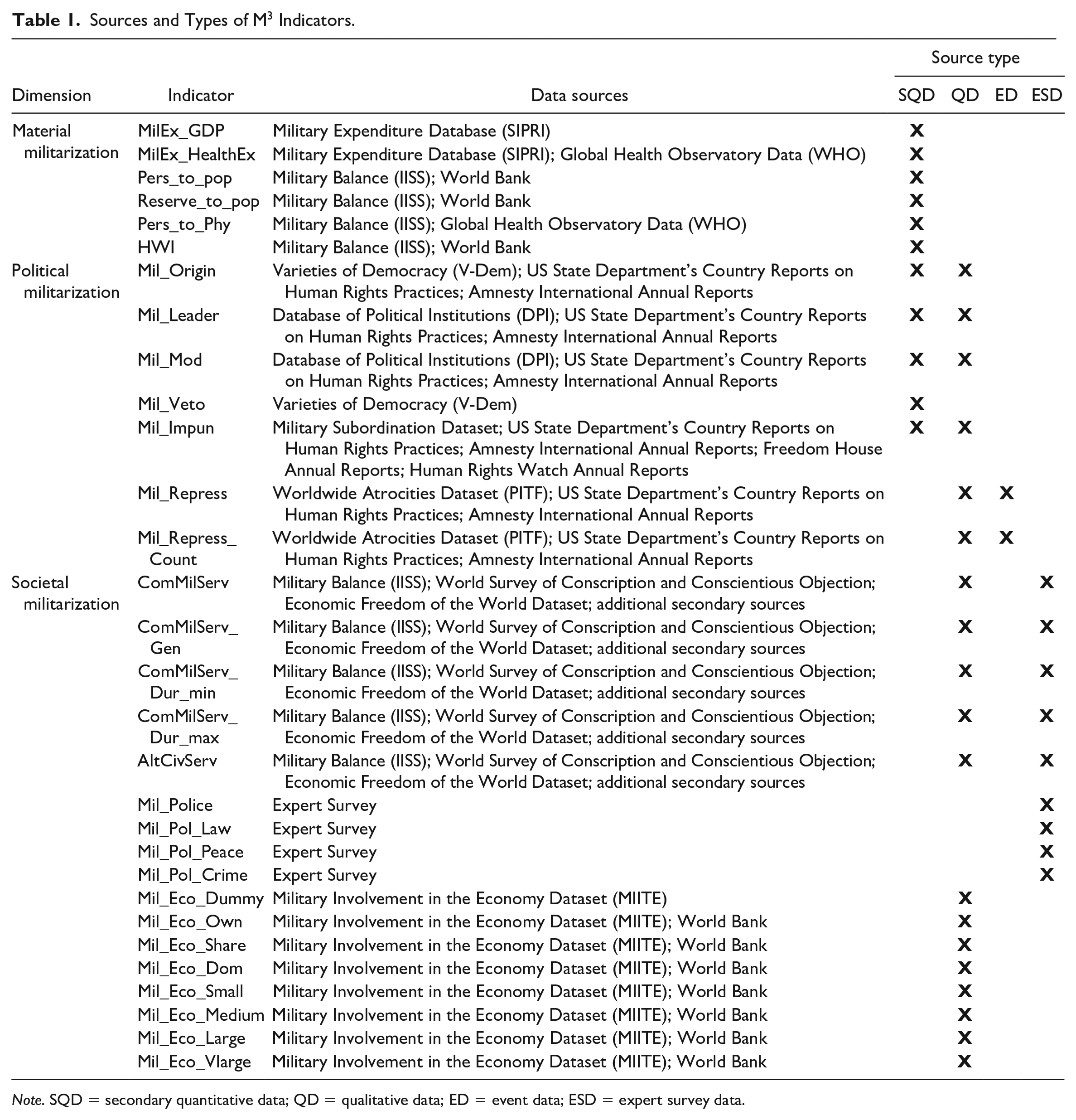
Note. SQD = secondary quantitative data; QD = qualitative data; ED = event data; ESD = expert survey data.
Coding Procedure
The M³-Dataset combines “objective” (statistical) data with expert-coded (“subjective”) indicators. The data collection process followed a multi-step procedure involving different coding strategies. First, we collected information from existing datasets and integrated it into our baseline country-year dataset, updating, supplementing, and expanding existing data as needed. The variables Mil_Origin, Mil_Leader and Mil_MoD—originally taken from the V-Dem and DPI datasets—contained a significant number of missing or conflicting values that had to be recoded and updated. 3 Other measures had to be transformed to match the conceptualization used in the M³-dataset. For example, the V-Dem’s measurement of military veto power is based on dichotomous ratings from multiple experts. Within the V-Dem dataset, the variable is coded as an interval ranging from 0 to 1 depending on how many experts consider the military to be the most important support group for the government. To match the structure of the Mil_Veto variable with all other central variables of the political dimension, we transformed the original V-Dem data into a binary indicator. We then collected and coded still missing data. For the repression indicators (Mil_Repress and Mil_Repress_Count), we manually filtered 19,227 violent events described in the PITF’s Worldwide Atrocities Dataset (Schrodt & Ulfelder, 2016) for repressive acts committed by the military. As the PITF data does not cover all years and countries in our dataset, the missing observations and years were coded through analysis of additional supplementary qualitative sources and cross-checked by different coders. Conflicting assessments were discussed and—if necessary—recoded. In total, we analyzed more than 9,400 US State Department’s Country Reports on Human Rights Practices and 1,600 individual events involving the military. A similar approach was taken to assess military impunity (Mil_Impun). In the absence of event data, more than 20,000 US State Department’s Country Reports on Human Rights Practices were reviewed for the coding. Again, the initial coding was followed by qualitative assessment.
Data on our four indicators on military recruiting practices was retrieved from various sources: For our variable on the existence of conscription, ComMilServ and its duration (ComMilServ_Dur_min and ComMilServ_Dur_max) we used data from the World Survey of Conscription and Conscientious Objection, the Economic Freedom of the World Dataset and the Military Balance (IISS). In some cases, we further surveyed other additional open access sources. Information on our variable ComMilServ_Gen, which codes if male and female citizen are both affected by an existing conscription and AltCivServ, which codes when there is an alternative civilian service to the military service, stem either from the World Survey of Conscription and Conscientious Objection or own codings based on secondary sources. If no qualitative secondary sources were available from which the required information could be extracted, we collected the necessary information by consulting experts. Between March and April 2023, we surveyed 509 country experts 4 on the extent of military policing in the countries covered by the dataset and received 150 completed questionnaires (response rate of ~30%). During the survey, the experts were asked to rate the confidence level of their assessment of the respective subdimensions of military policing. The level of confidence is captured by the variables max_conf_milpol_“dimension.” To obtain a reliable measure, all values of the variables on the military policing component (Mil_Policel; MilPol_LawEnf; MiPol_PeaPre; and MilPol_CriPre) represent the expert assessment with the highest confidence ratio. As shown in an analysis of V-Dem variables by Marquardt et al. (2019), an assessment of confidence in the quality of their coding made by the coding experts themselves correlates positively with the reliability of the resulting data. We only took into account data resulting from fully completed questionnaires. While it has long been acknowledged that expert-coded data are potentially vulnerable to individual coder biases, many of the available measures of governance used in political science rely mainly on expert assessments. Moreover, “objective” statistical or factual indicators are also not always observer-invariant but also rely often on subjective decisions by coders that makes them also prone to human-based coding errors (Knutsen et al., 2023, pp. 13–15).
Validity and Reliability of the Generated Data
Two important features of our dataset enhance its validity. First, to avoid potential biases that can arise from the use of a single measure, our measurement of conceptual attributes is based on multiple indicators. Second, to prevent the transmission of malicious estimates, we reviewed the data from secondary quantitative sources and cross-checked codings by multiple coders, revalidated and verified or updated missing or conflicting values using additional secondary sources before including them in our dataset. When assessing data based on qualitative sources, the most likely source of measurement error is potential underreporting. For example, with regard to our variables Mil_Repress and Mil_Repress_Count and Mil_Impun we attempt to minimize the risk of an underreporting bias by basing our qualitative assessments on multiple sources whenever possible. To address errors associated with expert-coded data resulting from insufficient expert knowledge about the indicator in question, we included a self-assessment of the confidence of the experts’ judgments in the military policing survey. We increased reliability by assigning multiple experts to each country and by allowing them to comment qualitatively on their judgments. Recruiting multiple experts per country also allowed us to assess inter-coder reliability. Since the absolute number of responses we received varied between cases and over time, we assessed inter-coder reliability by calculating the percentage agreement between experts for each country-year of the dataset. The percentage agreement is indicated by the variables p_a_milpol_“dimension.” The qualitative comments allowed us to assess whether deviations from other experts’ ratings were substantively justified. As collinearity is potentially relevant to our dataset, its use for subsequent data analysis and the interpretation of its results (see Johnston et al., 2017), we performed several collinearity test to reveal any such problems (see Online Appendix A10 and A11). However, results suggest that collinearity is not an issue.
The Militarization of Law Enforcement: A Global Assessment
An important facet of societal militarization is the military’s role expansion into law enforcement (see Flores-Macías & Zarkin, 2021). Contemporary research on the militarization of law enforcement has been dominated by a U.S.-centric approach that focuses on police militarization (e.g., Bove & Gavrilova, 2017; Delehanty et al., 2017; Lawson, 2019) but neglects the process of constabularization of the military (Flores-Macías & Zarkin, 2021). While police militarization describes the multidimensional process of the police “arming, organizing, planning, training for, threatening, and sometimes implementing violent conflict” (Kraska, 2007, p. 503), the constabularization of the military means the takeover of policing tasks by soldiers. 5
The work of Flores-Macías and Zarkin brings together these two processes. They unpack the concept of militarization of law enforcement and distinguish between different forms of policing, ranging from nonmilitarized police, militarized police, and paramilitary police to constabularized militaries. Taking stock of recent trends in Latin America, they find that constabularized militaries de facto describe a “new law enforcement reality” in the region (Flores-Macías & Zarkin, 2021, p. 533). In Latin America, however, this increasingly common form of law enforcement tends to contribute to more violence and more human rights violations as constabularized militaries further circumvent the prevailing legal order and impede police reform (Flores-Macías & Zarkin, 2021, p. 533). Other studies suggest that the use of the military is not limited to Latin American countries (Erickson et al., 2023; Khisa & Rwengabo, 2023). However, we still lack a systematic analysis of militarization of law enforcement and its impact on violence and human rights abuses worldwide. The data on military involvement in policing in the M3-Dataset allows researchers to systematically examine the phenomenon from a cross-regional perspective for the first time. Figure 2 shows that military policing since the Cold War is by no means limited to Latin America. In fact, soldiers on all continents are or have been involved in policing activities to varying degrees.
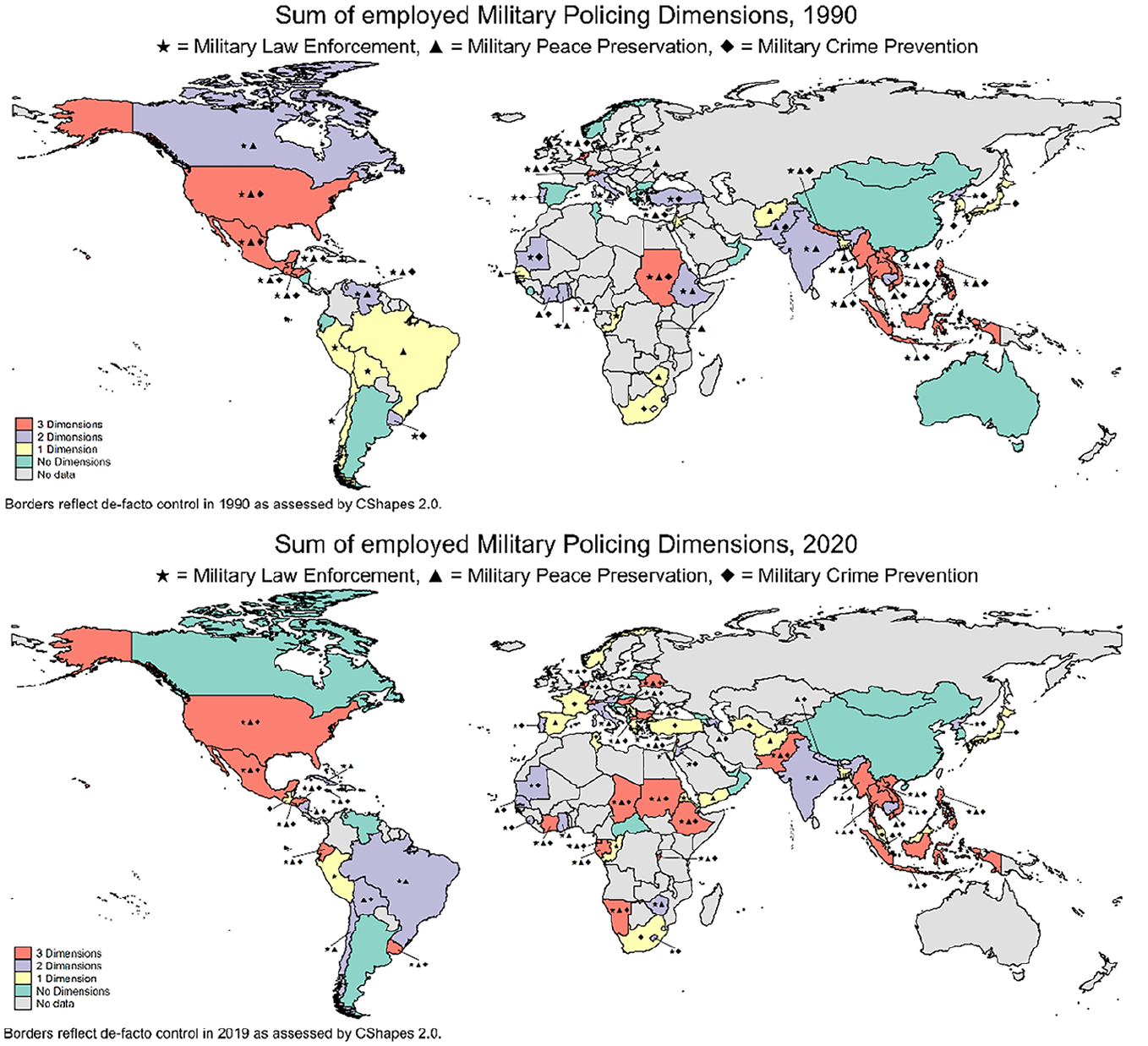
Military Policing in 1990 and 2020.
In addition, we can observe a significant increase in military policing and thus a global increase in societal militarization from 1990 to 2020. As depicted in Figure 3, total number of countries engaged in military policing and its respective subdimensions rose from 49 in 1990 to 71 in 2020. Our data further suggest that law enforcement and peace preservation were already more common military missions in the 1990s. In contrast, crime prevention has only become part of the military’s mission profile in many countries since the turn of the century. 6
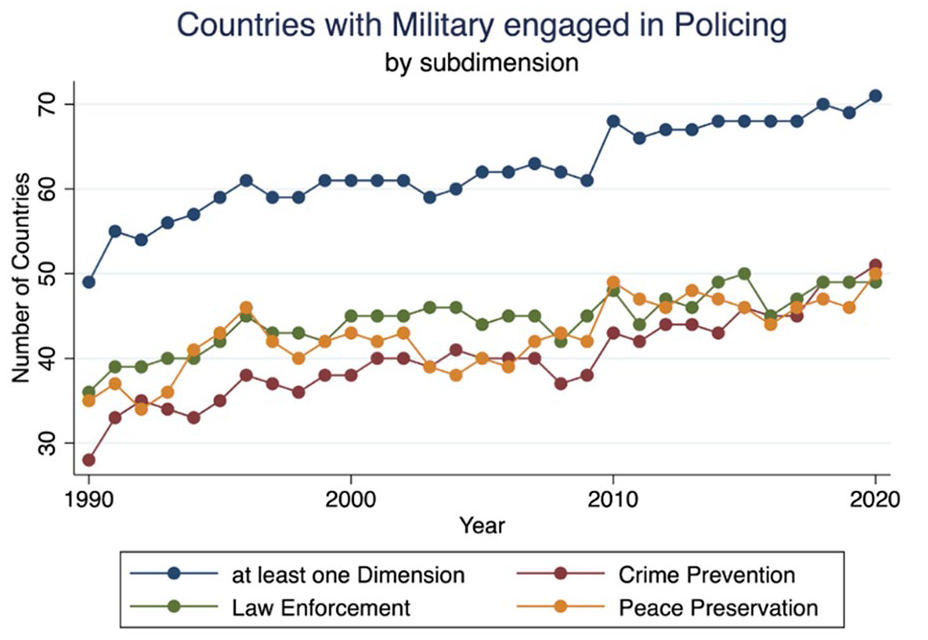
Dimensions of Military Policing.
In their analysis of Latin American cases, Flores-Macías and Zarkin (2021) find a negative impact of military policing on human rights and civil liberties. We utilize the M3-Dataset to test the cross-regional validity of this finding by estimating linear country-fixed-effects panel regressions (Models 1, 2, and 3 in Table 2). The data covers 1,950 country-years in which we recorded military policing in at least one of the three dimensions. 7 We use country-fixed-effects as well as clustered standard errors to account for country-specific characteristics and within country correlations respectively. In addition to the different dimensions of policing (milpol_cripre, milpol_lawenf, milpol_peapre), we also test the effect of impunity (mil_impun) and conscription (com_mil_serv), as we expect both to be potentially important drivers of violence and human rights violations; first, because perpetrators go unpunished, and second, because less trained and experienced troops may overreact. We also include several standard control variables (e.g., level of democracy, armed conflict, praetorian legacies, rentier states, and various measures of income and modernization) which are known drivers of repression and violent intrastate conflict (Basedau & Lay, 2009; Davenport & Armstrong, 2004). 8 As dependent variables, we use the disaggregated subindices of the V-Dems measure of civil liberties: the physical violence index (v2x_clphy), the private civil liberties index (v2x_clpriv), and the political civil liberties index (v2x_clpol).
Regression Results.
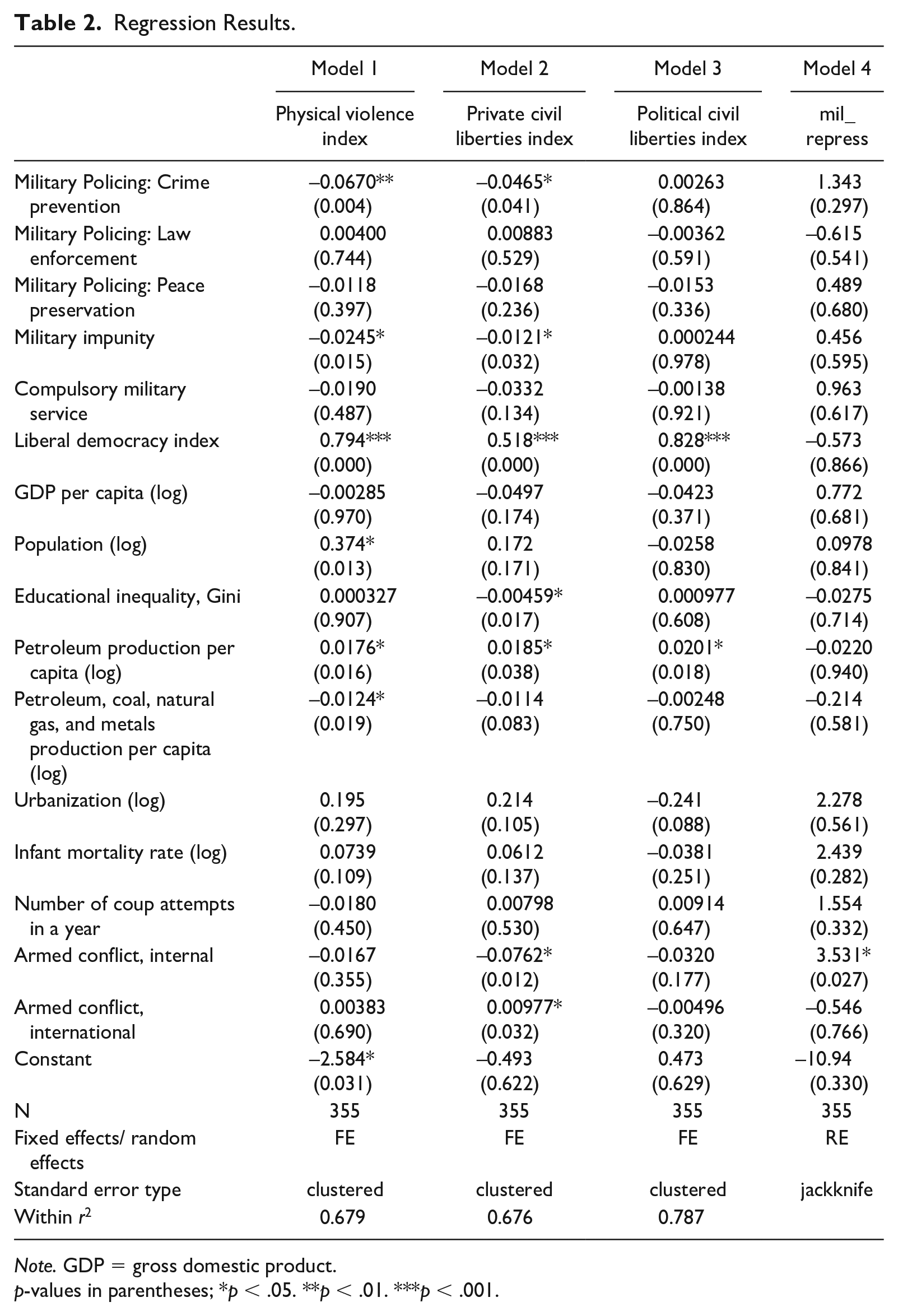
Note. GDP = gross domestic product.
p-values in parentheses; *p < .05. **p < .01. ***p < .001.
In Model 1 and Model 2, only crime prevention has a significant (negative) effect, suggesting that military crime prevention increases physical violence and decreases private civil liberties, albeit relatively small in magnitude. This may be explained by the fact that our dataset provides data on the occurrence of military policing in its three dimensions in a specific country–year but not the frequency with which military personnel is deployed in this role or on the scale of such operations. Similar to military crime prevention, military impunity appears to significantly increase the level of physical violence and decrease the level of private civil liberties. Model 3 suggests that neither military policing, military impunity, nor military conscription have a statistically significant impact on changes in political civil liberties—all coefficients fail to reach statistical significance. 9 The results for military law enforcement, peace preservation and conscription in Models 1, 2, and 3 indicate a negative impact on physical violence, and political and private civil liberties, although they fail to reach statistical significance. Although prior research suggests that direct control of paramilitary units does not play a decisive role in the violence or human rights crimes attributed to them (Koren, 2015; Stanton, 2015), these results may be influenced by the fact that we exclude paramilitary forces that are not under the command of the MoD (e.g., border guards in Israel). In Model 4, we estimate the effect of the different dimensions of military policing, military impunity and conscription on military repression. 10 In this model, all three dimensions of military policing as well as military impunity and military conscription produce insignificant results. In sum, the main models indicate that crime prevention is the only factor that is significantly correlated with civil liberties and physical violence. Neither conscription nor impunity significantly affected the outcomes. Our results are consistent with, but also challenge, the earlier findings of Flores-Macías and Zarkin. Indeed, we find support for the negative effect of military policing, which increases physical violence and decreases private civil liberties. Globally, however, it appears that this effect is not so much the result of law enforcement by the military as it is the result of military deployment in a crime prevention role. Worryingly, this is precisely the role that the military has been increasingly assigned around the world, probably as a result of the so-called war on terror.
Conclusion
Militarization around the globe is far from diminishing. After declining shortly after the end of the Cold War, military budgets are now reaching new highs every year. While the military’s political influence seemed to have diminished in the wake of the third wave of democratization, an increasing number of coups suggests that the military is back in (political) business. Moreover, as our analysis of military policing illustrates, some militaries have recently expanded their “civilian” missions by taking over the fight against drugs and terrorism or establishing businesses and industries. In other words, we can currently observe processes of militarization along all three dimensions of our concept.
The M3-Dataset is a first attempt to provide data to capture militarization more comprehensively along the dimensions of material, political and societal militarization. It merges already existing data with new original data in one dataset. The M3-Dataset is thereby far from exhaustive: Especially the new dimension of societal militarization is hitherto covered only rudimentary. Aspects like the militarization of the education and health system, or the role of the military as development agent (building infrastructure and providing services) are highly relevant to this dimension as well. Thus, gradually expanding the dataset—by increasing its coverage and adding new indicators—is an ongoing task. Nevertheless, we think that the dataset in its current form will help to stimulate new debates about the drivers and impacts of militarization by providing a basis for new empirical research.
By providing data on the hitherto neglected dimension of societal militarization and by conceptually linking the process of militarization to the changes in intra-societal relations (regime–military–society), the dataset can further help to bridge the gap between scholars in the field of political sciences, who are mainly concerned with narrower questions of civil–military relations, and those in other disciplines such as sociology, ethnology, psychology, and cultural studies, who are mainly concerned with broader civil–military interactions.
In addition to traditional applications in democratization, regime stability, and conflict research, the dataset opens up new areas of research, in particular the interdependence between different forms of militarization, such as how high levels of political militarization correspond to the allocation of resources to the military, or the extent to which a military can minimize some political control when it becomes an economic actor. Such research could also contribute to the further development of the concept of militarization by allowing us to distinguish between different forms of militarization and ask more specific questions about their origins and effects.
Supplemental Material
sj-docx-1-afs-10.1177_0095327X231215295 – Supplemental material for Multidimensional Measures of Militarization (M3): A Global Dataset
Supplemental material, sj-docx-1-afs-10.1177_0095327X231215295 for Multidimensional Measures of Militarization (M3): A Global Dataset by Markus Bayer, Aurel Croissant, Roya Izadi and Nikitas Scheeder in Armed Forces & Society
Footnotes
Acknowledgements
We would like to acknowledge the excellent work of our research assistants, Max Rother, Pascal Werle and Charlotte Rohrer.
Declaration of Conflicting Interests
The author(s) declared no potential conflicts of interest with respect to the research, authorship, and/or publication of this article.
Funding
The author(s) disclosed receipt of the following financial support for the research, authorship, and/or publication of this article: This research was supported by the German Foundation for Peace Research (Grant # FB1-PIL-01).
Supplemental Material
Supplemental material for this article is available online.

Notes
Author Biographies
References
Supplementary Material
Please find the following supplemental material available below.
For Open Access articles published under a Creative Commons License, all supplemental material carries the same license as the article it is associated with.
For non-Open Access articles published, all supplemental material carries a non-exclusive license, and permission requests for re-use of supplemental material or any part of supplemental material shall be sent directly to the copyright owner as specified in the copyright notice associated with the article.
