




Abstract
Gallantry medals are invested with deep significance not only by the armed forces but also by civilian society. In the last decade, there has been a debate in sociology about whether the medallic regime has become post-heroic or whether it has professionalized. This article contributes to these debates by focusing on the topic of fraudulent medals. Fake medals are very rare; there has been one proven case in the United Kingdom in the last 20 years. However, precisely because fake medals are the exception, their pathologies illustrate the processes by which medals are actually awarded with particular clarity. This analysis of the fake medal shows that gallantry awards have professionalized; in the UK medals have become more meritocratic, recognizing skill not status. The awarding process is also more objective. Yet, its very professionalism is ironically vulnerable to a specific type of fraud by skilful but cynical citation writers.
Introduction
Sociologists have long been interested in heroism. Charles Cooley (1897) conducted an early study of genius and, of course, Max Weber’s concept of charisma might be read as an analysis of the social and political significance of heroism (Weber, 1978). Sociologists have remained concerned with various aspects of the phenomenon of heroism to this day (Featherstone, 1992; Frisk, 2019; Schwartz, 1983, 1985, 2008; Seale, 1995). Sociologists have also been attracted to the specific question of military heroism—with good reason. It is a striking social fact that, in combat, humans have been recurrently willing to risk or even sacrifice themselves for their comrades. It may be the most extreme exemplification of collective action at work and, therefore, a vindication of the discipline of sociology itself; it demonstrates that humans are fundamentally social animals attuned to the collective good, not rational actors, prioritizing their own self-interest. Indeed, both Weber and Durkheim remarked on the topic of military sacrifice (Durkheim, 1965, pp. 251–252; Weber, 2003, p. 225). In addition to the philosophical significance of heroism, states and governments have regularly exploited heroism and heroes to mobilize support, or to exert power and social control (Mosse, 1994). It is unsurprising, then, that military heroism has consistently attracted the attention of sociologists.
Sociologists have examined military heroism in a number of different ways. They have examined battlefield performance to show when heroism (and cowardice) might be possible (Arkin & Dobrofsky, 1978; Ben-Shalom et al., 2005; Blomberg, Hess, & Raviv, 2009; Cockerham, 1978; Janowitz & Shils, 1948; King, 2006, 2013; Little, 1964; Winslow, 1999). They have examined cultural representations of heroism, often through the lens of commemoration (Ase & Wendt, 2017; Ben-Ari, 2005; Bury, 2017; Cavender & Prior, 2013; King, 2010; Scheipers, 2014; Wagner-Pacifici & Schwartz, 1991; Wendt, 2018). However, a small—but very fertile research field—about heroism has focused not on heroic acts on the battlefield themselves, but rather on their formal, post factum military recognition: medals (e.g., Blake, 1973; Blake & Butler, 1976; Frisk, 2017, 2018, 2019; Lachmann & Stivers, 2016; Mathers, 2018; Powel, 2018). Gallantry medals are the concrete military signifier of heroism: they are synecdoches of valor. Of course, the armed forces have long recognized their significance. Precisely because medals can become magical totems, signifying acts of bravery, sociologists have widely recognized their importance and interest.
In this article, we explore gallantry medals, focusing on the British armed forces during the Iraq and Afghan Wars, 2001–2020. The British armed forces award four types of medal. In the United Kingdom, service personnel receive operational medals, denoting their participation on a specific mission or campaign; for instance, all the personnel who served for at least 28 days in theater received Iraq or Afghan (Operation Telic or Herrick) campaign medals. Personnel also receive medals for leadership and dedication; in the United Kingdom, the Distinguished Service Order and various other Orders, like the Order of the British Empire, are awarded. Gallantry awards also exist for acts of bravery not in contact with the enemy; the highest of these is the George Cross, nine of which were awarded in Iraq and Afghanistan—three to IED Disposal personnel. Finally, there are gallantry awards reserved exclusively for acts of valor in battle in the face of the enemy. Because we are interested in heroism, we focus only on these gallantry medals, the Victoria Cross, the Conspicuous Gallantry Cross, and the Military Cross (see Figure 1).
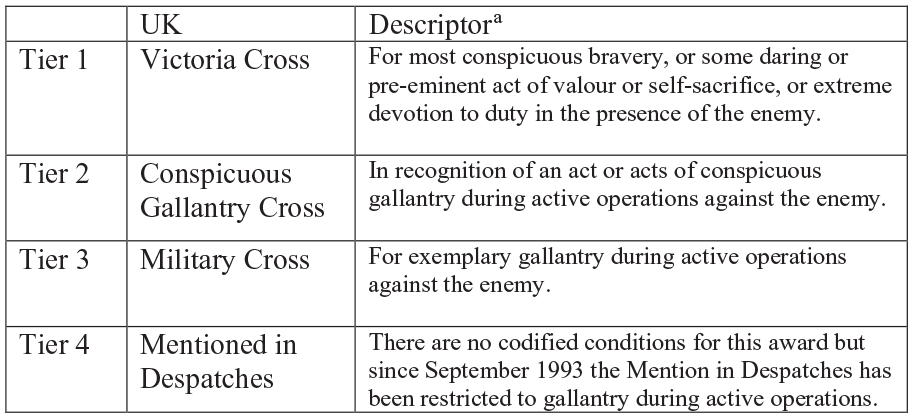
The UK Gallantry Medal Hierarchy.
This article takes an oblique look these medals though. We concentrate not on gallantry medals which have been bestowed on the basis of honorable actions in Iraq and Afghanistan, but on the much rarer cases of fraud. We are interested in cases when soldiers received awards they did not deserve. How do fraudulent cases help us understand military heroism in the 21st century? Clearly, the fake medal tells us nothing about actions on the field of battle; they are inventions, or gross exaggerations, of what occurred. Yet, this makes fakes very interesting, even though they are understudied, as Elishewah Weisz has recently noted (Weisz, 2023). Medals are the product not just of military action, but also of bureaucratic process. They involve complex processes of assessment and adjudication. It seems possible that the fake medal might actually offer a unique insight into this medallic regime. Precisely because it is pathological, the fake award might illustrate the central principles of the medallic system with particular force. It shows how the system is organized and where its vulnerabilities are. In this way, the fake medal highlights the values which the armed forces prioritize and the ways these values are sometimes imitated by knowledgeable actors. Consequently, the fake award might provide a good lens to understand how the armed forces define heroism today.
Post-Heroism or Professionalism?
In the 1970s, Joseph Blake conducted important work on medals (Blake, 1973; Blake & Butler, 1976). In the light of the campaigns in Iraq and Afghanistan, sociologists have become very interested in medals again. Writing in the 1970s, as the citizen army was being replaced by a professional force, Blake was interested in equality in the military. In the last decade, the scholarship of medals has focused on a more specific question. In 1995, Edward Luttwak published a highly influential paper, “Toward Post-Heroic War” (Luttwak, 1995). Luttwak’s concept of post-heroism was intended as a strategic injunction. In the light of the end of the Cold War and rise of regional instability in the Balkans and central Africa, Luttwak recommended that western leaders should exploit trade embargoes and blockades, while using precision munitions to strike opponents at a distance, to minimize the risk to their own troops.
The concept of post-heroic war was quickly lifted from Luttwak’s intended strategic meaning to refer not just to warfare, but to military culture itself. It became a fertile concept for analyzing the armed forces of the post-Cold War era (e.g., Scheipers, 2014). It referred to a general trend among western forces toward casualty aversion. Scholars noted the increasing reliance on automated weapon systems such as drones to reduce or even avoid military losses (Coker, 2013; Levy, 2012; Shaw, 1991, 2005). At this point, the concept of post-heroism began to be applied to the analysis of gallantry medals. Scholars began to contemplate a post-heroic thesis of gallantry. If warfare had indeed become increasingly post-heroic with the proliferation of automated and remote systems, then, it followed that personal valor on the battlefield became less relevant. It would be difficult to give a gallantry medal to a drone pilot sat in a control center thousands of miles from the frontline. But have gallantry medals become irrelevant? There has been a significant debate in the sociological literature about whether a distinctive post-heroic medallic regime is or should now be evident. Scholars have been interested whether, as acts of physical heroism on the battlefield have putatively receded, medals might be awarded for different qualities; or, perhaps, not at all. Some scholars have argued that a post-heroic regime is now evident. In line with casualty aversion, they claim that, in Iraq and Afghanistan, medals were awarded for life-saving, not killing (Lachmann & Stivers, 2016; Mathers, 2018), and in Afghanistan in particular, “a courageous restraint.” In their longitudinal analysis of the Congressional Medal of Honor (MoH), Richard Lachmann and Abby Stivers conclude: “Judging from the actions rewarded with MoH, both commanders and troops in the field now give priority to preserving soldiers” lives over defeating the enemy (Lachmann & Stivers, 2016, p. 352). In a similar examination of US medal citations in Iraq and Afghanistan, Jenny Mathers suggests there has been an evident shift in the medallic regime. She asserts there is “a clear trend favouring defensive over offensive acts of heroism in the Medal of Honour since the Vietnam War” (Mathers, 2018, p. 43).
Other scholars disagree. Most notably, Kristen Frisk has argued that medals have become professionalized (Frisk, 2017, 2018, 2019). Traditional bravery on this account is still important. Soldiers still risk themselves for their comrades as they fight the enemy. However, personnel are rewarded not just for personal heroism but rather, for exceptional expert performance, often as part of a team. Heroism has professionalized and gallantry medals are now awarded for skill, as much as raw individual valor.
Our analysis of fake medals is intended as an intervention into these debates about post-heroism and professionalism. On the basis of our analysis of the fake medal, we claim that military heroism has indeed professionalized in the 21st century; we concur with Frisk, not Lachmann and Stivers. We note three developments. In the United Kingdom, gallantry medals have become more meritocratic; professional expertise rather than personal bravery is preferred. There has been a mild inflation in awards. Finally, the awarding system itself has professionalized. It has become more objective, rigorous and standardized (Huntington, 1957; Janowitz, 1960; King, 2011, 2013, 2019). The post-heroic thesis has little to say about the awarding process, even though it is critical to understanding medals. Ironically, however, in the 21st century, this analysis also shows that the very professionalization of the gallantry award system has itself opened up the possibility of a special type of fraudulence. Awarding committees actively want to decorate professional soldiers. Highly capable (i.e., professional) citation writers have, therefore, been able to suborn the system; they have sometimes exaggerated actions, or in extreme cases, invented them. The existence of the fake medal is part this process of professionalization. This article focuses on the United Kingdom, but in the conclusion, we extend the analysis to the United States where in the last 20 years, there have also been some cases of fraud.
The Fake Medal
Fake medals are very rare but there have been some notable examples in the last 20 years. There has, for instance, been one proven case of fraud in the United Kingdom. In 2008, the 1st Battalion, The Royal Irish Regiment served in Helmand on an intense combat tour with 16 Air Assault Brigade. The battalion received 18 awards, including three Conspicuous Gallantry Crosses (CGC) and three Military Crosses (MC). Most were deserved. However, it later transpired that one of these medals was fraudulent. Major Robert Armstrong–attached to the battalion in Helmand from the Royal Artillery–was awarded a Military Cross. In his written citation, it was claimed he had rallied Afghan troops under fire in response to a Taliban ambush. Although the Royal Irish were exonerated of any fraud, an investigation later revealed significant disparities between what Armstrong claimed had happened and the reality of the incident, and a number of outright falsehoods in his claims. 1 He was court-martialled on other charges, and, in an unprecedented move, later stripped of his medal.
Fraudulent awards remain a very minor feature of the British decoration system but there are several other suspected cases. For instance, on November 12, 2021, the BBC news in the United Kingdom reported that Deacon Cutterham, a former sergeant in the Rifles Regiment, was putting his service medals up for auction for £140,000 ($120,000). 2 In addition to operational medals for tours to Iraq and Afghanistan, his collection included a Conspicuous Gallantry Cross, the second highest award for bravery in the United Kingdom, just below a Victoria Cross. Cutterham’s Conspicuous Gallantry Cross was one of only fifty-four awarded throughout the entire campaigns in Iraq and Afghanistan and was extremely valuable to collectors. He had been awarded this medal after he risked his own life disposing of a live grenade, thrown by the Taliban, while on patrol in Helmand in 2011.
Cutterham’s act seemed to be one of the many striking acts of battlefield bravery which occurred in Iraq and Afghanistan. Yet, with the announcement that he was going to profit from the sale of his gallantry medal, his former comrades came forward to express their discontent. They were unhappy not only that he was going to sell his medals but, more particularly, that Cutterham’s decoration was specious. They insisted that they had always opposed Cutterham’s award which they believed was fraudulent. According to the rest of his platoon, there were no Taliban in the area when Cutterham claimed the patrol had been attacked. They believed that rather than a Taliban grenade, Cutterham had simply used one of his own grenades: “We believe a grenade was thrown, but it was his.” It was noticeable that the patrol had taken 32 grenades out on the patrol that day but only 31 were ever returned. Both Cutterham and the MoD have defended the awarding process. As Cutterham rightly noted: “The citation wasn’t written by me, it was written by the commanders. The award is rigorously tested through several committees before being granted.” 3 His colleagues also freely admitted they did not like him, so personal animosity may have motivated their complaints. Nevertheless, Cutterham was accused of concocting the entire episode to win a medal.
While the overwhelming majority of decorations were well deserved in Iraq and Afghanistan, as indeed Cutterham’s Conspicuous Gallantry Cross might have been, questions have been raised privately about the legitimacy of some gallantry awards. Rumors of fakes circulate. In many cases, the concerns have not been that a particular award was utterly fraudulent, but that some might have been exaggerated. Although a unit deserved some recognition for a challenging tour, particular individuals were lucky to receive the decoration they were eventually awarded; they did not personally deserve them (Bury, 2017). At some point, the line between exaggeration and outright fake is blurred. The Ministry of Defence (MoD) awarded 359 gallantry medals during the campaigns in Iraq and Afghanistan. One has been proven false (0.27%). It is possible that perhaps a little under 1% of the medals awarded for Iraq and Afghanistan were fraudulent; there are more exaggerated decorations but it is very difficult to specify how many. Genuine fakes are very rare; they are the exception. However, they are deeply interesting.
It is noticeable that the United Kingdom is not alone here. There have been several cases of fraud in United States. For example, a posthumous Silver Star was awarded to high-profile former American footballer Ranger Pat Tilman in Afghanistan for putting “himself in the line of devastating enemy fire.” It was subsequently proven he was killed by friendly fire. The Tilman case was tragic. A national sporting star had been given up his lucrative career to defend his country. Nevertheless, however noble their motivations, the awarding body knew that Tilman’s citation was not accurate. Questions have also been raised about a US Marine sergeant, Dakota Meyer. Meyer was awarded a Congressional Medal of Honor in 2009 for his role in saving colleagues who had been caught in a Taliban ambush in Kunar Province. His case is not as remotely egregious as Armstrong case; there is no question that he performed courageously on the day of his citation and deserved a medal. However, some have questioned whether his actions were not somewhat inflated by the chain of command (Report: “Marines Promoted Inflated Story For Medal Of Honor Recipient,” NPR, 15 December 2011). Indeed, Meyer himself always insisted that an army colleague, Sergeant Swenson, was more deserving of a medal than him. Other frauds have also come to light. In his recent book, John Spencer recorded a clear case of fraud in Alpha Company, 1st Battalion, 68th Armor Regiment in Baghdad in 2008. One of the squadrons in this Battalion repeatedly fired into Sadr City in the hope of provoking the population and starting a fire-fight. A sergeant and his squad leaders were awarded Bronze Stars with a “V” device for their actions; “It was total nonsense” (Spencer, 2022, pp. 124–125). Indeed, Spencer described the sergeant as a “con man” (Spencer, 2022, p. 124).
These cases are not entirely new in the United States. There was an infamous case of medallic fraud in the 1990s. In 1996, Admiral Mike Boorda was accused of falsely wearing “v” insignias, denoting he was a combat veteran, on his Navy Commendation Medal and Navy Achievement Medal which he had legitimately won in 1973 and 1965. A media storm ensured, led by Colonel David Hackworth who, having fought in Vietnam, was incensed. Boorda shot himself on 16 May 1996 (Shenon, 1997). 4 There were suggestions that he might have misunderstood the Navy’s ruling on this combat decoration, though Boorda told colleagues before his death that he did not want to bring the Navy into disrepute over the matter. The Navy later stated he was not entitled to wear the “v” insignia. Hackworth decried Boorda’s actions: “It is simply unthinkable that an experienced officer would wear decorations he is not entitled to, awards that others bled for. There is no greater disgrace” (Shenon, 1997). The Boorda case is somewhat different to recent examples, such as Tilman, Meyer or the sergeant from 1/68. No citation was involved. Boorda had, by accident or design, arrogated himself the right to wear a combat veteran decoration. His case was an example of medallic fraud, like the others, though.
The Medallic System
Fraud is always intriguing. The specific mechanics of contemporary gallantry fraudulence are especially interesting because, ironically, the armed forces have tried to make the awarding regime more transparent, fairer and more objective. For instance, in the last two decades, the British armed forces and the MoD in the United Kingdom have gone to extensive lengths to improve the integrity of the system. The British Armed Forces tightened the awarding system in the 20th century, banning on-field decorations and implementing standardized reporting. After 2003 as a result of the Iraq and Afghan Wars, the armed forces were once again in sustained and intense combat; it was necessary to award many medals every year. The increased demand for medals put pressure on the system, demanding rationalization. The MoD, therefore, conducted a review of the medal system (Holmes, 2012) and much internal work on the process. It published repeated updates of Joint Services Publication 761 Honours and Awards in the Armed Forces, the key policy document for medals. Since 2008, the British medallic system has been substantially revised and improved.
There are two main ways in which the system has been altered. First, the medallic system itself has been rationalized. Gallantry medals have been re-organized into a clear hierarchy consisting of four levels. Each level has been aligned with non-operational awards and with other kinds of military and civilian awards (see Figure 1).
Second, the awarding procedure has itself also been improved. The MoD has clarified the process by which medals claims are proposed and then assessed. One of the most important developments here has been the changes which the MoD has instituted to the citation. In the Victorian Army, medals could be awarded in the field by commanders. This has not been the case for over a century. Decorations are awarded on the basis of citations: reports normally written by the officer in command of the action, the “initiating officer.” In the last twenty years, the MoD has paid great attention to the citation. For instance, Honours and Awards in the Armed Forces has standardized the format of the citation and instructed personnel how to write citations properly (MoD, 2014, pp. 1–3). Above all, citations must be confidential: “Recommendations for awards is in confidence. In no circumstances should individuals became aware from an initiating officer or anyone else that they have been recommended for an award” (MoD, 2014, pp. 1–3). This may seem strange but there are coherent reasons for confidentiality: “Disclosure of a recommendation can cause much disappointment if the recommendation fails” (MoD, 2014, pp. 1–3). Yet, confidentiality has another potentially more important purpose. If citations were submitted to informal tribunals within a military unit, the fear is that politics might infect the process. Popular soldiers or officers might be selected for a medal (as they were in the Victorian era); officers might even put pressure on soldiers to recommend undeserving individuals for awards. In short, in the last two decades, the awarding process has been rationalized and standardized; it has become more professional. Every effort has been made to ensure it is fair and meritocratic. The reforms reflect the process which Keith Macdonald observed when he suggested that a more professionalized military culture might be displacing the traditional public school habitus of the officer corps (Macdonald, 2004, p. 127) Yet, despite all these efforts, a small number of frauds remain. It is an intriguing anomaly.
The Research
Gallantry medals are awarded for acts of bravery on the battlefield. They signify an identifiable moment—an act of heroism. The connection between the act and the award should be direct and instrumental. It should be very easy to determine who deserves a medal. Heroes should be obvious. Yet, most observers are acutely aware of an anomaly in military medallic recognition. Winston Churchill described the problem eloquently in March 1944:
A medal glitters, but it also casts a shadow. The task of drawing up regulations for such awards is one which does not admit of a perfect solution. It is not possible to satisfy everybody without running the risk of satisfying nobody. All that is possible is to give the greatest satisfaction to the greatest number and to hurt the feelings of the fewest. (Holmes, 2012, p. 2)
Churchill identified the fundamental tension with military decorations. Although medals are designed to recognize valor objectively, the fact is that many, indeed, most soldiers, who might deserve a medal, never receive one. To preserve the intrinsic value of the award, medals have to be strictly rationed; inflationary dangers have to be resisted if the entire system is not to collapse. A system of adjudication and selection is, therefore, required. However fair and transparent it tries to be, this system cannot be entirely objective. In the course of assessing the merit of different cases, extraneous factors necessarily intrude which influence the awarding regime, favoring some candidates over others.
Although awarded for acts of valor in combat, the central explanation of how medals are awarded—and who gets them—cannot, ironically, be located on the battlefield alone. Acts of bravery are the necessary, not sufficient, condition of military decoration. If they were, everyone who acted bravely would get a medal. Yet, they do not. Fake medals affirm the point most forcefully; in these cases, there was no original acts of bravery and yet an award was made. Paradoxically, the ultimate locus of the gallantry award is not the field of battle, but in fact the bureaucratic apparatus, the committees and meetings, and the artifacts of the awarding system, the citations and forms, which ultimately determine awards. After all, the awarding bodies never see the acts themselves. They respond to the evidence which is presented to them in the citations and discussed in meetings. Since medals are not defined by acts of bravery alone, they can be fully understood only by analyzing the wider institutional processes in which those acts are recognized and individuals rewarded for them. It is necessary to look not at the medal, but at the awarding process. The case of fraud highlights this process of adjudication with particular force. In the current era, fraud is possible precisely because strictly rationed gallantry awards are awarded long after the acts they acknowledge on the basis of apparently rigorous paperwork.
To understand medal awards and the very possibility of fraudulence, it is, therefore, necessary to focus on the bureaucratic process which actually distributes—and rations—awards. In the United Kingdom, the crucial body is the Armed Forces Operational Awards Committee (AFOAC). This committee decides on all gallantry awards below the Victoria Cross. It is, therefore, the locus of medal awards. There is no suggestion that this Committee is remotely biased or corrupt. On the contrary, the awarding process is as fair as it is likely to be and the members of this Committee are hard-working professionals, committed to rewarding soldiers whom they believe have served gallantly. However, any appreciation of how fraudulence is still possible, despite the most dedicated efforts of its members, should focus on this Committee.
A gallantry award begins with an Initiating Officer who is in immediate command of the service-member who is being nominated for an award. The Initiating Officer writes the citation. Honours and Awards states that commanding officers are responsible for the initial oversight of the citation process. These citations are considered and counter-signed by the military hierarchy in the theater, the initiating officer’s Commanding Officer (CO) and then by a two-star commander; this is the first filtering process and the two-star general can request citations to be re-crafted to better capture an action if they think the citation has not done it justice. All these citations are then sent to the Chief of Joint Operations (CJO) at Permanent Joint Headquarters for ranking and further adjudication (Interview 2, June 18, 2020). The CJO decides with which citations to proceed. Normally for every 70 citations proposed to Chief of Joint Operations, about 30 will go forward to the AFOAC. An important division occurs here. At this point, potential citations for Level 1 awards (VC and George Cross) are assigned to a separate joint civilian and military awarding body. Meanwhile, all the other awards go forward from the Chief of Joint Operations to AFOAC.
AFOAC is the decisive tribunal in terms of all Level 2–4 awards for the Armed Forces and its workings therefore reveal the way in which awards are now made—and how fraudulence is possible. AFOAC is a small committee of six senior officers: one from each of the services, the Chief of Staff Permanent Joint Headquarters, a military secretary and a three-star chair (which rotates between the services). AFOAC meets twice a year to consider all citations submitted from the Chief of Joint Operations with that officer’s recommendations. If we want to understand how false medals have been awarded it is necessary to pay close attention to AFOACs as it is the decisive tribunal for all medals below the VC.
Accordingly, we collected qualitative interview data. Our interview approach was process tracing—to understand how the current awards system evolved and how it works today. Over 2020–2021, we conducted eight interviews with former and serving British Army officers with deep expertise of the medals awarding process. These were selected by case relevance basis to provide data on the system from all points within the reporting chain, bar the actual recipients themselves. Our participants represented key points in the professionalized awards process (discussed in detail in the following section) from the initial citation through to the eventual award to triangulate evidence from every point. These included a former Commanding Officer responsible for sifting and pushing recommendations up the chain of command, a former senior officer who had written citations as a Commanding Officer and then sat on formation-level awards committees, a former member of AFOAC, a former Chair of AFOAC, and a former Chief of the General Staff who served as Deputy Chief of Joint Operations (CJO) and also chaired AFOAC of behalf the Chief of Joint Operations. Although the interview sample size is small, given the sensitivity of the topic, it must be noted that it represents unparalleled access in the British case. To ensure accuracy, participants provided critical feedback on earlier drafts. Participants consented to partake under full anonymity and had full control over quoted material.
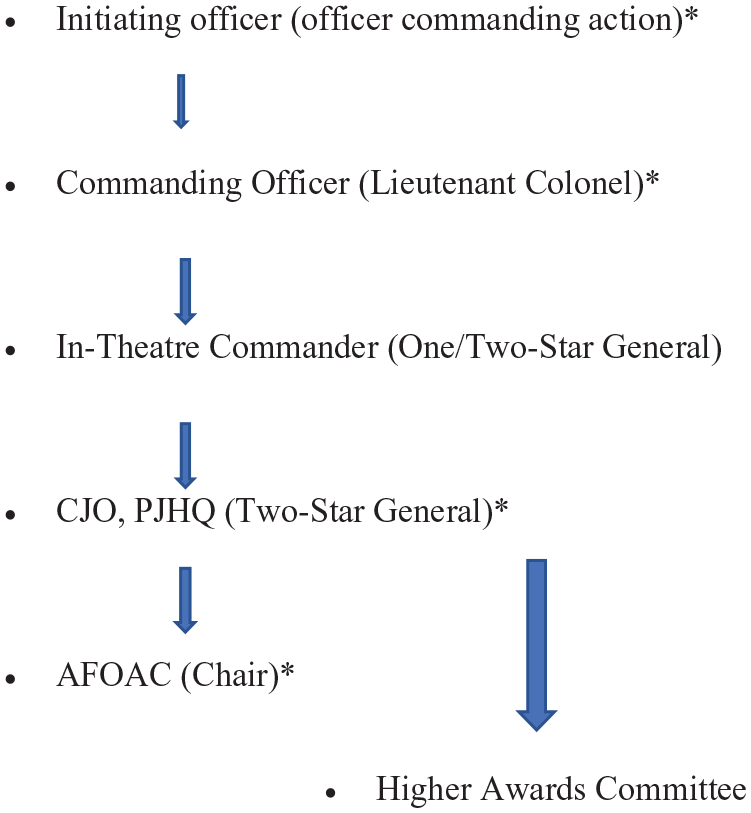
The Awards Process.
This was complemented by quantitative data. We collected quantitative data from the Victorian era and 20th century British Army (e.g., Smith, 2008). For the 21st century, this data was collected from British Operational Awards and Honors Lists and The London Gazette. To calculate medal/casualty ratios, we examined quantitative British Army casualty data from official War Office/ MoD publications for both periods, excluding Commonwealth personnel. Using the Killed/Wounded in Action (K/WIA) medals ratio is an important new metric for the medals /heroism literature as it limits the effect of the profoundly important transformation of battlefield medicine that has occurred since the Second World War (Fazal, 2014). To gain the most comprehensive understanding we did not limit our analysis to individual British military operations in Iraq and Afghanistan, but included all army killed or wounded in action casualties until operations in the country ceased. We present and integrate this substantial and varied data in support of our arguments in the following sections. Because the award system has become more meritocratic, a slight inflation in the number of awards has occurred; AFOAC has been keener to recognize soldiers like Deacon Cutterham and awarded more enlisted personnel. Finally, as the citation has become a critical piece of evidence to ensure greater objectivity and fairness, it has, ironically, facilitated a novel type of fraudulence. Precisely because the awarding process has become more meritocratic, and transparent, it has actually made itself vulnerable to a special kind of fraud: the elaborately fake citation.
Meritocratization
In 1992, John Major was elected as Prime Minister. Although a Conservative, he was from a modest background and sought to implement measures which overcame traditional barriers in Britain; he announced a “classless society.” He applied the principle to the military as well as civil society. In the military sphere, the reform and rationalization of gallantry awards was one of his most obvious successes. The Military Cross had been established in 1914 for junior officers; it was intended to recognize leadership in combat. Later in 1916, the Military Medal was instituted to recognize the gallantry of enlisted men, in line with a demand from Kitchener’s Armies. As a result, the Military Medal was more directly related to combat gallantry than the MC in the army. The distinction between the two endured until October 1993. At that point, under government instruction, the Review Committee abolished rank restrictions on all gallantry awards. As a result, the Military Medal was abolished, folded into the Military Cross. From 1993, soldiers and officers alike were awarded the MC (Ryder, 1997a, 1997b). At the same time, there was a recognition that the gap between the Victoria Cross and other awards was too wide; “basically you had to die to get a VC” (Interview 4, March 19, 2021). Consequently, the newly instituted Conspicuous Gallantry Cross (the medal Cutterham won) replaced the Conspicuous Gallantry Medal and Distinguished Conduct Medal as the new Level 2 award for all services.
Blake asserted that medals were awarded to officers to advance their careers. By contrast, British gallantry awards in the last two decades have not been obviously careerist in the way Blake asserts. On the contrary, and in stark contrast to either the Victorian era or the 20th century, honors have become decidedly meritocratic in the British army today. This is very clear with the award of VCs in this century. In the 19th and 20th centuries, officers were always disproportionately represented in Victoria Cross awards (Smith, 2008). Even in the Falklands, one of the two VCs awarded went to an officer, the other to a senior sergeant. However, in the last fifteen years, all four VCs have been awarded to junior enlisted soldiers; three to corporals (Budd, Ashworth, Leakey) and one to a private (Beharry). The democratization of awards is not simply demonstrated at the level of Victoria Crosses. On the contrary, it has been a general pattern in British gallantry awards in the last two decades. The pattern endures to the Conspicuous Gallantry Cross. While only seven officers won this medal in Afghanistan and none in Iraq, 47 enlisted soldiers were awarded this decoration for both campaigns. 46% of these were privates or corporals in Iraq and 69% in Afghanistan. The Conspicuous Gallantry Cross has become a junior soldier’s decoration. Only with Level 3 Military Cross does the old pattern begin to return. In Iraq and Afghanistan, British Army officers won 78 Military Crosses in both campaigns; 36% of all Military Crosses awarded in Iraq and 32% in Afghanistan. Officers have been somewhat overrepresented in Level 3 awards, then, but this is more than offset by their near absence from Level 1 and 2 awards. Of course, there have also been compensations for officers in that only they have been awarded Distinguished Service Orders for service in Iraq and Afghanistan.
It is not simply that only enlisted soldiers have won VCs, in contrast to previous eras; the leadership qualities of these soldiers were often identified in their citations and became a central reason for justifying the awards to them. In each case, they had taken on command and leadership responsibilities which exceeded their formal rank. They have assumed responsibilities in a manner which reflected the professional ethos which British forces declare for themselves: “The lower down you get, when you have citations for soldiers, for Junior Non-Commissioned Officers who have stepped up one or two ranks, when a corporal takes charge. I saw that this was a trend of Bosnia, Kosovo and Sierra Leone. Soldiers were recognised when the chain of command was absent and they had stepped up above their pay grade” (Interview 3, September 10, 2020). The British armed forces rewarded enlisted soldiers who embodied the professional values which it professed. These awards reflected its doctrine of empowering junior leaders to make decisions.
Joshua Leakey’s citation provides the best evidence of this. Leakey was awarded a VC in 2015 for taking command of an action against a Taliban attack in 2013 in which his US Marine commander had been wounded. He organized the extraction and personally rescued wounded US Marines under fire. His citation repeatedly emphasizes that he assumed command and acted in a way which far exceeded his rank:
Despite being the most junior commander in the area, Lance Corporal Leakey took control of the situation and initiated the casualty evacuation . . . Having regained the initiative, Lance Corporal Leakey handed over the machine gun and led the extraction of the wounded officer to a point from which he could be safely evacuated. During the assault 11 insurgents were killed and 4 wounded, but the weight of enemy fire had effectively pinned down the command team . . . Displaying gritty leadership well above that expected of his rank, Lance Corporal Leakey’s actions single-handedly regained the initiative and prevented considerable loss of life, allowing a wounded US Marine officer to be evacuated.
5
Although his citation did not come to the AFOAC, the chair of that committee was struck by it: “Leakey’s citation was the most extraordinary statement; Joshua Leakey was the most junior commander on the battlefield and yet he took command” (Interview 1, August 13, 2020). For this officer, Leakey’s VC was the most obviously deserved award which he had seen. Another officer confirmed this active recognition for soldiers who had assumed more responsibility than their formal rank. A professionalized force which encourages initiative from enlisted soldiers and very junior commanders increasingly rewards personnel who fulfill this ideal. However, there has been a clear shift in the awarding system, especially when contrasted with the 20th century. The armed forces have made an active and successful attempt to recognize and reward the contribution of junior service-personnel, not just for their bravery, but explicitly for their professionalism. It is an admirably democratic position but it opens AFOAC to the possibility of fraudulent claims. The Committee is actively looking to award gallantry medals to soldiers, in particular, just as the Army preferred to decorate officers in the 19th and 20th centuries.
Inflation
A central concept informs every AFOAC decision of whether to award a medal or not; the calculus of “risk and rigor.” The current medallic regime cannot be understood without understanding this concept. Risk and rigor are the quasi-objective criteria to which all officers refer as they judge the citations: they are the assessment criteria. Rigor is important; medals will be awarded when the conditions are arduous. Yet, uncomfortable conditions are not enough for medals to be awarded. The master variable is plainly risk; medals are primarily awarded on the basis of how dangerous an operation is. The higher the risk, the higher the level of award which might be made. In the past, awards committees operated with numeric metrics for the awards; to earn a VC, there had to be a 70% chance of dying. AFOAC no longer operates with objective metrics. However, the idea of risk is central to every judgment it makes; risk here refers to the dangerousness of an operation and therefore the potential jeopardy which a cited action involved. Clearly, the idea of risk is not objective. It is relative to operational conditions. Risk is circumstantial and contingent, ascending and falling depending on the kinds of campaigns in which the United Kingdom is involved. However, while no definitive risk calculus exists, the probability of being killed or wounded still plainly plays a major role in determining whether an individual is worthy. The more dangerous the situation, and the more likely that the candidate might die, then the more likely a medal will be awarded and the higher the level it is likely to be (Interview 2, June 18, 2020; Interview 3, September 10, 2020).
Danger remains the most potent reference for gallantry awards, then. Operations must be very dangerous for awards to be made. For a Level 1 or 2 award, the risks to life must be immediate. However, the economy of risk has changed somewhat in the 21st century. As Smith has shown, the medallic regime of the 20th century was extremely parsimonious. It was very difficult to earn a medal and almost impossible to win a VC and to survive. In the Second World War, for instance, 74 VCs were awarded to British Army members. As Table 1 highlights, with around 412,654 British Army personnel killed or wounded in action (K/WIA); this represented a ratio of one VC to 5,576 casualties. In the Korean War, this ratio dropped to 1:1,750. In Iraq it plummeted to around 1:620, before rising again in Afghanistan to 1:1,068. Clearly there has been an inflation in VCs recently. Other medals indicate a similar trend. The ratio for the Tier 2 Conspicuous Gallantry and Distinguished Conduct Medals, and the Distinguished Service Order was 1:86 in the Second World War. In Iraq, the replacement CGC to K/WIA ratio was 1:48, rising in Afghanistan to 1:110. Similarly, in Second World War, the Tier 3 Military Cross/Military Medal: K/WIA ratio was around 1:22. In Iraq, this dropped to 1:8, before rising again in Afghanistan again to 1:20. Clearly, these figures are not profligate. It remained very difficult to win a medal in Iraq and Afghanistan. Yet, while it was not a return to the liberal Victorian economy, the current regime appears more generous than the 20th century awards system, especially for Iraq. It appears somewhat easier to win a medal in the small professional army today than it was in a mass citizen army of the First and Second World Wars.
British Army Gallantry Award Ratios.
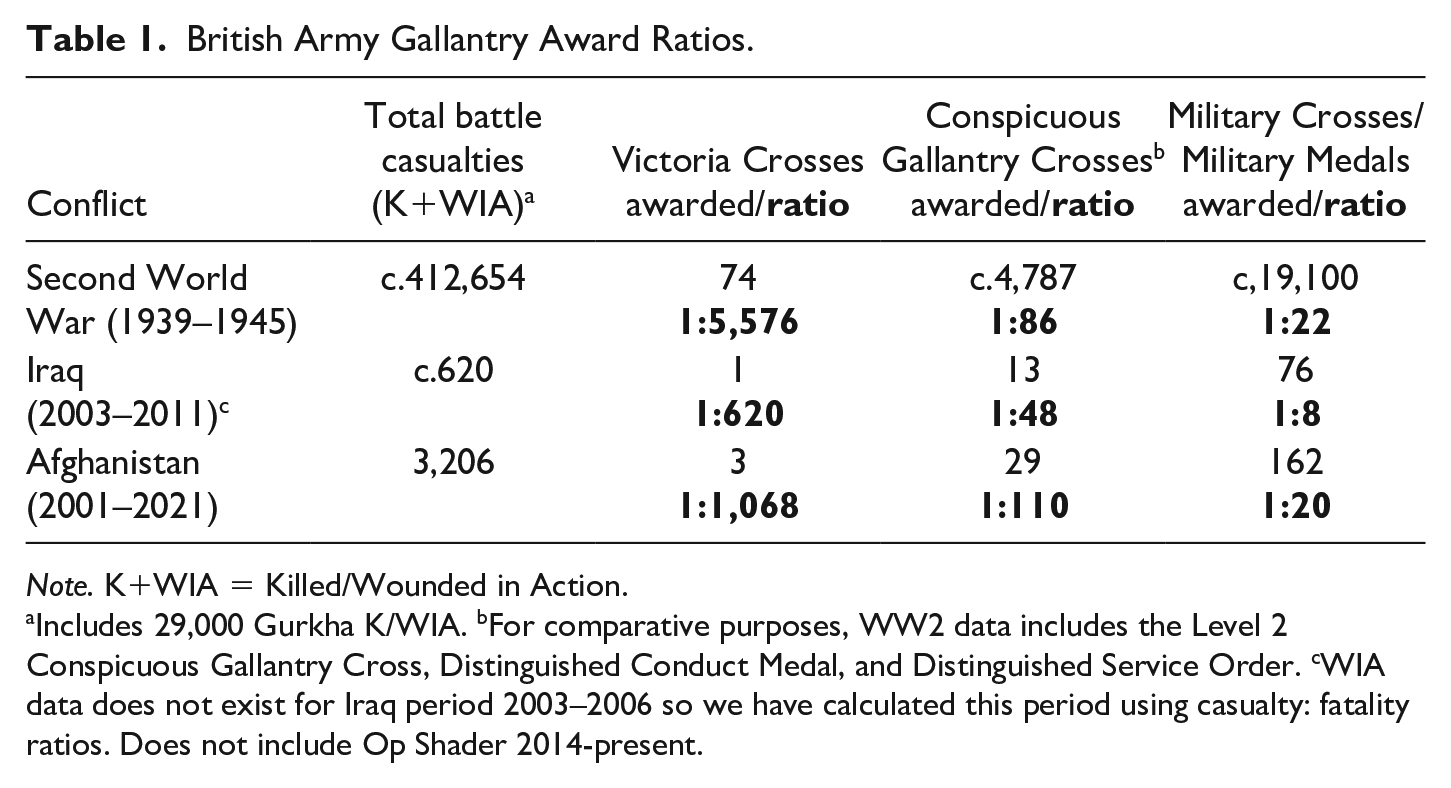
Note. K+WIA = Killed/Wounded in Action.
Includes 29,000 Gurkha K/WIA. bFor comparative purposes, WW2 data includes the Level 2 Conspicuous Gallantry Cross, Distinguished Conduct Medal, and Distinguished Service Order. cWIA data does not exist for Iraq period 2003–2006 so we have calculated this period using casualty: fatality ratios. Does not include Op Shader 2014-present.
Interlocutors questioned whether it is now easier to win a medal than it was in 20th century, reflecting their sensitivity to the issue. Yet, even when adjusting for different medals and better battlefield medicine and protection, the evidence is clear, and very pronounced for Iraq. Indeed, there were concerns about British gallantry medal inflation during these wars (Fears of “medal inflation” in the armed forces, The Daily Telegraph, May 3, 2009). In his work on the Medal of Honor, Blake claimed that the principal factors at work were careerism and propaganda; officers were decorated to advance their careers and to legitimate the armed forces to civilians. Blake (1973) would, therefore, claim that more medals are now awarded for propagandistic reasons to improve the public image of the armed forces or to advance the careers of officers. In fact, the career factor has played very little role in the mild inflation of British gallantry awards in the last two decades; officers have received relatively fewer decorations, especially at Levels 1 and 2. We can hypothesize that the inflation in medals might then have been an attempt to improve the reputation of the armed forces as it fought two unpopular wars, especially in Iraq. Indeed, the Iraq ratios appear to lend some weight to this hypothesis, in particular for the Victoria Cross award, which receives extensive media coverage. Yet, it cannot be true of the lower awards of CGC and MC which individually receive much less public mention; these awards are sometimes covered by local media outlets but often not at all. As one member of AFOAC noted: “A Victoria Cross makes a message splash, but a Military Cross is more of a murmur” (Interview 2, June 18, 2020).
Consequently, against Blake, it is possible that inflationary pressures may be less about public reputation but rather, internal military morale. In the 21st century, very small numbers of professional soldiers have volunteered to put themselves at risk on operations, by which the civilian population have been little affected or even had much interest in, and in the case of Iraq in particular, was also generally unpopular. Although the armed forces strongly resist any conscious inflation of awards to retain their value, they may have been unconsciously influenced by the need to reward professional soldiers for their exemplary service in unpopular wars that were not related to national survival. Medals have not been awarded for propagandistic purposes—to legitimate the armed forces for civil society—but rather to sustain morale. It is very noticeable that professional soldiers are very sensitive to medal awards. They actively want to go on operations so that they can win operational and, potentially, gallantry medals. Medals are the ultimate credential which distinguish military personnel from each other. As one informant stated: “It is about credibility. I have 15 medals. It is a question of credibility. You don’t need to explain” (Interview 1, August 13, 2020). Knowing the professional significance of a gallantry award, AFOAC has actively sought to reward enlisted personnel, as the previous section showed. The slight inflation of awards has not been for officers, but for soldiers and NCOs. The Committee’s desire to recognize soldiers for their professionalism seems to have fuelled a mild inflation in awards. It is in this context, that fake awards become possible. And even more so when one considers that due to rotational deployments and career paths personnel may realize that a certain incident is likely their only “window of opportunity” to be being awarded a gallantry medal—professional timing may matter too.
The Citation
The medal citation, a short report documenting an act and why it deserves recognition, lies at the heart of the professionalized award system. The officers that score the actions and the committees that judge them were not present when they occurred; they never actually saw the act of bravery. The only evidence they have is the document in front of them: the citation. The citation is ultimately the locus of the award, then. In the last two decades, the citation and its assessment has been systematized and professionalized. Yet, it has also become the locus of fraud. Indeed, it seems possible that the very process of rationalization has in fact facilitated the use of the citation for fraudulent purposes.
The AFOAC assesses every single citation in detail. Each of the six members of the Committee have two weeks to analyze the citations individually, assigning each to a particular level and then scoring it within that level. For example, a citation for a Military Cross is scored out of ten against the standards required for that award. A score of 8 or 9 indicates very strong support; 6 or 7 indicates good support. Below 5 indicates that the officer does not support the award. When the committee reconvenes, the members share their scores with each other, averaging their markings. At this point, AFOAC discuss problematic cases where there is a discrepancy of more than 2 marks between the members of the committee. When the members have all confirmed their marks, they aggregate them to reach a final score for each candidate. At this point, the Committee makes its final judgment “by cabinet decision” (Interview 5, April 6, 2021). Citations which average 6 or above stand a very good chance of an award, though the Committee may be constrained in awarding all deserving cases if there are numerous citations in that round (Interview 1, August 13, 2020). Indeed, typically the Committee is very constricted because there are quotas in place for the number of medals than can be awarded for any particular tour, on the basis of the size of the deployment.
The scoring process is crucial in AFOAC. How do the members of the AFOAC calculate the scores? Clearly, there is a subjective dimension to the scoring, reflecting these officers’ own operational experiences and their own interpretation of the citation. As a result, Mead has recently criticized the system as “no more than an informal set of guidelines established by erratically applied custom and practice implemented by a small group of senior officers according to opaque guidelines” (Mead, 2015, p. 216). This is an overstatement. The board is independent and consists of senior Army, Navy and Air Force personnel with the technical experience, and usually the combat experience, to help limit any single service bias or individual subjectivity (Interview 5, April 6, 2021). Great care is taken to assess the merits of each action within the context of rank expectation and technical aptitude, therefore. In addition, the committee is supported by an independent staff that aid the officers involved with the process.
The Committee tries to be as fair as possible. To create a system which is equitable, the MoD has also tried to put all citation writers on an equal footing. To this end, Honours and Awards instructs reporting officers in great detail how they should write their initial citations on the JPS 2004 form. It is not simply that the form has to be filled in properly to stand a chance of catching the attention of supporters. Honours and Awards stresses that the prose itself has to be “concise” “vivid and comprehensive” to capture the imagination (MoD, 2016, 1B1-2). Honours and Awards even provides a full example for officers to imitate (MoD, 2016, 4A1-3). Successful citations need to demonstrate the specific contribution of a candidate with clear evidence. It is noticeable that while cliches and vagueness undermine a citation, Honours and Awards does not rule out rhetoric totally. On the contrary, the skill of contemporary citation writing lies in the ability of aligning emotive verbs and adjectives with the evidence. Original phrasing, which nevertheless draws on established norms of understatement and concreteness, is crucial.
As Honours and Awards emphasizes, the initial citation determines whether a brave act on the battlefield will be recognized with an award. Citations must be clear and credible. Indeed, so important is the citation to the subsequent process of adjudication, especially by the CJO and AFOAC, that officers in the process have developed an aphorism to summarize the situation: “It’s not how you fight, it’s how you write” (Interview 2, June 18, 2020). This is a slight overstatement, rejected by other interlocutors (Interview 5, April 6, 2021). Yet, in practice, the citation supersedes the action in the process of assessment because that is the only evidence that AFOAC can objectively assess.
Once we recognize the importance of the citation as an artifact, it becomes possible to understand more clearly why a particular kind of fraudulence has been possible in the last two decades. Blake claimed that medals were awarded to maintain morale, to legitimate the armed forces, and to advance the career of officers. Yet, in the 21st century, a fourth factor may be decisive: credentialism. Medals may have become professional credentials, employed not so much to advance a recipient’s career, but to assert the professional status of the awardee’s unit and the armed forces more widely.
Randall Collins has explored the mechanics of credentialism more deeply. He has argued for a “credential society.” Drawing on Weber’s theory of the status group, Collins analyzed the way industrial societies are characterized by a sedimented hierarchy of professional status groups. He makes a radical and provocative argument. It is commonly assumed that credentials are the means by which professions ensure that only qualified individuals capable of fulfilling their specialist duties are recruited. Doctors, lawyers and academics can all practice because they have expert knowledge, acquired as they earn their credential. For Collins, credentials are not about expertise. They are in fact arbitrary ways of excluding the majority of the population from the special privileges of a professional status group: “People are actively concerned with the process of gaining and controlling occupational power and income, not merely (or even primarily) with using skills to maximize production” (Collins, 1979, p. 49). Credentials are just a way of rationing job opportunities. Collins illustrates this function in an entertaining and creative way. He discusses the problem of the fake credential at length. He records cases when doctors or lawyers, claiming to be qualified, have successfully practiced even though they have received no formal training at all; they are fakes. For him, the fake exposes the fraudulence of the entire system. It is actually unnecessary to have a formal credential to operate quite successfully as a doctor; the credential does not guarantee expertise. The credential is, therefore, about labor market closure, not skill (see also Abbott, 1988).
It is unnecessary to go as far as Collins empirically. However, methodologically, Collins’ work is deeply suggestive. If his analysis is true of the professional credential generally, then it might also be the case for fraudulent medals. The medal is a special kind of military credential. It is not a qualification, like a law degree, but it is an acknowledgment of military excellence. It is awarded to those who embody the values of the armed forces and have risked themselves for their comrades and, therefore, for the armed services themselves; it represents the status honor of the professional. However, its purpose is also to assert a professional status and to justify the monopoly over a particular military function. In this regard, is interesting to note there is also club for British military gallantry winners.
The armed forces are in a highly competitive professional situation. Outside of war-time, the armed forces have always had to defend their budgets. Since the end of the Cold War, British forces have faced contracting budgets, over which the different services have fought viciously. The individual services must constantly prove their utility to the MoD and the Treasury. In the British Army, this professional competition takes a distinctive form. The British Army operates on a regimental basis, which exerts a huge influence on its policies, culture and practices (French, 2005). Regiments within the Army actively strive to promote themselves over their rivals. Some of this is purely honorific, with little political significance. Yet, this competition is also for concrete benefits; the best training opportunities, the best equipment, and the opportunity to go on the most desirable operations. While most of these are decided by cyclical training and deployment schedules, regiments do frequently compete for the Army leadership’s political patronage based on their professional performance, which if received can unlock allocation to a high readiness brigade with better resources, for example. Conversely, many units (but not all) which are not performing or are undermanned, are also in danger of being cut, amalgamated, or reduced. There are many ways in which a regiment might show its professional worth: recruitment and retention, discipline, their performance of their personnel on courses, including Special Operations Forces selection, promotions, and, most significantly, performance on operations. However, for regiments, gallantry medals are potent organizational credentials which categorically demonstrate that a unit has performed bravely and professionally on an operation. Gallantry medals are a concrete, enduring, and indisputable status symbol. If the awards process is handled correctly, they can raise regimental morale and promote the reputation of the regiment externally. Although there is little evidence that gallantry medals are employed by Army authorities to judge them, regiments are actively motivated to win gallantry medals, therefore. 6 Sometimes this competition for medals is to the detriment of their rivals, as the example of the Royal Irish discussed below shows. In 2008, the Royal Irish believed that the Parachute Regiment’s chain of command had previously monopolized gallantry medals to the disadvantage of its personnel.
Because gallantry medals are invested with so much significance in inter-regimental competition, some regiments, therefore, invest a great deal of effort in writing citations. Citation writing is an “elusive skill” (Interview 4, March 19, 2021) which some regiments actively foster. Certain regiments become skilled at citation writing; “What I also noticed and this was confirmed by the Secretary of the Committee was that when it came to meritorious service awards that some organisations were very good at citations: the Guards, the SAS. It you look at the statistics—the Quartermaster Sergeant in the SAS for instance: many have MBEs, and the Guards too. These organisations understand how not to game the system but how to get individuals recognised: the Paras too” (Interview 3, September 10, 2020). The officer was talking about meritorious awards, not gallantry medals. Yet, he also thought that on the basis of his experience, his observations applied to gallantry medals too. Some regiments take great care in writing their citations. Indeed, they actively foster the expertise of writing citations and applying for awards. They instruct junior officers, who might become Initiating Officers, about how to do it and keep past successful citations on record so that Initiating Officers have templates from which to work. Of course, since they have received more awards than other regiments, they have a wide archive on which to base future citations; and more officers to ask for advice on the process. Sometimes there is no regimental policy on citations, but particularly diligent Commanding Officers will introduce a more professional and organized approach to them.
Well-organized regiments or battalions, which invest effort in the awards process, are advantaged over regiments who have less experience in applying for medals, or less inclination to invest in it. One former CO perceived the awards system as something that had to be worked at. He had:
To coach people how to initiate, how to capture, what language. And this is the language of The Victor [comic]—it’s not Joint Service Publication 100 staff writing—you need to apply effort and know the rules of the game . . . it’s an education and training thing, it’s not something they teach you at Sandhurst or Intermediate Command and Staff Course. And actually, you only get one shot at it. You need to study it and you need to put effort in. And if you do, you get success. (Interview 4, March 19, 2021).
Another, who had himself received some awards, had recommended many others as a superior and had served on the Army Lower Honours Committee (below AFOAC), recognized the advantages which experience conferred: “If I had known what I knew after two years on the committee, as a CO I would have got more people awards” (Interview 3, September 10, 2020). The result is an accidental bias in a system:
Yes, the system is open, yes it says the Chain of Command per JSP 761 requires Commanding Officer’s citations by this date and then the sifting process and any Commander discussions with [COs] will begin. But straight away you have an unequal system because one Commanding Officer doesn’t have a clue how to write a citation and reacts late, and another [is] determined to try to use the system for reward, recruitment and morale. It does depend on the energy of the initiator and the second RO supporter . . . So, the thing is unequal. (Interview 4, March 19, 2021).
While some regiments have learnt to write or, under a particular Commanding Officer, learn to write successful citations, others can simply be poorly constructed; they lack the detail to convince AFOAC members that they could award it a high mark.
Even if professional operational performance and soldier welfare are the priority, regiments are actively motivated to seek award because of this competitive medallic economy. The current medallic regime is, therefore, susceptible to a specific type of fraud: the convincingly professional, but actually false, citation. An award system which is so carefully meritocratic has sometimes become meretricious. For instance, in the proven case of fraud by the Royal Artillery officer in 2008, the Royal Irish Regiment to which he was attached, had actively instituted a highly professional system of citation writing. In 2006, one 90 strong company from the battalion had reinforced 3rd Battalion, The Parachute Regiment, on the first, very violent tour of Helmand with 16 Air Assault Brigade. The company had been engaged in intense fighting for 6 months, sustaining 17% casualties, including three dead. Yet, while 3 Para received numerous awards, including a VC, the Royal Irish got only one Mentioned in Despatches. Other reinforcements that saw very heavy fighting—like the Household Cavalry, Gurkhas, Fusiliers and Royal Engineers—were similarly unrecognized. The Royal Irish were offended with this and consequently, learning from the Parachute Regiment itself, sought to amend the situation in 2008. The Royal Irish put professional effort into ensuring those deserving were identified, and that their citations were written correctly, in the right language and on time. On operations, as the deadline for citations loomed, battalion headquarters formed a small board that assessed citations, made informal inquires as to their merit, and gave feedback to Initiating Officers. This board consisted of the Commanding Officer, Second-in-Command, Adjutant and Regimental Sergeant Major who met in confidence during operationally quiet times to pass around citations, making suggested amendments and testing their veracity, eventually coming to an agreed level of award and level of support for each citation they did not reject. However, their system was vulnerable because Major Robert Armstrong was the officer in charge of the action for which he was written up, and therefore could not be consulted. Although highly unusual, this situation is allowed. That it is further highlights the centrality of officer integrity to the gallantry system. The battalion was also committed to ensuring its supporting arms received recognition if and where deserved, unlike their own experience under 3 Para.
Armstrong was advantaged by the requirement for confidentiality specified in Honours and Awards and, in particular, the distributed nature of operations which meant there were limited officer witnesses. He seemed to exploit both deliberately. Although the headquarters team did informally try to corroborate the citation, ultimately in reference to an attack on a British and Afghan convoy he was leading, Armstrong’s citation praised his “swift, instinctive actions, personal courage and disregard for his own life,” adding: “As a result of his calm leadership under fire, losses were prevented and the lives of those injured were saved.” However, immediately on hearing of the award, two corporals present later claimed there was no hostile fire when the vehicle struck an IED, and one officer present was aggrieved that actions attributed to Armstrong were actually performed by others. Despite the professional efforts of the headquarters team, one citation—based more heavily than usual on a single officer’s integrity—got through the net. Clearly, some of this is a result of who corroborated the action; the distributed nature of operations meant some vital witnesses were not consulted, while others were. Deacon Cutterham’s detractors maintain they were never consulted either. His fellow soldiers were pointedly never asked their opinions. The same was true of the Royal Irish case: “The system has always relied on officer integrity. If you get a gong hunter, a crook—and they’ve always been there—the system can struggle” (Interview 4, March 19, 2021). The very attempt to be objective and professional has opened the possibility of the deliberate fraud; the professionalized medallic regime has created a system where professional knowledge can also subvert it.
Each era has its own pathologies. In the 19th century, medals were often awarded arbitrarily or through nepotism. For instance, in 1862, President Abraham Lincoln awarded the Congressional Medal of Honor to the entire 27th Maine Volunteer Infantry: 864 men, even though only 309 actually volunteered (Burrelli, 2013; Lachmann & Stivers, 2016, p. 327). Lieutenant Henry Havelock was awarded a VC by his father Brigadier General Havelock in the Indian Mutiny, even though there was no merit in his case. In the 20th century, a new pathology developed (Smith, 2008, p. 66); officers were over-represented and near-suicidal aggression was preferred (Smith, 2008, p. 189; 204). In today’s professionalized system, a different problem is evident. Even though the system has become more professional, bureaucratic and egalitarian—“it is as thorough as you can get it”—it remains vulnerable: “it’s not a system you couldn’t game if you wanted to, ultimately you are relying on the integrity of the people in the system” (Interview 5, April 6, 2021). It is still possible for skilled but cynical citation writers to exploit the process. A tiny minority of initiating officers who understand the system’s weak points—in particular, the reliance on a single well-written citation—have therefore been able to exploit the situation to submit exaggerated or fraudulent claims. In some cases, these claims have won medals. The irony is that precisely by being deeply knowledgeable about a gallantry system that has become highly professional, some skilled officers have been able to play, or even defraud the system.
Conclusion
This article does not aim to debunk gallantry awards. On the contrary, it fully recognizes the bravery and sacrifice which many service-personnel made in Iraq and Afghanistan. Most soldiers have fully deserved the medals they were awarded; many other soldiers, who might have been justifiably recognized, were denied. The system is not fraudulent or corrupt. On the contrary, completely fake medals are exceptional; exaggerated awards, while more common, are still rare. Most medals which were awarded for the campaigns in Iraq and Afghanistan were deserved. Nevertheless, the fake medal is methodologically useful. It highlights the current medal regime in the highly professionalized armed forces with particular clarity. Above all, the fake medal suggests that in the early 21st century, a new regime of military decoration has emerged. It reflects the culture and ethos of a professionalized military force. A new medallic regime, which is better understood as professionalized, rather than post-heroic, has appeared. In the United Kingdom, more decorations are now awarded than the 20th century because in stark contrast to the 20th century, small numbers of soldiers have volunteered to serve on operations, not of national survival but of choice. As a result of the introduction of a standardized concept of risk and rigor, decorations have become more meritocratic so that junior soldiers are recognized for gallantry more than officers. Yet ironically, precisely because of the rationalization of the awards system, which has eliminated some of the anomalies of the 20th century, it is now vulnerable to a new source of manipulation. Precisely because AFOAC is looking to award more gallantry medals to more junior personnel and the system is so totally reliant on the citation, a distinctive kind of fake is possible. It has become possible for a professional, but unscrupulous, officer to submit exaggerated or even completely fraudulent citations. Thus, ironically, the professionalization of the awards system has produced its own distinctive pathology. The very attempt to be meritocratic has opened up new possibilities of abuse and credentialism. Nevertheless, as in the Armstrong case, once an award is made, professional colleagues can be vocal enough to force an investigation. Faking is not without serious risk.
Does this analysis of the medallic regime in the United Kingdom and its pathologies have any wider relevance to armed forces in other countries? It seems likely. For instance, the US system has become a highly professionalized system. More enlisted soldiers and NCOs are recognized than in the past when Blake conducted his research. Moreover, enlisted personnel are specifically rewarded for their professional performance on the battlefield. Instead of outrageous acts of personal heroism, which were commonly acknowledged in the 20th century, the US medal citation now prioritizes competence, expertise and team-work. The armed forces are actively seeking to display their professionalism. It seems likely that the fakes which have emerged in the United States, like Tilman and the sergeant from 1/68, may have similarly be constructed to match the professional biases in the awarding system. The armed forces seem to develop the medallic regime they deserve– but that also means that any fraudulence within the system is also likely to reflect contemporary military culture too.
Footnotes
Acknowledgements
The authors would like to thank Christopher Dandeker, Daniel Smith, three anonymous reviewers at Armed Forces & Society for their comments on an earlier draft of this paper, and the assistance and advice of Pat Shields and Don Travis.
Declaration of Conflicting Interests
The authors declared no potential conflicts of interest with respect to the research, authorship, and/or publication of this article.
Funding
The authors disclosed receipt of the following financial support for the research, authorship, and/or publication of this article: P.B. acknowledges the support of the UK Research and Innovation Future Leaders Fellowship grant reference MR/S034412/1