




Abstract
In the 21st century, three international military organizations with standing headquarters in the Global South have emerged in the field of military operations. These are the Southern Cross Peace Force in Latin America, the Africa Standby Force, integrating five subregional African forces, and the Peninsula Shield Force in the command structures of the Gulf Cooperation Council countries. This article examines interorganizational differences and similarities in these three important cases, aiming to provide a deeper understanding of their organizational forms within the global diffusion phenomenon of multinational military cooperation. The article uses a novel comparative framework that bridges a gap in systematic studies of multinational military organizations. It aims to provide a gateway for theoretical growth now and for future studies, in the Global South and elsewhere.
The history of international relations knows numerous cases in which two or more states coordinate their armed forces to achieve common strategic objectives. However, since the end of the Cold War, multinational military cooperation has taken a new dimension. In the past, interactions in carrying out multinational operations—like NATO (North Atlantic Treaty Organization)—used to pertain to procedures at the strategic level of chiefs of staff and headquarters, whereas currently, national units are being integrated at the operational and tactical levels (King, 2011; Soeters & Manigart, 2008). Multinational interorganizational cooperation takes place in all segments and regions of the world with the aim to pool resources and competencies, to strengthen operational power and sustainability, and to increase legitimacy in operations (e.g., Gray & Purdy, 2018).
Nevertheless, the scholarly literature on multinational operations remains relatively scarce. The relevant studies mainly pertain to the Western hemisphere, particularly to European military organizations where the degree of multinational cooperation is most prominent given a large number of relatively small nations and ditto forces (King, 2011; Soeters & Manigart, 2008). So far, military organizations led by peripheral countries in the so-called Global South have been neglected in systematic and comparative analyses.
Until now, there have been three organizations that have developed with permanent command structures or standing headquarters to prepare peace operations in the security environments of the 21st century. These are as follows:
The Southern Cross Combined Joint Peace Force (Fuerza de Paz Conjunta Combinada Cruz del Sur) with headquarters rotations between Argentina and Chile,
The Africa Standby Force (ASF)—made up of five subregional African forces with headquarters in Addis Ababa, Ethiopia, and
The Jezira (Peninsula) Shield Force, based at Hafr al-Batin, Saudi Arabia, folded to the command structures of the Gulf Cooperation Council (GCC) countries.
These three important cases are characterized by the fact that they are forces of and not just on the Global South as they are led by local actors, seeking greater self-reliance in international crisis management. They seem to be different, operating in dissimilar strategic contexts, with different organizational cultures, mandates, and setups. However, a detailed observation will show that three cases are based on the emulation of force models such as the Standby Forces High Readiness Brigade (SHIRBRIG) concept or U.S./NATO models. Besides, their formations show different indicators of external dependence on resources and military know-how from central countries (Samaan, 2017; Tatschl, 2009; Várnagy, 2015). Such factors denote that multinationalization of military affairs also occurs as an isomorphing phenomenon. This implies that similar organizational models and concepts are diffused and emulated across the world. In this process, the U.S. model of defense transformation has been at the basis of applying standard operating procedures, certifying processes, and combined concepts (Farrell & Terriff, 2002; Pretorius, 2008). This raises at least three questions.
How and why have those force models and concepts been diffused in the regions of the Global South? Furthermore, how do similar force models and concepts from central countries change as they are emulated, transported, and readjusted to different strategic contexts and organizational cultures? And finally: How does external dependence affect multinational formations?
Until now, these questions have not received a lot of attention in the literature. Available studies either focus on the broader phenomenon of multinational operations or are dedicated to specific case studies, with little analysis of their ramifications, organizational forms, and differences within the global diffusion phenomenon (Daniel et al., 2015).
This exploratory article sheds some light on the aforementioned questions. We examine organizational differences and similarities in the three mentioned cases in the Global South, aiming to provide a deeper understanding of their organizational forms and differences within the global diffusion phenomenon of multinational military cooperation. Combining theoretical and case study methods, this article aims to bridge the lack of comparative studies and provide a gateway for theoretical growth now and for future studies. At the same time, this article wishes to expand the empirical data with information on understudied regions in the world, based on primary and secondary data material on the three cases in the Global South. 1
We selected these three cases because they have hitherto been the only effective experiences of multinational military cooperation in the 21st century that developed permanent command structures to prepare military operations and are made up only of member-states from the Global South. Furthermore, they are among the most outstanding experiences of regional military cooperation in their regions. Thus, this case selection excludes ad hoc temporary coalitions in such regions. It also excludes numerous military organizations and projections on but not of the Global South since they contain central countries as member-states or are represented by them. For instance, the U.S.-led AFRICOM in Africa or the “Arab NATO” project in the Gulf region, among many other cases, can be considered in this group. The concept of central countries here refers to the main world powers and those that concentrate the most capital-intensive economic activities in the world system, both technologically and industrially (Wallerstein, 2011). The United States is a prime example in this context, but in particular China can be seen as other important player; if not now, then quite probably in the very near future.
As a working hypothesis, we argue that in a global field of military management dominated by standards and resources from central countries, organizational isomorphism and external dependence tend to interweave in the formations of multinational military forces in the Global South. In some situations, the dependence on external resources (finance, equipment) can promote isomorphic pressures. In other cases, cultural identification, normative influences, or the attraction of specific force models can generate external dependence in peripheral military organizations. Of course, mixtures of both may occur too. Hence, both phenomena could be independent or dependent—and actually also mutually reinforcing—variables that condition their modes and scope of incidence, which may result in different organizational forms of military cooperation.
In this way, this article consists of a systematic comparison of the three cases in the Global South. The comparison is organized in a framework of five organizational variables considered relevant in the literature on interorganizational cooperation and multinational military cooperation. Overall, the analysis reveals that diffusions, isomorphic pressures, and external dependence have different modes and kinds of incidence in the three cases. Regional dynamics and strategic cultures interfere in such processes, changing and shaping interactions, organizational and operational profiles. This analytical framework offers a novel way of understanding complex relations among such dimensions; further, it may be useful to analyze other cases worldwide such as collective security mechanisms in the post-Soviet space and other experiences in the Asian continent.
To collect primary data, we have developed contact points with military and civilian officers who have worked with the selected organizations. As the African Standby Force consists of five subregional forces, we chose only one of them, namely the Eastern Africa Standby Force (EASF). Other experiences such as the ECOWAS Standby Force or formerly the Economic Community of West African States Monitoring Group (ECOMOG) have stood out in the last decades (Olonisakin, 2000). However, EASF is currently one of the most developed forces and the one with the most available data. As to the Peninsula Shield Force (PSF), we used interviews with officers available in the media and official reports. In this case, we have not developed official, primary contacts. After numerous attempts to contact the PSF through foreign embassies and the university, we concluded that one of the reasons for this limitation is precisely due to complex security issues in the Gulf region. As to the military cooperation between Chile and Argentina, we conducted three formal interviews in addition to two extensive telephone conversations. As secondary data for all three cases, we selected articles, books, theses, and data and information on the internet, in English and Spanish. All primary interviews—in English or Spanish—were conducted in 2020 and 2021 and had to be done online since the pandemic prevented traveling. All translations from Spanish to English have been made by the first author.
Literature on Multinational Military Cooperation
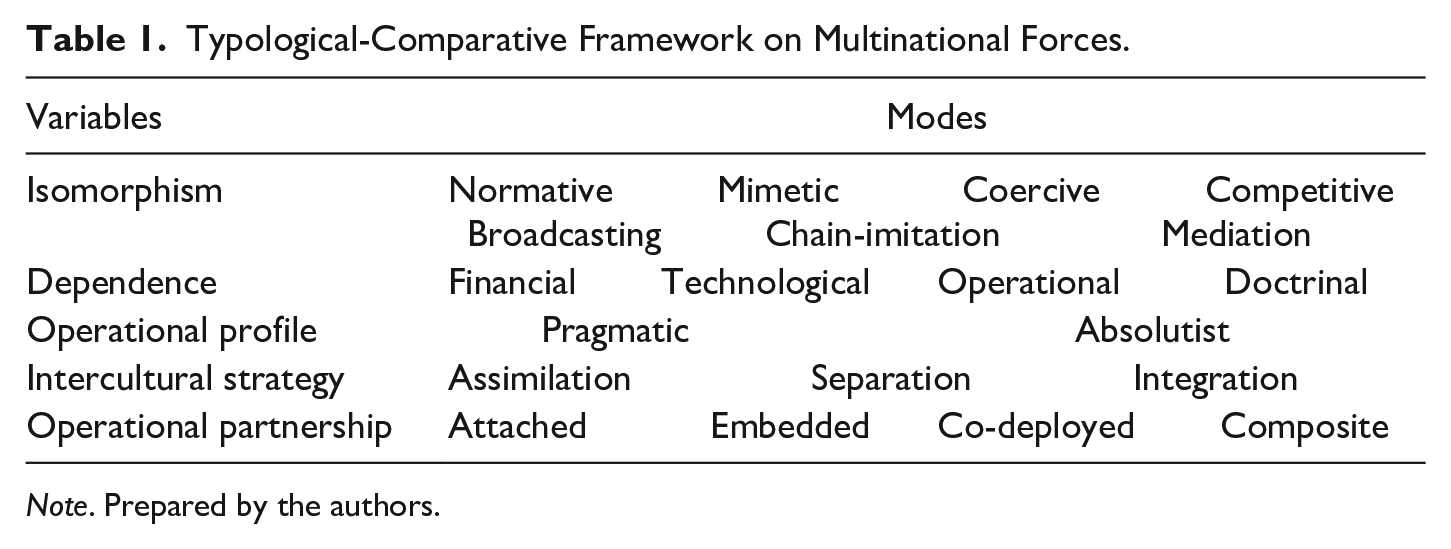
Like other organizations, military organizations are influenced by a variety of societal and institutional variables. We built an analytical framework on organizational variables considered relevant in the literature on organizational sociology, in particular, isomorphism, resource dependence, and interorganizational relations, as well as in writings on military social and organization studies (Cropper et al., 2010; DiMaggio & Powell, 1983; Farrell, 2005; Farrell & Terriff, 2002; King, 2011, 2019; Pfeffer & Salancik, 2003; Sahlin & Wedlin, 2008; Soeters, 2018, 2022; Soeters & Tresch, 2010). As these can present variations between the three cases, we created a set of variables with their respective ideal-typical, theoretically derived modes (see Table 1), which we will discuss in the following.
Typological-Comparative Framework on Multinational Forces.
Note. Prepared by the authors.
Isomorphism
The first variable compares “isomorphic pressures” (DiMaggio & Powell, 1983) and “modes of diffusion” (Sahlin & Wedlin, 2008). Several authors have sketched how a “rationalized environment” has been conducive to produce military isomorphism, that is, the process of militaries becoming alike, on a worldwide scale (Farrell & Terriff, 2002; Goldman, 2006). Soldiers or peacekeepers in these fields gradually develop the same understandings of meanings and norms about their jobs and profession through different mechanisms. These are as follows:
Normative pressures, stemming from military professionalization through formal educational exchange and networks across which models of practice diffuse (Farrell, 2005).
Mimetic pressures, referring to responses to uncertainty (DiMaggio & Powell, 1983) or the identification needs of actors (Sahlin & Wedlin, 2008), resulting in the imitating of the most prestigious military organizations outside of their own.
Coercive pressures, referring to actors in an unequal relation compelling others to adopt the same organizational concept. Here, the two keywords are power and dependence.
Competitive pressures, referring to the assumption that the “anarchic system” creates powerful competitive incentives—mainly between great powers—to adopt the most successful military practices (Farrell, 2005; Goldman, 2006).
Pressures may be driven by center-periphery relations. As Farrell (2005: 465) argues, the weaker and smaller a state is, the more normative its emulation mechanisms are. In practical terms, it involves officers being sent for training to military academies of central countries and military advisors, literature, standards, and equipment being deployed and dispatched to peripheral countries. Farrell (2005) explains this “one-way street” trend in that “small states seek the prestige attached to great-power military symbols, as well as the certainty provided by great-power scripts for military action” (p. 466). However, following Wendt and Barnett (1993) and Pretorius (2008), this “one-way street” trend expresses broader asymmetries in which central countries have shaped peripheral elites’ ideas about what constitutes a “modern army.” Today’s military world culture constitutes an asymmetrical structure precisely because Western definitions of modernity are its center and act as the point of reference for peripheral elites, and because these ideas fuel dependency (because of capital-intensive) patterns of militarization (Wendt and Barnett, 1993). The relatively recent incorporation of former Warsaw Pact countries into NATO is a prime example of such normative, but also mimetic and even coercive pressures—as without proper standardization, quality and safety in operations are not formally acknowledged (e.g., Soeters, 2018, p. 105 ff.).
Such asymmetries have their origin in periods of subordination to Western dominance in the world system (Wallerstein, 2011). In this process, the norms of what constitutes a “professional ‘army” were frequently imposed by Western powers (Farrell, 2005), whose legacy has transcended as peripheral emulators into current normative military orientations all over the world. This does not mean peripheral states are passive objects forced to accept Western military ideas against their will, but it is based on the idea that the global military culture is structurally asymmetric, constraining a primarily “one-way street” process.
Considering typologies of Sahlin and Wedlin (2008, p. 227), the military diffusion can occur in at least three different ways through which ideas, models, and practices are diffused and adopted:
Via the broadcasting mode: a central model of a key player inspiring (or leaving no alternative to) others.
Via the chain mode of imitation: an idea or practice being repeated but in different links without knowing the origin of its development.
The mediation by others (also called carriers): diffusion via international organizations such as NATO or the United Nations (UN), as well as via media and researchers in expert committees, among others.
Ideas, concepts, or models can be edited and reshaped as they travel between different emulators. In this sense, diffusion can generate not only homogenization but also variation or change patterns within military isomorphism.
Dependence
As argued, global military isomorphism would not be entirely understood without the implications of peripheral military dependence. In this regard, some propositions developed in the so-called “resource-dependence theory” (Pfeffer & Salancik, 2003) are useful. This approach assumes that to survive every organization requires external resources, that is, resources that are controlled by others, that is, stakeholders outside the organization. Thus, organizations are always constrained by uncertainties and networks of interdependence with others. Yet, such organizations are also capable “of managing to cope” with this dependence on external resources, hence inducing variation or twists in the specific character of the multinational cooperation.
We distinguish at least four kinds of resources generating military dependence to glimpse empirically its main patterns:
Financial: when external financial assets support the activity of military organizations.
Technological: when military capabilities’ development relies on the transference of science and technology from others.
Operational: when external support with respect to personnel or equipment is needed to execute tasks at the operational/tactical level during deployments.
Doctrinal: when military organizations sustain their formation in emulating doctrines, skills, and concepts created by others.
Operational Profile
As shown, processes toward isomorphism can affect organizational changes. It is important to note that these changes also affect the normative scope of the use of force. For instance, a multinational UN peacekeeping operation often requires its personnel to adopt the “non-use of force except in self-defense.” Such a rule denotes an operational culture consisting of a common set of values and beliefs at the strategic and operational levels, in which local, regional, and national environments can interfere generating different approaches of operations (e.g., Ruffa, 2017; Soeters, 2021). The specific operational culture that is conducive to peace operations will not easily be shared by all armed forces. For this reason, some militaries—and their political masters—don’t have a natural inclination to take part in UN peace operations, whereas others do.
Following Janowitz’s footsteps (1971 apud Travis, 2020), we can distinguish two main ideal approaches with respect to operational profiles:
The absolutist approach emphasizes the importance of fast wins, dominance over enemies, coercion, punishment, and combat mentality. “Since the political objectives of war are gained by victory, the more complete the victory, the greater the possibility of achieving political goals” (apud Travis, p. 264).
The pragmatic approach emphasizes lasting success, persuasion, and adaptation to others, stability, peace, and reconstruction, as well as less emphasis on the (continuous) use or the threat of violence by adapting it to political objectives that may change over time.
Intercultural Strategy
Another dimension linked to culture in international military organizations has been how these interoperability challenges relate to differences in language, beliefs, and practices among military personnel (Soeters, 2018, p. 25 ff.). Intercultural interactions occur in commanding headquarters, in project teams from different nations working together, and at operational and tactical levels in missions, exercises, and operations. These encounters are not exempt from tensions or caveats among mindsets about the meaning of commitment, visions of military competence, standards operating procedures, technologies, and perceptions on who is in power. In general, there are three ways to deal with the challenges emerging in multinational military exercises and operations (Soeters, 2018, pp. 27–28; Soeters & Tresch, 2010):
Assimilation: the process of smaller or junior partners adapting to and becoming or acting alike a senior partner, on whom they are dependent or whom they consider superior.
Separation: emerges in three ways:
○ Dividing the geographic area of operations into smaller segments or areas assigned to different national partners;
○ Separating the operation and allocating the various tasks to different national partners in different periods of time;
○ Task-related separation, distributing various tasks for the duration of the operations to different national partners.
Integration: occurs least frequently as it is the most complex way to smoothen intercultural challenges. In this mode, military personnel are integrated in the multinational military organization without national distinctions based on the idea that all nations are equal and can make a comparable contribution at all force levels.
Operational Partnerships
The analysis of military multinationalism can be complemented by adding the perspective on operational partnerships, valid also for standing “operational partnerships in-waiting” (Daniel et al., 2015). The focus here is on how is or could be the formation of unit and command structures during deployments. There are four types of partnerships based on two crossing variables: Does the partnership use multinational command structures? Does the partnership feature multinational operational units? Following the literature these are:
Attached: an independent operational unit works alongside and is under the operational command of a larger unit.
Embedded: troops from a country are integrated within operational units of another country to form mixed units under the command structure of the latter.
Co-deployed: distinct national units operate as part of a multinational command involving officers from both countries.
Composite: troops from different countries form mixed units that serve under a multinational command involving officers from two or more countries.
In these categories, “operational partners” can be junior, senior, or equal partners, as determined by mandates, the size of countries’ troop contributions, and their reputation and international standing. Obviously, these distinctions may covary with the categories that occur in relation to intercultural strategies.
We will now see how these variables can be recognized in the three cases under study. As such, they constitute the basis of our comparison.
Method of Operationalization and Case Description
The method of data analysis consists of a qualitative and synchronous comparison on interorganizational differences. Our focus and data collection are on land forces units; the operationalization of the variables has been done as follows.
On the isomorphism dimension, we have traced the identification of the organizations with external references and their adaptations to force models from central countries. We examined the role of international organizations in promoting force standards; moreover, we paid attention to how other organizations in each region could mediate/coordinate, or not, such processes. Yet, while the types of isomorphic pressures intermingle in an empirical setting, the comparison highlighted the contrasts according to the relative prevalence of the kinds of pressures and modes among the three case studies.
The perspective of external dependence can manifest itself in different conditions. Operational dependence can be tested only in cases of forces with deployments in real crisis scenarios based on indicators in situ of external support. In other cases, our analysis of all those dependence types focused on how external resources affect, or not, the principle of “local ownership” within organizations. It refers to the ability of their members to internally drive changes processes and create specific twists to the cooperation despite possible dependence on resources (Pfeffer & Salancik, 2003).
To compare operational profiles, we have collected data about the mission concepts and operational environments, which provide indicators on the method of employment, the design, and operations approaches. For the variable intercultural strategies, we studied the influence of cultural and linguistic heterogeneity, national military traditions, features of leadership, and asymmetries between partner members in missions, exercises, and operations. Finally, operational partnerships focused on formal data with respect to the command and unit structures in action.
For all analysis variables, we collected primary data from contact points with officers who have worked with the selected organizations. We developed semi-structured interviews based on freely organized, predetermined, open-ended questions (Adams, 2015). We conducted four remote interviews (video calls) between June and July 2020 with military advisors and attachés working with the African Union (AU) and EASF. Furthermore, we had extensive conversations on social networks with an EASF Headquarters officer between January and March 2020. For the Southern Cross Binational Force, we conducted remote interviews with two former Chief of Staff and a former civilian representative of the political body of the same institution between November 2020 and July 2021. In addition, we developed telephone conversations with two officers from training centers where members of the Binational Force carry out training courses.
Some officers only agreed to have informal or circumstantial conversations by telephone or on social media and provide us with public information about their institutions—albeit valuable data for the research. Hence, we have not named these “interviews” in a strict, formal sense but as “contacts.” In total, we spoke with 10 officers, military and civilian, and generated 460 min of audio with the corresponding transcripts. The length of each interview varied between 85 and 46 min. Telephone conversations lasted 27 min. Information about interviews can be requested on the Group of Studies of Defense and International Security (GEDES) website linked to the São Paulo State University. Protocols of this university and ethical norms of protecting human subjects have guided the data collection process with the research participants. 2
The three cases can be more fully described as follows.
The Southern Cross Binational Force was founded in 2007 by Argentina and Chile in the form of a Combined Joint Chiefs of Staff. In 2012 the Cruz del Sur was made officially available to the UN to deploy to peacekeeping missions (Memorandum of Understanding [MOU], 2011). The organization comprises fully equipped and self-sustaining land, naval, and air forces from both nations, including two mechanized infantry brigades, an engineering company, a mobile hospital, surface navy units, and transport helicopters. The Bilateral Political Steering Group (BPSG) is its highest political body to develop further the two states’ combined capabilities (Alves & Ferreyra, 2018; Várnagy, 2015).
The EASF was created in 2004 to maintain peace and security in Eastern Africa. In 2014, the EASF (2016) declared full operational capacity, composing civilian, police, and military bodies, and including land, naval, and air forces. Currently, the force is made up of 10 active member states: Burundi, Comoros, Djibouti, Ethiopia, Kenya, Rwanda, Seychelles, Somalia, Sudan, and Uganda. The organization consists of three main elements: the EASF Headquarters and the Logistics Base (LOG-BASE) in Addis Ababa, and the Planning Element (PLANELM) located in Nairobi. EASF is managed by a political body whose supreme organ is the Assembly of Heads of States and Government (Bayeh, 2014). The organization has been working on the standardization of doctrine and training to produce capabilities of operating in predetermined scenarios.
The PSF was established in 1984 as the military arm of the GCC. Its main purpose has been to deter and respond to the aggression against any of the six member-states: Bahrain, Kuwait, Oman, Saudi Arabia, Qatar, and the United Arab Emirates (UAE; GCC, 2009). The force based consists of two Saudi brigades’ units and forward elements that would host military units from the other GCC countries—composed of infantry, armor, artillery, and combat elements (Krylov, 2018). The command structure of the PSF has naval and air liaison offices to link with navies and air forces of individual states during exercises or operations (Alsiri, 2015). PSF has frequently tried to increase its capabilities in the number of troops and, since 2013, has been in process of folding to a project of a GCC’s unified military command based in Riyadh (Kishek, 2019).
Results
As a means of summary and guidance throughout the findings, we have compiled a comparative table (Table 2). This contains the main findings of our study.
Variables and Modes in the Three Multinational Military Forces.
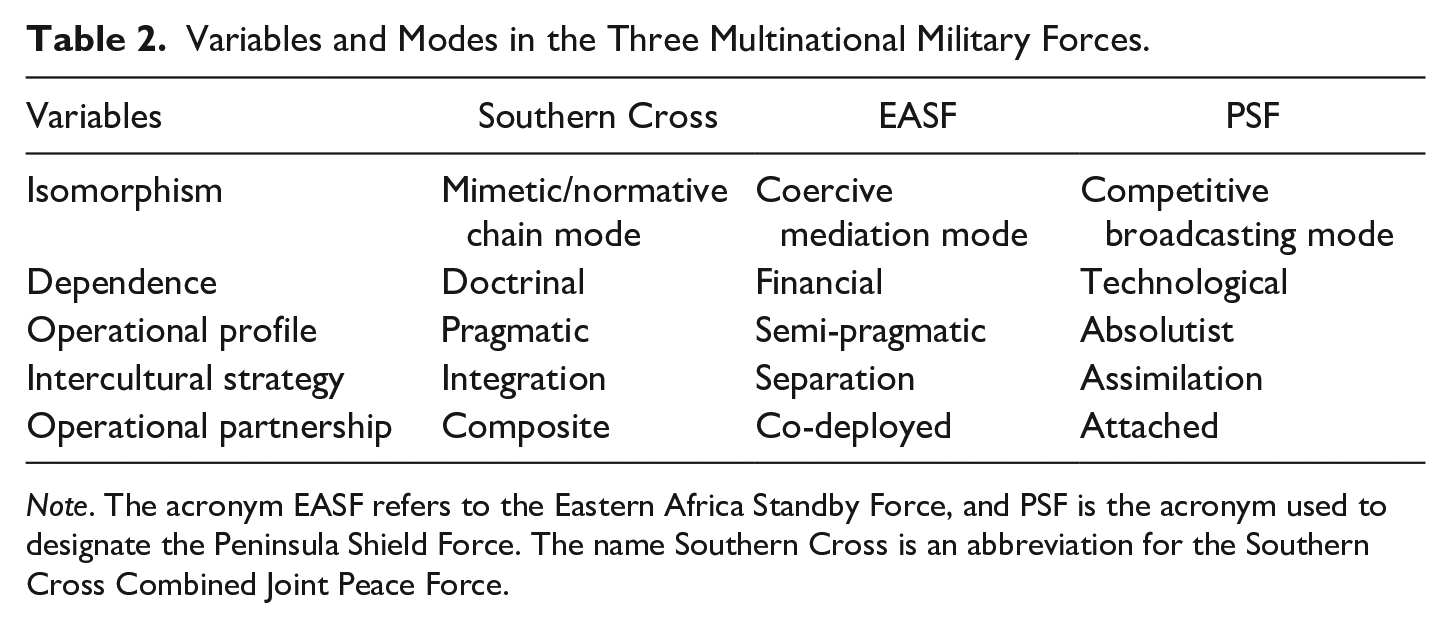
Note. The acronym EASF refers to the Eastern Africa Standby Force, and PSF is the acronym used to designate the Peninsula Shield Force. The name Southern Cross is an abbreviation for the Southern Cross Combined Joint Peace Force.
Isomorphism
On the isomorphism dimension, we can observe that mimetic pressures have played a role once the actors identified with central models considered successful or necessary for the formation of their own multinational forces. In the case of the EASF, the “policy framework” of the African Standby Force recognizes that “SHIRBRIG provides a good example of the HQ structure” (AU, 2003, p. 6). The AU (2003) stresses the particular utility of the SHIRBRIG’s Planning Element (p. 13). Besides, “the entire standby system would use as its basis for doctrine and training, concepts and material developed by the UN and SHIRBRIG” (AU, 2003, p. 15). In the same document, there are 13 mentions of SHIRBRIG and another six of NATO as examples of “standby models,” logistic systems, and standardizing command procedures, respectively. In East Africa, the Kenyan retired Colonel Peter Marwa (2006) stated,
The SHIRBRIG model remains the best example for our regions to learn from . . . At the time of establishing the Brigade, SHIRBRIG was involved in the experts meeting in Jinja Uganda and provided valuable contribution, which shaped the concept. (p. 126)
On the Southern Cross Force side, it is important to observe bilateral documents as the “Act of Bilateral Agreement between the Ministries of the Defense of the Republics of Argentina and Chile for the creation of a Combined Peace Force” (2005, Item G). This document stated that “for the command and functional relations of the Combined Peace Force, those defined by NATO will be used.” Elsewhere in the MOU it is stated that all military terminologies have been taken “from documentation available from the UN and NATO” (MOU, 2010, Annex. 1–6). According to our interviewees, these orientations respond not only to the identification with Western references but also to the interest in adopting common standard operating procedures and languages as “a starting line to facilitate military cooperation.” Furthermore, it is important to note that Argentina was a member of SHIRBRIG until 2003, while Chile had the status of “observer” in this organization. After the first peacekeeping mission of SHIRBRIG in Eritrea in 2000, the Brahimi Report (UN General Assembly, 2000) singled it out as a role model for regional arrangements, and the negotiations on the Southern Cross since 2004 followed these suggestions (Várnagy, 2015). According to a government report from Argentina, “this force would adopt the SHIRBRIG model, which is the only brigade-size force operationally available and in a position to provide the UN with rapid reaction capabilities according to the Brahimi report” (Observatorio de Políticas Públicas de la Jefatura de Gabinete de Ministros, 2007, p. 13). Interestingly enough, the concept of SHIRBRIG (1997–2009) has lost a great deal of its relevance in the countries of origin due to political difficulties concerning the ideas of “rapid reaction” and “high readiness” (Reykers & Karlsrud, 2017). In democracies, every deployment of troops abroad requires extensive negotiation at the political-military level and in parliament, which is not conducive to the ambition to respond quickly. This adds to a general hesitation to engage in missions abroad. Having said this, the SHIRBRIG concept stood at the foundation multinational military cooperation in both Latin America and Africa. Yet, it is not stating too much that similar hesitations as to quick responses occur in these regions as well.
In the case of the PSF in the Gulf states, according to its former Commander Colonel Al-Shaluani, the joint command is modeled “after an American Army’s staff” (Kuffel, 2000, p. 9). Moreover, many experts observe analogies between NATO and the current project in implementing a “GCC unified military command” (Alsiri, 2015; Saidy, 2014). According to Samaan (2017), the unified command might look like the NATO’s Allied Command for Operations (ACO) in Belgium (SACEUR). Both the ACO and the GCC command acknowledge the role of the biggest defense contributors to the alliances: respectively, the United States and Saudi Arabia. The reputational capital of NATO is recognized in statements of General Mutlaq Al-Azima, the former PSF Commander: “The Gulf Cooperation Council forces are the best forces after NATO” (“Al-Azimea, the hero,” 2020, p. 2). “. . . We have military forces that no state or institute in the world can compete with, with the exception of NATO” (p. 4). It is important to note that all GCC defense projects have been linked to the need to deter external threats from neighbors as Iran (Guzansky, 2014). Thus, a key difference has been the competitive pressures justifying the creation of the PSF. Such external interstate threats have simply not existed in the relations that motivated the creation of the Southern Cross or the EASF. In the GCC, interstate rivalries can explain the orientation by “collective defense mechanisms” inspired in U.S./NATO rather than UN models.
The Southern Cross and EASF, both adapting to the SHIRBRIG concept, conformed to the UN Standby Arrangement System (UNSAS), which means that their deployments require approval from the Security Council and authorization by their governments. However, EASF also acts at the request of the AU. Both forces are on-CALL, with troops not stationed together. When not deployed, both remain under national control attending joint training and capacitation to ensure cohesion. Both share training structures following the UN Core Predeployment Training Materials (CPTM), which is an indication of normative isomorphic aspects. In the case of Southern Cross, as some interviewees reported, the commanders of committed units attend simultaneous courses at their national training centers in peace operations. These centers bring the “latest update of UN standards” for training and exercises. Between 2003 and 2008, SHIRBRIG has received EASF officers at its headquarters in Denmark for training and sent theirs to support the EASF Headquarters and Secretariat (Tatschl, 2009). Officers of the SHIRBRIG Planning Element launched a comprehensive scheme, the African Capacity-Building Initiative (ACB), to support developing common operational standards and training on a wide range of peacekeeping and rapid intervention issues. Our interviews with military advisors at EASF and ASF highlight the importance of certifying all training and exercises according to international standards, such as those provided by the International Peace Support Training Centre in Nairobi.
Despite similar elements between Southern Cross and EASF, there are strong contrasts as well, focusing on aspects of coercive isomorphism. It is due to the critical dependence on external funds from groups such as the Nordic Defense Cooperation (NORDEFCO) and the “Friends of EASF,” without which it simply would not exist (Fleming, 2017). One of our interviewees reported that the local funds of EASF are insufficient, as only some member-states have regularly assumed their membership payments:
In 2018, the members of EASF have funded around 4% of the EASF training, with the other 96% funded by the EU through the ASPA [African Peace and Security Architecture] or from the UK, or Nordic states and some third nations.
If the EASF does not meet the goals set out, which are periodically tested—in training, exercises, and standards—they are at risk of losing the assistance they depend on. Coercive and informal pressures are expressed in the possible denial of funds—a form of material induction. In contrast, Southern Cross and PSF have been self-sufficient since their members assume all the contributions in manpower, logistics, and materials.
Besides, the core models have not been diffused in the same way in the three regions. Before Southern Cross and EASF emulated the standby/rapid deployment concept, these initiatives were first endorsed by the UN, expressly in the “Supplement to a Peace Program” of Boutros-Ghali (1995). In addition, the group “Friends of Rapid Deployment” led by countries such as Canada, Netherlands, and Denmark strongly supported this concept of force in the UN (Koops, 2008). One of the main reports on which these proposals were deliberated was “Towards a Rapid Reaction Capability for the United Nations” (Government of Canada 1995). This report explicitly contemplates the “current experiences” of “NATO, the United States, and France” as the “models” that contain the “primary elements” of that concept of force (pp. 18–20). In this way, the UN and countries such as Canada, Denmark, and the Netherlands have played a leading role in the diffusion of that force concept. Globally, these actors have played a leading role in the mediation (Sahlin & Wedlin, 2008) of the global diffusion of the force model (US/NATO) to the peripheral emulators (as EASF and Southern Cross). However, while the AU played the role of a continental carrier in Africa, in South America, there were no regional mechanisms with coordination capacity in the design of combined forces. The AU has certain binding capacities to act as a catalyst for the diffusion of peacekeeping norms. Although UNASUR in South America has tried to promote regional doctrines in peace operations, they have not materialized (Bragatti, 2019). Given this “vacuum,” there has been a direct “global mediation” between UN and countries such as Argentina and Chile, at the regional level adopting standards in a more decentralized way, that is, closer to a regionally deregulated chain mode of diffusion.
On the contrary, since 2006, the GCC member-states agreed to expand capacities on a rapid reaction apparatus with troops stationed in their respective countries although remaining under a joint command (Alsiri, 2015). Yet, the adoption of models here has not been by mediations like the UN. Instead, a direct military relationship can be observed in countless bilateral agreements on capacitation, training, and exercises between PSF countries and U.S. forces (Al-Saud & Kéchichian, 2020; “Camp Patriot,” 2003; Samaan, 2017). Besides, this relationship can be observed in multilateral programs such as the US–Gulf Strategic Forum and NATO’s Istanbul Cooperation Initiative (ICI) supporting all GCC’s defense projects (Akbulut, 2015). Altogether, the way central concepts of force are diffused in the PSF is closer to the broadcasting mode: direct exposure to the “broadcasting center” (i.e., the U.S. military) that almost leaves no place for intermediations.
As observed above, the so-called “broadcasting center” is made up of central countries which globally spread force models and concepts that are taken in different ways by peripheral emulators in the Global South. These center-periphery isomorphing trends would not be entirely understood without the perspective of the following variable of analysis: military dependence.
Dependence
In principle, considering operational dependence, EASF and Southern Cross cannot show indicators because they have not yet officially deployed troops to missions; however, there were some deployments in the case of the PSF. The first significant deployment of the PSF was in 2003, during the U.S. invasion of Iraq, with around 10,000 troops to support the mission in Kuwait (Josar, 2003). The second was in 2011 when their troops entered Bahrain to back the Al Khalifa government against popular revolts (Guzansky, 2014). In both operations, there were no direct combats, neither was there any direct external support. However, although PSF was not explicitly involved as such due to Oman’s absence (Krylov, 2018), the ad hoc Arab coalition that intervened in Yemen in March 2015 made use of external operational support. The operation “Decisive Storm” aimed at stopping the Houthis showed a lack of capacity to set up an infrastructure to deploy intervention units. So, they turned to the United States and United Kingdom for logistic support and the United States for targeting assistance, intelligence sharing, and rescue operations (see: Arteaga, 2015, p. 3; also, Robbins et al., 2018).
Financial dependence, as we observed before, has a critical impact on the force in East Africa. The NORDEFCO has led the main capacity-building programs for EASF. This group of Nordic countries has contributed more than US$11 million through the “Africa Capacity-Building Programme” since 2009. Other costs have been associated with the support of the Nordic Advisory and Coordination Staff (NACS) and sending East Africans to Nordic courses (Fleming, 2017, p. 53). According to our interviews, donors and stakeholders participate in defining the goals and standards, including its capabilities (the EASF Secretariat, for instance) to meet reporting requirements and deadlines according to the donor’s rules. That reflects the “outside-in” perspective on capacity-building, an externally driven process that measures capacity as the organization’s ability to satisfy its stakeholders (Fleming, 2017). In contrast, Southern Cross and PSF have been self-sufficient in funds and conform to an “inside-out” strategy because they define their own goals and deadlines; their staff members best know how to manage capacities and possible “gaps.”
However, the PSF countries have much greater financial capacity than Southern Cross. In the 2016–2020 period, Saudi Arabia was the world’s leading arms importer. Together with the UAE and Qatar, they accounted for 17.8% of global arms imports mostly from the United States, whose weapon industry supplied more than 50% of these materials (Stockholm International Peace Research Institute, 2020). But this import capacity is not consistent with their capacities for innovation, reflected in a still immature indigenous defense industry (Barany, 2020). It is a topic in which their purchasing power evidences the impact of technological dependence. In this sense, bilateral and multilateral cooperation such as the US–Gulf Strategic Forum or the NATO’s ICI has proven instrumental to technological support of GCC’s defense projects, such as the integrated joint ballistic missile defense system project (Samaan, 2017). In the 2000s, for instance, the GCC claimed to establish two anti-air systems inside the PSF framework (“The Peace Shield” and “Cooperation Belt”) using “AWACS” radars and anti-air missiles from United States (Krylov, 2018).
Contrasting to Southern Cross and EASF, the PSF experienced a higher degree of technological dependence. In short, while financial support has a relatively greater impact on the EASF and R&D dependence on the PSF, in the South American case, the primary impact is in the form of a doctrinal dependence based on mimetic-normative pressures with central references.
Although the modes of reliance on others vary, all three cases display a clear dependence on military equipment from different global powers. Although the Gulf states tend to concentrate their purchases in the United States, the PSF has also purchased weapons and equipment from Russia and China. According to Al-Qahtani et al. (2014), these different sources of acquisition have led to a lack of progress in developing effective information technology and problems of standardization. Such problems involved, for instance, failures to establish the Command, Control, Communications, Computers, and Intelligence (C4I) between GCC forces. As to the EASF, one of the interviewees assessed that although most member-states have acquired military hardware from NATO allies, others still use “obsolete” Russian equipment (e.g., communication systems), which harms interoperability. In the Cruz del Sur, Chile has invested more resources than Argentina in modern equipment—mostly from the United States. At the same time, Argentina has developed a growing defense cooperation with China in recent years, purchasing weapons in Beijing for Cruz del Sur (e.g., “Norinco” armored vehicles). All this has constrained binational military cooperation according to our informers.
Operational Profile
As shown, external dependence and processes toward isomorphism can affect organizational changes. Now, it is important to note that these changes also affect the normative scope of the use of the force according to different strategic contexts in each case. In the Southern Cross, according to our interviewees, the mission scope is structured on providing “modular and flexible forces.” The aim here is to prevent the escalation of violence, monitoring or facilitating ceasefire in a postconflict scenario for the subsequent deployment in a UN mission, providing “safe areas” to people, and ensuring humanitarian emergency aid. One interviewee stated that
today the humanitarian component is more important than the properly military component. It has a greater need for study and development to solve conflicts (displacements, famines, immigration). The force must be prepared to respond to all these kinds of circumstances.
At the time of implementation of the concept, Chile and Argentina had battalions coordinating in the UN Mission for the Stabilization of Haiti, and they modeled their doctrines on these experiences. Furthermore, recently combined exercises have included fictitious scenarios on regions such as Haiti.
In the case of EASF, it follows the AU doctrine with six mission scenarios for peace support operations with different purposes that inform the degree of consent, impartiality, and coercion in missions (AU, 2003; De Coning, 2017). In the first scenario, EASF should provide only military advice to a political mission. In the second, EASF would co-deploy with a UN mission. The third scenario requires a stand-alone AU/Regional observer mission. The fourth requires a peacekeeping force for Chapter VI of the UN Charter and preventive deployment. The fifth addresses a complex multidimensional peacekeeping mission with low-level spoilers. The sixth and most challenging scenario is “military intervention.” In the latter situation, the EASF would be empowered to respond to grave circumstances such as genocide and massive human rights violations.
Although the mission of the PSF is not clearly publicly defined, it refers basically to “military interventions” (Alsiri, 2015; Kuffel, 2000). It is intended to be activated in response to threats to territorial integrity and cases of internal unrest in member-states based on deterrence strategies (GCC, 2009). PSF could be the first line of defense against aggressors and then augment itself into the chain of command of the follow-on host nation. But it was not designed to be the leading regional power in a defensive war (Krylov, 2018). PSF would only assist the country’s army facing aggression as a “force multiplier in a limited Arabian Gulf crisis” (Kuffel, 2000). Since the social revolts of the “Arab uprisings,” the PSF would have reached 40,000 troops, spread among the respective member-states (“Peninsula Shield Force Commander,” 2011).
The Arab army size contrasts with the EASF. According to our informers from East Africa, EASF currently would have a brigade of around 5,800 troops. Also, the Southern Cross, whose Land Task Force, its major unit, has about 1,000 troops. But the greater operational contrast is between PSF and Southern Cross as this latter, as one interviewee reported, does not even conform to a “shock force.” The most frequent missions for Southern Cross would support relatively “safe” or low-risk operations (Faundes, 2009). Instead, the EASF, like other African forces, adapts on paper to combat forces in high-risk scenarios—and progressively in “stabilization operations” against terrorist groups (De Coning, 2017). In turn, the Southern Cross has a more “persuasive,” pragmatic profile, and it could be subject to fewer temporary pressures of reaction, being sent to the zone of conflict until 90 days after a mandate, while EASF in five and six scenarios must deploy between 15 and 30 days.
Although EASF and PSF contemplate possible combats operations, the latter is closer to the absolutist profile because of its primary function of “military interventions” with more robust and advanced units and weapon systems. The EASF could be localized in a middle way, as a “semi-pragmatic profile” between Southern Cross and PSF, due to its different degrees of use of force in more or less “mild” predefined scenarios.
The three profiles reflect what their regions and organizational cultures demand. In East Africa, in the last years, there were internal struggles, separatist and ethnic disputes, and sometimes terrorist violence in countries leading the ranking of the “Fragile States Index” (The Fund for Peace, 2019). These strategic scenarios open doors for more absolutist approaches of management—as contra-insurgence and “stabilization” operations (De Coning, 2017). These latter approaches are prominent in the Gulf given the perceived possibility of interstate conflicts—even nuclear—with Iran, confessional rivalries, and terrorism in the region. In contrast, South America has been a more stable region in terms of interstate peace and cohesion of states, which are rather “weaker” than “failed” states (Mejía, 2014). On agendas with less humanitarian gravity, pragmatism is more likely (peacebuilding, postconflict strategies).
Intercultural Strategy
In principle, in ethnic-linguistic terms, the member-states of the EASF have the most heterogeneous background. They have numerous communities with indigenous languages spoken across their borders and different colonial legacies. About the challenges for EASF, one of the advisors we interviewed told us: “there is one quite obvious. Some member-states are English-speakers, but others are French-speakers as Comoros, Djibouti, and Seychelles. So, there is a language issue that should be resolved.” According to another interviewee, “when you put together Francophone and Anglophone troops, sometimes they cannot speak with each other well. Thus, before interoperability, the basic asset at a national level is this.” Furthermore, East Africa has populations that speak Arabic, and religion-wise Islam and Christianity, among other religions, coexist. Given these diversities, intercultural challenges within EASF may be unavoidable. Furthermore, a true integration strategy (Soeters & Tresch, 2010) is hard to realize in EASF because of old mistrusts and rivalries between leading member-states. As one of our interviewees told us: “Never . . ., you will never have Ethiopian troops under the command of Kenyan troops, never . . .”.
Other interviewees highlight these challenges ex post facto in the African Union Mission to Somalia (AMISOM). Although this is not an EASF mission, several of its members have participated in that since 2007, being French, English, Arabic, and Amharic speakers. This linguistic diversity in the units showed typical communication challenges that became more serious if it happened at the tactical level. Indeed, the main criterion has been the “division of areas” in which each nation is responsible for a specific area. Thus, strategies in AMISOM have developed according to the separation mode, also called “federalization” (Soeters, 2021). For instance, during a period, the regions of Lower Shabelle in Somalia (Sector 1) were under the command of Ugandan troops; Lower and Middle Jubba (Sector 2) under Kenyan battalions. Bay, Bakool, and Gedo (Sector 3) were under Ethiopian command, and the Hiiraan and Galgaduud regions (Sector 4) under Djiboutian command (Wondemagegnehu & Kebede, 2017). The positive aspect of this strategy is that it tends to create a sense of territoriality, a feeling of ownership among soldiers, enhancing responsibility for the space assigned, feeling connected to home (same language, same food). Furthermore, this strategy avoids the challenges at the tactical level between nations (Soeters, 2021). On the negative side, this separation has generated coordination problems among the troop-contributing countries in AMISOM to comply with central command and control decisions in implementing the concept of operations. These lie in the nature of the federation model, often guided by the interests of national units, the lack of centralized command, and the risks of losing oversight of what is happening outside one’s “own” territory (Soeters & Tresch, 2010). Notably, one of the interviewees reported that the primary objectives in EASF’s current command and field exercises are to train this “political level” of negotiations between countries and AU for entry and control of troops in missions.
Chile and Argentina share a colonial history with a common metropolis, Spain, with a solid insertion of the Spanish language and Catholicism as the official religion. These factors have shaped their national identities, which is reflected in their armed forces. For example, both countries have the “Virgen del Carmen” as “patroness” of some of their national units, and since 2020 they have also enthroned her as “patroness” of the Southern Cross Force. According to an interviewee from South America, these elements indicate cultural affinities between two countries: “From the Southern Combined Force, when the staff returns to their country, they affirm how similar we are.” In this sense, Argentina and Chile can adapt better to the integration strategy. It is reflected in its design of mixed operational and tactical units and in simulated exercise systems (“SIMUPAZ”) in which Chile and Argentina “promote and provoke” to work without distinction of flags (interview). An interviewee pointed out the importance of balanced, combined, and joint units integrating binational battalions and companies of engineers, among other units. According to Soeters (2021), however difficult, at the operational level, a crisscrossing system through which cooperating militaries are assigned alternating minority and majority positions in different units that belong together seems the way forward to improve multinational cooperation (p. 13).
PSF’s homogeneity also stands out comparatively. Its six member-states have Arabic as an official language. Except for Oman, they all share the Sunni tradition of Islam, among other identity factors such as a common Bedouin tribal tradition (Bowden, 2017). However, the GCC membership is skewed in favor of Saudi Arabia because of its size, economy, and the largest army (Krylov, 2018). The Saudi contribution to the PSF constitutes a crucial addition to the army of the other member-states, enabling them to rely on its efforts and reduce their troop investment (Guzansky, 2014). Thus, these asymmetries have favored an assimilation strategy in which the smaller countries tend to adapt their military strategy to Saudi Arabia. Indeed, the PSF HQ is based in Saudi Arabia and always headed by a Saudi general. Then, the Deputy Commanding is a position rotating every 2 years across the other five members (Alsiri, 2015). The positive side of assimilation is that it favors central leadership of command. The potential loss, however, is that it might generate military myopia as well as mistrust among the smaller countries about Saudi dominance in making decisions and fears of interventions in internal affairs. For this reason, at the time that the PSF was created, Kuwait, Oman, and UAE insisted that
command and control would reside in Riyadh during normal periods. However, in time when the Peninsula Shield is called upon to support a member of the GCC, command, and control would resort to the country in which the Peninsula Shield is to be utilized. (Saidy, 2014, p. 5)
Because of such reasons, the PSF has a decentralized command, and it appears that it operates today as a “skeleton,” barely integrated rather than an effective standing army (Bowden, 2017; Guzansky, 2014).
Operational Partnerships
Finally, the comparison can be complemented with the perspective on “operational partnerships” on the formation of command and units during deployments. As mentioned, “operational partners” can be junior, senior, or equal partners (Daniel et al., 2015).
On the EASF side, there are inequalities in the contributions of troops. For example, in 2014, Ethiopia and Rwanda pledged to contribute motorized battalions, whereas Comoros and Djibouti were each contributing just a squadron or company (Nkala, 2014). However, they operated as equal partners in the EASF framework, conforming to the co-deployment type of operations (see Figure 1). In times of crisis, when deployments are considered, AU must appoint the HQ Commander who will be seconded by other nations’ officers (Bayeh, 2014). Currently, given the weak legal framework of the EASF (2014), it is not mandatory that member-states provide for preassigned troops for deployments. In case of urgency, each contributing country would sign an MOU with the EASF where their troops will be deployed (Ligawa, 2015). As one interviewee pointed out, “troops are not entirely under multinational command, and countries still dictate where and how their troops would be deployed.”
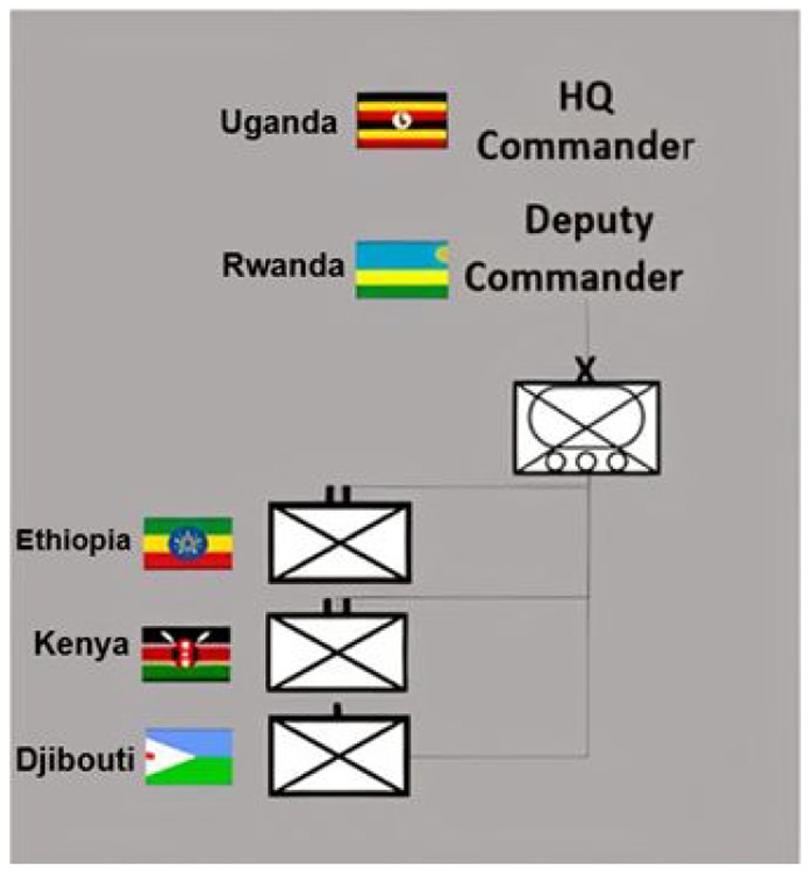
Co-Deployment—EASF: Integrated Command, Separated Units.
As to the Southern Cross, its members are equal partners, and they conform to the composite partnership in which they rotate, contributing the command and personnel and seeking integration of subunits. The country that serves annually as headquarters designates the Binational Commander (BC; MOU, 2010.). The BC supervises the deployment under the responsibility of the Force Commander for fulfilling the mission. The land force components must always be combined. As one interviewee told us, “with no possibility of separation.” This contribution comprises two mechanized battalions, counting on their respective General Staff, company, and a logistics subunit (see Figure 2).
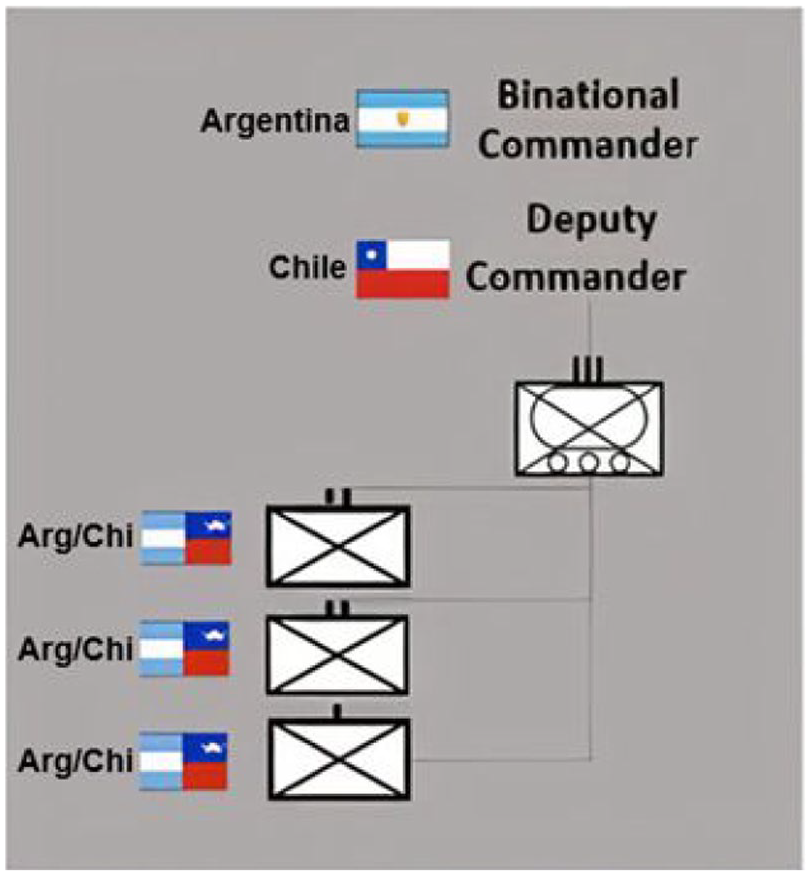
Composite—Southern Cross: Integrated Command, Integrated Units.
Finally, in the PSF, in case of authorization for deployment by the GCC Supreme Council, formally, the host country receiving the assistance assumes the operational command. In this frame, the Commanding General (always Saudi) should report to the Chief of Staff of the host country (Alsiri, 2015). However, in practice, an unequal dynamic is likely to emerge as Saudi Arabia is the senior partner. For instance, the PSF deployment in Kuwait in 2003 was mostly a Saudi force, contributing 70% of the troops (Guzansky, 2014), and the command was de facto under its leadership. In Bahrain, 2011, Saudi Arabia sent the bulk of the PSF (mechanized infantries) with small troop contributions from other members, and the PSF temporary HQ, set up in Manama, had a Saudi Force Commander in charge (“Peninsula Shield Force Commander,” 2011). In practice, PSF tended to conform to the attached partnerships in which the senior partner is responsible for bringing the junior partners on board (see Figure 3).
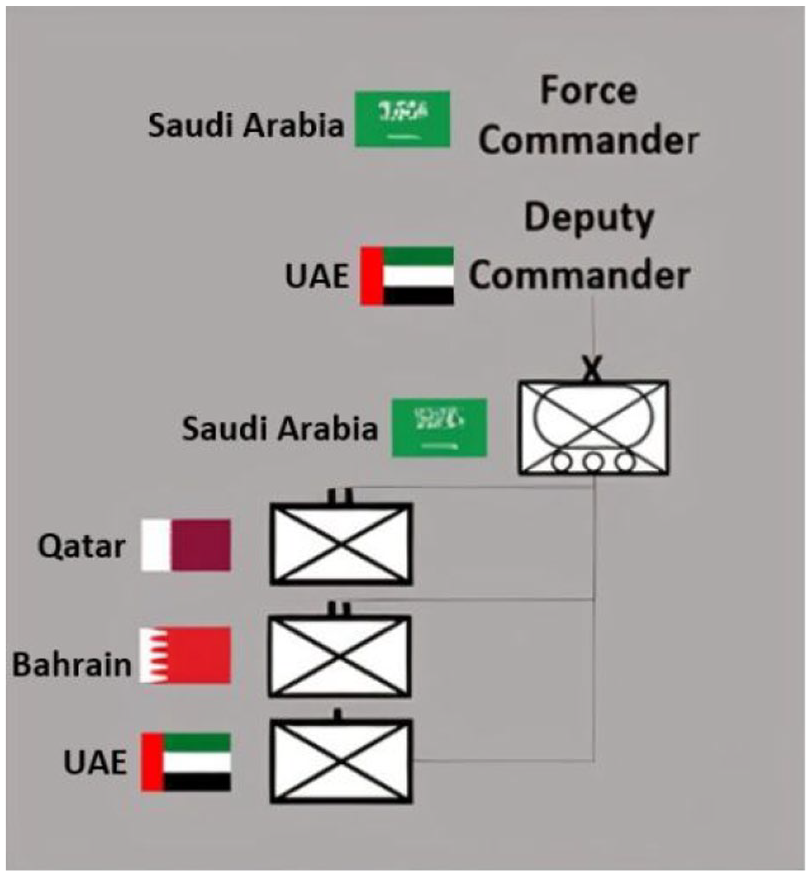
Attaché—PSF: One Nation Command, Separated Units.
As already mentioned, despite the significant developments of these three forms of operational partnerships, they still did not officially deploy troops to missions, except for modest experiences in PSF. The lack of deployment in real conflict scenarios reflects their greatest challenges in terms of “military effectiveness,” that is, the process by which armed forces convert available physical and political resources into fighting power (Millett et al., 1986).
In the case of Southern Cross, it has continuously developed its operational capabilities in the last 12 years and even UNASUR has suggested its participation in the peace process in Colombia in 2015. However, political constraints persist. Chile and Argentina have not yet been able to agree on a first deployment. As one interviewed argued, “deployment is not a matter that passes through Southern Cross, but through the governments.”
EASF has also played a minimal role in securing peace in East Africa. EASF has sent military advisors to Somalia as part of AMISOM and undertaken two election observations in recent years. Yet mistrust and political constraints between member-states inhibit effective deployment of troops. As one interviewee put it, “deploying as a force is not just a question of certification . . . If EASF is deployable or not, it is due to political reasons.”
Finally, the PSF structure is far from being ideal simply because the Commanding General always must be a Saudi. It means that in case of conflict, he would be responsible for lives of all the other GCC soldiers as well as the interests of the other states. This situation is further complicated as the PSF activation requires unanimous approval (Krylov, 2018). As observed in the war in Yemen, the lack of consensus was a central reason why PSF was not deployed.
Conclusion
As observed in this article, isomorphic pressures, diffusions, and military dependence have different primary incidences in the three cases. Regional dynamics and national strategic cultures interfere in such processes, changing and shaping interactions, organizational and operational profiles. The analysis showed that the dimensions of dependence and isomorphic pressures tend to interweave. On the EASF, the lack of funds has promoted financial dependence on stakeholders and has been functional to coercive isomorphism, which feedbacks to the doctrinal dependence on external advisors. The identification of Argentina and Chile with foreign standards reflected not only conceptual/doctrinal dependence but also mimetic and normative pressures. As to the PSF, besides competitive pressures, the technological dependence on weapons-supplying countries also encourages isomorphism. The efficient adoption of high-tech weapons presupposes specific skills requiring external educational support, which are sources of normative pressures. Hence, the working hypothesis proposed in the introduction, which argues that isomorphism and external dependence tend to interweave in the formations of multinational forces in the Global South, has been supported by the evidence in the three case studies.
These seemingly discrete, dual-oriented linkages between dependence and isomorphic pressures, though not necessarily reciprocal, give sense to identify actors who cannot develop without emulating standards coming from the Western broadcasting center. Peripheral emulators mimic, not because they choose to do so, but because they need to incorporate core models to develop themselves within the system. As their organizational autonomy is limited vis-à-vis central actors, the pressures of emulating, translating, or editing core models are unescapable in their formations.
This denotes the dominant normative role of U.S. and Western models in the transformation of armed forces in peripheral countries toward standards of global military cooperation and conflict management. A more balanced international order based on three leading players—United States, Russia, and China—has emerged in the last decades. However, most peripheral countries still do not seem to perceive China or Russia as alternative references for standards in those fields. Even so, geo-normative balances may change. Hence, it would be important to observe in the future whether new alliances and powers could generate new military and conflict management paradigms that peripheral countries may adopt as an alternative to Western influences.
List of Interviewees and Contact Points
Interviewee 1. Institutional and operational development, external support, and military training in the EASF: Interview with a Brazilian Military Attaché in Addis Ababa.
Interviewee 2. Institutional and operational development, international cooperation, and military training in the EASF: Interview with a French Military Advisor of the European Union to African Union.
Interviewee 3. Institutional and operational development, external support, and military training in the EASF: Interview with a British Military Advisor to the African Union and EASF.
Interviewee 4. Operational capacities, international cooperation, and military training in the EASF: Interview with a British Military Advisor to the African Union.
Contact with an IT Officer at the EASF Headquarters. Communications in January, February, and March 2020.
Interviewee 5. Institutional development, operational capacities, and military training in the Southern Cross Force: Interview with a former Chief of Staff of the Southern Cross Force.
Interviewee 6. Institutional development, operational capacities, and military training in the Southern Cross Force: Interview with a former Argentine representative in the Bilateral Group of Political Direction of the Southern Cross Force.
Interviewee 7. Current developments, organizational changes, and military training in the Southern Cross Force: Interview with the Chief of Staff of the Southern Cross.
Telephone conversation with a Commodore officer, at Centro Conjunto para Operaciones de Paz de Chile (CECOPAC).
Telephone conversation with a Corporal First officer, at Centro Conjunto para Operaciones de Paz de Chile (CECOPAC).
Footnotes
Acknowledgements
We thank Dr. Samuel A. Soares, Dr. Vágner C. Alves, and Dr. Alexandre Fucille for their valuable comments and suggestions on our research. We are also grateful to the reviewers for their constructive remarks of the manuscript.
Declaration of Conflicting Interests
The authors declared no potential conflicts of interest with respect to the research, authorship, and/or publication of this article.
Funding
The authors received no financial support for the research, authorship, and/or publication of this article.