




Abstract
The COVID-19 pandemic has forced militaries worldwide to join the fight. Numerous (e.g., British or Czech) armed forces seized the opportunity to propagate their domestic pandemic mitigation activities to improve their public image. However, defense budgets are usually cut first in times of crisis. Such cuts, or the mere threat of them, can have severe strategic and national security ramifications. This research, both exploratory and explanatory, investigates how military crisis-relief activities and their online propagation can muster public support against austerity cuts. It employs mixed-methods analyses of more than 160,000 posts and comments from the Czech Army’s Facebook page case study from January 2011 to January 2021. The study concludes that the Army’s propagation of information about its participation in pandemic mitigation induced positive feelings significantly more than the other content. Moreover, despite unpopular measures (e.g., lockdowns and policing), the Army’s efforts mobilized online public opposition to the austerity cuts.
Keywords
Since December 2019, when the COVID-19 pandemic first started (Baghchechi et al., 2020), many governments have utilized their armed forces to help civilian authorities and institutions tackle the crisis. Some have even employed wartime rhetoric, for example, French President Macron (“Coronavirus: ‘We Are at War’—Macron,” 2020), who triggered the military Operation Resilience (“Macron Launches Army Operation Resilience to Support Fight against Coronavirus,” 2020), and then-U.S. President Trump who used the term “big war” referring to the fight against coronavirus (Bennett & Berenson, 2020). Domestically, militaries have helped overwhelmed hospitals, administered materials, given meals to people in need, and provided other logistic support, and, more controversially, enforced restraining measures like lockdowns. The French Military Medical Service facilities have provided aerial medevac and research capabilities. Abroad, military-medical and logistic teams often distributed humanitarian aid for countries in need, for example, the Russian personnel and material transfer to Italy. These are not novel practices. Militaries helped during Ebola, Zika, and other prior outbreaks. However, the scale of COVID-19 operations is generally unprecedented (Kalkman, 2020; Pasquier et al., 2020).
Militaries have interests in being involved in COVID-19 mitigation and having the crisis resolved as soon as possible. The pandemic has made regular military activities harder or impossible to perform (Kalkman, 2020). Dealing with the pandemic is demanding both physically and mentally for deployed personnel, as well (Gupta et al., 2020; Lázaro-Pérez et al., 2020). Moreover, militaries can show taxpayers the substantial role they play within society (Kalkman, 2020). For example, the British armed forces used their response to the pandemic in their advertisement and recruitment efforts (Kennard & Glenton, 2020). The activities during the pandemic have also brought a public appreciation for the German Bundeswehr (Strack, 2021).
Especially in democracies, public institutions (militaries included) depend to a large extent on public perception, which influences people’s behavior and shapes mass events (Dowler et al., 2006), for example, support or opposition for defense budget austerity cuts. Yet, very little systematic academic attention has been given to the impact of militaries’ COVID-19 mitigation efforts on public perception of the armed forces in positive and negative directions. However, true beliefs and opinions are elusive phenomena that can be measured only indirectly (Dowler et al., 2006). In this matter, social media have proven useful, albeit not flawless, sources, as I explain in the section below on the limits of this study (Anstead & O’Loughlin, 2015; Murphy et al., 2014).
Using the case of the Czech Army, I employ an exploratory mixed-methods research design that is developed by a second, explanatory part to investigate how handling events like the COVID-19 pandemic by the military can affect public perceptions online (on Facebook) and how it can influence adverse outcomes like budgetary cuts. Based on both qualitative and quantitative analyses of more than 160,000 posts and comments on the Czech Army Facebook page, I argue that the impact of the Army’s COVID-19 mitigation efforts on online public perception has been substantive and statistically significant. Furthermore, I show that the Army influenced the online public opposition to the proposed budgetary cuts.
Background
The Czech Army Case
Like numerous other national militaries, the Czech Army has played an active role during the COVID-19 pandemic. And as in France and the United States, the Czech government has frequently employed wartime rhetoric (e.g., Kubištová, 2020). Since early 2020, more than 10 pandemic-related operations have been set in motion. Nine thousand soldiers helped the police with the temporary closure of borders during 10 days in March 2020 when the Czech Republic embraced relatively severe restrictive measures after the coronavirus was first detected in the country. Another such step was imposed on several local districts in which outbreaks occurred in April 2020. The Army helped the police by establishing checkpoints and guarding the perimeter. It also conducted several flights, mainly to China, to retrieve vital medical protective equipment and distributed it to medical facilities. It provided personnel to elderly homes and overstretched hospitals. In cooperation with the civilian National Agency for Communication and Information Technologies (NAKIT), the Army created specialized software for tracing infected people and managing the quarantine. The Army had also built a field hospital in Prague’s Letňany district with 500 beds, to be activated in case overwhelmed hospitals could not cope with the number of infected people (AČR, 2021; Marek, 2020).
With the sheer scale of deployed personnel, the Army’s pandemic mitigation efforts have been the largest operations in its history. They surpassed the response to extensive floods in 2009 (AČR, 2009) and every combat, peacekeeping, and humanitarian mission abroad (AČR, 2019). Since the first COVID-19 wave, the Czech Army has had to gradually scale down regular exercises of both its professional units and Active Reserves. Recruitment and basic training have been more demanding, both managerially and personally, as the recruits are required to wear face masks and maintain social distancing and quarantine measures.
In the 1990s, the Czech Army suffered from relatively poor public perception. It had been burdened by negative connotations stemming from the previous decades of communist rule. However, its reputation gradually improved, among other things, thanks to its relief efforts during repeated severe flooding (Stehlík, 2013; Světnička, 2013; Tauberová, 2017). Public confidence in the military rose from 33% in 1997 to 74% in 2019 (STEM, 2021). As these opinion polls indicate, and as Kalkman (2020) argues, any crisis represents an opportunity for a military to prove that it has a vital function to serve within the society and it pays off to make a noticeable contribution. During the pandemic, the Czech Army, like its British counterpart, has actively tried to seize this opportunity to improve its public image further. The Czech Cyber Forces Command (KySIO) launched Operation Communication, whose goal was to inform the public of the Army’s pandemic-related operations and deployments to borders, hospitals, testing points, elderly homes, and other pandemic-related activities (AČR, 2021).
The Army’s involvement seems to have met with a positive public response indeed. Relevant indicators can be seen in the news media, social media, and public space. A commercial billboard company, for example, created and launched a complimentary public relations campaign to support the Army, specifically referencing its contemporary dual character with the slogan “we help, we fight” (Venturová & Mazúchová, 2021). A recent opinion poll showed that people have a high level of trust in the military (approximately 75%). On the contrary, the proportion of people who view the Army negatively, that is, do not trust the institution, rose between March and September 2020 from 17% to 20% (ČTK, 2020). There are many controversies, both locally and globally, connected to the pandemic, for instance, the anti-vaccination movement, the Letňany field hospital critique, restrictive measures, compulsory testing, and facemasks. All these issues pertain to the Army as well. Furthermore, they are reflected in the often-polarized debates on its Facebook page, which serves as its primary and most influential public communication channel, with more than 156,000 followers.
Defense Budget Cuts
Defense ministries often come first when austerity cuts need to be introduced due to various crises, like the financial crisis in 2008 (Zandee et al., 2020). In its aftermath, the Czech defense budget was gradually cut from 1.44% gross domestic product (GDP) in 2008 to 0.96% GDP in 2014 (Resortní Rozpočet—Ministerstvo Obrany, n.d.). The Czech Republic should spend at least 2% of GDP on defense as an NATO member (North Atlantic Treaty Organization—Topic: Funding NATO, 2021). At the end of 2020, the government budget for 2021 was being discussed. The Communist Party of Bohemia and Moravia (KSČM), whose votes the ruling party ANO (Action of Disgruntled Citizens – the then ruling party) relied upon in the parliament, demanded the reallocation of 10 billion CZK (approximately 15% of the defense budget) from the Ministry of Defense to the health sector. ANO succumbed to the pressure while promising to return the money in January 2021. However, only 5 billion CZK were returned as promised and the rest did not follow until the end of March 2021 (Kopecký, 2021; Machová & Rambousková, 2021; Magdoňová, 2021a).
Such a severe budget intervention negatively impacts the armed forces’ capabilities. When investigating the post-2008 crisis austerity cuts in the Visegrad Group (V4) countries, Kufčák (2015) found that stagnating defense budgets create an unsustainable environment in the mid- to long-term due to, inter alia, increased costs of new equipment. The range of possible countermeasures is, furthermore, limited for countries with relatively small armed forces. They cannot carry out more extensive personnel cuts to reallocate finances to acquire and modernize military equipment. The Czech government and the rest of the V4 countries introduced cuts in the aftermath of 2008 with ramifications that continue even today. Even more serious impacts for the Czech Army are imminent in the COVID-19 crisis and its after-effects. In 2021, the government planned to sign contracts for nearly 70 billion CZK to acquire new self-propelled artillery, an anti-aircraft missile system, and infantry fighting vehicles (IFVs). The latter is the largest military acquisition in the history of the Czech Republic (ČT24, 2020). At the same time, this acquisition plan is under threat of forced postponement (Spurný, 2021). A few days before the government returned the remaining 5 billion CZK, the Ministry of Defense issued a warning that it would have to cut planned investments to pay its soldiers in April (Magdoňová, 2021b). The uncertainty surrounding the 2021 defense budget was also damaging because the Army had to scale down recruitment (Otto, 2020). Such conditions jeopardize not only compliance with NATO’s 2% spending guideline but also the pledge to modernize the Czech Army’s heavy 7th Mechanized Brigade by 2025, so it can fully function within the Alliance’s structures (ČTK, 2018). Zandee et al. (2020) also warn against defunding the military, as it might be needed to tackle subsequent humanitarian problems and potential armed conflicts, and their spillover effects.
There is at least one substantial difference between the COVID-19 crisis–related cuts and those of 2008. Although the armed forces did not play a major role in the latter, they surely do now. There has been a narrative of unfairness emerging in the public discourse in the media (Spurný, 2021), in both chambers of the parliament across the political spectrum (Vachtl & Kopecký, 2020) and in online discussions: that despite the Army’s activities during the pandemic, its budget was being cut. In a democracy, a military’s tools of defending itself are limited since budgetary decisions are primarily political. One option is to appeal to the constituency. During the 2021 budget discussion, the Chief of the General Staff issued an unprecedented open statement on the Army’s Facebook page condemning the proposed cut of 10 billion CZK as a direct attack on the Czech Republic’s security. He invoked the Army’s help during the pandemic and that it spent 3.5 billion CZK on related activities. Also mentioned were the planned modernization programs and acquisitions, for which the debated 10 billion CZK had been vital. The post has collected more than 12,000 engagements, making it the fourth-most engaged post in the page’s history (see Figure 1).
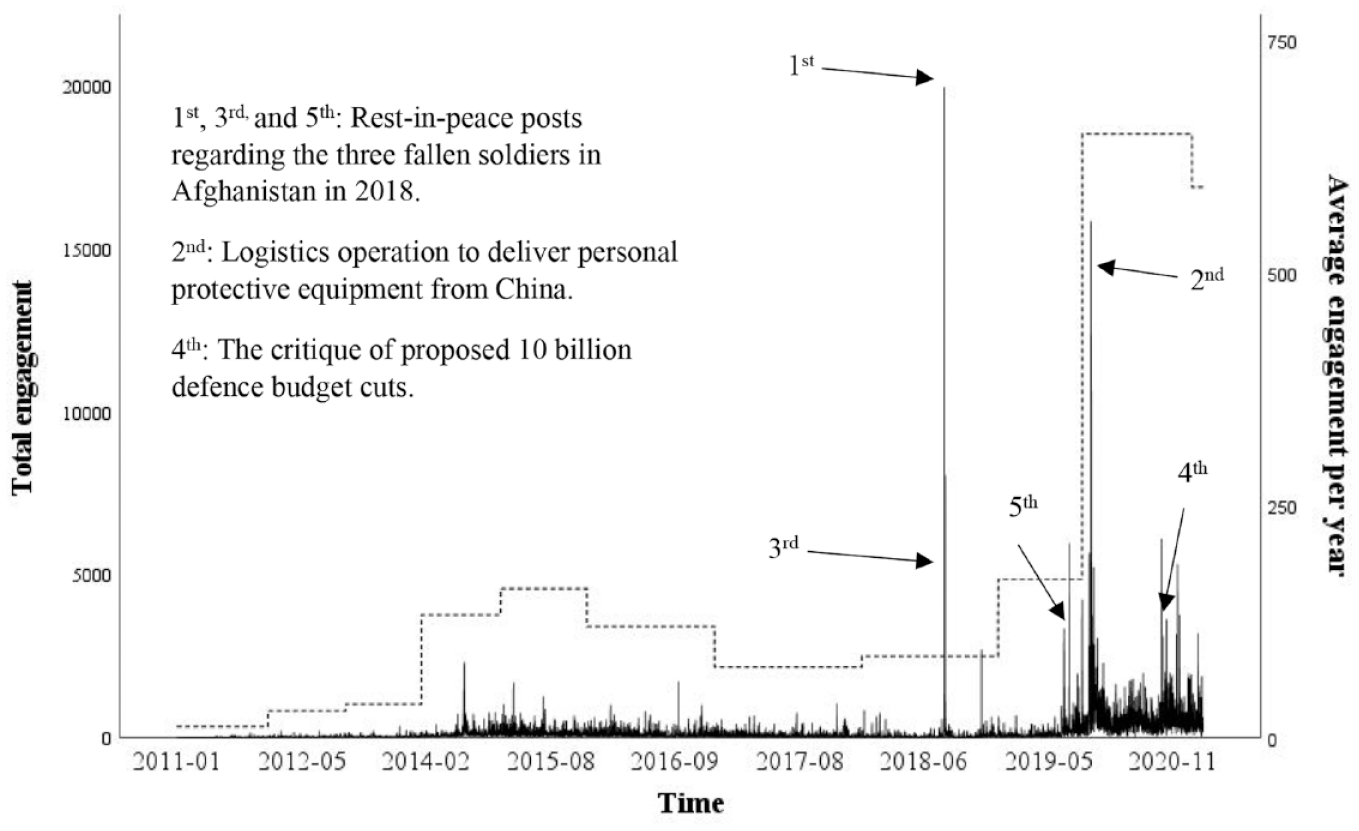
Engagement of Each Czech Army Post From 2011 to January 2021 and the Five Most Engaged Posts.
The Rationale Behind the Facebook Data Use
Social media, Google, and other similar sources of (“big”) data that were not initially meant for research on social phenomena have proven valuable in research. They allow us to inquire more broadly, deeper, and to overcome biases usually connected with the traditional methods of the social sciences (Davidowitz, 2018). They thus provide a relatively high level of ecological validity. In the context of armed forces, Google, Twitter, and Facebook data have been used, for example, to identify the concerns of potential recruits and link them with the propensity to join the U.S. military (Jahedi et al., 2016; Wenger et al., 2019) or to assess public compliance with stay-at-home orders (Layer et al., 2020). Facebook is the most used social network in the Czech Republic with approximately 50% of market share, compared with Twitter, for example, with around 7% (Social Media Stats Czech Republic, 2021).
Active individuals leave a digital trail of data on social media. Within Facebook, this trail is called engagement and it can be divided into two entities. The first is the content, specifically comments used widely in communication studies (Chan, 2018; Mhamdi et al., 2018). The second component of Facebook engagement is metrics, concretely numbers of post shares and reactions. From 2016 onward, the options were expanded by Facebook with “love,” “haha,” “wow,” “sad,” and “angry” reactions. Several studies use emoticons as indicators of sentiment, valence, or for research on emotions and perceptions (Al-Rawi, 2020; Freeman et al., 2020; Wang & Castanon, 2015). Importantly, Giuntini and colleagues (2019) were able to associate these reactions with real basic emotions and valences (positive, negative, and neutral). They found that the love reaction was predominantly associated with joy (positive valence), the wow reaction with surprise (positive or neutral), the sad one with sadness (negative), and the angry with anger (negative). The “like” and “haha” reactions were problematic and inconclusive as the polarity among the clusters of evaluated subjects was rather high in these two cases. I employ both engagement components in this study and look for valence and basic emotions associated with reactions to the Army content.
Facebook engagement is important not only in revealing users’ perceptions, but it also determines the amount of spillover a post has beyond the immediate audience. By reacting, commenting, and sharing the post or other comments beneath it, active individuals increase the probability of page content appearing in their friends’ news feeds. Engagement thus expands the reach of a given post and page, and ultimately the audience itself (Chan, 2018). Hence, the reach of the Army’s content is in this way boosted beyond and by the very people following the Army’s Facebook page. In cultural and media studies, the concept of “audience” corresponds with a certain understanding of the term (online) public (Boyd, 2020), which is “the kind of [online] public that comes into being only in relation to [online] texts and their circulation” (Warner, 2002, p. 50).
Method
The paragraphs above imply that the improvement in the public’s perception accelerated by the Army’s relief actions during floods could occur again due to the COVID-19 mitigation effort. However, in the latter situation, the Army has been involved in repressive lockdown measures and tainted by involvement in controversial topics like the unused and expensive field hospital in Letňany and the anti-vaccination debate. The theory also suggests that the military has an opportunity to prove its social value during times of crisis (Kalkman, 2020). On the contrary, the armed forces budget is usually the one to be cut first. The consequences of significant nonintentional events requiring military deployment like the COVID-19 pandemic can thus be ambivalent, complex, and influential for the armed forces themselves. Nevertheless, in democracies these ramifications can be diminished by positive public opinion. Therefore, this study aims to explore how handling events like the COVID-19 pandemic by an armed force and communicating it on Facebook can affect its online public perception and how it can influence adverse outcomes like budgetary cuts.
Due to the lack of research in this area, I utilize an exploratory design as defined by Stebbins (2001, p. 3): “a broad-ranging, purposive, prearranged undertaking to maximise the discovery of generalisations leading to description and understanding of. . . social or psychological life.” It starts with understanding the phenomenon with data from every possible ethical source to produce generalizations, followed by a grounded theory, a product of the eponymous strategy described below (Stebbins, 2001). The research questions are henceforth:
I extracted data with the Facepager software (version 4.3), which uses the Application Programming Interface (API) of Facebook to request and return data in a structured format (Jünger, 2020). First, I mined all the posts from the Czech Army’s Facebook page since its establishment on January 20, 2011, until the end of January 2021 (8,837 posts in total). Filters were set to retrieve each message and data on the time of creation and the continuous dependent variables of the number of shares, comments, and reactions (the total number and each reaction separately—like, love, haha, wow, sad, and angry). The posts were then treated as nodes from which a total of 160,281 comments were collected. Some of the data lacked the content needed for the planned analyses (photos, gifs, stickers, etc.). After cleaning, the complete data set stabilized at Nposts = 8,256, Ncomments = 152,200, and Ntotal = 160,456.
I used qualitative and quantitative content analyses based on the Grounded Theory approach to analyze the data. Specifically, I took inspiration from Corbin and Strauss (1990), using three stages of coding, which was performed with MAXQDA software. Two coders went through the whole process, and whenever a dispute occurred, a consensus was sought. The first stage resulted in open codes representing each text’s segments. Here, the coders identified topics and subtopics from throughout the entire history of the Army’s Facebook page to explore the discourse (RQ1). To do so, they inherently followed the paradigm model, which focuses on causal and intervening conditions, the phenomenon, context, interactions, and consequences (Strauss & Corbinová, 1999). The open codes were then linked together in the axial coding stage, resulting in their grouping into categories of topics (see Tables 1 and 2). The final step was the integration of the categories around the core category using selective coding, resulting in a theory (Corbin & Strauss, 1990). The quantitative data in the form of Facebook engagement metrics were statistically analyzed using SPSS (version 27) with the statistical significance threshold set to p < .05.
Topics and Basic Categories of the Army’s Pandemic-Related Posts.
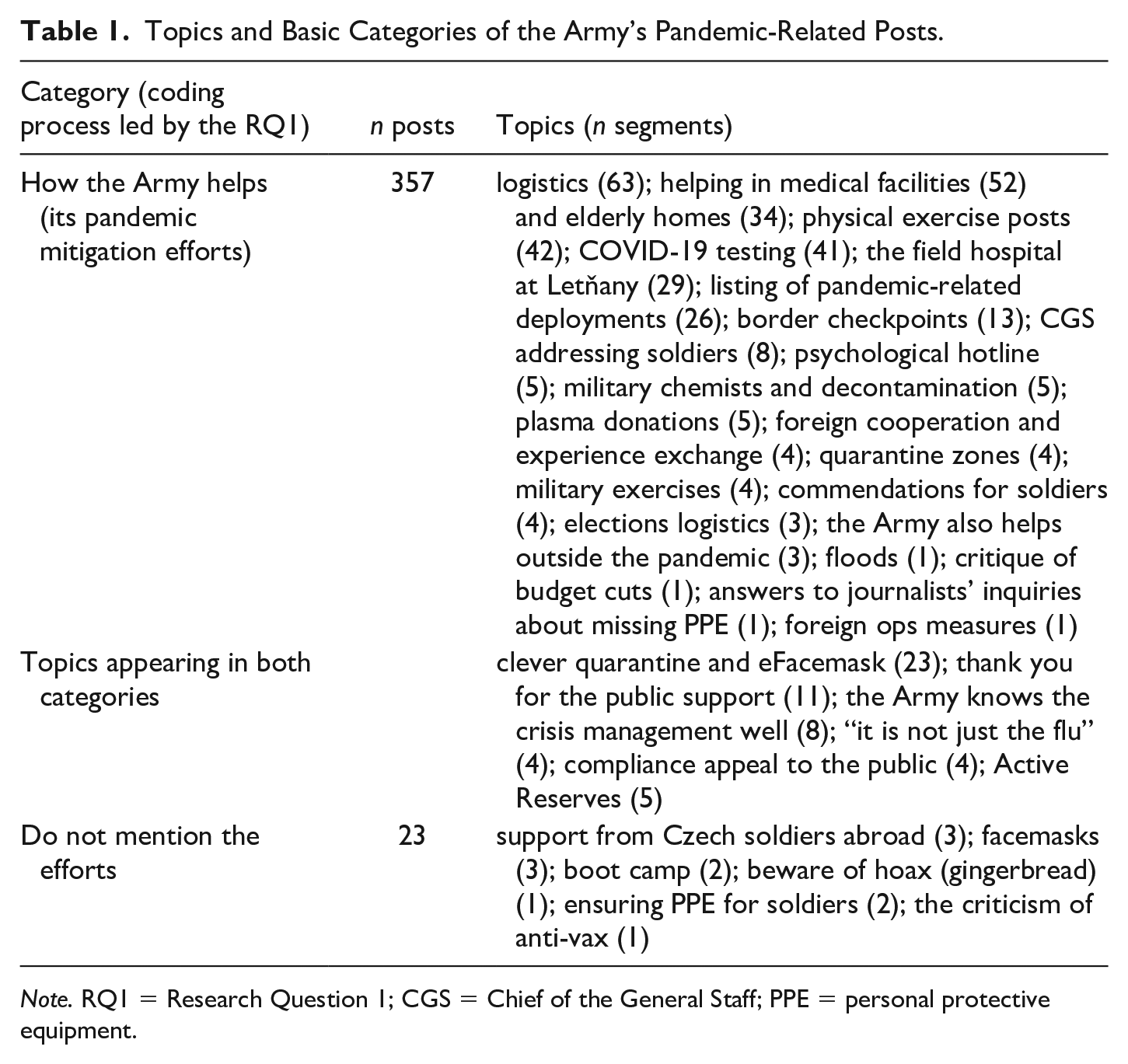
Note. RQ1 = Research Question 1; CGS = Chief of the General Staff; PPE = personal protective equipment.
The Most Engaged Online Topics and Subtopics in Comments on the Czech Army’s Facebook Page (From 2011 to January 2021) and the Identification of Pandemic-Related Categories.
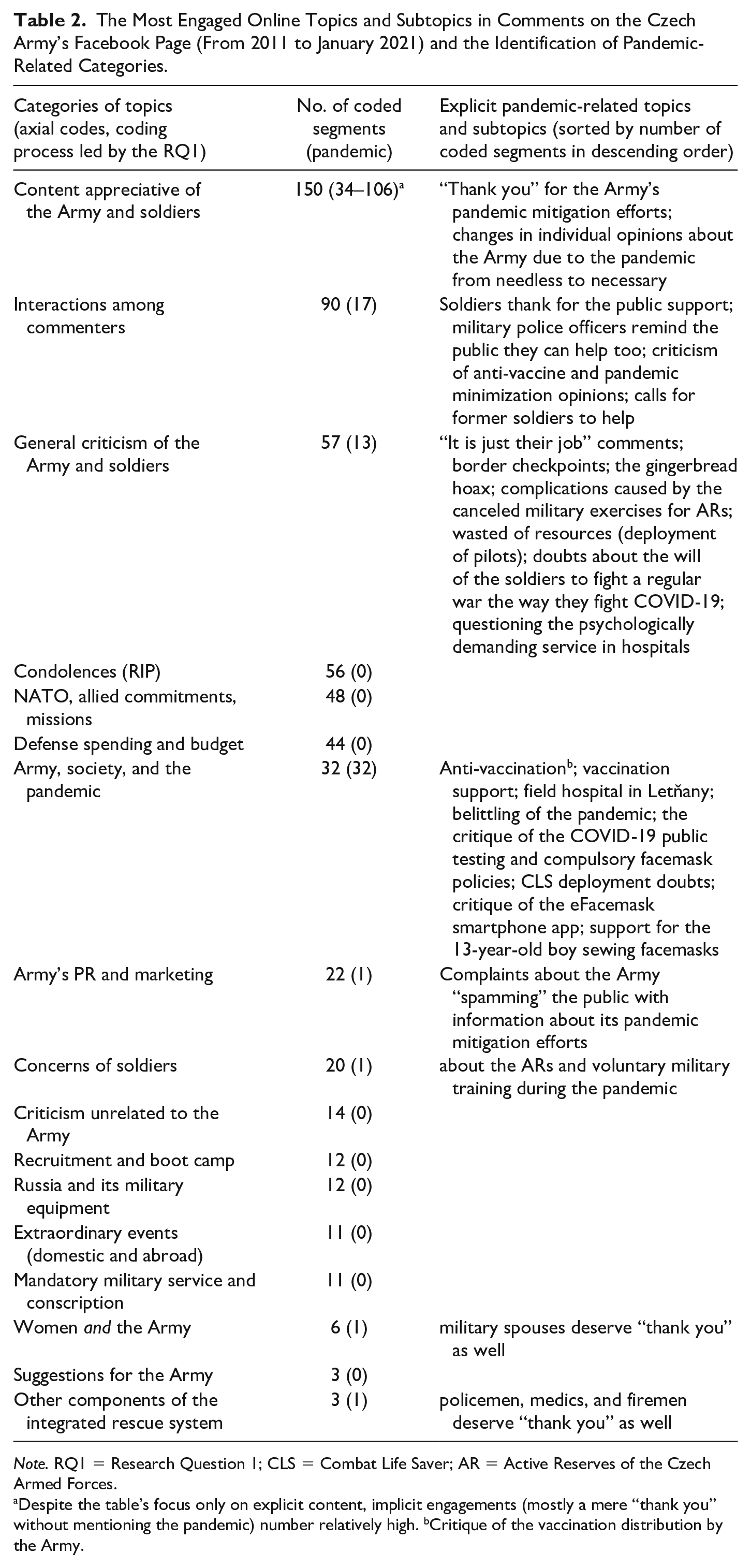
Note. RQ1 = Research Question 1; CLS = Combat Life Saver; AR = Active Reserves of the Czech Armed Forces.
Despite the table’s focus only on explicit content, implicit engagements (mostly a mere “thank you” without mentioning the pandemic) number relatively high. bCritique of the vaccination distribution by the Army.
Results
Just by eyeballing the line graph denoting total engagement over the examined period (Figure 1), we can see a substantive amplification related to the pandemic year of 2020 compared with previous years. The engagement per post ranged from M = 24 (Mdn = 16, SD = 30) to M = 341 (Mdn = 155, SD = 771) between 2011 and 2019 and then skyrocketed to M = 1,298 (Mdn = 944, SD = 1,600) and M = 1,184 (Mdn = 896, SD = 957) in 2020 and 2021, respectively. Moreover, after a close reading of the 100 most engaged posts of all time (in the complete data set), 51 of them directly pertained to the Army’s handling of the pandemic. We can observe that some amplification already started in the second half of 2019 (M = 863, Mdn = 463, SD = 1,405) and three of the five most engaged posts were in 2018. Still, there is a second, more powerful and lasting amplification starting in March 2020 (the first cases of COVID-19 in Czechia), shown in a more detailed version of Figure 1. 1
Online Discourse and the Pandemic’s Role
The Army’s Pandemic-Related Narrative
The online discourse connected to the Czech Army consists of two actors, the Army itself and its audience. I was primarily interested in how the Army communicated during the epidemic; I thus zoomed in on the period from the first published pandemic-related post by the Czech Army on March 14, 2020 (920 posts). I went through them with the other coder and applied open and axial coding to map the pandemic discourse from the Army’s side (developing the RQ1). The results are shown in Table 1. We also distinguished every post with a dichotomous independent variable as having (380 posts) or not having explicitly pandemic-related content for quantitative analysis.
Most of the 380 pandemic posts publicized how the Army had helped society with the tackling of the COVID-19 crisis. The influence of the already-mentioned Operation Communication (AČR, 2021) was clearly visible, as the main mass of topics concerned the Army’s activities (mostly logistical support). Especially the “Condor” 2 flights to China tasked with retrieving personal protective equipment, which was seriously lacking in the early phase. One of the posts about the flights was eloquently the second-most engaged of all time (see Figure 1). The rest concerned domestic transfers of medical material and military engineering connected with the testing points and the field hospital at Letňany. Another crucial effort was the deployment of personnel to the overloaded hospitals and elderly homes.
Besides the mere propagation of information about what the military does, various services were offered to the audience. The Army responded to the severe deterioration of public mental health (Bartoš et al., 2020) with the offer of psychological help from its specialists via a hotline, and with physical exercise videos featuring a new army unit each week. The support and flow of information were also directed inward, to the soldiers themselves, in the form of the Chief of the General Staff’s addresses. Although the Army had carried out some restrictive measures like local lockdowns, quarantines, and manning border checkpoints, it positively presented such conduct as a kind of service to citizens accompanied by additional benefits, for example, the COVID-19 testing points for the locked down areas or assisting participation in local elections for quarantined citizens.
The Army has also tried to support citizens with narrative framing. It created the hashtags, “we will manage [the pandemic] together” (spolutozvladneme) and “the Army helps” (armadapomaha), which occurred 169 and 109 times, respectively, in the 920-post data set, being the second and sixth most frequent terms, respectively. Another often-used phrase was “the coronavirus will not get us” (46 times). This narrative was complemented with one of assurance, stating that both the Army as an institution and its soldiers are strong and able to deal with the crisis.
The Audience’s Most Engaged Topics
I have used the whole data set here to grasp the role of the pandemic-related topics in the entire discourse. Given the massive number of relevant comments, I ordered them by total engagement. To avoid an arbitrary stopping point while maintaining a close reading within doable boundaries, the coding process was directed according to the principle of theoretical saturation. In such a manner, we went through a total of 509 comments and transcribed them into 143 codes from which we built 17 categories. We identified 24 topics and subtopics (open codes) of text segments that were tied to the pandemic. Together with the number of respective coded segments, they are shown in Table 2. 3 We did not consider implicit segments about the pandemic, just the explicit ones. The only exception was the first category of appreciative content. In this case, based on the time of creation, it was very probable that the audience’s thanks were connected to the pandemic mitigation efforts. Nevertheless, I keep them separated in the table.
An entire and relatively large category of topics and subtopics emerged due to the pandemic-related comments, for example, about vaccination, which we could not classify into the prepandemic categories. Since the beginning of vaccination practices, the “vax vs. anti-vax” debate has been around, most notably since Wakefield’s 1998 claim about the MMR (measles, mumps, and rubella) vaccine causing autism (Wilder-Smith & Qureshi, 2020). This debate is featured among the most engaged comments on the Czech Army Facebook page only in connection with the COVID-19 vaccines. Together with the controversies surrounding the never-used field hospital at Letňany in Prague, compulsory wearing of facemasks, and belittling of the pandemic, these topics relatively accurately reflect the general discussions and opinions being expressed in the Czech public space (ČTK, 2021a, 2021b; Štafhauser, 2021). Most of these subtopics are controversial and highly polarizing. This is visible in the category of interactions among commenters, encompassing all individual(s)-to-individual(s) text segments. There is a lot of criticism against those who deny the pandemic exists, minimize its manifestations, or question the vaccines. However, this is nothing new in the Czech Army online discourse. The pattern is almost identical to one that occurred in 2014 when five Czech soldiers were casualties in Afghanistan. The numerous critical, insensitive, and invective comments (general criticism of the Army and soldiers), like accusations of soldiers being mercenaries in foreign wars, or “it is just their job,” were met with supportive engagements broadly condemning such “disrespectful” content. Even the topic of wasted resources, criticizing the redundant deployment of expert assets (e.g., pilots working as elderly homes nurses during the pandemic), had been relatively highly engaged in the past, when the Army was tasked with guarding the exploded ammunition depot in Vrbětice in 2014 instead of the police. Besides disinformation largely spread by anti-vaccination supporters, for example, the novelty of mRNA-type vaccines or their toxicity (SemanticVisions & CTHH, n.d.), the Army discourse also contained hoax material. It was falsely accused of delivering gingerbread cookies to an elderly home, which belongs to the controversial holding company Agrofert, owned by the then-Czech Prime Minister Andrej Babiš (Zlámal, 2020).]
There is a caveat—we cannot yet infer from Table 2 conclusions about the mean online perception of the Army. Based on the open and axial coding results, we can claim that the pandemic has played a rather extensive role, considering the length of the examined period (from 2011).
Online Public Perceptions
Let us now move to answer the RQ2. I started by looking into word frequencies to establish a general picture. The “covid” part of the data set (March 2020–January 2021) was dominated by thank-yous, thanks, and other forms of this word (cumulatively n = 12,506). The prepandemic, and thus longer, period subset (since 2011) contained many fewer thank-yous (n = 2,149). The commenters also made use of the spolutozvlademe hashtag (n = 721), making it the 29th most frequent word. Regarding negative sentiments, I found no downright negative words in substantive positions on the frequencies list. The critique was more context-based. Table 2 shows that 13 pandemic-related audience text segments were among the most engaged comments of the whole period. Therefore, the criticism is there and visible. It is nonetheless refuted much more than liked by other commenters.
Then, I moved to statistical analyses of the engagement metrics of the posts and at the same time to the explanatory part of the study. The analysis so far suggests that the pandemic-related content is, in general,
It would also be reasonable, however less probable, to expect
We see in Figure 1 that the amplification started at the turn of May and June 2019. To take this into account, I restricted the data set to begin at that point. I used two binary predictors here to distinguish the effects of the Army’s pandemic mitigation activities and the pandemic itself stemming from the RQ1. The first was the identifier of pandemic content used for Table 1 (380 posts). The second was to denote the pandemic itself that started in Czechia on March 1, 2020. I then looked at the correlations. Despite the large sample, I used Kendall’s tau (two-sided) due to the many tied ranks and the nonparametric nature of the data. For similar reasons, I applied the Mann–Whitney U test to measure the differences between the groups of each predictor (coded 1 = pandemic/content; 0 = no pandemic/content) and to provide effect sizes (r; Rosenthal, 1991). The results are displayed in Table 3.
Correlations and Effect Sizes Showing the Relationship Between the Two Binary Predictors (X-Axis) and Engagement (From June 2019 to January 2021).
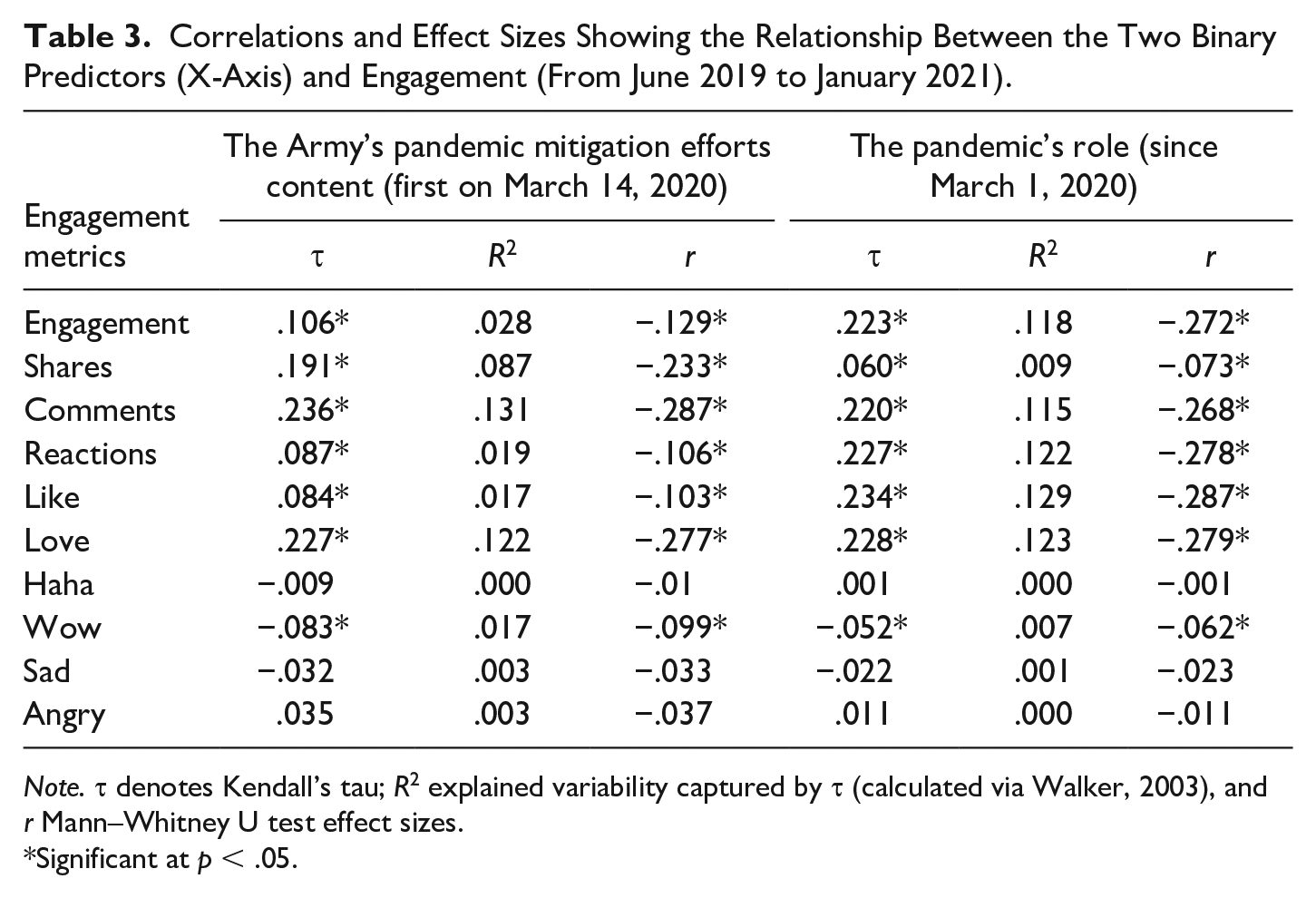
Note. τ denotes Kendall’s tau; R2 explained variability captured by τ (calculated via Walker, 2003), and r Mann–Whitney U test effect sizes.
Significant at p < .05.
The pandemic-related content in the Army’s posts, which is mainly centered on publicizing its mitigation effort, as we saw in Table 1, is significantly correlated with the increase of total engagement, shares, and reactions—concretely, like and love, with a decrease in the wow reaction. We see small to medium-sized correlations (τ is slightly below 0.3) with comments and love reactions. Other reactions’ correlations exist but are rather small. Mann–Whitney confirms this by showing significant differences between groups. A similar pattern, but with stronger correlations and effect sizes, occurs in terms of the general role of the pandemic. Formally, both the H1 and the H2 can be retained, while the H3 rejected. I was able to capture only 13% of the outcomes’ variability, at best. However, the effects of both content and the pandemic itself are clearly present and visible in the “amplification” period. Substantively, the Army’s efforts as presented to the online public relate to a significant increase in the joy and positive valences (Giuntini et al., 2019). Such posts were also more shared and commented, and thus more likely to reach beyond the Army Facebook page’s audience (Chan, 2018).
The Austerity Cuts
The only post concerning budget cuts and published by the Army conveyed the Chief of the General Staff’s (CGS) appeal (see the “Background” section). The analysis here (developing the RQ3) was thus aptly bounded by it and its 939 comments. The post was the fourth-most engaged in the Army’s history of Facebook discourse. Hence, all the measured variables (total engagement and its components) were significantly and substantively higher than with the rest of the “covid” part of the data set posts. Most reactions were likes (85.8%) and loves (12.1%), suggesting the valence was positive and joyous (Giuntini et al., 2019). Based on the RQ3 and the results so far, we arrive at a final hypothesis:
The second coder and I again closely read all the 939 comments and we attributed them two binary variables. The first denoted the general attitude toward the cuts (pro cuts or did not mention, n = 510; against them, n = 429). The second variable evaluated whether the comments mentioned the Army’s help during the pandemic (n = 83) or not (n = 856). Note that the ratio of against versus pro-cuts engagements is over 5 to 1. Moreover, the against-cuts and the pandemic help variables were significantly and strongly associated, χ2(1) = 65.54, p < .001. The odds of being against the cuts while mentioning the Army’s pandemic efforts was 10.25 times higher than without the mention (the H4 stands).
Discussion: Limits of the Study
The key questions in social media research are, “Who are the people in the sample, and how much do they differ from the offline public?” Facebook and other services do not allow the collection of private information (demographics, socioeconomic status, etc.). Anstead and O’Loughlin (2015), who compared traditional opinion polls and social media data, concluded that the representativeness of the latter was wanting. On the contrary, numerous studies have successfully approximated the information conveyed by social media to reality (e.g., Al-Rawi, 2020; Freeman et al., 2020; Giuntini et al., 2019; Wang & Castanon, 2015). Furthermore, this exploratory study leans toward qualitative logic, which builds on more theoretical than inference-driven representativeness. An appropriate design, transparency, and careful identification of what information the collected data convey represent three steps Halford and colleagues (2018) recommend in social media probing. Nevertheless, the methodological issue still represents a significant research gap (Olteanu et al., 2019; Tufekci, 2014).
Another sample-related implication is a possible overrepresentation of people favoring the Army in the audience. This is, however, to some extent countered by the way the Facebook algorithm works. In his paper, Chan (2018) writes that the more engagement a post gets, the more people it reaches beyond the immediate audience, including those who do not follow the page. On the contrary, an audience is often rather diverse. Moreover, the concept of page following goes beyond the show of affection toward the institution. Some members of an audience exploit social media environment to spread counter-discourse. Chan (2018) calls such segment of an audience counter-publics.
Conclusion
Let us now finish with the selective coding, and by including the other results construct a theoretical argument. The majority of the Army’s pandemic-related topics centered on its public-support efforts ranging from direct help in hospitals, elderly homes and at borders, through the logistics to services provided to citizens. By posting such topics, the Army significantly evoked joy in the audience. Moreover, the Army’s pandemic-related posts were significantly more shared and commented upon. Due to such conduct, the Army’s posts spread to a broader public than followers of its Facebook page, thus expanding the audience (Chan, 2018). Generally, the audience reacted to the topics publicized by the Army. However, commenters also occasionally added a few new ones (e.g., mentioning military spouses and girlfriends, and saying that police officers, medics, and firemen deserve “thank you” too). The Army’s content was met prevalently with appreciation and only marginal criticism from the audience’s side. The gratitude of the online public almost certainly imprinted itself into the proposed austerity defense cuts issue. Commenters who explicitly referred to the Army’s efforts were 10 times more likely to explicitly oppose the cuts than users who did not mention it.
Therefore, I claim that by tackling events like the COVID-19 pandemic and by publicizing its efforts, an armed force can improve its public perception via evoking positive emotions even if its mitigation efforts include restrictive measures (e.g., lockdown, policing, or border closures), mistakes like wasted resources, or controversial topics like vaccination. In this regard, I reiterate Kalkman’s idea of the military showing citizens it is worth their taxes (Kalkman, 2020). Furthermore, such improvement of public opinion can be powerful enough to support the military in discussions about issues like austerity cuts where consequences are vital as it matters a lot for public institutions in democracies (Dowler et al., 2006). For example, Ibenskas and Polk (2021) show that Central and Eastern European ruling parties are quite responsive to their electorates. The Czech Army faced a severe austerity cut of around 15% from its budget for almost 4 months right before signing the biggest acquisition contracts in its history. This created an environment of uncertainty that threatened the NATO 2% GDP spending commitment and the modernization of the armored brigade. The cuts were revoked in the end. As the evidence combined with the theory discussed suggest, the strong public opposition probably played a role.
Footnotes
Declaration of Conflicting Interests
The author declared no potential conflicts of interest with respect to the research, authorship, and/or publication of this article.
Funding
The author disclosed receipt of the following financial support for the research, authorship, and/or publication of this article: This publication was written at Masaryk University with the support of a Specific University Research Grant provided by the Ministry of Education, Youth and Sports of the Czech Republic.