




Abstract
What explains variation in the propensity for conflict involvement and initiation among states? In the study of international security, a debate remains between those who argue stronger civilian control of the military lowers the likelihood of interstate conflict, and those who argue that states with stronger civilian control over the military will be more conflict-prone. This article adjudicates between these competing theories through the use of a newly published measure of civilian control over the military. The theory is tested via Poisson regression using a large-N country-year data set. Ultimately, the results support theories of military restraint, showing that states with stronger civilian control over the military are more conflict-prone than states with weaker civilian control of the military. The article contributes to our understanding of war and interstate conflict and the study of civil–military relations by showing that increased civilian control increases the likelihood of interstate conflict.
Keywords
Are states in which civilian leadership has more power over the military establishment less likely to initiate interstate conflicts than states where the military establishment has greater control over foreign policy? A debate in the field of security studies and international relations is whether states in which the military is highly constrained by civil society are less likely to initiate international conflicts than states in which civilian constraint of the military is weaker. Answering the question of whether stronger civilian control over the military decreases or increases the incidence of international conflict has important consequences for the foreign policy decision-making of states: If it turns out that states are less conflict-prone when civilian constraints over the military are weaker, then military encroachment in foreign policy decision-making would be more conducive to peaceful interstate relations.
This article adjudicates the debate between the two sides, civilian conservatism (civilian control over the military leads to less conflict) and military conservatism (civilian control over the military leads to more conflict). In addition to using a new measure of civil–military control developed by Kenwick (2020), the article relies on a monadic country-year data set covering 153 countries between 1960 and 2001. The competing theories are tested through the use of Poisson regression models, with surprising results: Military conservatism theory gains support, indicating that greater civilian control over the military increases the likelihood of initiating military interstate disputes (MIDs), in contrast to previous findings. 1 The results found in this article challenge contemporary understandings of the pacifying effects of civilian control over the military, highlighting the need for further research on the connection between civilian–military control and its effects on interstate conflict.
An important contribution, in addition to adjudicating between two competing theories using updated data, is that this is one of the first major uses of the civil–military control latent variable introduced by Kenwick (2020). Kenwick’s civil–military control variable differs from previous attempts at measuring civilian control by introducing the effects of institutionalization and history into the construction of the variable. In sum, the civil–military control measure created by Kenwick incorporates institutionalization of civilian control over time; this is an advantage over other measures, which do not account for regime history effects. The construction of the variable is elaborated in more detail in the independent variable section.
The article is organized as follows: The next section discusses the two competing theories, civilian conservatism and military conservatism theory, laying out their respective hypotheses. Afterward, the variables are defined and measurements explained. This is followed by quantitative tests of the theories via Poisson regression models, showing the relationship between civilian control of the military and incidence of conflict measured in terms of initiating MIDs. Finally, the conclusion summarizes the findings.
Civil–Military Relations and Conflict: The Debate
Civil–military relations have long been a concern of political scientists and philosophers, going as far back as Plato’s question of who guards the guardians in The Republic. Yet, despite civil–military relations being a subfield of international relations today (Feaver, 1999), there is no unifying definition of what civil–military relations means. Civil–military relations might refer to the relationship between civil society and the military institution, government bureaucracies and the military, or leaders and the military institution (Nielsen & Snyder, 2009). However, in political science, the emphasis has been on the relationship between political elites and military leadership (Brooks, 2019, p. 380). Although the subfield of civil–military relations can be divided into four themes, such as military coups, military defection, civilian control, and societal–military (dis)integration (Brooks, 2019, p. 381), the focus of this article is on the third dimension: civilian control (civilian political leadership, more specifically) over the military institution.
Within research that studies civilian control over the military, one strand looks at whether civilian or military leadership is more conflict-prone than the other. The normative implication of such research is that, if it turns out that militaries are conflict-prone, civilian control of the military should be stronger for interstate relations to remain peaceful. On the contrary, if militaries are less conflict-prone, then civilian constraints on the military need to be lowered. The competing arguments might be labeled civilian conservatism theory and military conservatism theory, respectively, conservatism referring to the lower likelihood of initiating interstate conflicts and war. Within civil–military relations scholarship, the military conservatism theory has been the most popular, with its roots in Huntington’s (1957) classic, The Soldier and the State.
Military conservatism theory argues that the military is less likely to engage in war and military conflicts than civilian leadership. In Huntington’s (1957) view, military officers advocate for military action “only as a last resort in crises and only when victory is almost certain” (p. 69). The theory posits that military officers are more reluctant than civilians to initiate war because they do not want to risk the lives of their colleagues and friends and because soldiers bear the brunt of the violence of war. As Petraeus (1989), a retired U.S. Army general and former director of the Central Intelligence Agency claims, “the leading hawks have been civilian, not military, advisers” (p. 491). As civilians are less experienced in combat, they underestimate the costs of warfare and tend to be more supportive of interventionist military policy than their military counterparts (Gelpi & Feaver, 2004). Under this perspective, the military institution is conservative in its choice to use force, in contrast to civilian leadership that lacks military experience and views the military as just another diplomatic tool.
In contrast, civilian conservatism theory, succinctly summarized by Sechser (2004), argues that military institutions are more conflict-prone than the military conservatism theory suggests. Militaries have incentives to engage in conflict because war serves as an excuse for arms expenditures and increases the prestige of military leaders. As a result, force is likely to be favored by military leaders as a response to the crisis (Posen, 1984). Military officers have been trained to respond militarily to crises, while civilian leaders are “less subject to organizational biases and have a more ‘national’ perspective on defense issues” (Desch, 1999, p. 6). Finally, stronger civilian control over the military not only reins in military aggressiveness (Choi & James, 2008) but also ensures the military’s goals align with those of the broader civilian public (Cohen, 2002). According to the civilian conservatism perspective, military institutions and their leaders are more prone to conflict and war, so greater control of the military institutions by civilian leadership is warranted to decrease the incidence of conflict.
There is debate over which side of the civilian–military relationship is more likely to engage in armed conflicts and war. Most studies have been qualitative in character, focusing on specific case studies—mainly on the United States—to support military conservatism theory (Sechser, 2004, p. 752). Few studies engage the debate statistically: A notable example is Sechser’s (2004) study which finds that greater civilian control decreases the likelihood of militarized disputes. Similarly, Choi and James (2008) find that state dyads in which at least one of the actors increases in military power will tend to face more conflict, due to the military having more influence in policy decision-making over civilian leadership. However, a problem that earlier research faced was the lack of a systematic measurement of civil-military control that accounts for both nuance in the degree to which civilians or the military dominate foreign policy decision-making and the impact of time-dependent effects in strengthening or weakening civilian control over the military institution. Such measurement problem can be overcome by the use of Kenwick’s (2020) drift model parameter—described in more detail in the measurement section—which provides a nuanced measure of civil–military control through time. 2
Theoretical Arguments
Both the civilian and the military conservatism theory posit competing hypotheses with distinct causal mechanisms for why they expect civilian control over the military to affect the likelihood of interstate conflict in different ways. Civilian conservatism proponents argue that militaries have an incentive to engage in conflict and war and that this assumption is supported by empirical evidence. Militaries seem to have an incentive to engage in conflict; as previous research has shown, war and the threat of armed conflicts demonstrate that military spending should be kept high, which economically benefits military institutions. Furthermore, prestige in the field of combat serves as a personal incentive to favor war (Vagts, 1937). Civilian conservatism theorists also argue that military culture plays a role in incentivizing military institutions to favor the use of force as a conflict resolution tactic. According to Vasquez’ (2009) study of war, a crucial factor that drives the escalation of conflicts is the existence of realpolitik thinking, which teaches decision makers to be steadfast in their position and resort to military alliances or military buildup to deter the opposing side. This realpolitik view of the world is central to military culture, whose modus operandi is to resort to force as a means of solving a conflict. Therefore, due to economic incentives to increase the military budget, seek military honor and prestige, and a militaristic culture that teaches realpolitik thinking, military leaders and organizations have an incentive and a predilection to resort to force to solve problems.
On the contrary, civilian conservatism theory posits that civilian leaders will be less war-prone in comparison to their military counterparts, particularly in democratic states. War can be an expensive endeavor. Liberally using force might escalate a crisis into war, a decision that can be unpopular with citizens concerned about higher military spending and the possibility of military drafts or sending family members to die in conflict. As state leaders might face electoral consequences for initiating or escalating a crisis, civilian leaders have an incentive to be conservative in their use of military force. In addition, although some civilian leaders might believe in realpolitik decision-making strategies, the universe of available diplomatic options is wider: civilian leaders benefit from peacefully resolving conflicts rather than the use of force as doing so can improve their image as efficient diplomats internationally and efficient politicians domestically. Unlike military institutions, which require military conflict or the possibility of conflict to justify their existence or increase their budget, civilian leaders have incentives to resort to nonviolent diplomatic options to solve conflicts, if it increases their electoral chances in the future and improves their image in the world. Thus, the hypothesis drawn from civilian conservatism theory may be stated as follows:
A corollary that follows from civilian conservatism theory is the assumption that weaker civilian control, in which the military establishment has more control over politics, will lead states toward greater interstate conflict:
Proponents of military conservatism theory view the case for civilian conservatism as overstated. An important nuance is that civilian leaders can be as hawkish as military leaders, involving their country in more interstate conflicts and wars than dovish military leaders (Schultz, 2005). Furthermore, the historical record indicates that democracies—where the balance between the civilian and military spheres should lean toward the former—are quite willing to engage in conflicts with autocracies (Goldsmith et al., 2017; Maoz & Abdolali, 1989). Evidently, then, civilian leadership is not a panacea to the problem of interstate conflict.
Military conservatism theory goes further than simply questioning the claim that civilian leaders will be more restrained in their decision to go to war or initiate conflict-supporters of the theory argue that the military establishment will be more restrained in their decision to use force overall. Like the civilian conservative theorists, proponents of military conservatism also have empirical support. For example, Gelpi and Feaver (2002) find that the United States was less likely to initiate military interstate disputes when there were a high number of veterans in the legislative and executive branches. The mechanism at play in this theory is that the military establishment bears the brunt of war and interstate conflicts, so they will be more wary of initiating such conflicts. Unlike civilian leaders, particularly civilians with no military experience, the military leadership does not want to risk the lives of soldiers in conflicts unless strictly necessary. The more the balance shifts on the side of the military sphere over that of civilians, the greater likelihood that military leadership will avoid costly military ventures. Therefore, the military conservatism theory draws the following competing hypothesis:
A corollary follows from the assumption that civilian leadership will be more war-prone than their military counterparts. If the expectation is that conflict and war will be avoided more frequently when the military establishment has greater say in politics and there is less control over that sphere by civilians, then,
Data and Measures of Variables
The competing hypotheses will be tested via Poisson regression, a type of generalized linear model form of regression adequate for modeling count data. 3 The data set is monadic, consisting of 153 countries between the years 1960 and 2001. The period under consideration is chosen for both methodological constraints and substantive reasons. Methodologically, although both the measures of MID initiation and civil–military control have data as far back as 1946 and as recent as 2010, crucial control variables included in this article such as GDP per capita and revolutionary leader only have data as early as 1960 and up to 2001, respectively. Thus, the time period under consideration is limited by data constraints. Substantively, the absence of data can also be explained to a large degree by the fact that several countries did not become independent until the 1960s and 1970s; the lack of data for Algeria prior to its independence in 1962 is not a surprise. Furthermore, the period from 1960 to 2001 covers the Cold War era and the first decade of the post–Cold War world, a period of particular importance as the post–World War II period marked a shift in the balance of power from a multipolar to bipolar world and then a unipolar system that is of great interest to contemporary international relations scholars. The unit of analysis is the country-year, for a total of 5472 unique country-year observations. For each country-year observation, a measure of how many MIDs a state initiated that year is included, how many MIDs a state was involved in that year, and the degree of civilian control over the military establishment. The data set includes various controls as well, which are described below.
Dependent Variable
To measure MIDs, I rely on the Correlates of War project MID4 data set, which defines a military interstate dispute as “a set of interactions between or among states involving threats to use military force, displays of military force, or actual uses of military force” (Gochman & Maoz, 1984, p. 587). Using this data set to measure military interstate disputes is appropriate because it is one of the oldest and most used measures of MIDs, allowing this research to fit within the broader scholarship on conflict and war. Furthermore, the measure is perhaps the closest approximation of military interstate dispute as conceptualized in this article. 4 The dependent variable MID initiation is measured as a count variable counting the number of military interstate disputes a country initiated per country-year. The dependent variable counts the total number of military interstate disputes initiated by a state per year (Palmer et al., 2015), counting only those instances in which a state is coded as the aggressor.
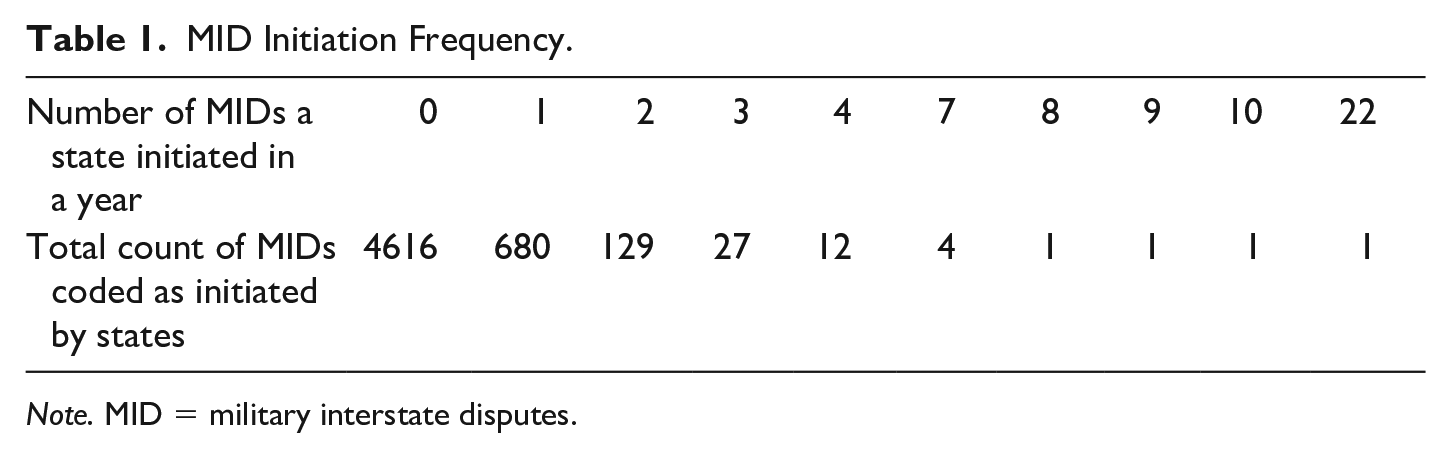
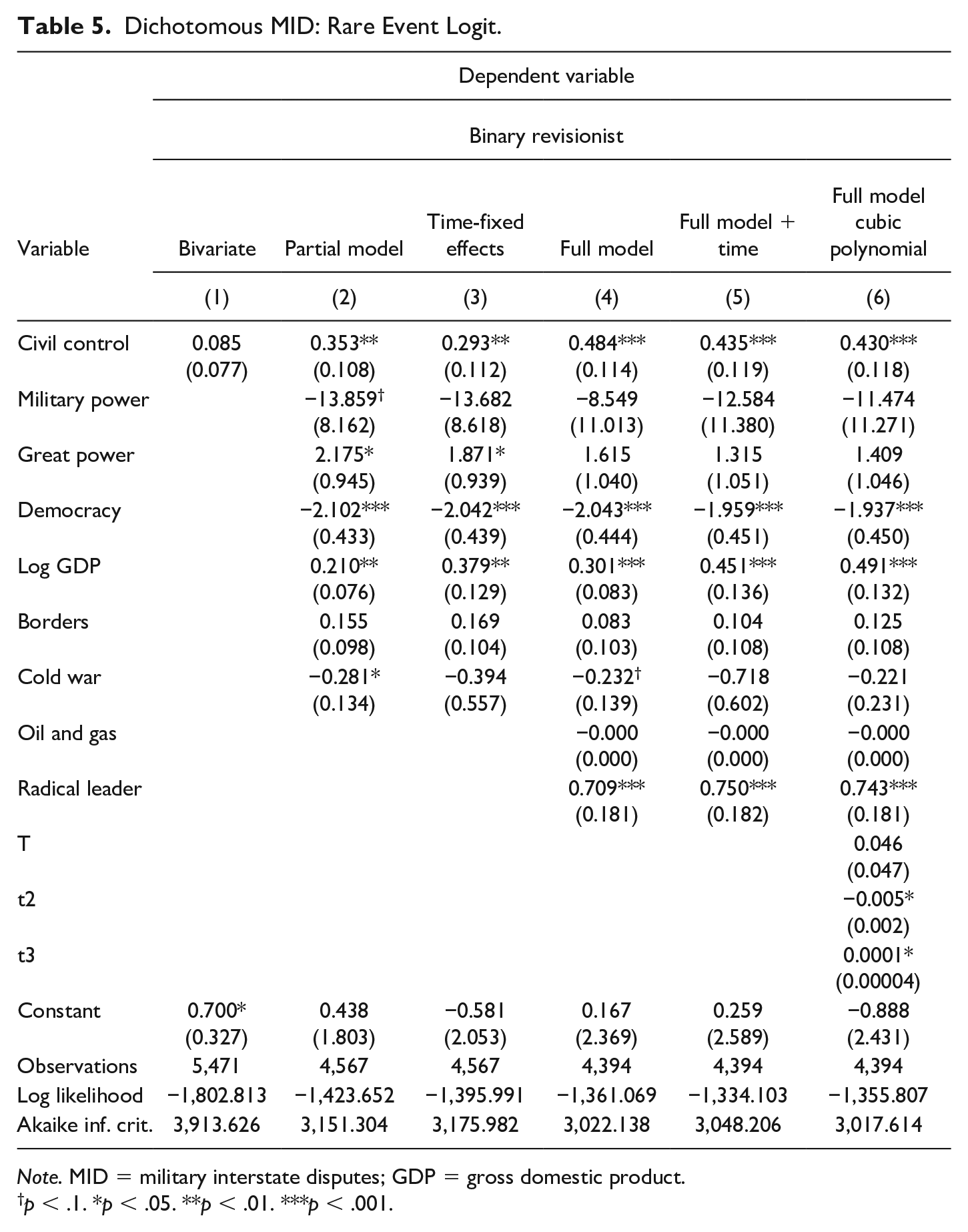
As in some cases it may be difficult to establish which state truly initiated an MID, a second measure of the dependent variable is included, MID onset, which is measured as a count variable counting the number of MIDs a country was involved in, whether as initiator or target, per country-year. Due to the relative rarity of military interstate disputes, the dependent variable is strongly right-skewed, with most country-year observations, 4616 of them, having 0 military interstate disputes. Considering some scholars might perceive Poisson regression as inappropriate for a skewed dependent variable, I also measure MID initiation dichotomously, labeled binary revisionist, as 1 if a country initiated an MID and 0 if not. This operationalization of the dependent variable is used in rare events logit models in Table 5. Table 1 shows the distribution of MIDs initiated by states per year. The table shows that most of the time countries are not initiators of conflicts. The outlier that initiated 22 MIDs in a single year is Iran in 1987. To ensure the outlier observation does not bias the results of the models, the country-year observation for Iran 1987 has been omitted from the analysis.
MID Initiation Frequency.
Note. MID = military interstate disputes.
Independent Variable
The main independent variable is the level of civilian control over the military institution. Previous research on war proneness of civilian versus military institutions relied on a categorical measure that labeled countries as having strong or weak civilian control based on whether nonmilitary leaders ruled the state (Sechser, 2004) or the proportion of military and civilian elites in power (Weeks, 2012). However, such measures neglect the influence of history and institutionalization of civilian control. To capture civilian control over the military and the effects of history, this article uses a new latent variable of civil–military control developed by Kenwick (2020). The latent variable is estimated through an item response theory (IRT) model that generates estimates for an unobservable trait based on combining information from observable variables (Kenwick, 2020, p. 76). In sum, the variable measures the level of civilian control over the military by accounting for both observable factors such as type of leader (military or civilian), level of military involvement in politics, and so on as well as institutionalization effects over time.
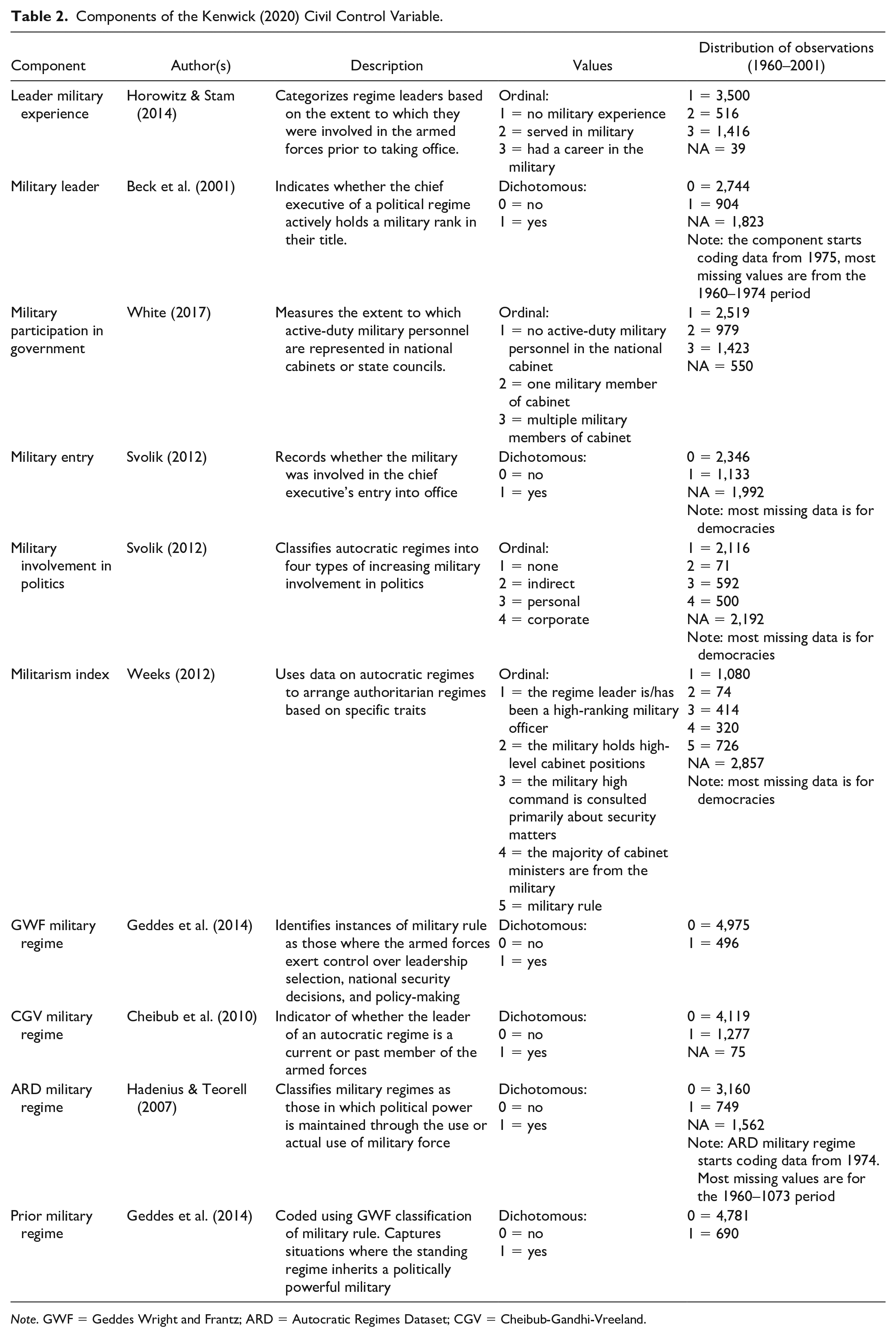
Following standard practice, Kenwick constructed the latent variable by looking for institutional features within states that allow us to infer the level of civilian control. As civilian control is most clearly observed when it is violated or absent, the indicators to construct the civil control measurement relate to various forms of military involvement in politics. The indicators to construct the latent variable are the following: (a) leader military experience categorizes leaders based on the extent that they were involved in the armed services prior to taking office. Information on this variable comes from Horowitz and Stam’s (2014) data, which categorize leaders into three groups: those without military experience; those who served in the military; and those who built careers in the military. (b) Military leader indicates if a chief executive actively holds a military rank in their title. This dichotomous measure is drawn from the Database of Political Institutions (DPI; Beck et al., 2001). (c) Military participation in government is an ordinal measure of the extent to which active-duty military personnel are represented in national cabinets or state councils (White, 2017). The measure captures whether there is no active-duty military personnel in the national cabinet; one military member of the cabinet; or multiple military members of the cabinet.
The fourth indicator, (d) Military entry, drawn from Svolik (2012), records whether the military was involved in the chief executive’s entry into office. (e) Military involvement in politics, also drawn from Svolik (2012), classifies autocratic regimes into four types of increasing military involvement in politics: none, indirect, personal, and corporate. (f) The Weeks (2012) militarism index arranges authoritarian regimes based on the following traits: whether the regime leader is or has been a high-ranking military officer; whether the military holds high-level cabinet positions; whether the military high command is consulted primarily about security matters; whether the majority of cabinet ministers are from the military; and whether the regime itself is characterized by military rule.
Finally, four indicators of regime type are included, all measuring military rule, a clear observable indication that civilian control over the military establishment is weak or nonexistent. (g) The Geddes et al. (2014) GWF military regime variable, drawn from the Geddes Wright and Frantz (GWF) Autocratic Regimes Dataset, identifies instances of military rule as those where the armed forces exert control over leadership selection, national security decisions, and policy-making more broadly. (h) The Cheibub et al. (2010) CGV military regime variable, from the Cheibub-Gandhi-Vreeland (CGV) index, is an indicator of whether the leader of an autocratic regime is a current or past member of the armed forces. (i) The Authoritarian Regimes Data Set’s ARD military regime (Hadenius & Teorell, 2007) classifies military regimes as those in which political power is maintained through the threat or actual use of force. Finally, (j) prior military regime classifies instances where a regime was preceded by military rule. 5 Table 2 provides a summary of the components of the index. The table includes information on the component, author(s), what it measures, the values for each component, and the distribution of values for each country-year observation for the 1960–2001 period.
Components of the Kenwick (2020) Civil Control Variable.
Note. GWF = Geddes Wright and Frantz; ARD = Autocratic Regimes Dataset; CGV = Cheibub-Gandhi-Vreeland.
To construct the latent variable measuring civilian control, Kenwick treated the ratings of each of the indicators as indicative of a latent unobservable trait, in this case, the underlying level of civilian control. In other words, each of the variables described above was treated as observable manifestations of the underlying level of civilian control per country-year. By using item response theory (IRT) modeling, information from each of the observable variables is combined to generate an estimate of an unobservable trait, civilian control over the military. However, Kenwick recognized that the latent trait, civilian control, may be self-reinforcing over time for some units, so he added an additional dichotomous indicator to categorize regimes into “civilianized” or “noncivilianized” regimes. A regime was considered civilianized if the following conditions were met; “the regime leader does not hold a rank while in office according to the DPI data; the regime is not classified as military by GWF, CGV, or ARD; the regime is classified as “none” or “indirect” on the Military involvement in politics scale; and the regime has the minimum score on the Weeks Militarism Index” (Kenwick, 2020, p. 7). This categorization of regimes as “civilianized” or “noncivilianized” is crucial because several country-year observations consist of low scores or 0 for specific components of the index that apply only to authoritarian states, such as the CGV military regime, ARD military regime, or GWF military regime. When a regime was categorized as civilianized in a previous period, a drift parameter δ is added to the prior for each subsequent year of civilianized rule. The drift parameter will tend to be positive if the probability of observing military involvement in politics decreases with each subsequent year of civilianized rule. The ensuing output of the IRT model is an interval latent variable estimate for each country-year, civilian control, where higher values indicate stronger civilian control over the military. Note that the end result accounts for the institutionalization of civilian control over time via the drift parameter: Unlike previous measures of civil control, the variable introduced here adds “the shadow of the past” as an additional component-institutionalization of civilian control over time is accounted for in the constructed variable.
An advantage of using the latent variable constructed by Kenwick (2020) over just using the individual component measures of civilian control is that conceptually the variable captures various factors believed to be important in measuring civil control. Relying on a single simple indicator, as previous work has done, captures part of the concept of civil–military control while missing other potentially important features. In addition, the individual components if used by themselves might miss the nuances of the level of control the civilian sphere might have over the military establishment. For instance, the component leader military experience captures the extent to which a leader was involved in the armed forces prior to holding office, yet by itself, this component is insufficient to measure whether the military establishment has greater say in politics than their civilian counterparts. The military participation in government component drawn from Svolik (2012) fares better as an ordinal measure capturing the extent to which active-duty military personnel are represented in government. Yet, due to the nature of the ordinal measure—consisting of three categories measuring if there are none, one, or many military members in the cabinet—nuances in the degree of civilian control within these arrangements are missed. Therefore, the index is deemed appropriate as a holistic measure of civil-military control. 6
To summarize, the latent variable to measure civil-military control accounts for both traditional factors thought to matter for civil-military control such as leader military experience, military participation in government, and regime type as well as institutionalization effects of civilian control over time. It must be emphasized that the civil-control variable does not just measure civilianized regimes; outright military regimes in which civil control is nonexistent also receive a civilian control score, covering democracies and autocracies alike. The civil–military control variable is an interval variable, ranging in values between −3.35 to a maximum of 2.88, with a mean score of −0.05. These values are meaningful in relation to each other; the greater the value, the greater the civilian control over the military for a particular country-year. The histogram in Figure 1 shows the distribution of values across all country-year observations, with each bin representing how many observations fall within a civil-military score in intervals of 0.5 points. For instance, 524 country-year observations fall within the 0.05 to 1 range in civil–military scores. 7
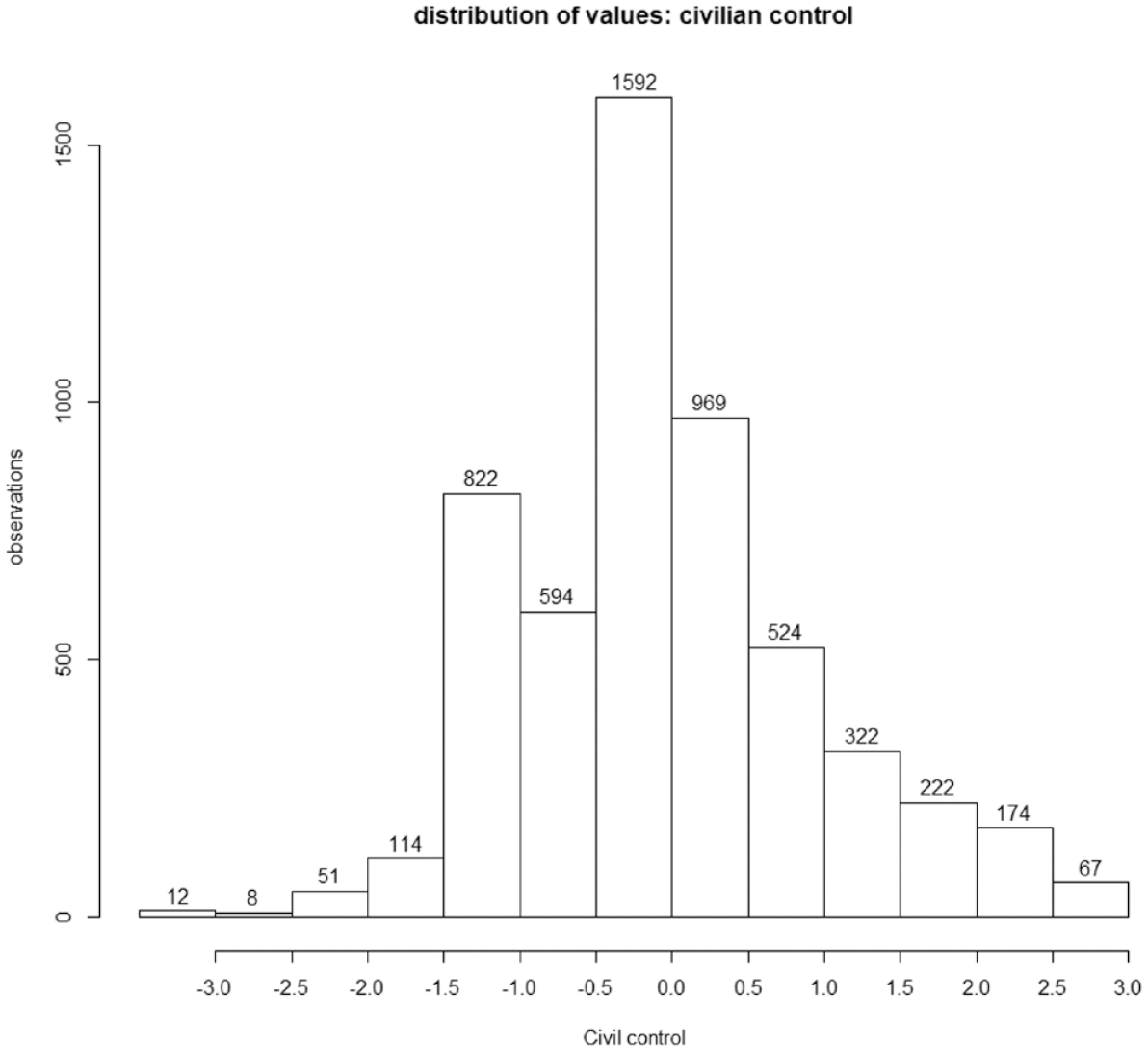
Distribution of values for civilian control.
Control Variables
The models include various control variables thought to affect the propensity to initiate military interstate disputes. 8 Perhaps an important determinant of MID initiation is the economic strength of a country. Economically developed states can afford larger militaries and invest in their armed forces at higher rates than poorer states. States with stronger militaries might be more likely to engage in conflicts as they can afford the risks of adopting hawkish foreign policy stances and goals. On the contrary, it could be argued that economically developed states want stability, so national economies could continue to develop uninterrupted by war. Therefore, the log of GDP per capita for each country is included to measure the effects of higher GDP per capita on the likelihood of initiating a MID, covering the years 1960–2001 as measured by the World Bank (2020). Borders, drawn from the Correlates of War (COW) project (Stinnett et al., 2002), measure the number of land borders a country shares, included as a control because a large proportion of conflicts occur between neighbors (Vasquez, 2009, p. 316). Military power is included as a control variable because militarily strong countries might be more likely to initiate conflicts than militarily weaker countries: Following similar logic to higher GDP per capita, large military power might incentivize hawkish foreign policy and the desire to project power abroad. Military power is measured by the Composite Indicator of National Capabilities index from the National Material Capabilities data set, version 5 (Singer et al., 1972), which is a 0 to 1 continuous measure that captures the share of power a country has based on six indicators: military expenditure, military personnel, energy consumption, iron and steel production, urban population, and total population. In addition, the models include a binary variable measuring whether a country is a great power—under the assumption Great Powers will be more likely than weaker powers to initiate conflicts—also based on COW data (Correlates of War Project, 2017).
To control for the effects of the cold war on conflict, I include a binary variable that codes post–Cold War years as 0 and cold war years as 1. Perhaps military interstate disputes are more likely to be initiated during the cold war period compared with the post–Cold War era once the Great Power rivalry between the United States and the Soviet Union came to an end. I also include a variable labeled democracy to measure whether a democratic regime type decreases the incidence of conflict as claimed by proponents of democratic peace theory (Oneal & Russett, 2001). Democracy is measured by using the polyarchy variable from the V-Dem project, a 0-1 interval measure of electoral democracy; the closer a country is to 1, the more democratic it is (Coppedge, Gerring, Knutsen, Lindberg, Skaaning, Teorell, Altman, Bernhard, Cornell, et al., 2018 V-Dem codebook, p. 40). 9 States rich in oil and gas might be involved in more conflicts over resources than states without them. To control for the effects of oil and gas production on conflict, I include an oil and gas variable that measures the total oil and gas production of each country per year (volume times world price for oil/gas), as measured by Ross and Mahdavi (2015). This variable is important as countries low in these resources may initiate interstate conflicts with their neighbor states. Finally, whether a state engages in more conflict with others might depend on how revolutionary the state’s government is. Colgan (2010) defines a revolutionary government as “one that transforms the existing social, political, and economic relationships of the state by overthrowing or rejecting the principal existing institutions of society” (p. 666). If revolutionary governments are less risk-averse, then they might be more likely to engage in international military disputes. A binary measure of revolutionary leader is drawn from Colgan (2010), covering the period 1960–2001, measuring whether a government was established by a revolutionary leader. Country-fixed effects, although not reported in the models, are included to control for invariant country-specific factors.
Empirical Results
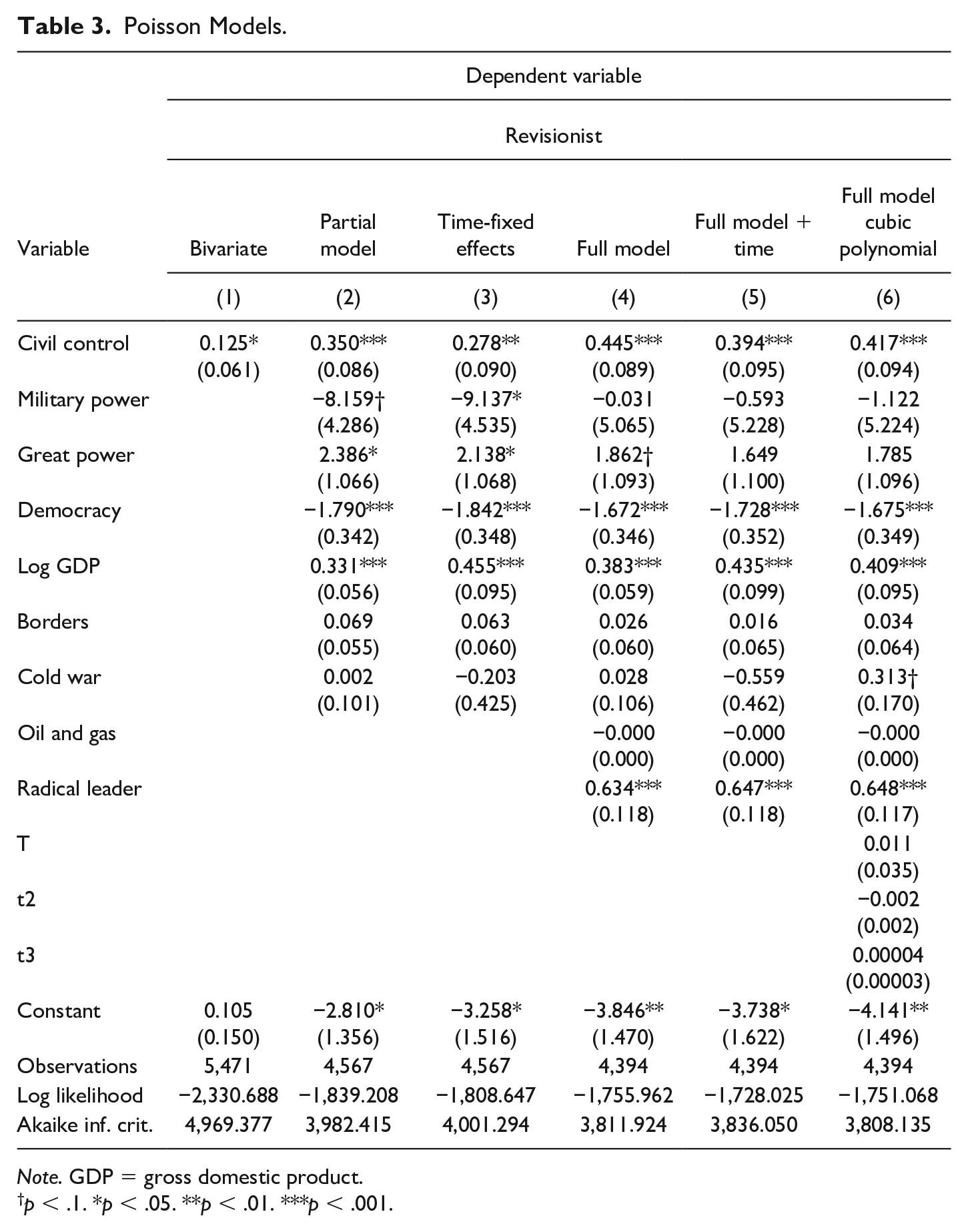
Table 3 shows the logit results of the Poisson regression models using MID initiation as the dependent variable. The coefficient output of a Poisson regression is the log of expected counts as a function of the predictor variables. For ease of interpretation, I exponentiate the coefficients shown in the models to obtain factor changes in the expected counts, then calculate the percent change using the formula (=100[exp(b) − 1]), where b is the logit coefficient. 10 The resulting output can then be interpreted as the percent change effect on the dependent variable when there is a one-unit increase in the independent variable, holding all other variables constant. Throughout all models, greater civilian control of the military increases the expected number of MIDs initiated by a state. Model 1, a simple bivariate model, shows a statistically significant positive result, at the p < .05 level. Model 2 shows a partial model that includes all controls except for oil and gas, radical leader, and time-fixed effects. According to Model 2, a one-unit increase in civilian control over the military increases the expected number of MIDs initiated by a state by 41.9%, holding all other variables constant. Similarly, Model 3, which includes time-fixed effects, finds that a one-unit increase in civilian control increases the expected number of MIDs initiated by states by 32.04%. Model 4 introduces oil and gas and radical leader into the models, while Model 5 includes time-fixed effects in addition to these additional control variables. Once again, civil control is statistically significant and in a positive direction, indicating that greater civilian control over the military institution increases the expected number of initiating more MIDs by a factor of 1.56 (Model 4) and a factor of 1.48 (Model 5), respectively. Model 6 also accounts for time-fixed effects, using cubic polynomials approximation to control for time effects (Carter & Signorino, 2010). The results are similar to those of Model 5. 11
Poisson Models.
Note. GDP = gross domestic product.
p < .1. *p < .05. **p < .01. ***p < .001.
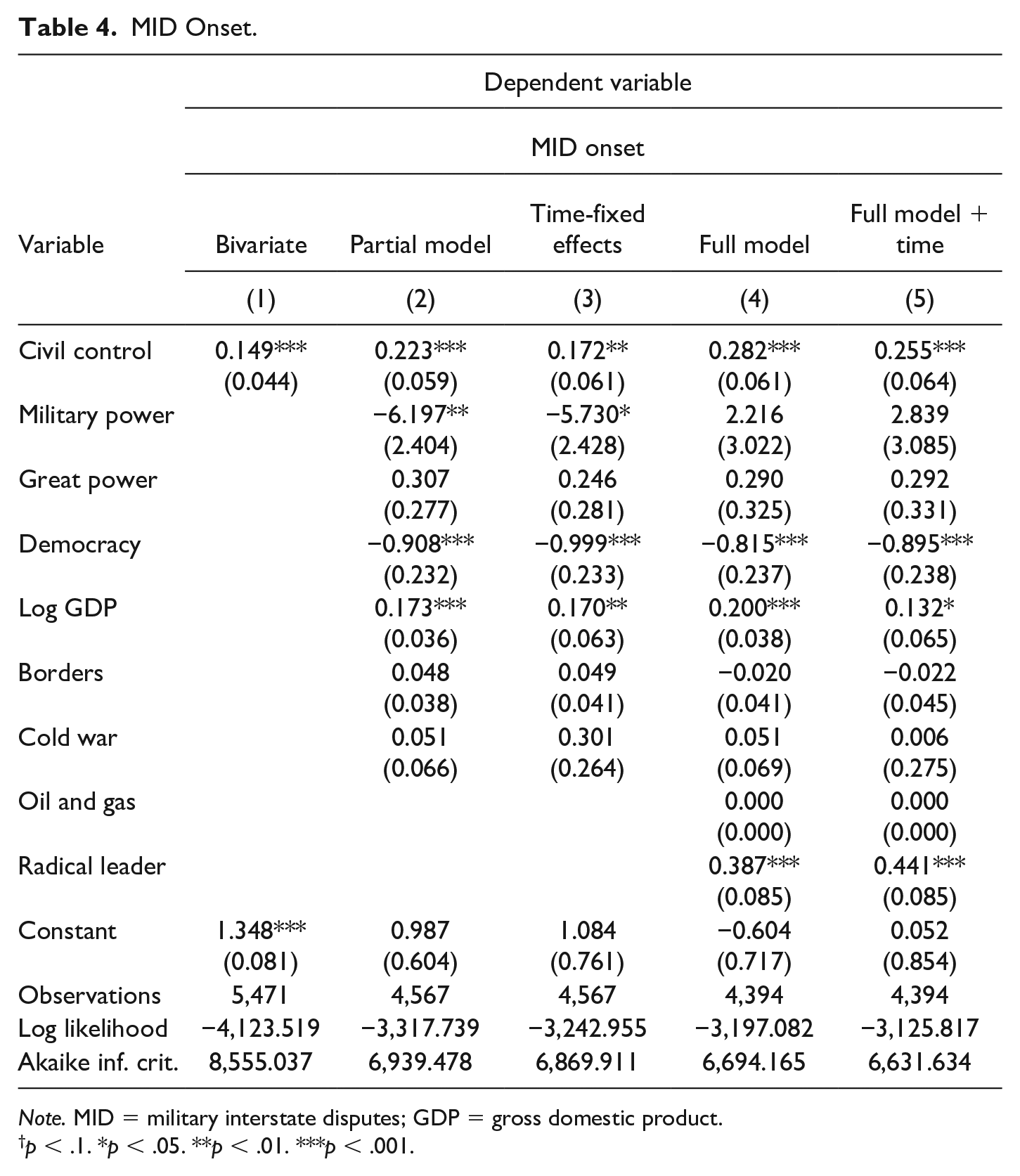
An important nuance is that it is not always clear which state initiated a military interstate dispute, as the initiation of conflict is an often-contentious topic in IR. It might be the case that civilian control over the military affects not just the likelihood of interstate conflict initiation but interstate conflict overall, whether as aggressor or target. Therefore, Table 4 switches the dependent variable from MID initiation to MID onset. For all models, civilian control over the military appears to be statistically significant and positive, indicating that civilian control over the military increases the likelihood of engaging in MIDs, broadly speaking.
MID Onset.
Note. MID = military interstate disputes; GDP = gross domestic product.
p < .1. *p < .05. **p < .01. ***p < .001.
Another potential problem is that MID initiation/MID onset might lead to biased results when used in a monadic data set. For example, a state might be coded as initiating or engaging in 6 MIDs in a given year, but these military interstate disputes might be instances of a single event in which the country targeted six other states at once, which may be coded as 6 different MIDs, one per targeted actor. To alleviate this potential problem, I dichotomized the dependent variable MID initiation, with 1 indicating country-years in which a state initiated an MID and 0 otherwise, to construct a MID binary. This alternative operationalization eliminates the potential bias of single events counting as multiple MIDs when a state initiates a military interstate dispute with multiple actors at once. Due to the rarity of MID events, rare events logistic regression is used for the models presented in Table 5. The coefficients largely match those of the Poisson models: The likelihood of MID initiation increases as civilian control increases.
Dichotomous MID: Rare Event Logit.
Note. MID = military interstate disputes; GDP = gross domestic product.
p < .1. *p < .05. **p < .01. ***p < .001.
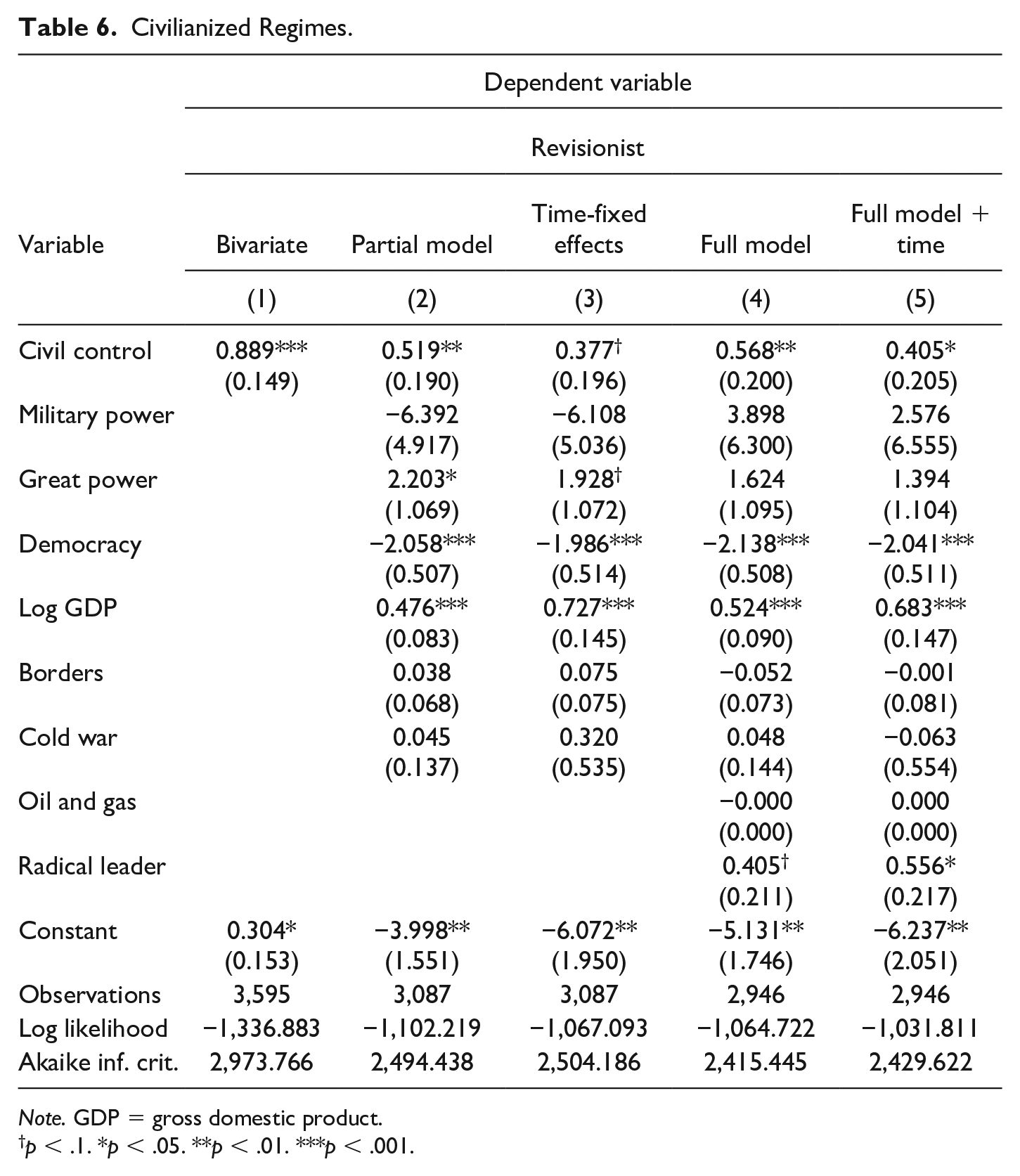
Finally, another threat to validity is that variation in the independent variable, civil control, might be driven principally by differences between civilianized and non-civilianized regimes. As discussed in the independent variable measurement section, each country-year observation was classified as “civilianized” or “non-civilianized” as part of the latent variable construction, with military regimes falling within the non-civilianized category. As a result, it is possible that variation in the independent variable is primarily driven by regime type. It could be that the models are capturing whether militarized regimes are more war-prone than civilianized regimes, rather than whether high/low levels of civilian control affect conflict initiation. To test whether this is the case, Table 6 shows the main models if we use a subset of data that exclusively includes “civilianized” regimes. If the effects of the independent variable observed in the models are driven by the civilianized–non-civilianized dichotomy, then the models in Table 6 should show that the results are statistically insignificant once we exclude non-civilianized country years from the data set. However, as shown in the models, the results generally remain statistically significant and in the same positive direction, revealing that even excluding non-civilianized, military regimes, the results still hold.
Civilianized Regimes.
Note. GDP = gross domestic product.
p < .1. *p < .05. **p < .01. ***p < .001.
A caveat is in order, which may call for some caution in interpreting the results. In all models, whether the Poisson models or rare logit, democracy appears to have a large negative effect on the initiation or onset of military interstate disputes. For instance, the full models 4 and 5 in Table 3 show a coefficient for the democratic control of −1.672 and −1.728, respectively. If transformed to percent change, the output suggests that a one-unit increase in democracy decreases the expected number of MID initiated by 81.21% and 82.23%, respectively. If the effect of democracy is substantively large, it may compensate for the positive effect civilian control has on MID initiation and onset. The complex relationship between civil-military control and regime type and their influence on conflict must be subjected to further study, perhaps case studies, to observe how these two factors affect conflict dynamics.
Apart from democracy, the dichotomous variable radical leader appears to have a significant positive effect on MID initiation. Table 3, Model 5 shows a coefficient of 0.647 for a radical leader. Translated to percent change, the results suggest that the presence of a radical leader increases the expected number of MIDs initiated by states by 90.98%. Similar results are found in Table 4, Model 5, where the presence of a radical leader increases the expected number of MID onset by 55.42%, holding all other variables constant. These results seem to support the argument that revolutionary leaders are less risk-averse, and so more likely to initiate conflicts than leaders that arrive at their seat of power through nonrevolutionary means.
Conclusion
The article adjudicated between two competing theories of civil–military relations—civilian conservatism versus military conservatism—and their relationship with international conflict. Contrary to the theoretical expectations of civilian conservatism theory, the results indicate that greater civilian control over the military increases the likelihood of initiating more military interstate disputes, seemingly supporting military conservatism theory. These results hold across various specifications of the model and are largely found even when using a different measure of democracy (Polity IV), employing ordinary least square regression or negative binomial models. Tables for each of these robustness checks are found in the Supplemental Appendix. The results appear to hold as well when using MID onset as the dependent variable or a dichotomous measure of MID initiation.
The results support military conservatism theory: Although the models control for the effects of having a revolutionary leader and democracy, civilian control over military institutions remains positively correlated with MID initiation. If these results are correct, the implications for foreign policy decision-making are important: Military establishments should have a greater say in the security realm of foreign policy to decrease the likelihood of initiating or getting involved in military interstate disputes, even in democratic states. Admittedly, such a conclusion is normatively worrying for proponents of civilian conservatism theory, who look at the military establishment skeptically. If the military institution is given a greater say in the state’s decisions to go to war, the possibility exists that civilians will lose power vis a vis the military establishment in the important realm of security policy.
An important conclusion that might be drawn from these results is that we should not be quick to dismiss older research showing that civilians are more hawkish than military leaders (Andreski, 1992; Betts, 1977; Campbell, 1998). Instead, future case studies of countries through time might be able to reveal causal mechanisms that explain why civilian leadership might be more hawkish than military leaders and the military establishment while at other times appear to be more peaceful than their military counterparts. Such qualitative studies might demonstrate nuances that quantitative research is unable to tackle head-on. Relatedly, it might be that states in which civilian leadership is stronger are susceptible to rally-around-the-flag effects: Instead of the public being adverse to conflicts, the public might be convinced by state propaganda to support their state’s use of force. If so, hawkish leaders do not have to fear retaliation at the polls for initiating military interstate disputes, as they can spin various justifications for aggression. Such effects have been found in an old study of the rally effect, which shows larger rallies when the United States was the initiator of a military interstate dispute (Baker & Oneal, 2001). Alternatively, civilian leaders with strong control over the military establishment might abuse their power to engage in scapegoating tactics, blaming other states for domestic unrest. Military interventions would then be rationalized as targeting the source of domestic problems when the real sources might be domestic in nature. Perhaps more frequently, leaders might threaten conflict or even initiate war with another state simply to distract from domestic issues such as a declining economy, rising unemployment, or political scandals without necessarily blaming the target state for domestic woes-expected behavior by the diversionary theory of war. Aggressive tendencies by democratic elites, then, might not be as constrained by democratic publics or institutions as originally thought.
On the contrary, the results could have optimistic implications as well. Civilian control over the military establishment could still be argued as normatively desirable so we can avoid, in the worst-case scenario, military dictatorships or quasi-dictatorships in which democratically elected leaders do not have power in government. Yet, input in decision-making by military leadership might be crucial so democratic leaders do not engage in unnecessary wars of aggression or start military disputes and conflicts. A mixture of adequate civilian control over the military while simultaneously providing military leaders a seat at the table in foreign policy decision-making, might serve as the best synthesis between both the civilian and the military spheres to decrease the incidence of international aggression while ensuring integrity of democratic institutions.
A curious result of the Poisson models for both MID initiation and onset is the seemingly contradictory effects of civilian control and revolutionary leader. I find that greater civilian control over the military establishment is correlated with a higher likelihood of MID initiation, yet simultaneously find that revolutionary leaders, who presumably must rely on the military force to hold on to power, are also more likely to initiate MIDs. As a conjecture to explain this curious finding, it may be that revolutionary leaders are, as expected, less risk-averse and quite likely to initiate more military disputes than their non-revolutionary counterparts. However, as the influence of the military establishment grows with time, the agency of revolutionary leaders to initiate conflicts might decrease due to military restraint. On the contrary, if the military establishment’s influence over foreign policy remains relatively weak compared with the civilian sphere, revolutionary leaders’ hawkish behavior may not be checked as frequently as it would be by a stronger military establishment. The potential result of this interaction is that (a) we find that revolutionary leader increases the likelihood of MID initiation, but also that (b) greater civilian control over the military is related with greater MID initiation as well. Ultimately, the curious interplay between the level of civilian control and the presence of a revolutionary leader, and how these two variables might influence conflict initiation and war, must be subject to in-depth study beyond the scope of this paper.
However, the results are tentative rather than definitive. As shown in the analysis, the democracy control variable has a major effect on the likelihood of initiating or being involved in military interstate disputes. As a result, the effects of civil-military control on MID initiation and onset are relatively small in comparison. Table 9 in the Supplemental Appendix includes models with an interaction effect between democracy and civil control to determine the joint effect on MID initiation. Although the coefficient for the interaction term is statistically insignificant, it does not follow the relationship is substantively insignificant; perhaps the insignificant result is caused by the particularities of the data. Future case study research could determine why democracy and civil control pull in opposite directions and how democracy might temper the apparent positive effects of civil control on MID initiation.
Some shortcomings of the present study that future research may address are worth highlighting. The data set used for this study is monadic, with each row in the data set representing a specific country-year. A weakness of such type of data set is that dyadic variables cannot be accounted for, such as enduring rivalries between actor A and actor B, or the number of disputes with immediate neighboring states. Future research could expand on the present study with a dyadic data set and test if the relationship found in this paper still holds. In addition, some predictors of conflict and war are not included in the article. For instance, some theorists argue that religious and cultural factors could account for the incidence of war (Huntington, 1996). Alternatively, state dissatisfaction with their status in the international system might drive states to initiate war (Renshon, 2016). Yet others argue that the existence of defense alliances might increase the incidence of war, particularly multiparty wars (Vasquez & Rundlett, 2016). In sum, although this article controls for some of the major predictors of military conflict, it does not cover all—a task for future studies.
In addition, the Kenwick (2020) latent variable index used to measure civil-military control suffers from some limitations. The index is created by combining various indicators of civil–military control used in the literature. Although some conceptual overlap among the components of an index is inevitable, problems might arise if the overlap is too extreme. Notably, the militarism index, GWF military regime, and military involvement in politics components might be measuring the same concept, degree of military rule in government. If the components of an index measure the same thing, then we have the problem of redundancy (Munck, 2009, p. 22), which may inflate the values of the index. 12 Equally important, some of the components of the index either might not vary much for some country-year observations or might lack data altogether for certain countries. For instance, the Weeks (2012) militarism index and Svolik’s (2012) military entry and military involvement in politics components are ideal for measuring authoritarian regimes, but country-year observations for democracies that never had a military rule, such as the United States and Canada, lack data on these three components. The rest of the components, such as GWF military regime and CGV military regime, do not suffer from missing data problems; they either code lack of military rule/influence as 0 or give it the lowest possible ordinal value. However, this means that in some of the components there is little variation, particularly for democracies, which might be coded as 0 (no military rule) throughout all country-year observations. Therefore, the civil–military control index constructed by Kenwick (2020) should be taken as a useful, if admittedly imperfect, measure of civil control that is not free from criticism and further questioning.
Finally, a weakness shared by all observational studies is that it is difficult to establish causality; all we can establish with such a research design is a correlated relationship between our independent and dependent variables arrived at through statistical modeling. It could be that a state frequently initiating interstate conflicts could lead to a shift in the balance of control between the civilian and military spheres, perhaps because civilians (or military) leaders think they can perform better than the other. If that is the case, then the causal relationship would be reversed, with increased MID initiation affecting the level of civilian control. Future studies could solve this threat to inference via an instrumental variable approach, alleviating doubts about the causal effect of civilian control on conflict initiation. 13
The conclusions reached here should not be interpreted as the final word on the debate between the civilian and the military conservatism theories. As has been shown, there are fruitful paths for future researchers to adjudicate the theoretical debate while avoiding some potential drawbacks of this study. Importantly, a test of the causal mechanisms itself is essential for demonstrating how exactly differing levels of civilian control over the military establishment affect the likelihood of initiating or being involved in interstate conflicts. Thus, qualitative studies geared toward process tracing of causal mechanisms might serve as a complement to the quantitative literature studying the topic of civilian-military control and conflict.
Supplemental Material
sj-docx-1-afs-10.1177_0095327X221112026 – Supplemental material for Adjudicating Competing Theories: Does Civilian Control Over the Military Decrease Conflict?
Supplemental material, sj-docx-1-afs-10.1177_0095327X221112026 for Adjudicating Competing Theories: Does Civilian Control Over the Military Decrease Conflict? by Edward Gonzalez in Armed Forces & Society
Footnotes
Acknowledgements
I thank Wayne Sandholtz for providing feedback to early drafts of this paper in his POIR 642 Institutions in Comparative and International Politics class in Spring 2020. This article’s development also benefited from the Center for International Studies (CIS) Spring 2021 workshop, especially Anne van Wijk’s discussant comments. Patrick James, Siu Hei Wong, James Lo, and Kyle Rapp also offered helpful suggestions for improvement. Finally, I thank the anonymous reviewers for their helpful comments.
Declaration of Conflicting Interests
The author declared no potential conflicts of interest with respect to the research, authorship, and/or publication of this article.
Funding
The author received no financial support for the research, authorship, and/or publication of this article.
Supplemental Material
Supplemental material for this article is available online.
Notes
Author Biography
References
Supplementary Material
Please find the following supplemental material available below.
For Open Access articles published under a Creative Commons License, all supplemental material carries the same license as the article it is associated with.
For non-Open Access articles published, all supplemental material carries a non-exclusive license, and permission requests for re-use of supplemental material or any part of supplemental material shall be sent directly to the copyright owner as specified in the copyright notice associated with the article.
