




Abstract
Whereas existing research posits that the presence of female fighters in armed groups decreases their propensity for wartime rape, one recent study tests this claim quantitatively and is unable to detect a statistically significant effect. This leads the author to conclude that female combatants do not decrease rape. Using that study’s original data, this article reexamines the evidence for the relationship between female rebel combatants and wartime sexual violence. Replications of the original models suggest that they make strong functional form assumptions regarding numerous independent variables and time dependence and that relaxing them results in substantively different findings. Namely, women’s participation in armed groups decreases groups’ use of wartime rape. In support of Loken’s organizational theory of rape, results also suggest that this effect is moderated by group norms. These findings contribute to the literature on female participation in rebel groups and beyond.
Introduction
Recent research has begun to consider the structural and strategic determinants of women participating as fighters in armed intrastate conflict (Henshaw, 2016; Thomas & Bond, 2015; Thomas & Wood, 2018; R. M. Wood & Thomas, 2017). At the same time, studies begin to examine the effects such participation has on the dynamics of armed conflict. Most prominently, 1 Loken (2017) extends Cohen (2013a) and presents evidence that contrary to qualitative studies and common expectations (E. J. Wood, 2006, 2009), female combatants do not decrease the prevalence of wartime rape. She argues instead that armed groups’ violence is driven by organizational features such as military culture and that individuals conform to this culture irrespective of their personal identities.
These conclusions are noteworthy as they challenge prominent existing work on the interplay of military organizations’ recruitment and their goals, norms, and behaviors. If armed group’s organizational culture can indeed neutralize the effects of combatants’ personal characteristics, it is surprising that these groups would invest in screening mechanisms to filter out low-quality recruits (Forney, 2015) and recruit child soldiers whose main benefit appears to be their malleability (Beber & Blattman, 2013) or that within the same organization, combatants’ behavior systematically differs based on their social background or how they entered that organization (McLauchlin, 2015). And while Loken (2017) is correct to point out that existing studies “prioritize organizational explanations for civilian [victimization], arguing that organizational factors drive behavior and group decision-making” (p. 84), these organizational factors are often linked to violence via fighter characteristics or group constituencies. For instance, Weinstein (2005, 2007) suggests that materially endowed rebels are more likely to abuse civilians because their endowments attract opportunistic recruits with little commitment to organizational goals. Similarly, group goals may drive whether and which civilians are targeted or spared (Asal & Rethemeyer, 2008; Fjelde & Hultman, 2014), but recent work shows that these goals themselves are affected by group’s strategic pressures to mobilize and retain support (Tokdemir et al., 2020). If groups seek to recruit women due to these pressures (Thomas & Bond, 2015), they should hence adapt their goals and behavior accordingly. For instance, women’s active participation in the Eritrean secessionist movement led to women’s rights becoming a relevant point of debate and, ultimately, core element of the Eritrean People’s Liberation Front’s goals (Thomas & Bond, 2015). Otherwise, disillusioned members may leave the organization or even switch to rival groups (Oppenheim et al., 2015). As such, there is a theoretical foundation to expect that armed groups where women fight have more gender-equal goals, less misogynistic socialization practices, and stronger norms against sexual violence, resulting in less wartime rape (see E. J. Wood, 2009).
This article takes these insights as motivation to replicate and extend Loken’s statistical analysis. It begins by conducting a close replication of her results and uncovers two statistical issues with the analysis. First, the main independent variable as well as three control variables are included as continuous items even though all of them are categorical, and two, ethnic war and conflict aim, also exhibit no clear rank-ordering. Second, the analysis includes a continuous variable indicating the calendar year of the observation. This imposes the strong assumption on the data that the baseline hazard of wartime rape monotonically increases, decreases, or stays constant over time. However, neither theory nor the data support this assumption. Addressing these two issues, both separately and together, while otherwise following Loken in the choice of data, sample, and variables, results in substantively different results: The presence of female rebel combatants is found to have a negative and statistically significant effect on wartime rape.
In an extension, I link this result back to Loken’s organizational theory of wartime rape by testing whether this effect is conditional on the group environment female combatants operate in. In line with expectations derived from Loken’s arguments, the effect is not moderated by rebel groups’ central command strength but instead by their norms pertaining to gender. Group norms thus determine whether women’s participation in rebel movements can affect rebel behavior and hence decrease the extent of rape or whether they even participate in gang rapes to fit in and not be victimized themselves. This conditional finding connects the results of this note to studies documenting female rebel’s participation in rape and suggests that combatant and organizational characteristics interact in driving rebels’ level of rape.
The next section presents a short discussion of Loken’s argument, replicates the analysis, and addresses the statistical issues therein, finding that female rebel combatants’ presence is associated with less wartime rape. Third section extends the analysis to take organizational features into account, and fourth section concludes by discussing the implications of these findings.
Replication: Female Rebels and Wartime Rape
Loken provides the first quantitative test of the notion that female combatants decrease armed groups’ wartime rape. This theoretical conjecture rests on four mechanisms, namely, that female combatants are more peaceful than their male counterparts because they are women; that they are (willing or unwilling) sexual partners for male combatants, thus substituting for civilian women; that the armed groups they participate in have more feminist, anti-rape goals; and that their presence changes group socialization practices to become less misogynistic and hence less supportive of sexual violence (Loken, 2017; E. J. Wood, 2009). Finding no statistically significant effect of female combatants on wartime rape, Loken (2017) contends that this is the case because “organizational cultures of militaries are often replete with hypermasculine and misogynistic norms” and “women are subject to the same organizational dogmatism as the men” (p. 83). In other words, she argues that organizational, not individual factors drive wartime rape as group members are socialized into a group top-down, leading to a null effect of combatant attributes such as gender. Notably, she suggests that this should be the case irrespective of rebel groups’ strength of command because the pervasiveness of their misogynistic norms (pp. 83–84). But as outlined above, these conclusions and their theoretical implications contrast with much of the existing literature on armed group membership, norms, and behavior.
This note takes this as a starting point to reexamine the empirical results reported in Loken (2017), using the provided replication data set and starting with a reconstruction of the article’s findings. 2 This data set includes 983 conflict-year observations from 86 individual intrastate conflicts over the period 1980–2009 and is described in more detail in Loken. In line with Loken, the dependent variable, rebel wartime rape, is measured using an ordered categorical item that indicates how intensely rebels used rape in a given year; ordered probit models are used to analyze it and standard errors are clustered on the conflict to account for within-conflict interdependencies. The main independent variable is an item measuring whether the rebel combatants in a conflict included women; it is time-invariant and collected by Loken. Finally, the replication begins with including all controls as done in Loken, these are ethnic war, state failure, conflict aim, genocide, abduction, forced recruitment, drugs, female labor force participation, polity, fertility rate, duration, population (log), and year.
Model 1 in Table 1 presents the resulting close replication of Loken’s model on rebel female combatants and wartime rape. The results are in line, if not identical, with the original analysis in that the presence of female combatants has a negative effect on wartime rape which, however, is not statistically significant. Instead, various control variables are identified as significant predictors of rape including state failure and conflict aim. These results mirror those in Loken as well as in Cohen (2013a), upon which Loken’s analysis is based to a large degree. However, a closer inspection reveals that both variables, as well as ethnic war and female rebels, are categorical; their categories and distribution are presented in Figure 1. 3
Female Rebels and Rape.
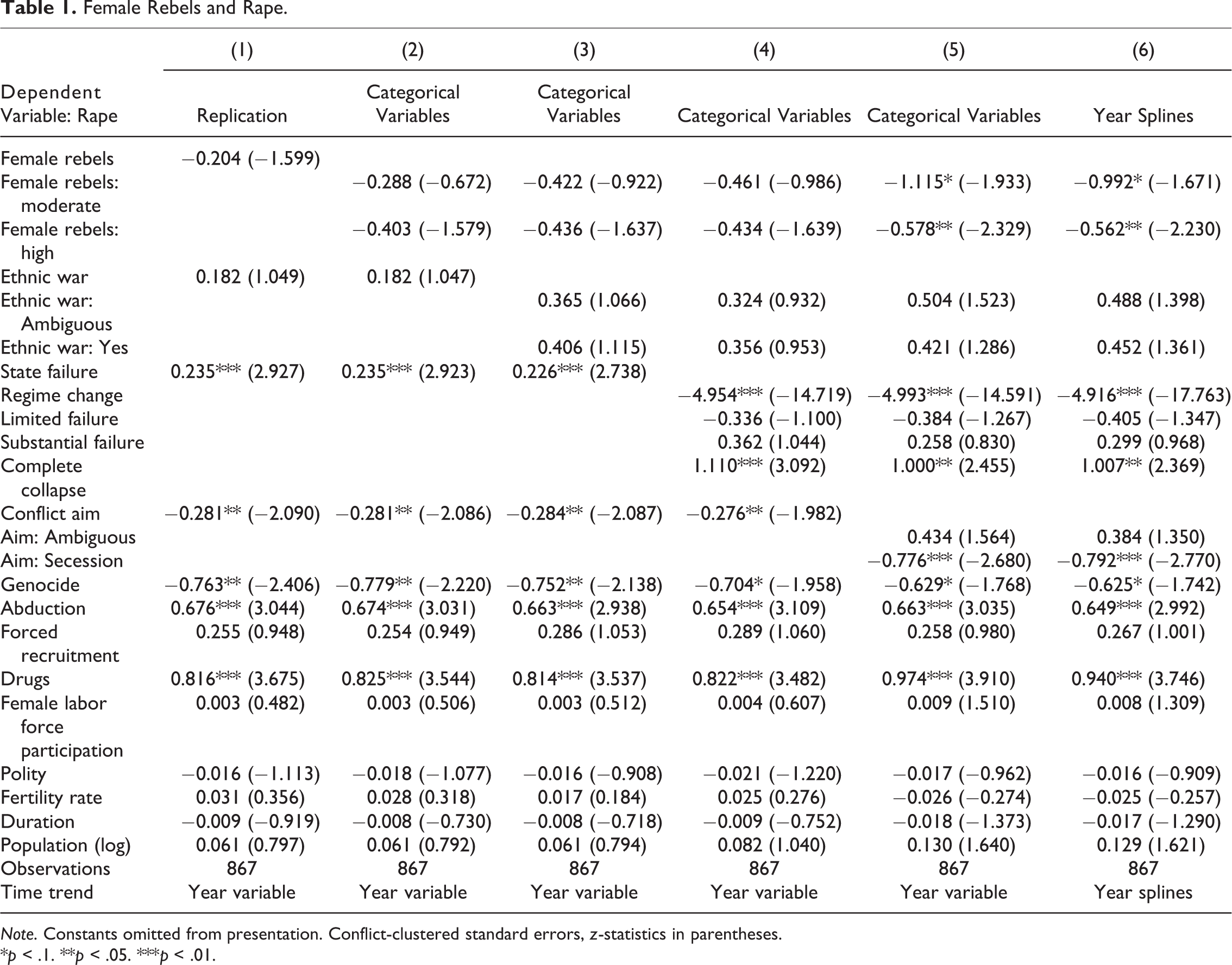
Note. Constants omitted from presentation. Conflict-clustered standard errors, z-statistics in parentheses.
*p < .1. **p < .05. ***p < .01.
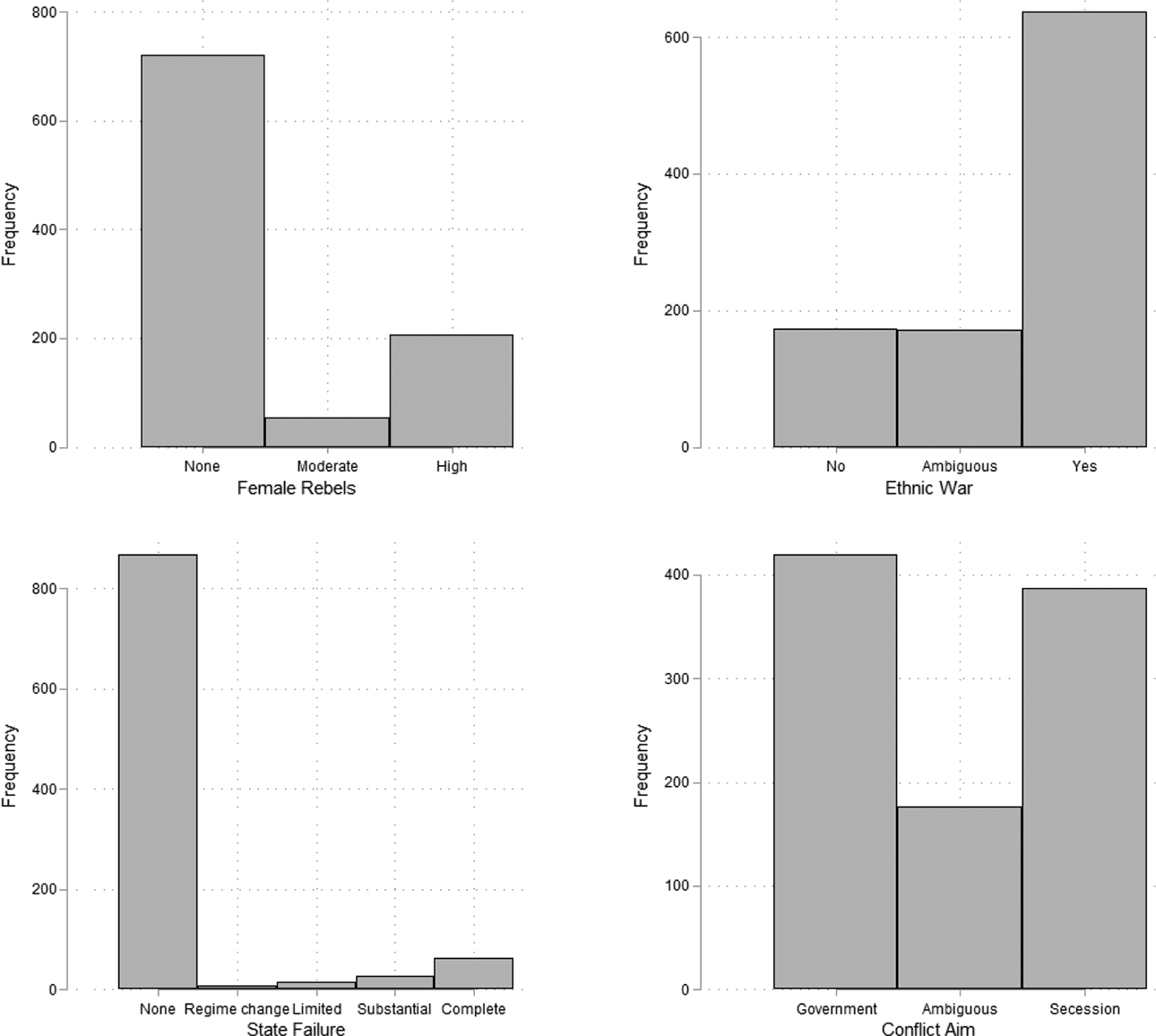
Categorical independent variables. Note. Histograms of female rebels, ethnic war, state failure, and conflict aim.
Cohen includes state failure, ethnic war, and conflict aim in a continuous manner; Loken follows her in this while also doing the same with female rebels. By having these variables enter their models in a continuous fashion, both studies assume that changes in these variables are monotonic and proportional. In other words, they assume that, for example, a one-unit change from a conflict over government to a conflict where rebels have ambiguous goals has the same effect on rape as a one-unit change from such an ambiguous conflict to one where rebels are fighting for secession. This monotonicity and proportionality of effects is similarly assumed for the difference between nonethnic and ambiguous conflicts and ambiguous and ethnic conflicts as well as the categories of female rebels and state failure. While there may be theoretical reasons to make these assumptions, these are spelled out in neither Cohen nor Loken. Including the four variables as continuous items may thus give rise to bias through functional form misspecification, assuming a linear relationship between categories where there is none (Wooldridge, 2013, p.294).
Models 2–5 in Table 1 thus one-by-one separate these items into factor variables instead, that is, include a dummy for each but their respective lowest category which is accordingly taken as baseline (Wooldridge, 2013, p.228). The results support scepticism over the variables’ linear inclusion as none appears to have a linear effect on wartime rape; instead, Category 1 of state failure, regime change, is found to decrease the probability of rebels engaging in rape as compared to no state failure while complete collapse has a positive effect. Similarly, rebels fighting over government appear somewhat less likely to rape than rebels with ambiguous aims but more likely than secessionist rebels. Notably, Model 5 also indicates that the presence of female rebels decreases wartime rape. Both groups with moderate and high numbers of women are found to be less likely to engage in higher levels of rape once the assumption that conflict aim has a monotonic and proportional effect on rape is relaxed. In line with the original study, this effect is thus found to be negative, but here it is also statistically distinguishable from zero.
Models 2–5 follow the original analysis in Loken and Cohen by including the variable year to “capture whether time is a significant factor, either because measurement is improving over time or wartime rape is getting worse” (Cohen, 2013a, p. 469). More specifically, this variable indicates in which year a given observation took place and enters the model as a continuous item in both Cohen (2013a) and Loken. As with the previously discussed continuous treatment of categorical variables, this implies a strong assumption in terms of functional form. Including year in a linear fashion only allows for a baseline hazard of rape that is either constant or monotonically increases or decreases. Cohen (2013a, p. 469) argues that this may be the case due to improved measurement or wartime rape becoming more common. However, the available data do not suggest that rape has gotten more prevalent over time. Figure 2 graphs year against wartime rape showing that while earlier observations are more likely to have no reported acts of rape, there is little difference in the temporal distribution of Categories 1–3 of wartime rape. There is thus little evidence for a linear, monotonic time trend to support the strong assumption made by including year in a linear fashion.
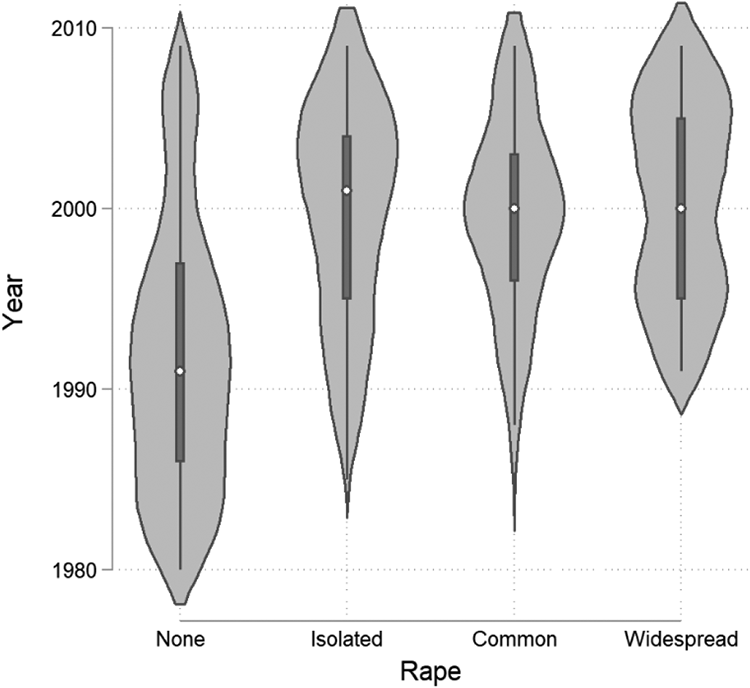
Wartime rape and year. Note. Gray areas represent probability density, spikes denote adjacent values, boxes indicate interquartile ranges, and white dots give the medians.
This is especially relevant as there are other, more flexible methods of taking time trends into account. Accordingly, Model 6 uses year splines 4 instead of the linear year variable, allowing the baseline hazard of rape to nonlinearly vary with time. In line with Model 5, the effect of female combatants’ participation on rebel groups’ level of rape is again negative and statistically significant in Model 6. 5 At the same time, it should be noted that while these changes in model specification alter the effect of female rebel combatants being present on rape, thus contradicting the results presented in Loken (2017), the other results remain consistent with Cohen (2013a) as rebels’ use of abduction continues to have a positive and statistically significant effect on their use of wartime rape.
To get a more substantive understanding of the negative effect of women participating in rebel groups, Figure 3 presents how the probability of each of the outcome values of wartime rape changes with the presence of female rebel combatants in Model 6, the model including all corrections. Here, two effects of female rebels, for moderate and for high participation, are shown. However, the confidence intervals of these variables almost completely overlap for all outcome categories, suggesting that while organizations that include no women behave differently from both, there is little difference between them. 6 In terms of their substantive effects, Figure 3 indicates that groups including women as combatants are 10.4–16.4 percentage points more likely to engage in no rape at all. In contrast, the presence of female combatants decreases the probability that rebels engage in sporadic, widespread, or systematic rape by 2.8–7.1 percentage points. All these effects are also statistically distinguishable from zero, suggesting that the presence of female combatants has a statistically and substantively significant effect on the use of rape by rebel organizations.
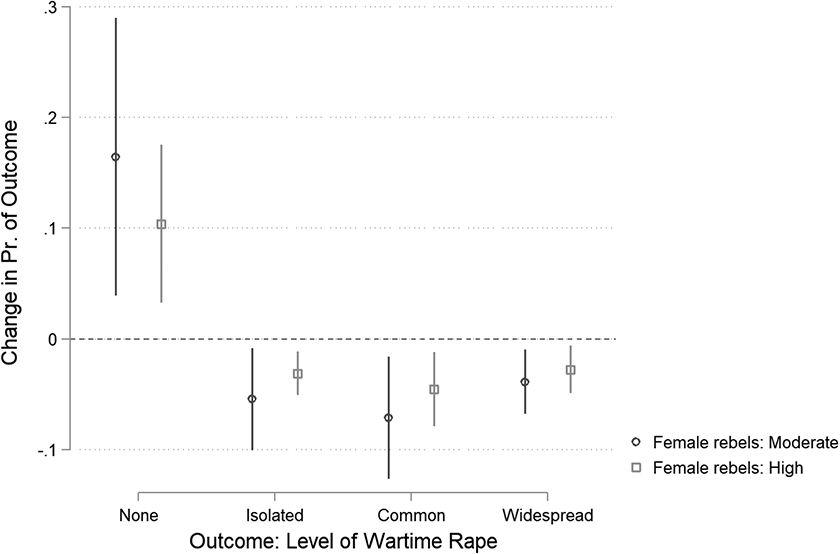
Female rebels and wartime rape. Note. Figure presents the marginal effect of switching female combatants from zero to either moderate or high levels on each of the outcome values of wartime rape based on Model 6. Dots give point estimates while whiskers represent 90% confidence intervals.
In the Online Appendix, I show that this result also holds up when accounting for time dependence within and possible heterogeneity across units, including year-fixed effects, using matching or a multinomial logit model, and when restricting the sample to a pure cross section of conflicts.
Extension: Female Rebels, Organizational Features, and Wartime Rape
In summary, these results do not support the argument that the participation of female combatants does not decrease rape. In other words, individual combatants being women affects group behavior which in turn is not completely determined by organizational features. However, the effect of individual combatant attributes such as gender may still depend on the organizational context in which these individuals operate. This section thus links the effect of female combatants on rape back to two factors that play a prominent role in Loken’s organizational role of wartime rape, rebel groups’ strength of command, and their misogynistic norms. Loken argues that misogynistic norms in rebel groups are so strong that their effect is pervasive and irrespective of central command’s level of authority. As a result, the latter should have little effect on whether female combatants can deviate from group orders regarding rape. In contrast, it should be the nature of group norms that determines to what extent women participating in rebel movements can affect group behavior and hence the extent of rape. Where these norms are especially misogynistic, female rebels may participate in gang rapes to fit in and not become victims themselves (Cohen, 2013b). Whereas if norms are less misogynistic, they may use this as an opportunity to challenge group behavior and strive for more gender equality both within and outside the group. Given Loken’s organizational theory of wartime rape, it should thus be expected that how female combatants affect rape is not moderated by rebels’ strength of command but instead by their gender norms.
This section extends Loken’s analysis by testing the effect of female rebel participation on rape conditional on rebel group command strength and norms. To measure the former, I employ an ordinal variable command strength which is taken from the Non-State Actor Data, version 3.4 (Cunningham et al., 2013). Measuring group norms is less straightforward as they are unobservable, I use a dummy indicating whether rebels include female commanders in their leadership as a proxy (Henshaw et al., 2019). Group commanders should have a clear influence on group norms as they are in a position to directly institute them through training and threats as well as sanction their breaches as they seek to direct the use of violence (Hoover Green, 2016; E. J. Wood, 2018). If commanders are women, norms should be somewhat less misogynistic as a result. Additionally, women being in commanding positions can already be viewed as a signal that group norms are not very misogynistic given that their presence implies male rank-and-file being subordinate to and having to follow the orders of women. For instance, the Kurdish forces in Syria include numerous women among their commanders and have been documented to exhibit gender-equal group norms as well as policies that explicitly guarantee women’s rights (Szekely, 2019). I thus replicate Model 6 while respectively adding the command strength and female commanders items and interacting them with female rebels.
Given that the middle category of female rebels consists of observations from only three conflicts, I binarize this measure; substantive results however remain unchanged when using the original, ordinal version. The substantive results of these extended models are presented in Figures 4 and 5. 7 In line with Loken’s claims, Figure 4 presents no clear evidence that group command strength moderates the effect of female rebel membership on rape. Women’s presence is found to make the nonoccurrence of rape 20 percentage points more likely in groups with a strong central command but also 16 percentage points more likely in groups where central command is weak. Similarly, the probability of rape being common is decreased by 8.2 percentage points when women fight for a group and its central command is weak whereas that decrease is 9.9 percentage points if the group has a strong central command instead. All these effects are also statistically distinguishable from zero, suggesting that the participation of women decreases wartime rape both in groups with low and high levels of central command strength.
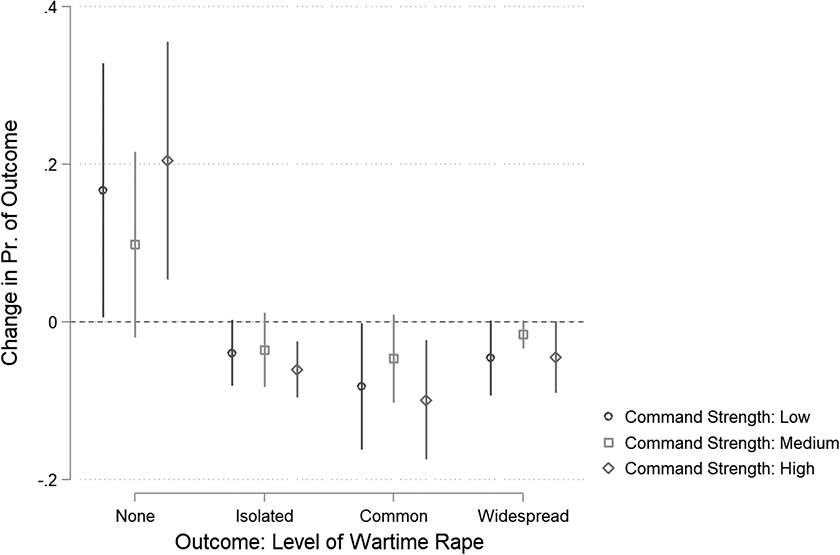
Female rebels, command strength, and wartime rape. Note. Figure presents the marginal effect of switching female combatants from zero to one on each of the outcome values of wartime rape based on the Online Appendix Model A.12. Dots give point estimates while whiskers represent 90% confidence intervals.
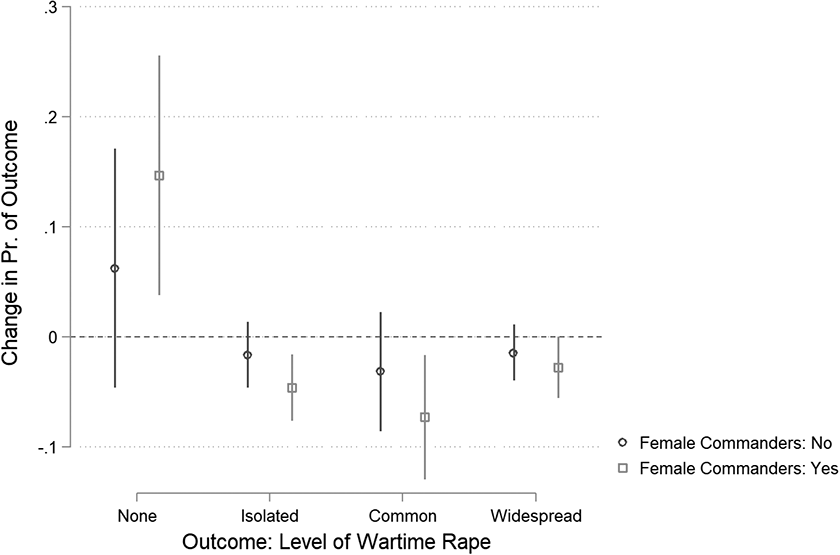
Female rebels, female commanders, and wartime rape. Note. Figure presents the marginal effect of switching female combatants from zero to one on each of the outcome values of wartime rape based on the Online Appendix Model A.13. Dots give point estimates while whiskers represent 90% confidence intervals.
In contrast, Figure 5 suggests that group’s gender norms, as proxied by having women in leadership positions, moderate the effect of female combatants being present on wartime rape. Where women have access to commanding positions, female combatants’ participation is found to decrease the probability of rape by 14.7 percentage points; where they do not, this effect decreases to 6.2 percentage points and is statistically insignificant. Similarly, the presence of female combatants decreases the probability of groups with women in leadership positions engaging in isolated or common levels of wartime rape by 4.6 and 7.3 percentage points; there is again no statistically significant effect when there are no women in the group leadership and hence more misogynistic group norms. These results thus provide suggestive evidence in support of Loken’s argument that group culture matters as misogynistic norms prove so pervasive as to erase any rape-decreasing effect the presence of female combatants might otherwise have. In contrast, less misogynistic norms provide space for women to affect group behavior and hence decrease rape levels. This suggests that the overall finding that female combatants being present is associated with a decrease in rape is mainly driven by less misogynistic groups. At the same time, this conditional effect also provides an important linkage from this overall finding to studies documenting women’s participation in gang rapes as members of highly misogynistic groups (Cohen, 2013b).
Taken together, these results suggest that the originally found null effect of women participating in rebel groups on the wartime use of rape can be attributed to the strong functional form assumptions imposed on some of the control variables by having them enter the model in a linear fashion. Once one relaxes these assumptions by including categorical items such as conflict aim as factor variables and allowing a non-monotonic baseline hazard of rape, the evidence presented here supports the idea that conflict-related sexual violence decreases in the presence of female rebel combatants. However, further analyses also provide support for Loken’s organizational theory of wartime rape as the effect of female combatants’ participation is moderated by group gender norms. The participation of female rebels is only associated with a lower probability of rape in organizations where norms afford them the space to affect group behavior, whereas there is no such effect on rape when group norms are misogynistic and female combatants participate in rape to fit in.
Conclusion
This article reconsiders how the participation of women in rebel groups affects wartime rape, finding support for the notion that rebel groups which include women as fighters are less prone to commit acts of conflict-related sexual violence than strictly male groups. This conclusion differs from Loken’s, and this article shows that this is due to strong and problematic assumptions in the specification of her analysis. In short, all independent variables enter the model in a continuous fashion there, including categorical ones with more than two outcome categories and a variable indicating the year of the observation, thus restricting their effect on wartime rape to be linear. However, there is little theoretical and empirical support for the assumptions that rape increases linearly from rebel groups who fight over government to groups that have ambiguous goals to groups who aim to achieve secession or that the baseline hazard of rape is either flat or monotonically changing with time. The analysis in this article thus closely replicates Loken’s models, using the same data, variables, and observations, while allowing the effects of multicategorical variables and of time to be nonlinear. Results provide support for the idea that the presence of female rebel combatants decreases wartime rape. However, the results of an extension of Loken’s analysis also offer support for her organizational theory of rape as the presence of female combatants is found to reduce rape only for groups without misogynistic gender norms. These findings suggest that individual combatant and group attributes interact in shaping rebel organizations’ level of rape.
First and foremost, this research thus adds to the literature on the drivers and effects of female participation in rebel groups. Future studies should examine this phenomenon further by, for example, studying group-level data or even seeking microlevel data on the participation of women in rebel fighting units to examine how it affects these units’ behavior as compared to homogeneously male units. And, perhaps even more importantly, they should further develop the theoretical underpinnings of why such an effect may be the case, especially as combatant and organizational attributes interact in how they influence outcomes such as sexual violence and the victimization of civilians. More generally, this research serves as a reminder that when specifying independent variables in parametric regression models, implicit functional form assumptions can and do matter. It illustrates that including multicategorical variables in a linear fashion can severely change the results one obtains, especially if these variables are not rank-ordered. At the same time, it serves as another reminder that it not only matters whether potential effects of time are accounted for but also how this is done. As shown prominently in the context of binary dependent variables, it can only be the first step to realize that one needs to account for time dependence, the second step should be to do so in a flexible manner that imposes no strong, unintended functional form assumptions (Carter & Signorino, 2010). The results on the relationship between female combatants and wartime rape presented here serve as an example for how such assumptions can impact substantive conclusions.
Supplemental Material
Supplemental Material, sj-docx-1-afs-10.1177_0095327X20981696 - Female Combatants and Wartime Rape: Reconsidering the Role of Women in Armed Conflict
Supplemental Material, sj-docx-1-afs-10.1177_0095327X20981696 for Female Combatants and Wartime Rape: Reconsidering the Role of Women in Armed Conflict by Marius Mehrl in Armed Forces & Society
Footnotes
Author’s Note
This paper has benefited from comments by Tobias Böhmelt, Daina Chiba, Kristian Skrede Gleditsch, Meredith Loken, Nils Metternich, Lydia Karga, and participants at the UCL Political Turbulences workshop.
Acknowledgments
I would like to thank the editor, Patricia M. Shields, and two anonymous reviewers for their helpful feedback.
Declaration of Conflicting Interests
The author declared no potential conflicts of interest with respect to the research, authorship, and/or publication of this article.
Funding
The author received no financial support for the research, authorship, and/or publication of this article.

Supplemental Material
The supplemental material for this article is available online.
Notes
References
Supplementary Material
Please find the following supplemental material available below.
For Open Access articles published under a Creative Commons License, all supplemental material carries the same license as the article it is associated with.
For non-Open Access articles published, all supplemental material carries a non-exclusive license, and permission requests for re-use of supplemental material or any part of supplemental material shall be sent directly to the copyright owner as specified in the copyright notice associated with the article.
