




Abstract
In this article, we present a collection of texts and images by four Amazonian authors from the state of Pará, Brazil: Juanielson Silva, Jéssica de Miranda Matos, Thiago Kazu and Thiago Batista. Through their poetic approaches, we aim to share other ways of accessing the reality of Amazonia. We thus propose an alternative to the production of knowledge about the Amazon region, which has been dominated by conservation science from research centers abroad, be it in Florida, London, or other economic centers. International cooperation—including those responsible for the exploitation of land and life—adapts the discourse of “valuing the forest” through commodification and praise for the “guardians of the forest.” The exoticizing, fixated, and colonial gaze sometimes omits the multiplicity of local practices and languages, dynamics that make up sociocultural reproduction in the region. In this sense, through the texts, we seek to glimpse gaps in reality, fragments of space, time, and affections, where ways of life survive and are reworked, producing and constructing their own contemporaneity.
Neste artigo apresentamos um conjunto de textos e imagens de cinco autores amazônicos paraenses, Juanielson Silva, Jéssica de Miranda Matos, Thiago Kazu e Thiago Batista. Propomos, assim, uma alternativa à produção de conhecimento sobre a região amazônica, que tem sido dominada pela ciência da conservação de centros de pesquisa alhures, seja na Flórida, em Londres e em outros centros econômicos. As cooperações internacionais – inclusive as responsáveis pela exploração da terra e da vida – adapta o discurso de “valorizar a floresta” por meio da mercantilização e elogiar os “guardiões da floresta”. O olhar exotizante, fixador e colonial omite, por vezes, a multiplicidade de práticas e linguagens locais, dinâmicas que compõem a reprodução sociocultural na região. Neste sentido, através dos textos queremos entrever brechas de realidades, fragmentos de espaço, tempo e afetos, onde modos de vida sobrevivem e se reelaboram, ao produzir e fabular a sua própria contemporaneidade.
In this article, we present a collection of texts and images by four Amazonian authors from the state of Pará (PA), Brazil: Juanielson Silva, Jéssica de Miranda Matos, Thiago Kazu and Thiago Batista. Through their poetic approaches, we aim to share other ways of accessing the reality of Amazonia. They are daughters and sons, granddaughters and grandsons who sometimes summon their lives in the countryside, on the banks of the rivers, and sometimes flow into Belém, the capital of the state of Pará, a city also depicted, a place of violence and of encounter. We thus propose an alternative to the production of knowledge about the Amazon region, which has been dominated by conservation science from research centers abroad, be it in Florida, London, or other economic centers. International cooperation—including those responsible for the exploitation of land and life—adapts the discourse of “valuing the forest” through commodification and praise for the “guardians of the forest.” The exoticizing, fixated, and colonial gaze sometimes omits the multiplicity of local practices and languages, dynamics that make up sociocultural reproduction in the region. In this sense, through the texts, we seek to glimpse gaps in reality, fragments of space, time, and affections, where ways of life survive and are reworked, producing and constructing their own contemporaneity.
Narrative Fragments
by
Here I am, in the middle of the river, sailing on the ferry. Between one bank and the other, I write about the trips I make to my city, seven years after I left there, on return to my home, on a journey of body and spirit, on a reunion of self, I am walking.
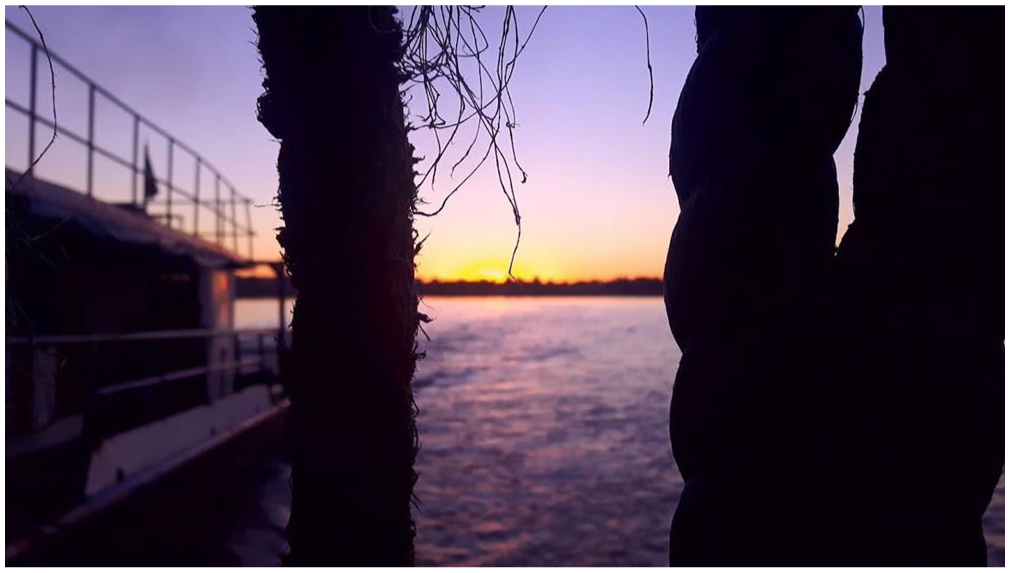
The Ferry.
A boat heads toward the horizon. “Where are they going? To sell flour? To school? To stroll? Or, like me, are they returning home?” I ask myself. On one bank, the one I left, on a stilt house, two caboclos [descendants of Indigenous and white peoples] watch the ferry crossing. “What’s going on in those minds on the other side?” I ask myself. The boat disappears into the horizon.
On the other bank, the one I went in search of, other stories. The river is a separation. To cross it is to cross myself. On the other bank, another me, crossed by the past. In passage. The river is a landscape. On the other bank, Bujarú, a city where cars and motorcycles create their own dance of traffic. Not so different from Concórdia, the city I seek. On the other bank, I see caboclos from the Amazon and Pará. Dark-skinned women, short in stature, with long black hair. They remind me of my mother. On the other side, I feel more inward and I see myself in various mirrors. We continue. . .
Already on the bus, I pass the place where I used to sell flour with my godfather when, during my childhood, I came to spend the holidays at his house, here in Bujarú: the market. Leaving the city, there are woods, farms, woods, a village, woods, a church, a soccer field, a small school, another village, more woods. This is how the route between Bujarú and Concórdia unfolds. Passengers disembark in the middle of nowhere. “Nothing?” I ask myself. “Nothing for me. Everything for them.” They head down small paths that cut through the woods at the side of the road: the branch roads. What’s on the other side of the road? “Stop at the mouth of the branch road, driver!” shouts a man about to get off. “I've finally arrived at my house. There’s nothing better than living in the countryside. In the big city, there’s so much chaos and noise, I'm too old for that,” he adds. Up ahead, in one of the houses on the side of the road, there’s a flour oven leaning against the wall. It’s practically a decorative item that reveals the home of a flour mill family. We continue. . .
Arriving in Concórdia, I get off at the town square and walk home. The town is small, so walking or cycling are often the best options. I'm arriving home, and as usual: a party. The scene repeats itself like a welcoming ritual: still far away, on the corner, I see my nephews running toward me. I've lost count of how many there are, about six or maybe seven children who always make noise in the street when I arrive. "Here comes Uncle Nielson!" they shout.
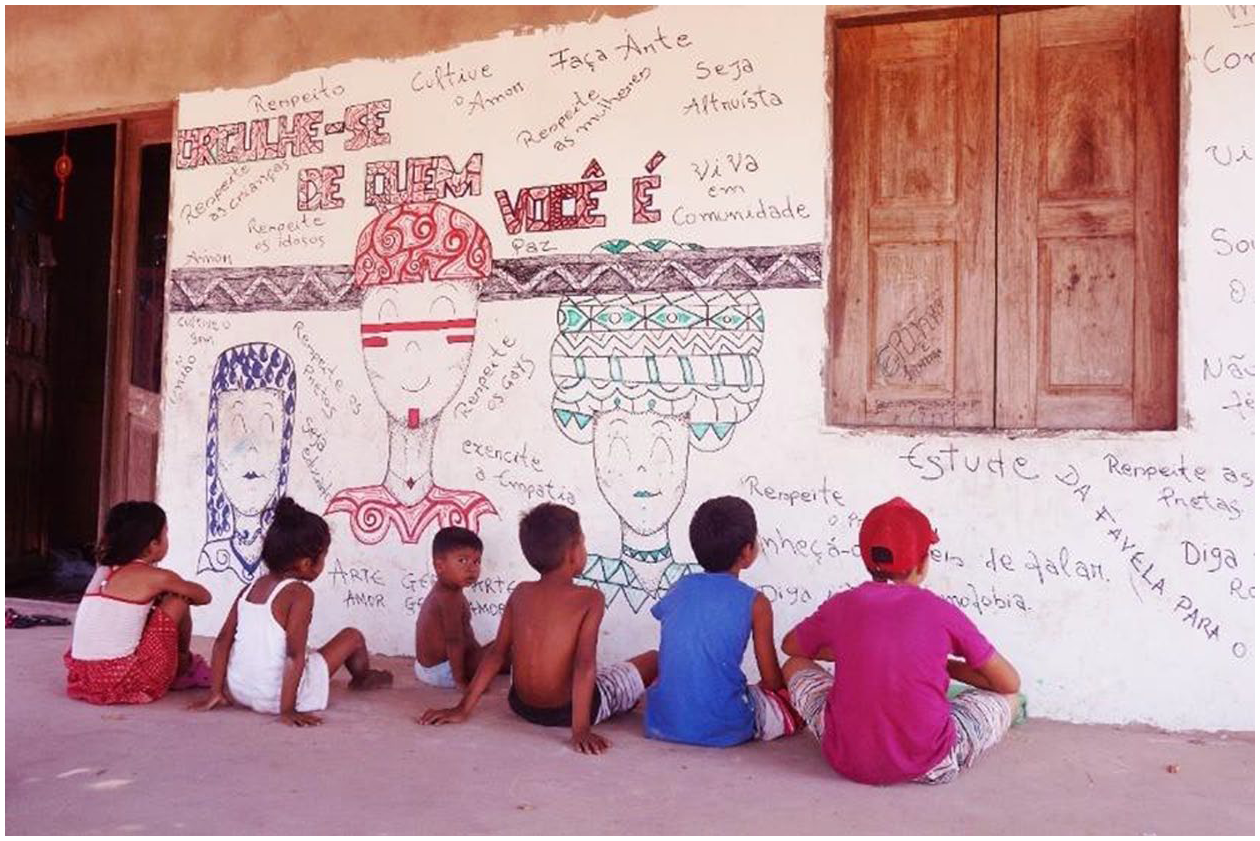
Curumins (Indigenous children).
In the morning, a convoy of children and teenagers on their bicycles passes through the street. They shout and smile. It feels like the beginning of a revolution. It’s time to go to the land where my parents prepare cassava flour. It’s the land of Mr. João, affectionately called Mr. Kito, and Mrs. Neuza, family friends who allow my parents to farm on their land and, as a form of “exchange,” splitting the produce fifty-fifty. A kind of barter.
The poet, deep in the woods, finds his little boy, and plays with him in the middle of the forest. There he finds Mr. Jane and Mrs. Maria, finds those who already knew the stories of old—the stories his parents arduously lived to tell him.
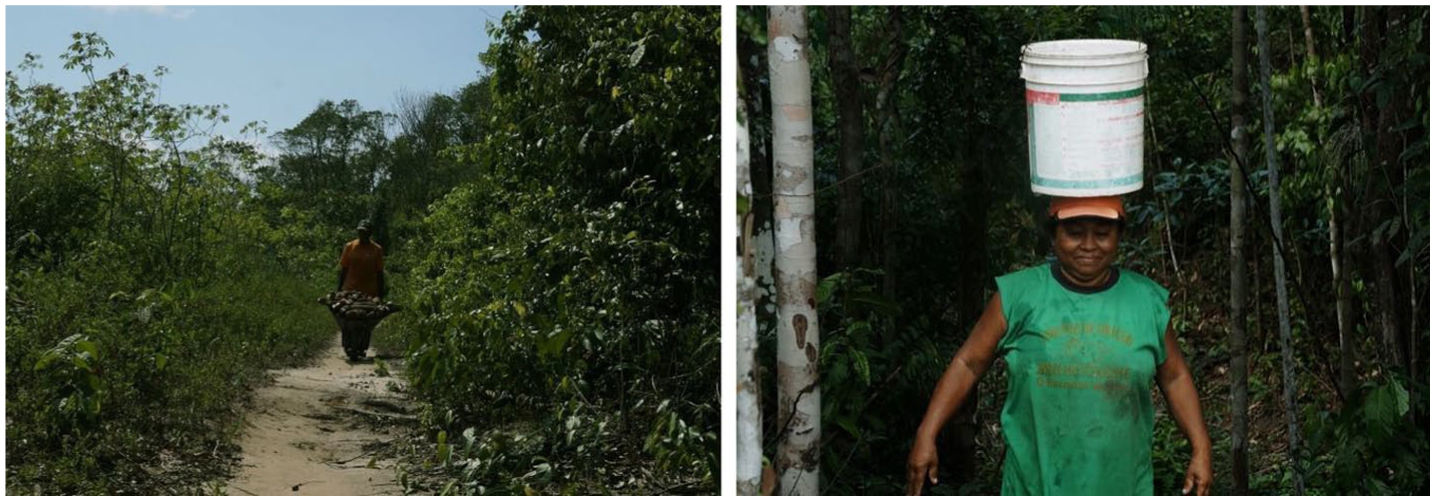
The harvest.
Entering this land also brings back memories of my childhood, of when I made manioc flour (farinha de mandioca) on my grandfather’s land with the rest of my family. It also reflects on everything I've experienced so far, reminiscing about my journey.
I'm leaving my sandals outside, before the gate that marks the entrance to the land. I'm returning home. To my flour mill. Returning to the past to speak of the present and materialize the future. Here, I kill (myself). The silence within me fuses with the whistle that calls the wind. The same silence that announces a storm. It’s time to enter, and this time, alone.
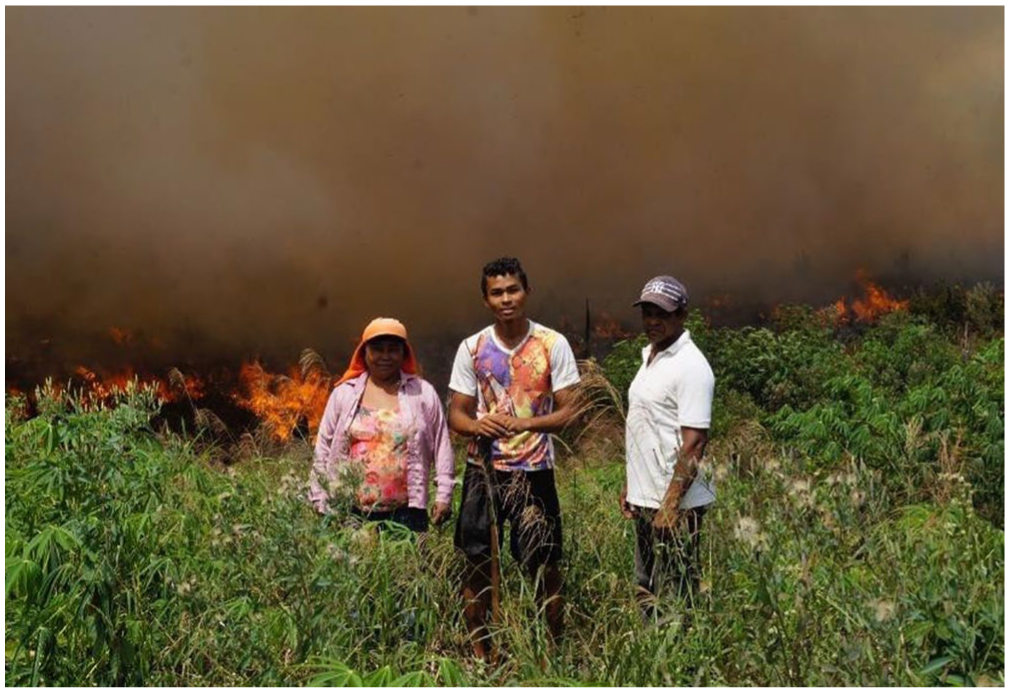
Crop Burning 5: Trinity.
In this field there is a fire,
An act of destruction
That turns my past to ashes
And destroys every illusion.
They are ashes of other preparations.
Ashes that serve as food
Embers that spark memories
And that burn my feelings.
I walk among memories
In the slash-and-burn of my loves.
Here are my stories
Of smiles and pain.
A slash-and-burn
cleans, smokes, and purifies.
Frail body, slow movements, time has entered this house, and the old age in his bones is not the same old age that penetrates my soul. How many journeys can fit into the heart of an old flour miller? The fear of loneliness and of leaving is etched in his eyes, which barely see what’s in front of them. Lying in bed, he breathes deeply as he hears so many voices in his room. A tear runs down the corner of his eye. I wipe it away and say:
It’s going to be okay, Grandpa.
“All elements have these two sides: the bad and the good. Water, for example, serves to water the plants, but if it rains too much, it ends up flooding everything and ruining the crops,” says my father, who was standing by the bed listening to our conversation. “Indeed, all of them are like this, fire, water, wind, and earth too.” At this point in the conversation, my grandfather calms down and speaks serenely about his history as a farmer. Then I tell him the news about my Master’s degree and my research into the preparation of cassava flour, and he gives a slight smile and says,
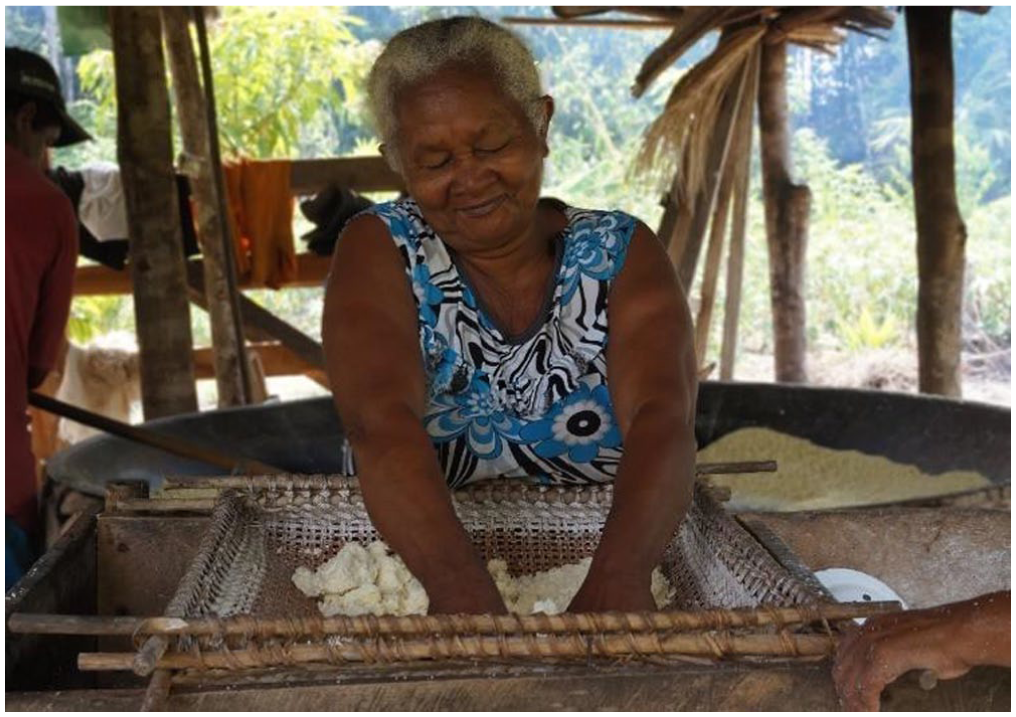
Sifting 1: Dona Neuza.
Three Poems
by
we saw from above a muddy color invading the fish house a clay-colored mud that spreads in the Tapajós River in the immense and dense Tapajós River enchanted water fish house life of many people the color of the mud appeared after the machine drilled the earth looking for that yellowish texture they call gold gold for what? gold for whom? it seems like a fifteen-hundred-year-old story a story that was never ours because our story begins with us our story begins at the beginning of the life of a river or in a black-water flooded forest it doesn't begin with mud whoever drills the earth, drills the fish and the life of the riverbank
gold mining is something that only brings mud but no one talks about the mud only the richness “a treasure in the Amazon” of the treasure, we are left with only the prayer the hardest recitation the heaviest mercury the contamination that bleeds with the silent time of life dying
when the fish house changes color
it is the slowest death
arriving sweaty at the edge
with a fever carrying the rarest diseases the dirtiest water the saddest path it is frightening to see it arriving where food, boats, baths, and blessings arrive death arrived at the edge and we saw from above a muddy color invading the fish house contaminating the Tapajós River Santarém/PÁ, 2022
Five poems
by
(Kazu, 2021)
forcing themselves against the wind they gain altitude and are quickly out of sight sadness doesn't vanish in a decree it’s necessary as it is now that the rain is confusing and I'm isolated on the roof with a notebook which will get wet the slat on the neighbor’s roof flies the tile sheet is now supported only by a brick and goes up and down an obvious leak on that side will be a bedroom will be a living room a hallway it will be on the head of a saint on the shoulder of a photograph, the painted suit the acrylic dress the face fading -up you can already see a hole -down a corridor of wind between the uneven houses someone takes advantage it is the other neighbor to scrub the patio with the most worn broom I hear it’s a regional poem, it’s the Amazonian winter but rituals are no longer strictly observed there’s no time for rain except for people returning home on their bicycles this time or that, which will fall later we are very certain of this everything is out of sight the vulture is not sadness. nor the rain, nor the drip nor the humidity it is nothing the opposite of astonishment, of novelty which cannot be discussed it is what rises and know is late. the rain gives a respite – it doesn't stop – it’s now possible to leave the awning and reach another.
and suddenly you have to win everything again. Start the game again but now with low morale this atmosphere of maceration squeezes and twists us a toothache hurts the soul the toothache therefore finds the soul dirty flour hunger and water - don't give up on love, woe is me - it’s no longer a time for paper the password isn't written in the villain’s room - one tattoo over another: we change, but we repeat - streamers and serpents scattered in the rotten sack of Carnival I think of pleasing you I think of pleasing you in exchange for nothing but in exchange for nothing because silence is an option that fails and it is through failure that a popular saying is made and royalties, royalties and farms and foremen, that’s what it’s all about these are the only terms used by enemies the Amazon isn't exotic because there’s the smell of rotting citrus, black earth - - breathing - - one step away from consuming the entire hourglass - - the hourglass: the chicken hanging by its feet its neck gushing blood began to time our seconds what are you doing that you haven't run yet image: they said ten with the number I think of those who ran, of the crying of those who still can I look at the photo. it’s true that there aren't ten why aren't they all in the photo? why did they stack them? I look at the photo. it didn't have to be all of them just one person says it all and the pile defines a certain quantity but not the real extent of the violence: if they were all stretched out side by side, in single file they piled them up to have something to show, the undeniable but not that they died individually and as a group so we don't think in human terms despite being so insistently repetitive: stained with dirt and blood were the wall tiles, once white and pretty clean. -it’s common knowledge: as bodies we only bleed when alive. the distance between the blood and the bullet is short: quick, accurate; incredible in a conflict, isn't it? aiming is rare. trained police officers, they said. Based on the Pau d'Arco massacre, 2017
2 GIFS from the Açaí Fair
I The boy and the man practicing capoeira. They fight. The boy does a cartwheel. The boy holds a lollipop between his teeth. The man holds a cigarette tightly. They kick again and clap hands.
II The dignity of those who suffer dances.
Reminder
the Amazon isn't what you want to see nor is it just what you can see
A poem
by
bIrd
noir
soul and rhythm of the race
under your great wings remains
the guilty secret
the hidden code
the unspeakable trauma
of the meats the market the burden of the stench of fish prowling hides, fur, feet and paws patois against egum
1
of the sordid kingdoms of ignorance and the virulent horde of nocturnal sailors hungry captains of great ships, perverse hungry ships also, perverse while true hunger challenges affection between you and your towering sister
Oiseau blanc
Footnotes

Notes
Cláudia Horn is a sociologist and lecturer at King’s College London. José Viana is an artist, researcher, and educator, and is currently a doctoral candidate in Visual Poetics at the University of São Paulo. Juanielson A. Silva, also known as Juani Maniva, holds a PhD in Arts from the Graduate Program in Arts at the Federal University of Pará. Jéssica de Miranda Matos holds a Master’s degree in Art History from the Federal University of São Paulo. Thiago Kazu is a poet, editor, graphic designer, and cultural producer from Belém, Pará with a degree in psychology from the Federal University of Pará. Thiago Batista is a poet, photographer, proofreader, editor, and professor. Robert Sean Purdy is a professor of the history of the Americas at the Universidade de São Paulo.