



Abstract

This photo essay documents a small grassroots effort to counter the isolating impacts of COVID-19, particularly for ribereño communities that live on the outskirts of Iquitos, the largest city in the Peruvian Amazon.
In March 2020, Iquitos was in the midst of battling a dengue outbreak when Covid-19 emerged as yet another public health concern threatening to overwhelm the health care system. As many others have already noted, the coronavirus pandemic brought to the fore preexisting societal inequalities. For inhabitants of the Peruvian Amazonian, this meant making international headlines as one of the hardest-hit regions in the world during the pandemic (Álvarez-Antonio et al., 2021).
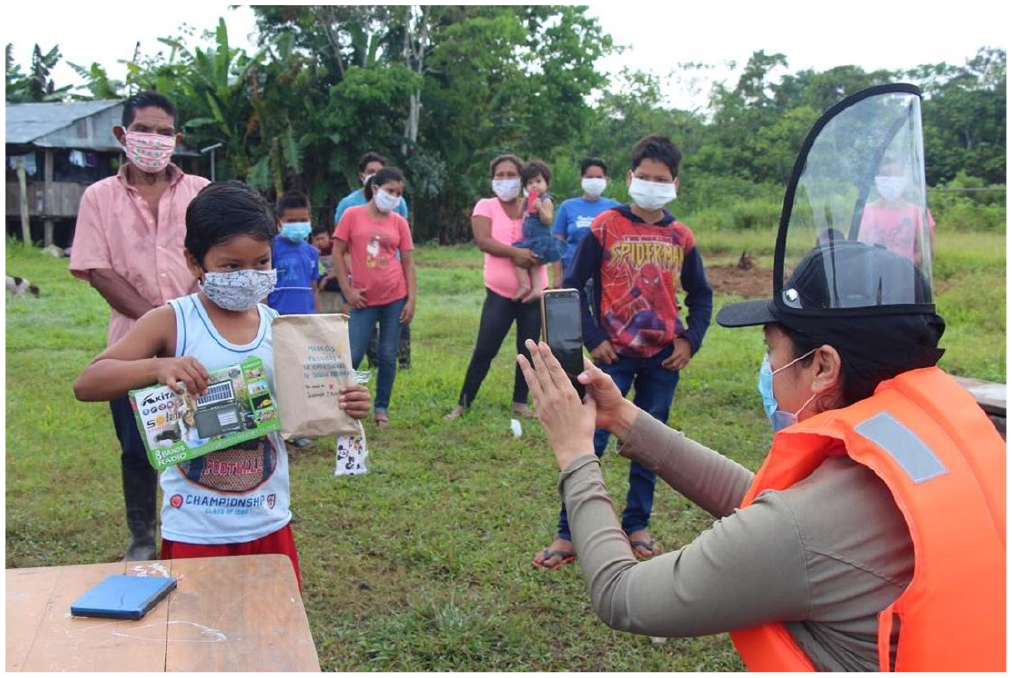
Tanith Peña Araujo documents the delivery of a radio and care package to a student.
When Peruvian President Martín Vizcarra announced the beginning of the national COVID-19 lockdown on Sunday March 15th of 2020, the entire country came to a standstill. International borders were closed and interstate travel was banned. With the police and military patrolling the streets, people were not allowed to leave their homes, save for essential trips to health care clinics, pharmacies, banks, and supermarkets. The Amazonian experience of the global pandemic was marked by a severe health care crisis, economic difficulties, and the notable absence of leadership. Two weeks into the national lockdown, Vizcarra singled out the state government of Loreto during his daily televised updates for utilizing only 10,000 of the 5 million soles that were allocated to combat COVID-19, though the state government later disputed this claim (La República, 2020).
Tanith Peña Araujo addresses members of the Dos de Muyuy community.

Loretanos, being geographically and culturally distant from the center of power in Peru (Arteaga, 2021), suffered other indignities during the pandemic. A presenter on a nationally televised educational program incorrectly stated that the regional staple juanes was prepared with banana leaf instead of the bijao leaf. And despite the provision of educational programming on television and online classes, the lack of reliable internet connection in Iquitos led to major disruptions in classroom learning even within the city, but particularly in the ribereño (riverside) and indigenous communities without reliable electricity.
Tanith Peña Araujo with the radios stacked behind her on the motokar, waiting to depart from Belén.

Frustrated by the lack of official response to the needs of remote communities, Tanith Peña Araujo initially wanted to deliver six radios to the community of Nueve de Diciembre, where she had worked as a kindergarten teacher for over ten years.
After receiving 1,000 soles following a call for donations, Peña Araujo was able to obtain not only the six radios she needed but also twenty-nine other radios for neighboring communities such as Piwicho Isla, Villasis, and Belén. Once she realized the scale of the problem, she established the Un Niño Una Radio (One Child One Radio) project in June 2020 to distribute radios to other ribereño communities. In some of these physically isolated communities, radios were the only solution that would allow children to access educational programming and continue their formal schooling.
Age-appropriate masks and care packages were delivered along with the radios.

The Un Niño Una Radio project raised over 11,200 soles (US$3,700) within two months to purchase and distribute 447 radios to 27 communities. Volunteers collected children’s masks and prepared care packages to be distributed. Other Iquitos-based teachers, who prior to the pandemic commuted daily by boat to their schools, played a key role in distributing radios to the communities where they had preexisting relationships. For many, it was the first time since the national lockdown began that they were able to see their students. During the coronavirus pandemic, Peru gained the unfortunate distinction of having the world’s highest per capita COVID-19 death rate (Beaubien, 2021). In the Amazon, a region that was particularly hard-hit by COVID-19, numerous locally based efforts like the Un Niño Una Radio project were crucial to delivering services where the state was absent. While this project began due to one teacher’s concerns about her students’ lack of education, the delivery of radios to rural communities ensured that marginalized communities were able to remain connected to the outside world. In particular, the radios ensured that they were to obtain crucial information about the coronavirus pandemic, state policies on lockdowns, and the availability of health care services.
Dingies were also chartered to distribute supplies to as many communities as possible.

Teachers in the Un Niño Una Radio project returned in person to the classroom, but during a prolonged period of crisis the radios were an important symbolic and practical act of solidarity in the Amazon.
Footnotes
Diana Tung is a Ph.D. candidate in anthropology at the Australian National University. Her fieldwork examines the transformation of the aguaje (Mauritia flexuosa) palm fruit from a locally prized foodstuff in the Peruvian Amazon to a global superfood. She volunteered as a photographer for the Un Niño Una Radio project. The photographs included here are her own.