




Abstract
In the face of the devastating implementation of corporative agri-food systems, processes of re-territorialization driven by agroecology, such as peasant resistance, become particularly relevant. In this article, we examine the history of the organization La Alianza (The Alliance) in Lara, Venezuela from 1975 to 2020, as narrated by its members, and using the methodology of the systematization of experiences. Based on the analytical categories of agroecology, territory and intersubjectivities, we reconstruct trajectories and organization, identifying harmonious moments which as in the case of a symphony orchestra are triggers for social processes that have promoted the constitution of specific territories. We conclude by showing the possibility of an alternative existence to hegemonic structures, constructed by collective, organized, and conscious subjects that are the driving force behind territories.
Frente a la devastadora implementación de los sistemas agroalimentarios corporativos, los procesos de reterritorialización impulsados por la agroecología como, por ejemplo, la resistencia campesina, cobran especial relevancia. Este artículo analiza la historia de la organización La Alianza en Lara, Venezuela, desde 1975 hasta 2020, narrada por sus miembros y utilizando la metodología de la sistematización de experiencias. Reconstruimos trayectorias y el proceso de organización a partir de categorías analíticas pertenecientes a la agroecología, el territorio y las intersubjetividades, identificando momentos de armonía que, al igual que en el caso de una orquesta sinfónica, han sido detonantes de procesos sociales a favor de la constitución de territorios específicos. Concluimos mostrando la posibilidad de una existencia alternativa a las estructuras hegemónicas—una alternativa construida por sujetos colectivos, organizados y conscientes capaces de fungir como la fuerza motriz del territorio.
Keywords
“We made the revolution before Chávez,” proudly stated one of the founders of Las Lajitas (1976), the first agroecology cooperative in Venezuela, which is today part of the La Alianza network of organizations. This expression, which refers to a character who changed the history of that country, means to the people the leading role in the process of transformation. This cooperative triggered an organizational process that allowed access to housing, land, schools and sustainable ways of providing medicine and food. Above all, it put agroecology into practice, which brought together various organizations in a territory that was the target of modernizing agricultural policies during the 1970s (González, 2011). Currently, La Alianza includes more than one hundred peasant families who produce food for one of the largest and most successful cooperative markets in the country: the Family Consumption Fairs. 2
Agroecology uses a group of techniques and practices that derive from principles, such as the recovery of traditional knowledge, and aims to strengthen the functions of biodiversity (Perfecto et al., 2009; Altieri and Toledo, 2011). Its implementation involves processes of transformation that create material and immaterial territories, such as autonomous thought (Domené-Painenao et al., 2020; Val et al., 2019; Lugo, 2019). The experiences of La Alianza demonstrate agroecology’s capacity to respond to the inequalities that affected peasant communities that were displaced and marginalized by the process of agricultural modernization linked to private capital (Fernandes, 2017; Delgado, 2017). In the Venezuelan case, this modernization translated into a severe dependence on globalized food policies and a trend toward intensive agriculture that were underpinned by an oil culture (Herrera et al., 2017; Schiavoni, 2015), which contributed to a decline in the rural population from 38% in 1960 to 11.5% in 2018, according to the World Bank. 3
In this article, we analyze territory from an immaterial and symbolic perspective to highlight its importance in the territorialization of agroecology (Fernandes, 2017; Haesbaert, 2013; Harvey, 2000). Reconsidering the notion of intersubjectivity, as proposed by Alfred Schütz (1951), with his allegorical allusion to a musical symphony, we aim to understand how harmoniously interlinked discourse can boost intersubjectivities’ potential to construct, in order to contribute to processes of appropriation of social spaces that distance themselves from the logic determined by capitalism and modernism (Leff, 2010; Zemelman, 2005; 2011). We reconstruct La Alianza’s historical process through the systematization of its leaders’ experiences (Jara, 1994) and with a historical cultural focus (Zemelman, 2005; 2011) in order to determine how they acted in the territory to establish and consolidate the organization.
We begin the article with a theoretical discussion on the discourses related to the process of territorialization of agroecology, the allegorical notion of symphonies and the role of the subject. We then enter into detail about the La Alianza experience, followed by a concluding section.
Creating Territorial Symphonies And The Emergence Of The Conscious Subject
Considered as science, practice and movement, agroecology combines practices and knowledges that are founded on indigenous systems of knowledge and a series of territorialized practices carried out by peasant families to grow crops (Wezel et al., 2009). It has currently been consolidated as a true alternative to the advance of a voracious corporate agri-food system that has caused profound ecological and social deterioration, threatening life on a planetary scale (Delgado, 2017; Toledo, 2005). Recognized for its political and critical character, it constitutes a strategy for social movement struggle based on the leading role of territorial subjects and manifesting a transformational potential (Giraldo and Rosset, 2018; Meek, 2014; Domené-Painenao et al., 2020; Val et al., 2019).
In this way, we understand agroecology as a pattern of social activation, a way to transform the corporate agri-food system by promoting processes of creation and recreation of territories. Focusing on this perspective, we see two transformation paths. The first is through the reappropriation and reconstruction of specific spaces that reflect peasant identity and cultural meanings (Duer and Vegliò, 2019; Val et al., 2019; Haesbaert, 2013). The second is by way of the reinvention of immaterial territories through ideas, thoughts and creativities (Porto-Gonçalves, 2009; Fernandes 2009; 2017).
The territory is a social construction resulting from the exercise of tense and conflictive relationships about power over the space resulting in the symbolic and cultural appropriation of the same (Harvey, 2000). By being resignified through social practices, it configures a representation of the use of geographic space (Duer and Vegliò, 2019; Haesbaert, 2013). Thus, because of displacements (forced or voluntary) or abandonment, the space is de-territorialized and immediately afterwards, whoever exercises power, appropriates it, that is, (re)territorializes it. This process happens over and over again, producing a continuous movement of territorial reconstruction (Haesbaert, 2013; Guattari, 2006).
It is by this mechanism that the corporate agri-food system has imposed its power logic and forms of control, domination and appropriation as a result of the expansive action of monoculture on rural spaces, which in turn reduces peasant communities’ autonomy. This generates both exclusion and accumulation through plunder, leading to resistance in impacted communities that refuse to disappear ((Fernandes, 2017; Harvey, 2000; Haesbaert, 2013). Such resistance shows that what is being disputed is not only an empty dehistorialized space, but the possession of land and ways of life. Indeed, the destruction of territories entails the extermination of subjects, cultures and communities (Fernandes, 2017). For this reason, social movements take up peasant agroecology as a territorial defense mechanism, as a means of resistance and the defense of a political project in the face of the continuous dispute with capital (Fernandes, 2017; Meek, 2014).
In this scenario of resistance, an examination of the territorialization that involves agroecology sheds light on how peasants and communities can adopt sustainable practices and promote the development of public policies and social economic markets (Ferguson et al., 2019; Brescia, 2017). In their works on this topic, Ferguson et al. (2019) and Mier y Terán et al. (2018) emphasize mobilizing discourses, understood as instigators of collective action to defend territories and construct modes of struggle and identity that can reclaim agroecological systems. There are also processes of constructivist learning from a popular education perspective, elaborated during the 1970s by Freire (1970), Fals Borda (2008), and others, which had different expressions, including the peasant-to-peasant method of horizontal learning in Central America, characterized by the leading role of communicative strategies and dissemination of experiences and knowledge among peasants, a form of dialogue of knowledges (Holt-Giménez, 2006).
Experiences such as the Movement of Natural Agriculture with Zero Budget in India demonstrate the importance of discourse (of a charismatic leader) that, added to the spiritual element, reveal the exploitative and anti-peasant component of multinational companies and Western culture. Resistance to the multinationals, which in the state of Karnataka alone involved 100,000 peasant families (Khadse et al., 2018), promoted autonomous thinking that led to the implementation of agroecological techniques.
The Cuban case also stands out, in which the critique of the agro-industrial model is compatible with the values of the socialist revolution and the critical and anticolonial discourse of José Martí. In the context of a permanent economic crisis on the island, the idea of food sovereignty and the orientation towards agroecology are strengthened by the peasant-to-peasant method, which has been adopted by more than half of the country’s families (Mier y Terán et al., 2018).
In Venezuela, the antiempirical and anticapitalistic discourse lent itself to the goal of achieving food sovereignty, together with a new institutional order promoting formative and organizational spaces (Schiavoni, 2015). Peasant agroecology represented a response to the scarcity of food and its increasing prices that have affected the country over the last several decades (Herrera, et al., 20017). 4 This experience confirms the transforming potential of discourses that, together with popular education, stimulate the territorialization of agroecology, produces a sense of territorial belonging, promotes the claiming of what is one’s own as opposed to what is foreign, and renews the importance of territorial symbols. In short, in specific situations, discourse has an effect on subjects and vice versa, promoting mobilization and political actions (Aquino, 2013; Zemelman, 2010).
Guattari (2006) posits that the social forces behind capitalism understand that producing subjectivity can be more important than any other type of production, because it allows them to achieve hegemony. Such production of subjectivity refers to the various disciplinary devices that, articulated among themselves, produce a specific type of mentation and eventually conform to existing cultural conditions (Foucault, 1992). This issue needs to be addressed in order to make alternative logics of resistance and insubordination visible in peasant agroecological practices, and to enhance the ability to reterritorialize space and challenge the developmentalist discourse and the corporate agri-food model.
The Creation Of Agroecological Symphonies And The Emergence Of The Conscious Subject
The expansion of capitalism, which has benefited from the disciplinary constitution of logics in the framework of the extractivist model, has been partly made possible by the symbolic appropriation of logic through discourses and the configuration of subjectivities that favor the system (Leff, 2010; Guattari, 2006; Zemelman, 2005; 2011). This section will center on the topic of subjectivity, which was largely a marginalized category that emerged in the crisis of the 1970s, 5 generating interest in the role of the subject within social theory (Aquino, 2013; Hernández and Galindo, 2007). We underline the contribution of Alfred Schütz (1899-1959), with his work Making Music Together: A Study in Social Relationship (1951) on social relations, which made a metaphorical allusion to the musical act of a symphony. He referred to synchronization, simultaneously living in different dimensions of time, a fact verified in intersubjective communication, possible by virtue of the fact that the actors share not only signs or language, but also meanings that are constantly reconstructed in their own interactions (Schütz, 1951; 1964). Along the same lines, Zemelman (2010) highlights the importance of meanings that can differ between subjects depending on the structures of the socio-historical reality in which they are located, but do not lose the quality of promoting interaction, communication, and articulations in the logic of collectivity.
This ensemble of meanings, like a symphony, involves multidimensional and simultaneous processes, where each one interprets its own part, but in doing so, anticipates the part of the sound of the other, allowing for a synchronization of inner time and outer time (Schütz, 1951). The interior time refers to the interaction between members of a community and the exterior to the relationship established with other actors and subjects outside of it (Cabrolié, 2010; Schütz, 1951).
Based on this approach, we develop our proposal of an agroecological symphony. Our intention is to highlight and understand how intangible territories are intertwined in the conformation of concrete territories. For the purposes of our analysis, we understand a symphony to be the composition constituted by a set of speeches that are full of collective meanings and are interpreted and performed by thinking and historical subjects. Such composition is structured in several long-lasting movements (times), with a certain unity of tone (synchrony) and where the parts of an issue are amalgamated, in this case being the specific territory. Such a plot which refers to immaterial territories, nourishes and sustains a complex system of cultural and social elements, related to socio-productive relations, in which agroecologies flourish. The plot also refers to the peasant subject, including their historical memory, their cognitive structure correlative to their way of life and the spatial scope of their socio-productive displacements.
Our study is based on the case of Via Campesina 6 (LVC) [Peasant Path], which articulates around a common discourse: to achieve food sovereignty for more than 200,000,000 people from 182 organizations in 81 countries. Such an “orchestra” develops diverse strategies over an extended period of time, emerging from grassroots organizations, educational institutions (from rural schools to universities) and productive processes, among others; but, also, at another level, multiple voices are heard with their specific claims, from sectors of the population such as women and young people for the recognition of territorial and cultural diversity (Val et al., 2019). Simultaneously, they articulate and synchronize struggles and promote grassroots work towards collective action, specifically agroecology on a global scale, with actions from the local.
This experience demonstrates that the expansion of agroecological territories is possible when a territorial symphony synchronizes with other symphonies. This is the case, for example, with progressive public policies from which the capacity to share and reconstruct ideas can be expanded in collective action. Another example is the LVC’s creation of the Latin American Agroecological Institute (IALA) “Paulo Freire,” which benefited from the support of the Venezuelan government on the basis of common objectives in favor of agroecology (Herrera et al., 2017).
This subject category becomes important in three ways:
1) It is not possible to think of any social structure if it is not a result of the presence of subjects who, in complex relationships of codependency, constitute social processes as constructions in a specific historical context (Zemelman, 2010; 2005; Martínez Torres, 2006).
2) Subjects are always situated in multiple heterogeneous relationships, which form the space that determine them, in which recognition of collective belonging takes place (Zemelman, 2010; 2011).
3) Emerging subjectivities are capable of producing new practices and relations, as well as constructing realities according to interests and intentions (Leff, 2010; Zemelman, 2010; 2011).
For our case study, the subjects that drive processes of territorialization of agroecology are motivated by discourses that circulate in the areas of popular education (Holt-Giménez, 2006; Domené-Painenao et al., 2020). These subjects claim memory and their own knowledges, and reject the concealment or denial of their experiences, or what Grosfoguel (2013) called “epistemicide,” or the destruction of people’s own knowledge caused by colonialism (Limón, 2010).
The processes nurture the emergence of critically thinking subjects, with their one voices and that, symphonically, can have the potential to cause the rupture of individualism’s modern logic by stimulating the meeting and interaction with the other (Domené-Painenao et al., 2020; Zemelman, 2010). It also favors the emergence of “we,” in the interweaving of complex reciprocal relations, in time and space, aimed towards the construction of a shared collectivity and social identity (Cusquicanqui et al., 2016; Leff, 2010).
Learning to listen and understand symphonies constitutes a true challenge, but it is a path to understanding the plot that is not obvious, but sustains territories where subjects live. They, in their ways of thinking, reproduce particular discourses and practices, including those that facilitate the appropriation of lived space where agroecology flourishes.
Methodology
This research (2017-2020) itself a product of transformations linked to the social dynamics that have arisen in the territory, constitutes both a path and a way of walking from a militant, decolonial, and feminist perspective. The research integrates the method of systematizing experiences in a way that privileges what has been lived and combines objective and subjective dimensions. These include the actions of the people who are the subject matter, their perceptions, sensations, emotions and interpretations; and the personal and social relationships with each other oriented towards the construction of collective knowledge (Jara, 1994; Padilla and Guzmán, 2018).
We opted for a historical cultural focus in order to analyze the subject as a constructor of history, which involves recovering memory and resignifying and transforming it, based on the premise that each one contributes to the construction of knowledge and other truths (Zemelman, 2005; 2011).
Under this logic, we reconstructed La Alianza’s lived history throughout 28 intermittent weeks of relationships and meetings over a period of two and a half years (2017-2019). We examined the lives of 126 families that participated in the organization, residing in settlements that form La Alianza, Bojó, Monte Carmelo and Palo Verde in the Municipality of Andrés Eloy Blanco in the state of Lara, as well as other leading figures of the community’s history (Figure 1).
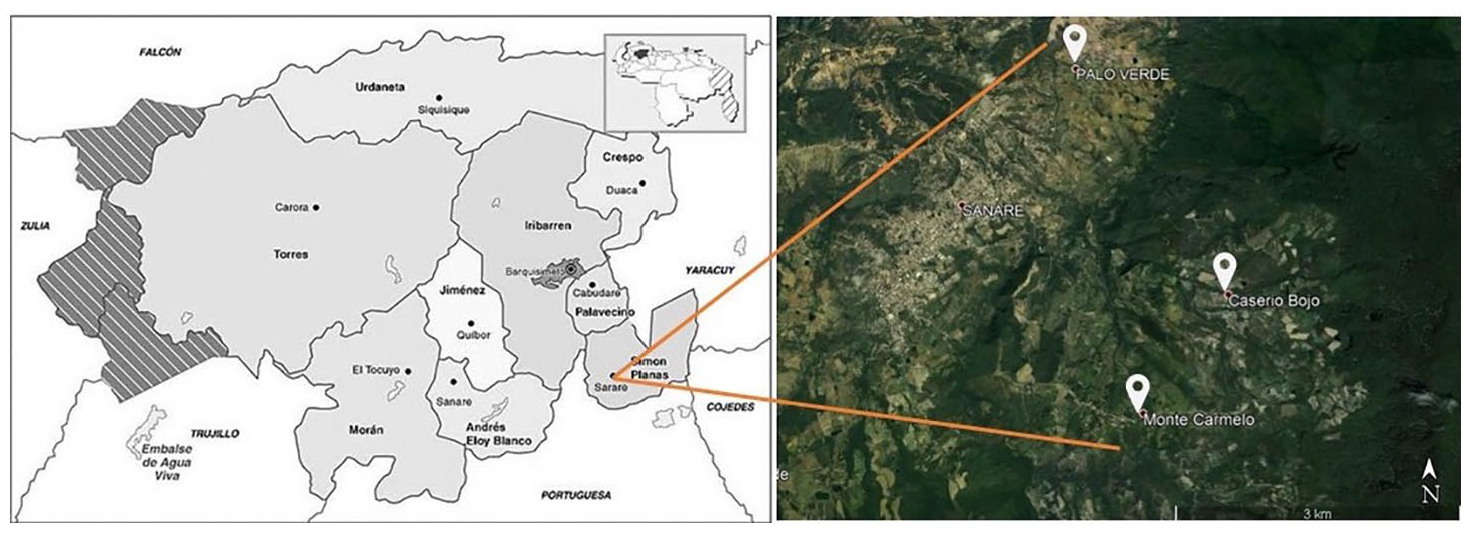
Map Showing the Location of Venezuelan Communities that Participate in La Alianza in Sanare, Lara.
Throughout our investigation (facilitated by the fact that the first author has maintained regional relationships and presence since 2009), we held six focus meetings to establish collective construction of timelines and critical moments; carried out 32 ethnographic interviews to examine intentional discursive practices and the interaction between participants’ frames of meaning and the ways in which their identities were constructed (Pizarro, 2014); and recorded 19 life stories of key founding actors, which allowed us to investigate sociocultural elements through the retelling of their own history, which, as always, is based on retrospective logic (Cornejo et al., 2008).
Finally, we merged the stories, and at the same time we identified the main tensions and conflicts. This helped us answer to two key questions: What were the critical moments in the La Alianza organization? And what were the common ideas that drove the transformations in the territory during those critical moments? The history we compiled allowed us to determine how subjects acted to establish and consolidate their organization.
Results: A History In Symphonic Time
Venezuelan history derives from a modern/colonial process that determined the nature of its future status as a petroleum producer and consumer of imported goods (Sanoja, 2011). A logic of rentier development was imposed, which marginalized the activities in rural areas. Cities became a pole of population attraction and modulating epicenters of market logics that consolidated the current corporate agri-food system (Herrera et al., 2017). It was the profound social inequalities configured by urbanization that explain in large part Hugo Chávez’s rise to power in 1998. This triggered a grassroots constituency that highlighted the importance of food sovereignty (Schiavoni, 2015) and promoted the massification of agroecology from “above to below,” which impacted organizations such as La Alianza (Domené-Painenao and Herrera, 2019).
La Alianza takes in peasant communities of indigenous origin, Gayones and Coyones, contrary to the industrial agricultural model imposed in this mountain region in the 1960s, with the presence of musiú 7 and the implementation of potato monoculture (Domené-Painenao, 2022; González, 2011). Agricultural settlements constituted by musiú responded to a political strategy that intended to establish white supremacy to civilize the peasant population (González, 2011).
However, in the mid-1970s, foreign families abandoned the lands due to a devastating plague. Shortly after the arrival in the region in 1975 of three European Catholic priests, who followed Liberation Theology and advocated for the impoverished sectors, a series of meetings were held that set off peasant organization. In this way, three critical moments arose that determined territorialization, which were woven to the beat of intense symphonies: “La juntura” [the juncture] for the formulation of a territorialization strategy; “mass involvement” in the search for an alternative type of agriculture; and the emergence of the “Maestro Pueblo” (Teacher People).
Moment 1. (Re)territorialization since the Juntura
. . .then there was the necessity to participate politically, to begin popular education projects and organize ourselves.
(Founding member, interview, Sanare, July 21, 2018)
The juncture, referred to as “finding ourselves and becoming a community,” was driven by mobilizing discourses from priests and Liberation Theology, as well as from the cooperative movement and the political influence of the guerrilla movement. Under their influence, the first meetings were held to study biblical texts and become literate, with a view towards organizing and rebellion. Inspired by religious practice, first they proposed to produce in orchards. After its implementation, and not immediately achieving the desired benefits, many families deserted, while 12 participants decided in 1976 to establish a cooperative, Las Lajitas, which acquired a fundamental requisite through financing: access to land. 8
Thus, motivated by the call to organize, men and women founded cooperatives; some of them even shared their assets, as was the case with members of Las Lajitas and La Triguera. At the same time, other families chose to form civil associations, such as Monte Carmelo, Bojó and Palo Verde. All these initiatives were associated with Lara’s Central Cooperativa de Servicios Sociales (Cecosesola), a network of cooperatives created in 1967 that was centered in the city of Barquisimeto.
In 1990, all of them formed a second-tier cooperative: the La Alianza Union of Cooperatives, in which all decisions are made in assemblies. Vegetable cultivation and processing organic foods became their main activity. Their marketing at the Family Consumption Fairs (Ferias de Consumo Familiar), created in 1980, advanced their mission. They currently have three marketing centers and control a network of warehouses, where they move tons of food weekly.
Other activities were promoted in conjunction with food production and marketing, such as literacy classes, housing programs, health promotion and care, and popular religion, among other initiatives that have increased their collective capacity to territorialize. In the same way, the women who demanded participation from the beginning made themselves visible. Some of them decided to join organizations, such as the Women’s Association (Moncar) (1982) and the March 8 Cooperative (1983), which make sauces and sweets with crop residues and process bread and other organic food. These women also have a central role in popular medicine using medicinal plants. For the members of La Alianza, these activities made clear the need to meet and organize as a community, as well as to think of differences as a strength.
Moment 2. “Other Agriculture:” An Alternative Agricultural
We were obsessed. . . to a degree not acceptable to the body. . .
So, that comes from producing in another way.
(Founding member, interview, Las Lajitas, July 12, 2019).
Since the beginning, the La Alianza sought a different agricultural method as a response to health concerns, given the lack of medical services in the community and as an autonomous strategy to access seeds, fertilizers and other supplies. They also explored other forms of production such as organic fertilizer and employed existing knowledge on medicinal plants (Asopromoca member, Monte Carmelo, June 7, 2019). The result was insufficient. In 1983 a university project carried out a medical evaluation due to evidence of negative effects of agrochemicals on peasant communities in the country. A majority of the region’s residents showed organophosphate toxicity from agrochemicals in spite of the fact that some were already working organically. In response to this revelation, La Alianza formed a Health and Education Committee in 1984. A member recalled the situation in this way: . . .then came the so-called Green Revolution, which contaminated us Sanareños’ blood and also contaminated our conscience. We began to leave the plots. . . Our wise men warned us. . . nobody paid attention. . . They stopped planting beans and corn, and that was a cultural crisis. . . (Member, life story, Bojó, September 19, 2019).
The crisis led the community to seek the support of the National Institute of Agricultural Research (INIA), where some researchers began to research ecological agriculture due to the health problems generated by the use of toxic products in the region’s monoculture (García-Guadilla, 1996). The organization then began to use new techniques, such as integrated management of plagues and the production of bioingredients and biofertilizers. In addition, they were pioneers in the region in establishing peasant laboratories of Chrysopa spp. y Trichoderma spp.
At the same time, women and children maintained their agricultural plots, but the activity remaining unnoticed because they did not report economic income. Then, preoccupied by the loss of peasant seeds, the women began to organize, going “door to door, farmhouse to farmhouse” in search of local seeds. This is how they recall the process: People were jealous. . . so we proposed that they lend us [the seeds] and when we reproduced them, we would return them in abundance. . . So that’s how we came to collect more than 250 varieties. . .. That’s how the idea of holding a meeting to show them came up. (Member, life story, Mount Carmel, February 17, 2019)
Beginning in 2005, October 25 became known as Peasant Seed Day and later became recognized nationally as a result of a ministerial initiative, thus promoting the importance of local seeds and establishing plots. This institutional action was a product of popular aspirations. Since 1999 there was a groundswell in favor of a “shift to a sustainable agricultural model” through an institutional transformation with a leading role assigned to peasant, indigenous and Afro-descendent women (Domené-Painenao, 2022).
Besides the organizational process, recovery of community memory, use of medicinal plants, preservation of the plots and the recovery of seeds, it was imperative to secure institutional allies in order to achieve a synchronicity through respectful dialogue: “. . .they do not come to impose anything on us, we ask them for what we need” (Member, interview, Bojó, September 22, 2017). All of this was strategic in promoting reterritorialization and the achievement of autonomy.
Moment 3. The Maestro Pueblo: Reconfiguration of a Conscious and Collective Subject
. . .we have assumed ourselves as peasant thinkers.
(J.J. Escalona, life story, Sanare, June 12, 2019).
The organization carried out educational activities through institutional agreements and allies and on that basis established an educational system including the Escuela Campesina (Peasant School). Beginning in 1985, a university program, which undertook the task of systematizing historical processes collectively and critically analyzing educational processes, was established to train educators to ensure that the youth would stay in the territory. Two participants, J. J. Escalona and J. R. Escalona, popularized the notion of the “Maestro Pueblo,” identified as a collective and territorial subject, which counterfigures the official teacher and school: . . .the intellectuals who come from the cities do not come to the mountains, do not say anything to us. . . They are trapped. . . They consider us peasants an inferior culture. . . but we insist. . . The mythical magic is alive, flourishing, insurgent. . . just like oral memory, that is how we discovered who we were. . . We transcended and delved into the ideological, political, ethnic and thus, without being anthropologists or anything like that. . . we had junctures that allowed us to see our knowledge. . . (J.J. Escalona, Bojó, life story, October 26, 2019)
In this way, La Alianza members began to recognize and promote a new type of teacher, who finds their way of orally transmitting their community’s memory: “. . .how to dialogue with their yesterdays, with their ancestors and above all with these new generations” (Maestro Pueblo, interview, Monte Carmelo, February 26, 2019). The configuration of the Maestro Pueblo was a way to promote their own vigorous, shared social ties, from everyday life, their practices and knowledge. The notion of this subject gained strength within the organization. The notion of this subject resonated within the organization. The aim was to modify the official curriculum and incorporate the Maestro Pueblo in training spaces. In 2004, Father Grippo, who had arrived decades before and participated actively in the process, proposed to Minister of Education Aristóbulo Istúriz, who took part in the Peasant Seed Day that year, the creation of an Agroecology Major. Since then, the peasant-coordinated program has been implemented in different villages. In 2008, 15 rural high schools were established and Las Lajitas opened a successful peasant-taught course on “Cooperatives and Agroecology,” training hundreds of public officials from all over the country. This course reconnects institutions with territorial knowledge and other ways of thinking about agroecology.
Temporary Tensions Interwoven In The Territory
Although La Alianza has demonstrated a vigorous organizational capacity that inspired agroecology and the emergence of the Maestro Pueblo, it is no stranger to tensions, experienced both internally and externally. One source of internal tension stemmed from the crisis of generational transition, based on the difference in lived experiences, in which the elders feel abandoned and not recognized by youth. Other organizations, such as the March 8 Cooperative, which is subject to the same challenge, have promoted an organizational dynamic that has managed to transfer responsibilities to daughters, granddaughters and other women in the community with an idea: “. . . wanting to continue. . . the lifetime of the cooperative” (Member, life history, Palo Verde, March 23, 2018). The March 8 Cooperative previously processed vegetarian pastas and other food, but access to some ingredients became impossible due to the current economic blockade imposed by the United States, so tits members are now working with substitutes such as yuca flour. They also run a warehouse for Cecosesola in the community.
Other tensions, although minor in comparison, originated from the relationship with the organization of the Family Consumption Fairs, whose assemblies (where attendance is obligatory) always seek consensus without requiring voting. As in every collective dynamic, these spaces are not free of contradictions and difficulties, because members of rural spaces find it more difficult to attend due to having to go to the city to participate. Members complained: “. . .they don’t understand life in the countryside” (Founding member, interview, Las Lajitas, March 4, 2018).
In summary, these developments demonstrated the strength of collective experiences and actions, such as organization, agroecology practice and the Maestro Pueblo, allowing members to confront corporate agriculture or the imposition of a school that placed them in an inferior position. In addition, these experiences provide them with forms of (re)territorialization, which embodies an alternative way of life through La Alianza.
Agroecological Symphonies Woven In La Alianza
La Alianza symphonically articulates a series of initiatives, events, relationships, discourses, changing historical situations, among many others, that show the power of subjects as transformers of the territory, in a logic of reterritorialization. An example is the coming together of La Alianza members in the (re)appropriation of territory that had been dispossessed as a result of a modern agricultural model that, under a logic of white supremacy, marginalized and even poisoned them. Another example is their response to the social invisibility of a school curriculum that was completely decontextualized from their reality as peasants.
The combination of actions and practices has allowed La Alianza members to establish an agroecology that is based on techniques and practices conducive to the recognition of traditional knowledge as well as agrobiodiversity.
This peasant organization shows us how the power of listening and being listened to favored meetings for dialoguing, such as that with the clergy, whose practice was committed to popular and liberating causes (Tahar, 2007). Assuming its commitment to the transformation of reality and promoting organizational action, it led to a collective awakening that took on an expansive life of its own. There was also a dialogue with the cooperative movement (Rodríguez et al., 2006), which favored access to resources, promotion and resignification of collective values. Both discourses, the religious and the cooperative, also converge in other peasant processes, such as the Landless Movement in Brazil (Karriem, 2009) and among organic coffee producers in Mexico (Martínez-Torres, 2006). The logic of these spaces, which are essentially true dialogues of knowledge nurtured in multiple scenarios and experiences, has full correspondence with the social process that supports the Peasant-to-Peasant Method previously referenced and whose foundations are the same as that symphonic logic we described (Holt-Giménez, 2006).
A key element that generated territorial identity was recognizing themselves from their indigenous ancestry, with their cultural particularities and their specific ways of life and territorial knowledge, which stands in stark contrast to the mode of modern rationalist logic and Western knowledge (Rivera-Cusicanqui et al., 2016). Its Native epistemes correspond to a knowledge identified and recognized as a collective, plural subject. We have also highlighted the discursive meeting with the armed guerilla movement inspired by the Cuban Revolution (Linárez, 2006). 9
Symphonies As An Articulating Power Of Territories
The conquest and opening of spaces territorialized by the agroecology of La Alianza implied the articulation of shared discourses in a plural symphony of many voices, as a symbolic and historically situated production. The situation like this in which when someone speaks many voices are present has been analyzed by thinkers such as Schütz (1951) and Bajtin (Bubnova, 2006), through their concepts of polyphony and dialogism. Based on the La Alianza experience, we see how symphonies, in time, strengthen and articulate transformative actions in the following ways:
a) Voices that tell their own story are expressed, whose context is historically constructed and subjectively interpreted. In this history, the recovery of what is “autochthonous and owned” takes a central place, in considering those social values that have held meaning for indigenous peoples. As Fals-Borda (2008) suggests, it is in this way that local knowledge is made visible (Rosset and Martínez-Torres, 2012). An example is the adopting of agricultural methods that use few external supplies and the reviving of the use of medicinal plants.
b) To achieve symphonies, it is necessary to recognize oneself, which is not possible if there is concealment and denial of any nature. There is no room here for subordination, but rather the articulation of action projects provided with shared meanings. Collective voices can create and enhance immaterial territories, while nurturing materialized territorialities. One example is the fact that, given the need for permanence and as a (re)territorialization strategy, the women of the March 8 Cooperative handed over the baton to new generations, as well as considering and promoting the diversification of their activities. It is, then, a constantly changing symphony of internal and external times, which can surpass generational times.
c) Conscious subjects emerge with the strengthening of the symphonic moment. In this sense, the appearance of the Maestro Pueblo has been decisive in creating and deepening understanding and revaluing one’s knowledge along the lines of what Foucault called an insurrection of subjugated knowledge (Foucault, 1992) and the elimination of the hegemonic logic of a single mode of thinking. Thus, it is not only about recovering memory, but also thinking “rhizomatically,” which implies distance from the notion of absolute truth (Guattari, 2006). This collective subject, the Maestro Pueblo, is counterposed to the ethnic shame of being the invisible other. Instead, it assumes an anti-hegemonic stance, similar to that of the collective subjects of La Vía Campesina (Val et al., 2019), whose objective is training and organizational development to deal with agribusiness. In this case, the Maestro Pueblo reconnect with the memory of the territory and challenge colonial logics and the capitalist system per se.
d) It enables synchronies with other symphonies. One of the strengths of La Alianza has been achieving synchronies with other organizations and institutions (symphonies in foreign time). In this way they manage to advance in the mass production of bio-ingredients, as well as to build educational programs that, under the logic of confluence of relevant knowledge, are more adjusted to their needs and open diverse educational environments, becoming a national reference. In this sense, the symphonic speeches at La Alianza become a source of inspiration for other organizations, such as the celebration of the National Day of Peasant Seeds, which highlights the defense of native seeds. It also allows promoting agroecology from the experiences of Maestro Pueblo, in the voices of Al Alianza members, whose testimony is reflected at the national level.
This process is linked to synchronies related to Article 305 of the Venezuelan Constitution, which established the transition to a sustainable agricultural model. Following its enactment in 1999, agroecology was embodied in law and was facilitated by the spreading of the example of social forces, such as La Alianza, (Domené-Painenao, 2022).
Finally, in this case, the symphonies favored the territorialization of agroecology through the power of rediscovering their own history in the form of the lived experiences of their subjects and the emergence of a leading collective subject. In addition, the Maestro Pueblo was key to demonstrate the existence of a peasant world. All of this made possible synchronies with other external symphonies, which were oriented and adapted to a powerful territorialization elsewhere. Experiences like La Alianza shine light on mechanisms for rebuilding transformative horizons through sharing common meanings that are woven into collective actions. They are also all about subjects capable of confronting and defeating the corporative and capitalist agricultural model (Van Der Ploeg, 2021).
Greater attention needs to be paid to what is invisible and has been made invisible, what we may not see: the immaterial. That is the place where resources are required to explore actions that allow for understanding other forms of struggle and resistance that have the potential to transform nutritional systems in the future.
Closing Reflections
Mobilizing discourses of collective action leads to processes of (re)territorialization by stimulating organization, training, and production, among other processes, that become symphonic (when listened to and making themselves listened to), reconstructing their own meanings in intersubjective dynamics, and creating particular ways of agroecology, such as forms of production akin to collective ways of thinking and ways for people to inhabit their territories.
The dynamic described in this article is the process in which people’s cultural knowledge is identified, revalued and strengthened, as well as the peasant experience and knowledge that are present in memory, resisting concealment and rejecting their denial, projecting a dignified life as a collective yearning. The dynamic involves the recognition of conscious subjects, collective and critical subjects that can discover synchronicities when meeting with each other and with other organizations, communities and institutions. The same process leads to the expansion of the organization and social movements that oppose hegemonic interests, such as corporate food systems. Consequently, an agroecology emerges in opposition to those agricultures that de-territorialize and bury their own ancestral, cultural, local and knowledge.
The story of symphonies speaks of agroecology beyond the material spheres (productive, economic, ecological or others), and emphasizes the importance of understanding how invisible structures that form the immaterial area of the territory are constructed. The dynamic discussed in this article should also be seen in the context of the warnings of Guattari (2006) and Harvey (2000) that capitalism prevails because of its capacity to create subjectivities, as well as for its striking creativity. Along these lines, agroecology is coopted by organic food multinational companies, which reproduce the same pattern of inequality, exclusion and contamination (Giraldo and Rosset, 2018). It is thus indispensable to create spaces for a true dialogue of knowledges among different sectors and disciplines, but most of all with subjects that inhabit and converge in territories: the people. In this way, learning to listen to themselves and the other gives way to complex challenges and the recognition that there are always other truths, before and beyond those expressed by Western rationality.
Footnotes
Notes
Olga Domené-Painenao is PhD in Ecology and Sustainable Development and is a researcher at the Department of Agriculture, Society and Environment at El Colegio de la Frontera Sur (Ecosur), México. Mateo Mier y Terán holds a PhD in Development Studies and is currently a National Council of Science and Technology Professor in the Agriculture, Society and Environment Department at El Colegio de la Frontera Sur (CONACYT-ECOSUR), Mexico. Fernando Limón Aguirre has a PhD in Sociology and teaches in the Society and Culture Department of El Colegio de la Frontera Sur, Mexico. Peter M. Rosset holds a PhD in Agroecology and is a researcher at the Department of Agriculture, Society and Environment at El Colegio de la Frontera Sur (ECOSUR), Mexico. Miguel Ángel Conteras Natera holds a PhD in Development Studies and heads the Complex Social Systems Theory and Design Laboratory, Laboratory Director of the Center of Science Studies at the Instituto Venezolano de Investigaciones Científicas, and Academic Coordinator at the Center of Science Studies. Margot Olavarria is a political scientist, translator, interpreter and editor living in New York City. The authors would like to thank the members of La Alianza, and particularly the Maestro Pueblo as well as the National Council of Science and Technology of Mexico, which funded this research.