




Abstract
This research paper investigates the confrontation faced by the Gamela indigenous community, located in the Cerrado biome, in the southern region Piauí State in Norteastern Brazil, between agrarian issues and agribusiness. The territory in this area is considered to be the country’s last agricultural frontier. Self-recognition and self-organization of the Gamela people in their struggle for the demarcation of Indigenous territory, and gaining titles to the land, are key to overcoming the invisibility of Indigenous people in Piauí that has been imposed by historiography and official policies. The article highlights the existence of maneuvering done by agribusiness, with the participation of the state, to harm the rights of Indigenous peoples and nature.
Este trabalho de pesquisa examina o confronto enfrentado pela comunidade indígena Gamela, localizada no bioma do Cerrado, região sul do estado do Piauí, no Nordeste do Brasil, entre as questões agrárias e o agronegócio. O território desta área é considerado a última fronteira agrícola do país. O autorreconhecimento e a auto-organização do povo Gamela em sua luta pela demarcação do território indígena e pela conquista de títulos de terra são fundamentais para superar a invisibilidade dos povos indígenas no Piauí que tem sido imposta pela historiografia e pelas políticas oficiais. O artigo destaca a existência de manobras do agronegócio, com a participação do Estado, para prejudicar os direitos dos povos indígenas e da natureza.
Keywords
Environmental and ecological issues have been recurring themes, with alerts presented by the scientific community about the need for international organizations and the state to have a common agenda to enable planetary sustainability. Paradoxically, the Brazilian state has been investing financial resources through tax incentives to support transnational agricultural corporations and global institutions that are engaged in agribusiness, the commercialization of water, and extractive mining of natural resources, activities that function as their productive base, which is the financialization of nature. 1 This paradigm causes major environmental and social impacts, and it includes the invasion of Indigenous lands and traditional communities, the "ex-colonies," if we can call them that, which continue facing colonial ideas that have been persecuting the Amerindian peoples for centuries.
This process intensified with the COVID-19 virus pandemic, resulting in increased hunger and food insecurity worldwide. According to the Food and Agriculture Organization (FAO), 2 hunger is a global challenge: "In 2020, moderate or severe food insecurity reached 30.4 percent, compared to 22.6 percent in 2014. Almost 40 percent of these people - 11.9 percent of the global population, that is, 928 million, are experiencing severe food insecurity" (FAO, 2022: 1). According to data from the Second National Survey on Food Insecurity conducted by the Rede Brasileira de Pesquisa em Soberania e Segurança Alimentar e Nutricional (Brazilian Research Network on Food and Nutritional Sovereignty and Security, PENSSAN) in 2022, 33.1 million people in Brazil did not have enough to eat. More than half the population (58.7 percent) experienced some degree of food insecurity, especially in rural areas (over 60 percent) and black or mixed-race households (65 percent), a situation similar to that of 2004.
From an ethical-political and scientific standpoint, this requires overcoming the paradigm of production based on agrarian capitalism and the formation of sustainable and healthy agrifood systems on a global scale. For this discussion, we consider that biomes are sources of life on the planet. In Brazil, the most well-known biome is the Amazon. However, there are others that, though less known, are being threatened by the advance of monoculture in agribusiness, based on a project of hegemonic development. It is important to point out that the state of Piauí is located in the Northeast region of Brazil, and within its territory there are two biomes - the Cerrado and the Caatinga.
Sampaio (2012: 7) emphasizes that “the Brazilian Cerrado, currently considered the richest savanna in the world in terms of biodiversity, brings together a wide variety of landscapes and an enormous amount of plant and animal species.” There is migration among families and economic groups from southern Brazil who are settling in the biome, driven by the logic of productivity associated with territorial expropriation and environmental devastation, including the destruction of water resources. This mode of production has been creating food, territorial, and ethnic insecurity for the population living in the southwest region of Piauí.
Matopiba, which is a territory composed mainly of land in the Cerrado, is made up of territorial strips of the states of Maranhão, Tocantins, Piauí, and Bahia, and was established through Federal Decree No. 8,447/2015. The area became recognized as the new frontier for agricultural exploration, in line with the idea of fronts of expansion (Santos, 2018) attracting, with government support, national and international companies such as Bunge Alimentos and Cargill. The Sustainable Economic Development Plan (Piauí - 2050) of the state government of Piauí includes the registration of these two companies in Currais and the southwest region of the state: "The arrival of two large companies (Bunge and Cargill) in the region brought a great boost to the development of trade and services linked to this grain export market, attracting new ventures" (CEPRO, 2013: 26). These companies have launched ventures with streamlined licensing due to weak oversight and with high potential for destruction of natural assets and local ways of life, causing conflicts involving traditional communities and, at the same time, giving rise to ethnic identities.
The land, which was previously economically undervalued, has seen its prices rise upon the incorporation of a new productive standard that includes government support for infrastructure, technology, and increased lines of credit. In the state of Piauí, this process generates a new economic cycle, with an increase in the gross domestic product (GDP) of the municipalities involved (Alves, 2020), and coexistence with inequalities, demonstrating land concentration, predatory accumulation, and deterritorialization, which are components of the capitalist and neoliberal contradiction that perpetuate agrarian problems (Harvey, 2005; Silva and Monteiro, 2020).
To consider this perspective, we begin by understanding that the self-identification and self-organization of the Gamela Indigenous people, in the struggle for the right to land, production, and protection of water resources, reflect their process of resistance and confrontation with agribusiness and agrarian issues. Therefore, we seek to answer the underlying question behind this discussion: how do agrarian issues relate to the process of resistance to agribusiness through the self-identification and self-recognition of the Gamela community?
Using a qualitative approach, data was produced through semi-structured interviews, and bibliographic and documentary surveys, taking into account the foundations of participatory research (Freire, 2007; Borda, 1981), and carried out in the context of the teaching practices of the Universidade Popular extension project that accompanies and supports the Gamela people in the struggle for territory and recognition. 3
This analytical exercise begins by considering the materiality of the Gamela Indigenous community’s fight, seeking to understand its internal dynamics, while at the same time directly relating it to everything that it represents. We consider the contradiction between two antagonistic projects in the rural area and in the "last agricultural frontier": one formulated within the framework of agribusiness development and the other within the framework of ecological and environmental sustainability for the well-being of traditional and Indigenous peoples.
We highlight historical constructions of agrarian and Indigenous issues, considering connections, interdependencies, and interactions between what is provided for by law and what effectively occurs through the actions and omissions of public authorities, placing the existence of the Gamela people, agribusiness companies, and the state in context. We primarily employ the categories of contradiction, mediation, and totality, emphasizing that contradiction only arises when there are interactions between opposing aspects, enabling the creative and transformative movement of reality through the incidence of individual and collective subjects (Kosik, 2010).
This reality is not shown a priori; it requires successive approximations that, in the case under discussion, are carried out with the support of actions undertaken with the community in the action-reflection processes of university extension anchored in the theoretical-methodological principles of popular education. In this context, it is understood that the process of liberation occurs with the protagonism of oppressed people. As a result, it is not necessary to talk about rescue here, but rather about self-confirmation of their ontological vocation to be more through processes of education that liberate individual and collective potential (Freire, 2007).
We demonstrate that the advance of neoliberalism in the countryside has enabled a development model focused on meeting the demands of national and international capital at the expense of labor exploitation, natural resources, and territories (Pereira, 2019; Souza and Pereira, 2019; Reis and Pertile, 2019). On one hand, we highlight the consequences of Matopiba in the southwest of Piauí as the regional expression of this project, in which companies use sophisticated mechanisms to carry out land grabs with the complicity of the state, promoting the expansion of the agricultural frontier, environmental degradation, the expropriation of sources of freshwater, wetlands and streams, the siltation of springs, and the expulsion of traditional and Indigenous populations. On the other hand, we emphasize that this process has also led to the organized ethnic emergence of the Gamela Indigenous people, who are fighting for their territory, denouncing illegalities and other forms of violence, and confronting agribusiness ventures.
Agrarian Issues And Overcoming Indigenous Invisibility In Confronting Agribusiness In Piauí
According to Brazilșs Federal Constitution of 1988, the issue of Indigenous lands predates the land tenure problems in the country. According to Article 231, Indigenous people have original rights to the lands they traditionally occupy. It is in this sense that the struggle of the Gamela people to inhabit the Cerrado territory, in the southwest of Piauí, cannot be understood as the generation of a new right, because it is an original right.
In the context of the Brazilian reality, discussions of this matter necessarily involve understanding the invasion, occupation, and exploration of the territory through the process of colonization, associated with genocide, ethnocide, and epistemicide that extend throughout history as coloniality (Silva and Macedo, 2022; Lander, 2005). In Piauí, Indigenous peoples have also been subjected to "forced silencing." Silva and Macedo (2022: 52) note that Indigenous issues were "deliberately overlooked by the means of historiographic production and official records." The authors further explain that due to "nomadism" caused by the conditions of biodiversity, and the state’s variety of geographical, water, and natural resources, people needed to periodically migrate in "search of food, fertile lands, and safety, due to persecution and wars fought against explorers and colonizers, as well as between enemy tribes" (Silva and Macedo, 2022: 53). In this way, “the historical formation of Piauí was forged through a brutal shedding of indigenous blood and enslavement of those who remained, followed by strategies of de-Indianization and forced integration of descendant families, resulting in an ethnic erasure to the point that FUNAI [National Indian Foundation] recognizes no presence of Indigenous people in the state” (Silva and Macedo, 2022: 53).
Despite inaccuracies in the data on ethnicities, with conflicting numbers, Baptista (quoted in Silva; Macedo, 2022: 53) recorded the:
existence of four ethnicities: Jê, Caraíba, Cariri, and Tupi - divided into seven nations: Pimenteiras (Caraíba); Tremembé (Cariri); Acroá, Gueguês, Jaicós and Timbira (Jê); and the Tabajaras (Tupi). The four ethnicities present in Piauí are distributed among 158 indigenous tribes, including, among others: Jenipapos, Acauã, Anacé, Canela, Gueguês, Jaicós, Gilbués, Gamelas, and Tacariju.
The aforementioned authors attribute the process of "de-Indianization" to several factors, including: 1) the intervention carried out by Jesuit missionary settlements between the mid-17th century and the early 18th century, with catechetical work and hard labor; 2) the actions of Indigenous agencies, by encouraging interethnic marriages; and 3) the Land Law of 1850, in which, upon losing their lands, the survivors had to hide their Indigenous cultural traits as a way to preserve their existence.
This set of factors, and especially the last one, express the direct relationship between Indigenous agrarian issues, because, just like enslaved Black people, Indigenous people were excluded from the possibility of accessing land since the colonial period (Prado Júnior, 2000; Martins, 2010). This process has gone through different moments in the dynamics of capitalist development in Brazil, and today we find an economic supremacy of agribusiness, in contrast to peasant and family agriculture, anchored in the unequal distribution of land ownership.
Data from the 2017 agricultural census, from the Brazilian Institute of Geography and Statistics (IBGE), showed that 10.8 percent of establishments with 100 hectares or more occupied 79.5 percent of the area dedicated to agriculture, while establishments with less than 10 hectares accounted for more than 50.22 percent and occupied only 2.3 percent of the total area (Pereira, 2019). According to the same census data, in Piauí, family farming represented 80.3 percent of the total number of establishments and 38.5 percent of the total area used (Morais, Sousa, and Araújo, 2017). In the Matopiba territory, 2.1 percent of agricultural establishments had more than 1,000 hectares and occupied 51.6 percent of the total area (Pereira, 2019).
The Indigenous conflict persisted throughout the Brazilian historical process with different configurations and resistance from the peoples. Today, among the strategies applied to this conflict are attempts at erasure, despite the guarantees of formal recognition of the right to traditionally occupied lands. The Brazilian Federal Constitution of 1988 guarantees the right to social organization, customs, languages, beliefs, and peopleșs own traditions, which must be implemented by the state.
In Piauí, the logic of erasure disseminated the idea of the nonexistence of Indigenous people in the state, facilitating the expropriation of lands originally occupied by the communities. In contrast to this process, a certain resistance has been forming in Piauí, echoing the growing mobilizations of Indigenous peoples in Brazil, such as the "Terra Livre" Camp, the March of Indigenous Women, the Uprising for the Land, the National Meeting of Indigenous Students, and the Meetings of Leaders of the Articulation of Indigenous Peoples of Brazil (APIB), among others. The main battle cries include struggles against the relaxation of environmental legislation and inspection, which facilitate land grabbing (draft legislation PL 2633/2020 and PL 510/2021); the construction of dams and hydroelectric plants in traditional territories; illegal mining (PL 191/2020); attempts to impose a time frame (PL 490/2007), and the demarcation of native lands, among others.
The protests and other mobilizations in Piauí gave forcefully addressed Indigenous and agrarian issues, especially in the southwestern part of the state, where there is an expansion of the agricultural frontier, whose intensification accompanied the commodity boom in 2001 and the search for agricultural lands in the face of the 2008 financial market crisis. According to the Associação de Advogados de Trabalhadores Rurais (Lawyers Association in defense of Rural Workers, AATR), "in 2016, soybeans occupied an area of 563,084 hectares, reaching a total of 711,123 hectares in 2017, thus incorporating nearly 150,000 additional hectares by agribusiness in a single year" (AATR, 2020: 18). In Piauí, soybean production is concentrated in the Uruçuí and Bom Jesus regions in the southwest of the state. For a better understanding, this is the location on the map:
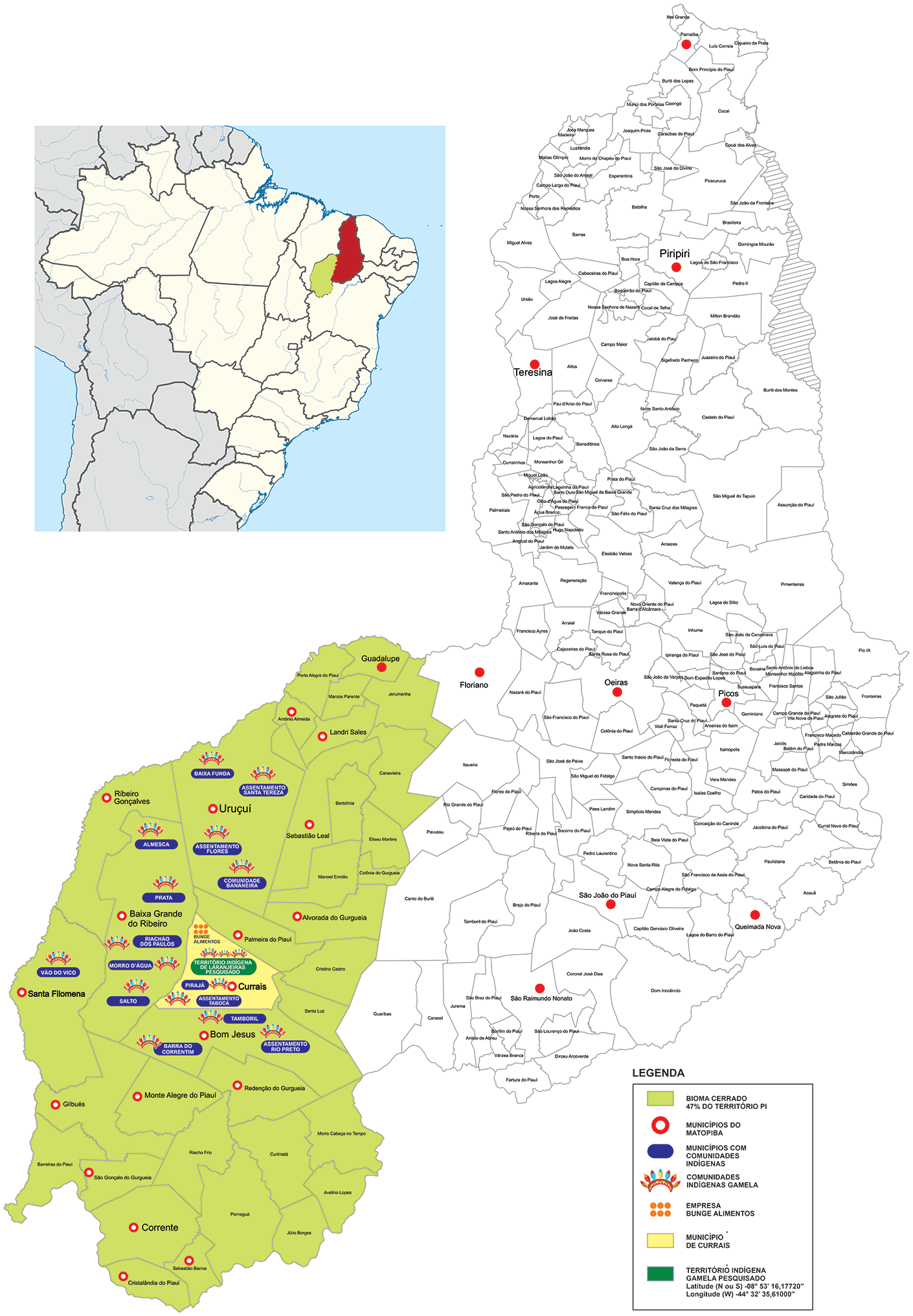
Map of the Gamela Indigenous territory in southwestern Piauí.
Silva and Macedo (2022: 52) explain that only recently, in the first half of the 2000s, was it possible to give some visibility to the history of Indigenous erasure in Piauí and promote mobilizations in other municipalities of the state in favor of historical reparations. This happened with the mobilization initiated by a group of Indigenous people from a community in the northern region of Piauí, specifically in the municipality of Piripiri, with the participation of anthropologists and researchers, who, in addition to carrying out research, supported the creation of an Indigenous organization.
According to the Brazilian Institute of Geography and Statistics (IBGE), the data on Indigenous people in the 1991 and 2000 demographic censuses came from the question of color or race. However, "the annual growth of 10.8 percent of the population that declared themselves indigenous, in the period 1991/2000, mainly in urban areas of the country, was atypical. There is no demographic effect that explains such a phenomenon.” The census also showed a dispersion of the population, so that the 2010 data indicate the existence of self-declared Indigenous people in 80.5 percent of municipalities.
It was in the Northeast where the highest relative percentage was expressed compared to the other regions, considering the data from the two previous censuses. In Piauí, the census recorded a self-declared population of 2,944 Indigenous people in the municipalities of Teresina, Floriano, Queimada Nova, Parnaíba, Picos, São Raimundo Nonato, Bom Jesus, São João do Piauí, Oeiras, and Piripiri (Brasil, 2021). This phenomenon is known as ethnogenesis, an anthropological concept that indicates the emergence of ethnic identities, or the resurgence of already recognized but not assumed identities, due to historical circumstances. By the time this article was written, only two communities in the state of Piauí had been demarcated: in 2020, the territory of the Kariri People, formed by 35 families from the municipality of Queimada Nova; and, in 2022, the territory of the Tabajara People, from the municipality of Piripiri, with 246 families.
According to the Map of Conflicts: Environmental Injustice and Health in Brazil, the Brazilian state has recognized the migratory flow of the Gamela people in Maranhão, a neighboring state of Piauí, since at least 1765, as well as uprisings and intense resistance against invasions. 4 Currently, in Piauí, the Gamela Indigenous communities are located in the Piauí Cerrado region, and are mainly engaged in family farming, as well as small and medium-sized animal breeding, in four municipalities: Bom Jesus (Barra do Correntim and Tamboril), Baixa Grande do Ribeiro (Morro DșÁgua), Currais (Pirajá, Laranjeira, and Prata), Santa Filomena (Vão do Vico); with the exception of the Tamboril community. In all other cases, the Gamela predominate in relation to the local population contingent, according to data from the New Social Cartography of the Amazon Project (PNCSA). According to the demographic census of IBGE (2022), the population of the Akroá Gamela people is approximately 1,198 Indigenous people in the southwest region.
The PNCSA also highlights the damaging socio-spatial and economic effects of agribusiness activities in the region since the 1990s, which mainly produces soybeans for export to countries like China and Germany. This contrasts to the process of ethnic emergence of the Gamela Indigenous people, who have been (re)constituting collective social memory and kinship ties in secular territorialization.
The reports produced by the PCNSA highlight conflicts arising from pressures, as agribusiness aggressions increased during the pandemic period and gained a new component with the involvement of the Piauí Land Institute (INTERPI). The latter, in response to community demands, started addressing the issue with the proposal of producing land titles, with boundaries that exclude streams and wetlands, and ignore ethnic identity, claiming greater efficiency. This proposal caused division within the communities and, amidst the conflict, INTERPI even issued a collective title to one community in a public act that included putting up a sign informing them of the use of funds from the World Bank and other sources. The Indigenous people tore down the sign and burned it in protest, and from then on organizations such as the Federal Public Ministry (MPF), the Public Defenderșs Office of the Union (DPU), and the National Indian Foundation (FUNAI) - now the National Foundation for Indigenous Peoples - were called into action. At the time this article was completed, these processes were ongoing and INTERPI was conducting anthropological studies to carry out new land titling, including in two Gamela Indigenous communities (Morro Dșagua and Vão do Vigo), without clear explanations about the criteria for exclusion or inclusion.
The PNCSA’s first cartography brief reported that "the arrival of agribusiness, as well as the implementation of MATOPIBA, intensified the process of territorial expropriation they had been suffering throughout history" (PNCSA, 2020). The territory of the Gamela Indigenous peoples can be located on the social cartography map.
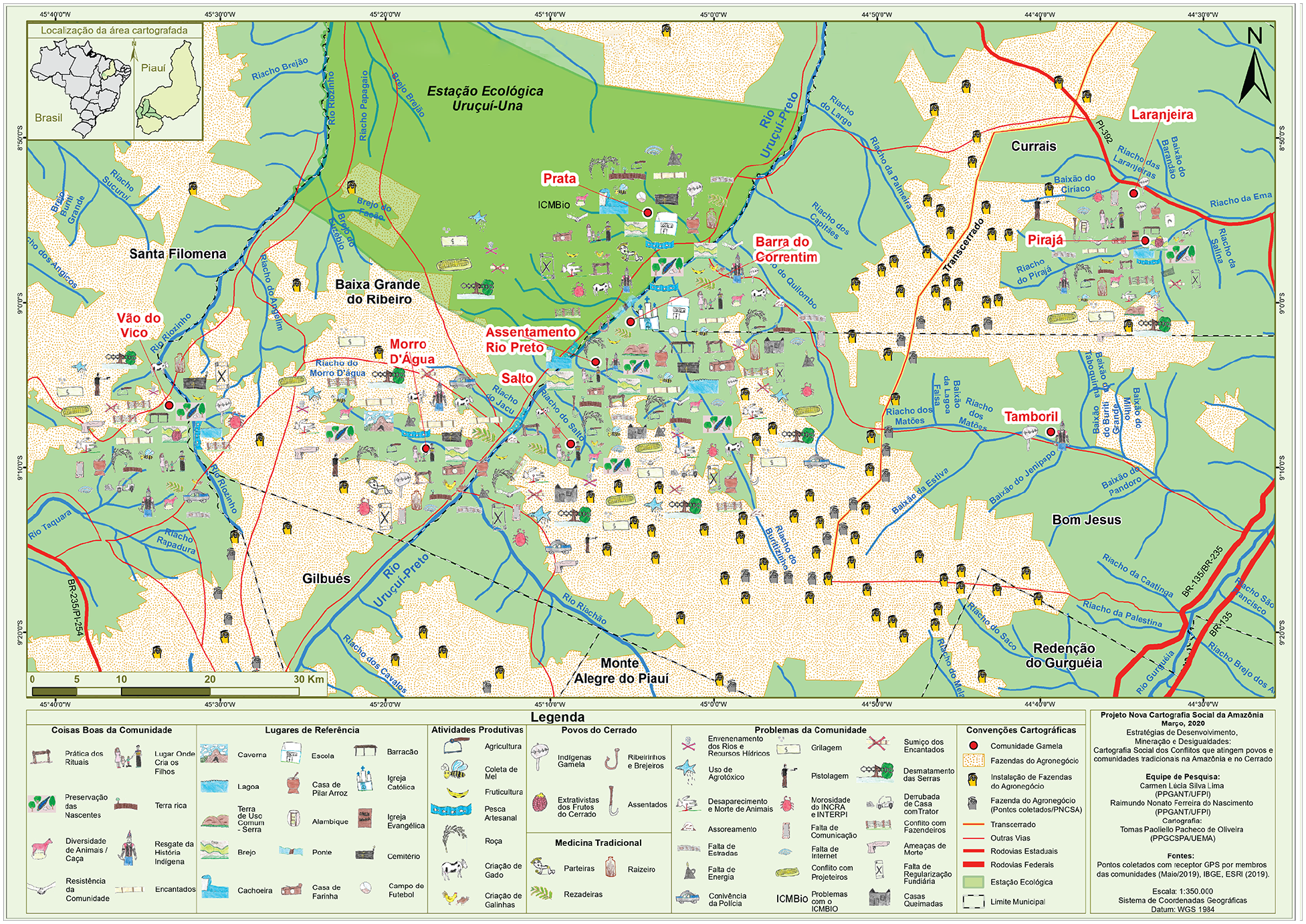
Gamela Peoples Location.
The 2015 Decree, which created Matopiba, also established the Agricultural Development Plan. Part of the materialization of the Plan is carried out with government incentives for the implementation of enterprises on lands that were previously used for subsistence purposes, with extensive livestock farming, as well as artisanal and community extractivism.
The arrival of the first enterprises and southern migrants produced a narrative of agricultural modernization, which was reinforced by a change of scenery in the municipalities with the implementation of a hotel network, installation of services, and expansion of commerce. Reciprocally, the government’s part consisted of the provision of infrastructure and adoption of tax incentives.
The spatial occupation of agribusiness in the Gamela territory occurred in the higher region, while the communities are located in the lowlands. The growth of farms resulted in deforestation, environmental imbalance, and extinction of native plants and animals. Moreover, the occupation of the mountain range represents, in the communityșs worldview, an invasion of the dwelling sites of their spirits (encantados).
The main conflicts involving the Gamela revolve around expulsion attempts, mainly because the preserved areas with water resources are in the lowlands. However, there are also conflicts due to the demarcation strategy used by the government, which uses its own land regularization mechanisms on non-traditional lands, neglecting the legal guarantees of Decree 1,775/1996, which establishes the procedure for demarcations, as well as recommendations by the International Labor Organization (ILO), registered in Convention 169, on Indigenous and tribal peoples. These frameworks call for anthropological work to be performed, duly supervised by protection and defense bodies, with broad community participation, presentation to the federal assistance agency, and with set deadlines and guidelines as to registration services.
The AATR is a civil society organization based in the state of Bahia, northeastern Brazil, with the objective of supporting rural communities and workers who live in, and depend on, the countryside. This organization has performed an analysis on the land and environmental legislation of Piauí, finding that the Matopiba is an example of how the actions of the state privilege "the ongoing existence of a concentrated land structure, based on racist assumptions that exclude Black, Indigenous, and traditional peoples, and based on the looting of public lands while promoting intensive processes of theft and dispossession" (AATR, 2020: 4). It is the project of civilized peoples. It is the humanity of commodities. It is the humanity of pesticides.
However, in 2015, after creating the Matopiba territory, the state of Piauí approved Law 6,709/2015, which addresses land reform, land regularization, and colonization of public lands, under the argument of ensuring legal security to large investors and rural producers in the state. The law ensured that the holder of an irregular title had preference in acquiring ownership. However, per the AATR (2020: 59) this determination has caused the intensification “of land and socio-environmental conflicts, especially involving territories occupied by traditional peoples and communities in the Cerrado region,” proving that the law did not fulfill the role initially attributed to it. Further, it is unconstitutional, since the Constitution of the State of Piauí expressly prohibits the sale of public lands, which are required to be collected and exclusively allocated for the settlement of rural workers and the protection of natural ecosystems, including flora, fauna, soils, water, and the atmosphere. 5
Amidst demonstrations against the 2015 law, Law 7,294 was passed in 2019, ensuring significant advances in the recognition of territorial rights of Indigenous and traditional peoples, including revoking the provision of preference in the acquisition of ownership by holders of irregular titles. Nevertheless, we observe the persistence of the mistaken idea of land regularization for Indigenous lands, the negligence of land agencies with a small staff to carry out the processes of identification and delimitation of lands, fragile mechanisms to prevent environmental degradation actions, the favoring of deforestation legalization, the advancement of occupation of private properties, and the lack of state management to address land conflicts.
In a counter-hegemonic path, the Gamela people rise through self-organization and self-formation as part of the movement of their ethnic self-identification, following decades of concealment. A study by the state of Piauí (2020: 6) indicates that the existence of the Gamela Indigenous people dates:
to the colonial period, and like other Indigenous peoples, the Gamela have been severely fought against. . . They use the name Gamela and live in Bom Jesus (Barra do Correntim, Assentamento Rio Preto and Salto I and II and Tamboril), Baixa Grande do Ribeiro (Morro DșAgua and Prata), Currais (Pirajá, Passagem do Correntim and Laranjeira) and Santa Filomena (Vão do Vico).
Records from FUNAI (2020: 2) included in the qualification process for the Gamela indigenous land also indicate that “due to the high number of indigenous communities, the vastness of the territory, the socio-environmental problems that affect it, and the limited field research period, it was not possible to cover the entire region and visit all Gamela communities.”
Based on this data on the Gamela Indigenous presence, we situate their history of belonging to the territory and the redefinition of their existence in southwestern Piauí through two constructions: the first, self-identification as an ethnic dimension of native peoples, historically denied, which constitutes itself as a project of resistance and alternative to the ecological and territorial damages caused by agribusiness and neglect by the government; and second, is an ethnic dimension that has meant the strengthening of the self-organization of the Gamela people into a representative entity.
With this in mind, the Association of Traditional and Indigenous Peoples of the Laranjeiras Community was created in 2021. It is registered with public administration agencies as an organized civil society entity, institutionally led by the Gamela Indigenous peoples, and based in the municipality of Currais. It is coordinated, mostly, by Gamelas women, who organize themselves through productive activities, such as farming, sustainable buriti extraction, and animal breeding. 6 It is currently funded by the Sustainable Buriti Agroextractivism project, the aim of which is to strengthen the association and the women. As one of the association’s directors explains: “I am a Gamela female Indigenous person, we women from the Indigenous association here, women workers of the Laranjeiras - Currais-Piauí territory work collectively . . . taking care of the land, giving it rest and building resistance” (Gamela Indigenous female, interview, 2022).
In the same vein, the president of the Indigenous Association reports: “I am a Gamela female Indigenous person from the Laranjeiras locality, I was born and raised here, my parents and grandparents were all born and raised here . . . we cultivate the field with a machete, a scythe, a hoe, we plant corn, cassava, beans, fava beans” (Gamela female Indigenous person, interview, 2022). The Indigenous association has been a fundamental instrument in organizing the community and territory to resist agribusiness.
Expansion Of Agrobusiness On Indigenous Lands In The "Last Agricultural Frontier": Between A Notarial Farce And Ecological Devastation
Agrarian issues and the invasion of Indigenous lands by the capitalist system focused on monoculture production in the "last agricultural frontier" are part of the problem of land structure in Brazil and Latin America, formed from colonized territories. These backgrounds ensure the “legalization of illegality” in the expansion of agribusiness on the lands of the Gamela people in Piauí. 7 This process has been happening on three fronts: the first, through land grabbing, supported by the “notarial farce," with digital land grabbing and its distinct formats; the second is related to the judicial and institutional dispute over productive lands; and the third, no less important, is the devastation of natural resources, specifically water resources, such as wetlands, springs, and native plants.
These assaults by speculative companies, legitimized by state action, resulted in successive attempts at depopulation of the rural environment. Martins (2000: 107), points out that “the historical impasse, the contradiction between land and capital, which sustained the remaining struggle for agrarian reform, would be resolved through the unexpected path and the countermodel of rentier capitalism.” This was based on the understanding that land concentration makes the countryșs social development unfeasible and, at the same time, generates wealth accumulation for the sectors of agrarian bourgeoisie.
Despite this, the voices of Brazilian Indigenous people echo around the world, as shown by the participation of the Articulation of Indigenous Peoples of Brazil (APIB) in the Climate Summit and in the presentation of a petition to the International Criminal Court (ICC) against the Bolsonaro government. This group has also been participating in hearings in United Nations committees, denouncing agribusiness and global financial capital in the invasion of their lands; and opposing the colonialist mentality, which makes ecological and environmental sustainability of the Cerrado unfeasible, generates land speculation, and provokes the proletarianization of traditional Indigenous and peasant peoples, sometimes under conditions similar to slave labor. The "notarial farce" involves digital fences, wherein, according to Grain (2020), digital land registries made with georeferencing attempt to justify the expropriation of public lands and land concentration with the false narrative that they promote economic development and progress in improving rural life. As Mondardo and Azevedo (2019: 300) put it, “at the same time that this model presents itself as the driver of regional economic development, it paradoxically reproduces poverty through the exploitation of labor, land, and other natural resources, such as water.”
The environmental and social impacts, previously hidden in the narrative of development, are revealed when rainwater falls on the deforested, dry, and arid mountains in the Piauí Cerrado region, whose native vegetation and entire biodiversity were destroyed for soybean monoculture planting. The waste from agribusiness reaches the lowlands, simultaneously crossing the very heart of the Gamela indigenous territory.
8
This waste destroys their crops, buries their freshwater springs, and pollutes their streams with pesticide runoff. In 2021, the Gamelas Indigenous people reported ecological damages in the southwest region of Piauí:
Currently, the situation is one of environmental and social calamity for the community, which is unable to access the creek water to meet their needs. Today, the scenario is also one of destruction along the slopes and for the environment in general, causing impacts directly on the lives of the people who make up the Laranjeiras Community (Gamela Indigenous female, interview, 2021).
Agrarian issues are at the heart of conflicts regarding the capitalist mode of production that drains the lands, directly impacting the ways of life of Indigenous peoples, whose reality, as described and experienced by the Gamela Indigenous people, reveals the scourge of suffering caused by a fallacious logic of food production.
The narrative of agricultural modernization seeks to keep the consequences of agribusiness hidden and its territories invisible, because “the deliberate invisibility of rural populations and traditional peoples of the Cerrado is an essential part of the strategy to advance the frontier, without their negative effects becoming the object of public debate, either within the state itself or within civil society” (AATR, 2020: 6). Given this concealment, the voices that denounce agribusiness do not find answers from the state, and Indigenous people see their history and their grievances forgotten. As Rancière (2018: 38) writes, "It is the pact of oppression between those who always ask and those who never answer, who never consider in their equality the speaking beings to whom the first ones giveș a say, but . . . render the voices deaf and the words mute." This context leads us to believe that the““fall from the sky” is near and, despite the resistance efforts of Indigenous peoples, social and environmental impacts are spreading across the Cerrado biome. 9
In the expansion of the agricultural frontier, “the main message is that there is more poverty and inequality than wealth and well-being in Matopiba. As such the dominant narrative, that environmental problems or those experienced by traditional local communities would be the cost of progress, makes no sense" (Favareto et al., 2019: 9). As we can see, the damages caused by soy commodity agriculture directly impact Indigenous territories.
Development that relies on expansion of agribusiness in the state of Piauí, and specifically in the municipality of Currais, where the Gamela Indigenous community is located, increases the tensions and agrarian conflicts in the region. Despite this reality, the government of Piauí celebrates the results of agricultural sector statistics in the development of the state. According to the Center for Economic and Social Research of Piauí (CEPRO, 2020: 26):
In 2018, the ten municipalities with the highest participation in Agriculture were Baixa Grande do Ribeiro, Uruçuí, Ribeiro Gonçalves, Bom Jesus, Currais, Guadalupe, Santa Filomena, Gilbués, Monte Alegre do Piauí and Sebastião Leal. [. . .] The the leading role of the Chapada das Mangabeiras Agricultural Development territories is evident through the production of commodities in the state.
As we can see, almost 60 percent of production is concentrated in the southwestern region of Piauí. Still, according to CEPRO (2020: 7), “this expansion was influenced by improvement in the performance of the productive structure of agriculture, including support for agriculture and post-harvest in the state, justified mainly by the expansion of soybean cultivation practiced in the Piauí Cerrado; the activity grew 25.3 percent." According to statistical data from the government, the agricultural sector contributed the most to the state’s GDP.
The increase in GDP is unrelated to the increase in the Human Development Index (HDI) of Piauí, which is 0.646, ranking twenty-fourth among Brazilian states (CEPRO, 2020). Like an inverted image, the economic development celebrated by the government has failed to reduce social inequalities, as there is an increase in hunger and poverty in the state. This is the reality of the municipalities of Currais and Bom Jesus, gateways to agribusiness.
The expansion of the agricultural frontier over the Indigenous territories of Gamela is based first on land grabbing and is sustained by the notarial farce, “which, through registrations with georeferencing of areas, has been neglecting collective territories in all the analyzed countries in order to create the foundations to supply land markets” (AATR, 2020: 2). These distinct forms of land grabbing accelerate the expropriation of physical lands through the illegalities of land registration, “or through land grabbing in digital and/or registry systems, aimed at land speculation by national and/or foreign companies and individuals” (AATR, 2020: 8). This reality, analyzed by the Rural Lawyers Association, is updated in the version of what the Gamelas de Laranjeiras Indigenous peoples widely denounced during the process of “prior consultation” carried out by the Piauí State Land Institute (INTERPI):
There is an urgent need for action from social movement bodies and the government to represent and defend the Laranjeiras community from the attacks of the ranch owner, who has been trying to take our lands for several decades. Recently, he invaded the residentsș lands, which was proven by satellite to exceeding the limits of the marshland (Gamela Indigenous female, interview, 2021).
In a qualification document of the Gamela Indigenous land in Piauí, made available by the National Indian Foundation to the Federal University of Piaui (UFPI) through the Rural Education Degree Program, there are reports of advances in land grabbing by large agribusiness companies, with the support of local notaries in southwestern Piauí.
Specifying such conflicts, Your Savior informed that the community was systematically targeted by violent attacks committed by "grileiros" [land-grabbers] who claimed to be the owners of the lands traditionally occupied by indigenous people and who received support from local registries (FUNAI, 2020: 13).
Notarial land grabbing is legitimized through the judicialization of lands by agribusiness companies in the Matopiba territory, as reported by the AATR study (2021: 5): “It can be stated, with absolute certainty, that land grabbing in the studied region is necessarily mediated by the actions of the Notary Offices, which end up ignoring registration rules.” This diagnosis can be observed in the lack of control by the state and its land regulation agencies in Piauí, such as INTERPI.
In the case of the Gamela Indigenous territory, there is an ongoing process of land regularization for the settlement being carried out by INTERPI. This state government agency is unaware of the need for a registry survey, requested by the Gamela Indigenous association, about the lands involved in the qualification process carried out by FUNAI in SEI-Funai process No. 08620.012443/2018-95. In other words, there is an administrative and institutional claim by the Gamelas Indigenous people at FUNAI.
This narrative sets up the second front of expansion of the agricultural frontier within the Gamela Indigenous territory. Against this logic, the Gamelas people have been petitioning the Federal Public Ministry of the municipality of Corrente to monitor the legal demands and agrarian conflicts imposed by the farmers. In the request, Chief James Gamela, from the Articulation of Indigenous Peoples and Organizations of the Northeast, Minas Gerais and Espírito Santo (APOINEM), emphasizes the negligence of the State: “We request that the MPF [Federal Public Ministry] investigate the land regularization process of the Gamela villages carried out by INTERPI and take the necessary measures regarding cases of disrespect for the rights of indigenous peoples” (APOINEM, 2021:1).
It was only on February 15, 2023, that the prosecutor from MPF in Corrente, Piauí, visited the Gamela de Laranjeiras Indigenous community to officially listen to the issues involving land demarcation struggles, human rights violations, and violence, as well as the demand for public policies. Several requests for public hearings by the Indigenous association are currently being processed by the FUNAI - Northeast II Regional Office to access information about the land qualification process. Recently, through a power of attorney, the Order of Attorneys of Brazil (OAB) Piauí Section officially began representing the Association of Gamelas Indigenous Peoples of Laranjeiras in legal actions. This movement of Indigenous peoples occurs due to the advancement of land grabbing and unfavorable judicial decisions for the Gamelas people. The AATR (2020: 8) notes that: “In January 2021, Indigenous people were evicted from their homes based on an eviction decision by the Gilbués District judge, and their houses were set on fire.” This situation is exacerbated by the fact that the land-grabber’s lawsuits allege that no Indigenous peoples inhabit the territory of Piauí.
It was not until 2020 that Piauí formally recognized the existence of Indigenous peoples and communities in the state, through Law No. 7,389/2020. Despite this, land grabbing, with a consolidated legal basis, expanded into the "last agricultural frontier" in southwestern Piauí. Allied with technology networks and large national and transnational corporations, it not only encroaches on the lands, but also has a network within the Brazilian state that legalizes things that are illegal. 10
This idea further develops in the third front of expansion of the agricultural frontier in the Gamela Indigenous territory over natural and water resources. The expropriation of freshwater sources in the territory is characterized by farmers damming or blocking water from marshes and streams, the silting of water springs when agribusiness waste descends from the mountains, and the land-grabbing of lowland areas that have abundant water production.
The soya monoculture farmers, mainly BUNGE, expand their borders over the natural resources of collective use in the Indigenous Gamela territory, on one hand, and, on the other hand, make these resources inaccessible due to the pollution caused by agribusiness waste. "In the last two years, the agribusiness has compromised the creek’s water, with possible waste and chemical residues coming from the savannahs during the rainy season floods, due to poisonous pesticides that contaminate the wetlands’ water” (Gamela Indigenous female, interview, 2021). In addition, there is a conflict regarding the ownership of creek lands, as to whether they are state or privately owned.
This dispute is included in the technical report prepared by UFPI on the prior consultation conducted by INTERPI. This document was delivered to the government of Piauí, and was signed and received by the governor himself. The preparation of the report was requested by the Indigenous people themselves, since the University has been following developments in the territory since 2018 through the Popular University extension project. The report contains attempts to attach titles to lands unoccupied by the state, which must occur without including creek lands, where the water resources for collective use of the Gamela people are located:
The information that the creek does not belong to the settlementșs lands caused a collective revolt in the community, as this is a claim from both the settlers and the Indigenous people, who point out that in the territorial demarcation carried out in 1990, it granted the community and the peasants the right to access the creek, which INTERPI now says is on private land, but has not provided any documentary evidence such as a land survey (Pro-Reitoria de Extensão e Cultura, 2021: 7).
This context confirms the process of predatory expropriation of natural resources, such as water sources and land, a combination that expands agribusiness frontiers to Indigenous lands. The accelerated pace of the invasion of Gamela Indigenous lands and the appropriation of natural resources place “the agrarian issue at the center of the rights of traditional populations, whose ways of life are victimized by the transformation of natural vegetation into pastures and vast areas of cultivated crops” (Favareto et al., 2019: 24). Contradictorily, this hegemony is being deconstructed through alternative projects and experiences of resistance to agribusiness, led by the Gamela Indigenous people in the "last agricultural frontier," that updates qualified political advocacy in the struggle for land demarcation and environmental protection of their territories.
It is not possible to reconcile this mode of food production with Indigenous epistemologies of protecting environmental and ecological systems, on which they directly depend to survive in their territory. As Gadotti (2005) tells us, there is no way to equate sustainability with capitalism. This conciliation is unfeasible. Ecological imbalance not only affects the environment, but also humanity itself - it threatens not only ecosystems, but human life itself.
Conclusion
Faced with the contradictions produced in a context that ensures the existence of the Indigenous question and how it relates to agrarian issues, which are currently exacerbated by agribusiness and the commercialization of water, we highlight legal and notarial artifices that occur with the stateșs complicity, and that neglect the right of the Gamela Indigenous community to have their territory recognized through a demarcation and titling process.
We observe that the Indigenous invisibility in Piauí is explained by agrarian issues, in association with multiple forms of violence, such as attempts at slavery and extermination, and the difficulties of facing water and food scarcity. Faced with the reality of ongoing concealment, Indigenous identity was used for self-protection, and taken in historiography and official acts as part of a narrative that persisted until recently: the allegation that there were no Indigenous populations in Piauí.
However, the process of self-identification and self-organization of the Gamela community, alongside others, has been consolidating a set of initiatives and struggles in defense of identities, territory, and natural resources in the region, which has been conventionally referred to as the last agricultural frontier. As a counter-hegemonic logic against productive capital, the Gamela people, for over 520 years, continue to insist on having their own lives, fighting for the demarcation of their land as an original right, and echoing their voices against the colonial mentality of the Brazilian state.
The struggle of the Gamela people, far from being merely celebratory, is grounded in anticolonial epistemology, inspired by ancestry that holds a deep connection with nature and with the land as part of their entirety as Indigenous peoples. And so, they continue to face and confront the large estates without fear, denouncing the old agrarian model of the national state with colonial bases and, at the same time, announcing that Indigenous peoples are ideas constituted in a fight to postpone the end of the world.
Footnotes
Notes
Maria do Socorro Pereira da Silva is the Coordinator of the Center for Studies, Research, and Extension in Education, Decolonial Science, Epistemology, and Society at the Federal University of Piauí (UFPI), Brazil. Lucineide Barros Medeiros is an Associate Professor at the State University of Piauí (UESPI), Brazil. Heather Hayes is a translator living in Quito, Ecuador.