




Abstract
In this study, we employ a critical political economy framework for an empirical analysis of environmental withdrawals from agricultural production in Latin America. Namely, we focus on the role of export-orientation and trade direction of food as drivers of cropland footprint expansion in (semi-)periphery countries. Following the literature on the treadmill of production, ecological unequal exchange, and extractivism, we reason that (semi-)peripheries are structured to produce agricultural primary goods that rely on expansionary cropland dynamics. To test this claim, we utilize a panel study of fourteen countries in Latin America from 1970 to 2016. We collected data from the World Bank, the International Monetary Fund, and the Global Footprints Network. Results from the study show that export-orientation and trade direction have a positive relationship with the dependent variable, cropland footprint. The results confirm the basic model presented by critical political economy, that (semi-)peripheries are structured toward increasing environmental withdrawals as a part of their agricultural production.
Este estudio emplea un marco crítico de economía política para realizar un análisis empírico de las formas de extracción de recursos naturales en la producción agrícola de América Latina. Nos centramos en el papel propulsor que juegan la orientación hacia la exportación y la dirección comercial de los alimentos en la expansión y huella ecológica de las tierras de cultivo en países (semi)periféricos.
Basándonos en la literatura que analiza el espiral de la producción, el intercambio ecológico desigual y el extractivismo, sugerimos que las (semi)periferias han sido estructuradas para producir bienes agrícolas primarios que dependen de la dinámica expansiva de las tierras de cultivo. Para probar esta afirmación, utilizamos un estudio de panel de catorce países de América Latina desde 1970 hasta 2016.
Recopilamos datos del Banco Mundial, el Fondo Monetario Internacional y la Red Global de la Huella Ecológica. Los resultados del estudio muestran que la orientación hacia la exportación y la dirección del comercio tienen una relación positiva con la variable dependiente, la huella ecológica que dejan las tierras de cultivo. Los resultados también confirman la existencia del modelo básico sugerido por la economía política crítica, según el cual la estructura de las (semi)periferias se encuentra dirigida hacia el aumento de la extracción ambiental como parte de su producción agrícola.
Keywords
Scholarship shows that increased withdrawals from intensive farming are a driver in biodiversity loss and rifts in water flows and biogeochemical cycles, like nitrogen and phosphorus (Schneider and McMichael, 2010; Moore, 2011; Stockholm, 2015). A critical political economy framework building from the confluence of three literatures, extractivism, treadmill of production, and ecological unequal exchange, posits that when peripheral and semi-peripheral economies sell primary goods to core nations, environmental impacts will intensify over time. This is because exposing (semi-)peripheral ecologies to the structurally uneven global marketplace generally involves additional environmental withdrawals to satisfy capital accumulation by the core and urban centers in the (semi-)periphery, as well as to provide an abundance of cheap consumer goods (Schnaiberg, 1980; Bunker, 1985; Acosta, 2013; Gudynas, 2018). Based on this framework, we propose the following claim: increasing export-oriented production and intensified economic relations with the global North will tend to a more unsustainable agricultural production over time through increasing environmental withdrawals to expand production for sale to wealthier countries.
To test this claim, we employ time series regression methods using cross-national data from the World Bank, Global Footprint Network, and the International Monetary Fund (IMF) on fourteen Latin American countries: Argentina, Bolivia, Brazil, Chile, Colombia, Costa Rica, El Salvador, Guatemala, Mexico, Nicaragua, Panama, Paraguay, Peru, and Venezuela. These models help us assess the relationship between changes in metrics associated with export-oriented food system development and how those changes affect a measure of agrarian intensification (i.e. cropland footprint) in Latin American countries. Agriculture in Latin American countries presents an important set of cases for understanding the cropland impacts of export-oriented food production and trade relations with the global North. In the region, agribusiness in conjunction with states prioritize accumulation through the global market, intensify production through the application of repurposed military technologies and infrastructure, and concentrate and consolidate land (Patel, 2013). For example, in the Mexican poultry industry, foreign capital utilized a contract system to reduce farmer control over the production process as the sector increasingly sought external markets (Martinez-Gomez, Aboites-Manrique, and Constance, 2013).
This deepens (semi-)peripheral dependence on input purchases from core nations and expands commodity-oriented production, specifically for certain crops like soy in certain South American countries like Brazil and Argentina, and various non-traditional agricultural exports depending on the country, such as cut flowers and avocado in Mexico, or pineapple in Costa Rica (Robinson, 2008; McMichael, 2012; Otero, Pechlaner, and Gürcan, 2013; FAO, 2020; Araya, 2021). Overall, agricultural exports rose from 45 billion USD in 2000 to 193 billion USD in 2019 (FAO, 2020). Even Pink Tide governments (i.e., the leftist governments in Latin America that came to power from the late 1990s until the 2010s) saw a rise in the use of glyphosate and use of Roundup Ready soy over this period, as they re-focused on primary goods exports in the agriculture sector (Santos and Vasconcelos, 2022). This was part of a general strategy to take advantage of high commodity prices that led to increasing socio-environmental conflicts, even with nominally socialist and social democratic parties in power (Svampa, 2019).
Additionally, there is evidence to support the linkage between export-orientation and alterations to production in the Latin American context. Data show pesticide use has increased from 123,093.76 tons in 1990 to 7,770,393.77 tons in 2020; macronutrient nitrogen use growing from 3.734 million tons in 2002 to 9.139 million tons in 2020; and machinery in South America went from averaging 23,069 tractor imports per year in the 1990s to 31,110 tractor imports per year in the 2000s (FAO, 2022). In the case of guarana produced in the Brazilian Amazon, as national agricultural production was increasingly incorporated into global trade flows, different cultivars saw increasing applications of insecticides, herbicides, and fertilizers to increase yield (Filoche and Pinton, 2014). Thus, there are consistent indicators that demonstrate technological intensification occurring in agricultural production in tandem with an increase in agricultural exports. Therefore, Latin America is a strategic research site for understanding the relationship between the capitalist economy and the environment in relation to agricultural production. In the following sections, we elaborate further on critical political economy, describe our data and methods, and discuss the results from our statistical analysis.
Critical Political Economy and Capitalist Agriculture’s Ecological Impact
Environmental political economy has become a robust area of scholarship analyzing the comparative outcomes of structures and institutions for environmental sustainability (Clark et al., 2022). Within this area, critical political economy has theorized a set of mechanisms representative of capitalist dynamics that are claimed to drive a problematic social-ecological relation. In this section, we discuss these mechanisms in relation to agriculture and the sector’s relationship with the environment through a dialogue between three theoretical frameworks: extractivism, treadmill of production, and ecological unequal exchange.
Critical political economy perspectives reason that capitalist structural imperatives based on commodification in the pursuit of capital accumulation will continue to produce pressure to degrade the environment despite institutional changes. This structural pressure often outpaces gains in efficiency and can be exacerbated by ostensibly well-intended policy adjustments and market reforms (York, Rosa, and Dietz, 2003; Foster, Clark, and York, 2011). The basic argument, following the treadmill of production scholarship, is that market-driven productive increases require additional environmental withdrawals, as well as waste additions, that are harmful to the environment (Schnaiberg, 1980; Buttel, 2004). In sum, economic growth in a capitalist economic system is understood as a material process that requires higher and higher levels of environmental withdrawals to keep the treadmill running. Essentially, if a treadmill-effect is present, increases in economic growth will correspond with increased levels of environmental impacts.
For example, increases in industrial, commodity-based agricultural production can lead to increases in greenhouse gas emissions due to practices such as tillage that releases carbon stored in the soil or increased production of livestock that emit methane (Gunderson, 2011; Houser and Stuart, 2020). Agricultural producers choose practices that focus primarily on profitability at the expense of the environment because of how their decisions are structured by the overall market, such as when contract tournaments motivate increased application of nitrogen fertilizers (Schewe and Stuart, 2017; Houser and Stuart, 2020). Scholars have also noted that agriculture is increasingly connected with irrigation requiring more withdrawals of water and application of chemical pesticides (Longo and York, 2009; Hedlund, Longo, and York, 2020). Even when the problem is recognized, governments are structured to provide institutionalized loopholes that permit the ongoing overuse of irrigation that exhausts water resources (Sanderson, 2019).
A key theory relevant to global markets, trade, and ecology is ecologically unequal exchange, a concept initially advanced by Bunker (1985) to explain how exports of raw materials are more likely to be produced within nations and regions distant from the capitalist core. In terms of agriculture, (semi-)peripheries are often not the main exporters of certain important grains and livestock, such as wheat or chicken meat, instead concentrating on specialty crops, like avocados and coffee cherries (FAO, 2022). For example, the United States is a primary exporter of commodity crops, like wheat, while Mexico is the top exporter of avocados (FAO, 2022). This means importing caloric necessities, while exporting luxury.
The unequal exchange relationship is made possible via the incorporation of politically less powerful and economically poorer states into the global capitalist marketplace. Typified by buyer driven supply chains, where a global North firm captures value from a series of decentralized suppliers across the global South, productive centers in peripheral nations are confronted with structural pressures to degrade ecologies in order to remain competitive, keep prices low, and satisfy more flexible buyers (Clark and Longo, 2021). In these peripheral nations and regions, the capitalist core extracts and expropriates value from human labor and nature at comparatively high rates. Scholars have noted this dynamic in agriculture specifically, such as in the positive association between the increased export of beef and expanded deforestation within “less developed countries” as classified by the World Bank (Austin, 2010). That association is even more marked in semi-peripheral Latin American countries. The relation between deforestation and beef is generalizable to agriculture as a whole, with links to other commodities, like cereal, rice, and soybeans (Restivo, Shandra, and Sommer, 2020).
Ecological unequal exchange is a historical reality linked to colonialist dynamics of the world food system, like in the case of guano extracted from South America and exported to Europe as nitrogen fertilizer (Clark and Foster, 2009). Even after independence, neo-colonialist dynamics continued to reproduce these tendencies, such as post-independence Cuba exporting sugar while importing value-added goods from the United States (Smolski, 2022; Vasconcelos, 2023). Linking past colonial dynamics to contemporary imperialism, critical political economy scholars reason that the standardization of export-oriented, ecologically intensive commodity agriculture is an essential component for the economic stability of modern capitalism, which requires artificially cheap food and continued economic value capture to maintain upward flows of capital accumulation (Ajl, 2021; Patnaik and Paitnaik, 2021).
The treadmill of production and ecological unequal exchange converge into an argument that has been developed by scholars of extractivism in Latin America. The extractivism framework notes that export-oriented production is embedded within a dependent relationship, whereby the appropriation of nature converted into primary commodities that flow to core countries reinforces the concentration of value-added industries in the core that sell back to (semi-)peripheries commodities that accumulate more surplus value (Acosta, 2013; Gudynas, 2018). Some of the advanced commodities that are imported, like certain pesticides for agricultural production, may be banned in core countries due to their harm to human health and the wider environment (Grandia, 2022).
This extractivist dynamic sustains a disarticulated form of economic development, whereby primary goods production as a form of primitive accumulation does not lead to the development of advanced technologies for processing value-added goods (Assis and Franco, 2018). Instead, in pursuing economic growth within this structurally unequal relationship, (semi-)periphery countries increase their dependence on the global market for food imports while territorially re-organizing agriculture for commodity crops, like soy, that are destined to be refined in other markets and not for domestic consumption (Palmisano, 2018; Santos and Vasconcelos, 2022; Schutte and Campos, 2022).
Based on this critical political economy understanding of social-ecological relations in agriculture, we argue that a process of increasing export-oriented production linking (semi-)peripheries to the core will maintain the coupling of economic expansion with environmental degradation because structural imperatives to accumulate, produce, and trade motivate increased land use and withdrawals in the periphery and semi-periphery. Ecological Marxism has a long history of scholarship noting this dynamic, such as in O’Connor’s (1991) argument concerning the second contradiction of capital. In the following section, we outline our method for measuring environmental impacts in Latin American agriculture.
Measuring Environmental Impact in Latin American Agriculture
We collected secondary, quantitative data from publicly available sources, long provided by multiple international organizations. Similar to other cross-national studies of environmental change, continuous variables are logged on both sides of the equation, forming log-log models that allow for easier interpretations of change in historical, cross-national data (Clark. Longo, Clark, and Jorgenson, 2018; Jorgenson, Dietz, and Kelly, 2018; Rosa, York, and Dietz, 2004). Because of this format, coefficients of variables can be interpreted as follows: for every 1% increase in the explanatory variable, there is a predicted increase of X (the coefficient’s size) in the dependent variable. Thus, we would interpret a hypothetical .5 GDP coefficient as follows: for every 1% increase in a nation’s GDP, the model predicts a .5% increase in a nation’s cropland footprint. This is a predicted value, rather than an actual value, based on the statistical model being employed. Data is organized at the nation state level. We gathered all available data for most Latin American nations, from 1970-2016.
Dependent Variable: Cropland Footprint of Production
The Global Footprint Network calculates a variety of ecological indicators across nations over time. While prior sociological studies have utilized footprint indicators, such studies have typically focused on the ecological footprints of consumption (Jorgenson et al., 2005; Jorgenson and Clark, 2010; Clark et al., 2018; Clark and Longo, 2019). Studies that utilize these indicators are useful for measuring net ecological consumption; however, we utilize the footprint of production indicator to better explore how trade and export-oriented production affect metrics that concern the material bases for agricultural production in Latin America. We find this important because there is an analytical need to measure how variability in environmental withdrawals are based within socio-economic structures that change over time and space in terms of the production and exchange process (Walter and Martinez-Alier, 2012). In this instance, we consider environmental withdrawals to be when natural resources, such as land, are removed from their ecological cycles and placed in service of human production processes.
The footprint of cropland production assesses the area of land required to grow all crop products within a nation (Global Footprint, 2018). The equation for this indicator accounts for differences in the bioproductivity of land between countries by relativizing yields and converting into global hectares (Passeri et al., 2013). A drawback of this measure is that it is not capable of differentiating productivity by cultivar, even though agroecosystemic conditions that are productive depend on the type of cultivar. At a broad level, the cropland footprint variable captures the amount of land required to produce a nation’s crops, including crops grown for livestock feed (Lin et al., 2019). The ongoing expansion of cropland footprint represents a serious threat to ecological stability at multiple scales. Researchers have noted that the expansion of cropland often comes at the expense of carbon sinks and ecological buffer zones, like forests and savannas (Hansen et al., 2022). Much of this expansion worldwide—a total of 9 percent in two decades—has occurred in Latin America (Potapov et al., 2022; Hansen et al., 2022). In Latin American nations, cropland footprints increased consistently over the course of our sample (Figure 1).
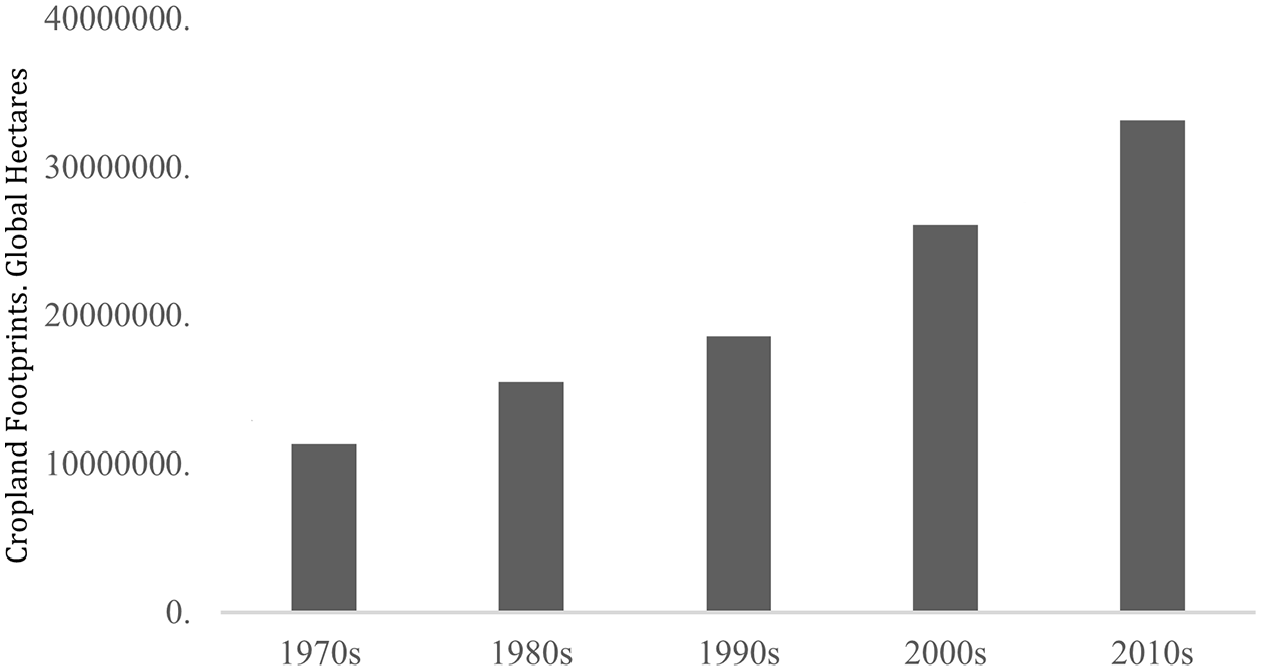
Cropland Footprint Mean by Decade Across Latin American Nations.
Explanatory Variables
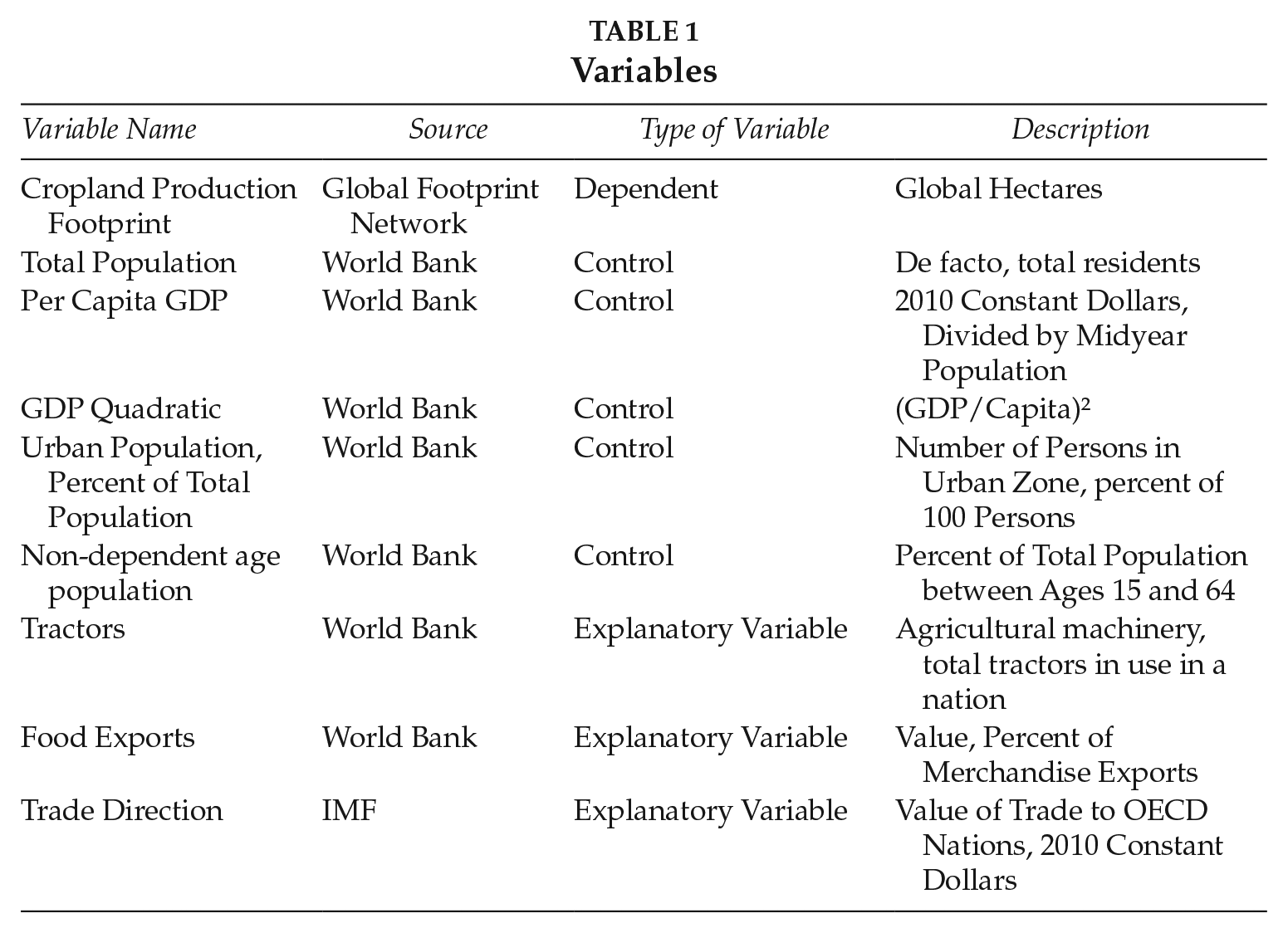
Our model includes population indicators to control for the expected increases associated with a larger population and shifting population dynamics (urban/rural) that are usually associated with changes in land use and impact (Clark and Longo, 2019; Dietz, Rosa, and York, 2007; Dietz and Jorgenson, 2013). To account for a potential treadmill of production effect, we control for GDP per capita (2010 constant dollars). We also examine if a treadmill effect eventually ‘levels off,’ declines, or intensifies at higher levels of growth. We accomplish this by including a quadratic of GDP as a control variable. In simple terms, because the GDP term is squared (hence the term quadratic of GDP), it allows the model to predict the impact of economic growth at higher levels of GDP. If the quadratic of GDP indicates declines at higher levels of affluence, this would suggest that economic growth eventually becomes more sustainable. However, if the quadratic indicates leveling off or intensification, it suggests that growth is either moderating at an unsustainable peak or intensifying to even more unsustainable levels.
Prior research suggests that the structure of international trade drives change in ecological indicators and stimulates unequal exchange of materials and resources (Rice, 2007; Besek and McGee, 2014; Jorgenson and Clark, 2012). Trade and export-oriented development are particularly important considerations for assessing long-term ecological change within the neoliberal world food system, or food regime (Bernstein, 2016; Otero, Pechlaner, and Gürcan, 2013). Accordingly, we test for relationships that consider the economic character of food trade output and trade relationships. Specifically, we utilized the World Bank’s calculation of food export valuation and the IMF’s calculation of trade direction statistics. The former metric is measured as the percent of nations’ merchandise export value. The latter is the value of exports sent to wealthy, OECD economies.
Thus, increases of the trade direction metric signify intensified economic relations with global North nations. Similarly, higher levels of food export valuation as a percentage of merchandise exports signifies that a nation’s food system is becoming more export oriented. Overall, these two metrics consider the degree to which Latin American nations are engaging in export-oriented food production and the extent to which the same nations are economically intertwined with OECD, global North nations. Finally, consistent with cross-national studies that assess human/societal drivers of changing environmental impacts, we also include a metric that assesses a nation’s level of technological development: tractors within a nation (Dietz and Jorgenson, 2013).
Variables
Time Series, Panel Regression Models
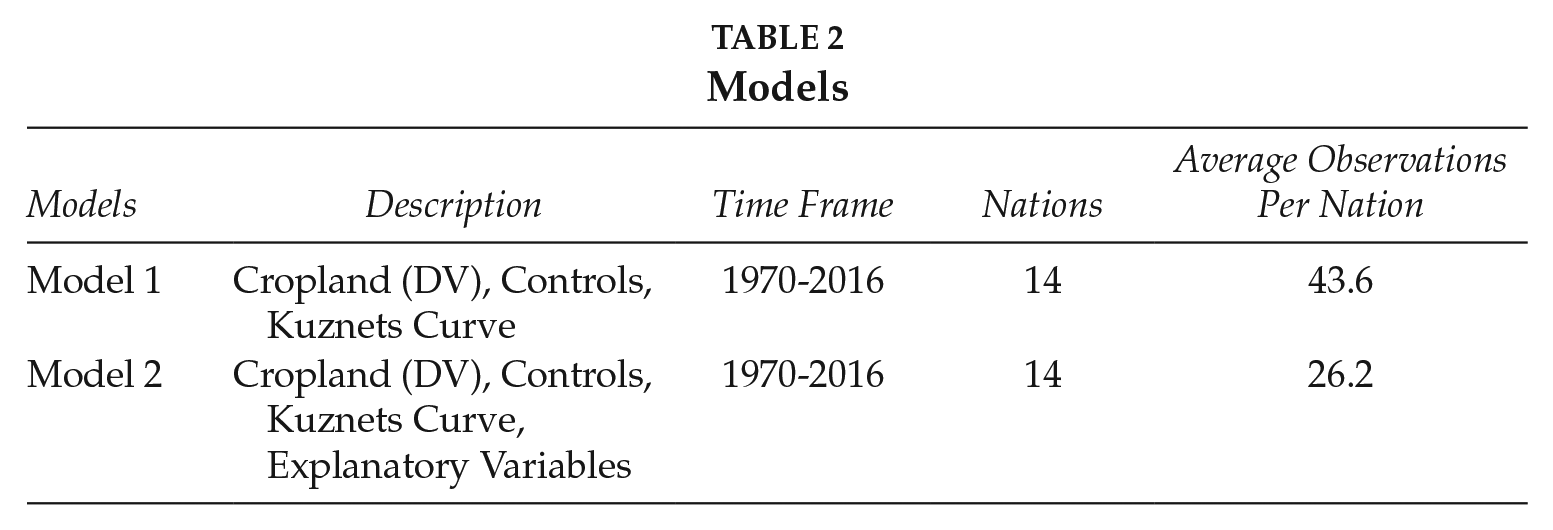
We conducted a series of tests prior to running the model to determine which modelling approach would best fit the available data. We ultimately apply ‘panel corrected standard error models’ with an autoregressive adjustment to adjust for time lag effects where observations of variables are correlated with prior observations. Analysis was run in STATA. 1 Our models also include country-specific terms, which essentially allows the models to adjust for non-changing characteristics across nations in the sample (e.g., landmass of a nation or latitude of a nation). More detail is provided in the appendix.
Model 2 includes explanatory variables that explore the effects of export-oriented production: trade direction, agricultural machinery (tractors), and food exports as a percentage of merchandise export value. We are particularly interested in trade direction because it quantifies the degree to which a nation is engaged with the capitalist core. Core capitalist nations are socially positioned to dominate less economically powerful countries (Rice, 2007). Thus, we are curious if the nature of the effect of other, key food system developmental indicators varies at heightened levels of economic engagement with rich nations.
Results
Results from models 1 and 2 indicate consistent results across per capita GDP and total population—both of which are positively associated with increases in cropland footprints (models 1 and 2, respectively). There is also strong support for the presence of a quadratic effect in model 1 and model 2.
Models
Models
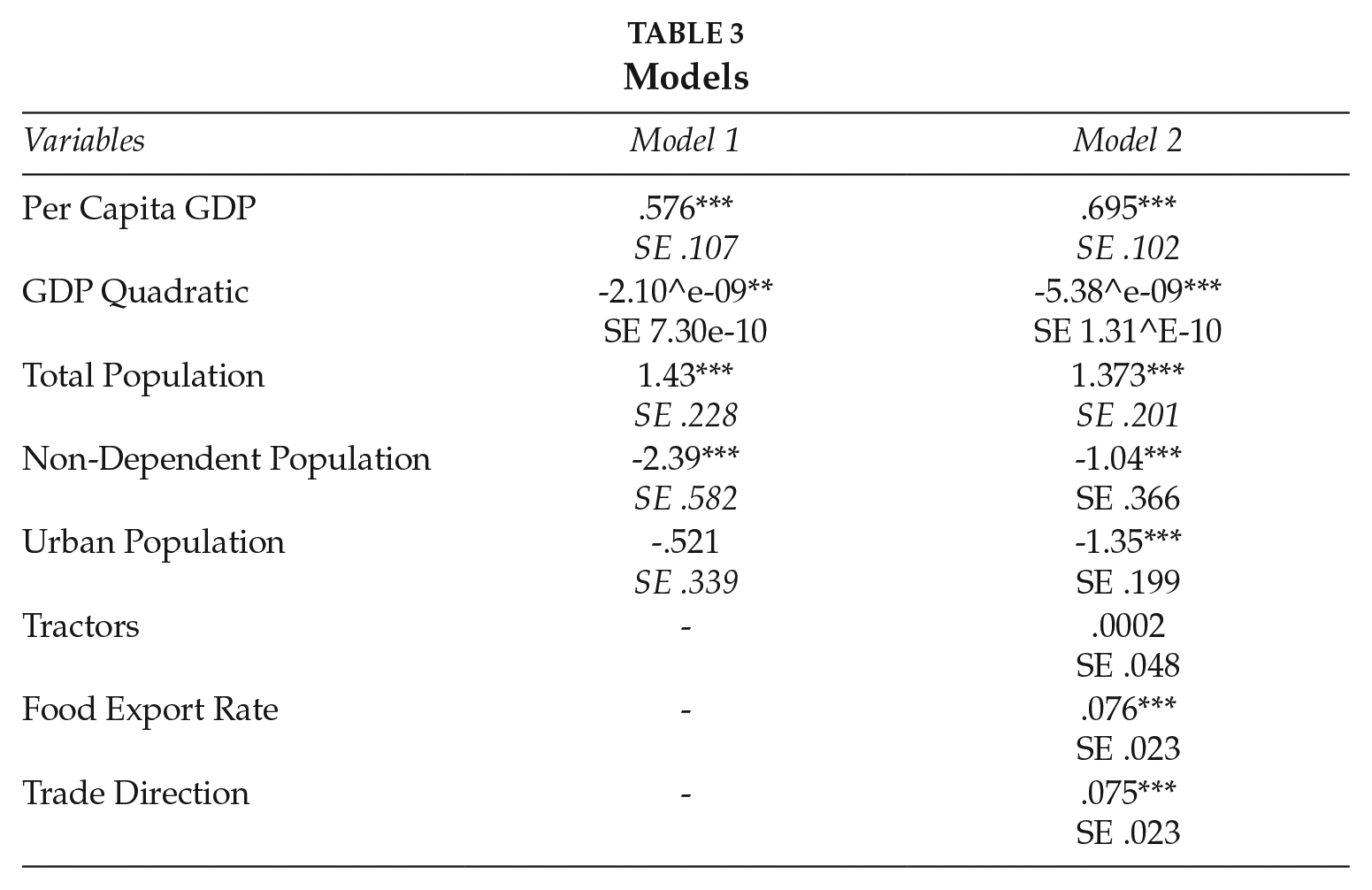
However, the magnitude of the coefficient is quite small; thus, we reason that the presence indicates a leveling off effect of the cropland footprint at higher levels of national GDP. The total population remains statistically significant and positive. We found moderate evidence that increases in food export rates and trade direction with affluent nations tend to result in increases in cropland footprints within nations.. The log-log model indicates that for every 1 percent increase in a nation’s GDP/Capita, there is a predicted .695 percent increase in a nation’s cropland footprint. All other coefficients, with the exception of tractors, were statistically significant. In terms of population structure variables, the non-dependent (i.e., working age) population variable was the most consistent. Increases in working age population correspond with decreases in cropland footprint, which makes sense within the context of a modernizing and increasingly automated agrarian system. Thus, we found evidence to support the notion that economic relations with global North nations intensifies already unsustainable patterns for Latin American cropland footprints.
Correlation Table for El Salvador’s Cropland Footprint
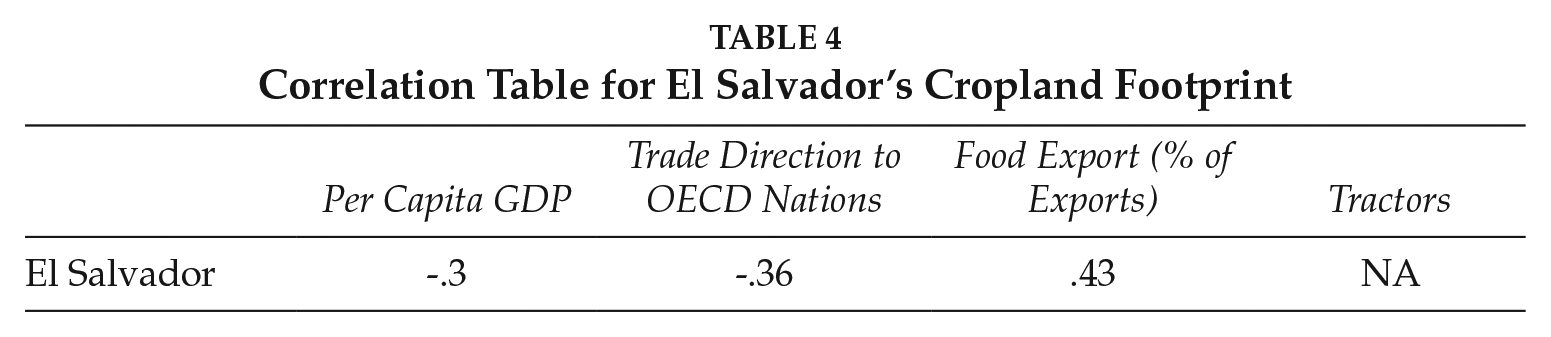
Yet, while this is the general, regional trend in the data, prior research relying on the theoretical frameworks employed in this paper has shown the analytical importance of between and within country differentiation. A key example within our data is the case of El Salvador. The country presents an outlier in terms of the overall trend because GDP per capita and trade direction are not associated with the expansion of cropland footprint. Prior scholarship provides evidence for a series of possible reasons for this differential trend. For example, the process and outcome of the civil war, whereby in the 1980s GDP per capita and trade direction declined precipitously. Additionally, Garni and Weyher (2013: 66-67) note that “Elite interests are thus based on the relative absence of productive relations. . .”, impacting capacity for export-oriented production as a “parasitic faction of the capitalist class” instead extracts money from processing remittances. Another possibility was the role of peasant activism that sought redistribution of land and debt cancellation, thereby putting into question production by large landowners (Kowalchuk, 2003). In general, the key point is that a regional trend does not cancel out within-country dynamics.
Importantly, we understand these indicators not in a deterministic fashion but rather as structural pressures that different countries embrace and contest in ways that vary given political, cultural, and geographic contexts. Thus, while there is a regional trend in the statistical data, that aggregate does not discount the need for understanding within-country particularity. For instance, Mexico demonstrates how agricultural production and export is differentiated at the state level. States in the North, like Chihuahua, have higher concentrations of agricultural land, and certain states concentrate production of specific commodities, like avocados in Michoacán (INEGI, 2019).
While the nation-state as a unit of observation can be useful, it obfuscates this variation by homogenizing into a large-scale territorial unit. As well, while we focus on Latin America as a region, this also can homogenize between-country variation in forms that reproduce problematic renderings. The results here should instead be interpreted as one type of evidence for understanding the coupling of capitalist political economy and the environment, within the parameters of the statistical method employed. We therefore hope that these results are interpreted not as laws that apply evenly everywhere, but as broader structural imperatives that nations within a highly unequal global economy tend to face.
Discussion And Conclusion
Our findings primarily provide evidence to support our theories in critical political economy. Additionally, the results provide a response to our question: Does increasing export-oriented production and intensified economic relations with the global North tend to a more unsustainable agricultural production over time through increasing environmental withdrawals to expand production for sale to wealthier countries? In terms of the treadmill of production, the results indicate moderately strong support for the notion that economic growth degrades the environment. This is in line with the argument that increasing production under a system governed by the laws of capital accumulation will lead to increasing withdrawals from the environment. It is important to note that there is a leveling off effect in the GDP quadratic, as indicated by a small, negative quadratic coefficient present in some models. This suggests that there are limits to the linkages between increased production and environmental impacts over time for cropland footprints. This makes sense, given there are natural barriers to productivity that economic growth cannot always overcome. However, even in these models for cropland footprint (where the statistically significant quadratic persists) we stress that the actual nature of this effect — as indicated by the near zero coefficient — is so small that it provides little evidence to suggest that radically different relations between the environment and economic imperatives are occurring, at present.
The models provided support to suggest that export-oriented food production generates unsustainable outcomes over time for these indicators. Model 2 indicates that increased food export rates correspond with increasing cropland footprints. However, model 2 does not demonstrate a signification association between tractor supply and increased cropland footprint, possibly because the effect of tractors is largely washed out when controlling for broader factors like economic growth. Yet, as a qualitative condition, technological intensification, or automation of agricultural labor, is tied to the reality in Latin America of declining rural populations participating in agricultural production. As the total population in each country increased, so did the negative environmental impacts, with statistically significant associations with cropland footprints. Therefore, the focus on exports with declining rural populations appears to have deleterious impacts on this agroecosystemic indicator.
In terms of ecological unequal exchange, we reason that the intensification of trade partnerships with core nations serves as an independent driver of unsustainable outcomes. First, intensification of economic relations with core nations—as measured by the trade direction variable—corresponds with worsening outcomes for cropland footprints. Moreover, the statistically significant, positive coefficient for food export rate suggests that as nations’ food systems shift toward more export oriented production, their cropland footprint intensifies. Taken together, these indicators suggest that incorporation within the world system (as indicated by trade direction increases) and a ‘modernizing’, export-oriented food system correspond with increased cropland footprints over time in Latin American nations.
The intertwining of these two then demonstrate the utility of the extractivist framework. Rather than separating the treadmill of production and ecological unequal exchange, extractivism connects the two as part of a dynamic underpinning (semi-)peripheral development. Food export increases are a part of bringing in foreign exchange and increasing GDP, thereby financing further economic development. Because that trade, in part, is occurring with core nations, extractivism is also about how (semi-)peripheral countries sell raw materials or primary commodities, rather than value-added goods that accumulate more surplus value. In that way, these results support the claim in the literature on extractivism that the dependent relationship of (semi-)periphery countries on core countries reinforces the expansion of deleterious environmental impacts (Acosta, 2013; Gudynas, 2018).
Therefore, the case of export-oriented production tied to trade with core nations in Latin American agriculture provides evidence for the theoretical conjectures made by critical political economy. These patterns and relations reinforce long-standing patterns of Latin American dependency, whereby local environmental degradation fosters reliance on foreign markets for essential goods and economic valorization. These findings provide support for the notion that alternative models of agricultural production will be necessary to address unsustainable trends that foster problematic dependency and uneven development.
Building a More Complex Model
In this study, we presented a base model for understanding the role of economic development in agroecosystemic outcomes, specifically the relationship between productive expansion, trade, and environmental withdrawals. Following the extractivism literature, it is possible to build a more complex model to further understand the structural contradictions underlying these environmental outcomes. Specifically, what are the roles of food imports and foreign direct investment, if any, in these environmental outcomes? If there is a concomitant rise in food imports with food exports, thereby increasing dependency, is this also a driver of the expansion of cropland footprint? The logic is that exports increase to pay for imports, thereby requiring expansions in agricultural land use to bring foreign exchange. Further, foreign direct investment involves core nations relying on exports as a part of their accumulation strategies, whereby they direct surplus into growth areas that have environmental impacts. This also would reinforce the dependency dynamic, by locking (semi-)peripheral development into capital flows from core nations.
Additionally, there are two further areas for study that we think it is important to highlight as questions requiring further research. The first limitation of this study concerns the scope of the analysis; chiefly, we are not able to directly assess what accounts for a leveling off or plateau effect of GDP per capita. Prior research has shown evidence for possible “conservation booms” in certain Latin American countries, which need to be accounted for when empirically modeling trends in environmental withdrawals related to agricultural production (Zimmerer, 2011). As one example, future research should examine the extent to which eco-certification programs have moderated the deleterious effects of neoliberal modernization and treadmill effects on these indicators in Latin America. Eco-certification, or other similar programs, could be a reason for why there is a leveling off effect in the GDP quadratic in the cropland footprint models. However, it is equally likely that soil and land degradation, along with a finite amount and quality of arable land, account for falling impacts of GDP at higher levels of affluence.
In any case, within Latin America, eco-certification has become increasingly prominent for certain cultivars. For example, in the case of Ecuadorian bananas, non-governmental organizations have implemented a standard for sustainable production. Those farms that meet this standard have been shown to reduce environmental risk in comparison with non-certified farms (Melo and Wolf, 2005). Additionally, organic practices, parallel with low-input agriculture, have seen an expansion in some countries (Raynolds, 2008). Whether an increase in these production practices, often driven by an imperative to access these emerging specialty markets, will alter the relationship between export-oriented production and the environment is an open question. From the perspective of critical political economy, we would hypothesize that continued environmental degradation occurs at unsustainable levels even with organic production and eco-certification, because their ultimate goal is an increasing share of exchange value across the global market (Obach, 2007; Patel, 2013; Holt-Gimenez, 2017).
The last area involves political comparisons between countries. Pink Tide governments that claimed to be post-neoliberal while still participating in the commodity consensus also implemented policies that curtail some of these deleterious dynamics (Santos and Vasconcelos, 2022). In Ecuador, the state enshrined food sovereignty into their constitution relying on the normative framework sumac kawsay (translated from Quechua into Spanish as buen vivir and into English as living well), which had been employed by peasant and indigenous activists (Peña, 2016). There was also redistribution of land in countries like Bolivia and Brazil, although this did not alter the overall agrarian structure. That is because these policies relied on redistributing state land, rather than the expropriation of land under private control. And, in the case of Bolivia, soybeans saw an increase under a government that established an extractivist dynamic as a part of its food sovereignty strategy (McKay and Colque, 2021). Therefore, it is possible that while on a similar trend, there is variation in the environmental impacts of agriculture dependent upon the political ideology of the party in power—particularly if those parties hold influence for longer periods of time. Future studies should explore the role of the party in power to mediate the relationship between agricultural production and environmental impacts.
Footnotes
Appendix: Further Elaboration on Methods
The footprint of cropland production assesses the area of land required to grow all crop products within a nation (Global Footprint,2018). The equation for this indicator is as follows (Passeri et al., 2013):
Where A is the area used for crop cultivation, Yn / Yw is a scaling factor to convert from local to average bioproductive land requirements, and EQF an equivalence factor to convert the figure into global hectares. Importantly, the footprint of cropland production’s scaling factor adjusts the metric to depend upon agricultural productivity. It thus considers how productive a hectare of land is for growing crops. If a nation’s yield (Yn) increases relative to world yield (Yw), it would thus increase the nation’s footprint of cropland production. EFp is therefore a measure of a nation’s agricultural productivity relative to world average bio-productivity, expressed in global hectares (Global Footprint Network, 2018). Thus, results related to the footprint of cropland production must receive careful interpretation. Declines in cropland productivity could signal long term losses in agro-ecological potential; however, growth in cropland productivity does not signify sustainable agriculture, especially if the methods used are industrial and input dependent.
We first conducted several diagnostic tests to determine which modeling approach to utilize. These diagnostics were based on Model 1 which included controls related to population, population structure, and affluence indicators. Results indicated that the fixed effects approach was superior to the random effects model. We then tested for heteroscedasticity, cross-sectional dependency, and serial correlation in Model 1 and 2 (Torres-Reyna, 2007). Results from the modified Wald test and the Woolridge test indicate presence of heteroscedasticity and serial correlation. Thus, we needed to utilize an approach that could adjust for heteroscedastic error terms, serial correlation within panels, and provide some way to account for the need for a fixed effects approach, i.e. an approach that would adjust from time-invariant differences across nations. We utilized panel corrected standard error models (xtpcse, in STATA), a proven approach for modeling ecological change and food system dynamics in cross-national, time series panel data that adjusts for heteroscedasticity (Clark and Longo, 2019; Thombs and Jorgenson, 2019). We further respond to serial correlation by including a panel specific, autoregressive option. Finally, we include a country specific term (i.id) within the model, effectively creating a one-way fixed effects model that adjusts for both heteroscedasticity and serial correlation. Adjusting for country specific differences and auto-correlation produce a highly specified model, indicated by a high R-squared value, which we stress is a product of this modeling structure.
Notes
Andrew Smolski is a Postdoctoral Research Scholar in the Department of in the Department of Agricultural and Human Sciences at North Carolina State University. Timothy P. Clark is an Assistant Professor in the Department of Sociology at Catawba College.