




Abstract
Territorial disputes have intensified in Latin America due to the advance of neo-extractivism, while agrarian socio-territorial movements have created strategies of resistance and reinvention of their territorialities. In dialogue with political ecology perspectives, we seek to understand the dynamics of these movements in Argentina and Brazil. We analyzed the information systematized in the DataLuta Network database on the actions and reactions of socio-territorial movements based on published news reports in 2021. We noted that, even with different political contexts, the socio-territorial movements of Argentina and Brazil have included environmental issues in their agendas, demonstrated by their commitment to the fight against pesticides, agro-industry, and mining, and in defense of agroecology and the production of healthy food.
La disputa territorial se ha intensificado en América Latina por el avance del neoextractivismo, mientras que los movimientos socioterritoriales agrarios han creado estrategias de resistencia y reinvención de sus territorialidades. Dialogando con las perspectivas de la ecología política, buscamos comprender la dinámica de estos movimientos en Argentina y Brasil. Analizamos la información sistematizada en la base de datos de la Red DataLuta sobre las acciones y reacciones de los movimientos socioterritoriales a partir de las noticias publicadas en 2021. Notamos que, aún con diferentes contextos políticos, los movimientos socioterritoriales de Argentina y Brasil han incluido la cuestión ambiental en sus agendas, que se manifiesta en su compromiso con la lucha contra los plaguicidas, la agroindustria y la minería, en la defensa de la agroecología y la producción de alimentos saludables.
The debate on the agrarian question in Latin America is crucial to understanding the territorial and environmental dynamics resulting from differing processes in the use of land and nature revealed by various projects in rural development and social production relations. Without a doubt, an intrinsic relationship exists between the agrarian question and ecological perspectives in the region, since nature and the land are interconnected in the face of advancing neo-extractivism, which lacerates territories and peasant, indigenous and quilombola communities while furthering countless and often irreversible environmental impacts, generating territorial disputes, primarily of a political and environmental nature (Svampa, 2016).
In this context, the movements that we are calling socio-territorial, with a long history of struggle in Latin America, have promoted a new pattern of organization and mobilization that involves “expanding their autonomy, strengthening emancipatory social practices, developing new imaginaries and ideas” (Zibechi, 2008: 11). They seek to create counter-narratives and emancipatory strategies as forms of resistance and reinvention of their territorialities, “in defense of their ancestral territories and economic and productive logics distinct from capitalism” (Wahren, 2016: 37).
In the quest for other possible worlds (Krenak, 2020), socio-territorial movements incorporate environmental standards into their political agendas. These movements with historical demands based on access to land have recently added claims that include environmental dimensions (Jara, 2014). According to Svampa (2016), the movements display an “eco-territorial shift.” Along these lines, this article will attempt to interpret the actions and reactions of socio-territorial movements during 2021, in the face of the onslaught of agrarian capitalism, particularly in Argentina and Brazil, exploring the environmental dimension as the focal point of analysis.
Our methodological strategy is based on the mapping and qualitative analysis of information derived from the databases of the Socio-territorial Movements in Comparative Perspective project, which we jointly produced with research teams from several Latin American universities. 1 The intent of this project, the source of this article, is to develop an international comparative analysis using national level studies. To do so, we conducted an overarching analysis of the collective actions of socio-territorial movements that defend and/or produce territory in Argentina and Brazil. In this work, we are specifically interested in those actions linked to the issues of agroecology, agrotoxins, mining, and deforestation.
Our period of analysis, the year 2021, bears the particularity of having been affected by the COVID-19 pandemic, a health emergency with significant social and economic repercussions. Preventive isolation measures affected the typical forms of collective activity entailed by concentrations of people in public spaces. But, as we will describe in this article, socio-territorial movements continued to act. In an attempt to mitigate the pandemic’s effects, they explored innovative spaces that opened up at that time (Della Porta, 2020), producing networks and acts of resistance.
The article is organized into four sections. In the first, we present our theoretical perspective. Second, we state the methodological strategy employed. Then, we briefly contextualize the political and agrarian context in Argentina and Brazil in which the actions of socio-territorial movements unfold, described in the following sections using cases by region. We conclude by reflecting on the socio-territorial movements’ activities and the environmental disputes in this specific context.
A Possible Dialogue Between Socio-Territorial Movement Studies And Political Ecology
In this work, we assume that Latin American social movements can be read in a geographical perspective, and therefore be considered “socio-territorial movements” (Fernandes, 2005; Cardona and Sobreiro Filho, 2016). The concept constitutes a theoretical proposition for approaching collective action from “the process of spatial and territorial production, which does not mean denying the concept of social movement, but rather qualifying it” (Pertuz and Fernandes, 2021: 13). It is part of an attempt to develop categories that enable understanding of the specificities of collective action from and in the current Latin American context.
Originally, crafting the concept of socio-territorial movements began with studies of the Landless Workers’ Movement (MST) in Brazil. Fernandes et al. (1985) utilized the geographic method in dialogue with sociological theory (Gohn, 2009). His studies on the first MST land occupations showed that, in this process, the “landless” create spaces of political socialization in order to share their endured realities and to change them (Fernandes et al., 1985). In this manner, they transform space into territory (Fernandes, 2005).
In later years, the concept of socio-territorial movement was re-worked and demonstrated its theoretical and analytical potential to examine different collective actions beyond the Brazilian case. According to Halvorsen, Fernandes, and Torres (2021: 29), these movements “are not only produced by land occupations, but also include any attempt to appropriate and control space with the goal of promoting a political project.”
Thus, the territory is, from our perspective, the result of a concrete or symbolic action carried out by an actor for the purpose of appropriating space, through which the actor territorializes it and reveals relations marked by power (Raffestin, 1993). The appropriation is the establishment of power relations or, more concretely, of differential capacities to control and influence matters, make decisions about their arrangement, use and transformation, restrict their availability to other actors, and distribute their negative impacts (Alimonda, 2011; Manzanal, 2007; Saettone, 2023).
By “matters” we are referring to the land, water, persons, productive practices, identity, pollution, public policies; ideas about how things are and how they should be; the ways of naming, explaining, ranking, and interconnecting them; defining current social problems, who and how to resolve them, among many others that are geographically constituted (Saettone, 2023). Together, these reveal a territorial political project that the movements fight for, that is co-constitutive of its emergence and its becoming, and is at once the object, product, and means of struggle.
In the current context of “greening” social issues —that is, the inclusion of environmental arguments to legitimize various institutional, political, and scientific practices (Leff, 2015; Acselrad, 2010)— we believe establishing a dialogue with political ecology to be highly productive. Political ecology, according to Robbins (2011), contributes to understanding which actors have the power to decide, control, and assign benefits and environmental costs directly associated with conflicts resulting from extractive practices.
Likewise, it challenges us to center the subjects directly involved in processes of resistance who take on the role of ensuring the defense of collectively shared common goods (Robins, 2011). Sharing our emphasis on power relations, political ecology helps us to consider the environmental question in studies of socio-territorial movements (Leff, 2015; Alimonda, 2011; Escobar, 2005; Bebbington, 2007; Robbins, 2011; Aráoz Machado, 2017).
Alimonda (2011) posits that while there have always been demands, conflicts, and movements with environmental components in the region, they have not always been explicit in the consciousness and discourse of the actors spearheading them. Svampa (2016) and Acosta and Machado (2012) invite us to elaborate on the role of socio-territorial movements in the grammar of struggle and commitment to life in resistance to capitalist neo-extractivism and the various forms of exploitation of nature and territories in Latin America. In what follows, we specify the methodological strategy established to proceed in that direction.
Methodological Notes For Reading Socio-Territorial Movements
In an effort to analyze the movement actions using the concept of socio-territorial movements and political ecology in Argentina and Brazil, we utilized information from DATALUTA Network, particularly in the project, “Socioterritorial Movements in Comparative Perspective.” The goal of our research is to build an information matrix to record and systematize documents (accounts, news, editorials), institutional reports and newsletters, leaflets, and other written or audiovisual material available on websites and news platforms referring to the activities of the socio-territorial movements, taking into account their various forms of action, struggle, and resistance. Through this extensive collection of data in time and space, we hope to contribute to the mapping of socio-territorial movements and to the knowledge of their territorializations in a macro perspective, enabling a broad critical analysis of the political situation in each country and their comparison.
Our research began in 2020 in Brazil and in 2021 in Argentina and continues to the present. The team in Brazil has four thematic groups: agrarian spaces, urban spaces, forests. and water. In Argentina there are two groups: agrarian spaces and urban spaces. In 2022, the “Socio-territorial Movements in Critical Comparative Perspective in Latin American and the Caribbean” working group was approved by the Latin American Social Sciences Council, with twelve countries participating.
Regarding the tools employed, we used Google Alert to gather news, a tool that detects related content with phrases or terms chosen by the user through algorithms. In our case, we chose names of movements and rural organizations, phrases related to their demands and claims, names of bureaucratic entities, and topics related to the Sustainable Development Goals (SDGs) and Argentine and Brazilian rural situations. This list is continually being adjusted and updated.
We defined movement activities as the unit of analysis, defined operationally as those actions carried out by a group of people who come together and organize to fight for a right. To systematize this information, categories were created based on a qualitative analysis of the first batch of news gathered and collective academic discussions and fine-tuned during the first year of work. These categories include types of movements, the form taken by the action, and the topics and SDGs to which the action referred, among others.
Based on these categories and others related to the source, date, and location of the action, we designed forms for a standardized capture of information. To do so, Argentina used Google Forms and Brazil used Jotform, which automatically places the information entered into an Excel spreadsheet. For a standardized record of location, we used census codes from the National Institute of Statistics and Census (INDEC, 2010) of Argentina and the Instituto Brasileiro de Geografia e Estatística (Brazilian Institute of Geography and Statistics, IBGE) (2020). The census code contains several digits indicating location (in the Argentine case), department, and province, allowing for grouping and mapping data on different scales using Geographic Information Systems (GIS).
In this article, we analyze the database developed by Argentine and Brazilian agrarian teams for 2021, the first with data for both countries. The Argentine agrarian database includes actions of indigenous movements, but the Brazil data does not, as those appear in the registry of the team concerned with forests. In order to dialogue with political ecology concerning the distributive injustices and conflicts associated with the agrarian spaces in Argentina and Brazil, we worked with three groups of activities: 1) protests against, deforestation, and mining, 2) agroecological production and commerce, and 3) reforestation experiences.
After identifying these actions in the database, we conducted a qualitative analysis by region and described some cases as examples, highlighting not only trends but also the various actors that carry out these actions and their specificities. We name the actors, companies, or state institutions against which they are mobilizing only insofar as they appear in the systematized news items. Using the open code Quantum Gis GIS, we map the locations of the actions described by means of the corresponding census.
Political And Agrarian Conjunctures In Argentina And Brazil
In Argentina, the year 2021 was marked by the worldwide COVID-19 health crisis and the resulting economic problems, which were added to foreign indebtedness, inflation, and currency devaluation. With respect to agrarian spaces, the effects of the policies of the previous Cambiemos Alliance administration (2015-2019), which improved profitability for big business linked to commodity exports while conditions for other activities (dairy farms, pork, poultry, and regional production, among others) worsened, particularly for family farmers.
The close ties between Macrismo and agribusiness were evidenced, for example, by the fact that a significant number of Sociedad Rural Artentina (Argentine Rural Society—SRA) leaders held important positions in public office. 2 This association has historically brought together economic groups linked to the agro-export model which defend the free market economy. In fact, public policies clearly favored this sector over and against family farming. The Registro Nacional de Trabajadores y Empleadores Agrarios (National Registry of Agrarian Workers and Employers—RENATEA), an entity in charge of overseeing rural employment, was dissolved. There were massive dismissals of workers in the Secretaría de Agricultura Familiar (Family Farming Department—SAF). In general, repression and criminalization of social protest increased.
At the same time, upon taking office Macri executed an abrupt devaluation, eliminated export rights for wheat, corn, beef, and regional products, and reduced taxes on soy. He eliminated the Registro de Operaciones de Exportación (Export Operations Registry—ROE) system through which exports were authorized and price caps set for local consumption of basic food basket products such as meat, and he extended the obligatory liquidation of foreign exchange to five years. All of this meant a decline in state income. Macri’s term ended with an enormous acquisition of debt with the International Monetary Fund (IMF).
In December 2019, Alberto Fernández became president with the Frente de Todos, which was critical of the previous government’s neoliberal policies. Less than four months into his term, the COVID-19 pandemic was declared, worsening the country’s delicate economic situation regarding trade restrictions and IMF pressures. These factors restricted the margins for progress on progressive policies. Confronted with the need for foreign exchange, raw materials exports continued to be key in the developmentalist narrative. In fact, despite some rebuilding of family, peasant, and indigenous farming policy, the expansion of the agricultural, livestock, and mining frontiers that characterize neo-extractivism continued to advance.
Moreover, during this period, the enormous power wielded by agribusiness to block measures against its interests was confirmed, such the president’s decision to take over a large grain company that was accumulating a staggering debt with the state, which he later reversed. The Frente de Todos involved a diverse government alliance in terms of ideology and constituency. A significant portion of peasant and indigenous movements supported the progressive government’s proposition in favor of redistributive policies. Nevertheless, the primary demands of agrarian socio-territorial movements, such as putting an end to evictions and moving towards a more equitable distribution of land, have yet to receive concrete responses.
In the case of Brazil, 2021 was also marked by public health, political, economic, and environmental crises. From the time that Jair Bolsonaro became president in 2019, his administration actively threatened the pillars of democracy. One of his administration’s first acts was to eliminate and/or rearrange ministries, departments, and institutional channels for social participation designed to strengthen public policies for various segments of Brazilian society.
These actions were part of a conservative and ultra-neoliberal agenda instituted in Brazil in recent years that included the dismantling of the state apparatus (Sauer, Leite, and Tubino, 2020). Among the various public policies that were disbanded, discontinued, or downsized were the Programa Nacional de Educação na Reforma Agrária (National Program of Education on Agrarian Reform—PRONERA), the Programa de Aquisição de Alimentos (Food Procurement Program—PAA), and the Programa Nacional de Alimentação Escolar (National School Food Program—PNAE), among others. In addition, Bolsonaro and his allies openly defended the use of weapons against peasants, indigenous people, and quilombolas, inciting hatred against the left. The criminalization of the struggle for land and the halting of agrarian reform was notorious (Fernándes et al., 2020). Another example of the administration’s agenda against rural peoples is found in the events of 2020, when the pandemic began and the environment minister environment informed the administration of what he considered an opportunity to change regulations at a moment in which the society and media’s attention was on the new coronavirus (G1.com, 2020). With the support of agribusiness, corporate sectors, and the ruralist legislative caucus, 3 environmental licensing, the pesticide regulatory framework, and the system of environmental fines were flexibilized, resulting in the advance of deforestation and the expulsion of rural communities across the country.
The Bolsonaro administration reached power as a result of a veritable political coup in 2016, which involved center-right, right, and extreme right parties, churches, businesses, and movements against the Partido dos Trabalhadores (Workers’ Party—PT). Fake news and denialism marked the post-fascist positions that elected Jair Bolsonaro in 2018. The administration’s position against science, human rights, the working class, indigenous peoples, quilombolas, and peasants produced a set of public policies which enjoyed support from the armed forces. These policies favoring agribusiness, mining, wind, and solar production corporations led to the dispossession of traditional peoples in a process of devastation, deforestation, and assassinations, even condemning indigenous populations to death, as in the case of the Yanomami in Amazonia.
There is still a dearth of studies on these processes of deterritorialization and resistance. Therefore, this text reveals these movement’s acts of resistance against extreme-right governments and progressive governments in comparative perspective, in Brazil and Argentina. We show that while far-right governments promote policies of deterritorialization, progressive governments promote policies of resistance without fundamentally attacking policies of deterritorialization.
Actions And Reactions Of Socio-Territorial Movements In Argentina
During the first semester of 2021, COVID-19 infections spread quickly in Argentina, making it necessary to continue policies of caution and preventive distancing. Despite this, according to the data gathered, neither extractivism nor resistances halted. The collective actions deployed by movements took several innovative forms, such as the expansion of digital media usage. As the vaccination campaign progressed in the second semester, mobility was progressively restored.
In the following sections, we analyze the protests and production and reforestation initiatives by region, through a description of cases whose location can be seen in Map 1, which shows that these actions extended throughout the country and were led by various socio-territorial movements of family, peasant, and indigenous farmers.
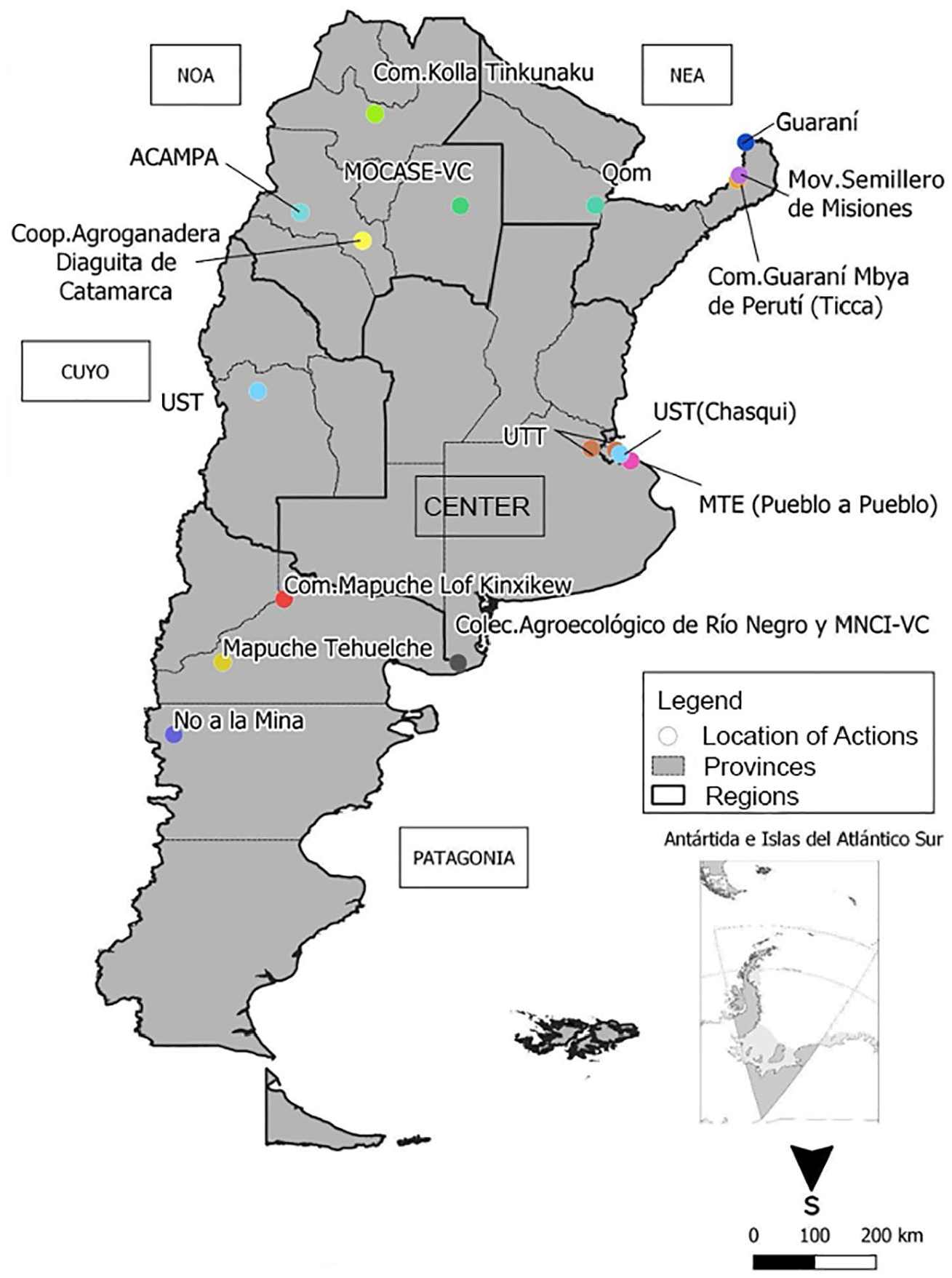
Location of Cases in Argentina Discussed in this Article.
Protests Against Agrotoxins, Deforestation, And Mining
In Argentina’s central region, where the country’s most fertile lands are found and where the soy agribusiness is deeply entrenched, movements carried out protest actions against agrotoxins, denouncing their impact on the ecosystem and on human health in both rural and urban areas (Russo, 2021). Standing out were the protests against HB4 wheat promoted by the transnational company Bioceres, of Argentine origin, along with national public scientific institutions as a solution to climate change that “allows for a more efficient use of water and greater CO2 fixing than conventional wheat.” These movements, such as the Unión de los Trabajadores de la Teirra (Union of Land Workers—UTT), responded by denouncing that this wheat “increases the use of agrochemicals that are more toxic than glyphosate, poses a greater risk of genetic contamination of other wheat varieties, and consolidates the power and concentration of agribusiness” (Perfil, 2021a).
In the Northwest, we recorded several protests against large-scale deforestation, showing that the expansion of the agricultural frontier did not cease during the pandemic. Socio-territorial movements held demonstrations in support of Law 26.331 regarding land use planning in native forests. They frame their demands in terms of defense of the earth, as part of a broader struggle that also entails care for terrestrial ecosystems, healthcare, access to habitats, and housing. One example is the claims filed by the Movimiento Campesino de Santiago del Estero (Santiago del Estero Peasant Movement-Vía Campesina—MOCASE-VC) over evictions and deforestation perpetrated by agribusiness magnates at the expense of peasants and indigenous people, which also cause the disappearance of forest and a decline in biodiversity (AIM Digital, 2021a).
In the Northeast, 2021 was a year marked by drought, successive forest fires, and a reduction in the volume of one of the country’s primary rivers, the Paraná. In the Chaco, where extensive native forest surfaces have been lost in recent years, Qom communities have repeatedly filed claims over deforestation and violation of the Forestry Law. In Misiones, Guaraní villagers are also denouncing the logging of native trees in their ancestral territories (Primera Edición, 2021). Furthermore, evictions of these indigenous communities have been registered due to the failure to recognize their right to the land.
Protests against mega-mining have been concentrated in the regions of Patagonia, Cuyo, and the Northwest. In the province of Chubut, for example, actions by the Asamblea No a la Mina Esquel (No to Esquel Mining Assembly) against the reform of a law to benefit large-scale mining despite the historical struggle of the population against this activity. This situation was also noted in the province of Río Negro, where the Tehuelche Mapuche denounced the influx of extractive projects into their communal territories without prior consultation in areas near Menucos, Pilcaniyeu, and Ñorquinco, among others (Notas Periodismo Popular, 2021). In Catamarca and Jujuy, assemblies and public documents were registered denouncing lithium mining projects, with the participation of the the Asociación Campesinos de Abaucán (Abaucán Peasant Association—ACAMPA), among other movements and organizations (AIM Digital, 2021b).
In sum, deforestation, agrotoxins, and mega-mining had a direct effect on peasant and indigenous communities during 2021, including covert evictions, invasion of their territories, loss of their sources of food and medicine, violations of historic and sacred spaces, and water contamination, just to name a few. This compromises the possibilities for reproduction of life for these actors, fomenting resistance processes. In other words, socio-territorial movements engage in a repertoire of collective actions as a product of their territories and vice versa. Territory is mobilized as a core strategy to achieve their objectives, becoming a means and an end for the very existence of these movements, as it informs their identity and political socialization and enables the creation of new institutions (Halvorsen, Fernandes, and Torres, 2021).
Agroecological Production And Commercialization Initiatives
Socio-territorial movements’ activities in this area took diverse forms, ranging from the implementation of new technologies value-added production, thus demonstrating practices respectful of nature and life. They have also set in motion new sales strategies based on the principles of fair trade and in short food supply chains, such as bartering, seed markets, agricultural supply stores, agroecological baskets, virtual sales, and farmers markets, among others.
In the central region, socio-territorial movements undertook actions to shoulder the increase of food prices and reduce the distance between producers and consumers, providing agroecological foodstuffs through direct sales, as in the case of the Unión de Trabajadores y Trabajadoras de la Tierra (Union of Land Workers—UTT) stores. This organization offers a variety of products from fruit, vegetables, and meat, to value-added products such as dairy, sausages, and preserves, whose prices are below the market rate. In addition, communication between producer and consumer was maintained virtually (QPW, 2021).
The second semester of 2021 featured the use and creation of digital platforms for the purchase of products in agroecological transition. 4 For example, Pueblo a Pueblo, the commercialization tool of the Movimiento de Trabajadores Excluidos (Excluded Workers’ Movement—MTE), connects families of producers and consumers with the help of a Google Form through which one may order bags of vegetables and fruits, cheeses, baked goods, etc. for home delivery (Que Pasa Web, 2021). Pueblo a Pueblo created this method prior to the pandemic, but during COVID the number of orders grew exponentially, and delivery days were expanded. Another case is the Chasqui platform, developed in collaboration with the Universidad Nacional de Quilmes (National University of Quilmes), bringing together forty virtual stores with products from family farms organized by food categories and a system of seals that specify the nature of each productive process (Perfil, 2021b). Through this platform, farmers organized in the Unión de Trabajadores Rurales Sin Tierra (Union of Landless Rural Workers—UST) sell their fruit and vegetables.
In the Northeast region the Movimiento Semillero de Misiones (Misiones Seed Bank Movement) has held fairs for native and creole seeds in Misiones, with the goal of acknowledging the expertise of peasant and indigenous communities in their preservation and producing fresh and healthy foods (Olivo, 2021). These fairs foster exchanges through workshops and training seminars. The development of Food Sovereignty Markets and the Free Trade Fairs also stands out. In the Northwest region, an interesting initiative markets agroecological Christmas packages in the fairs held by the Secretaría de Agricultura Campesina Indígena y Familiar (Department of Peasant, Indigenous, and Family Agriculture—SAFCI) in the provinces of Catamarca, Corrientes, Mendoza, and Salta. The packages include a variety of products such as jams, seasonal fruit and vegetables, handicrafts, flours and starches, and wines produced by indigenous, peasant, and family farmers. Among them, the Cooperativa Agroganadera Diaguita de Catamarca (Catamarca Diaguita Agro-Livestock Cooperative), dedicated to the milling, packaging, and direct sale of legumes, spices, and condiments such as paprika, whole washed and ground quinoa, chili peppers, and whole and ground cumin seeds (Grupo La Provincia, 2021).
In the Patagonia region, where Mapuche communities are resisting attacks and eviction attempts, we registered various activities of agroecological food production and sales in local stores. One of the most significant actions was the shipping of twenty tons of agroecological vegetables from the Río Negro coast to Bariloche by different family farming organization, including the Colectivo Agroecológico de Río Negro (Río Negro Agroecological Collective) and the Movimiento Nacional Campesino Indígena-Vía Campesina (National Indigenous Peasant Movement-Vía Campesina—MNCI-VC), in support of indigenous resistance (Río Negro, 2021). Lastly, in Cuyo, we highlight the creation of the Almacén Campesino, an agroecological store and agricultural cooperative in the Mendoza province. This is a space in which products are provided directly to farms without intermediaries and at a “fair price,” created by the Unión de Trabajadores Rurales Sin Tierra (Union of Landless Rural Workers—UST) (Sileci, 2021).
Reforestation Initiatives
With regard to reforestation initiatives, on a national scale, the case of the network Territorios y Áreas Conservadas por Pueblos Indígenas y Comunidades Locales (Territories and Areas Preserved by Indigenous Peoples and Local Communities –TICCA) is noteworthy. The initiative has an international presence and seeks to preserve biocultural diversity through projects financed by the United Nations with support from the Universidad de Buenos Aires and the National Institute of Agricultural Technology. More than thirty indigenous communities of different ethnicities are participating (La Tinta, 2021).
One such community is the Mbya Guaraní of Perutí, in El Alcázar, Misiones, which contends that their principal challenge is to mitigate the disappearance of the forest, “because without the forest we have no identity. In the forest we find food, materials to make our houses, and the spaces and elements to carry out our religious practices.” Another is the Kolla Tinkunaku community in Salta, which states that, “our primary problems are the entry of trucks into our territory to take out wood, the hunters who not only hurt and kill the forest animals but also those that we raise for our own consumption, and the motocross races that destroy the flora and fauna of the forest” (La Tinta, 2021).
In Neuquén, the Lof Kinxikew Mapuche community participates in the network. They say the principal challenge is “the loss of the menucos (wetlands) with their exotic flora and fauna, among which is the wild boar, introduced by those who came after the Conquest of the Desert. Without the menucos, we will not have medicinal plants to cure ourselves, there will be no pastures for the animals that are our food, and our fruit and vegetable production will deteriorate, leaving us without food and without the surplus that we sell. All the processes that affect the environment destabilize us as a community. That is why we need to preserve our nine menucos” (La Tinta, 2021).
Similarly, in the North, there is a plethora of experiments by peasant and indigenous organizations that are working to avert deforestation in the face advancing agribusiness, in order to recover and improve the rainforest. This is the case of the Yriapú Guaraní community, which has created a nursery to plant trees and medicinal plants, collect seeds, and make seedlings and pots with recycled material (La Voz de las Cataratas, 2021).
Through these initiatives, just as those of agroecological production and commercialization, agrarian socio-territorial movements are promoting the defense of common goods, including the environmental question in their agendas, and re-producing territories in which they present a political project of rural development as an alternative to that of capital. In the following table, we systematize the actions deployed by the socio-territorial movements described above.
Argentina: Name and Types of Movements and Collective Actions – 2021
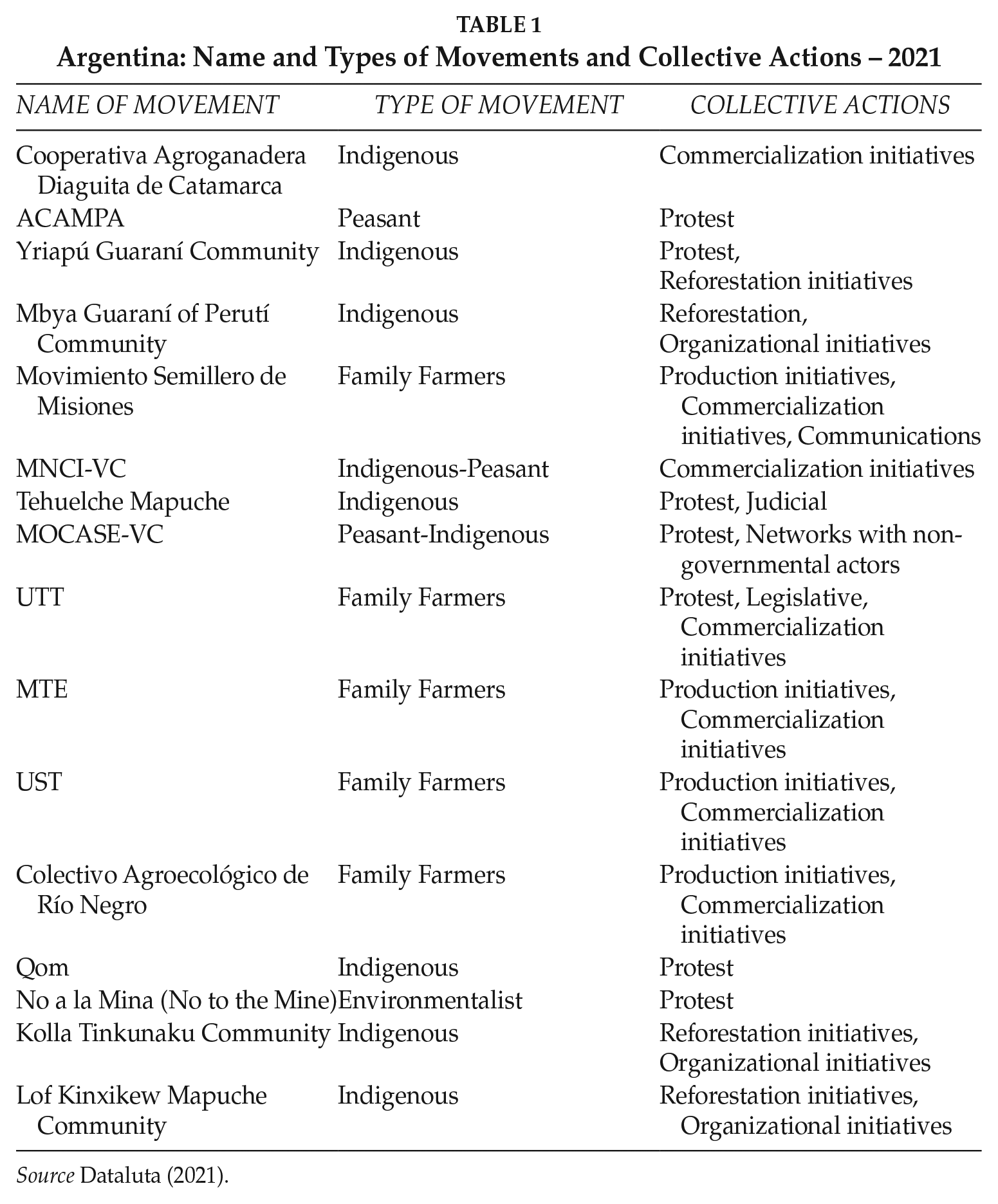
Source Dataluta (2021).
Actions And Reactions Of Socio-Territorial Movements In Brazil
As in Argentina, socio-territorial movements in Brazil engaged in activities of resistance and solidarity, but also in confrontations. Even while subject to a period of restrictions due to the COVID-19 pandemic, these movements reorganized to defend their traditional rallying cries as well as their territories. With their long history of conflict and in the political context of a right-wing government, socio-territorial movements had to grapple with the advance of agribusiness and mining in traditional communities as well as the dismantling of public policies.
We registered actions related to news items referring to the protests against pesticides; agroecological initiatives, including the production of healthy foods, productive resistance, campaigns, events, and marches; and news that provided information on reforestation efforts around the country. As can be seen in Figure 2, we found that activities were stronger in the South and Southeast regions, especially those of the Movimento dos Trabalhadores Rurais Sem Terra (Rural Landless Workers’ Movement—MST).
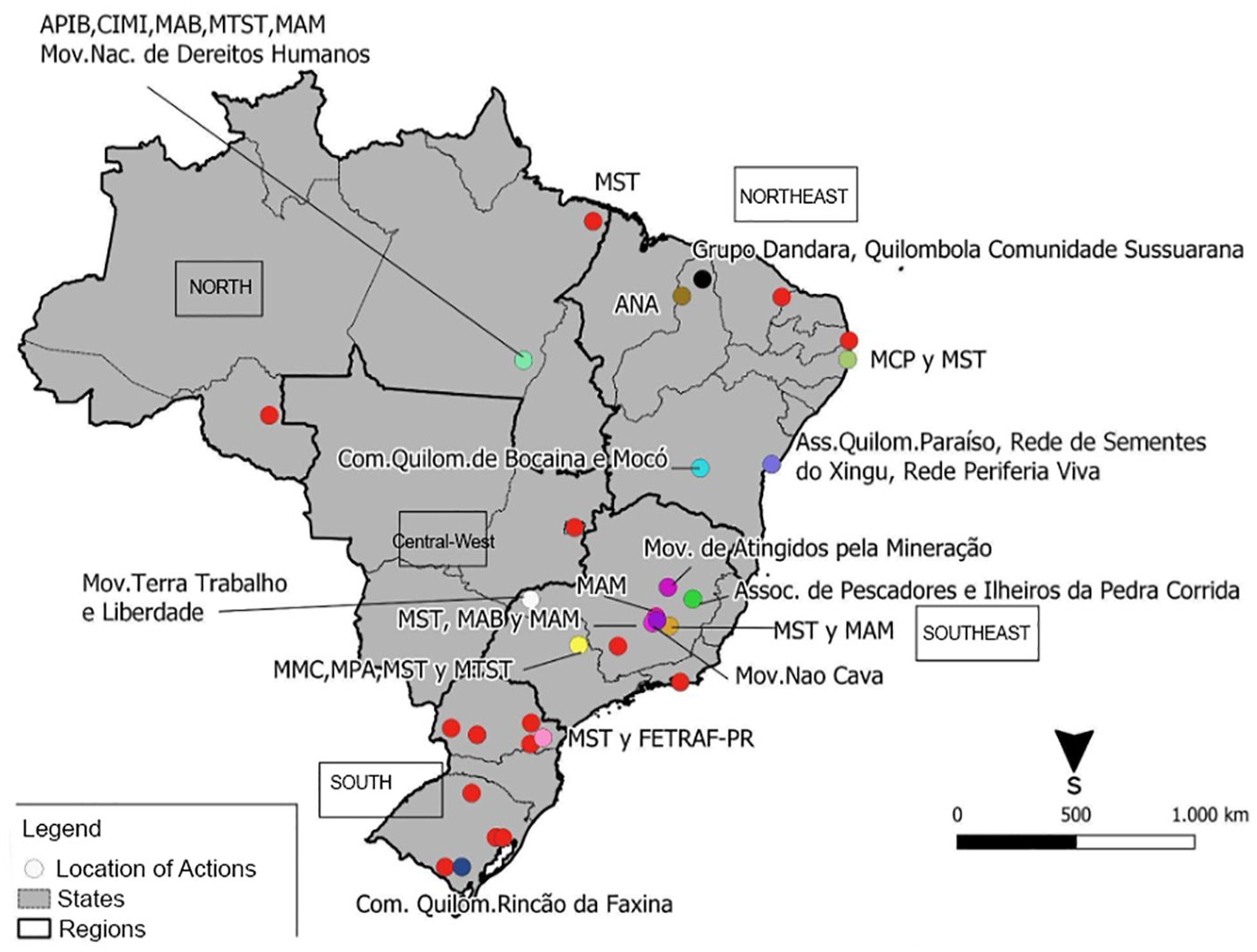
Location of Cases in Brazil Discussed in this Article.
Protests Against Agrotoxins, Deforestation, And Mining
Since 2008, Brazil ranks as the greatest consumer of agrotoxins in the world. According to the Dossier of the Associação Brasileira de Saúde Coletiva (Brazilian Collective Health Association—ABRASCO) (ABRASCO, 2012), 70% of the fresh foods consumed in the country are contaminated with pesticides. In releasing the Dossier, ABRASCO hoped to alert the Brazilian population to the risks that agrotoxins present for public health. In response, demonstrations against agrotoxins, which had been occurring sporadically, began to take place more regularly. Socio-territorial movements have been denouncing efforts to change the country’s laws, in addition to protesting against aerial fumigation in inhabited areas.
On the national level, protests took place on March 6, 2021 in every region of Brazil, started by the Campanha Permanente Contra os Agrotóxicos e Pela Vida (Permanent Campaign against Agrotoxins and for Life), to halt Legislative Bill 6299, called the “Package of Poison” by movements. This bill “proposes, through modifications of Law No 7.802 of 1989, to change the system of registering pesticides, their components, and related products” (Câmara de Diputados, 2018). In an attempt to stop the reforms, the Campaign coordinated with various socio-territorial movements, including urban movements.
In addition to the national protests, we have also observed local mobilizations, such as the claims filed by the Campamento Arco Iris (Arco Iris Encampment) in Minas Gerais, in southeast Brazil. Residents of the encampment accused an agricultural worker of spilling agrotoxins into their fields (Brazil 247, 2021). The residents filed a suit, but the conflict between the residents and the owner of the farm is ongoing since 2009. With the support of the Movimento dos Trabalhadores Sem-Teto (Homeless Workers’ Movement—MTST) and the Movimento Terra, Trabalho e Liberdade (Land, Work and, Freedom Movement (MTL), those occupying the land have been resisting in this territory, surviving through production without agrotoxins. Attorneys for the MTST have been pressuring the Instituto Nacional de Colonização e Reforma Agrária (National Institute of Colonization and Agrarian Reform—INCRA) to formalize the settlement in a process of continuous coordination with the MST, two important movements in Brazil, in both the countryside and the city. According to Silva (2017: 174), “these joint actions demonstrate a singularity of interests of social causes and organizational structures of influence in society,” and as such these movements are fighting for numerous public policies for access to rights, land, and housing.
In some of these cases, legal victories were achieved. In the South, the use of agrotoxins was suspended in an area close to MST agroecological production. The MST and environmental and agroecological movements filed a suit against aerial fumigations with agrotoxins, and an injunction in favor of the agroecological producers was granted (Fraga, 2021). A municipality in the mid-western region also achieved success when a municipal law was passed prohibiting aerial crop dusting with agrotoxins.
We also highlight the launch of a campaign against agrotoxins in the country’s northwestern region. The campaign began in May 2021, when grassroots movements, non-governmental organizations (NGOs), and environmentalists coordinated the Campanha Permanente Contra os Agrotóxicos e Pela Vida Ceará- Agrotóxicos Não, Agroecologia Sim! (Ceará Permanent Campaign for Life – No to agrotoxins, Yes to agroecology!), with the goal of eliminating tax exemptions for agrotoxins in the state of Ceará and defending a state law —the only one of its kind in Brazil— that prohibits aerial fumigation with agrotoxins.
Protests against mining projects in Brazil, on the other hand, focused primarily on companies like Vale and Samarco, which were denounced by socio-territorial movements as responsible for the rupture of dams in Mariana and Brumadinho, Minas Gerais, in 2015 and 2018, respectively. Since then, movements have tried to prosecute these companies with the support of the Movimento dos Atingidos Movimento dos Atingidos por Barragens (Movement of Persons Affected by Dams—MAB), the Movimento pela Soberania Popular na Mineração (Movement for Popular Sovereignty in Mining—MAM), the Associação Nacional dos Atingidos por Barragens (National Association of Persons Affected by Dams—ANAB), the Centro de Alternativas Socioeconômicas do Cerrado (Center for Socioeconomic Alternatives of the Cerrado—CASC) and parliamentarians of leftist parties.
In addition to these protests, we have also observed the steady advance in deterritorialization of traditional communities and rural settlements in the north of the country, through land concessions to foreign mining companies. In December 2021, the INCRA reduced the area of a settlement created twenty-two years ago in the state of Pará to create space for gold mining. In sum, the runaway use of agrotoxins, the rupture of dams, and the advance of mining companies in the country have caused suffering to traditional populations and to the agrarian reform settlers who have lost their territories. Nevertheless, we have observed considerable resistance in defense of their rights.
Agroecological Production And Commercialization Initiatives
We documented a significant diversity of agroecological initiatives coordinated by socio-territorial movements in Brazil, centered mainly on strategies to disseminate production and commercialization of agroecological products, contributing to the intensification and/or consolidation of productive resistance by peasant communities, as well as contributing to healthy diets for urban populations, especially in the context of the pandemic.
Within this type of activities, it is worth spotlighting a coordinated set of initiatives to defend of agroecology as a possible means of overcoming hunger in Brazil, with the goal of ensuring food and nutritional sovereignty and security. Among these actions, those that stand out include: agroecological harvests, donations of agroecological food baskets, establishment of urban community cafeterias, campaigns against agrotoxins, educational initiatives promoting agroecology, political organizing in defense of agroecology, virtual marches, digital media, and online courses, talks, and conferences, among others.
To cite some examples, we can highlight the MST’s agroecological initiatives, which have been central to their agendas since 2013 and which, with the pandemic, achieved greater visibility due to the amount of food donations received and the creation of virtual networks for marketing organic and agroecological products. In this way, the MST has been working to establish itself as a key actor in healthy food production without agrotoxins in Brazil. In this sense, the movement seeks to increase the number of physical and virtual stores, with the challenge of raising awareness among families already involved about the importance of getting into family farming and sharing techniques that are more respectful of nature (Mirkhan, 2021).
Events, fairs, and agroecological campaigns also constituted important activities conducted in 2021. In the Northeast, as well as in other regions around the country, these fairs were important for movements’ distribution of agroecological production. In the case of Ceará, for example, in Limoeiro do Norte, the Feira da Reforma Agrária e Agricultura Familiar (Agrarian Reform and Family Farming Fair) was held with agroecological products from rural settlements. The fair also included a political event in defense of Agrarian Reform as a step towards putting an end to hunger in the country (Oliveira, 2021).
Also in 2021, campaigns and demonstrations were held to show the importance of agroecology in combatting hunger. In these processes, we highlight the role of women in coordinating networks in both communities as well as external spaces, such as the organization of the Marcha das Margaridas (March of the Daisies), which brought together rural women from around the country. Among the various socio-territorial movements directly involved in agroecology, in addition to the MST and MTST, are: the Articulação Nacional de Agroecologia (National Agroecology Coordination—ANA), the Asociação Brasileira de Agroecologia (Brazilian Agroecology Association—ABA), the Associação Brasileira de Reforma Agrária (Brazilian Agrarian Reform Association—ABRA), the Movimento de Mulheres Camponesas (Movement of Peasant Women—MMC), the Movimento dos Pequenos Agricultores (Small Farmers Movement—MPA), and the Movimento Urbano de Agroecologia (Urban Agroecology Movement—MUDA).
Reforestation Initiatives
With regard to reforestation initiatives in Brazil by socio-territorial movements, we identified activities related to the planting of trees by the MST. These actions are part of the movement’s national “Plant Trees, Produce Healthy Foods” plan, set in motion in 2020. This plan aims to plant 100 million saplings over the next ten years. To do so, in 2021, the MST created an application called Arvoredo, which will attempt to map the planting. According to the plan’s coordinator, the “application is designed to monitor the planting of trees throughout the country” (Brasil de Fato, 2021).
In addition to mapping the sowing, the app’s purpose is to understand how the settlements and encampments linked to the MST are producing food. This activity is important to the movement’s environmental and agroecological dimensions; the coordinator remarked: “When we say that our mission is to produce healthy foods and care for our common goods, we want to show in practice how each one of our territories are involved” (Brasil de Fato, 2021). In this sense, combining tree planting with growing food would be “a way to diversify agroecosystems and provide more productive diversity” (Moreira, 2022).
Brazil: Name and Types Of Movements and Collective Actions – 2021
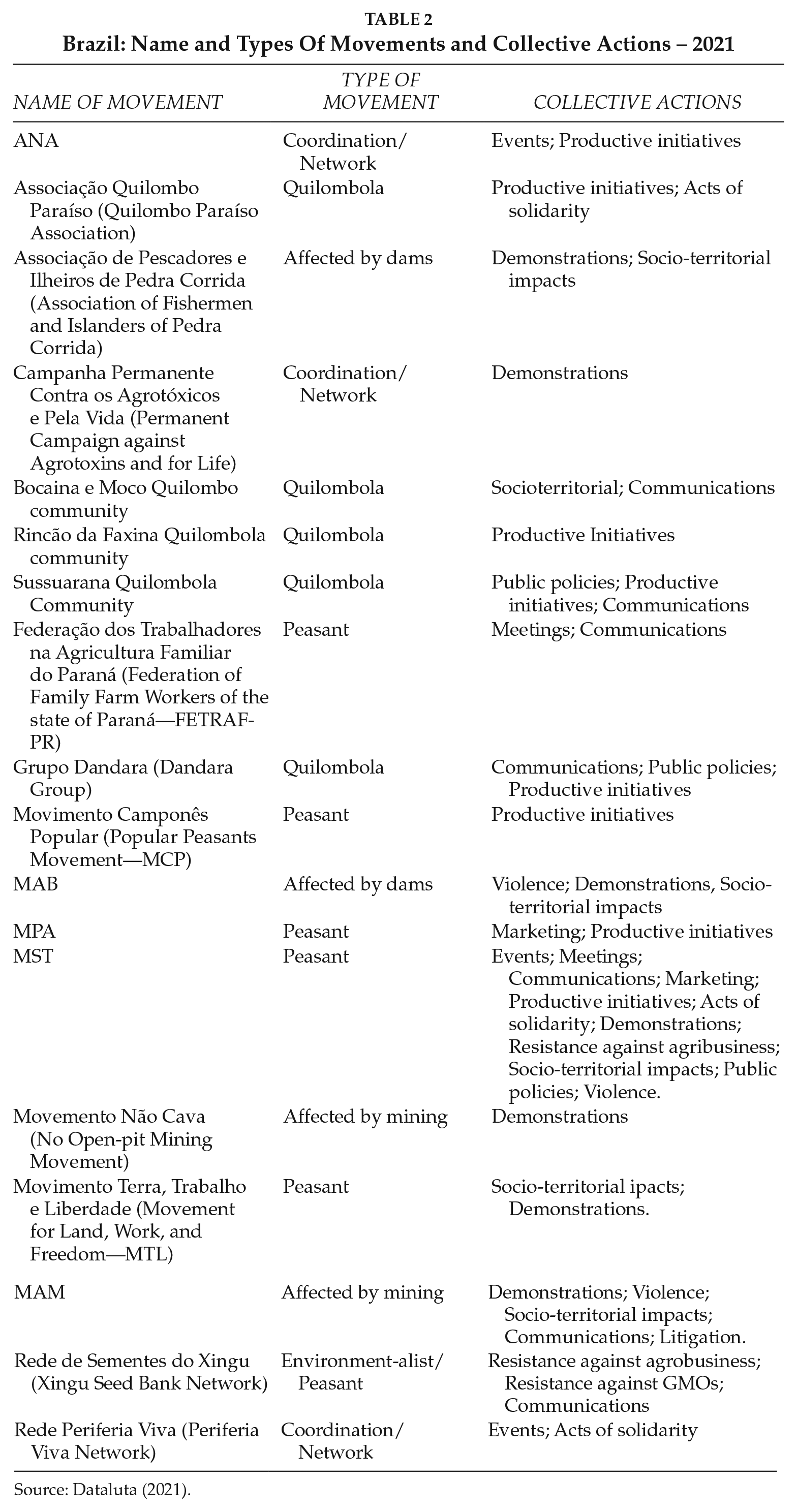
Source: Dataluta (2021).
Final Observations
This study has shown that ecological issues have become ever more present in the agendas of socio-territorial movements operating in agricultural areas of Argentina and Brazil. This is expressed in actions against agrotoxins, deforestation, and large-scale mining, and in defense of agroecology, healthy food production, and the promotion of reforestation. These actions are in direct dialogue with the SDGs oriented toward the intersection of sustainable agriculture and the fight against climate change.
While the political situations of each country differed in terms of opportunities for socio-territorial movements, it is possible to identify persisting long-term challenges that worsened during the COVID pandemic. In this regard, we highlight the profound differences between the government of Bolsonaro in Brazil and that of Fernández in Argentina. The first was deeply hostile, repressive, and opposed to the interests of movements that fight for social and environmental justice. The second, although he received support from a significant portion of popular and progressive sectors, was not able to make substantive progress in support of family farming, such as halting deforestation, implementing redistributive policies, and limiting the environmental damage caused by extractivist activities. Growing inflation, foreign debt inherited by the Macri administration, and the public health crisis weakened the president, making it impossible to challenge the interests of agribusiness. For example, the increase in tax withholdings on primary export products was strongly resisted by this sector.
On the other hand, our cartography revealed that agrarian and environmental struggles were specific to diverse areas of both South American countries, corresponding to different identity affiliations (peasant, indigenous, family farmers, among others) and organizational histories. Although many of their demands and strategies differ, they share a common defense and development of their territories. In these struggles, the protesters’ survival is at stake (for example, to not be evicted and not be poisoned with agrotoxins) as is their aspiration to improve living conditions in the countryside.
In short, the debate over the actions and reactions of socio-territorial movements in contemporary rural areas reflects the need to consider the diversity of agendas activated by different social groups in Latin America, such as the inclusion of environmental issues that are central to these movement’s agendas, as evidenced by the practices and strategies discussed above. This poses theoretical and methodological challenges for the analysis of socio-territorial transformations, including the complexity of the relationships observed beyond issues strictly linked to the land, as the struggle for environmental justice emerges in the configuration of the region’s rural territories.
Footnotes
Notes
Joana Tereza Vaz de Moura is a Ph.D. in Political Science and Professor at the Institute of Public Policies and the Postgraduate Program in Urban and Regional Studies of the Universidad Federal de Río Grande do Norte (UFRN).
Leandro Vieira Cavalcante is a Ph.D. in Geography and Professor in the Department of Geography and the Postgraduate Programs in Geography and Urban and Regional Studies of the UFRN.
Cristian Emanuel Jara is a Ph.D. in Humanities, Professor of sociology at the Universidad Nacional de Santiago del Estero (UNSE), and researcher at the Consejo Nacional de Investigación Científicas y Tecnológicas (CONICET).
Julieta Saettone is a doctoral candidate at the Universidad de Buenos Aires (UBA) and Fellow at CONICET.
Bernardo Mançano Fernandes is a Ph.D. in Geography and Professor in the Department of Geography and Postgraduate Programs in Geography and Territorial Development of Latin America and the Caribbean at the Universidade Estadual Paulista (UNESP).
Ana Eliza Villalba is a Ph.D. in Agricultural Sciences, Professor of Sociology at the Universidad Nacional del Chaco Austral (UNCAUS), and Fellow at CONICET.
Silmara Oliveira Moreira Bitencourt is a Doctoral candidate in the Postgraduate Geography Program of the UNESP and Fellow at the Fundação de Amparo à Pesquisa do Estado de São Paulo (FAPESP).
Claudia Yesica Fonzo Bolañez is a Doctoral candidate in Humanities, Professor of Sociology at the Universidad Nacional de Santiago del Estero (UNSE), and Fellow at CONICET.
Victoria Furio is a conference interpreter and translator who lives in Yonkers, NY.