




Abstract
In recent decades, Brazil has experienced a pattern of commodity-based productive specialization as part of the nation’s subordinate entry into the global structure of capital. As a result, the accumulation process has been based primarily on the intensive and extensive exploitation of available natural and ecological resources. From a historical perspective, we apply the theory of the metabolic rift and the structural crisis of capital to analyze the contemporary processes of social degradation of nature resulting from Brazil’s economic development. We focus on the cases of the Brazilian Amazon and Cerrado regions to examine the trend towards the progressive elimination of the elementary conditions for the social reproduction of life in the current stage of development of the productive forces on a global scale.
Nas últimas décadas, o Brasil tem experimentado um padrão de especialização produtiva baseado em commodities, na presença de seu ingresso subordinado na estrutura global do capital. Com isso, o processo de acumulação tem se apoiado, dominantemente, sobre a exploração intensiva e extensiva dos recursos naturais e ecológicos disponíveis. Desde uma perspectiva histórica, mobilizamos a teoria da fenda metabólica e da crise estrutural do capital para analisar os processos contemporâneos de degradação social da natureza no curso do particular desenvolvimento econômico brasileiro. Lançamos luz nos casos da Amazônia e do Cerrado brasileiros para examinar a tendência à eliminação progressiva das condições elementares da reprodução social da vida no atual estágio do desenvolvimento das forças produtivas em escala global.
The process of plundering ecological and natural resources is nothing new. It dates back at least to the dawn of capital and its extraordinary social system of extracting surplus value and exploiting nature (Mészáros, 2009). But despite its expansive nature, while capital had the capacity to drive accumulation/(self)valorization – such as the Green Revolution in the 1960s and 1970s or the integration of biotechnology into the productive system in the following decades – its contradictions could be deferred, or “pushed forward” (Moore, 2008; Mészaros, 2009). In the current phase of development of productive forces, however, capitalist expansion seems to impose a new rhythm and dynamics on the onslaught of environmental degradation, driven by the drastic reduction in the margin of productive viability of capital on a planetary scale (Mészáros, 2009).
Some studies have characterized this process as a “rift” or “failure” in the sociometabolic relationship, and as a salient feature of the capitalist mode of production (Foster, 1999; Mancus, 2007). This dynamic drives the accumulation process which, when reaching its absolute limits, starts to progressively eliminate the elementary conditions of the social reproduction of life (Mészáros, 2009). In the context of this approach, our objective is to examine the socio-environmental degradation process of two of the most important Brazilian biomes, namely the Amazon and the Cerrado (the second largest biome in South America located in the central region of Brazil) in light of the expansion of the commodity frontier, particularly in the area of agribusiness.
Since the end of the civil-military dictatorship (1964-1985), a period marked by a peak of industrialization, a new pattern of reproduction of capital was constituted in Brazil, one based on the productive specialization of commodities (Osorio, 2012). This process converts the country into an international platform for financial valorization in conjunction with structural adjustment policies to the new international division of labor (Paulani, 2008).
As a result, Brazil has become an important territory in the contemporary global process of plundering natural and ecological resources. In 2017, scientists from the International Institute for Sustainability (IIS), together with other research institutions, found that the combination of the expansion of agribusiness, civil construction and infrastructure, and the absence of legal protection in the Cerrado region placed around 200 million hectares of the tropical savanna in Brazilian territory at risk of habitat loss and species extinction. The authors estimated that the biome had already lost 46% of all its vegetation, leaving only 19.8% of the original coverage, and concluded that the biome was going through a veritable moment of truth (Strassburg et al., 2017). Lovejoy and Nobre (2019) drew attention to the 139,400 ha of coverage of the Brazilian Amazon under deforestation alert as of August 2019 1 , when the total loss already registered was 17% in the entire basin, which placed it at tipping point of the sociometabolic relationship (Lovejoy and Nobre, 2019). According to INPE, 1,170,691 ha of forests were destroyed in 2021 (as opposed to 1,031,862 in 2020). In the Cerrado, 853,144 ha were deforested in 2021 (8% more than in 2020). 2
This article will analyze the elimination of the elementary conditions of the social reproduction of life, a tendency generated by the processes of sociometabolic rupture sometimes resulting from the structural crisis of capital. The article will look at the cases of the Brazilian Amazon and Cerrado in the context of the expansion of a new pattern of reproduction of capital based on the productive specialization of commodities.
The first section of the article presents the theoretical premises that underlie the arguments put forward in the subsequent sections. The second section defines the paper’s methodological approach. The third section centers on the current pattern of Brazilian economic and social development based largely on the production of commodities dating back to the neoliberal period of the 1980s and 1990s. Subsequently, commodities production underpinned neo-developmentalism in the 2000s, which was a form of neoliberalism made possible by the boom in the production and export of commodities. The article pays special attention to agribusiness, particularly the soy and livestock industries, which occupy the most significant portion of Brazilian exports. Our discussion supports the thesis defended by Osorio (2012) that the Brazilian economy is marked by a pattern of productive specialization in the framework of a new global structure of capital that resulted from the structural crisis beginning in the 1970s (Mészáros, 2009).
Finally, in the fourth section, which is based on secondary data and documentary research, we present considerable information concerning the devastation of ecological and natural resources. We chose the case studies of the Amazon and the Cerrado, even though Brazil has another four biomes, because both are subject to the most significant expansion of agribusiness in the country, and are thus a prime expression of the pressure of capital on the elementary conditions of social reproduction.
Theoretical Foundations
According to Brett Clark and John Bellamy Foster, over the last three or four decades Marxian ideas about the socio-ecological metabolism mediated by capital-based relationships opened up a fruitful field of analysis about the contemporary processes of social degradation of nature, often characterized as an ecological crisis. For the authors, this work has followed two main trajectories: the first, which is their own, is based on the concept of “metabolic rift” in the relationship between man and nature which occurs under capitalism; the second is associated with the work of István Mészáros, who uses the notion of a sociometabolic system to analyze the absolute limits of the social reproduction of capital (Clark and Foster, 2011). In our opinion, both lines of investigation constitute important theoretical instruments for the analysis of contemporary conditions of social degradation of nature. Most important, both are underpinned by the notion of socio-metabolic rupture imposed by the capital-based relationship, resulting from the alienation of work.
By approaching large-scale agriculture in the context of the growth of large-scale industry from 1850 onwards, Marx, influenced by the work of the chemist Justus von Liebig, argued that the interaction between man and nature under the mediation of capital, creates a “rift.” This rift is the result of the intensive exploitation of the soil caused by the expansion of industry and the progressive integration of the technical base of agriculture and industry (Foster, 1999). This was what led Marx to incorporate the concept of metabolism to shed light on the interaction between man and nature through work as well as his investigating the constantly changing requirements that resulted from capitalist development in the ongoing search for profit. The process of accumulation on an ever-increasing scale introduces new social relations and socio-ecological exchange, characterized by estrangement and degradation of the relationship between humans and nature. In this sense, the social metabolism of capitalism increasingly separates itself from the natural metabolism, and in the process produces “various metabolic failures and forms of ecological degradation in natural cycles and processes, which lead to a violation of the naturally imposed laws of regulation of production that maintain the conditions of nature” (Clark and Foster, 2011: 120). The concept of “metabolic rift” allowed Marx to capture the degradation of the natural conditions of humanity’s existence under the mediation of capitalist production. For Foster (1999), when stating that large-scale agriculture opened a “metabolic rift,” Marx was arguing that the elementary conditions of human existence were being violated.
Mészáros (2009) suggests that this violation of the basic conditions of sociometabolism, which were already identified by Marx, results from the “structural defects” of the capital-based relationship, whose internal structure is formed by a three-part rupture: between production and control; between production and consumption; and between production and circulation. However, if, on the one hand, the capital-based relationship has extraordinary dynamism as a system that extracts more labor, on the other hand, it produces antagonisms that are insolvent under any historical circumstances.
Over a substantial period of time, this fundamental violation of sociometabolism can positively stimulate the expansion of the system of capital, but once it has extended its domain to the entire planet, capital reaches its absolute limits 3 . For the Hungarian philosopher, these limits coincide with the historical descent phase of capital; when reaching the limit beyond which the law of value cannot be accommodated, the sociometabolic system of capital enters a phase of irreversible crisis. Given the impossibility of the law of value to go beyond its limits, the productive viability of capital is drastically reduced, converting the forces of production into forces of destruction, which further push open metabolic rifts (Mészáros, 2009).
In this context, the process of Brazilian capitalist accumulation begins to reflect new particularities (negatively impacting capital's own structural crisis), becoming a prime territory for analyzing the processes of metabolic rupture promoted by the relationship with capital. As Paulani (2008) argues, if we analyze the stage of industrialization, under the civil-military dictatorship later to be deployed in the countryside – we will see the national economy take the form of a “international platform for financial valorization.” This meant that from the 1970s onwards, with the financialization of the economy, the country became attractive to financial capital. Foreign companies and investors were able to make high profits by generating income transfers to rentiers not resident in Brazil. But not just this. Integrating technological agriculture into industry in the same period, brokered by financial capital, made it possible in the following decade to generate a reproduction pattern of capital based on the productive specialization of commodities. This process would end up coming full circle in the 1990s through an adjustment of the national economy to the new international division of labor, in accordance with the neoliberal playbook.
Under this new pattern of accumulation, Brazil moves toward a specific social order within which a new socio-ecological relationship emerged. The order is marked by a widening of the rift in the sociometabolism imposed by capital, which tends to eliminate the elementary conditions of social reproduction. In the framework of the commodities-based capital reproduction pattern, a potentially more destructive phase opens up with regard to ecological and natural resources, as can be seen from the analysis of the Amazon and Cerrado biomes.
Research Method
Although the process of degradation of ecological and natural resources extends into all six Brazilian biomes, we analyze this process by observing the Amazon and Cerrado, as they constitute the main frontiers of expansion of the new Brazilian pattern of commodities-based productive specialization. In both cases, the ongoing expansion of certain branches of agribusiness (as well as other activities that are intensive in nature) contributes to the substantial loss of biodiversity.
Throughout the argument proposed here, we made use of secondary data provided by some of Brazil’s main research institutes, both public and private. We have also used data from the Agricultural Census performed by the Brazilian Institute of Geography and Statistics (IBGE), which is an extremely useful study that has published data since 1920 (the most recent released in 2017) related to the Brazilian countryside.
We also used data provided by the National Supply Company (CONAB), a Brazilian state-owned company under the Ministry of Agriculture, Livestock, and Supply of Brazil, which supplies agricultural products and participates in the formulation of policies for that sector. The agency provides historic figures on Brazilian agricultural production. In this article, we use data related to soybean plantations covering the 1976-1977 and 2020-2021 harvests and the expansion of livestock in the same period. Our objective was to correlate this information with data on deforestation in the Amazon, which was produced by the National Institute for Space Research (INPE) of Brazil, through a system known as PRODES (Projeto de Monitoramento do Desmatamento na Amazônia Legal por Satélite). Additionally, to analyze the forest cover and anthropic use of Brazilian soil in the two studied biomes, we used data from the Annual Mapping Project of Land Use and Coverage in Brazil (MapBiomas), a relatively recent collaborative initiative made up of NGOs, universities, and technology companies, which produces annual maps of land use and land cover for all of Brazil.
Making use of such data, we overlapped land use maps for Brazilian territory with livestock grazing and soybean production areas to demonstrate that this expansion generates the qualitative regression of the biomes in question, promoting metabolic rifts that lead to the progressive elimination of the elementary conditions of social reproduction, namely, ecological and natural resources.
To analyze the social impacts caused by the expansion of agribusiness, we analyze reports released by two organizations. For the case of the Amazon, we report on the impact deforestation has had on traditional population groups. The discussion is derived from literature on the area, as well as information provided by the Institute of Man and the Environment of the Amazon (IMAZON), an organization that since 2008 has issued monthly newsletters on deforestation in Brazil's Legal Amazon. In our analysis of the Cerrado case, we rely on the robust research by Fian Internacional (2018), which, along with other non-governmental organizations, published a report on the environmental and human rights impact caused by the expansion of agribusiness in the MATOPIBA region, which is predominantly in the Cerrado biome. We also drew from data provided by other Brazilian and international research institutions.
The Crisis Resulting from the Commodities-Based Productive Specialization Pattern in Brazil
Since the 1980s, when industrial expansion came to an end, Brazil has been experiencing large-scale transformations driven by the structural adjustment to the new conditions of capital accumulation on a global scale. This resulted in the emergence of a pattern of a commodity-based productive specialization (Osorio, 2012), as it morphed into an international platform for financial valorization (Paulani, 2008).
Through the processes of an ongoing restructuring of capital and the implementation of neoliberal policies since the end of the civil-military dictatorship (1964-1985), civil governments have integrated Brazil into the new international division of labor. They have also dismantled the welfare state, deregulated labor relations, and enhanced the financialization of the economy, greater openness of capital operations and shift of the accumulation dynamic axes from national industries towards transnational companies. In the 1990s – despite the technology-based agriculture (with intensive use of technological equipment) as promoted by the military governments – conditions were created which led to the emergence of a pattern of development in agribusiness (Firmiano, 2016), with initiatives that included: investments in infrastructure, specifically with retard to transportation and commodity corridors; a research strategy on the part of the Brazilian Agricultural Research Corporation (EMBRAPA) which converged with large transnational corporations; an exchange rate policy that favored the competitiveness of the agricultural sector in the international market; lax regulation of the land market (Delgado, 2020); creation of the Brazilian Agribusiness Association (ABAG); and the abandonment of agrarian reform policies while family farming became integrated into agribusiness (Firmiano, 2016). Thus, by the turn of the century, a political and institutional arrangement was consolidated, thus contributing to a positive trade balance underpinned by the commodity-export sectors.
With the election of the first administration of the Workers' Party (PT) in 2003, the country's subordinate condition in the global structure of capital was reaffirmed. The liberalization of the Brazilian economy left the nation at the mercy of the free flow of transnational capital, reinforcing the structural dependence of the national economy on financial capital (Paulani, 2008; Sampaio Jr, 2012). With Lula da Silva (2003-2010) and Dilma Rousseff (2011-2016), the state attempted to activate economic growth, create jobs, and promote social programs, without breaking with the neoliberal model put into place in the previous decade. As a result, it earmarked massive public resources for the restructuring of certain sectors of capital. Through the National Bank for Economic and Social Development (BNDES), the state contributed to the formation of Brazilian global players to operate in the international market in sectors such as construction, agribusiness, energy, steel, and transportation, in the process bolstering the commodities-based productive specialization pattern, characteristic of other Latin American economies as well.
After a decade of the neo-developmentalist formula, the country had expanded primary commodity production and reprimarized exports while deindustrialization put a break on industrial innovation (Firmiano, 2016). Since the service sector does not export, it was necessary that the primary sector produce a surplus in the trade balance, thus leveraging the nation's “natural comparative advantages” 4 (Delgado, 2020).
Indeed, the share of commodities in Brazil’s total exports jumped from 28.9% in 2003 to 47.0% in 2012. During the same period, the share of manufactured goods fell from 54.3% to 37.2% (Moreira and Magalhães, 2014). In the period between 1989 and 2012 there was a strong predominance of low and medium-low technology products in the total exported by the manufacturing industry. Alongside the lower performance of industrial exports came a decline in the trade balance of manufactured goods.
Following the impact of the 2008 global financial crisis on the Brazilian economy and the concurrent domestic political and social contradictions resulting in the removal of then President of the Republic, Dilma Rousseff, in August 2016, the country entered a new stage of expanded neoliberal policies and the restructuring of the state. This development manifested itself under the provisional Michel Temer administration (2016-2018) with the dismantling of the political-institutional structure relating to rural management in favor of family farming; then, under the far-right government of Jair Bolsonaro (2019-2022), the model of commodities-based productive specialization, associated with the vilification of the national environmental policy, eliminated barriers to the expansion of accumulation by dispossession (Firmiano, 2020).
Contemporary Brazilian capitalist development with its integration into the global capital system negatively affected the conditions of sociometabolic exchange. If during the decades of industrialization, “natural comparative advantages” based on an alliance between capital and landholding (Martins, 1999) conditioned economic and social development, today the pattern of accumulation centers on the productive specialization of commodities (Osorio, 2012). This newer pattern is conditioned by the structural crisis of capital and is driven by the financialization of the global economy, which puts in evidence the structural limits of the accumulation process based on a social degradation of unprecedented nature.
The Power of Agribusiness in Brazil
Capital's urge to transcend its natural limits has produced drastic transformations in Brazilian ecology as it relates to a productive, extensive and intensive leap in certain monocultures, both in terms of cultivated area and increased productivity. But again, this is only scratching the surface. Large infrastructure works, industrial-mineral complexes, and other commodity-based activities have led to the rapid extinction of irrecoverable portions of the biodiversity present in Brazilian territory (in addition to producing a confrontation with the ways of life of countless peoples, groups, and parts of the working class).
In spite of a significant loss of its share in the National GDP over the last two decades –agribusiness represented 34.8% in 1996 and only 20.9% in 2019 – agribusiness produced a GDP-annual income of about R$1.6 billion between 1996 and 2019, thus exerting a strong influence on the national economy a whole. 5
In 2021, Brazilian agribusiness exports resulted in US$ 120.59 billion in revenue (43% of total Brazilian exports), registering an increase of 19.7% over the previous year. Among the most important exported products were soybeans (2.71 million tons); soybean meal (1.72 million tons); cellulose (1.64 million tons); and animal protein (667 thousand tons). 6
As shown by the 2017 Brazilian Agricultural Census, 32% of the total area of agricultural land in the country, which corresponds to 111.8 million hectares, consists of planted pastures. When natural pastures are added to this number, the total comes to 45% of all agricultural land, or 159.5 million hectares, with 172.7 million head of cattle. This figure represents an increase of about 70 million in the total head of cattle over the period 1975 to 2017 (IBGE, 2019). Furthermore, according to data from the National Supply Company (Conab, 2022), the 2017-2018 harvests of soy plantations represented a significant increase over the years 1976-1977. This drastic increase occurred in the Center-South region of the country, and especially in the Center-West. On the other hand, in the same period, there was a reduction in areas planted with rice and beans. The increase in soybean production was due to the expansion of Genetically Modified Organisms (GMOs). 7
According to the report Global Status of Commercialized Biotech/GM Crops: 2019, put out by the International Service for the Acquisition of Agri-Biotech Applications (ISAAA), transgenic crops in Brazil occupied an area of 52.8 million hectares in 2019, as compared with 49.1 million hectares in 2016. (ISAAA, 2020: 6; ISAAA, 2016: 2). Of the total, 35.1 million hectares were occupied by soy; 16.3 million by corn; 1.4 million hectares by cotton, and the rest by other crops, including sugar cane. (ISAAA, 2020: 6).
The ISAAA reports also show that the global area of the planet occupied by transgenic crops, which today spans 29 countries, jumped from 1.7 million to 190.4 million hectares between 1997 and 2019. Between 2015 and 2016, there was a 3% increase in the total area planted with this technology, which reflects the incorporation of 5.4 million hectares. Brazil was the country with the greatest increase, namely 11% in the area occupied by transgenic crops from 2015 to 2016. Indeed, of the total global area of this type of cultivation, 27% is found in Brazil (ISAAA, 2020; ISAAA, 2016). It is worth noting the association of transgenic monoculture with the intensive use of pesticides and its repercussions on ecological and natural resources and on human health. 8
Two of the main agribusiness products, soy and livestock, are advancing extensively from the center-south region towards the north of the country, reflecting an exponential expansion of the metabolic rift typical of the capitalist exploitation of natural and ecological resources. This advance puts pressure primarily, though not exclusively, on the Amazon and Cerrado biomes (Figure 1).
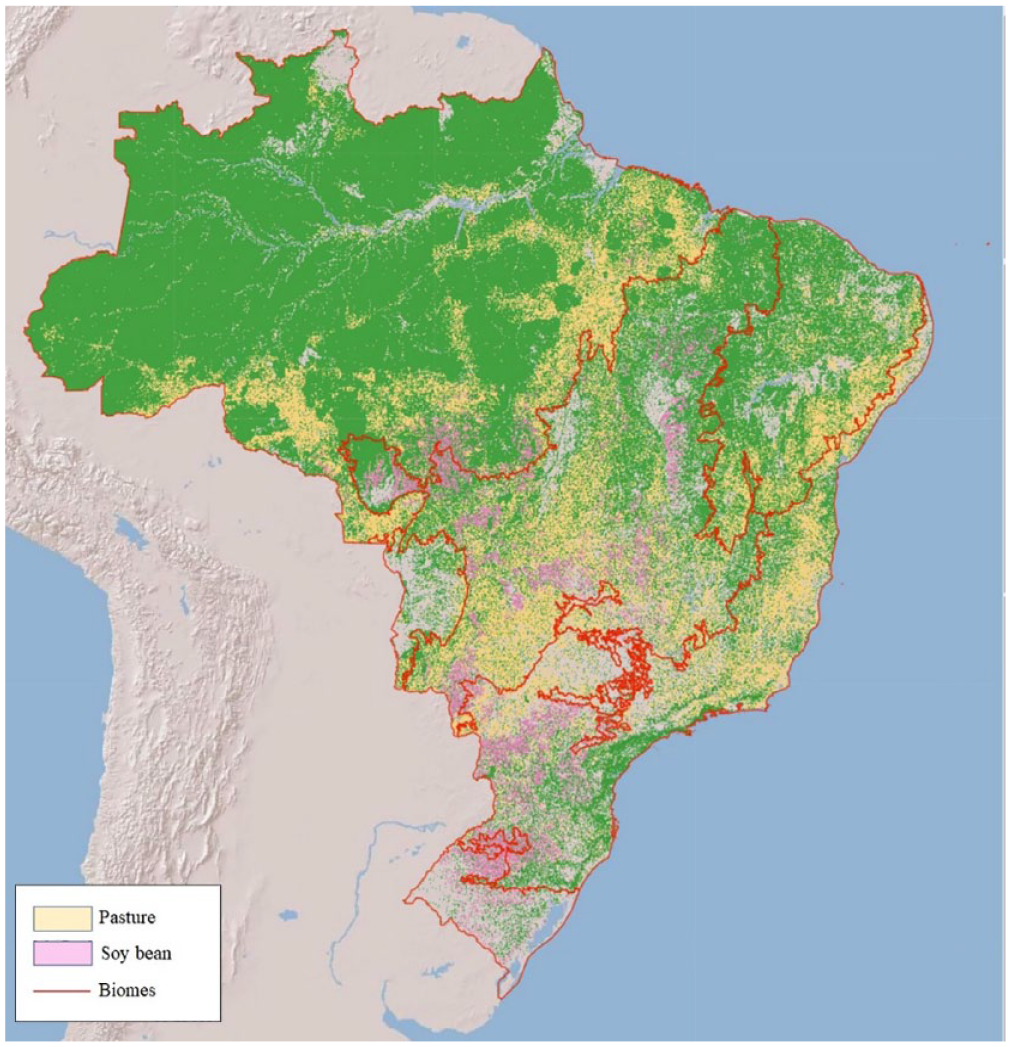
Overlapping areas of pasture and soy plantation in Brazilian territory (2020).
The “Fissure” of Social Metabolism and the Absolute Limits of Capital: The Brazilian Amazon and Cerrado
As Moore (2008) argued, the contradictions of the capitalist system, particularly those concerning the sociometabolic relationship between social beings and nature, can be mitigated as long as new land and manpower are available and within reach. But due to the exhaustion of “external colonization,” viable options now consist only of “internal colonization,” which translates into such activities as drilling deeper to search for oil or minerals, genetically modifying plants and animals, and the use of pesticides that turn human beings into “toxic waste dumps.” Given the structural limits of capital (Mészáros, 2009), the question posed by Moore assumes great relevance: “Where is the agricultural Revolution – that audacious mix of technical innovation and (neo?) colonial plunder – that will feed today’s workshop of the world?” (Moore, 2008: 56). The answer appears to be: “It is not here.” In other words, the intensity of commodity production today, such as the soy complex in Brazil, aggravates on the metabolic rift of the capitalist system, leading to the destruction of natural and ecological resources.
What happens as a result of the drastic reduction in the margin of productive viability of capital when it reaches its absolute limits is a reflection of Moore’s metaphor about robbing a gas station twice in the same day: the second time there will be less to steal, which means that the thief will have to return more frequently and put the stolen amounts at risk of running out (Moore, 2008: 56). In the same way, the intensive and extensive production of soy agribusinesses, especially in the Brazilian Amazon and Cerrado, begin to threaten their own viability.
According to the study by Marengo et al. (2022), higher deforestation rates in eastern Amazonia cause more dangerous weather, including drier and hotter seasons. These phenomena favor water stress risks that extend into the Cerrado and specifically the MATOPIBA region, an area seeing soybean crop expansion, and could put not only forest stability and natural vegetation processes in the region at risk, but also agricultural production itself. According to the cited authors: “The consequences of climate change and deforestation in both Amazonia and Cerrado could bring this agribusiness boom to an end” (Marengo et al., 2022).
The Pillage of the Amazon
Back in the 1950s, the Brazilian government instituted the concept of Brazil's Legal Amazon (Law 1806 from January 1953), making the municipalities that comprise it subject to political, economic, and social development policies under certain parameters of environmental preservation. Currently, the region consists of 772 municipalities in 9 states with a population of close to 28 million people (13% of the national total), taking in 61% of all Brazilian territory. According to the Atlas of Deforestation and Hot Spots put out by Imazon, sixty municipalities (which the federal government have designated as priorities for monitoring and prevention actions), constitute approximately 32% of the total number of hot spots in the region (Salomão, et al., 2020). Between 2008 and 2019 Brazil’s Legal Amazon accounted for an annual average of 132,367 hot spots. In the case of the 60 municipalities targeted by this Institute, 45% of the hot spots occurred in forest areas, thus threatening what remains of the forest and comprising about 834,000 km2 (Salomão et al., 2020: 11).
Fires, along with deforestation, constitute one of the most serious socio-environmental problems in Brazil. In general, they are associated with livestock activity, which historically, represents a type of primitive capital accumulation. The deforestation cycle begins with the construction of roads and farms and a concomitant destructive timber felling process, followed by the creation of grazing areas, and finalizing with mechanized agriculture primarily connected to soy production. Since the 1990s, however, agribusiness associated with the production of commodities puts even greater pressure on the Amazon (Firmiano, 2016). This development includes old practices of slash and burn farming and deforestation, but incorporates new forms of exploitation of ecological resources associated with technology involving the use of internet, known as agriculture 4.0 (Ferreira et al., 2005). This phase can no longer be characterized as primitive accumulation, but rather is a response to the reduction of the margin of productive viability of capital in the face of the structural limits related to expansion (Firmiano, 2016). As a result, despite significant fluctuations, INPE has been registering alarming annual rates of deforestation in the Amazon, as shown in Chart 1, which covers Brazil’s Legal Amazon.
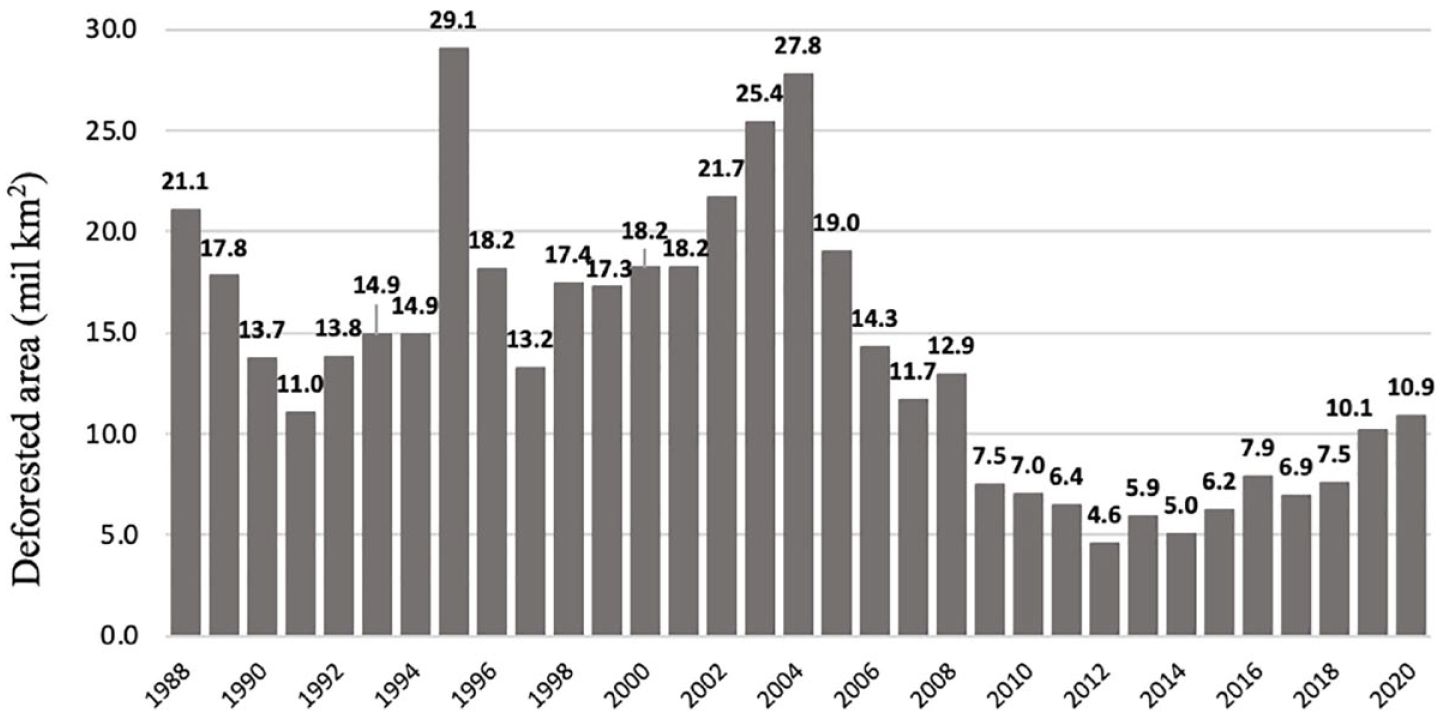
Deforested area in Brazil's Legal Amazon between 1988 and 2020.
Many studies demonstrate that deforestation in the Amazon leads to biodiversity reduction, rupture of the rain and water cycles, and the emission of carbon dioxide, in addition to the impact on people whose production and reproduction of life and existence depend on their direct relationship with the forest (Cox et al., 2000; Fearnside, 2006; Jones et al., 2005; Salati, 2001). Furthermore, tropical rainforest deforestation increases average temperature and in doing so stimulates droughts. Lawrence and Vandecar (2015) also point to its impact on agricultural productivity. Lower productivity leads to the need to incorporate new lands for farming, and those lands are often already occupied by traditional peoples.
Furthermore, the tropical forest performs a fundamental function of transpiration through its leaves and evaporation of its surfaces, on which the hydrological cycle of the biome depends. Cyclical Amazon rains provide about 75% of moisture to the westward-moving air mass, recycling itself countless times before heading south. Water precipitation in the Amazon River complex is somewhere close to 20%. But when there is deforestation, losses exceed 50% from rainwater that is not recycled. This is how the pressure caused by deforestation triggers a process that transforms the tropical forest into a savanna, a process that today is affecting mainly the eastern and southern Amazon and may extend into the central and southwest Amazon regions. This process is also pressured by the negative synergy imposed by global warming, which causes a reduction in rainfall and an increase in temperatures (which in turn are strongly impacted by the intensive use of burning). The consequences are already being felt, which include dry seasons getting longer and mortality rates increasing for humid climate species (Lovejoy and Nobre, 2019: 1).
The Amazon biome has a complex metabolic relationship between soil and forest, as it has the highest biomass density in the world – something between 500 and 700 tons per hectare – in addition to the highest availability of solar radiation per acre in the world. It also is home to the largest hydrographic basin on the planet, which results in the production of 40 to 70 tons of biomass per hectare, on average, per year – against, for example, a productivity of 4 tons per hectare, on average, per year for soybeans (Porto-Gonçalves, 2019). The penetration of the forest by agribusiness, especially that related to soy and livestock, generates loss of “the richest forest in terms of biomass density per hectare on the planet, with the highest primary biological productivity in the world and the greatest biological diversity” (Porto-Gonçalves, 2019: 12-13).
But as Porto-Gonçalves (2010) pointed out, the Amazon has become even more important due to germplasm (the genetic material of a species), which is key to the biotechnology industry. Along these lines, Pat Mooney has stated that we would be experiencing a shift from the focus of large transnational agricultural companies to a focus on biomass. Virtually everything that can be produced from fossil carbon would also be possible from living carbon, given advances in synthetic biology, so that it would be possible to create unimaginable forms of life from biomass and DNA manipulation. 9
More recently, technological advances that include Big Data platforms, which are capable of gathering huge amounts of data on a wide variety of factors, including soil, climate, vegetation, energy consumption, and water, also made it possible to manipulate the nucleotide bases of the DNA double helix in a way that, for example, an Ethiopian grain preserved in Germany could be genetically manipulated in Iceland so that a drought-resistant variety could be developed in a given country where the crop is intended to be produced. These innovations follow step with the global movement of concentration and centralization of capital, expressed, among other phenomena, by mergers of large transnational corporations, such as Bayer and Monsanto (which maintained the Bayer brand), Dow and DuPont (Corteva Agrisciencie), ChemChina and Syngenta (Sinochem), which fundamentally alter the divide between pesticide and fertilizer formulators; grain traders and genetic “breeders;” and retail sectors. One of the problems, says Mooney (2020), is that whoever controls these platforms has the power to organize and reorganize the global industrial landscape.
While the processes of concentration and centralization of capital are not new, they are now entering a new stage, one coupled with the presence of unprecedented forms of external control of production. 10 On the one hand, this movement tends to create even greater forms of subordination of agro-exporting economies, such as Brazil, to monopolistic or oligopolistic transnational capital, impeding any possibility of building sovereignty in the global agro-food system. On the other hand, it has a decisive impact on the conditions for exploiting natural and ecological resources, raising more questions than answers about where we will go in terms of sociometabolism. Theoretically, technologies linked to genetic manipulation and synthetic biology could pave the way to solving the problems associated with climate change and the global demand for food, producing even greater diversity and reducing the need for more land for production - an argument often utilized by corporations in the sector. However, leading scientists are skeptical of this possibility, either because of the social embedding of science, compromised as a productive force of capital (Mészáros, 2009), or because there are pending issues related to security and ownership issues linked to genetic editing methods (Monney, 2020).
Mészáros (2009) draws attention to the fact that capital makes an ongoing effort to transcend the obstacles placed on accumulation and that, by nature, is unable to recognize that it has reached its absolute limits. Here, indeed, lies one of the most problematic aspects of this sociometabolic system: its inability to treat the causes of problems as their true causes, as recognizing the determinations of the problem means recognizing its contradictions, regardless of the severity of their implications. Its limits must always be understood as relative limits, open to the possibility of transcendence through the progressive expansion of their boundaries and productive efficiency, temporarily mitigating the deleterious effects of the fundamental causal structure of capital. This is also because any recognition of absolute limits would call into question the very causal structure of capital. Thus, problems should be treated as temporary malfunctions. This, then, is its ultimate rationale: a causa sui, even when it reaches its limits, what is seen is the (irresponsible) relativization of these absolute restrictions.
One of the implications of the causa sui is the ongoing restoration of its reproductive structures, which makes capital function reactively and retroactively. Mészáros (2009) refers to this mechanism as the restored temporality paralyzing of capital. In terms of this temporality, social change is only admissible if absorbed into the current network of structural determinations. As a result, true qualitative societal transformations always remain unattainable within the prevailing order. This is how the process of exploring ecological diversity on an ever-increasing scale, despite the promises of new technologies in progress, remains a source of great concern.
In this context, the promises of high-tech agriculture do not seem to be able to solve the problem of the metabolic rift and extreme social degradation processes in nature. Mancus (2007) has already shown how the accumulation of reactive nitrogen in the biosphere, resulting from the current forms of production in the global agrifood system, has been undermining the biological basis necessary for agricultural production, producing an insolvent contradiction that tends to widen the metabolic fissure to the limit of its possibilities. This is just one examples of how the accumulation process eliminates conditions that enable its continuity.
The Cerrado as the “Last” Frontier for the Expansion of Brazilian Agriculture
According to INPE, the Cerrado constituted the second largest biogeographic region in South America, occupying the equivalent of 25% of the entire Brazilian territory, in about 2 million km2 of savanna, with the greatest biodiversity on the planet. 11 If its transition areas are taken into account, the Cerrado occupies 36% of the Brazilian territory (Porto-Gonçalves, 2019). The biome has 4,800 species of plants and vertebrates that are not found anywhere else in the world, making it a global biodiversity hot spot. It includes three of the largest watersheds in South America (Tocantins-Araguaia; São Francisco; Paraná), which hold 43% of Brazil's surface water outside the Amazon (Strassburg et al., 2017). Strassburg et al. (2017) designed the business-as-usual (BAU) context, with strong pressure from agribusiness combined with a low level of legal protection. Under BAU, the estimate is that, by 2050, between 31% and 34% of what remains of the biome will be decimated and deforestation of this area will account for the extinction of about 480 plant species. This involves the disappearance of more than 3 times the number of species extinctions recorded since 1500 with a concomitant increase in CO2 emissions (Figure 2).
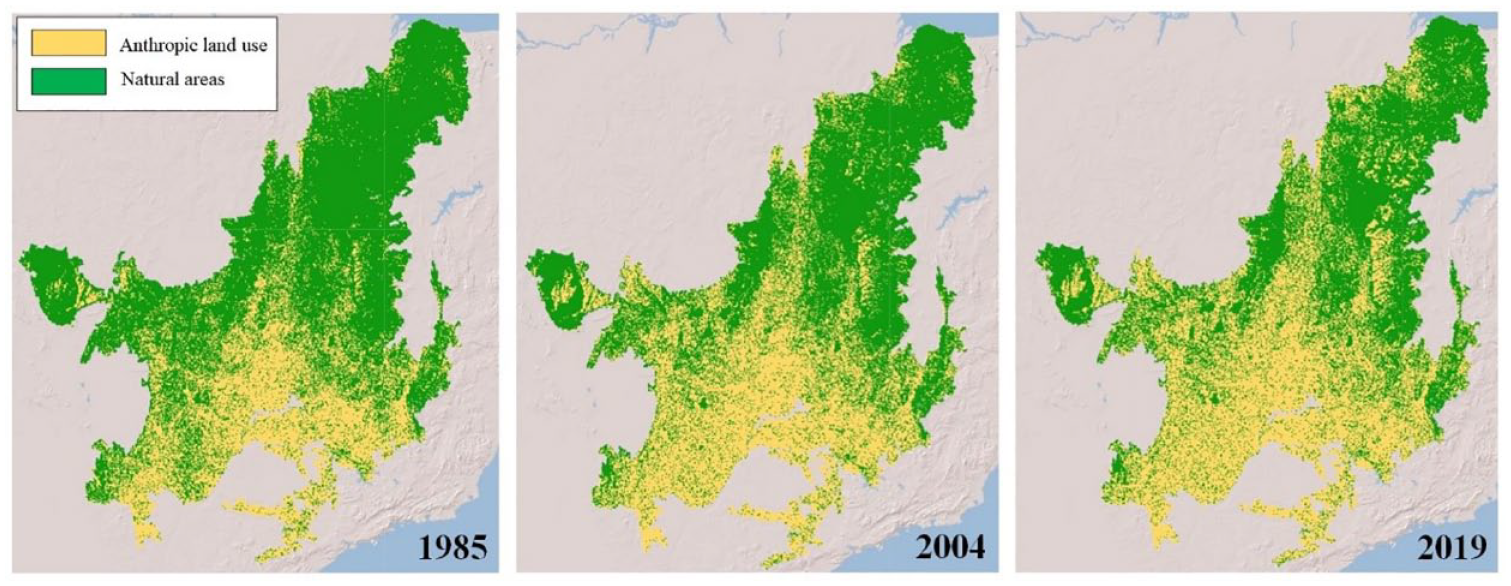
Evolução do uso antrópico de áreas do Cerrado brasileiro (1985-2019).
Porto-Gonçalves et al. (2016) draw attention to the morphoclimatic and phytogeographical aspects that make the Cerrado the most booming agricultural frontier in the country. In addition to the land structure, financial contributions from the state, and incredible technological advances, diverse metabolic conditions made it possible to adapt soybean production to the region, with its vast tracts of flat land and a large availability of water and solar energy. Ever since soybeans were tropicalized, the Cerrado has become the object of capital's greed. The Cerrado has acute hydrological relevance, as it distributes water to other biomes. The Cerrado plateaus are the nation's most important water recharge areas, in addition to the region constituting one of the largest freshwater reserves on the planet and containing the headwaters of rivers that are essential for South America. Furthermore, the Pantanal Mato-Grossense and the “varjões” (or floodplains) of Araguaia, the two largest extensions of continental wetlands in the world, are connected to the hydrological dynamics of the Cerrado (Porto-Gonçalves, 2019).
The above authors also made forecasts about the preponderance of gains in productivity in relation to the incorporation of new soy production areas, taking into account its expansion into the Cerrado. Although productivity gains are important, the incorporation of new areas is the determining factor in the production pattern imposed by agribusiness on the Cerrado as is the case with other Brazilian biomes. This development impacts both the reduction of vegetation and the availability of water, despite new advances in agriculture 4.0 (Porto-Gonçalves et al, 2016).
The “last” frontier of agricultural expansion in the country is the MATOPIBA, which was coined in 2010. 12 This region concentrates 337 municipalities in the states of Maranhão, Tocantins, Piauí, and Bahia, with a Cerrado territory covering more than 70 million of hectares of land, where there are about 780 agrarian reform settlements and quilombo lands and 35 indigenous lands. Between 2014 and 2018, agricultural activity in the region expanded by 25% per year due to support from the state and genetic research provided by EMBRAPA, as well as the increased presence of corporations and transnational investment funds. 13
Beginning in 2008, the race for fixed assets intensified, as Brazil was found to be an important land market, which was both abundant and deregulated. The law that governs the sale of land to foreigners in the country dates back to the civil-military dictatorship (specifically Law 5709 of 1971). The law provides for restrictions on operations of this nature, which are often the subject of political and legal disputes. Nevertheless, despite major safeguards against the foreignization of land ownership in Brazil, this process has been advancing. Pereira (2017) differentiates between the land acquisition process by foreigners and land grabbing, which includes purchasing properties or leasing them through partnership contracts, creating companies in the name of third parties, or using mergers and acquisitions. In 2016, 108 corporations operated in the Brazilian production of grains, sugarcane, and tree monoculture, with a predominant presence in the MATOPIBA region (Pereira, 2017). Despite the lack of reliability in the precarious databases on land foreignization in Brazil, Pereira (2019) based his research on the National Rural Registry System (SNCR), with information released by the press in 2018, finding that, at the time, 455,451 hectares were under the control of foreigners in that region, with a strong concentration in the state of Bahia (292,236), followed by Tocantins (88,494), Maranhão (44,075), and Piauí (30,646). 14
In 2018, FIAN Internacional, together with other non-governmental organizations, published a report on the environmental impact and on human rights resulting from the expansion of agribusiness in the MATOPIBA region. The report documents the suffering of the local population as a consequence of deforestation and loss of biodiversity, which includes the following:
a) Degradation and pollution of springs, riverbeds and the capacity of groundwater to accumulate water due to deforestation
b) Destruction of fauna, flora, and fishing resources
c) Deterioration of human health and the environment, due to the intensive use of pesticides
d) Destruction of food resources and forced alteration of diet
e) Expropriation of local communities and peoples from their territories (FIAN, 2018).
The report states that, of the total number of agricultural establishments in MATOBIPA, 80% are considered “very poor”; 14% “poor”; 5.79” of “middle class” and only 0.42% of “upper class.” It concludes that “poverty and inequality have increased considerably as a result of the expropriation of rural peoples resulting from the expansion of agribusiness” (FIAN, 2018: 24).
Everything demonstrates that metabolic rupture, in the course of the expansion of the reproduction pattern of capital based on the productive specialization in commodities, cannot be extrapolated. When this happens, there is a tendency towards the progressive elimination of the elementary conditions of social reproduction; in the precise sense, depletion of the ecological and natural resources necessary for human survival. The expansion of soy (and other commodities) in the Cerrado and Amazon regions suggests that we have already reached this point of no return, as evidenced by the research by Strassburg et al. (2017), Lovejoy and Nobre (2019), and Morengo et al. (2022), as part of what Foster (1998) called irrecoverable mutilation due to accelerated human action, when referring to the threat to the planet's ecology.
Final Considerations
This paper is based on the argument that ever since the 1970s the global capital system, upon entering its phase of historical descent, began to impose a potentially destructive pattern of production, exponentially expanding the metabolic rift in the relationship between the social being and nature. This means that during the period of capital's historical rise, the "violation of the natural laws of social production regulation" contributed to the system's expansion. However, when the system itself found its absolute limits, the capitalist accumulation process turned this "violation" into a dangerous contradiction that began to put the elementary conditions of social reproduction at risk.
In the case of Brazil, the structural crisis of capital is marked by the transition from the industrialization process into the emergence of a pattern of productive specialization based on Brazilian commodities. The process coincides with the end of the civil-military dictatorship (1964-1985) and the structural adjustment of the national economy to the imperatives of the new international division of labor that has occurred since then. Under this new pattern of capital accumulation, which is driven largely by agribusiness and other sectors that are intensive in nature, a new socio-ecological relationship emerges, whose most striking characteristic is the progressive elimination of the elementary conditions of social reproduction.
The accelerated process of social degradation is particularly evident in the case of the Amazon and Cerrado biomes, which constitute fronts for the intensive and extensive expansion of agribusiness, with special emphasis on the soy complex. As we showed in this paper, until 2019 the total loss of vegetation cover in the Amazon basin reached 17% and almost 20% in the Brazilian territory. In the case of the Cerrado, almost half of its original vegetation was lost by 2017. In both cases, due to pressure from sectors that have intensive impacts on nature, which have been fundamental in articulating the pattern of commodities-based productive specialization, the potential destruction for the future is even more devastating.
This article seeks to contribute to studies that analyze the processes of social degradation of nature by articulating the theory of metabolic rift with the theory of the structural crisis of capital, specifically by analyzing the dynamics of the periphery of the global sociometabolic system in the case in Brazil. Much research is still needed on this issue. There is a particular need to examine the sociometabolic relations mediated by the industrial-mineral complex and large infrastructure works, in addition to those activities initiated by agriculture 4.0. Experiences that point to sustainable and humanly rewarding exchange relations should also be a special focus of theoretical-empirical investigation.
Footnotes
Notes
Frederico Daia Firmiano has a PhD in Social Sciences from FCLar/UNESP and is a professor at Faculty of Social and Human Sciences of the São Paulo State University (FCHS/UNESP). Paula Maria Rattis Teixeira is a PhD student in Production Engineering at the University of São Paulo (USP) and is a professor at Federal Institute of Education, Science and Technology of São Paulo (IFSP). Heather Hayes is a translator living in Quito, Ecuador.