




Abstract
Authoritarian populism in the early twenty-first century is rooted in a global conjuncture of convergent social and ecological crises, but the ways in which the crises shape authoritarian populist politics and vice versa vary across socio-ecological formations worldwide. An analysis of the politics behind the rise of the flex sugarcane and oil palm complexes in Guatemala since the mid-2000s shows that an authoritarian corporate populist agenda is on the rise. Authoritarian corporate populism is especially keen on manufacturing the consent of working people to the elites-led sustainability and development pathway. This involves political concessions to the underprivileged through public grants and multistakeholder governance as in other populist political regimes but additionally, and distinctively, meaningful concessions to working people and the environment in the sphere of private relations of production. Although these concessions go beyond mere greenwashing, they do not compromise and ultimately enhance the flex cane and palm complexes’ profitability and ability to stay in business and the racialized class hegemony of the elites. Violence, however, remains foundational to this political agenda, even if it is now cloaked in the rule of law. Thus, the concept of authoritarian corporate populism showcases a form of politics in which big business, intimately linked to the state and elites, plays a major role in mainstream sustainability transitions.
El populismo autoritario a principios del siglo XXI está arraigado en una coyuntura global de crisis sociales y ecológicas convergentes, pero las formas en que dichas crisis dan forma a la dinámica política populista autoritaria y viceversa difieren en diversas formaciones socioecológicas a través del mundo. Mi análisis de la dinámica política tras el avance de los complejos corporativos de los cultivos comodín de caña de azúcar y palma aceitera en Guatemala desde mediados de la década de 2000 muestra cómo una agenda corporativa populista autoritaria está en auge. El populismo corporativo autoritario busca fabricar el consentimiento popular a la perspectiva sobre sustentabilidad y desarrollo de la oligarquía. Esto implica concesiones políticas a la población desfavorecida a través de programas sociales públicos y sistemas de gobernanza multipartes al igual que en otros regímenes políticos populistas, pero adicional y distintivamente, a través de concesiones a las y los trabajadores y el medio ambiente en el ámbito de las relaciones privadas de producción. Aunque estas concesiones van más allá del simple lavado de imagen verde, las mismas lejos de comprometer fortalecen la rentabilidad y capacidad de los complejos corporativos de la caña y de la palma para seguir en el negocio, a la vez que contribuyen a reproducir la hegemonía racializada de las élites. Sin embargo, la violencia sigue siendo parte fundamental de esta agenda política, aunque ahora se trate de justificar su uso como parte del ejercicio del estado de derecho. Es así como el concepto de populismo corporativo autoritario da cuenta de una dinámica política en la que grandes corporaciones íntimamente vinculadas al estado y a las élites desempeñan un papel clave en las transiciones a la sustentabilidad convencionales.
Keywords
The recent debate on populist political regimes has rightly focused on the initially progressive and currently ultraconservative authoritarian populist wave sweeping Latin America and the world. But does this mean that authoritarian forms of governance are reserved for those living under iron-fist populist leaders? In short, no; there is more to authoritarian populism today, and the role of big business intimately linked to the state and elites, or “populism from above,” as Andrade (2019) dubs it—is an important part of the story. Furthermore, authoritarian populism nowadays is rooted in a global conjuncture of climate, energy, environmental, food, and financial/economic crises thriving (at least) since 2008. 1 In this context, demand for renewables is burgeoning in business, poverty reduction, and climate change adaptation and mitigation strategies, and natural-resource extractivism follows suit (Borras et al., 2018). This has contributed to the rise of flex crops and commodities, including crops such as oil palm, soybeans, and sugarcane and trees such as eucalyptus and pine, with multiple uses that can be flexibly interchanged (Borras et al., 2016). Corporate flex crops and commodities complexes are becoming consolidated and upgraded within their former strongholds and setting off for new territories in response to the convergent crises. What is the political agenda that makes this possible?
A thorough examination of this question, admittedly an awkward one at first glance, is what I aim to contribute to the discussion of contemporary authoritarian populism(s). To this end, I bridge critical development, environmental, and political studies and rely on an empirically rich longitudinal analysis for inductive theorization. In particular, my detailed examination of this question in Guatemala since 2005 2 offers a series of insights that may resonate elsewhere. In Guatemala, a long history of despotic and violent populist rulers gave way to liberal democracy from 1985 on with the blessing of the almighty national oligarchy. Since 2005, and amid convergent global crises, the burgeoning flex cane and palm complexes have fueled an “extractivist purge” (Alonso-Fradejas, 2020) of human and nonhuman nature through their predatory model of “agrarian extractivism” (Alonso-Fradejas, Caal Hub, and Chinchilla, 2011). This is led by a select group of white Guatemalan oligarchs, owners of flex sugarcane and oil palm complexes with strong ties to foreign capital, and especially by part of a new generation of well-trained young executives who are reframing these complexes as a phenomenon capable of responding to the convergent social and ecological crises of our times and in so doing developing a new political agenda that I call authoritarian corporate populism.
In what follows, I first describe the role of the national oligarchy in the rise of the flex cane and palm complexes and then discuss the rationale and the supporters of the new authoritarian corporate populist agenda. I go on to examine the strategies, tactics, means, and forms of contention of this political agenda. Finally, I advance some conclusions.
The Flex Cane and Palm Complexes as Favorites of ‘The Almighties’
Two major traditional participants in world-trade multicommodity crops, sugarcane and oil palm, have taken a big leap forward since the mid-2000s as global flex crops with multiple and flexibly interchangeable uses (Alonso-Fradejas et al., 2016; McKay et al., 2016). In Guatemala, sugarcane and oil palm (cane and palm henceforth) plantations and processing plants have spread like wildfire since 2005, and the small Central American country has become a leading world producer and exporter of multiple cane and palm commodities (ACAN-EFE, 2013; Alonso-Fradejas, 2013; Mingorría et al., 2014). The rise of the flex cane and palm complexes represents a distinct model of resource extractivism in the early twenty-first century that adversely affects life in the countryside and beyond (see Alonso-Fradejas, 2020). My focus here is on the political agenda of the supporters of these complexes. Involvement of foreign capital notwithstanding, the main vector of this “green gold pandemic” has been the almighty national oligarchy. Embodying the country’s traditional ruling bloc, this is a very compact and close-knit group 3 made up of white European-descendant Guatemalans with family ties (see Casaús Arzú, 2007 [1992]). Whereas the older men among them remain the ultimate authority, a new generation of women and men between 25 and 45 years old has gradually taken over key managerial positions in the family businesses since the turn of the century. Usually alumni of the elitist and libertarian Francisco Marroquin University in Guatemala or of European and U.S. Ivy League universities, from which they often also hold postgraduate degrees, 4 they are playing a central role in the politics behind the current rise of the flex cane and palm complexes in mainstream sustainability transitions and, more generally, in the reproduction of the racialized class hegemony of the national oligarchy. As the oligarchy’s business intelligentsia, they have been the main force behind the transformation of their elders’ domestic agroindustries into full-fledged transnational agribusinesses. 5
The flex cane and palm complexes are embedded in oligarchic corporate groups. These are made up of legally independent companies over which oligarchic families exert control through participation in boards of directors. The horizontally integrated corporate group structure allows for a combination of plantations with financial services, agro-inputs, and farm machinery upstream with processing and consumer goods manufacturing downstream. Not surprisingly, this business structure is prone to cartelization. In 2012 there were 12 active cane companies in Guatemala owned by 10 corporate groups and under the control of the same number of oligarchic families. Since 1957, the cane sector has been organized through the Asociación de Azucareros de Guatemala (Guatemalan Sugar Producers Association—ASAZGUA). This association is part of the Cámara del Agro (Chamber of Agriculture—CAMAGRO), which in turn is a member of the powerful trade and political organization of the Guatemalan oligarchy, the Comité de Asociaciones Agrícolas, Comerciales, Industriales, y Financieros (Committee of Agricultural, Commercial, Industrial, and Financial Associations—CACIF). Five oligarchic family business groups, one of which also owns a major cane company, controlled the 6 palm companies active in the country in 2014. One of them had been established in 2008 by the U.S. biodiesel producer Green Earth Fuels, but Green Earth had withdrawn in 2011 and the Guatemalan palm company NaturAceites had taken over its plantations and mill. Since 2008, palm companies have also organized as a business cartel through the Gremial de Palmicultores de Guatemala (Guatemalan Oil Palm Growers Guild— GREPALMA). 6 GREPALMA is part of the Chamber of Industry and, like ASAZGUA, a member of the CAMAGRO and the CACIF. Additionally, cane and palm companies are behind the Asociación de Combustibles Renovables (Renewable Fuels Association—ACR) and have a say in the CACIF’s think tank the Fundación para el Desarrollo de Guatemala (Foundation for the Development of Guatemala—FUNDESA), the Francisco Marroquin University, and the Centro para la Acción de la Responsabilidad Social Empresarial en Guatemala (Center for Business Social Responsibility Action—CentraRSE), the Guatemalan branch of the World Business Council for Sustainable Development). Cane and palm companies have also received support from social organizations and (trans)national nongovernmental organizations (NGOs), private Guatemalan universities in addition to Francisco Marroquin, and the (inter)national media.
Furthermore, the flex cane and palm complexes have received substantial support from state actors. All the political parties except those on the left are linked in some way—including through funding—to the oligarchy (Palencia Prado, 2014). These shadow rulers influence the government and the Congress in a way that, although neither overwhelming nor uncontested, is strategic for their hegemony. In addition to appointing the presidential commissioner for competitiveness, the CACIF has veto power over the appointment of the ministers of the economy, finance, energy and mines, agriculture, and transport and infrastructure (interview with Guatemalan minister of agriculture, food, and livestock, Guatemala City, July 2013). Furthermore, the CACIF has a stake in all official multistakeholder governance initiatives (e.g., the Fondo de Tierras [Land Fund]), including some in which no other private actor has a seat (e.g., the Central Bank’s monetary council). Moreover, it stays on good terms with the judiciary through its cohort of corporate lawyers and through political sinecures for retired judges and has long-standing bonds with the military (Rubio Castañeda, 2017). Finally, regional and international financial institutions like the World Bank, the Inter-American Development Bank, and the Central American Bank of Economic Integration have also been actively supporting the Guatemalan flex cane and palm complexes.
Authoritarian Corporate Populism as the Political Backbone of the Flex Cane and Palm Complexes
The political agenda of flex cane and palm complexes’ supporters initially focused on building a favorable policy structure and milking the state to fund the energy and transport mega-projects that these corporations require. They pursued social legitimation through the modernization-and-progress narrative that has been common since the liberal revolution of 1871. Nonetheless, (mostly indigenous) working people’s unrest sparked mobilization against the expansion of these complexes as early as 2008. Amid the high-profile global crises of that year, negative responses at the grassroots caught the eye of national and foreign journalists, researchers, social justice organizations, NGOs, and international development agencies (Alonso-Fradejas, 2015; Mingorría, 2017). Following the early global airing of grievances and the negative consumer perceptions regarding cane and palm commodities, supporters of the flex cane and palm complexes refined their political agenda. According to the GREPALMA president, “Our big mistake was that we were very quiet” (quoted in Luxner, 2014).
Thus, from 2009 on supporters gradually recast their agenda to keep watch over the policy structure and the reproduction of their businesses’ general conditions of production but focus on the ideological-political debate over the pros and cons of their corporate complexes and the enhancement of their businesses’ personal and natural conditions of production. 7 In so doing, they evolved toward the new twist in the traditional politics of racialized class domination in Guatemala that I have called authoritarian corporate populism. Key to this evolving political agenda is the recasting of the flex cane and palm complexes from ordinary business ventures led by socially responsible individual companies to extraordinary planetary stewards in a web of big business-led global commodity chains. Thus they are being promoted not simply as investors in lucrative cash crops that promise to end ‘backwardness’ 8 but also, and especially, as highly productive and environmentally sound means of feeding the world, generating green energy, and cooling down the planet while simultaneously creating employment, economic growth, and ‘good governance.’ 9
First, supporters depict cane and palm as global food security champions. In this way, they aim to counter the critique that these companies are replacing food with fuel crops. To this end, they use two counternarratives that are mutually reinforcing. One epitomizes cane and palm as food, not fuel, and cherry-picks eye-catching figures from United Nations reports to construct neo-Malthusian arguments about the need to increase food production to feed an ever-growing world population. For instance, GREPALMA’s president uses data from the Food and Agriculture Organization to argue that “150 million tons more of edible oil need to be produced to feed the world by 2050” (ACAN-EFE, 2013). He personally adds that “large-scale agroindustrial projects are the answer to food insecurity in Guatemala and the world, and this is something multistakeholder efforts to feed the world should keep in mind” (ACAN-EFE, 2013). The other counternarrative presents cane and palm as the most efficient of sugar and oilseed crops. This is a key message delivered by the executive director of the International Sugar Organization, himself a Guatemalan at the time (cited in Bollman, 2014), and a critical argument upon which GREPALMA’s president leans to promote his business complex: “to produce the extra 150 million tons of edible oil to feed the world by 2050, it is necessary to plant 333 million hectares with soy or 217 million hectares with rapeseed but only 36.5 million hectares with palm. Hence, palm is more oil on less land” (remarks at the first Latin American Congress of Oil Palm Growers, Guatemala City, October 2013, emphasis added).
Second, supporters explain that cane is a sustainable crop because it must be replanted only once every two or three farming seasons rather than yearly. When there is a need to underscore its capacity for fighting climate change, palm is represented as a tree through narratives such as “the environment created by a palm forest is very positive for climate change mitigation” (Colombian FEDEPALMA’s president at the first Latin American Congress of Oil Palm Growers, Guatemala City, October 2013). Likewise, cane and palm are portrayed as not just “the next” biofuel feedstocks but the “most efficient biofuel feedstocks,” according to the Inter-American Institute for Cooperation on Agriculture (Ascher et al., 2010).
Third, supporters argue that the cane and palm complexes create employment and drive economic growth and good governance. ASAZGUA (2016) welcomes visitors to its website saying that “cane agroindustry is one of the main sources of foreign currency and employment in Guatemala. It is key for the development of fifty townships and more than a million people, and thus for the progress of Guatemala.” GREPALMA (2016) makes a similar statement on its website: “Every day, in everything you do, palm oil is with you creating thousands of jobs in Guatemala.” And in his inaugural address to the first Latin American Congress of Oil Palm Growers in October 2013 GREPALMA’s president claimed that “supporting the palm eco-industry means contributing to the real development, prosperity, and well-being of rural families.”
To make sure that everyone gets the message about the flex cane and palm complexes’ role as planetary stewards, the new-wave executives have embarked on a prosocial branding campaign. Prosocial brands are “more politically disruptive and inspiring than basic sustainable brands. Instead of focusing on what a brand has done internally to drive a better world, prosocial brands look outward to take a stand on key moral issues” (Sachs, 2015, emphasis added). With these efforts supporters are developing an authoritarian corporate populist agenda that mirrors the capitalist state’s contradictory tasks of facilitating accumulation (and defending it at all costs) while maintaining the greatest possible degree of social legitimacy (Poulantzas, 1978).
Thus, authoritarian corporate populism stands on two pillars, one authoritarian and violent and the other populist. Whereas authoritarianism as lack of democratic space and decision making is a rather straightforward concept, the notion of populism is subject to much more debate (Andrade, 2019; Borras, 2020; Coronado, 2019; Scoones et al., 2017). A review of the competing perspectives on populism has been carried out by others, including those just mentioned. Here I follow Borras’s (2020:5) understanding of it as the deliberate political act of aggregating disparate and even competing and contradictory class and group interests and demands into a relatively homogenized voice, that is, “we, the people,” against an “adversarial them” for tactical or strategic political purposes. As such, populism is inherently relational. It tends to be a means towards an end rather than an end itself, giving it a very generic character that is open-ended and flexible, facilitating easy adaptation by various ideological camps, even competing ones.
Thus, the new authoritarian corporate populist political agenda in Guatemala involves two strategic shifts. The first is the “multistakeholderization” of flex cane and palm commodity chains. Following broader multistakeholder governance trends, 10 the new wave executives have gradually switched their corporate governance approach from shareholder- to stakeholder-centered while ensuring that shareholders remain at the core. The second shift is replacing the “bullets and beans” agenda of authoritarian-paternalistic military regimes and their allies, including the national oligarchy. 11 This political agenda was used to counter the communist threat during Cold War times through both selective and indiscriminate mass killings. Instead, authoritarian corporate populism relies on persuasion and selective violence cloaked in the rule of law to counter opposition. As Scoones and colleagues (2017: 3) explain, “authoritarian populism frequently circumvents, eviscerates or captures democratic institutions, even as it uses them to legitimate its dominance, centralise power and crush or severely limit dissent.”
As a result, authoritarian corporate populism leans on big businesses’ prosocial branding and the state’s “strategic selectivity” 12 to reproduce in new ways the racialized class hegemony of the national oligarchy. Whereas violence or the threat thereof underpins the authoritarian corporate populist agenda from the very beginning, working people’s consent and adherence to the oligarchy’s recipe for development and sustainability are paramount. This involves political concessions, especially those made to the underprivileged through public grants and multistakeholder governance, as in other populist political regimes, but additionally, and distinctively, concessions to working people and the environment in the sphere of private relations of production. These are connected to a series of fixes that the young executives have implemented since 2009 in the social relations of cane and palm commodity production (Alonso-Fradejas, 2020)—particularly the corporate fixes of labor, land, and knowledge relations that ameliorate the worst impacts of the flex cane and palm complexes on people and the environment.
Authoritarian Corporate Populism in Action
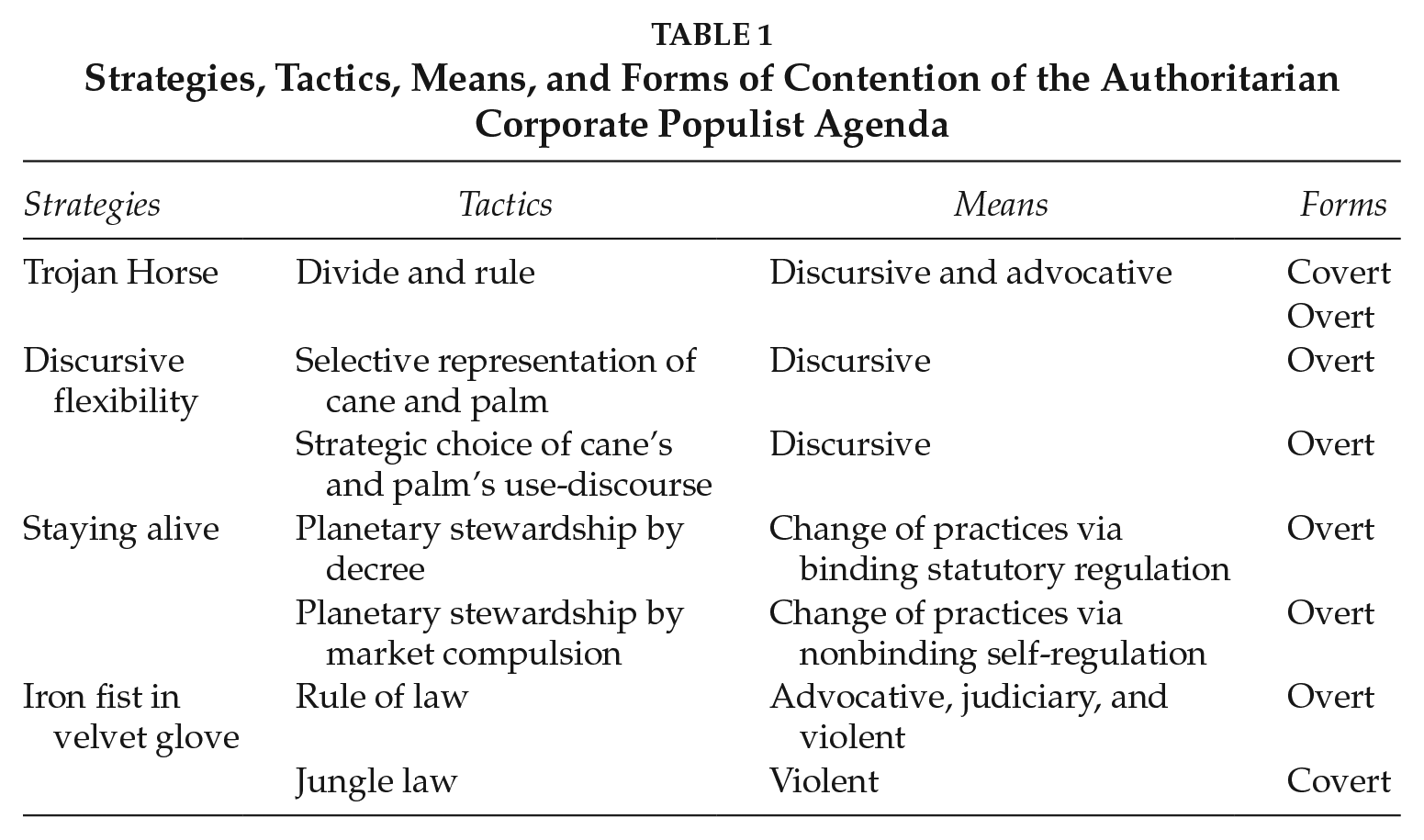
The authoritarian corporate populist agenda relies on four main strategies. Although they work synergistically, the Trojan Horse, discursive-flexibility, and staying-alive strategies are part of the agenda’s populist pillar and the iron-fist-in-a-velvet-glove strategy part of its authoritarian and violent one (Table 1).
Strategies, Tactics, Means, and Forms of Contention of the Authoritarian Corporate Populist Agenda
The Trojan Horse Strategy
This contention strategy has a twofold purpose: to build cane and palm companies’ legitimacy at the grassroots and to co-opt opposition. On one side, “corporate coyotes” who enjoy local economic, political, and/or symbolic authority broker land and villagers’ consent. 13 On the other, the cane and palm companies ally themselves with leaders of labor unions, peasant and indigenous organizations, and NGOs that can claim a civil-society stake in multistakeholder governance initiatives. Corporate coyotes at the grassroots in particular but also others working at different (sub)national scales are embedded in or enjoy easy access to key village institutions that exclude these companies or admit them only as outsiders. Once ‘in,’ the coyotes come out of the Trojan Horse to divide and rule in the community. They resemble the paramilitary civil defense patrols enforced at the community level by the state as part of its counterinsurgency campaigns during the 1980s except that they encroach upon the village’s educational, property, or religious institutions to steer common sense and ideas of well-being toward big-business-friendly stances. To this end, they work through class, gender, generational, religious, and other cleavages among villagers to erode community consensus or reframe it around a shared life project. The aim is for villagers to engage willingly in land, labor, or contract-farming arrangements with cane and palm companies or at least not hinder them. As a Maya-Q’eqchi’ man in his late fifties from Sayaxché municipality said, “Our mind and thoughts are being dominated. This is the result of the way of thinking that the ‘big rich’ spread in our communities through their ‘coyotes,’ but only to fool us and take the land from our hands again” (contribution to group discussion, July 2010). I collected similar testimonies in many other villages and witnessed corporate coyotes in action while attending village assemblies.
Similarly, social organizations supportive of cane and palm companies are strategically deployed in multistakeholder governance initiatives. An interesting case is that of the Fundación Turcios Lima (Turcios Lima Foundation—FTL) in the Polochic area of the Guatemalan northern lowlands. A charismatic mestizo man in his late sixties who enjoyed a good reputation among Polochic villagers directed the FTL in 2007. Formerly, he had been a guerrilla commander-in-chief and then an adviser to the general manager of the Land Fund (FONTIERRAS) in 2005–2008. Aware of these facts, the companies involved in resource-extractivism in the Polochic lean on their former class enemy to broker land and villagers’ consent and to legitimize themselves as sustainability and development agents in the eyes of the (inter)national community. In the Polochic, the FTL’s director arrives in a corporate helicopter to visit villages and haciendas where the companies covet land. He offers the Land Fund’s support to landless villagers or tenants who agree to withdraw their land claims to property sought by the companies. He also promises employment and publicly scolds anyone daring to challenge him or the companies. To manufacture consent beyond the Polochic’s regional borders, the Guatemalan Nickel Company (a subsidiary of the Swiss mining giant Solway Investment Group), MayaNiquel (a subsidiary of Dutch Cunico Resources), the rubber company Baleu, the industrial timber company Maderas El Alto, the cane company Chabil Utzaj, the palm company NaturAceites, and the FTL have joined forces in the Polochic Foundation for the Promotion of Natural Resources and Sustainable Development, which enjoys the blessing of Guatemala’s vice president. Building a favorable consensus is, however, only part of the task at hand. There is a need to mobilize the new consensus (Tarrow, 1998: 175), and therefore the Trojan Horse feeds on discursive flexibility.
The Discursive–Flexibility Strategy
Supporters frame the flex cane and palm complexes as providing extraordinary solutions to the current social and ecological crises. In so doing, they strategically choose among plausible flex policy narratives (Borras et al., 2016) to suit their audiences in different contexts in a “discursive flexibility” fashion on (Hunsberger and Alonso-Fradejas, 2016). The young executives play a leading role in the use of discursive flexibility to transform the flex cane and palm complexes from basic sustainable brands to prosocial ones. To this end, they rely on overt and covert forms of discourse through selective representation and strategic choice of use-discourse. 14
Selective representation involves casting cane and palm as different things to fit the circumstances at hand. The usual representations of cane and palm include “crops,” “plants,” and “commodities.” They are represented as crops to support discourses presenting them as world food security champions and vectors of economic growth and employment. As I have pointed out, this representation helps to counter the “food-for-fuel” critique. Alternatively, they may be represented as plants and their plantations as carbon sinks and biodiversity-friendly agroecosystems. This is done when the aim is to stress their capacity to generate green energy and fight climate change. Finally, they may be represented as commodities with multiple uses. This is advantageous in transnational negotiations on trade, investment, intellectual property rights, and public procurement, in which it helps avoid restrictions in the areas of agricultural produce and biodiversity.
Strategic choice may involve the conflation of multiple cane and palm use-discourses and/or their dissociation. Two or all three types of cane and palm representation and legitimating discourse may be used, as when cane is promoted for producing “food and electricity” (ASAZGUA’s executive director, cited in Luxner, 2013) or palm for “creating jobs, generating green energy, and capturing CO2 in palm-oil-mill-effluent (POME) anaerobic-decomposition lagoons” (GREPALMA’s executive secretary, interview, April 2009). Dissociation involves strategically choosing one or two of the three competing use-discourses according to the circumstances. The discarded use-discourse(s) is/are simply ignored or outright denied. A good example is the argument for a new biofuels law in Guatemala. While the promoters of the 1985 law on biofuels stressed the benefits of ethanol and petrol blends for reducing fuel imports, from 2008 on this discourse has been buried under one that pinpoints biofuels’ contributions to employment and climate change mitigation. Taking strategic dissociation a step farther, GREPALMA (2012a: 4, emphasis added) claims that the flex palm complex strengthens the edible oil industry and thus “contributes to food sovereignty.”
Furthermore, conflation and dissociation as mechanisms of strategic choice of use-discourse are not mutually exclusive. The same actor may deliberately lean on one or the other. For example, at the Latin American Congress of Oil Palm Growers GREPALMA conflated all three representations of oil palm, but when addressing outraged villagers it cleverly focused on its representation as a developmental cash crop. Finally, discursive flexibility is not limited to the level of ideas. By informing ideological-political standpoints, it also helps in mobilizing funds, legitimizing favorable policies, and manufacturing workers’ and consumers’ consent. In other words, the discursive-flexibility strategy reinforces the high material flexibility of the flex cane and palm complexes.
The Staying-Alive Strategy
The new-wave executives recognize that their discursive achievements need to be materialized to some extent if their businesses’ profitability is to be sustained and their kin’s racialized class hegemony reproduced. This makes concessions to working people and the environment a means to pursue their interests rather than, as for their elders, a sign of weakness. In the words of the young CEO of the cane giant Magdalena (quoted in Jaramillo, 2016, emphasis added), “We are required to incorporate important elements like bioterrorism or social and environmental sustainability issues into the productive process. We face a much more demanding market, and we have had to transform our company to address these new demands.”
Thus, the young executives are gradually shifting to a stakeholder-centered corporate governance approach that introduces a series of reforms into the labor, land, and knowledge relations of cane and palm commodity production. First, they are increasing wages and, to a lesser extent, improving working conditions in exchange for a new flex and piecemeal-based labor regime. This results in heightened labor productivity but also in harder, longer, and more casual workdays (Alonso-Fradejas, 2020). Second, since bloodline, status, power, and revenues no longer have the same ties to land for the young executives as they did for their elders, 15 they are more open to exploring nonfreehold property mechanisms of land control. Thus, although land purchases continue to be predominant, the new generation of cane and palm executives is introducing long-term land leases and contract-farming arrangements to their inventory of land control mechanisms. Fixing land relations in this way allows them to counter accusations of land grabbing while expanding their plantations. Third, they are adopting biological pest control, soil conservation, and other sustainable-intensification and “climate-smart” agricultural practices. While partially reducing the burden of waste and contaminants on people and nonhuman nature, this knowledge fix enhances the yields of plantations and their resilience to climate and environmental disruptions (Alonso-Fradejas, 2020).
Thus these fixes involve concessions that upgrade cane and palm companies as prosocial businesses while simultaneously helping them to increase productivity, expand their operations, reduce costs, and reproduce their personal and natural conditions of production more generally. This means that supporters rely on the staying-alive strategy to keep “underproduction crises” at bay (O’Connor, 1988) 16 and to legitimize flex cane and palm complexes’ capability discourse by practicing what they preach. In particular, supporters pursue the enhancement of that planetary stewardship discourse through two tactics— by decree and by market compulsion, the former mobilizing statutory means of contention and the latter private ones. In both cases, the role of “planetary stewardship gatekeepers” is paramount. These are state and social actors that take advantage of corporate interest in green prosocial branding as an opportunity to hold companies accountable in ethical, environmental, and/or social terms.
A set of (trans)national state actors is the driving force behind the tactic of planetary stewardship by decree. I have explained that authoritarian corporate populism still includes ensuring an elites-friendly national policy structure, especially regarding land, labor, environment, trade, investment, finance, intellectual property, and fiscal and monetary policies. Among these, three are central to the planetary stewardship discourse of the flex cane and palm complexes. First, the national energy and transport infrastructure development plans that are of utmost relevance for the reproduction of cane and palm companies’ general conditions of production adhere to the green-economy paradigm (PRONACOM, 2012), and therefore support for biofuels, biomaterials, and bioenergy is a national priority. Second, the land good governance policy paradigm in Guatemala (see Garoz et al., 2005, Grünberg et al., 2012, and Brent et al., 2018) is being upgraded to fit the needs of expanding flex cane and palm complexes. This means underfunding the Land Fund’s land purchase program and funding its land lease program and allocating emergency funds to the purchase of land to expedite the resolution of conflicts that disrupt big business’s resource extractivism (interview with head of research of the Secretariat of Agrarian Affairs, January 2007). Third, the government’s small-scale palm contract-farming program (PROPALMA) is being pumped up with food security funds and framed as a “pro-poor policy to stop land grabbing by the rich” (interview with PROPALMA director, September 2009).
Nevertheless, the main contribution to the enhancement of the flex cane and palm complexes’ planetary-stewardship-by-decree tactic involves social grants. Public conditional cash transfers from 2008 on were a timely (though largely insufficient) survival subsidy for the increasing numbers of people deemed redundant to the mainstream development model. 17 In contrast to the situation elsewhere (e.g., Bolivia and Ecuador), however, where social grants are being funded through resource-extractivist rents and thus perform as a wealth distribution mechanism, in Guatemala they are funded through public debt. In addition to socializing debt rather than wealth, this favors financiers who control public debt bonds. As a result, the (trans)national financiers often linked to the flex cane and palm complexes (e.g., as part of oligarchic family business groups) can profit while simultaneously increasing their political leverage over the state.
Conversely, the “planetary-stewardship-by-market-compulsion” tactic of the staying-alive strategy is spearheaded by large international conservation and development NGOs acting as private planetary stewardship gatekeepers. They rely on voluntary, nonbinding governance tools such as corporate codes of conduct and performance certification schemes that are often developed through multistakeholder initiatives like the Roundtable on Sustainable Palm Oil (RSPO) and the Better Sugarcane Initiative (Bonsucro). 18 The U.S. vice president of the RSPO cofounder World Wide Fund for Nature argued that “when done right, oil palm can be carbon-positive and improve biodiversity and livelihoods” (at the fourth Latin American Conference of the RSPO in Honduras, August 2013), while for Bonsucro (2016b) sugarcane “could play a valuable role in solving many 21st-century problems”. In fact, certification by private but also public planetary stewardship gatekeepers has become a sine qua non for cane and palm companies supplying transnational consumer goods manufacturers under social scrutiny. Together with sugar producers, Bonsucro includes the largest transnational manufacturers and distributors of sugar-based consumer goods (Bonsucro, 2016a). Similarly, most transnational companies that manufacture, transport, and distribute consumer goods including palm oil or any of its components have committed to 100-percent-RSPO-certified palm oil since 2015 (announcement by GREPALMA’s president at the first Latin American Congress of Oil Palm Growers, October 2013). Additionally, intergovernmental institutions also contribute to enhancing the image of the flex cane and palm complexes as sustainability transition vehicles via voluntary codes of corporate conduct. Two iconic examples include the World Bank’s 2010 Principles for Responsible Agricultural Investment that Respect Rights, Livelihoods, and Resources and the biofuels sustainability scorecard introduced by the Inter-American Development Bank in 2008.
The Iron-Fist-in-a-Velvet-Glove Strategy
Rather than simply filling the gaps left by the previous consent-seeking populist strategies, violence or the threat thereof underpins the authoritarian corporate populist agenda from the very beginning. This is the aim of the iron-fist-in-a-velvet-glove strategy. The openness of the new wave of cane and palm executives to softening the negative impacts of their businesses on people and the environment is one thing. Consenting to an alternative pathway toward sustainability and well-being based on economic, social, and environmental justice as the challengers of the flex cane and palm complexes demand is another (Alonso-Fradejas, 2015). Thus supporters especially reserve this authoritarian and violent political strategy for adamant transformative challengers and especially for leftists and/or “insurrectionary Indian[s]” (Hale, 2004). But the iron fist strikes hard at anyone who dares to contest the dominant extractivist pathway to sustainability and its oligarchic hegemon, whether it be a state or a corporate or social actor, national or foreign. 19 To this end, this strategy relies on the ‘rule of law’ and the ‘jungle law’ tactics.
The rule-of-law tactic entails the mobilization of state powers to turn the interest of a few cane and palm tycoons into the national interest. In so doing, flex cane and palm complexes’ supporters leverage their trade and political organizations to keep a favorable balance of forces within the state. The rule of law serves the iron-fist-in-a-velvet-glove strategy through advocacy and judicial and violent means of contention, deployed either sequentially or simultaneously. A notorious example of rule-of-law advocacy is the fast-track approval by the Guatemalan Congress in February 2013 of eight new laws on investment protection and labor flexibilization promoted by the CACIF. This happened while the Congress froze, once again, the discussion of the Comprehensive Rural Development Law pending since 2008 and promoted by a coalition of the flex cane and palm complexes’ challengers and accommodators. Other relevant cases of rule-of-law advocacy include the CACIF’s efforts to secure privileges in the negotiation of the association agreement with the European Union ratified by the Guatemalan Congress in 2013 and to preempt any serious redistributive measure in the series of farming, rural development, and land policies approved from 2009 on. The case of the 2014 land policy is particularly telling. When questioned about the reasons for the major differences between the initial and final drafts of the land policy, a sub-secretary of agrarian affairs explained, “It is not exactly what we aimed at, right, fellas? But as the saying goes, where a captain rules a sailor has no sway!” (in the consultation with peasant organizations convened by the Secretariat of Agrarian Affairs and the Food and Agriculture Organization, March 2014).
If advocacy fails or the situation calls for an exemplary response, litigation ensues. To this end, the CACIF works with a cohort of well-trained (and well-paid) lawyers, most often part of law firms within the network of oligarchic family business groups. Two such judicial processes help to illustrate the working of this means of contention. First, the CACIF’s lawyers were involved in the arbitration panel to which the Office of the United States Trade Representative brought Guatemala in November 2014 for violations of labor rights. Of the 16 companies the U.S. government faulted, 4 were palm companies (Véliz, 2015). In the end, the two governments agreed on an enforcement plan to resolve the labor concerns raised by the United States, and no company was prosecuted. Second, in January 2013, the municipality of Raxruha imposed extraction fees on palm companies to “cover a small part of the costs of restoring what they destroy and pollute,” according to Raxruha’s mayor (interview, July 2013). Unexpectedly, a month later the mayor received a court notification stating that the Agricultural Chamber (CAMAGRO) was suing the municipality for illegal taxation. Especially considering the negative ruling by the Constitutional Court in May 2014, the mayor was outraged by the fact that neither the palm companies in Raxruha nor the CAMAGRO had informed him beforehand.
When advocacy and litigation take too long or do not produce the expected outcomes, authoritarian corporate populism mobilizes state violence. This is exactly what the original owners of Polochic’s cane company Chabil Utzaj demanded from the state in 2011—the eviction of 769 landless and jobless Maya-Q’eqchi’ families from the cane fields they had been occupying for a year. The seizure had been organized to protest the way in which the company was hoarding land in the Polochic Valley. As the original company owner argued on camera, “We bring employment and wealth for the people. How are they [the evicted families] going to progress with those tiny corn plants [maicitos]? And who else do you think would be willing to invest US$50 million in this petty valley [vallecito de pipiripau]? We are here to enforce rule of law in the name of real development for the real poor” (quoted in Alonso-Fradejas, 2015: 510). Some 1,500 police and soldiers were involved in the violent evictions that resulted in the death of one occupier, the injury of dozens, and the burning of their crops, harvests, and houses to ashes. This call for rule-of-law violence resembles GREPALMA’s demand of the Guatemalan president during the 2011 labor conflict in the palm plantations of the municipality of Sayaxché, when in addition to “respecting the rule of law” and “deploying combined police and military forces” GREPALMA called on the president to “carry out civil and military intelligentsia work to take definitive measures against the protest organizers and their funders” (GREPALMA, 2012b, emphasis added).
In fact, rule-of-law violence unfolds through direct repression as well as through the criminalization of protest and protesters. Disruptive collective action is crushed using the Anti-terrorist Bill as justification. Land occupations in particular are treated as criminal offenses of “aggravated usurpation,” and the oligarchy’s think tanks and universities have supported state intelligence gathering just as they did during the armed conflict. A controversial example of this collaboration includes the reports mapping protest against resource extractivism and energy and infrastructure development mega-projects produced by a faculty member of the Francisco Marroquin University and leaked online. The actors identified in these reports are largely social justice organizations and their national and foreign allies. 20 As a result, a multitude of agrarian, environmental, and labor justice activists have been jailed for defending human rights (IACHR, 2015).
Despite their large numbers, it is not only the military and the police that have evicted hundreds of Maya-Q’eqchi’ families from the Polochic Valley’s cane fields. The security chief of Chabil Utzaj was in command of some 50 men tasked with burning the crops, harvests, and houses of the evicted families. The police officer in charge allowed them to participate in the eviction “on the condition that they do not carry any firearms” (interview during the evictions in March 2011), so instead they were equipped with iron batons. Whereas police and military forces were brought in from other regions to avoid any bonding with the evicted families, the private security task force was recruited from nearby villages. This task force included Maya-Q’eqchi’ men—just as landless and jobless as those they were evicting—who covered their faces and made sure to avoid the camera. Bosses apart, most of these “barefoot thugs”—some of whom will agree to a murder for only US$15—were usually outcasts pushed to the margins of the mainstream extractivist development and sustainability pathway (Alonso-Fradejas, 2020).
Barefoot thugs are the cannon fodder of the jungle-law tactic. This tactic is named for the generalized context of early-twenty-first-century Guatemala, in which it is not the fittest that prevail but the strongest. The Inter-American Human Rights Commission (IACHR, 2015: 18) revealed that in 2014 alone, 814 attacks had been “directed at human rights defenders who work in the main problems affecting the country’s human rights, such as those dedicated to defending the rights of indigenous peoples, territory, land, and environment.”
Conclusion
There is more to authoritarian populism today than the charismatic political leaders featured day in and day out in news headlines. Authoritarian populism in the early twenty-first century is rooted in a convergence of social and ecological crises, and these are not unrelated but shape and express each other. How this happens differs across geographies and socio-ecological formations. Here I have discussed the political agenda behind the rise of the flex cane and palm complexes in mainstream sustainability transition initiatives Guatemala. As Scoones and colleagues (2017: 3) argue, “charismatic leaders, personality cults and nepotistic, familial or kleptocratic rule combined with impunity are common, though not essential, features of authoritarian populism.” In Guatemala nowadays, the lack of a charismatic political leader is more than compensated for by nepotistic and kleptocratic rule combined with impunity and the tight grip of the oligarchy over the national economy and polity. Thus the Guatemalan situation showcases in an exemplary way the key role of big business linked to the state and the hegemonic classes elites in authoritarian populist politics today.
Particularly, amid negative responses at the grassroots and a related global airing of grievances that seriously threatened their businesses, a new generation of executives within the Guatemalan oligarchy has reframed the flex cane and palm complexes as planetary stewards with the capacity to resolve global crises. In their efforts to present the flex cane and palm complexes in this light and sell it through prosocial branding, they and their supporters in the state and the society have developed a political agenda with two main pillars. One is the authoritarian and violent pillar mobilized through the iron-fist-in-a-velvet-glove strategy, and the other is the corporate populist pillar, which initially acted to influence the ideological-political debate over the flex cane and palm complexes through the Trojan Horse and discursive-flexibility strategies but increasingly focuses on achieving license to operate at the local level and keep at bay global reputational risks. This pillar of the agenda has evolved to include political concessions to the underprivileged through public grants and multistakeholder governance but has gone beyond this to include meaningful concessions to (mostly indigenous) working people and the environment in the sphere of private relations of production through its staying-alive strategy. However, these corporate concessions do not compromise and ultimately strengthen the flex cane and palm complexes’ ability to remain profitable and the racialized hegemony of the national oligarchy. Thus, by an attractive blend of public and private concessions underpinned by rule-of-law and jungle-law violence, authoritarian corporate populism stands for a new twist on the classic carrot-and-stick approach to authoritarian populist politics that compels challengers and accommodators to think outside the box.
Footnotes
Notes
Alberto Alonso-Fradejas is a postdoctoral researcher in the Department of Human Geography and Planning of Utrecht University in the Netherlands, an associate researcher at the Transnational Institute, and coeditor of the reviews section of the Journal of Peasant Studies. This manuscript benefits from the insights gained at the conference “Authoritarian Populism and the Rural World” organized by the Emancipatory Rural Politics Initiative at the Institute of Social Studies of Erasmus University on March 17–18, 2018, and at the Sixth Conference of the BRICS Initiative for Critical Agrarian Studies at the University of Brasilia, November 11–13, 2019. The author is indebted to (in chronological order) Jun Borras, Max Spoor, Murat Arsel, Marc Edelman, Christina Schiavoni, Ian Scoones, Salena Tramel, Zoe Brent, Wendy Wolford, Ruth Hall, and Annelies Zoomers for their comments on earlier versions of this manuscript or parts thereof. He is also grateful to the issue editors Sergio Coronado, Lyda Fernanda Forero, and Daniela Andrade and to Michael Dougherty and Ward Schinke for their insightful peer-review comments.