




Abstract
Having a criminal record significantly alters a person’s life chances, decreasing their opportunities for employment, housing, student loans, voting, public benefits, and more. The collateral consequences of criminal convictions, or the civil restrictions that follow criminal convictions, are well documented. However, because individuals are connected to families and communities, it is impossible to isolate the effects of punishment to only the persons holding criminal records. Instead, the effects of criminal records might be best understood as a set of symbiotic harms, marked by relational and interdependent effects. Drawing on semi-structured interviews with 59 expungement-eligible persons and 69 community representatives, this paper explores the symbiotic harms of lower-level criminal records and explores the potential for automated criminal record clearance to enhance the lived experiences of record holders and their networks.
Keywords
Introduction
[W]hen we are so bent on punishing the person that we have put into the criminal justice system, we are, by extension, punishing families and generations. (Victoria, community representative, director: reentry center, CA)
One in three adults in the United States, or approximately 80 million people, has a criminal record (Chien, 2020). Having a criminal record significantly alters a person’s life chances, decreasing their opportunities for employment, licensure, voting, public benefits, and more (Corda et al., 2023; Horowitz et al., 2024; Prescott & Starr, 2020). Research on the effects of a criminal record has been centered on the collateral consequences experienced by record holders. However, since people are connected in families and communities, it is impossible to isolate punishment, and by extension, the effects of punishment, to a single person (Condry & Minson, 2021). Research is beginning to explore the varied effects people experience when a family member is imprisoned, sometimes known as the symbiotic harms of imprisonment (Condry & Minson, 2021). However, studies on the symbiotic harms of a criminal record, which may not have involved incarceration, remain limited. Using data from semi-structured interviews with formerly arrested/convicted persons, and community representatives who work in the field, this paper explores the symbiotic harm record holders and professionals believe formerly arrested/convicted persons and their children experience. The possibility of record clearance alleviating some of the symbiotic harms of a criminal record will be considered. This paper makes three contributions to the literature. First, it makes distinctions between the terms “collateral consequences” and “symbiotic harms.” Second, it applies the concept of symbiotic harm to the effects of a criminal record. Third, it provides insight about the impact of criminal records from community representatives (e.g., lawyers, advocates, and government officials) who devote their careers to working with clients, overseeing court cases, advocating for expungement policies, and implementing record clearance laws. The terms expungement and record clearance are used interchangeably throughout this manuscript and reflect the legal terminology used in the state where the participant is located.
Review of Relevant Literature
The Collateral Consequences of a Criminal Record
The term “collateral consequences” can be understood as the civil disqualifications associated with a criminal record that are implemented by non-criminal justice institutions (Condry & Minson, 2021; Uggen & Stewart, 2015). These consequences are collateral because they are not the primary intention of punishment, but rather secondary consequences that flow from punishment (Condry & Minson, 2021). Some of the well-documented collateral consequences of a criminal record include diminished access to employment, housing, health care, public benefits, educational loans, and negative outcomes in areas of parental rights, custody of dependents, and adoption opportunities (Amaning & Cohen, 2020; Corda et al., 2023; Horowitz et al., 2024; Pinard, 2010; Pinard & Thompson, 2005; Prescott & Starr, 2020).
A criminal record impacts a record holder’s family members in various ways (Hirsch et al., 2002; Lake, 2020; Pinard, 2010). A parent’s criminal record diminishes their family’s stability and economic security, which can affect their children’s education, mental development, and overall welfare (Amaning & Cohen, 2020). When formerly convicted persons experience unemployment/underemployment, their families and communities support them by providing food, utilities, child care, housing, transportation, and other necessities (Boches et al., 2022; Horn, 2019). Fear of prior convictions surfacing in background checks results in formerly convicted persons staying unemployed, remaining in low-wage jobs, and staying in low-quality housing (Lageson, 2016). These decisions directly impact the standard of living of the children residing with formerly convicted parents and relatives. When individuals experience diminished access to opportunities, their families may be driven into poverty, an outcome that could have multigenerational effects (Lake, 2020).
Parents with criminal records often need public assistance post-conviction/detention to help with paying rent, purchasing basic necessities for their families, and accessing housing (Hirsch et al., 2002). However, record holders experience challenges accessing public benefits due to their criminal records (Hirsch et al., 2002). Formerly convicted persons have been evicted from, or denied, public housing, because of their relative’s criminal record (Horn, 2019; Prescott & Starr, 2020). Relatives have had to make the difficult decision of excluding family members from their household because of their criminal records (Carey, 2004). Persons living in public housing have had to sign agreements confirming that their relatives with a criminal record cannot live with them, nor visit their units (Pinard & Thompson, 2005). These restrictions around housing place significant pressure on parents with criminal records as they attempt to secure housing for themselves and their children who hold no prior convictions. Moreover, parents who experience unstable housing face problems reunifying their families (Carey, 2004).
The pervasiveness of online criminal records encourages parents to engage in a myriad of evasive behaviors, including avoiding activities with their children out of fear that someone will learn about their criminal record (Lageson, 2016). While some parents were prevented from volunteering in their children’s schools because they could not pass a background check, the stigma associated with a criminal record discouraged other parents from attempting to participate in activities at their children’s schools (Lageson, 2016). Parents’ avoidance strategies limit their contact with prosocial individuals at schools, churches, and workplaces (Lageson, 2016). This is unfortunate, since increased contact with prosocial actors is associated with cognitive transformation and the development of a “replacement self,” which facilitates desistance from criminal activity (Giordano et al., 2002; Hirschi, 1969).
The types of convictions a person receives, and their residential status in the United States, impact the types of collateral consequences they experience. Parents can lose custody of their children if they are incarcerated or if the police discover drugs in the home pre-conviction (Uggen & Stewart, 2015). In New York City, the issuance of a search warrant can result in a person’s eviction from public or private housing (Uggen & Stewart, 2015). Conviction for a “misdemeanor involving moral turpitude” makes a person ineligible for licensure as a massage therapist (Uggen & Stewart, 2015). Being convicted of the sale or possession of illegal drugs for an offense that occurred when the record holder was receiving federal student aid can make that person ineligible for federal student aid in the future (Uggen & Stewart, 2015). Across the United States, many schools prohibit parents, and other adults, with criminal records from volunteering at the school and chaperoning field trips (Uggen & Stewart, 2015). Countries such as Canada, Australia, and the United Kingdom prohibit persons with criminal convictions from entering the country (Uggen & Stewart, 2015). Undocumented immigrants are subject to detention and deportation post criminal justice contact, whereas non-citizen residents may be deported after receiving select criminal convictions (Uggen & Stewart, 2015).
Symbiotic Harms of a Criminal Record
Originating from the Greek word symbíōsis, “symbiotic” relates to “a close, cooperative, or interdependent relationship” (Merriam-Webster.com, n.d.). The term symbiotic harm is relatively new in scholarly literature. Condry and Minson suggest that the symbiotic harms of incarceration refer to “the negative effects that flow both ways through the interdependencies of intimate associations such as kin relationships” (Condry & Minson, 2021, p. 540). This term highlights the complex and varied effects of punishment (Minson & Flynn, 2021). Post conceptualization, “symbiotic harms” have been applied to monetary sanctions associated with criminal justice system contact (see Boches et al., 2022), women with incarcerated partners’ surveilled living arrangements (see Schmidt et al., 2024), and in the caregiving for children experiencing maternal incarceration (see Nisa & Eriksson, 2025).
The authors of this paper posit that the term “symbiotic harm” is better suited to describe the relational consequences of a criminal record because these harms permeate various aspects of families’ lives and evolve as record holders and their family members go through life together (Condry & Minson, 2021). Further, use of the term “collateral” gives the impression that harms associated with a criminal record are an unfortunate, but accepted, consequence of the conviction (Condry & Minson, 2021). However, the harms family members experience as a result of their loved one’s criminal record are unjustified. Finally, many “collateral consequences” are civil penalties codified by state and federal law, and fail to account for the non-legal but strikingly harmful impacts of the criminal label on families and communities. Symbiotic harms are characterized by their relational, mutual, non-linear, agentic, and heterogeneous attributes (Condry & Minson, 2021). Although Condry and Minson describe these characteristics as they relate to the family members of incarcerated persons, we examine how these harms are also applicable to the family members of persons with criminal records. Next, we consider each characteristic and how it relates to record holders and their family members.
Relational: Record holders are enmeshed in kin relationships as they experience the collateral consequences of their convictions.
Mutual: Record holders and their families are affected by what happens to each other.
Non-linear: The harm experienced by record holders and their families interact and interrelate in complex ways and may be experienced differently by different people. The harm associated with a criminal record may vary in types and intensity in the years following the acquisition of the criminal record.
Agentic: Family members construct and reconstruct their relationships with record holders over time. Further, each person’s agency, resilience, and access to resources affect how the harms associated with criminal records are experienced on an individual level.
Heterogeneous: The harms of the criminal record are fluid and are experienced in very individual ways by record holders and their family members.
Thus, the term “symbiotic harms” is a more precise conceptual tool when applied to the effects of a criminal record on individuals and their families because it explicitly invokes how harms are extended among those who never experienced direct legal system contact. Many of the effects described by interviewees have long been characterized in the literature as “collateral consequences,” but our aim is to challenge that umbrella term and offer a more precise conceptualization that clearly describes the interrelated family effects of the legal system. Given that 45% of Americans have had an immediate family member incarcerated at some point in their lives (Enns et al., 2019), many more have a family member with some type of arrest or conviction record that may not have led to incarceration. By centering symbiotic harms, this paper adds new dimensions to the current literature by also including persons who were arrested and/or convicted of a crime but were not detained or convicted—a much larger group of people than those with felony convictions and incarceration histories. Our interviewees described how their criminal record limited their ability to fully engage in familial activities, created strain, and impacted custody arrangements. In reflecting on these experiences, our interviewees also shared how their children and family members experienced the effects of their criminal records, adding to the psychological tax of contending with the U.S. criminal legal system.
Method
The data analyzed in this paper were coded from semi-structured interviews conducted for a larger study on the impact of misdemeanor criminal records on record holders, the implementation of automated record clearance policies, and the impact of automated record clearance on record holders. Given the focus of the larger study, interviews were conducted with expungement-eligible persons and community/government representatives who worked with record holders and/or on the implementation of automated criminal record clearance policies as opposed to record holders’ family members. This study received IRB approval from three academic institutions. The guiding research question for this segment of the study was: “what are the perceived and actual, intended or unintended impacts of record clearance on outcomes including employment, housing, health care, child care and family relationships, drug use, and criminal activity?” Both expungement-eligible persons and community representatives were asked questions pertaining to this research question. Interview questions for expungement-eligible persons included: “Has your criminal record impacted your ability to provide for your family in any way?” “Has your criminal record affected your ability to participate in your children’s educational or other activities?” and “Has your record impacted your custody of any dependents? If yes, please explain.” Interview questions for community representatives included: “How do criminal records impact the persons you work with?” and “How do criminal records impact these people’s family members?”
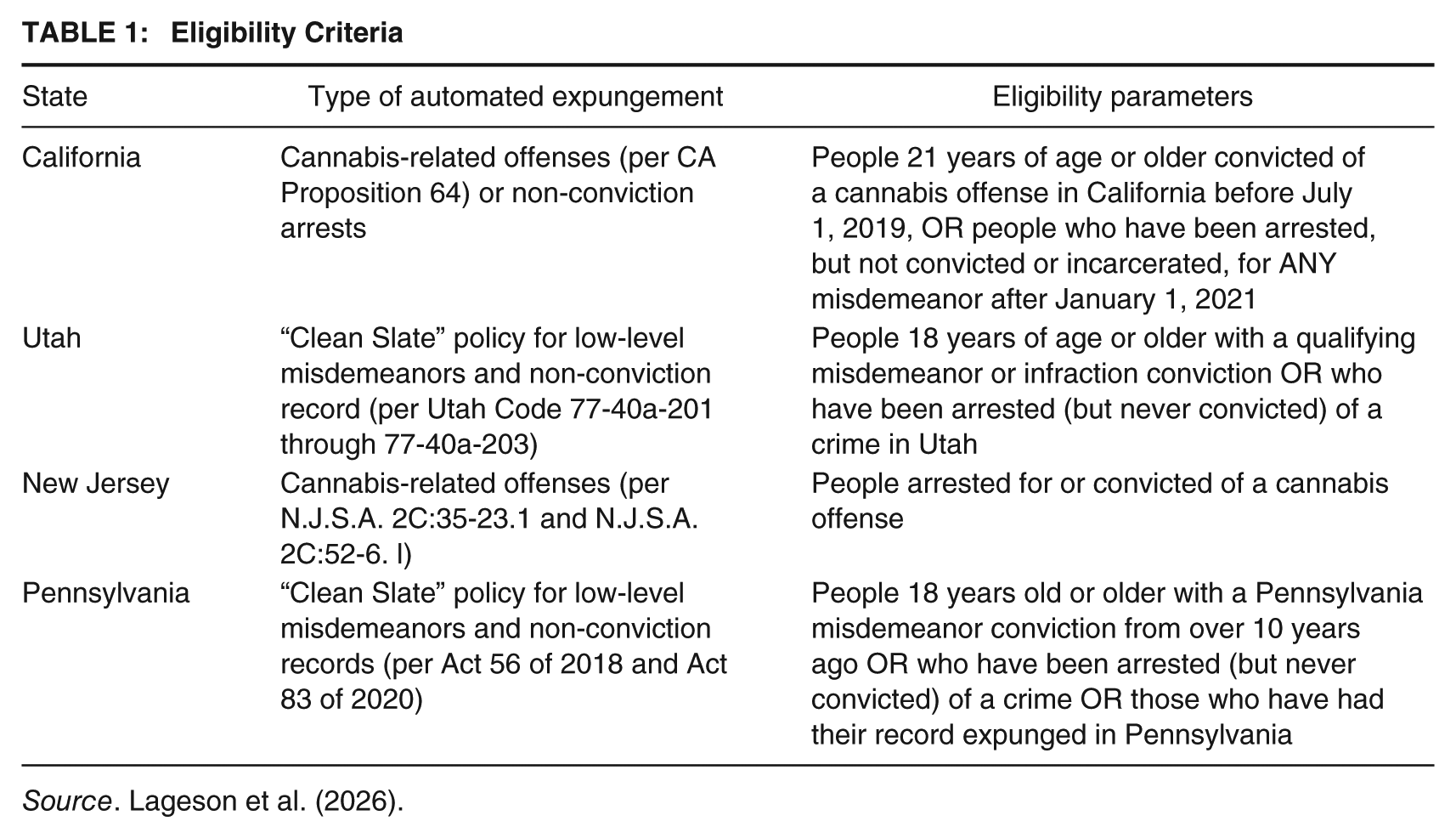
Semi-structured interviews were conducted with 102 expungement-eligible persons in California, New Jersey, Pennsylvania, and Utah between November 2021 and December 2023. These states were selected because, at the time of the investigation, they had laws that enabled automatic expungement of one or more eligible criminal offenses. Table 1 describes the criteria for automated criminal record clearance, and the eligibility parameters for expungement-eligible persons, in each of the four states under investigation.
Eligibility Criteria
Source. Lageson et al. (2026).
Of the expungement-eligible persons interviewed for the larger study, 59 indicated they either had children or relatives who were dependent on them. Sixty-nine community and government representatives, henceforth referred to as community members, who worked with expungement-eligible persons, or on the implementation of automated record clearance, were also interviewed for this study. Quotes from respondents were analyzed to explore the impact of a criminal record on a person and their family members. Semi-structured interviews were selected for this study because they enabled an in-depth exploration of an under-researched topic, allowed interviews to flow like conversations, and provided respondents with the opportunity to detail the nuanced impact of criminal records on expungement-eligible persons and their loved ones (Fontana & Frey, 2000; Lofland et al., 2006; O’Connell Davidson & Layder, 1994).
To begin the recruitment process for expungement-eligible interviewees, the researchers developed English and Spanish flyers based on the eligibility criteria for automated expungement laws in each of our four states. Hard copies of the recruitment materials were distributed at churches, reentry centers, community centers, record clearance events, cannabis dispensaries, and smoke shops. Electronic copies of recruitment materials were distributed to public defenders, probation officers, legal aid providers, past interviewees, and community-based organizations. We asked contacts at these organizations to share our electronic flyers with expungement-eligible persons. Although the research team was able to recruit many expungement-eligible persons in Utah through community-based organizations, recruitment proved more challenging in California, New Jersey, and Pennsylvania. As such, the research team launched online recruitment ads via Craigslist, Reddit, MTurk, NextDoor, and Prolific and copies of our electronic flyers were shared via Facebook, Instagram, and Twitter.
Once potential expungement-eligible participants learned about our study, they were directed to our study’s website to complete an intake survey. Persons who appeared eligible for the study were contacted by a research assistant for further screening of their criminal history. Persons assessed to be eligible for the study were scheduled for a Zoom interview. The research team received 2,706 intake surveys expressing interest in participation. However, 2,021 intake-survey respondents did not have qualifying criminal records and were screened out of the study. Other potential interviewees were screened out because they had suspicious IP addresses (e.g., IP address from another country, n = 274), were unresponsive to the research team’s attempts to contact them (n = 224), provided invalid contact information (n = 61), declined to be interviewed or were deemed ineligible for the study during the second screening (n = 23), or were no shows for scheduled interviews (n = 10). Seven people were flagged as potentially fraudulent after being interviewed. Of the102 expungement-eligible persons interviewed for this study, 86 were recruited online.
Community representatives who work with expungement-eligible persons were recruited for this study via purposive snowball sampling. The researchers compiled a list of community representatives they knew through advocacy channels, prior research relationships, expungement-related conferences and events, and those who had appeared in media reports and policy briefs in support of automated expungement legislation. The researchers contacted these government officials and community stakeholders and requested an interview with them. Interviews were scheduled with stakeholders favorable to the interview. At the end of each interview, researchers asked respondents to recommend additional interviewees. When the same people were recommended as potential interviewees, the researchers realized that we had reached a significant portion of the relevant community representatives in each state.
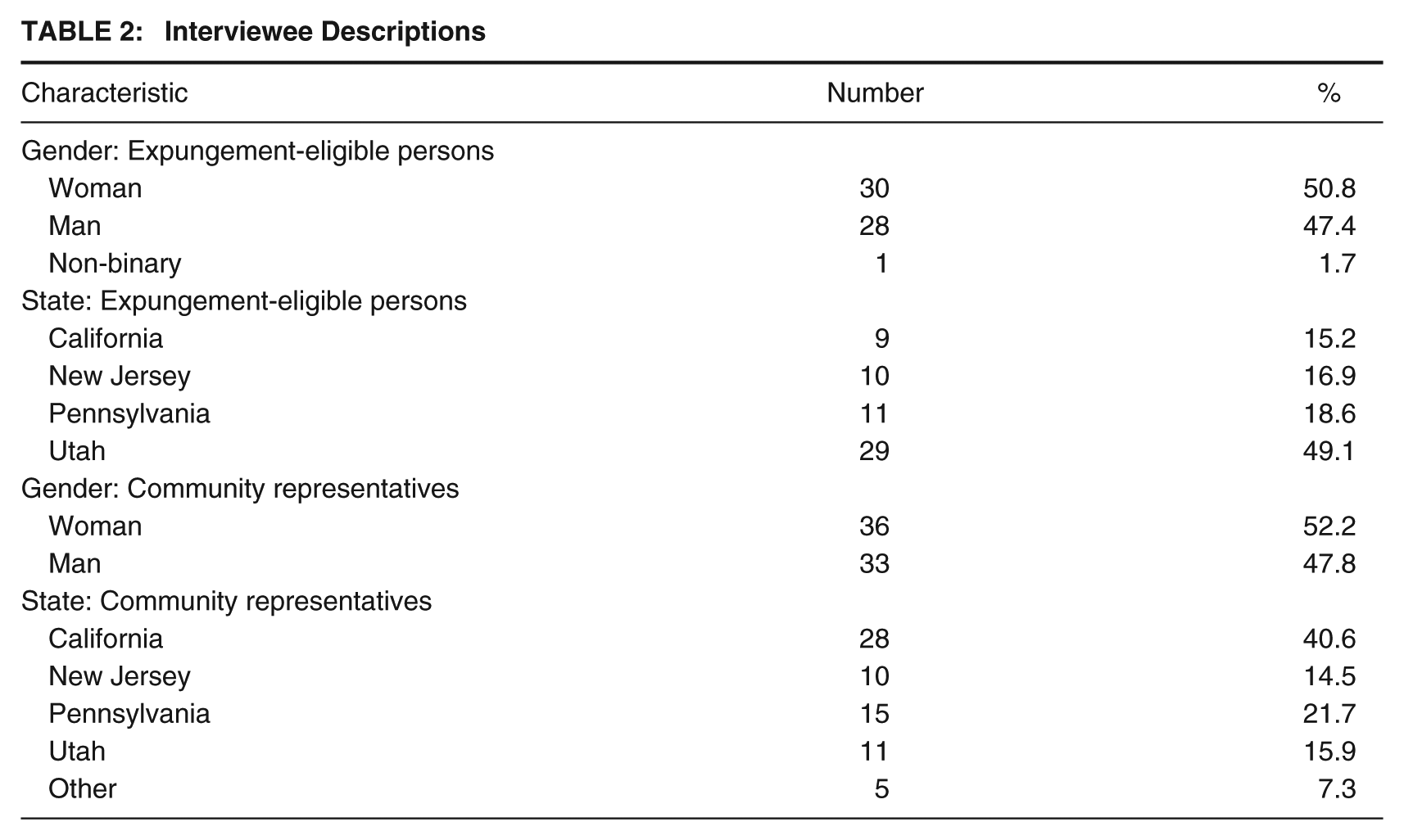
Interviews with expungement-eligible persons and community representatives occurred via Zoom and were recorded. Only one community representative declined to be recorded. In this case, the interviewer took thorough notes during the interview and devoted time after the interview to fill in details about the conversation. An informed consent form was emailed to respondents before the interview to enable them to review their rights as research participants. At the beginning of each interview, the interviewer reviewed the informed consent form with participants and answered any questions they had about their participation in the study. Verbal consent was acquired for participation in the study and the recording of the interview. An interview guide was used for each interview to ensure that all participants were asked questions pertinent to the investigation. However, semi-structured interviews allowed interviewers to skip questions that were covered in earlier parts of the interview, remove questions that were not relevant to an interviewee, and probe participants to gather additional information related to the study (Fontana & Frey, 2000; Lofland & Lofland, 1995; O’Connell Davidson & Layder, 1994). Table 2 presents respondents’ characteristics.
Interviewee Descriptions
Interview transcripts were developed by uploading recorded interviews to Otter.ai, an automated transcription service. Research assistants then cleaned interview transcripts to ensure accuracy. Cleaned interview transcripts, and interview notes from the one interview that was not recorded, were uploaded to the Atlas.ti qualitative data analysis program for coding purposes. Two members of the research team coded each interview transcript line-by-line. The research team developed an initial list of codes based on the study’s research questions and interview questions. Open coding was implemented to begin the coding process. Topics that emerged from interview transcripts were discussed at the research team’s weekly meetings. These conversations enabled the researchers to refine our list of codes by adding new codes to the list of codes and merging codes that referenced the same topic. As the list of codes was refined, interview transcripts that were coded early in the coding process were re-coded to ensure they were thoroughly coded. Once coding was complete, thematic memos were developed to explore the relationships between dominant codes. The themes presented in the next section were developed by analyzing thematic memos that contained quotes from expungement-eligible persons and community representatives. Since we endeavored to center the experiences of expungement-eligible persons, the themes presented in the next section were expressed by at least 30% of this group.
We specifically focus on themes related to the concept of symbiotic harms, rather than emphasizing the collateral consequences of a criminal conviction as codified into law (such as bars to occupational licensing). We follow the methodological approach of Boches et al. (2022) who interviewed people with legal debt and analyzed how their experiences implicated their family members. Other research on symbiotic harms has incorporated interview data from family members as well (Nisa & Eriksson 2025; Schmidt et al., 2024); however, the privacy implications of our study (interviewing people about their expunged records that are hidden from public view) precluded us from ethically asking for referrals to family networks. Instead, we leverage stakeholder interviews to provide additional context and experience. That said, we emphasize the limits of our approach and the potential benefits of directly interviewing family members for future research on symbiotic harms.
Results
This section details expungement-eligible persons’ and community representatives’ perspective on the symbiotic harms of a criminal record experienced by record holders and their dependents. The topics discussed in this section include providing housing and financial support to loved ones, custody, and participating in activities with children.
Providing for Children and Family Members
Parents and grandparents with criminal records, and community representatives who work with formerly justice-involved persons, described the toll a criminal record has on people’s ability to provide financial support and housing for their loved ones. In this section, our data show how a criminal record could limit the economic stability of persons who were never involved in the criminal legal system.
Financial Support
Having a criminal record resulted in the denial of jobs and promotions, pushed people into taking lower-paying jobs, and or influenced their decisions not to apply for better paying jobs out of fear that their criminal record would prevent them from being hired or promoted. Forty-three (out of 58) of our expungement-eligible interviewees noted that their criminal record impacted their employment; one person failed to answer this question. People with records’ unemployment and underemployment had direct implications for their families, decreasing their ability to financially support their dependents. Our interviewees explained: My record, every time I got laid off, it was a hindrance to my family. You know, being it was me, my wife, and my daughter . . . there was no support, like government support, food stamps, anything like that, that we could qualify for, because my wife was still working. And, I remember one time, with unemployment, I was making $3 too much to get any other assistance. (Jordan, man, UT) I had a particular client who had a mental breakdown, picked up a very, wasn’t a big deal misdemeanor, but she was a teacher. And even though she had one of these, like post plea offers, when she moved out of state, they can continue to see the history and even though the case was dismissed, she could not get a full-time teaching job. And so, it took us filing the petition to seal a case that was already dismissed. (Yale, community representative, Government [Public Defense], CA)
Here we see the impact of a criminal record on expungement-eligible persons’ employment prospects and the strain their families experienced due to their inability to secure work.
Being limited in the types of jobs they could obtain, formerly convicted persons stayed in low-paying jobs that did not offer great benefits and worked inconvenient shifts that sometimes compensated them more, yet it took them away from spending time with their children. While staying in these jobs meant that people with records could provide some financial support to their families, their earning potential and the economic stability of their loved ones were still compromised because of their criminal records. Respondents said: It would definitely affect my family. You know, there were times that I wouldn’t get hired. . . . My work treats me okay. But the benefits aren’t super awesome. The hours aren’t great, you know, I can make more money elsewhere with other companies, but I have been turned down because of my criminal record. (Richard, man, UT) I feel like I could have given both my kids better, shown them better, taught them better, and been there a little more. Not had to take a graveyard shift, because it paid more and missed out in the mornings and in the afternoons. And you know, I missed out on a lot of things because I had to work graveyards. (Melony, woman, UT)
As they described it, interviewees felt the time they could have spent with their children and the opportunities they could have provided to their dependents were restricted because of their criminal records.
When people are prevented from providing for their family through legitimate means, they may turn to other strategies to fulfill their financial obligations. Interviewees described not answering questions about their convictions on employment applications to increase their chances of getting a job. Other respondents spoke about record holders turning to illicit activities to earn money for their family: When people can’t secure employment, when people can’t provide for themselves and their family, there’s lots of ramifications that do affect the community. [I]f we have people who just feel hopeless, and continue to turn to non-conventional ways of providing for their families, because they can’t get a conventional job, that hurts a lot of people beyond just the individual core person or their family nucleus. (Nyla, community representative, Public Defender’s Office, CA) [W]hen I first got married, . . . I was the only one working during that time. My wife was pregnant. So once I got laid off that job I had to go find a job and I ended up finding a part time job at UPS . . . I needed the money so bad, so I wouldn’t even answer the question on [the application] . . . If they asked me, I just would not say nothing. If they find out, they kicked me off, because I had to feed my family. (Marlon, man, CA)
Engaging in illegal and unethical behaviors (e.g., lying on employment application forms) might enable guardians to temporarily provide for their children, but it could also lead to instability. If a parent is arrested for participating in illicit activities, they may be detained and lose custody of their children, lose their current housing, and experience additional arrests/convictions which may make it more difficult for them to secure employment in the future. Similarly, if an employer found out an employee lied on their job application, they could be terminated, thus increasing the economic instability of the record holder’s children. In addition to struggling to financially provide for their children, our interviewees spoke about the impact of criminal records on housing for record holders and their families.
Housing
Having a criminal record limits people’s ability to secure housing (Horowitz et al., 2024; Pinard, 2010). When this occurs, loved ones who have had no contact with the criminal legal system can be impacted. Of the expungement-eligible persons interviewed for this paper, 27 out of 58 (one failed to answer) indicated that their criminal record affected their housing. After sharing information about her criminal record with her landlord, one of our interviewees was evicted, along with her dependent father. She explained: I’m a full-time caretaker for my dad. He’s a disabled veteran . . . I got evicted because of my two felonies and stuff, even though my felonies are way back from 2008 . . . That’s something that they had to specifically be looking for, because that’s well over 10 years ago. (Stephanie, woman, UT)
Similarly, community representatives interviewed for this study lamented that their clients, and by extension their children, encountered difficulties securing housing because of their criminal records. They said: There’s zero tolerance for people, so many of our clients are working and are ready to move into their own housing, but because of the image, or because of the dominant narrative about who system-impacted people are, and how they live . . . It’s like “okay, so they are barred from housing.” This affects the children, so they end up living in substandard housing and the children grow up in environments that probably aren’t as conducive as they could be to their growth, to their trajectories, and to the behaviors they model. (Victoria, community representative, non-profit organization employee, CA) So if you have section eight housing and you have certain convictions . . . you can lose your voucher and then your family loses their housing, so that has a ripple effect. (Ryleigh, community representative, attorney, CA)
Restrictions on the types of housing accessible to formerly arrested/convicted persons have ramifications for their children’s place of residence and the environments they are exposed to. Regulating people with criminal records to substandard housing also places these restrictions on people who are dependent on them for housing, contributing to the myriad of difficulties individuals may experience because of a loved one’s criminal record. From being evicted to becoming ineligible for housing benefits, a criminal record can have a pervasive impact on persons with no criminal legal history. These effects we view as symbiotic harms.
Community representatives similarly described the intergenerational influence of criminal records and their potential drawbacks for the communities that record holders reside in. Interviewees explained: I think the stigma of a criminal record . . . can certainly harm a person’s life, and can have intergenerational impacts on not just their earning capacity but their kid’s earning capacity . . . [W]hat I’ve seen in my work is, people get stuck in these cycles of the justice system, cycles of poverty. And unfortunately, those cycles are transferred to the next generation of children. (Lauren, community representative, non-profit advocacy, UT) When a person has a record and is a provider for a family, that affects the family’s prospects economically . . . This is not just a matter of an individual impact, given the percentage of people who have records. If you go to a place like North Philadelphia, which is a low-income, primarily Black community, you’ll find half the people in the community having records that are holding them back. So sure it affects families, it affects communities. (Diane, community representative, non-profit legal aid, PA)
Here we see the potential reach of the harms associated with a criminal record going beyond the individual record holder and extending to their families and communities.
Participating in Activities With Children
Restrictions on participating in activities with children were discussed by 22 out of 53 of our expungement-eligible interviewees; six interviewees failed to answer this question. Volunteering in activities with children at school or participating in their extracurricular activities is a great way for parents and guardians to “show up” for children. Research shows that parental participation in children’s educational activities (i.e., volunteering in school) is positively related to student achievement (Blair, 2014; Houtenville & Conway, 2008). However, adults’ ability to volunteer in children’s school and extracurricular activities are dependent on their time, interest, and ability to pass background checks. Respondents in our study spoke about record holders wanting to take on volunteer roles to support the children in their families but being denied that opportunity due to their criminal records. They explained: My daughter who’s 14, she’s autistic, and she goes to a special school, and my background check is still pending with that school. So, I can’t go in and volunteer. And, you know, until they come to me and ask for an explanation, I mean, it just hasn’t moved forward. And it’s such an embarrassing thing, that it’s not like, I want to be proactive and contact them to dig into it . . . I know what’s holding it up. (Brenda, woman, UT) My son, he wanted me to go to field trips and stuff like that. He’s 11 now, but I was declined. I couldn’t go on my son’s field trip. Because I’m a felon. (Melanie, woman, UT)
Community representatives corroborated formerly convicted persons’ challenges volunteering in activities with children when they said: [S]ometimes a person with a criminal record is prohibited from volunteering at their child’s school, or sports activity. So it really interferes with that family bond, that family time. (Grace, community representative, non-profit legal aid, PA) Another thing that we’ve started to see coming up is mothers that want to take their children on like field trips, having some criminal charges can be a barrier to that. In our state, if you use illicit substances in the presence of a child, or while a child [is] in the home, you’re going to get charged with criminal child neglect. And that can be a charge that prevents you from . . . participating in those activities with your children, even though they’re in your custody. (Aaron, community representative, Advocate, UT)
Thus, depending on how criminal charges are filed (i.e., adults being charged with neglect for using illicit substances in the presence of minors), and the types of convictions formerly convicted persons have on their record, participating in activities with children can be difficult long after people turn their lives around. Unfortunately, limiting formerly convicted persons’ opportunities to volunteer in activities with children decreases adults’ ability to bond with the children in their lives and show up for them during important activities.
One interviewee described a situation where her relationship with personnel at her daughter’s school changed after they were informed about her criminal history. Stephanie spent time developing relationships with the staff at her daughter’s school. She explained: “Everybody there [at] her school knows me. And I used to have a really good rapport with everybody in the office, her teachers like everything.” However, after Stephanie’s ex-partner shared information about her criminal record, this changed: I’ve been off probation ever since I gave birth to my daughter. It was like four years ago. My [ex-partner] told them last time that I was on probation. And they straight [up] told me that I wasn’t allowed. In order for me to be on the school grounds, I had to take them proof that I was off probation . . . Like, it was the most humiliating thing that I’ve ever experienced in my entire life. Hands down, because it made my daughter look at me differently. It was terrible. I couldn’t volunteer for school anymore. Like, all of the years of volunteering, and getting close, and having a good rapport with everybody went down the drain. (Stephanie, woman, UT)
Here we see that the relationships an interviewee built with the staff at her daughter’s school, and her ability to participate in school activities, were compromised when school employees learned about her criminal record.
Even years after changing their lives around, having a criminal record still restricted record holder’s ability to participate in activities with their children. Our interviewees explained: A lot of parents who, maybe because of their active addiction, weren’t able to be the parent they wanted to be to their child. After their recovery, a lot of them desperately want that very thing but were told by schools, due to their policies, they weren’t allowed to volunteer in classrooms or be a chaperone on a field trip. (Lauren, community representative, attorney, UT) I do know plenty of people in the recovery community. They cannot go on field trips with their children, or cannot go to their children’s school and volunteer because of their criminal record. And they’ve been sober for 10, 15 years. (Sienna, woman, Utah)
After becoming clean and sober, parents’ actions in the past continued to show up on background checks and impact their experiences, and the experiences of their children.
Knowing that they would need to go through a background check to participate in school and extracurricular activities with their children, and fearing that they would not pass the background check, some record holders refrained from even attempting to volunteer. This decision decreased the chances of members of the school community learning about their criminal history. Our interviewees said: I am horrified to go to a PTA meeting, or to supervise a field trip, or to organize any parent activities. I’m horrified to make my appearance at the school because I don’t want my son to be cut off or to be referred to as the son of a criminal. (James, man, Utah) I did not volunteer for class field trips because it would have been a background check. (Nova, woman, PA)
While the decision to avoid participating in activities with their children protected record holders’ criminal records from being shared with members of the school community, it limited the opportunities for parents to be immersed in their children’s lives and restricted the positive memories that could have been made in these settings.
Custody
In this section, we discuss the impact of a criminal record on parents’ and relatives’ ability to gain custody of youth post their involvement with the criminal legal system. Of our expungement-eligible interviewees, 17 out of 53 indicated that their criminal record impacted their ability to gain custody of their children/family members; six interviewees did not answer this question. Some of our interviewees noted that formerly convicted persons lost custody of their children when they were arrested/convicted of crimes and/or addicted to drugs. They said: [The] mother of my first two children, she used my record against me. Although I picked up my record when I was with her, . . . they didn’t care. When I was pending with family court and I got arrested they used the arrest against me as well. (Armando, man, CA) [Y]ou can’t even like . . . get custody of your kids back in a lot of places, which are like key facets of actually succeeding in society. (Ava, community representative, non-profit advocacy, CA)
Other study participants noted that peoples’ criminal records prevented them from gaining custody of younger relatives who were in need of a placement after these youth were removed from the custody of their biological parents: I really assumed the state would let me have my grandson since he didn’t have anywhere else to go. But instead, they throw him in foster care because of my past. [I had to] get a very expensive lawyer [and] fight for two years to get my grandson to live with me. I’ve sent two children to college. I’m now a licensed plumber, I live in a very nice community, I work my butt off, I work two jobs. I’ve not broken the law since 2005 . . . And they chose to put him in foster care and group homes for two years and make severe damage to him emotionally, where we’re struggling with it. (Randy, woman, UT) [T]he law prefers that children be placed with a family member if they cannot be returned right away to the parent . . . [I]f a relative has a specific non-exemptible, usually they’re violent crimes, non-exemptible offense or conviction, then the department cannot approve that placement and the Court cannot place there. And then there are some offenses or convictions that are discretionary, meaning that the director of the Department of Family and Children Services use his or her discretion and allow placement there anyway. (Leighton, community representative, non-profit advocacy, CA)
Here we see interviewees’ inability to care for their younger relatives because of their criminal record. Rules around juvenile placements limit families’ opportunities to care for relatives in need and can place hardships on families.
One interviewee, Amelia, explained that when she was arrested and detained, her daughter needed someone to live with. Although Amelia’s daughter could have been placed with her mother, Amelia’s father had a criminal record that prevented him from living in the same house as his granddaughter. To resolve this problem, Amelia’s father moved out of his home to enable his granddaughter to live with her grandmother. Amelia explained: So my daddy, when my mom got my daughter, he had to move out. So they had a whole other expense, they got a studio so they had to pay that monthly and then they had my daughter. But they weren’t going to let my daughter go in the system, you know, and when they told me, I was just like crying. . . . I thought they were going [to] just like leave her there . . . But a lot of people don’t have that. (Amelia, woman, CA)
Amelia was lucky that her parents were able to rent a studio apartment for her father to live in while her mother gained custody of her daughter. For other families, taking on this kind of expense, and inconvenience, may not be possible and the child may be placed in the foster care system. Throughout this section, we have seen that having a criminal record can impact parents’ and grandparents’ ability to gain custody of their children/grandchildren. However, it is important to note that custody decisions impact the children about whom these decisions are made. If a child is being removed from their parents’ custody due to the parent’s involvement in the criminal legal system, or for other reasons, and family members have a criminal record that prevents them from assuming custody of the children, then children are experiencing the effects of not just their parents’ criminal record but the effects of criminal records held by their grandparents and other relatives.
The themes that emerge from this paper map onto the five characteristics of symbiotic harms by reflecting the relational, mutual, and agentic aspects of criminal records on family relationships. Record holders are enmeshed in kin relationships and what happens to them affects their loved ones and dependents. Children, in particular, are impacted by their parents’ and guardians’ financial instability, housing insecurity, inability to participate in activities with them, and challenges with securing custody. Yet, compared to adults, children may lack agency and access to resources to counter the effects of their parents’ and guardians’ criminal record. As such, they are at higher risk of experiencing the effects of a loved one’s criminal record in relation to custody, financial support, housing, and having adults participate in activities with them. The non-linear impact of a criminal record is illustrated in the complex outcomes for housing insecurity. Living in substandard housing, because of a parent’s/guardian’s criminal record can expose children to dangerous environments, limit children’s access to resources, and can have an intergenerational impact on record holders’ loved ones. Finally, the heterogeneity of criminal records is exemplified in our interviews by the ways custody decisions vary for individual cases.
The Hope of Record Clearance
The interview data make clear the symbiotic harms of a person’s criminal record on their dependents. After considering the impact of a criminal record, our interviewees recommended criminal record clearance as a strategy to alleviate the symbiotic harms they identified. In hopes of removing barriers to volunteering in schools and participating in extracurricular activities, some interviewees considered and sought out criminal record clearance.
I want to make sure it’s clear before I’m embarrassed in my community. So yeah, my son didn’t get to have me in his classroom this year, because I didn’t want to get the background check done. (Brenda, woman, UT) For sure, I mean, I started the expungement process with the hopes to be able to coach. At the time, my son was playing soccer. But unfortunately, being a violent offender, that has limited me in my ability to show up for my kids, or to volunteer and things of that nature. And so, you know, that’s what started me on the road. (Richard, man, UT)
Interviewees expressed hopes that obtaining expungement would increase their ability to participate in extracurricular and school activities with their children.
The community representatives we interviewed for this study explained that record clearance would increase employment prospects for formerly arrested/convicted persons. And our expungement-eligible interviewees shared their aspirations for a better future post-record clearance: I think I’ve had several clients where, these are single mothers with more than one child in the household, trying to make ends meet. And all of a sudden [post record clearance], they can get a job that’s not at Foster Farms, packaging chickens, or some sort of minimum wage jobs. So, I think it’s helped people get off of government assistance. (Yale, community representative, attorney, CA) The most obvious benefit is to spouses and children of the person with the criminal record. Suddenly, they are eligible for better work, better pay, and better overall standard of living. (Warrick, community representative, attorney, CA) [I]t will be great, . . . like a burden off my back. I’ll feel a lot more confident moving forward with certain jobs, I won’t lie, like there’s one job, unfortunately, I will have to miss out on getting into union with them because of my jacket [record]. So, you know, moving forward, it will give me a relief and more of a sense of hope. And you know, and being able to provide for my family a whole lot better. (Matthew, man, PA)
Although criminal records restricted the opportunities and experiences of some record holders, our interviewees were hopeful that record clearance could alleviate some of these harms. In the next section, we consider the implications of these findings.
Discussion
Research has documented the pervasive and detrimental effects of a criminal record, including arrests when no convictions have occurred (Corda et al., 2023; Horowitz et al., 2024; Pinard, 2010; Pinard & Thompson, 2005; Prescott & Starr, 2020). In contemporary times, research illustrates that punishment is not limited to the legal penalties imposed by the criminal legal system (e.g., jail time, fines, fees, probation, suspended licenses, etc.) but includes collateral consequences that can be felt decades after a conviction. Exploring the symbiotic harms of criminal records helps us consider the far-reaching consequences of criminal records in more totality. The term symbiotic harms adds greater voice to the prolonged, and extensive, impact of a criminal record on families.
Findings from this paper illustrate that, at times, a criminal record limited the employment and housing prospects for formerly convicted persons, decreased record holders’ ability to participate in activities with children, and hindered adults’ attempts to gain custody of younger relatives. The harms that children and families experience as a result of their relatives’ criminal record extend deep into family life. If parents have limited opportunities for employment, or are forced to remain in jobs that have unconventional hours, then the children unequivocally suffer. Due to their parents’ criminal record, children may experience economic and housing insecurity, which can be correlated with living in poor and unsafe neighborhoods, exposure to food deserts, decreased access to extracurricular activities, and increased exposure to neighborhood violence. The data is clear—children who are unsupervised are more likely to engage in substance abuse, early sexuality, delinquency, and other related harms (Nawi et al., 2021; Reynoso & Rossi, 2019; Sun et al., 2025). Here we demonstrate again that the punishment of the record holder extends well beyond the person—by limiting the employment opportunities, parents have no choice but to take any job that they can use to financially support their children at the cost of emotional support or stable home dynamics that would allow children to flourish.
This research shows that family members feel the reverberations of their loved one’s criminal record. If parents are limited in the housing they can secure, the prospect of moving children to better areas with better schools, where educational and extracurricular opportunities would increase their chances for success, becomes nearly impossible. Children who are subjected to disadvantaged neighborhoods because they live with a guardian with a criminal record, have limited mobility and decreased chances for success. Therefore, a criminal record heightens the risk of intergenerational transmission of poverty. When evaluating the impact and appropriateness of punishment, as well as how long a criminal record should be available to the public, it is important to consider the symbiotic harms experienced by families. The data from this study confirm that punishment does not only hurt the person who holds the criminal record, but also their loved ones.
Of particular importance is our finding that having a criminal record limited adults’ ability to participate in school and extracurricular activities with the children in their lives. Field trips, classroom volunteering, and children’s sporting activities are important opportunities for adults to “show up” for, and develop healthy bonds with, the children in their lives. Parents’ participation in school and extracurricular activities provide an opportunity to develop meaningful memories with their children. Involvement in these activities also increases record holders’ contact with prosocial individuals (e.g., teachers and school personnel) which could be important for their recidivism. Finally, restrictions around granting custody to adults with select criminal records limit the opportunities for adults to care for younger relatives in need of secure placement. While it is important to place children in secure placements, there is a weak case for preventing a person with an old criminal record for a misdemeanor, particularly one that is eligible for petition-based expungement, from having the opportunity to care for a younger family member.
To decrease the symbiotic harms of a loved one’s criminal record, we recommend the expansion of automated criminal record clearance. All states have laws that allow criminal record clearance (Chien, 2020). The eligibility for record clearance varies across states but typically involves the petitioner having no pending criminal cases, having been discharged from probation/parole, having paid any fines and fees related to their criminal legal contact, and having met a specified waiting period since their last conviction (e.g., 3 years, 5 years, 10 years, etc.; Chien, 2020; Chin & Ormonde, 2017). The benefits of criminal record clearance are numerous. Record clearance increases people’s employment opportunities, earning potential, and access to housing, and reduces the stigma associated with a criminal record (Adams et al., 2017; Chien, 2020; Crampton, 2022). People who obtain record clearance receive approximately 22% higher wages within 1 year (Prescott & Starr, 2020). Record clearance also increases individuals’ self-worth, confidence in applying for jobs, restores voting rights, and is associated with secondary desistance (Adams et al., 2017; Chien, 2020). Finally, people who receive expungement commit future crimes at low rates, similar to the general population (Prescott & Starr, 2020).
Although the benefits of expungement are extensive, research shows that less than 10% of persons who are eligible for criminal record clearance seek and obtain this relief (Chien, 2020). In Michigan, only 6.5% of people eligible for expungement obtained this relief within 5 years of eligibility (Prescott & Starr, 2020). For persons who seek record relief, petition-based record clearance can be confusing, time-consuming, and expensive (Chien, 2020). Based on the symbiotic harms of a criminal record, and the fact that most persons who are eligible for petition-based record clearance neither seek, nor obtain, this relief, we recommend the expansion of automated record clearance policies. Automated record clearance, often referred to as Clean Slate, is currently available in 12 states. With automated record clearance, states/counties are responsible for identifying persons who are eligible for criminal record relief and initiating the process of clearing eligible records. Automated record clearance removes the cost and complexities associated with record clearance from individuals and shifts this burden to the state. Automated criminal record clearance can close the second chance gap by increasing the number of eligible persons who obtain criminal record clearance (Chien, 2020).
Limitations
There are a few limitations to this study. First, the researchers did not interview record holders’ family members who could have provided their own firsthand experience of symbiotic harms. Our research design was not originally tailored toward symbiotic harms; instead, this was a theme that emerged from the data collected for a study of expungement. Our approved IRB applications precluded interviews that would involve compromising the confidentiality of our participants by discussing their criminal records with other people. While we note the limitations in not interviewing family members, we also highlight how unexpected research findings can lead a study toward a new, and unexpected, theoretical framework. Second, the research presented here is from a cross-sectional study. Although we interviewed participants with a wide range of ages and marital statuses, and have data from different points of interviewees’ lives, interviewing the same participants at different points in time could deepen our understanding about the longevity of symbiotic harms of a criminal record. Third, although the researchers implemented various strategies to solicit interviewees for this project, the sample size of interviewees from each state remained modest. Fourth, when expungement-eligible persons noted the absence of a theme (e.g., their criminal record did not impact housing, custody, etc.), the researchers did not ask why their record had not impacted them. As such, we cannot explain why some expungement-eligible interviewees, and not others, experienced select symbiotic harms. We hope to address this in future interviews. Finally, although interviewers asked expungement-eligible interviewees questions about how their criminal record impacted them and the people around them, we did not ask about their housing, employment, custody of dependents, etc. before they obtained their criminal record. Asking questions about their experiences pre- and post-criminal record could have helped shed additional light on the effects of a criminal record.
Conclusion
The results from this study illustrate the importance of contemplating the symbiotic harms of a criminal record. Since people are not autonomous agents, but rather our lives are interwoven with the people in our families and social networks, it is impossible for the impact of a criminal record to be isolated to record holders. Families, particularly children, are deeply impacted by the effects of their loved ones’ criminal records. These effects are unjustified since these dependents did nothing to warrant the deprivations they experience. As a society, it is important to understand the impact of our decisions/actions and to implement corrective behaviors when our decisions/actions cause harm. Considering the far-reaching effects of a criminal record, it is important for us to reconsider who should have access to criminal records, how long criminal records should be visible, and what restrictions people should experience because of their criminal records. For now, providing more support for petition-based record clearance and expanding automated criminal record clearance could be valuable first steps to decreasing the symbiotic harms of a criminal record.
Footnotes
Acknowledgements
The authors would like to thank Raven Lewis, Caroina Ribiero Caliman, Deirdre Crawford, Eva Gonzalez, Desaray Castellanos Ordonez, Maile Belnap, Rachel Stattion, and Samantha Campos for their valuable research assistance.
We have no conflicts of interest to disclose.
We gratefully acknowledge funding from the New Venture Foundation, #NVF-CSIN-Santa Clara University-Subgrant-013425-2021-02-01.
