




Abstract
Law enforcement’s response to the commercial sexual exploitation of children (CSEC) has evolved over the past decade; however, both survivors and service providers report that law enforcement is often perceived as untrustworthy and unhelpful in CSEC cases. The specific challenges law enforcement face in CSEC cases and their impact on community safety and justice goals remain unclear. This study explores these challenges from the perspectives of law enforcement and their community collaborators through 80 semi-structured interviews across 11 U.S. communities. The findings identify three key categories of challenges: systemic, interpersonal, and professional. Systemic challenges form the foundation for all other issues. Interpersonal and professional challenges were found to influence each other. Results highlight that challenges are interconnected, dynamic, and vary depending on context. Such complexities call for innovative solutions. Participants expressed a strong desire for new frameworks and approaches to improve police practices with CSEC survivors and reduce [re]victimization.
Keywords
The commercial sexual exploitation of children (CSEC) occurs when sex and/or sexual acts with children (i.e., any individuals under the age of 18) are exchanged for any item of value, including goods, services, drugs, or money (Trafficking Victims Protection Act [TVPA], 2000). Sometimes referred to as child sex trafficking, CSEC differs from adult sex trafficking in that it does not necessitate force, fraud, or coercion. Instead, any commercial exchange of sex or sexual acts by an individual below the age of 18 constitutes exploitation under U.S. federal law (TVPA, 2000). Children are generally exploited by individuals known to them including parents, peers, relatives, and intimate partners (Miller-Perrin & Wurtele, 2017). Contrary to media representations of the crime, CSEC does not always involve a third person negotiating the exchange, and children also self-negotiate sexual exchanges (Mitchell et al., 2010). Technology also plays a role in CSEC, by facilitating exploiter grooming, as well as perpetration of the crime (Gezinski & Gonzalez-Pons, 2022; O’Brien & Li, 2020; Prior et al., 2025).
Given the vast array of ways that CSEC victimization can occur, law enforcement’s response to the crime must be equally nuanced. In the early 2000s, research indicated that many law enforcement agencies in the United States viewed CSEC as “juvenile prostitution,” which was reflective of both state and federal legislation at the time. Upon the passage of the federal Trafficking Victims Protection Act of 2000, most states began passing their own legislation related to CSEC to ensure that victims were not criminalized for behaviors inherent to their victimization experiences (e.g., prostitution; Shared Hope International, 2016). More recent research that underscores this shift has resulted in a victim-centered response to CSEC across law enforcement agencies nationwide (Mitchell, O’Brien, et al., 2025), including victim-centered approaches to both victim identification and interdisciplinary collaboration with community service provision (Mitchell et al., 2024).
Nonetheless, gaps in law enforcement response are frequently reflected in survivor narratives. Both survivors and service providers consistently emphasize that children impacted by CSEC often do not view law enforcement as safe, trustworthy, or helpful (Hurst, 2021; O’Brien et al., 2019). Research also documents disparities in the application of victim-centered approaches, which vary by region, urbanicity, and survivor characteristics (Cole & Sprang, 2020; Mitchell et al., 2024). For example, research frequently highlights that survivors who cooperate with law enforcement and generally follow traditional victim narratives of being grateful have a markedly different experience in the criminal justice system when compared with survivors who are uncooperative or uninterested in help (Farrell et al., 2019). Similarly, research highlights differentially positive service experiences for CSEC victims who are cisgender, White, and female. These identities align with long-held beliefs that sexual victimization is predominantly a female issue, bound by moral mores championed by White Christians since the Industrial Revolution (Bromfield, 2016).
Unfortunately, most CSEC survivor experiences are not reflective of the narratives described above. Specifically, most CSEC survivors do not self-identify as victims, understanding their CSEC experiences as extensions of either ongoing abuse (e.g., sexual abuse in the home) or life circumstance (e.g., experiencing homelessness or trading sex for food or shelter; Franchino-Olsen, 2021; Greenbaum, 2014; Prior et al., 2022). For children who are self-negotiating sexual exchanges, identification as a victim may be particularly complex. Such children may perceive self-agency in their exchanges, even if they are being cajoled into such exchanges by individuals with experience in grooming and exploitation (Prior et al., 2023). Furthermore, CSEC victimization disproportionately impacts children of color, as well as children who identify as sexual and gender minorities (Walsh et al., 2024; Williamson & Flood, 2021). The intersection of both systemic trauma and CSEC-specific trauma likely manifests in unique ways for these particularly vulnerable survivors (Wagner et al., 2024), and complicates their journey in both service selection and receipt (Jones et al., 2024).
Law enforcement frequently serves as first responders in contexts where CSEC may be occurring, and most CSEC survivors report having had contact with police during their experiences of exploitation (Watson & Edelman, 2013). This places law enforcement in a unique position to identify children impacted by CSEC and facilitate their connection to appropriate services. However, service provider and survivor accounts often reflect a disconnect between the intended implementation of victim-centered policing practices and how those practices are experienced on the ground. Law enforcement personnel largely acknowledge that CSEC survivors do not trust them, which complicates their efforts to engage victims in the justice process and collaborate effectively with service providers (O’Brien, Kahn, et al., 2025). Yet, the challenges officers face when working on CSEC cases in their communities—and the ways these challenges influence broader community safety efforts—remain insufficiently understood.
More research is needed to understand the challenges law enforcement are facing in their work on CSEC crimes occurring in the communities they purport to serve. Understanding the challenges they face will help improve their practice which, in turn, would lead to better care for victims and the community at large. To explore the unique experiences of law enforcement responding to CSEC crimes in their communities, the current study qualitatively explored the challenges faced by law enforcement, as understood by both law enforcement as well as the service providers with whom they collaborate. The research question guiding the current study was purposefully broad: What are some of the challenges law enforcement faces working on CSEC cases occurring in their communities? Within the purview of this broad question, we explored how challenges may be inter-related, community dependent, and bi-directionally impactful.
Method
The current study is part of a larger, mixed methods study exploring law enforcement and community response to CSEC (Mitchell, Jones, et al., 2025). Here, we highlight questions that are specifically related to challenges faced by the police; however, other topics were covered within the interviews (e.g., forms of police and service provider collaboration, use of victim-centered approaches). Additional details about study design, methods, and/or results can be found in previous publications (e.g., Mitchell, Jones, et al., 2025; Mitchell, O’Brien, et al., 2025; O’Brien, Jones, et al., 2025).
Participants and Data Collection
Qualitative data were collected from 18 law enforcement and 62 service providers from 11 different communities across the United States. Communities were purposively drawn from varying geographic regions, and sizes. Given that state-level legislation varies widely, we also sought a sample with diverse CSEC-focus legislative response. CSEC-focused legislative response was assessed using state-level scores on Shared Hope International’s 2018 Protected Innocence Challenge (PIC; Center for Justice and Advocacy, 2018). The PIC is a yearly project done by the national anti-trafficking initiative “Shared Hope” and assesses 41 components of state law based on their intention to create safer environments for victims and survivors of CSEC. Interviews gathered in-depth information about police practices, forms of police and service agency collaboration, types of area service provision (and their availability), and perceptions of community focus and orientation to the problem of CSEC. Ultimately, we included three states from the Eastern United States (14 total interviews), three states from the Midwestern United States (21 total interviews), one state from the Southwestern United States (13 total interview), and three states from the Western United States (32 total interviews). Three communities were rural, three urban, and five suburban. State PIC grades included five communities with a score of “A,” three with a score of “B,” two with a score of “C,” and one with the score of “D.” Each community had an average of 7 participants, with the range of participants per community ranging from 4 to 11.
In each community, study personnel began recruitment by calling law enforcement agencies, providing an oral prospectus of the study, and asking if there was a member of their agency that would be a good fit to discuss their community’s legal response to CSEC, with a particular interest in those who may be involved in local CSEC-related task forces or multi-disciplinary teams (MDTs). Interviews were scheduled at the convenience of each identified individual. After interviews were scheduled, study details were provided in writing via email. We employed a snowball sampling strategy, in which participants were invited to recommend other individuals in their community who served CSEC victims and survivors. Since the study sought to include only individuals within each community that had knowledge about the topic of interest (e.g., their community’s legal response to CSEC), the snowball sampling method was ideal. Specifically, participants were asked to refer other members of MDT’s they had worked with to address CSEC cases, as well as any additional community members they had heard of addressing CSEC survivor needs even if that community member did not work on cases in a formal professional capacity. In this way, we were able to speak to individuals who may not have professionally identified as serving CSEC victims and survivors, but did so in a meaningful way within their community. We assumed we had spoken to most individuals with familiarity on this topic in a particular community when the same referrals were provided two or more times by different participants in each community.
While we sought to achieve theoretical saturation, which is accomplished when no new information is gleaned (Guest et al., 2006), not all communities had enough individuals with familiarity in the topic of interest. Importantly, one of the study goals was to understand metathemes across communities, as well as achieve saturation within communities that were similar—such as those with similar rurality, region, and PIC score. After 80 interviews, no additional data were being found and we had fit the suggested threshold of sample size (i.e., 10–20 participants) as denoted by Morgan et al. (2002) for each subsample within our larger sample (e.g., rurality, region, PIC score). Similarly, we hit thresholds as suggested by Hagaman and Wutich for deducted metathemes across multiple sites (i.e., 20–40 interviews; Hagaman & Wutich, 2017). At this point, participant recruitment was stopped, and no additional interviews were sought.
Participants provided oral consent for participation and digital recording prior to the start of each interview. The semi-structured interview guide included several questions related to identification protocols, service provision, and building trust with victims—both by police and service providers. Examples include: (a) Tell me about any police protocols you are aware of around CSEC victim identification? and (b) Can you talk to me about forms of police and service agency collaboration, including whether these are formal or informal connections? Prompts were used to explore specific challenges, elucidate answers and prompt depth of response. Participants were encouraged to reflect on how they navigate their professional roles to address these challenges both in the moment and over time. Interviews lasted approximately 1 hr, with an average length of 44.33 min (range = 40–65 min).
All participants were provided a $25 Amazon Gift Card in appreciation of their time. All protocols were reviewed and approved by the University of New Hampshire IRB. Data collection and analysis occurred concurrently so that analyzed data could guide subsequent data collection efforts (Padgett, 2016).
Demographic Surveys
The research team collected demographic information from all participants including age, race, gender, sex, employment, length of time in their current position, and education. Even though completing demographic surveys was not mandatory for study participation, the majority of participants (n = 69; 86.25%) completed the demographic form. Professional identities were not mutually exclusive and included participants who self-identified as having a current position in law enforcement (n = 15; 21.7%), advocacy (n = 24; 34.8%), case management (n = 18; 26.1%), mental health/substance use (n = 12; 17.4%), and sexual assault/domestic violence (n = 15; 21.7%). Additional roles included legal (n = 10), policy (n = 8), and education (n = 9). Most participants noted working in their current positions for 2 to 10 years (65.2%) and were between 35 and 64 (82.6%) years of age. The majority of participants identified as female (n = 53; 76.8%). The sample was mostly White (n = 57, 82.6%). Additional demographic data, including the variety of racial identities included, were collected via an online survey and available in previous publications (Mitchell, Jones, et al., 2025; O’Brien et al., 2024).
Data Analysis
Digital recordings of all interviews were transcribed verbatim by a transcription service and subsequently reviewed for accuracy by research team members. The initial codebook was developed using an inductive, grounded theory approach. Specifically, 10 interviews were coded independently by two members of the research team and subsequently reviewed during weekly team meetings. In these meetings, the qualitative team (a) reviewed all code phrases developed during the first-round of coding along with interview transcripts thoroughly, (b) reduced code phrases by subsuming overlapping categories, (c) created higher-level conceptual clusters of codes, and (d) ultimately abstracted major themes from these categories. The resultant codebook was then reviewed by six members of the expert advisory group: two expert qualitative researchers, two experienced service providers, and two experts with lived experience. This was done to ensure major themes were not excluded, and important areas of focus and/or potential bias were addressed. The resultant code book was used to code all interviews. Approximately 30% of the total interviews were double coded (n = 30; 37.5%).
The final stage of the coding process, which laid the groundwork for this article, concentrated on the prominent category of “police practices,” with a particular focus on the subcategory of challenges encountered in police work. This stage of focused coding involved identifying key themes and the connections between them. It enabled the research team to conceptualize three primary types of challenges that law enforcement faces in addressing CSEC.
Quality Criteria
Methods to enhance the rigor of the research included regular debriefing and obtaining consultation from research experts on the semi-structured interview guide and initial codebook, the use of detailed case notes capturing nonverbal participant cues, double coding of interviews, and data triangulation by using more than one method to collect similar data (i.e., surveys and interviews; Padgett, 2016). To address potential effects of reflexivity of the researcher’s social position (Berger, 2013), details on the coding team are provided. Specifically, the coding team was diverse in terms of experience and education. Initial coding was completed by four members of the research team: a PhD-level White American woman with extensive experience in CSEC research, a BS-level Asian American woman with minimal CSEC research experience, a master’s-level White American woman with some CSEC research experience, and a master’s-level graduate student who identified also as a White American woman who had experience with victimization and vulnerable children broadly. The final stage of the coding project was done by two PhD-level women (Authors 1 and 2)—one a White American and the other Israeli—both with substantial CSEC research experience.
Findings
Data analysis reveals that police officers encounter a range of challenges in their work with CSEC victims, which can be categorized into three primary areas: systemic challenges, interpersonal challenges, and professional challenges. Systemic challenges serve as the foundation for all other challenges, providing the underlying context that hinders police practices broadly and particularly in cases involving CSEC. Within this framework, the other two categories of challenges emerged. Interpersonal and professional challenges were found to have a bidirectional influence on one another. In some instances, interpersonal difficulties led to obstacles in fulfilling professional responsibilities, whereas in other cases, challenges in their professional roles exacerbated interpersonal difficulties. These overarching challenges were consistently present throughout all interviews, though they varied in intensity and frequency, potentially due to the varying role of the professionals represented in the sample. Please see Figure 1 for a visual depiction of themes and their dynamic relationship.
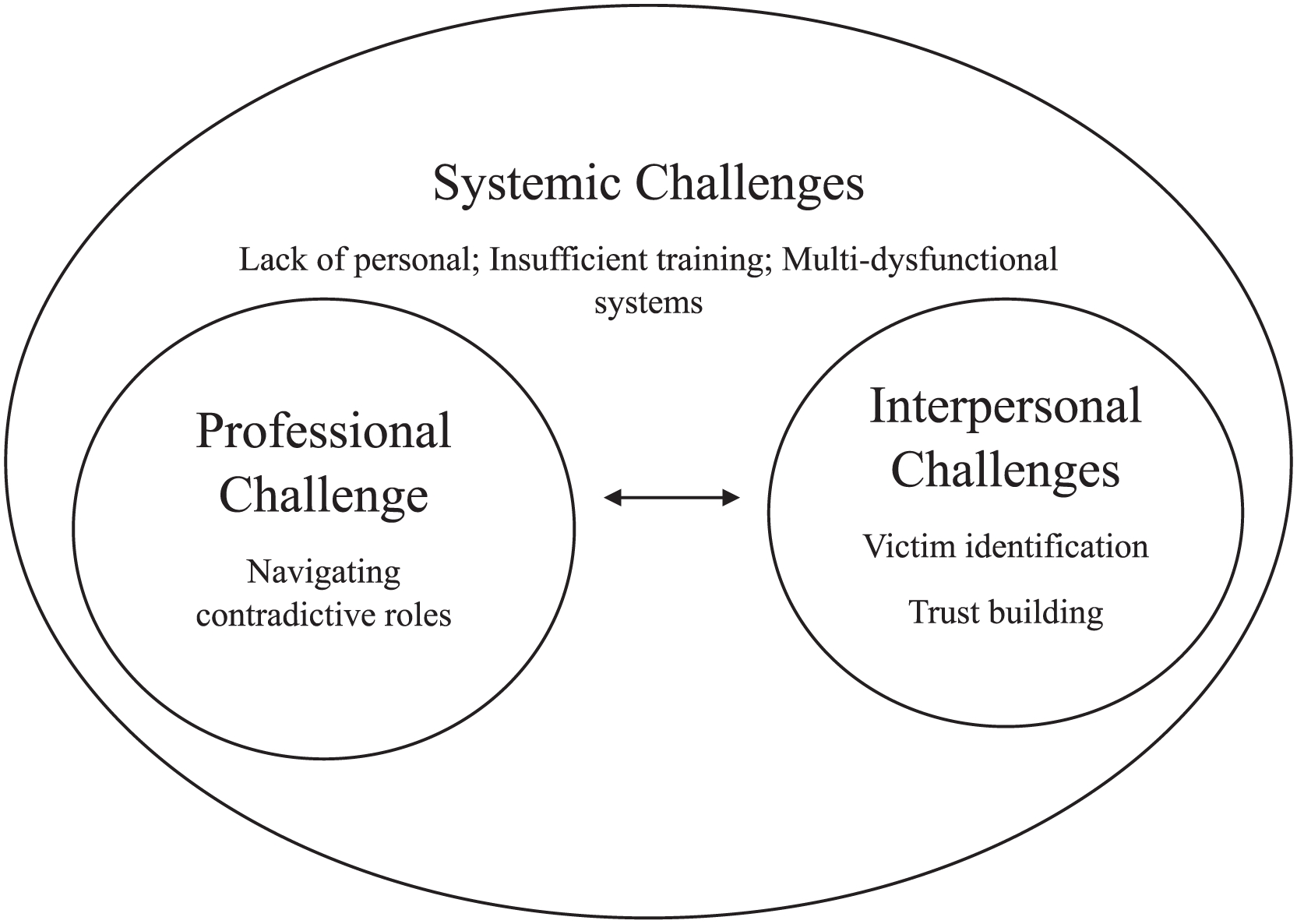
Visual Depiction of Themes Related to Challenges in Police Practice in Cases Involving CSEC
Systemic Challenges
The theme systemic challenges encompasses fundamental issues that impair police practices broadly. While these issues are not unique to working on CSEC cases, they were discussed as particularly impactful when addressing CSEC crimes. As illustrated in Figure 1, these challenges serve as significant contextual barriers within which other challenges arise. Participants consistently highlighted three primary systemic issues that hindered police officers’ practices: a shortage of personnel, insufficient trauma-informed training, and multi-systemic failures. We discuss each of these subthemes in more detail below.
Shortage of Personnel
Participants highlighted that CSEC cases are complex—necessitating a lot of time and investigation of people, as well as materials. Many participants emphasized the desire to investigate each CSEC case to the fullest but also acknowledged that it was sometimes very difficult—or impossible—to do so. In the words of one police officer:
500 kids at risk for trafficking is a lot for two people to follow up on. . . And if you get just one trafficking investigation, the amount of time and effort that goes into it makes it very, very difficult to reach out to the rest of the kids. . . . it’s hard to meet that need if there’s just not [enough]people to fill in those positions. (POL, Midwest, Urban)
The shortage of manpower and constant overload are significant barriers that hinder police officers from effectively carrying out their duties across the board. Given the complex nature of CSEC crimes, the lack of personnel may be even more pronounced and impactful than in other contexts. As one service provider noted,
Most agencies are operating at 75% to 85% of capacity. Officers are working overtime. They are overworked, they are exhausted. They simply don’t have the capacity to provide training or to pay their officers for two to five hours worth of training that they need. . . . a lot of the times the cases are not getting investigated because they simply don’t have the capacity and don’t ask for help. (Service Provider, West, Suburban)
Understaffed and overburdened, police officers are forced to triage cases, prioritizing certain cases over others. Many participants noted such prioritizations have sweeping consequences on CSEC cases. One police participant gave a specific example of how such priorities may manifest, stating,
Child sexual abuse material is connected to trafficking. Absolutely. And if you are one detective in one city and you’ve got child sexual abuse material of a 16-year-old girl and a two-year-old, where are you going to prioritize your day? . . . They’re going to pick the two-year-old every time. Every time. (POL, Southwest, Urban)
Insufficient Training
Universally, participants noted that trauma-informed training is becoming more widespread within law enforcement, with law enforcement agencies positively recognized for being better-trained and knowledgeable about CSEC crimes and victim-centered approaches. Nonetheless, participants noted that misguided perceptions of CSEC are deeply ingrained in the attitudes of police officers toward victims. As one police participant acknowledged, “I feel like we’re in the infant stages when it comes to sexual exploitation. Because there’s just so many cops that are just like, ‘Oh, she’s just a prostitute. Oldest profession’” (POL, Rural, West). Furthermore, most participants argued that when drugs or gang involvement were involved in the exploitation, police officers struggle in implementing a victim-centered approach toward CSEC victims. Several participants noted that this can mean a failure to understand how CSEC may be related to other, parallel crimes. In the words of one service provider,
If they are 13 then they probably didn’t have a lot of information or a lot of ability to stop the 25-year-old man with a gun from, you know, telling you that you should help transport drugs or you set traps so, Yeah, so I think there is still- Still definitely a huge role for education among police. Just sort of making sure that every person at every level is trained. Because all it takes is one-one person to not be trained for someone to have a very, very bad outcome. (Service Provider, Rural, Midwest)
Coding and analysis reveal that trauma-informed training may be unevenly distributed highlighting how the systemic inequality in resource allocation impedes the care of CSEC victims, particularly in rural areas. In the words of one service provider,
I think here [in our state] in the more urban areas, it’s definitely something that is part of the ongoing training process and the fact that they have more resources, it is, it’s become more standardized and I think also unfortunately service providers and even funding has focused more on urban areas for this particular crime versus, versus some of the rural. (Service Provider, Rural, Midwest)
Multisystemic Failures
Participants noted that many CSEC victims experience inter-generational trauma and oppression, which drives them to rely on multiple health, social, and legal systems. However, participants highlighted that many of these systems are not equipped to address the complexities of CSEC cases, which demand a multidisciplinary, comprehensive, and adaptive response. Most participants noted specifically that the coordination of such a response can be time consuming, and sometime adversarial. Some participants also noted that when coordination efforts take a long time, the children being exploited are the ones who suffer. In a sentiment echoed by many, one police participant recounted,
By the time we see them on there [the venue for trading sex], and we try to set up a date for services to come out, and we get all of our resources together-because it takes six to eight of us to do this-and we get our warrants in place, and we get the prosecutors onboard, well, they’ve [the victim and/or trafficker] already moved three towns since then. (POL, Rural, West)
These systemic delays and misalignments leave police officers unable to provide effective protection, ultimately contributing to continued [re]victimization. One police participant summed up this difficult position, stating,
I think law enforcement’s in a difficult position because they know. . . What are they going to do with these kids? They know that if they call human services and they get them placed, they’re going to run. If human services now doesn’t have a place to put them—because we don’t have residential—they’re back out on the street, and then they’re in the position of being discouraged from arresting them for a parallel crime. I mean, it’s an endless cycle. I feel for law enforcement. I think it’s in a real bind right now, and I think they’re sort of throwing their hands up. (POL, Urban, West)
Several participants acknowledged that law enforcement frequently bear the brunt of blame for broader systemic shortcomings across the various services CSEC victims depend on. Accordingly, while all the participants opposed the idea of enforcing arrest procedures on CSEC victims, a few participants argued that when other systems fail to support these victims, carceral protection feels like the only option. In the words of one police participant,
I went to my chief, and I said, “When everybody else in this system, on behalf of these kids fails to do their job, [beat] law enforcement becomes a default system to deal with these kids and we have to arrest them. Here’s my bias. We have to arrest them, and then everybody’s going to blame us and call us Neanderthals for arresting them. So, you can’t win for losing here. (POL, Urban, Southwest)
Although this argument was less common, it is valuable in uncovering the complex dilemmas that police officers face.
Interpersonal and Professional Challenges
Against the backdrop of these larger systemic challenges, interpersonal and professional challenges emerged as two key categories. These challenges were often rooted in, and exacerbated by, systemic issues and exhibited a bidirectional influence on one another (as illustrated in Figure 1). For instance, inadequate training frequently hinders police officers’ ability to build trust with CSEC victims. However, it may be difficult to engage in professional responsibilities such as evidence collection and prosecution without building a foundation of interpersonal trust with CSEC-impacted children and their families. Consequently, while interpersonal and professional challenges are distinct categories, they are deeply interconnected.
Interpersonal Challenges
Two main interpersonal challenges were extensively discussed: the difficulty of identifying CSEC victims and the difficulty of gaining their trust. These interpersonal dynamics were described as unique to police practice with CSEC victims.
Challenges in identifying CSEC victims
Many participants noted that CSEC crimes manifest in diverse forms; however, most participants also reported that the prevailing narrative within law enforcement continues to emphasize the notion that CSEC victims are coerced by a third party into selling sex. Therefore, these victims are disproportionately identified and investigated by police. Indeed, most participants noted that CSEC that did not involve a third-party facilitator appeared to be more difficult for police officers to identify. In the words of one service provider,
Many law enforcement and others think of child sex trafficking as involving physical coercion and confinement and crossing borders and a variety of things that will lead them to then, when they see other forms of what I would call exploitation, . . . make them less sympathetic [to that form of victimization/exploitation] or not-not making those connections. (Service Provider, Midwest, Rural)
In particular, some participants reported that cases involving self-negotiated sexual exchanges (or CSEC cases without an identified third-party exploiter) were particularly challenging for police officers to identify. In the words of one police participant,
Even identifying, “Hey, this runaway is having sex with a guy to sleep on the couch.” Nobody looks at that as trafficking. They don’t see that aspect of. . . “Well, she doesn’t have a pimp, so she’s not being trafficked. So why are we going to consider this a trafficking victim?”—even though they’re trading sex for food or a place to stay. So, even just identifying it, I don’t see as much as I believe that’s there. (POL, Urban, West)
Many participants also noted that children self-identifying as CSEC victims and disclosing their exploiters were essential for police intervention. As a result, even when police officers had a strong suspicion of CSEC victimization, participants noted that they are often unable to help without the victim’s explicit self-identification. This reliance on the victim’s outcry highlights a critical challenge in police practices, which are frequently criticized for placing excessive weight on the victim’s willingness to speak out. In a sentiment echoed by many, one service provider stated,
I’ve done multiple therapy sessions with the 12-year-old girl and she’s willing to give up her pimp. And within the third question, the officer gives this child and she says, yeah, I do it because I want to. He closes his book and says, well, I can’t do anything because this is what you wanna do. And she looked at me like she’s terrified. You know, like it’s a lot to give up your pimp. (Service Provider, Suburban, East)
Many police participants acknowledged self-identification as a critical piece of ensuring victims are affording protection while simultaneously recognizing the difficulties and risk inherent to children who self-identify as CSEC victims. In these cases, participants expressed frustrations in their role, noting that they are able to do little in cases in which a child is strongly suspected of CSEC victimization. As one police participant from a suburban community in the Eastern United States succinctly noted, “Without confirmed victimization, as law enforcement, there would be nothing [we could do]. What would we do with them? We can’t keep them.” A few participants posited that if they had some way to hold the youth and work with them over time, they may be able build some rapport and ultimately protect victims from [re]victimization. In a statement similar to others, one police participant explained,
There’s got to be something that doesn’t allow them to walk away. And again, we’re not talking about incarceration. Just give me three days, give me four days. All I’m asking is four freaking days. I might be able to change your mind [about talking to me] in four days. (POL, Urban, West)
Obtaining victims’ self-identification and disclosure of their exploiters within the limited timeframe of a single interview, without implementing measures to prevent their immediate return to “the life,” presents a particularly complex challenge for police officers. In this context, the interpersonal difficulties of victim identification contribute to professional challenges, as officers must balance their dual roles as protectors and enforcers.
Challenges in gaining the trust of CSEC victims
Almost universally, participants in the present study indicated that traumatic histories and abusive relationships significantly impact the trust that police officers attempt to establish with CSEC victims. As one police participant noted,
These victims, they’re just . . . The exploiters are so much in their head that it is just such an uphill battle to try to earn their trust. . . . These victims are some of the most difficult you’re going to work with. Trauma bonding plays such a huge role. Take a domestic abuse victim, time’s up by 10 . . . the majority of the time, they don’t identify as a victim. They don’t want your help. They’re mistrustful of law enforcement. (POL, West, Rural)
Many participants acknowledged that the challenge of law enforcement gaining trust is influenced not only by individual victim’s exploitative experiences, but also by the collective trauma of past interactions they, their families, and their communities have sustained with the criminal justice system. As one service provider noted,
The girls who have been placed with us is um they have been I mostly say conditioned by their traffickers um to view law enforcement as the enemy or um or someone who going to hurt [them]. I think it’s part of the manipulation and the mind games within that whole framework of trafficking. A lot of our girls have also been involved in drug raids or police contact, or they’ve been maybe removed from their home—Situations involving police officers. So, there’s various ways I think that they can have just negative perceptions of law enforcement. (Service Provider, Suburban, West)
Trusting law enforcement appears to be a challenge not only for CSEC victims but also for some service providers who work with them. For instance, some participants noted that service providers might deliberately withhold certain information from law enforcement out of concern that their clients could be mishandled or unintentionally placed at risk of arrest. As explained by one service provider participant,
When it comes to minors participating in the commercial sex industry, often it just . . . if someone is really fearful of law enforcement because of past experiences or et cetera, et cetera, or because maybe they have a warrant for their arrest. . . And so, law enforcement can’t actually promise that they’re not going to arrest them because of something else they did. I think our systems are going to completely miss each other based on some of that distrust or the ways in which we address those really sensitive situations. (Service Provider, Urban, West)
While this protective stance is understandable, the lack of trust in law enforcement may ultimately prevent CSEC victims from receiving the support and protection they need. Of note, the absence of inter-organizational cooperation was much more common in communities where systemic dysfunction was more prevalent, highlighting the ways in which themes interact.
Professional Challenges
The theme professional challenges focuses on the difficulties law enforcement face navigating their responsibilities to protect communities in the context of CSEC crimes. Many participants extensively discussed the challenges of law enforcement maintaining their roles as protectors as well as enforcers in the context of these crimes. For example, many participants depicted the difficulty law enforcement may have balancing their roles as enforcers (i.e., individuals meant to enforce the law and punish those who break it via citation, adjudication, or arrest) and protectors (i.e., individuals meant to ensure community safety by being trustworthy and accessible to the public), particularly in CSEC cases where these lines might be blurred or victims may be engaged in crimes parallel to their victimizations. As one police officer noted,
We want to make sure that we protect them . . . But it’s . . . To build that rapport with that kid is . . . It becomes very challenging, because I keep telling them they’re not in trouble, they’re not in trouble, they’re not in trouble, but I need to take you to a facility that I can . . . Take you so we can kind of serve your needs. (POL, Suburban, East)
Some participants noted this challenge in police practice with a variety of crime victims, beyond the context of CSEC crimes. In the words of one service provider,
From law enforcement’s perspective, if it’s not black and white, they don’t see it. I don’t say that in a critical way. I say that as that’s their job, is really to see black and white and to be able to charge the elements of a crime and to meet those criteria. (Service Provider, Urban, West)
Most participants noted that the unique dynamics of CSEC crimes intensifies professional difficulties for police officers and may be further exacerbated by the systemic and interpersonal challenges that were discussed previously. For example, executing professional duties was universally noted as being much harder in communities where there is a lack of trained and qualified personnel, and with highly vulnerable victims that may be challenging to engage. In these communities, some participants argued the importance of interprofessional communication and connection. As one service provider noted,
We’re asking them [police officers] more and more to be social workers. And while I do think that they can be trained to be emotionally intelligent, responsive, and attuned individuals to the person that’s in front of them, their job is not to do any social work and find resources for people. Their job is to connect them to an advocate who can spend a lot of time with them doing that. (Service Provider, Rural, West)
In addition, many participants argued that professional challenges often reflect a tension between long-term strategies and ad hoc practices. For instance, enabling police officers to prioritize gaining the cooperation of youth who do not identify as victims and who actively reject the help being offered to them may be a strong long-term strategy for preventing CSEC crimes. However, some participants acknowledged that prioritizing such youth may seem less pressing compared to other crimes that may be occurring (e.g., homicides), particularly in communities with limited resources and officer presence. Importantly, most participants were quick to point out that this triaging approach (wherein some cases are prioritized over others) not only hinders immediate assistance for CSEC victims, but also increases the workload for police officers in the future, compounding the challenges they will face. As one police participant astutely stated,
So then you’d think, “Okay, well do we want a detective to investigate these shootings and the gangs and the drugs and that kind of stuff? Or do we want a detective to go out, build relationships with kids and maybe hold people accountable for trafficking these children?” But getting the kids to cooperate is hard, and building a relationship is hard. It’s hard to get the future thought of, “If we help these kids now, they’re not going to be as much of a problem later,” because now we’re trying to deal with this problem here. What happens in 10 years? Well, we’ll deal with that when it comes. (POL, Urban, West)
Discussion
The current study explored the challenges faced by law enforcement working on CSEC crimes across 11 communities in the United. In addition to understanding the challenges law enforcement face in working with victims of CSEC, study findings show how systemic challenges create the conditions for interpersonal and professional challenges. Moreover, findings indicate that challenges are bidirectional and impact one another likely in a cyclical manner.
Systemic Challenges
Systemic challenges such as personnel shortages, an insufficient number of trained personnel, and multisystemic failures were mentioned by participants in the current study as setting the stage for other individual-level challenges to impact their work. Importantly, many of the systemic challenges identified by participants have also been well-documented in prior research. For example, law enforcement has long noted a dearth of trained personnel to respond to crimes against children generally, and sexual crimes against children in particular (Redmond et al., 2023). Some studies suggest that law enforcement personnel who work on child sexual abuse cases may be at increased risk for burnout and may report higher rates of mental health concerns such as depression, anxiety, and post-traumatic stress compared with their peers (Gewirtz-Meydan et al., 2024). Although the hope is that training may positively impact these outcomes, research into the effectiveness of trainings has yielded varied results (e.g., Farrell et al., 2020; Hurst et al., 2024). Specifically, pre/post evaluations of CSEC trainings with law enforcement and victim service professionals have shown that participants demonstrate increased knowledge about core concepts of victimization (Farrell et al., 2020; Hurst et al., 2024), however, continue to struggle with personal biases regarding youths’ agency and consent in commercial exchanges (Hurst et al., 2024). This may be heightened in communities lacking formal protocols related to sexual exploitation broadly, and CSEC in particular (Farrell et al., 2020; Hurst et al., 2024). Furthermore, Cole and Sprang (2015) discovered wide variations in training for both CSEC and trauma-informed practices across varied professionals in Kentucky, noting that rural areas were consistently overlooked. Research suggests that wellness programming and mental health awareness are effective at preventing and treating burnout among law enforcement and service professionals working with survivors of trauma and abuse; however, funding for wellness programming is inconsistent and sometimes minimized within law enforcement culture (Mitchell et al., 2022). Self-assessment tools for burnout that law enforcement personnel can use and score privately have been developed and may be a promising method to assess emotional and psychological well-being and promote formal help-seeking as needed (Mitchell et al., 2024).
Finally, the failure of systems such as juvenile justice, child welfare, and community-based service networks to connect, coordinate, and agree upon common goals in CSEC-related cases is prevalent across studies reflecting survivor (Godoy et al., 2020), law enforcement (O’Brien et al., 2024), prosecutor (O’Brien, Kahn, et al., 2025), and service provider perspectives (Rizo et al., 2021). Despite the fact that MDT responses to child sexual abuse generally have been the gold standard for many years (Herbert & Bromfield, 2019), the utilization of such teams in the context of CSEC cases remains inconsistent at best (Mitchell et al., 2024). This study’s findings underscore that the lack of interdisciplinary communication in CSEC cases complicates their resolution and likely negatively impacts survivor experience.
Interpersonal Challenges
Participants noted interpersonal challenges to their work including identifying CSEC victims, as well as gaining trust. As noted previously, it is well-documented that CSEC victims rarely self-identify as victims due to a variety of issues including fear of retribution, trauma bonds (Greenbaum, 2014), and self-perceived agency (particularly in cases of self-facilitated exchanges Turner et al., 2024). Many professionals working as first responders note general ignorance on the issues of CSEC and report feeling unable to reliably identify CSEC victims or offer them appropriate support (O’Brien et al., 2024). Failure to identify CSEC victims—or misidentifying victims as criminals—can be extremely detrimental to subsequent treatment option availability (Clawson et al., 2009), as well as victim trust. Given that many individuals impacted by CSEC victimization have their own histories of trauma and abuse (Franchino-Olsen, 2021), the invalidating experience of victim blaming in the form of adjudication may serve to solidify and compound a child’s distrust of professional intervention generally, including police intervention.
Professional Challenges
Law enforcement’s dual roles as both enforcers of the law and protectors of the public are generally parallel; however, in the case of CSEC findings highlight that they become entwined and sometimes at odds. Perhaps some of this tension results from the massive collective decision to shift away from the criminalization of commercial sex among children and youth, and toward victim-centered approaches. Nonetheless, even professional definitions of this crime vary widely within communities (O’Brien, 2019). Complicating these varied understandings is the reality that the same crime—commercial sex in the absence of force, fraud, or coercion—goes from a victimization prior age 18 to a criminogenic activity at age 18 and above in most states (TVPA, 2000). Given these realities, it makes sense that a law enforcement officer may focus on CSEC cases in which a third-party exploiter is clear as these cases are much more straightforward in terms of who is to be protected (i.e., the child), and who is breaking the law (i.e., the exploiter).
Of note, results underscore that challenges are dynamic, inter-related, and can change within different contexts and circumstances. Given the fluid and context-specific nature of these challenges, effective responses must be both adaptive and nuanced. Law enforcement in the current study was open in their desire for new frameworks and approaches to working with CSEC victims. Although varied in terms of quality, extant estimates of survivor revictimization are high (60%–70%; Cimino, 2012). Survivor revictimization is associated with a variety of factors including unmet physical or mental health needs, substance use, food insecurity, interpersonal connection (e.g., feelings of love for their exploiter), and fear (Jacobs, 2018). It can be frustrating for law enforcement and service providers alike to see revictimization occur, as most long to see their work make a positive impact in the children, families, and communities they serve.
Limitations
The present study aimed to examine law enforcement’s response to CSEC crimes from the perspectives of both law enforcement officers and service providers. While challenges were consistently highlighted across interviews with both police officers and service providers, focusing exclusively on the perspectives of law enforcement could have produced distinct findings. Importantly, the current study sought to explore law enforcement responses to CSEC with a focus on community collaboration, and therefore, community perspectives on law enforcement’s response across a variety of community sizes, regions, and state legislation types were sought. In many of the communities included in the current study, only one officer worked on CSEC-related cases. Accordingly, the sample captures challenges police face in the context of community. A sample of only law enforcement would potentially uncover unique challenges that may or may not overlap with current study findings. In addition, although some participants in this study self-identified as survivors in addition to their professional roles, the study did not include interviews with CSEC-impacted youth or adults reflecting on their experiences retrospectively. We attempted to adjust for this through the use of expert feedback from those with lived experience. Nonetheless, additional interviews with youth survivors could add to our understanding of CSEC victim’s experiences with law enforcement and would be an important area for future research. Furthermore, as noted above, the sampling for the study was purposeful in terms of location, and within communities, a snowball sampling strategy was used. While this was done to understand referral patterns and service availability, it is possible that important and divergent perspectives—particularly among service providers—were underrepresented. Finally, interviews were semi-structured in nature to allow for nuance and depth of response. Accordingly, some themes may not appear within interviews not because the participant would not affirm them but because the topic did not appear organically within the context of the broader interview.
Implications
Despite these limitations, the current study offers important implications for police practice and community response. Specifically, the findings suggest the need for a new investigative and multidisciplinary framework that emphasizes the dynamic and inter-related nature of the challenges police face when investigating CSEC crimes. In contrast to a siloed approach to challenges, it may be that challenges are unable to be fully addressed unless all levels of challenges are approached together. For example, it is not enough to allocate more resources/money to an agency. Instead, funding should be combined with training and education for police, service providers, and others working closely with communities differentially impacted by CSEC victimization. MDTs may be an important potential avenue for such training and education. As noted previously, the importance of MDTs in CSEC crimes is emerging (Farrell et al., 2020). Accordingly, offering communities more training and support in the development of MDTs may be an important next step toward developing a full community response to better help these youth facing multiple adversities at different levels, such as substance abuse, child abuse and neglect, medical concerns, housing instability, and mental health.
Another key implication from this study is the need to place emphasis and importance on profession and personal wellness. Working with CSEC victims is extremely challenging and can take a lot of time and effort with varied results: suspects may not be charged, victims may return to the streets, and children may protect their exploiters. In addition, knowledge of the trauma in the lives of these youth, exploitation related to their current life circumstances, and exposure to child sexual abuse material (CSAM) can also take a toll on law enforcement as well as their community collaborators. These challenges may be even more pressing in the face of systematic challenges such as personnel shortages, insufficient trauma-informed training, and the sheer volume of child-related cases requiring investigation. Wellness programming and professional settings that prioritize self-care may reduce burnout, aid mental health, and mitigate interpersonal problems (Mitchell et al., 2024). At the least, making self-assessment tools available to those working in this field (i.e., see Mitchell et al., 2024) may provide police and their collaborators a way to objectively assess whether additional supports are needed to ensure their emotional and psychological well-being.
Finally, police have come a long way toward moving to a more victim-centered approach for CSEC victims (Mitchell et al., 2024). However, this study suggests there still appears to be a tendency for law enforcement to focus on minors being exploited by third parties. The reality is that these cases are quite diverse, and technological advances have introduced new dynamics, including how central a role that CSAMs play in these cases (Walsh et al., 2024). Education and training about the diversity of these cases and how they present is critical. Importantly, technological advances and the incorporation of CSAM may offer police new opportunities to develop cases against suspects in the forms of illegal images, videos, and text conversations thereby reducing the emphasis on victim testimony and cooperation.
Conclusion
Challenges that law enforcement face responding to CSEC crimes in their communities are bidirectional and interrelated. Specifically, systemic challenges lay the foundation for subsequent interpersonal and professional challenges, which then cyclically impact future systemic conditions. Findings underscore the need for a new investigative and multidisciplinary framework that emphasizes the dynamic and inter-related nature of challenges police face when investigating CSEC crimes, and the important role community collaborations play in responding to this complex crime.
Footnotes
Authors Note
The authors thank all of the study participants for their time and willingness to share their experiences with us, as well as the service providers and law enforcement across the United States who engage in this difficult work. AP is grateful to Yad-Hanadiv Foundation for the award of a Rothschild Fellowship. This study was funded by the United States Department of Justice, National Institute of Justice (NIJ) award 2020-MU-CX-0041. Points of view are of the researchers and do not necessarily reflect those of the U.S. Department of Justice.
