




Abstract
Latent class analysis was used to create a typology of men who had perpetrated intimate partner violence (IPV) (n = 7,781) using data collected with the Service Planning Instrument (SPIn). Perpetrators were classified using variables empirically demonstrated to be related to recidivism risk. The resulting typology includes three classes: High Criminal History—High Antisocial Attitudes (18.5%; n = 1,439), High Criminal History—Low Antisocial Attitudes (51.6%; n = 4,015), and Low Criminal History—Low Antisocial Attitudes (29.9%; n = 2,327). The three classes were compared on additional risk factors and four recidivism outcomes at 1 and 3 years. High Criminal History—High Antisocial Attitudes perpetrators displayed the highest prevalence of risk factors and the highest rate of all recidivism outcomes, the Low Criminal History—Low Antisocial Attitudes class had the lowest rates, and the High Criminal History—Low Antisocial Attitudes class scored intermediate to the other classes.
Keywords
Introduction
Intimate Partner Violence
In 2022, there were 117,093 victims of police-reported intimate partner violence (IPV) in Canada (Statistics Canada, 2023), although the actual number of victims is much higher as less than 20% of incidents are reported to police (Burczycka, 2016), and police-reported data only include forms of IPV that are chargeable offenses (e.g., assault, harassment). Although people of all genders can experience or perpetrate IPV, most perpetrators of IPV are men, and most victims are women (Boyes, 2021; Statistics Canada, 2023).
Typologies of Perpetrators of IPV
Researchers have demonstrated that men who perpetrate IPV are not a homogeneous group and that different types exist. Fowler and Westen (2011) used the term “patterned heterogeneity” to explain that distinct subgroups can exist within populations that are often grouped for research and treatment purposes, such as perpetrators of IPV. Since the 1970s (Elbow, 1977; Faulk, 1974), researchers have sought to classify perpetrators of IPV. Several methodological strategies have been used by researchers to develop typologies of men who have perpetrated IPV. One methodological strategy is the empirical/inductive approach, where types are not pre-set but are derived from the data, using methods such as cluster analysis or latent class analysis (LCA) (e.g., Brassard et al., 2023; González-Álvarez et al., 2024; Holtzworth-Munroe et al., 2000; Sjödin et al., 2018). Another common method is the rational/deductive approach, where IPV perpetrators are classified into pre-set types, such as coding generality of violence (e.g., family-only or generally violent/antisocial; e.g., Aguilar Ruiz & González-Calderón, 2022) or instrumental or reactive violence (e.g., Ennis et al., 2017; Hershorn & Rosenbaum, 1991) from police records. Theoretical/conceptual typologies (i.e., not drawing on data collected from perpetrators) have also been proposed, based on reviews of existing literature or authors’ clinical observations (e.g., Elbow, 1977; Holtzworth-Munroe, & Stuart, 1994; M. P. Johnson, 1995).
A variety of different typologies have been proposed, including family-only and generally violent (e.g., Aguilar Ruiz & González-Calderón, 2022; Brisson, 1981); family-only, generally violent, and borderline/dysphoric (e.g., Carbajosa, Catalá-Miñana, Lila, & Gracia, 2017; Holtzworth-Munroe & Stuart, 1994); family-only, generally violent, low-level antisocial, and borderline/dysphoric (e.g., Holtzworth-Munroe et al., 2000; R. R. Johnson & Goodlin-Fahncke, 2015); severity and frequency of violence (e.g., Brassard et al., 2023; Dutton et al., 2005); reactive and instrumental (e.g., Babcock et al., 2023; Ennis et al., 2017; Hershorn & Rosenbaum, 1991); situational couple violence and coercive control (e.g., Hardesty et al., 2015; M. P. Johnson, 1995, 2006); personality types (e.g., Faulk, 1974; González-Álvarez et al., 2024). Other typologies have also been created, such as treatment responsivity (e.g., Carbajosa, Catalá-Miñana, Lila, Gracia, & Boira, 2017), physiological reactivity (e.g., Gottman et al., 1995), and typologies of perpetrators of intimate partner femicide (e.g., Dawson & Piscitelli, 2021).
Recidivism among Perpetrators of IPV
Preventing recidivism is one of the main goals of case management for perpetrators of IPV. Many men who have perpetrated IPV do so again, including after the relationship has ended. Studies of IPV recidivism range in terms of sample sizes, length of follow-up periods, and measures of recidivism (e.g., rearrest, reconviction, or victim reports), as well as reported rates of IPV and non-IPV recidivism.
Researchers have demonstrated that typologies can be used to predict recidivism (e.g., Cantos et al., 2019; Dutton et al., 2005; Eckhardt, Holtzworth-Munroe, et al., 2008; Eckhardt, Samper, et al., 2008; González-Álvarez et al., 2024; Huss & Ralston, 2008; R. R. Johnson & Goodlin-Fahncke, 2015; Peters et al., 2023; Petersson & Strand, 2017; Romero-Martínez et al., 2021; Stalans et al., 2004). Several of these studies reported that generally violent/antisocial perpetrators had a higher rate of recidivism than family-only perpetrators in the dichotomous family-only/generally violent typology (Cantos et al., 2019; Peters et al., 2023; Petersson & Strand, 2017; Stalans et al., 2004) or family-only, borderline/dysphoric, and low-level antisocial individuals in the tripartite and quadripartite typologies (Eckhardt, Holtzworth-Munroe, et al., 2008; Huss & Ralston, 2008; R. R. Johnson & Goodlin-Fahncke, 2015; Romero-Martínez et al., 2021).
The Present Study
Researchers must continue developing a method of classifying IPV perpetrators by typology that can be used to assign individuals to appropriate case management strategies, including treatment programs and risk management conditions. The aim of this study was to build upon previous research to create a new typology using data that are regularly available to criminal justice professionals. The goal was to develop a typology that has utility for predicting risk and informing case management strategies relevant to the different types, in addition to classifying perpetrators as different types. This article discusses the creation of the typology and differences between the derived types on risk factors and recidivism outcomes.
Bonta and Andrews (2024) described a set of risk/need factors, known as the Central Eight, that are consistently shown to impact criminal behavior: criminal history, procriminal attitudes, procriminal associates, antisocial personality patterns, family/marital relationships, school/work, substance abuse, and leisure/recreation. A meta-analysis by Helmus and colleagues (2024) examined empirically supported risk factors for domestic violence and their connection to recidivism. Findings from this meta-analysis highlight the relevance of risk factors associated with the Central Eight—including criminal history, antisocial personality pattern, antisocial cognitions, antisocial associates, employment problems, substance use issues, and family (specifically experiencing abuse and witnessing domestic violence in childhood)—for predicting IPV and other reoffending among perpetrators. Given the connection of these static and dynamic risk factors to risk for general and IPV recidivism and the availability of information pertaining to these areas in correctional files, the present study examined the potential to use these risk factors (collected using the Service Planning Instrument; SPIn; Orbis Partners, 2003) to create a typology of men who have perpetrated IPV, and the potential for the derived typology to effectively predict recidivism, and inform case management for different types of IPV perpetrators.
Using archival data, this study had three primary research questions:
Method
Sample
This study used archival criminal justice assessment information maintained by Orbis Partners on behalf of the Ministry of Public Safety and Emergency Services, Government of Alberta, Canada. Recidivism data were provided to Orbis Partners by Alberta. The sample comes from the initial SPIn assessment database, which contains records for individuals who initially started community supervision between 2009 and 2015. 1 Three-year follow-up data were available for 31,477 justice-involved individuals (79.5% men; n = 25,012) under the supervision of the Alberta Correctional Services Division between 2014 and 2017. The present study analyzed data for 7,781 men for whom SPIn full assessment data had been collected and who had been flagged as perpetrators of domestic violence on the SPIn. Over one-quarter (26.8%, n = 2,083) of men in the sample were Indigenous; the majority of the sample was non-Indigenous (73.2%, n = 5,698).
Measures
Service Planning Instrument (SPIn)—Full Assessment
The SPIn (Orbis Partners, 2003) is an actuarial assessment that guides case management for people involved with the criminal legal system by predicting the risk of recidivism and identifying criminogenic needs and appropriate intervention strategies (Jones & Robinson, 2018). The full SPIn assessment contains 90 items, organized within 11 domains, including criminal history, response to supervision, aggression/violence, substance use, social influences, family, employment, attitudes, social/cognitive skills, stability, and mental health. The SPIn is a general assessment instrument used with all people involved with community corrections and was not specifically developed for people who have perpetrated IPV. The SPIn has been found to effectively predict recidivism in various justice-involved populations (Olver et al., 2024). The present study adds to the small body of extant research using the SPIn. 2
Indicator Variables
The seven variables used in the development of the typology connect to the Big Four of the Central Eight risk/need factors (Bonta & Andrews, 2024): criminal history (including [1] criminal history static risk score, [2] failure while on conditions, and [3] violations of protection or no-contact orders), procriminal attitudes (represented by [4] attitudes dynamic risk score), procriminal associates (represented by [5] antisocial peers), and antisocial personality pattern (including [6] social/cognitive skills dynamic risk score and [7] aggression/violence dynamic risk score). (For more information about how indicator variables were selected and created, see Supplemental Material 2.)
External Variables
Fourteen dichotomous variables (i.e., additional risk factors) were selected from the SPIn to compare the typology created using the indicator variables. Five external variables relate to individuals’ history of violence: sexual offending/aggression, violence to unknown victims, violent behavior before age 16, weapon offenses, and two or more violent convictions/incidents. Two variables relate to substance misuse: alcohol impacts functioning/crime, and drugs impact functioning/crime. Two variables represent childhood trauma: physical or sexual victimization and exposure to violence between caregivers. Three variables relate to mental health conditions: depression, any mental health condition, and suicidal ideation. Two additional external variables include homicidal ideation and employment problems. Variables that are not scored dichotomously in the SPIn were dichotomized for the purpose of these analyses. (For more information about how external variables were selected and created, see Supplemental Material 3.)
Recidivism
The recidivism measures used in this study pertain to general (i.e., not IPV-specific) recidivism. Four dichotomous measures of reoffending (i.e., new offenses leading individuals to come into repeat contact with correctional services) were analyzed. These included any recidivism, 3 technical violations, 4 new non-violent offenses, 5 and new violent offenses. 6 The dataset did not include victim information. Therefore, although it is expected that a proportion of recidivism would be IPV, it was not possible to identify IPV-specific reoffending.
Analytic Approach
Descriptive statistics and frequencies were examined using Statistical Package for the Social Sciences (SPSS) Statistics Version 28 (IBM Corporation, 2021). No data were missing for any of the indicator variables or external variables used in this study. The typology was created (Research Question 1) by conducting LCA with Latent GOLD 6.0 (Statistical Innovations, 2021). This study involved a three-step LCA (Bakk et al., 2013; Vermunt, 2010). The first step involved the creation of a latent class model, including the selection of indicator variables (detailed above) and the selection of the number of classes. The second step comprised classifying the 7,781 men according to the model. The third step involved investigating relationships between the derived latent classes and external variables (additional risk factors; Research Question 2) and distal outcomes (recidivism; Research Question 3). The three classes were compared on external variables and recidivism using Wald tests and pairwise comparisons (conducted using Latent GOLD 6.0) and Pearson’s chi-square significance tests with Cramer’s V as a test of the effect size (using SPSS 28).
Results
Class Enumeration and Testing Model Fit
In the first step of the LCA, a series of models that ranged from one to five classes were created to determine the best fit. Several measures of fit (see Supplemental Material 4) were examined. Overall, these measures indicated that the three-class model was the best fit, although the improvement over the four-class model was slight. To confirm the number of classes that should be used, van den Bergh and colleagues’ (2018) method of examining the relative improvement of fit, indicated by the difference in Bayesian information criterion between one- and two-class models and the difference between subsequent models, was employed (see Supplemental Material 5). Due to the relative improvement of fit between the three- and four-class models, the three-class model was chosen. Bivariate residuals, a local goodness-of-fit test, were used to examine each pair of indicators for violations of local independence (see Supplemental Material 6).
Typology of Men who Perpetrated IPV (Research Question 1)
The LCA resulted in three classes: High Criminal History—High Antisocial Attitudes, High Criminal History—Low Antisocial Attitudes, and Low Criminal History—Low Antisocial Attitudes. Individuals were assigned to one of the three classes based on the probability that they belonged to that class.
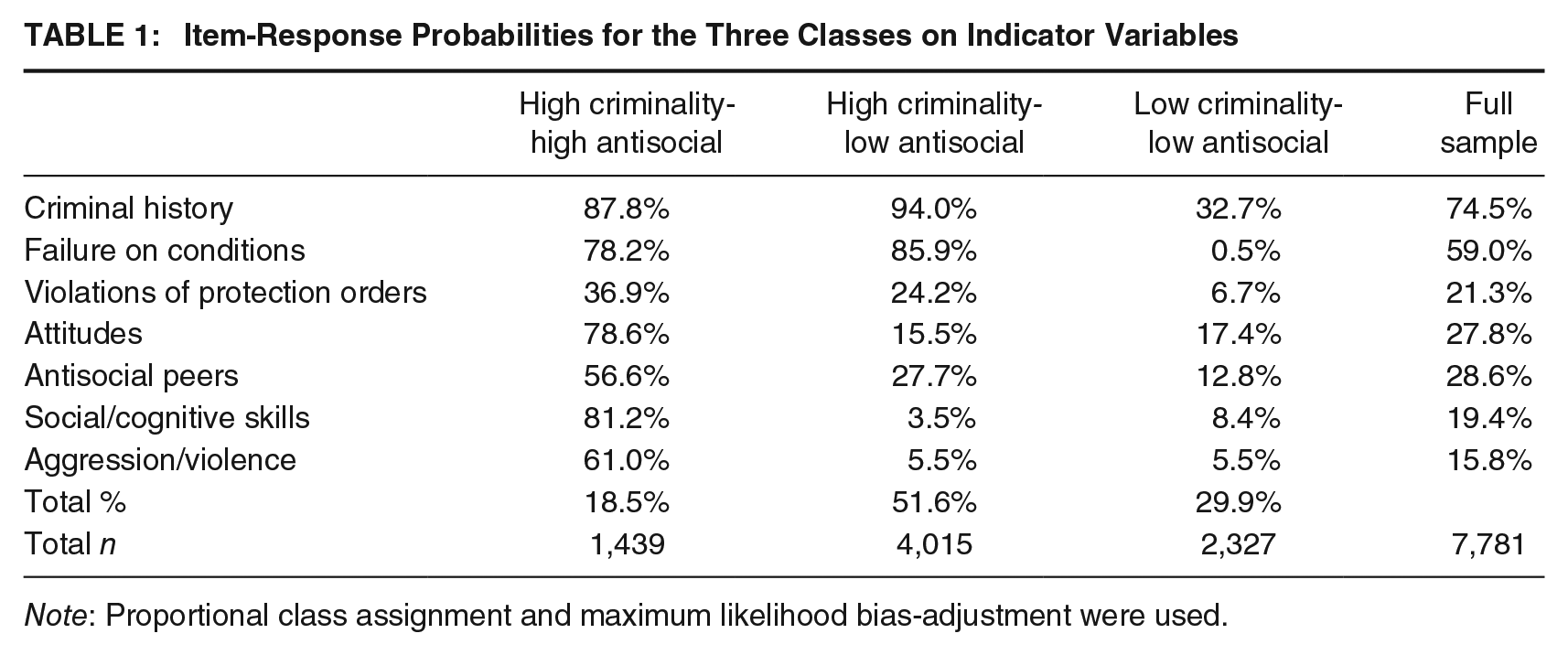
High Criminal History—High Antisocial Attitudes perpetrators were the smallest class, comprising 18.5% (n = 1,439) of the sample (Table 1). Although slightly lower than the High Criminal History—Low Antisocial Attitudes class, this group had a high probability of scoring moderate or high on criminal history static risk (87.8%) and previous failure while on conditions (failure to appear in court, technical violation, new offense, transfer to custody, or absconded) (78.2%). Over one-third (36.9%) had previous violations of no-contact or protective orders. The High Criminal History—High Antisocial Attitudes class is most distinguishable by a high probability of moderate to high scores on items pertaining to antisocial attitudes, personality pattern, and associates. This group had a 78.6% probability of holding procriminal attitudes (SPIn attitudes risk score; comprising law-abiding attitudes, acceptance of responsibility, attitude when engaged in criminal activity, commitment to a criminal lifestyle, attitudes toward the criminal justice system, lack of empathy, willingness to make amends, readiness to change, and program involvement). Relating to antisocial personality pattern, this class had an 81.2% probability of a moderate to high social/cognitive skills dynamic risk score (impulsivity, hostile attributions, consequential thinking, social-perspective taking, problem-solving, behavioral control, interpersonal skills, and goal-setting) and a substantially higher (61.0%) aggression/violence dynamic risk score (anger/frustration tolerance, belief in use of physical violence to solve conflict, belief in use of verbal aggression to solve conflict, and frequently in conflict with others) than the other classes. This group also had the highest probability of having antisocial peers (56.6%).
Item-Response Probabilities for the Three Classes on Indicator Variables
Note: Proportional class assignment and maximum likelihood bias-adjustment were used.
The High Criminal History—Low Antisocial Attitudes class comprised approximately half (51.6%, n = 4,015) of the sample. This group had the highest probability of a moderate or high score on criminal history static risk (94.0%) and the highest probability of previous failure while on conditions (85.9%). Notably, this group had the lowest (3.5%) probability of a moderate or high social/cognitive skills dynamic risk score and a very low probability (5.5%) of aggression/violence dynamic risk score.
The Low Criminal History—Low Antisocial Attitudes class comprised 29.9% (n = 2,327) of the sample. This class had the lowest probability of all seven indicator variables. About one-third (32.7%) of this group had a moderate or high criminal history static risk score, compared with the majority of the other two classes. Notably, members of this class had a less than 1% probability of previous failure while on conditions.
Table 1 displays the probability of the presence of the indicator variables for members of each class. A figure displaying item-response probabilities for the three classes on indicator variables is included in Supplemental Material 7.
Wald tests illustrate that all seven indicator variables are significant at the p < .001 level, thus indicating that they are useful in discriminating between the classes (see Supplemental Material 8). All (19 of 19) pairwise comparisons yield a statistically significant p-value, illustrating that the variables effectively discriminate between classes. Two indicators—attitudes and aggression/violence dynamic risk scores—effectively distinguished between the High Criminal History—High Antisocial Attitudes class and the other two classes, but not between the two classes with Low Antisocial Attitudes, as both groups had similarly low probabilities on these variables (see Supplemental Material 9).
Pearson’s chi-square significance tests were used to further assess whether there was a significant difference between the classes, and Cramer’s V was used as a test of the effect size to measure the strength of these associations. Chi-square tests for all seven indicator variables were significant at the p < .001 level, indicating a significant difference between one or more of the three classes on every variable. Using Cramer’s V, large effect sizes were found between the groups on five indicators: criminal history, failure while on conditions, attitudes, social/cognitive skills, and aggression/violence. The effect size for antisocial peers was medium, and the effect size for violations of protection or no-contact orders was small but significant (see Supplemental Material 10).
Comparing the Classes on External Variables (Research Question 2)
After classifying the 7,781 individuals according to the three-class model, relationships between the three classes and external variables (i.e., additional risk factors) were examined by comparing the classes on 14 dichotomous variables.
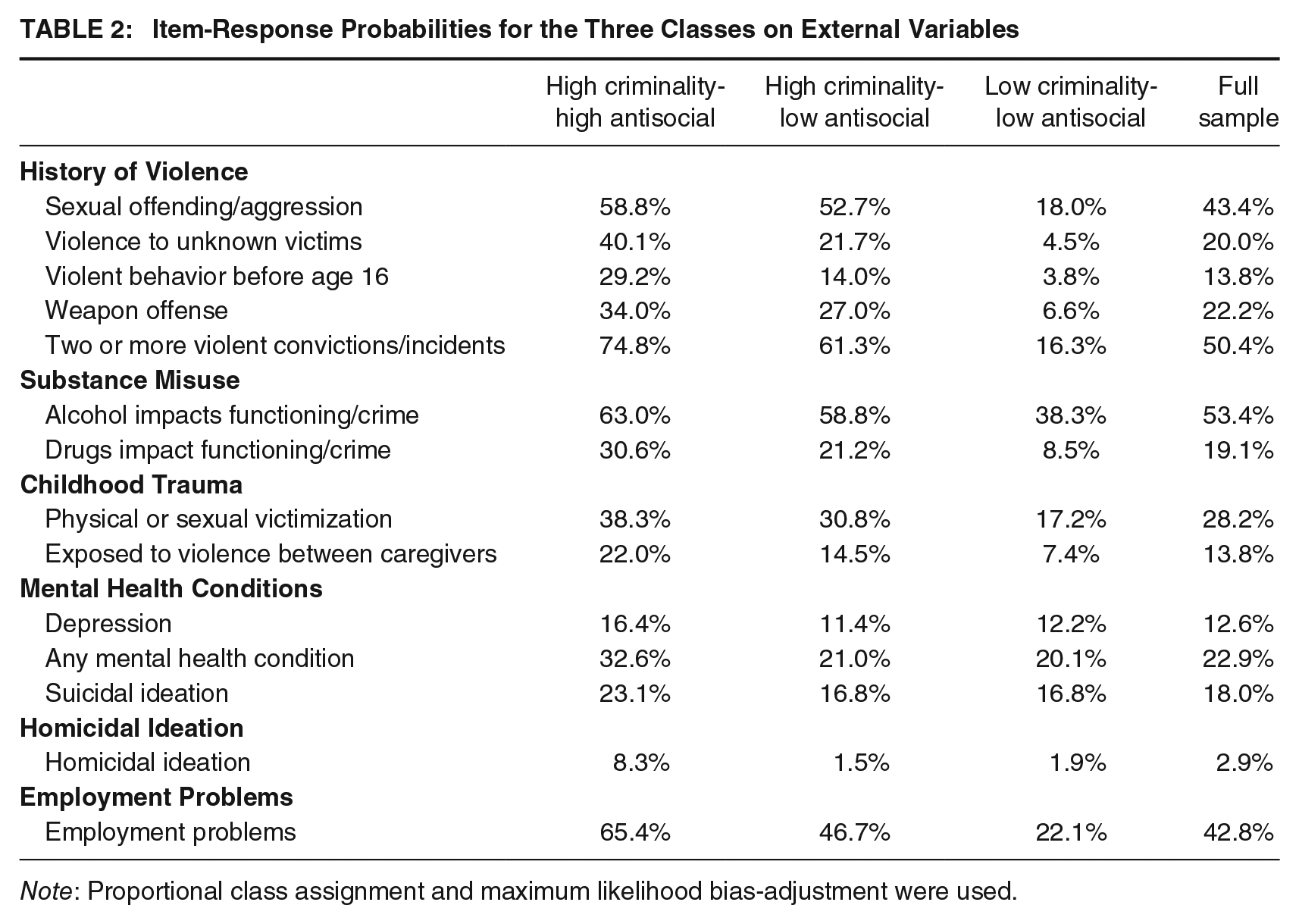
The High Criminal History—High Antisocial Attitudes class had a greater item response probability than the sample mean on every external variable in the analysis. The High Criminal History—High Antisocial Attitudes class scored higher than the other two groups on variables relating to antisocial personality pattern, including any violence to unknown victims, violent behavior before age 16, and two or more violent convictions/incidents. Also of note was the higher probability of employment problems and homicidal ideation displayed by the High Criminal History—High Antisocial Attitudes group, compared with the other two classes.
The High Criminal History—Low Antisocial Attitudes class scored median to the two other classes on all external variables, except for homicidal ideation, where the Low Criminal History—Low Antisocial Attitudes had a similarly low prevalence (1.5% vs. 1.9%). Both the High Criminal History—High Antisocial Attitudes and High Criminal History—Low Antisocial Attitudes groups scored higher than the sample mean and higher than the Low Criminal History—Low Antisocial Attitudes class on external variables relating to history of violence.
Table 2 displays the probability of the presence of external variables for members of each class. A figure displaying item-response probabilities for the three classes on external variables is included in Supplemental Material 11.
Item-Response Probabilities for the Three Classes on External Variables
Note: Proportional class assignment and maximum likelihood bias-adjustment were used.
Wald tests indicate that all 14 external variables are significant at the p < .001 level, indicating that these variables are effective for further differentiating between the derived classes (see Supplemental Material 12). Differences between classes on these variables were further explored using pairwise comparisons. Forty-one of 45 pairwise comparisons yield a statistically significant p-value, indicating that the classes differ significantly on the external variables. Four comparisons were significant at the p < .001 level between High Criminal History—High Antisocial Attitudes and the other two classes, but were not significant between the two classes with low antisocial attitudes: depression, any mental health problems, suicidal ideation, and homicidal ideation (see Supplemental Material 13).
Pearson’s chi-square significance tests for all 14 external variables were significant at the p < .001 level, indicating a significant difference between one and more of the three classes on every variable. Using Cramer’s V, a medium effect size was found between the groups on one variable (two or more violent convictions/incidents). Effect sizes for the three variables relating to mental health conditions (depression, any mental health condition, and suicidal ideation) were negligible; effect sizes for the remainder of the variables were small (see Supplemental Material 14).
Comparing the Classes on Recidivism Outcomes (Research Question 3)
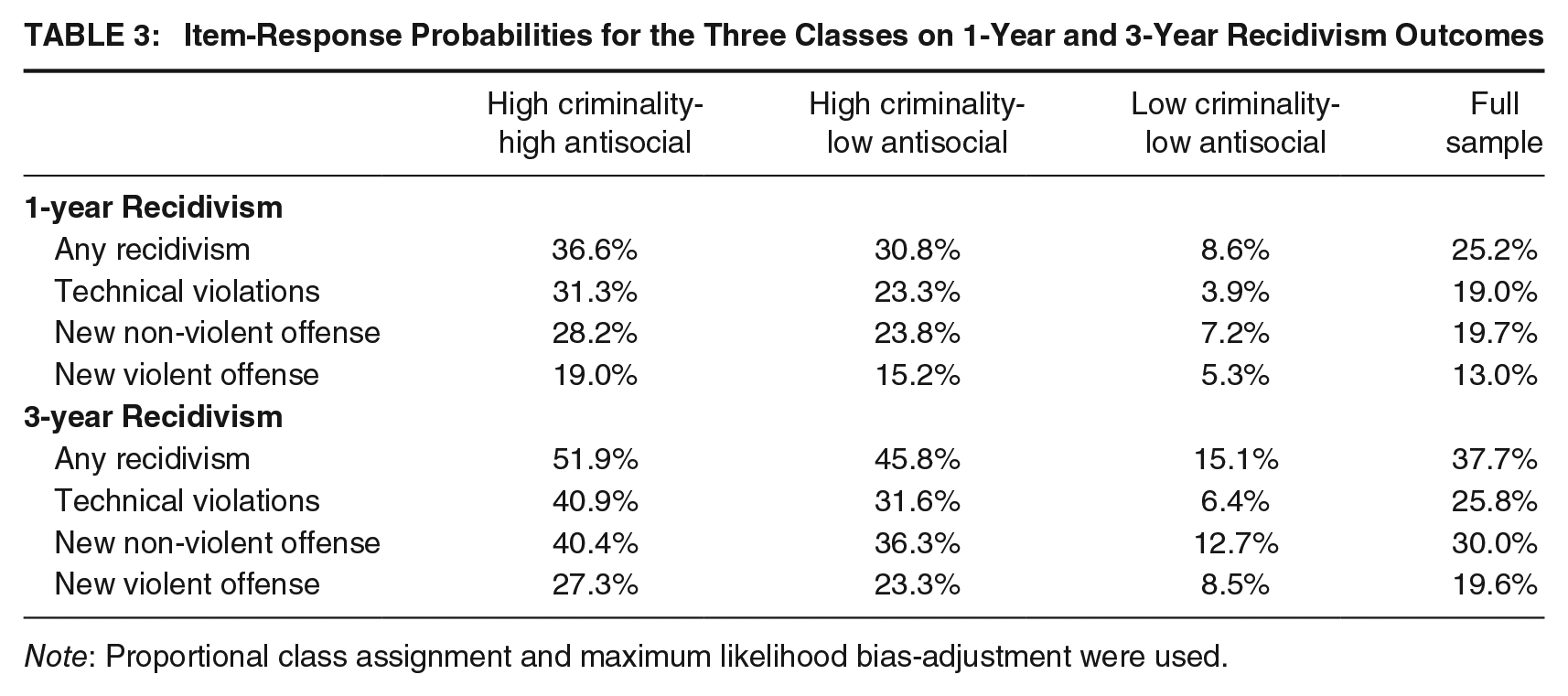
The classes were compared on four dichotomous general (i.e., not IPV-specific) recidivism outcomes (any recidivism, technical violations, new non-violent offenses, and new violent offenses) at 1 year and 3 years after assessment. The High Criminal History—High Antisocial Attitudes class had a higher prevalence than the other two classes on all recidivism outcomes, whereas the Low Criminal History—Low Antisocial Attitudes class scored lower than the other two. The High Criminal History—Low Antisocial Attitudes class scored intermediate to the two other classes on all measures of recidivism. Item response probabilities for the three classes on recidivism outcomes are displayed in Table 3. Figures displaying item-response probabilities for the three classes on recidivism at 1 and 3 years are included in Supplemental Materials 15 and 16.
Item-Response Probabilities for the Three Classes on 1-Year and 3-Year Recidivism Outcomes
Note: Proportional class assignment and maximum likelihood bias-adjustment were used.
Wald tests indicate that, at 1 and 3 years, differences between the classes on all recidivism outcomes were significant at the p < .001 level, thus demonstrating that the new typology was effective for predicting recidivism at 1 and 3 years (see Supplemental Material 17). Pairwise comparisons were employed to examine the differences between the individual classes on each of the recidivism outcomes. All paired comparisons were significant, with 22 of 24 significant at the p < .001 level. The remaining two comparisons, between the two High Criminal History classes (Classes 1 and 3) on new violent offenses (p = .01), and new non-violent (p = .02; see Supplemental Material 18) at 3 years, were also significant.
Pearson’s chi-square significance tests for all four recidivism outcomes (any recidivism, technical violations, new non-violent offense, and new violent offense) at 1 and 3 years were significant at the p < .001 level, indicating a significant difference between one or more of the three classes on every recidivism outcome. Using Cramer’s V, small effect sizes were found between the groups on all four recidivism outcomes at both time points (see Supplemental Material 19).
Discussion
The present study was the first Canadian study to create a typology of men who perpetrated IPV using a large (n = 7,781) sample. This study utilized data collected using the SPIn, a validated structured assessment protocol used to assess the risks and needs of justice-involved individuals. The advantages of the new typology include the expected ease of replication in future research, as well as potential clinical utility. The simplicity of the typology means that other samples could be classified the same way when the same information (i.e., criminal history, procriminal attitudes, procriminal associates, and antisocial personality pattern) is available.
Holtzworth-Munroe and Stuart (1994) wrote that typologies have limited utility if only employed for descriptive purposes; therefore, the goal of classifying perpetrators of IPV must be not only to demonstrate that perpetrators are a heterogenous population in terms of characteristics and behavior but also how information regarding difference can be utilized for case management, including more accurately predicting risk of recidivism and implementing strategies to reduce and manage risk. The present study adds to a small body of research that demonstrates that typologies can be used to predict recidivism (e.g., Cantos et al., 2019; Dutton et al., 2005; Eckhardt, Holtzworth-Munroe, et al., 2008; Eckhardt, Samper, et al., 2008; González-Álvarez et al., 2024; Huss & Ralston, 2008; R. R. Johnson & Goodlin-Fahncke, 2015; Peters et al., 2023; Petersson & Strand, 2017; Romero-Martínez et al., 2021). Previous typology studies that included a generally violent class reported that these individuals had higher rates of IPV recidivism (Cantos et al., 2019; Huss & Ralston, 2008; R. R. Johnson & Goodlin-Fahncke, 2015; Peters et al., 2023; Petersson & Strand, 2017; Romero-Martínez et al., 2021; Wexler, 2000) and general recidivism (Eckhardt, Holtzworth-Munroe, et al., 2008; Peters et al., 2023; Stalans et al., 2004; Wexler, 2000). Other typology studies have indicated that antisociality, instability (González-Álvarez et al., 2022), and anger expression (Eckhardt, Samper, et al., 2008) were associated with recidivism.
The new typology comprises three classes: High Criminal History—High Antisocial Attitudes, High Criminal History—Low Antisocial Attitudes, and Low Criminal History—Low Antisocial Attitudes. In this study, the three types differed significantly on all reoffending outcomes. High Criminal History—High Antisocial Attitudes was the smallest class, comprising 18.5% of the sample. This class had the greatest risk of (general) reoffending. This was indicated by higher rates than the other two classes on all four recidivism measures at 1 and 3 years after assessment. Over one-third (36.6%) of the High Criminal History—High Antisocial Attitudes men had committed some form of recidivism within the first year, and over half (51.9%) had recidivated within 3 years.
The High Criminal History—High Antisocial Attitudes class had the highest probability of one of the static risk factors, violations of protection or no-contact orders, used in the development of the typology; on the two other static risk factors (criminal history and failure while on conditions), this class scored between the other two classes. When compared on other static risk factors relating to history of violence (sexual offending/aggression, violence to unknown victims, violent behavior before age 16, weapon offenses, and two or more violent convictions/incidents), the High Criminal History—High Antisocial Attitudes class scored significantly higher than the other two classes.
High Criminal History—High Antisocial Attitudes individuals had a significantly higher prevalence of dynamic risks (i.e., criminogenic needs) used to develop the typology, including aggression/violence dynamic risk score, antisocial attitudes, antisocial personality patterns, and antisocial associates. This class also displayed a significantly higher prevalence of all other criminogenic needs explored in Research Question 2, including problematic alcohol and drug use, depression, mental health conditions, suicidal ideation, homicidal ideation, and employment problems. This class was also the most likely to have experienced physical or sexual victimization in childhood and have witnessed violence between their caregivers.
The High Criminal History—Low Antisocial Attitudes class comprised more than half (51.6%) of the sample. In terms of risk, this class scored intermediate to the two other classes on all measures of recidivism at 1 and 3 years. Nearly one-third (30.8%) of the High Criminal History—Low Antisocial Attitudes men had committed some type of recidivism within the first year, and nearly half (45.8%) had recidivated within 3 years. The High Criminal History—Low Antisocial Attitudes class had the highest prevalence among the classes of two static risk factors, criminal history and failure while on conditions. On the other static risk factors (violations of protection or no-contact orders, sexual offending/ aggression, violence to unknown victims, violent behavior before age 16, weapon offenses, two or more violent convictions/incidents, experience of physical or sexual victimization in childhood, and witnessing violence between their caregivers), the High Criminal History—Low Antisocial Attitudes class scored intermediate to the two other classes.
In terms of criminogenic needs, the High Criminal History—Low Antisocial Attitudes class scored intermediate to the other classes on employment problems and antisocial associates. The High Criminal History—Low Antisocial Attitudes class scored intermediate to the other two classes on the prevalence of other criminogenic needs, including problematic drug and alcohol use, although the difference between this class and the High Criminal History—High Antisocial Attitudes class in terms of alcohol use was not significant. Notably, this group had the lowest probability of a moderate or high social/cognitive skills dynamic risk score and a very low probability of a moderate or high aggression/violence dynamic risk score. The High Criminal History—Low Antisocial Attitudes class also had the lowest score on antisocial attitudes, although the difference in aggression/violence dynamic risk score and antisocial attitudes was not significantly different than the Low Criminal History—Low Antisocial Attitudes class. There was also no significant difference between this class and the Low Criminal History—Low Antisocial Attitudes class on depression, mental health conditions, suicidal ideation, and homicidal ideation.
The Low Criminal History—Low Antisocial Attitudes class comprised 29.9% of the sample. This class had the lowest risk of recidivism at 1 and 3 years after assessment. The Low Criminal History—Low Antisocial Attitudes class also had the lowest probability of all static risk factors used as indicator variables. About one-third of this group had a moderate or high criminal history static risk score, compared with the majority of the other two classes. The Low Criminal History—Low Antisocial Attitudes class also had the lowest probability of all static risk factors included as external variables.
Relating to criminogenic needs, the Low Criminal History—Low Antisocial Attitudes class scored lower than the other classes on antisocial associates, employment problems, problematic drug use, and problematic alcohol use (case management recommendations, including assessment, treatment and referrals, and supervision and risk management, for the three types are presented in Supplemental Material 20 and are discussed in more detail in Giesbrecht, 2024).
Similarities to Extant Typologies
Although this empirical typology does not replicate an existing typology, similarities exist between classes in the present typology and classes in extant studies. Sjödin and colleagues (2018) described two clusters: HAV (higher in aggression and violence) and LAV (lower in aggression and violence). HAV perpetrators had higher scores on all measures of anger, hostility, aggression, and psychopathic traits than the LAV group. The High Criminal History—High Antisocial Attitudes class in the present study had higher scores than the other two classes on variables relating to violence and aggression and antisocial personality pattern. As with both High Criminal History types (High and Low Antisocial Attitudes) in the present study, the HAV group had more previous offenses and convictions. High Criminal History and HAV individuals were more likely to have experienced victimization in childhood. The Low Criminal History—Low Antisocial Attitudes class in the present study had a lower probability of the presence of all indicator variables and all external variables than the two High Criminal History groups. This was also the case for Sjödin et al.’s (2018) LAV in relation to the HAV type.
González-Álvarez et al. (2022, 2024) found four classes differentiating perpetrators on high/low instability and high/low antisociality: LiLa (low instability/low antisociality), LiHa (low instability/high antisociality), HiLa (high instability/low antisociality), and HiHa (high instability/high antisociality). As with the Low Criminal History—Low Antisocial Attitudes class in the present study, González-Álvarez et al.’s (2022) LiLa group had lower probabilities of all risk factors. The two groups with high levels of antisociality identified by González-Álvarez et al. (2022; HiHa and LiHa) had similarities with both High Criminal History classes in the present study, including criminal history, past failures while on conditions, history of violent behavior, and sexual aggression. Like the High Criminal History types, HiHa individuals were more likely to have more substantial criminal histories, have used weapons, have been victimized in childhood, and have issues with substance abuse. González-Álvarez et al. (2024) found that HiHa perpetrators were the most likely to violate protective orders; in the present study, both High Criminal History classes have a history of failure while on conditions and of violating no-contact or protective orders. Although the High Criminal History—High Antisocial Attitudes class had the highest rate of all forms of recidivism, both High Criminal classes had substantially more recidivism than the Low Criminal History—Low Antisocial Attitudes class, including technical violations at 1 and 3 years. Furthermore, both High Criminal History—High Antisocial Attitudes and HiHa were more likely than the other classes to have mental health conditions.
The High Criminal History—High Antisocial Attitudes class and González-Álvarez et al.’s (2024) two classes with high antisociality (HiHa and LiHa) can be distinguished from the other classes in the typologies by their antisocial attitudes. González-Álvarez et al. (2024) also found antisociality to be associated with recidivism, as HiHa and LiHa perpetrators had the highest rate of reoffending. In the present study, High Criminal History—High Antisocial Attitudes men had substantially higher scores on all indicator variables and external variables relating to antisocial personality pattern and had the highest rate of recidivism among the three classes on all outcome measures at both time points.
Different measures and analysis strategies result in the creation of different typological solutions or different classifications of individuals. Men in this study would be classified as other types if assessed using a different typology. There are similarities between the three classes derived in the present study and various types detailed in the other typology studies (e.g., reactive, generally violent, low-level antisocial, situational couple violence).
Similarities Between High Criminal History—High Antisocial Attitudes and Reactive Perpetrators
Regarding similarities with extant typologies, the High Criminal History—High Antisocial Attitudes class had an 81.2% probability of a moderate or high social/cognitive skills dynamic risk score (impulsivity, hostile attributions, consequential thinking, social-perspective taking, problem-solving, behavioral control, interpersonal skills, and goal-setting; vs. 3.5% and 8.4% for the other two classes [Table 1]). Impulsivity, hostility, and challenges with behavioral control are hallmarks of reactive/impulsive/under-controlled perpetrators (Babcock et al., 2023; Ennis et al., 2017). Reactive perpetrators have been reported to perpetrate more general violence; the High Criminal History—High Antisocial Attitudes group had a significantly higher rate of violence against unknown victims. Reactive perpetrators are also more likely to misuse alcohol, as are High Criminal History—High Antisocial Attitudes individuals. Previous research stated that reactive perpetrators were more likely to have experienced trauma or abuse in childhood; individuals with High Criminal History—High Antisocial Attitudes were significantly more likely to have experienced physical or sexual abuse in childhood and to have witnessed violence between their caregivers. 7
Information required to align the classes in the present typology with traits of instrumental perpetrators (such as having psychopathic traits, narcissistic traits, and using violence in a way that is goal-oriented and calculated) was not available. Some previous studies have identified instrumental perpetrators as having antisocial traits, attitudes that are more supportive of IPV, and higher overall risk scores. It is possible that if the men in the present sample were classified as reactive or instrumental, some of the men classified as High Criminal History—High Antisocial Attitudes would be classified as instrumental, and the majority would fit the reactive classification. It is also possible that individuals in the High Criminal History—Low Antisocial Attitudes and Low Criminal History—Low Antisocial Attitudes types may overlap with both classes. It is not possible, however, to make such a determination without more information regarding specific uses of and motives for IPV.
Similarities Between High Criminal History—High Antisocial Attitudes and Generally Violent Perpetrators
In the present study, data were not available to classify perpetrators as family/partner-only (having perpetrated IPV but no violence to non-familial victims) or generally violent (history of violence to intimate partners as well as non-familial victims). All individuals in the present sample (n = 7,781) had perpetrated IPV. Approximately half of the sample had two or more violent convictions or incidents; however, data were not available to identify the victims of these incidents. It is likely that for some individuals in the sample, all convictions/incidents related to violence against their intimate partner, whereas others had also used violence toward others. Twenty percent (20.0%) of the sample had previous violence toward unknown victims; High Criminal History—High Antisocial Attitudes perpetrators were twice as likely (40.1%) to have committed violence against unknown victims. It was not possible, however, to identify individuals with a history of perpetrating violence against known but non-partner victims.
Prior research demonstrates that generally violent perpetrators are assessed as higher-risk than family-only perpetrators. Generally violent men have extensive criminal histories with more arrests and convictions and more previous violent offenses. In the present study, although the High Criminal History—Low Antisocial Attitudes group tends to score higher in terms of criminal history, High Criminal History—High Antisocial Attitudes individuals have higher rates of past offenses, including adjudications for violence before the age of 16. In terms of recidivism outcomes, the High Criminal History—High Antisocial Attitudes class has the highest rate of all four forms of recidivism, followed by the High Criminal History—Low Antisocial Attitudes class. The Low Criminal History—Low Antisocial Attitudes class has substantially lower rates on all these factors. Generally violent men have also been reported to perpetrate more sexual violence and more violence with a weapon. In the present typology, High Criminal History—High Antisocial Attitudes men have higher rates of both, closely followed by the High Criminal History—Low Antisocial Attitudes group (Low Criminal History—Low Antisocial Attitudes individuals have substantially lower rates).
Generally violent men have higher levels of antisocial traits and behavior, as well as more hostility, impulsivity, behavioral disinhibition, and lower frustration tolerance. Generally violent perpetrators also hold pro-criminal attitudes and have negative attitudes toward the criminal legal system. In this regard, generally violent men are similar to the High Criminal History—High Antisocial Attitudes men, who score higher on procriminal attitudes and antisocial personality pattern.
Generally violent individuals are more likely to have experienced childhood abuse, been exposed to violence in their family of origin, and to have displayed conduct disorder or delinquent behaviors as youth. Generally violent perpetrators have more lifestyle risk factors, including frequent unemployment, deviant peers, and problematic alcohol and/or drug use. In the present typology, High Criminal History—High Antisocial Attitudes perpetrators have more antisocial peers, more challenges with employment, and more reports of alcohol and drugs impacting functioning and/or influencing criminal behavior (Aguilar Ruiz & González-Calderón, 2022; Cantos et al., 2019; Carbajosa, Catalá-Miñana, Lila, & Gracia, 2017; R. R. Johnson & Goodlin-Fahncke, 2015; Peters et al., 2023; Petersson & Strand, 2017, 2020; see Note 7).
Another typology commonly replicated in the literature is a three-class typology, including family-only, generally violent, and borderline/dysphoric or emotionally volatile types. Although similarities are present between the new typology and existing three-class typologies that find higher-risk (generally violent) and lower-risk (family-only) categories of perpetrators with a third type that scores intermediate to the other two (borderline/dysphoric), it was not possible with the present dataset to assess parallels between men in this sample and those identified as borderline/dysphoric (e.g., borderline traits or diagnosis of borderline personality disorder, personality traits, presence of specific personality disorders, attachment styles/issues).
Similarities Between High Criminal History—Low Antisocial Attitudes and Low-Level Antisocial Perpetrators
Some studies have identified a group of low-level antisocial perpetrators that score higher on measures of antisocial traits than family-only perpetrators but lower than generally violent perpetrators (Holtzworth-Munroe et al., 2000; Eckhardt, Holtzworth-Munroe, et al., 2008; Huss & Ralston, 2008; R. R. Johnson & Goodlin-Fahncke, 2015; Romero-Martínez et al., 2021; see Note 7). This group falls intermediate to family-only perpetrators and generally violent perpetrators in terms of risk level, criminal behavior, violence outside the home, and substance misuse. Given that the High Criminal History—Low Antisocial Attitudes class in the present study scores higher than the High Criminal History—High Antisocial Attitudes class in relation to criminal history static risk score and previous failure while on conditions, and lower than the High Criminal History—High Antisocial Attitudes group on all other indicator variables, all external variables, and all recidivism outcomes, it is plausible that the High Criminal History—Low Antisocial Attitudes group would be analogous to the low-level antisocial group that falls between the generally violent and family-only classes in other studies.
Situational Violence and Coercive Control
Although studies of perpetrators of situational violence and coercive control identify other traits that are common among members of both groups, the most important distinction between the two types is the coercive controlling perpetrator’s motivation to dominate their partner and control multiple aspects of their life. Situational violence can be severe and pose a high risk of danger, but is not rooted in the motivation to control (M. P. Johnson, 2006). The dataset used in the present study did not include data that would make it possible to assess motivation or specific IPV behaviors; as such, it is unknown how the individuals classified as High Criminal History—High Antisocial Attitudes, High Criminal History—Low Antisocial Attitudes, and Low Criminal History—Low Antisocial Attitudes would be categorized in terms of situational violence and coercive control. Studies of coercive control have identified that perpetrators of this form of IPV minimize, deny, and do not take responsibility for their violence and are not motivated to change their behavior (Hardesty et al., 2015; M. P. Johnson, 1995, 2006; see Note 7). Although the SPIn attitudes dynamic risk score relates to criminal offending generally (and not IPV specifically), this score includes (lack of) acceptance of responsibility, empathy, willingness to make amends, readiness to change, program involvement, as well as factors relating to attitudes regarding criminal behavior. The High Criminal History—High Antisocial Attitudes type scores substantially higher on this indicator variable than the other two groups.
Strengths and Limitations
The use of the secondary dataset was a strength, as this offered the opportunity to conduct research using assessment and recidivism data from a large sample of men who had perpetrated IPV. The study also offered the opportunity to create a typology with data that is widely collected by and available to professionals within the criminal legal system.
Limitations in the present study are common in research with secondary data (Hilton et al., 2023). These secondary file data were collected using the SPIn for case management purposes, not for research purposes. As this study relied on data from one assessment (the SPIn), it was not possible to examine some of the variables found to be of importance in previous typological studies (such as details regarding incidents of IPV, forms of violence enacted, information regarding motivation for IPV [e.g., coercive control, reactive or impulsive violence], or personality traits). Although the new typology effectively predicted recidivism on four measures of general recidivism, data pertaining to IPV reoffending were not available.
A challenge in IPV research, more generally, is that the majority of incidents of IPV are not reported (Burczycka, 2016), not all forms of IPV are captured in police data, and there are differences in characterizations of violence and reports of recidivism in victim reports when compared with official reports and self-reports (Arce et al., 2020; Cheng et al., 2021). This means that the full extent of recidivism is not captured in official data sources. There is a possibility that some perpetrators of IPV may be less likely to come to the attention of law enforcement (potentially those who are classified as Low Criminal History—Low Antisocial Attitudes in the present study); therefore, official records may not accurately represent these individuals’ history of violence. Future studies that classify men according to the typology presented in this study would benefit from the incorporation of corroborating sources of information, such as survivor reports.
Future Directions
Given that the new typology was created using archival data collected from men who were in contact with community corrections in Alberta, it is necessary to test the typology with other samples, including additional community corrections samples and treatment samples. It is probable that if classifying different samples (e.g., men who voluntarily entered a counseling program, clients mandated to treatment, federally incarcerated individuals) according to the typology presented in this article, different proportions would be found for the three classes. Factors that are prevalent among one group may not be present in another sample. For example, three-quarters (74.5%) of the sample in the present study had a moderate or high score on the dichotomized criminal history static risk score variable, and 59.0% had a history of failure while on conditions. It is likely that these proportions would be even higher among a federally incarcerated sample but lower among a self-referred sample recruited from the community. Further research is needed to determine if the High Criminal History—High Antisocial Attitudes, High Criminal History—Low Antisocial Attitudes, and Low Criminal History—Low Antisocial Attitudes classes would be found, and the proportions of these classes, if classifying other samples using the same indicators.
As the present study used assessment data collected using the SPIn, information regarding participation in IPV treatment interventions and treatment outcomes was not available. The present study found significant differences between the three classes on four forms of general recidivism (any recidivism, technical violations, new non-violent offenses, and new violent offenses) at 1 year and 3 years after assessment. Future research should attempt to replicate the new typology with a treatment sample to determine if the typology can effectively differentiate groups of perpetrators in another sample; evaluate if the three classes display significant differences on measures of treatment outcomes, such as attrition (program completion, drop-out, or termination), number of sessions attended, difference in scores on pre- and post-treatment measures, reduction/continuation of violent behavior, and treatment compliance/non-compliance; and assess if recidivism outcomes are impacted by treatment completion for each of the classes.
Data to differentiate individuals who were only violent to their intimate partners from those who were also violent to others were not available in the present dataset (beyond the “unknown victims” variable). Furthermore, data relating to the perpetration of child abuse and animal maltreatment were not available in the dataset used to create the new typology. Previous researchers have demonstrated differences between men who perpetrate IPV and men who perpetrate IPV as well as violence against non-familial victims. It is also likely that factors exist which differentiate men who make a choice to also target children or animals from those who confine their violence to their partner. The inclusion of variables to identify the presence of, as well as different forms of, concurrent child maltreatment and animal maltreatment in future research is expected to further clarify differences between these classes of perpetrators.
Supplemental Material
sj-pdf-1-cjb-10.1177_00938548251362812 – Supplemental material for A New Typology of Men who Perpetrate Intimate Partner Violence: Differentiating Perpetrators Based on Criminal History and Antisocial Attitudes
Supplemental material, sj-pdf-1-cjb-10.1177_00938548251362812 for A New Typology of Men who Perpetrate Intimate Partner Violence: Differentiating Perpetrators Based on Criminal History and Antisocial Attitudes by Crystal J. Giesbrecht, Leslie Anne Keown and Kaila C. Bruer in Criminal Justice and Behavior
Footnotes
Authors’ Note:
This research was supported by a Vanier Canada Graduate Scholarship (Social Sciences and Humanities Research Council; SSHRC) awarded to Crystal J. Giesbrecht and is based on Crystal J. Giesbrecht’s doctoral dissertation, co-supervised by Kaila C. Bruer and Leslie Anne Keown. This article is dedicated to Rick Ruddell, who supervised the planning stages of this study. The authors would like to thank Orbis Partners and Alberta Public Safety and Emergency Services for providing access to the SPIn and reoffense datasets. This study was conducted in cooperation with Alberta Public Safety and Emergency Services. The interpretations and conclusions contained herein are those of the researchers and do not necessarily represent the views of the Government of Alberta. Neither the Government of Alberta nor Alberta Public Safety and Emergency Services have expressed an opinion in relation to this study. The authors have no conflicts of interest to disclose.

Notes
References
Supplementary Material
Please find the following supplemental material available below.
For Open Access articles published under a Creative Commons License, all supplemental material carries the same license as the article it is associated with.
For non-Open Access articles published, all supplemental material carries a non-exclusive license, and permission requests for re-use of supplemental material or any part of supplemental material shall be sent directly to the copyright owner as specified in the copyright notice associated with the article.
