




Abstract
This study compares Taiwanese male and female police officers’ work stress and coping strategies during the COVID-19 pandemic. Data derived from 1,329 male and 225 female police officers between May and July 2021, during the COVID-19 pandemic. It was found that male officers experienced more family-work stress than their female colleagues. Male officers were more likely to engage in avoidance coping and used humor to cope with stress. On the contrary, female officers were more inclined to adopt emotion regulation strategies and distraction to cope with stress. Supervisor support was found to be positively associated with officers’ well-being and negatively connected with officers’ stress. Humor and self-distraction were found to be positively associated with officers’ well-being, whereas avoidance and negative stressor appraisal of COVID-19 were negatively connected with well-being. Policy implications and suggestions for future research are discussed.
Policing is generally seen as one of the most stressful occupations (Siu et al., 2015; Toch, 2002; Varker et al., 2023). In their line of work, police are often exposed to dangerous and traumatic incidents (Andersen et al., 2015; Arble et al., 2018). Their work includes handling traffic accidents and domestic violence cases, investigating crime scenes, and working with traumatized victims (Arble et al., 2018; Gutschmidt & Vera, 2022; Huey & Kalyal, 2017). And during health emergencies, police serve as first line responders, assuming expanded responsibility of working with public health officials to contain the spread, of some virus and to enforce relevant mandates (Jennings & Perez, 2020).
Since the beginning of 2021, the COVID-19 pandemic posted unprecedented challenges to first line responders around the world. As an important group among the first responders during the pandemic, police had to face unpredictable circumstances and possibilities of contracting the virus. Some studies have examined factors that affect police officers’ well-being and stress during the pandemic, but very few studies focus on sex-differences in coping strategies and mental health. Also lacking is an understanding of whether certain coping strategies, in a traumatic time, are more effective in reducing work-related stress and enhancing different dimensions of officers’ well-being. Frenkel and colleagues (2021) have highlighted the importance of understanding officers’ stress experiences and coping resources in such times. Stogner and colleagues (2020) recommended that future research examine sources of stressor as well as healthy and unhealthy coping to allow for preparedness of proper resources for reducing officers’ stress during health crises. Clifton and colleagues (2018) also noted that understanding how male and female officers cope with stress is vital because some ineffective coping strategies may be associated with compromised mental health.
Studies have shown that women police may experience types of stress that are different from those of their male colleagues (Hassell et al., 2011). Bonner and Brimhall (2022) suggested that future study should consider examining whether male and female officers vary in their perceptions of stressors. To date, only a few studies focus on sex-based differences in perceived stress and coping strategies among police officers (e.g., Bonner and Brimhall, 2022). To the author’s best knowledge, none of these have explored such topic during the COVID-19 pandemic. To bridge the gap in literature, this study examines male and female police officers’ well-being and coping strategies in Taiwan during COVID-19 pandemic.
Taiwan police played a crucial role in pandemic prevention and control. Their extra duties have included enforcing mandatory mask policy, maintaining security for quarantine facilities, check-ins on arrival of foreign travelers, assisting them during their quarantine, using technology to trace contacts between those in mandatory quarantine and isolation, and investigating malicious spread of disinformation. In addition to performing existing preventive and control duties, police frequently conducted random inspections on entertainment venues that may pose greater risk of infections (National Police Agency [NPA], 2021a).
There are several purposes in this study. First, it aims to explore whether male and female officers differed in various aspects of mental health during the virus outbreak. Second, it assesses whether organization-related factors identified in past studies, such as police identity and supervisor support, affected officers’ well-being during the pandemic. Third, it examines whether male and female officers used different strategies to cope with stress during that time. Fourth, it investigates whether different coping strategies yielded different effects on officers’ mental health. The findings of this study can help police administrations develop gender-sensitive training programs to enhance coping skills and to enable them to deal with future health emergencies or other crises.
Literature Review
General Stressors Encountered by Police and Relevant Coping
Studies show some factors (e.g., organization-related factors) may affect officers’ stress. Supervisors can directly impact the well-being of employees, especially in such issues of work-family conflict, stress, job satisfaction and turnover intent (Hämmig, 2017). Social exchange theory posits that good supervisors can create positive interactions with their subordinates, leading to beneficial behavior for the whole organization (Brunetto et al., 2017; Cropanzano & Mitchell, 2005). Supervisors’ support, such as provision of suitable job resource and information/knowledge, can serve as a buffer from stressors (Brunetto et al., 2014, 2017). Studies reveal that the work environment in law enforcement connects directly with officers’ stress levels (Kula, 2017; Schwabe et al., 2001). Effective leadership can mitigate stress, especially when employees must handle many tasks with time restraints (Wicks, 2005). Studies also show that the lack of supervisor support is one of the prominent job stressors reported by officers (Blum, 2000; Johnson, 2015; Seltzer et al., 1996).
Except for supervisor support, studies have found other factors, such as identity with police and officer’s sex may also affect officers’ stress level. Existing studies examining the relationship between identity and stress in policing yield findings somewhat inconsistent. Some suggest that self-identity exerts a beneficial effect on work performance and commitment (Diefendorff et al., 2002; Lambert et al., 2015; Schaible, 2018). Other studies observe a negative effect of self-identity and even emotional exhaustion, especially when officers must carry out duties that conflict with their self values (Schaible, 2018; Schaible & Gecas, 2010).
Previous studies found that women working in historically male-dominated occupations, such as policing, may experience challenges unlike those of their male colleagues. For example, Veldman and colleagues (2017) note that differences in team members concerning gender in policing affect women’s but not men’s perception of gender-work identity. They further reveal that individuals who experience gender-work conflict may be less likely to develop attachment to their team. Blasdel (2010) pointed out that one of the challenges that women face in policing is males’ reluctance to be receptive to women (Rabe-Hemp, 2008; Yu, 2015). Colleagues and supervisors may be less supporting or accepting of female officers, which can lead to increased stress (Acquadro Maran et al., 2015; Berg et al., 2006). There is also a higher prevalence among female police officers to perceive a lack of supervisor support (e.g., Violanti et al., 2016). These studies suggest that female police officers experience more strain than their male colleagues due to a lack of supervisor support and gender-work identity conflict.
Studies have found that workers with more experience reported lower levels of stress, compared to those with less experience (e.g., Acquadro Maran et al., 2015). Some studies indicate an association between rank and stress. In a study conducted with 201 police officers in Athen, Greece, Alexopoulos and colleagues (2014) found that higher rank officers experienced higher levels of stress.
Positive and Negative Coping
Coping refers to the ability to manage stressful emotional state and to handle disagreeable events from which such emotions originate. Coping reflects an individual’s use of cognitive or behavioral methods that help develop resources or manage environmental demands (Anshel et al., 2013). Problem-focused coping, conceived as proactive responses to stress, aims at stressor itself and seeks ways to remove, elude or reduce the impact of the stressor. Emotion-focused coping, focusing on diminishing distress, includes a variety of responses, such as relaxation, seeking emotional support, and expressing negative feelings (Carver & Connor-Smith, 2010). Research has shown that positive coping relates to lower stress and optimistic well-being among police officers (e.g., Salinas & Webb, 2018). Humor, too, has been recognized as one of the coping mechanisms for dealing with traumatic stress. Some Holocaust survivors indicated that they used humor to survive and cope with the stress in concentration camp (Lipman, 1991; Papazoglou & Andersen, 2014). In a similar vein, Riolli and Savicki (2010) found humor and emotional social support were associated with a reduced level of overall psychological symptoms (measured by the scales of somatization, obsessive compulsive, interpersonal sensitivity, depression, anxiety, hostility, phobic anxiety, paranoid, and psychoticism) among the US soldiers stationed in Iraq. Salinas and Webb (2018) also found humor is related to a reduced level of stress among police officer in Texas.
Distraction is usually regarded as a negative way of coping. Some studies show disengagement is associated with higher levels of psychological distress and lower levels of quality of life (Langford et al., 2017; Shapiro et al., 2010). Nevertheless, Waugh and colleagues (2020) note that not all disengagement coping strategies are alike. While avoidance may be a negative coping strategy, positive distraction can be an effective coping strategy.
Avoidance is usually seen as a negative coping strategy. Studies have found that avoidant or negative coping correlates with higher levels of work stress, negative psychological outcomes, and low job satisfaction (Gershon et al., 2009; Kazmi & Singh, 2015; Ménard & Arter, 2013; Padyab et al., 2023). Previous research identified a connection between the use of avoidant strategy and higher degrees of organizational stressors (Gutschmidt & Vera, 2022; Pasillas et al., 2006).
Coping Strategies Among Male and Female Officers
Studies have found that positive coping strategies are associated with a lower level of stress for police officers and other professionals (e.g., Vaezi & Fallah, 2011). Arble and colleagues (2018) indicate that some police officers may depend on avoidant strategies, such as drinking alcohol or avoiding discussing their negative experiences or emotions. Past studies have found that female officers are more likely to use emotion-focused coping strategies or to seek social support (Bonner & Brimhall, 2022). On the contrary, males are found to be more likely to use problem-based coping strategies. Bonner and Brimhall (2022) examined male and female police officers’ perceived stress and coping strategies in an urban police department in the United States. They found that compared to their male colleagues, female officers scored higher in several dimensions of stressor and were more prone to use positive coping strategies. Analyzing survey data from 917 Swedish police officers, Arble and colleagues (2018) found male and female officers differed in coping strategies responding to stress. Compared to their male colleagues, female officers were less likely to use avoidant coping strategies. They also found that avoidant coping strategies were significantly associated with poor well-being.
Stress and Coping Under Unusual Circumstances (e.g., COVID-19 Pandemic)
Despite increased scholarly attention to investigating various sources of officers’ stressor, only a few studies specifically examine factors affecting officers’ stress and subsequent coping under unusual circumstances, such as the COVID-19 pandemic. Analyzing data with surveys conducted with officers in Austria, Germany, Switzerland, the Netherlands, and Spain, Frenkel and colleagues (2021) found that female officers were more strained during COVID-19 pandemic than their male counterparts. They also found that officers who appraised COVID-19 pandemic as stressful, threatened, and uncontrolled and those who used maladaptive coping strategies were more likely to experience stress. In addition, they found adaptive emotion-focused coping was associated with enhanced well-being and reduced stress during the COVID-19 pandemic. Jiang (2021) found that work adaptation was negatively associated with stress response among Chinese officers during the COVID-19 pandemic.
Some studies suggest that distraction can be adaptive if it is a temporary re-direction of one’s attention to something else for a short period of time, with the intent to reconnect with some challenging circumstances in the near future (Wolgast & Lundh, 2017). Similarly, in a recent study, Waugh and colleagues (2023) found that distraction was an effective strategy for coping with the stressors from the pandemic; distraction was significantly related to increased positive emotions. They suggested that people may select and adopt different strategies to cope with different stress. A pandemic like COVID-19 that triggers stressor of high uncertainty and lasting intensity may inspire people to choose distraction as a coping strategy to temporarily disconnect with the reality (Waugh et al., 2023).
The Current Study
As shown in the literature review, most existing studies have examined general stressors encountered by officers, along with their own coping strategies. Although some studies look into factors affecting officers’ stress during the COVID-19 pandemic, relatively little research has examined how officers coped with stress during the pandemic. The research assumptions in this study, regarding factors influencing officers’ stress, are guided by studies made during the COVID-19 pandemic. DeLongis and Newth (2001) argue that coping–cognitive or behavioral response to usual or stressful circumstances should be flexible. An individual should be able to adapt his or her strategy to changes in the circumstances. It is thus reasonable to suppose that coping in general is applicable to unusual circumstances. Due to the lack of studies specifically focusing on officers’ coping during the outbreak, assumptions regarding coping are generated mainly based upon the findings of studies on officers’ coping in general.
Frenkel and colleagues (2021) found that female officers, during the COVID-19 pandemic, were more strained than their male colleagues. Thus, the first hypothesis in this study predicts that there is a significant difference between male and female officers’ well-being during the pandemic. As identified by Kyprianides et al. (2021), police identity may relate to officers’ mental health during the pandemic. Similarly, Jiang (2021) found that Chinese officers’ stress response was negatively associated with emotional identity of profession and work adaptation during the virus outbreak. Consequently, the second hypothesis expects that police identity would have a positive effect on officers’ mental health. Some previous studies have found that supervisor support exerted a beneficial effect on officers’ work performance during the pandemic (e.g., Li et al., 2022). Accordingly, the third hypothesis assumes that supervisor support has a positive effect on officers’ mental health.
Previous studies have found that men were more likely to employ problem-focused coping, while women were more likely to use emotion-based strategies to cope with stress (e.g., Bonner & Brimhall, 2022). The fourth hypothesis subsequently expects that male and female officers would use different strategies to cope with stress during the pandemic. Finally, studies infer that adaptive coping would generate positive effects on mental health, while maladaptive coping would have negative psychological consequences (Frenkel et al., 2021; Jiang, 2021; Kirby et al., 2011; Shakespeare-Finch et al., 2002). The fifth hypothesis thus expects that positive coping strategies would have a beneficial effect on mental health. And the sixth hypothesis predicts that negative coping has an adverse impact on officers’ mental health. This study also includes several control variables that are not connected to the research hypotheses but are possibly linked to well-being, such as job post, region, rank, and education level.
Data and Methods
This study is a part of a project entitled “Policing during COVID-19 pandemic in Taiwan” that aims to understand Taiwanese police officers’ accessibility of COVID-19 information, health training, support and equipment along with their quarantine duties, self-protective measures, organizational co-ordination, perceived fear and stress, coping mechanism, and so forth (Chu, 2023). Data were collected via an online survey. A hyperlink to the survey was sent to several police discussion groups via Line, a popular social media in Taiwan, between mid- June and early July 2021, during level three alert of the COVID-19 pandemic. There are four epidemic warning levels with level one as the lowest alert and level four as the highest. At the start of the pandemic, the country was doing well in containing COVID-19, but after mid-May 2021, there was a spike in infections. The Central Epidemic Command Center raised the epidemic prevention restrictions to level three on 15 May 2021, first in Taipei and New Taipei, and then expanded nationwide on 19 May 2021, which lasted until 12 July 2021 (Executive Yuan, 2021). Restrictions imposed during level three alert included mandatory mask-wearing at all times, indoor and outdoor gatherings limited to five and 10 people, respectively, and closure of business and public venues-with the exception of essential services like police departments, hospitals and government buildings (Everington, 2021). Police also enforced the above-mentioned level three alert restrictions.
During this period, many officers served as the first responders, facing tremendous pressure due to increased spread of virus and many uncertainties to the pandemic. Some officers not only participated in the on-line survey themselves, but also voluntarily circulated the link to their colleagues. Officers expected such research will help policy makers and administrations to understand their pressure and problems that they encountered. Within the first 3 days since the links were posted, more than a thousand officers completed the online surveys voluntarily. In total, 1,582 on-line surveys were completed. After eliminating respondents who were not police officers (e.g., police college students or firefighters) or repeatedly filled-in surveys detected by the IP record, there were 1,554 usable surveys (1,329 males and 225 females).
Measurement
Dependent Variables
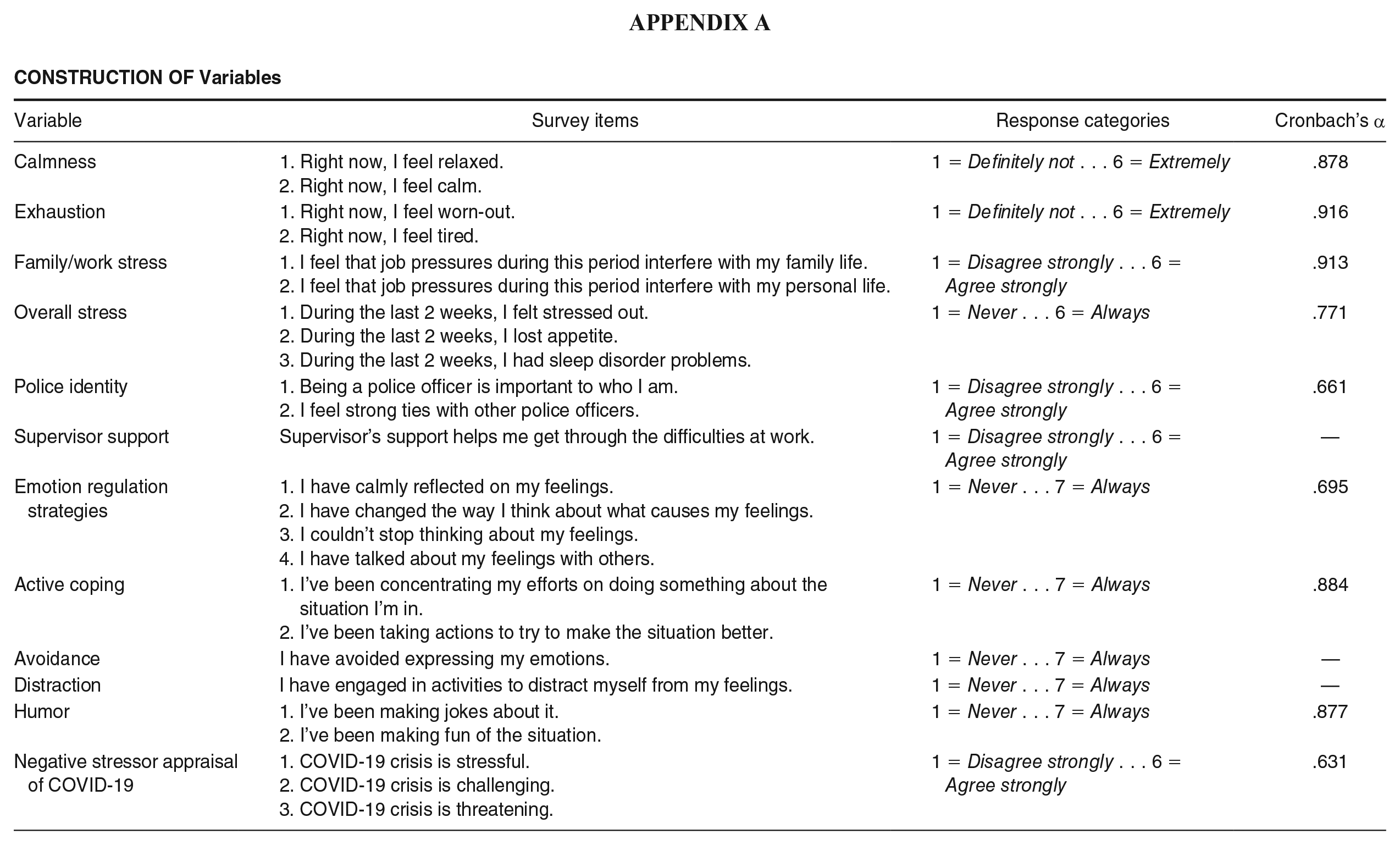
Four dependent variables, calmness, exhaustion, family/work stress, and overall stress are included in the analysis. The first and second dependent variables, adopted from Frenkel et al.’s (2021) and Wilhelm and Schoebi’s (2007) studies, includes two Likert-type scale items each. The two items measuring “calmness” contain the following. “Right now, I feel relaxed.” “Right now, I feel calm.” The second dependent variable “exhaustion” includes two questions about their current affect “Right now, I feel worn-out.” “Right now, I feel tired.” (1 = definitely not, 2 = not, 3 = not really, 4 = a little, 5 = very much, 6 = extremely). The third dependent variable “family/work stress,” adapted from Fisher et al.’s study (2020), contains the following two items. “I feel that job pressures during this period interfere with my family life.” “I feel that job pressures during this period interfere with my personal life.” (1 = disagree strongly, 2 = disagree, 3 = disagree somewhat, 4 = agree somewhat, 5 = agree, 6 = agree strongly). The fourth variable “overall stress” contains 3 items adapted from Frenkel et al.’s (2021) and Huang et al.’s (2021) studies. During the last 2 weeks, “I felt stressed out.” “I lost appetite.” “I had sleep disorder problems.” (1 = never, 2 = rarely, 3 = sometimes, 4 = frequently, 5 = usually, 6 = always). The values of Cronbach’s alpha of the items measuring the above four dependent variables ranged between .771 and .916, reflecting accepting to good reliability.
Independent Variables
The main independent variables include police identity, supervisor support, emotion regulation strategies, active coping, avoidance, distraction, humor, and negative stressor appraisal of COVID-19. The measure of “police identity” was based on two items adapted from Kyprianides et al.’s study (2021). The variable of “supervisor support” was based on a single item adopted from Fisher et al.’s study (2020). The variable “emotion regulation strategies” was measured by four items adapted from the studies of Brans et al. (2013) and Frenkel et al.’s (2021) work. The variable “active coping” was measured by two items adopted from Carver’s study (1997). “Avoidance” and “distraction” were each measured by a single item adapted from Brans et al.’s (2013) and Frenkel et al.’s (2021) studies. “Humor” was measured by two items adapted from Carver’s study (1997). “Negative stressor appraisal of COVID-19” was measured by three items adapted from Frenkel et al.’s study (2021). The values of Cronbach’s alpha of the items measuring the above independent variables ranged between .631 and .884, reflecting accepting to suitable reliability. The construction of the dependent and independent variables and response categories along with the corresponding Cronbach’s alpha values is listed in Appendix A.
Control Variables
The control variables include sex, education, marital status, job position, home quarantine, COVID-19 health training, region, rank, and work experience. Sex, marital status, job position, home quarantine, COVID-19 health training, and region were coded dichotomously (1 = male; 0 = female); (1 = denoting married; 0 = indicating single, divorced or widowed); (1 = patrol/criminal investigation/security check; 0 = desk work); (1 = duties involving home quarantine; 0 = duties not involving home quarantine); (1 = Yes; 0 = No); (1 = Taipei city or New Taipei city, where contained more infected cases; 0 = other cities or counties). Education and rank were both measured by ordinal level (1 = high school diploma; 2 = associate degree; 3 = bachelor’s degree; 4 = above bachelor’s); (1 = line officer; 2 = sergeant; 3 = lieutenant or above). Work experience was a continuous variable, which was measured by years.
Analysis Plan
First, descriptive statistics were conducted. Then independent t test was conducted to estimate the mean differences in the dependent and independent variables between male and female officers. To estimate the bivariate correlations between variables, a correlation analysis was performed. Finally, Ordinary Least Squares (OLS) regression analysis was employed to estimate the effects of antecedents of officers’ affective states (calmness and exhaustion) along with family/work stress and overall stress.
Results
Table 1 presents the characteristics of the sample officers. On average, the sampled female officers were younger and had higher educational attainment than male officers. The mean age was 42.41 years (SD = 10.85) for male officers and 33.85 years (SD = 9.79) for female officers. 75.1% of the female officers held bachelor’s degree or above; only 46.4% of male officers held such degrees. The majority of male officers were married (68.5%), while only 36.4% of the female officers were married. The majority of male (77.5%) and female (69.3%) officers held the post of patrol/ criminal investigation/security check. 47.3% of the male versus 44.9% of the female officers were assigned to duties involving home quarantine. About 70% of male and female officers had received COVID-19 health training. 36.4% of the sampled male officers and 31.6% female officers were stationed in the Taipei or New Taipei City. 47.6% of the males versus 69.2% of the females were line officers. Male officers had longer tenure than female officers. The majority of the sample male officers (72.9%) have worked in the police force for more than 10 years, while only 34.7% of the sampled female officers had a tenure above 10 years.
Characteristics of the Respondents
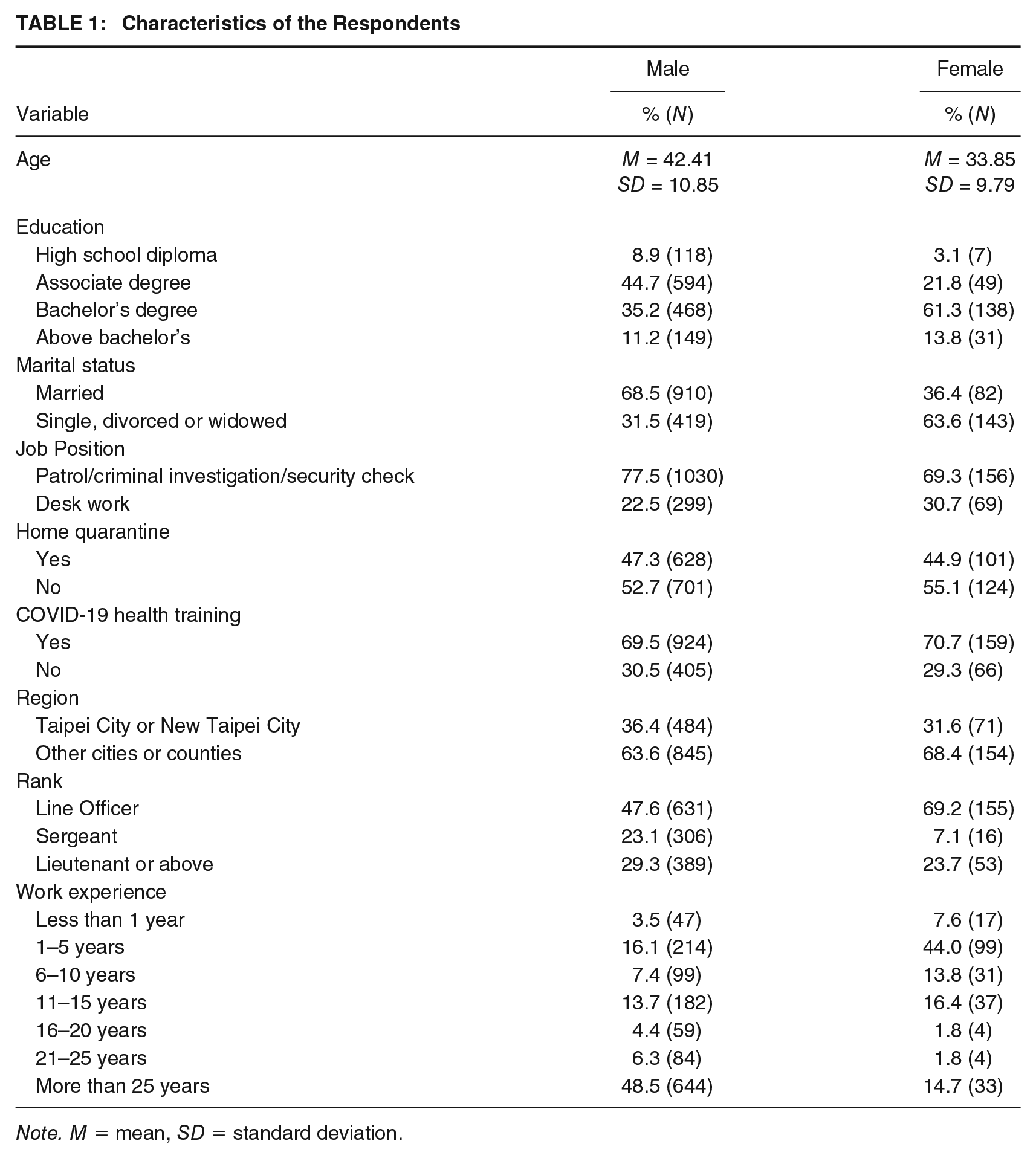
Note. M = mean, SD = standard deviation.
According to the statistics of the NPA (2024), at the end of 2023, there were 68,724 police in Taiwan: 59,607 were male (86.73%) and 9,117 were female (13.27%). A special report compiled by the NPA (2021b) shows male officers were older than female officers: 54% of the male officers were between 40 and 59 years old, while 78% of female officers were below 39 years old. The sample comprises approximately 86% of male and 14% of female officers, and the mean age of male officers was higher than female officers. The distribution of gender and age of officers who responded to the survey somewhat reflects the general demographics of Taiwan’s population.
Table 2 presents the results of t tests between the male and female police officers in perceived police identity, supervisor support, various coping strategies, affective states (calmness and exhaustion) and various dimensions of stress. It was found that male officers had significantly higher scores in police identity, indicating male officers held stronger police identity, compared to their female colleagues. Compared to female officers, male officers were more likely to perceive they received support from supervisor. With regard to coping strategies, compared to their male colleagues, female officers were more likely to use emotion regulation coping (e.g., thinking about their feelings and talking about their feelings with others), and distraction approach (e.g., engaging activities to distract themselves from their feelings). On the contrary, in comparison with their female counterparts, male officers were more likely to utilize humor and emotional avoidance as coping mechanism. In terms of mental health, male officers had significantly higher scores of family/work stress, compared to their female colleagues.
Mean Comparison Between Male and Female Officers
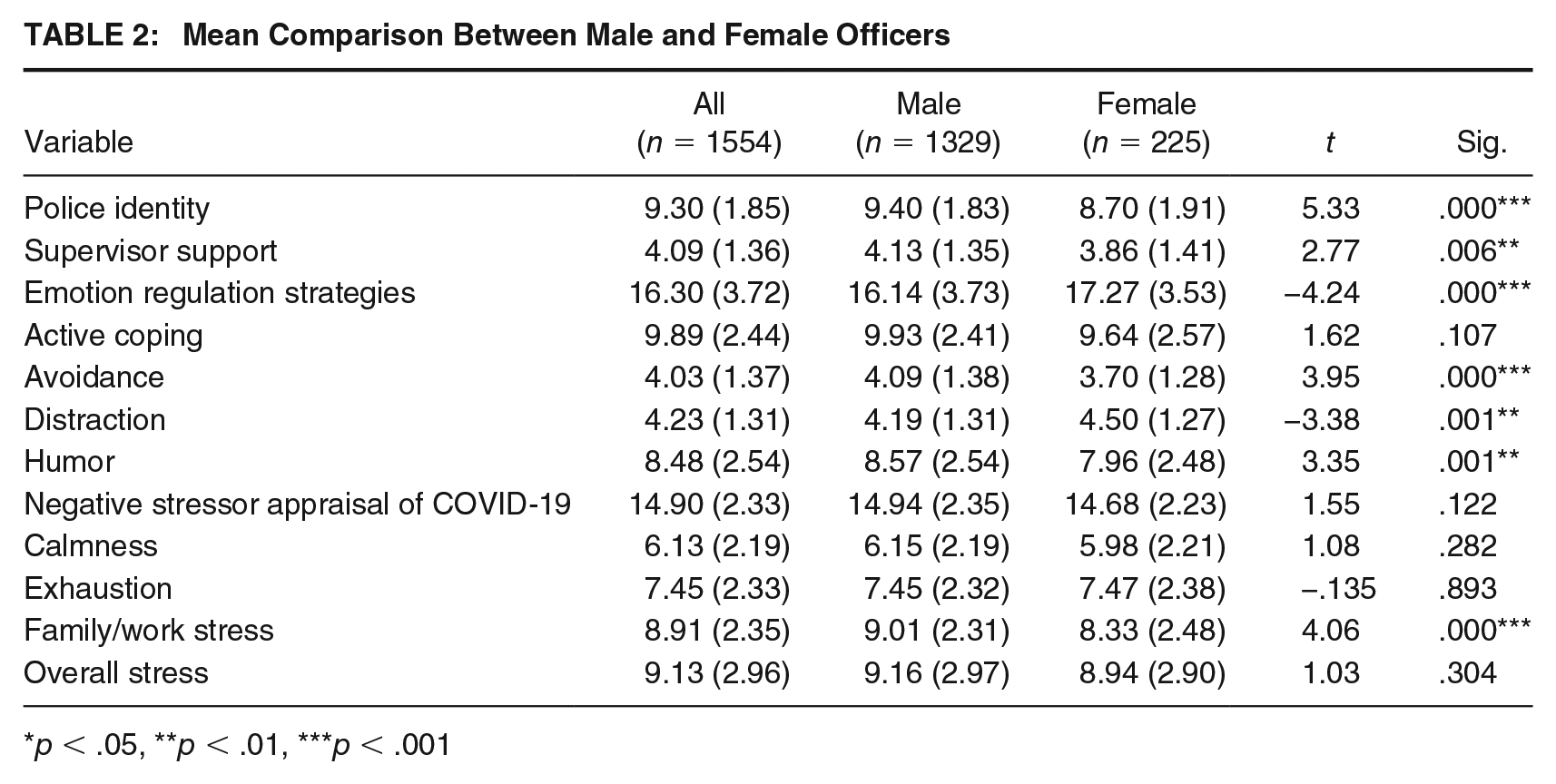
p < .05, **p < .01, ***p < .001
Table 3 displays the correlations between variables. There is generally no multicollinearity issue.
Correlation Matrix
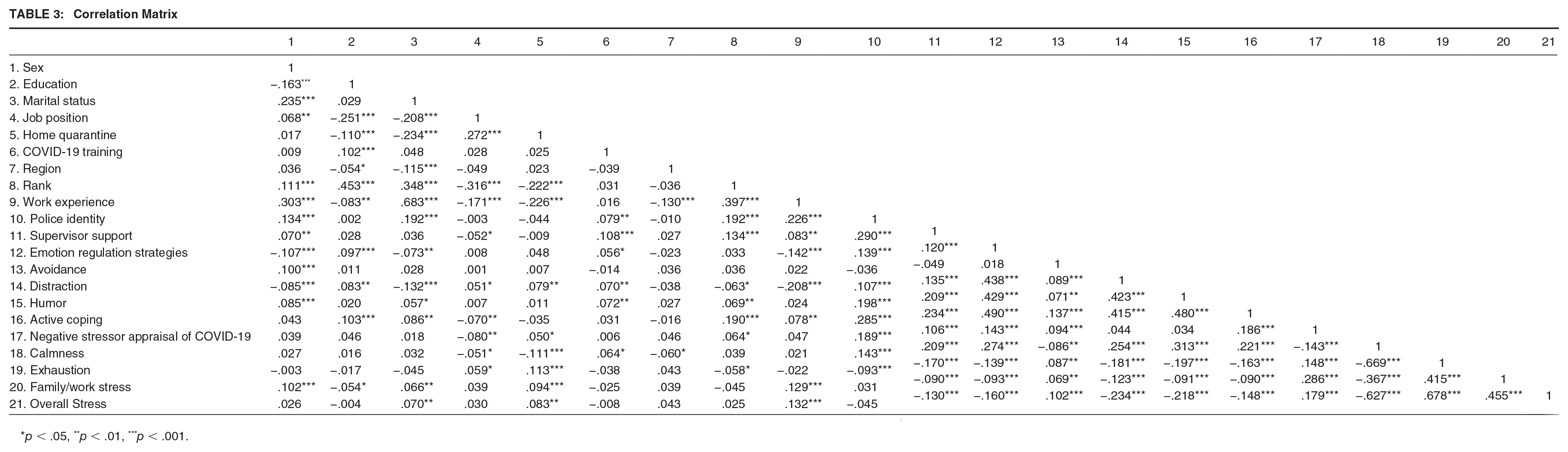
p < .05, **p < .01, ***p < .001.
The results of multiple regression were presented in Table 4. As shown in the first panel of Table 4, male officers were more likely to display calmness. Officers who perceived stronger police identity and supervisor support were more likely to feel calm. Emotion regulation strategies, distraction, and humor were significantly and positively related with calmness. On the contrary, officers who were assigned to patrol/criminal investigation/security check posts, duties involving home quarantine, and posted in Taipei or New Taipei City were less prone to feel calm. In addition, avoidance coping and negative stressor appraisal of COVID-19 were found to be significantly and negatively correlated with calmness. In other words, officers who utilized avoidance coping strategies and appraised COVID-19 negatively were less likely to be calm. Approximately 22% of the variances of the dependent variable “calmness” were explained by the independent and control variables.
Multiple Regression
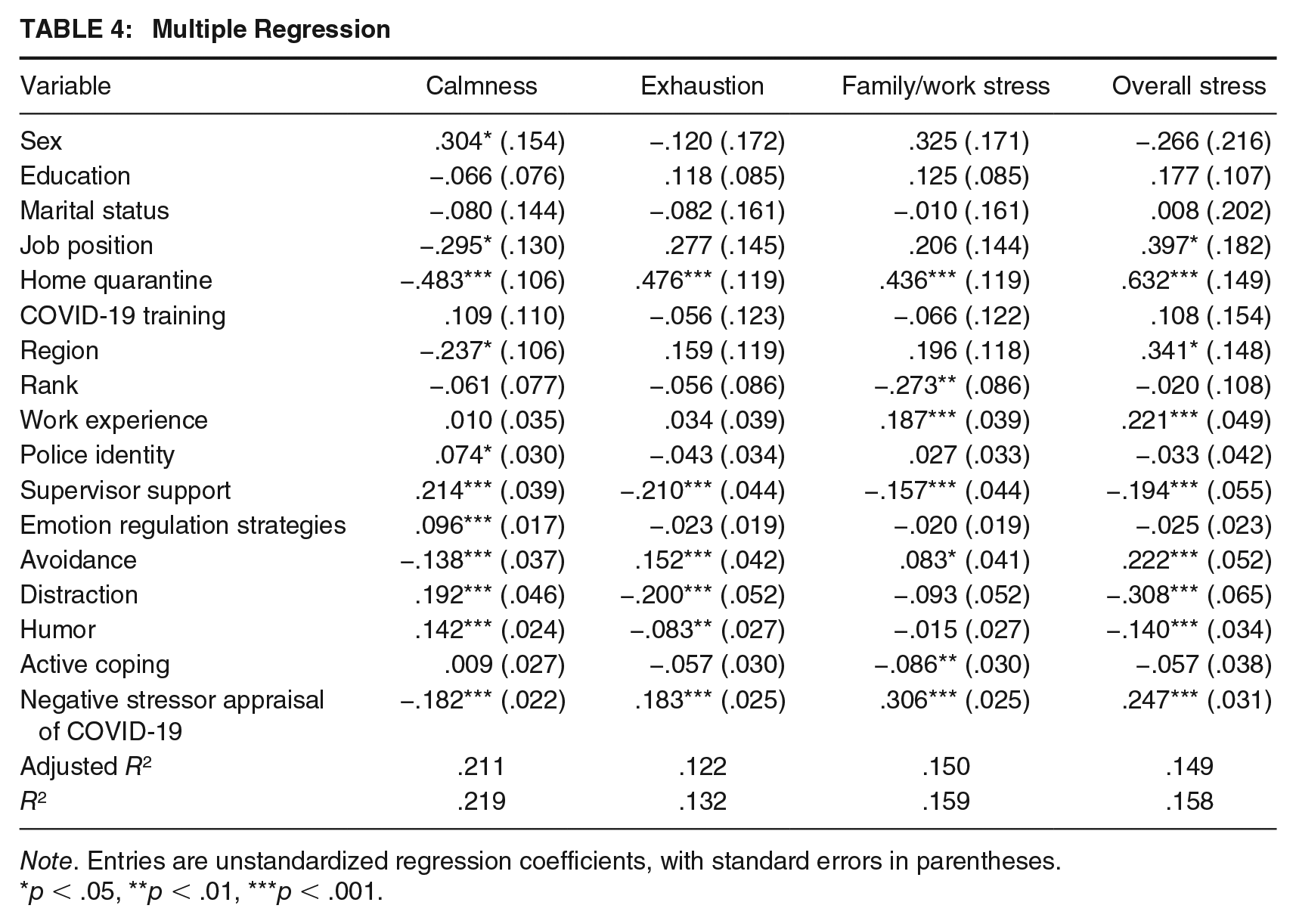
Note. Entries are unstandardized regression coefficients, with standard errors in parentheses.
p < .05, **p < .01, ***p < .001.
As shown in the second panel of Table 4, home quarantine, avoidance coping, along with negative stressor appraisal of COVID-19 were significantly predictive of exhaustion. In other words, officers assigned to home quarantine and those who used avoidance coping or negatively appraised COVID-19 were more likely to feel exhausted. On the contrary, supervisor support, distraction, and humor were negatively and significantly associated with exhaustion. That is, officers who perceived higher level of supervisor support and used distraction and humor as coping mechanisms were less likely to feel exhausted. About 13% of variance in exhaustion was explained in this model.
As shown in the third panel of the regression table, home quarantine, work experience, avoidance, and negative stressor appraisal of COVID-19 were positively and significantly associated with family/work stress. Officers who were assigned to home quarantine duties, had more experiences, using avoidance strategy, and negatively appraised COVID-19 were more likely to perceive family/work stress. Rank, supervisor support, and active coping were found to be negatively and significantly associated with family/work stress. Officers with higher rank, those who perceived stronger supervisor support and utilized active coping were less inclined to perceive family/work-life stress. This model explained approximately 16% of the variance.
Moving to the last panel of the regression table, job position, home quarantine, region, work experience, avoidance, and negative stressor appraisal of COVID-19 were positively and significantly correlated with overall stress. Officers who were assigned to patrol/criminal investigation/security check post and home quarantine duties, in Taipei or New Taipei City, had more experience, utilized avoidance coping and negatively appraised COVID-19, were more likely to perceive overall stress. Supervisor support, distraction, and humor were negatively and significantly correlated with overall stress. In other words, those officers who perceived stronger supervisor support and utilized distraction and humor as coping methods were less likely to experience such overall stress. The independent and control variables explained about 16% of the variance in the model.
Discussion
Most empirical studies of police’s mental health during the COVID-19 pandemic examine factors that affect officers’ work-related stress. Very few studies explore the coping strategies that officers adopted during the pandemic. This study makes several contributions to relevant literature. First, it utilizes data derived from a substantial sample of officers from a non-western cultural setting-thus providing a cross-national perspective. Second, this study extends the scope of existing literature by simultaneously examining perceived stress and the coping strategies used by police officers during the pandemic. Third, this study investigates how different coping strategies affect various dimensions of affective states and perceived stress (e.g., calmness, exhaustion, family/work stress, and overall stress). Furthermore, this study examines whether male and female officers used different coping strategies during the pandemic. And finally, it explores what coping strategies are more beneficial to officers’ well-being.
Guided by the empirical evidence of past literature, six research hypotheses are formulated and tested. The statistical finding supports the first hypothesis, which assumes a significant sex difference in officers’ mental health. The result of t test shows that male officers, compared with their female colleagues, perceived higher levels of family/work stress. This finding contradicts those of several studies conducted in western countries, in which female officers, during the pandemic, experienced higher stress than their male counterparts (e.g., Berg et al., 2006; Frenkel et al., 2021). One possible explanation might be that about 70% of the sampled male officers were married, while only 36% of female officers were married; that is, male officers would be more likely to struggle with balancing work and family life. This finding is in line with that of Robinson and colleagues’ study (2014), in which Chinese male cadets were found to be significantly more stressed than Chinese female cadets, and more so than cadets in Australia and Canada. The authors speculated the difference may partly be due to gender role expectations in traditional Chinese society, in which males are expected to care for their parents and members of extended family, along with their own families. Male officers are more likely to burn out in balancing the demands of work and family. Similarly, in a recent study of Canadian officers, Duxbury et al. (2021) found that male officers were more likely to experience family demands interfering with their work. It should be noted that all of the sex-based differences are no longer significant in the primary regression models, with the exception of calmness. In other words, there is limited relevance in explaining sex-differences in well-being outcomes once other factors are taken into consideration.
The statistical findings partially support the second hypothesis, which suggests identity with police work would have a positive effect on well-being. The finding shows such identity was a significant predictor of perceived calmness; but that identity did not significantly correlate with a reduced level of stress. This finding is in line with Jiang’s study (2021), which found that emotional identity with police, during the COVID-19 pandemic, is positively associated with officers’ well-being.
This study observed that supervisor support is not only positively correlated with officers’ well-being, but also associated with lower levels of family/work and overall stress, which confirms the third hypothesis. Officers who perceived higher levels of supervisor support were more likely to be calm and less likely to feel exhausted. These findings accord with Li et al.’s study (2022), in which supervisor support was seen to be positively and significantly associated with Hong Kong officers’ performance and engagement during the pandemic.
The finding also supports the fourth hypothesis, which predicts that male and female officers would use different strategies to cope with stress during the pandemic. The results of t test showed that compared to their male colleagues, female officers were more likely, in coping with stress, to use emotion regulation and distraction strategies. On the contrary, male officers were more inclined to use avoidance and humor as coping mechanisms. This finding is line with that of Bonner and Brimhall’s study (2022), which found female officers tended to employ emotional support, self-distraction, and venting as coping strategies. This result is also consistent with Arble et al.’s study (2018), which found female officers to be less likely to use avoidance strategies in times of stress.
Finally, the statistical findings partially support the fifth and sixth hypotheses. This study found that emotion regulation strategies were positively associated with calmness, while active coping negatively connects with family/work stress. The finding showed that humor was significantly associated with positive well-being, which is consistent with Salinas and Webb’s study (2018). Self-distraction was found to be significantly related to enhanced well-being and reduced stress, which contradicts some but mirrors other studies. Edwards and colleagues (2021) found a positive association between self-distraction and perceived stress. Nevertheless, in a recent study, Waugh and colleagues (2023) found distraction to be an adaptive coping behavior for reducing stress during the global pandemic. The authors also indicated that distraction as the most popular coping strategy during the pandemic identified by the research participants.
This study also found that negative coping, such as avoidance of expressing emotions, was related to poor well-being, a finding consistent with that of Arble and colleagues’ study (2018). Negative stressor appraisal of COVID-19 was found to be significantly associated with negative affective states and higher stress, which was consistent with the finding of Frenkel et al.’s study (2021).
This study found that female officers perceived weaker police-identification and lesser supervisor support than their male colleagues, which mirrors the findings of Veldman and colleagues’ (2017) and Violanti et al.’s (2016) studies. Analyzing survey data derived from officers in the United States, Violanti and colleagues (2016) found female officers reported that they received a lower level of supervisor support, compared to their male colleagues.
Conclusion
Kirby et al. (2011) noted the lack of studies that focus on coping strategies among emergency service workers. This study adds to the literature by examining sex-differences in police officers’ well-being, and subsequent coping strategies in response to stress, with a sample of 1,554 officers drawn from various police departments and brigades in Taiwan during the COVID-19 pandemic. The findings can help police administrations better understand coping strategies among officers in facing the virus outbreak. Suitable training that aims at effective stress management can be developed to enhance officers’ skills to cope with future heath crises.
Supervisor support was found to be significantly associated with different dimensions of affective states as well as family/work and overall stress. The importance of a supervisor’s role cannot be underestimated. Police agencies can implement suitable training and assessment to ensure supervisors provide effective support for officers. Duly informed, the supervisors can identify and mitigate officers’ stress (Purba & Demou, 2019). The analysis reveals that female officers, compared to their male colleagues, felt weaker identity in their police work and also perceived lower support coming from their supervisors. These findings align with those of Veldman and colleagues’ study (2017). Cultivating inclusive and diverse work cultures, along with support from supervisors, may ameliorate such gender-based work conflicts and benefit well-being among female officers.
The analyses reveal that the role and location of service significantly relate to officers’ well-being. Officers assigned to patrol/criminal investigation/security check posts, monitoring home quarantine, and stationed in Taipei or New Taipei City were more likely to experience higher levels of stress. Police administration should direct more attention to the workload and psychological health of these officers. Suitable resources and tolerable workload may help improve officers’ psychological well-being during public health emergency events (Arble et al., 2018). During the time of the recent pandemic, findings show that certain coping strategies, such as distraction and humor, significantly correlated with a reduced level of stress. Avoidance was negatively associated with officers’ well-being. It was also found that in coping with stress, male officers were more likely to use humor and avoidance, and female officers more inclined to engage emotion regulation strategy and self-distraction. Police agencies should develop stress management strategies tailored to the different sexes and expose all officers to the relevant literature about such strategies. In stressful times, male officers should be encouraged not to suppress their emotions but rather to engage in activities to distract themselves. On the contrary, female officers can be urged to use humor to cope with stress, along with emotion regulation strategy and self-distraction.
While this study provides valuable information, limitations exist. First, the sample comprising a convenience sample of 1,544 officers, may leave out officers who were less comfortable in navigating the on-line survey. The sample, then, may not be representative of the population. The findings should be interpreted with this caveat in mind. Because the study is cross-sectional, the temporal order among variables cannot be derived. Also, there is no available data before and after the onset of pandemic for a comparison, so it is not clear whether sex differences in perceived stress and coping styles are persistent or exacerbated by pandemic conditions. And it is unknown whether officers adapted their coping styles after the onset of pandemic. Future study can include a representative sample to improve generalization. Employing longitudinal data in future research can further specify the causal effects between variables and bring to light more information about adaptation to coping during unusual circumstances, such as the COVID-19 pandemic. Future study can also include in-depth interviews to disentangle the reasons why female officers were less likely to perceive supervisor support and had weaker police identification. Also, qualitative data can further underscore what specific support from supervisors is successful and how various coping mechanisms help to mitigate officers’ stress.
Footnotes
Appendix
Construction of Variables
| Variable | Survey items | Response categories | Cronbach’s α |
|---|---|---|---|
| Calmness | 1. Right now, I feel relaxed. 2. Right now, I feel calm. |
1 = Definitely not . . . 6 = Extremely | .878 |
| Exhaustion | 1. Right now, I feel worn-out. 2. Right now, I feel tired. |
1 = Definitely not . . . 6 = Extremely | .916 |
| Family/work stress | 1. I feel that job pressures during this period interfere with my family life. 2. I feel that job pressures during this period interfere with my personal life. |
1 = Disagree strongly . . . 6 = Agree strongly | .913 |
| Overall stress | 1. During the last 2 weeks, I felt stressed out. 2. During the last 2 weeks, I lost appetite. 3. During the last 2 weeks, I had sleep disorder problems. |
1 = Never . . . 6 = Always | .771 |
| Police identity | 1. Being a police officer is important to who I am. 2. I feel strong ties with other police officers. |
1 = Disagree strongly . . . 6 = Agree strongly | .661 |
| Supervisor support | Supervisor’s support helps me get through the difficulties at work. | 1 = Disagree strongly . . . 6 = Agree strongly | — |
| Emotion regulation strategies | 1. I have calmly reflected on my feelings. 2. I have changed the way I think about what causes my feelings. 3. I couldn’t stop thinking about my feelings. 4. I have talked about my feelings with others. |
1 = Never . . . 7 = Always | .695 |
| Active coping | 1. I’ve been concentrating my efforts on doing something about the situation I’m in. 2. I’ve been taking actions to try to make the situation better. |
1 = Never . . . 7 = Always | .884 |
| Avoidance | I have avoided expressing my emotions. | 1 = Never . . . 7 = Always | — |
| Distraction | I have engaged in activities to distract myself from my feelings. | 1 = Never . . . 7 = Always | — |
| Humor | 1. I’ve been making jokes about it. 2. I’ve been making fun of the situation. |
1 = Never . . . 7 = Always | .877 |
| Negative stressor appraisal of COVID-19 | 1. COVID-19 crisis is stressful. 2. COVID-19 crisis is challenging. 3. COVID-19 crisis is threatening. |
1 = Disagree strongly . . . 6 = Agree strongly | .631 |
Authors’ Note:
I would like to express my gratitude to the anonymous reviewers and editors for their constructive comments that significantly enhanced the manuscript. I also thank the officers who participated in the surveys and Miss Yu-Ru Zheng for her assistance in data entry.
