




Abstract
This empirical study was the first to explore the criminal life course of people imprisoned in a Dutch facility for uncontrollably violent persons as a consequence of prison violence (N = 383). Their characteristics were compared with those from studies of Dutch incarcerated people and those of persons residing in an in-prison psychiatric facility (N = 1,913). Results showed that uncontrollably violent detained persons are an extreme group: their criminal life course is characterized by an early onset, an extensive and severe criminal career, and high scores on most violence-related historical risk factors. The severity and early onset of their criminal life course, their problematic behavior, and their problems in other life domains became even more apparent following our comparisons. This study underlines the relevance of detained persons’ pre-prison characteristics in addressing prison violence risk factors, and shows that early detection and monitoring is essential to prevent (more) damage.
Keywords
Introduction
Consensus exists about the extensiveness and negative consequences of prison violence on institutional safety, staff, other detained persons, and those who exhibit prison violence. Previous studies, for example, described physical and mental injury to both staff and detained persons, damaged property, negative psychological and criminal justice consequences, and additional restrictions for individuals who exhibit prison violence (e.g., Brown, 2020; Caravaca-Sánchez et al., 2023; Conde et al., 2021; Isenhardt & Hostettler, 2020; Linning et al., 2022). Hence, enhancement of the understanding and targeting of factors that might underlie or relate to prison violence is required. This study focuses on the criminal life course of uncontrollably violent detained persons, that is, those who have displayed severe aggressive or disruptive in-prison behavior, who have been deemed too aggressive or too dangerous to remain safely within other prison wards, and who are therefore transferred to a highly restrictive prison facility.
Explanatory Models for Prison Violence
The literature predominantly describes two explanatory models for problems underlying prison violence. First, Sykes’ (1958) deprivation model assumes that detained persons’ aggressive behavior results from the pains of imprisonment: stressful, repressive restrictions and deprivations inherent in imprisonment, such as loss of autonomy and freedom. These factors make imprisonment undesirable, might affect detained persons’ beliefs, norms, and values, and might cause stress and oppositional behavior (Bosma et al., 2020; Quick et al., 2023; Shammas, 2017). Second, the import model (Irwin & Cressey, 1962) assumes that certain factors within detained individuals explain in-prison aggressiveness, such as personal characteristics, experiences, and criminal history (Bosma et al., 2020; Innes, 1997; Quick et al., 2023; Spreen et al., 2014). According to the import model, unique intrinsic characteristics and the pre-prison lifestyle of detained persons drive their in-prison behavior and are directly imported into prison together with the admittance of these individuals (Quick et al., 2023).
Detainee Characteristics Associated With Prison Violence
Several studies identified particular personal characteristics that have been associated with prison violence. For example, younger detained persons and those with a lower educational level appear to be more likely to engage in violence (Bosma et al., 2020; Cunningham & Sorensen, 2007; Engstrom & Scott, 2020; Schenk & Fremouw, 2012). Adverse prior experiences, such as victimization of abuse and violence, are linked to prison misconduct as well (Henry, 2020; Klatt & Kliem, 2021; Steiner et al., 2014). Furthermore, detained individuals that are suffering from psychiatric disorders (e.g., ADHD, personality disorder, psychosis) or with low intelligence have an increased risk of engaging in prison violence (Felson et al., 2012; Kuo, 2020; Lovell et al., 2000; Steiner et al., 2014; Van der Vorst et al., 2023).
With respect to criminological characteristics, an early start of delinquency is seen as an important risk factor for a long-lasting and varied criminal career (Moffitt, 1993; Piquero et al., 2007; Van Hazebroek et al., 2019), a higher lifetime number of convictions (Piquero et al., 2007), and for more severe and violent types of crimes (Loeber et al., 2003; Piquero et al., 2007). Regarding the specific group of those who exhibit prison violence, an extensive criminal record, a history of violent and drug crimes, previous incarcerations, and prior involvement in prison violence appear to be risk factors for prison violence (M. Butler et al., 2022; Kuanliang & Sorensen, 2008; Schenk & Fremouw, 2012; Steiner et al., 2014). Sorensen and Cunningham (2010) found drug offenses to be related to violent in-prison behavior, as well as property crimes and weapon violations. With respect to the relationship between the risk of prison violence and the severity of the crime that resulted in the current imprisonment, the so-called index crime, the findings are diverse (H. D. Butler et al., 2021). Interestingly, several studies found individuals imprisoned for a non-violent or less severe crime more likely to show prison violence than persons imprisoned for a more severe or violent crime like homicide (Cunningham & Sorensen, 2007; Schenk & Fremouw, 2012) or did not find a relationship between the index crime severity and prison violence (Reidy et al., 2012). In contrast, other studies found individuals imprisoned for violent crimes are more likely to exhibit prison violence (Griffin & Hepburn, 2006; Kuanliang & Sorensen, 2008).
The Current Study
While risk factors for prison violence have been studied extensively, little empirical research has been conducted on the characteristics and the criminological life course of persons who are residing in highly restrictive prison facilities as a consequence of severe in-prison violence. Furthermore, the available small number of studies mainly focused on American “supermax” prisons: an overarching phrasing for restrictive prison facilities intended for long-term isolation of detained individuals that are perceived as “the worst of the worst” (Reiter, 2019). Persons reside in these facilities for a variety of reasons, not necessarily in-prison violence (Pizarro & Narag, 2008; Ross & Tewksbury, 2018), and can, therefore, hardly be compared with the specific group of violent detained persons that are transferred to restrictive prison facilities as a consequence of severe in-prison violence. Moreover, these studies examined criminal characteristics only to a limited extent, as these studies described only a few characteristics, such as age at first offense, prior convictions, prior violent convictions, and whether or not the detained individual had previously been incarcerated and convicted for a violent offense (Kurki & Morris, 2001; Lovell et al., 2000, 2007; Mears & Bales, 2010; O’Keefe, 2008).
Hence, the current explorative study addresses an empirical knowledge gap—with the import model as its main theoretical framework—by focusing on the criminal life course of detained individuals who have caused severe in-prison incidents and are, therefore, transferred to the strictest prison facilities. In the Netherlands, this facility is called the facility for Uncontrollably Violent Detained persons, 1 from now on referred to as “Violence Facility.” Our first research question was: What characterizes uncontrollably violent detained persons’ criminal careers in terms of their judicial history and violence-related risk factors? Our second research question was: How do these characteristics compare with those of individuals residing in regular prison facilities and with those in in-prison psychiatric treatment facilities (“Psychiatric Facilities”)? The results of this study can improve the understanding of in-prison violence and of violent detained individuals. Furthermore, results can contribute to developing an evidence-based and targeted practice for risk management, prevention, and support, both within prison and in subsequent services and society.
Method
Study Population
Penitentiary Institution (PI) Vught accommodates the Dutch prison facility for uncontrollably violent persons, with a capacity of 48 individuals. Individuals are admitted to this highly restrictive facility based on their in-prison behavior, regardless of the crime that induced imprisonment. If their behavior is regarded as too aggressive or too disruptive for other detention regimes, and if there is no acute psychopathology or treatment indication according to a psychologist or psychiatrist of the referring facility (based on their clinical judgment or solely on available file information), incarcerated individuals are referred to the Violence Facility (Dutch Custodial Institutions Agency [DCIA], 2017). Transference aims to temporarily relieve the original prison facilities to restore the in-prison order and safety. The main goal of transference to the Violence Facility is incapacitation; the opportunity to show violence or other disruptive behavior is minimized through restrictions, such as individual programs in which detained persons are unlocked for a maximum of 18.5 hours a week, compartmented areas, and guidance of unlocked detained individuals by at least two guards. The Violence Facility provides minimal support and services for reintegration, diagnostics, and interventions targeting risk factors and causes of detained persons’ disruptive behavior (DCIA, 2017).
Procedure and Samples
Data on individuals incarcerated in the Violence Facility were deduced from a sizable preexisting database on persons transferred to this Violence Facility in PI Vught, the Violence Facility database. Data on criminal careers were first compared with available figures of detained individuals residing in regular prison facilities. Dutch empirical studies published since 2016 describing judicial and criminological statistics on the regular Dutch prison population were searched for this purpose. Second, statistical comparisons were made between a Violence Facility cohort and a cohort of individuals who reside in the in-prison psychiatric treatment facility of the same prison, “Psychiatric Facility detained persons,” at the so-called “Penitentiary Psychiatric Center.” A statistical comparison with the criminal life course of these “Psychiatric Facility” detained persons is of interest for multiple reasons. First, psychopathology is a significant risk factor for in-prison violence (e.g., Kuo, 2020; Steiner et al., 2014; Van der Vorst et al., 2023). Second, Psychiatric Facility detained individuals are frequently regarded as unmanageable in general prison populations too, and third, they are also notorious for their high incidence of aggressive in-prison incidents (Van Beek et al., 2023; Van Bekkum et al., 2021). Unlike the Violence Facility, a Psychiatric Facility focuses primarily on diagnosis, treatment, and stabilization of presumed and recognized psychopathology.
Both the Violence Facility database (created in 2016) and the Psychiatric Facility database (created in 2012) were constructed and maintained for policy purposes and contain demographic, diagnostic, and judicial information (e.g., reports to judicial authorities, previous imprisonments, and the criminal record), systematically entered by trained criminologists and psychologists. For this study, two fully anonymized data files were provided from both databases, comprising information on all male detained individuals (18+) referred to PI Vughts’ Violence Facility and Psychiatric Facility between January 2016 and January 2022. In the case of multiple admissions during the inclusion period, only information at the time of the latest admission was used to ensure recentness and completeness. Data regarding 80 persons admitted to both facilities between 2016 and 2022 were only included in the Violence Facility data set as this study’s primary focus is on those incarcerated in the Violence Facility. The final Violence Facility data set included data on 383 unique male incarcerated individuals. Of these, 49.6% were born in a foreign country. Furthermore, 48.1% (69 missing cases excluded) had completed primary school as their highest level of education. The final Psychiatric Facility data set comprised data on 1,913 unique male incarcerated persons. Of these, 40.9% were born in a foreign country, and 33.8% (521 missing cases excluded) had achieved the highest level of education through primary school completion. In the current study, no diagnostic data were collected. A previous study (Van der Vorst et al., 2023) revealed a high prevalence of psychopathology among those imprisoned in the Violent Facility.
Measures
Judicial variables were formulated based on crime characteristics, imprisonment characteristics, and corresponding ages (see Table 1 for a complete variable overview). It’s important to note that crimes that had not (yet) led to a conviction or were acquitted were deliberately excluded from our study. This exclusion criterion ensures our research’s focus on convicted crimes. Crime severity was classified into 12 categories (cf. Brand, 2005), with a higher category indicating a more serious crime. In cases of multiple offenses, the most severe category was included.
Judicial Characteristics of Persons Imprisoned in the Violence Facility (N = 383) and Those Incarcerated in the Psychiatric Facility (N = 1,913)
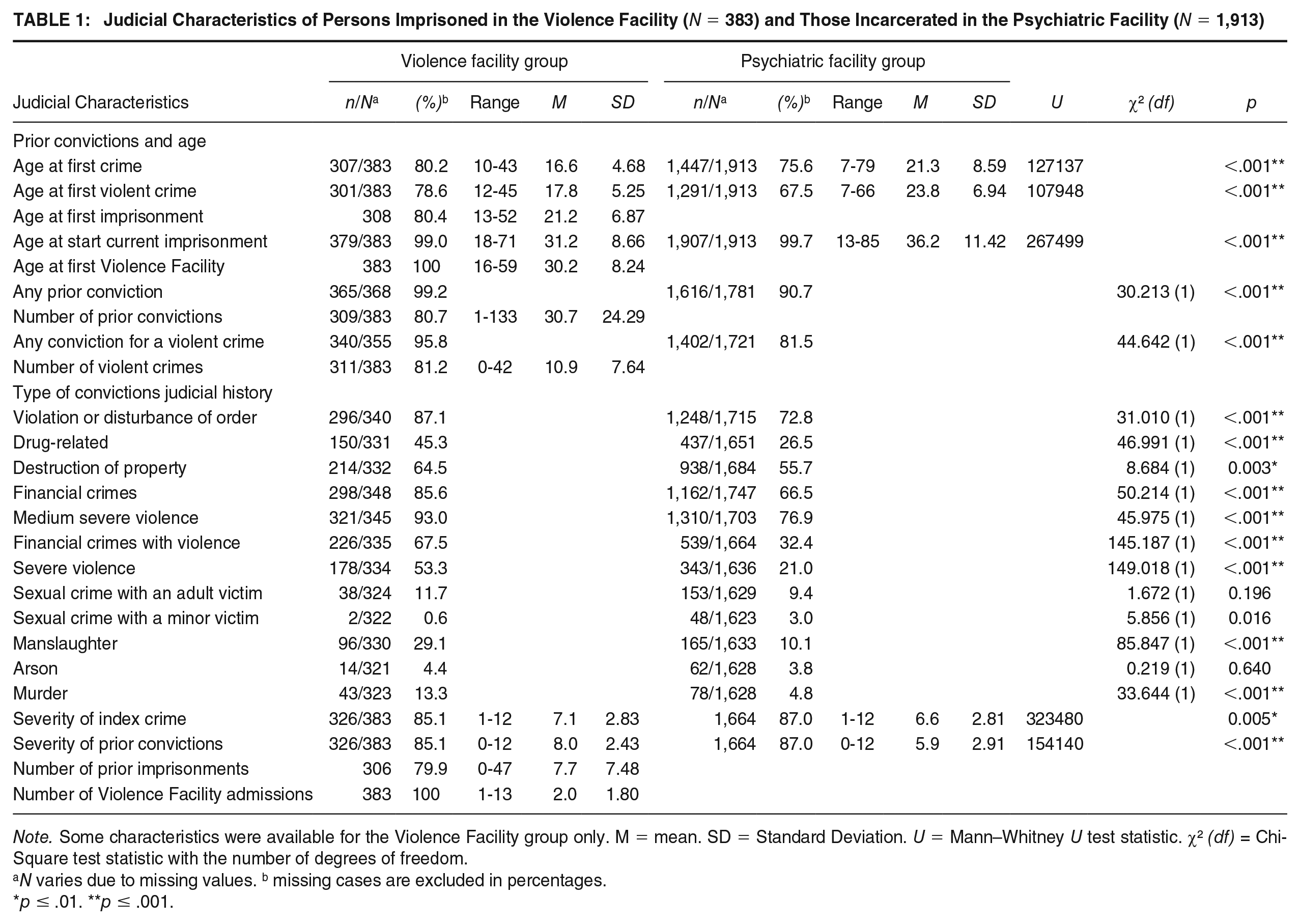
Note. Some characteristics were available for the Violence Facility group only. M = mean. SD = Standard Deviation. U = Mann–Whitney U test statistic. χ² (df) = Chi-Square test statistic with the number of degrees of freedom.
N varies due to missing values. b missing cases are excluded in percentages.
p ≤ .01. **p ≤ .001.
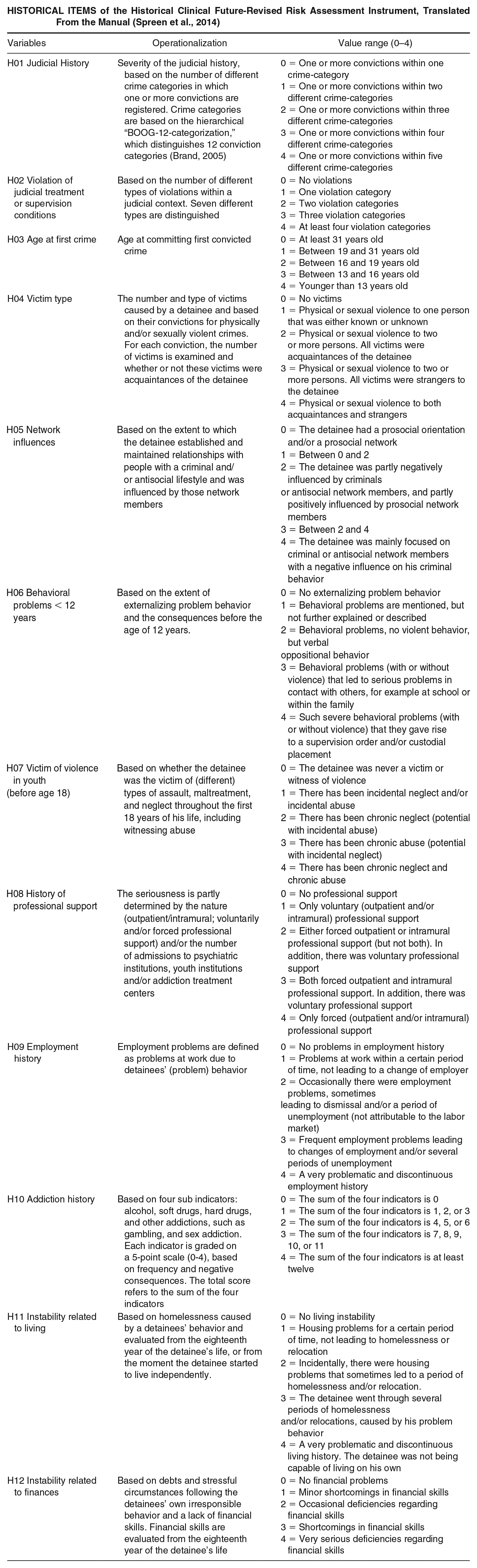
For operationalizing aspects of the criminal life course and criminal history in terms of violence-related risk factors, the historical items of the Historical Clinical Future (in Dutch: “Historisch Klinisch Toekomst”) Revised instrument (HKT-R) (Bogaerts et al., 2018; Spreen et al., 2014) were used. The interrater reliability for these items can be considered reasonable to very good (Bogaerts et al., 2018). Each item was rated on a 5-point Likert-type scale (0–4), with a higher score indicating a higher risk. Appendix presents the operationalization of the included HKT-R variables and the description of the rating values. The HKT-R was scored by psychologists or criminologists who had received in-company training on administering this instrument.
Statistical Analyses
Descriptive statistics were computed for individuals incarcerated in the Violence Facility. For the subsequent comparisons with available criminal life course characteristics of persons imprisoned in the Psychiatric Facility, group differences were tested for significance with Mann–Whitney U tests and cross-tabulations with chi-square statistics. Because multiple exploratory tests were used, a p value less than .01 was considered statistically significant.
Ethics
This study was approved by the Dutch Ministry of Justice and Security. Positive advice was received from the Ethics Committee for Legal and Criminological Research, Faculty of Law, VU Amsterdam.
Results
Characteristics of Judicial History
Characteristics regarding the judicial history of individuals incarcerated in the Violence Facility are presented in Table 1.
On average, individuals imprisoned in the Violence Facility were 31.2 years old (range 18–71, SD = 8.66) at the start of the current imprisonment, 16.6 years old (range 10–43, SD = 4.68) at committing the first crime that was followed by a conviction, 17.8 years old (range 12–45, SD = 5.25) at committing their first convicted violent crime, 21.2 years old (range 13–52, SD = 6.87) at their first imprisonment, and 30.2 years old (range 16–59, SD = 8.24) at their first Violence Facility admission. Over 99% of these detained persons had been convicted prior to the current imprisonment, with an average number of 30.7 previous convictions (range 1–133, SD = 24.29). A conviction for a violent crime was present in 95.8% of those imprisoned in the Violence Facility, with, on average, 10.9 (range 0–42, SD = 7.64) convictions for violent crimes. Convictions for medium severe violence such as threat or assault (93.0%), violations or disturbance of order (87.1%), and financial crimes (85.6%), were the most prevalent. Furthermore, 29.1% had been convicted for manslaughter and 13.3% for murder. The average severity of the index crime was 7.1 (range 1–12, SD = 2.83), and the average severity of prior convictions was 8.0 (range 0–12; SD = 2.43). Only 5.7% had not been previously imprisoned, 39.0% had been previously detained in a juvenile prison, and, as far as known, 11.5% had been imprisoned abroad. For 14.6% (n = 56), it was unclear whether they had previously been imprisoned.
After the literature search, five studies were identified that provided quantitative data on the judicial characteristics of individuals detained in regular Dutch prison regimes (Berghuis et al., 2023; Bosma et al., 2020; Ramakers et al., 2017; Van Ginneken et al., 2018; Van Hall & Cleofa-Van der Zwet, 2023). Comparisons of the aggregated data on the characteristics of these general prison populations with those from individuals detained in the Violence Facility point to differences in nearly all judicial characteristics. As can be seen in Table 2, persons incarcerated in the Violence Facility are usually younger at imprisonment and at committing their first crime than individuals imprisoned in regular prison-wards. The criminal careers of those incarcerated in the Violence Facility started earlier and with more convictions, for crimes in general and violent crimes. Furthermore, these detained persons seem to be more frequently imprisoned compared with Dutch detained individuals in general.
Judicial Characteristics of Individuals Incarcerated in the Violence Facility (n = 383) and Figures From Studies Into Dutch Detained Persons
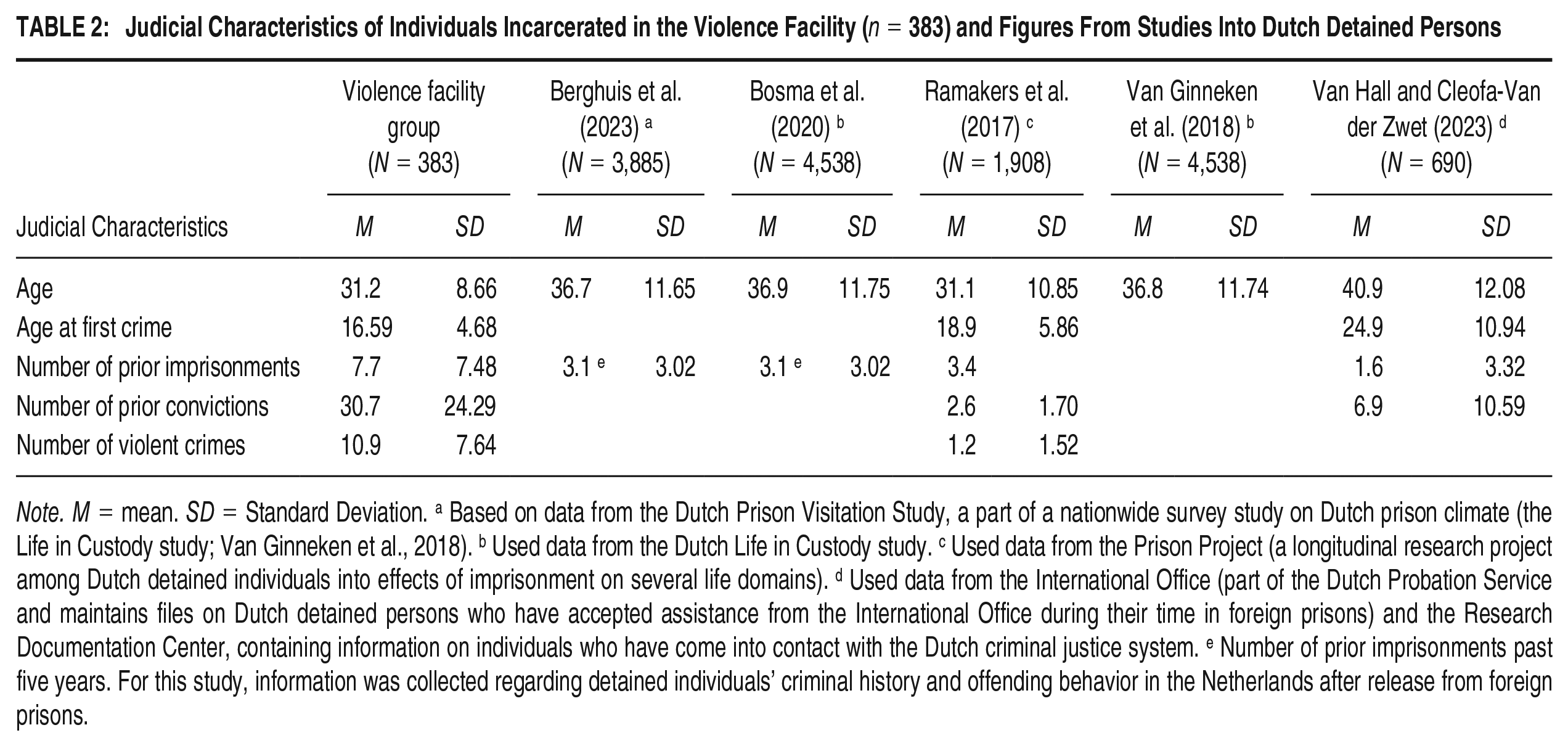
Note. M = mean. SD = Standard Deviation. a Based on data from the Dutch Prison Visitation Study, a part of a nationwide survey study on Dutch prison climate (the Life in Custody study; Van Ginneken et al., 2018). b Used data from the Dutch Life in Custody study. c Used data from the Prison Project (a longitudinal research project among Dutch detained individuals into effects of imprisonment on several life domains). d Used data from the International Office (part of the Dutch Probation Service and maintains files on Dutch detained persons who have accepted assistance from the International Office during their time in foreign prisons) and the Research Documentation Center, containing information on individuals who have come into contact with the Dutch criminal justice system. e Number of prior imprisonments past five years. For this study, information was collected regarding detained individuals’ criminal history and offending behavior in the Netherlands after release from foreign prisons.
Statistical comparisons with individuals incarcerated in the Psychiatric Facility on characteristics that were gathered for both groups are shown in Table 1. Persons detained in the Violence Facility were significantly younger than those incarcerated in the Psychiatric Facility at committing their first and first violent crime, and at the start of the current imprisonment. Prior convictions for general as well as violent crimes were significantly more common among individuals imprisoned in the Violence Facility. Convictions for almost all types of crimes were more prevalent among Violence Facility detained persons, including homicidal offenses. Moreover, the crimes that induced the current imprisonment, as well as the previous offenses, were significantly more severe in the Violence Facility group than in the Psychiatric Facility group.
Violence-Related Historical Risk Factors
Scores on violence-related historical risk factors are presented in Table 3. Missing cases were excluded. Violence Facility detained persons’ highest average scores were found on Judicial history, Victim type, Violation of judicial treatment or supervision conditions, Network influence, and Employment history. Since Judicial history refers to the number of different crime categories in which convictions are registered, apart from the conviction frequency, this result implicates a wide crime variety among individuals detained in the Violence Facility. Regarding victim type, this means that many of the Violence Facility detained persons committed physical or sexual violent crimes to at least two different persons and both acquaintances and strangers. Several different violation categories during judicial treatment or supervision were common among those imprisoned in the Violence Facility, and they were often at least partially focused on criminal or antisocial network members who were negatively influencing their criminal behavior. Furthermore, a very problematic and discontinuous employment history is common in the Violence Facility group.
Violence-Related Historical Risk Factors of Violence Facility Detained Individuals (N = 383) and Psychiatric Facility Detained Persons (N = 1,913)
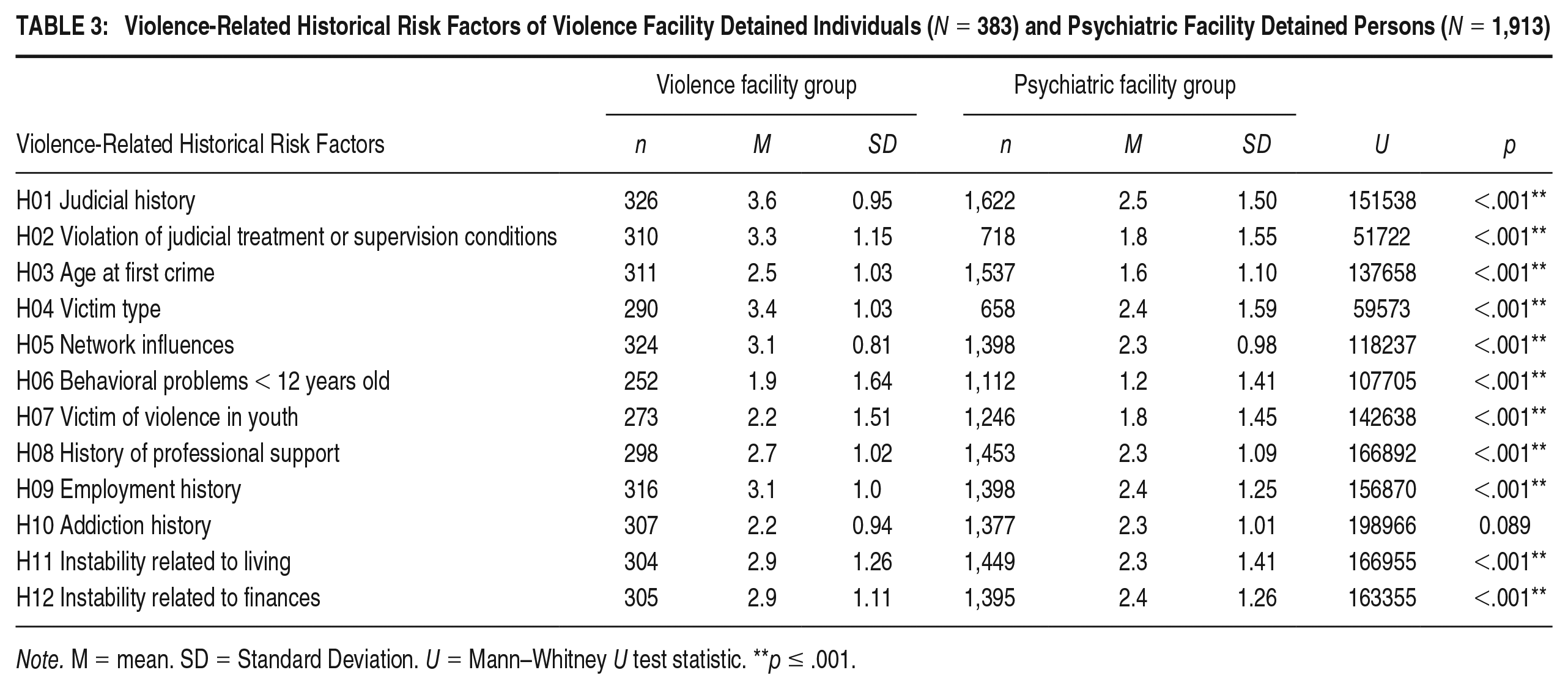
Note. M = mean. SD = Standard Deviation. U = Mann–Whitney U test statistic. **p ≤ .001.
Statistical comparison of historical risk factors between individuals imprisoned in the Violence Facility and persons incarcerated in the Psychiatric Facility showed that Violence Facility detained persons’ scores were significantly higher on all historical risk factors that are related to violent behavior, except Addiction history. These comparison results are presented in Table 3.
Discussion
This first study into criminal characteristics of violent detained individuals transferred to a restrictive Dutch prison facility following severe in-prison violence revealed that these persons who are imprisoned in the “Violence Facility” can be considered as an extreme group in many respects. First of all, their general and violent criminal life course started at a very young age and continued with great persistence, growing into an extensive and severe criminal career, including an abundant imprisonment history. Second, their violent behavior is characterized as unfocused or arbitrary since most persons incarcerated in the Violence Facility committed violent crimes against several victims, known and unknown. Third, Violence Facility detained individuals are characterized by a wide crime variety and are often convicted for different types of crimes, indicating generalistic instead of specific criminal behavior. Fourth, persons imprisoned in the Violence Facility generally show high scores on violence-related historical risk factors, including poor performance in both professional and personal life domains, and they frequently experienced victimization themselves.
The severity and early onset of Violence Facility detained persons’ criminal life course, their problematic behavior, and their problems in other areas of life become even more apparent following our comparison with figures derived from prior studies into the general Dutch prison population (Berghuis et al., 2023; Bosma et al., 2020; Ramakers et al., 2017; Van Ginneken et al., 2018; Van Hall & Cleofa-Van der Zwet, 2023) and following our statistical comparison with a cohort of detained individuals admitted to an in-prison psychiatric treatment facility. Compared with descriptives of the general Dutch prison population, persons who are imprisoned in the Violence Facility are generally younger, started their criminal career earlier, generally had more imprisonments, and had more convictions for (violent) crimes. Compared with individuals imprisoned in a Psychiatric Facility—who are generally considered unmanageable just as Violence Facility detained individuals and who are also characterized by a high incidence of aggressive in-prison incidents (Van Beek et al., 2023; Van Bekkum et al., 2021)—Violence Facility detained persons were younger, showed significantly higher scores on all but one of the violence-related historical risk factors, and showed a more extensive and earlier-started crime record, both for general crimes and violent crimes. No significant differences were present regarding the prevalence of sexual crimes and arson; all other types of convictions were significantly more prevalent in the Violence Facility group, including severe violence, manslaughter, and murder. Furthermore, both the index crime and the crime history were more severe among Violence Facility detained individuals compared with those imprisoned in the Psychiatric Facility.
Our results are in line with previous findings that younger detained individuals are more likely to engage in prison violence (e.g., Bosma et al., 2020; Cunningham & Sorensen, 2007; Schenk & Fremouw, 2012; Steiner et al., 2014), that those with histories of violent behavior and prior incarcerations often show prison violence (e.g., Bosma et al., 2020; M. Butler et al., 2022; Cunningham & Sorensen, 2007; Schenk & Fremouw, 2012), that violent detained persons show frequent and chronic criminal behavior (e.g., Kuanliang & Sorensen, 2008; Schenk & Fremouw, 2012; Steiner et al., 2014), that they tend to perform poorly in other life-course domains (e.g., Engstrom & Scott, 2020; Schenk & Fremouw, 2012; Steiner et al., 2014), and that they often experienced victimization themselves (e.g., Henry, 2020; Klatt & Kliem, 2021; Steiner et al., 2014). Our results furthermore align with previous findings that an early start in crime is an important predictor of a long, varied, and severe criminal career (Loeber et al., 2003; Piquero et al., 2007; Van Hazebroek et al., 2019). The criminal history of individuals imprisoned in the Violence Facility is diverse, and both their index crime and crime history were more severe compared with persons incarcerated in the Psychiatric Facility. Therefore, and together with the previously reported ambiguity regarding relations between index crimes and prison violence (Cunningham & Sorensen, 2007; Griffin & Hepburn, 2006; Schenk & Fremouw, 2012), it is important to consider not only the index crime but also the criminal history, including the index crime, in the likeliness of prison violence.
In sum, our results confirm the relevance of persons’ pre-prison characteristics concerning prison violence and, therefore, support the import model (Irwin & Cressey, 1962) as important explanatory model. Individuals imprisoned in the Violence Facility might belong to the group of life-course persisters (Blokland et al., 2005; Moffitt, 1993; Piquero et al., 2007) and are characterized by a pattern of violent behavior that already starts from early childhood and persists throughout life, also while imprisoned. Whereas most criminal careers show a decline in criminal behavior as individuals age (Bersani et al., 2009; Piquero et al., 2007), these persons who persist to offend chronic or at high-rate have an increased likelihood to engage in crime at a very substantial rate (Blokland et al., 2005). While the findings of this study show clear support for the import model, this does not automatically imply that an effect as described by the deprivation model can be ruled out. As the data that were collected in this study do not provide a conclusive answer to this hypothesis, it may be worthwhile to address this issue further in future research.
Strengths and Limitations
This explorative empirical study contributes to the global understanding of prison violence and the internationally underresearched and high-impact group of detained individuals who show severe in-prison violence. Since all male incarcerated persons admitted to the Violence Facility from 2016 to 2022 were included in this study, a complete and precise description of the total Dutch Violence Facility population is provided. However, differences in legal systems, culture, populations, and sentencing practices need to be considered in light of international generalizability (M. Butler et al., 2022).
Regarding the limitations, several factors could have led to an underestimation of the severity and intensity of Violence Facility detained persons’ criminal careers and the overestimating of the ages at which crimes were committed. First, judicial documentation established during childhood was unavailable since Dutch juvenile- and adult criminal law and their file systems are divided. Second, information was sometimes missing, especially for those with a migration background. Third, only convicted crimes were included, not suspected crimes that were not (yet) followed by a conviction and, obviously, crimes that were not noticed by the police and the judiciary. The aforementioned might thus implicate an even more extensive and earlier started criminal career among individuals imprisoned in the Violence Facility than our results already showed. Finally, the findings may be compromised because the comparison with individuals imprisoned in regular regimes is based on aggregated data described in published studies from other researchers who might have used a slightly different methodology and measurements.
Clinical and Research Implications
Since uncontrollably violent detained persons’ problems, criminal behavior, and imprisonment trajectory manifested themselves long before admission to a highly secured prison facility, monitoring of persons with an early start in crime and, where feasible, implementation of risk-based interventions is recommended for this population so more damage might be prevented. This is both in the interest of prison safety, subsequent (prison) services, society in general, as individuals who are detained themselves. In addition to detained persons’ current behavior and circumstances, it is recommended to consider both the severity of the index crime and the extensiveness of the criminal history in estimating their likeliness to show prison violence. Moreover, our results highlight the importance of sufficient resources and training for staff, to manage uncontrollably violent detained individuals within the justice setting safely. According to the Risk Need Responsivity model (RNR; Andrews et al., 1990; Bonta & Andrews, 2017), which is currently the most prominent theoretical framework and has the potential to reduce criminal recidivism (Starfelt Sutton et al., 2021), individuals with the highest risk should receive the most extensive and intensive programs, targeting criminogenic behavior and factors that might affect treatment response (Drawbridge et al., 2019; Starfelt Sutton et al., 2021). Investments in interventions that focus on criminal risk factors are, therefore, highly recommended to possibly influence Violence Facility detained persons’ future criminal life course, although much is yet unknown on the efficacy of prison interventions on the desistance process of high-risk detained individuals (Anderson & McNeill, 2019; Auty et al., 2017; Polaschek et al., 2015).
Since uncontrollably violent detained persons can be regarded as an earnest group about whom internationally little is known thus far, follow-up research is essential. First, replication of this study to international populations of individuals that are transferred to restrictive prison facilities following severe in-prison violence would be of added value. Second, investigating whether discriminating profiles and classifications can be distinguished of individuals imprisoned in the Violence Facility is necessary, to determine whether a specific type of risk management, (therapeutic) intervention, and monitoring is indicated for specific subgroups. It is recommended that the possible higher prevalence of psychopathy among those imprisoned in the Violence Facility is included in this matter, given the prior demonstrated correlation between psychopathy and aggressive behaviors, as well as institutional violence and recidivism (e.g., Hemphill et al., 1998; Moretti et al., 2024). Moreover, a recent umbrella review and meta-analysis (Gillespie et al., 2023) identified psychopathy as one of the most significant predictors of dangerousness, that is, antisociality, general recidivism, violent recidivism, institutional violence or infractions, and measures of aggression. In an attempt to differentiate possible distinct profiles in both clinical functioning and correctional adjustment, it is possible that classification systems developed by, for instance, Megargee and Bohn (1977) may prove to be of benefit, of which the reliability and applicability have been explored more recently by Rossi and Sloore (2008). Third, to explore clinical implications further, it is important to consider modifiable factors and prison conditions in relation to in-prison violence, as addressed by clinical or dynamic risk factors and as described by the deprivation model. Finally, future research should longitudinally monitor perpetrators of in-prison violence also after their release from the highly secured prison facility. These insights might provide additional understanding of their desistance process in criminal behavior and prison violence, and insights into effective interventions and risk management.
Footnotes
Appendix
Historical Items of the Historical Clinical Future-Revised Risk Assessment Instrument, Translated From the Manual (Spreen et al., 2014)
| Variables | Operationalization | Value range (0–4) |
|---|---|---|
| H01 Judicial History | Severity of the judicial history, based on the number of different crime categories in which one or more convictions are registered. Crime categories are based on the hierarchical “BOOG-12-categorization,” which distinguishes 12 conviction categories (Brand, 2005) | 0 = One or more convictions within one crime-category 1 = One or more convictions within two different crime-categories 2 = One or more convictions within three different crime-categories 3 = One or more convictions within four different crime-categories 4 = One or more convictions within five different crime-categories |
| H02 Violation of judicial treatment or supervision conditions | Based on the number of different types of violations within a judicial context. Seven different types are distinguished | 0 = No violations 1 = One violation category 2 = Two violation categories 3 = Three violation categories 4 = At least four violation categories |
| H03 Age at first crime | Age at committing first convicted crime | 0 = At least 31 years old 1 = Between 19 and 31 years old 2 = Between 16 and 19 years old 3 = Between 13 and 16 years old 4 = Younger than 13 years old |
| H04 Victim type | The number and type of victims caused by a detainee and based on their convictions for physically and/or sexually violent crimes. For each conviction, the number of victims is examined and whether or not these victims were acquaintances of the detainee | 0 = No victims 1 = Physical or sexual violence to one person that was either known or unknown 2 = Physical or sexual violence to two or more persons. All victims were acquaintances of the detainee 3 = Physical or sexual violence to two or more persons. All victims were strangers to the detainee 4 = Physical or sexual violence to both acquaintances and strangers |
| H05 Network influences | Based on the extent to which the detainee established and maintained relationships with people with a criminal and/or antisocial lifestyle and was influenced by those network members | 0 = The detainee had a prosocial orientation and/or a prosocial network 1 = Between 0 and 2 2 = The detainee was partly negatively influenced by criminals or antisocial network members, and partly positively influenced by prosocial network members 3 = Between 2 and 4 4 = The detainee was mainly focused on criminal or antisocial network members with a negative influence on his criminal behavior |
| H06 Behavioral problems < 12 years | Based on the extent of externalizing problem behavior and the consequences before the age of 12 years. | 0 = No externalizing problem behavior 1 = Behavioral problems are mentioned, but not further explained or described 2 = Behavioral problems, no violent behavior, but verbal oppositional behavior 3 = Behavioral problems (with or without violence) that led to serious problems in contact with others, for example at school or within the family 4 = Such severe behavioral problems (with or without violence) that they gave rise to a supervision order and/or custodial placement |
| H07 Victim of violence in youth (before age 18) |
Based on whether the detainee was the victim of (different) types of assault, maltreatment, and neglect throughout the first 18 years of his life, including witnessing abuse | 0 = The detainee was never a victim or witness of violence 1 = There has been incidental neglect and/or incidental abuse 2 = There has been chronic neglect (potential with incidental abuse) 3 = There has been chronic abuse (potential with incidental neglect) 4 = There has been chronic neglect and chronic abuse |
| H08 History of professional support | The seriousness is partly determined by the nature (outpatient/intramural; voluntarily and/or forced professional support) and/or the number of admissions to psychiatric institutions, youth institutions and/or addiction treatment centers | 0 = No professional support 1 = Only voluntary (outpatient and/or intramural) professional support 2 = Either forced outpatient or intramural professional support (but not both). In addition, there was voluntary professional support 3 = Both forced outpatient and intramural professional support. In addition, there was voluntary professional support 4 = Only forced (outpatient and/or intramural) professional support |
| H09 Employment history | Employment problems are defined as problems at work due to detainees’ (problem) behavior | 0 = No problems in employment history 1 = Problems at work within a certain period of time, not leading to a change of employer 2 = Occasionally there were employment problems, sometimes leading to dismissal and/or a period of unemployment (not attributable to the labor market) 3 = Frequent employment problems leading to changes of employment and/or several periods of unemployment 4 = A very problematic and discontinuous employment history |
| H10 Addiction history | Based on four sub indicators: alcohol, soft drugs, hard drugs, and other addictions, such as gambling, and sex addiction. Each indicator is graded on a 5-point scale (0-4), based on frequency and negative consequences. The total score refers to the sum of the four indicators | 0 = The sum of the four indicators is 0 1 = The sum of the four indicators is 1, 2, or 3 2 = The sum of the four indicators is 4, 5, or 6 3 = The sum of the four indicators is 7, 8, 9, 10, or 11 4 = The sum of the four indicators is at least twelve |
| H11 Instability related to living | Based on homelessness caused by a detainees’ behavior and evaluated from the eighteenth year of the detainee’s life, or from the moment the detainee started to live independently. | 0 = No living instability 1 = Housing problems for a certain period of time, not leading to homelessness or relocation 2 = Incidentally, there were housing problems that sometimes led to a period of homelessness and/or relocation. 3 = The detainee went through several periods of homelessness and/or relocations, caused by his problem behavior 4 = A very problematic and discontinuous living history. The detainee was not being capable of living on his own |
| H12 Instability related to finances | Based on debts and stressful circumstances following the detainees’ own irresponsible behavior and a lack of financial skills. Financial skills are evaluated from the eighteenth year of the detainee’s life | 0 = No financial problems 1 = Minor shortcomings in financial skills 2 = Occasional deficiencies regarding financial skills 3 = Shortcomings in financial skills 4 = Very serious deficiencies regarding financial skills |
Authors’ note:
All relevant data are within the paper. Data are available on reasonable request from the corresponding author. This study did not receive grants from public, commercial, or not-for-profit funding agencies. The authors declare no potential conflicts of interest. The authors thank the Dutch Ministry of Justice and Security for providing the data and all criminologists and psychologists involved in file records processing. Expressed views are those of the authors and not necessarily those of the Dutch Ministry of Justice and Security. This study was approved by the Dutch Ministry of Justice and Security and a positive advise was received from the Ethics Committee for Legal and Criminological Research, Faculty of Law, VU Amsterdam.
Patient Consent Statement
Detained persons were not actively recruited, informed or rewarded for this study. Data files used in this study were based on already existing databases, containing previously collected information intended for policy purposes. From both databases, a select file was provided, only containing the data of detained persons who were placed in the facility for uncontrollably violent detained persons or the Penitentiary Psychiatric Center of Penitentiary Institution Vught between 2016 and 2022. Both data files were obtained completely anonymously and cannot be linked in any way to persons or criminal cases. This procedure complies with Dutch privacy legislation and was approved by the Dutch Ministry of Justice and Security and the Ethics Committee for Legal and Criminological Research, Faculty of Law, VU Amsterdam.
Permission to Reproduce Material From Other Sources
Data usage from the database regarding uncontrollably violent detained persons and the Penitentiary Psychiatric Center database for this study has been approved by the managing board of Penitentiary Institution Vught, the managing board of the National Penitentiary Psychiatric Center Database and was furthermore authorized by the Dutch Ministry of Justice and Security.
