




Abstract
Women experiencing homelessness (WEH) are a marginalized group who often lack support services, leading them to adopt alternative survival strategies that leave them at risk of being victimized and becoming involved with the justice-system. To better understand this problem, we analyzed the adaptive strategies Canadian WEH use to survive. Comparing the life histories of WEH who turned to criminal activities (n = 4) with WEH who demonstrated prosocial resilience (n = 4) makes it possible to identify protective and risk factors for criminal behavior and to propose adaptive strategies that can be used to support these women to adopt a prosocial lifestyle. The results provide a framework for understanding the needs of WEH, filling a gap that results from the focus on men needs in most scientific literature and by many resources, and suggesting that meeting those needs may reduce the likelihood that WEH will become involved with the justice-system.
Women use different adaptive strategies to survive homelessness. These survival behaviors are rooted in their life experiences but are also actualized in response to the environment in which they find themselves prior to or once homeless (Bellot & Rivard, 2017). Scientific literature on homelessness in Canada and Quebec points to a disparity between the services available and the needs of WEH, in part because homelessness is usually considered in terms of how it is experienced by men (Andermann et al., 2021; Laberge et al., 2000; Maurin, 2015). In Quebec, the occupancy rate for emergency housing resources for men is 85.7%, while for women it is 103.9% (Ministère de la Santé et des Services sociaux [MSSS], 2014b), this result not only of a lack of sufficient resources but of the urgent need many women feel for shelter during the night. This situation forces women to rely on individual capacities and experiential knowledge to cope with residential instability. For some, this involves the use of survival criminal activities (SCA) (Asberg & Renk, 2015; Bellot & Rivard, 2017; Grenier et al., 2020), while others demonstrate prosocial resilience. The development and use of these survival behaviors—SCA vs prosocial resilience—remain poorly researched (Bellot & Rivard, 2017; Laberge et al., 2000), making it difficult to prevent crime among this population.
The present study then aims to answer the following research question: what are the social and individual factors that distinguish WEH applying SCA from those demonstrating prosocial resilience? The resulting analysis provides a framework for understanding the needs of WEH, filling a gap that results from the focus on men needs in most scientific literature and by many resources, and suggesting that meeting those needs may reduce the likelihood that WEH will become involved with the justice-system.
Women Experiencing Homelessness in the Province of Quebec
In October 2022, women accounted for 29% of those experiencing homelessness in Quebec (MSSS, 2023) and more than a quarter (27.3%) of the homeless population in Canada (Andermann et al., 2021). Several groups, such as aboriginal women (15.0 %) and immigrant women (13.5%), have been shown to be over-represented in official figures (MSSS, 2023) and to be more likely to be accompanied by children (Fournier et al., 2022). However, these figures are believed not only be underestimates but to be increasing (Gélineau et al., 2015; Sikich, 2008). They also fail to take into account that women often reside “temporarily with others, but with no guarantee of sustained residence or immediate possibility of access to permanent housing” (Gravel, 2020, p. 20). As a result, a majority of WEH are invisible to the general population and to government institutions, which contributes to the difficulty of identifying their unique needs and developing appropriate practices (Gélineau et al., 2015; Schwan et al., 2020). It is clear that both the causes that lead to homelessness and the experience of homelessness differ according to gender: “the situation for women who are homeless is more precarious in terms of income, employment, and housing” (Bellot & Rivard, 2017, p. 97). Understanding the specific causes that lead to homelessness as well as the way homelessness is experienced throughout a life course makes it possible to identify the various factors that contribute to an individual developing a deviant or pathological trajectory (Ordre des psychoéducateurs et psychoéducatrices du Québec [OPPQ], 2014).
Women’s Homelessness and Survival Behaviors
Becoming homeless is the result of interaction between structural, systemic, relational, and individual factors (Gentil et al., 2019; MSSS, 2022). Researchers have suggested that the leading causes of women’s homelessness are poverty resulting from the prevailing gendered social structure 1 (Bellot & Rivard, 2017; Laberge et al., 2000; Maurin, 2019), as well as domestic violence (abuse by a spouse or partner, 21% of women vs. 1% of men; marital conflict, 18% of women vs. 12% of men) (Latimer & Bordeleau, 2019), 2 inability to pay rent or mortgage (17.2% of women vs. 16.4% of men), as well as substance abuse (16.1% for women vs. 23.9% for men), eviction (22.4% of women vs. 23.1% of men), and mental health problems (13% of women vs. 11.2% for men) (MSSS, 2023). Other factors are institutionalization (prison, psychiatric institution, youth protection program), weak social network, participation in the sex industry, being a caregiver, having a dependent child (Gélineau et al., 2008), and adverse childhood experiences (Phipps et al., 2019). Women homelessness is usually the result of an accumulation of risk factors throughout a life course (MSSS, 2022).
Once homeless, women adopt numerous survival behaviors to meet their needs for housing, food, emotional security and stability, and psychosocial and health care. These behaviors are expressed not only according to the individual nature of their trajectory into homelessness but also in a gendered experience of homelessness. Unlike their men counterparts, women’s most pressing need is for safety, as they are more likely than men to be the victims of physical and sexual aggression when living on the street (Bellot & Rivard, 2017; Fournier et al., 2022; MSSS, 2014a). This may lead them, among other things, to find temporarily housing with friends or family (“couch surfing”) (MSSS, 2019) or to stay in a rooming house, in their car, or a squat in abandoned buildings, places they consider to be less dangerous than the street (Grenier et al., 2020). The few WEH who live on the street (17.9% in Quebec in 2023; MSSS, 2023) adopt survival behaviors such as getting a dog, dressing as a man or very shabbily, neglecting personal hygiene, adopting a masculine or aggressive attitude toward others, establishing intimate homosexual relationships, affiliating with a pimp, or joining forces with a man for protection (Bellot & Rivard, 2017; Laberge et al., 2000). The use of such strategies can, however, put WEH at greater risk of (re)victimization, contact with the legal system, and continued homelessness. Affiliation with a pimp, for example, can lead to even greater risk of violence (Beijer et al., 2018; Laberge et al., 2000). These adaptations can also contribute to self-destructive behaviors (drug and alcohol use), which may sometimes lead to participation in criminal activities to obtain the money required to satisfy an addiction (Finfgeld-Connett, 2010). WEH may also use sex practices (prostitution) (Asberg & Renk, 2015; Gélineau et al., 2008), drug dealing, or shoplifting to survive (Fournier et al., 2022; Grenier et al., 2020; MSSS, 2014a), and those strategies, with the exception of prostitution in Quebec 3 (Projet de loi C-36, 2014), can lead to contact with the legal system. There are clear links between women’s homelessness and criminal behaviors (Asberg & Renk, 2015; Schwan et al., 2020).
Women Experiencing Homelessness and Conflict With the Law
Although women identified as homeless are still less likely than men identified as homeless to come into conflict with the law, municipal regulations adopted in the 2000s have put them at greater risk of entering the criminal justice system (Bellot et al., 2021; Bernier et al., 2011). A community organization helping WEH in Montreal found that nearly one out of four of its clients (24%) had had some conflict with the law (Auberge Madeleine, 2022). The number of citations given out by the police has increased since 2012 (from 11.8% of total citations issued in 2012 to 16.8% in 2018 in Montreal) (Bellot et al., 2021), with most citations given for loitering, disturbing the peace, or, in the province of Quebec, solicitation (Bernier et al., 2011). Women who have been imprisoned are more likely than men to become homeless when they are released, making imprisonment a precipitating factor for homelessness (Asberg & Renk, 2015; Freudenberg et al., 2007; Fries et al., 2014). Criminal activities that lead to contact with the law can make it more difficult for WEH to take advantage of social services or intervention policies (Salem et al., 2021). WEH who resort to criminal activities are also at greater risk of victimization (Asberg & Renk, 2015), as they are more likely to find themselves in compromising situations and in contact with dangerous people, which often leads to an increase in criminal behavior (Turanovic, 2019). All of this suggests that, given the greater vulnerability of WEH living on the street and the inadequacy of current aid policies and practices, they may tend to develop survival behaviors that, paradoxically, further marginalize them, making them “invisible” and keeping them in a precarious situation, as well as increasing the possibility of conflict with the legal system.
Conceptual Framework
Finfgeld-Connett (2010) suggests that overcoming homelessness involves three stages: (1) the crisis stage, during which women experience overwhelming distress after becoming homeless; (2) the assessment stage, in which the costs and benefits associated with the use of social services are evaluated; and (3) the sustained action stage of seeking help. Homelessness is then resolved through women’s use of various assistance mechanisms. However, the theory fails to deal with the question of whether, once the third stage is reached, women have access to services that are sufficiently accessible and well-adapted to encourage their use, nor does it consider the experiences of those who do not use social services or have become involved with the legal system and may be denied access to services (Salem et al., 2021). It also fails to recognize that women in the last category may have to go through the process of desisting from crime before they can deal with their homelessness.
Desistance from crime generally occurs in three distinct phases. Primary desistance refers to cessation of all forms of criminal activity while secondary desistance involves “a change in social roles or identity that leads the offender to conceive of himself as a ‘new person’” (Maruna et al., 2004 cited in F.-Dufour et al., 2018, p. 209). Finally, tertiary desistance involves “changes in the sense of belonging” to a community, “how a person is perceived by others and how they perceive their place in society” (Stone, 2020, p. 171). The limited literature on desistance for women identifies having a child, being in a supportive relationship, being financially independent, avoiding drug dependency, and the development of a sense of agency as facilitators of the process (Rodermond et al., 2016). It is unclear if these factors can be generalized to WEH, particularly as some studies have suggested that WEH are likely to remain in an unhealthy relationship if this is necessary to secure accommodation (Andermann et al., 2021) and that they sometimes become involved in criminal activities as a way to survive (Bellot & Rivard, 2017; Gélineau et al., 2015). This suggests that getting off the street may be a prerequisite for the desistance process. To address this issue, we look at the social and individual factors that distinguish WEH using criminal activities to survive from those who demonstrate greater prosocial resilience, with the specific objectives of identifying the protective and risk factors related to adopting criminal activities and proposing adaptive strategies to support WEH who are in conflict with the law in developing a prosocial lifestyle in line with prevailing social norms.
Methodology
Research Design
An interpretivist paradigm, which suggests that reality is socially constructed from individual perceptions that can change over time depending on lived experiences (Fortin & Gagnon, 2015), was used to identifying the meaning that WEH give to their survival behavior. A narrative phenomenological perspective was used to identify what differentiates WEH who use criminal activities to survive from those who have not resorted to such activities. This approach highlights the importance of recognizing the construction and reconstruction of internalized narrative discourse and how it is influenced by an understanding of past, present, and future life experiences (McAdams, 2001). Individual development is understood as involving a change in self-narrative: through the capacity for retrospection about the stories that form their lives, individuals can “refine certain aspects, introduce new key elements, and modify previous interpretations. This work of rewriting one’s own history becomes constitutive of one’s identity” (F.-Dufour et al., 2021, p. 198). Life narratives are of scientific interest for several reasons, particularly the relationship of narrative discourse to lived experience (Burke, 2019) and the recognition that self-narrative not only organizes and guides behavioral patterns (F.-Dufour et al., 2021; F.-Dufour & Villeneuve, 2020; Glowacz, 2020) but makes it possible to appreciate the context in which difficult-to-understand behaviors take place (Harding et al., 2016; Maruna, 2001).
Data Sources and Data Collection
The data in this study were taken from a larger study—Project Transcendance. 4 As part of this project, 91 life stories of adults aged between 18 and 32 who had experienced various adaptive difficulties were obtained through interviews lasting between 60 and 120 minutes. Participants were recruited from community organizations and therapy or transition centers in the Quebec City and Trois-Rivières regions. Life stories were collected using McAdams’ (2001) narrative approach. The sample in the present study was created using a contrast-deepening strategy 5 (Pires, 1997) and consists of the stories of eight WEH (n = 8), four of whom (Andrea, Claire, Francoise, and Evelyne) had resorted to criminal activities to survive that had sometimes led to contact with the legal system while four others (Audrey, Maude, Rachel, and Laurence) had demonstrated prosocial resilience. Defining a sample size a priori is difficult in inductive or exploratory research but, as we read through all the stories, eight stories seemed to provide sufficient information about the themes being considered, with redundancies noted if more stories were added (Sim et al., 2018). This size sample is sufficient according to Smith et al. (2009), who recommend between three and 10 case studies for this type of study. All the women in the sample identified as women and had experienced at least one episode of homelessness; four had been involved in criminal activities that lead to involvement with the law. Type of residential condition and type and severity of offenses were not related to their choice as subjects.
Data Analysis Strategy
Phenomenological case study is a recognized method of research and data analysis that favors the examination “in detail of one or more cases over a given period” (p. 191) and is “well suited to research”—such as the present study—“aimed at discovering the ‘how’ and ‘why’ of phenomena” (Fortin & Gagnon, 2015, p. 198; Yin, 2014). Its holistic dimension is part of the process of “preserving and understanding the entirety of the case unit” (Fortin & Gagnon, 2015, p. 198; Punch, 2005) and makes it possible to identify the events that the women in the sample felt, in retrospect, had been important in determining their life trajectories (Fortin & Gagnon, 2015). Using an inductive approach, lifelines (Fiorelli et al., 2014) were created to understand the temporal relationship of different events. Based on a hermeneutic approach, a phenomenological reformulation 6 of the life stories was then carried out to clarify the nature of the experiences attached to different events perceived as significant by the two groups (F.-Dufour et al., 2021; Fortin & Gagnon, 2015). More specifically, the strategy used to capture the essence of the phenomenon under study was observation and reflection on the content of the life stories (Fortin & Gagnon, 2015). It was then possible to highlight “how different ‘ingredients’ of the trajectory, in their respective temporality, influenced the construction” (Fiorelli et al., 2014, p. 5) of the life stories of WEH who used or did not use criminal activities to survive. Based on this descriptive and analytical representation of these events, the similarities and contrasts in narratives were identified, making it possible to develop typical trajectories for each group. Social and individual risk and protective factors for each group are then identified, based on the theory of developmental psychopathology (OPPQ, 2014).
Results
As, due to length constraints, it is not possible to present the life stories of all eight women, we have included two life stories from each group.
Phenomenological Summaries of Two Women Who Did Not Use Criminal Activities to Survive
Françoise
Françoise lived with her biological parents until the age of one, when her parents separated. She then lived with her mother and younger brother until she was 14. During this period, Françoise saw her father every other weekend until she was 11, and then had no contact with him until she was 14 because her mother refused to let her see him: “It was painful. We wanted to see him . . . he always did everything for us.” She sees her life between the ages of 11 and 14 as being “shit, because I was bullied at school. Then I’d come home, and my mother would tell me I was shit. . . . I was really depressed. I tried to kill myself several times.” She identifies the relationship with her mother as the most negative element in her life: “Basically, all she did was put me down . . . I had no self-esteem. I couldn’t make friends, because every time I made a friend, she told me that that wasn’t a good person.” At the age of 14, Françoise lived with her father for six months. She says: “He didn’t know how to look after me. I didn’t have any food . . . I was the one who did my laundry and cooked my meals. Except I didn’t earn any money. My father didn’t have any money. So, in the end, I didn’t really go to school.” Following a report from the school, Françoise was placed in a foster home for a few days but then had to return to live with her mother, who was considered the more suitable parent. Françoise later returned to her father’s home, but found the conditions difficult: “. . . I had to sleep on the floor in his living room, I decided not to stay there.” “. . . I spent two years like that, moving from one [place] to another, then sleeping outside when I couldn’t find a place to sleep. . . . I was half on the street, half in people’s homes. . . . Everyone who’s in trouble knows everyone else.” During this period, she explains: “I didn’t want to sleep outside. . . . all kinds of things can happen to you. I used to not sleep by taking drugs”
7
but eventually “I was raped. You know, sometimes people say, ahh I’ll take you in, but that’s not what they do.” To meet her basic needs, she “often went to [social resource] for lunch. Then I’d go to [social resource] for dinner. I would beg for money to be able to eat for the week.” At 17, Françoise moved back in with her father and got a job. On the eve of her 18th birthday, she became pregnant after a two-month relationship with a violent partner. She broke all ties with her mother, who did not support her pregnancy. Following the birth of her daughter when she was 19, she left the father’s house because of his violent behavior. Françoise explains that the birth of her daughter was a turning point in her life: “it gave me new life. Before I had my daughter, I was a nobody. I had no ambition, no will to do anything . . . I would have killed myself.” Her daughter motivated her to finish high school and undertake professional training: “I took it [the birth of my daughter] as a trigger to wake up a bit and be able to take back control of my life.” From 18 to 25, Françoise lived in cooperative housing with her daughter. She finished high school and professional training with the support of Emploi Québec and welfare. She has since worked as a mechanic and tow-truck driver and has a meaningful relationship with her ex-partner’s mother, who helps her with her daughter. At the age of 25, she gave birth to a daughter by her current partner and she and her first daughter moved in with him.
Claire
From birth to age 14, Claire lived with her biological parents, where she was physically neglected. She explained that from the age of 4 she did all the chores around the house, such as washing dishes, doing the laundry, and cleaning: “I remember cleaning my parents’ room by myself because I thought it was disgusting.” She was sexually abused by her father from the age of 6 to 14 and identifies this as the most negative time in her life, given the negative consequences of this abuse: “I was depressed. I had suicidal thoughts on a regular basis.” She received little support from her parents, who considered her “problematic.” She experienced rejection during primary and high school as she had difficulty relating to others but suffered little as a result: “I never took it badly because I’ve always been very solitary and very good on my own without needing friends.” At the age of 14, Claire explains that “my whole life changed” when she acknowledged that she was being sexually abused by her father: she wrote a letter to her grandmother in which she detailed: “Everything that was going on with my father. I even wrote down examples of what he had already done to me. I wrote down how my mother treated me. How I had to do all the housework. How I felt about all this.” The grandmother reported the situation to the Quebec Youth Protection Agency (YPA) and took Claire to live with her. Claire was sent by YP to live with a foster family and remained there from 14 to 18. She describes this chapter as the most positive time in her life: “In that period of time, I really felt like myself. I was free of pressure, worries, and all that. What I was going through at my parents’ house was uncomfortable for me, and it started to dissipate.” At 17, Claire started college but dropped out in the fall semester “because I wanted to be with my boyfriend all the time.” She got a job and lived one week with her partner and the next with her foster family. But on her eighteenth birthday, her partner ended the relationship, leaving her to pay for their apartment alone: “I had 2-3 months of unpaid rent. Then it was a mess. I didn’t have Internet anymore. I got into a lot of debt.” Between the ages of 18 and 19, Claire moved more than six times, and her difficulties in paying rent led to her staying with different men she met on dating apps who physically abused her and made her felt obliged to have sex: “I wanted to have a place to sleep where I was comfortable . . . it was a room and a half, there’s just one bed . . . we slept together . . . [One of them] actually tried to strangle me.” Finally, around the age of 19, Claire moved into a mixed-use shelter and met her current partner, with whom she shared an apartment. She identifies her integration into the resource and meeting him as a turning point in her life, because: “It played a big part. I helped him a lot. He’s grateful for that, which helps my confidence . . . My personality, I’ve become a bit more open. Then socially, I’m just less stressed. I’ve got hope for my future since I met him . . . It’s starting to sink in.” Claire has found a well-paid job and is receiving welfare support. She hopes to have a family and go back to school. She is waiting for psychological follow-up to learn how to deal with the after-effects of her sexual abuse.
The life trajectories of WEH who did not use SCA are characterized by victimization (sexual abuse, mistreatment, bullying, “dysfunctional” family) from an early age, leading YPA to intervene. This victimization led to the development of mental health (Andrea, Claire, and Françoise) and behavioral difficulties (Evelyne) that continued at the time of the interview. Despite this, the women had managed to develop attachments to a family member (foster or biological) or peers and to attend school, creating prosocial capital (F.-Dufour et al., 2016) that could be used in learning to cope with the repercussions from their traumas and in developing a narrative of themselves as survivors. The social support increased their sense of belonging and reduced the physiological, social, and emotional distress caused by homelessness, while also reducing the number of episodes of homelessness (Phipps et al., 2019). Three of these individuals (Françoise, Evelyne, and Andrea) were able to find temporary housing with people they knew during their episodes of homelessness. Interestingly, none of the women in the prosocial group developed a substance use problem.
Phenomenological Summaries of Two WEH Who Used Criminal Activities to Survive
Audrey
Audrey was born prematurely and spent the first six months of her life in a hospital incubator. Once she was released from hospital, YPA quickly became involved because her parents “abandoned me in a snow drift at 6 months . . . to make cocaine with their clients.” The baby was entrusted to her paternal grandmother until the age of 5. While there, Audrey was sexually molested by her paternal uncle and abused (sequestered and malnourished). She told her aunt about this and was then placed with several foster families from the age of 6 to 11. But she “was badly treated, abused, malnourished. We ate once a week.” She describes this period of her life as a “childhood trauma”: “It had such an impact that I became aggressive and impulsive, with extreme personality disorder. I didn’t know who I was, I don’t even know how to take care of myself.” Friends of her paternal grandparents became her legal guardians and she lived with them from the age of 11 to 18: “I ate, I went to school, I had laundry. I felt good and I had a roof over my head.” It was at this point, however, that she began “to become rebellious”: “They did everything to keep me out of trouble. Then I did everything to get into trouble.” She explains that she had a “bad time” at the age of 12, when she started using “crack, peanut, heroin, crystal meth, and cocaine.” At the age of 14 she committed her first crimes during a period when she had run away from home: “I was making [drugs] . . . I went to my friends’ houses to make dope guts. Ass guts. A turning point because that’s when I understood that even if you do everything you want, someone will always bring you back to the law. And then to justice.” She ran away from home between the ages of 14 and 17 and stayed with friends in temporary, unsafe lodgings. It is unclear where she lived during this period—she says she lived with friends between the ages of 14 and 17 but also mentioned buying a house with $25,000 in cash when she was 15, only to have her girlfriend set it on fire when she was 16. It is therefore impossible to know with any certainty where Audrey lived during these years, or even where she lived from the age of 19 until the time of the interview, when she was 21. She says, however, that she wants to “have holy peace” and “go away to a quiet place.”
Maude
From age 11 to 17, Maude lived in a foster home: “ [My mother] put me in a foster home and said ‘bye.’ Like I was some kind of trash. . . . That was hard.” Maude reacted to this placement by running away, which led to unsafe housing or homelessness: “I met some bad people. I sold drugs to get by. I had no place to go and no place to stay. Because it took money to live. I sold drugs, I stole. I’ll even tell you that I ripped off people. I’m not proud of myself . . . it was a really rough part of my life.” The difficulty of surviving led to a great deal of stress: “You feel like you’re going nowhere, like you’re always falling into a void and like you never hit bottom.” She explains that these experiences led her to try to forget herself and to feel worthless. She experienced another period of residential instability when she left the foster home at the age of 17: “I felt free. . . . I’m going to live the way I want to live, not the way other people want me to live. The power of freedom really made an impression on me.” Her way of expressing her freedom took the form of indifference toward the law (selling drugs, verbal and physical violence directed toward her mother, vandalism), failure to look after her health (increased drug and alcohol consumption), and difficulty in dealing with others (difficulties with her family and loss of friendships): “I didn’t care about anything. F**k the world. It’s my opinion that counts, not yours.” The difficulties with her family had a negative impact on her mental health: “ I have trouble with my head, like I found the silence heavy . . . chaotic thoughts spinning in my head and I’m not doing well.” Maude began living with a violent partner at the age of 17 but left him when she was 19. This breakup led to a relapse into drug and alcohol abuse, which led to further criminal acts (violence towards others) and residential instability: “I was on the street. I was going to bed in the bushes . . .. I got up one morning and I looked around: it was a small two and a half, full of gangs, one on top of the other, and then I was lying on little mattresses all dirty, eaten by dogs.” At the time of the interview, Maude had a job. She was sober, in a healthy relationship, and in the process of reconciling with her family. Her desire to start her own family and to be able to provide a better future for her future children helped her maintain a healthy lifestyle. Maude describes this chapter of her life (ages 19 to 25) as a “positive journey” in which she gradually evolved and achieved her ideal self with pride and perseverance: “Today, when I find myself on my own, I feel good about myself. I’m proud of the progress I’ve made, of everything I’ve done to help myself, and I’m still trying to find solutions to make things even better.” For Maude, quitting drugs and alcohol at the age of 25 was central to her journey away from crime and towards stable housing, and she identifies this achievement as a turning point.
The life trajectories of WEH who turned to criminal activities as part of their survival behaviors are characterized by more numerous and diversified forms of victimization (mistreatment, sexual abuse, parental abandonment and rejection, exposure to crime and violence) from an early age, often leading to intervention by YPA. However, in contrast to the women who did not resort to SCA, they did not develop stable, secure attachments during their time in care. They had no “home,” no place to belong, no anchor point. They moved more frequently, and the adults responsible for their care often changed. Their mental health deteriorated, and they developed both substance abuse problems and behavioral problems such as aggressiveness, indifference to others, and impulsivity. They felt misunderstood by those in their environment (e.g., youth protection practitioners) and had difficulty with developing a clear self-identify, which complicated their interactions with others, leading them to gradually become disaffiliated (Phipps et al., 2019). As a result, they had to deal with their trauma and its repercussions on their own. All the women in this group used running away as a way to deal with the suffering they experienced but this led not only to their first experiences with homelessness but to increasing integration into antisocial systems and to drug addiction. Two of the four WEH (Maude and Rachel) who used SCA also identified the lack of support they received when they aged out of institutional care as a difficult moment that contributed to their precarious social situation and delinquency (Gélineau et al., 2008).
Discussion
Overcoming Homelessness: Survival Behavior According to Group
In situations of homelessness, women in neither group turned to resources provided by the government or community, differing from the situation Finfgeld-Connett (2010) describes in her conceptualization. Before entering the assessment stage (Finfgeld-Connett, 2010), women in both groups in our sample prioritized survival strategies that put them at risk of being (re)victimized, having to deal with the judicial system, or continuing their homelessness (Bellot & Rivard, 2017). The majority of women in the sample ended up in what has been called hidden homelessness (Gravel, 2020)—only Françoise, out of the eight women considered, was actually living on the street. WEH who did not use SCA made use of the unsafe residences of men acquaintances (Claire and Françoise) or abusive partners (Françoise and Evelyne), or practiced survival sex (Claire) to find a place to sleep (Gélineau et al., 2008). They begged for money on the streets (Françoise), went to soup kitchens (Françoise), or turned to low-paying and unreliable jobs (Andrea and Claire) to meet their needs. All of the WEH who used criminal activities participated in the street economy (Grenier et al., 2020), either by selling drugs (Maude, Rachel, Laurence, and Audrey), making drugs (Audrey), or stealing (Maude). The majority (Laurence, Audrey, and Maude) linked their experience of being victimized as a child or developing a substance abuse problem (Laurence, Rachel, and Audrey) to their delinquency in adolescence and young adulthood (Lanctôt, 2010; Turanovic, 2019). Finally, most of the women in this group (Maude, Rachel, and Laurence) noted that being on the street contributed to their criminal activity (Asberg & Renk, 2015; Teasdale & Bradley-Engen, 2017).
All of the eight women in the sample, more than once and at different moments of their experience of homelessness, used their personal social capital to help them secure safe housing before turning to government or community resources. In the case of WEH who used criminal activities as part of their survival behaviors, the personal resources they could turn to were often violent spouses or deviant peers, putting them at even greater risk of contact with the legal system (Agnew, 2016). For WEH who did not use SCA, the personal resources available to them during the sustained action stage (Finfgeld-Connett, 2010) were insufficient and their residential and financial stabilization was tied to social assistance, either financial (e.g., Emploi Québec and welfare) or housing resources intended for women victims of sexual abuse, domestic violence, or homelessness. They identify the use of these resources as a turning point in their stabilization, as was finding a prosocial partner. As Phipps et al. (2019) point out, solving homelessness requires identifying and dealing with needs other than housing. Some women (Evelyne and Andrea) found that the social resources available had restrictions (e.g., eviction for problematic behavior which also led to loss of custody of a child [Evelyne] or limited resources (Andrea)). For these women who didn’t use SCA, it took more than one attempt to find help before they were able to make a real change in their lives and on more than one occasion it was necessary for them to rely on their depleting personal social capital, rather than available social resources, to meet their varied and complex needs during their experience of homelessness (Grimard et al., 2021), a finding that shows the limits of Finfgeld-Connett’s (2010) conceptualization of how women’s overcome homelessness.
The difference in survival behavior between the two groups seems to be based in large part on the quality of social ties. The social capital of those who did not use SCA, as well as their ability to make connections and develop appropriate supports (abilities developed in childhood and adolescence through interaction with more secure and stable environments), seems to have been sufficient to overcome the limitations in social service resources and make it possible for them to escape homelessness (Phipps et al., 2019) without resorting to criminal activity. The fact that they did not develop substance abuse problems also reduced the risk of legal action and thus the number of problems they faced (Lanctôt, 2010; Petrillo, 2023).
Desistance From Crime by Women Who Have Used SCA
The main finding from the present study is that women who have been involved with the legal system are most likely to be able to overcome homelessness only after they have been able to desist from criminal acts. Among the elements listed as having triggered this process of desistance were the birth of a child (Audrey), finding a prosocial partner (Rachel and Maude), the desire to regain custody of a child (Laurence), the fear of further prosecution (Laurence), satisfaction with what they had achieved from criminal acts (Laurence), and a desire to find a better life and become a better person (Maude, Laurence, Rachel, and Audrey). Such experiences resulted in awareness of the possibility of change and made it possible for them to become more prosocial (primary desistance).
For all these women, giving up drug and alcohol use helped them abandon their criminal behavior and stabilize their residential situation. To achieve this, some turned to detoxification therapy (Audrey and Laurence), while others (Maude, Laurence, and Rachel) moved away from a deviant peer (“knifing off opportunities,” Maruna & Roy, 2007) or met a partner who motivated them to undertake more prosocial roles (e.g., becoming a student) (Maude and Rachel). For these women, reintegration into society was not achieved solely through the use of various social resources, as suggested in Finfgeld-Connett’s (2010) conceptualization of how homelessness is overcome. This finding may not be unexpected as studies have shown that neither prison facilities or the Housing First programs currently in place across Canada to promote residential stability for people experiencing homelessness are equipped to deal with the adverse childhood experiences and their traumatic after-effects, or with victimization and involvement with the law, elements that are nonetheless central to exiting homelessness and desistance from crime (Edalati et al., 2020; Petrillo, 2023). In Bukowski and Buetow’s (2011) study, WEH saw social services as helping them to survive and remain healthy but did not feel that the resources had helped them resolve their homelessness.
The experiences (E) the women encountered during their developmental trajectory and once they were homeless led to consequences (C) (systemic, structural, relational, and individual) that affected their self-narratives (N). This change in self-narrative then modified their life situations (S). Our study suggests that WEH have to live through new experiences—particularly residential stabilization and desistance from crime—to change their life trajectory. It is by recognizing the difference between possible situations available to them that they are able to develop a narrative that contributes to choosing experiences that lead to the development of social capital, while the realization that they can act as agents (with positive consequences) contributes to their finding more stable residential situations and desisting from crime. The dynamic process of self-narrative evolution of WEH is conceptualized in Figure 1.
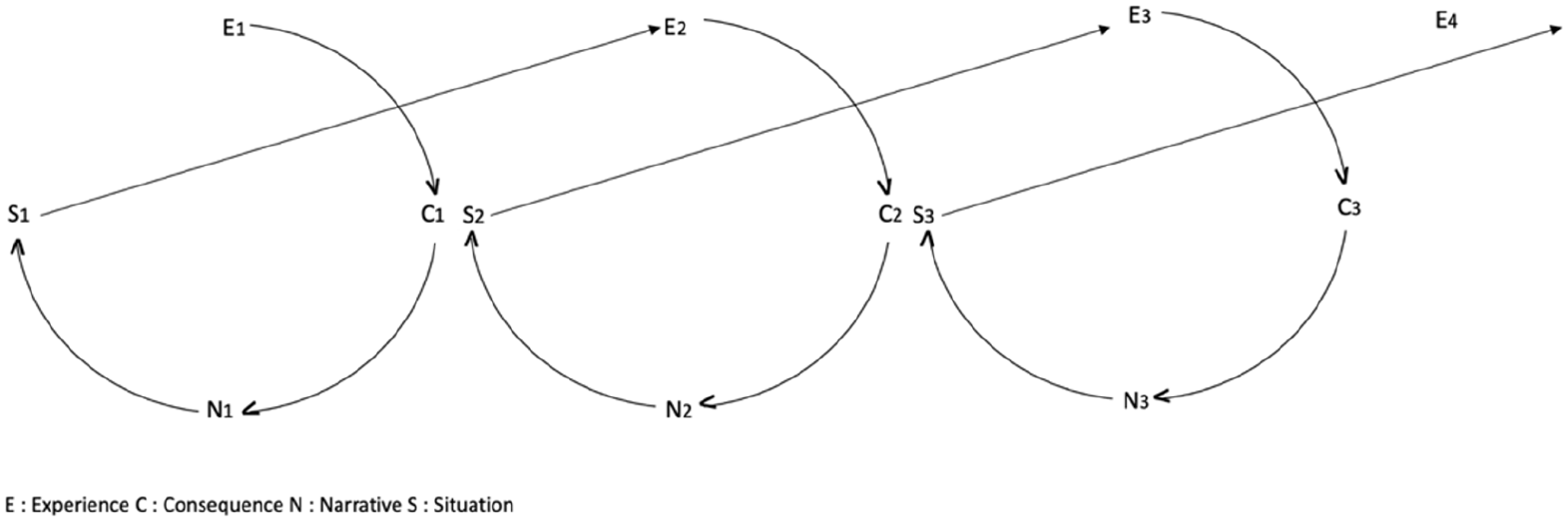
Self-Narrative Evolution Loop
Implications of the Findings
Our analysis shows that interaction and evolution in prosocial systems and the development of attachments and friendship in childhood are central to the use of prosocial survival strategies when homeless and their absence increases the likelihood that women will turn to criminal activities to survive. Other social and individual factors also contributed to desistance from crime, such as having a life project and abandoning the use of drugs and alcohol (Rodermond et al., 2016). Encounters with prosocial individuals (spouse/friend/caregiver) and participation in detoxification therapies created opportunities for women to work on their self-identity (e.g., self-esteem and self-confidence) and relationships with others, providing a space for personal change that made it possible for them to secure a safe, stable, and healthy environment. All these factors increased their ability to gradually withdraw from concentrating only on survival and learn how to deal with the sequelae of their traumas. Their criminal trajectories informed their individual process of exiting homelessness.
Future research should provide more information on the effect of women’s relational traumas (Petrillo, 2023) on their exit from homelessness and desistance from crime, as well as on such women’s socio-demographic data, making it possible to develop better resources for this population. The IRIS (Instrument for housing instability risk identification and assessment) designed by Hurtubise et al. (2019) could be used with women using resources intended for victims of sexual or domestic abuse or released from prison to help prevent homelessness, (re)victimization, and conflict with the law. More information should be made available to the general public about hidden homelessness, particularly as it affects women (Gélineau et al., 2015; Schwan et al., 2020), not only to increase awareness about the problem and the resources available but to encourage the creation of resources for this underestimated but increasing population (Gélineau et al., 2015; Sikich, 2008).
Conclusion
The survival behaviors of WEH are strongly influenced by their life trajectories and the way they understand their stories. While each participant’s journey is unique, there are some similarities, particularly in how significant events contribute to the modification of self-narrative and trajectory. A more complete understanding of the socio-emotional development of such women would enable us to develop interventions that are better tailored to their needs depending on where they are in their life trajectory (childhood, adolescence, or adulthood) and, for some, in their process of desistance from crime (primary, secondary, or tertiary).
Footnotes
Authors’ note:
We acknowledge the financial support of the (RÉ)SO 16-35 research center and the Institut Universitaire Jeunes en Difficulté (IUJD), as well as the work of Joan McGilvray, Freelance editor, who edited the English translation of this article. We thank Julie Marcotte, Principal Investigator of Projet Transcendance, for providing us with the secondary data for this study. All names used are pseudonyms to protect the confidentiality of study participants.
