




Abstract
Research has reported inconsistent findings with respect to how female and male police officers use force. This study examined this issue in a Canadian context. Use of force data over 9 years were collected from a large Canadian police agency. The results demonstrated that, overall, female officers used force less frequently than male officers relative to the number of female and male officers within the participating police agency. Female officers had lower odds of using physical control “hard” options (e.g., stuns and strikes) and higher odds of using intermediate weapons (e.g., conducted energy weapon) compared with male officers. Female officers also generally reported less effectiveness, more injuries to themselves, and fewer injuries to subjects related to their use of force compared with male officers. Literature on police use of force and social role theory are used to help explain the findings, and recommendations for improving outcomes in police–public interactions are suggested.
Policing has traditionally been, and largely remains, a male-dominated profession with a masculine subculture (Bikos, 2016; Rabe-Hemp, 2008b). In the past, police agencies typically allowed only men to be officers and did not invite women to join their ranks (e.g., P. B. Hoffman & Hickey, 2005; Lonsway et al., 2003). For example, it was not until 1974 that the Royal Canadian Mounted Police (RCMP), Canada’s national police service, established its first troop of female officers (RCMP, 2016). In an attempt to modernize and create diversity within their ranks, many Canadian police agencies have prioritized hiring more female police officers (e.g., Edmonton Police Service, 2019; RCMP, 2013; Toronto Police Service, 2019). However, women still only account for approximately 21% of officers in Canada (Conor, 2018). 1
The growing number of female police officers could potentially affect various aspects of policing, including police use of force (UoF). Often considered as the “gentler” or “weaker” sex (Jensen, 2012), female officers are regularly assumed to be less likely than male officers to use force and more likely to use lower levels of force to control situations. Some commentators and researchers have gone so far as to speculate that hiring more female police officers will reduce police UoF (Gerster, 2019), including lethal force (Carmichael & Kent, 2015), and decrease the prevalence of excessive force (Bagri, 2017). If such assumptions are true, not only would a reduction in the UoF have the potential to prevent citizen injuries and deaths, and the trauma associated with these incidents for the victim’s family, the community, and the officers involved (Artwohl & Christensen, 2019; Outland et al., 2022), but reductions in the UoF would also likely have a positive impact on the degree to which the public trusts the police, has confidence in them, and views them as a legitimate source of state authority (Pickering & Klinger, 2016; Wood et al., 2020).
Given the bold claims being made by some that female officers will use force less frequently, and will use lower levels of force, there is a need to rigorously study the relationship between officer sex and the UoF. Some research has already examined this issue, but the available research is not extensive, produces mixed results, and relies mostly on American data. The goal of this study was to contribute to this body of research by identifying and describing trends from UoF encounters involving Canadian police officers, to determine if officer sex influences whether and how force is used, and the impact of that force in terms of its effectiveness and resulting injuries. The Canadian focus of our study is important because American research may not generalize to Canada. Not only do officer demographics differ between the two countries, with female officers making up a larger proportion of the police population in Canada (Conor, 2018; Hyland & Davis, 2019), but UoF rates are also lower in Canada (Baldwin et al., 2022; Hickman et al., 2008), as are some of the dangers that Canadian police officers encounter (e.g., due to rates of gun ownership; Department of Justice Canada, 2022). These differences may influence the amount and type of force officers use, and its impact.
Before describing this study, a literature review will be presented. The review will begin with a general overview of UoF research to make it clear how this study is situated in the broader UoF literature. We will then propose a theoretical framework, which draws on social role theory, to explain why officer sex might be related to the UoF. Social role theory will help us interpret research findings related to the UoF by male and female police officers and to make sense of common explanations for potential sex differences in the UoF.
Police UoF
Police officers in the United States and Canada have the authority to use force. In Canada, that authority is laid out in Section 25 of the Criminal Code (1985), which states that police officers who are acting on reasonable grounds are authorized to use as much force as necessary to enforce the law. Fortunately, in both countries, force is rarely used by police officers during interactions with the public. While it is hard to derive accurate estimates, largely because high-quality data are difficult to access (Bennell et al., 2022), most police–public interactions in the United States and Canada do not involve the UoF. In the United States, for example, data from the Police-Public Contact Survey and the Survey of Inmates in Local Jails were used by Hickman et al. (2008) to estimate rates of nonlethal force. They suggested that nonlethal force occurs in approximately 1.7% of all contacts that the police have with the public, and in about 20% of all arrests. Lethal force obviously occurs in only a small fraction of these cases. In Canada, it has been estimated that UoF is even more rare. Several reports have suggested that UoF occurs in about 0.10% of all police–public encounters in Canada (e.g., Baldwin et al., 2022; Hall & Votova, 2013), with lethal force occurring in about 0.001% of encounters (RCMP, 2022).
One of the issues that UoF researchers try to understand is how various factors affect UoF rates. While it is impossible to review all this research in such a limited space, especially because mixed findings often emerge from this research, meta-analytic reviews have helped identify key trends. Here, we draw on one specific meta-analysis, which was conducted by Bolger (2015), and focus on three sets of findings from his analysis that help to contextualize this study—the impact of officer sex on UoF rates, the role that situational and subject characteristics play, and the influence of other factors, especially neighborhood characteristics.
As discussed in more detail below, the impact of officer sex on UoF rates has been examined in a number of studies, especially in the United States. Unlike other officer characteristics explored by Bolger (2015), such as officer race, experience, and education, officer sex was found to be a significant predictor of UoF rates, although not a strong predictor. More specifically, based on an analysis of 32 effect sizes, Bolger found that male officers were 1.11 times more likely to use force than female officers. Interestingly, officer sex was also associated with a significant Q score (Q = 91.69), as was the case for many of the predictors Bolger examined, suggesting a significant degree of effect size heterogeneity across the primary studies included in the meta-analysis. While the effects of officer sex reported by Bolger may not generalize to the Canadian context, it does suggest that an exploration of officer sex and the UoF is warranted.
More predictive than officer characteristics are situational and subject characteristics (Bolger, 2015), suggesting that these too are important to study. Indeed, out of the four predictor domains examined by Bolger—officer, situational, subject, and neighborhood characteristics—situational and subject characteristics proved most predictive of UoF rates. The situational characteristics that were associated with the highest degree of predictive power included the following: subject arrested (k = 12, odds ratio [OR] = 4.34), subject resistance (k = 35, OR = 2.97), offense seriousness (k = 18, OR = 1.46), proactive police encounter (k = 30, OR = 1.38), citizen conflict (k = 25, OR = 1.34), and number of officers on scene (k = 26, OR =1.08). The subject characteristics associated with significant results included the following: male subject (k = 43, OR = 1.30), hostile subject (k = 39, OR = 1.17), lower class subject (k = 24, OR = 1.14), intoxicated subject (k = 36, OR = 1.11), and minority subject (k = 42, OR = 1.06). However, based on Bolger’s meta-analysis, it is unclear whether the importance of situational and subject characteristics differs when officer sex is taken into account. This is something we will examine in this study, although not using the exact same characteristics that Bolger focused on (due to data availability).
Finally, according to Bolger’s (2015) meta-analysis, neighborhood characteristics are the least studied to date. Indeed, he could not include two of the three predictors he planned to include in his analysis—community income level and racial demographics—because no studies were available that met the inclusion criteria. The only neighborhood characteristic that was analyzed related to community crime rates (k = 4), which was not found to be a significant predictor of UoF. These findings suggest that more research is required to establish the role that neighborhood characteristics play in shaping UoF rates. Unfortunately, these sorts of variables were not readily available in the data set we had access to, so they could not be explored in this study.
Officer Sex and Police UoF: Social Role Theory
As mentioned above, numerous studies have compared UoF rates associated with male and female officers. Consistent with the heterogeneity analysis conducted by Bolger (2015), some studies have found that female officers are less likely to use force against the public (e.g., Ba et al., 2021; Bazley et al., 2007; Carmichael & Kent, 2015; Garner et al., 2002), while a smaller number have found no differences between male and female officers (e.g., P. B. Hoffman & Hickey, 2005; Paoline & Terrill, 2005), or higher rates of force associated with female officers (Smith, 2003). Before discussing some of these studies in more detail, we discuss a theoretical framework that might enhance our ability to understand the potential role that officer sex plays in the UoF by police—social role theory (Eagly & Wood, 2012).
There are numerous theories that can be drawn on to potentially explain observed officer sex differences in the UoF, ranging from evolutionary explanations to neurobiological explanations, but one theory that appears particularly well-suited is a social psychological theory known as social role theory (Eagly & Wood, 2012). In essence, social role theory argues that widely shared sex and gender stereotypes develop from the social roles that men and women play in society, especially the roles played by men and women in the workforce. According to social role theory, men’s greater participation in certain roles (particularly paid employment roles, often in authority positions), and the disproportionate assignment of nurturing or caretaking roles to women (in both the home and employment settings) have created stereotypes that associate agency with men and communion with women (Eagly, 1987). Agency here refers to more individualistic behaviors related to goal attainment, such as aggression, competitiveness, and ambition, which are commonly associated with men and their traditional role as providers (Abele et al., 2016). Communion, on the other hand, refers to community-oriented behaviors that are necessary for developing and maintaining social relationships, such as being compassionate, nurturing, and kind, which are historically and stereotypically associated with women and their traditional role as homemakers (Abele et al., 2016).
As discussed in the following sections, we believe social role theory may help explain dominant findings that emerge from studies of officer sex and UoF, such as the fact that female police officers tend to use less force than male officers during their interactions with the public (Bolger, 2015). We argue below that this theory also aligns nicely with commonly endorsed explanations for these differences, such as the view that female officers may be more effective communicators than male officers, that the public may be less likely to exhibit violence toward female officers (thus requiring less police violence in return), and that female officers may be assigned to policing duties that require less UoF. We will briefly examine each of these issues in turn.
Social Role Theory and UoF Rates
With respect to sex differences in aggressive behavior, which police UoF clearly is, social role theory explains these differences in one of the two ways. In some cases, “the learned norms defining the gender role may be internalized, and the role becomes a part of the individual’s personality,” whereas in other cases, “the individual may learn to exhibit the behaviours appropriate to his or her gender role in response to social pressure, without having fully internalized the defining norms” (Lightdale & Prentice, 1994, p. 35). Thus, according to social role theory, men will aggress more than women because of the differences in roles they are socialized to fill. In our case, the male gender role will encourage the UoF to resolve disputes, whereas the female gender role will discourage aggression, prompting female officers to use other strategies during potentially volatile interactions with the public, such as nonaggressive, communication-based, de-escalation tactics (e.g., rapport building, active listening, showing empathy; Todak & James, 2018).
Consistent with these expectations, numerous studies have shown that female police officers use less force than male officers (Bolger, 2015). For example, in one American study, Schuck et al. (2007) examined 7,365 surveys completed by arresting officers from six American cities and found that female officers were less likely to use force than male officers when effecting an arrest. The study also found that in two-officer patrol units, female–female officer pairs used less force compared with male–male officer pairs, and female–male pairs (where the arresting officer was female) were found to use less force compared with male–female pairs (where the arresting officer was male). In another study, Bazley et al. (2007) examined mandated UoF reports that were submitted by 558 patrol officers, comprising 82 women and 476 men, from an urban American police force. The researchers found that male officers were involved in significantly more UoF encounters (approximately 46 incidents per officer) compared with their female counterparts (approximately 37 incidents per officer).
Some research has also demonstrated that female police officers use lethal force to a lesser degree than their male counterparts. In one study, McElvain and Kposowa (2008) obtained police shooting files and personnel files from the Riverside County Sheriff’s Department in California covering a 15-year period. They compared 314 officers who had used deadly force in this timeframe with a control group of 334 officers who had not used deadly force in the same timeframe. The researchers found that male officers were 3 times more likely than female officers to be involved in shootings. In Canada, Carmichael and Kent (2015) examined the influence that female officers have on rates of police shootings. The researchers obtained their data by searching news articles published between 1996 and 2010. Regression analyses, which controlled for key variables such as the size of the city, the size of the police force, and the level of community poverty, revealed that there were significantly fewer police shooting deaths in cities where there were more female officers (i.e., female officers made up 11% or more of the agency). Similar results were recently presented by Ba et al. (2021) using data from police–public interactions in Chicago. They also found lower rates of UoF by female officers across interactions that involved different racial groups.
In contrast to these studies, and the predictions that would be made from social role theory, a smaller number of studies have found no difference in the prevalence of force used by female officers compared with male officers. For example, P. B. Hoffman and Hickey (2005) examined officer-reported UoF incidents over 7 years in the Maryland Police Department and found no significant difference between female and male UoF across approximately 32,000 arrests. In another study, Paoline and Terrill (2005) analyzed data collected via systematic observations of, and interviews with, police officers from two American cities. No significant differences between female and male officers’ UoF were found in the 3,356 encounters that were examined. One study even found that the presence of female officers may inflate the level of police violence observed. More specifically, Smith (2003) examined police violence in U.S. cities that varied by size. He found that for cities with more than 100,000 residents, a higher proportion of female officers were actually related to greater numbers of police-caused homicides. He suggested that female officers in these cities may become socialized into a police culture that encourages them to be aggressive.
Social Role Theory and Common Explanations for Sex Differences in the UoF
Social role theory also aligns nicely with commonly endorsed explanations for why sex differences may exist in the UoF. For example, some researchers have suggested that women tend to be more communicative than men (e.g., Gerster, 2019; Rabe-Hemp, 2009), as would be predicted if women internalize (or simply express) behaviors that are associated with learned sex and gender norms. Extrapolating from this, female police officers may have a greater ability to de-escalate potentially volatile interactions, or prevent them from occurring in the first place, thus minimizing the need for force. Although research to support this supposition is limited, it is consistent with some literature reviews (e.g., Lonsway et al., 2003) and primary research (e.g., Schuck, 2014) on the topic.
For example, Schuck (2014) differentiated between female and male police officers’ communication styles based on a survey completed by 897 Chicago officers. The survey questions were designed to measure emotional labor skills and masculine police culture. The findings suggested that male officers tended to use cognitive behavioral communication strategies, such as analysis and decision-making, whereas female officers were more likely to use caring strategies including those focused on empathy, nurturance, and compassion. Consequently, the communication style employed by female officers may be more conducive to reducing violence (Schuck, 2014). Similar results have been reported more recently by White et al. (2021). In contrast to these findings, Rabe-Hemp (2008a) found that, although female officers were less likely to use certain compliance techniques than male officers, female and male officers did not differ in their utilization of supporting behaviors (e.g., providing comfort, information, and referrals to community resources). This was found even when controlling for officer assignment, given that female officers were more likely to hold community policing positions.
Another potential explanation for why female officers may rely on force less than male officers relates to how members of the public have become socialized to treat men and women differently. Not only may their smaller stature (Rogers & Mukherjee, 1992) lead to female police officers being perceived as weaker or less threatening, thus eliciting less violence from those they interact with, but it is often embedded in societal values that it is wrong to be violent toward women, with boys and men often being told to “never hit a girl” (Marcus, 2018; Schippers, 2014). Sex and gender stereotypes that emerge from social roles, which include the communal qualities discussed above (Eagly & Steffen, 1984), likely contribute to these views. Given these factors, the public may be less inclined to be violent when interacting with female officers, which may in turn decrease the likelihood that female officers will need to use force during these interactions (Lersch & Mieczkowski, 2005).
All this being said, research does not necessarily support these predictions. For example, Schuck et al. (2007) observed that female officers may be at a similar or even higher risk of violence than male officers. They examined self-reported data from police in a multisite survey regarding violence by and against the police. Their findings suggested that citizens were no less violent toward female police officers than their male counterparts, and in some contexts (e.g., domestic violence situations), they were even more violent toward female officers. With very little research exploring citizen violence against male versus female police officers, the relationship between this factor and police UoF remains speculative.
The last potential explanation we will discuss here for why female officers may rely on force less than male officers relates to the idea, which is in line with social role theory, that female officers may be assigned to, or choose duties, that require less UoF (e.g., less dangerous duties) because those duties are incompatible with sex and gender stereotypes. Female police officers have historically not been assigned to frontline roles in policing, but to support roles such as guards or administrative services (RCMP, 2016). Although female officers are now more prominently represented on the frontline of policing, there may still be organizational or managerial tendencies, as well as self-selection, that funnel female officers into roles that maintain the female stereotype of being nurturing and empathetic. Positions of this nature, such as community policing, typically involve duties that are less likely to require the UoF (Rabe-Hemp, 2008b). Bazley et al. (2007) opined that male officers may be more likely to work in areas, and be assigned to certain shifts, that expose them to police–public interactions that require the UoF. A similar assumption was presented in Lersch and Mieczkowski’s (2005) review of the literature, in which they asserted that UoF discrepancies between female and male officers might stem partially from male officers being dispatched to calls for service of a more violent nature.
Rabe-Hemp (2008a) examined officer assignment as a possible mediator between officer sex and police behaviors. In their sample, community policing positions were more likely to be occupied by female officers. In addition, being a community policing officer, as opposed to a regular patrol officer, was related to less use of both physical restraint and verbal commands. However, when officer assignment was controlled for, a sex difference was still evident for certain compliance techniques, which female officers were less likely to use. In other words, while women may be overrepresented in positions that expose them to less risk, which may contribute to the interpretation that female officers use less force by virtue of their sex, this study suggests there is likely a more complex interplay between these variables and other factors (e.g., presence of other officers; Rabe-Hemp, 2008a). Female police officers have also been found to be severely underrepresented on specialty police units, such as Special Weapons and Tactics (SWAT) teams, largely because of the sex and gendered structures and culture of policing (Todak, 2023) and high physical strength requirements (Brown et al., 2021). Given that UoF is sometimes used more frequently by officers serving in these types of specialty units (Gaub et al., 2021), largely due to the nature of the calls they respond to, the lack of female representation in these units may help explain sex differences in the UoF.
Officer Sex Differences in Choice of Intervention Option, Effectiveness, and Injury
Given the potential discrepancies between male and female police officers in terms of the frequency with which they use force, there may also be value in exploring how they use force. The effectiveness and risks associated with the UoF intervention options that male and female officers employ are also important factors to examine.
Choice of Intervention Options
P. B. Hoffman and Hickey (2005) considered officer sex and UoF intervention options in their examination of self-reported UoF incidents by officers in the Maryland Police Department. Although they found no statistically significant difference in the rates of using unarmed physical force (e.g., strikes) between female and male officers, differences were found in the rates of other intervention tools (i.e., baton, oleoresin capsicum [OC] spray, firearm). When all intervention tools were considered together, female officers used them significantly less often (2.0% of arrests) than male officers (2.4% of arrests). Conversely, Bazley et al. (2007) found that female and male officers from an urban American police force used various intervention options at comparable rates, with the exception of the firearm. In all incidents involving male officers (n = 21,743), 21 incidents (0.1%) involved the discharge of a firearm, whereas none of the incidents involving female officers did (n = 2,758). Other studies have explored the level of UoF relative to the level of resistance exhibited by the subject. Schuck and Rabe-Hemp’s (2007) analysis of data from their multisite survey of arresting officers indicated that female police officers were more likely than male officers to use a lower level of force than would be justified in the situation. In contrast, Bazley et al. (2007) found that female officers used higher levels of force than male officers and tended to use intervention options that spanned “a narrower range of the force continuum” (p. 183). The mixed results reported in research from the U.S. examining officer sex differences in the use of various UoF intervention options suggest there is value in exploring this issue in a Canadian policing context.
Effectiveness
Effectiveness in a UoF encounter relates to the ability of the police officer to gain control or cooperation of a subject. To our knowledge, a sex analysis of effectiveness specifically in UoF encounters has not previously been conducted; rather, researchers have speculated about other, more general areas of performance. For example, in their literature review, Lonsway et al. (2003) surmised that even though female officers tended to rely more on communication than physical force compared with male officers, they were just as effective in carrying out their duties and performed with equal capability as their male counterparts. They based this conclusion on studies they reviewed that found no meaningful differences between male and female officers in terms of their activities and productivity, their commitment to the profession, their performance at the academy and on the job, and their participation in training and other professional development activities. Based on self-reported data, Dodge et al. (2011) also found that female officers perceived themselves as being as capable as male officers with respect to handling a combative suspect and performing on a tactical team. Given the lack of attention paid to the topic of UoF effectiveness as a function of officer sex and the intervention option(s) used, the current research is important.
Injury
P. B. Hoffman and Hickey (2005) examined subject injury related to police UoF. The authors found that, overall, the rate of subject injury (excluding OC spray) was low (1.6% of arrests), but the rate was even lower for situations involving female officers compared with male officers. In contrast, when they specifically examined subject injuries that required transportation to the hospital, they did not find differences between female and male officers. Schuck et al. (2007) found that, although female police officers were more likely than male officers to use less force than what would be justified in the situation, using less force did not correlate with an officer’s increased likelihood of injury. Given the contradictory findings in this area of research, we wanted to explore whether injuries experienced by subjects and officers in Canada vary by officer sex and the type of UoF intervention option(s) used.
This Study
This study aims to examine whether there are differences between UoF encounters involving male and female police officers in a large Canadian police agency. The UoF rates of male and female officers (in relation to the number of male and female officers within the agency) will be compared, as will the tendency for male and female officers to use particular types of force. This study will also explore how various situational factors (e.g., subject behavior) relate to the UoF and examine sex differences in the effectiveness (i.e., officer-reported effectiveness and whether the subject was able to be handcuffed) and risk (i.e., officer and subject injuries) associated with different intervention options.
The overarching research question we address in this study is the following: How, and to what extent, does the UoF differ between male and female officers? To answer this question, we focus on the following six, more narrow questions:
Do UoF rates by male and female officers differ in relation to the number of male and female officers within the agency?
Do situational factors differ when male and female officers use force?
What intervention options do male and female officers tend to employ and with what frequency?
Does the effectiveness of intervention options differ between male and female officers?
Does the risk of injury to the subject differ between male and female officers when force is used?
Does the risk of injury to the officer differ between male and female officers when force is used?
Method
Data
Data for the study were collected over a 9-year consecutive period from January 1, 2010, to December 31, 2018, through standardized reporting in a large Canadian police agency. It is the policy in that agency for officers to complete postincident UoF reports. All data are self-reported by officers and are based on their perceptions at the time of the incident without the aid of body-worn cameras, dashboard cameras, or audio recording devices (none of which were in widespread use in the participating agency during the data collection period). All reports are reviewed at a minimum by a supervisor.
UoF data were included for analysis if the UoF was above physical control “soft” on the agency’s UoF model (physical control soft includes the use of pressure points, joint locks, and come-along techniques; R. Hoffman et al., 2004). Furthermore, only actual applications of force, and not the use of interventions as deterrents (e.g., draw and display of a conducted energy weapon [CEW]), were included in the analysis. The analysis was further restricted to include only intervention options available to general duty officers and, therefore, excluded the use of interventions like police dogs, extended range impact weapons, and specialty munitions. Sex data for the officers are not collected on the UoF reports; it was therefore obtained from the agency’s human resource management system and matched with the UoF data. It should be noted that, although the agency’s human resource management system uses the term gender to collect information, the responses are constrained to sex-based response options and include “male,” “female,” “other,” or “unknown.” This is why the terms male and female are used throughout our analysis.
It is important to note that for a serious injury or death resulting from an officer-involved shooting (OIS), or where it appears an officer may have contravened a provision of the Criminal Code, other investigative and reporting processes are initiated within the participating police agency. A UoF report for these incidents may not be completed until the potentially lengthy investigative process has concluded. However, data for OIS incidents (i.e., incidents in which a firearm was discharged) were obtained from supplemental tracking and used for the analysis of UoF rates and the breakdown of used intervention options. Data from OIS incidents were not available for the analysis of situational factors, effectiveness, or injury.
As discussed above, it is the policy in the agency we collaborated with for an officer to complete a UoF report following a UoF incident with a subject. When more than one officer is involved in an incident and uses force, the agency’s policy requires that each officer complete a UoF report (this is something that the UoF reporting system tracks). This can lead to a situation where there are more reports completed than incidents occurring. In addition, an individual officer may use force on more than one subject during an incident and/or use multiple intervention options on a single subject or multiple subjects. Information related to each intervention is captured within one UoF report prepared by the reporting officer, which can lead to many more interventions than there are subjects. These four “levels” of analysis—incidents, reports, subjects, and interventions—are depicted in Figure 1.
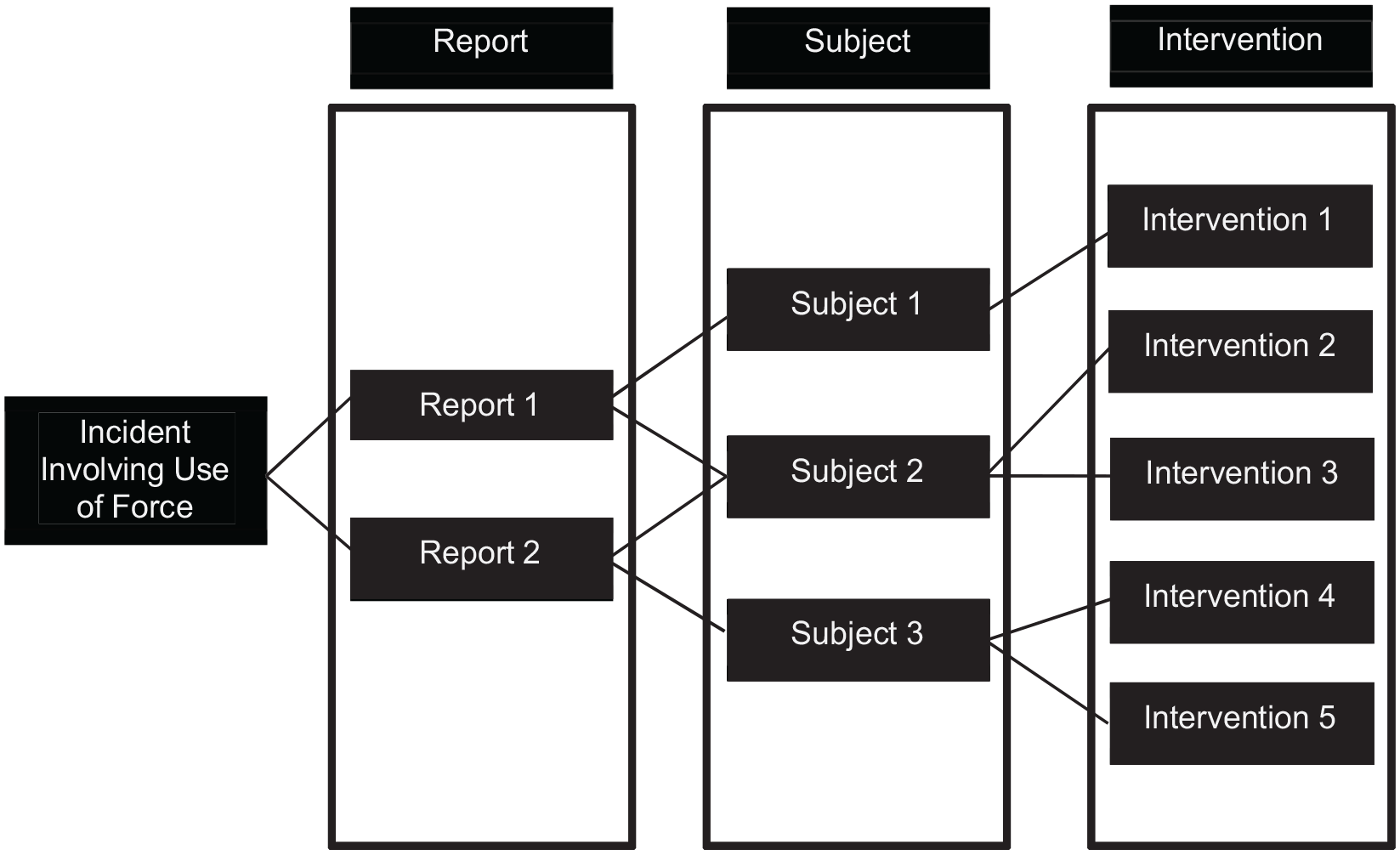
Structure of the UoF Report Data
The resulting sample sizes for each level of analysis in this study were the following:
17,155 UoF incidents (including 164 OIS incidents);
19,452 UoF reports;
17,536 subjects;
22,155 UoF interventions (including 268 officers discharging their firearm).
Study Variables
Only one variable—officer sex—was used as an independent variable in this study. Officer sex was obtained from the agency’s human resource management system where it was coded as “male,” “female,” “other,” or “unknown.” All officers reported their sex as “male” or “female”; none reported “other” or “unknown.”
A range of dependent variables were examined in this study. These related to situational and subject factors, the type and frequency of UoF intervention options used, the effectiveness of the UoF intervention options used, and whether the UoF resulted in subject and/or officer injuries. We briefly describe each of these variables below, along with their level of analysis and their response options.
Situational and Subject Factors
All the situational and subject factors were obtained from the UoF reports. One situational factor falls at the report level:
“Was there a struggle that went to the ground?” (“yes” or “no”)
Three situational and subject factors fall at the subject level:
Subject sex (“male,” “female,” “other,” or “unknown”). 2
“Was the subject perceived to be under any influences?” If yes, “Confirmed or suspected influences that had an impact on the subject.” (“alcohol,” “drugs,” or “inhalants”—this variable was dichotomized into “yes” or “no”).
“Was the subject perceived to be emotionally disturbed?” (“yes” or “no”).
Being emotionally disturbed in this case refers to individuals who are perceived to be in an agitated state due to any of the following reasons: the person is in emotional distress, is in crisis suffering a temporary or pervasive loss of touch with reality, is under the influence of a substance, or is perceived or known to be suffering from a mental disorder (Canadian Police Knowledge Network, n.d.).
Finally, two situational and subject factors fall at the intervention level:
“Did you perceive or believe that the subject was in possession of a weapon” (“yes” or “no”).
“Subject behaviour exhibited” (“cooperative,” “passive resistant,” “active resistant,” “assaultive,” or “grievous bodily harm or death”—this variable was dichotomized into whether the subject was assaultive or presented a threat of grievous bodily harm or death, “yes” or “no”).
The subject behaviors in the last item correspond to categories included in the agency’s UoF model (Canadian Association of Chiefs of Police, 2000). Cooperative refers to a subject who responds appropriately to the officer’s presence, communication, and control. Passive resistant refers to a subject who refuses, with little or no physical action, to cooperate with the officer’s lawful direction (e.g., verbal refusal or consciously contrived physical inactivity, such as the subject going limp and becoming dead weight). Active resistant refers to a subject who uses nonassaultive physical action to resist an officer’s lawful direction (e.g., pulling away to prevent or escape control or overt movements such as walking or running away from an officer). Assaultive refers to a subject who attempts to apply, or applies force to any person, or attempts or threatens by an act or gesture to apply force to another person (e.g., kicking or punching, but may also include aggressive body language that signals the intent to assault). Finally, grievous bodily harm or death refers to a subject exhibiting actions that the officer reasonably believes are intended to, or likely to cause, grievous bodily harm or death to any person (e.g., assaults with a knife, stick, or firearm, or other actions that would result in serious injury to an officer or member of the public).
Type and Frequency of Intervention Options
The type and frequency of intervention options used by male and female officers were based on the UoF response method(s) from the officer, as obtained from their UoF reports. The response method(s) could include the following: “physical control—hard” (PCH; this includes stuns/strikes, vascular neck restraint [VNR], and takedowns), “intermediate weapon,” or “police firearm.” For intermediate weapons, analyses were conducted using the categories of “OC spray,” “Conducted Energy Weapon” (both probe and contact mode), and “Baton.” These outcomes all fall at the intervention level.
Effectiveness
To examine whether the reported effectiveness when using various intervention options differed between male and female officers, analyses were conducted using responses to two questions taken directly from the UoF reports:
“Was the subject handcuffed as a result of this response?” (“yes” or “no”)
“Was this response effective?” (“yes” or “no”)
With respect to the second question, effectiveness is defined in the agency’s reporting system as whether “the subject became compliant, was incapacitated, and/or the intervention resulted in a desired outcome, such as de-escalating the situation or the subject dropping the weapon.” The outcomes related to effectiveness fall at the intervention level.
Subject and Officer Injuries
Finally, to examine risk/injury when various intervention options were used by male and female officers, analyses were conducted using two different outcomes taken from the UoF reports:
“Was the subject injured as a result of this response?” (“yes” or “no”)
“Was the applying officer injured as a result of this response?” (“yes” or “no”)
In the agency’s policy and reporting system, and consistent with Section 25 of the Criminal Code (1985), injury is defined as “bodily harm that is not merely transient or trifling in nature, and which interferes with a person’s health or comfort.” These two outcomes both fall at the intervention level.
Analytical Strategy
Data were prepared for analysis using IBM SPSS Statistics for Windows (Version 25). Given the structure of our data set, analyses were conducted at one of the four levels: the incident level, the report level, the subject level, or the intervention level (see above). Responses in the UoF report are constrained through the use of dropdown menus and checkboxes; therefore, no outliers were observed. There were also no missing data as the variables under study were all mandatory fields; however, officer injury data were not captured in UoF reports used by the participating agency until late 2011; therefore, some data are unavailable for this variable.
Logistic regression analysis was used to model all dichotomous outcome variables and examine differences between male and female officers. All assumptions for the analyses were assessed and met. No control measures were used (e.g., call type, officer assignment, shift) due to lack of availability and/or the unstructured nature of the data. We discuss this in more detail in our “ Study Limitations” section. ORs greater than 1 (i.e., increased odds) are interpreted as “very small” (<1.68), small (1.68–3.46), medium (3.47–6.71), or large (>6.70; Chen et al., 2010). ORs less than 1 (i.e., decreased odds) are interpreted as “very small” (>0.60), small (0.29–0.60), medium (0.15–0.29), or large (<0.15).
Results
UoF Rates
During the reporting period, there were 24,605,000 police occurrences, 3 of which 17,155 (0.07%) involved the UoF, as defined in the “Method” section. In other words, police applied this level of force in approximately one in every 1,434 encounters with the public. This means that 99.9% of police occurrences were resolved naturally or with officer presence, communication, the use of interventions as deterrents (e.g., draw and display of a CEW), and/or the application of physical control soft techniques (e.g., escort/come-along techniques) or restraints (e.g., handcuffing).
To investigate sex differences in UoF rates in relation to the number of female and male officers within the agency, we examined officer demographics within the constable and corporal ranks (female n = 3,565; male n = 12,130). These ranks account for 81.3% of the agency’s officers and 98.2% of all UoF reports. 4 In the agency, these ranks comprised 22.7% female officers and 77.3% male officers. However, only 14% of the officers in these ranks that used force during the time period under study were female, whereas 86% were male. This indicates that in relation to their makeup in the agency, female officers had 45% lower odds of being involved in at least one UoF encounter compared with male officers (OR = 0.55, 95% confidence interval [CI] = [0.51, 0.60], p < .001). In addition, female officers only accounted for 9.1% of UoF reports in these ranks and male officers accounted for 90.9%. This indicates that, in relation to their representation in the agency, female officers had 66% lower odds of using force than male officers (OR = 0.34, 95% CI = [0.32, 0.36], p < .001). Similarly, in relation to their makeup in the agency, female officers had 70% lower odds of discharging their firearm than male officers (OR = 0.30, 95% CI = [0.20, 0.47], p < .001).
Situational and Subject Factors
As seen in Table 1, logistic regression analyses demonstrated that, compared with male officers who used force, female officers had 24% lower odds of being involved in a struggle that went to the ground, 68% lower odds of being involved in a UoF encounter with a male subject, and 35% lower odds of being involved in a UoF encounter with a subject perceived to be in possession of a weapon. In addition, compared with male officers who used force, female officers had 35% greater odds of being involved in a UoF encounter with a subject perceived to be emotionally disturbed and 18% greater odds of being involved in a UoF encounter with a subject perceived to be under the influence of a substance. No statistically significant differences were observed between female and male officers’ assessments of being exposed to violent subject behavior.
Situational Difference Between Female and Male Officers
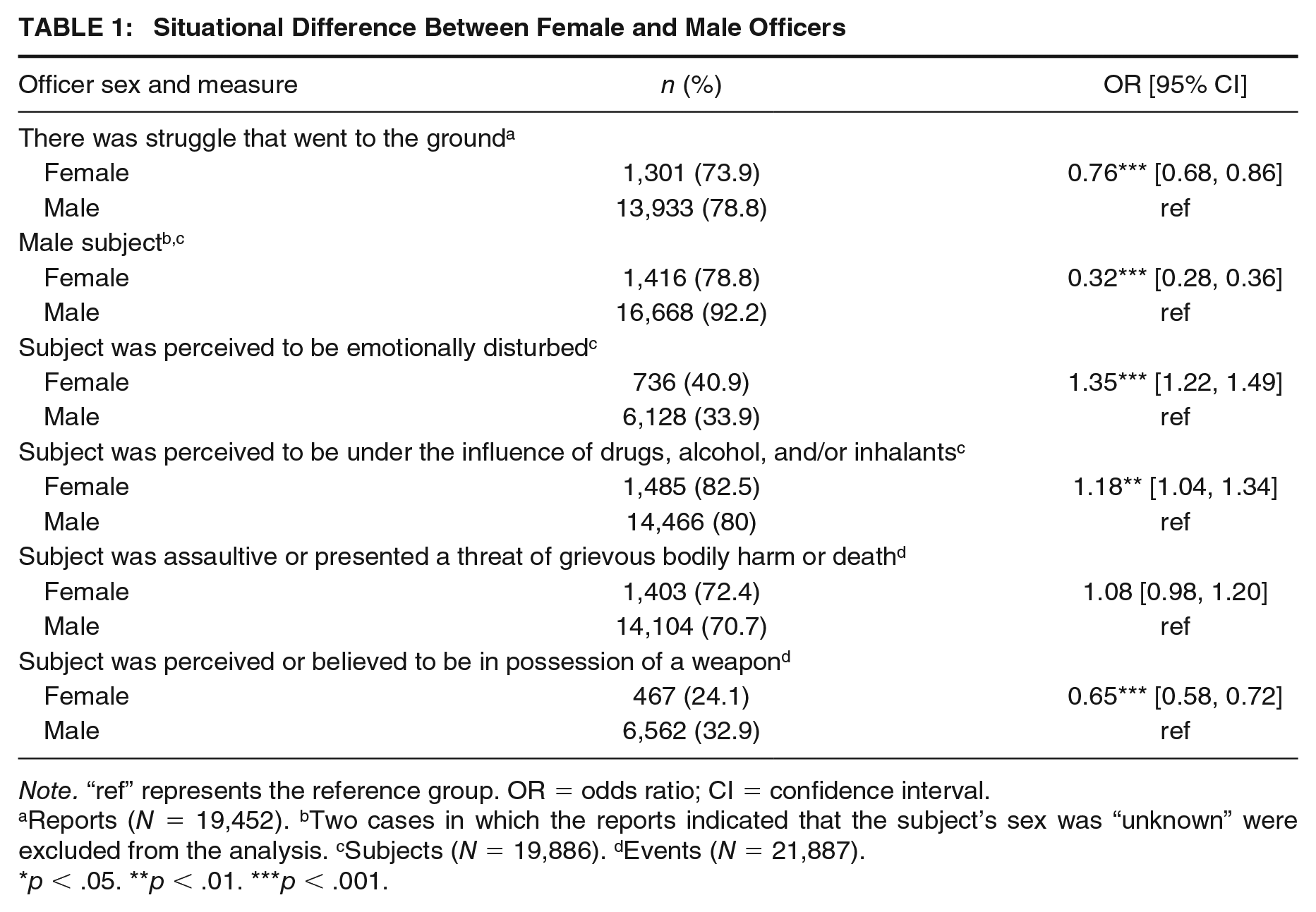
Note. “ref” represents the reference group. OR = odds ratio; CI = confidence interval.
Reports (N = 19,452). bTwo cases in which the reports indicated that the subject’s sex was “unknown” were excluded from the analysis. cSubjects (N = 19,886). dEvents (N = 21,887).
p < .05. **p < .01. ***p < .001.
Use of Intervention Options
Logistic regression analyses were conducted to examine which intervention options female and male officers tend to employ. This analysis yielded significant results, as illustrated in Table 2. When all PCH options were considered together (stuns/strikes, VNR, and takedowns), female officers had 40% lower odds of using PCH compared with male officers (48.0% vs. 60.5% usage rate, respectively). This was mostly driven by the lower odds of female officers using stuns/strikes. Specifically, female officers had 44% lower odds of using stuns/strikes compared with male officers. Neither the VNR nor takedowns demonstrated significantly different odds between male and female officers.
Intervention Options Used, Effectiveness, and Handcuffing by Female and Male Officers
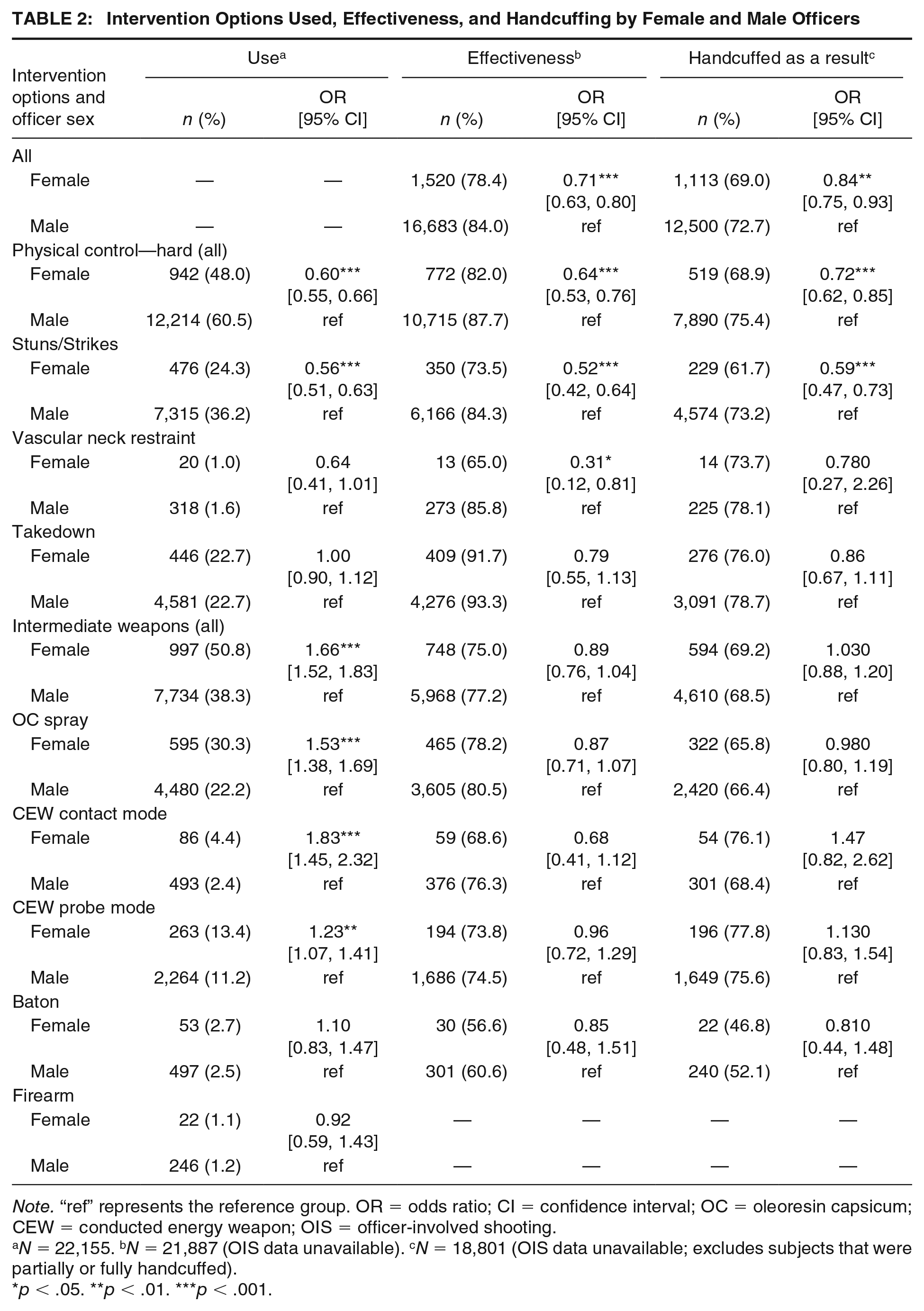
Note. “ref” represents the reference group. OR = odds ratio; CI = confidence interval; OC = oleoresin capsicum; CEW = conducted energy weapon; OIS = officer-involved shooting.
N = 22,155. bN = 21,887 (OIS data unavailable). cN = 18,801 (OIS data unavailable; excludes subjects that were partially or fully handcuffed).
p < .05. **p < .01. ***p < .001.
In contrast to PCH, female officers had 66% greater odds of using intermediate weapons compared with male officers when all intermediate weapons were considered together (OC spray, CEW, and baton; 50.8% vs. 38.3% usage rate, respectively). Concerning specific intermediate weapons, while OC spray was the most common option used by both female and male officers, female officers had 53% greater odds of using OC spray than male officers. Female officers also had greater odds of using the CEW both in contact mode (83% greater odds) and in probe mode (23% greater odds) compared with male officers. Out of all the intermediate weapons, the baton was used least often, and firearms were rarely discharged by both female and male officers. No significant differences were observed for these intervention options.
Perceived Effectiveness and Subject Handcuffing
Logistic regression analyses were conducted to examine self-reported effectiveness when force was used and whether the subject was handcuffed as a result of the intervention. This analysis yielded significant results, as illustrated in Table 2. When all intervention options were considered together (all PCH and intermediate weapons), female officers had 29% lower odds of reporting their response as effective compared with male officers (78.4% vs. 84.0% effectiveness rate, respectively) and 16% lower odds of handcuffing the subject as a result of the intervention compared with male officers (69.0% vs. 72.7% subject handcuffing rate, respectively). This was mostly driven by the lower odds of PCH (e.g., stuns/strikes) being perceived as effective and resulting in the subject being handcuffed by female officers. Specifically, female officers had 48% lower odds of reporting their use of stuns/strikes as effective compared with male officers and 69% lower odds of reporting their use of the VNR as being effective. Compared with male officers, female officers also had 41% lower odds of reporting that their use of stuns/strikes resulted in the subject being handcuffed. No statistically significant differences were observed between female and male officers’ reported effectiveness and subject handcuffing from takedowns or any of the intermediate weapons.
Injury to Subjects
Logistic regression analyses were conducted to examine subject injury when force was used. This analysis yielded significant results, as illustrated in Table 3. When all intervention options were considered together (all PCH and intermediate weapons), female officers had 40% lower odds of injuring the subject compared with male officers (17.4% vs. 26.1% subject injury rate, respectively). This was due in part to the lower odds of female officers injuring the subject with stuns/strikes and takedowns. Specifically, female officers had 37% lower odds of injuring the subject than male officers when they used stuns/strikes and 39% lower odds when using takedowns. No statistically significant differences in odds of subject injury between male and female officers were observed for the VNR or any of the intermediate weapons.
Intervention Options Injury by Female and Male Officers
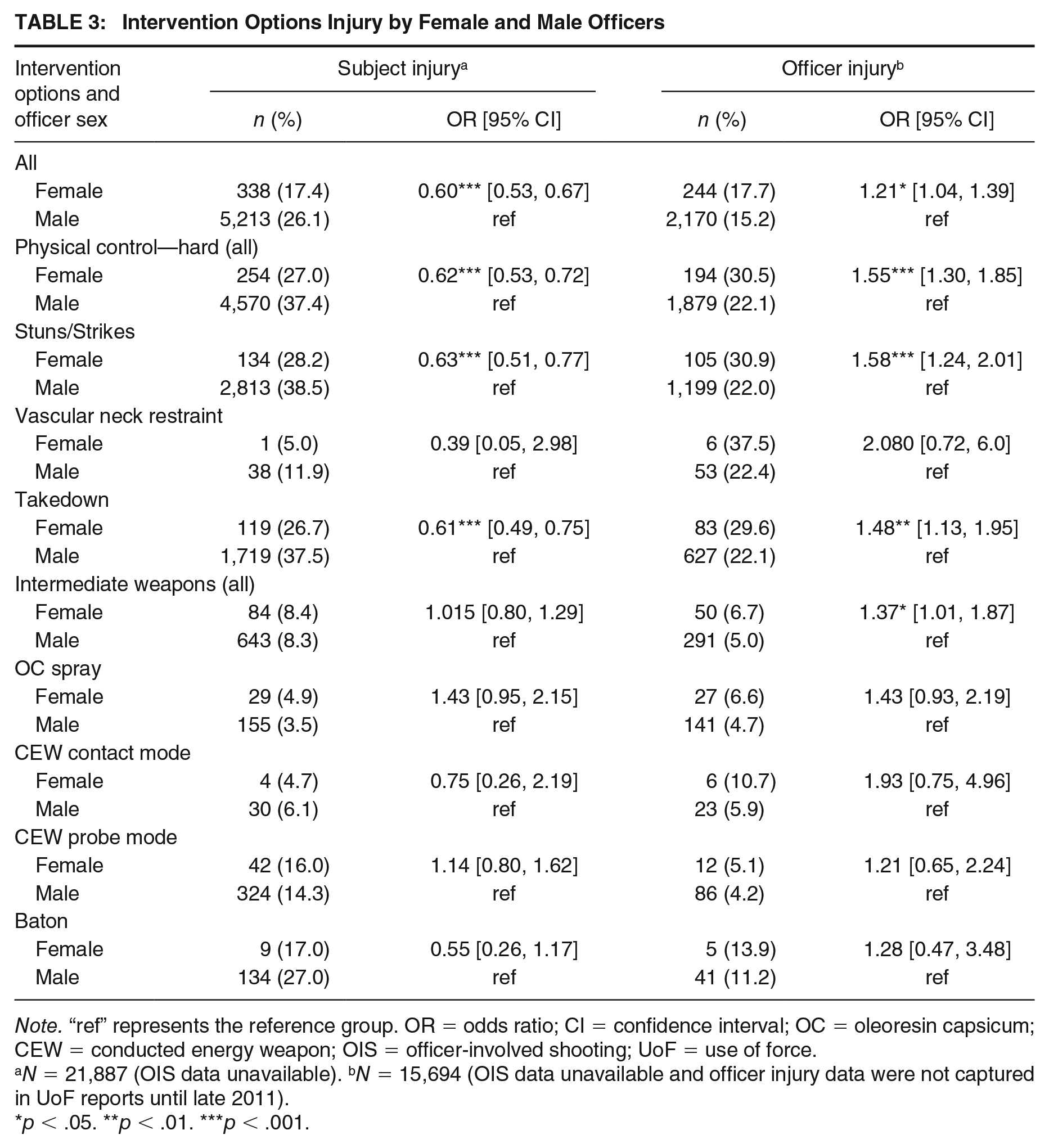
Note. “ref” represents the reference group. OR = odds ratio; CI = confidence interval; OC = oleoresin capsicum; CEW = conducted energy weapon; OIS = officer-involved shooting; UoF = use of force.
N = 21,887 (OIS data unavailable). bN = 15,694 (OIS data unavailable and officer injury data were not captured in UoF reports until late 2011).
p < .05. **p < .01. ***p < .001.
Injury to Officers
Logistic regression analyses were conducted to examine officer injury when force was used. These results are presented in Table 3. When all intervention options were considered together (all PCH and intermediate weapons), female officers had 21% greater odds of being injured when using force than male officers (17.7% vs. 15.2% officer injury rate, respectively). This was mainly attributed to the greater odds (55% higher) of female officers being injured when using PCH. Specifically, female officers had 58% greater odds of being injured when they used stuns/strikes, and 48% greater odds of being injured when they used takedowns. Compared with male officers, female officers also had 37% higher odds of injury with intermediate weapons overall; however, no statistically significant differences between male and female officer injury were observed for specific intermediate weapons or the VNR.
Discussion
This study was conducted to identify trends involving female and male officers’ UoF in Canada. Some researchers have suggested that female officers use less force than male officers (e.g., Carmichael & Kent, 2015; Lonsway et al., 2003); however, the research in this area is not plentiful, especially in the Canadian policing context, and findings are inconsistent. This study builds upon the extant literature and provides findings derived from a large sample of UoF encounters from a Canadian law enforcement agency. We were specifically interested in examining sex differences in UoF rates in relation to the number of male and female officers within the participating agency, the situational and subject factors encountered, the intervention options used, the effectiveness of force, as well as the risk (i.e., injury) to subjects and officers in UoF encounters.
UoF Rates
Consistent with previous findings (e.g., Hall & Votova, 2013), we found that the rate of police UoF incidents, as defined in the “Method” section, in the participating agency is very low (0.07%). With respect to UoF rates, two key findings emerged. First, in relation to the number of male and female officers in the participating agency, the odds of female officers ever using force was almost half as much as male officers. Second, in relation to the number of male and female officers in the participating agency, the odds of female officers being involved in an incident where force was used was two thirds lower than male officers. This means that, in relation to their representation within the agency, fewer female officers used force than male officers, and female officers who used force used it less frequently than male officers. In addition, in relation to the number of male and female officers in the participating agency, female officers had 70% lower odds of using lethal force compared with male officers. This set of findings is consistent with some of the previously cited research (e.g., Bazley et al., 2007; Carmichael & Kent, 2015; Rabe-Hemp, 2008a), and with predictions of sex differences that emerge from theories like social role theory.
These analyses, however, do not elucidate why female officers in this sample exhibit lower rates of force than would be predicted from their representation in the participating police agency. As introduced in the review of the literature, and consistent with social role theory, it could be that female officers are more skilled at resolving situations without resorting to force (Lonsway et al., 2003; Schuck, 2014). Alternatively, the public may be less likely to use violence against female officers due to their smaller stature and less threatening presence, or because of societal norms that violence against women is immoral (Marcus, 2018; Schippers, 2014). Others have suggested that discrepancies between female and male officers’ UoF rates may be due to female officers being assigned to certain duties (Rabe-Hemp, 2008b), shifts and neighborhoods (Bazley et al., 2007), or calls for service (Lersch & Mieczkowski, 2005) that present a lower likelihood of requiring the UoF. Testing these potential explanations directly should be a major goal of future research on this topic.
Interestingly, another possible explanation for sex differences in the UoF was uncovered in the current analysis when situational and subject factors were examined—female officers may use force less frequently because of the type of subjects and situations they encounter or the way they tend to perceive subject and situational factors. For example, we found that female officers tended to report encountering subjects who they perceived to be emotionally disturbed and/or under the influence of a substance more frequently than male officers, and they reported encountering subjects who they perceived to be in possession of a weapon less frequently than male officers. Perhaps female officers adjust their approach based on these encounters or perceptions, which leads to situations being resolved more often without the need to use force. In sum, a combination of factors likely contributes to the relatively lower rate of female officers’ UoF in this sample (in relation to their representation in the participating agency). The specific role that these factors play requires further research.
Use of Intervention Options, Effectiveness, and Injury
Our examination of how often various UoF intervention options are used, and the effectiveness and injury rates associated with those options, revealed some similarities and some differences between male and female officers. When female officers used force, intermediate weapons (OC spray, CEW, and baton) were generally used most often (51% of all applications of force by female officers). This was followed very closely by PCH, which female officers used in 48% of cases. On the other hand, male officers primarily used PCH (61%), followed by intermediate weapons (38%). This means that female officers had 40% lower odds of using PCH and 66% greater odds of using intermediate weapons compared with male officers. Specifically, female officers had lower odds of employing stuns/strikes and greater odds of employing OC spray and the CEW compared with male officers. This suggests that female officers tend to favor interventions that do not require a high degree of physical power for them to be effective.
It seems reasonable to surmise that officers will rely more heavily on intervention options that they have found to be effective previously, or what they feel most confident in using. In our analysis, PCH was the sole intervention option for which there was a significant difference between female and male officers in self-reported effectiveness. Specifically, compared with male officers, female officers had 48% lower odds of reporting that their response was effective when using stuns/strikes and 69% lower odds when using the VNR. Therefore, female officers may use PCH options less often than their male counterparts, and intermediate weapons more often, because they perceive intermediate weapons to be more effective than PCH. That being said, it should be noted that the effect sizes for effectiveness were very small, indicating only modest differences between male and female officers.
Our findings related to the effectiveness of intervention options are congruent with the results regarding injury to subjects. Overall, female officers had 40% lower odds of injuring the subject when applying force compared with male officers. This is consistent with P. B. Hoffman and Hickey’s (2005) findings that female officers injured subjects at a lower rate than male officers. When specific intervention options were examined, female officers had lower odds of injuring subjects when using PCH only (i.e., stuns/strikes and takedowns). As female officers reported lower levels of effectiveness when using PCH, it is logical that they would also injure subjects less frequently than male officers when using these techniques.
The overall rate of officer injury as a result of police UoF was relatively low (10.6%). Female officers were found to have greater odds than male officers of being injured in a UoF encounter; however, when intervention options were considered individually, female officers had greater odds of injury only when they applied PCH (i.e., stuns/strikes and takedowns). This finding runs contrary to Schuck and Rabe-Hemp’s (2007) findings that female officers were no more likely to be injured. However, as is the case with our other findings, caution must be exercised in interpreting our results due to the relatively small effect sizes associated with officer injury rates. Research examining whether female officers are more likely than male officers to acknowledge and document that they were injured in a UoF encounter would also be valuable. Because female officers appear to be involved in UoF encounters with female subjects more frequently, future research should also examine the type of resistance and violence presented by female subjects compared with male subjects, as this may help explain why more female officers are being injured.
Implications
Our results indicate several discrepancies between male and female officers’ UoF, particularly in terms of the subject and situational factors they encounter or perceive, the types of intervention options they use, and the associated outcomes (i.e., effectiveness and injuries). Although most of the differences are quite small in magnitude, some of our findings may have significant practical implications. Therefore, it is prudent to identify specific areas that could be addressed, including ways to potentially increase effectiveness and reduce risk.
Turning first to our findings related to the prevalence of UoF, it is important to recognize how rare UoF is in the Canadian policing context, at least within the jurisdictions policed by the participating law enforcement agency. This suggests that police officers in Canada are generally effective at managing their interactions with the public, which is not meant to minimize the seriousness of those encounters where biased or excessive force is used. Interestingly, our results do not align with public perceptions about police UoF. In the few studies examining this issue, the public consistently overestimates UoF rates, often by a large margin (e.g., Goldberg, 2023; McCaffree & Saide, 2021; O’Neill et al., 2017). This suggests a need for more public education around these issues, especially given that inaccurate perceptions of UoF likely fuel negative attitudes toward the police more generally (e.g., Mourtgos & Adams, 2020; Mullinix et al., 2021).
With respect to the situational and subject factors associated with the UoF, recall that female officers experienced different circumstances than male officers when using force. For example, not only did female officers experience lower odds of a struggle going to the ground, they experienced greater odds of being involved in situations with female subjects and subjects perceived to be emotionally disturbed and/or under the influence of a substance. While UoF training must adequately cover the full range of circumstances that officers are likely to encounter in the field, regardless of officer sex, these differences may speak to a need to ensure that officers are particularly well trained to intervene in certain situations. More research is needed to explore this possibility.
There are also potential implications related to our analyses of specific intervention options. For example, the disparity between female and male officers’ use of PCH, and the resulting effectiveness and injury rates, may be attributed to the specific PCH techniques officers are trained to use. There is often a focus and reliance on stuns/strikes, which require a considerable level of physical dominance and power to be effective. This may pose disadvantages for female officers, who tend to have a smaller stature and are less muscle-bound (Anderson & Plecas, 2000). Therefore, when female officers apply stuns/strikes, they may do so with less force, which might make the application less effective. This in turn can result in lower risk of injury to the subject and greater risk of injury to the officer. While more research is needed to explore this possibility, it may be advantageous (if supported in future research) to add training related to PCH techniques that focus more on control techniques, such as those used in jiujitsu, that can be effectively applied regardless of an individual’s strength or stature.
Finally, our study has implications for training on intermediate weapons, especially with regard to OC spray and the CEW, both of which are used relatively frequently by both female and male officers. These intervention options are associated with effectiveness ratings that are only slightly lower than those associated with PCH techniques such as stuns/strikes. Importantly, however, the injury rates (for both subjects and officers) associated with these intermediate weapons are significantly lower than those resulting from PCH techniques. In other words, compared with PCH techniques, intermediate weapons allow officers to achieve a better balance between effectiveness and injuries. Given this, police agencies need to ensure that officers are equipped with intermediate weapons such as CEWs, and that they provide adequate training to their officers on these tools.
Study Limitations
The self-reported nature of responses in this study poses some limitations as the data are based on officers’ perceptions and memory after a UoF incident. In high-stress police–public encounters, it is not uncommon for officers to experience perceptual distortions that can affect their recall of the events and, therefore, what is reported after the fact (Grossman & Siddle, 1998; Klinger & Brunson, 2009). It is unknown if male and female officers are affected to different extents under such circumstances. As these distortions are based on autonomic physiological responses, there may be little that can be done to eliminate them, although researchers continue to explore ways to counteract the impact of stress on perception and memory (e.g., Grady et al., 2016). However, in the future, a similar study could be conducted in a jurisdiction where potential memory aides are available, such as body-worn cameras or dashboard cameras. If officers are allowed to view the footage from such devices, it could facilitate their memory when preparing their reports, and prevent the sole reliance on officer perception and memory in studies such as this one (Bennell et al., in press). 5 Unfortunately, as highlighted above, these potential memory aides were not widely used in the participating agency during the data collection period.
A second, related limitation is that some responses were based on the officers’ subjective assessment of the situation (e.g., perceptions of subjects as being emotionally disturbed, under the influence of a substance, or being in possession of a weapon). An obvious example of this is self-perceived effectiveness. Effectiveness in this study was reported based on the officers’ subjective self-assessment of their own effectiveness in the interaction. Subjects in these encounters, or independent observers, might perceive the effectiveness of an officer’s intervention very differently. It is also possible that there are sex differences in such perceptions that were unaccounted for in this study. For example, female officers may perform as effectively as their male counterparts, but report on their performance (i.e., effectiveness) with a more critical eye. Conversely, masculine pride or bravado may inhibit male officers from perceiving or reporting their performance as less than adequate (see Rawski and Workman-Stark [2018] and Workman-Stark [2021] for an examination of the “masculinity contest culture” in policing). The self-reporting tendencies of male and female officers warrant further research.
A third limitation relates to control variables or, more specifically, the lack of control variables in this study. As discussed in the literature review, numerous potential explanations exist for sex differences in the UoF. Ideally, variables reflecting these potential explanations, such as officer assignment and call type, would have been controlled for in our analysis to better discern whether these factors might explain our results. Unfortunately, these data were not available to us at the time of this study so we could not account for them, but in the future, researchers should attempt to include such variables in their analysis. Examining sex differences in the UoF across time would also be an interesting avenue for future research, especially as the proportion of female officers within policing increases. Analytical techniques such as latent growth curve modeling may prove very useful for this purpose.
A fourth limitation of this study relates to the injury data. Specifically, it is possible that injuries to subjects are underrepresented. The UoF report is completed based on the information known by the officer at the time they completed the report, which may be inadequate for injury assessment. If a subject does not present an injury before their interaction with the officer is over, the officer may not indicate an injury on the UoF report. This means that any injuries that are concealed during the interaction or surface after the interaction is over may not be captured in the current data. Various methods for assessing injuries in a more robust manner should be explored in future research (e.g., having medical professionals review files to assess for potential injuries; see Bozeman et al., 2018, 2022).
A final limitation of the study relates to the generalizability of the results. All the data we analyzed came from a single agency. Other police services in Canada (and elsewhere) may conduct UoF training differently and may also have organizational policies and procedures that vary. In addition, the equipment and tools used by police services can vary substantially and, presumably, so can the effectiveness of this equipment. As such, the results derived from one agency may not generalize to other police services; future research will have to be conducted to determine if this is the case. That being said, the agency that participated in this study does provide policing services to urban, suburban, rural, and remote areas; therefore, our data include police–public encounters from diverse jurisdictions, increasing the potential for generalizability.
Conclusion
This study supports previous findings in that female officers used force less frequently than male officers relative to the number of female and male officers within the participating police agency, though the reasons for this discrepancy are not clear. Female officers also reported less effectiveness and sustained more injuries compared with male officers when PCH was used. These discrepancies may be due to the nature of the UoF training provided to officers, especially its focus on physical control techniques that require high levels of strength to be effective. Changes at the organizational level, such as modifying UoF training to incorporate techniques that are more advantageous for female officers, as well as the broader rollout of intermediate weapons like the CEW, may help improve outcomes.
Footnotes
Authors’ Note:
The views expressed in the submitted article are the authors’, and not an official position of Carleton University or the participating law enforcement agency.
