




Abstract
A key issue for policy makers and practitioners is finding a way to identify what constitutes a rehabilitative prison. In this study, aspects of a carceral experience that successfully ignite desistance journeys, or that “assist” desistance are identified and measured. We report the findings of a measure to do this, the Macquarie Assisted Desistance Instrument (MADI), which was co-designed with staff and residents in two correctional centers in New South Wales, Australia. Analysis of data from both prison staff and residents (N = 604) revealed that the measure was generally coherent (unidimensional), internally consistent, and stable across time. In addition, those who felt their desistance journeys were being more strongly assisted reported a greater sense of self-efficacy, providing support for the idea that custodial experiences can lead to better rehabilitative outcomes. Suggestions for how to improve prison practice and more meaningfully to assist people to desist from crime are proposed.
Despite the intuitive appeal of the idea that harsher punishments will deter criminal behavior, this is simply not the case. In fact, the available evidence suggests that an experience of incarceration will often increase the likelihood of recidivism (Loeffler & Nagin, 2022; Petrich et al., 2021) and it might even be argued that our contemporary prisons have been designed to expose individuals to a range of criminogenic factors (see Halsey & de Vel-Palumbo, 2020). This potentially places those who are charged with the responsibility to rehabilitate “in the uncomfortable position of defending something that the existing evidence concludes is ineffective” (Petrich et al., 2021, p. 402), and points to the importance of understanding more about the mechanisms that allow some people to become more prosocial over the course of a sentence (Crewe & Ievins, 2020; Mears et al., 2015). We currently have few sources of data from which to understand how and when imprisonment will assist desistance journeys. This study reports the development and initial validation of a new tool for assessing the extent to which a prison is supporting desistance processes.
This research is based on the idea of assisted desistance (Villeneuve et al., 2021) and has been co-designed with those who live and work in prisons. For Villeneuve and colleagues, desistance from crime is a process during which periods of being crime-free lead to cognitive transformations and identity shifts that are consistent with a desired prosocial identity and lifestyle. Desistance is the “first step” toward social inclusion, as desisters come to have a strong sense of belonging to a prosocial community and receive recognition from others for the changes made. Given that this is a largely social-relational process, then the obvious question that arises is “Who can help facilitate or hinder the changes initiated by desisters?” (p. 76). And, given many journeys toward desistance will involve some form of assistance from the criminal justice system, one can explore institutions’ role—here, prisons—in assisting desistance.
We begin by reviewing what is already known about how and why people desist from crime and then summarize the key elements of contemporary desistance theories. We then consider the application of these theories for understanding personal change in prison settings and outline our attempt to measure the extent to which prisons support such processes.
Why Assisted Desistance?
It is possible to explain how the risk of reoffending increases during imprisonment with reference to a number of different criminological theories. First, social learning theory (see Akers, 2009) suggests exposure to antisocial peers reinforces procriminal attitudes and presents new opportunities to learn from and imitate antisocial behavior. General strain theory (see Agnew, 1992), on the other hand, proposes that it is a failure to achieve positively valued goals, the removal of positive stimuli, and the introduction of negative stimuli that lead to further criminal behavior. Thus, the hypothesis is that the level of strain induced by imprisonment (e.g., erosion of personal and social capital) will influence its deleterious effects (Listwan et al., 2013). Social bonding theory (Hirschi, 1969) asserts that the stronger an individual’s bonds to society, the less likely they will be to deviate from societal norms. Imprisonment then can increase risk as a result of weakening emotional ties with significant others, thwarting the pursuit of conventional goals, restricting opportunities to participate in conventional activities, and promoting the rejection of conventional norms and morals. Finally, labeling theories (see Lemert, 1951) broadly suggest that prison reflects stigmatizing societal reactions that are internalized by those in prison and serve to ensnare them in a criminal trajectory. Related to this is the idea that imprisonment weakens social bonds that inhibit crime through normative influence, such as with family, and by limiting opportunities for subsequent employment, education, and housing (Uggen & Stewart, 2015).
The empirical evidence to support the application of each of these theories to understanding desistance in carceral settings is currently limited, but all are likely to have some merit. However, the notion of assisted desistance has some appeal, given that it is sufficiently broad to embrace the main propositions of each of these different theories. That is, assisting desistance should, in principle, contribute to reduced recidivism irrespective of which of the four criminological lenses is taken to hold more weight. As we describe below, an assisted desistance approach will inevitably entail reducing reliance on antisocial peers, reducing strain, and reducing stigma, while also strengthening social bonds. Importantly, the concept of assisted desistance is also of practical use in re-designing prison regimes such that they become optimally rehabilitative. In short, it focuses attention on how every aspect of a prison and every member of staff has a key role to play in supporting desistance.
Key Elements of a Desistance-Focused Approach
Although there is no single mechanism by which people move toward a more conventional life, good desistance journeys tend to encompass primary, secondary, and tertiary dimensions (see Nugent & Schinkel, 2016; Weaver, 2019). Primary desistance denotes the physical cessation of crime—that is, the imposed (e.g., via incarceration) or more consciously achieved absence of offending. But for desistance to endure, change is also required in relation to self-identity. Maruna et al. (2004) described this as secondary desistance, or “the movement from the behaviour of non-offending to the assumption of the role or identity of a changed person” (p. 19). Secondary desistance may begin with an “openness to change,” followed by the ability to take hold of “hooks for change” (e.g., employment is viewed positively as helping to build new relationships rather than negatively as severing ties with old peers), the fashioning of a “replacement self” based around legitimate pursuits, and the cognitive re-conceptualization of criminal behavior as “no longer positive, viable or . . . personally relevant” (Giordano et al., 2002, p. 1002). Key to embedding and energizing a positive sense of sense is the belief that one can realize and live out one’s desired “replacement self.” In other words, a sense of agency and hope for the future is important if one is to see a prosocial identity as a practical alternative to one’s current (“criminal”) identity. Hopelessness and helplessness are likely to limit perceived future prospects and reduce motivation to act upon potential or emerging identities (Liem & Richardson, 2014). Indeed, hope—“an individual’s overall perception that personal goals can be achieved” (Burnett & Maruna, 2004, p. 395)—has been found to be a reasonably good predictor of success after release and is connected to desistance processes (see Woldgabreal et al., 2016).
More recently, scholars have highlighted the importance of social-relational factors that bear heavily on the success of the desistance process (McNeill & Schinkel, 2016; Weaver, 2019). Tertiary desistance refers to the sense of belonging one might have within (prosocial) communities. Put simply, the idea here is “that desistance may be best facilitated when the desisting person’s change in behaviour is recognised by others and reflected back to [them] in a ‘delabelling process’” (Maruna & LeBel, 2012, p. 76). Enabling and sustaining the belief that a better future is possible requires would-be desisters to be recognized, encouraged, and to feel trusted by others (Ugelvik, 2022). This is when law-abiding citizens (family members, educators, employers, counselors, friends) and key institutions (police, courts, corrections, victim services, social services, etc.) work in a timely and consistent fashion to transform a condemned sense of self (i.e., one that is caught in a self-defeating narrative of despair, blame, and anger) into a publicly redeemed persona (i.e., one that is invested in narratives of hope, recovery, and “making good”). In this context, generativity—the practice of caring about one’s own legacy and its impact on the next generation—has been linked to rehabilitative success (Halsey & Harris, 2011). For instance, the process of “giving back” can enable prisoners or those on community-based orders to do good (for others) and, more importantly, to be seen to be doing good. What has been called retroflexive reformation—the process of strengthening one’s own commitment to desistance by helping others—has also been identified as a powerful means for igniting and sustaining desistance (LeBel et al., 2015). In such instances, the rising stocks of personal and social legitimacy provide, in reflexive fashion, further reason to stay on the desistance path. In fact, tertiary desistance—or relational desistance, as it is perhaps better called (Nugent & Schinkel, 2016)—may be expected to often, if not typically, precede other dimensions of desistance.
Overview of Research
The focus of the present study is specifically on identifying and measuring prison practices that more directly support processes of desistance. There is, of course, an important body of work that describes the process of desistance and how it occurs in prisons (see Bullock et al., 2019; Cleere, 2020; Kazemian, 2019; Maier & Ricciardelli, 2022), but does not explicitly consider how the prison can actively support and hasten this process. From a policy perspective, knowledge about assisted desistance is important as it can be used to inform decisions about which prison programs and practices to invest in. Given that prisons vary in their capacity to create a rehabilitative environment, developing a way to compare prisons on relevant criteria also has the potential to provide evidence that can then be used to shape penal policy and practice to achieve the very best rehabilitative outcomes. However, for the idea of assisted desistance to be useful, it has to be operationalized into a method of collecting evidence so that valid and reliable judgments can be made about what, where, and when such assistance is available.
We sought to develop a new self-report measure assessing the degree to which a prison is perceived as desistance-oriented—the Macquarie Assisted Desistance Inventory (MADI). We aimed to establish whether desistance could be meaningfully operationalized into a psychometrically sound measure reflecting a prison’s efforts to assist people from crime. We then established the measurement invariance and stability of our measure across time and when used with independent samples. Therefore, this study specifically sought to answer the following questions:
Does a self-report assisted desistance measure produce a three-factor solution that maps onto the levels of primary, secondary, and tertiary desistance?
Are assisted desistance scores invariant or equivalent across occasions (time)?
Are scores invariant across staff and resident groups, and across cultures (in this case Caucasian and First Nations Australians in prison)?
The final question arose in response to the context in which this study was conducted. In Australia, Aboriginal and Torres Strait Islander peoples account for 30% of the total prisoner population but just 3% of the general population (Australian Bureau of Statistics, 2021, 2022). These statistics are, of course, alarming and serve to highlight the importance of correctional practice that will optimally support efforts to prevent the reincarceration of First Nations people.
Our tool was developed using a mix of qualitative and quantitative methods. The current research involved two key phases: (1) Item generation and (2) Scale validation. The first phase was largely inductive, in which we developed items through discussion with prison staff and residents. We started the scale development process with an inductive logic based on the theory of desistance; that is, desistance was used as an orienting concept or lens through which to understand and organize participants’ experiences (Charmaz, 2003; Glaser, 1992). We then employed abductive reasoning as we sought to understand emergent empirical findings from the focus groups. Following item refinement, we administered and validated the measure using large samples of participants across two correctional centers.
The co-design of our measure with people in correctional centers is a deliberate and critical aspect of our approach. It recognizes that members of the population under study are “experts” concerning their experiences of what does and does not work in assisting them to desist from crime. This end user expertise is, we believe, central to the design of instruments with strong validity (Vogt et al., 2004) and for maximizing the usefulness of the tool for those living and working in prisons. Informed written consent was obtained from all participants at each stage of the research. The research was approved by the Flinders University human research ethics committee and Corrective Services New South Wales (NSW).
Methodology
Item Generation Phase
To generate potential items for our scale, we conducted focus groups with staff and residents in two maximum security men’s prisons in NSW, Australia: Macquarie and Wellington Correctional Centres. We then refined our items in consultation with select staff and residents (as well as with expert scholars). Twenty potential items were generated from this phase of the research, which were subsequently tested in the validation phase.
Participants
Members of the research team conducted a series of small focus groups with case worker/programs staff, correctional staff, and residents at Macquarie and Wellington Correctional Centres. Participants (N = 85) ranged from 18 to over 56 years of age, with the largest group being 26 to 35 years for both staff and residents. A quarter of residents, and a fifth of staff, identified as Aboriginal or Torres Strait Islander. Staff participants were more or less evenly divided between male (51%) and female (49%). Full demographic data are provided in Supplemental Appendix 2 (available in the online version of this article). Macquarie and Wellington are of similar size but deliver different regimes and house different populations. While the two prisons share the same physical architecture, Macquarie is known to be more rehabilitation-oriented (see Sample 1 description in the Scale Validation Phase section). This variance in people’s experiences of assisted desistance would ensure items would be generalizable beyond any particular prison.
Procedure
Staff and residents participated in separate focus groups so that they could speak freely. Focus group discussions aimed to explore: (for staff) the practice-based evidence of staff about what helps best to support desistance journeys in prison; and (for residents) how people in prison experience different aspects of the prison and prison regime as helpful or unhelpful. We aimed to keep discussions relatively unstructured (in line with our inductive approach), with prompts designed to keep participants on topic. For residents, a discussion was prompted by questions such as: “What works in helping you to desist from crime?”; “What support have you received in this prison in relation to desisting from crime now and when released?”; and “What are the things that matter to you most in this prison in terms of life after release?” For staff, prompts for discussion included: “What does rehabilitation actually mean in this prison?”; “When have you made a real positive difference to a resident’s future?”; and “If could improve two things about this prison, what would you change?”
We then drew on focus group fieldnotes to construct a list of statements worded as self-report items reflecting perceptions of support provided within a prison which spoke to the three dimensions of desistance. Through an iterative process (working individually and then discussing items among the team), the study authors compiled a shortlist of potential items. Items were worded in the following fashion, for example: “In this prison . . . Inmates 1 can show the people they care about they’ve changed.” The shortlist was sent to three leading international desistance scholars for comment. Items were then adjusted based on this expert feedback. Following this, the revised items were sent to select staff and residents at Macquarie who had been involved in the focus groups. Residents and staff were asked to rate each item for clarity and relevance, suggest any improvements, and draw attention to any omissions. Items rated as potentially unclear were revised. Following this, we provisionally settled on a 20-item measure to progress to the validation phase.
Note that an important aspect of scale construction in Australian criminal justice settings is ensuring that First Nations people have the opportunity to comment on both the language and meaning of items (see Newton et al., 2015). In this study, First Nations peoples were represented in both the resident and staff focus groups where they not only contributed to item generation but were also invited to offer a “sense check” to ensure both clarity and comprehensibility of items. The Aboriginal Strategy Unit of Corrective Services NSW also reviewed the items to identify the potential for misunderstanding or obvious omissions from a cultural perspective.
Scale Validation Phase
The psychometric properties of the items were assessed in two samples: Sample 1 (Macquarie Correctional Centre) and Sample 2 (Hunter Correctional Centre). Macquarie is a 400-bed maximum security prison for male prisoners located in regional NSW. Its design includes four sections each with four pods housing 25 men in open living quarters—there are no traditional “cells” (except segregation). It is a relatively new facility (built in 2017) and has become (intentionally or by accident) something of an experimental prison in terms of its emphasis on innovative programs, commitment to rehabilitation, a consultative style of management, and meaningful involvement of an inmate delegate committee. Macquarie houses a wide range of people with varying offense types. Hunter Correctional Centre is identical to Macquarie in terms of physical design and capacity. The main difference between the two facilities is that Hunter houses a larger number of people who have been convicted of sexual offenses.
Participants
Sample 1
Two-hundred and seventy-seven surveys were completed and mailed back to the researchers from Macquarie Correctional Centre. We excluded 15 responses (5 staff and 10 residents) who failed our a priori eligibility criteria (i.e., those who had been living/working at Macquarie for less than one month; this would ensure suitable familiarity with the environment). One additional respondent was excluded for a highly improbable response pattern. The final sample thus consisted of 261 participants (139 staff and 122 residents). Age ranged, with most participants between 25 and 54 years old. There were similar proportions of people identifying as Aboriginal and/or Torres Strait Islander across the two groups (approx. 12%), though there was more cultural diversity in the resident group than the staff group, with just less than half of residents (43%) identifying as Caucasian/White. See Supplemental Appendix 2 of the online supplement for full demographic data.
The assisted desistance items were administered a second time to a subset of residents who had indicated a willingness to participate on another occasion (to establish test–retest reliability). Forty (of 61 eligible) residents completed the measure at Time 2. This group was similar in demographics to the larger sample from which it was drawn.
Sample 2
We received 356 responses by return mail from Hunter Correctional Centre. After removing ineligible responses (12 had been at the prison less than 1 month; one showed an unlikely response pattern) we were left with a sample size of 343 (63 staff and 280 residents). Some key differences were observed between Hunter and Macquarie (mostly for residents) that should be kept in mind when comparing the groups: Residents at Hunter were older (36% compared to 12% were aged 55+) and were more likely to identify as Caucasian/White (69% compared to 43%) than those at Macquarie. See Supplemental Appendix 2 of the online supplement for full demographic data.
Procedure
Paper-and-pen surveys were mailed to the two correctional centers and distributed to all residents and staff by prison management and resident delegates via (a) residents’ beds; or (b) staff pigeonholes. Envelopes were provided to all potential participants for the confidential return of surveys. An option for residents to include an identifier was included in the survey delivered to Sample 1 (Macquarie Correctional Centre) to be able to identify and link participants for the second administration at this site. The second administration of the survey took place approximately six weeks after the first administration.
Materials
We included a number of measures in addition to the MADI to assess the psychometric properties of our scale (see Data Analytic Plan section). To keep each survey brief and manageable, rather than including all measures across both samples we selectively included different measures in each sample. Note that all scale items, including the assisted desistance items, were scored on 6-point Likert-type scales (Definitely false to Definitely true). Total scores on the MADI were calculated by summing responses across all items. Other scale scores were calculated using mean scores across items.
Assisted Desistance Items (MADI)
The final MADI consisted of 18 items that captured efforts to assist desistance at primary, secondary, and tertiary levels. These items, and their psychometric properties, are described in the Results section. Note that Sample 1 participants at the first administration received all 20 items emerging from the item generation process, but two items were dropped from the scale following the analysis of Sample 1 data (see Factor Analysis Results section).
State Hope Scale
An adapted version of the State Hope Scale (six items; Snyder et al., 1996; α = .897) was included in Sample 1 as a measure of convergent validity.
Essen Climate Evaluation Schema
The Safety subscale of the Essen Climate Evaluation Schema (EssenCES; a five-item measure of safety/prison climate; see Schalast & Tonkin, 2016; α = .894) was included in Sample 1 as a second measure of convergent validity.
Self-Efficacy
We included two self-efficacy measures in Sample 2 for concurrent validity purposes. Concurrent validity assesses whether a measure influences the types of outcomes we would expect it to predict—namely, rehabilitative success. We thus checked whether scores on the MADI were associated with self-efficacy (a proxy for rehabilitative success). First, four novel items relating to resident projections of life beyond prison were used (α = .815). These items, which speak to confidence about future desistance from crime, were as follows: “I know I can resist peer pressure to get involved in crime”; “I have a high level of self-control”; “I know I will never use hard illicit drugs”; and “I know how to take advantage of the positive opportunities that come my way.” Second, the 10-item General Self-Efficacy Scale (Schwarzer & Jerusalem, 1995; α = .938) was included, as this is a well-validated measure associated with desistance from crime (Woldgabreal et al., 2016).
Data Analytic Plan
We undertook a series of analyses as part of the scale validation phase of the research. The results of these analyses are reported in the following order. We first examined the underlying factor structure of the MADI. Sample 1 was used to establish the factor structure (in two steps; first exploring structure using all 20 items administered to that sample, and second using nested models to subsequently modify the scale), and Sample 2 was used to cross-validate the final scale and structure. Factor analysis of the items is the necessary first step before determining whether our measure could be used for further analysis. Second, we present a test–retest reliability analysis, which uses a small subset of Sample 1 (who were re-sampled at a later date). Third, we examined convergent validity by correlating MADI scores with constructs conceptually similar but not identical to assisted desistance (using Sample 1). Fourth, we analyzed the concurrent validity of the measure by correlating MADI scores with self-efficacy measures (using Sample 2). Fifth, we use pooled data across both samples to establish the invariance of the factor structure across population groups. Our final analysis tested whether any demographic variables were associated with (pooled) assisted desistance scores.
We analyzed data using version 27 of the SPSS software and Mplus version 8.5 (Muthén & Muthén, 2017). Prior to conducting the main analyses, we checked the data for accuracy of entry and missing values, outliers, and normality. We also used the Kaiser-Meyer-Olkin (KMO) measure of sampling adequacy and Bartlett’s test of sphericity to assess the appropriateness of conducting factor analysis on the dataset. Sample sizes were considered adequate for factor analysis detecting structures up to three factors, given the number of items on our scale and assuming reasonable loadings (see Mundfrom et al., 2005; Wolf et al., 2013).
Results
Scale descriptives and intercorrelations between all scales are presented in Table 1.
Intercorrelations and Descriptive Statistics for Scale Measures
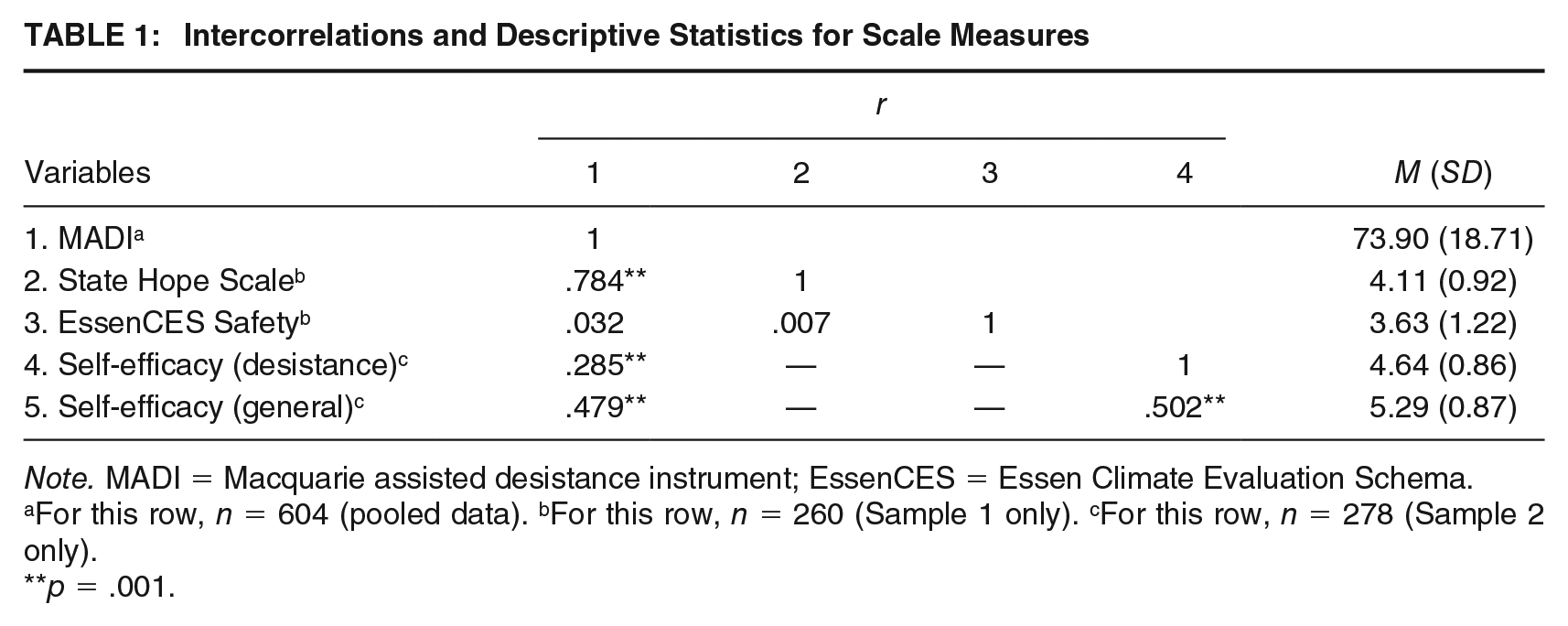
Note. MADI = Macquarie assisted desistance instrument; EssenCES = Essen Climate Evaluation Schema.
For this row, n = 604 (pooled data). bFor this row, n = 260 (Sample 1 only). cFor this row, n = 278 (Sample 2 only).
**p = .001.
Factor Structure of the MADI
Factor analysis was used to examine whether assisted desistance, as measured by our items, measured a single underlying construct, or whether other solutions (e.g., three factors, reflecting primary, secondary, and tertiary dimensions) might offer a better fit. Because resident perceptions are more central to our research, we used the resident samples to conduct the initial factor analyses (Sample 1) and to confirm the resulting structure (Sample 2). We then later tested for measurement invariance across staff and resident groups at both prisons (see Measurement Invariance section).
The KMO measure of sampling adequacy for residents in Sample 1 was 0.94; above the recommended value of 0.60, and Bartlett’s test of sphericity (homogeneity of variance) was significant (p < .001), indicating that significant correlations existed between most of the study variables (Tabachnick & Fidell, 2007). This allowed us to proceed with the factor analysis. We initially conducted an exploratory factor analysis (EFA) on the 20 items using principal axis factoring with oblimin (oblique) rotation to explore the data without imposing any particular structure on it. Analysis revealed one dominant factor explaining 54.56% of the variance, with potentially a second factor explaining 6.73% of the variance also indicated. The following criteria (Howard, 2016) were used to determine whether an item loaded on an underlying factor: (a) The item had to have a factor loading of 0.40 or better on one factor; (b) a loading of less than 0.30 on the second factor; and (c) the cross-loading differential across the two factors had to be greater than 0.20. Using these criteria, only the first factor was indicated, with all 20 items as strong indicators (loadings > 0.50).
We then used the one-factor model as a baseline model in a series of Confirmatory Factor Analyses (CFAs) that aimed to refine the scale. Results indicated the one-factor model using all 20 items adequately fit the data for the χ2/df and SRMR indices, but there was a poor fit for the RMSEA and CFI indices (see Table 2). Modification indices suggested that two items in particular were problematic in terms of producing a clear single-factor solution. Therefore, we removed these two items from the scale and conducted a second CFA modeling the remaining 18 items loading onto a single factor. Removal of the two items significantly (p < .01) improved model fit, though RMSEA and CFI indices were still not within suggested thresholds (see Table 2). However, factor loadings were all high (>0.50), and the 18 items produced a scale that showed an excellent internal consistency reliability index (α) of .935. Overall, these findings suggest that the 18-item modeled as a unifactorial structure appears satisfactory (though not perfect), based on initial exploratory analysis.
Model Fit Indices for Confirmatory Factor Analysis Models
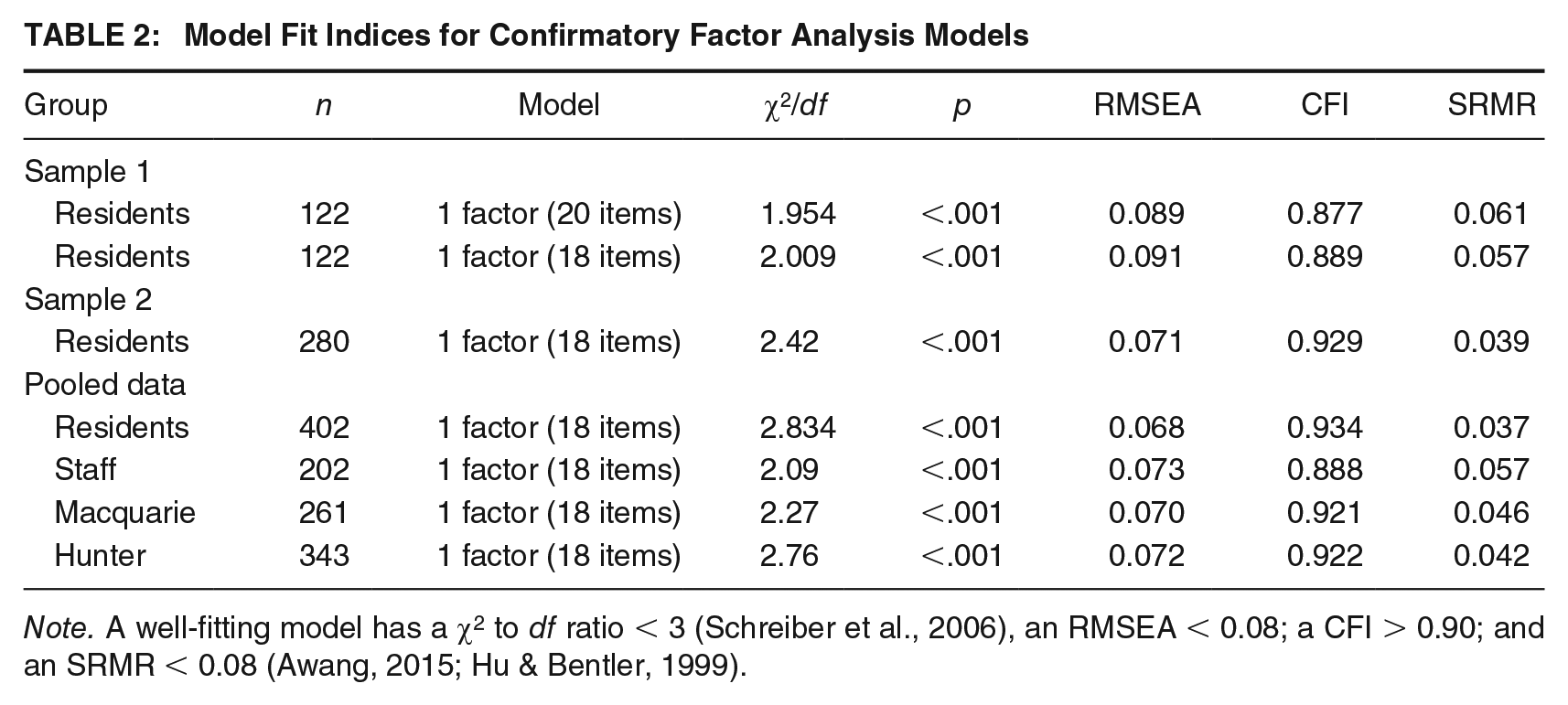
Note. A well-fitting model has a χ2 to df ratio < 3 (Schreiber et al., 2006), an RMSEA < 0.08; a CFI > 0.90; and an SRMR < 0.08 (Awang, 2015; Hu & Bentler, 1999).
We then validated this identified factor structure using Sample 2 resident data. The data met the criteria for sampling adequacy (KMO = 0.96) and homogeneity of variance (Bartlett’s test of sphericity p < .001). A CFA indicated that the single-factor model with 18 items fit the data well across all four fit indices (see Table 2; also, all loadings > 0.50). Internal consistency of the scale was again excellent (α = .960). The final 18 items in the MADI are displayed in Table 3.
Macquarie Assisted Desistance Inventory (MADI)
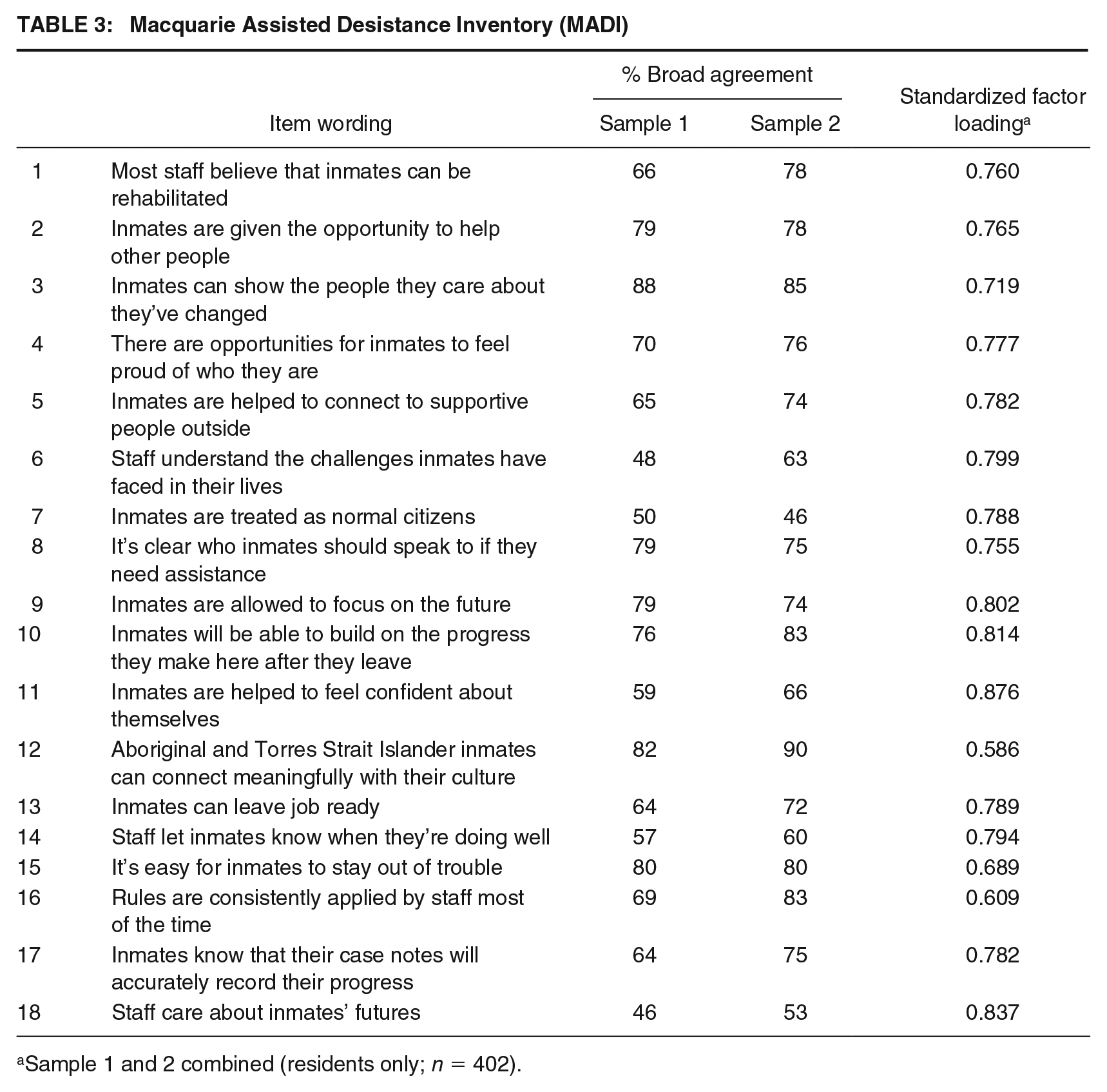
Sample 1 and 2 combined (residents only; n = 402).
Test–Retest Reliability
We assessed agreement between scores on the scale across the two time points (i.e., the degree of concordance or “match”) by estimating the intraclass correlation coefficient (ICC) using a single-measures, absolute-agreement, two-way mixed-effects model. Results indicated moderate agreement, ICC = .735, p < .001.
Convergent Validity
Assisted desistance correlated, as expected, with the State Hope Scale (see Table 1); however, no correlation was observed between assisted desistance scores and those on the Safety subscale of the EssenCES. In retrospect, the Safety subscale may not have been an ideal choice for convergent validity; assisted desistance requires more than just a safe environment—our items assess the range of supports provided by others that may facilitate a meaningful change toward prosocial behavior and identity. Lending further support to this idea, the hope and safety scales were uncorrelated.
Concurrent Validity
It was hypothesized that higher levels of assisted desistance would be associated with higher degrees of confidence about (specific) desistance and (general) self-efficacy. The two self-efficacy measures were moderately correlated (see Table 1), indicating they measured similar concepts (and providing some empirical support for the validity of the novel four-item measure). More critically, assisted desistance scores correlated with self-efficacy measures, even after controlling for demographics and prison history variables—a sign that the extent to which residents feel assisted to desist in prison positions them well for success beyond release.
Measurement Invariance
Pooling the data across both sites allowed us to test for measurement invariance (i.e., invariance of the factor structure) across the various population groups (residents vs. staff; Macquarie vs. Hunter). Measurement invariance is a statistical property of a scale that reflects the degree to which a construct has the same meaning across different populations or repeated measurements (Putnick & Bornstein, 2016). This is critical for generalization purposes and when aiming to compare mean scores across different groups.
Tests of measurement invariance require a series of analyses involving three sequential steps: configural invariance, metric invariance, and scalar invariance. Configural invariance means that the basic structure of the construct (e.g., 18 items loading on a single factor) is consistent across groups. Metric invariance assesses whether the factor loadings for each item are equivalent across groups (i.e., whether each item contributes to the underlying construct to a similar degree across groups). The third step, scalar invariance, assesses whether item intercepts are equivalent across groups (i.e., whether the expected value of each item is the same given the same factor value).
To establish configural variance, we compared model fit statistics for the one-factor model fitted to the data across four groups: all residents (n = 402), all staff (n = 202), all Macquarie (n = 261), and all Hunter participants (n = 343). Small sample sizes did not permit comparison of First Nations and non-First Nations participants. All four models were supported as indicated by excellent fit statistics relating to χ2/df, RMSEA, CFI, and SRMR (see Table 2). Only one statistic—the CFI in the staff model—was below the acceptable threshold. Overall, this demonstrates the fit of the configural invariance model to the data was excellent, allowing us to proceed with the next two steps.
Metric and scalar invariance is established by running models comparing each matching pair of groups (e.g., all residents vs. all staff) for invariance across items in the scale. We tested for metric and scalar invariance using the FIXED Alignment optimization method (Asparouhov & Muthén, 2014). Full metric invariance was supported for both models as factor loadings for all items were equivalent across both (a) resident and staff groups, and (b) Macquarie and Hunter groups. Partial scalar invariance (i.e., equivalent intercepts) was supported for both models, with invariance undetected for fewer than 25% of item intercepts (Muthén & Asparouhov, 2014).
Assisted Desistance Scores Across Groups
Table 4 presents total score statistics for the MADI across the two samples and participant groups (residents and staff). Skewness and kurtosis across and within the sites were generally within +1 and −1, indicating normal distributions. The exception was some deviation from normality in the Hunter staff sample, with results indicating the presence of more extreme values, and a slight bias toward the high end of the distribution.
Assisted Desistance Scale Scores
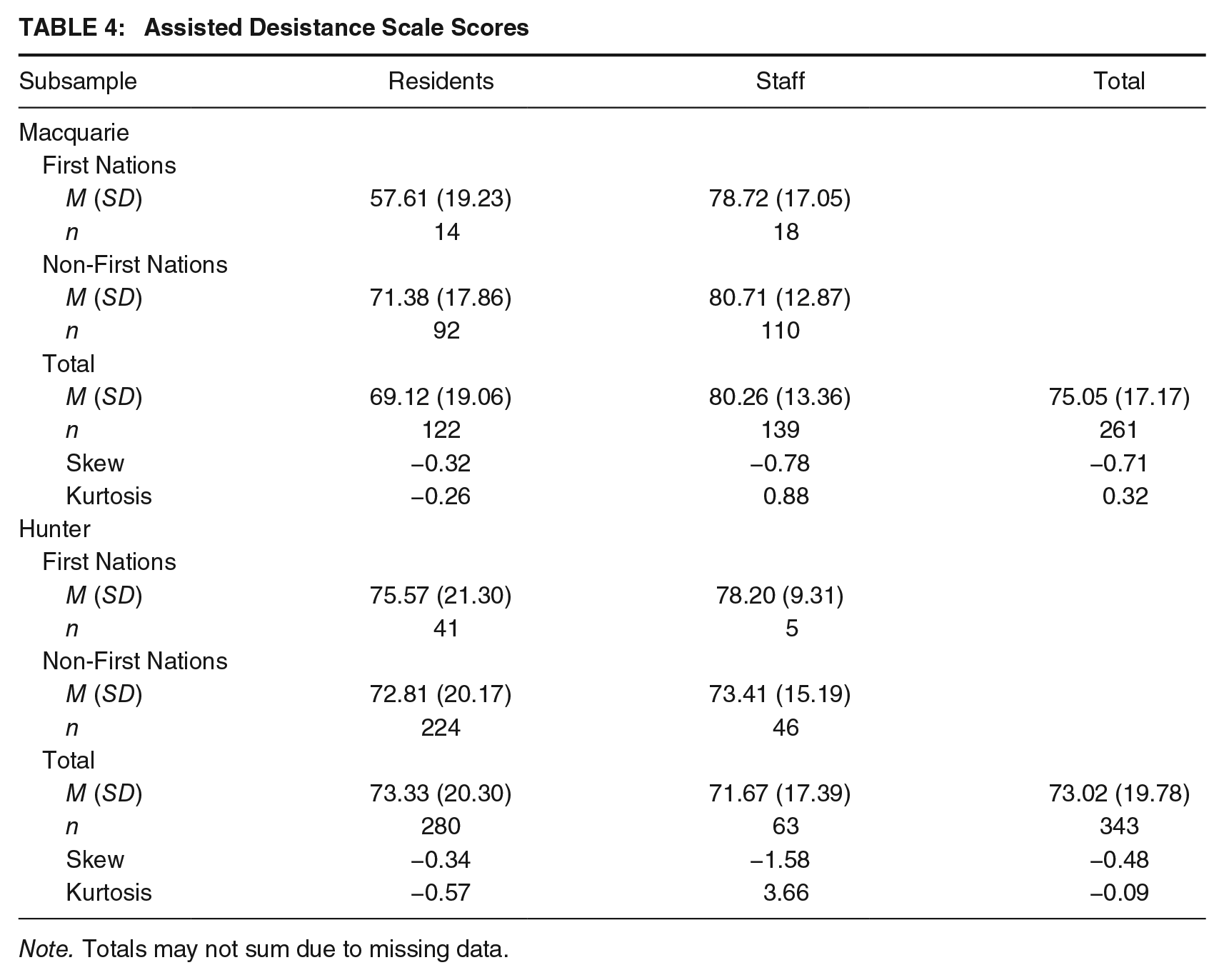
Note. Totals may not sum due to missing data.
Average assisted desistance scores were similar at Hunter (M = 73.02, SD = 19.78) and Macquarie (M = 75.05, SD = 17.17), t(591.64) = 1.35, p = .178, d = 0.11. Because the midpoint of the scale is 63, scores over 63 indicate general agreement that a prison is assisting desistance more than not. On this metric, both prisons were rated positively. Yet some interesting differences emerged when stratifying these data by subgroup. Results revealed there was more variability across groups within Macquarie relative to Hunter. First, at Macquarie, assisted desistance mean scores were higher for staff than for residents. This difference was statistically significant, t(213.09) = 5.40, p < .001, reflecting a medium effect size (d = 0.69). The item with the biggest disparity between staff and resident ratings was: “Staff let inmates know when they’re doing well” (d = 1.06). In contrast, staff and resident ratings did not significantly differ from one another at Hunter, U = 8465.00, p = .618, d = 0.05. Note that a Mann–Whitney U test was used for the Hunter staff versus resident comparison because staff data were not normally distributed (the d for this test was calculated following Lenhard & Lenhard, 2016). Hunter resident ratings were similar to the Macquarie resident ratings, t(400) = 1.95, p = .052, d = 0.21; as shown in Table 4, it was the staff at Macquarie who had particularly elevated scores compared to all other groups.
Data also indicated that at Macquarie, First Nations participants reported lower assisted desistance scale scores relative to those who did not identify as such. This difference was statistically significant for residents, t(104) = 2.66, p = .009, d = 0.76 (a medium to large effect size), but not for staff, t(126) = 0.58, p = .564, d = 0.15. At Hunter, there were no significant differences between First Nations and non-First Nations residents, t(263) = −0.80, p = .424, d = 0.14 (small sample sizes did not allow testing between staff groups). Overall, results indicated that there were some disparities in how different groups viewed the Macquarie environment.
Having only collected data from two prisons, it is not possible to provide an indication of what a “good” score might be on our measure. However, broad agreement (indicating agreement rather than disagreement) with items provides a rough sense of how helpful a prison is perceived to be on any given dimension. As seen in Table 3, the lowest-rated item across both sites was “Staff care about inmates’ futures.” The most strongly endorsed item at Macquarie was item 5, “Inmates can show the people they care about they’ve changed,” while at Hunter that item was second most strongly endorsed item; the most strongly endorsed item at Hunter was “Aboriginal and Torres Strait Islander inmates can connect meaningfully with their culture.” Stratifying this item by First Nations identification showed that First Nations participants agreed with this item almost as strongly (83%) as non-First Nations participants (92%).
Factors Predicting Assisted Desistance
We also tested whether any demographic variables were associated with assisted desistance scores. We used linear multiple regression to examine which of these factors predicted assisted desistance scores using the pooled data (the models included prison site as a predictor). Full results are presented in Table 5. For residents, none of the variables significantly predicted assisted desistance scores. For staff, age and prison site predicted assisted desistance scores. Those who were slightly older perceived less assisted desistance, perhaps suggesting a tendency to become desensitized or disillusioned with the ability of prison regimes to genuinely assist people over time. A significant finding for prison site—Macquarie having higher scores than Hunter—is consistent with earlier findings indicating that staff at Macquarie had particularly elevated assisted desistance scores.
Multiple Regression Models for Factors Predicting Assisted Desistance Scale Scores
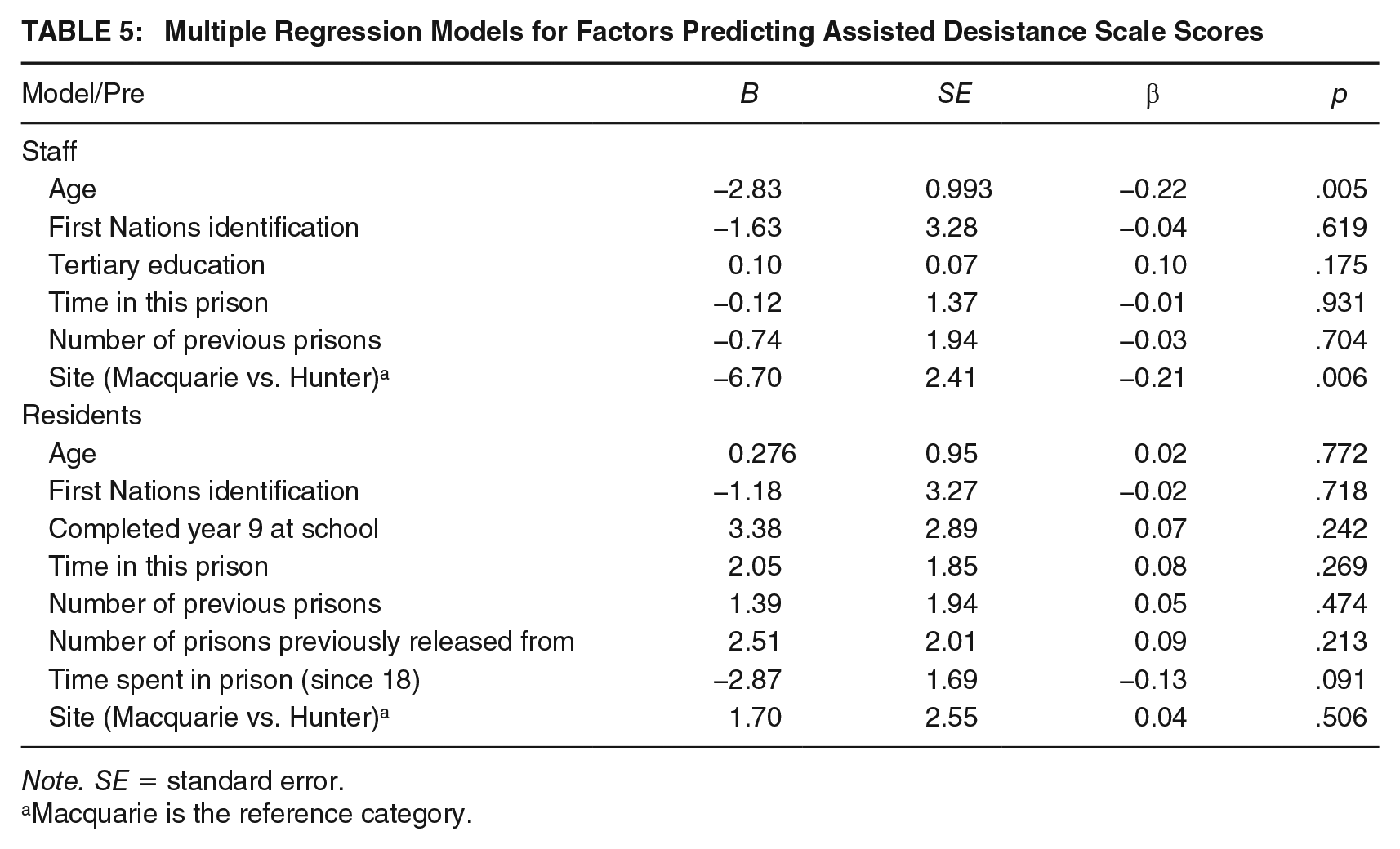
Note. SE = standard error.
Macquarie is the reference category.
Discussion
Theoretical and Practical Implications
In this research, we developed and completed an initial validation of a new measure to assess the construct of assisted desistance in the prison setting. Our work is premised on an understanding that rehabilitation is the primary goal of any progressive prison system and that the performance of any prison can be judged in terms of its capacity to engender meaningful and sustainable personal change. We also began this article by noting the typically criminogenic effects of imprisonment and the considerable challenges that all corrections professionals face when trying to provide rehabilitation in environments that often act to mitigate the impact of their efforts. In this way, our work responds to urgent calls for research identifying mechanisms through which different effects of incarceration are supposed to occur (Loeffler & Nagin, 2022). We developed a simple self-report tool for use by both staff and residents that can be used to measure the extent to which a prison is viewed as supporting or assisting desistance. While there is already a body of work that explores the social climate of penal institutions (e.g., Day et al., 2012) and the moral quality of prison life (e.g., Liebling et al., 2012), this previous research does not directly consider the process of desistance in prison. We argue that desistance theory has much to offer here—not only in helping us to understand the different ways that people come to lead law-abiding lifestyles but also how and why people change while in prison. We determined, for example, that those who felt their desistance journeys were being more strongly assisted expressed a greater sense of self-efficacy, providing preliminary support for the idea that igniting desistance in custody can lead to rehabilitative success.
The MADI displayed psychometric properties that allow us to have confidence in its further use. It was found to be generally coherent, internally consistent, and stable across time. Factor analyses offered support for a single-factor solution, rather than factors corresponding to the three levels of desistance. This may be because a particular intervention may impact more than a single level at once, or changes in one level might lead to changes in another level. For example, being treated by others as a worthy, respected member of society (tertiary desistance) can influence one’s self-view as such (secondary desistance). Disentangling the various factors may then be a difficult exercise to do empirically, while it is still possible to distinguish them conceptually. It is also important to remember that the three-factor model of desistance is one of the intraindividual processes (changes within the individual). Our instrument is not intended to measure these processes. In contrast, it assesses the degree to which participants perceive the prison environment to be engaging in practices that should contribute to those intraindividual processes. Though we expect the prison environment to facilitate change in residents’ thinking, there could be a discrepancy between the two; for this reason, one might not expect to find items in our measure to fall together across three factors. In any case, we believe thinking in terms of the three levels of desistance is helpful when considering what prisons can do to support people. They allow correctional agencies to consider a wide array of strategies that they can put into place to assist desistance, even if those strategies may, at least according to our data, influence desistance in multiple ways.
Results also indicated that perceptions of assisted desistance differed between groups, pointing to variability in the way that assistance may be provided to, or received by people in prison. Residents in one sample (Macquarie Correctional Centre) consistently scored lower than staff on perceived levels of assisted desistance. More simply, staff perceived themselves to be offering more assistance than was perhaps the case—at least from the point of view of the recipients of such support. Similarly, and of significant note, First Nations residents at Macquarie consistently perceived there to be lower levels of assisted desistance compared with non-First Nations residents.
Some variance in ratings of assisted desistance across different groups with fundamentally different experiences and roles is likely inevitable, and disparities between groups may be useful as a means to identify “blind spots” and improve service delivery. That is, despite management’s best efforts to assist people, they may not be providing the type of assistance that (some) residents feel they need. In turn, residents may not understand the rationale for initiatives being implemented to support them. In short, staff efforts may be misaligned or misunderstood. For example, there was a particularly large difference between staff and residents at Macquarie for the item, “Inmates can leave job ready.” After the present study was complete, researchers spoke to staff and residents at Macquarie about their divergent scores for this item. Discussions revealed that staff believed Macquarie was providing job readiness through its training programs. In contrast, while residents recognized that a qualification contributed to job readiness, it did not necessarily address softer barriers to employment such as confidence in self-presentation and potential employer stigma. Staff might not have recognized that a mere qualification does not guarantee these other aspects of job readiness. Ratings on our tool could thus be used to create a dialogue between staff and residents in prisons to identify possibilities for improvement, which could be recorded in a follow-up Assisted Desistance Action Plan (or ADAP).
An important feature of our work was the effort made to understand the meaning of desistance from the perspectives of both correctional staff and residents. We are indebted to all of those who gave their time freely to share their experiences and views on how, when, and why their prison could make a valuable contribution to the long-term goal of rehabilitation. In our view, the development of a tool to measure the experiences of assisted desistance from the perspectives of both correctional staff and residents represents a potentially critical step forward in efforts to improve the rehabilitative performance of prisons. It allowed us to develop a set of new questions/statements that not only have theoretical currency but also practical application, as is evident from some of our recommendations above. It provides the means to collect the type of evidence that prisons can use to better understand the extent to which any center is assisting residents to lead law-abiding lives. For instance, the MADI could serve as a useful evaluation measure for use before and after the introduction of a policy change or new initiative. This is a different type of evidence from that which is generally collected as part of reporting mechanisms by correctional systems as it speaks directly to how a prison is experienced by those who live and work in such places. The MADI thus offers a way to access some of the “truths” about prison rehabilitation in a way that can promote confidence regarding what can realistically be achieved and what more might be done. In turn, this should help counter the cynicism expressed by some staff and many residents about how genuine the correctional system is in wanting to assist people instead of punishing them.
Limitations and Future Directions
The survey development research is, however, only the starting point for continuing improvement in this area. One important step will be to identify to what extent and how various efforts to assist desistance in prison influence people’s lives post release. It was encouraging to observe that assisted desistance scores and self-efficacy scales were positively correlated. However, self-efficacy is only a proxy measure of rehabilitative success. Further research is needed to link assisted desistance scores with post-release outcomes. For example, we would hypothesize that the return to corrections rate of those who spend significant periods of time in facilities high in assisted desistance will be lower than that of people who serve their sentence in prisons that are rated less highly. Establishing the relative rehabilitative success of an individual prison is a complex task, requiring several potentially confounding variables to be controlled for (e.g., risk rating, time served in a particular prison, prison size; e.g., Galouzis, 2021). Despite such difficulties, research to establish the actual impact of a prison site relative to its expected performance is critical to the development of evidence-based practice.
In addition, by itself, the MADI cannot determine the complexities of such exposure for building actual desistance. That can only be done through longitudinal work that draws on the experiences of ex-residents at regular intervals in the community where “real” desistance happens (or not). Such work could provide critical information about how the various types of assisted desistance provided during one’s time in prison influence post-release successes. Of course, there will also likely be important individual differences in the way that particular people perceive and respond to efforts to assist desistance. Factors such as personality, life experiences, and the costs that incarceration imposes shape the effects of imprisonment (Mears et al., 2015)—despite the levels of assistance provided.
In addition, more work must be done to establish the generalizability of the MADI to other groups and contexts. Critically, our research did not include women. While desistance theory has drawn on both women’s and men’s experiences, there do appear to be some differences in the specific factors that influence desistance. In particular, women appear to benefit more from family factors, while men are influenced more by employment and peer factors (Rodermond et al., 2016). In this sense, there might be some key differences in the way men and women view the types of assistance they need. If true, women’s and men’s prisons may require slightly different foci for supporting desistance. Another critical next step would thus be to validate the MADI with a sample of women in prison. Yet, irrespective of any group differences, it is important to remember that desistance journeys are unique, such that an individualized approach to support would likely lead to greater successes (i.e., providing people with the right sorts of assistance on offer in any particular facility).
Finally, it is important to recognize that there are limits to the rehabilitative effects of even the most desistance-oriented prisons. Broader socio-political processes influence the contexts in and through which offending emerges and in which desistance is attempted. In other words, the re-entry process is likely to be challenging—more for some than others—in contexts where, for example, there are low levels of post-release support, where opportunities for legitimate pursuits are limited, or where ex-residents are routinely stigmatized and excluded. If changes made in prison are to be sustainable, more must be done to foster a rehabilitative ideal within institutions and communities more widely.
With these qualifications in mind, we are optimistic that a policy and practice focus on assisted desistance can help to improve the performance of prisons. This article presents a new tool to reliably measure this construct. This provides the empirical foundation for strengthening correctional practice and for understanding, in quite a nuanced fashion, the rehabilitative potential of particular prisons and areas for improvement within such institutions.
Supplemental Material
sj-docx-1-cjb-10.1177_00938548231193313 – Supplemental material for Assisted Desistance in Correctional Centers: From Theory to Practice
Supplemental material, sj-docx-1-cjb-10.1177_00938548231193313 for Assisted Desistance in Correctional Centers: From Theory to Practice by Melissa de Vel-Palumbo, Mark Halsey and Andrew Day in Criminal Justice and Behavior
Footnotes
AUTHORS’ NOTE:
This research was funded by Corrective Services NSW under the Premier’s Priorities initiative. The research reported in this article does not reflect the views of Corrective Services NSW. We sincerely thank those in prison and prison staff who freely gave their time to contribute to this project, as well as Corrective Services, who funded and facilitated this research. Thanks also to Milla Jane who provided research assistance.

Supplemental Material
Notes
References
Supplementary Material
Please find the following supplemental material available below.
For Open Access articles published under a Creative Commons License, all supplemental material carries the same license as the article it is associated with.
For non-Open Access articles published, all supplemental material carries a non-exclusive license, and permission requests for re-use of supplemental material or any part of supplemental material shall be sent directly to the copyright owner as specified in the copyright notice associated with the article.
